

- Industry Size (2026)
- USD 1.2 Bn
- Forecast (2036)
- USD 2.8 Bn
- CAGR (2026 to 2036)
- 8.7%
Organic Textile Cotton Seeds Market Forecast and Outlook 2026 to 2036
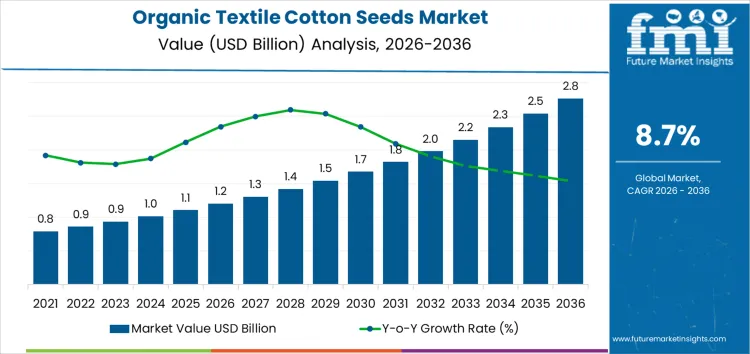
The organic textile cotton seeds market is valued at USD 1.2 billion in 2026 and is projected to reach USD 2.8 billion by 2036, reflecting a CAGR of 8.7%. Production is concentrated among a limited number of certified seed suppliers, creating dependency on high-quality genetics. Regional control of seed multiplication and processing affects availability for global cotton programs. Supply reliability is influenced by climate conditions, regulatory certification, and organic farming compliance. Smaller operators face challenges in scaling production without access to verified seed stock.
Performance is constrained by seasonal planting cycles, logistics of certified seed distribution, and compliance with organic standards. Adoption rates vary across regions depending on textile industry demand and regulatory alignment. Margin concentration favors suppliers that integrate seed certification, traceable production, and multi-region supply. Fragmentation persists in regional markets, while established players secure concentrated value through production control, distribution reliability, and alignment with organic cotton programs rather than volume alone.
Quick Stats of the Organic Textile Cotton Seeds Market
- Organic Textile Cotton Seeds Market Value (2026): USD 1.2 billion
- Organic Textile Cotton Seeds Forecast Value (2036): USD 2.8 billion
- Organic Textile Cotton Seeds Forecast CAGR 2026 to 2036: 8.7%
- Organic Textile Cotton Seeds Leading Type: Open-Pollinated Varieties
- Organic Textile Cotton Seeds Leading End Use: Textile Cotton Production
- Organic Textile Cotton Seeds Key Growth Regions: India, Brazil, China, USA, Australia
- Organic Textile Cotton Seeds Top Players: Bayer CropScience, UPL Limited, Advanta Seeds, Nuseed (Tamar Seeds), CRISPR/Cotton BioSeed Ventures
What is the Growth Forecast for Organic Textile Cotton Seeds Market through 2036?
Between 2026 and 2031, the organic textile cotton seeds market is projected to grow from USD 1.2 billion to USD 1.7 billion, generating an absolute increase of USD 0.5 billion. The market is in the early adoption phase, characterized by increasing awareness of organic farming practices, demand for certified organic cotton, and gradual expansion of cultivation acreage. Growth is largely volume-driven, accounting for roughly 70% of expansion, as farmers adopt seeds for experimental plots and small-scale production. Price growth contributes 30%, supported by premium pricing for certified organic seeds. Value capture favors suppliers providing high-germination, certified seeds and agronomic guidance.
From 2031 to 2036, the market is expected to expand from USD 1.7 billion to USD 2.8 billion, adding USD 0.9 billion. The market enters the early majority phase, with adoption accelerating due to increasing demand from organic textile manufacturers and retail chains. Volume continues as the primary driver, representing approximately 68% of growth, fueled by expanded cultivation and farmer familiarity. Price growth contributes 32%, supported by certified organic labeling, seed quality differentiation, and regulatory compliance. Competitive advantage favors suppliers offering consistent seed quality, certification support, and technical guidance for larger-scale organic cotton production.
Organic Textile Cotton Seeds Market Key Takeaways
| Metric | Value |
|---|---|
| Market Value (2026) | USD 1.2 billion |
| Forecast Value (2036) | USD 2.8 billion |
| Forecast CAGR 2026 to 2036 | 8.70% |
How Is the Organic Textile Cotton Seeds Market Evolving with Sustainable Farming Practices?
Organic textile cotton seeds are increasingly cultivated to support chemical-free cotton production, improve soil health, and meet the rising demand for sustainable fabrics. Previously, conventional seeds dominated production, requiring synthetic fertilizers and pesticides that affected environmental and ecosystem balance. Modern organic seeds are bred for resilience, natural pest resistance, and high-quality fiber suitable for organic textile standards. Farmers, seed suppliers, and textile brands prioritize seed germination, yield stability, and fiber uniformity. Initial adoption was concentrated among small-scale organic farms, while current demand spans large-scale certified organic operations responding to consumer awareness, regulatory frameworks, and global sustainability initiatives. Seed adaptability, disease resistance, and organic certification compliance guide selection and procurement strategies.
Increasing market focus on eco-friendly textiles, brand sustainability commitments, and regulatory support for organic agriculture are driving growth. Compared with conventional cotton seeds, organic varieties emphasize compatibility with natural pest control methods, climate resilience, and consistent fiber quality. Cost considerations include breeding, certification, and distribution, concentrating margins among suppliers capable of delivering reliable, high-performing seeds. Farmers adopt organic seeds to enhance soil fertility, reduce chemical dependence, and ensure compliance with organic textile standards. By 2036, organic textile cotton seeds are expected to underpin large-scale sustainable cotton cultivation, supporting environmentally responsible textile production and meeting the global rise in demand for organic fabrics.
What Factors Are Shaping the Demand for Organic Textile Cotton Seeds in Terms of Seed Type and End Use?
The demand for organic textile cotton seeds is segmented by seed type and end use. Seed types include open-pollinated varieties, heirloom varieties, hybrid organic seeds, and other categories. End uses cover textile cotton production, organic apparel manufacturing, home furnishing applications, and other sectors. Adoption is influenced by yield potential, fiber quality, and adaptability to organic cultivation practices. Uptake is driven by demand for certified organic textiles, sustainability objectives, and regulatory compliance. Seed type and end-use selection depend on regional climate, soil conditions, and production goals, ensuring high-quality fiber, operational efficiency, and alignment with organic agriculture standards.
Why Are Open-Pollinated Varieties Leading the Seed Type Segment in Organic Textile Cotton?
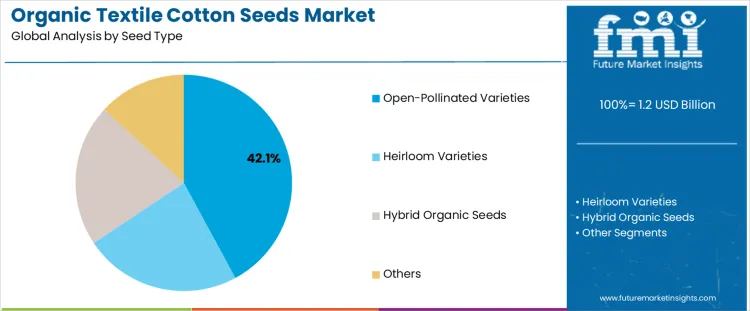
Open-pollinated varieties account for approximately 42% of total seed type demand, making them the leading category. These seeds provide consistent fiber quality, adaptability to diverse environmental conditions, and suitability for organic cultivation. Farmers adopt open-pollinated seeds to maintain genetic stability, optimize yield under low-input systems, and ensure reliable performance in different soil types. Adoption is reinforced by compliance with organic certification standards and compatibility with sustainable farming practices. Maintenance involves crop rotation, pest management, and soil fertility monitoring to preserve plant health and fiber quality. The segment leads because open-pollinated seeds deliver predictable yields and operational efficiency in organic cotton production.
Operational factors further shape adoption. Open-pollinated seeds perform well under minimal chemical inputs and support biodiversity in farming systems. They allow seed saving and replanting, reducing input costs. The segment leads because these varieties combine high-quality fiber production, environmental adaptability, and alignment with organic certification requirements, making them the preferred choice for textile cotton cultivation.
Why Is Textile Cotton Production Representing the Largest End-Use Segment in Organic Cotton Seeds?
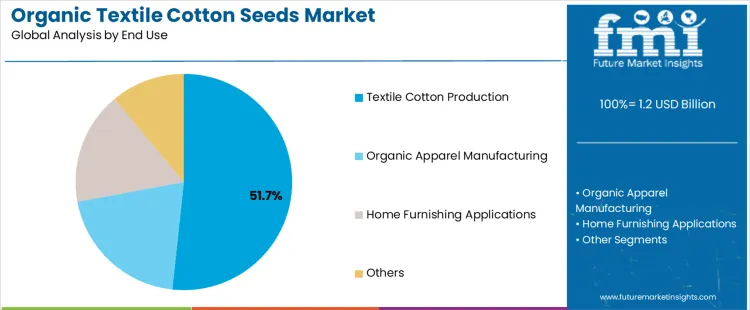
Textile cotton production accounts for approximately 51.7% of total end-use demand, making it the largest segment. Adoption is driven by the growing demand for certified organic textiles and sustainable fiber sourcing. Farmers cultivate organic cotton for yarn, fabric, and industrial textiles, prioritizing fiber length, strength, and uniformity. Production practices include organic soil management, pest control, and water-efficient irrigation. Compliance with organic certification standards ensures market access and premium pricing.
Operational and functional factors influence adoption. Cotton must meet quality benchmarks for spinning, weaving, and finishing processes while minimizing environmental impact. Seed selection, planting density, and harvesting techniques affect fiber yield and consistency. Textile cotton production leads because it represents the primary application for organic cotton seeds, providing measurable value through sustainable fiber supply, market compliance, and operational efficiency.
How Are Organic Textile Cotton Seeds Supporting Sustainable Agriculture?
Organic textile cotton seeds are increasingly adopted by cotton farmers to produce fiber without synthetic chemicals, supporting environmentally friendly farming practices. Adoption is strongest in regions with high cotton cultivation, organic certification programs, and consumer demand for sustainable textiles. Seeds are selected for germination rate, yield potential, and resistance to pests and environmental stress. Growth is driven by regulatory incentives, market demand for organic fibers, and premium pricing. Investment focuses on seed quality, certification, and agronomic support. Farmers prioritize seeds that ensure reliable yields, maintain soil health, and meet regional organic farming standards.
Why Are Regional Organic Farming Policies and Consumer Demand Driving Adoption?
Demand is influenced by local organic agriculture regulations, certification programs, and retail demand for organic textiles. Farmers adopt certified organic seeds to comply with environmental and trade standards and to access premium markets. Varieties with high fiber quality, adaptability to local soil, and pest resistance gain preference. Adoption is concentrated in regions with supportive organic policies and established cotton markets. Regulatory compliance and market access drive procurement rather than cost. Seed suppliers providing validated, high-quality, and certified organic varieties gain advantage among cotton growers and textile producers.
What Factors Limit Broader Deployment of Organic Textile Cotton Seeds?
High seed costs, lower yields compared with conventional varieties, and vulnerability to pests and climate variability restrict adoption. Certification requirements and technical support needs add complexity for smallholder farmers. Limited availability of locally adapted varieties can affect crop performance. Smaller farms or regions with less infrastructure may face challenges in sourcing and maintaining organic certification. These factors concentrate early adoption among larger farms, cooperatives, and regions with established organic cotton value chains.
How Are Breeding Innovations and Industry Collaboration Shaping Market Growth?
Developments include high-yield, pest-resistant, and climate-adapted organic cotton seed varieties. Collaboration between seed breeders, research institutions, and certification agencies ensures genetic quality, regulatory compliance, and agronomic guidance. Pilot trials validate germination, fiber quality, and adaptability under local conditions before large-scale planting. Quality monitoring and traceability support certification and market access. Focus is on yield reliability, fiber quality, and compliance rather than cost or volume. Partnerships enable broader adoption of organic textile cotton seeds while promoting sustainable agriculture and access to premium organic textile markets.
What is the Demand for Organic Textile Cotton Seeds by Country?
| Country | CAGR (%) |
|---|---|
| India | 9.4% |
| USA | 8.9% |
| China | 8.6% |
| Brazil | 7.8% |
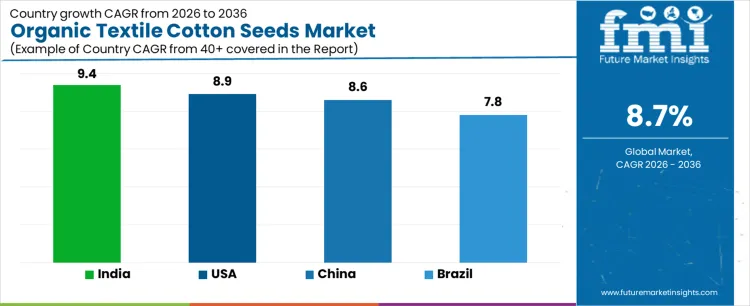
Demand for organic textile cotton seeds is rising as textile manufacturers and farmers focus on sustainable and chemical-free cotton cultivation to meet consumer and regulatory demand for organic fabrics. India leads with a 9.4% CAGR, driven by large cotton-growing regions, increasing adoption of organic farming practices, and rising domestic and export demand for organic cotton. The USA follows at 8.9%, supported by organic textile initiatives and certified cotton production programs. China records 8.6% growth, shaped by expansion in organic textile production and export opportunities. Brazil shows 7.8% CAGR, reflecting gradual adoption of organic farming practices and increasing demand for eco-friendly cotton.
How Is India Experiencing Growth in the Organic Textile Cotton Seeds Market?
India is experiencing growth at a CAGR of 9.4%, supported by adoption of organic cotton seeds in commercial textile farming to meet rising demand for sustainable fabrics and eco-friendly production practices. Farmers and seed suppliers are deploying seeds optimized for high yield, pest resistance, and suitability to diverse climatic conditions. Demand is concentrated in major cotton-growing states such as Maharashtra, Gujarat, and Telangana. Investments focus on seed quality, germination rates, and regulatory compliance rather than large-scale expansion. Growth reflects increasing consumer preference for organic textiles, government support for sustainable agriculture, and adoption of climate-resilient cotton farming practices.
- Organic cotton seeds drive adoption.
- Seeds are optimized for high yield and pest resistance.
- Major cotton-growing states concentrate demand.
- Seed quality and regulatory compliance guide investment.
How Is the United States Witnessing Adoption with Sustainable Agriculture Initiatives?
United States is witnessing growth at a CAGR of 8.9%, fueled by adoption of organic cotton seeds in commercial textile farming to reduce chemical inputs and enhance sustainable production. Farmers and suppliers are using seeds selected for climate adaptability, high germination, and pest resilience. Demand is concentrated in cotton-producing states such as Texas, Mississippi, and Arkansas. Investments prioritize seed quality, environmental compliance, and cultivation efficiency rather than acreage expansion. Growth reflects increasing market demand for organic textiles, sustainability certifications, and adoption of environmentally friendly farming practices in major textile-producing regions.
- Sustainable agriculture drives adoption.
- Seeds are optimized for climate adaptability and pest resilience.
- Cotton-producing states concentrate demand.
- Seed quality and cultivation efficiency guide investment.
How Is China Experiencing Growth with Organic Cotton Farming Programs?
China is experiencing growth at a CAGR of 8.6%, supported by adoption of organic cotton seeds in commercial farming to reduce pesticide use, improve soil health, and meet textile industry demand for sustainable fibers. Farmers and suppliers are deploying seeds optimized for high yield, disease resistance, and regional climate conditions. Demand is concentrated in provinces such as Xinjiang, Henan, and Shandong. Investments focus on seed performance, environmental compliance, and germination rates rather than large-scale area expansion. Growth reflects government initiatives for sustainable agriculture, increasing consumer preference for organic textiles, and adoption of modern cotton cultivation techniques.
- Organic cotton farming drives adoption.
- Seeds ensure high yield and disease resistance.
- Key provinces concentrate demand.
- Seed performance and environmental compliance guide investment.
How Is Brazil Experiencing Growth with Climate-Resilient Organic Cotton Seeds?
Brazil is experiencing growth at a CAGR of 7.8%, supported by adoption of organic cotton seeds to meet increasing domestic and international demand for sustainable textiles. Farmers and suppliers are implementing seeds optimized for climate resilience, high yield, and pest resistance. Demand is concentrated in cotton-producing states such as Mato Grosso, Bahia, and Goiás. Investments focus on seed performance, germination reliability, and adherence to organic certification standards rather than area expansion. Growth reflects rising interest in eco-friendly fabrics, adoption of sustainable cotton cultivation methods, and government support for environmentally conscious farming practices.
- Climate-resilient seeds drive adoption.
- Seeds ensure high yield and pest resistance.
- Cotton-producing states concentrate demand.
- Seed performance and organic certification guide investment.
Who Competes in the Organic Textile Cotton Seeds Market and What Differentiates Their Offerings?
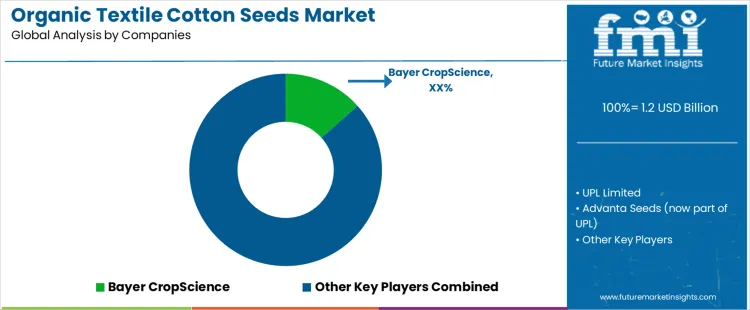
Competition in the organic textile cotton seeds market is shaped by breeding performance, environmental adaptability, and compatibility with certified organic practices. Bayer CropScience offers cotton seed varieties designed for pest tolerance, yield stability, and fibre quality that suit organic certification standards. UPL Limited supplies seeds optimized for regional soil and climate conditions, supported by agronomic advisory programs to help growers maintain productivity under organic protocols. Advanta Seeds (now part of UPL) leverages legacy germplasm integrated into broader UPL breeding initiatives to provide varieties resistant to local pests and environmental stresses while meeting organic compliance.
Nuseed (Tamar Seeds) delivers cotton seeds focused on fibre length, strength, and adaptability to varying moisture conditions. CRISPR/Cotton BioSeed Ventures develops gene edited varieties aimed at enhanced stress resistance and yield under organic systems within regulatory limits. Other market participants include regional seed suppliers and cooperatives producing cotton cultivars suited for local climates, pest pressures, and organic management practices. Competitive differences arise from germination consistency, pest resistance, fibre quality, environmental adaptability, and availability of agronomic support, with providers that combine performance traits and organic compliance able to strengthen grower adoption and maintain sustainable supply for textile production.
Key Players in the Organic Textile Cotton Seeds Market
- Bayer CropScience
- UPL Limited
- Advanta Seeds (now part of UPL)
- Nuseed (Tamar Seeds)
- CRISPR/Cotton BioSeed Ventures
- Others
Scope of the Report
| Items | Values |
|---|---|
| Quantitative Units (2026) | USD billion |
| Seed Type | Open-Pollinated Varieties, Heirloom Varieties, Hybrid Organic Seeds, Others |
| End Use | Textile Cotton Production, Organic Apparel Manufacturing, Home Furnishing Applications, Others |
| Region | Asia Pacific, Europe, North America, Latin America, Middle East & Africa |
| Key Countries Covered | China, Japan, South Korea, India, Australia & New Zealand, Germany, United Kingdom, France, Italy, Spain, Nordic, BENELUX, United States, Canada, Mexico, Brazil, Chile, Kingdom of Saudi Arabia, Other GCC Countries, Turkey, South Africa, Other African Union |
| Key Companies Profiled | Bayer CropScience, UPL Limited, Advanta Seeds (now part of UPL), Nuseed (Tamar Seeds), CRISPR/Cotton BioSeed Ventures, Others |
| Additional Attributes | Dollar sales by seed type and end use; regional CAGR, volume and value growth projections; adoption in organic cotton production, apparel, and home furnishing applications; compliance with organic certification standards; seed quality, germination, and agronomic support |
Organic Textile Cotton Seeds Market Segmentation
Seed Type:
- Open-Pollinated Varieties
- Heirloom Varieties
- Hybrid Organic Seeds
- Others
End Use:
- Textile Cotton Production
- Organic Apparel Manufacturing
- Home Furnishing Applications
- Others
Region:
- Asia Pacific
- China
- Japan
- South Korea
- India
- Australia & New Zealand
- ASEAN
- Rest of Asia Pacific
- Europe
- Germany
- United Kingdom
- France
- Italy
- Spain
- Nordic
- BENELUX
- Rest of Europe
- North America
- United States
- Canada
- Mexico
- Latin America
- Brazil
- Chile
- Rest of Latin America
- Middle East & Africa
- Kingdom of Saudi Arabia
- Other GCC Countries
- Turkey
- South Africa
- Other African Union
- Rest of Middle East & Africa
Bibliography
- Food and Agriculture Organization (FAO). (2024). Global Outlook for Organic Agriculture: Cotton Seed Production and Sustainable Supply Chains. FAO Publications.
- International Federation of Organic Agriculture Movements (IFOAM). (2023). Organic Cotton Systems: Standards, Certification, and Seed Sovereignty. IFOAM Reports.
- United Nations Conference on Trade and Development (UNCTAD). (2023). Sustainable Cotton Value Chains: Trade, Certification, and Climate Adaptation. UNCTAD Publications.
- Textile Exchange. (2023). Organic Cotton Market Report 2023: Production, Certification, and Supply Chain Integrity. Textile Exchange.
- International Cotton Advisory Committee (ICAC). (2024). Organic and Low-Input Cotton Production: Seed Breeding and Regional Programmes. ICAC Technical Reports.
- Organisation for Economic Co-operation and Development (OECD). (2023). Seed Schemes and Varietal Certification for Organic Cotton in Developing Economies. OECD Publishing.
Frequently Asked Questions
How big is the organic textile cotton seeds market in 2026?
The global organic textile cotton seeds market is estimated to be valued at USD 1.2 billion in 2026.
What will be the size of organic textile cotton seeds market in 2036?
The market size for the organic textile cotton seeds market is projected to reach USD 2.8 billion by 2036.
How much will be the organic textile cotton seeds market growth between 2026 and 2036?
The organic textile cotton seeds market is expected to grow at a 8.7% CAGR between 2026 and 2036.
What are the key product types in the organic textile cotton seeds market?
The key product types in organic textile cotton seeds market are open-pollinated varieties, heirloom varieties, hybrid organic seeds and others.
Which end use segment to contribute significant share in the organic textile cotton seeds market in 2026?
In terms of end use, textile cotton production segment to command 51.7% share in the organic textile cotton seeds market in 2026.
Preview the report firsthand - request a free sample
Get SampleGet the brochure for pricing and purchase details.
Get PDFTable of Content
- Executive Summary
- Global Market Outlook
- Demand-side Trends
- Supply-side Trends
- Technology Roadmap Analysis
- Analysis and Recommendations
- Market Overview
- Market Coverage / Taxonomy
- Market Definition / Scope / Limitations
- Market Background
- Market Dynamics
- Drivers
- Restraints
- Opportunity
- Trends
- Scenario Forecast
- Demand in Optimistic Scenario
- Demand in Likely Scenario
- Demand in Conservative Scenario
- Opportunity Map Analysis
- Product Life Cycle Analysis
- Supply Chain Analysis
- Investment Feasibility Matrix
- Value Chain Analysis
- PESTLE and Porter’s Analysis
- Regulatory Landscape
- Regional Parent Market Outlook
- Production and Consumption Statistics
- Import and Export Statistics
- Market Dynamics
- Global Market Analysis 2021 to 2025 and Forecast, 2026 to 2036
- Historical Market Size Value (USD Million) Analysis, 2021 to 2025
- Current and Future Market Size Value (USD Million) Projections, 2026 to 2036
- Y-o-Y Growth Trend Analysis
- Absolute $ Opportunity Analysis
- Global Market Pricing Analysis 2021 to 2025 and Forecast 2026 to 2036
- Global Market Analysis 2021 to 2025 and Forecast 2026 to 2036, By Seed Type
- Introduction / Key Findings
- Historical Market Size Value (USD Million) Analysis By Seed Type , 2021 to 2025
- Current and Future Market Size Value (USD Million) Analysis and Forecast By Seed Type , 2026 to 2036
- Open-Pollinated Varieties
- Heirloom Varieties
- Hybrid Organic Seeds
- Others
- Open-Pollinated Varieties
- Y-o-Y Growth Trend Analysis By Seed Type , 2021 to 2025
- Absolute $ Opportunity Analysis By Seed Type , 2026 to 2036
- Global Market Analysis 2021 to 2025 and Forecast 2026 to 2036, By End Use
- Introduction / Key Findings
- Historical Market Size Value (USD Million) Analysis By End Use, 2021 to 2025
- Current and Future Market Size Value (USD Million) Analysis and Forecast By End Use, 2026 to 2036
- Textile Cotton Production
- Organic Apparel Manufacturing
- Home Furnishing Applications
- Others
- Textile Cotton Production
- Y-o-Y Growth Trend Analysis By End Use, 2021 to 2025
- Absolute $ Opportunity Analysis By End Use, 2026 to 2036
- Global Market Analysis 2021 to 2025 and Forecast 2026 to 2036, By Region
- Introduction
- Historical Market Size Value (USD Million) Analysis By Region, 2021 to 2025
- Current Market Size Value (USD Million) Analysis and Forecast By Region, 2026 to 2036
- North America
- Latin America
- Western Europe
- Eastern Europe
- East Asia
- South Asia and Pacific
- Middle East & Africa
- Market Attractiveness Analysis By Region
- North America Market Analysis 2021 to 2025 and Forecast 2026 to 2036, By Country
- Historical Market Size Value (USD Million) Trend Analysis By Market Taxonomy, 2021 to 2025
- Market Size Value (USD Million) Forecast By Market Taxonomy, 2026 to 2036
- By Country
- USA
- Canada
- Mexico
- By Seed Type
- By End Use
- By Country
- Market Attractiveness Analysis
- By Country
- By Seed Type
- By End Use
- Key Takeaways
- Latin America Market Analysis 2021 to 2025 and Forecast 2026 to 2036, By Country
- Historical Market Size Value (USD Million) Trend Analysis By Market Taxonomy, 2021 to 2025
- Market Size Value (USD Million) Forecast By Market Taxonomy, 2026 to 2036
- By Country
- Brazil
- Chile
- Rest of Latin America
- By Seed Type
- By End Use
- By Country
- Market Attractiveness Analysis
- By Country
- By Seed Type
- By End Use
- Key Takeaways
- Western Europe Market Analysis 2021 to 2025 and Forecast 2026 to 2036, By Country
- Historical Market Size Value (USD Million) Trend Analysis By Market Taxonomy, 2021 to 2025
- Market Size Value (USD Million) Forecast By Market Taxonomy, 2026 to 2036
- By Country
- Germany
- UK
- Italy
- Spain
- France
- Nordic
- BENELUX
- Rest of Western Europe
- By Seed Type
- By End Use
- By Country
- Market Attractiveness Analysis
- By Country
- By Seed Type
- By End Use
- Key Takeaways
- Eastern Europe Market Analysis 2021 to 2025 and Forecast 2026 to 2036, By Country
- Historical Market Size Value (USD Million) Trend Analysis By Market Taxonomy, 2021 to 2025
- Market Size Value (USD Million) Forecast By Market Taxonomy, 2026 to 2036
- By Country
- Russia
- Poland
- Hungary
- Balkan & Baltic
- Rest of Eastern Europe
- By Seed Type
- By End Use
- By Country
- Market Attractiveness Analysis
- By Country
- By Seed Type
- By End Use
- Key Takeaways
- East Asia Market Analysis 2021 to 2025 and Forecast 2026 to 2036, By Country
- Historical Market Size Value (USD Million) Trend Analysis By Market Taxonomy, 2021 to 2025
- Market Size Value (USD Million) Forecast By Market Taxonomy, 2026 to 2036
- By Country
- China
- Japan
- South Korea
- By Seed Type
- By End Use
- By Country
- Market Attractiveness Analysis
- By Country
- By Seed Type
- By End Use
- Key Takeaways
- South Asia and Pacific Market Analysis 2021 to 2025 and Forecast 2026 to 2036, By Country
- Historical Market Size Value (USD Million) Trend Analysis By Market Taxonomy, 2021 to 2025
- Market Size Value (USD Million) Forecast By Market Taxonomy, 2026 to 2036
- By Country
- India
- ASEAN
- Australia & New Zealand
- Rest of South Asia and Pacific
- By Seed Type
- By End Use
- By Country
- Market Attractiveness Analysis
- By Country
- By Seed Type
- By End Use
- Key Takeaways
- Middle East & Africa Market Analysis 2021 to 2025 and Forecast 2026 to 2036, By Country
- Historical Market Size Value (USD Million) Trend Analysis By Market Taxonomy, 2021 to 2025
- Market Size Value (USD Million) Forecast By Market Taxonomy, 2026 to 2036
- By Country
- Kingdom of Saudi Arabia
- Other GCC Countries
- Turkiye
- South Africa
- Other African Union
- Rest of Middle East & Africa
- By Seed Type
- By End Use
- By Country
- Market Attractiveness Analysis
- By Country
- By Seed Type
- By End Use
- Key Takeaways
- Key Countries Market Analysis
- USA
- Pricing Analysis
- Market Share Analysis, 2025
- By Seed Type
- By End Use
- Canada
- Pricing Analysis
- Market Share Analysis, 2025
- By Seed Type
- By End Use
- Mexico
- Pricing Analysis
- Market Share Analysis, 2025
- By Seed Type
- By End Use
- Brazil
- Pricing Analysis
- Market Share Analysis, 2025
- By Seed Type
- By End Use
- Chile
- Pricing Analysis
- Market Share Analysis, 2025
- By Seed Type
- By End Use
- Germany
- Pricing Analysis
- Market Share Analysis, 2025
- By Seed Type
- By End Use
- UK
- Pricing Analysis
- Market Share Analysis, 2025
- By Seed Type
- By End Use
- Italy
- Pricing Analysis
- Market Share Analysis, 2025
- By Seed Type
- By End Use
- Spain
- Pricing Analysis
- Market Share Analysis, 2025
- By Seed Type
- By End Use
- France
- Pricing Analysis
- Market Share Analysis, 2025
- By Seed Type
- By End Use
- India
- Pricing Analysis
- Market Share Analysis, 2025
- By Seed Type
- By End Use
- ASEAN
- Pricing Analysis
- Market Share Analysis, 2025
- By Seed Type
- By End Use
- Australia & New Zealand
- Pricing Analysis
- Market Share Analysis, 2025
- By Seed Type
- By End Use
- China
- Pricing Analysis
- Market Share Analysis, 2025
- By Seed Type
- By End Use
- Japan
- Pricing Analysis
- Market Share Analysis, 2025
- By Seed Type
- By End Use
- South Korea
- Pricing Analysis
- Market Share Analysis, 2025
- By Seed Type
- By End Use
- Russia
- Pricing Analysis
- Market Share Analysis, 2025
- By Seed Type
- By End Use
- Poland
- Pricing Analysis
- Market Share Analysis, 2025
- By Seed Type
- By End Use
- Hungary
- Pricing Analysis
- Market Share Analysis, 2025
- By Seed Type
- By End Use
- Kingdom of Saudi Arabia
- Pricing Analysis
- Market Share Analysis, 2025
- By Seed Type
- By End Use
- Turkiye
- Pricing Analysis
- Market Share Analysis, 2025
- By Seed Type
- By End Use
- South Africa
- Pricing Analysis
- Market Share Analysis, 2025
- By Seed Type
- By End Use
- USA
- Market Structure Analysis
- Competition Dashboard
- Competition Benchmarking
- Market Share Analysis of Top Players
- By Regional
- By Seed Type
- By End Use
- Competition Analysis
- Competition Deep Dive
- Bayer CropScience
- Overview
- Product Portfolio
- Profitability by Market Segments (Product/Age /Sales Channel/Region)
- Sales Footprint
- Strategy Overview
- Marketing Strategy
- Product Strategy
- Channel Strategy
- UPL Limited
- Advanta Seeds (now part of UPL)
- Nuseed (Tamar Seeds)
- CRISPR/Cotton BioSeed Ventures
- Others
- Bayer CropScience
- Competition Deep Dive
- Assumptions & Acronyms Used
- Research Methodology


