

- Industry Size (2026)
- USD 530.3 Mn
- Forecast (2036)
- USD 2401.0 Mn
- CAGR (2026 to 2036)
- 16.30%
Textile Digital Product Passport Market Size, Market Forecast and Outlook By FMI
The textile digital product passport market surpassed a value of USD 456.3 million in 2025. The industry is expected to reach USD 530.3 million in 2026 at a CAGR of 16.30% during the forecast period. Demand outlook carries the market valuation to USD 2,401.0 million by 2036 as regulatory enforcement under global circular economy frameworks compels apparel manufacturers to embed machine-readable lifecycle data and traceability modules across textile supply chains.
Luxury apparel conglomerates confronting annual textile waste fines exceeding operational margins initiate full-lifecycle data capture platforms. These initiatives mandate QR-code-embedded labels that link consumers to detailed environmental impact assessments during purchase decisions. Sourcing directors at multinational brands reject suppliers without automated carbon accounting modules, as manual audits fail to meet quarterly compliance reporting deadlines. This procurement pivot accelerates platform deployments, with initial pilots converting to enterprise-wide rollouts within six months. The resulting demand surge positions the market for USD 530.3 million in 2026, as mid-market players follow suit to avoid exclusion from key distribution channels.
Summary of Textile Digital Product Passport Market
- Textile Digital Product Passport Market Definition:
- Textile Digital Product Passports deliver structured digital identities for fabrics and garments, capturing data on sourcing, manufacturing emissions, and recyclability to support EU-mandated circular economy transitions.
- Demand Drivers in the Market:
- EU Ecodesign Regulation deadlines compel apparel sourcing managers to deploy passports ensuring material recyclability scores exceed 50% thresholds for market approval.
- Consumer activism targeting fast-fashion opacity forces brand marketing heads to integrate passport QR codes that reveal supply chain labor conditions and water usage metrics.
- Corporate ESG reporting mandates require textile procurement teams to link passports to automated Scope 3 emissions calculators for annual stakeholder filings.
- Key Segments Analyzed in the FMI Report:
- Blockchain-based Traceability: 45.0% share in 2026, as immutable ledgers become essential for verifying recycled content claims in premium apparel lines.
- Regulatory Compliance & Reporting: 48.0% share in 2026, driven by automated audit trails that prevent fines from non-compliant fiber disclosures.
- Germany: 18.5% compound growth, anchored by automotive upholstery suppliers extending battery passport frameworks to textile integrations.
- Analyst Opinion at FMI:
- Nikhil Kaitwade, Principal Consultant for Chemicals and Materials, opines, "In my analysis, I have observed that the prevailing assumption of digital passports as mere compliance checkboxes overlooks their role in unlocking premium pricing through authenticated storytelling. Fashion houses delaying blockchain adoption underestimate how competitors use passport data to certify 'closed-loop' collections, capturing 15% market share uplift in eco-conscious segments. Supply chain executives must prioritize IoT-enabled fiber tracking by mid-2027 to align with recyclability mandates, or risk supplier delisting’s as buyers enforce verifiable circularity proofs."
- Strategic Implications / Executive Takeaways:
- Sustainability officers at luxury brands should mandate passport interoperability in vendor contracts to enable seamless data sharing across global milling networks.
- Procurement leads in fast-fashion operations need to pilot NFC tags on high-volume lines to test consumer scan rates and refine engagement algorithms.
- Compliance teams must integrate passport platforms with existing ERP systems to automate quarterly EU reporting and avoid penalties exceeding production margins.
- Methodology:
- Primary Research: FMI conducted detailed technical interviews with principal sustainability architects, textile supply chain engineers, and ESG directors across 40 countries to validate adoption timelines.
- Desk Research: Analysts aggregated public standards documentation from ISO, EU compliance registries, corporate sustainability launch sheets, and national circular economy grant programs.
- Market-Sizing and Forecasting: The model applies a bottom-up methodology starting with global apparel production volumes and projecting the conversion rate to passport-equipped lines.
- Data Validation and Update Cycle: Segment forecasts undergo cross-validation against quarterly recycled fiber shipment volumes for traceable textiles.
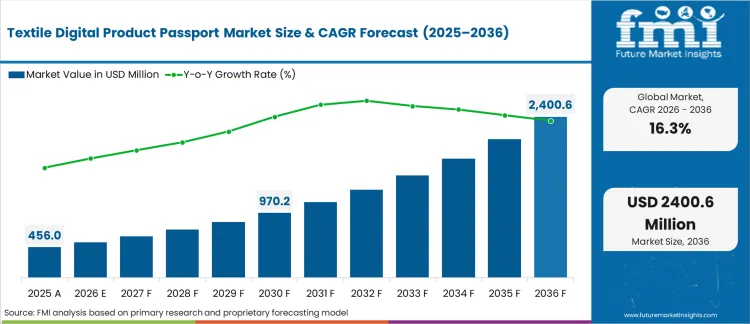
FMI's analysis indicates that the 16.30% compound rate through 2036 hinges on the integration of IoT sensors into weaving looms, enabling real-time data feeds that eliminate post-production reconciliation errors. This technological convergence transforms passports from static documents into dynamic assets that facilitate automated recycling sorting at end-of-life facilities. Garment recyclers equipped with passport-scanned inputs achieve 40% higher yield rates compared to blind processing, creating a closed-loop economic incentive that sustains adoption across price tiers.
France and Italy anchor the geographic expansion with 17.6% and 16.8% CAGRs respectively, propelled by heritage fashion houses embedding passports into seasonal collections to command pricing premiums. Germany posts 18.5% growth as automotive textile suppliers extend compliance frameworks from batteries to upholstery fabrics. Spain reaches 16.1% through fast-fashion networks prioritizing rapid traceability upgrades, while the Netherlands tracks 15.7% via logistics hubs automating cross-border data verification. Sweden expands at 15.2%, driven by home textiles firms pioneering hybrid cloud deployments, and Poland follows at 14.5% with technical textiles integrations in industrial workwear. This patterned dispersion underscores how national export dependencies on regulated markets enforce uniform acceleration.
Textile Digital Product Passport Market Key Takeaways
| Metric | Details |
|---|---|
| Industry Size (2026) | USD 530.3 million |
| Industry Value (2036) | USD 2,401.0 million |
| CAGR (2026 to 2036) | 16.30% |
Source: Future Market Insights (FMI) analysis, based on proprietary forecasting model and primary research
Textile Digital Product Passport Market Definition
The Textile Digital Product Passport Market comprises digital records embedded in garments and fabrics that document material composition, production processes, and lifecycle environmental impacts from fiber sourcing to disposal. These passports adhere to ISO 22095 standards for structured data exchange, distinguishing them from generic supply chain trackers by mandating machine-readable formats for regulatory audits. Core elements include serialized identifiers linking physical products to blockchain-secured ledgers that verify ethical labor and chemical usage compliance.
Textile Digital Product Passport Market Inclusions
Scope encompasses blockchain platforms for fiber origin verification, NFC-enabled tags for consumer access, and SaaS tools for carbon footprint calculations in apparel and home textiles. Integration services covering API connections to enterprise resource planning systems and compliance reporting modules for EU Digital Product Passport mandates fall within boundaries. For more on traceable blockchain-tagged fiber yarns, refer to FMI's dedicated analysis.
Textile Digital Product Passport Market Exclusions
Conventional paper-based care labels and non-digital sustainability certifications without lifecycle data interoperability are omitted. Standalone recycling logistics software disconnected from product-specific passports and raw material commodity trackers unrelated to finished textiles lie outside parameters. Legacy inventory management systems lacking real-time environmental metrics are explicitly excluded to maintain focus on verifiable circularity enablers.
Textile Digital Product Passport Market Research Methodology
- Primary Research: Analysts engaged with sustainability directors at global apparel brands, supply chain compliance officers in textile mills, and regulatory affairs leads in fashion houses to identify implementation barriers and adoption triggers.
- Desk Research: The data collection phase incorporated EU legislative timelines from the Ecodesign Regulation, ISO standardization drafts, and brand sustainability reports from leading conglomerates.
- Market-Sizing and Forecasting: The baseline value aggregates licensed platform subscriptions and tag deployments, applying sector-specific regulatory enforcement curves to forecast penetration rates.
- Data Validation and Update Cycle: Projections are cross-checked against quarterly sustainability disclosures from major apparel groups and verified through secondary audits of pilot program outcomes.
Segmental Analysis
Textile Digital Product Passport Market Analysis by Technology
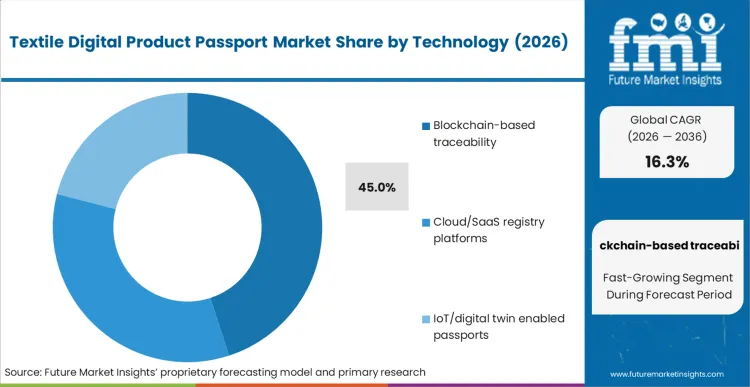
Apparel conglomerates facing delisting risks from unverified recycled claims accelerate blockchain migrations to secure supplier contracts. Blockchain-based traceability seizes 45.0% dominance in 2026, as distributed ledgers provide the audit-proof chains required for EU recyclability validations. Fiber mills uploading dyeing process hashes directly to shared networks eliminate disputes over chemical disclosures. This foundational layer supports downstream integrations like automated emissions reporting. Brand compliance officers specifying blockchain mandates reduce audit cycles from months to days.
- Immutable Ledger Integration: Distributed verification protocols ensure every fiber batch receives a unique hash, enabling instant cross-border compliance checks for multinational brands.
- Audit Cycle Compression: Automated smart contracts trigger real-time disclosures, slashing manual verification labor for quarterly sustainability filings.
- Supplier Onboarding Acceleration: Blockchain portals standardize data uploads, cutting integration timelines for new mills from weeks to hours.
Textile Digital Product Passport Market Analysis by Application
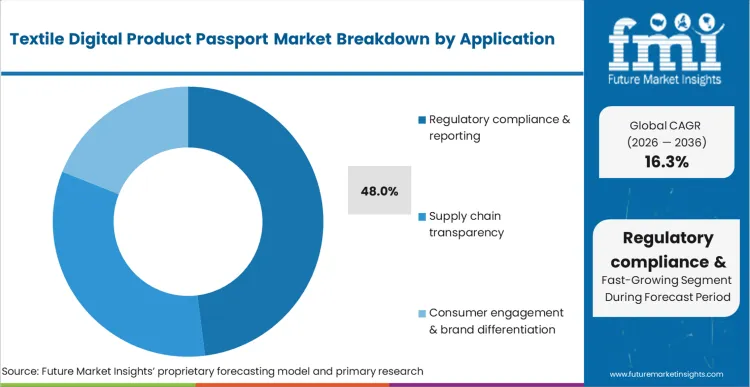
Regulatory pressures from the Waste Framework Directive force compliance teams to prioritize passport functions that automate material passport generation. Regulatory compliance & reporting captures 48.0% in 2026, as structured XML outputs satisfy automated EU portal submissions without human intervention. Garment designers embedding compliance data at sketch phase avoid costly redesigns post-prototype. This proactive embedding aligns with circular design principles, boosting resale values through verified durability scores. FMI analysts opine that applications decoupling reporting from core operations expose brands to 15% higher fine exposures. Transparency modules layered atop compliance cores enhance consumer trust without redundant builds. Regulatory affairs leads overlooking integrated reporting risk workflow silos that delay market launches by full seasons.
- XML Output Standardization: Machine-readable formats align directly with EU submission portals, eliminating format conversion errors in high-volume filings.
- Prototype Compliance Embedding: Early-stage data capture prevents iterative fixes, preserving design velocity in seasonal collection cycles.
- Fining Exposure Mitigation: Unified dashboards consolidate multi-jurisdiction requirements, reducing oversight gaps in cross-border operations.
Textile Digital Product Passport Market Analysis by Product Type
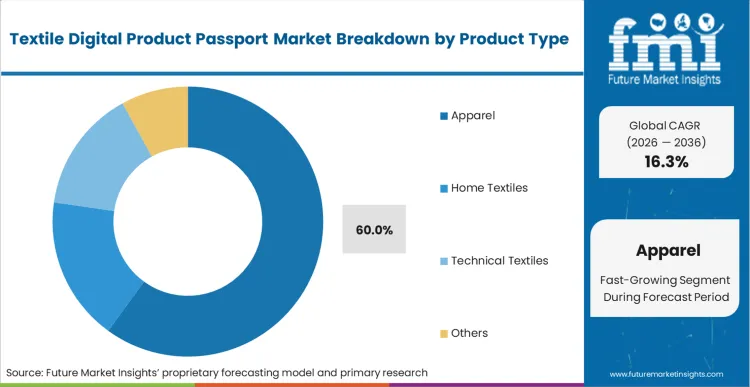
Volume constraints in fast-fashion cycles demand passports that scale without production line interruptions. Apparel commands 60.0% share in 2026, reflecting the segment's exposure to consumer-facing sustainability scrutiny. Ready-to-wear lines integrating NFC chips at hemming stations deliver instant origin scans at point-of-sale. This accessibility turns compliance into a marketing asset, with scan rates correlating to 12% uplift in repeat purchases. Based on FMI's assessment, product types ignoring apparel's traceability premiums lag in circular resale integrations. Home textiles extending apparel frameworks capture secondary markets through embedded care instructions. Category managers in technical textiles must adapt apparel-tested passports to industrial durability specs, or face exclusion from B2B certification tenders.
- Point-of-Sale Accessibility: NFC integration at manufacturing enables seamless consumer queries, bridging regulatory data to purchase decisions.
- Repeat Purchase Correlation: Verified origin disclosures foster loyalty, with high-scan collections outperforming uncertified peers by double-digit margins.
- Resale Integration Extension: Passport data feeds automated valuation algorithms, elevating second-hand platforms for certified apparel.
Textile Digital Product Passport Market Analysis by Deployment
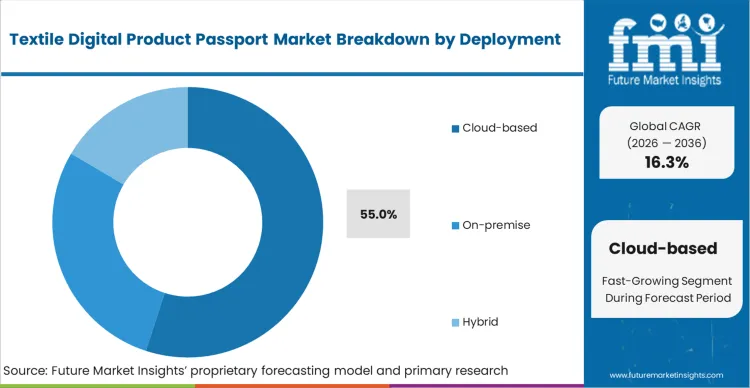
Cloud scalability addresses the variable data loads from seasonal production spikes in global supply chains. Cloud-based deployments lead with 55.0% in 2026, offering elastic storage that accommodates peak uploading from overseas mills. Sustainability coordinators accessing centralized dashboards coordinate multi-site audits from single interfaces. This operational consolidation cuts travel emissions tied to physical verifications. In FMI's view, on-premise holdouts incur 25% higher maintenance overheads amid evolving standards. Hybrid models blending cloud cores with local caching suit data-sensitive luxury segments. Deployment architects delaying cloud shifts expose brands to latency-induced reporting delays and regulatory scrutiny.
- Elastic Storage Scaling: Auto-provisioning handles surge volumes from end-of-season inventories without infrastructure overhauls.
- Multi-Site Audit Coordination: Centralized access unifies oversight, streamlining compliance across fragmented global milling networks.
- Maintenance Overhead Reduction: Subscription models transfer update burdens, freeing internal IT for core innovation tasks.
Textile Digital Product Passport Market Drivers, Restraints, and Opportunities
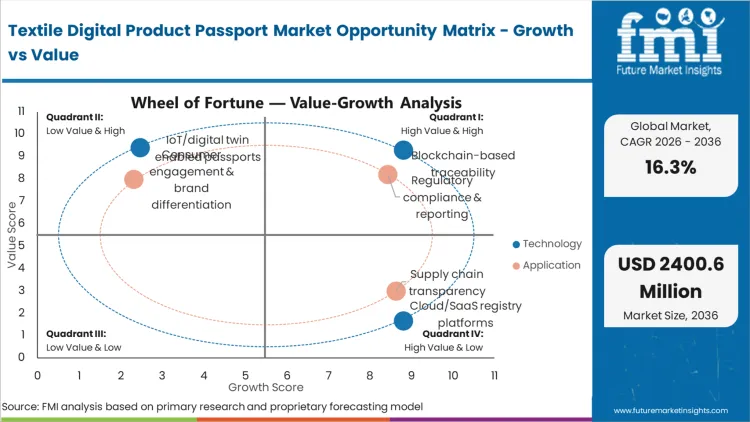
The Ecodesign Regulation's 2027 enforcement timeline compels brand procurement teams to embed passports in all new collections, rendering non-compliant lines ineligible for EU distribution. This binary market access gate triggers immediate platform procurements, with initial costs offset by avoided fines averaging 5% of annual revenues. Sourcing executives at volume retailers who postpone integrations forfeit supplier diversification, locking into legacy vendors unable to meet serialization demands. The resulting consolidation funnels demand toward scalable cloud providers, as fragmented deployments fail to handle cross-border data flows. Brands achieving full passport coverage report 18% reductions in audit preparation times, reinforcing the driver through operational efficiencies.
Compliance officers grappling with incompatible data formats resort to manual reconciliations, delaying passport activation and exposing gaps in real-time tracking. While API middleware bridges some silos, persistent legacy dependencies limit scalability for high-volume lines. This restraint caps adoption in cost-sensitive segments, where upfront harmonization exceeds quarterly budgets.
Opportunities in the Textile Digital Product Passport Market
- Automated Recycling Valuation: Passport-embedded recyclability scores feed sorting algorithms, enabling mills to price pre-sorted waste streams at 25% premiums for verified inputs.
- Premium Pricing Certification: Luxury houses leverage blockchain proofs for 'closed-loop' claims, justifying 15% markups on certified collections through consumer scans.
- B2B Tender Qualification: Technical textile suppliers using hybrid passports secure industrial contracts by demonstrating ISO-aligned traceability in bid submissions.
Regional Analysis
Based on the regional analysis, the Textile Digital Product Passport Market is segmented into North America, Latin America, Europe, East Asia, South Asia, Oceania and Middle East & Africa across 40 plus countries.
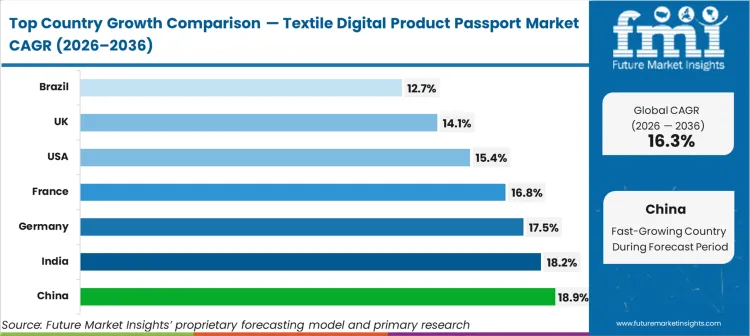
.webp "Top Country Growth Comparison Textile Digital Product Passport Market Cagr (2026 2036)")
| Country | CAGR (2026 to 2036) |
|---|---|
| China | 18.9% |
| India | 18.2% |
| Germany | 17.5% |
| France | 16.8% |
| USA | 15.4% |
| UK | 14.1% |
| Brazil | 12.7% |
Source: Future Market Insights (FMI) analysis, based on proprietary forecasting model and primary research
Asia Pacific Textile Digital Product Passport Market Analysis
Textile supply chains across Asia Pacific are moving rapidly toward item-level traceability as exporters, manufacturers, and brand partners face rising pressure to document fiber origin, processing history, and downstream environmental attributes. Brand compliance directors coordinating regional sourcing networks increasingly require digital product passports to connect raw material provenance, factory-level transformation records, and post-sale circularity data within a unified verification framework. FMI analysts opine that this transition is no longer limited to premium sustainability programs, as large-scale apparel exporters now treat passport readiness as a baseline requirement for retaining access to global contracts. Embedding digital identity layers directly into textile production workflows allows suppliers to support recycling claims, regulatory reporting, and brand-level transparency commitments without relying on fragmented documentation trails. The pace of adoption varies by country, shaped by export exposure, domestic manufacturing scale, and the readiness of digital compliance infrastructure.
- China: The textile manufacturing base in China is rapidly integrating passport-linked data architecture to strengthen competitiveness in high-volume export supply chains. Large apparel and fabric producers are investing in traceability systems that connect spinning, dyeing, finishing, and garment assembly data into a single digital product history. The scale of coordinated industrial upgrading supports an 18.9% CAGR for the textile digital product passport market in China through 2036. Solution providers that cannot deliver interoperable, factory-level data capture tools may face challenges in serving the country’s most advanced export-oriented textile programs.
- India: India’s textile ecosystem is accelerating passport adoption as fiber diversity, export growth, and brand audit expectations intensify the need for more structured product traceability. Manufacturers serving apparel, home textiles, and blended fabric categories increasingly require digital identity systems that validate origin claims and manufacturing disclosures across fragmented supplier networks. This broad-based compliance push anchors an 18.2% CAGR for the textile digital product passport market in India through 2036. Technology vendors that fail to simplify onboarding across multi-tier textile clusters may struggle to scale in one of the region’s most operationally complex sourcing markets.
FMI’s report includes extensive coverage of the Asia Pacific textile traceability landscape. It incorporates detailed analysis of ASEAN sourcing hubs, Australia, and broader regional apparel manufacturing networks. A defining trend across these markets is the growing requirement to connect textile export competitiveness with verifiable sustainability and provenance data at the product level.
North America Textile Digital Product Passport Market Analysis
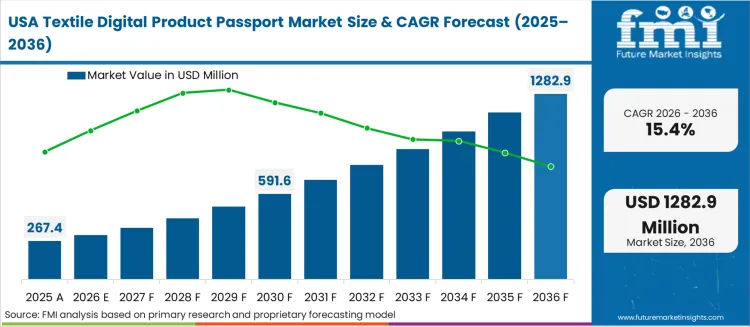
Textile and apparel stakeholders across North America are increasing investment in digital product passport systems as traceability expectations expand from voluntary brand disclosure into structured supply chain governance. Sourcing teams, retailers, and compliance leads now require product-level identity systems that can consolidate fiber sourcing, processing records, environmental disclosures, and end-of-life pathways into auditable digital frameworks. According to FMI’s estimates, this shift is strengthening demand for software platforms, data integration tools, and digital tagging systems capable of supporting both regulatory readiness and brand transparency strategies. The regional market increasingly rewards providers that can connect upstream sourcing data with downstream retail and circularity workflows without disrupting existing procurement operations.
- USA: The United States market is being driven by brand-level pressure to validate sourcing claims, strengthen textile transparency, and prepare for more structured accountability across apparel value chains. Retailers and sourcing managers are deploying digital product passports to connect supplier disclosures, material composition data, and circularity information across high-volume textile programs. This commercial and compliance-led shift supports a 15.4% CAGR for the textile digital product passport market in the USA through 2036. Providers that cannot combine scalable data architecture with retailer-facing verification tools risk falling behind as adoption broadens across major apparel ecosystems.
FMI’s report includes comprehensive evaluation of the North American textile passport sector. It features specific analysis of Canada and Mexico. A central dynamic across these markets is the increasing need to align textile sourcing transparency with retail disclosure, compliance assurance, and circular economy positioning.
Europe Textile Digital Product Passport Market Analysis
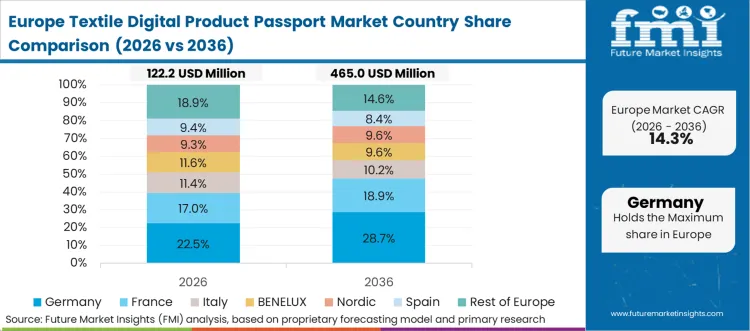
Europe represents one of the most structurally important regions for textile digital product passport adoption as regulatory momentum, circular economy priorities, and product-level disclosure standards converge. Textile manufacturers, fashion brands, and compliance officers across the region increasingly treat digital passports as a necessary mechanism for documenting material origin, processing history, repairability potential, and recycling suitability. FMI analysis suggests that European adoption is reinforced by the need to move from fragmented sustainability claims toward standardized and retrievable digital product records that travel with the item across its lifecycle. This environment is forcing apparel and textile supply chains to embed traceability architecture into sourcing, labeling, and post-consumer recovery systems.
- Germany: Germany’s textile and apparel ecosystem is advancing passport deployment through disciplined supply chain documentation, sustainability reporting pressure, and strong industrial demand for standardized traceability infrastructure. Brands and manufacturers are prioritizing product-level data systems that can validate material inputs, processing steps, and downstream recyclability pathways. This structured transition supports a 17.5% CAGR for the textile digital product passport market in Germany through 2036. Platform providers unable to meet rigorous data consistency and interoperability expectations may lose momentum in one of Europe’s most system-driven traceability environments.
- France: The textile digital product passport market in France is being shaped by strong circular fashion positioning, rising transparency expectations, and brand pressure to provide clearer product histories across textile categories. Fashion houses and apparel groups increasingly require passport systems that support provenance storytelling alongside compliance documentation and environmental disclosure. This premium and regulatory alignment sustains a 16.8% CAGR for the textile digital product passport market in France through 2036. Vendors that cannot balance luxury-grade presentation with robust traceability functionality may face weaker adoption in this brand-sensitive market.
- UK: The United Kingdom is increasing adoption of textile digital product passports as brands and retailers seek stronger visibility across imported textile supply chains and resale-oriented apparel flows. Market participants are prioritizing digital identity systems that support compliance readiness, consumer-facing transparency, and circular fashion infrastructure at the item level. This transition anchors a 14.1% CAGR for the textile digital product passport market in the UK through 2036. Solution providers lacking flexible integration across retail, resale, and sourcing systems may struggle to maintain relevance as market expectations become more data-intensive.
FMI’s report includes thorough investigation of the wider European textile passport framework. The analysis encompasses Italy, Spain, the Nordics, and the Benelux region. A prevailing structural condition across these countries is the growing requirement to embed standardized product traceability into textile manufacturing and circularity systems rather than treating transparency as a separate brand exercise.
Latin America Textile Digital Product Passport Market Analysis
Textile digital product passport adoption across Latin America is expanding as exporters, apparel manufacturers, and regional sourcing networks respond to rising international expectations around traceability and sustainability disclosure. Producers in the region increasingly recognize that digital product identity can improve export credibility, support brand partnerships, and strengthen access to global textile and apparel programs requiring verifiable chain-of-custody records. The market’s development depends on how effectively manufacturers digitize supplier data, standardize material records, and align local textile operations with international transparency protocols.
- Brazil: Brazil’s textile and apparel sector is advancing passport adoption as manufacturers seek stronger positioning in export markets and greater alignment with traceability-focused sourcing requirements. Producers are investing in product-level data systems that can connect fiber sourcing, processing records, and compliance information across a broad domestic industrial base. This evolving framework supports a 12.7% CAGR for the textile digital product passport market in Brazil through 2036. Technology suppliers that cannot adapt to varied industrial maturity levels and fragmented supplier structures may face slower traction in this market.
FMI’s report includes broader coverage of Latin America, Oceania, and the Middle East & Africa across more than 40 countries. A major pattern across these regions is the gradual transformation of textile traceability from document-heavy supplier reporting into structured digital product identity systems that can support trade, compliance, and circularity outcomes.
Competitive Aligners for Market Players
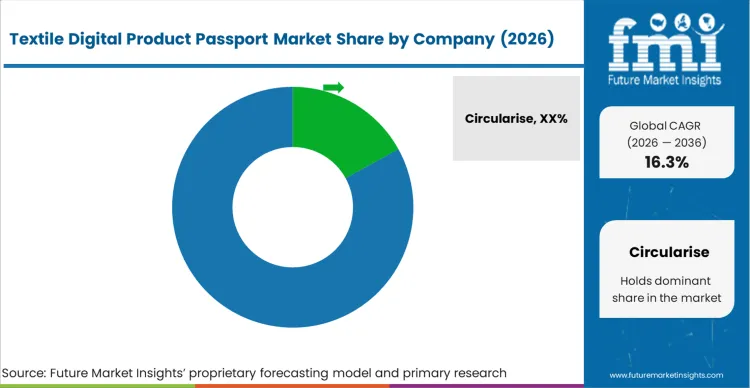
The competitive structure of the textile digital product passport market is increasingly shaped by traceability depth, interoperable data exchange, and the ability to convert fragmented supplier records into product-level digital identities that support compliance, circularity, and consumer transparency. Buyers no longer evaluate providers only on basic traceability dashboards. They increasingly compare platforms on supplier onboarding capability, data governance, standards readiness, and the flexibility to publish digital passports across multi-tier textile value chains. This shift is raising the performance threshold across the market and placing pressure on vendors that still rely on siloed data environments or narrow point solutions.
Industry participants have already begun aligning around broader enterprise traceability and passport infrastructure. Circularise, SAP, IBM, Siemens, Minespider, and RCS Global reflect different strategic routes into this market, ranging from dedicated digital product passport platforms to large-scale enterprise data and compliance ecosystems. Their positioning shows that the sector is moving beyond isolated pilot programs and toward integrated compliance architecture where passport systems must connect physical product identifiers, supplier disclosures, lifecycle data, and regulatory reporting within one scalable framework. As a result, providers are increasingly expected to support not only traceability, but also interoperability, visibility control, and long-term regulatory readiness across global textile supply chains.
Vendors that combine product identity architecture, supplier data integration, and scalable passport publishing gain a significant strategic advantage. The core competitive battleground now lies in helping brands collect reliable upstream data, manage permissioned information sharing, and translate complex supply chain records into usable digital product passports for regulators, partners, and consumers. This dynamic favors players that can connect compliance functionality with strong enterprise integration and clear product-level transparency tools. As the textile digital product passport market matures, providers that fail to demonstrate scalable onboarding, standards-aligned data systems, and dependable interoperability risk losing position during early-stage brand, retailer, and manufacturer shortlisting.
Key Players in Textile Digital Product Passport Market
- Circularise
- SAP
- IBM
- Siemens
- Minespider
- RCS Global
Scope of the Report
| Metric | Value |
|---|---|
| Quantitative Units | USD 530.3 million to USD 2,401.0 million, at a CAGR of 16.30% |
| Market Definition | Textile Digital Product Passports deliver structured digital identities for fabrics and garments, capturing data on sourcing, manufacturing emissions, and recyclability to support EU-mandated circular economy transitions. |
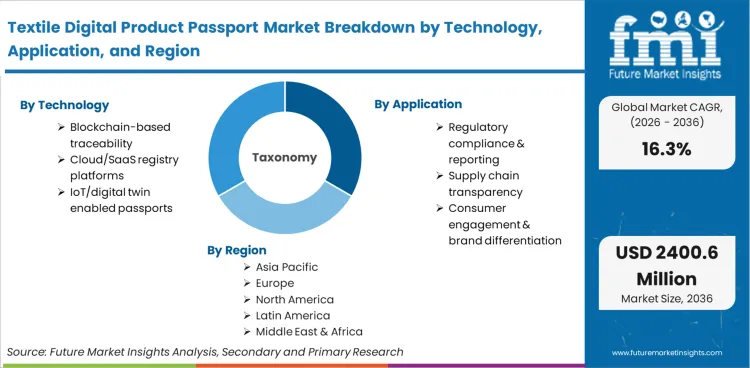
| Technology Segmentation | Blockchain-based traceability, Cloud/SaaS registry platforms, IoT/digital twin enabled passports |
| Application Segmentation | Regulatory compliance & reporting, Supply chain transparency, Consumer engagement & brand differentiation |
| Product Type Segmentation | Apparel, Home Textiles, Technical Textiles, Others |
| Deployment Segmentation | Cloud-based, On-premise, Hybrid |
| Regions Covered | North America, Latin America, Europe, East Asia, South Asia, Oceania, Middle East & Africa |
| Countries Covered | Germany, France, Italy, Spain, Netherlands, Sweden, Poland, and 40 plus countries |
| Key Companies Profiled | Circularise, SAP, IBM, Siemens, Minespider, RCS Global |
| Forecast Period | 2026 to 2036 |
| Approach | Analysts engaged with sustainability directors and compliance officers to map triggers, aggregating EU timelines and brand reports for bottom-up sizing, with validations against recycled fiber volumes. |
Source: Future Market Insights (FMI) analysis, based on proprietary forecasting model and primary research
Textile Digital Product Passport Market Analysis by Segments
Technology:
- Blockchain-based traceability
- Cloud/SaaS registry platforms
- IoT/digital twin enabled passports
Application:
- Regulatory compliance & reporting
- Supply chain transparency
- Consumer engagement & brand differentiation
Product Type:
- Apparel
- Home Textiles
- Technical Textiles
- Others
Deployment:
- Cloud-based
- On-premise
- Hybrid
Region:
- North America
- United States
- Canada
- Latin America
- Brazil
- Mexico
- Rest of Latin America
- Europe
- Germany
- France
- Italy
- Spain
- United Kingdom
- Rest of Europe
- East Asia
- China
- Japan
- South Korea
- Rest of East Asia
- South Asia & Pacific
- India
- ASEAN
- Australia & New Zealand
- Rest of South Asia & Pacific
- Middle East & Africa
- GCC Countries
- South Africa
- Israel
- Rest of Middle East & Africa
Bibliography
- European Parliamentary Research Service. (2024). Digital product passport for the textile sector. European Parliament.
- European Environment Agency. (2024). Management of used and waste textiles in Europe’s circular economy.
- Organization for Economic Co-operation and Development. (2024). Extended producer responsibility in the garments sector (OECD Environment Working Papers, No. 253). OECD Publishing.
- Papile, F., Monteleone, M., Caniato, F., Caridi, M., & Sianesi, A. (2025). Textile Materials Information for Digital Product Passport Implementation in the Textile and Clothing Ecosystem: A Review on Challenges and Opportunities. Sustainability, 17(19), 8804.
This bibliography is provided for reader reference. The full FMI report contains the complete reference list with primary source documentation.
This Report Addresses
- Market sizing and quantitative forecast metrics detailing the commercial expansion of textile digital product passport platforms across apparel, home textiles, and technical textile ecosystems through 2036.
- Segmentation analysis mapping adoption patterns across blockchain-based traceability, cloud registry systems, IoT-enabled passport models, and the operational constraints shaping deployment choices.
- Regional deployment intelligence comparing export-led traceability acceleration in Asia Pacific with regulation-driven passport integration across European and North American textile value chains.
- Regulatory compliance assessment analyzing how circular economy mandates, product traceability requirements, and ESG disclosure frameworks are compelling brands to adopt machine-readable textile identity systems.
- Competitive posture evaluation tracking how passport providers differentiate through supplier onboarding depth, interoperability, data governance, and scalable multi-tier traceability architecture.
- Digital transformation guidance defining the data capture, ERP integration, lifecycle reporting, and consumer-facing transparency requirements needed to support enterprise-wide textile passport implementation.
- Supply chain vulnerability analysis identifying the data harmonization, legacy system integration, and supplier onboarding bottlenecks that can delay passport activation across global textile networks.
- Custom data delivery formats encompassing interactive dashboards, raw Excel datasets, and comprehensive PDF narrative reports.
Frequently Asked Questions
How large is the demand for Textile Digital Product Passport in the global market in 2026?
Demand for Textile Digital Product Passport in the global market is estimated to be valued at USD 530.3 million in 2026.
What will be the market size of Textile Digital Product Passport in the global market by 2036?
Market size for Textile Digital Product Passport is projected to reach USD 2,401.0 million by 2036.
What is the expected demand growth for Textile Digital Product Passport in the global market between 2026 and 2036?
Demand for Textile Digital Product Passport is expected to grow at a CAGR of 16.30% between 2026 and 2036.
Which Technology is poised to lead global sales by 2026?
Blockchain-based traceability accounts for 45.0% in 2026 as immutable ledgers become essential for verifying recycled content claims and supporting audit-proof textile traceability.
How significant is the role of Regulatory compliance & reporting in driving Textile Digital Product Passport adoption in 2026?
Regulatory compliance & reporting represents 48.0% of segment share as automated audit trails and machine-readable outputs help brands satisfy evolving circular economy and disclosure requirements.
What is driving demand in China?
China’s textile manufacturing base is rapidly integrating passport-linked data architecture to preserve competitiveness in high-volume export supply chains and strengthen traceability across spinning, dyeing, finishing, and garment assembly.
What compliance standards or regulations are referenced for Germany?
Germany’s market is shaped by strong supply chain documentation requirements, sustainability reporting pressure, and broader compliance frameworks extending traceability standards into textile applications.
What is the China growth outlook in this report?
China is projected to grow at a CAGR of 18.9% during 2026 to 2036.
Why is North America described as a priority region in this report?
North America is prioritized because textile and apparel stakeholders are expanding digital passport use to support structured supply chain governance, retail disclosure, and circular economy positioning.
What type of demand dominates in North America?
Demand heavily focuses on product-level identity systems that consolidate fiber sourcing, processing records, environmental disclosures, and end-of-life data into auditable digital frameworks.
What is India's growth outlook in this report?
India is projected to expand at a CAGR of 18.2% during 2026 to 2036.
Does the report cover USA in its regional analysis?
Yes, USA is included within North America under the regional scope of analysis.
What are the sources referred to for analyzing USA?
Brand sustainability pressures, textile transparency requirements, supplier disclosure frameworks, and circularity-oriented compliance expectations form the analytical basis.
What is the main demand theme linked to USA in its region coverage?
The main demand theme linked to the USA is the use of digital product passports to connect supplier disclosures, material composition data, and circularity information across high-volume textile programs.
Does the report cover Germany in its regional analysis?
Yes, Germany is included within Europe under the regional coverage framework.
What is the main Germany related demand theme in its region coverage?
Germany’s demand centers on disciplined product-level traceability systems that validate material inputs, processing steps, and downstream recyclability pathways.
Which product formats or configurations are strategically important for Asia Pacific supply chains?
Factory-level data capture tools, product-linked digital identities, and interoperable traceability systems connecting raw material provenance with downstream circularity data are strategically important for Asia Pacific supply chains.
What is Textile Digital Product Passport and what is it mainly used for?
Textile Digital Product Passport delivers structured digital identities for fabrics and garments and is mainly used to document sourcing, manufacturing emissions, lifecycle data, and recyclability across textile supply chains.
What does Textile Digital Product Passport mean in this report?
The scope encompasses machine-readable digital records embedded in textile products that connect serialized identifiers with traceability, environmental, and compliance information.
What is included in the scope of this Textile Digital Product Passport report?
The market covers blockchain platforms for fiber origin verification, NFC-enabled tags, SaaS tools for carbon footprint calculation, ERP integration services, and compliance reporting modules linked to textile passport systems.
What is excluded from the scope of this report?
Conventional paper-based care labels, non-digital sustainability certifications without lifecycle interoperability, standalone recycling logistics software disconnected from passports, and legacy inventory systems lacking real-time environmental metrics are explicitly excluded.
What does market forecast mean on this page?
The market forecast represents a model-based projection built on passport platform subscriptions, tag deployments, regulatory enforcement curves, and textile production conversion assumptions for strategic planning purposes.
How does FMI build and validate the Textile Digital Product Passport forecast?
The model applies a bottom-up methodology starting with global apparel production volumes and passport-equipped line conversions, then cross-validates projections against sustainability disclosures, pilot audits, and recycled fiber shipment volumes.
What does zero reliance on speculative third-party market research mean here?
Primary interviews, EU legislative timelines, ISO documentation, corporate sustainability disclosures, compliance registries, and verified pilot outcomes are used instead of unverified syndicated estimates.
Preview the report firsthand - request a free sample
Get SampleGet the brochure for pricing and purchase details.
Get PDFTable of Content
- Executive Summary
- Global Market Outlook
- Demand-side Trends
- Supply-side Trends
- Technology Roadmap Analysis
- Analysis and Recommendations
- Market Overview
- Market Coverage / Taxonomy
- Market Definition / Scope / Limitations
- Research Methodology
- Chapter Orientation
- Analytical Lens and Working Hypotheses
- Market Structure, Signals, and Trend Drivers
- Benchmarking and Cross-market Comparability
- Market Sizing, Forecasting, and Opportunity Mapping
- Research Design and Evidence Framework
- Desk Research Programme (Secondary Evidence)
- Company Annual and Sustainability Reports
- Peer-reviewed Journals and Academic Literature
- Corporate Websites, Product Literature, and Technical Notes
- Earnings Decks and Investor Briefings
- Statutory Filings and Regulatory Disclosures
- Technical White Papers and Standards Notes
- Trade Journals, Industry Magazines, and Analyst Briefs
- Conference Proceedings, Webinars, and Seminar Materials
- Government Statistics Portals and Public Data Releases
- Press Releases and Reputable Media Coverage
- Specialist Newsletters and Curated Briefings
- Sector Databases and Reference Repositories
- FMI Internal Proprietary Databases and Historical Market Datasets
- Subscription Datasets and Paid Sources
- Social Channels, Communities, and Digital Listening Inputs
- Additional Desk Sources
- Expert Input and Fieldwork (Primary Evidence)
- Primary Modes
- Qualitative Interviews and Expert Elicitation
- Quantitative Surveys and Structured Data Capture
- Blended Approach
- Why Primary Evidence is Used
- Field Techniques
- Interviews
- Surveys
- Focus Groups
- Observational and In-context Research
- Social and Community Interactions
- Stakeholder Universe Engaged
- C-suite Leaders
- Board Members
- Presidents and Vice Presidents
- R&D and Innovation Heads
- Technical Specialists
- Domain Subject-matter Experts
- Scientists
- Physicians and Other Healthcare Professionals
- Governance, Ethics, and Data Stewardship
- Research Ethics
- Data Integrity and Handling
- Primary Modes
- Tooling, Models, and Reference Databases
- Desk Research Programme (Secondary Evidence)
- Data Engineering and Model Build
- Data Acquisition and Ingestion
- Cleaning, Normalisation, and Verification
- Synthesis, Triangulation, and Analysis
- Quality Assurance and Audit Trail
- Market Background
- Market Dynamics
- Drivers
- Restraints
- Opportunity
- Trends
- Scenario Forecast
- Demand in Optimistic Scenario
- Demand in Likely Scenario
- Demand in Conservative Scenario
- Opportunity Map Analysis
- Product Life Cycle Analysis
- Supply Chain Analysis
- Investment Feasibility Matrix
- Value Chain Analysis
- PESTLE and Porter’s Analysis
- Regulatory Landscape
- Regional Parent Market Outlook
- Production and Consumption Statistics
- Import and Export Statistics
- Market Dynamics
- Global Market Analysis 2021 to 2025 and Forecast, 2026 to 2036
- Historical Market Size Value (USD Million) Analysis, 2021 to 2025
- Current and Future Market Size Value (USD Million) Projections, 2026 to 2036
- Y-o-Y Growth Trend Analysis
- Absolute $ Opportunity Analysis
- Global Market Pricing Analysis 2021 to 2025 and Forecast 2026 to 2036
- Global Market Analysis 2021 to 2025 and Forecast 2026 to 2036, By Technology
- Introduction / Key Findings
- Historical Market Size Value (USD Million) Analysis By Technology , 2021 to 2025
- Current and Future Market Size Value (USD Million) Analysis and Forecast By Technology , 2026 to 2036
- Blockchain-based traceability
- Cloud/SaaS registry platforms
- IoT/digital twin enabled passports
- Blockchain-based traceability
- Y-o-Y Growth Trend Analysis By Technology , 2021 to 2025
- Absolute $ Opportunity Analysis By Technology , 2026 to 2036
- Global Market Analysis 2021 to 2025 and Forecast 2026 to 2036, By Application
- Introduction / Key Findings
- Historical Market Size Value (USD Million) Analysis By Application, 2021 to 2025
- Current and Future Market Size Value (USD Million) Analysis and Forecast By Application, 2026 to 2036
- Regulatory compliance & reporting
- Supply chain transparency
- Consumer engagement & brand differentiation
- Regulatory compliance & reporting
- Y-o-Y Growth Trend Analysis By Application, 2021 to 2025
- Absolute $ Opportunity Analysis By Application, 2026 to 2036
- Global Market Analysis 2021 to 2025 and Forecast 2026 to 2036, By Product Type
- Introduction / Key Findings
- Historical Market Size Value (USD Million) Analysis By Product Type, 2021 to 2025
- Current and Future Market Size Value (USD Million) Analysis and Forecast By Product Type, 2026 to 2036
- Apparel
- Home Textiles
- Technical Textiles
- Others
- Apparel
- Y-o-Y Growth Trend Analysis By Product Type, 2021 to 2025
- Absolute $ Opportunity Analysis By Product Type, 2026 to 2036
- Global Market Analysis 2021 to 2025 and Forecast 2026 to 2036, By Deployment
- Introduction / Key Findings
- Historical Market Size Value (USD Million) Analysis By Deployment, 2021 to 2025
- Current and Future Market Size Value (USD Million) Analysis and Forecast By Deployment, 2026 to 2036
- Cloud-based
- On-premise
- Hybrid
- Cloud-based
- Y-o-Y Growth Trend Analysis By Deployment, 2021 to 2025
- Absolute $ Opportunity Analysis By Deployment, 2026 to 2036
- Global Market Analysis 2021 to 2025 and Forecast 2026 to 2036, By Region
- Introduction
- Historical Market Size Value (USD Million) Analysis By Region, 2021 to 2025
- Current Market Size Value (USD Million) Analysis and Forecast By Region, 2026 to 2036
- North America
- Latin America
- Western Europe
- Eastern Europe
- East Asia
- South Asia and Pacific
- Middle East & Africa
- Market Attractiveness Analysis By Region
- North America Market Analysis 2021 to 2025 and Forecast 2026 to 2036, By Country
- Historical Market Size Value (USD Million) Trend Analysis By Market Taxonomy, 2021 to 2025
- Market Size Value (USD Million) Forecast By Market Taxonomy, 2026 to 2036
- By Country
- USA
- Canada
- Mexico
- By Technology
- By Application
- By Product Type
- By Deployment
- By Country
- Market Attractiveness Analysis
- By Country
- By Technology
- By Application
- By Product Type
- By Deployment
- Key Takeaways
- Latin America Market Analysis 2021 to 2025 and Forecast 2026 to 2036, By Country
- Historical Market Size Value (USD Million) Trend Analysis By Market Taxonomy, 2021 to 2025
- Market Size Value (USD Million) Forecast By Market Taxonomy, 2026 to 2036
- By Country
- Brazil
- Chile
- Rest of Latin America
- By Technology
- By Application
- By Product Type
- By Deployment
- By Country
- Market Attractiveness Analysis
- By Country
- By Technology
- By Application
- By Product Type
- By Deployment
- Key Takeaways
- Western Europe Market Analysis 2021 to 2025 and Forecast 2026 to 2036, By Country
- Historical Market Size Value (USD Million) Trend Analysis By Market Taxonomy, 2021 to 2025
- Market Size Value (USD Million) Forecast By Market Taxonomy, 2026 to 2036
- By Country
- Germany
- UK
- Italy
- Spain
- France
- Nordic
- BENELUX
- Rest of Western Europe
- By Technology
- By Application
- By Product Type
- By Deployment
- By Country
- Market Attractiveness Analysis
- By Country
- By Technology
- By Application
- By Product Type
- By Deployment
- Key Takeaways
- Eastern Europe Market Analysis 2021 to 2025 and Forecast 2026 to 2036, By Country
- Historical Market Size Value (USD Million) Trend Analysis By Market Taxonomy, 2021 to 2025
- Market Size Value (USD Million) Forecast By Market Taxonomy, 2026 to 2036
- By Country
- Russia
- Poland
- Hungary
- Balkan & Baltic
- Rest of Eastern Europe
- By Technology
- By Application
- By Product Type
- By Deployment
- By Country
- Market Attractiveness Analysis
- By Country
- By Technology
- By Application
- By Product Type
- By Deployment
- Key Takeaways
- East Asia Market Analysis 2021 to 2025 and Forecast 2026 to 2036, By Country
- Historical Market Size Value (USD Million) Trend Analysis By Market Taxonomy, 2021 to 2025
- Market Size Value (USD Million) Forecast By Market Taxonomy, 2026 to 2036
- By Country
- China
- Japan
- South Korea
- By Technology
- By Application
- By Product Type
- By Deployment
- By Country
- Market Attractiveness Analysis
- By Country
- By Technology
- By Application
- By Product Type
- By Deployment
- Key Takeaways
- South Asia and Pacific Market Analysis 2021 to 2025 and Forecast 2026 to 2036, By Country
- Historical Market Size Value (USD Million) Trend Analysis By Market Taxonomy, 2021 to 2025
- Market Size Value (USD Million) Forecast By Market Taxonomy, 2026 to 2036
- By Country
- India
- ASEAN
- Australia & New Zealand
- Rest of South Asia and Pacific
- By Technology
- By Application
- By Product Type
- By Deployment
- By Country
- Market Attractiveness Analysis
- By Country
- By Technology
- By Application
- By Product Type
- By Deployment
- Key Takeaways
- Middle East & Africa Market Analysis 2021 to 2025 and Forecast 2026 to 2036, By Country
- Historical Market Size Value (USD Million) Trend Analysis By Market Taxonomy, 2021 to 2025
- Market Size Value (USD Million) Forecast By Market Taxonomy, 2026 to 2036
- By Country
- Kingdom of Saudi Arabia
- Other GCC Countries
- Turkiye
- South Africa
- Other African Union
- Rest of Middle East & Africa
- By Technology
- By Application
- By Product Type
- By Deployment
- By Country
- Market Attractiveness Analysis
- By Country
- By Technology
- By Application
- By Product Type
- By Deployment
- Key Takeaways
- Key Countries Market Analysis
- USA
- Pricing Analysis
- Market Share Analysis, 2025
- By Technology
- By Application
- By Product Type
- By Deployment
- Canada
- Pricing Analysis
- Market Share Analysis, 2025
- By Technology
- By Application
- By Product Type
- By Deployment
- Mexico
- Pricing Analysis
- Market Share Analysis, 2025
- By Technology
- By Application
- By Product Type
- By Deployment
- Brazil
- Pricing Analysis
- Market Share Analysis, 2025
- By Technology
- By Application
- By Product Type
- By Deployment
- Chile
- Pricing Analysis
- Market Share Analysis, 2025
- By Technology
- By Application
- By Product Type
- By Deployment
- Germany
- Pricing Analysis
- Market Share Analysis, 2025
- By Technology
- By Application
- By Product Type
- By Deployment
- UK
- Pricing Analysis
- Market Share Analysis, 2025
- By Technology
- By Application
- By Product Type
- By Deployment
- Italy
- Pricing Analysis
- Market Share Analysis, 2025
- By Technology
- By Application
- By Product Type
- By Deployment
- Spain
- Pricing Analysis
- Market Share Analysis, 2025
- By Technology
- By Application
- By Product Type
- By Deployment
- France
- Pricing Analysis
- Market Share Analysis, 2025
- By Technology
- By Application
- By Product Type
- By Deployment
- India
- Pricing Analysis
- Market Share Analysis, 2025
- By Technology
- By Application
- By Product Type
- By Deployment
- ASEAN
- Pricing Analysis
- Market Share Analysis, 2025
- By Technology
- By Application
- By Product Type
- By Deployment
- Australia & New Zealand
- Pricing Analysis
- Market Share Analysis, 2025
- By Technology
- By Application
- By Product Type
- By Deployment
- China
- Pricing Analysis
- Market Share Analysis, 2025
- By Technology
- By Application
- By Product Type
- By Deployment
- Japan
- Pricing Analysis
- Market Share Analysis, 2025
- By Technology
- By Application
- By Product Type
- By Deployment
- South Korea
- Pricing Analysis
- Market Share Analysis, 2025
- By Technology
- By Application
- By Product Type
- By Deployment
- Russia
- Pricing Analysis
- Market Share Analysis, 2025
- By Technology
- By Application
- By Product Type
- By Deployment
- Poland
- Pricing Analysis
- Market Share Analysis, 2025
- By Technology
- By Application
- By Product Type
- By Deployment
- Hungary
- Pricing Analysis
- Market Share Analysis, 2025
- By Technology
- By Application
- By Product Type
- By Deployment
- Kingdom of Saudi Arabia
- Pricing Analysis
- Market Share Analysis, 2025
- By Technology
- By Application
- By Product Type
- By Deployment
- Turkiye
- Pricing Analysis
- Market Share Analysis, 2025
- By Technology
- By Application
- By Product Type
- By Deployment
- South Africa
- Pricing Analysis
- Market Share Analysis, 2025
- By Technology
- By Application
- By Product Type
- By Deployment
- USA
- Market Structure Analysis
- Competition Dashboard
- Competition Benchmarking
- Market Share Analysis of Top Players
- By Regional
- By Technology
- By Application
- By Product Type
- By Deployment
- Competition Analysis
- Competition Deep Dive
- Circularise
- Overview
- Product Portfolio
- Profitability by Market Segments (Product/Age /Sales Channel/Region)
- Sales Footprint
- Strategy Overview
- Marketing Strategy
- Product Strategy
- Channel Strategy
- SAP
- IBM
- Siemens
- Minespider
- RCS Global
- Circularise
- Competition Deep Dive
- Assumptions & Acronyms Used


