

- Industry Size (2026)
- USD 85.4 Mn
- Forecast (2036)
- USD 458.5 Mn
- CAGR (2026 to 2036)
- 18.30%
Digital Product Passports for Cosmetic Packaging Market Size, Market Forecast and Outlook By FMI
The digital product passports for cosmetic packaging market crossed a valuation of USD 72.5 million in 2025. Industry is expected to reach USD 85.4 million in 2026 at a CAGR of 18.30% during the forecast. Demand outlook carries the market valuation to USD 458.5 million through 2036 as regulatory traceability requirements extend to premium beauty lines that previously relied on static claims.
EU-mandated traceability requirements have pushed cosmetic brands to embed verifiable lifecycle data directly into primary packaging formats. Brand compliance teams now reject static labels that cannot link to dynamic material provenance records. This regulatory pivot forces packaging converters to integrate digital identifiers into every new production run for skincare and makeup lines. Suppliers entering 2027 tender cycles without certified DPP compatibility face immediate disqualification from major European beauty contracts.
Summary of Digital Product Passports for Cosmetic Packaging Market
- Digital Product Passports for Cosmetic Packaging Market Definition
- Digital Product Passports for Cosmetic Packaging encompass QR/NFC-enabled identifiers and supporting platforms embedded in beauty packaging to deliver auditable lifecycle data on materials and recyclability.
- Demand Drivers in the Market
- EU ESPR compliance deadlines compel cosmetic brand procurement teams to specify packaging with embedded digital identifiers capable of linking to verified material provenance records.
- Consumer demand for transparent sustainability credentials forces formulation teams to integrate DPP functionality that allows real-time scanning of recycled content and end-of-life instructions.
- Rising counterfeiting risks in premium skincare categories drive supply chain managers to deploy blockchain-linked packaging that guarantees product authenticity across global distribution networks.
- Key Segments Analyzed in the FMI Report
- QR Code-Based: 38.5% share in 2026, reflecting the low-cost, high-accessibility entry point for mass-market beauty brands establishing basic traceability.
- Bottles & Jars: 42.0% share in 2026, as primary packaging formats standardize on embedded identifiers to support high-volume skincare lines.
- Germany: 16.5% compound growth driven by early ESPR enforcement and strong premium beauty export focus.
- Analyst Opinion at FMI
- Ismail Sutaria, Principal Consultant for Packaging, opines, “In my analysis, I have observed that the real tension lies between the perceived cost of DPP integration and the hidden revenue upside from enhanced consumer trust and premium positioning. Brands that treat compliance as a checkbox miss the window where scanned packaging becomes a direct engagement channel that drives repeat purchase and loyalty programs. Packaging engineers who embed verifiable data early will capture share from competitors still relying on static labels that cannot prove circularity claims to regulators or end-users.”
- Strategic Implications / Executive Takeaways
- Beauty brand procurement leads must mandate native DPP compatibility in all new packaging RFPs to secure compliance before 2027 regulatory deadlines.
- Contract manufacturers should invest in NFC/RFID tooling upgrades to qualify for premium skincare contracts requiring verifiable traceability.
- Sustainability managers need to align DPP data platforms with existing ERP systems to streamline reporting and unlock circular economy incentives.
- Methodology Primary Research:
- FMI conducted technical interviews with packaging engineers, brand compliance officers, and regulatory experts across key beauty markets to validate adoption timelines.
- Desk Research: Analysts aggregated EU regulatory filings, industry standards documentation, and corporate sustainability reports from leading cosmetic converters.
- Market-Sizing and Forecasting: The model applies bottom-up methodology starting with smart label penetration rates in personal care and projecting regulatory-driven conversion.
- Data Validation and Update Cycle: Forecasts undergo cross-validation against quarterly shipment data for NFC/RFID components in beauty applications.
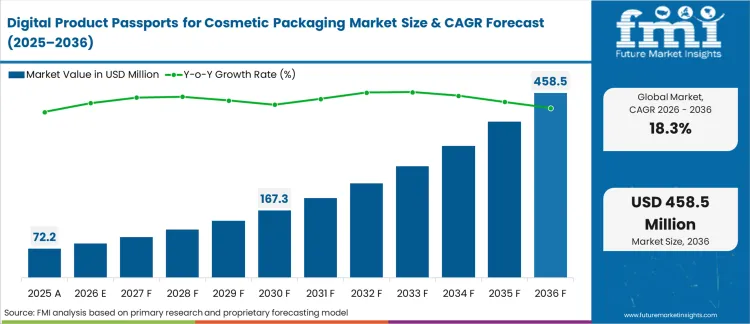
Digital Product Passports for Cosmetic Packaging Market Key Takeaways
| Metric | Details |
|---|---|
| Industry Size (2026) | USD 85.4 million |
| Industry Value (2036) | USD 458.5 million |
| CAGR (2026-2036) | 18.30% |
Source: Future Market Insights (FMI) analysis, based on proprietary forecasting model and primary research
Standardized digital identifiers have crossed from voluntary pilot programs to contractually required specifications across premium and mass-market cosmetic lines. Formulation chemists executing new product launches now demand packaging that guarantees immutable data on recycled content and end-of-life routes. This architectural shift compels contract manufacturers to abandon legacy printing processes and commit capital to QR/NFC-enabled tooling. Packaging partners delaying integration of compliant identifiers lose priority status in global supply agreements.
The projected compound expansion relies on the structural necessity of consumer-facing transparency that turns regulatory cost into brand differentiation. The underlying mechanism sustaining the 18.30% growth trajectory is the absolute requirement for auditable circularity data that legacy labeling physically cannot deliver. The geographic distribution of this compliance migration reveals distinct adoption velocities tied directly to national implementation of EU ESPR standards.
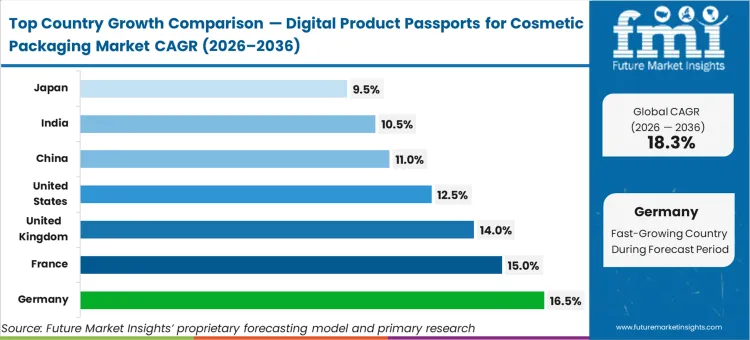
As beauty brands navigate this transition, Germany sets the pace with a 16.5% CAGR, followed by France at 15.0% as both nations leverage early regulatory enforcement to accelerate greenfield adoption. The United Kingdom advances at a 14.0% rate supported by post-Brexit alignment with circular economy goals. The United States records 12.5% expansion while China tracks at 11.0%, both driven by export compliance pressures. India expands at a 10.5% trajectory anchored by rising domestic premium skincare demand. Japan maintains a 9.5% pace as luxury brands integrate DPP for traceability in high-value fragrance lines.
Digital Product Passports for Cosmetic Packaging Market Definition
Digital Product Passports for Cosmetic Packaging represent embedded digital identifiers within primary and secondary packaging that provide verifiable, lifecycle-wide data on material composition, origin, recyclability, and carbon footprint for cosmetic products. The ecosystem includes QR codes, NFC tags, blockchain-linked records, and cloud platforms that enable real-time access for brands, regulators, recyclers, and consumers while ensuring compliance with emerging circularity mandates.
Digital Product Passports for Cosmetic Packaging Market Inclusions
Market scope includes QR/NFC-enabled labels and inlays integrated into cosmetic bottles, jars, tubes, and pouches, along with associated cloud software platforms for data management and blockchain verification layers. Smart packaging components that link physical items to digital records for traceability and sustainability reporting fall within boundaries. Solutions supporting EU ESPR compliance through material passport integration for personal care and beauty applications are fully incorporated. Related DPP-enabled smart labels and material passport systems for consumer goods packaging are central to the ecosystem.
Digital Product Passports for Cosmetic Packaging Market Exclusions
Standard static barcodes or printed labels without digital linkage capabilities are excluded because they cannot deliver dynamic, verifiable lifecycle data. Pure IT software platforms unrelated to physical packaging integration and non-cosmetic DPP applications such as electronics or textiles fall outside the defined parameters. Legacy non-traceable packaging materials without compliance-ready digital identifiers are explicitly omitted from the valuation.
Digital Product Passports for Cosmetic Packaging Market Research Methodology
- Primary Research: Analysts engaged with packaging specification leads at global beauty brands, regulatory compliance officers at cosmetic manufacturers, and sustainability managers at contract fillers to map decision gates for DPP adoption.
- Desk Research: The data collection phase aggregated compliance roadmaps from EU ESPR documentation, industry association guidelines on circular packaging, and beauty OEM sustainability reports.
- Market-Sizing and Forecasting: The baseline value derives from bottom-up aggregation of smart label shipments for personal care, applying region-specific regulatory adoption curves to project future integration velocity.
- Data Validation and Update Cycle: Projections are rigorously tested against publicly reported capital expenditure guidance from leading cosmetic packaging converters and brand sustainability filings.
Segmental Analysis
Digital Product Passports for Cosmetic Packaging Market Analysis by Technology
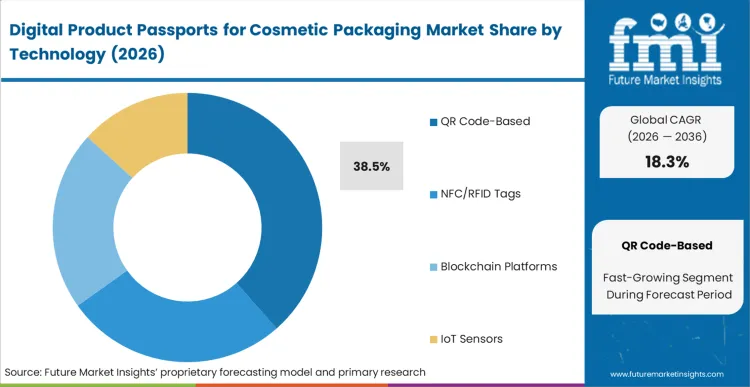
Legacy static labeling proves inadequate for delivering verifiable circularity data demanded by both regulators and premium consumers. QR Code-Based solutions command a dominant 38.5% share in 2026, reflecting the immediate accessibility and low implementation barrier that allows rapid deployment across existing production lines. Skincare manufacturers deploying these identifiers establish direct consumer engagement channels that previously required separate marketing investments. This integration eliminates reliance on secondary apps or websites. Brand managers specifying these solutions streamline compliance reporting while enhancing shelf appeal through scan-to-story functionality. According to FMI's estimates, facilities adopting QR-based DPP realize measurable lifts in consumer trust metrics. Technology providers unable to deliver seamless mobile compatibility risk exclusion from the next wave of mass-market beauty RFPs.
- Cost accessibility: Entry-level QR solutions enable smaller indie brands to achieve full regulatory compliance without heavy upfront capital outlay.
- Scan reliability: High-resolution printing combined with error-correction algorithms ensures consistent data retrieval even on curved bottle surfaces under retail lighting conditions.
- Integration speed: Plug-and-play cloud dashboards allow marketing teams to update product stories without involving IT departments for every formulation change.
Digital Product Passports for Cosmetic Packaging Market Analysis by Packaging Format
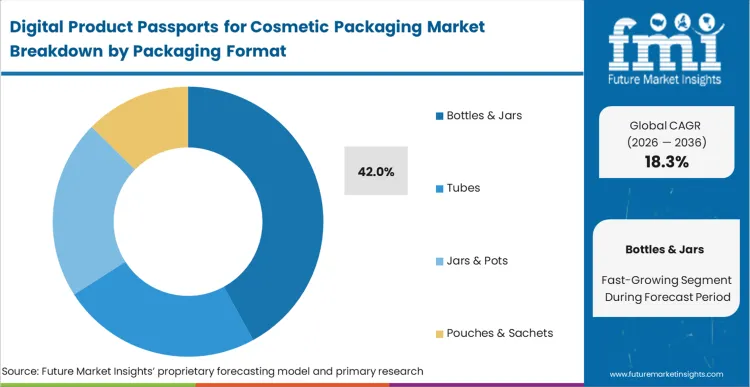
Bottles & Jars emerge as the dominant format area, expected to represent 42.0% of total market share in 2026. Premium skincare and serum lines standardize on rigid formats that accommodate embedded NFC or QR inlays without compromising structural integrity or aesthetics. FMI analysts opine that these formats provide the ideal surface area and durability for reliable scanning throughout the product lifecycle. Packaging engineers must validate DPP performance during accelerated aging tests to authorize final project sign-off. The convergence of high-end design with functional digital layers forces converters to rethink traditional decoration processes.
- Surface optimization: Curved geometry engineering ensures optimal scan angles while maintaining brand aesthetic requirements.
- Durability alignment: Moisture-resistant inlays survive repeated consumer handling and bathroom storage conditions without data degradation.
- Volume scalability: Standardized inlay placement across bottle families reduces tooling changeover times for high-volume production runs.
Digital Product Passports for Cosmetic Packaging Market Analysis by Cosmetic Category
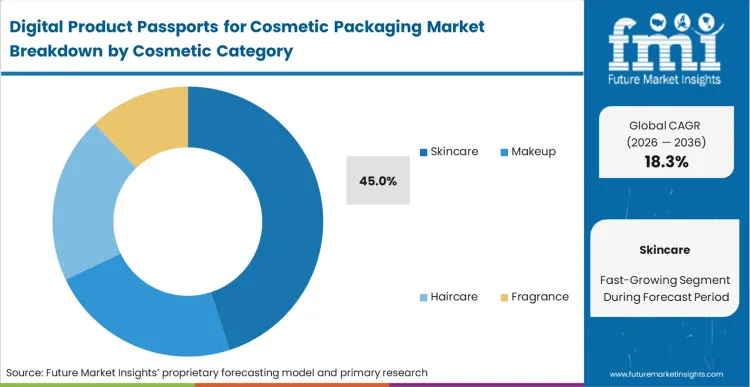
Every brand compliance officer evaluating new launches now faces strict traceability thresholds for material disclosure. Skincare accounts for a leading 45.0% segment share in 2026. Product development teams operating serum and cream lines reject packaging designs introducing data gaps into the digital record. Incorporating certified DPP modules guarantees that sustainability claims remain verifiable from raw material sourcing through consumer recycling. As per FMI's projection, the integration of consumer-facing transparency with core formulation storytelling amplifies demand for advanced digital packaging. Suppliers failing to demonstrate seamless linkage with brand e-commerce platforms lose priority status in flagship product rollouts.
- Claim verification: Direct scan access to third-party certification data builds consumer confidence beyond traditional marketing statements.
- Lifecycle tracking: Continuous data updates enable brands to monitor real-world recycling rates and adjust future material choices accordingly.
- Premium positioning: Verified circularity credentials support price justification in competitive skincare categories.
Digital Product Passports for Cosmetic Packaging Market Analysis by Material
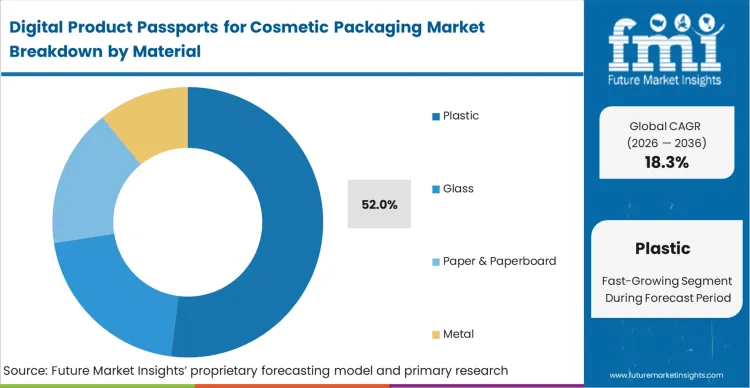
Prior reliance on non-traceable substrates created blind spots in circularity reporting across global supply chains. Plastic captures 52.0% of the market share in 2026 by providing the optimal balance of cost, formability, and digital integration capability for high-volume beauty applications. Packaging specification leads utilizing these materials coordinate complex compliance requirements with consistent data accuracy. Precise material composition logging enables advanced sorting and recovery programs when products reach end-of-life. Converters operating without foundational DPP-ready substrates face systemic disqualification from regulated markets.
- Recyclability mapping: Embedded data flags specific polymer grades to streamline automated sorting at material recovery facilities.
- Carbon footprint logging: Real-time material provenance updates support accurate Scope 3 reporting for corporate sustainability targets.
- Compatibility assurance: Standardized digital interfaces work across mono-material families without requiring format-specific reprogramming.
Digital Product Passports for Cosmetic Packaging Market Drivers, Restraints, and Opportunities
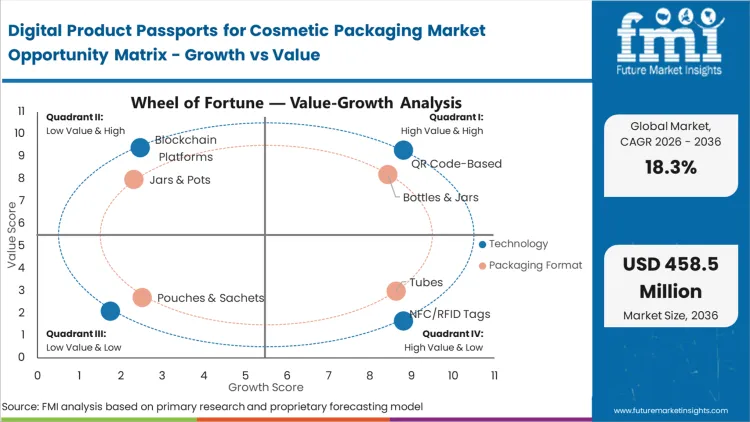
Regulatory pressure from the EU ESPR forces cosmetic packaging leads to extract verifiable material data directly from primary containers. This architectural requirement renders traditional labeling obsolete for compliance purposes. Brand owners upgrading existing lines face a strict choice between complex retrofits or full redesigns incorporating native digital identifiers. Transitioning to DPP-ready packaging simplifies reporting while enabling premium positioning through consumer transparency. Companies that fail to modernize core packaging layers risk operational blind spots and lost market access in regulated regions. As DPP platforms gain traction, the shift accelerates.
The technical complexity of integrating NFC or blockchain layers into high-speed filling lines creates steep learning curves for traditional converters. Designing conflict-free data architectures across multi-supplier supply chains demands specialized expertise that most beauty packaging teams lack internally. To mitigate this gap, capital project directors increasingly rely on pre-validated DPP modules that automate compliance validation before physical deployment.
Opportunities in the Digital Product Passports for Cosmetic Packaging Market
- Consumer Engagement Layer: Next-generation DPP platforms enable skincare brands to deliver personalized product education and refill reminders directly via consumer scans. This capability transforms packaging from cost center to loyalty driver.
- Circular Economy Premium: Verified material passports allow premium beauty lines to command higher prices by proving closed-loop recycling performance to eco-conscious buyers.
- Export Compliance Bridge: Standardized DPP formats simplify entry into multiple regulated markets by providing a single data structure that satisfies varying national traceability requirements.
Regional Analysis
Based on the regional analysis, the Digital Product Passports for Cosmetic Packaging market is segmented into Europe, North America, Asia Pacific, Latin America, Middle East & Africa, Oceania and South Asia across 40 plus countries. The full report also offers market attractiveness analysis based on regional trends.
.webp "Top Country Growth Comparison Digital Product Passports For Cosmetic Packaging Market Cagr (2026 2036)")
| Country | CAGR (2026 to 2036) |
|---|---|
| Germany | 16.5% |
| France | 15.0% |
| United Kingdom | 14.0% |
| United States | 12.5% |
| China | 11.0% |
| India | 10.5% |
| Japan | 9.5% |
Source: Future Market Insights (FMI) analysis, based on proprietary forecasting model and primary research
Europe Digital Product Passports for Cosmetic Packaging Market Analysis
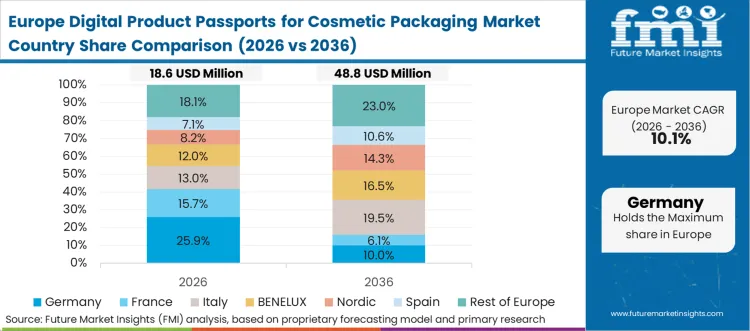
Regulatory mandates across Europe accelerate the integration of digital identifiers into cosmetic packaging from the earliest design stages. Packaging engineers at leading beauty conglomerates now specify DPP functionality during initial concept development to completely eliminate later-stage costly retrofits. This forward-looking approach removes compliance friction that previously delayed multiple product launches across skincare and makeup portfolios. By embedding native traceability capabilities directly into core packaging structures, European brands establish highly flexible supply chains that adapt quickly to evolving regulatory updates. The regulatory-first strategy continues to drive strong demand for advanced digital inlays, NFC solutions, and supporting data platforms throughout the region.
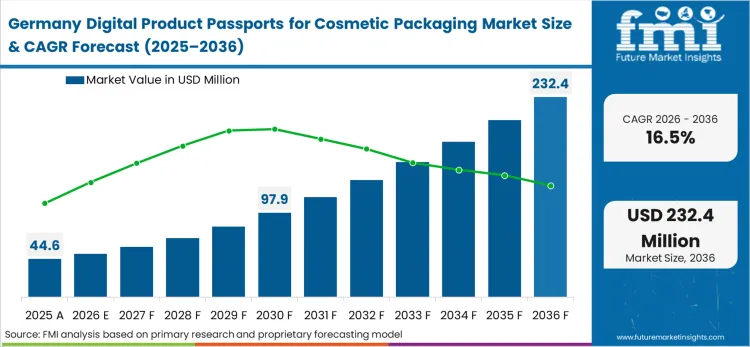
- Germany: Germany's premium skincare and export-oriented beauty sector operates under the strictest interpretation of EU ESPR rules, requiring seamless data exchange between packaging and centralized corporate compliance systems. Packaging specification leads at major German beauty houses have moved away from legacy labeling approaches entirely, now mandating native DPP modules on all new primary containers for both domestic and export lines. The substantial volume of high-value German beauty exports has created a massive installed base of interoperable digital packaging infrastructure across European distribution networks. This aggressive modernization approach anchors Germany's 16.5% CAGR for digital product passport solutions through 2036. Suppliers unable to demonstrate verified ESPR compliance and reliable scan performance under real-world conditions continue to lose access to flagship brand contracts in the German market.
- France: France’s luxury fragrance and high-end makeup sector functions under demanding traceability frameworks that insist on immutable records for every production batch. Packaging development teams must deploy solutions that guarantee critical data delivery without any risk of loss or tampering throughout the supply chain. The cultural emphasis on traceable provenance in high-value personal care triggers accelerated facility upgrades that prioritize unified digital backbone systems. This intense compliance pressure sustains France’s 15.0% compound expansion in DPP-enabled cosmetic packaging demand until 2036. Packaging converters that fail to provide hardware with robust built-in verification mechanisms face disqualification from high-margin luxury tenders.
- United Kingdom: The United Kingdom beauty industry balances post-Brexit regulatory alignment with strong domestic demand for transparent and sustainable packaging. Capital project directors at UK cosmetic manufacturers now require DPP integration as a standard procurement condition to maintain access to both EU and domestic premium channels. This dual-pressure environment drives consistent investment in smart packaging technologies. The United Kingdom advances at a 14.0% CAGR as brands focus on building consumer trust through verifiable circularity data while meeting evolving national sustainability targets.
FMI's report includes extensive coverage of additional European markets. It incorporates detailed analysis of Italy, Spain, the Nordics, and Benelux countries. A primary trend shaping these nations remains the rapid adoption of digital traceability technologies to satisfy both stringent consumer protection laws and ambitious environmental directives.
North America Digital Product Passports for Cosmetic Packaging Market Analysis
Voluntary sustainability initiatives combined with growing export compliance needs are driving systematic improvement in cosmetic packaging transparency across North America. Packaging compliance leads replacing conventional decoration processes are now deploying converged digital architectures capable of supporting both powerful brand storytelling and regulatory reporting requirements. Premium beauty segments actively drive this consolidation to protect verifiable claims against increasing consumer and retailer scrutiny. Implementing standardized DPP solutions enables facilities to roll out advanced consumer engagement tools without sacrificing high-speed production efficiency.
- United States: The United States prestige skincare and color cosmetics sector enforces strict voluntary transparency mandates across multi-channel retail and e-commerce ecosystems. Packaging specification leads replacing traditional labels must now deploy solutions capable of delivering real-time consumer scans alongside backend compliance tracking. Federal and state-level sustainability initiatives actively support modernization of packaging lines through digital identifiers. The United States advances at a 12.5% compound rate as major beauty brands unify their logical data architectures. Technology providers lacking documented performance under diverse retail scanning conditions continue to face exclusion from major retail chain approvals.
FMI's report includes comprehensive evaluation of additional North American markets. It features specific analysis of Canada and Mexico. A defining dynamic involves cross-border supply chain coordination that requires standardized digital formats for seamless traceability across the entire continent.
Asia Pacific Digital Product Passports for Cosmetic Packaging Market Analysis
Export-driven compliance pressures across Asia Pacific are accelerating adoption of digital packaging solutions for beauty products targeting regulated Western markets. Packaging development teams building new production capacity now specify DPP functionality directly in initial blueprints. This clean-slate strategy eliminates the expensive retrofit costs that continue to burden older manufacturing facilities. By embedding native digital capabilities into core packaging from day one, regional exporters establish strong competitive advantages in global beauty trade. Aggressive modernization strategies directly fuel demand for cost-effective yet reliable digital inlays and platforms.
- China: China’s fast-growing domestic premium beauty segment combined with strict export requirements to Europe has pushed local manufacturers to rapidly adopt digital product passport technologies. Packaging engineers at major Chinese cosmetic producers are integrating DPP solutions into high-volume production lines to meet both domestic green claims regulations and international buyer demands. This dual focus on domestic growth and export compliance anchors China’s 11.0% CAGR for DPP-enabled cosmetic packaging through 2036. Converters that cannot deliver scalable and cost-effective solutions risk losing share in one of the world’s largest beauty markets.
- India: India’s rising affluent consumer base and expanding organized beauty retail sector are creating new demand for transparent and traceable packaging. Domestic brands targeting premium positioning are increasingly specifying DPP features to differentiate their products and build consumer trust. The combination of growing local standards and export requirements to regulated markets sustains India’s 10.5% compound growth rate in this segment until 2036. Packaging suppliers capable of offering affordable yet compliant digital solutions stand to gain significant traction in the Indian market.
- Japan: Japan’s luxury beauty houses continue to emphasize precision, quality, and sustainability storytelling, making digital product passports a natural fit for high-value fragrance and skincare lines. Strict domestic quality standards and sophisticated consumer expectations drive adoption of advanced NFC and QR-based solutions. This focus on premium traceability supports Japan’s steady 9.5% growth trajectory through the forecast period.
FMI's report includes thorough investigation of additional Asia Pacific markets. The analysis encompasses detailed coverage of South Korea, Australia, and key ASEAN nations. A prevailing structural condition across the region is the strategic alignment of local production standards with international traceability requirements to protect and expand export market access.
Competitive Aligners for Market Players
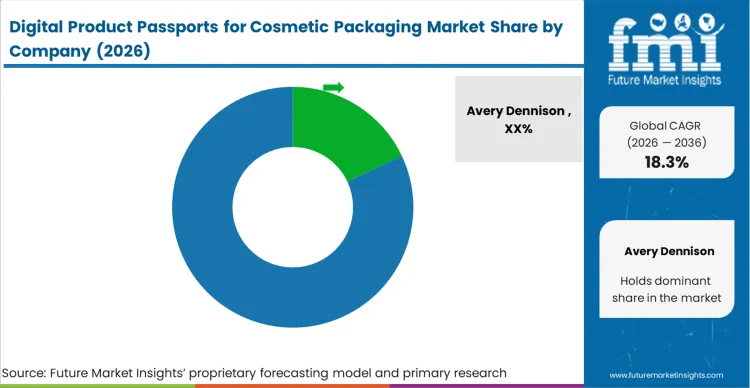
The introduction of standardized DPP protocols under EU ESPR is reshaping how cosmetic brands evaluate packaging suppliers. Procurement teams now demand certified digital integration capabilities in every tender rather than accepting conventional decoration. This shift has raised the performance threshold across the industry, meaning converters relying on legacy processes risk exclusion from major beauty contracts.
Industry leaders have adapted by embedding native digital layers into standard production tooling. Companies such as Avery Dennison, Amcor, and AptarGroup have aligned portfolios with open DPP frameworks, setting new benchmarks that challengers must match. Automation suppliers are pushed to integrate compliant identifiers directly into filling and decoration lines instead of relying on secondary applications. Leading RFID integrated smart packaging providers are gaining ground here.
Vendors embedding NFC or blockchain directly at the material level gain significant structural advantages. Players like Berry Global and Huhtamaki, which incorporate digital capabilities at the substrate stage, reduce downstream engineering overhead and accelerate time-to-market for compliant lines. This approach shortens qualification cycles, allowing brand teams to prioritize platforms that avoid complex post-production integration. Slower adopters risk losing position during early vendor selection phases.
Growth of cross-supplier interoperability ecosystems is disrupting established supply relationships. With DPP layers becoming standardized, brand owners can now source primary packaging from multiple qualified converters without compatibility concerns. This flexibility empowers procurement teams to optimize for cost and innovation instead of being locked into single-vendor ecosystems.
Recent Developments Avery Dennison expanded its DPP-ready label portfolio with new moisture-resistant NFC inlays optimized for cosmetic jar applications. Amcor launched a cloud-connected platform enabling real-time material provenance updates for skincare bottle lines. AptarGroup introduced modular DPP modules compatible with existing high-speed filling equipment for fragrance packaging. Berry Global partnered with blockchain providers to offer end-to-end traceability solutions for premium makeup compacts. Huhtamaki certified new paper-based DPP formats meeting EU recyclability verification requirements for sustainable beauty lines.
Key Players in Digital Product Passports for Cosmetic Packaging Market
- Avery Dennison
- Amcor
- AptarGroup
- Berry Global
- Huhtamaki
- CCL Industries
- Sonoco
Scope of the Report
| Metric | Value |
|---|---|
| Quantitative Units | USD 85.4 million to USD 458.5 million, at a CAGR of 18.30% |
| Market Definition | Digital Product Passports for Cosmetic Packaging encompass embedded digital identifiers within beauty packaging that provide verifiable lifecycle data on material composition, origin, recyclability, and carbon footprint. |
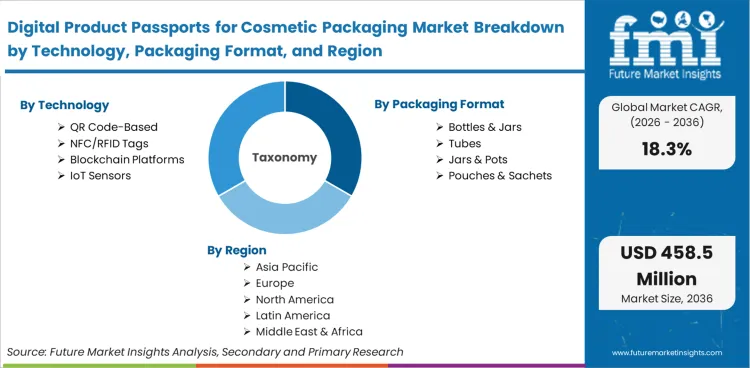
| Technology Segmentation | QR Code-Based, NFC/RFID Tags, Blockchain Platforms, IoT Sensors |
| Packaging Format Segmentation | Bottles & Jars, Tubes, Jars & Pots, Pouches & Sachets |
| Cosmetic Category Segmentation | Skincare, Makeup, Haircare, Fragrance |
| Material Segmentation | Plastic, Glass, Paper & Paperboard, Metal |
| Regions Covered | Europe, North America, Asia Pacific, Latin America, Middle East & Africa, Oceania, South Asia |
| Countries Covered | Germany, France, United Kingdom, United States, China, India, Japan, and 40 plus countries |
| Key Companies Profiled | Avery Dennison, Amcor, AptarGroup, Berry Global, Huhtamaki, CCL Industries, Sonoco |
| Forecast Period | 2026 to 2036 |
| Approach | The baseline value derives from bottom-up aggregation of digital inlay shipments for personal care applications, applying region-specific regulatory adoption curves to project future integration velocity. Primary interviews with packaging engineers and brand compliance teams validated technical feasibility and timeline assumptions while cross-checks against EU regulatory filings ensured forecast robustness. |
Source: Future Market Insights (FMI) analysis, based on proprietary forecasting model and primary research
Digital Product Passports for Cosmetic Packaging Market Analysis by Segments
Technology:
- QR Code-Based
- NFC/RFID Tags
- Blockchain Platforms
- IoT Sensors
Packaging Format:
- Bottles & Jars
- Tubes
- Jars & Pots
- Pouches & Sachets
Cosmetic Category:
- Skincare
- Makeup
- Haircare
- Fragrance
Material:
- Plastic
- Glass
- Paper & Paperboard
- Metal
Region:
- Asia Pacific
- India
- China
- Japan
- South Korea
- Indonesia
- Australia & New Zealand
- ASEAN
- Rest of Asia Pacific
- Europe
- Germany
- Italy
- France
- United Kingdom
- Spain
- Benelux
- Nordics
- Central & Eastern Europe
- Rest of Europe
- North America
- United States
- Canada
- Mexico
- Latin America
- Brazil
- Argentina
- Chile
- Rest of Latin America
- Middle East & Africa
- Kingdom of Saudi Arabia
- United Arab Emirates
- South Africa
- Turkey
- Rest of Middle East & Africa
Bibliography
- European Parliament and Council of the European Union. (2024). Regulation (EU) 2024/1781 establishing a framework for the setting of ecodesign requirements for sustainable products. Official Journal of the European Union.
- European Commission. (2025). Commission launches consultation on the Digital Product Passport.
- European Parliament and Council of the European Union. (2025, January 22). Regulation (EU) 2025/40 of the European Parliament and of the Council of 19 December 2024 on packaging and packaging waste, amending Regulation (EU) 2019/1020 and Directive (EU) 2019/904, and repealing Directive 94/62/EC. Official Journal of the European Union, L, 2025/40.
- Cosmetics Europe. (2025). A call for stronger EU rules for safer and fairer eCommerce.
- Council of the European Union. (2024, January 9). Proposal for a Regulation on ecodesign requirements for sustainable products, mandate for negotiations with the European Parliament.
This bibliography is provided for reader reference. The full FMI report contains the complete reference list with primary source documentation.
This Report Addresses
- Market sizing and quantitative forecast metrics detailing capital expenditure dedicated to DPP-enabled identifiers in cosmetic packaging through 2036.
- Segmentation analysis mapping adoption velocity of specific digital technologies and evaluating technical limitations driving format upgrades.
- Regional deployment intelligence comparing aggressive regulatory enforcement in Europe against export-driven modernization in Asia Pacific.
- Regulatory compliance assessment analyzing how ESPR and national circularity standards force adoption of unified digital packaging architectures.
- Competitive posture evaluation tracking the mandatory shift toward certified interoperability and resulting differentiation opportunities.
- Capital project strategic guidance defining exact procurement specifications and scan reliability tolerances required for next-generation beauty lines.
- Supply chain vulnerability analysis identifying network integration bottlenecks that extend packaging qualification timelines.
- Custom data delivery formats encompassing interactive dashboards, raw Excel datasets, and comprehensive PDF narrative reports.
Frequently Asked Questions
How large is the Digital Product Passports for Cosmetic Packaging market in 2026?
Demand for digital product passports in cosmetic packaging is estimated to be valued at USD 85.4 million in 2026.
What will the Digital Product Passports for Cosmetic Packaging market be valued at by 2036?
Market size for digital product passports in cosmetic packaging is projected to reach USD 458.5 million by 2036.
What CAGR is projected for Digital Product Passports for Cosmetic Packaging from 2026 to 2036?
Demand for digital product passports in cosmetic packaging is expected to grow at a CAGR of 18.30% between 2026 and 2036.
Which Technology segment is poised to lead global sales by 2026?
QR Code-Based accounts for 38.5% share in 2026 as packaging engineers execute rapid deployment programs to eliminate translation barriers between physical containers and digital records.
How significant is the role of Bottles & Jars in driving Digital Product Passports for Cosmetic Packaging adoption in 2026?
Bottles & Jars represent 42.0% of segment share as skincare and serum lines standardize on rigid formats that support reliable inlay integration without compromising structural integrity.
What is driving demand in Germany?
Germany’s premium skincare export sector requires seamless data exchange between packaging and corporate compliance systems, forcing specification of native DPP modules across all new primary containers.
What compliance standards drive adoption in France?
The luxury fragrance sector operates under stringent traceability frameworks demanding immutable records for every batch, triggering facility upgrades that prioritize unified digital backbones.
What is the Germany growth outlook in this report?
Germany is projected to grow at a CAGR of 16.5% during 2026 to 2036 as early ESPR enforcement combines with strong export focus to accelerate digital packaging integration.
Why is Europe described as a priority region in this report?
European markets actively drive network consolidation to secure verifiable circularity claims against regulatory scrutiny while enabling consumer-facing transparency features.
What type of demand dominates in Europe?
Demand heavily focuses on embedding native digital identifiers that satisfy ESPR requirements and support premium positioning in competitive beauty categories.
What is India's growth outlook in this report?
India is projected to expand at a CAGR of 10.5% during 2026 to 2036 as rising domestic premium skincare demand aligns with export compliance pressures.
Does the report cover USA in its regional analysis?
Yes, USA is included within North America under the regional scope of analysis.
What are the sources referred to for analyzing USA?
Federal and state sustainability initiatives combined with retailer transparency requirements form the analytical basis for North American demand patterns.
What is the main demand theme linked to USA in its region coverage?
Voluntary brand standards and export requirements force deployment of converged digital architectures supporting both storytelling and regulatory reporting.
Does the report cover France in its regional analysis?
Yes, France is included within Europe under the regional coverage framework.
What is the main France related demand theme in its region coverage?
Stringent traceability frameworks for luxury fragrance compel packaging teams to deploy solutions guaranteeing critical data integrity across global distribution.
Which product formats are strategically important for Asia Pacific supply chains?
Embedded NFC inlays integrated directly into primary bottles and jars are critical for streamlining export compliance and consumer engagement in regulated markets.
What is Digital Product Passports for Cosmetic Packaging and what is it mainly used for?
Digital Product Passports provide verifiable lifecycle data embedded in beauty packaging. They are primarily used to satisfy regulatory traceability requirements while enabling consumer-facing transparency and circularity verification.
What does Digital Product Passports for Cosmetic Packaging mean in this report?
The scope encompasses smart identifiers and supporting platforms built into cosmetic containers to guarantee auditable material provenance and end-of-life instructions.
What is included in the scope of this Digital Product Passports for Cosmetic Packaging report?
Market covers QR/NFC-enabled labels, inlays, and associated cloud platforms featuring native digital capabilities for beauty packaging applications.
What is excluded from the scope of this report?
Standard static barcodes, pure software platforms unrelated to physical packaging, and non-cosmetic DPP applications are explicitly excluded.
What does market forecast mean on this page?
Market forecast represents a model-based projection built on defined regulatory and technology adoption assumptions for strategic planning purposes.
How does FMI build and validate the Digital Product Passports for Cosmetic Packaging forecast?
The model applies a bottom-up methodology starting with digital inlay penetration rates in personal care and cross-validates projections against corporate sustainability filings and regulatory roadmaps.
What does zero reliance on speculative third-party market research mean here?
Primary interviews with packaging engineers, verified regulatory filings, and official industry compliance registries are used exclusively instead of unverified syndicated estimates.
Preview the report firsthand - request a free sample
Get SampleGet the brochure for pricing and purchase details.
Get PDFTable of Content
- Key Takeaways
- Market Size and CAGR
- Top Growth Driver
- Fastest Growing Segment
- Leading Region
- Key Companies
- Emerging Opportunities
- Executive Summary
- Global Market Outlook
- Demand-side Trends
- Supply-side Trends
- Technology Roadmap Analysis
- Analysis and Recommendations
- Analyst Perspective (What is happening? Why now? What should investors know?)
- Key Questions Answered
- How large is the market?
- What is the CAGR?
- What are key trends?
- Which region dominates?
- Who are the leaders?
- Market Overview
- Market Coverage / Taxonomy
- Market Definition / Scope / Limitations
- Research Methodology
- Chapter Orientation
- Analytical Lens and Working Hypotheses
- Market Structure, Signals, and Trend Drivers
- Benchmarking and Cross-market Comparability
- Market Sizing, Forecasting, and Opportunity Mapping
- Research Design and Evidence Framework
- Desk Research Programme (Secondary Evidence)
- Expert Input and Fieldwork (Primary Evidence)
- Tooling, Models, and Reference Databases
- Data Engineering and Model Build
- Quality Assurance and Audit Trail
- Market Background
- Market Dynamics (Drivers, Restraints, Opportunity, Trends)
- Scenario Forecast (Optimistic, Likely, Conservative)
- Impact Analysis
- AI Impact
- Sustainability Impact
- Regulatory Impact
- Technology Impact
- Consumer / Buyer Analysis
- Purchase Drivers
- Adoption Barriers
- Buyer Journey
- Opportunity Map Analysis
- Product Life Cycle Analysis
- Supply Chain Analysis
- Investment Feasibility Matrix
- Value Chain Analysis
- PESTLE and Porter's Analysis
- Regulatory Landscape
- Regional Parent Market Outlook
- Production and Consumption Statistics
- Import and Export Statistics
- Global Market Analysis and Forecast, 2021 to 2036
- Historical Market Size Value (USD Million) & Volume (Unit) Analysis, 2021 to 2025
- Current and Future Market Size Value (USD Million) & Volume (Unit) Projections, 2026 to 2036
- Y-o-Y Growth Trend Analysis
- Absolute $ Opportunity Analysis
- Global Market Pricing Analysis, 2021 to 2036
- Global Market Analysis and Forecast, By Technology, 2021 to 2036
- Introduction / Key Findings
- Historical Market Size Value (USD Million) & Volume (Unit) Analysis By Technology, 2021 to 2025
- Current and Future Market Size Value (USD Million) & Volume (Unit) Analysis and Forecast By Technology, 2026 to 2036
- QR Code-Based
- NFC/RFID Tags
- Blockchain Platforms
- IoT Sensors
- QR Code-Based
- Y-o-Y Growth Trend Analysis By Technology, 2021 to 2025
- Absolute $ Opportunity Analysis By Technology, 2026 to 2036
- Global Market Analysis and Forecast, By Packaging Format, 2021 to 2036
- Introduction / Key Findings
- Historical Market Size Value (USD Million) & Volume (Unit) Analysis By Packaging Format, 2021 to 2025
- Current and Future Market Size Value (USD Million) & Volume (Unit) Analysis and Forecast By Packaging Format, 2026 to 2036
- Bottles & Jars
- Tubes
- Jars & Pots
- Pouches & Sachets
- Bottles & Jars
- Y-o-Y Growth Trend Analysis By Packaging Format, 2021 to 2025
- Absolute $ Opportunity Analysis By Packaging Format, 2026 to 2036
- Global Market Analysis and Forecast, By Cosmetic Category, 2021 to 2036
- Introduction / Key Findings
- Historical Market Size Value (USD Million) & Volume (Unit) Analysis By Cosmetic Category, 2021 to 2025
- Current and Future Market Size Value (USD Million) & Volume (Unit) Analysis and Forecast By Cosmetic Category, 2026 to 2036
- Skincare
- Makeup
- Haircare
- Fragrance
- Skincare
- Y-o-Y Growth Trend Analysis By Cosmetic Category, 2021 to 2025
- Absolute $ Opportunity Analysis By Cosmetic Category, 2026 to 2036
- Global Market Analysis and Forecast, By Material, 2021 to 2036
- Introduction / Key Findings
- Historical Market Size Value (USD Million) & Volume (Unit) Analysis By Material, 2021 to 2025
- Current and Future Market Size Value (USD Million) & Volume (Unit) Analysis and Forecast By Material, 2026 to 2036
- Plastic
- Glass
- Paper & Paperboard
- Metal
- Plastic
- Y-o-Y Growth Trend Analysis By Material, 2021 to 2025
- Absolute $ Opportunity Analysis By Material, 2026 to 2036
- Global Market Analysis and Forecast, By Region, 2021 to 2036
- Introduction
- Historical Market Size Value (USD Million) & Volume (Unit) Analysis By Region, 2021 to 2025
- Current Market Size Value (USD Million) & Volume (Unit) Analysis and Forecast By Region, 2026 to 2036
- North America
- Latin America
- Western Europe
- Eastern Europe
- East Asia
- South Asia and Pacific
- Middle East & Africa
- Market Attractiveness Analysis By Region
- North America Market Analysis and Forecast, By Country, 2021 to 2036
- Historical Market Size Value (USD Million) & Volume (Unit) Trend Analysis By Market Taxonomy, 2021 to 2025
- Market Size Value (USD Million) & Volume (Unit) Forecast By Market Taxonomy, 2026 to 2036
- By Country
- USA
- Canada
- Mexico
- By Technology
- By Packaging Format
- By Cosmetic Category
- By Material
- By Country
- Market Attractiveness Analysis
- By Country
- By Technology
- By Packaging Format
- By Cosmetic Category
- By Material
- Key Takeaways
- Latin America Market Analysis and Forecast, By Country
- Historical Market Size Value (USD Million) & Volume (Unit) Trend Analysis By Market Taxonomy, 2021 to 2025
- Market Size Value (USD Million) & Volume (Unit) Forecast By Market Taxonomy, 2026 to 2036
- By Country
- Brazil
- Chile
- Rest of Latin America
- By Technology
- By Packaging Format
- By Cosmetic Category
- By Material
- By Country
- Market Attractiveness Analysis
- By Country
- By Technology
- By Packaging Format
- By Cosmetic Category
- By Material
- Key Takeaways
- Western Europe Market Analysis and Forecast, By Country
- Historical Market Size Value (USD Million) & Volume (Unit) Trend Analysis By Market Taxonomy, 2021 to 2025
- Market Size Value (USD Million) & Volume (Unit) Forecast By Market Taxonomy, 2026 to 2036
- By Country
- Germany
- UK
- Italy
- Spain
- France
- Nordic
- BENELUX
- Rest of Western Europe
- By Technology
- By Packaging Format
- By Cosmetic Category
- By Material
- By Country
- Market Attractiveness Analysis
- By Country
- By Technology
- By Packaging Format
- By Cosmetic Category
- By Material
- Key Takeaways
- Eastern Europe Market Analysis and Forecast, By Country
- Historical Market Size Value (USD Million) & Volume (Unit) Trend Analysis By Market Taxonomy, 2021 to 2025
- Market Size Value (USD Million) & Volume (Unit) Forecast By Market Taxonomy, 2026 to 2036
- By Country
- Russia
- Poland
- Hungary
- Balkan & Baltic
- Rest of Eastern Europe
- By Technology
- By Packaging Format
- By Cosmetic Category
- By Material
- By Country
- Market Attractiveness Analysis
- By Country
- By Technology
- By Packaging Format
- By Cosmetic Category
- By Material
- Key Takeaways
- East Asia Market Analysis and Forecast, By Country
- Historical Market Size Value (USD Million) & Volume (Unit) Trend Analysis By Market Taxonomy, 2021 to 2025
- Market Size Value (USD Million) & Volume (Unit) Forecast By Market Taxonomy, 2026 to 2036
- By Country
- China
- Japan
- South Korea
- By Technology
- By Packaging Format
- By Cosmetic Category
- By Material
- By Country
- Market Attractiveness Analysis
- By Country
- By Technology
- By Packaging Format
- By Cosmetic Category
- By Material
- Key Takeaways
- South Asia and Pacific Market Analysis and Forecast, By Country
- Historical Market Size Value (USD Million) & Volume (Unit) Trend Analysis By Market Taxonomy, 2021 to 2025
- Market Size Value (USD Million) & Volume (Unit) Forecast By Market Taxonomy, 2026 to 2036
- By Country
- India
- ASEAN
- Australia & New Zealand
- Rest of South Asia and Pacific
- By Technology
- By Packaging Format
- By Cosmetic Category
- By Material
- By Country
- Market Attractiveness Analysis
- By Country
- By Technology
- By Packaging Format
- By Cosmetic Category
- By Material
- Key Takeaways
- Middle East & Africa Market Analysis and Forecast, By Country
- Historical Market Size Value (USD Million) & Volume (Unit) Trend Analysis By Market Taxonomy, 2021 to 2025
- Market Size Value (USD Million) & Volume (Unit) Forecast By Market Taxonomy, 2026 to 2036
- By Country
- Kingdom of Saudi Arabia
- Other GCC Countries
- Türkiye
- South Africa
- Other African Union
- Rest of Middle East & Africa
- By Technology
- By Packaging Format
- By Cosmetic Category
- By Material
- By Country
- Market Attractiveness Analysis
- By Country
- By Technology
- By Packaging Format
- By Cosmetic Category
- By Material
- Key Takeaways
- Key Countries Market Analysis
- USA
- Pricing Analysis
- Market Share Analysis, 2025
- By Technology
- By Packaging Format
- By Cosmetic Category
- By Material
- Canada
- Pricing Analysis
- Market Share Analysis, 2025
- By Technology
- By Packaging Format
- By Cosmetic Category
- By Material
- Mexico
- Pricing Analysis
- Market Share Analysis, 2025
- By Technology
- By Packaging Format
- By Cosmetic Category
- By Material
- Brazil
- Pricing Analysis
- Market Share Analysis, 2025
- By Technology
- By Packaging Format
- By Cosmetic Category
- By Material
- Chile
- Pricing Analysis
- Market Share Analysis, 2025
- By Technology
- By Packaging Format
- By Cosmetic Category
- By Material
- Germany
- Pricing Analysis
- Market Share Analysis, 2025
- By Technology
- By Packaging Format
- By Cosmetic Category
- By Material
- UK
- Pricing Analysis
- Market Share Analysis, 2025
- By Technology
- By Packaging Format
- By Cosmetic Category
- By Material
- Italy
- Pricing Analysis
- Market Share Analysis, 2025
- By Technology
- By Packaging Format
- By Cosmetic Category
- By Material
- Spain
- Pricing Analysis
- Market Share Analysis, 2025
- By Technology
- By Packaging Format
- By Cosmetic Category
- By Material
- France
- Pricing Analysis
- Market Share Analysis, 2025
- By Technology
- By Packaging Format
- By Cosmetic Category
- By Material
- India
- Pricing Analysis
- Market Share Analysis, 2025
- By Technology
- By Packaging Format
- By Cosmetic Category
- By Material
- ASEAN
- Pricing Analysis
- Market Share Analysis, 2025
- By Technology
- By Packaging Format
- By Cosmetic Category
- By Material
- Australia & New Zealand
- Pricing Analysis
- Market Share Analysis, 2025
- By Technology
- By Packaging Format
- By Cosmetic Category
- By Material
- China
- Pricing Analysis
- Market Share Analysis, 2025
- By Technology
- By Packaging Format
- By Cosmetic Category
- By Material
- Japan
- Pricing Analysis
- Market Share Analysis, 2025
- By Technology
- By Packaging Format
- By Cosmetic Category
- By Material
- South Korea
- Pricing Analysis
- Market Share Analysis, 2025
- By Technology
- By Packaging Format
- By Cosmetic Category
- By Material
- Russia
- Pricing Analysis
- Market Share Analysis, 2025
- By Technology
- By Packaging Format
- By Cosmetic Category
- By Material
- Poland
- Pricing Analysis
- Market Share Analysis, 2025
- By Technology
- By Packaging Format
- By Cosmetic Category
- By Material
- Hungary
- Pricing Analysis
- Market Share Analysis, 2025
- By Technology
- By Packaging Format
- By Cosmetic Category
- By Material
- Kingdom of Saudi Arabia
- Pricing Analysis
- Market Share Analysis, 2025
- By Technology
- By Packaging Format
- By Cosmetic Category
- By Material
- Türkiye
- Pricing Analysis
- Market Share Analysis, 2025
- By Technology
- By Packaging Format
- By Cosmetic Category
- By Material
- South Africa
- Pricing Analysis
- Market Share Analysis, 2025
- By Technology
- By Packaging Format
- By Cosmetic Category
- By Material
- USA
- Market Structure Analysis
- Competition Dashboard
- Competition Benchmarking
- Market Share Analysis of Top Players
- By Regional
- By Technology
- By Packaging Format
- By Cosmetic Category
- By Material
- Emerging Startups
- Innovation Benchmarking
- Competition Analysis
- Competition Deep Dive
- Avery Dennison
- Overview
- Product Portfolio
- Profitability by Market Segments (Product/Region/Sales Channel)
- Sales Footprint
- Strategy Overview
- Marketing Strategy
- Product Strategy
- Channel Strategy
- Amcor
- AptarGroup
- Berry Global
- Huhtamaki
- CCL Industries
- Sonoco
- Avery Dennison
- Case Studies
- Success Stories
- Recent Developments
- Competition Deep Dive
- Assumptions & Acronyms Used


