

- Industry Size (2026)
- USD 5.3 Bn
- Forecast (2036)
- USD 10.4 Bn
- CAGR (2026 to 2036)
- 6.9%
Reusable Biologics Cold Chain Shippers Market Size, Market Forecast and Outlook By FMI
The reusable biologics cold chain shippers market crossed a valuation of USD 4.9 billion in 2025. Industry is expected to reach approximately USD 5.3 billion in 2026 as biopharma logistics managers orchestrating these closed-loop networks are standardizing their lane qualifications. The market revenue is expected to expand at a CAGR of 6.9% and reach USD 10.4 billion by 2036 as reverse logistics infrastructure matures across secondary clinical trial hubs.
Temperature-controlled packaging engineers face a closing window to validate high-value payload lanes before impending regulatory audits tighten thermal variance allowances. The transition from disposable polyurethane systems to vacuum-insulated reusable configurations compresses the vendor shortlisting process. Clinical logistics directors must deploy qualified shippers integrated with continuous telemetry before the next global sourcing cycle begins. Processors deploying reusable cold chain packaging assets report significant total-cost-of-ownership reductions over multi-year deployment horizons. Supply chain planners operating without these certified return networks forfeit access to the most lucrative biologic distribution contracts.
Summary of Reusable Biologics Cold Chain Shippers Market
- Reusable Biologics Cold Chain Shippers Market Definition:
- The reusable biologics cold chain shippers market represents the engineering, production, and deployment of multi-trip thermal packaging configurations designed to maintain strict temperature tolerances for high-value pharmaceutical payloads.
- Demand Drivers in the Market:
- Regulatory pressure forces biopharma logistics managers to eliminate single-use plastics from clinical trial supply chains.
- High-value cell and gene therapies mandate deep-frozen temperature stability that only advanced vacuum-insulated reusable panels provide.
- Rising global freight rates compel supply chain directors to adopt modular, stackable thermal assets that optimize volumetric weight limits.
- Key Segments Analyzed in the FMI Report:
- Reusable Insulated Boxes & Containers: 38.0% share in 2026, reflecting the primary form factor utilized by contract research organizations for direct-to-patient clinical trial distributions.
- Pharmaceuticals & Healthcare: 46.5% share in 2026, as biologic manufacturers standardizing lane qualifications demand high-performance thermal autonomy.
- India: Expanding at a 9.9% CAGR as domestic contract manufacturing organizations scale their export logistics networks.
- Analyst Opinion at FMI:
- Ismail Sutaria, Principal Consultant for Packaging, opines, “Environmental sustainability directives are forcing a structural reckoning within temperature-sensitive distribution networks. Quality assurance leads at contract development organizations know that qualifying a single-use container carries the same regulatory burden as validating a multi-trip asset, but yields no carbon accounting benefit. This asymmetry renders disposable configurations obsolete for recurring lane traffic. Clinical logistics planners who delay the integration of high-performance phase-change material networks will forfeit their ability to compete in European pharmaceutical tenders within the next sourcing cycle.”
- Strategic Implications / Executive Takeaways:
- Asset leasing providers must establish global conditioning networks to support biopharma logistics managers operating multi-continent distribution lanes.
- Thermal packaging engineers must integrate predictive telemetry sensors into VIP panels to pass rigorous pre-approval inspection audits.
- Contract manufacturing organizations must redesign their standard operating procedures to accommodate the physical conditioning required for reusable phase-change material packs.
- Methodology:
- Primary Research: Analysts conducted technical interviews with clinical supply chain directors and temperature-controlled packaging engineers across 40 countries to map asset recovery capabilities.
- Desk Research: The data aggregation phase analyzed public carbon reduction commitments from global pharmaceutical producers and published thermal validation reports.
- Market-Sizing and Forecasting: The baseline value derives from a bottom-up aggregation of active reusable asset fleet sizes, projecting future adoption based on pending clinical trial volumes.
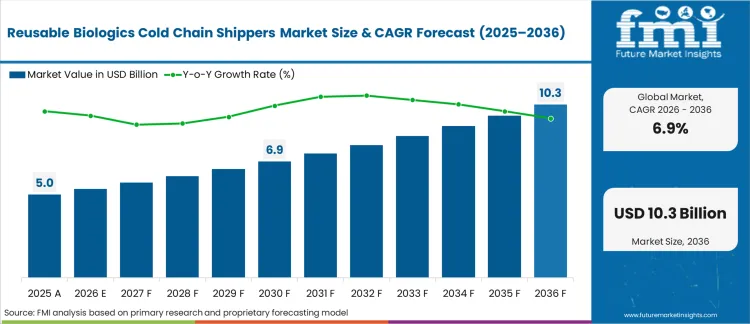
The transition from single-use thermal protection to fleet-managed multi-trip assets represents a fundamental reorganization of pharmaceutical capital allocation. The 6.9% compound expansion rate demonstrates that the initial hurdle of establishing reverse logistics infrastructure has been cleared by major distribution hubs. FMI analysts observe that the financial focus is shifting from asset acquisition costs toward conditioning efficiency and network balancing. This maturation in operational capability dictates the adoption curves mapped across regional regulatory environments.
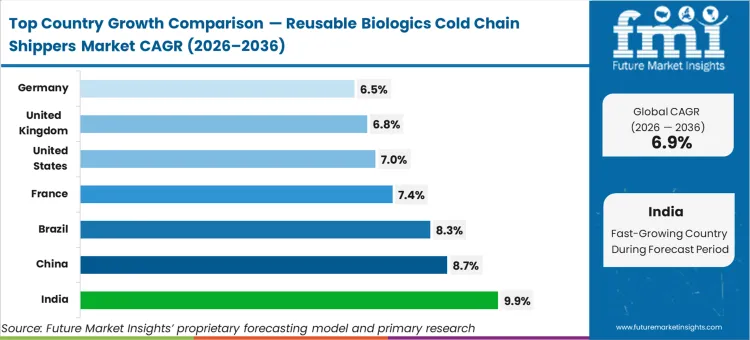
The regional analysis highlights distinct deployment velocities, with Asia Pacific contract manufacturing centers expanding their reusable footprints faster than legacy European hubs. FMI notes that India's 9.9% and China's 8.7% growth rates reflect aggressive export network modernization. Brazil follows closely at 8.3%. Mature markets such as France (7.4%), the United States (7.0%), the United Kingdom (6.8%), and Germany (6.5%) exhibit steady expansion as environmental mandates replace voluntary sustainability initiatives.
Reusable Biologics Cold Chain Shippers Market Key Takeaways
| Metric | Details |
|---|---|
| Industry Size (2026) | USD 5.3 billion |
| Industry Value (2036) | USD 10.4 billion |
| CAGR (2026-2036) | 6.9% |
Source: Future Market Insights (FMI) analysis, based on proprietary forecasting model and primary research
Reusable Biologics Cold Chain Shippers Market Definition
The reusable biologics cold chain shippers market represents the engineering, production, and deployment of multi-trip thermal packaging configurations designed to maintain strict temperature tolerances for high-value pharmaceutical payloads. This includes the integration of vacuum-insulated panels, hard-shell plastic composites, and phase-change materials engineered to withstand repeated transit cycles. Solutions ranging from small parcel direct-to-patient boxes to full-scale active pallet shippers are central to the definition.
Reusable Biologics Cold Chain Shippers Market Inclusions
The market scope includes high-density polyethylene exterior shells, polyurethane rigid foam insulation cores, and proprietary phase-change material conditioning packs. Digital data loggers and integrated IoT tracking sensors physically embedded into the shipper architecture fall within the boundaries. Modular pallet configurations utilizing vacuum-insulated panels for bulk active pharmaceutical ingredient transport are fully incorporated.
Reusable Biologics Cold Chain Shippers Market Exclusions
Single-use expanded polystyrene coolers and disposable gel packs are explicitly omitted from the valuation. Standalone software platforms managing logistics networks without associated physical hardware are excluded. Refrigerated ocean containers and active temperature-controlled cargo aircraft compartments fall outside the defined packaging parameters.
Reusable Biologics Cold Chain Shippers Market Research Methodology
- Primary Research: FMI conducted detailed technical interviews with clinical supply chain directors and temperature-controlled packaging engineers across 40 countries to validate protocol adoption timelines.
- Desk Research: Analysts aggregated public standards documentation from ISTA compliance registries, corporate sustainability reports, and national pharmaceutical infrastructure programs.
- Market-Sizing and Forecasting: The baseline value derives from a bottom-up aggregation of reusable shipper fleet deployments, applying region-specific modernization curves to project future adoption velocity.
- Data Validation and Update Cycle: Segment forecasts undergo cross-validation against quarterly biological product approval rates and clinical trial initiation data.
Segmental Analysis
Reusable Biologics Cold Chain Shippers Market Analysis by Product Type
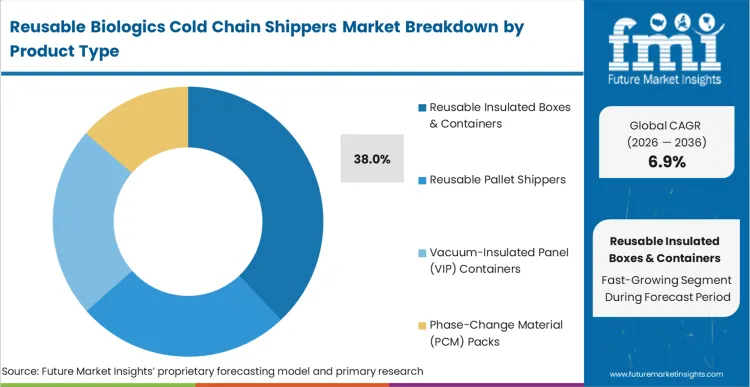
Every clinical supply chain director bidding on advanced therapy distribution contracts now faces strict adherence criteria for deep-frozen payload stability. Reusable Insulated Boxes & Containers capture a commanding 38.0% share in 2026, reflecting the massive scale of direct-to-patient clinical trial deliveries required by modern research protocols. Manufacturers deploying passive temperature controlled packaging solutions directly into localized distribution hubs establish the foundation for agile response networks. As per FMI's projection, clinical supply chain directors utilizing these modular assets significantly reduce volumetric shipping penalties on long-haul air freight lanes. Logistics providers unable to supply certified multi-trip configurations face exclusion from the next wave of decentralized clinical trial RFPs.
- Thermal validation endurance: Phase-change material combinations demand rigorous pre-conditioning protocols to guarantee precise latent heat absorption during extended international transit legs.
- Volumetric optimization: Advanced vacuum-insulated panels minimize exterior wall thickness, maximizing internal payload capacity within constrained cargo environments.
- Asset lifecycle management: Tracking software platforms assign unique identification codes to individual shippers to monitor physical degradation over multiple deployment cycles.
Reusable Biologics Cold Chain Shippers Market Analysis by Material Type
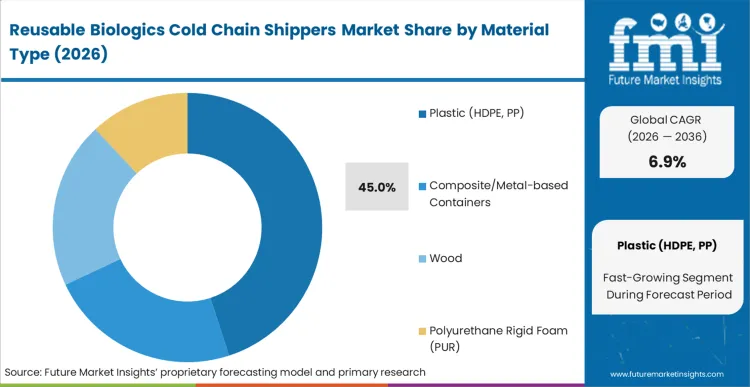
Traditional single-use polyurethane configurations lacked the structural integrity necessary for continuous reverse logistics recovery. High-density plastic composites engineered for impact resistance broke this barrier, establishing a new operational standard. Plastic (HDPE, PP) dominates with a 45.0% segment share in 2026, driven by the material's superior strength-to-weight ratio and sanitization characteristics. According to FMI's estimates, packaging qualification engineers specifying these resilient shells drastically extend the amortization lifecycle of their thermal assets. Material suppliers focusing on closed-loop recyclability secure long-term contracts with major contract development organizations.
- Impact resistance thresholds: Reinforced thermoplastic corner assemblies absorb mechanical shock during automated sortation processes, protecting internal vacuum panels from micro-fractures.
- Chemical inertness: High-density polypropylene surfaces withstand aggressive sterilization agents required between distinct clinical trial shipments.
- Thermal bridging mitigation: Seamless blow-molded construction eliminates exterior joints, preventing ambient heat transfer into the primary payload chamber.
Reusable Biologics Cold Chain Shippers Market Analysis by Application
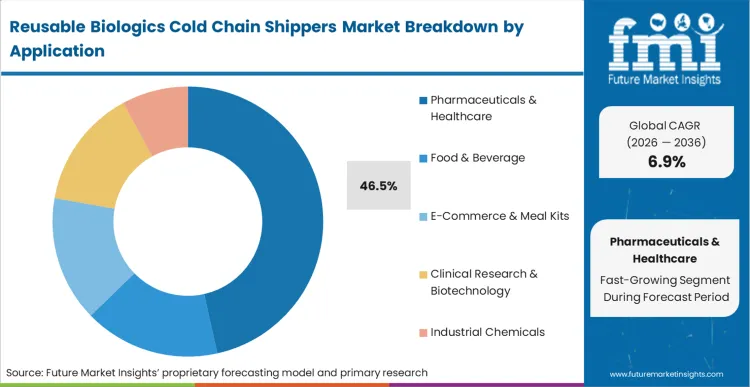
Strict cybersecurity and data visibility mandates across multi-tier defense supply chains force the deployment of converged network architectures. Pharmaceuticals & Healthcare represent the primary application sector, capturing 46.5% of the market share in 2026. Biopharma logistics managers operating continuous production facilities reject packaging designs introducing variable temperature excursions into the supply chain. FMI analysts opine that thermal integrity requirements for mRNA vaccines amplify the demand for high-performance pharmaceutical cold chain packaging. Suppliers failing to demonstrate seamless integration with established digital data loggers lose priority status in critical infrastructure upgrade cycles.
- Deep-frozen continuity: Specialized phase-change formulations maintain ultra-low temperatures without the regulatory handling restrictions associated with dry ice replenishment.
- Chain of custody transparency: Embedded tracking sensors provide quality assurance leads with continuous location and temperature telemetry required for batch release authorization.
- Decentralized trial support: Downsized shipper formats accommodate direct delivery of individualized cell therapies to specific clinical administration sites.
Reusable Biologics Cold Chain Shippers Market Analysis by Add-on Features
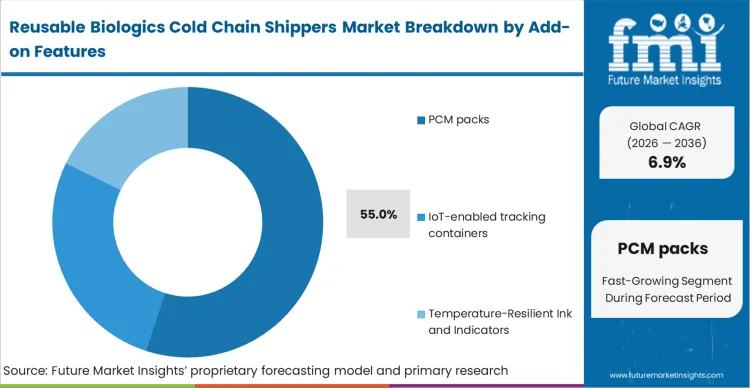
Prior reliance on localized, uncoordinated hardware clocks caused significant synchronization drift across expansive production facilities. The integration of advanced thermal energy storage resolves this fundamental disconnect. PCM packs account for a commanding 55.0% share in 2026 by establishing a highly accurate thermal buffer capable of absorbing extreme external temperature variations. As per FMI's projection, digital lane monitoring combined with temperature controlled pharma packaging assets coordinate complex multi-axis motion sequences with unprecedented reliability. Facilities operating without this foundational timing architecture face systemic production errors as control domains drift out of phase.
- Latent heat capacity: Formulated salt hydrates deliver targeted energy absorption profiles, maintaining tight temperature bands during critical tarmac transfer delays.
- Conditioning efficiency: Color-coded temperature indicators visually confirm when phase-change packs have reached their designated solid or liquid states prior to pack-out.
- Telemetry integration: Low-power wide-area network sensors transmit real-time internal payload conditions directly to centralized control towers.
Reusable Biologics Cold Chain Shippers Market Drivers, Restraints, and Opportunities
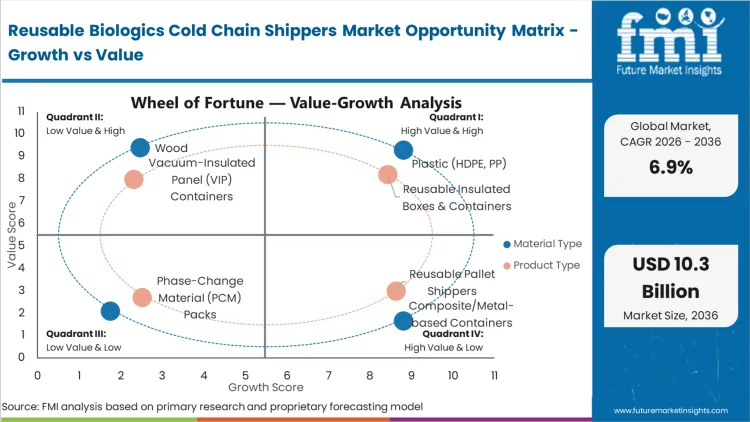
The convergence of clinical trial complexity and stringent environmental mandates forces biopharma logistics managers to extract actionable carbon data directly from their distribution networks. This architectural requirement renders fragmented, disposable packaging systems obsolete. Asset owners upgrading international lanes face a strict binary choice between absorbing carbon tax penalties or overhauling their base physical infrastructure. According to FMI's estimates, reverse logistics execution capabilities enable healthcare cold chain logistics operators to lower per-trip costs over a five-year horizon.
The intricate reverse logistics required to optimize asset recovery create steep learning curves for traditional clinical supply planners. Recovering insulated shippers from remote clinical sites demands specialized network coordination that most pharmaceutical producers lack internally. Managing this complex repositioning flow while ensuring precise pre-conditioning at regional depots requires dedicated third-party service centers. Supply chain planners mitigate this constraint by transitioning from outright purchase models to lease-based network access agreements.
- Conditioning Center Expansion: Infrastructure developers construct high-capacity refrigeration hubs near major airport gateways. Biopharma logistics managers utilize these localized depots to access pre-conditioned phase-change materials on demand.
- Bio-Based Insulant Integration: Chemical engineers formulate compostable foam alternatives to replace traditional polyurethane cores. This material science breakthrough allows quality assurance leads to align thermal performance with aggressive corporate sustainability targets.
- Predictive Telemetry Analytics: Software developers integrate artificial intelligence algorithms into shipment monitoring platforms. Clinical supply directors leverage this predictive data to proactively reroute high-value biologic payloads before thermal deviations occur.
Regional Analysis
Based on the regional analysis, the reusable biologics cold chain shippers market is segmented into North America, Latin America, Europe, East Asia, South Asia, Oceania and Middle East & Africa across 40+ countries. The full report also offers market attractiveness analysis based on regional trends.
.webp "Top Country Growth Comparison Reusable Biologics Cold Chain Shippers Market Cagr (2026 2036)")
| Country | CAGR (2026 to 2036) |
|---|---|
| India | 9.9% |
| China | 8.7% |
| Brazil | 8.3% |
| France | 7.4% |
| United States | 7.0% |
| United Kingdom | 6.8% |
| Germany | 6.5% |
Source: Future Market Insights (FMI) analysis, based on proprietary forecasting model and primary research
East Asia Reusable Biologics Cold Chain Shippers Market Analysis
Greenfield pharmaceutical infrastructure development across the East Asia region accelerates the bypass of legacy single-use packaging constraints. Capital projects directors constructing new biologics manufacturing facilities specify unified reusable shipping networks in their initial logistics blueprints. FMI analysts opine that regional payload consolidation entirely eliminates the costly and time-consuming disposable material procurement cycles that plague older European centers. By building native conditioning capabilities into the foundation, regional asset owners establish highly flexible distribution environments capable of rapid volume scaling. The specific therapeutic export requirements of individual nations dictate the precise thermal implementation parameters for these shipping technologies.
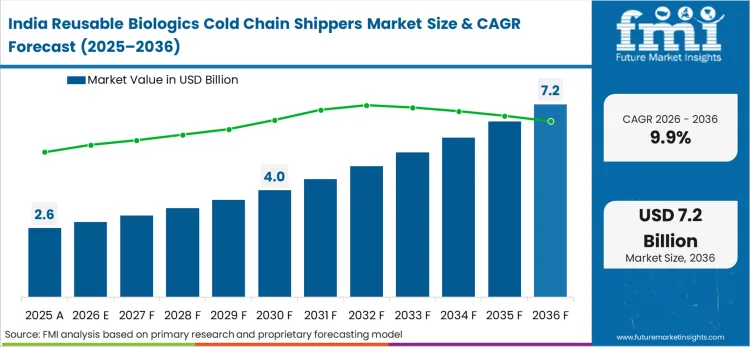
- India: The national contract development and manufacturing sector operates under stringent pre-approval inspection frameworks requiring immutable thermal records for all exported biologics. Biopharma logistics managers must deploy qualified reverse logistics networks capable of returning high-value insulated assets from North American distribution hubs to domestic formulation sites. India's pharmaceutical export sector relies heavily on these closed-loop asset recovery programs to maintain gross margins on temperature-sensitive therapies. This structural shift anchors a 9.9% compound expansion of reusable thermal packaging demand in India through 2036. Clinical supply chain directors failing to establish verifiable asset return lanes face immediate exclusion from major life sciences distribution tenders.
- China: China's biologics contract manufacturing sector deploys highly automated cold chain distribution lines requiring seamless data exchange between centralized monitoring towers and physical shipment assets. Greenfield facility architects bypass disposable polyurethane solutions entirely, specifying native vacuum-insulated reusable configurations for all new clinical trial distribution contracts. The aggressive modernization strategy drives an 8.7% CAGR for multi-trip thermal shippers in China through 2036. Logistics providers unable to demonstrate verified high-bandwidth telemetry capabilities lose access to the most lucrative regional biomedical projects.
FMI's report includes extensive coverage of the Asia Pacific reusable packaging landscape. It incorporates detailed analysis of Japan, South Korea, Australia, and the broader ASEAN region. A primary trend shaping these nations is the rapid localization of active pharmaceutical ingredient formulation, forcing contract manufacturers to deploy unified reverse logistics architectures to satisfy stringent global brand traceability requirements.
North America Reusable Biologics Cold Chain Shippers Market Analysis
Industrial modernization mandates across North America target the systematic eradication of single-use plastics from advanced clinical trial supply chains. Biopharma logistics managers leading critical infrastructure overhauls face strict directives to unify disparate regional distribution domains under a single leased-asset architecture. Implementing a standardized, reusable backbone enables clinical research organizations to deploy advanced predictive telemetry algorithms without compromising real-time payload stability. This strategic shift requires significant capital allocation toward robust composite hardware capable of isolating mixed-criticality biologic streams. National pharmaceutical frameworks and aerospace cargo qualification standards govern the exact specifications required for these critical network deployments.
- United States: The United States advanced therapy medicinal product sector enforces strict temperature visibility mandates across its entire multi-tier clinical trial ecosystem. Network specification leads replacing aging single-use cooler systems must deploy converged architectures capable of supporting both deep-frozen stability and secure telemetry extraction. The United States advances at a 7.0% compound rate across the forecast decade as discrete clinical networks unify their physical packaging topologies. United States and Canada cold chain packaging directors lacking documented compliance with rigorous thermal validation standards face immediate exclusion from gene therapy distribution contracts.
FMI's report includes comprehensive evaluation of the North American cold chain sector. It features specific analysis of the Canadian and Mexican distribution markets. A defining dynamic in these countries involves the integration of cross-border clinical trial supply chains, which requires standardized conditioning protocols to coordinate just-in-time delivery sequences and maintain synchronized therapeutic efficacy across multiple trial sites.
Europe Reusable Biologics Cold Chain Shippers Market Analysis
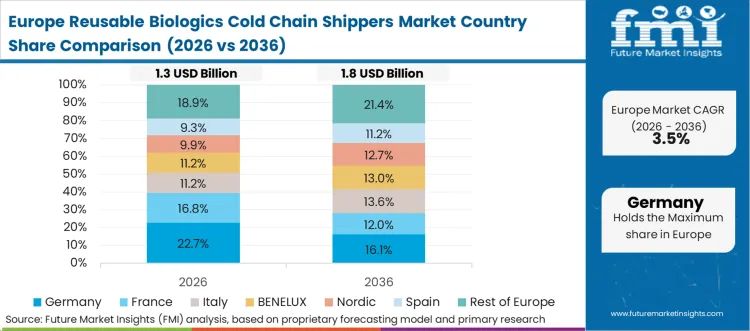
European environmental policy actively penalizes the continued operation of waste-generating and technologically isolated pharmaceutical supply chains. Packaging qualification engineers redesigning legacy distribution lines must integrate continuous carbon footprint data alongside critical payload temperature signals. The transition requires a complete overhaul of existing procurement topologies, shifting from linear consumption models to circular, event-driven asset architectures. Upgrading the core physical infrastructure provides the necessary thermal duration and physical durability to support advanced sustainable healthcare practices. Regional extended producer responsibility standards heavily influence the technical requirements for these network transformations.
- France: France's national healthcare system enforces strict eco-modulation tariffs on all single-use pharmaceutical transit packaging. Clinical logistics directors must demonstrate flawless execution of scheduled asset recovery flows before receiving authorization to connect new therapeutic lines to the main hospital distribution network. The systemic qualification pressure drives a 7.4% annual expansion rate for certified multi-trip thermal assets as the standard proliferates. Packaging infrastructure providers targeting domestic biologic distribution projects must guarantee zero-waste performance prior to the finalization of hospital procurement budgets.
- United Kingdom: The United Kingdom's National Health Service modernization programs require precise carbon measurement data to balance increasingly strict net-zero supplier requirements. Utility network planners deploying advanced centralized pharmacy systems mandate packaging architectures capable of multi-year operational lifecycles across distributed geographic assets. The critical infrastructure transition sustains a 6.8% CAGR for reverse logistics assets in the UK through 2036. Logistics operators unable to demonstrate absolute thermal determinism under severe transit conditions forfeit qualification for national healthcare distribution programs.
- Germany: Germany's central European logistics sector dictates stringent validation criteria for high-value biologic transfers moving through major air freight hubs. Control systems engineers must execute rapid turnaround and re-conditioning protocols to maximize asset utilization rates. Germany registers a 6.5% compound growth rate through 2036 as the foundation for continental European clinical trial logistics. Asset leasing providers lacking localized conditioning facilities lose their competitive advantage during multi-national clinical trial bidding processes.
FMI's report includes thorough investigation of the European pharmaceutical networking framework. The analysis encompasses Italy, Spain, the Nordics, and the Benelux region. A prevailing structural condition across these nations is the mandatory compliance with strict corporate sustainability directives, forcing asset owners to specify leased networks that can reliably transport fail-safe therapeutics while minimizing secondary packaging waste.
Latin America Reusable Biologics Cold Chain Shippers Market Analysis
Stringent import qualification standards across Latin America target the systematic eradication of temperature excursions in biologic supply chains. Biopharma logistics managers leading critical distribution overhauls face strict directives to unify disparate national customs clearance domains under a single extended-duration packaging architecture. Implementing a standardized, highly insulated backbone enables regional distributors to deploy advanced passive systems capable of surviving prolonged tarmac delays without active refrigeration. This strategic shift requires significant capital allocation toward robust vacuum-insulated hardware capable of isolating mixed-criticality traffic streams. Regional health surveillance frameworks govern the exact thermal performance specifications required for these critical network deployments.
- Brazil: Brazil's federal health regulatory agency enforces strict continuous temperature visibility mandates across its entire multi-tier pharmaceutical importation ecosystem. Quality assurance leads replacing aging active container networks must deploy highly durable passive architectures capable of supporting both deep-frozen precision and rugged physical handling. Brazil advances at an 8.3% compound rate across the forecast decade as regional distributors unify their physical packaging topologies. Packaging hardware providers lacking documented compliance with rigorous ANVISA thermal validation standards face immediate exclusion from national immunization distribution contracts.
FMI's report includes extensive coverage of the Latin American cold chain logistics landscape. It incorporates detailed analysis of Argentina, Chile, Colombia, and the broader Andean region. A primary trend shaping these nations is the rapid localization of clinical trial execution, forcing global pharmaceutical sponsors to deploy unified reverse logistics architectures to satisfy stringent international thermal traceability requirements.
Competitive Aligners for Market Players
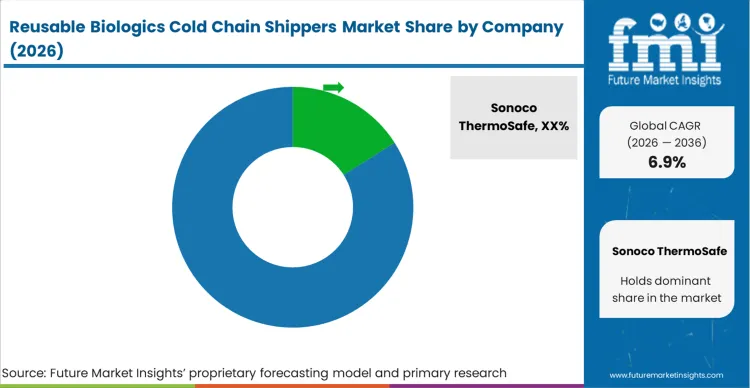
As per FMI's projection, thermal validation data sharing between biopharmaceuticals packaging providers and drug manufacturers is redefining supplier qualification criteria. Instead of accepting static laboratory test results, clinical supply chain directors now demand continuous, real-world lane telemetry data in all new tenders. This architectural pivot forces incumbent hardware providers to integrate IoT silicon into every new reusable product line to maintain data continuity. Packaging operations directors utilizing these dynamic analytics platforms streamline their deployment topologies and significantly reduce overall payload loss rates. Asset manufacturers unable to supply certified interoperable data streams face a disqualification window they cannot close after shortlisting begins.
Asset leasing providers deploying high-density global conditioning networks establish a formidable barrier to entry for regional competitors. Maintaining pre-conditioned phase-change material inventories adjacent to major clinical trial hubs requires substantial capital investment and precise predictive demand modeling. Biopharma logistics managers specifying these agile networks streamline their reverse logistics topologies and significantly reduce overall capital expenditure. Hardware engineers executing factory floor expansions now reject proprietary conditioning processes that fragment operational efficiency. Logistics firms failing to demonstrate seamless integration with established global depot networks lose priority status in critical clinical trial upgrade cycles.
The integration of sustainable material science into the core physical hardware fundamentally alters the lifecycle cost calculations for major pharmaceutical shippers. Chemical engineers formulating biodegradable or infinitely recyclable structural components address the stringent end-of-life disposal requirements demanded by European regulatory bodies. Clinical logistics planners utilizing these advanced materials coordinate complex global distribution sequences with unprecedented environmental compliance reliability. Regulatory frameworks enforcing absolute carbon accountability force asset owners to abandon highly toxic insulating materials and commit significant capital to sustainable backbones.
Key Players in Reusable Biologics Cold Chain Shippers Market
- Sonoco ThermoSafe
- Pelican BioThermal
- Cold Chain Technologies
- va-Q-tec AG
- Softbox Systems
- Envirotainer
- Cryopak
Scope of the Report
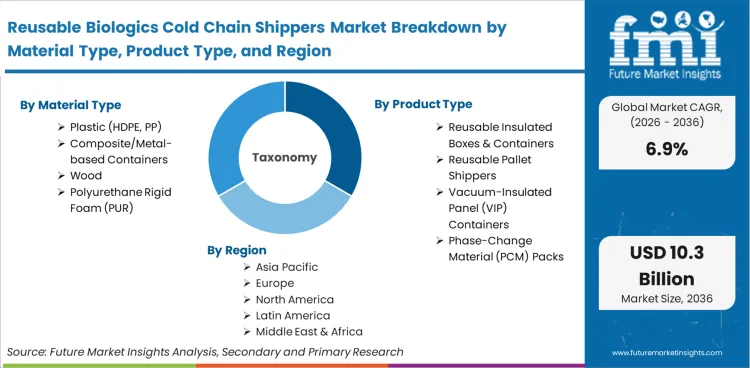
| Metric | Value |
|---|---|
| Quantitative Units | USD 5.32 billion to USD 10.45 billion, at a CAGR of 6.9% |
| Market Definition | The reusable biologics cold chain shippers market represents the engineering, production, and deployment of multi-trip thermal packaging configurations designed to maintain strict temperature tolerances for high-value pharmaceutical payloads. |
| Product Type Segmentation | Reusable Insulated Boxes & Containers, Reusable Pallet Shippers, Vacuum-Insulated Panel (VIP) Containers, Phase-Change Material (PCM) Packs |
| Material Type Segmentation | Plastic (HDPE, PP), Composite/Metal-based Containers, Wood, Polyurethane Rigid Foam (PUR) |
| Application Segmentation | Pharmaceuticals & Healthcare, Food & Beverage, E-Commerce & Meal Kits, Clinical Research & Biotechnology, Industrial Chemicals |
| Add-on Features Segmentation | PCM packs, IoT-enabled tracking containers, Temperature-Resilient Ink and Indicators |
| Regions Covered | North America, Latin America, Europe, East Asia, South Asia, Oceania, Middle East & Africa |
| Countries Covered | India, China, Brazil, France, United States, United Kingdom, Germany, and 40 plus countries |
| Key Companies Profiled | Sonoco ThermoSafe, Pelican BioThermal, Cold Chain Technologies, va-Q-tec AG, Softbox Systems, Envirotainer, Cryopak |
| Forecast Period | 2026 to 2036 |
| Approach | The baseline value derives from a bottom-up aggregation of reusable shipper fleet deployments, applying region-specific modernization curves to project future adoption velocity. |
Reusable Biologics Cold Chain Shippers Market Analysis by Segments
Product Type:
- Reusable Insulated Boxes & Containers
- Reusable Pallet Shippers
- Vacuum-Insulated Panel (VIP) Containers
- Phase-Change Material (PCM) Packs
Material Type:
- Plastic (HDPE, PP)
- Composite/Metal-based Containers
- Wood
- Polyurethane Rigid Foam (PUR)
Application:
- Pharmaceuticals & Healthcare
- Food & Beverage
- E-Commerce & Meal Kits
- Clinical Research & Biotechnology
- Industrial Chemicals
Add-on Features:
- PCM packs
- IoT-enabled tracking containers
- Temperature-Resilient Ink and Indicators
Region:
- Asia Pacific
- India
- China
- Japan
- South Korea
- Indonesia
- Australia & New Zealand
- ASEAN
- Rest of Asia Pacific
- Europe
- Germany
- Italy
- France
- United Kingdom
- Spain
- Benelux
- Nordics
- Central & Eastern Europe
- Rest of Europe
- North America
- United States
- Canada
- Mexico
- Latin America
- Brazil
- Argentina
- Chile
- Rest of Latin America
- Middle East & Africa
- Kingdom of Saudi Arabia
- United Arab Emirates
- South Africa
- Turkey
- Rest of Middle East & Africa
Bibliography
- USA Food and Drug Administration. (2026, February 23). Cellular & gene therapy guidances. FDA.
- Central Drugs Standard Control Organization. (2024, April 2). Guidelines on good distribution practices for pharmaceutical products. CDSCO.
- Medicines and Healthcare products Regulatory Agency. (2024, May 13). Medicines: good manufacturing practice and good distribution practice. GOV.UK.
- Press Information Bureau, Government of India. (2026, February 2). Transforming India into a global biopharma hub. PIB.
- International Safe Transit Association. (2026, April 8). 2026 ISTA Forum USA program issue. ISTA.
- International Air Transport Association. (2025, April 13). 2025 vision for the future of air cargo facilities: Reimagining logistics through technology and innovation. IATA.
This bibliography is provided for reader reference. The full FMI report contains the complete reference list with primary research documentation.
This Report Addresses
- Market sizing and quantitative forecast metrics detailing the precise capital expenditure dedicated to multi-trip thermal packaging hardware across major pharmaceutical distribution sectors through 2036.
- Segmentation analysis mapping the adoption velocity of specific phase-change material configurations and evaluating the thermal limitations driving component upgrades.
- Regional deployment intelligence comparing the aggressive export network expansion strategies in Asia Pacific against the complex environmental compliance modernization requirements prevalent in European logistics hubs.
- Regulatory compliance assessment analyzing how stringent good distribution practices and zero-waste hospital mandates force the adoption of unified reverse logistics architectures.
- Competitive posture evaluation tracking the mandatory shift toward integrated telemetry validation and the resulting commoditization of the physical insulation layer.
- Clinical project strategic guidance defining the exact procurement specifications and thermal retention tolerances required to support next-generation cell and gene therapy commercialization.
- Supply chain vulnerability analysis identifying the specific asset recovery bottlenecks that extend container conditioning turnaround timelines.
- Custom data delivery formats encompassing interactive dashboards, raw Excel datasets, and comprehensive PDF narrative reports.
Frequently Asked Questions
How large is the demand for reusable biologics cold chain shippers in the global market in 2026?
Demand for reusable biologics cold chain shippers in the global market is estimated to be valued at USD 5.32 billion in 2026.
What will be the market size of reusable biologics cold chain shippers in the global market by 2036?
Market size for reusable biologics cold chain shippers is projected to reach USD 10.45 billion by 2036.
What is the expected demand growth for reusable biologics cold chain shippers in the global market between 2026 and 2036?
Demand for reusable biologics cold chain shippers is expected to grow at a CAGR of 6.9% between 2026 and 2036.
Which Product Type is poised to lead global sales by 2026?
Reusable Insulated Boxes & Containers accounts for 38.0% in 2026 as clinical supply chain directors execute full-scale direct-to-patient logistics programs.
How significant is the role of Pharmaceuticals & Healthcare in driving reusable biologics cold chain shippers adoption in 2026?
Pharmaceuticals & Healthcare represents 46.5% of segment share as biologic manufacturers standardize on unified reusable backbones to eliminate thermal excursion risks.
What is driving demand in India?
India's contract development and manufacturing sector relies heavily on closed-loop asset recovery programs to maintain gross margins on temperature-sensitive therapies exported to North American distribution hubs.
What compliance standards or regulations are referenced for France?
The French Ministry of Health enforces strict eco-modulation tariffs on all single-use pharmaceutical transit packaging.
What is the India growth outlook in this report?
India is projected to grow at a CAGR of 9.9% during 2026 to 2036.
Why is North America described as a priority region in this report?
The North American advanced therapy medicinal product sector actively drives network consolidation to secure clinical trial payloads against complex multi-tier supply chain delays.
What type of demand dominates in North America?
Demand heavily focuses on replacing vulnerable disposable coolers with standardized multi-trip architectures that comply with strict federal thermal visibility mandates.
What is China's growth outlook in this report?
China is projected to expand at a CAGR of 8.7% during 2026 to 2036.
Does the report cover Brazil in its regional analysis?
Yes, Brazil is included within Latin America under the regional scope of analysis.
What are the sources referred to for analyzing Brazil?
Federal health regulatory mandates and ANVISA cold chain validation standards form the analytical basis.
What is the main demand theme linked to Brazil in its region coverage?
Strict continuous temperature visibility mandates across multi-tier pharmaceutical importation ecosystems force the deployment of converged reusable architectures.
Does the report cover France in its regional analysis?
Yes, France is included within Europe under the regional coverage framework.
What is the main France related demand theme in its region coverage?
Stringent validation criteria for zero-waste hospital logistics operations compel the adoption of multi-trip shipping assets.
Which product formats or configurations are strategically important for Asia Pacific supply chains?
Embedded vacuum-insulated panels integrated directly into modular pallet shippers are critical for streamlining localized active pharmaceutical ingredient export assembly.
What is reusable biologics cold chain shippers and what is it mainly used for?
Reusable biologics cold chain shippers provide extended thermal protection and zero physical degradation over multiple transit cycles. They are primarily used to synchronize high-value cell therapies and critical biologic distributions in pharmaceutical environments.
What does reusable biologics cold chain shippers mean in this report?
The scope encompasses specialized hardware, phase-change materials, and embedded telemetry built on global compliance standards to guarantee thermal stability for clinical traffic.
What is included in the scope of this reusable biologics cold chain shippers report?
The market covers high-density plastic shells, vacuum-insulated panels, phase-change packs, and integrated tracking modules featuring native reusable capabilities.
What is excluded from the scope of this report?
Standard single-use expanded polystyrene coolers, pure software platforms lacking physical hardware, and active refrigerated cargo containers are explicitly excluded.
What does market forecast mean on this page?
The market forecast represents a model-based projection built on defined clinical trial and logistics adoption assumptions for strategic planning purposes.
How does FMI build and validate the reusable biologics cold chain shippers forecast?
The model applies a bottom-up methodology starting with global installed base metrics and cross-validates projections against publicly reported biological product approval rates.
What does zero reliance on speculative third-party market research mean here?
Primary interviews, verified regulatory filings, and official thermal compliance registries are used exclusively instead of unverified syndicated estimates.
Preview the report firsthand - request a free sample
Get SampleGet the brochure for pricing and purchase details.
Get PDFTable of Content
- Key Takeaways
- Market Size and CAGR
- Top Growth Driver
- Fastest Growing Segment
- Leading Region
- Key Companies
- Emerging Opportunities
- Executive Summary
- Global Market Outlook
- Demand-side Trends
- Supply-side Trends
- Technology Roadmap Analysis
- Analysis and Recommendations
- Analyst Perspective (What is happening? Why now? What should investors know?)
- Key Questions Answered
- How large is the market?
- What is the CAGR?
- What are key trends?
- Which region dominates?
- Who are the leaders?
- Market Overview
- Market Coverage / Taxonomy
- Market Definition / Scope / Limitations
- Research Methodology
- Chapter Orientation
- Analytical Lens and Working Hypotheses
- Market Structure, Signals, and Trend Drivers
- Benchmarking and Cross-market Comparability
- Market Sizing, Forecasting, and Opportunity Mapping
- Research Design and Evidence Framework
- Desk Research Programme (Secondary Evidence)
- Expert Input and Fieldwork (Primary Evidence)
- Tooling, Models, and Reference Databases
- Data Engineering and Model Build
- Quality Assurance and Audit Trail
- Market Background
- Market Dynamics (Drivers, Restraints, Opportunity, Trends)
- Scenario Forecast (Optimistic, Likely, Conservative)
- Impact Analysis
- AI Impact
- Sustainability Impact
- Regulatory Impact
- Technology Impact
- Consumer / Buyer Analysis
- Purchase Drivers
- Adoption Barriers
- Buyer Journey
- Opportunity Map Analysis
- Product Life Cycle Analysis
- Supply Chain Analysis
- Investment Feasibility Matrix
- Value Chain Analysis
- PESTLE and Porter's Analysis
- Regulatory Landscape
- Regional Parent Market Outlook
- Production and Consumption Statistics
- Import and Export Statistics
- Global Market Analysis and Forecast, 2021 to 2036
- Historical Market Size Value (USD Billion) & Volume (Unit) Analysis, 2021 to 2025
- Current and Future Market Size Value (USD Billion) & Volume (Unit) Projections, 2026 to 2036
- Y-o-Y Growth Trend Analysis
- Absolute $ Opportunity Analysis
- Global Market Pricing Analysis, 2021 to 2036
- Global Market Analysis and Forecast, By Product Type, 2021 to 2036
- Introduction / Key Findings
- Historical Market Size Value (USD Billion) & Volume (Unit) Analysis By Product Type, 2021 to 2025
- Current and Future Market Size Value (USD Billion) & Volume (Unit) Analysis and Forecast By Product Type, 2026 to 2036
- Reusable Insulated Boxes & Containers
- Reusable Pallet Shippers
- Vacuum-Insulated Panel (VIP) Containers
- Phase-Change Material (PCM) Packs
- Reusable Insulated Boxes & Containers
- Y-o-Y Growth Trend Analysis By Product Type, 2021 to 2025
- Absolute $ Opportunity Analysis By Product Type, 2026 to 2036
- Global Market Analysis and Forecast, By Material Type, 2021 to 2036
- Introduction / Key Findings
- Historical Market Size Value (USD Billion) & Volume (Unit) Analysis By Material Type, 2021 to 2025
- Current and Future Market Size Value (USD Billion) & Volume (Unit) Analysis and Forecast By Material Type, 2026 to 2036
- Plastic (HDPE, PP)
- Composite/Metal-based Containers
- Wood
- Polyurethane Rigid Foam (PUR)
- Plastic (HDPE, PP)
- Y-o-Y Growth Trend Analysis By Material Type, 2021 to 2025
- Absolute $ Opportunity Analysis By Material Type, 2026 to 2036
- Global Market Analysis and Forecast, By Application, 2021 to 2036
- Introduction / Key Findings
- Historical Market Size Value (USD Billion) & Volume (Unit) Analysis By Application, 2021 to 2025
- Current and Future Market Size Value (USD Billion) & Volume (Unit) Analysis and Forecast By Application, 2026 to 2036
- Pharmaceuticals & Healthcare
- Food & Beverage
- E-Commerce & Meal Kits
- Clinical Research & Biotechnology
- Industrial Chemicals
- Pharmaceuticals & Healthcare
- Y-o-Y Growth Trend Analysis By Application, 2021 to 2025
- Absolute $ Opportunity Analysis By Application, 2026 to 2036
- Global Market Analysis and Forecast, By Add-on Features, 2021 to 2036
- Introduction / Key Findings
- Historical Market Size Value (USD Billion) & Volume (Unit) Analysis By Add-on Features, 2021 to 2025
- Current and Future Market Size Value (USD Billion) & Volume (Unit) Analysis and Forecast By Add-on Features, 2026 to 2036
- PCM packs
- IoT-enabled tracking containers
- Temperature-Resilient Ink and Indicators
- PCM packs
- Y-o-Y Growth Trend Analysis By Add-on Features, 2021 to 2025
- Absolute $ Opportunity Analysis By Add-on Features, 2026 to 2036
- Global Market Analysis and Forecast, By Region, 2021 to 2036
- Introduction
- Historical Market Size Value (USD Billion) & Volume (Unit) Analysis By Region, 2021 to 2025
- Current Market Size Value (USD Billion) & Volume (Unit) Analysis and Forecast By Region, 2026 to 2036
- North America
- Latin America
- Western Europe
- Eastern Europe
- East Asia
- South Asia and Pacific
- Middle East & Africa
- Market Attractiveness Analysis By Region
- North America Market Analysis and Forecast, By Country, 2021 to 2036
- Historical Market Size Value (USD Billion) & Volume (Unit) Trend Analysis By Market Taxonomy, 2021 to 2025
- Market Size Value (USD Billion) & Volume (Unit) Forecast By Market Taxonomy, 2026 to 2036
- By Country
- USA
- Canada
- Mexico
- By Product Type
- By Material Type
- By Application
- By Add-on Features
- By Country
- Market Attractiveness Analysis
- By Country
- By Product Type
- By Material Type
- By Application
- By Add-on Features
- Key Takeaways
- Latin America Market Analysis and Forecast, By Country
- Historical Market Size Value (USD Billion) & Volume (Unit) Trend Analysis By Market Taxonomy, 2021 to 2025
- Market Size Value (USD Billion) & Volume (Unit) Forecast By Market Taxonomy, 2026 to 2036
- By Country
- Brazil
- Chile
- Rest of Latin America
- By Product Type
- By Material Type
- By Application
- By Add-on Features
- By Country
- Market Attractiveness Analysis
- By Country
- By Product Type
- By Material Type
- By Application
- By Add-on Features
- Key Takeaways
- Western Europe Market Analysis and Forecast, By Country
- Historical Market Size Value (USD Billion) & Volume (Unit) Trend Analysis By Market Taxonomy, 2021 to 2025
- Market Size Value (USD Billion) & Volume (Unit) Forecast By Market Taxonomy, 2026 to 2036
- By Country
- Germany
- UK
- Italy
- Spain
- France
- Nordic
- BENELUX
- Rest of Western Europe
- By Product Type
- By Material Type
- By Application
- By Add-on Features
- By Country
- Market Attractiveness Analysis
- By Country
- By Product Type
- By Material Type
- By Application
- By Add-on Features
- Key Takeaways
- Eastern Europe Market Analysis and Forecast, By Country
- Historical Market Size Value (USD Billion) & Volume (Unit) Trend Analysis By Market Taxonomy, 2021 to 2025
- Market Size Value (USD Billion) & Volume (Unit) Forecast By Market Taxonomy, 2026 to 2036
- By Country
- Russia
- Poland
- Hungary
- Balkan & Baltic
- Rest of Eastern Europe
- By Product Type
- By Material Type
- By Application
- By Add-on Features
- By Country
- Market Attractiveness Analysis
- By Country
- By Product Type
- By Material Type
- By Application
- By Add-on Features
- Key Takeaways
- East Asia Market Analysis and Forecast, By Country
- Historical Market Size Value (USD Billion) & Volume (Unit) Trend Analysis By Market Taxonomy, 2021 to 2025
- Market Size Value (USD Billion) & Volume (Unit) Forecast By Market Taxonomy, 2026 to 2036
- By Country
- China
- Japan
- South Korea
- By Product Type
- By Material Type
- By Application
- By Add-on Features
- By Country
- Market Attractiveness Analysis
- By Country
- By Product Type
- By Material Type
- By Application
- By Add-on Features
- Key Takeaways
- South Asia and Pacific Market Analysis and Forecast, By Country
- Historical Market Size Value (USD Billion) & Volume (Unit) Trend Analysis By Market Taxonomy, 2021 to 2025
- Market Size Value (USD Billion) & Volume (Unit) Forecast By Market Taxonomy, 2026 to 2036
- By Country
- India
- ASEAN
- Australia & New Zealand
- Rest of South Asia and Pacific
- By Product Type
- By Material Type
- By Application
- By Add-on Features
- By Country
- Market Attractiveness Analysis
- By Country
- By Product Type
- By Material Type
- By Application
- By Add-on Features
- Key Takeaways
- Middle East & Africa Market Analysis and Forecast, By Country
- Historical Market Size Value (USD Billion) & Volume (Unit) Trend Analysis By Market Taxonomy, 2021 to 2025
- Market Size Value (USD Billion) & Volume (Unit) Forecast By Market Taxonomy, 2026 to 2036
- By Country
- Kingdom of Saudi Arabia
- Other GCC Countries
- Türkiye
- South Africa
- Other African Union
- Rest of Middle East & Africa
- By Product Type
- By Material Type
- By Application
- By Add-on Features
- By Country
- Market Attractiveness Analysis
- By Country
- By Product Type
- By Material Type
- By Application
- By Add-on Features
- Key Takeaways
- Key Countries Market Analysis
- USA
- Pricing Analysis
- Market Share Analysis, 2025
- By Product Type
- By Material Type
- By Application
- By Add-on Features
- Canada
- Pricing Analysis
- Market Share Analysis, 2025
- By Product Type
- By Material Type
- By Application
- By Add-on Features
- Mexico
- Pricing Analysis
- Market Share Analysis, 2025
- By Product Type
- By Material Type
- By Application
- By Add-on Features
- Brazil
- Pricing Analysis
- Market Share Analysis, 2025
- By Product Type
- By Material Type
- By Application
- By Add-on Features
- Chile
- Pricing Analysis
- Market Share Analysis, 2025
- By Product Type
- By Material Type
- By Application
- By Add-on Features
- Germany
- Pricing Analysis
- Market Share Analysis, 2025
- By Product Type
- By Material Type
- By Application
- By Add-on Features
- UK
- Pricing Analysis
- Market Share Analysis, 2025
- By Product Type
- By Material Type
- By Application
- By Add-on Features
- Italy
- Pricing Analysis
- Market Share Analysis, 2025
- By Product Type
- By Material Type
- By Application
- By Add-on Features
- Spain
- Pricing Analysis
- Market Share Analysis, 2025
- By Product Type
- By Material Type
- By Application
- By Add-on Features
- France
- Pricing Analysis
- Market Share Analysis, 2025
- By Product Type
- By Material Type
- By Application
- By Add-on Features
- India
- Pricing Analysis
- Market Share Analysis, 2025
- By Product Type
- By Material Type
- By Application
- By Add-on Features
- ASEAN
- Pricing Analysis
- Market Share Analysis, 2025
- By Product Type
- By Material Type
- By Application
- By Add-on Features
- Australia & New Zealand
- Pricing Analysis
- Market Share Analysis, 2025
- By Product Type
- By Material Type
- By Application
- By Add-on Features
- China
- Pricing Analysis
- Market Share Analysis, 2025
- By Product Type
- By Material Type
- By Application
- By Add-on Features
- Japan
- Pricing Analysis
- Market Share Analysis, 2025
- By Product Type
- By Material Type
- By Application
- By Add-on Features
- South Korea
- Pricing Analysis
- Market Share Analysis, 2025
- By Product Type
- By Material Type
- By Application
- By Add-on Features
- Russia
- Pricing Analysis
- Market Share Analysis, 2025
- By Product Type
- By Material Type
- By Application
- By Add-on Features
- Poland
- Pricing Analysis
- Market Share Analysis, 2025
- By Product Type
- By Material Type
- By Application
- By Add-on Features
- Hungary
- Pricing Analysis
- Market Share Analysis, 2025
- By Product Type
- By Material Type
- By Application
- By Add-on Features
- Kingdom of Saudi Arabia
- Pricing Analysis
- Market Share Analysis, 2025
- By Product Type
- By Material Type
- By Application
- By Add-on Features
- Türkiye
- Pricing Analysis
- Market Share Analysis, 2025
- By Product Type
- By Material Type
- By Application
- By Add-on Features
- South Africa
- Pricing Analysis
- Market Share Analysis, 2025
- By Product Type
- By Material Type
- By Application
- By Add-on Features
- USA
- Market Structure Analysis
- Competition Dashboard
- Competition Benchmarking
- Market Share Analysis of Top Players
- By Regional
- By Product Type
- By Material Type
- By Application
- By Add-on Features
- Emerging Startups
- Innovation Benchmarking
- Competition Analysis
- Competition Deep Dive
- Sonoco ThermoSafe
- Overview
- Product Portfolio
- Profitability by Market Segments (Product/Region/Sales Channel)
- Sales Footprint
- Strategy Overview
- Marketing Strategy
- Product Strategy
- Channel Strategy
- Pelican BioThermal
- Cold Chain Technologies
- va-Q-tec AG
- Softbox Systems
- Envirotainer
- Cryopak
- Sonoco ThermoSafe
- Case Studies
- Success Stories
- Recent Developments
- Competition Deep Dive
- Assumptions & Acronyms Used


