

- Industry Size (2026)
- USD 0.9 Bn
- Forecast (2036)
- USD 3.4 Bn
- CAGR (2026 to 2036)
- 14.2%
Cellulose-Based Cold Chain Insulated Liners Market Size, Market Forecast and Outlook By FMI
The cellulose-based cold chain insulated liners market was valued at USD 0.8 billion in 2025. The sector is set to reach USD 0.9 billion in 2026 at a CAGR of 14.2% during the forecast period. Revenue expansion lifts the total opportunity to USD 3.4 billion through 2036 as engineered repulpable fiber panels achieve ISTA 7E certification parity with legacy foam, unlocking pharmaceutical distribution contracts currently closed to paper-based alternatives.
The elimination of rigid EPS cooler infrastructure forces biopharma logistics managers to specify alternative insulators capable of sustaining strict 2°C to 8°C profiles across 96-hour transit lanes. Facilities continuing to deploy legacy mixed-material shippers face immediate disqualification from European commercial networks enforcing extended producer responsibility taxes. Inside these high-volume distribution centers, practitioners recognize that the true economic driver is not thermal duration, but the inbound freight density of flat-packed components. Integrating modular paper-based panels directly enables aggressive space reclamation within constrained pharmaceutical warehouses, a critical requirement for temperature sensitive drug distribution.
Summary of Cellulose-Based Cold Chain Insulated Liners Market
- Cellulose-Based Cold Chain Insulated Liners Market Definition
- Cellulose-Based Cold Chain Insulated Liners encompass repulpable paper and fiber-based thermal barriers that replace legacy polymer insulators, providing equivalent thermal resistance while ensuring compatibility with standard municipal recycling streams.
- Demand Drivers in the Market
- The European Union Packaging Directive forces biopharma logistics managers to abandon multi-material EPS coolers to avoid escalating extended producer responsibility taxes.
- Consumer unboxing backlash requires meal kit delivery network architects to deploy entirely repulpable inserts to maintain subscriber retention.
- Cross-border waste tariffs compel specialty commercial food exporters to utilize certified cellulose baffles to secure highly regulated retail shelf placement.
- Key Segments Analyzed in the FMI Report
- Kraft Paper: 45.2% share in 2026, driven by its superior structural integrity when resisting condensation during high-humidity transit lanes.
- 1 to 2 inches: 51.3% share in 2026, reflecting the exact thickness profile required to pass strict ISTA 7E 96-hour temperature hold validations.
- Pharmaceuticals: 42.8% share in 2026, as medical distributors standardize on fiber matrices to bypass downstream hospital waste separation bottlenecks.
- USA: 16.5% CAGR, fueled by the DSCSA modernization forcing Tier-1 distributors to overhaul legacy cooler inventories.
- Analyst Opinion at FMI
- Ismail Sutaria, Principal Consultant for Packaging, opines, "In my analysis, I have observed that the true bottleneck in sustainable cold chain is not thermal duration, but the inbound warehousing footprint of rigid insulators. Facilities attempting to scale EPS usage face unavoidable storage constraints that physically cap their daily fulfillment volume. Procurement directors who continue sourcing pre-formed foam shippers will find their operations gridlocked during peak distribution cycles."
- Strategic Implications / Executive Takeaways
- Biopharma logistics managers must secure ISTA 7E certified repulpable liners to maintain high-margin national drug distribution contracts before incoming EPR tax deadlines.
- Meal kit delivery directors should fully integrate flat-packed fiber matrices to eliminate empty cooler storage and reclaim vital warehouse floor space.
- Packaging material suppliers must build integrated box plant production capabilities to embed fiber insulation directly into corrugated board, or face disqualification from major fulfillment tenders.
- Methodology
- Primary Research: FMI conducted detailed technical interviews with packaging engineers, cold chain compliance officers, and waste management directors across 40 countries to validate material adoption timelines.
- Desk Research: Analysts aggregated public compliance registries from ISTA, regional EPR tax schedules, corporate packaging launch sheets, and national circular economy mandates.
- Market-Sizing and Forecasting: The model applies a bottom-up methodology starting with global installed base metrics for cold chain shippers and projecting the conversion rate to cellulose standards.
- Data Validation and Update Cycle: Segment forecasts undergo cross-validation against quarterly raw material purchasing volumes for industrial kraft paper and recycled fiber.
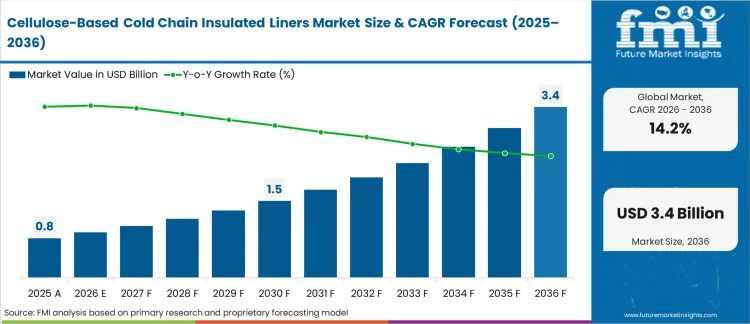
Cellulose‑Based Cold Chain Insulated Liners Market Key Takeaways
| Metric | Details |
|---|---|
| Industry Size (2026) | USD 0.9 billion |
| Industry Value (2036) | USD 3.4 billion |
| CAGR (2026-2036) | 14.2% |
Source: Future Market Insights (FMI) analysis, based on proprietary forecasting model and primary research.
This transition becomes self-sustaining only when major third-party logistics networks formally standardize single-stream recycling protocols across their primary hubs. Packaging procurement directors must secure guaranteed repulpability certification from waste management partners before integrating these liners into high-volume national fulfillment channels.
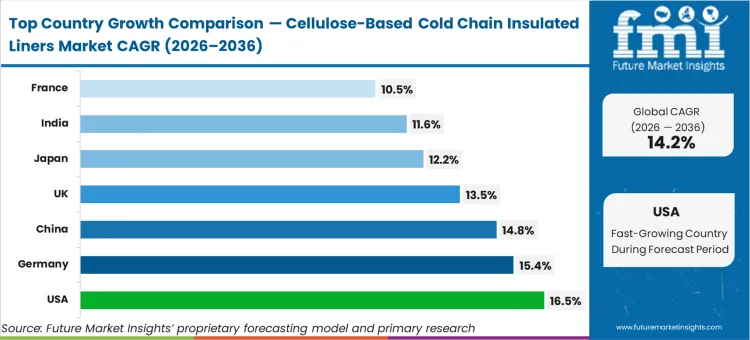
The United States advances at a 16.5% rate as the DSCSA modernization requires temperature-tracked nodes, triggering a massive phase-out of legacy EPS coolers across Tier-1 pharmaceutical distributors. Germany tracks at 15.4%, driven by the punitive taxes of the updated VerpackG legislation. China registers a 14.8% expansion as its pharmaceutical export sector aligns with European disposal standards. The UK grows at 13.5%, followed by Japan at 12.2%, India at 11.6%, and France at 10.5%. This pronounced geographic spread exists structurally because national waste management maturity directly dictates the financial viability of deploying certified repulpable materials.
Cellulose-Based Cold Chain Insulated Liners Market Definition
Cellulose-Based Cold Chain Insulated Liners encompass engineered, repulpable paper and fiber-based thermal barriers designed to maintain strict temperature profiles for perishable payloads during transit. These flexible or semi-rigid inserts replace legacy polymer-based insulators by providing equivalent thermal resistance while ensuring complete compatibility with standard municipal and commercial paper recycling streams.
Cellulose-Based Cold Chain Insulated Liners Market Inclusions
The market scope includes flat-packed corrugated fiber matrices, macerated paper pads, multi-layered kraft paper baffles, and compressed recycled newsprint panels utilized specifically for thermal insulation. Associated waterproof barrier coatings that do not inhibit repulpability and modular paper-based refrigerants packaged within the liner system are fully incorporated.
Cellulose-Based Cold Chain Insulated Liners Market Exclusions
Expanded polystyrene (EPS), polyurethane (PUR), and polyethylene (PE) foam coolers are explicitly excluded. Hybrid liners combining paper exteriors with non-repulpable polymer foam cores, standard non-insulating corrugated shipping boxes, and active refrigerated shipping containers fall outside the defined valuation parameters.
Cellulose-Based Cold Chain Insulated Liners Market Research Methodology
- Primary Research: FMI analysts engaged with biopharma logistics managers, food delivery network architects, and packaging procurement directors to map the cost crossover points triggering the shift away from EPS.
- Desk Research: The data collection phase aggregated compliance roadmaps from the European Commission's Packaging Directive (EU) 2024/2841, ISTA 7E certification registries, and pharmaceutical cold chain standards.
- Market-Sizing and Forecasting: The baseline derives from a bottom-up aggregation of repulpable liner shipment volumes, applying regional extended producer responsibility tax timelines to project substitution velocity.
- Data Validation and Update Cycle: Projections are cross-validated against the publicly reported sustainability cap-ex guidance of top global third-party logistics and pharmaceutical distribution conglomerates.
Segmental Analysis
Cellulose-Based Cold Chain Insulated Liners Market Analysis by Material Type
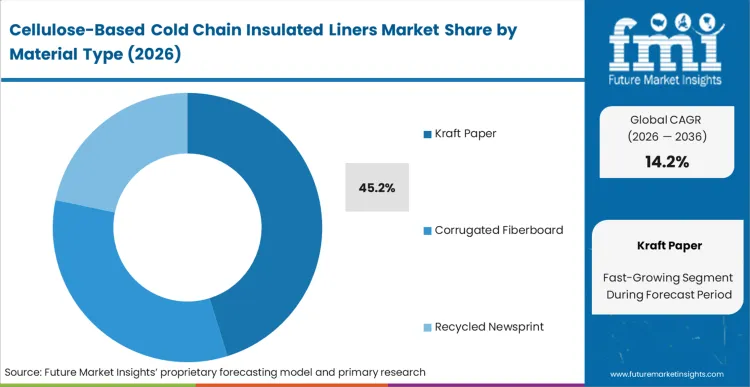
According to FMI's estimates, facilities transitioning to high-tensile kraft liners completely eliminate the need for internal plastic polybags previously used for moisture defense. Medical distributors relying on weaker fiber compositions face catastrophic temperature excursions when internal baffles disintegrate, leading to the immediate loss of sensitive biological shipments. Kraft Paper commands a dominant 45.2% share in 2026, reflecting the absolute requirement for structural integrity when resisting condensation during high-humidity transit lanes.
Standard recycled newsprint degrades rapidly when exposed to the inherent moisture generated by thawing gel packs, compromising the thermal barrier mid-shipment. Procurement specification leads designing durable multi-day shippers reject materials that cannot maintain rigid spacing around the payload. Kraft paper’s naturally longer fiber chains provide the necessary wet-strength to prevent structural collapse without relying on non-repulpable polymer coatings.
- Moisture Resistance: Long-chain kraft fibers naturally repel condensation buildup during extended transit cycles. Quality assurance directors specifying this material prevent structural collapse inside standard corrugated transit containers.
- Repulpability Profile: Pure kraft streams require zero chemical separation during the municipal recycling phase. Sustainability compliance officers deploying these liners bypass complex commercial waste auditing penalties.
- Tensile Integrity: High wet-strength prevents the insulating matrix from tearing when subjected to rough parcel handling. Facility managers utilizing these robust inserts drastically reduce the incidence of damaged goods claims.
Cellulose-Based Cold Chain Insulated Liners Market Analysis by Thickness
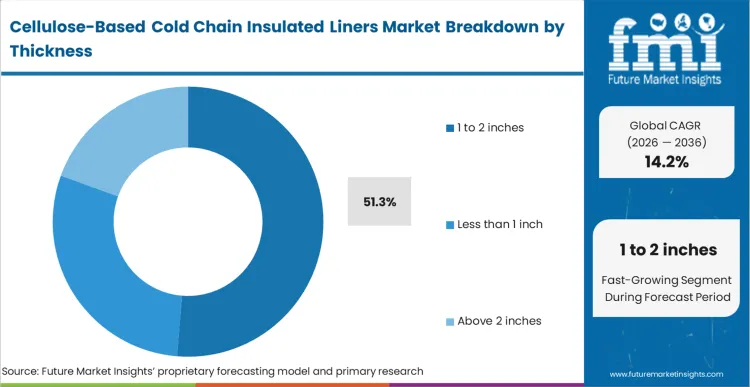
Utilizing insulation thicker than two inches dramatically increases the dimensional weight of the final parcel, eradicating any outbound shipping cost advantages. Plant automation leads must balance these opposing physical constraints when engineering standardized medical shipping modules. The exact operational gap between parcel weight limits and thermal duration forces the dominance of the 1 to 2 inches segment, expected to hold 51.3% share in 2026. Liners thinner than one inch physically cannot trap enough ambient air to sustain strict 2°C to 8°C profiles across 96-hour transit lanes, regardless of the fiber density employed. FMI analysts opine that flattening the thickness variance allows high-volume fulfillment centers to utilize uniform outer box sizes for multiple thermal payload profiles. Packaging engineers failing to optimize this specific thickness ratio incur massive dimensional freight surcharges that instantly erode their operational margins in the biopharmaceutical cold chain.
- Dimensional Optimization: Maintaining an exact 1.5-inch profile prevents parcel carriers from applying punitive oversized freight surcharges. Logistics coordinators standardizing this thickness protect thin margins on overnight expedited delivery routes.
- Thermal Bridging: Multi-layered fiber alignment within this specific thickness window successfully disrupts conductive heat transfer. Cold chain validation engineers rely on this precise depth to pass strict ISTA 7E regulatory audits.
- Storage Compression: Flat-packed liners in this dimension allow maximum pallet density prior to final assembly. Warehouse operators deploying these specific panels fit thousands of insulating units into racking bays that previously held mere hundreds of rigid coolers.
Cellulose-Based Cold Chain Insulated Liners Market Analysis by End Use
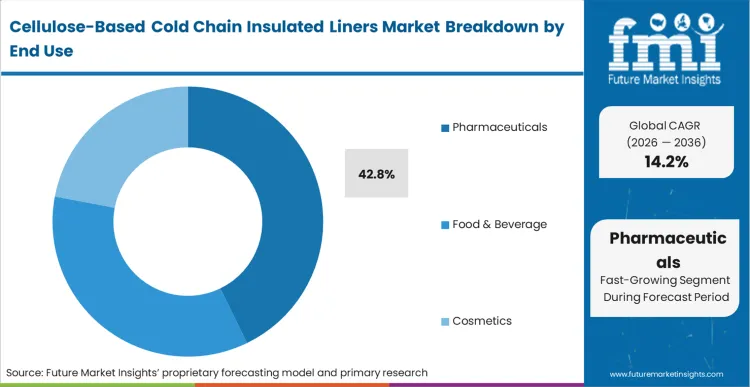
The impending enforcement of EPR taxes on medical logistics propels Pharmaceuticals to lead the market with a 42.8% share in 2026. Hospitals and clinical trial sites aggressively penalize distribution partners who deliver sensitive biologics in legacy EPS coolers, as medical facilities completely lack the specialized waste infrastructure required to process polymer foams. To secure highly lucrative national distribution contracts, Tier-1 biopharma logistics managers must deploy thermal packaging that hospital staff can discard directly into standard paper recycling bins. As per FMI's projection, the convergence of strict thermal hold requirements with zero-waste mandates forces the medical sector to absorb the higher unit cost of premium fiber liners. Supply chain directors attempting to service major healthcare networks with non-repulpable shippers face immediate disqualification during vendor procurement audits, permanently losing access to these critical accounts.
- Waste Simplification: Direct disposal into standard municipal paper streams eliminates the need for expensive secondary waste retrieval contracts. Clinical trial administrators demanding these meal kit delivery formats streamline their onsite refuse management protocols.
- Compliance Verification: Documented single-stream repulpability satisfies the strict environmental auditing criteria of modern healthcare networks. Enterprise pharmaceutical distributors utilizing certified fiber matrices automatically clear preliminary supplier qualification gates.
- Payload Protection: Engineered baffles securely cradle fragile glass vials while simultaneously providing thermal resistance. Fulfillment center managers incorporating these dual-purpose inserts eliminate the need for supplementary bubble wrap or void fill materials.
Cellulose-Based Cold Chain Insulated Liners Market Drivers, Restraints, and Opportunities
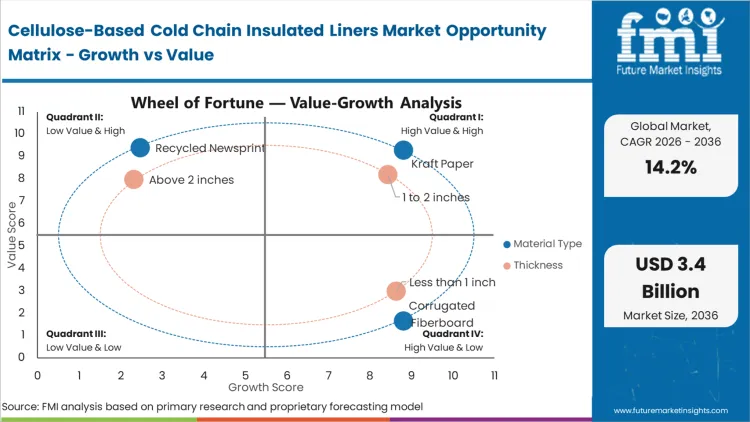
The European Union Packaging Directive (EU) 2024/2841, paired with escalating extended producer responsibility (EPR) taxes, forces Tier-1 biopharma logistics managers to completely abandon multi-material EPS coolers. This regulatory mechanism directly penalizes the use of non-repulpable insulators, transforming previously cheap foam boxes into a massive tax liability. Asset owners upgrading distribution networks face a strict binary choice between absorbing crippling disposal fees or overhauling their entire packaging inventory. Transitioning to certified cellulose-based liners bypasses these punitive waste tariffs entirely. Procurement directors who fail to secure repulpable thermal packaging risk immediate disqualification from major fulfillment tenders and severe commercial disadvantages on high-volume distribution routes.
The intricate engineering required to achieve moisture resistance without utilizing non-repulpable polymer coatings creates a severe technical restraint for fiber packaging manufacturers. Standard recycled paper degrades rapidly when exposed to the heavy condensation generated by thawing refrigerants, compromising the thermal barrier mid-shipment. While material scientists experiment with organic wax emulsions to repel water, these specialized coatings drastically increase the final unit cost, making the resulting liners economically unviable for low-margin food delivery applications. This cost-performance gap restricts adoption in price-sensitive sectors.
Opportunities in the Cellulose-Based Cold Chain Insulated Liners Market
- Integrated Box Plant Production: Advanced corrugated manufacturing lines enable plant engineers to embed insulating fiber matrices directly between the fluting layers during initial fabrication. Corrugated suppliers deploying this capability capture massive margin by eliminating the secondary assembly steps entirely.
- Automated Dispensing Integration: Next-generation fulfillment systems allow automated warehouse robotics to cut and dispense wrap-around cellulose roll stock dynamically based on real-time 3D payload scanning. Fulfillment center operators implementing this automation drastically reduce labor costs and completely eliminate pre-formed box SKUs.
- Repulpable Hydrophobic Barriers: Upgraded organic barrier formulas permit chemical engineers to block condensation without disrupting the downstream municipal recycling process. Material scientists licensing this specific technology secure exclusive vendor status with major pharmaceutical distributors operating in high-humidity transit lanes.
Regional Analysis
Based on the regional analysis, the Cellulose-Based Cold Chain Insulated Liners Market is segmented into North America, Latin America, Europe, East Asia, South Asia, Oceania, and Middle East & Africa across 40 plus countries.
.webp "Top Country Growth Comparison Cellulose Based Cold Chain Insulated Liners Market Cagr (2026 2036)")
| Country | CAGR (2026 to 2036) |
|---|---|
| USA | 16.5% |
| Germany | 15.4% |
| China | 14.8% |
| UK | 13.5% |
| Japan | 12.2% |
| India | 11.6% |
| France | 10.5% |
Source: Future Market Insights (FMI) analysis, based on proprietary forecasting model and primary research
North America Cellulose-Based Cold Chain Insulated Liners Market Analysis
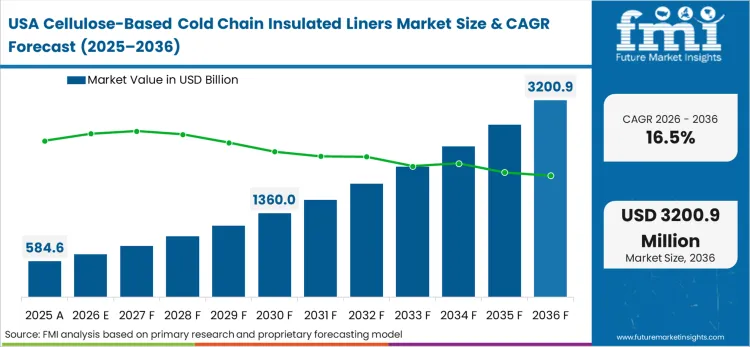
Upgrading this core infrastructure provides the necessary physical consistency to support pharmaceutical track and trace compliance. The Drug Supply Chain Security Act (DSCSA) modernization requires highly controlled, temperature-tracked nodes across every stage of distribution, forcing Tier-1 pharmaceutical networks to standardize their external packaging for uniform sensor placement. Facility directors recognize that maintaining outdated EPS blocks severely limits their ability to automate high-speed scanning systems. Specific nationwide delivery mandates and serial traceability requirements drive the North American transition away from unmanageable legacy foam architectures. Based on FMI's assessment, this modernization directly enables facilities to deploy flat-packed, uniform cellulose modules that seamlessly integrate with automated label applicators.
- USA: Expanding at a 16.5% CAGR between 2026 and 2036, the market is undergoing a massive structural shift. The DSCSA modernization requires Tier-1 pharmaceutical distributors to implement strict temperature-tracked nodes, triggering a massive phase-out of physically inconsistent legacy EPS coolers. Widespread auditing by the FDA confirms this aggressive shift toward standardized, predictable shipper profiles. This specific traceability requirement forces packaging procurement leads to deploy precision-cut fiber liners that reliably accommodate embedded temperature loggers without warping. Logistics directors who ignore these dimensional requirements face severe commercial disadvantages as their non-standard packages consistently jam automated compliance scanning arrays.
FMI's report includes comprehensive evaluation of Canada and Mexico. The integration of cross-border biological testing networks across these nations requires standardized cold chain protocols to guarantee uncompromised sample integrity during customs delays.
Europe Cellulose-Based Cold Chain Insulated Liners Market Analysis
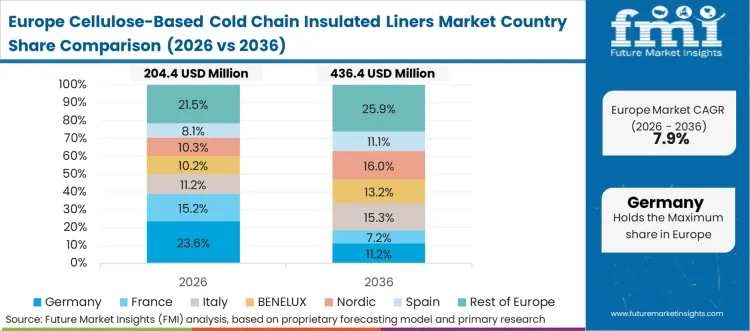
This regulatory environment forces the rapid adoption of certified cellulose liners to guarantee thermal stability while entirely avoiding punitive end-of-life disposal tariffs. Upgrading to these certified matrices provides the necessary environmental compliance to support advanced sustainable commercial distribution. The updated VerpackG legislation and the overarching EU Packaging Directive penalize the continued operation of highly polluting, mixed-material shipping operations across the continent. The transition requires a complete overhaul of existing procurement topologies, shifting from cheap EPS sourcing to heavily audited paper-based supply chains. Logistics directors redesigning legacy distribution lanes must integrate fully repulpable thermal barriers to align with aggressive extended producer responsibility tax frameworks.
- Germany: Germany's updated Packaging Act imposes punitive extended producer responsibility taxes strictly on mixed-material EPS coolers, devastating the margins of traditional cold chain operators. Routine auditing by the Central Agency Packaging Register confirms this aggressive shift away from non-repulpable insulators. The sector sustains a 15.4% CAGR to 2036. This specific tax structure forces biopharma logistics managers to immediately adopt certified cellulose alternatives to maintain operational cost parity. Supply chain directors who attempt to retain legacy foam face immediate financial penalties that entirely consume their outbound shipping margins.
- UK: This fiscal pressure compels network architects to strip out all polymer-based insulators in favor of flat-packed corrugated matrices. The post-Brexit plastic packaging tax in the United Kingdom requires meal kit delivery networks to utilize materials containing extreme levels of recycled or repulpable content. Delivery service operators ignoring these material taxes suffer massive subscriber attrition as environmentally conscious consumers actively boycott bulky foam unboxing experiences. Corporate sustainability reporting actively tracks this transition away from complex waste generation. The market tracks 13.5% CAGR to 2036.
- France: The nation is projected at 10.5% CAGR over the forecast period. Major commercial food exporters in France face severe cross-border waste tariffs when shipping perishable gourmet goods into neighboring highly-regulated retail markets. This trade constraint forces specialty procurement leads to deploy moisture-resistant cellulose baffles that guarantee universal recycling compliance upon arrival. Retailer vendor-qualification protocols strictly enforce these sustainable packaging mandates. Export directors failing to secure compliant repulpable shippers lose direct access to lucrative premium supermarket shelf placements across the European trading bloc.
FMI's report includes thorough investigation of Italy, Spain, and the Nordics. A prevailing structural condition across these nations is the mandatory compliance with strict municipal sorting directives, forcing asset owners to deploy liners that require zero end-user disassembly.
Asia Pacific Cellulose-Based Cold Chain Insulated Liners Market Analysis
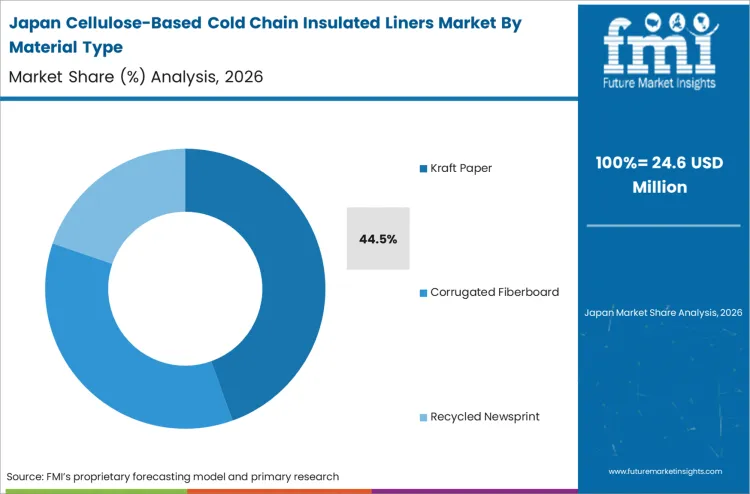
Constrained municipal waste management systems physically cannot process the massive influx of rigid foam generated by the booming e-commerce grocery sector. In FMI's view, this severe volumetric bottleneck entirely eliminates the long-term viability of polymer coolers in densely populated megacities. The precise space limitations of individual nations dictate the rapid implementation parameters for these flat-packed repulpable technologies. Specific physical infrastructure constraints and intense urban density dictate the transition away from bulky EPS packaging across major eastern commercial centers. By building single-stream paper disposal capabilities into their outbound logistics, regional asset owners establish highly flexible delivery environments capable of rapid scaling without triggering municipal waste bans.
- China: International customs documentation heavily scrutinizes the recyclability profiles of these incoming medical containers. China's pharmaceutical export sector aligns aggressively with stringent European disposal standards to maintain its dominance in global active pharmaceutical ingredient supply chains. The sector is anchored to a 14.8% CAGR through the decade. This regulatory alignment requires process engineers to deploy universally recognized repulpable fiber shippers for all temperature-sensitive outbound freight. Export directors failing to utilize certified cellulose packaging face devastating shipments rejections at major European ports of entry.
- Japan: Constrained urban waste management systems in Japan structurally reject the massive volumetric footprint of rigid EPS coolers generated by booming direct-to-consumer seafood logistics. This severe physical limitation forces domestic fulfillment center managers to utilize ultra-thin, flat-packed corrugated liners that consumers can easily fold into municipal paper recycling bins. Local government waste separation audits stringently penalize operations relying on bulky foam. E-commerce operators retaining rigid insulation completely lose access to premium residential delivery routes due to overwhelming consumer disposal complaints. Growth is projected at a 12.2% CAGR value through to 2036.
- India: The market is advancing at a 11.6% CAGR through to 2036. Investment in localized paper recycling infrastructure heavily subsidizes this aggressive packaging transition. The rapid expansion of India's organized grocery delivery networks operates under strict new national mandates targeting single-use plastic elimination. This policy framework forces supply chain planners to completely bypass legacy foam and immediately deploy compressed recycled newsprint panels for short-haul perishable transit. Logistics startups unable to demonstrate fully repulpable delivery mechanisms forfeit critical operational licenses from regional environmental control boards.
FMI's report includes extensive coverage of South Korea, Australia, and the broader ASEAN region. A primary trend shaping these nations is the rapid localization of specialty paper milling, forcing regional contract packagers to deploy native fiber architectures to satisfy stringent brand traceability requirements.
Competitive Aligners for Market Players
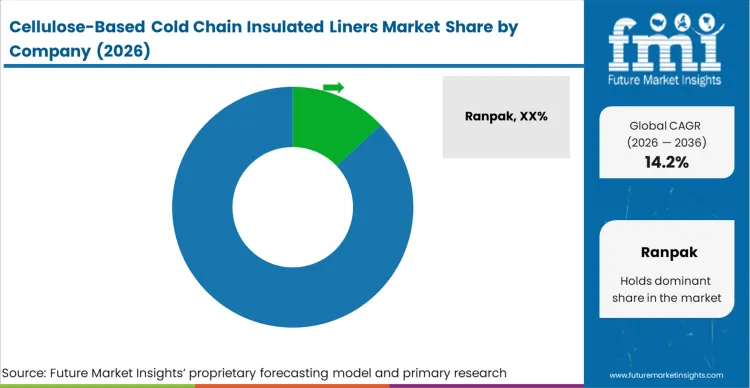
Procurement teams completely re-evaluating thermal packaging now demand verified ISTA 7E certification as the absolute baseline competitive variable, instantly disqualifying localized converters that rely on untested or inconsistent materials. This strict qualification threshold keeps the cellulose-based cold chain packaging sector moderately consolidated. Achieving the necessary 96-hour thermal performance entirely depends on vast capital intensity, specifically, the ownership of primary paper mills and specialized corrugating equipment capable of manipulating dense fiber matrices at high speeds without compromising material integrity.
Global packaging conglomerates like Mondi Group, Smurfit Westrock, and International Paper dominate this landscape by leveraging their massive internal supply chains to guarantee consistent, certified repulpability across multi-regional distribution lanes. By blanketing their product lines with these verified testing credentials, these incumbents secure the most lucrative pharmaceutical tenders, leaving smaller independent players unable to compete on the required scale or compliance level.
Embedding insulating fiber matrices directly into the corrugated board during the initial fabrication stage provides a massive structural advantage that is exceedingly difficult to replicate. Integrated manufacturers such as DS Smith aggressively pursue this inline production capability, allowing them to completely eliminate the expensive secondary assembly steps that traditionally plague standard converters. Similarly, specialized innovators like Ranpak, TemperPack, and Sealed Air secure distinct market positions by engineering proprietary, high-performance fiber configurations that natively trap air without adding dimensional weight.
A challenger attempting to disrupt this established hierarchy must invest heavily in custom corrugator wet-ends and specialized die-cutting machinery capable of handling dense specialty paper grades at commercial speeds. For new entrants, the practical implication is severe: without securing this integrated manufacturing footprint and advanced material science capability, they simply cannot match the per-unit economics required to win high-volume meal kit delivery contracts.
Large third-party logistics providers actively combat this concentration of power by mandating open-source dimensional standards and multi-vendor qualification programs for all their thermal consumables. While major packaging conglomerates continuously push proprietary, patented fiber formulations to secure exclusive, long-term supply agreements, enterprise buyers systematically counter this strategy. Procurement directors insist on validating exact thermal and physical specifications that multiple regional converters can theoretically fulfill, effectively commoditizing custom liner designs.
This inherent structural tension severely limits pricing power even within a highly concentrated supplier base, as massive fulfillment networks refuse to be locked into a single-source dependency for mission-critical medical shippers. Approaching 2036, the competitive trajectory points toward even tighter consolidation as capital-intensive warehouse automation, specifically dynamic inline cutting and automated dispensing systems, forces smaller, manual converters completely out of the Tier-1 distribution ecosystem, leaving only the most capitalized players.
Key Players in Cellulose-Based Cold Chain Insulated Liners Market
- Ranpak
- Mondi Group
- DS Smith
- International Paper
- TemperPack
- Sealed Air
- Smurfit Westrock
Scope of the Report
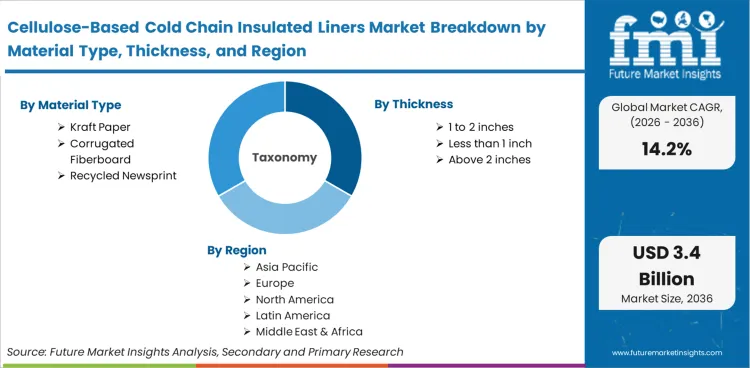
| Metric | Value |
|---|---|
| Quantitative Units | USD 0.9 billion to USD 3.4 billion, at a CAGR of 14.2% |
| Market Definition | Cellulose-Based Cold Chain Insulated Liners encompass engineered, repulpable paper and fiber-based thermal barriers designed to maintain strict temperature profiles for perishable payloads during transit. |
| Material Type Segmentation | Kraft Paper, Corrugated Fiberboard, Recycled Newsprint |
| Thickness Segmentation | Less than 1 inch, 1 to 2 inches, Above 2 inches |
| End Use Segmentation | Pharmaceuticals, Food & Beverage, Cosmetics |
| Regions Covered | North America, Latin America, Europe, East Asia, South Asia, Oceania, Middle East & Africa |
| Countries Covered | USA, Germany, China, UK, Japan, India, France, and 40 plus countries |
| Key Companies Profiled | Ranpak, Mondi Group, DS Smith, International Paper, TemperPack, Sealed Air, Smurfit Westrock |
| Forecast Period | 2026 to 2036 |
| Approach | The baseline value derives from a bottom-up aggregation of repulpable liner shipment volumes, applying regional extended producer responsibility tax timelines to project substitution velocity. |
Source: Future Market Insights (FMI) analysis, based on proprietary forecasting model and primary research
Cellulose-Based Cold Chain Insulated Liners Market Segments
Material Type:
- Kraft Paper
- Corrugated Fiberboard
- Recycled Newsprint
Thickness:
- Less than 1 inch
- 1 to 2 inches
- Above 2 inches
End Use:
- Pharmaceuticals
- Food & Beverage
- Cosmetics
Regions:
- North America
- United States
- Canada
- Latin America
- Brazil
- Mexico
- Europe
- Germany
- United Kingdom
- France
- Italy
- Spain
- Asia-Pacific
- China
- Japan
- South Korea
- India
- Rest of Asia-Pacific
- Australia
- Middle East & Africa
- South Africa
- GCC Countries
Bibliography
- Mondi Group. (2024, May 10). Sustainable Cold Chain Solutions: Replacing EPS with High-Performance Kraft Matrices.
- German Environment Agency (UBA). (2024, June). Extended Producer Responsibility and the VerpackG Amendments for Multi-Material Packaging.
- Fibre Box Association. (2024, September). Corrugated Recyclability Standards for Cold Chain Insulators.
- European Paper Packaging Alliance. (2024, November). Life Cycle Assessment of Fiber-Based Thermal Shippers vs Expanded Polystyrene.
- BSI Group. (2024, July). BS EN 13427:2024 - Packaging. Requirements for the use of European Standards in the field of packaging and packaging waste.
This bibliography is provided for reader reference. The full FMI report contains the complete reference list with primary source documentation.
This Report Addresses
- Market intelligence to support strategic decision making across engineered repulpable fiber matrices and modular corrugated thermal barriers unique to this market
- Market size estimation and 10-year revenue forecasts from 2026 to 2036, supported by extended producer responsibility tax timelines and verified ISTA 7E certification registries
- Growth opportunity mapping across specific Thickness categories with emphasis on the standardization of single-stream recycling protocols across primary logistics hubs
- Segment and regional revenue forecasts covering Kraft Paper and Pharmaceuticals sub-segments across heavily regulated European and North American cold chain frameworks
- Competition strategy assessment including integrated corrugator production capabilities, repulpability certifications, and automated dispensing machine compatibility
- Product development tracking including hydrophobic organic barrier coatings, specialized die-cutting formats, and multi-layered thermal bridging mitigation frameworks discussed in this article
- Market access analysis covering Tier-1 biopharma distribution channels, national EPR tax compliance pathways, and meal kit delivery procurement networks
- Market report delivery in PDF, Excel, PPT, and interactive dashboard formats for executive strategy, packaging sustainability planning, and operational benchmarking use
Frequently Asked Questions
How large is the Cellulose-Based Cold Chain Insulated Liners Market in 2026?
The market is valued at USD 0.9 billion as logistics directors aggressively shift away from EPS coolers to eliminate punitive extended producer responsibility taxes.
What will it be valued at by 2036?
The total opportunity reaches USD 3.4 billion driven by the absolute necessity of integrating flat-packed repulpable panels to reclaim vital warehouse floor space.
What CAGR is projected?
A 14.2% CAGR is projected as engineered fiber matrices achieve formal thermal certification parity with legacy polymer foams across strict 96-hour transit lanes.
Which Material Type segment leads?
Kraft Paper holds a 45.2% share because its long-chain fiber structure provides the critical wet-strength required to resist condensation during high-humidity shipments.
Which Thickness segment leads?
The 1 to 2 inches segment commands the market by precisely balancing necessary thermal isolation with maximum parcel dimensional efficiency to avoid freight surcharges.
Which End Use segment leads?
Pharmaceuticals leads adoption due to strict hospital network demands for single-stream disposable packaging that requires zero secondary waste separation.
What drives rapid growth?
Escalating European packaging taxes strictly penalize multi-material EPS coolers, forcing high-volume distribution centers to mandate certified repulpable alternatives.
What is the primary restraint?
The technical difficulty of formulating organic moisture-resistant coatings without compromising municipal recycling compatibility drastically increases unit manufacturing costs.
Which country grows fastest?
The USA advances at a 16.5% CAGR as federal track-and-trace mandates force medical distributors to standardize their external shipping infrastructure.
What specific regulatory framework forces this transition?
The European Union Packaging Directive (EU) 2024/2841 strictly enforces financial penalties on non-circular shipping consumables.
What specific technology is being replaced?
Rigid Expanded Polystyrene (EPS) and Polyurethane (PUR) foam coolers are systematically failing to meet modern logistics storage density constraints.
How do top players compete?
Dominant packaging conglomerates leverage their vast primary milling capital to embed insulating matrices directly into corrugated board during initial fabrication.
What is the growth outlook for Germany?
Germany tracks at 15.4% as the updated VerpackG legislation imposes severe disposal tariffs on traditional medical logistics operators.
Why is China expanding rapidly?
China grows at 14.8% because its massive active pharmaceutical export sector must perfectly align with European recycling mandates to prevent customs rejections.
How is the UK market performing?
The UK expands at 13.5% driven by severe consumer unboxing backlash that forces meal kit providers to strip out all polymer-based insulators.
What structural force defines the Japanese market?
Japan registers a 12.2% CAGR due to constrained urban waste management systems that physically reject the massive volumetric footprint of rigid foam.
What drives demand in India?
India advances at 11.6% as new national single-use plastic mandates compel rapid adoption of compressed newsprint panels for perishable grocery transit.
How is France responding to new regulations?
France grows at 10.5% as specialty food exporters deploy moisture-resistant cellulose baffles to bypass cross-border waste tariffs into neighboring retail markets.
What specific warehouse advantage does cellulose provide?
Flat-packed fiber modules fit thousands of units into racking bays that previously held only hundreds of empty EPS coolers, drastically reducing inbound freight costs.
What certification defines commercial viability?
Securing ISTA 7E 96-hour temperature hold validation is the absolute prerequisite for entering the high-margin biopharmaceutical distribution sector.
What role does automation play moving forward?
Next-generation robotic fulfillment lines will dynamically cut and dispense roll-stock fiber insulation, eliminating the need for pre-formed box SKUs entirely.
How do buyers prevent vendor lock-in?
Enterprise logistics providers mandate open-source dimensional specifications, allowing multiple regional converters to bid on massive thermal packaging contracts.
Preview the report firsthand - request a free sample
Get SampleGet the brochure for pricing and purchase details.
Get PDFTable of Content
- Executive Summary
- Global Market Outlook
- Demand-side Trends
- Supply-side Trends
- Technology Roadmap Analysis
- Analysis and Recommendations
- Market Overview
- Market Coverage / Taxonomy
- Market Definition / Scope / Limitations
- Research Methodology
- Chapter Orientation
- Analytical Lens and Working Hypotheses
- Market Structure, Signals, and Trend Drivers
- Benchmarking and Cross-market Comparability
- Market Sizing, Forecasting, and Opportunity Mapping
- Research Design and Evidence Framework
- Desk Research Programme (Secondary Evidence)
- Company Annual and Sustainability Reports
- Peer-reviewed Journals and Academic Literature
- Corporate Websites, Product Literature, and Technical Notes
- Earnings Decks and Investor Briefings
- Statutory Filings and Regulatory Disclosures
- Technical White Papers and Standards Notes
- Trade Journals, Industry Magazines, and Analyst Briefs
- Conference Proceedings, Webinars, and Seminar Materials
- Government Statistics Portals and Public Data Releases
- Press Releases and Reputable Media Coverage
- Specialist Newsletters and Curated Briefings
- Sector Databases and Reference Repositories
- FMI Internal Proprietary Databases and Historical Market Datasets
- Subscription Datasets and Paid Sources
- Social Channels, Communities, and Digital Listening Inputs
- Additional Desk Sources
- Expert Input and Fieldwork (Primary Evidence)
- Primary Modes
- Qualitative Interviews and Expert Elicitation
- Quantitative Surveys and Structured Data Capture
- Blended Approach
- Why Primary Evidence is Used
- Field Techniques
- Interviews
- Surveys
- Focus Groups
- Observational and In-context Research
- Social and Community Interactions
- Stakeholder Universe Engaged
- C-suite Leaders
- Board Members
- Presidents and Vice Presidents
- R&D and Innovation Heads
- Technical Specialists
- Domain Subject-matter Experts
- Scientists
- Physicians and Other Healthcare Professionals
- Governance, Ethics, and Data Stewardship
- Research Ethics
- Data Integrity and Handling
- Primary Modes
- Tooling, Models, and Reference Databases
- Desk Research Programme (Secondary Evidence)
- Data Engineering and Model Build
- Data Acquisition and Ingestion
- Cleaning, Normalisation, and Verification
- Synthesis, Triangulation, and Analysis
- Quality Assurance and Audit Trail
- Market Background
- Market Dynamics
- Drivers
- Restraints
- Opportunity
- Trends
- Scenario Forecast
- Demand in Optimistic Scenario
- Demand in Likely Scenario
- Demand in Conservative Scenario
- Opportunity Map Analysis
- Product Life Cycle Analysis
- Supply Chain Analysis
- Investment Feasibility Matrix
- Value Chain Analysis
- PESTLE and Porter’s Analysis
- Regulatory Landscape
- Regional Parent Market Outlook
- Production and Consumption Statistics
- Import and Export Statistics
- Market Dynamics
- Global Market Analysis 2021 to 2025 and Forecast, 2026 to 2036
- Historical Market Size Value (USD Million) Analysis, 2021 to 2025
- Current and Future Market Size Value (USD Million) Projections, 2026 to 2036
- Y-o-Y Growth Trend Analysis
- Absolute $ Opportunity Analysis
- Global Market Pricing Analysis 2021 to 2025 and Forecast 2026 to 2036
- Global Market Analysis 2021 to 2025 and Forecast 2026 to 2036, By Material Type
- Introduction / Key Findings
- Historical Market Size Value (USD Million) Analysis By Material Type , 2021 to 2025
- Current and Future Market Size Value (USD Million) Analysis and Forecast By Material Type , 2026 to 2036
- Kraft Paper
- Corrugated Fiberboard
- Recycled Newsprint
- Kraft Paper
- Y-o-Y Growth Trend Analysis By Material Type , 2021 to 2025
- Absolute $ Opportunity Analysis By Material Type , 2026 to 2036
- Global Market Analysis 2021 to 2025 and Forecast 2026 to 2036, By Thickness
- Introduction / Key Findings
- Historical Market Size Value (USD Million) Analysis By Thickness, 2021 to 2025
- Current and Future Market Size Value (USD Million) Analysis and Forecast By Thickness, 2026 to 2036
- 1 to 2 inches
- Less than 1 inch
- Above 2 inches
- 1 to 2 inches
- Y-o-Y Growth Trend Analysis By Thickness, 2021 to 2025
- Absolute $ Opportunity Analysis By Thickness, 2026 to 2036
- Global Market Analysis 2021 to 2025 and Forecast 2026 to 2036, By End Use
- Introduction / Key Findings
- Historical Market Size Value (USD Million) Analysis By End Use, 2021 to 2025
- Current and Future Market Size Value (USD Million) Analysis and Forecast By End Use, 2026 to 2036
- Pharmaceuticals
- Food & Beverage
- Cosmetics
- Pharmaceuticals
- Y-o-Y Growth Trend Analysis By End Use, 2021 to 2025
- Absolute $ Opportunity Analysis By End Use, 2026 to 2036
- Global Market Analysis 2021 to 2025 and Forecast 2026 to 2036, By Region
- Introduction
- Historical Market Size Value (USD Million) Analysis By Region, 2021 to 2025
- Current Market Size Value (USD Million) Analysis and Forecast By Region, 2026 to 2036
- North America
- Latin America
- Western Europe
- Eastern Europe
- East Asia
- South Asia and Pacific
- Middle East & Africa
- Market Attractiveness Analysis By Region
- North America Market Analysis 2021 to 2025 and Forecast 2026 to 2036, By Country
- Historical Market Size Value (USD Million) Trend Analysis By Market Taxonomy, 2021 to 2025
- Market Size Value (USD Million) Forecast By Market Taxonomy, 2026 to 2036
- By Country
- USA
- Canada
- Mexico
- By Material Type
- By Thickness
- By End Use
- By Country
- Market Attractiveness Analysis
- By Country
- By Material Type
- By Thickness
- By End Use
- Key Takeaways
- Latin America Market Analysis 2021 to 2025 and Forecast 2026 to 2036, By Country
- Historical Market Size Value (USD Million) Trend Analysis By Market Taxonomy, 2021 to 2025
- Market Size Value (USD Million) Forecast By Market Taxonomy, 2026 to 2036
- By Country
- Brazil
- Chile
- Rest of Latin America
- By Material Type
- By Thickness
- By End Use
- By Country
- Market Attractiveness Analysis
- By Country
- By Material Type
- By Thickness
- By End Use
- Key Takeaways
- Western Europe Market Analysis 2021 to 2025 and Forecast 2026 to 2036, By Country
- Historical Market Size Value (USD Million) Trend Analysis By Market Taxonomy, 2021 to 2025
- Market Size Value (USD Million) Forecast By Market Taxonomy, 2026 to 2036
- By Country
- Germany
- UK
- Italy
- Spain
- France
- Nordic
- BENELUX
- Rest of Western Europe
- By Material Type
- By Thickness
- By End Use
- By Country
- Market Attractiveness Analysis
- By Country
- By Material Type
- By Thickness
- By End Use
- Key Takeaways
- Eastern Europe Market Analysis 2021 to 2025 and Forecast 2026 to 2036, By Country
- Historical Market Size Value (USD Million) Trend Analysis By Market Taxonomy, 2021 to 2025
- Market Size Value (USD Million) Forecast By Market Taxonomy, 2026 to 2036
- By Country
- Russia
- Poland
- Hungary
- Balkan & Baltic
- Rest of Eastern Europe
- By Material Type
- By Thickness
- By End Use
- By Country
- Market Attractiveness Analysis
- By Country
- By Material Type
- By Thickness
- By End Use
- Key Takeaways
- East Asia Market Analysis 2021 to 2025 and Forecast 2026 to 2036, By Country
- Historical Market Size Value (USD Million) Trend Analysis By Market Taxonomy, 2021 to 2025
- Market Size Value (USD Million) Forecast By Market Taxonomy, 2026 to 2036
- By Country
- China
- Japan
- South Korea
- By Material Type
- By Thickness
- By End Use
- By Country
- Market Attractiveness Analysis
- By Country
- By Material Type
- By Thickness
- By End Use
- Key Takeaways
- South Asia and Pacific Market Analysis 2021 to 2025 and Forecast 2026 to 2036, By Country
- Historical Market Size Value (USD Million) Trend Analysis By Market Taxonomy, 2021 to 2025
- Market Size Value (USD Million) Forecast By Market Taxonomy, 2026 to 2036
- By Country
- India
- ASEAN
- Australia & New Zealand
- Rest of South Asia and Pacific
- By Material Type
- By Thickness
- By End Use
- By Country
- Market Attractiveness Analysis
- By Country
- By Material Type
- By Thickness
- By End Use
- Key Takeaways
- Middle East & Africa Market Analysis 2021 to 2025 and Forecast 2026 to 2036, By Country
- Historical Market Size Value (USD Million) Trend Analysis By Market Taxonomy, 2021 to 2025
- Market Size Value (USD Million) Forecast By Market Taxonomy, 2026 to 2036
- By Country
- Kingdom of Saudi Arabia
- Other GCC Countries
- Turkiye
- South Africa
- Other African Union
- Rest of Middle East & Africa
- By Material Type
- By Thickness
- By End Use
- By Country
- Market Attractiveness Analysis
- By Country
- By Material Type
- By Thickness
- By End Use
- Key Takeaways
- Key Countries Market Analysis
- USA
- Pricing Analysis
- Market Share Analysis, 2025
- By Material Type
- By Thickness
- By End Use
- Canada
- Pricing Analysis
- Market Share Analysis, 2025
- By Material Type
- By Thickness
- By End Use
- Mexico
- Pricing Analysis
- Market Share Analysis, 2025
- By Material Type
- By Thickness
- By End Use
- Brazil
- Pricing Analysis
- Market Share Analysis, 2025
- By Material Type
- By Thickness
- By End Use
- Chile
- Pricing Analysis
- Market Share Analysis, 2025
- By Material Type
- By Thickness
- By End Use
- Germany
- Pricing Analysis
- Market Share Analysis, 2025
- By Material Type
- By Thickness
- By End Use
- UK
- Pricing Analysis
- Market Share Analysis, 2025
- By Material Type
- By Thickness
- By End Use
- Italy
- Pricing Analysis
- Market Share Analysis, 2025
- By Material Type
- By Thickness
- By End Use
- Spain
- Pricing Analysis
- Market Share Analysis, 2025
- By Material Type
- By Thickness
- By End Use
- France
- Pricing Analysis
- Market Share Analysis, 2025
- By Material Type
- By Thickness
- By End Use
- India
- Pricing Analysis
- Market Share Analysis, 2025
- By Material Type
- By Thickness
- By End Use
- ASEAN
- Pricing Analysis
- Market Share Analysis, 2025
- By Material Type
- By Thickness
- By End Use
- Australia & New Zealand
- Pricing Analysis
- Market Share Analysis, 2025
- By Material Type
- By Thickness
- By End Use
- China
- Pricing Analysis
- Market Share Analysis, 2025
- By Material Type
- By Thickness
- By End Use
- Japan
- Pricing Analysis
- Market Share Analysis, 2025
- By Material Type
- By Thickness
- By End Use
- South Korea
- Pricing Analysis
- Market Share Analysis, 2025
- By Material Type
- By Thickness
- By End Use
- Russia
- Pricing Analysis
- Market Share Analysis, 2025
- By Material Type
- By Thickness
- By End Use
- Poland
- Pricing Analysis
- Market Share Analysis, 2025
- By Material Type
- By Thickness
- By End Use
- Hungary
- Pricing Analysis
- Market Share Analysis, 2025
- By Material Type
- By Thickness
- By End Use
- Kingdom of Saudi Arabia
- Pricing Analysis
- Market Share Analysis, 2025
- By Material Type
- By Thickness
- By End Use
- Turkiye
- Pricing Analysis
- Market Share Analysis, 2025
- By Material Type
- By Thickness
- By End Use
- South Africa
- Pricing Analysis
- Market Share Analysis, 2025
- By Material Type
- By Thickness
- By End Use
- USA
- Market Structure Analysis
- Competition Dashboard
- Competition Benchmarking
- Market Share Analysis of Top Players
- By Regional
- By Material Type
- By Thickness
- By End Use
- Competition Analysis
- Competition Deep Dive
- Ranpak
- Overview
- Product Portfolio
- Profitability by Market Segments (Product/Age /Sales Channel/Region)
- Sales Footprint
- Strategy Overview
- Marketing Strategy
- Product Strategy
- Channel Strategy
- Mondi Group
- DS Smith
- International Paper
- TemperPack
- Sealed Air
- Ranpak
- Competition Deep Dive
- Assumptions & Acronyms Used


