

- Industry Size (2026)
- USD 18.9 Bn
- Forecast (2036)
- USD 31.1 Bn
- CAGR (2026 to 2036)
- 5.1%
Specialty Paper Market Forecast and Outlook 2026 to 2036
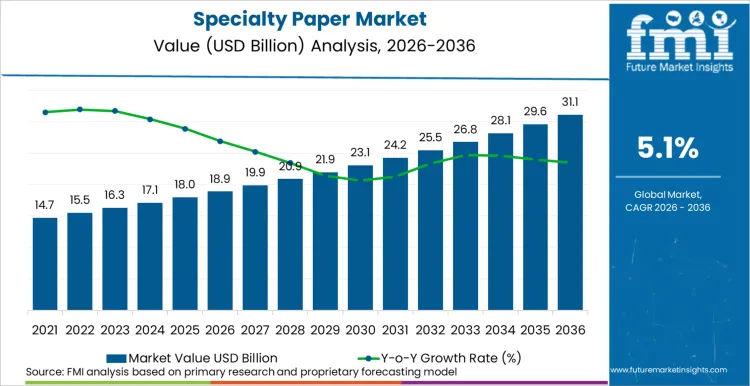
Specialty paper market is poised to reach USD 18.9 billion in 2026, driven by global shifts toward sustainable alternatives for single-use plastics. The industry is projected to expand at a steady CAGR of 5.1% through 2036, pushing total sector worth beyond USD 31.1 billion by the conclusion of this assessment period. Escalating demand for high-performance cellulose substrates in food service and industrial applications acts as a primary catalyst for this financial trajectory as per FMI's projection.
Manufacturers are channeling significant capital into developing biodegradable barrier coatings, aiming to meet stringent environmental regulations without compromising functionality. Brands are shifting focus from fossil-fuel-based packaging to renewable fiber solutions, redefining procurement habits in major consumer goods economies. Such behavioral changes encourage paper mills to introduce comprehensive functional product portfolios utilizing advanced chemical treatments.
E-commerce proliferation and changing hygiene standards are significantly influencing industry expansion. Packaging engineers emphasize material robustness, utilizing lightweight kraft and thermal grades to ensure shipping efficiency as per FMI's estimates. Clinical trials investigating the safety of direct-food-contact papers are creating needs for certified high-purity pulp, instilling confidence among regulators regarding future product pipelines.
Quick Stats for Specialty Paper Market
- Specialty Paper Industry Value (2026): USD 18.9 Billion
- Specialty Paper Industry Forecast Value (2036): USD 31.1 Billion
- Specialty Paper Industry Forecast CAGR: 5.1%
- Specialty Paper Industry Leading Form: Kraft paper (31.6%)
- Specialty Paper Industry Leading End Use: Packaging (39.7%)
- Specialty Paper Industry Leading Functionality: Virgin fiber (48.4%)
- Specialty Paper Industry Key Growth Regions: China, Germany, United States
- Specialty Paper Industry Key Players: International Paper, Mondi Group, Stora Enso, UPM-Kymmene, Sappi Limited
Does Gross Margin % Reflect Value-Add Capabilities?
Specialty grades typically command gross margins between 18% and 24%, significantly higher than commodity papers (often ~10%), reflecting premium pricing for functional barriers and proprietary coatings. Maintaining this margin requires efficient raw material sourcing and minimized waste during changeovers, distinguishing niche players from bulk manufacturers.
How Critical is Inventory Turnover Ratio for Operations?
High inventory turnover ratios, averaging 4.0x to 5.0x annually in the packaging sector, are essential to prevent the degradation of sensitive chemical additives and coated stocks. Efficient stock management ensures mills can respond rapidly to fluctuating pulp prices without locking capital in depreciating assets, a key indicator of supply chain agility.
What Role Does EBITDA Margin Play in Solvency?
Healthy EBITDA margins, generally settling within the 15% to 19% range for top specialty performers, indicate robust operational efficiency against volatile energy costs. Stakeholders monitor this metric closely to gauge resilience against supply chain disruptions and the ability to fund continuous R&D according to FMI analyst opinion.
Innovations in surface engineering are transforming how cellulose fibers perform under stress. Researchers are combining specialty pulp and paper chemicals with bio-based polymers to create water-resistant barriers. Development of paper goods with enhanced tensile strength is gaining traction, addressing durability challenges in heavy-duty sacks.
Focus is shifting toward comprehensive flexible packaging paper solutions offering heat-sealability comparable to polymer films. Advancements in synthetic paper manufacturing enable producers to create weather-proof sheets, enhancing application versatility while maintaining printability. These innovations are pivotal in shaping a future where material sustainability meets industrial performance standards.
Specialty Paper Market Key Takeaways
| Metric | Value |
|---|---|
| Industry Size (2026) | USD 18.9 Billion |
| Industry Value (2036) | USD 31.1 Billion |
| CAGR (2026 to 2036) | 5.1% |
Source: Future Market Insights (FMI) analysis, based on proprietary forecasting model and primary research
What Drivers Are Accelerating Sustainable Substrate Adoption?
Shift toward biodegradable packaging is serving as a significant catalyst for broader acceptance of functional fibers. Recent breakthroughs in sck paper production have complemented release liner applications by ensuring consistent adhesive release. This holistic approach appeals to converters seeking efficiency in high-speed labeling. Clinical success of wet strength paper integration in beverage labels has expanded application possibilities. Education programs highlighting environmental benefits of renewable materials are driving procurement proactivity as per FMI's estimates. Pulp manufacturers are capitalizing on these trends by introducing super calendered glassine paper variants for translucent packaging. Integrating baking and cooking paper solutions into household product lines is becoming considered standard, ensuring diverse culinary needs are met without relying on non-recyclable composites.
How Is the Specialty Paper Market Segmented Across Key Categories?
Global landscape is intricately segmented to address diverse requirements of industrial converting and commercial printing, categorizing sector by product type, end-use application, and raw material source. Structural division allows stakeholders to identify specific growth pockets, such as rising demand for thermal receipts in logistics or preference for decorative laminates in furniture. By analyzing these segments, manufacturers can tailor production lines to meet distinct needs of luxury brand owners versus industrial tube winders. Segmentation also highlights shift from standard weights to highly engineered, low-grammage functional substrates. As industry matures, granular segmentation becomes essential for understanding flow of capital and innovation, ensuring product development aligns perfectly with evolving sustainability mandates of global corporations.
Why Does Kraft Paper Retain Dominance?
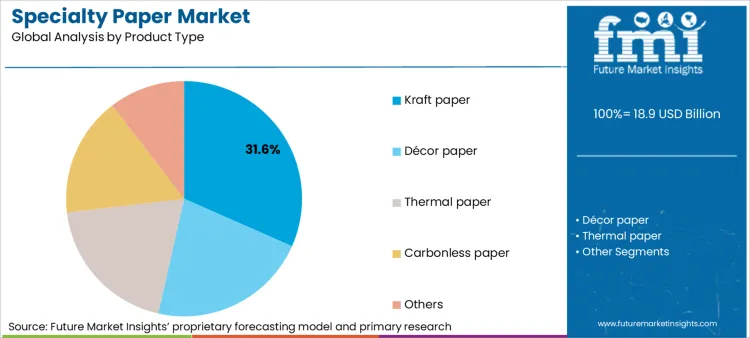
Kraft paper accounts for 31.6% of share in 2026, driven by exceptional tensile strength and printability. Leadership position is underpinned by growing preference for unbleached, organic aesthetics in retail packaging. Segment benefits from continuous refining improvements, allowing for downgauging without compromising structural integrity. Research focused on paper cores utilizing high-yield unbleached fibers is renewing interest among industrial winders. Critical role in managing waxed paper base stock further solidifies standing, as these substrates provide excellent barrier foundation. As supply chains prioritize plastic elimination, demand for robust kraft solutions is expected to remain robust.
Why Is Packaging the Primary Revenue Stream?
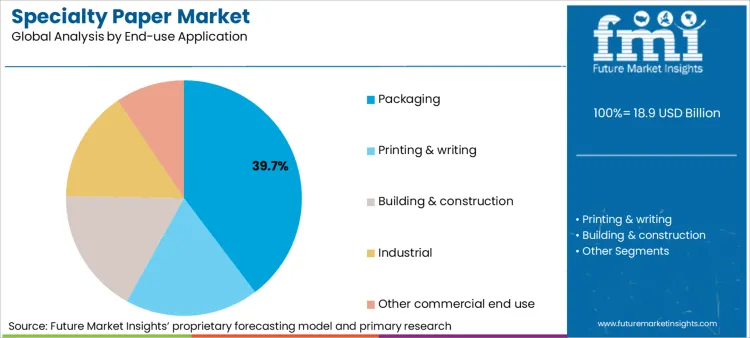
Packaging commands 39.7% share of sector in 2026, reflecting global reliance on protective coverings for consumer goods. Dominance is inextricably linked to online shopping boom requiring durable shipping envelopes. Converters rely on specialized greaseproof paper sheets to manage fast-food delivery needs effectively as per FMI's projection. These settings are essential for handling oily products, driving priority status in procurement budgets. Relentless pursuit of shelf appeal ensures products designed specifically for branding remain top priority. High consumption volume necessitates dynamic material supply, bolstering sustained revenue streams for paper mills.
How Will Digitalization Influence Thermal Grade Sales?
Digital transaction adoption is set to reshape sales landscapes by altering demand for physical transaction records. As roll type thermal paper usage evolves, logistics sectors access labels with higher durability for automated sorting. Shift toward digital invoicing creates demand for premium thermal grades resistant to heat and environmental stress. Manufacturers failing to upgrade coating technologies risk losing visibility among high-speed printing sectors. Availability of greaseproof sheets for wrapping drives complimentary consumption in food service. Rise of phenol-free formulations stimulates innovation, with companies differentiating offerings by ensuring regulatory compliance and consumer safety.
How Will the Specialty Paper Industry Evolve in Major Nations?
Global landscape for specialty grades is characterized by diverse growth patterns, influenced by manufacturing output and environmental legislation. Established markets prioritize lightweighting and circularity, whereas emerging economies rely on packaging upgrades to support export activities. Asia-Pacific is emerging as rapid growth hub due to manufacturing dominance and expanding retail networks. Conversely, North American sectors pivot towards high-barrier food service solutions. Government initiatives in developing nations supporting plastic bans ensure sustained demand for fiber-based alternatives across all geographies.
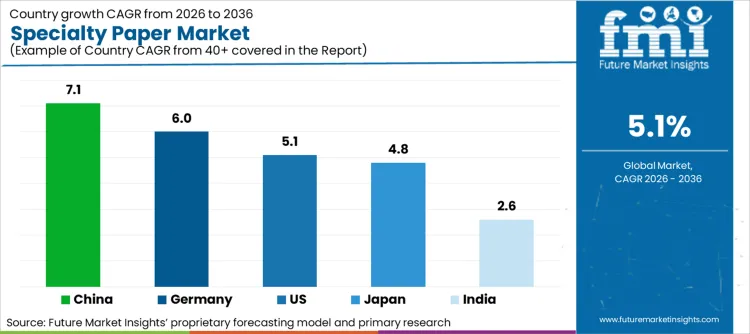
| Country | CAGR (2026 to 2036) |
|---|---|
| China | 7.1% |
| Germany | 6.0% |
| United States | 5.1% |
| Japan | 4.8% |
| India | 2.6% |
Source: Future Market Insights’ proprietary forecasting model and primary research
Why is the Specialty Paper Sector in China Expanding?
Demand for functional substrates in China is projected to rise at 7.1% CAGR during assessment period. Initiatives emphasizing green packaging foster favorable environment for domestic and international vendors. Increasing investment in high-speed paper machines creates massive supply channel for standardized grades. Rising middle-class consumption requiring premium packaging prompts local brands to seek scalable solutions. Shift is supported by government policies restricting non-degradable plastics, accelerating uptake of recyclable materials across country and fueling sector expansion.
Why is the Specialty Paper Industry in Germany Showing Potential?
Specialty paper industry in Germany is poised to expand at 6.0% CAGR. Surge is largely attributed to strong engineering heritage and focus on technical applications. Government focus on circular economy encourages facilities to opt for recycled fiber inputs. Increasing partnerships between German machinery firms and paper producers necessitate availability of high-precision rolls. High environmental standards combined with export-oriented manufacturing attract significant investment. Strict adherence to EU packaging directives further drives adoption of bio-based coatings.
Why is the Specialty Paper Industry in the United States Growing?
Sales of specialty grades in United States are set to grow at 5.1% CAGR through 2036. Expansion is underpinned by robust food service industry and e-commerce logistics. Growth is fueled by widespread shift towards sustainable packaging in fast-food chains as per FMI analyst opinion. Rapid adoption of fluorochemical-free papers drives revenue generation per ton. Presence of major forestry players headquartered within country streamlines supply chains. Emphasis on domestic sourcing continues to be primary driver, maintaining United States position as critical revenue generator.
Why is the Specialty Paper Industry in Japan Showing Stability?
Specialty paper industry in Japan is poised to expand at 4.8% CAGR. Surge is largely attributed to sophisticated packaging culture prioritizing aesthetics and functionality. Government focus on waste reduction encourages facilities to opt for minimal yet effective packaging. Increasing partnerships between chemical suppliers and mills necessitate availability of advanced barrier technologies. High quality standards combined with aging workforce driving automation attract significant investment. Strict adherence to hygiene protocols further drives adoption of functional papers.
Why is the Specialty Paper Sector in India Expanding?
Demand for paper products in India is projected to rise at 2.6% CAGR during assessment period. Initiatives emphasizing manufacturing self-reliance foster favorable environment for domestic vendors. Increasing investment in packaging parks creates massive supply channel for industrial grades. Rising literacy rates requiring printing and writing papers prompts local administrators to seek scalable solutions. Shift is supported by government policies encouraging plastic alternatives, accelerating uptake of kraft and tissue grades across country and fueling sector expansion.
What is the Competitive Outlook for the Specialty Paper Market?
Market participants are increasingly focusing on portfolio optimization to capture value from high-margin niches. Leading players like International Paper and Mondi Group are directing investment toward barrier coating lines as per FMI's estimates. Significant trend involves developing plastic-free cups and trays that are fully recyclable. Companies actively engage in strategic collaborations with FMCG giants to secure long-term supply contracts. Sustainability emerges as competitive frontier, with providers exploring alternative fibers like bamboo and bagasse. Consolidation activities remain high as large forest product conglomerates acquire specialized converters to broaden their value-added offerings against regional competitors. International Paper holds a significant 18% share, leveraging its massive fiber resources and global converting network.
Key Players in Specialty Paper Market
- International Paper
- Mondi Group
- Stora Enso
- UPM-Kymmene
- Sappi Limited
- Domtar Corporation
- Nippon Paper
- Fedrigoni
- Glatfelter
- ITC Paperboards
Scope of Report
| Items | Values |
|---|---|
| Quantitative Units | USD Billion |
| Product Type | Kraft paper, Décor paper, Thermal paper, Carbonless paper, Others |
| End-use Application | Packaging, Printing & writing, Building & construction, Industrial, Other commercial end use |
| Raw Material | Virgin fiber, Recycled fiber, Synthetic/hybrid compositions |
| Regions | North America, Europe, East Asia, South Asia, Latin America, MEA |
Source: FMI analysis based on primary research and proprietary forecasting model
Specialty Paper Market by Segments
Product Type:
- Kraft paper
- Décor paper
- Thermal paper
- Carbonless paper
- Others
End-use Application:
- Packaging
- Printing & writing
- Building & construction
- Industrial
- Other commercial end use
Raw Material:
- Virgin fiber
- Recycled fiber
- Synthetic/hybrid compositions
Bibliography
- European Commission, Eurostat. (2025). Forestry and paper products statistics: Production, consumption, recycling, and circular economy indicators. European Commission, European Union.
- European Environment Agency. (2024). Paper and cardboard recycling rates and packaging waste recovery in the European Union. European Environment Agency, European Union.
- USA Environmental Protection Agency. (2025, October 22). Paper and paperboard: Material-specific data from municipal solid waste generation, recycling, and disposal. USA Environmental Protection Agency, United States.
- Food and Agriculture Organization of the United Nations. (2024). FAOSTAT forestry database: Global statistics on pulp, paper, and recovered paper production and trade. Food and Agriculture Organization of the United Nations.
- Statistics Canada. (2025). Waste diversion and recycling of paper and paperboard materials in Canada. Statistics Canada, Government of Canada.
Frequently Asked Questions
How large is the demand for Specialty Paper in the global market in 2026?
Demand for Specialty Paper in global market is estimated to be valued at USD 18.9 billion in 2026 as per FMI's estimates.
What will be the market size of Specialty Paper in the global market by 2036?
Market size for Specialty Paper is projected to reach USD 31.1 billion by 2036.
What is the expected demand growth for Specialty Paper in the global market between 2026 and 2036?
Demand for Specialty Paper in global market is expected to grow at CAGR of 5.1% between 2026 and 2036.
Which Product Type is poised to lead global sales by 2026?
Kraft paper is expected to be dominant product type, capturing approximately 31.6% of global market share in 2026 due to packaging versatility.
How significant is the role of Packaging Applications in driving Specialty Paper adoption in 2026?
Packaging Applications represent critical end use, projected to hold substantial 39.7% share of total market in 2026 as brands seek sustainable alternatives.
Preview the report firsthand - request a free sample
Get SampleGet the brochure for pricing and purchase details.
Get PDFTable of Content
- Executive Summary
- Global Market Outlook
- Demand-side Trends
- Supply-side Trends
- Technology Roadmap Analysis
- Analysis and Recommendations
- Market Overview
- Market Coverage / Taxonomy
- Market Definition / Scope / Limitations
- Research Methodology
- Chapter Orientation
- Analytical Lens and Working Hypotheses
- Market Structure, Signals, and Trend Drivers
- Benchmarking and Cross-market Comparability
- Market Sizing, Forecasting, and Opportunity Mapping
- Research Design and Evidence Framework
- Desk Research Programme (Secondary Evidence)
- Company Annual and Sustainability Reports
- Peer-reviewed Journals and Academic Literature
- Corporate Websites, Product Literature, and Technical Notes
- Earnings Decks and Investor Briefings
- Statutory Filings and Regulatory Disclosures
- Technical White Papers and Standards Notes
- Trade Journals, Industry Magazines, and Analyst Briefs
- Conference Proceedings, Webinars, and Seminar Materials
- Government Statistics Portals and Public Data Releases
- Press Releases and Reputable Media Coverage
- Specialist Newsletters and Curated Briefings
- Sector Databases and Reference Repositories
- Roots Internal Knowledge Base and Historical Datasets
- Subscription Datasets and Paid Sources
- Social Channels, Communities, and Digital Listening Inputs
- Additional Desk Sources
- Expert Input and Fieldwork (Primary Evidence)
- Primary Modes
- Qualitative Interviews and Expert Elicitation
- Quantitative Surveys and Structured Data Capture
- Blended A8oach
- Why Primary Evidence is Used
- Field Techniques
- Interviews
- Surveys
- Focus Groups
- Observational and In-context Research
- Social and Community Interactions
- Stakeholder Universe Engaged
- C-suite Leaders
- Board Members
- Presidents and Vice Presidents
- R&D and Innovation Heads
- Technical Specialists
- Domain Subject-matter Experts
- Scientists
- Physicians and Other Healthcare Professionals
- Governance, Ethics, and Data Stewardship
- Research Ethics
- Data Integrity and Handling
- Primary Modes
- Tooling, Models, and Reference Databases
- Desk Research Programme (Secondary Evidence)
- Data Engineering and Model Build
- Data Acquisition and Ingestion
- Cleaning, Normalisation, and Verification
- Synthesis, Triangulation, and Analysis
- Quality Assurance and Audit Trail
- Market Background
- Market Dynamics
- Drivers
- Restraints
- Opportunity
- Trends
- Scenario Forecast
- Demand in Optimistic Scenario
- Demand in Likely Scenario
- Demand in Conservative Scenario
- Opportunity Map Analysis
- Product Life Cycle Analysis
- Supply Chain Analysis
- Investment Feasibility Matrix
- Value Chain Analysis
- PESTLE and Porter’s Analysis
- Regulatory Landscape
- Regional Parent Market Outlook
- Production and Consumption Statistics
- Import and Export Statistics
- Market Dynamics
- Global Market Analysis 2021 to 2025 and Forecast, 2026 to 2036
- Historical Market Size Value (USD Million) Analysis, 2021 to 2025
- Current and Future Market Size Value (USD Million) Projections, 2026 to 2036
- Y-o-Y Growth Trend Analysis
- Absolute $ Opportunity Analysis
- Global Market Pricing Analysis 2021 to 2025 and Forecast 2026 to 2036
- Global Market Analysis 2021 to 2025 and Forecast 2026 to 2036, By Product Type
- Introduction / Key Findings
- Historical Market Size Value (USD Million) Analysis By Product Type , 2021 to 2025
- Current and Future Market Size Value (USD Million) Analysis and Forecast By Product Type , 2026 to 2036
- Kraft paper
- Décor paper
- Thermal paper
- Carbonless paper
- Others
- Kraft paper
- Y-o-Y Growth Trend Analysis By Product Type , 2021 to 2025
- Absolute $ Opportunity Analysis By Product Type , 2026 to 2036
- Global Market Analysis 2021 to 2025 and Forecast 2026 to 2036, By End-use Application
- Introduction / Key Findings
- Historical Market Size Value (USD Million) Analysis By End-use Application, 2021 to 2025
- Current and Future Market Size Value (USD Million) Analysis and Forecast By End-use Application, 2026 to 2036
- Packaging
- Printing & writing
- Building & construction
- Industrial
- Other commercial end use
- Packaging
- Y-o-Y Growth Trend Analysis By End-use Application, 2021 to 2025
- Absolute $ Opportunity Analysis By End-use Application, 2026 to 2036
- Global Market Analysis 2021 to 2025 and Forecast 2026 to 2036, By Raw Material
- Introduction / Key Findings
- Historical Market Size Value (USD Million) Analysis By Raw Material, 2021 to 2025
- Current and Future Market Size Value (USD Million) Analysis and Forecast By Raw Material, 2026 to 2036
- Virgin fiber
- Recycled fiber
- Synthetic/hybrid compositions
- Virgin fiber
- Y-o-Y Growth Trend Analysis By Raw Material, 2021 to 2025
- Absolute $ Opportunity Analysis By Raw Material, 2026 to 2036
- Global Market Analysis 2021 to 2025 and Forecast 2026 to 2036, By Region
- Introduction
- Historical Market Size Value (USD Million) Analysis By Region, 2021 to 2025
- Current Market Size Value (USD Million) Analysis and Forecast By Region, 2026 to 2036
- North America
- Latin America
- Western Europe
- Eastern Europe
- East Asia
- South Asia and Pacific
- Middle East & Africa
- Market Attractiveness Analysis By Region
- North America Market Analysis 2021 to 2025 and Forecast 2026 to 2036, By Country
- Historical Market Size Value (USD Million) Trend Analysis By Market Taxonomy, 2021 to 2025
- Market Size Value (USD Million) Forecast By Market Taxonomy, 2026 to 2036
- By Country
- USA
- Canada
- Mexico
- By Product Type
- By End-use Application
- By Raw Material
- By Country
- Market Attractiveness Analysis
- By Country
- By Product Type
- By End-use Application
- By Raw Material
- Key Takeaways
- Latin America Market Analysis 2021 to 2025 and Forecast 2026 to 2036, By Country
- Historical Market Size Value (USD Million) Trend Analysis By Market Taxonomy, 2021 to 2025
- Market Size Value (USD Million) Forecast By Market Taxonomy, 2026 to 2036
- By Country
- Brazil
- Chile
- Rest of Latin America
- By Product Type
- By End-use Application
- By Raw Material
- By Country
- Market Attractiveness Analysis
- By Country
- By Product Type
- By End-use Application
- By Raw Material
- Key Takeaways
- Western Europe Market Analysis 2021 to 2025 and Forecast 2026 to 2036, By Country
- Historical Market Size Value (USD Million) Trend Analysis By Market Taxonomy, 2021 to 2025
- Market Size Value (USD Million) Forecast By Market Taxonomy, 2026 to 2036
- By Country
- Germany
- UK
- Italy
- Spain
- France
- Nordic
- BENELUX
- Rest of Western Europe
- By Product Type
- By End-use Application
- By Raw Material
- By Country
- Market Attractiveness Analysis
- By Country
- By Product Type
- By End-use Application
- By Raw Material
- Key Takeaways
- Eastern Europe Market Analysis 2021 to 2025 and Forecast 2026 to 2036, By Country
- Historical Market Size Value (USD Million) Trend Analysis By Market Taxonomy, 2021 to 2025
- Market Size Value (USD Million) Forecast By Market Taxonomy, 2026 to 2036
- By Country
- Russia
- Poland
- Hungary
- Balkan & Baltic
- Rest of Eastern Europe
- By Product Type
- By End-use Application
- By Raw Material
- By Country
- Market Attractiveness Analysis
- By Country
- By Product Type
- By End-use Application
- By Raw Material
- Key Takeaways
- East Asia Market Analysis 2021 to 2025 and Forecast 2026 to 2036, By Country
- Historical Market Size Value (USD Million) Trend Analysis By Market Taxonomy, 2021 to 2025
- Market Size Value (USD Million) Forecast By Market Taxonomy, 2026 to 2036
- By Country
- China
- Japan
- South Korea
- By Product Type
- By End-use Application
- By Raw Material
- By Country
- Market Attractiveness Analysis
- By Country
- By Product Type
- By End-use Application
- By Raw Material
- Key Takeaways
- South Asia and Pacific Market Analysis 2021 to 2025 and Forecast 2026 to 2036, By Country
- Historical Market Size Value (USD Million) Trend Analysis By Market Taxonomy, 2021 to 2025
- Market Size Value (USD Million) Forecast By Market Taxonomy, 2026 to 2036
- By Country
- India
- ASEAN
- Australia & New Zealand
- Rest of South Asia and Pacific
- By Product Type
- By End-use Application
- By Raw Material
- By Country
- Market Attractiveness Analysis
- By Country
- By Product Type
- By End-use Application
- By Raw Material
- Key Takeaways
- Middle East & Africa Market Analysis 2021 to 2025 and Forecast 2026 to 2036, By Country
- Historical Market Size Value (USD Million) Trend Analysis By Market Taxonomy, 2021 to 2025
- Market Size Value (USD Million) Forecast By Market Taxonomy, 2026 to 2036
- By Country
- Kingdom of Saudi Arabia
- Other GCC Countries
- Turkiye
- South Africa
- Other African Union
- Rest of Middle East & Africa
- By Product Type
- By End-use Application
- By Raw Material
- By Country
- Market Attractiveness Analysis
- By Country
- By Product Type
- By End-use Application
- By Raw Material
- Key Takeaways
- Key Countries Market Analysis
- USA
- Pricing Analysis
- Market Share Analysis, 2025
- By Product Type
- By End-use Application
- By Raw Material
- Canada
- Pricing Analysis
- Market Share Analysis, 2025
- By Product Type
- By End-use Application
- By Raw Material
- Mexico
- Pricing Analysis
- Market Share Analysis, 2025
- By Product Type
- By End-use Application
- By Raw Material
- Brazil
- Pricing Analysis
- Market Share Analysis, 2025
- By Product Type
- By End-use Application
- By Raw Material
- Chile
- Pricing Analysis
- Market Share Analysis, 2025
- By Product Type
- By End-use Application
- By Raw Material
- Germany
- Pricing Analysis
- Market Share Analysis, 2025
- By Product Type
- By End-use Application
- By Raw Material
- UK
- Pricing Analysis
- Market Share Analysis, 2025
- By Product Type
- By End-use Application
- By Raw Material
- Italy
- Pricing Analysis
- Market Share Analysis, 2025
- By Product Type
- By End-use Application
- By Raw Material
- Spain
- Pricing Analysis
- Market Share Analysis, 2025
- By Product Type
- By End-use Application
- By Raw Material
- France
- Pricing Analysis
- Market Share Analysis, 2025
- By Product Type
- By End-use Application
- By Raw Material
- India
- Pricing Analysis
- Market Share Analysis, 2025
- By Product Type
- By End-use Application
- By Raw Material
- ASEAN
- Pricing Analysis
- Market Share Analysis, 2025
- By Product Type
- By End-use Application
- By Raw Material
- Australia & New Zealand
- Pricing Analysis
- Market Share Analysis, 2025
- By Product Type
- By End-use Application
- By Raw Material
- China
- Pricing Analysis
- Market Share Analysis, 2025
- By Product Type
- By End-use Application
- By Raw Material
- Japan
- Pricing Analysis
- Market Share Analysis, 2025
- By Product Type
- By End-use Application
- By Raw Material
- South Korea
- Pricing Analysis
- Market Share Analysis, 2025
- By Product Type
- By End-use Application
- By Raw Material
- Russia
- Pricing Analysis
- Market Share Analysis, 2025
- By Product Type
- By End-use Application
- By Raw Material
- Poland
- Pricing Analysis
- Market Share Analysis, 2025
- By Product Type
- By End-use Application
- By Raw Material
- Hungary
- Pricing Analysis
- Market Share Analysis, 2025
- By Product Type
- By End-use Application
- By Raw Material
- Kingdom of Saudi Arabia
- Pricing Analysis
- Market Share Analysis, 2025
- By Product Type
- By End-use Application
- By Raw Material
- Turkiye
- Pricing Analysis
- Market Share Analysis, 2025
- By Product Type
- By End-use Application
- By Raw Material
- South Africa
- Pricing Analysis
- Market Share Analysis, 2025
- By Product Type
- By End-use Application
- By Raw Material
- USA
- Market Structure Analysis
- Competition Dashboard
- Competition Benchmarking
- Market Share Analysis of Top Players
- By Regional
- By Product Type
- By End-use Application
- By Raw Material
- Competition Analysis
- Competition Deep Dive
- International Paper
- Overview
- Product Portfolio
- Profitability by Market Segments (Product/Age /Sales Channel/Region)
- Sales Footprint
- Strategy Overview
- Marketing Strategy
- Product Strategy
- Channel Strategy
- Mondi Group
- Stora Enso
- UPM-Kymmene
- Sappi Limited
- Domtar Corporation
- Nippon Paper
- Fedrigoni
- Glatfelter
- International Paper
- Competition Deep Dive
- Assumptions & Acronyms Used


