

- Market Size (2026)
- USD 11.8 Bn
- Forecast (2036)
- USD 21.9 Bn
- CAGR (2026 to 2036)
- 6.4%
Specialty Control Plasma Market Size, Market Forecast and Outlook By FMI
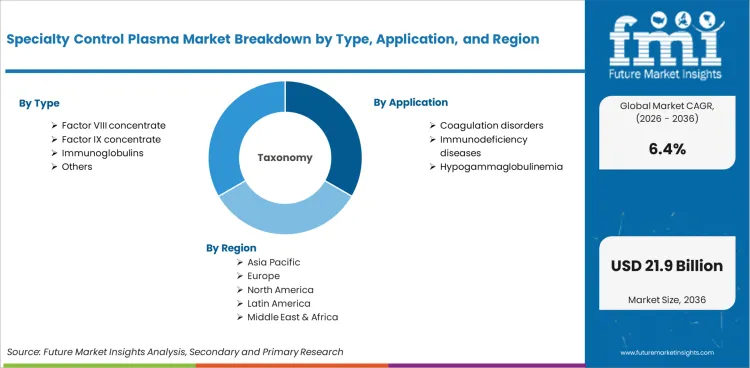
The specialty control plasma market was valued at USD 11.1 billion in 2025. the market is set to reach USD 11.8 billion by 2026-end and grow at a CAGR of 6.4% between 2026-2036 to reach USD 21.9 billion by 2036. Factor VIII concentrate will dominate with a 55.0% share, While Coagulation disorders will lead with a 60.0% share.
Summary of the Specialty Control Plasma Market
- Demand and Growth Drivers
- Expansion of diagnostic coagulation testing in clinical laboratories is sustaining demand for specialty control plasma products used in quality assurance and assay calibration workflows.
- Rising prevalence of coagulation disorders globally is increasing the need for validated control plasma in hemostasis testing and treatment monitoring.
- Regulatory requirements for laboratory quality control in in-vitro diagnostics are creating structured procurement cycles for certified control plasma materials.
- Product and Segment View
- Factor VIII concentrate leads the type segment at 55.0%, reflecting its critical role in hemophilia A treatment monitoring and coagulation quality control testing.
- Coagulation disorders account for 60.0% of the application segment, driven by established clinical testing protocols and growing diagnostic volumes.
- Hospitals remain the primary end-user channel, Supported by centralized laboratory infrastructure and high-volume diagnostic testing requirements.
- Geography and Competitive Outlook
- The USA leads with a 6.5% CAGR, reflecting established diagnostic laboratory infrastructure and regulatory-driven quality control requirements.
- Japan at 6.5% CAGR sustains demand through advanced healthcare systems and precision medicine adoption in coagulation diagnostics.
- Companies with validated product portfolios and multi-platform compatibility are positioned to gain traction as diagnostic testing volumes expand.
- Analyst Opinion
- 'Companies that can maintain validated control plasma specifications across multiple diagnostic platforms while meeting evolving regulatory requirements are positioned to strengthen their market standing.'
- The market is expanding beyond centralized hospital laboratories into reference testing, Research applications, and point-of-care coagulation diagnostics.
- Supply chain integrity for human-derived plasma products remains a critical procurement consideration, Shaping supplier qualification criteria.
- Demand is supported by the growing emphasis on laboratory accreditation and external quality assurance programs across clinical diagnostics.
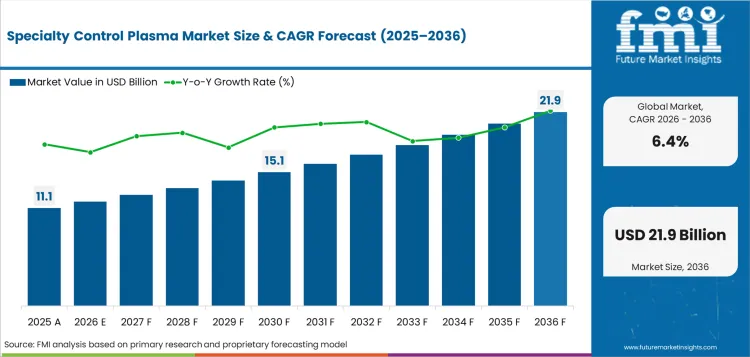
Key Takeaways, Market Size, And Forecast
- The specialty control plasma market was valued at USD 11.05 billion in 2025.
- By 2036, The Specialty Control Plasma Market is expected to be worth USD 21.86 billion.
- From 2026 to 2036, The market is projected to expand at a CAGR of 6.4%.
- The market is projected to create an incremental opportunity of USD 10.11 billion between 2026 and 2036.
- In 2026, Factor viii concentrate is expected to account for 55% of the type segment, Driven by demand for diagnostic coagulation testing protocols and hemophilia treatment monitoring requirements.
- USA (6.5%) and Japan (6.5%) are two of the fastest growing markets in the world.
Specialty Control Plasma Market Definition
The specialty control plasma market encompasses human-derived and processed plasma products used as quality control materials in coagulation testing, Immunoassay calibration, and clinical diagnostic workflows. Market scope includes Factor VIII concentrates, Factor IX concentrates, Immunoglobulins, and other specialty plasma products.
Specialty Control Plasma Market Inclusions
Market scope includes all commercially traded specialty control plasma products categorized by type (Factor VIII concentrate, Factor IX concentrate, Immunoglobulins, Others), application (coagulation disorders, Immunodeficiency diseases, Hypogammaglobulinemia), end user (hospitals, Diagnostic laboratories, Clinics, Others), product type, source, and form. Revenue sizing covers the 2026 to 2036 forecast period.
Specialty Control Plasma Market Exclusions
The scope does not include standard blood bank plasma products, Bulk fractionation intermediates, or convalescent plasma used in therapeutic applications outside of diagnostic quality control.
Specialty Control Plasma Market Research Methodology
- Primary Research: FMI analysts conducted interviews with manufacturers, Distributors, Procurement specialists, and end-use application experts in key markets.
- Desk Research: Combined data from industry associations, regulatory filings, Certification bodies, and manufacturer disclosures.
- Market Sizing and Forecasting: Bottom-up aggregation across type, application, end user, product type, source, form segments, with regional adoption curves and cross-referencing against publicly available industry data.
- Data Validation: Cross-checked quarterly against global production data, Trade statistics, and manufacturer-reported figures.
Why is the Specialty Control Plasma Market Growing?
- Globally, Clinical laboratory testing volumes for coagulation disorders are rising, Resulting in steady procurement demand for validated specialty control plasma materials.
- Regulation focuses on laboratory quality assurance, and accreditation is creating structured procurement cycles for certified control plasma products.
- USA and Japan lead growth at 6.5% CAGR each, reflecting advanced diagnostic infrastructure and regulatory driven quality control requirements.
The specialty control plasma market is expanding due to the increasing volumes of diagnostic testing for coagulation disorders globally and stringent regulatory requirements for quality control of laboratories. Control plasma products are essential components of hemostasis testing workflows, Providing validated reference materials for assay calibration, quality assurance and proficiency testing. the growth is attributed to the increasing installed base of coagulation analyzers and increasing prevalence of bleeding and thrombotic disorders.
The type segment is dominated by Factor VIII concentrate at 55.0%, Mainly due to its importance in monitoring hemophilia A and in quality control of coagulation testing. Hospitals continue to be the primary end-user channel, but diagnostic laboratories and reference-testing facilities are emerging procurement channels. the market structure favors established suppliers with validated product portfolios, regulatory documentation and multi-platform compatibility across major coagulation analyzer systems.
Market Segmentation Analysis
- Factor VIII concentrate leads the type segment with 55% market share, reflecting established supply and end-use preference.
- Coagulation disorders holds the leading position in the application category at 60%.
- Hospitals accounts for the largest share in the end user segment.
The specialty control plasma market is segmented by type, application, end user, product type, source, form. Each segment reflects distinct procurement criteria, end-use requirements, and pricing structures.
Insights into the Type Segment
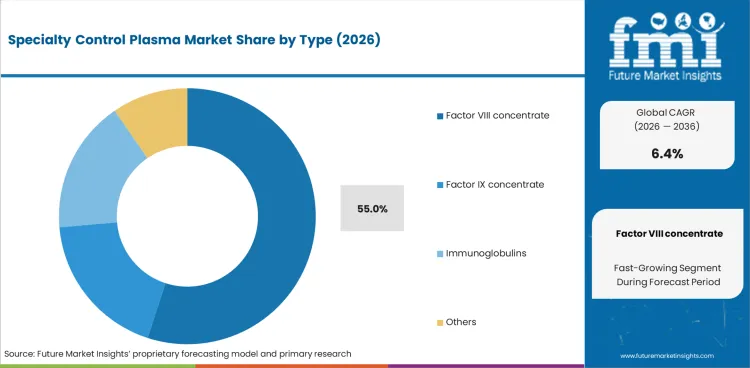
The market is dominated by Factor VIII concentrate in the type segment with 55% Demand is driven by availability of end-use compatibility and supply chains and cost competitiveness relative to alternative options.
Other type categories comprise Factor IX concentrate, Immunoglobulins, Others. All these are customized according to specific application requirements and showcase diversity in technical specifications across end-use industries.
Insights into the Application Segment
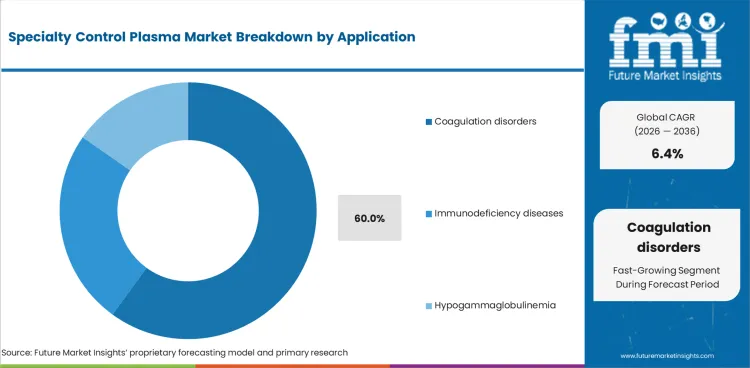
By application, Coagulation disorders segment holds the largest market share of 60%. Demand is driven by end-use compatibility, Availability within the supply chain and cost competitiveness with alternatives.
Other application categories are Immunodeficiency diseases, Hypogammaglobulinemia, Each fitting specific application needs and having technical specification variation across end-use industries.
Specialty Control Plasma Market Drivers, Restraints, and Opportunities
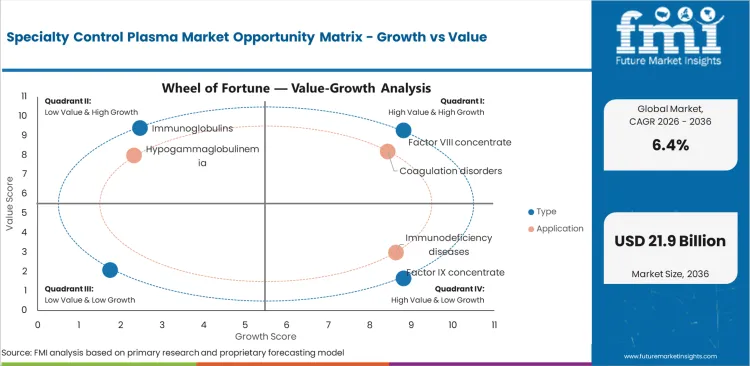
- Demand for validated specialty control plasma products is being sustained in clinical laboratories worldwide by increasing volumes of diagnostic testing for coagulation disorders.
- The complex regulatory requirements for human plasma products create compliance barriers that limit market entry and concentrate supply in the hands of incumbent manufacturers.
- Market opportunity expanding beyond traditional hospital-based procurement with growth in point of care coagulation testing and reference laboratory services.
The specialty control plasma market continues to grow, Shaped by regulatory drivers, Cost structure constraints, and emerging application opportunities. Adoption pace varies by segment, Geography, and price sensitivity of end-use applications.
Diagnostic Volume Expansion
The clinical laboratory testing volumes for coagulation disorders continue to grow, driven by the aging population, Chronic disease screening programs, and improved access to diagnostic services. Every coagulation analyzer needs validated control plasma for daily quality assurance, which means that there is a recurring demand for procurement as the installed instrument base grows.
Regulatory and Supply Chain Complexity
Human plasma products are subject to strict regulatory requirements in terms of sourcing, Processing and quality documentation. These compliance barriers concentrate supply among established manufacturers with collection networks and processing capabilities, Limiting competitive entry.
Point-of-Care Testing Expansion
Decentralized point-of-care coagulation testing is creating new demand for control plasma products tailored for portable and near-patient testing platforms. this channel requires products that have longer stability and are easy to handle.
Analysis of Specialty Control Plasma Market By Key Countries
.webp "Top Country Growth Comparison Specialty Control Plasma Market Cagr (2026 2036)")
| Country | CAGR |
|---|---|
| USA | 6.5% |
| Japan | 6.5% |
| South Korea | 6.4% |
| EU | 6.3% |
| UK | 6.2% |
Source: FMI analysis based on primary research and proprietary forecasting model
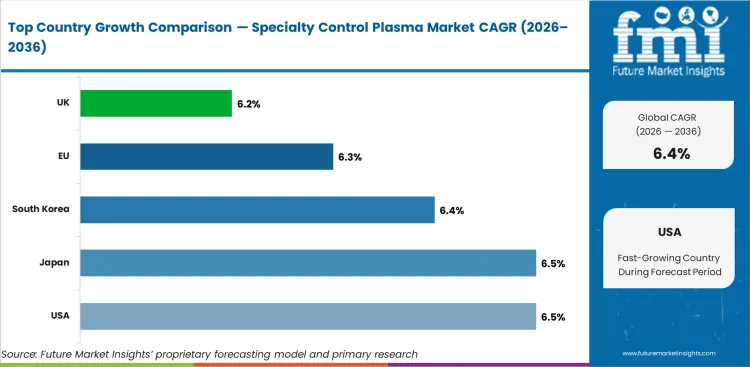
- USA leads with a 6.5% CAGR, reflecting established procurement networks.
- Japan at 6.5% shows strong demand due to advanced manufacturing capabilities.
- South Korea (6.4%) and EU (6.3%) continue growing, Supported by end-use industry expansion.
The global specialty control plasma market is expected to grow at a rate of 6.4% per year from 2026 to 2036. the study covers more than 30 countries, and the main markets are listed below.
Demand Outlook for Specialty Control Plasma Market in USA
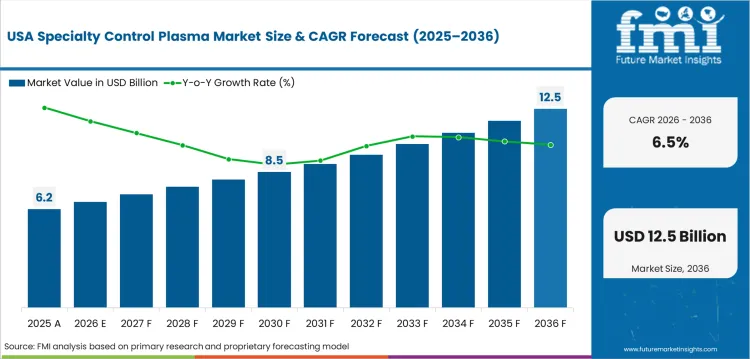
USA is projected to grow at a rate of 6.5% through 2036, reflecting established procurement networks, regulatory compliance investment, and strong end-use demand. Demand is supported by compliance-driven procurement, established distribution networks, and premium product demand.
- Compliance-LED procurement is sustaining demand for products meeting regulatory specifications.
- Established distribution networks support efficient supply chain coverage across end-use sectors.
- Premium product demand is creating value-added procurement channels alongside volume purchasing.
Future Outlook for Specialty Control Plasma Market in Japan
Japan is projected to grow at a rate of 6.5% through 2036, reflecting advanced manufacturing capabilities, quality-driven procurement standards, and technology adoption. Demand is supported by quality-driven procurement standards, advanced manufacturing, and technology adoption across end-use sectors.
- Quality-driven procurement standards sustain demand for high-specification products.
- Advanced manufacturing capabilities support domestic production and technology adoption.
- Established industry infrastructure enables efficient distribution across end-use sectors.
Opportunity Analysis of Specialty Control Plasma Market in South Korea
South Korea is projected to grow at a rate of 6.4% through 2036, reflecting technology-LED adoption, manufacturing sector modernization, and export-oriented production capabilities. Demand is supported by manufacturing sector investment, technology adoption, and export-oriented capabilities.
- Technology-LED adoption is driving procurement modernization across industrial applications.
- Manufacturing sector investment supports domestic demand and export competitiveness.
- Regulatory development is raising product specification requirements across categories.
In-depth Analysis of Specialty Control Plasma Market in Europe
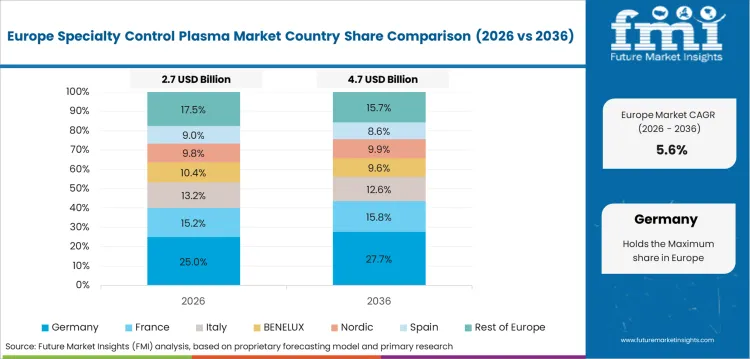
Europe is projected to grow at a rate of 6.3% through 2036, reflecting EU regulatory frameworks, sustainability mandates, and advanced manufacturing infrastructure. Demand is supported by EU-wide regulatory harmonization, sustainability mandates, and advanced manufacturing infrastructure.
- EU regulatory frameworks are creating compliance-LED demand across member states.
- Sustainability mandates are accelerating adoption of compliant product specifications.
- Advanced manufacturing infrastructure supports efficient production and distribution.
Sales Analysis of Specialty Control Plasma Market in UK
UK is projected to grow at a rate of 6.2% through 2036, reflecting regulatory alignment with quality standards and established distribution infrastructure. Demand is supported by regulatory alignment, established distribution channels, and quality-driven procurement.
- Regulatory standards alignment is shaping product specifications and procurement criteria.
- Established distribution infrastructure supports efficient market coverage across the region.
- Premium segment demand is creating opportunities for value-added product positioning.
Competitive Landscape and Strategic Positioning
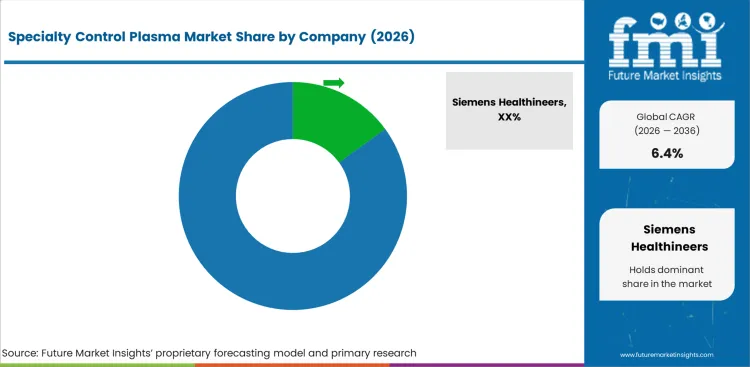
- Siemens Healthineers enjoys a leading position in the market, Owing to its well-established manufacturing infrastructure, Wide product portfolio and strong relationships with end-use customers.
- Thermo Fisher Scientific and Bio-Rad Laboratories are in a position of competitiveness in product breadth and regional distribution capability.
- Smaller and new players are focusing on specialized applications, Niche segments to build market position.
Siemens Healthineers is well positioned because of its broad manufacturing capacity and longstanding relationships with end-use customers in multiple geographies. Thermo Fisher Scientific competes on distribution reach and product portfolio breadth.
Bio-Rad Laboratories competes with Werfen (Instrumentation Laboratory) in certain product categories and regional markets. Barriers to entry are the need for manufacturing scale, regulatory certification time and existing procurement relationships.
The strategic priorities are: Cost optimization, Geographic expansion, product specification upgrades, Alignment with regulatory compliance timelines.
Key Companies in the Specialty Control Plasma Market
Key global companies leading the specialty control plasma market include:
- Siemens Healthineers, Thermo Fisher Scientific, Bio-Rad Laboratories hold leading positions through established infrastructure and strong customer relationships.
- Werfen (Instrumentation Laboratory) and Stago Group maintain competitive positions through regional expertise and product specialization.
Competitive Benchmarking: Specialty Control Plasma Market
| Company | Product Validation Range | Platform Compatibility | Regulatory Documentation | Geographic Reach |
|---|---|---|---|---|
| Siemens Healthineers | High | Strong | Strong | Global |
| Thermo Fisher Scientific | High | Strong | Strong | Global |
| Bio-Rad Laboratories | High | Strong | Strong | Global |
| Werfen (Instrumentation Laboratory) | Medium | Moderate | Moderate | Regional |
| Stago Group | Medium | Moderate | Moderate | Regional |
Source: Future Market Insights competitive analysis, 2026.
Key Developments in Specialty Control Plasma Market
- The market is growing steadily, with forecasts in recent reports showing strong expansion through 2033-2035, driven by rising demand for accurate diagnostic quality control materials.
- Key growth drivers include broader use in coagulation and hemostasis testing, Plus product innovation by major diagnostic companies to improve platform compatibility and reliability.
Key Players in the Specialty Control Plasma Market
Major Global Players
- Siemens Healthineers
- Thermo Fisher Scientific
- Bio-Rad Laboratories
- Werfen (Instrumentation Laboratory)
- Stago Group
Emerging Players/Startups
- Werfen (Instrumentation Laboratory)
- Stago Group
Report Scope and Coverage
| Metric | Value |
|---|---|
| Quantitative Units | USD 11.76 billion to USD 21.86 billion, at a CAGR of 6.4% |
| Market Definition | The specialty control plasma market encompasses products categorized by type, application, end user, product type, source, form across all major end-use applications. |
| Regions Covered | North America, Latin America, Europe, East Asia, South Asia and Pacific, Middle East and Africa |
| Countries Covered | USA, Japan, South Korea, EU, UK, 30 plus countries |
| Key Companies Profiled | Siemens Healthineers, Thermo Fisher Scientific, Bio-Rad Laboratories, Werfen (Instrumentation Laboratory), Stago Group |
| Forecast Period | 2026 to 2036 |
| Approach | Hybrid bottom-up and top-down methodology starting with verified transaction data, Projecting adoption velocity across segments and regions. |
Market Segmentation Analysis
Specialty Control Plasma Market Segmented by Type:
- Factor VIII concentrate
- Factor IX concentrate
- Immunoglobulins
- Others
Specialty Control Plasma Market Segmented by Application:
- Coagulation disorders
- Immunodeficiency diseases
- Hypogammaglobulinemia
Specialty Control Plasma Market Segmented by End user:
- Hospitals
- Diagnostic laboratories
- Clinics
- Others
Specialty Control Plasma Market Segmented by Product Type:
- Normal Human Plasma
- Cryoprecipitate Plasma
- Control Plasma for Coagulation Tests
- Cryoprecipitate Plasma Concentrates
- Fresh Frozen Plasma
Specialty Control Plasma Market Segmented by Source:
- Human Plasma
- Voluntary Donor Plasma
- Single Donor Plasma
- Pooled Plasma
- Voluntary Donor Plasma
- Animal Derived Plasma
- Control Plasma Models
- Research Grade Plasma
- Diagnostic Grade Plasma
- Control Plasma Models
- Synthetic And Recombinant Sources
- Laboratory Engineered Plasma
- High Purity Standards
- Custom Control Plasma
- Laboratory Engineered Plasma
Specialty Control Plasma Market Segmented by Form:
- Liquid Plasma
- Ready To Use Plasma
- Short Shelf Life
- Immediate Testing
- Ready To Use Plasma
- Lyophilized Plasma
- Freeze Dried Plasma
- Extended Shelf Life
- Transport Stable
- Freeze Dried Plasma
Specialty Control Plasma Market by Region:
- North America
- USA
- Canada
- Mexico
- Latin America
- Brazil
- Chile
- Rest of Latin America
- Western Europe
- Germany
- UK
- Italy
- Spain
- France
- Nordic
- BENELUX
- Rest of Western Europe
- Eastern Europe
- Russia
- Poland
- Hungary
- Balkan & Baltic
- Rest of Eastern Europe
- East Asia
- China
- Japan
- South Korea
- South Asia and Pacific
- India
- ASEAN
- Australia & New Zealand
- Rest of South Asia and Pacific
- Middle East & Africa
- Kingdom of Saudi Arabia
- Other GCC Countries
- Turkiye
- South Africa
- Other African Union
- Rest of Middle East & Africa
Research Sources and Bibliography
- World Health Organization. (2025). Global Diagnostics and Laboratory Services Report. WHO.
- United States Food and Drug Administration. (2024). In Vitro Diagnostic Products: Blood Establishment Registration and Product Listing. FDA.
- European Commission. (2024). In Vitro Diagnostic Regulation (IVDR) Implementation Update. EC.
- International Society on Thrombosis and Haemostasis. (2025). Standards for Coagulation Testing and Quality Control. ISTH.
- College of American Pathologists. (2025). Laboratory Accreditation and Proficiency Testing Standards. CAP.
This bibliography is provided for reader reference.
This Report Answers
- Estimating the size of the specialty control plasma market and revenue projections from 2026 to 2036.
- Segmentation by type, application, end user, product type, source, form.
- Insights across more than 30 country and regional markets.
- Analysis of key growth drivers, Restraints, and emerging opportunities.
- Assessment of the competitive landscape and strategic positioning.
- Identification of investment opportunities across primary application segments.
- Supply chain structure and distribution channel analysis.
- Delivery of data in PDF and Excel formats.
Frequently Asked Questions
What is the global market demand for Specialty Control Plasma Market in 2026?
In 2026, the global specialty control plasma market is expected to be worth USD 11.76 billion.
How big will the Specialty Control Plasma Market be in 2036?
By 2036, the specialty control plasma market is expected to be worth USD 21.86 billion.
How much is demand for Specialty Control Plasma Market expected to grow between 2026 and 2036?
Between 2026 and 2036, the specialty control plasma market is expected to grow at a CAGR of 6.4%.
Which segment is likely to lead the Specialty Control Plasma Market in 2026?
In the Specialty Control Plasma Market, Factor VIII concentrate is expected to account for 55% of the type segment in 2026, reflecting strong downstream demand and established procurement patterns.
What is causing demand to rise in USA for the Specialty Control Plasma Market?
In the Specialty Control Plasma Market, USA is projected to grow at 6.5% through 2036, reflecting established procurement networks, regulatory compliance investment, and strong end-use demand.
What is causing demand to rise in Japan for the Specialty Control Plasma Market?
In the Specialty Control Plasma Market, Japan is projected to grow at 6.5% through 2036, reflecting advanced manufacturing capabilities, quality-driven procurement standards, and technology adoption.
What is the definition of the Specialty Control Plasma Market?
The specialty control plasma market encompasses products categorized by type, application, end user, product type, source, form across all major end-use applications.
How does FMI forecast and validate the Specialty Control Plasma Market?
Forecasting models use a hybrid bottom-up and top-down approach, starting with verified transaction data and cross-referencing against global production statistics and manufacturer disclosures.
Preview the report firsthand - request a free sample
Get SampleGet the brochure for pricing and purchase details.
Get PDFTable of Content
- Executive Summary
- Global Market Outlook
- Demand-side Trends
- Supply-side Trends
- Technology Roadmap Analysis
- Analysis and Recommendations
- Market Overview
- Market Coverage / Taxonomy
- Market Definition / Scope / Limitations
- Research Methodology
- Chapter Orientation
- Analytical Lens and Working Hypotheses
- Market Structure, Signals, and Trend Drivers
- Benchmarking and Cross-market Comparability
- Market Sizing, Forecasting, and Opportunity Mapping
- Research Design and Evidence Framework
- Desk Research Programme (Secondary Evidence)
- Company Annual and Sustainability Reports
- Peer-reviewed Journals and Academic Literature
- Corporate Websites, product Literature, and Technical Notes
- Earnings Decks and Investor Briefings
- Statutory Filings and Regulatory Disclosures
- Technical White Papers and Standards Notes
- Trade Journals, Industry Magazines, and Analyst Briefs
- Conference Proceedings, Webinars, and Seminar Materials
- Government Statistics Portals and Public Data Releases
- Press Releases and Reputable Media Coverage
- Specialist Newsletters and Curated Briefings
- Sector Databases and Reference Repositories
- FMI Internal Proprietary Databases and Historical Market Datasets
- Subscription Datasets and Paid Sources
- Social Channels, Communities, and Digital Listening Inputs
- Additional Desk Sources
- Expert Input and Fieldwork (Primary Evidence)
- Primary Modes
- Qualitative Interviews and Expert Elicitation
- Quantitative Surveys and Structured Data Capture
- Blended Approach
- Why Primary Evidence is Used
- Field Techniques
- Interviews
- Surveys
- Focus Groups
- Observational and In-context Research
- Social and Community Interactions
- Stakeholder Universe Engaged
- C-suite Leaders
- Board Members
- Presidents and Vice Presidents
- R&D and Innovation Heads
- Technical Specialists
- Domain Subject-matter Experts
- Scientists
- Physicians and Other Healthcare Professionals
- Governance, Ethics, and Data Stewardship
- Research Ethics
- Data Integrity and Handling
- Primary Modes
- Tooling, Models, and Reference Databases
- Desk Research Programme (Secondary Evidence)
- Data Engineering and Model Build
- Data Acquisition and Ingestion
- Cleaning, Normalisation, and Verification
- Synthesis, Triangulation, and Analysis
- Quality Assurance and Audit Trail
- Market Background
- Market Dynamics
- Drivers
- Restraints
- Opportunity
- Trends
- Scenario Forecast
- Demand in Optimistic Scenario
- Demand in Likely Scenario
- Demand in Conservative Scenario
- Opportunity Map Analysis
- Product Life Cycle Analysis
- Supply Chain Analysis
- Investment Feasibility Matrix
- Value Chain Analysis
- PESTLE and Porter’s Analysis
- Regulatory Landscape
- Regional Parent Market Outlook
- Production and Consumption Statistics
- Import and Export Statistics
- Market Dynamics
- Global Market Analysis 2021 to 2025 and Forecast, 2026 to 2036
- Historical Market Size Value (USD Million) Analysis, 2021 to 2025
- Current and Future Market Size Value (USD Million) Projections, 2026 to 2036
- Y-o-Y Growth Trend Analysis
- Absolute $ Opportunity Analysis
- Global Market Pricing Analysis 2021 to 2025 and Forecast 2026 to 2036
- Global Market Analysis 2021 to 2025 and Forecast 2026 to 2036, by Type
- Introduction / Key Findings
- Historical Market Size Value (USD Million) Analysis By Type , 2021 to 2025
- Current and Future Market Size Value (USD Million) Analysis and Forecast By Type , 2026 to 2036
- Factor VIII concentrate
- Factor IX concentrate
- Immunoglobulins
- Others
- Factor VIII concentrate
- Y-o-Y Growth Trend Analysis By Type , 2021 to 2025
- Absolute $ Opportunity Analysis By Type , 2026 to 2036
- Global Market Analysis 2021 to 2025 and Forecast 2026 to 2036, by Application
- Introduction / Key Findings
- Historical Market Size Value (USD Million) Analysis By Application, 2021 to 2025
- Current and Future Market Size Value (USD Million) Analysis and Forecast By Application, 2026 to 2036
- Coagulation disorders
- Immunodeficiency diseases
- Hypogammaglobulinemia
- Coagulation disorders
- Y-o-Y Growth Trend Analysis By Application, 2021 to 2025
- Absolute $ Opportunity Analysis By Application, 2026 to 2036
- Global Market Analysis 2021 to 2025 and Forecast 2026 to 2036, by End user
- Introduction / Key Findings
- Historical Market Size Value (USD Million) Analysis By End user, 2021 to 2025
- Current and Future Market Size Value (USD Million) Analysis and Forecast By End user, 2026 to 2036
- Hospitals
- Diagnostic laboratories
- Clinics
- Others
- Hospitals
- Y-o-Y Growth Trend Analysis By End user, 2021 to 2025
- Absolute $ Opportunity Analysis By End user, 2026 to 2036
- Global Market Analysis 2021 to 2025 and Forecast 2026 to 2036, by Product Type
- Introduction / Key Findings
- Historical Market Size Value (USD Million) Analysis By Product Type, 2021 to 2025
- Current and Future Market Size Value (USD Million) Analysis and Forecast By Product Type, 2026 to 2036
- Normal Human Plasma
- Cryoprecipitate Plasma
- Control Plasma for Coagulation Tests
- Cryoprecipitate Plasma Concentrates
- Fresh Frozen Plasma
- Normal Human Plasma
- Y-o-Y Growth Trend Analysis By Product Type, 2021 to 2025
- Absolute $ Opportunity Analysis By Product Type, 2026 to 2036
- Global Market Analysis 2021 to 2025 and Forecast 2026 to 2036, by Source
- Introduction / Key Findings
- Historical Market Size Value (USD Million) Analysis By Source, 2021 to 2025
- Current and Future Market Size Value (USD Million) Analysis and Forecast By Source, 2026 to 2036
- Human Plasma
- Voluntary Donor Plasma
- Single Donor Plasma
- Pooled Plasma
- Animal Derived Plasma
- Control Plasma Models
- Research Grade Plasma
- Diagnostic Grade Plasma
- Synthetic And Recombinant Sources
- Laboratory Engineered Plasma
- High Purity Standards
- Custom Control Plasma
- Human Plasma
- Y-o-Y Growth Trend Analysis By Source, 2021 to 2025
- Absolute $ Opportunity Analysis By Source, 2026 to 2036
- Global Market Analysis 2021 to 2025 and Forecast 2026 to 2036, by Form
- Introduction / Key Findings
- Historical Market Size Value (USD Million) Analysis By Form, 2021 to 2025
- Current and Future Market Size Value (USD Million) Analysis and Forecast By Form, 2026 to 2036
- Liquid Plasma
- Ready To Use Plasma
- Short Shelf Life
- Immediate Testing
- Lyophilized Plasma
- Freeze Dried Plasma
- Extended Shelf Life
- Transport Stable
- Liquid Plasma
- Y-o-Y Growth Trend Analysis By Form, 2021 to 2025
- Absolute $ Opportunity Analysis By Form, 2026 to 2036
- Global Market Analysis 2021 to 2025 and Forecast 2026 to 2036, by Region
- Introduction
- Historical Market Size Value (USD Million) Analysis By Region, 2021 to 2025
- Current Market Size Value (USD Million) Analysis and Forecast By Region, 2026 to 2036
- North America
- Latin America
- Western Europe
- Eastern Europe
- East Asia
- South Asia and Pacific
- Middle East & Africa
- Market Attractiveness Analysis By Region
- North America Market Analysis 2021 to 2025 and Forecast 2026 to 2036, by Country
- Historical Market Size Value (USD Million) Trend Analysis By Market Taxonomy, 2021 to 2025
- Market Size Value (USD Million) Forecast By Market Taxonomy, 2026 to 2036
- By Country
- USA
- Canada
- Mexico
- By Type
- By Application
- By End user
- By Product Type
- By Source
- By Form
- By Country
- Market Attractiveness Analysis
- By Country
- By Type
- By Application
- By End user
- By Product Type
- By Source
- By Form
- Key Takeaways
- Latin America Market Analysis 2021 to 2025 and Forecast 2026 to 2036, by Country
- Historical Market Size Value (USD Million) Trend Analysis By Market Taxonomy, 2021 to 2025
- Market Size Value (USD Million) Forecast By Market Taxonomy, 2026 to 2036
- By Country
- Brazil
- Chile
- Rest of Latin America
- By Type
- By Application
- By End user
- By Product Type
- By Source
- By Form
- By Country
- Market Attractiveness Analysis
- By Country
- By Type
- By Application
- By End user
- By Product Type
- By Source
- By Form
- Key Takeaways
- Western Europe Market Analysis 2021 to 2025 and Forecast 2026 to 2036, by Country
- Historical Market Size Value (USD Million) Trend Analysis By Market Taxonomy, 2021 to 2025
- Market Size Value (USD Million) Forecast By Market Taxonomy, 2026 to 2036
- By Country
- Germany
- UK
- Italy
- Spain
- France
- Nordic
- BENELUX
- Rest of Western Europe
- By Type
- By Application
- By End user
- By Product Type
- By Source
- By Form
- By Country
- Market Attractiveness Analysis
- By Country
- By Type
- By Application
- By End user
- By Product Type
- By Source
- By Form
- Key Takeaways
- Eastern Europe Market Analysis 2021 to 2025 and Forecast 2026 to 2036, by Country
- Historical Market Size Value (USD Million) Trend Analysis By Market Taxonomy, 2021 to 2025
- Market Size Value (USD Million) Forecast By Market Taxonomy, 2026 to 2036
- By Country
- Russia
- Poland
- Hungary
- Balkan & Baltic
- Rest of Eastern Europe
- By Type
- By Application
- By End user
- By Product Type
- By Source
- By Form
- By Country
- Market Attractiveness Analysis
- By Country
- By Type
- By Application
- By End user
- By Product Type
- By Source
- By Form
- Key Takeaways
- East Asia Market Analysis 2021 to 2025 and Forecast 2026 to 2036, by Country
- Historical Market Size Value (USD Million) Trend Analysis By Market Taxonomy, 2021 to 2025
- Market Size Value (USD Million) Forecast By Market Taxonomy, 2026 to 2036
- By Country
- China
- Japan
- South Korea
- By Type
- By Application
- By End user
- By Product Type
- By Source
- By Form
- By Country
- Market Attractiveness Analysis
- By Country
- By Type
- By Application
- By End user
- By Product Type
- By Source
- By Form
- Key Takeaways
- South Asia and Pacific Market Analysis 2021 to 2025 and Forecast 2026 to 2036, by Country
- Historical Market Size Value (USD Million) Trend Analysis By Market Taxonomy, 2021 to 2025
- Market Size Value (USD Million) Forecast By Market Taxonomy, 2026 to 2036
- By Country
- India
- ASEAN
- Australia & New Zealand
- Rest of South Asia and Pacific
- By Type
- By Application
- By End user
- By Product Type
- By Source
- By Form
- By Country
- Market Attractiveness Analysis
- By Country
- By Type
- By Application
- By End user
- By Product Type
- By Source
- By Form
- Key Takeaways
- Middle East & Africa Market Analysis 2021 to 2025 and Forecast 2026 to 2036, by Country
- Historical Market Size Value (USD Million) Trend Analysis By Market Taxonomy, 2021 to 2025
- Market Size Value (USD Million) Forecast By Market Taxonomy, 2026 to 2036
- By Country
- Kingdom of Saudi Arabia
- Other GCC Countries
- Turkiye
- South Africa
- Other African Union
- Rest of Middle East & Africa
- By Type
- By Application
- By End user
- By Product Type
- By Source
- By Form
- By Country
- Market Attractiveness Analysis
- By Country
- By Type
- By Application
- By End user
- By Product Type
- By Source
- By Form
- Key Takeaways
- Key Countries Market Analysis
- USA
- Pricing Analysis
- Market Share Analysis, 2025
- By Type
- By Application
- By End user
- By Product Type
- By Source
- By Form
- Canada
- Pricing Analysis
- Market Share Analysis, 2025
- By Type
- By Application
- By End user
- By Product Type
- By Source
- By Form
- Mexico
- Pricing Analysis
- Market Share Analysis, 2025
- By Type
- By Application
- By End user
- By Product Type
- By Source
- By Form
- Brazil
- Pricing Analysis
- Market Share Analysis, 2025
- By Type
- By Application
- By End user
- By Product Type
- By Source
- By Form
- Chile
- Pricing Analysis
- Market Share Analysis, 2025
- By Type
- By Application
- By End user
- By Product Type
- By Source
- By Form
- Germany
- Pricing Analysis
- Market Share Analysis, 2025
- By Type
- By Application
- By End user
- By Product Type
- By Source
- By Form
- UK
- Pricing Analysis
- Market Share Analysis, 2025
- By Type
- By Application
- By End user
- By Product Type
- By Source
- By Form
- Italy
- Pricing Analysis
- Market Share Analysis, 2025
- By Type
- By Application
- By End user
- By Product Type
- By Source
- By Form
- Spain
- Pricing Analysis
- Market Share Analysis, 2025
- By Type
- By Application
- By End user
- By Product Type
- By Source
- By Form
- France
- Pricing Analysis
- Market Share Analysis, 2025
- By Type
- By Application
- By End user
- By Product Type
- By Source
- By Form
- India
- Pricing Analysis
- Market Share Analysis, 2025
- By Type
- By Application
- By End user
- By Product Type
- By Source
- By Form
- ASEAN
- Pricing Analysis
- Market Share Analysis, 2025
- By Type
- By Application
- By End user
- By Product Type
- By Source
- By Form
- Australia & New Zealand
- Pricing Analysis
- Market Share Analysis, 2025
- By Type
- By Application
- By End user
- By Product Type
- By Source
- By Form
- China
- Pricing Analysis
- Market Share Analysis, 2025
- By Type
- By Application
- By End user
- By Product Type
- By Source
- By Form
- Japan
- Pricing Analysis
- Market Share Analysis, 2025
- By Type
- By Application
- By End user
- By Product Type
- By Source
- By Form
- South Korea
- Pricing Analysis
- Market Share Analysis, 2025
- By Type
- By Application
- By End user
- By Product Type
- By Source
- By Form
- Russia
- Pricing Analysis
- Market Share Analysis, 2025
- By Type
- By Application
- By End user
- By Product Type
- By Source
- By Form
- Poland
- Pricing Analysis
- Market Share Analysis, 2025
- By Type
- By Application
- By End user
- By Product Type
- By Source
- By Form
- Hungary
- Pricing Analysis
- Market Share Analysis, 2025
- By Type
- By Application
- By End user
- By Product Type
- By Source
- By Form
- Kingdom of Saudi Arabia
- Pricing Analysis
- Market Share Analysis, 2025
- By Type
- By Application
- By End user
- By Product Type
- By Source
- By Form
- Turkiye
- Pricing Analysis
- Market Share Analysis, 2025
- By Type
- By Application
- By End user
- By Product Type
- By Source
- By Form
- South Africa
- Pricing Analysis
- Market Share Analysis, 2025
- By Type
- By Application
- By End user
- By Product Type
- By Source
- By Form
- USA
- Market Structure Analysis
- Competition Dashboard
- Competition Benchmarking
- Market Share Analysis of Top Players
- By Regional
- By Type
- By Application
- By End user
- By Product Type
- By Source
- By Form
- Competition Analysis
- Competition Deep Dive
- Siemens Healthineers
- Overview
- Product Portfolio
- Profitability by Market Segments (Product/Age /Sales Channel/Region)
- Sales Footprint
- Strategy Overview
- Marketing Strategy
- Product Strategy
- Channel Strategy
- Thermo Fisher Scientific
- Bio-Rad Laboratories
- Werfen (Instrumentation Laboratory)
- Stago Group
- Other Companies (combined)
- Siemens Healthineers
- Competition Deep Dive
- Assumptions & Acronyms Used


