

- Industry Size (2026)
- USD 2410.0 Mn
- Forecast (2036)
- USD 5013.5 Mn
- CAGR (2026 to 2036)
- 7.6%
Controlled-Release Flavor Systems Market Forecast and Outlook 2026 to 2036
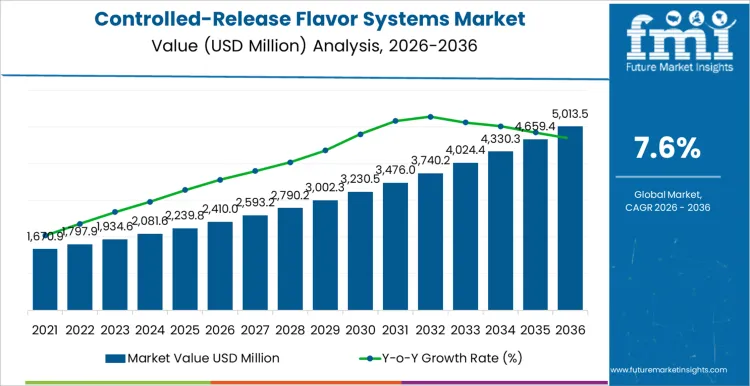
The controlled-release flavor systems market is likely to reach USD 2,410.0 million in 2026 and reach USD 5,013.5 million by 2036, at 7.6% CAGR. Value formation reflects increasing reliance on flavor delivery architectures that manage timing, intensity, and persistence rather than simple aroma strength. Product categories such as chewing gum, confectionery, instant beverages, and fortified foods depend on release control to maintain sensory impact after exposure to heat, moisture, or mechanical stress. Processing steps including baking, extrusion, spray drying, and pasteurization weaken conventional flavors, shifting formulation strategy toward systems that protect volatiles and trigger release during consumption. Revenue growth aligns with products where extended flavor perception or sequential taste experience is central to perceived quality.
Adoption behavior follows technical constraints tied to matrix interaction, regulatory acceptance, and manufacturing scalability. Formulators select systems based on response to pH, saliva, hydration, or mastication, with performance evaluated under real consumption conditions rather than laboratory stability alone. Sugar reduction and protein fortification increase bitterness and off-note exposure, raising dependence on delayed or staged release to manage taste perception. Regional distribution lengths and climate variability reinforce the need for predictable release behavior across shelf life. Cost sensitivity limits use in products requiring multi-layer constructs, concentrating demand in categories where sensory differentiation justifies formulation complexity. Market expansion remains structured around functional precision and processing resilience rather than volume-led flavor innovation cycles.
Quick Stats for Controlled-Release Flavor Systems Market
- Controlled-Release Flavor Systems Market Value (2026): USD 2,410.0 million
- Controlled-Release Flavor Systems Market Forecast Value (2036): USD 5,013.5 million
- Controlled-Release Flavor Systems Market Forecast CAGR 2026 to 2036: 7.6%
- Leading Release Mechanism by Demand Share: Time-controlled release systems
- Fastest-Growing Countries: India, China, Brazil, USA, UK
- Top Players in Global Demand: Givaudan, IFF, Symrise, DSM-Firmenich, Sensient Technologies
Controlled-Release Flavor Systems Market Key Takeaways
| Metric | Value |
|---|---|
| Market Value (2026) | USD 2,410.0 million |
| Market Forecast Value (2036) | USD 5,013.5 million |
| Forecast CAGR 2026 to 2036 | 7.6% |
Why is the Demand for Controlled-Release Flavor Systems Market Growing?
Controlled-release flavor systems are becoming integral in product formulations where staged flavor impact improves the eating or drinking experience. Food scientists designing multicourse textures and layered taste perceptions need mechanisms that deliver initial top-note aromas followed by sustained base flavors. Confectionery formats that combine crunchy exteriors with soft centers use controlled-release technologies to manage sequential perception without altering sweetness or mouthfeel. Ready-to-drink beverages with complex flavor profiles depend on these systems to protect delicate volatiles during processing and release them at the moment of consumption, compensating for losses that occur during heat treatment or storage.
Chewing gum and breath freshener categories utilize controlled-release formulations to extend flavor life during prolonged mastication, meeting consumer expectations for lasting sensory engagement. Demand is also supported by expansion of health-oriented and functional foods that integrate bioactive compounds with flavor components. Nutraceutical beverages and fortified snacks can exhibit off-tastes due to active ingredients; controlled-release systems help delay or modulate undesirable taste perception until sweetness or masking agents are active. Ingredient developers optimize carrier matrices and encapsulation techniques to respond predictably to pH, moisture, or mechanical action. Sensory analysis guides the tuning of release kinetics to align with consumption patterns, ensuring that flavor evolution matches textural and aromatic benchmarks established for specific product categories.
How Is the Controlled-Release Flavor Systems Industry Segmented by Release Mechanism, Delivery Matrix, and Application?
Demand for controlled-release flavor systems is shaped by requirements for sustained sensory perception, processing stability, and differentiated consumption experience. Food and oral care formulators seek precise control over flavor timing, intensity, and persistence under varying moisture, temperature, and mechanical conditions. Adoption reflects product format complexity, shelf-life expectations, and interaction with base matrices such as sugars, proteins, or fats. Segmentation by release mechanism, delivery matrix, and application explains how formulation strategies align with performance expectations across packaged foods, confectionery, beverages, and functional products.
Which Release Mechanism Accounts for the Highest Utilization Share?
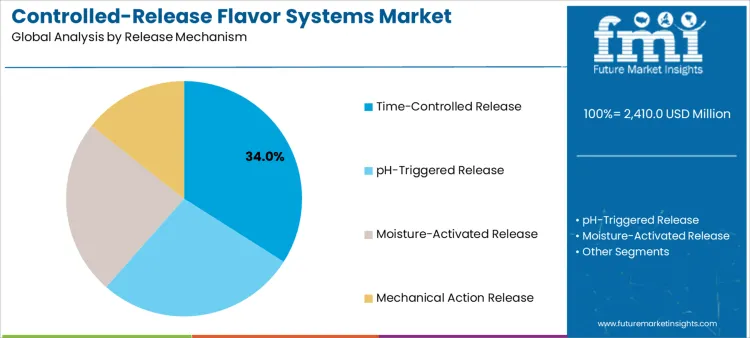
Time-controlled release holds 34.0%, reflecting its ability to deliver gradual flavor perception across extended consumption periods. This mechanism is widely applied where sustained sensory impact supports product differentiation and consumer engagement. pH-triggered release represents 27.0%, used in systems responding to oral or gastrointestinal conditions to activate flavor release. Moisture-activated release accounts for 21.0%, supporting products exposed to saliva or rehydration. Mechanical action release holds 18.0%, relying on chewing or mastication forces to liberate flavor compounds. Release mechanism segmentation reflects alignment between consumption behavior and desired sensory timing.
Key Points
- Time-based systems support prolonged flavor perception.
- pH sensitivity enables condition-specific flavor activation.
- Mechanical release aligns with chewing-driven products.
How Does Delivery Matrix Selection Shape Controlled-Release Performance?
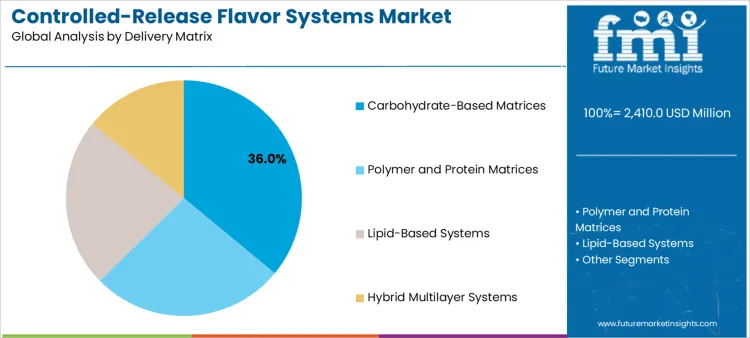
Carbohydrate-based matrices account for 36.0%, supported by film-forming properties, process compatibility, and predictable dissolution behavior. Polymer and protein matrices represent 28.0%, offering structural integrity and tailored release under specific environmental triggers. Lipid-based systems hold 22.0%, applied where delayed release and protection from moisture are required. Hybrid multilayer systems represent 14.0%, combining multiple materials to achieve sequential or staged release profiles. Delivery matrix segmentation reflects formulation trade-offs involving stability, release precision, and compatibility with target product formats.
Key Points
- Carbohydrate matrices provide predictable dissolution control.
- Protein and polymer systems enable structural tuning.
- Hybrid systems support multi-phase release behavior.
Which Applications Drive Demand for Controlled-Release Flavor Systems?
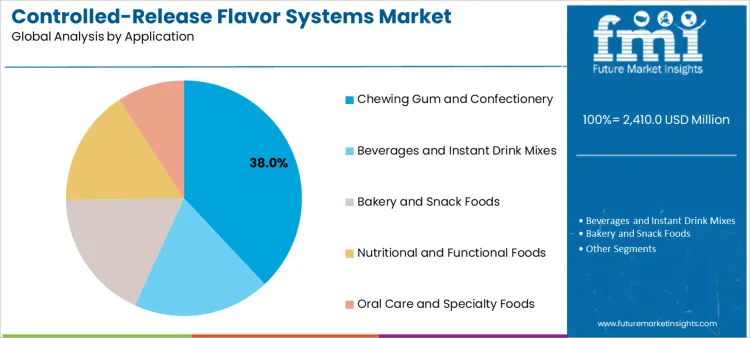
Chewing gum and confectionery account for 38.0%, supported by prolonged oral exposure that requires sustained and sequential flavor delivery. Beverages and instant drink mixes represent 22.0%, where controlled release moderates flavor burst and reduces rapid flavor loss during consumption. Bakery and snack foods hold 17.0%, reflecting the need for flavor protection through baking, extrusion, and shelf storage. Nutritional and functional foods represent 13.0%, using controlled release to balance sensory acceptance with active ingredients. Oral care and specialty foods account for 10.0%, where timed flavor perception supports product usage duration and compliance.
Key Points
- Chewing gum and confectionery rely on extended flavor persistence.
- Beverage applications use release control to manage flavor intensity.
- Functional foods apply controlled release to balance taste and efficacy.
What are the Key Dynamics in the Controlled-Release Flavor Systems Market?
Demand in the controlled-release flavor systems market is anchored in the need to enhance sensory experience in foods, beverages, oral care, and nutraceutical formats where traditional flavor delivery fails to sustain impact throughout consumption. Market traction is especially notable in formats such as chewing gum, confectionery, baked goods, and fortified beverages where temporal flavor delivery or delayed release enriches perceived quality. Value perception depends on how precisely an ingredient system modulates release kinetics under specific eating or drinking conditions. Ingredient adoption reflects compatibility with diverse matrices and stability through processing and storage rather than broad flavor enhancement alone.
How do processing conditions and consumption profiles drive adoption?
In product categories that involve complex processing, controlled-release systems are chosen to preserve volatile and labile flavor compounds that would otherwise dissipate or degrade. Extruded snacks and baked foods, for instance, require encapsulation architectures that protect flavor through high temperature and shear then trigger release at chewing. In beverages with layered sensory phases, systems that provide staggered release contribute to sustained taste perception during consumption. Oral care products such as toothpaste and mints benefit from sustained flavor impact during use, which reinforces product differentiation. Nutraceutical chews and effervescent tablets integrate controlled-release technologies to balance flavor longevity with functional ingredient stability, ensuring that off-notes from actives are masked until dissolution triggers intended sensory cues.
How do technical complexity and regulatory classification influence market scalability?
Growth in the controlled-release flavor systems market is influenced by the technical demands of designing delivery structures that perform as intended across diverse conditions and by regional regulatory frameworks governing ingredient use and labeling. Some controlled-release constructs lose efficacy under extreme pH or prolonged heat, requiring iterative design and formulation optimization, which extends development timelines. Variations in how encapsulation materials are classified and labeled across jurisdictions affect claim strategy and cross-market applicability, shaping where developers deploy specific systems without triggering complex compliance reviews. Cost sensitivity arises where multi-component delivery mechanisms are needed to achieve both protection and targeted release, influencing pricing decisions in mainstream categories. Sensory evaluation to verify release profiles and flavor persistence adds to development investment, which can affect how rapidly new controlled-release systems are commercialized in competitive food and beverage segments.
How Is Demand for the Controlled-Release Flavor Systems Market Evolving Globally?
Global demand for controlled-release flavor systems is increasing as food, beverage, and nutrition manufacturers manage flavor delivery across complex processing and consumption conditions. Growth reflects rising use of multi-layer flavor profiles, extended shelf-life products, and formulations requiring delayed or staged flavor perception. Demand expansion remains tied to sugar reduction, protein fortification, and functional ingredient inclusion that alters flavor release dynamics. India records 8.8% CAGR, China records 8.5% CAGR, Brazil records 8.0% CAGR, USA records 6.9% CAGR, and UK records 6.6% CAGR. Adoption is driven by sensory precision needs rather than growth in finished product volumes.
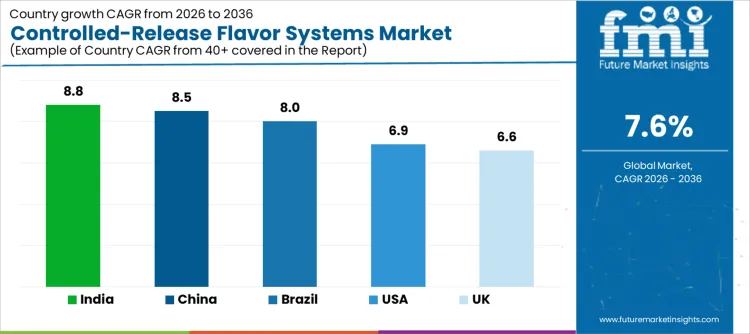
| Country | CAGR (%) |
|---|---|
| India | 8.8% |
| China | 8.5% |
| Brazil | 8.0% |
| USA | 6.9% |
| UK | 6.6% |
What is driving growth of controlled-release flavor systems demand in India?
Demand for controlled-release flavor systems in India is expanding as packaged food, beverage, and nutraceutical producers handle complex flavor stability challenges. Growth at 8.8% CAGR reflects rising formulation of instant beverages, nutrition powders, chewables, and fortified foods requiring staged flavor perception. High ambient temperatures and long distribution cycles increase the need for delayed release and flavor protection. Cost sensitivity encourages systems that combine flavor masking and release control within single solutions. Domestic formulators prioritize compatibility with spray drying, extrusion, and tablet compression. Demand remains concentrated within mass-market nutrition products and flavored beverages positioned for urban consumers.
- Expansion of instant and powdered formulations
- Need for delayed flavor perception
- High temperature processing compatibility
- Cost-efficient multi-function flavor systems
Why is China seeing expansion in controlled-release flavor systems adoption?
Controlled-release flavor systems demand in China is rising as industrial food processors refine sensory delivery across high-volume production. Growth at 8.5% CAGR reflects increased use in ready-to-drink beverages, dairy drinks, and functional nutrition products. Protein fortification and sugar reduction increase flavor release complexity, supporting adoption of staged delivery systems. Centralized manufacturing favors technologies delivering consistent sensory outcomes across large batches. Domestic suppliers scale encapsulation and matrix-based release platforms for beverage and nutrition use. Demand remains centered on industrial processors supplying national retail and foodservice channels.
- High-volume beverage and nutrition processing
- Flavor release control in reduced sugar systems
- Industrial consistency requirements
- Expansion of domestic release technology platforms
What factors are shaping controlled-release flavor systems sales in Brazil?
Sales of controlled-release flavor systems in Brazil are increasing as beverage and food manufacturers adapt to reformulation requirements. Growth at 8.0% CAGR reflects rising use in carbonated drinks, juices, confectionery, and powdered beverage mixes. Tropical climate conditions accelerate flavor volatility, increasing reliance on delayed release systems. Local producers focus on maintaining aroma impact and sweetness perception across shelf life. Demand remains strongest in mass-market beverages and confectionery products serving price-sensitive consumers. Ingredient selection emphasizes stability under ambient storage and compatibility with regional flavor profiles.
- Climate-driven flavor volatility management
- Expansion of beverage and confectionery use
- Need for sustained aroma impact
- Focus on mass-market sensory consistency
How is the USA supporting growth of controlled-release flavor systems demand?
Controlled-release flavor systems market demand in the USA is advancing as manufacturers manage complex reformulation across functional and fortified products. Growth at 6.9% CAGR reflects adoption in protein beverages, supplements, snacks, and reduced sugar foods. Controlled release supports bitterness management and staged flavor perception during consumption. Clean label expectations influence material selection and processing design. Large brands prioritize systems ensuring uniform sensory experience across national distribution. Demand is driven by formulation reliability and taste consistency rather than new product proliferation.
- Growth of functional and fortified foods
- Need for bitterness and off-note control
- Clean label driven system selection
- Nationwide distribution sensory consistency
What is driving expansion of controlled-release flavor systems demand in the UK?
Demand for controlled-release flavor systems in the UK is rising as nutrition policy and retailer standards reshape formulation strategies. Growth at 6.6% CAGR reflects usage across beverages, bakery fillings, dairy alternatives, and supplements. Sugar reduction and protein enrichment increase reliance on delayed flavor release technologies. Retail sensory benchmarks emphasize consistency across shelf life. Ingredient selection prioritizes regulatory approval and label clarity. Demand remains linked to compliance-driven reformulation cycles rather than changes in overall consumption patterns.
- Sugar reduction driven formulation changes
- Retail sensory quality benchmarks
- Growth of dairy alternative applications
- Regulatory compliant release technologies
What is the competitive landscape of demand for the controlled-release flavor systems market globally?
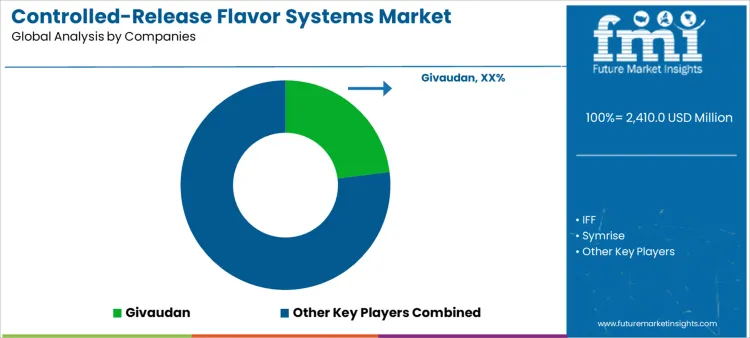
Timed flavor delivery requirements are shaping demand for controlled-release flavor systems across chewing gum, confectionery, beverages, and nutrition formats. Product developers assess release trigger accuracy, flavor intensity retention, matrix interaction, and stability during processing and storage. Buyer assessment includes encapsulation robustness, moisture sensitivity, particle size control, and consistency across production batches. Procurement behavior reflects extended sensory validation cycles, reliance on pilot-scale trials, and preference for suppliers supporting customized release profiles. Trend in the controlled-release flavor systems market reflects increased focus on multi-phase sensory experiences and longer-lasting flavor perception in reduced sugar formulations.
Givaudan holds leading positioning through advanced controlled-release platforms developed using proprietary encapsulation and sensory modeling capabilities. IFF competes by integrating release technologies within broader flavor and taste modulation systems tailored to application-specific needs. Symrise supports demand with controlled-release solutions optimized for confectionery and functional nutrition products. DSM-Firmenich maintains relevance through flavor delivery systems aligned with processing stability and sensory consistency targets. Sensient Technologies participates with encapsulated flavor systems emphasizing reproducible release and scalability across global manufacturing sites. Competitive differentiation centers on release precision, sensory performance reliability, customization depth, and collaborative formulation expertise.
Key Players in the Controlled-Release Flavor Systems Market
- Givaudan
- IFF
- Symrise
- DSM-Firmenich
- Sensient Technologies
- Others
Scope of the Report
| Items | Values |
|---|---|
| Quantitative Units | USD million |
| Release Mechanism | Time-Controlled Release; pH-Triggered Release; Moisture-Activated Release; Mechanical Action Release |
| Delivery Matrix | Carbohydrate-Based Matrices; Polymer and Protein Matrices; Lipid-Based Systems; Hybrid Multilayer Systems |
| Application | Chewing Gum and Confectionery; Beverages and Instant Drink Mixes; Bakery and Snack Foods; Nutritional and Functional Foods; Oral Care and Specialty Foods |
| Regions Covered | Asia Pacific, Europe, North America, Latin America, Middle East & Africa |
| Countries Covered | India, China, Brazil, USA, UK, and 40+ countries |
| Key Companies Profiled | Givaudan; IFF; Symrise; DSM-Firmenich; Sensient Technologies; Others |
| Additional Attributes | Dollar sales by release mechanism, delivery matrix, and application; precision of flavor release timing and intensity control across chewing, hydration, and thermal triggers; stability of encapsulated flavors during processing and storage; multilayer and hybrid system performance in extending flavor longevity; suitability for confectionery, beverage, and nutrition formats; procurement dynamics driven by customized flavor system development and long-term partnerships with global flavor houses. |
Controlled-Release Flavor Systems Market by Segment
Release Mechanism:
- Time-Controlled Release
- pH-Triggered Release
- Moisture-Activated Release
- Mechanical Action Release
Delivery Matrix:
- Carbohydrate-Based Matrices
- Polymer and Protein Matrices
- Lipid-Based Systems
- Hybrid Multilayer Systems
Application:
- Chewing Gum and Confectionery
- Beverages and Instant Drink Mixes
- Bakery and Snack Foods
- Nutritional and Functional Foods
- Oral Care and Specialty Foods
Region:
- Asia Pacific
- China
- Japan
- South Korea
- India
- Australia & New Zealand
- ASEAN
- Rest of Asia Pacific
- Europe
- Germany
- United Kingdom
- France
- Italy
- Spain
- Nordic
- BENELUX
- Rest of Europe
- North America
- United States
- Canada
- Mexico
- Latin America
- Brazil
- Chile
- Rest of Latin America
- Middle East & Africa
- Kingdom of Saudi Arabia
- Other GCC Countries
- Turkey
- South Africa
- Other African Union
- Rest of Middle East & Africa
Bibliography
- European Food Safety Authority. (2023). Safety assessment of encapsulation and delivery systems used for flavor and taste modulation in foods. EFSA Journal, 21(10).
- Food and Agriculture Organization of the United Nations. (2023). Encapsulation and controlled release technologies for food ingredients and flavors. FAO Food and Nutrition Paper.
- International Organization for Standardization. (2023). ISO 12099: Sensory analysis - Methodology for evaluating aroma retention and flavor release in foods (current edition). ISO.
- International Organization for Standardization. (2024). ISO 11036: Sensory analysis - Texture profile analysis (applications to time-dependent flavor perception). ISO.
- McClements, D. J. (2023). Advances in encapsulation and controlled-release systems for food flavors and bioactives. Food Hydrocolloids, 136, 108274.
- Gouin, S., & Voilley, A. (2024). Controlled release of flavors in food matrices: Mechanisms, materials, and sensory implications. Trends in Food Science & Technology, 146, 118-131.
Frequently Asked Questions
How big is the controlled-release flavor systems market in 2026?
The global controlled-release flavor systems market is estimated to be valued at USD 2,410.0 million in 2026.
What will be the size of controlled-release flavor systems market in 2036?
The market size for the controlled-release flavor systems market is projected to reach USD 5,013.5 million by 2036.
How much will be the controlled-release flavor systems market growth between 2026 and 2036?
The controlled-release flavor systems market is expected to grow at a 7.6% CAGR between 2026 and 2036.
What are the key product types in the controlled-release flavor systems market?
The key product types in controlled-release flavor systems market are time-controlled release, ph-triggered release, moisture-activated release and mechanical action release.
Which delivery matrix segment to contribute significant share in the controlled-release flavor systems market in 2026?
In terms of delivery matrix, carbohydrate-based matrices segment to command 36.0% share in the controlled-release flavor systems market in 2026.
Preview the report firsthand - request a free sample
Get SampleGet the brochure for pricing and purchase details.
Get PDFTable of Content
- Executive Summary
- Global Market Outlook
- Demand-side Trends
- Supply-side Trends
- Technology Roadmap Analysis
- Analysis and Recommendations
- Market Overview
- Market Coverage / Taxonomy
- Market Definition / Scope / Limitations
- Market Background
- Market Dynamics
- Drivers
- Restraints
- Opportunity
- Trends
- Scenario Forecast
- Demand in Optimistic Scenario
- Demand in Likely Scenario
- Demand in Conservative Scenario
- Opportunity Map Analysis
- Product Life Cycle Analysis
- Supply Chain Analysis
- Investment Feasibility Matrix
- Value Chain Analysis
- PESTLE and Porter’s Analysis
- Regulatory Landscape
- Regional Parent Market Outlook
- Production and Consumption Statistics
- Import and Export Statistics
- Market Dynamics
- Global Market Analysis 2021 to 2025 and Forecast, 2026 to 2036
- Historical Market Size Value (USD Million) Analysis, 2021 to 2025
- Current and Future Market Size Value (USD Million) Projections, 2026 to 2036
- Y-o-Y Growth Trend Analysis
- Absolute $ Opportunity Analysis
- Global Market Pricing Analysis 2021 to 2025 and Forecast 2026 to 2036
- Global Market Analysis 2021 to 2025 and Forecast 2026 to 2036, By Release Mechanism
- Introduction / Key Findings
- Historical Market Size Value (USD Million) Analysis By Release Mechanism , 2021 to 2025
- Current and Future Market Size Value (USD Million) Analysis and Forecast By Release Mechanism , 2026 to 2036
- Time-Controlled Release
- pH-Triggered Release
- Moisture-Activated Release
- Mechanical Action Release
- Time-Controlled Release
- Y-o-Y Growth Trend Analysis By Release Mechanism , 2021 to 2025
- Absolute $ Opportunity Analysis By Release Mechanism , 2026 to 2036
- Global Market Analysis 2021 to 2025 and Forecast 2026 to 2036, By Delivery Matrix
- Introduction / Key Findings
- Historical Market Size Value (USD Million) Analysis By Delivery Matrix, 2021 to 2025
- Current and Future Market Size Value (USD Million) Analysis and Forecast By Delivery Matrix, 2026 to 2036
- Carbohydrate-Based Matrices
- Polymer and Protein Matrices
- Lipid-Based Systems
- Hybrid Multilayer Systems
- Carbohydrate-Based Matrices
- Y-o-Y Growth Trend Analysis By Delivery Matrix, 2021 to 2025
- Absolute $ Opportunity Analysis By Delivery Matrix, 2026 to 2036
- Global Market Analysis 2021 to 2025 and Forecast 2026 to 2036, By Application
- Introduction / Key Findings
- Historical Market Size Value (USD Million) Analysis By Application, 2021 to 2025
- Current and Future Market Size Value (USD Million) Analysis and Forecast By Application, 2026 to 2036
- Chewing Gum and Confectionery
- Beverages and Instant Drink Mixes
- Bakery and Snack Foods
- Nutritional and Functional Foods
- Oral Care and Specialty Foods
- Chewing Gum and Confectionery
- Y-o-Y Growth Trend Analysis By Application, 2021 to 2025
- Absolute $ Opportunity Analysis By Application, 2026 to 2036
- Global Market Analysis 2021 to 2025 and Forecast 2026 to 2036, By Region
- Introduction
- Historical Market Size Value (USD Million) Analysis By Region, 2021 to 2025
- Current Market Size Value (USD Million) Analysis and Forecast By Region, 2026 to 2036
- North America
- Latin America
- Western Europe
- Eastern Europe
- East Asia
- South Asia and Pacific
- Middle East & Africa
- Market Attractiveness Analysis By Region
- North America Market Analysis 2021 to 2025 and Forecast 2026 to 2036, By Country
- Historical Market Size Value (USD Million) Trend Analysis By Market Taxonomy, 2021 to 2025
- Market Size Value (USD Million) Forecast By Market Taxonomy, 2026 to 2036
- By Country
- USA
- Canada
- Mexico
- By Release Mechanism
- By Delivery Matrix
- By Application
- By Country
- Market Attractiveness Analysis
- By Country
- By Release Mechanism
- By Delivery Matrix
- By Application
- Key Takeaways
- Latin America Market Analysis 2021 to 2025 and Forecast 2026 to 2036, By Country
- Historical Market Size Value (USD Million) Trend Analysis By Market Taxonomy, 2021 to 2025
- Market Size Value (USD Million) Forecast By Market Taxonomy, 2026 to 2036
- By Country
- Brazil
- Chile
- Rest of Latin America
- By Release Mechanism
- By Delivery Matrix
- By Application
- By Country
- Market Attractiveness Analysis
- By Country
- By Release Mechanism
- By Delivery Matrix
- By Application
- Key Takeaways
- Western Europe Market Analysis 2021 to 2025 and Forecast 2026 to 2036, By Country
- Historical Market Size Value (USD Million) Trend Analysis By Market Taxonomy, 2021 to 2025
- Market Size Value (USD Million) Forecast By Market Taxonomy, 2026 to 2036
- By Country
- Germany
- UK
- Italy
- Spain
- France
- Nordic
- BENELUX
- Rest of Western Europe
- By Release Mechanism
- By Delivery Matrix
- By Application
- By Country
- Market Attractiveness Analysis
- By Country
- By Release Mechanism
- By Delivery Matrix
- By Application
- Key Takeaways
- Eastern Europe Market Analysis 2021 to 2025 and Forecast 2026 to 2036, By Country
- Historical Market Size Value (USD Million) Trend Analysis By Market Taxonomy, 2021 to 2025
- Market Size Value (USD Million) Forecast By Market Taxonomy, 2026 to 2036
- By Country
- Russia
- Poland
- Hungary
- Balkan & Baltic
- Rest of Eastern Europe
- By Release Mechanism
- By Delivery Matrix
- By Application
- By Country
- Market Attractiveness Analysis
- By Country
- By Release Mechanism
- By Delivery Matrix
- By Application
- Key Takeaways
- East Asia Market Analysis 2021 to 2025 and Forecast 2026 to 2036, By Country
- Historical Market Size Value (USD Million) Trend Analysis By Market Taxonomy, 2021 to 2025
- Market Size Value (USD Million) Forecast By Market Taxonomy, 2026 to 2036
- By Country
- China
- Japan
- South Korea
- By Release Mechanism
- By Delivery Matrix
- By Application
- By Country
- Market Attractiveness Analysis
- By Country
- By Release Mechanism
- By Delivery Matrix
- By Application
- Key Takeaways
- South Asia and Pacific Market Analysis 2021 to 2025 and Forecast 2026 to 2036, By Country
- Historical Market Size Value (USD Million) Trend Analysis By Market Taxonomy, 2021 to 2025
- Market Size Value (USD Million) Forecast By Market Taxonomy, 2026 to 2036
- By Country
- India
- ASEAN
- Australia & New Zealand
- Rest of South Asia and Pacific
- By Release Mechanism
- By Delivery Matrix
- By Application
- By Country
- Market Attractiveness Analysis
- By Country
- By Release Mechanism
- By Delivery Matrix
- By Application
- Key Takeaways
- Middle East & Africa Market Analysis 2021 to 2025 and Forecast 2026 to 2036, By Country
- Historical Market Size Value (USD Million) Trend Analysis By Market Taxonomy, 2021 to 2025
- Market Size Value (USD Million) Forecast By Market Taxonomy, 2026 to 2036
- By Country
- Kingdom of Saudi Arabia
- Other GCC Countries
- Turkiye
- South Africa
- Other African Union
- Rest of Middle East & Africa
- By Release Mechanism
- By Delivery Matrix
- By Application
- By Country
- Market Attractiveness Analysis
- By Country
- By Release Mechanism
- By Delivery Matrix
- By Application
- Key Takeaways
- Key Countries Market Analysis
- USA
- Pricing Analysis
- Market Share Analysis, 2025
- By Release Mechanism
- By Delivery Matrix
- By Application
- Canada
- Pricing Analysis
- Market Share Analysis, 2025
- By Release Mechanism
- By Delivery Matrix
- By Application
- Mexico
- Pricing Analysis
- Market Share Analysis, 2025
- By Release Mechanism
- By Delivery Matrix
- By Application
- Brazil
- Pricing Analysis
- Market Share Analysis, 2025
- By Release Mechanism
- By Delivery Matrix
- By Application
- Chile
- Pricing Analysis
- Market Share Analysis, 2025
- By Release Mechanism
- By Delivery Matrix
- By Application
- Germany
- Pricing Analysis
- Market Share Analysis, 2025
- By Release Mechanism
- By Delivery Matrix
- By Application
- UK
- Pricing Analysis
- Market Share Analysis, 2025
- By Release Mechanism
- By Delivery Matrix
- By Application
- Italy
- Pricing Analysis
- Market Share Analysis, 2025
- By Release Mechanism
- By Delivery Matrix
- By Application
- Spain
- Pricing Analysis
- Market Share Analysis, 2025
- By Release Mechanism
- By Delivery Matrix
- By Application
- France
- Pricing Analysis
- Market Share Analysis, 2025
- By Release Mechanism
- By Delivery Matrix
- By Application
- India
- Pricing Analysis
- Market Share Analysis, 2025
- By Release Mechanism
- By Delivery Matrix
- By Application
- ASEAN
- Pricing Analysis
- Market Share Analysis, 2025
- By Release Mechanism
- By Delivery Matrix
- By Application
- Australia & New Zealand
- Pricing Analysis
- Market Share Analysis, 2025
- By Release Mechanism
- By Delivery Matrix
- By Application
- China
- Pricing Analysis
- Market Share Analysis, 2025
- By Release Mechanism
- By Delivery Matrix
- By Application
- Japan
- Pricing Analysis
- Market Share Analysis, 2025
- By Release Mechanism
- By Delivery Matrix
- By Application
- South Korea
- Pricing Analysis
- Market Share Analysis, 2025
- By Release Mechanism
- By Delivery Matrix
- By Application
- Russia
- Pricing Analysis
- Market Share Analysis, 2025
- By Release Mechanism
- By Delivery Matrix
- By Application
- Poland
- Pricing Analysis
- Market Share Analysis, 2025
- By Release Mechanism
- By Delivery Matrix
- By Application
- Hungary
- Pricing Analysis
- Market Share Analysis, 2025
- By Release Mechanism
- By Delivery Matrix
- By Application
- Kingdom of Saudi Arabia
- Pricing Analysis
- Market Share Analysis, 2025
- By Release Mechanism
- By Delivery Matrix
- By Application
- Turkiye
- Pricing Analysis
- Market Share Analysis, 2025
- By Release Mechanism
- By Delivery Matrix
- By Application
- South Africa
- Pricing Analysis
- Market Share Analysis, 2025
- By Release Mechanism
- By Delivery Matrix
- By Application
- USA
- Market Structure Analysis
- Competition Dashboard
- Competition Benchmarking
- Market Share Analysis of Top Players
- By Regional
- By Release Mechanism
- By Delivery Matrix
- By Application
- Competition Analysis
- Competition Deep Dive
- Givaudan
- Overview
- Product Portfolio
- Profitability by Market Segments (Product/Age /Sales Channel/Region)
- Sales Footprint
- Strategy Overview
- Marketing Strategy
- Product Strategy
- Channel Strategy
- IFF
- Symrise
- DSM-Firmenich
- Sensient Technologies
- Others
- Givaudan
- Competition Deep Dive
- Assumptions & Acronyms Used
- Research Methodology


