

- Industry Size (2026)
- USD 228.3 Mn
- Forecast (2036)
- USD 527.2 Mn
- CAGR (2026 to 2036)
- 8.7%
Flavor-Release Films Market Forecast and Outlook 2026 to 2036
The flavor release films market expands from USD 228.3 million in 2026 to USD 346.4 million in 2031, representing a clearly defined early growth block. This phase reflects a CAGR of 8.7% and captures the transition from niche adoption to broader commercial use. Growth in this block is driven by increased incorporation of flavor films in oral care, confectionery, nutraceuticals, and functional food formats. Manufacturers focus on improving film stability, flavor retention, and controlled dissolution, which supports wider formulation acceptance. Annual value additions accelerate steadily, indicating rising order volumes rather than isolated project demand.
From 2031 to 2036, the market advances from about USD 346.4 million to USD 527.2 million, forming a stronger second growth block with higher absolute dollar expansion. This period reflects deeper penetration across consumer products and healthcare applications, where precise flavor delivery improves user compliance and product differentiation. The latter block shows larger year-on-year increments, signaling scale-up in production and repeat procurement cycles. Growth is shaped by portfolio expansion and manufacturing efficiency gains rather than new application discovery, marking a shift from adoption driven growth to volume driven growth across established end uses.
Quick Stats of the Flavor-Release Films Market
- Flavor-Release Films Market Value (2026): USD 228.3 million
- Flavor-Release Films Market Forecast Value (2036): USD 527.2 million
- Flavor-Release Films Market Forecast CAGR (2026-2036): 8.7%
- Leading Application: Snacks & Confectionery (40%)
- Key Growth Regions: India, China, Brazil, United States, Germany
- Top Players: Amcor, Berry Global, Mondi, Sealed Air, Innovia Films, ProAmpac
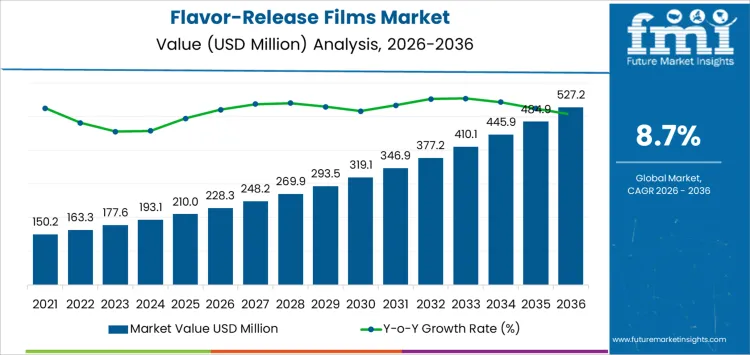
What is the Growth Forecast for the Flavor-Release Films Market through 2036?
From 2026 to 2031, the flavor-release films market expands from USD 228.3 million to about USD 318.7 million, with growth driven less by volume expansion and more by widening application depth. Adoption strengthens in confectionery strips, oral dissolvable supplements, and pediatric and geriatric dosage formats where taste masking and controlled release directly affect compliance. During this phase, demand is concentrated among premium product lines, pilot-scale pharmaceutical uses, and functional foods targeting portability and portion control. Manufacturing complexity, including multilayer film structures and encapsulation stability, limits rapid commoditization. YeAR-on-year growth accelerates as production yields improve and brand owners gain confidence in shelf-life consistency.
Between 2031 and 2036, demand rises from approximately USD 318.7 million to USD 527.2 million, reflecting a structural shift toward scaled commercialization. Growth in this phase is supported by broader penetration into mass-market nutraceuticals, over-the-counter therapeutics, and specialty food coatings where flavor sequencing and delayed release offer differentiation. Film technologies move beyond single-flavor delivery toward multi-stage release profiles, increasing average selling value per unit. Pharmaceutical adoption expands as regulatory familiarity improves, while food manufacturers integrate films into automated filling and packaging lines. The latter period shows stronger absolute annual additions, driven by higher formulation density, wider end-use acceptance, and repeat integration across global product portfolios rather than incremental trial usage.
Flavor Release Films Market Key Takeaways
| Metric | Value |
|---|---|
| Market Value (2026) | USD 228.3 million |
| Forecast Value (2036) | USD 527.2 million |
| Forecast CAGR (2026-2036) | 8.7% |
How Is Controlled Sensory Delivery Shaping the Flavor-Release Films Market from 2026 to 2036?
Flavor-release films gained attention as food, confectionery, and oral care manufacturers explored formats that deliver taste without bulk ingredients. Thin edible films enabled precise flavor dosing in products such as breath strips, functional supplements, and novelty confectionery. Historical demand developed through interest in portion control, rapid dissolution, and portable consumption formats. Producers valued films that dissolved predictably in the mouth and maintained flavor stability during storage. Adoption relied on advances in film forming polymers and encapsulation methods that protected volatile flavor compounds until use.
From 2026 to 2036 demand is expected to broaden with expansion of functional foods, nutraceutical delivery, and experiential eating formats. Manufacturers experiment with layered films that release flavors sequentially or under specific conditions such as moisture or temperature. Growth reflects consumer preference for low calorie, low volume products with strong sensory impact. Developers focus on improving film strength, mouthfeel, and compatibility with natural flavor systems. Buyers assess scalability, flavor retention, and regulatory acceptance when integrating flavor-release films into new product concepts.
What Is the Demand for the Flavor-Release Films Market by Application and Product Type for 2026 to 2036?
From 2026 to 2036, the flavor-release films market develops alongside packaged food innovation, portion-controlled formats, and sensory differentiation in convenience foods. Snacks and confectionery account for 40% of application demand as brands focus on controlled aroma release, freshness perception, and on-consumption flavor activation. Multilayer co-extruded films lead product type demand at 38% because they enable precise barrier control and timed flavor migration. Market behavior reflects collaboration between film manufacturers and food formulators to align release kinetics with consumption patterns, shelf-life targets, and processing constraints.
Why do snacks and confectionery account for 40% of demand in the flavor-release films market by application?
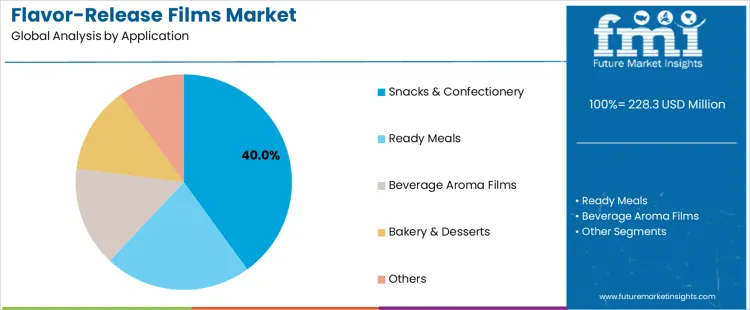
Snacks and confectionery account for 40% of demand because these categories rely heavily on aroma intensity and immediate sensory impact to drive consumer preference. Consumption intensity is high in single-serve and on-the-go formats where flavor perception must remain consistent from opening to final bite. Usage remains steady as manufacturers integrate flavor-release films into wrappers, inner liners, and compartmentalized packaging to protect volatile compounds during storage. Procurement decisions prioritize films that delay flavor loss while enabling rapid release during consumption. Buyers favor solutions compatible with high-speed packaging lines and varied fat, sugar, and moisture profiles. Price sensitivity stays moderate since packaging plays a direct role in perceived product quality and brand differentiation. Specification control focuses on barrier tuning, flavor retention stability, and controlled permeability. Demand continues from 2026 to 2036 as snack producers expand premium variants and reformulate to maintain taste impact under reduced additive usage. Repeat utilization remains predictable because flavor-release films become embedded within standard packaging specifications for key product lines.
Why do multilayer co-extruded films represent 38% of demand in the flavor-release films market by product type?
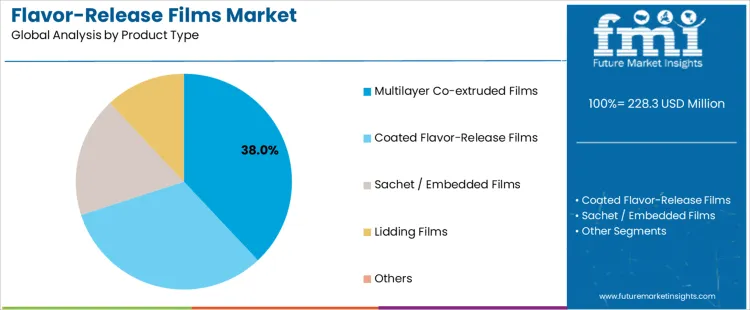
Multilayer co-extruded films represent 38% of demand because they allow precise control over flavor retention, migration rate, and protection from oxygen and moisture. Consumption is strong among manufacturers requiring consistent performance across extended shelf-life products. Usage remains steady as multilayer structures combine functional layers for sealing, strength, and aroma control within a single film. Procurement favors co-extruded films that reduce the need for secondary coatings or sachets, simplifying packaging design. Buyers prioritize reproducibility, downgauging potential, and compatibility with recycling or mono-material strategies where applicable. Price sensitivity stays moderate since multilayer films deliver multiple functions within one structure, reducing overall packaging complexity. Specification control emphasizes layer thickness accuracy, interlayer adhesion, and predictable diffusion behavior. Demand persists from 2026 to 2036 as food brands seek packaging solutions that protect volatile flavors while supporting efficient manufacturing and consistent consumer experience across global distribution networks.
How Is Demand for Flavor Release Films Being Shaped by Technical Formulation and Usage Precision?
Demand develops where controlled sensory delivery is required without altering product bulk or texture. Product developers use flavor release films to separate taste delivery from sweeteners, fats, or liquids. Oral care brands rely on films to manage short duration flavor during use without residue. Nutraceutical formats adopt films for products consumed without water, supporting precise dosing. Food innovation teams test films to deliver layered flavor profiles released at defined intervals. These applications reflect formulation control needs rather than volume driven food processing, grounding demand in technical design choices and usage accuracy.
What Technical and Product Development Factors Are Driving Demand for Flavor Release Films?
Drivers originate from the need for predictable dissolution and repeatable sensory output. Manufacturers use polymer selection and film thickness to control release timing under saliva contact. Flavor houses collaborate with film producers to stabilize volatile compounds during storage. Lightweight film formats reduce packaging requirements for single dose products. Developers also use films to mask bitter actives in functional products. These drivers reflect laboratory level priorities tied to consistency, stability, and user experience rather than shifts in mass consumption patterns.
What Technical and Commercial Barriers Are Limiting Wider Adoption of Flavor Release Films?
Barriers arise from scale up complexity, material sensitivity, and cost control. Maintaining uniform film thickness at commercial scale remains challenging. Moisture sensitivity demands specialized packaging, raising logistics costs. Limited compatibility between certain flavors and film polymers restricts formulation options. Production yields can vary, affecting pricing stability. Regulatory clearance differs by application, extending timelines. Market education also remains limited outside specialized categories. These factors constrain broader use where manufacturing risk, cost pressure, and regulatory effort outweigh controlled flavor delivery benefits.
What is the Demand for Flavor Release Films by Country?
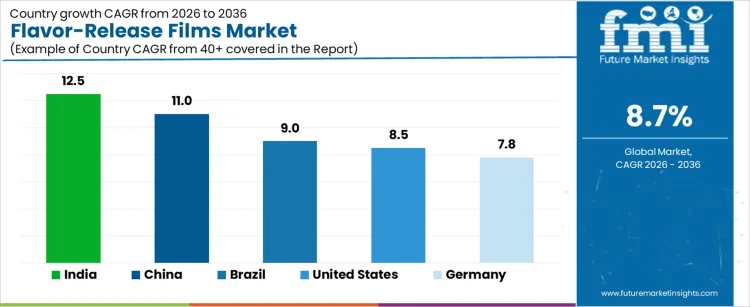
| Country | CAGR (%) |
|---|---|
| China | 11.0% |
| United States | 8.5% |
| Germany | 7.8% |
| Brazil | 9.0% |
| India | 12.5% |
The demand for flavor release films shows varied growth patterns across major economies, shaped by food processing scale, packaging adoption, and consumer preferences. India leads at a 12.5% CAGR, supported by rapid expansion in packaged foods, confectionery, and oral care applications. China follows at 11.0%, driven by large scale food manufacturing and increasing use of functional packaging formats. Brazil records 9.0%, reflecting growth in processed food consumption and expanding local packaging industries. The United States grows at 8.5%, supported by established food brands adopting controlled flavor delivery technologies. Germany posts 7.8%, influenced by mature food processing sectors and steady uptake of advanced packaging solutions across bakery, dairy, and nutraceutical applications.
How Is Functional Confectionery Innovation Supporting Growth in China?
In China, revenue from the Flavor-Release Films Market is expanding at a CAGR of 11% through 2035, driven by rising demand for functional confectionery, oral care strips, and nutraceutical delivery formats. Food and pharmaceutical manufacturers are incorporating flavor-release films to improve taste masking and controlled sensory release. Expanding urban consumption and growing acceptance of edible films in supplements and breath fresheners are supporting adoption. Domestic producers are scaling production capabilities, while multinational suppliers strengthen distribution partnerships. Regulatory clarity around edible film materials is supporting broader commercialization across food, healthcare, and personal care applications nationwide.
- Growing nutraceutical consumption is increasing demand for flavor-release films.
- Functional confectionery formats are supporting wider product adoption.
- Domestic manufacturing expansion is improving supply availability.
- Urban consumer demand is driving volume growth.
Why Is Product Differentiation Driving Adoption in the United States?
The United States is experiencing steady expansion in the Flavor-Release Films Market at a CAGR of 8.5% through 2035, supported by product differentiation strategies across food, oral care, and nutraceutical segments. Manufacturers are adopting flavor-release films to enhance consumer experience and enable precise flavor delivery. Strong demand for breath strips, oral dissolvable supplements, and functional food products is sustaining momentum. Advanced material development and established regulatory pathways are supporting commercial scalability. Brand focus on convenience formats continues to support integration of flavor-release films across premium and mass market product portfolios nationwide.
- Demand for oral dissolvable formats is supporting steady adoption.
- Product differentiation strategies are increasing material usage.
- Regulatory clarity supports commercial deployment at scale.
- Established brands drive consistent procurement volumes.
How Does Processed Food Innovation Sustain Demand in Germany?
Germany continues to record growth in the Flavor-Release Films Market at a CAGR of 7.8% through 2035, supported by processed food innovation and structured product development standards. Food manufacturers are incorporating flavor-release films to enable controlled flavor profiles and consistent sensory performance. Demand is concentrated within confectionery, bakery inclusions, and functional food categories. Strong technical expertise in food processing and material science supports adoption across industrial production environments. Compliance focused manufacturing practices and stable demand from food processors are sustaining predictable procurement patterns across domestic production facilities.
- Processed food innovation supports consistent material adoption.
- Controlled flavor delivery remains a key application driver.
- Technical expertise enables integration into production lines.
- Industrial food manufacturers anchor baseline demand.
What Factors Are Encouraging Market Expansion in Brazil?
Brazil is seeing expansion in the Flavor-Release Films Market at a CAGR of 9% through 2035, supported by growth in confectionery consumption and increasing focus on value added food products. Manufacturers are exploring flavor-release films to enhance taste stability and extend product differentiation. Rising middle income consumption and expanding packaged food distribution are supporting adoption. Import dependence remains present for advanced film materials, while local converters expand processing capabilities. Food brand experimentation with novel formats continues to drive incremental demand across confectionery and oral care segments nationwide.
- Confectionery consumption growth supports film adoption.
- Product differentiation is encouraging material trials.
- Imports remain important for advanced formulations.
- Packaged food expansion sustains volume growth.
How Is Nutraceutical Manufacturing Expansion Driving Growth in India?
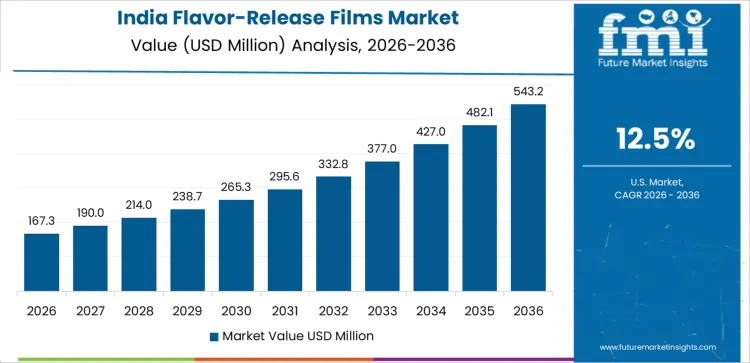
India is witnessing strong growth in the Flavor-Release Films Market at a CAGR of 12.5% through 2035, driven by rapid expansion of nutraceutical manufacturing and functional food production. Manufacturers are adopting flavor-release films to improve palatability and consumer acceptance of supplements. Growing demand for oral dissolvable strips and fortified food formats is supporting application expansion. Domestic material suppliers are entering the segment with cost focused offerings, while regulatory alignment for edible films supports commercialization. Rising health awareness and expanding distribution of nutrition products are sustaining strong adoption momentum nationwide.
- Nutraceutical manufacturing growth drives application demand.
- Oral dissolvable formats support wider usage.
- Domestic suppliers improve cost accessibility.
- Health focused consumption trends sustain adoption.
What Is Driving the Demand for Flavor Release Films and Which Companies Shape Packaging Innovation?
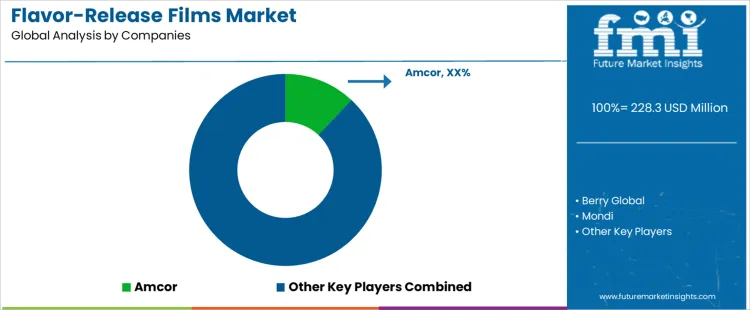
The demand for flavor release films is shaped by growth in packaged food, confectionery, oral care, and nutraceutical products that rely on controlled sensory delivery. Food manufacturers use these films to manage aroma retention, timed flavor release, and product differentiation without altering core formulations. Amcor supports adoption through multilayer flexible packaging designed to regulate barrier properties and release behavior in chewing gum, confectionery, and snack applications. Berry Global contributes through specialty films used in portion packs and unit dose formats where flavor perception matters. Mondi supports demand through functional paper based and hybrid structures used in food wraps and sachets that balance protection with controlled interaction. Innovia Films plays a role through biaxially oriented films used in aroma sensitive packaging formats.
Material selection is governed by permeability control, heat seal performance, food contact compliance, and stability during storage. Sealed Air supports niche applications where packaging integrates protection with functional release in high value food products. ProAmpac participates through custom flexible packaging structures developed with brand owners seeking sensory differentiation. Buyers emphasize consistency of release, compatibility with existing filling lines, and regulatory acceptance across regions. Usage spans confectionery wraps, oral strips, seasoning sachets, and functional food packaging. Demand visibility tracks innovation in sensory focused foods, premiumization of packaged snacks, and continued investment by brands in packaging that enhances consumer experience without changing product composition.
Key Players in the Flavor-Release Films Market
- Amcor
- Berry Global
- Mondi
- Sealed Air
- Innovia Films
- ProAmpac
Scope of the Report
| Items | Values |
|---|---|
| Quantitative Units (2026) | USD million |
| Application | Snacks and Confectionery; Ready Meals; Beverage Aroma Films; Bakery and Desserts; Other Applications |
| Product Type | Multilayer Co Extruded Films; Coated Flavor Release Films; Sachet and Embedded Films; Lidding Films; Other Film Types |
| Technology | Microencapsulation; Pressure Activated Release; Heat Activated Release; Time Release Systems; Other Technologies |
| Regions Covered | Asia Pacific; Europe; North America; Latin America; Middle East and Africa |
| Countries Covered | China; Japan; South Korea; India; Australia and New Zealand; ASEAN; Germany; United Kingdom; France; Italy; Spain; Nordic; BENELUX; United States; Canada; Mexico; Brazil; Chile; Kingdom of Saudi Arabia; Turkey; South Africa; plus additional countries across Asia Pacific, Europe, Latin America, and Middle East and Africa |
| Key Companies Profiled | Amcor; Berry Global; Mondi; Sealed Air; Innovia Films; ProAmpac |
| Additional Attributes | Dollar by sales across applications and product types; integration of flavor release films into confectionery, nutraceutical, oral care, and functional food packaging formats; demand patterns shaped by controlled sensory delivery, portion control, and flavor stability requirements; adoption of multilayer and co extruded film structures for timed flavor migration and barrier control; role of encapsulation and activation technologies in managing release kinetics; compatibility requirements with high speed packaging, filling, and sealing lines; influence of regulatory acceptance and food contact compliance on commercial deployment across regions |
Flavor-Release Films Market Segmentation
By Application:
- Snacks & Confectionery
- Ready Meals
- Beverage Aroma Films
- Bakery & Desserts
- Others
By Product Type:
- Multilayer Co-Extruded Films
- Coated Flavor-Release Films
- Sachet / Embedded Films
- Lidding Films
- Others
By Technology:
- Microencapsulation
- Pressure-Activated
- Heat-Activated
- Time-Release
- Others
Region
- Asia Pacific
- China
- Japan
- South Korea
- India
- Australia & New Zealand
- ASEAN
- Rest of Asia Pacific
- Europe
- Germany
- United Kingdom
- France
- Italy
- Spain
- Nordic
- BENELUX
- Rest of Europe
- North America
- United States
- Canada
- Mexico
- Latin America
- Brazil
- Chile
- Rest of Latin America
- Middle East & Africa
- Kingdom of Saudi Arabia
- Other GCC Countries
- Turkey
- South Africa
- Other African Union
- Rest of Middle East & Africa
Frequently Asked Questions
How big is the flavor-release films market in 2026?
The global flavor-release films market is estimated to be valued at USD 228.3 million in 2026.
What will be the size of flavor-release films market in 2036?
The market size for the flavor-release films market is projected to reach USD 527.2 million by 2036.
How much will be the flavor-release films market growth between 2026 and 2036?
The flavor-release films market is expected to grow at a 8.7% CAGR between 2026 and 2036.
What are the key product types in the flavor-release films market?
The key product types in flavor-release films market are snacks & confectionery, ready meals, beverage aroma films, bakery & desserts and others.
Which product type segment to contribute significant share in the flavor-release films market in 2026?
In terms of product type, multilayer co-extruded films segment to command 38.0% share in the flavor-release films market in 2026.
Preview the report firsthand - request a free sample
Get SampleGet the brochure for pricing and purchase details.
Get PDFTable of Content
- Executive Summary
- Global Market Outlook
- Demand-side Trends
- Supply-side Trends
- Technology Roadmap Analysis
- Analysis and Recommendations
- Market Overview
- Market Coverage / Taxonomy
- Market Definition / Scope / Limitations
- Market Background
- Market Dynamics
- Drivers
- Restraints
- Opportunity
- Trends
- Scenario Forecast
- Demand in Optimistic Scenario
- Demand in Likely Scenario
- Demand in Conservative Scenario
- Opportunity Map Analysis
- Product Life Cycle Analysis
- Supply Chain Analysis
- Investment Feasibility Matrix
- Value Chain Analysis
- PESTLE and Porter’s Analysis
- Regulatory Landscape
- Regional Parent Market Outlook
- Production and Consumption Statistics
- Import and Export Statistics
- Market Dynamics
- Global Market Analysis 2021 to 2025 and Forecast, 2026 to 2036
- Historical Market Size Value (USD Million) Analysis, 2021 to 2025
- Current and Future Market Size Value (USD Million) Projections, 2026 to 2036
- Y-o-Y Growth Trend Analysis
- Absolute $ Opportunity Analysis
- Global Market Pricing Analysis 2021 to 2025 and Forecast 2026 to 2036
- Global Market Analysis 2021 to 2025 and Forecast 2026 to 2036, By Application
- Introduction / Key Findings
- Historical Market Size Value (USD Million) Analysis By Application , 2021 to 2025
- Current and Future Market Size Value (USD Million) Analysis and Forecast By Application , 2026 to 2036
- Snacks & Confectionery
- Ready Meals
- Beverage Aroma Films
- Bakery & Desserts
- Others
- Y-o-Y Growth Trend Analysis By Application , 2021 to 2025
- Absolute $ Opportunity Analysis By Application , 2026 to 2036
- Global Market Analysis 2021 to 2025 and Forecast 2026 to 2036, By Product Type
- Introduction / Key Findings
- Historical Market Size Value (USD Million) Analysis By Product Type, 2021 to 2025
- Current and Future Market Size Value (USD Million) Analysis and Forecast By Product Type, 2026 to 2036
- Multilayer Co-extruded Films
- Coated Flavor-Release Films
- Sachet / Embedded Films
- Lidding Films
- Others
- Y-o-Y Growth Trend Analysis By Product Type, 2021 to 2025
- Absolute $ Opportunity Analysis By Product Type, 2026 to 2036
- Global Market Analysis 2021 to 2025 and Forecast 2026 to 2036, By Technology
- Introduction / Key Findings
- Historical Market Size Value (USD Million) Analysis By Technology, 2021 to 2025
- Current and Future Market Size Value (USD Million) Analysis and Forecast By Technology, 2026 to 2036
- Microencapsulation
- Pressure-Activated
- Heat-Activated
- Time-Release
- Others
- Y-o-Y Growth Trend Analysis By Technology, 2021 to 2025
- Absolute $ Opportunity Analysis By Technology, 2026 to 2036
- Global Market Analysis 2021 to 2025 and Forecast 2026 to 2036, By Region
- Introduction
- Historical Market Size Value (USD Million) Analysis By Region, 2021 to 2025
- Current Market Size Value (USD Million) Analysis and Forecast By Region, 2026 to 2036
- North America
- Latin America
- Western Europe
- Eastern Europe
- East Asia
- South Asia and Pacific
- Middle East & Africa
- Market Attractiveness Analysis By Region
- North America Market Analysis 2021 to 2025 and Forecast 2026 to 2036, By Country
- Historical Market Size Value (USD Million) Trend Analysis By Market Taxonomy, 2021 to 2025
- Market Size Value (USD Million) Forecast By Market Taxonomy, 2026 to 2036
- By Country
- USA
- Canada
- Mexico
- By Application
- By Product Type
- By Technology
- By Country
- Market Attractiveness Analysis
- By Country
- By Application
- By Product Type
- By Technology
- Key Takeaways
- Latin America Market Analysis 2021 to 2025 and Forecast 2026 to 2036, By Country
- Historical Market Size Value (USD Million) Trend Analysis By Market Taxonomy, 2021 to 2025
- Market Size Value (USD Million) Forecast By Market Taxonomy, 2026 to 2036
- By Country
- Brazil
- Chile
- Rest of Latin America
- By Application
- By Product Type
- By Technology
- By Country
- Market Attractiveness Analysis
- By Country
- By Application
- By Product Type
- By Technology
- Key Takeaways
- Western Europe Market Analysis 2021 to 2025 and Forecast 2026 to 2036, By Country
- Historical Market Size Value (USD Million) Trend Analysis By Market Taxonomy, 2021 to 2025
- Market Size Value (USD Million) Forecast By Market Taxonomy, 2026 to 2036
- By Country
- Germany
- UK
- Italy
- Spain
- France
- Nordic
- BENELUX
- Rest of Western Europe
- By Application
- By Product Type
- By Technology
- By Country
- Market Attractiveness Analysis
- By Country
- By Application
- By Product Type
- By Technology
- Key Takeaways
- Eastern Europe Market Analysis 2021 to 2025 and Forecast 2026 to 2036, By Country
- Historical Market Size Value (USD Million) Trend Analysis By Market Taxonomy, 2021 to 2025
- Market Size Value (USD Million) Forecast By Market Taxonomy, 2026 to 2036
- By Country
- Russia
- Poland
- Hungary
- Balkan & Baltic
- Rest of Eastern Europe
- By Application
- By Product Type
- By Technology
- By Country
- Market Attractiveness Analysis
- By Country
- By Application
- By Product Type
- By Technology
- Key Takeaways
- East Asia Market Analysis 2021 to 2025 and Forecast 2026 to 2036, By Country
- Historical Market Size Value (USD Million) Trend Analysis By Market Taxonomy, 2021 to 2025
- Market Size Value (USD Million) Forecast By Market Taxonomy, 2026 to 2036
- By Country
- China
- Japan
- South Korea
- By Application
- By Product Type
- By Technology
- By Country
- Market Attractiveness Analysis
- By Country
- By Application
- By Product Type
- By Technology
- Key Takeaways
- South Asia and Pacific Market Analysis 2021 to 2025 and Forecast 2026 to 2036, By Country
- Historical Market Size Value (USD Million) Trend Analysis By Market Taxonomy, 2021 to 2025
- Market Size Value (USD Million) Forecast By Market Taxonomy, 2026 to 2036
- By Country
- India
- ASEAN
- Australia & New Zealand
- Rest of South Asia and Pacific
- By Application
- By Product Type
- By Technology
- By Country
- Market Attractiveness Analysis
- By Country
- By Application
- By Product Type
- By Technology
- Key Takeaways
- Middle East & Africa Market Analysis 2021 to 2025 and Forecast 2026 to 2036, By Country
- Historical Market Size Value (USD Million) Trend Analysis By Market Taxonomy, 2021 to 2025
- Market Size Value (USD Million) Forecast By Market Taxonomy, 2026 to 2036
- By Country
- Kingdom of Saudi Arabia
- Other GCC Countries
- Turkiye
- South Africa
- Other African Union
- Rest of Middle East & Africa
- By Application
- By Product Type
- By Technology
- By Country
- Market Attractiveness Analysis
- By Country
- By Application
- By Product Type
- By Technology
- Key Takeaways
- Key Countries Market Analysis
- USA
- Pricing Analysis
- Market Share Analysis, 2025
- By Application
- By Product Type
- By Technology
- Canada
- Pricing Analysis
- Market Share Analysis, 2025
- By Application
- By Product Type
- By Technology
- Mexico
- Pricing Analysis
- Market Share Analysis, 2025
- By Application
- By Product Type
- By Technology
- Brazil
- Pricing Analysis
- Market Share Analysis, 2025
- By Application
- By Product Type
- By Technology
- Chile
- Pricing Analysis
- Market Share Analysis, 2025
- By Application
- By Product Type
- By Technology
- Germany
- Pricing Analysis
- Market Share Analysis, 2025
- By Application
- By Product Type
- By Technology
- UK
- Pricing Analysis
- Market Share Analysis, 2025
- By Application
- By Product Type
- By Technology
- Italy
- Pricing Analysis
- Market Share Analysis, 2025
- By Application
- By Product Type
- By Technology
- Spain
- Pricing Analysis
- Market Share Analysis, 2025
- By Application
- By Product Type
- By Technology
- France
- Pricing Analysis
- Market Share Analysis, 2025
- By Application
- By Product Type
- By Technology
- India
- Pricing Analysis
- Market Share Analysis, 2025
- By Application
- By Product Type
- By Technology
- ASEAN
- Pricing Analysis
- Market Share Analysis, 2025
- By Application
- By Product Type
- By Technology
- Australia & New Zealand
- Pricing Analysis
- Market Share Analysis, 2025
- By Application
- By Product Type
- By Technology
- China
- Pricing Analysis
- Market Share Analysis, 2025
- By Application
- By Product Type
- By Technology
- Japan
- Pricing Analysis
- Market Share Analysis, 2025
- By Application
- By Product Type
- By Technology
- South Korea
- Pricing Analysis
- Market Share Analysis, 2025
- By Application
- By Product Type
- By Technology
- Russia
- Pricing Analysis
- Market Share Analysis, 2025
- By Application
- By Product Type
- By Technology
- Poland
- Pricing Analysis
- Market Share Analysis, 2025
- By Application
- By Product Type
- By Technology
- Hungary
- Pricing Analysis
- Market Share Analysis, 2025
- By Application
- By Product Type
- By Technology
- Kingdom of Saudi Arabia
- Pricing Analysis
- Market Share Analysis, 2025
- By Application
- By Product Type
- By Technology
- Turkiye
- Pricing Analysis
- Market Share Analysis, 2025
- By Application
- By Product Type
- By Technology
- South Africa
- Pricing Analysis
- Market Share Analysis, 2025
- By Application
- By Product Type
- By Technology
- USA
- Market Structure Analysis
- Competition Dashboard
- Competition Benchmarking
- Market Share Analysis of Top Players
- By Regional
- By Application
- By Product Type
- By Technology
- Competition Analysis
- Competition Deep Dive
- Amcor
- Overview
- Product Portfolio
- Profitability by Market Segments (Product/Age /Sales Channel/Region)
- Sales Footprint
- Strategy Overview
- Marketing Strategy
- Product Strategy
- Channel Strategy
- Berry Global
- Mondi
- Sealed Air
- Innovia Films
- ProAmpac
- Amcor
- Competition Deep Dive
- Assumptions & Acronyms Used
- Research Methodology


