

- Industry Size (2026)
- USD 1.3 Bn
- Forecast (2036)
- USD 2.7 Bn
- CAGR (2026 to 2036)
- 7.6%
AlOx Films Market Size, Market Forecast and Outlook By FMI
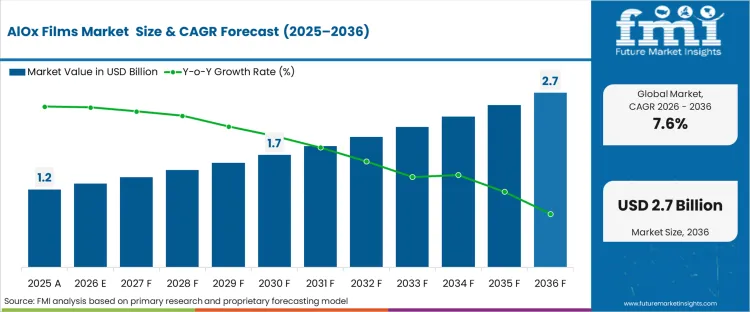
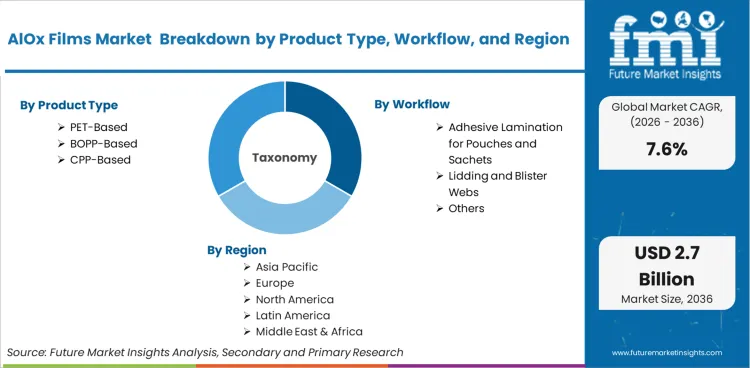
The AlOx films market was valued at USD 1.2 billion in 2025. The market is projected to reach USD 1.3 billion in 2026 and USD 2.7 billion by 2036, expanding at a CAGR of 7.6% during the forecast period. PET-based AlOx films are expected to lead product type with a 47.6% share in 2026. Adhesive lamination for pouches and sachets is projected to remain the leading workflow with a 44.3% share in 2026. Food and beverage companies are expected to lead end-user demand with a 54.8% share in 2026.
Summary of AlOx Films Market
- Key Segments Analyzed in the Report
- Product type: pet-based alox films, bopp-based alox films, cpp-based alox films, and others
- Workflow: adhesive lamination for pouches and sachets, lidding and blister webs, retort and boil-in-bag structures, and wraparound and overwrap formats
- End user: food and beverage, pharmaceuticals, personal care and home care, electronics and industrial
- Region: North America, Latin America, Western Europe, Eastern Europe, East Asia, South Asia and Pacific, and Middle East and Africa
- Analyst Opinion
- Nandini Roy Choudhury, Principal Analyst at Future Market Insights says, "Value in AlOx films is concentrating less in raw film tonnage and more in barrier consistency, converting compatibility, and recyclability-led structure redesign. Suppliers that can deliver transparent barrier performance with stable lead times and application support will capture the premium end of this market."
- AlOx Films Market Definition
- The AlOx films market includes transparent flexible packaging films coated with a thin aluminum oxide layer to deliver high oxygen and moisture barrier performance. It covers AlOx-coated PET, BOPP, CPP, and related specialty film structures sold as base films, coated substrates, or converter-ready rolls. These materials are used in food packaging, pharmaceutical packaging, personal care packs, and selected industrial applications where visibility, shelf-life extension, and lighter barrier structures matter.
- AlOx Films Market Inclusions
- Revenue from AlOx-coated transparent barrier films sold for flexible packaging, lidding, blister, retort, and related converting applications
- Revenue from film-grade coated substrates and converter-ready barrier rolls used in commercial packaging formats
- Demand across all major geographic markets where AlOx films are supplied for food, pharma, personal care, and industrial packaging
- AlOx Films Market Exclusions
- Metallized films, except as a competitive benchmark for barrier substitution
- Finished packaged goods sales, brand owner product revenue, and downstream filling operations
- General commodity plastic films without a functional AlOx barrier layer or equivalent transparent barrier positioning
- AlOx Films Market Research Methodology
- The study evaluates AlOx film demand by product type, workflow, end user, and region, with 2025 as the base year and 2026 to 2036 as the forecast period. Market size is expressed in value terms. Evidence inputs include European packaging recyclability rules, company annual reports and product disclosures from UFlex, TOPPAN, Jindal Films, and DNP, and technical documentation on oxygen and moisture barrier performance in transparent vapor-deposited films. Market estimates are established through triangulation of film capacity, value-added coating premiums, application intensity in food and pharmaceutical packs, and regional demand patterns in flexible packaging.
Key Drivers, Restraints, and Trends in AlOx Films Market
Drivers
The strongest growth driver is the need to combine shelf-life protection with pack transparency. Brands increasingly want barrier structures that block oxygen and moisture while still letting the consumer see the product, which is a direct advantage over foil-based opaque structures. That matters most in snacks, confectionery, bakery, dry foods, convenience meals, and selected pharmaceutical packs. Recyclability pressure adds a second layer of demand, because converters are redesigning laminates to reduce material complexity before 2030 packaging deadlines in Europe. TOPPAN’s barrier-film disclosures and Indian GL-SP launch show that transparent vapor-deposited barriers are now being positioned as commercial answers to mono-material packaging demand rather than as niche specialty experiments.
Restraints
Cost remains a real barrier in lower-value packaging formats. AlOx coatings require process control that not every converter can absorb at commodity price points. Performance sensitivity also matters, because poor downstream handling, weak lamination control, or inappropriate structure design can erode the value of a premium barrier layer. Supply concentration raises another constraint, as buyers often depend on a relatively small pool of specialized film suppliers with proven barrier consistency. Finally, metallized films and some coated alternatives still remain cheaper in applications where transparency is not essential, which limits immediate substitution.
Trends
The market is moving toward simplified, recycle-ready flexible structures. Suppliers are no longer selling AlOx films only as high-barrier substrates, they are selling them as part of a broader design package that includes mono-material compatibility, retort performance, and conversion support. BOPP-based AlOx films are gaining more attention because they align with the push toward all-PP or PP-heavy packaging systems. At the same time, PET-based AlOx films continue to hold a strong position where dimensional stability, printability, and premium appearance remain decisive. Competitive momentum is shifting toward companies that can integrate base film production, vapor deposition, and packaging application support.
Segmental Analysis
AlOx Films Analysis by Product Type
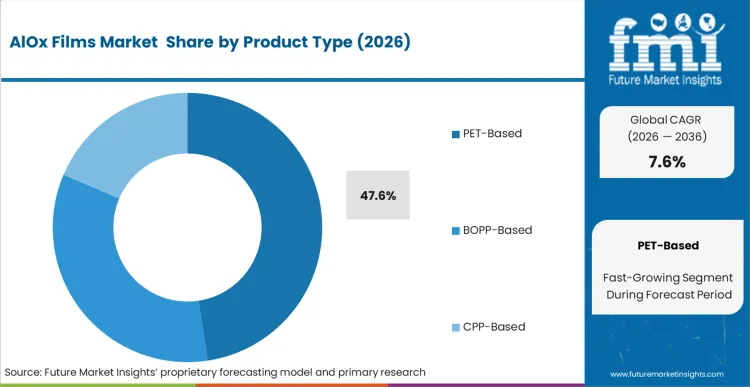
PET-based AlOx films are projected to hold the leading 47.6% share in 2026. They lead because PET remains the most established transparent high-barrier platform for converters that need dimensional stability, print compatibility, and strong barrier performance across premium food and pharmaceutical uses. PET also works well in complex laminates where visual appeal and processing consistency matter as much as barrier. UFlex stated that its 9.5 micron PET AlOx specialty film delivered both oxygen and water vapor transmission rates below 1.0, which helps explain why PET continues to anchor the premium end of the market even as BOPP alternatives gain traction.
AlOx Films Analysis by Workflow
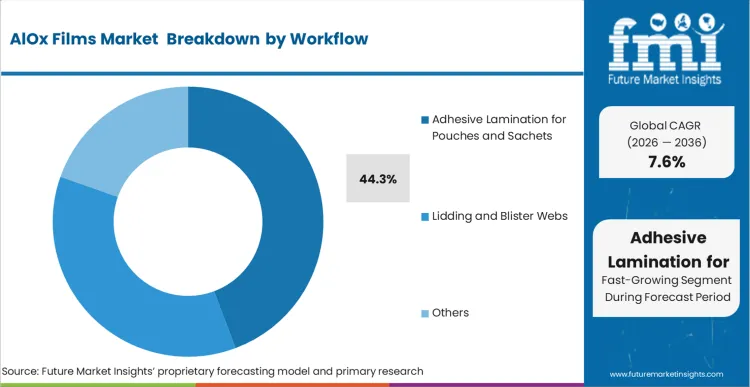
Adhesive lamination for pouches and sachets is expected to account for 44.3% of market value in 2026. This workflow leads because most commercial AlOx demand sits inside multilayer flexible structures used for stand-up pouches, sachets, and flow-wrap formats where the barrier layer is only one part of the finished performance equation. The workflow solves the practical need to combine barrier, printability, sealability, and visual merchandising in one structure. UFlex noted that its AlOx transparent ultra-high barrier films find extensive use in stand-up pouches, while TOPPAN highlights printing and laminating compatibility as a core feature of GL BARRIER.
Competitive Aligners for Market Players
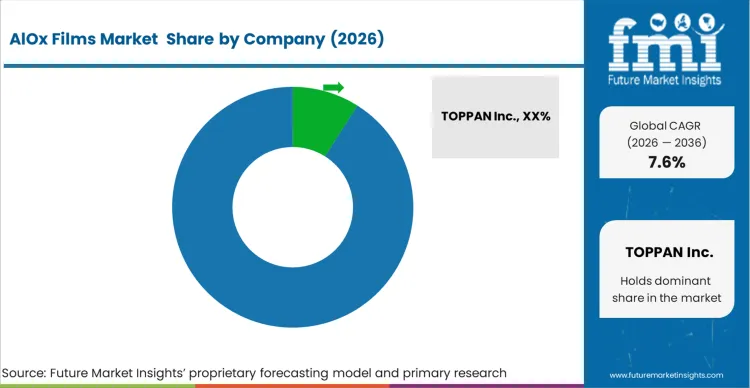
Competitive advantage in AlOx films does not come from coating capability alone. Buyers want stable barrier values, reliable supply, converting ease, documentation support, and structures that fit recyclability goals without increasing pack failure risk. The strongest suppliers combine premium barrier film portfolios with broad packaging-system knowledge. TOPPAN’s March 2024 launch of BOPP-based GL-SP in India was notable because it linked substrate production and barrier processing in one location to reduce lead times and costs. Its December 2024 agreement to acquire Sonoco’s TFP business for approximately USD 1.8 billion showed the same logic at a larger scale: barrier materials win faster when paired with converting reach and customer access. Jindal Films is also positioning Alox-Lyte as a transparent replacement for metallized and foil films, reinforcing the shift toward higher-value barrier simplification.
Key Players in AlOx Films Market
- TOPPAN Inc.
- UFlex Limited
- Jindal Films
- Dai Nippon Printing Co., Ltd.
- Toray Industries, Inc.
- Cosmo First Limited
- Mitsubishi Chemical Group
- Toyobo Co., Ltd.
- Oike & Co., Ltd.
- Kureha Corporation
Strategic Outlook by FMI on AlOx Films Market
The market is shifting from specialty barrier substitution toward mainstream sustainable packaging redesign. Its next phase will be shaped by mono-material adoption, converter qualification speed, and the ability to maintain high barrier performance in thinner, more recyclable structures. Companies with integrated film manufacturing, vapor-deposition know-how, application engineering, and strong relationships with global converters will define market leadership.
Scope of the Report
| Metric | Value |
|---|---|
| Market Value | USD 1.2 billion in 2025 to USD 2.7 billion by 2036 |
| CAGR | 7.6% from 2026 to 2036 |
| Base Year | 2025 |
| Forecast Period | 2026 to 2036 |
| Product Type Segmentation | PET-based AlOx Films, BOPP-based AlOx Films, CPP-based AlOx Films, Others |
| Workflow Segmentation | Adhesive Lamination for Pouches and Sachets, Lidding and Blister Webs, Retort and Boil-in-Bag Structures, Wraparound and Overwrap Formats |
| End User Segmentation | Food and Beverage, Pharmaceuticals, Personal Care and Home Care, Electronics and Industrial |
| Regions Covered | North America, Latin America, Western Europe, Eastern Europe, East Asia, South Asia and Pacific, Middle East and Africa |
Bibliography
- European Parliament and Council. 2025. Regulation (EU) 2025/40 of 19 December 2024 on packaging and packaging waste.
- TOPPAN Holdings Inc. 2024. TOPPAN to Launch Indian Production of BOPP-based GL-SP Barrier Film for Sustainable Packaging.
- TOPPAN Holdings Inc. 2024. Agreement reached on acquisition of Sonoco’s TFP business as TOPPAN Group accelerates expansion of sustainable packaging business in Americas.
- TOPPAN. Current. Barrier Film | GL BARRIER.
- UFlex Limited. 2024. Investor Presentation, September 2024.
- UFlex Limited. 2016. UFlex Engineers Thinnest PET ALOx Speciality Film.
- Jindal Films. Current. Alox-Lyte Transparent.
- Dai Nippon Printing Co., Ltd. Current. DNP’s Transparent Barrier Film.
Frequently Asked Questions
What is the projected size of the AlOx films market by 2036?
The AlOx films market is projected to grow from USD 1.3 billion in 2026 to USD 2.7 billion by 2036, reflecting steady demand for transparent high-barrier packaging structures.
What is the expected CAGR of the AlOx films market from 2026 to 2036?
The AlOx films market is expected to expand at a CAGR of 7.6% during the 2026 to 2036 forecast period.
Which product type leads the AlOx films market in 2026?
PET-based AlOx films are expected to lead the AlOx films market in 2026 with a 47.6% share, supported by strong dimensional stability, print compatibility, and premium barrier performance.
Which workflow holds the largest share in the AlOx films market?
Adhesive lamination for pouches and sachets is projected to hold the largest share of the AlOx films market in 2026, accounting for 44.3% of market value.
Which end-use segment dominates the AlOx films market?
Food and beverage is expected to dominate the AlOx films market in 2026 with a 54.8% share, driven by demand for shelf-life extension and transparent packaging.
What is driving demand in the AlOx films market?
Demand in the AlOx films market is being driven by the need for transparent barrier packaging, recyclability-focused structure redesign, and converter demand for lighter high-performance alternatives to foil-based formats.
Preview the report firsthand - request a free sample
Get SampleGet the brochure for pricing and purchase details.
Get PDFTable of Content
- Executive Summary
- Global Market Outlook
- Demand-side Trends
- Supply-side Trends
- Technology Roadmap Analysis
- Analysis and Recommendations
- Market Overview
- Market Coverage / Taxonomy
- Market Definition / Scope / Limitations
- Research Methodology
- Chapter Orientation
- Analytical Lens and Working Hypotheses
- Market Structure, Signals, and Trend Drivers
- Benchmarking and Cross-market Comparability
- Market Sizing, Forecasting, and Opportunity Mapping
- Research Design and Evidence Framework
- Desk Research Programme (Secondary Evidence)
- Company Annual and Sustainability Reports
- Peer-reviewed Journals and Academic Literature
- Corporate Websites, Product Literature, and Technical Notes
- Earnings Decks and Investor Briefings
- Government Statistics Portals and Public Data Releases
- Press Releases and Reputable Media Coverage
- Specialist Newsletters and Curated Briefings
- Sector Databases and Reference Repositories
- FMI Internal Proprietary Databases and Historical Market Datasets
- Subscription Datasets and Paid Sources
- Social Channels, Communities, and Digital Listening Inputs
- Additional Desk Sources
- Expert Input and Fieldwork (Primary Evidence)
- Primary Modes
- Qualitative Interviews and Expert Elicitation
- Quantitative Surveys and Structured Data Capture
- Blended Approach
- Why Primary Evidence is Used
- Field Techniques
- Interviews
- Surveys
- Focus Groups
- Observational and In-context Research
- Social and Community Interactions
- Stakeholder Universe Engaged
- C-suite Leaders
- Board Members
- Presidents and Vice Presidents
- R&D and Innovation Heads
- Technical Specialists
- Domain Subject-matter Experts
- Scientists
- Physicians and Other Healthcare Professionals
- Governance, Ethics, and Data Stewardship
- Research Ethics
- Data Integrity and Handling
- Primary Modes
- Tooling, Models, and Reference Databases
- Desk Research Programme (Secondary Evidence)
- Data Engineering and Model Build
- Data Acquisition and Ingestion
- Cleaning, Normalisation, and Verification
- Synthesis, Triangulation, and Analysis
- Quality Assurance and Audit Trail
- Market Background
- Market Dynamics
- Drivers
- Restraints
- Opportunity
- Trends
- Scenario Forecast
- Demand in Optimistic Scenario
- Demand in Likely Scenario
- Demand in Conservative Scenario
- Opportunity Map Analysis
- Product Life Cycle Analysis
- Supply Chain Analysis
- Investment Feasibility Matrix
- Value Chain Analysis
- PESTLE and Porter’s Analysis
- Regulatory Landscape
- Regional Parent Market Outlook
- Production and Consumption Statistics
- Import and Export Statistics
- Market Dynamics
- Global Market Analysis 2021 to 2025 and Forecast, 2026 to 2036
- Historical Market Size Value (USD Million) Analysis, 2021 to 2025
- Current and Future Market Size Value (USD Million) Projections, 2026 to 2036
- Y-o-Y Growth Trend Analysis
- Absolute $ Opportunity Analysis
- Global Market Pricing Analysis 2021 to 2025 and Forecast 2026 to 2036
- Global Market Analysis 2021 to 2025 and Forecast 2026 to 2036, By Product Type
- Introduction / Key Findings
- Historical Market Size Value (USD Million) Analysis By Product Type , 2021 to 2025
- Current and Future Market Size Value (USD Million) Analysis and Forecast By Product Type , 2026 to 2036
- PET-Based
- BOPP-Based
- CPP-Based
- PET-Based
- Y-o-Y Growth Trend Analysis By Product Type , 2021 to 2025
- Absolute $ Opportunity Analysis By Product Type , 2026 to 2036
- Global Market Analysis 2021 to 2025 and Forecast 2026 to 2036, By Workflow
- Introduction / Key Findings
- Historical Market Size Value (USD Million) Analysis By Workflow, 2021 to 2025
- Current and Future Market Size Value (USD Million) Analysis and Forecast By Workflow, 2026 to 2036
- Adhesive Lamination for Pouches and Sachets
- Lidding and Blister Webs
- Others
- Adhesive Lamination for Pouches and Sachets
- Y-o-Y Growth Trend Analysis By Workflow, 2021 to 2025
- Absolute $ Opportunity Analysis By Workflow, 2026 to 2036
- Global Market Analysis 2021 to 2025 and Forecast 2026 to 2036, By Region
- Introduction
- Historical Market Size Value (USD Million) Analysis By Region, 2021 to 2025
- Current Market Size Value (USD Million) Analysis and Forecast By Region, 2026 to 2036
- North America
- Latin America
- Western Europe
- Eastern Europe
- East Asia
- South Asia and Pacific
- Middle East & Africa
- Market Attractiveness Analysis By Region
- North America Market Analysis 2021 to 2025 and Forecast 2026 to 2036, By Country
- Historical Market Size Value (USD Million) Trend Analysis By Market Taxonomy, 2021 to 2025
- Market Size Value (USD Million) Forecast By Market Taxonomy, 2026 to 2036
- By Country
- USA
- Canada
- Mexico
- By Product Type
- By Workflow
- By Country
- Market Attractiveness Analysis
- By Country
- By Product Type
- By Workflow
- Key Takeaways
- Latin America Market Analysis 2021 to 2025 and Forecast 2026 to 2036, By Country
- Historical Market Size Value (USD Million) Trend Analysis By Market Taxonomy, 2021 to 2025
- Market Size Value (USD Million) Forecast By Market Taxonomy, 2026 to 2036
- By Country
- Brazil
- Chile
- Rest of Latin America
- By Product Type
- By Workflow
- By Country
- Market Attractiveness Analysis
- By Country
- By Product Type
- By Workflow
- Key Takeaways
- Western Europe Market Analysis 2021 to 2025 and Forecast 2026 to 2036, By Country
- Historical Market Size Value (USD Million) Trend Analysis By Market Taxonomy, 2021 to 2025
- Market Size Value (USD Million) Forecast By Market Taxonomy, 2026 to 2036
- By Country
- Germany
- UK
- Italy
- Spain
- France
- Nordic
- BENELUX
- Rest of Western Europe
- By Product Type
- By Workflow
- By Country
- Market Attractiveness Analysis
- By Country
- By Product Type
- By Workflow
- Key Takeaways
- Eastern Europe Market Analysis 2021 to 2025 and Forecast 2026 to 2036, By Country
- Historical Market Size Value (USD Million) Trend Analysis By Market Taxonomy, 2021 to 2025
- Market Size Value (USD Million) Forecast By Market Taxonomy, 2026 to 2036
- By Country
- Russia
- Poland
- Hungary
- Balkan & Baltic
- Rest of Eastern Europe
- By Product Type
- By Workflow
- By Country
- Market Attractiveness Analysis
- By Country
- By Product Type
- By Workflow
- Key Takeaways
- East Asia Market Analysis 2021 to 2025 and Forecast 2026 to 2036, By Country
- Historical Market Size Value (USD Million) Trend Analysis By Market Taxonomy, 2021 to 2025
- Market Size Value (USD Million) Forecast By Market Taxonomy, 2026 to 2036
- By Country
- China
- Japan
- South Korea
- By Product Type
- By Workflow
- By Country
- Market Attractiveness Analysis
- By Country
- By Product Type
- By Workflow
- Key Takeaways
- South Asia and Pacific Market Analysis 2021 to 2025 and Forecast 2026 to 2036, By Country
- Historical Market Size Value (USD Million) Trend Analysis By Market Taxonomy, 2021 to 2025
- Market Size Value (USD Million) Forecast By Market Taxonomy, 2026 to 2036
- By Country
- India
- ASEAN
- Australia & New Zealand
- Rest of South Asia and Pacific
- By Product Type
- By Workflow
- By Country
- Market Attractiveness Analysis
- By Country
- By Product Type
- By Workflow
- Key Takeaways
- Middle East & Africa Market Analysis 2021 to 2025 and Forecast 2026 to 2036, By Country
- Historical Market Size Value (USD Million) Trend Analysis By Market Taxonomy, 2021 to 2025
- Market Size Value (USD Million) Forecast By Market Taxonomy, 2026 to 2036
- By Country
- Kingdom of Saudi Arabia
- Other GCC Countries
- Turkiye
- South Africa
- Other African Union
- Rest of Middle East & Africa
- By Product Type
- By Workflow
- By Country
- Market Attractiveness Analysis
- By Country
- By Product Type
- By Workflow
- Key Takeaways
- Key Countries Market Analysis
- USA
- Pricing Analysis
- Market Share Analysis, 2025
- By Product Type
- By Workflow
- Canada
- Pricing Analysis
- Market Share Analysis, 2025
- By Product Type
- By Workflow
- Mexico
- Pricing Analysis
- Market Share Analysis, 2025
- By Product Type
- By Workflow
- Brazil
- Pricing Analysis
- Market Share Analysis, 2025
- By Product Type
- By Workflow
- Chile
- Pricing Analysis
- Market Share Analysis, 2025
- By Product Type
- By Workflow
- Germany
- Pricing Analysis
- Market Share Analysis, 2025
- By Product Type
- By Workflow
- UK
- Pricing Analysis
- Market Share Analysis, 2025
- By Product Type
- By Workflow
- Italy
- Pricing Analysis
- Market Share Analysis, 2025
- By Product Type
- By Workflow
- Spain
- Pricing Analysis
- Market Share Analysis, 2025
- By Product Type
- By Workflow
- France
- Pricing Analysis
- Market Share Analysis, 2025
- By Product Type
- By Workflow
- India
- Pricing Analysis
- Market Share Analysis, 2025
- By Product Type
- By Workflow
- ASEAN
- Pricing Analysis
- Market Share Analysis, 2025
- By Product Type
- By Workflow
- Australia & New Zealand
- Pricing Analysis
- Market Share Analysis, 2025
- By Product Type
- By Workflow
- China
- Pricing Analysis
- Market Share Analysis, 2025
- By Product Type
- By Workflow
- Japan
- Pricing Analysis
- Market Share Analysis, 2025
- By Product Type
- By Workflow
- South Korea
- Pricing Analysis
- Market Share Analysis, 2025
- By Product Type
- By Workflow
- Russia
- Pricing Analysis
- Market Share Analysis, 2025
- By Product Type
- By Workflow
- Poland
- Pricing Analysis
- Market Share Analysis, 2025
- By Product Type
- By Workflow
- Hungary
- Pricing Analysis
- Market Share Analysis, 2025
- By Product Type
- By Workflow
- Kingdom of Saudi Arabia
- Pricing Analysis
- Market Share Analysis, 2025
- By Product Type
- By Workflow
- Turkiye
- Pricing Analysis
- Market Share Analysis, 2025
- By Product Type
- By Workflow
- South Africa
- Pricing Analysis
- Market Share Analysis, 2025
- By Product Type
- By Workflow
- USA
- Market Structure Analysis
- Competition Dashboard
- Competition Benchmarking
- Market Share Analysis of Top Players
- By Regional
- By Product Type
- By Workflow
- Competition Analysis
- Competition Deep Dive
- TOPPAN Inc.
- Overview
- Product Portfolio
- Profitability by Market Segments (Product/Age /Sales Channel/Region)
- Sales Footprint
- Strategy Overview
- Marketing Strategy
- Product Strategy
- Channel Strategy
- UFlex Limited
- Jindal Films
- Dai Nippon Printing Co., Ltd.
- Toray Industries, Inc.
- Cosmo First Limited
- Mitsubishi Chemical Group
- TOPPAN Inc.
- Competition Deep Dive
- Assumptions & Acronyms Used


