

- Market Size (2026)
- USD 51.1 Bn
- Forecast (2036)
- USD 70.8 Bn
- CAGR (2026 to 2036)
- 3.3%
Control Arm and Suspension Joint Bearings Market Size, Market Forecast and Outlook By FMI
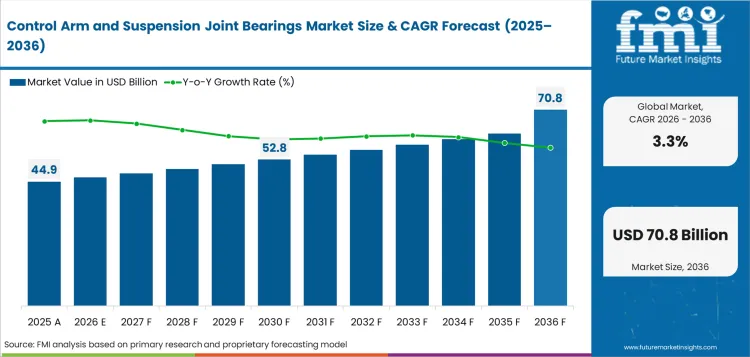
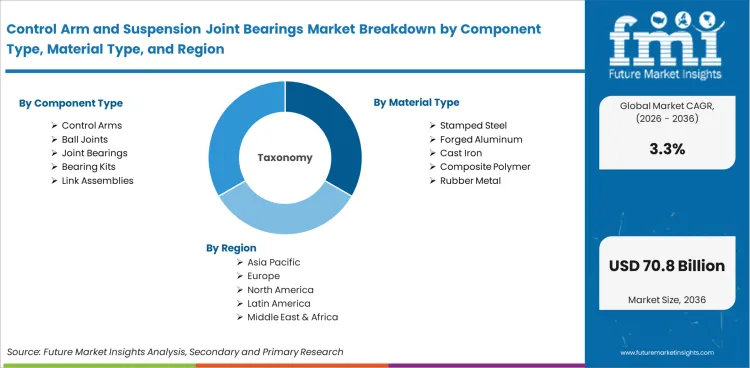
The control arm and suspension joint bearings market is valued at USD 44.9 billion in 2025. Industry is projected to reach USD 51.1 billion in 2026 and advance at 3.3% CAGR during the assessment period. The market is forecast to reach USD 70.8 billion by 2036 as vehicle makers continue to specify durable suspension assemblies for steering control and ride stability. Control arms are projected to account for 46.0% of component type in 2026, and stamped steel is estimated to hold 39.5% share by material type.
Suspension repair increasingly starts with exposed joint wear and bearing contamination rather than isolated part failure. Suppliers are moving toward protected assemblies for parts facing water, road debris and repeated articulation. ZF’s July 2025 Smart Chassis Sensor adds confirms this as the ball joint becomes a data point for vehicle movement.
OEMs gain packaging space when sensing shifts into an existing chassis node. Aftermarket channels also need broader part coverage as vehicle platforms fragment across trims and suspension layouts. ZF’s addition of more than 130 TRW chassis SKUs in February 2025 reflects that service demand is moving beyond single part replacement. Workshops benefit when control arms, ball joints and tie rods are available under one chassis program. Bearing suppliers that combine sealing, sensor compatibility and complete repair coverage are likely to hold stronger positions with OEMs and replacement networks.
Summary of the Control Arm and Suspension Joint Bearings Market
- Demand and Growth Drivers
- Suspension component demand follows vehicle output and replacement cycles as control arms support wheel load and alignment stability.
- SUV and EV weight adds stress on ball joints and bushings. Higher load raises interest in durable joint bearing packages.
- Aftermarket demand improves through service replacement needs as worn joints affect steering feel and tire wear.
- Product and Segment View
- Control arms form the main product base because OEMs need stable wheel guidance in front suspension assemblies.
- Stamped steel holds a clear cost advantage as mass vehicle platforms need proven durability at controlled pricing.
- Front suspension parts see steady replacement demand because steering load and braking force create higher wear exposure.
- Geography and Competitive Outlook
- China is witnessing stable demand as local vehicle production supports large chassis component volumes.
- •Industry in India is driven by utility vehicle output and deeper local sourcing across suspension parts.
- Suppliers with OE approval depth and wider aftermarket coverage are better placed across replacement channels.
- Analyst Opinion
- Nikhil Kaitwade, Principal Consultant at FMI says, “Control arm and suspension joint bearing demand is evolving along two distinct tracks. OEM demand is shaped by platform approvals and the ability to achieve ride and handling targets without adding unnecessary weight. Aftermarket demand, by contrast, is driven by vehicle age and the accuracy of replacement catalog coverage. Suppliers with strong OE engineering capabilities are better positioned to secure new vehicle programs, while aftermarket specialists gain share by reducing installation complexity and addressing technician pain points.”
- Control Arm and Suspension Joint Bearings Market Value Analysis
- Control arm and suspension joint bearing value is created through wheel guidance and steering stability across passenger and commercial vehicle platforms.
- Control arms hold the main product role because OEMs approve them around suspension geometry and load paths.
- Front suspension service supports repeat demand when worn joints affect tire wear and steering response.
- OEM programs shape early spending because approved geometry and material choice are locked during vehicle design.
- Stamped steel parts keep pricing pressure high as mass vehicle platforms need durability without higher component cost.
Key Takeaways
- The control arm and suspension joint bearings market was valued at USD 44.9 billion in 2025.
- Industry is projected to reach USD 51.1 billion in 2026 as OEM and aftermarket channels support steady component use.
- Suspension load requirements and replacement cycles are forecast to lift the market to USD 70.8 billion by 2036.
- During the assessment period, the market is expected to expand at 3.3% CAGR.
- Incremental opportunity between 2026 and 2036 is projected at USD 19.7 billion.
- Control arms are projected to account for 46.0% of component type demand in 2026 as OEMs need stable wheel guidance.
- Cost control and proven durability are expected to help stamped steel hold 39.5% share by material type in 2026.
- China (5.9% CAGR) and India (5.1% CAGR) are expected to remain the two lucrative countries through 2036 as vehicle output and local chassis sourcing expand.
Control Arm and Suspension Joint Bearings Market Definition
The control arm and suspension joint bearings market covers structural suspension arms, ball joints, spherical joint bearings, rubber metal joints, and bearing kits used in automotive suspension systems. These parts guide wheel movement and help transfer road loads between the wheel hub and vehicle body.
Control Arm and Suspension Joint Bearings Market Inclusions
Market scope includes control arms, ball joints, spherical bearings, joint bushings, bearing kits, link assemblies, stamped steel parts, forged aluminum components, rubber metal joints, OEM channels, aftermarket channels, and demand across major vehicle-producing regions. Market participants include passenger vehicle OEMs, commercial vehicle manufacturers, Tier 1 chassis suppliers, suspension system integrators, aftermarket distributors, repair workshops, fleet maintenance operators, and authorized service networks.
Control Arm and Suspension Joint Bearings Market Exclusions
The scope excludes wheel hub bearings, engine bearings, driveline bearings, shock absorbers, coil springs, brake components, steering racks, complete axle modules, and rail suspension products.
Control Arm and Suspension Joint Bearings Market Research Methodology
- Primary Research: FMI analysts reviewed supplier input from chassis component manufacturers, suspension system integrators, aftermarket distributors, and repair channel participants. Interviews focused on platform approval, material choice, replacement cycles, and regional catalog coverage.
- Desk Research: The study used vehicle production data, suspension component references, company product information, and public supplier announcements. FMI reviewed related areas such as automotive suspension control arms, joint bearing applications, and chassis replacement parts.
- Market Sizing and Forecasting: Market size was developed through bottom-up component demand modeling across vehicle type, material type, and sales channel. The model combined control arm unit use, joint bearing replacement rates, average part value, and regional vehicle production trends.
- Data Validation: Forecast assumptions were checked against vehicle output, aftermarket catalog expansion, and supplier portfolio activity. FMI cross-checked the market with adjacent demand in automotive control arm assemblies and suspension bearing components before finalization.
Why is the Control Arm and Suspension Joint Bearings Market Growing?
- Vehicle makers need stable suspension geometry as SUVs, EVs, and pickups carry higher curb weight.
- Replacement demand increases when worn ball joints cause steering play and uneven tire wear.
- OEMs specify lighter control arm designs as aluminum and multi-material suspension assemblies gain use.
- Aftermarket suppliers expand catalog coverage to match newer platforms with complex front suspension layouts.
Aftermarket growth follows repair frequency rather than new vehicle output. ZF Aftermarket added more than 130.0 TRW chassis products in the first two months of 2025, including control arms and ball joints for passenger cars and SUVs. The company said the expansion added coverage for about 29.0 million more vehicles in operation across the USA and Canada. Wider coverage helps distributors reduce catalog gaps for newer models. Repair shops prefer complete assemblies when labor time and alignment risk are high.
Market Segmentation Analysis
- Control arms are projected to account for 46.0% of component type demand in 2026 as they carry structural load in suspension assemblies.
- Stamped steel is estimated to hold 39.5% share by material type in 2026 as mass platforms need low-cost durability.
- Passenger cars are projected to represent 58.0% share by vehicle type in 2026 as global production volume stays concentrated in cars and utility vehicles.
- Front suspension is expected to account for 57.5% share by suspension position in 2026 as steering and alignment control create higher replacement need.
- OEMs are projected to represent 62.0% share by sales channel in 2026 as control arm geometry is approved during platform development.
Market segmentation covers component type, material type, vehicle type, suspension position, sales channel, and region. Component types include control arms, ball joints, joint bearings, bearing kits, and link assemblies. Material type includes stamped steel, forged aluminum, cast iron, composite polymer, and rubber metal. Vehicle type includes passenger cars, light commercial vehicles, heavy commercial vehicles, off-highway vehicles, and electric vehicles. Suspension position includes front suspension, rear suspension, multi link, double wishbone, and MacPherson strut. Sales channel includes OEMS, aftermarket, authorized service, online retail, and fleet workshops.
Insights into the Control Arms Component Type Segment
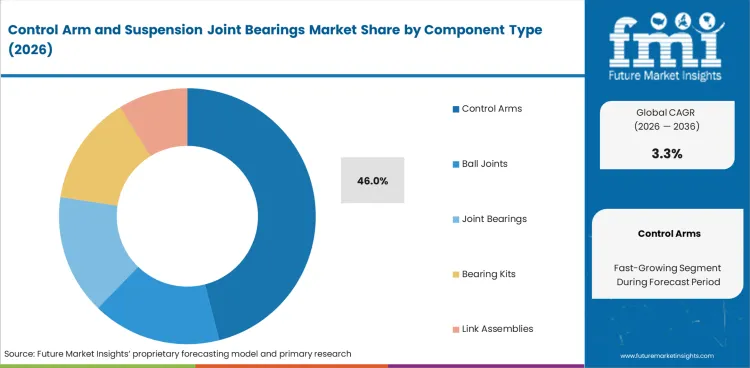
- Control arms are forecast at 46.0% of component type demand in 2026. OEMs use control arms as the main structural link between the chassis and wheel assembly.
- Geometry approval starts around arm design because bushing stiffness and joint placement affect ride feel. Ball joints follow closely in replacement channels when steering looseness or uneven tire wear pushes service demand.
Insights into the Stamped Steel Material Type Segment
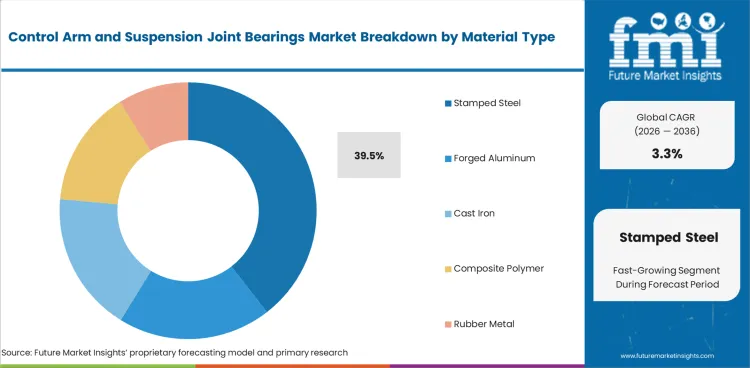
Stamped steel is estimated to hold 39.5% of material type demand in 2026 because high-volume OEM programs need lower part cost and proven fatigue behavior.
Forged aluminum gains value in EV and premium SUV platforms because weight reduction helps offset battery mass and improve ride tuning.
Insights into the Passenger Cars Vehicle Type Segment
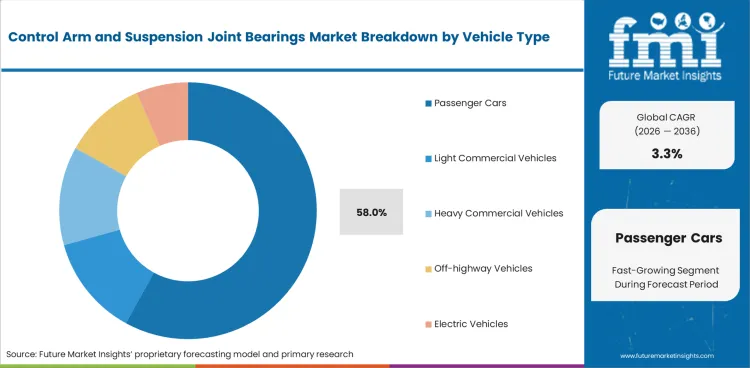
Within vehicle type, passenger cars are projected at 58.0% by 2026 as passenger platforms carry the main suspension component base across OEM and replacement channels.
Light commercial vehicles generate higher replacement intensity because payload cycles and rough roads increase stress on ball studs and joint housings.
Insights into the Front Suspension Position Segment
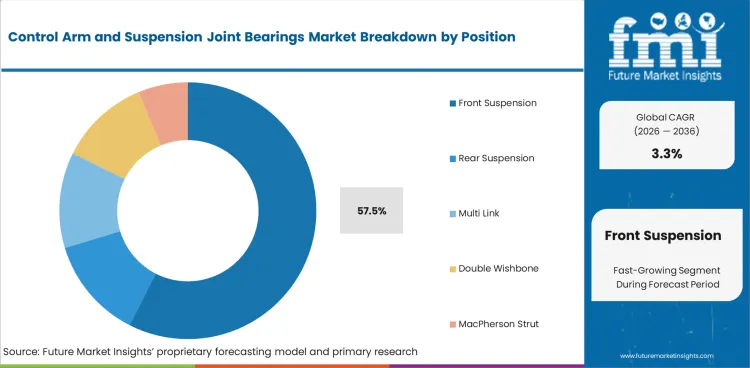
- Front suspension is expected to hold 57.5% share by suspension position in 2026, with steering input and braking load placing more stress on joints.
- Rear suspension demand is rising in multi-link layouts because premium platforms use more arms per axle. Double wishbone layouts support higher value in performance and utility vehicles.
Insights into the OEM Sales Channel Segment
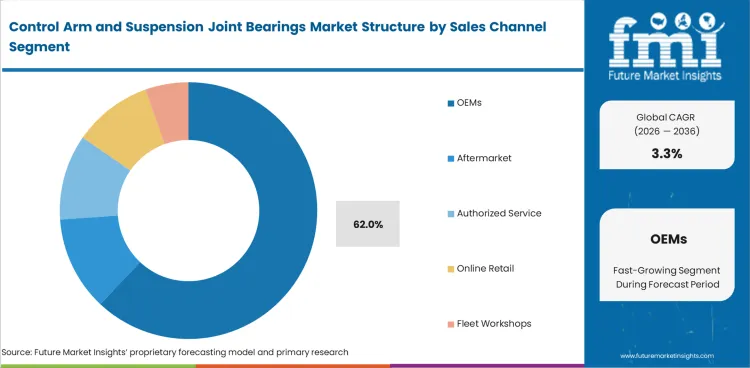
- OEMs are estimated at 62.0% of sales channel demand in 2026. Early value rests with OEM programs because approved geometry and material selection are locked before vehicle launch.
- Aftermarket demand follows later through service replacement for worn joints and bent arms. Authorized service gains value when vehicles need brand-approved parts during warranty-linked repair cycles.
Control Arm and Suspension Joint Bearings Market Drivers, Restraints, and Opportunities
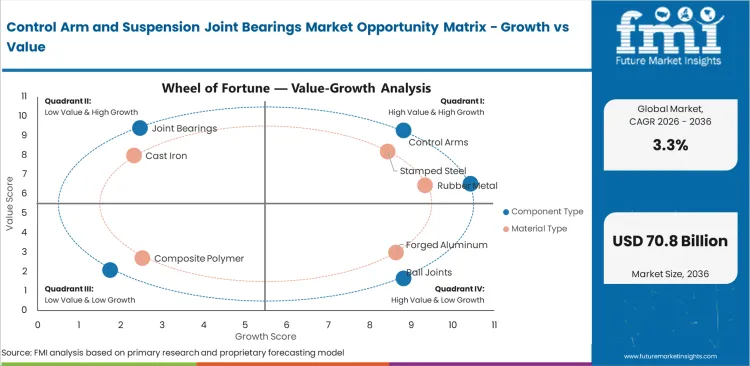
- Vehicle weight growth increases load demand on control arms and joint bearings.
- Complex suspension designs raise the number of arms and joints per vehicle.
- Price pressure limits premium material use in entry-level vehicle platforms.
- Aftermarket catalog expansion creates opportunity for suppliers with late-model coverage.
- Sensor-integrated ball joints open a future path for chassis health monitoring.
Higher Vehicle Load Requirements
SUVs, pickups, and EVs place higher mechanical stress on suspension joints. Heavy batteries and larger wheels increase the force carried by control arms and ball joints during braking and cornering. ZF’s next-generation Smart Chassis Sensor places measurement electronics inside a ball joint. The development indicates how this component is moving beyond a passive mechanical role. Sensor integration makes the joint a data point for chassis health and load detection. Suppliers that can combine mechanical durability with electronic readiness will be better placed in advanced vehicle programs.
Aftermarket Coverage Expansion
Aftermarket competition depends on matching vehicle coverage with technician needs. Mevotech announced 193 new part numbers in April 2025, including control arms and chassis parts for more than 106.8 million vehicles in the USA and 10.0 million in Canada. Catalog expansion gives repair shops faster access to complete replacement assemblies. Assemblies reduce bay time when old bushings and joints are difficult to press out. Suppliers with wider late-model coverage can protect share across the automotive suspension component aftermarket.
European Cost Pressure
European suspension component suppliers face cost pressure as vehicle output and supplier margins stay under strain. CLEPA reported in January 2026 that European automotive suppliers announced 104,000 job cuts across 2024 and 2025. Lower output weakens factory loading for chassis components with high tooling cost. Cost pressure can push more programs toward steel parts and regional sourcing. Suppliers serving Europe must balance price discipline with durability expectations in suspension components and related chassis assemblies.
Analysis of Control Arm and Suspension Joint Bearings Market By Key Countries
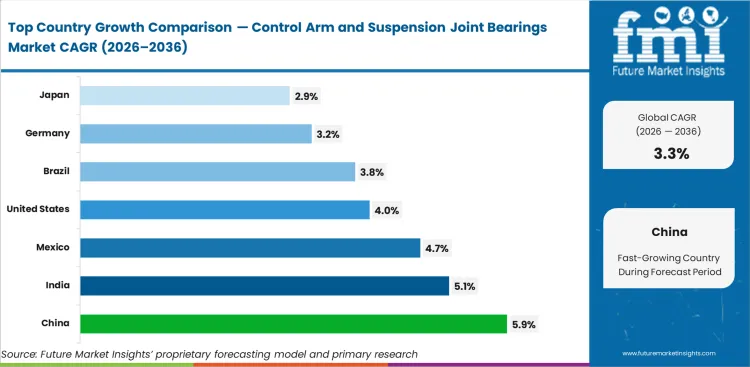
| Country | CAGR |
|---|---|
| China | 5.9% |
| India | 5.1% |
| Mexico | 4.7% |
| United States | 4.0% |
| Brazil | 3.8% |
| Germany | 3.2% |
| Japan | 2.9% |
Source: FMI analysis based on primary research and proprietary forecasting model.
Control Arm and Suspension Joint Bearings Market CAGR Analysis By Country
- China’s growth outlook is 5.9% CAGR through 2036, reflecting large vehicle output and deeper local chassis sourcing.
- Utility vehicle production places India at 5.1% CAGR during the forecast period, with load-bearing suspension parts gaining wider use.
- Mexico is forecast at 4.7% CAGR by 2036, helped by North American export platforms and local Tier 1 supply needs.
- The United States is forecast to grow at a 4.0% CAGR, supported by consistently high repair demand for SUVs and pickups across the assessment period.
- Brazil is projected to register a 3.8% CAGR between 2026 and 2036, supported by light vehicle production recovery and increased reliance on regional component sourcing.
- Premium vehicle platforms place Germany at 3.2% CAGR through 2036, with demand tied to precise chassis components.
- Japan’s 2.9% CAGR for 2026 to 2036 reflects mature vehicle output and continued preference for quality joint bearings.
- The global market is expected to advance at 3.3% CAGR in the forecast timeframe.
Demand Outlook for Control Arm and Suspension Joint Bearings Market in China
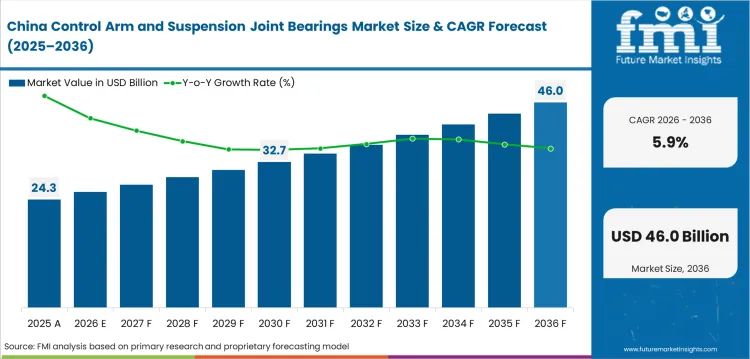
China benefits from large-scale vehicle production and fast local sourcing across passenger cars and EVs. The country is projected to record 5.9% CAGR during 2026 to 2036 as domestic OEMs specify control arms and joint bearings across higher-volume platforms. EV production in Guangdong and Shanghai raises interest in lighter arm designs. Local suppliers can gain when they combine stamping cost control with tighter tolerance needs. Replacement demand improves as the vehicle parc expands in large urban regions.
- Guangdong EV plants raise demand for forged aluminum arms that help manage vehicle weight.
- Chongqing supports chassis component supply through its passenger car and commercial vehicle base.
- Shanghai-based EV programs increase the need for precise front suspension components.
Sales Analysis of Control Arm and Suspension Joint Bearings Market in India
India’s demand base is shaped by utility vehicle growth and deeper local parts sourcing. During the assessment period, India is expected to expand at 5.1% CAGR as SUVs and light commercial vehicles need durable suspension assemblies. Pune and Chennai remain important chassis manufacturing locations because several OEM and supplier plants operate near these clusters. Localized production helps reduce cost pressure for stamped steel parts. Aftermarket replacement demand improves in regions with rough road exposure and rising private vehicle use.
- Pune supports Tier 1 chassis supply through nearby passenger vehicle and utility vehicle plants.
- Chennai strengthens demand through its automotive manufacturing belt and export-oriented supplier base.
- Gujarat EV projects create more scope for lightweight control arms and tighter joint bearing tolerances.
Demand Analysis of Control Arm and Suspension Joint Bearings Market in Mexico
Mexico’s position depends on North American vehicle production. The country is forecast at 4.7% CAGR through 2036 as export-focused OEM plants need locally supplied control arms and suspension joints. Guanajuato and Puebla matter to platform sourcing because major automakers operate production sites in these states. Suppliers gain when they meet OEM quality checks and reduce cross-border lead times. Aftermarket demand gains support from service networks tied to USA vehicle platforms.
- Guanajuato supports control arm demand through Toyota and Mazda-linked vehicle activity.
- Puebla sustains chassis component use through Volkswagen and Audi production lines.
- Coahuila adds value through pickup and commercial vehicle assembly activity.
Opportunity Analysis of Control Arm and Suspension Joint Bearings Market in the United States
The United States has a large replacement base shaped by SUV and pickup use. A 4.0% CAGR outlook through 2036 reflects steady service demand for front suspension parts. Michigan supports OE engineering because Detroit-area suppliers and vehicle makers influence chassis specifications. Texas raises replacement intensity through pickup use and higher load conditions. Service channels prefer complete control arm assemblies when labor time and alignment risk affect repair costs.
- Michigan supports OE chassis design through Detroit-area engineering centers and supplier offices.
- Texas pickup use raises service demand for ball joints and control arms under higher load.
- Midwest repair channels favor complete assemblies when corrosion makes bushing removal difficult.
Future Outlook for Control Arm and Suspension Joint Bearings Market in Brazil
Brazil’s market depends on light vehicle production and localized replacement supply. Brazil is projected at 3.8% CAGR during 2026 to 2036 as regional vehicle output supports chassis component demand. São Paulo remains the main supplier base for suspension parts because many component makers serve local OEM plants there. Minas Gerais contributes through established vehicle assembly activity. Suppliers that offer durable steel arms and service-ready kits can serve cost-sensitive replacement demand.
- São Paulo state supports chassis parts supply through its dense automotive supplier network.
- Minas Gerais adds demand through local assembly activity and regional service channels.
- Paraná supports light commercial vehicle repair demand across cargo and utility fleets.
Demand Outlook for Control Arm and Suspension Joint Bearings Market in Germany
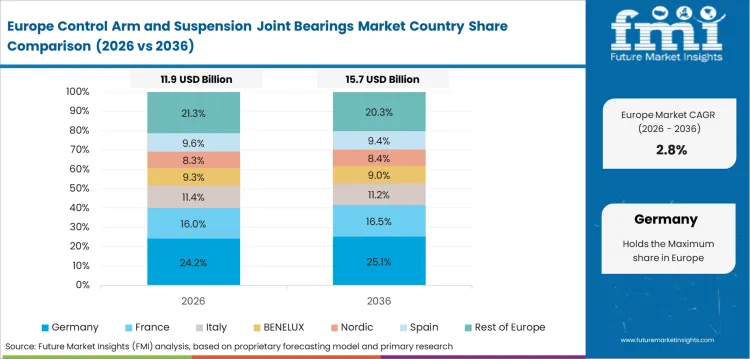
Germany’s demand profile is value-focused because premium platforms use more complex suspension layouts. The country is forecast at 3.2% CAGR through 2036 as advanced chassis systems keep demand for precise arms and joint bearings. Bavaria and Baden-Württemberg support higher-value supply because premium automakers and engineering centers operate there. Cost pressure keeps stamped steel important in mass models. Premium EV and performance platforms create room for forged aluminum parts with tighter dimensional control.
- Bavaria supports higher-value control arm demand through BMW and Audi-linked platform activity.
- Baden-Württemberg raises precision needs through Mercedes-Benz and Porsche chassis engineering.
- Saxony EV production improves demand for lightweight arms and low-noise joint bearings.
In-depth Analysis of Control Arm and Suspension Joint Bearings Market in Japan
Japan advances more slowly because vehicle production is mature and replacement behavior is disciplined. The country is expected to post 2.9% CAGR during 2026 to 2036 as quality needs support premium joint bearing demand. Aichi remains central to suspension component use because Toyota-linked production shapes supplier activity. Kyushu supports compact car and export-oriented production. Japanese suppliers compete through low-noise joints and corrosion-resistant finishes that meet strict service-life expectations.
- Aichi supports steady suspension component demand through Toyota-centered vehicle production.
- Kyushu contributes through compact car output and export-oriented assembly activity.
- Shizuoka supplier networks support precision parts used in suspension and steering assemblies.
Competitive Landscape and Strategic Positioning
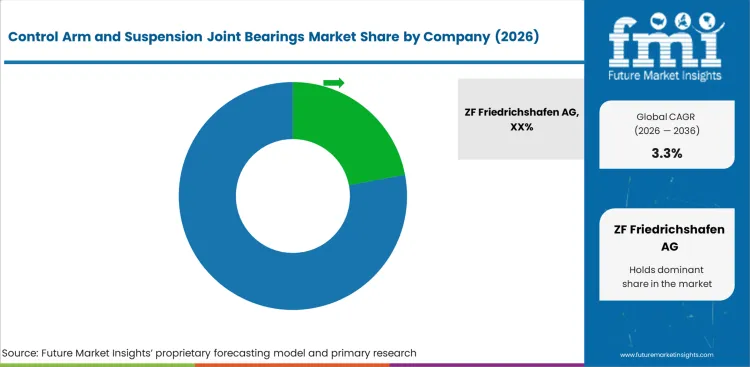
- Competition is centered on OE-approved chassis suppliers and large aftermarket catalog owners.
- Global suppliers compete on platform approvals and durability testing for suspension assemblies.
- Aftermarket specialists compete through late-model coverage and complete repair kits.
- Entry barriers include tooling cost and catalog accuracy for model-specific applications.
Competition depends on application coverage and tolerance control. OEM programs need suppliers that can match vehicle geometry and bushing stiffness before a control arm reaches production. ZF Friedrichshafen AG supports this position through its TRW chassis portfolio, which includes control arms and ball joints for passenger cars and SUVs. The official 2025 expansion indicates how OE-backed suppliers use chassis coverage to strengthen aftermarket access.
Aftermarket specialists compete by solving service pain for repair workshops. Mevotech expanded its chassis coverage in April 2025 with first-to-market parts for late-model trucks and SUVs. The release included TTX front upper control arms for GM heavy-duty trucks, which gives the company a clear position in severe-duty repair applications. Product coverage helps workshops reduce fitting issues and service delays.
Sensor integration is changing suspension joint design. ZF Friedrichshafen AG has developed a Smart Chassis Sensor that places measurement electronics inside the ball joint. The design turns the joint into a chassis data point for load and condition monitoring. Suppliers with electronic sensing capability can compete for higher-value chassis programs.
Key Companies in the Control Arm and Suspension Joint Bearings Market
Profiled companies compete through OE approval, bearing expertise, and aftermarket coverage.
- Global Leaders: ZF Friedrichshafen AG, Schaeffler AG, SKF Group, NTN Corporation, and AISIN Corporation serve OEM and replacement demand through chassis engineering and bearing design.
- Aftermarket Specialists: Mevotech, Dorman Products, and Tenneco’s DRiV group compete through catalog expansion and complete repair assemblies.
- Regional and Platform Suppliers: Magna International, CTR Corporation, Sankei Industry, and Rane NSK Steering Systems support regional OEM programs and export platforms.
Competitive Benchmarking: Control Arm and Suspension Joint Bearings Market
| Company | OE Chassis Approval Depth | Joint Bearing Design Capability | Aftermarket Coverage Strength | Geographic Footprint |
|---|---|---|---|---|
| ZF Friedrichshafen AG | High | High | Strong | Global |
| Schaeffler AG | High | High | Moderate | Global |
| SKF Group | Medium | High | Moderate | Global |
| NTN Corporation | Medium | High | Moderate | Global |
| AISIN Corporation | High | Medium | Moderate | Asia, Global |
| Mevotech | Low | High | Strong | North America |
| Dorman Products | Low | Medium | Strong | North America |
| Tenneco DRiV | Medium | Medium | Strong | Global |
| Magna International | High | Medium | Moderate | Global |
| CTR Corporation | Medium | Medium | Moderate | Asia, Global |
Source: Future Market Insights competitive analysis, 2026. Ratings reflect relative positioning based on OE chassis approval depth, joint bearing design capability, and aftermarket coverage strength.
Key Developments in Control Arm and Suspension Joint Bearings Market
- In July 2025, Schaeffler announced rear-wheel steering production for a German OEM. The chassis system supports complex suspension and steering integration.
- In October 2025, DRiV presented expanded aftermarket offerings under MOOG and Monroe at AAPEX 2025. The activity supports replacement demand for steering and suspension service channels.
Key Players in the Control Arm and Suspension Joint Bearings Market
Global Leaders
- ZF Friedrichshafen AG
- Schaeffler AG
- SKF Group
- NTN Corporation
- AISIN Corporation
Aftermarket Specialists
- Mevotech
- Dorman Products
- Tenneco DRiV
Regional and Platform Suppliers
- Magna International
- CTR Corporation
- Sankei Industry
- Rane NSK Steering Systems
Report Scope and Coverage
| Parameter | Details |
|---|---|
| Quantitative Units | USD 51.1 billion in 2026 to USD 70.8 billion by 2036, at 3.3% CAGR |
| Market Definition | Control arms, ball joints, spherical joint bearings, rubber metal joints, and bearing kits used in automotive suspension assemblies |
| Regions Covered | North America, Latin America, Europe, East Asia, South Asia and Pacific, Middle East and Africa |
| Countries Covered | China, India, Mexico, United States, Brazil, Germany, Japan, 30+ countries |
| Key Companies Profiled | ZF Friedrichshafen AG, Schaeffler AG, SKF Group, NTN Corporation, AISIN Corporation, Mevotech, Dorman Products, Tenneco DRiV, Magna International, CTR Corporation |
| Forecast Period | 2026 to 2036 |
| Approach | Hybrid bottom-up and top-down methodology using vehicle platform demand, replacement cycles, material mix, and regional production checks |
Control Arm and Suspension Joint Bearings Market by Segments
Control Arm and Suspension Joint Bearings Market Segmented by Component Type:
- • Control Arms
- • Ball Joints
- • Joint Bearings
- • Bearing Kits
- • Link Assemblies
Control Arm and Suspension Joint Bearings Market Segmented by Material Type:
- • Stamped Steel
- • Forged Aluminum
- • Cast Iron
- • Composite Polymer
- • Rubber Metal
Control Arm and Suspension Joint Bearings Market Segmented by Vehicle Type:
- • Passenger Cars
- • Light Commercial Vehicles
- • Heavy Commercial Vehicles
- • Off-highway Vehicles
- • Electric Vehicles
Control Arm and Suspension Joint Bearings Market Segmented by Suspension Position:
- • Front Suspension
- • Rear Suspension
- • Multi Link
- • Double Wishbone
- • MacPherson Strut
Control Arm and Suspension Joint Bearings Market Segmented by Sales Channel:
- • OEMs
- • Aftermarket
- • Authorized Service
- • Online Retail
- • Fleet Workshops
Control Arm and Suspension Joint Bearings Market by Region:
- North America
- United States
- Canada
- Mexico
- Latin America
- Brazil
- Chile
- Rest of Latin America
- Western Europe
- Germany
- UK
- Italy
- Spain
- France
- Nordic
- BENELUX
- Rest of Western Europe
- Eastern Europe
- Russia
- Poland
- Hungary
- Balkan & Baltic
- Rest of Eastern Europe
- East Asia
- China
- Japan
- South Korea
- South Asia and Pacific
- India
- ASEAN
- Australia & New Zealand
- Rest of South Asia and Pacific
- Middle East & Africa
- Kingdom of Saudi Arabia
- Other GCC Countries
- Turkiye
- South Africa
- Other African Union
- Rest of Middle East & Africa
Research Sources and Bibliography
- ZF Friedrichshafen AG. (2025, February 26). ZF Aftermarket adds over 130 new parts to TRW chassis line, expands coverage to 29 million more vehicles in operation.
- Mevotech. (2025, April 16). Mevotech expands coverage with 193 new parts, including 58 first-to-markets.
- ZF Friedrichshafen AG. (2025, July 10). Next-gen smart chassis sensor: More data for intelligent chassis functions.
- Dorman Products, Inc. (2025, March 13). Dorman releases more Dorman OE FIX auto repair innovations and dozens of first-to-the-aftermarket solutions.
- Schaeffler AG. (2025, July 9). Rear-wheel steering: Successful production launch for German OEM and new volume production orders with greater vertical integration.
- Tenneco. (2025, October 30). DRiV showcases leading brands and expanded aftermarket offering at AAPEX 2025.
- International Organization of Motor Vehicle Manufacturers. (2026, April 23). Auto industry growth shifted east in 2025 amid global repositioning. OICA.
- Society of Indian Automobile Manufacturers. (2026, January). Auto industry performance of December 2025 and Q3 October to December 2025. SIAM.
- International Trade Administration. (2026, February 11). Mexico: Automotive industry. USA Department of Commerce.
- CLEPA. (2026, January 14). Structural pressures on Europe's suppliers: Policy delivery is key.
- Agência Brasil. (2026, January 15). Brazilian vehicle production grows 3.5% in 2025. Empresa Brasil de Comunicação.
- Japan Automobile Manufacturers Association. (2025). The Motor Industry of Japan 2025. JAMA.
This Report Answers
- What is the current and future value of the control arm and suspension joint bearings market?
- What CAGR is expected for the control arm and suspension joint bearings market during the forecast period?
- Which component type is projected to lead demand in 2026?
- Which material type is estimated to hold the leading share in 2026?
- How do SUVs, EVs, and pickups affect control arm and ball joint demand?
- Why does aftermarket catalog coverage matter for replacement suspension components?
- Which countries are forecast to grow fastest in the assessment period?
- How do OEM approvals shape supplier selection in this market?
- Which companies are active in control arm and suspension joint bearing supply?
- How does FMI estimate and validate the market forecast?
Frequently Asked Questions
What is the current and future value of the control arm and suspension joint bearings market from 2026 to 2036?
The control arm and suspension joint bearings market is valued at USD 51.1 billion in 2026 and is forecast to reach USD 70.8 billion by 2036.
What CAGR is expected for the control arm and suspension joint bearings market during the forecast period?
The market is projected to expand at 3.3% CAGR during the assessment period as OEM and replacement demand stays steady.
Which component type is projected to lead control arm and suspension joint bearing demand in 2026?
Control arms are projected to lead component type demand with 46.0% share in 2026 due to their load-bearing role in suspension assemblies.
Which material type is expected to hold the leading share in control arm and suspension joint bearings?
Stamped steel is estimated to hold 39.5% share by material type in 2026 as mass vehicle platforms need cost-efficient durability.
What factors are raising control arm and suspension joint bearing use across vehicle platforms?
SUV weight, EV battery mass, and front suspension wear are raising demand for durable control arms and joint bearing packages.
How do OEM approvals affect control arm and suspension joint bearing supplier selection?
OEM approvals shape supplier selection because control arm geometry, bushing stiffness, and material choice are locked during vehicle platform development.
Which countries are expected to grow fastest in the control arm and suspension joint bearings market?
China (5.9%) and India (5.1%) are expected to record the fastest growth through 2036 due to vehicle output and local chassis sourcing.
Which companies are positioned across OE chassis supply and aftermarket suspension parts?
ZF Friedrichshafen AG, Schaeffler AG, SKF Group, Mevotech, Dorman Products, and Tenneco DRiV are active across OE and replacement channels.
How does FMI define the control arm and suspension joint bearings market scope?
FMI defines the market as control arms, ball joints, spherical joint bearings, rubber metal joints, and bearing kits used in vehicle suspension assemblies.
What forecasting approach was used to estimate control arm and suspension joint bearing demand from 2026 to 2036?
FMI used a hybrid bottom-up and top-down approach based on vehicle platform demand, replacement rates and regional production checks.
Preview the report firsthand - request a free sample
Get SampleGet the brochure for pricing and purchase details.
Get PDFTable of Content
- Key Takeaways
- Market Size and CAGR
- Top Growth Driver
- Fastest Growing Segment
- Leading Region
- Key Companies
- Emerging Opportunities
- Executive Summary
- Global Market Outlook
- Demand-side Trends
- Supply-side Trends
- Technology Roadmap Analysis
- Analysis and Recommendations
- Analyst Perspective (What is happening? Why now? What should investors know?)
- Key Questions Answered
- How large is the market?
- What is the CAGR?
- What are key trends?
- Which region dominates?
- Who are the leaders?
- Market Overview
- Market Coverage / Taxonomy
- Market Definition / Scope / Limitations
- Research Methodology
- Chapter Orientation
- Analytical Lens and Working Hypotheses
- Market Structure, Signals, and Trend Drivers
- Benchmarking and Cross-market Comparability
- Market Sizing, Forecasting, and Opportunity Mapping
- Research Design and Evidence Framework
- Desk Research Programme (Secondary Evidence)
- Expert Input and Fieldwork (Primary Evidence)
- Tooling, Models, and Reference Databases
- Data Engineering and Model Build
- Quality Assurance and Audit Trail
- Market Background
- Market Dynamics (Drivers, Restraints, Opportunity, Trends)
- Scenario Forecast (Optimistic, Likely, Conservative)
- Impact Analysis
- AI Impact
- Sustainability Impact
- Regulatory Impact
- Technology Impact
- Consumer / Buyer Analysis
- Purchase Drivers
- Adoption Barriers
- Buyer Journey
- Opportunity Map Analysis
- Product Life Cycle Analysis
- Supply Chain Analysis
- Investment Feasibility Matrix
- Value Chain Analysis
- PESTLE and Porter's Analysis
- Regulatory Landscape
- Regional Parent Market Outlook
- Production and Consumption Statistics
- Import and Export Statistics
- Global Market Analysis and Forecast, 2021 to 2036
- Historical Market Size Value (USD Billion) & Volume (Unit) Analysis, 2021 to 2025
- Current and Future Market Size Value (USD Billion) & Volume (Unit) Projections, 2026 to 2036
- Y-o-Y Growth Trend Analysis
- Absolute $ Opportunity Analysis
- Global Market Pricing Analysis, 2021 to 2036
- Global Market Analysis and Forecast, By Component Type, 2021 to 2036
- Introduction / Key Findings
- Historical Market Size Value (USD Billion) & Volume (Unit) Analysis By Component Type, 2021 to 2025
- Current and Future Market Size Value (USD Billion) & Volume (Unit) Analysis and Forecast By Component Type, 2026 to 2036
- Control Arms
- Ball Joints
- Joint Bearings
- Bearing Kits
- Link Assemblies
- Control Arms
- Y-o-Y Growth Trend Analysis By Component Type, 2021 to 2025
- Absolute $ Opportunity Analysis By Component Type, 2026 to 2036
- Global Market Analysis and Forecast, By Material Type, 2021 to 2036
- Introduction / Key Findings
- Historical Market Size Value (USD Billion) & Volume (Unit) Analysis By Material Type, 2021 to 2025
- Current and Future Market Size Value (USD Billion) & Volume (Unit) Analysis and Forecast By Material Type, 2026 to 2036
- Stamped Steel
- Forged Aluminum
- Cast Iron
- Composite Polymer
- Rubber Metal
- Stamped Steel
- Y-o-Y Growth Trend Analysis By Material Type, 2021 to 2025
- Absolute $ Opportunity Analysis By Material Type, 2026 to 2036
- Global Market Analysis and Forecast, By Vehicle Type, 2021 to 2036
- Introduction / Key Findings
- Historical Market Size Value (USD Billion) & Volume (Unit) Analysis By Vehicle Type, 2021 to 2025
- Current and Future Market Size Value (USD Billion) & Volume (Unit) Analysis and Forecast By Vehicle Type, 2026 to 2036
- Passenger Cars
- Light Commercial Vehicles
- Heavy Commercial Vehicles
- Off-highway Vehicles
- Electric Vehicles
- Passenger Cars
- Y-o-Y Growth Trend Analysis By Vehicle Type, 2021 to 2025
- Absolute $ Opportunity Analysis By Vehicle Type, 2026 to 2036
- Global Market Analysis and Forecast, By Suspension Position, 2021 to 2036
- Introduction / Key Findings
- Historical Market Size Value (USD Billion) & Volume (Unit) Analysis By Suspension Position, 2021 to 2025
- Current and Future Market Size Value (USD Billion) & Volume (Unit) Analysis and Forecast By Suspension Position, 2026 to 2036
- Front Suspension
- Rear Suspension
- Multi Link
- Double Wishbone
- MacPherson Strut
- Front Suspension
- Y-o-Y Growth Trend Analysis By Suspension Position, 2021 to 2025
- Absolute $ Opportunity Analysis By Suspension Position, 2026 to 2036
- Global Market Analysis and Forecast, By Sales Channel, 2021 to 2036
- Introduction / Key Findings
- Historical Market Size Value (USD Billion) & Volume (Unit) Analysis By Sales Channel, 2021 to 2025
- Current and Future Market Size Value (USD Billion) & Volume (Unit) Analysis and Forecast By Sales Channel, 2026 to 2036
- OEMs
- Aftermarket
- Authorized Service
- Online Retail
- Fleet Workshops
- OEMs
- Y-o-Y Growth Trend Analysis By Sales Channel, 2021 to 2025
- Absolute $ Opportunity Analysis By Sales Channel, 2026 to 2036
- Global Market Analysis and Forecast, By Region, 2021 to 2036
- Introduction
- Historical Market Size Value (USD Billion) & Volume (Unit) Analysis By Region, 2021 to 2025
- Current Market Size Value (USD Billion) & Volume (Unit) Analysis and Forecast By Region, 2026 to 2036
- North America
- Latin America
- Western Europe
- Eastern Europe
- East Asia
- South Asia and Pacific
- Middle East & Africa
- Market Attractiveness Analysis By Region
- North America Market Analysis and Forecast, By Country, 2021 to 2036
- Historical Market Size Value (USD Billion) & Volume (Unit) Trend Analysis By Market Taxonomy, 2021 to 2025
- Market Size Value (USD Billion) & Volume (Unit) Forecast By Market Taxonomy, 2026 to 2036
- By Country
- USA
- Canada
- Mexico
- By Component Type
- By Material Type
- By Vehicle Type
- By Suspension Position
- By Sales Channel
- By Country
- Market Attractiveness Analysis
- By Country
- By Component Type
- By Material Type
- By Vehicle Type
- By Suspension Position
- By Sales Channel
- Key Takeaways
- Latin America Market Analysis and Forecast, By Country
- Historical Market Size Value (USD Billion) & Volume (Unit) Trend Analysis By Market Taxonomy, 2021 to 2025
- Market Size Value (USD Billion) & Volume (Unit) Forecast By Market Taxonomy, 2026 to 2036
- By Country
- Brazil
- Chile
- Rest of Latin America
- By Component Type
- By Material Type
- By Vehicle Type
- By Suspension Position
- By Sales Channel
- By Country
- Market Attractiveness Analysis
- By Country
- By Component Type
- By Material Type
- By Vehicle Type
- By Suspension Position
- By Sales Channel
- Key Takeaways
- Western Europe Market Analysis and Forecast, By Country
- Historical Market Size Value (USD Billion) & Volume (Unit) Trend Analysis By Market Taxonomy, 2021 to 2025
- Market Size Value (USD Billion) & Volume (Unit) Forecast By Market Taxonomy, 2026 to 2036
- By Country
- Germany
- UK
- Italy
- Spain
- France
- Nordic
- BENELUX
- Rest of Western Europe
- By Component Type
- By Material Type
- By Vehicle Type
- By Suspension Position
- By Sales Channel
- By Country
- Market Attractiveness Analysis
- By Country
- By Component Type
- By Material Type
- By Vehicle Type
- By Suspension Position
- By Sales Channel
- Key Takeaways
- Eastern Europe Market Analysis and Forecast, By Country
- Historical Market Size Value (USD Billion) & Volume (Unit) Trend Analysis By Market Taxonomy, 2021 to 2025
- Market Size Value (USD Billion) & Volume (Unit) Forecast By Market Taxonomy, 2026 to 2036
- By Country
- Russia
- Poland
- Hungary
- Balkan & Baltic
- Rest of Eastern Europe
- By Component Type
- By Material Type
- By Vehicle Type
- By Suspension Position
- By Sales Channel
- By Country
- Market Attractiveness Analysis
- By Country
- By Component Type
- By Material Type
- By Vehicle Type
- By Suspension Position
- By Sales Channel
- Key Takeaways
- East Asia Market Analysis and Forecast, By Country
- Historical Market Size Value (USD Billion) & Volume (Unit) Trend Analysis By Market Taxonomy, 2021 to 2025
- Market Size Value (USD Billion) & Volume (Unit) Forecast By Market Taxonomy, 2026 to 2036
- By Country
- China
- Japan
- South Korea
- By Component Type
- By Material Type
- By Vehicle Type
- By Suspension Position
- By Sales Channel
- By Country
- Market Attractiveness Analysis
- By Country
- By Component Type
- By Material Type
- By Vehicle Type
- By Suspension Position
- By Sales Channel
- Key Takeaways
- South Asia and Pacific Market Analysis and Forecast, By Country
- Historical Market Size Value (USD Billion) & Volume (Unit) Trend Analysis By Market Taxonomy, 2021 to 2025
- Market Size Value (USD Billion) & Volume (Unit) Forecast By Market Taxonomy, 2026 to 2036
- By Country
- India
- ASEAN
- Australia & New Zealand
- Rest of South Asia and Pacific
- By Component Type
- By Material Type
- By Vehicle Type
- By Suspension Position
- By Sales Channel
- By Country
- Market Attractiveness Analysis
- By Country
- By Component Type
- By Material Type
- By Vehicle Type
- By Suspension Position
- By Sales Channel
- Key Takeaways
- Middle East & Africa Market Analysis and Forecast, By Country
- Historical Market Size Value (USD Billion) & Volume (Unit) Trend Analysis By Market Taxonomy, 2021 to 2025
- Market Size Value (USD Billion) & Volume (Unit) Forecast By Market Taxonomy, 2026 to 2036
- By Country
- Kingdom of Saudi Arabia
- Other GCC Countries
- Türkiye
- South Africa
- Other African Union
- Rest of Middle East & Africa
- By Component Type
- By Material Type
- By Vehicle Type
- By Suspension Position
- By Sales Channel
- By Country
- Market Attractiveness Analysis
- By Country
- By Component Type
- By Material Type
- By Vehicle Type
- By Suspension Position
- By Sales Channel
- Key Takeaways
- Key Countries Market Analysis
- USA
- Pricing Analysis
- Market Share Analysis, 2025
- By Component Type
- By Material Type
- By Vehicle Type
- By Suspension Position
- By Sales Channel
- Canada
- Pricing Analysis
- Market Share Analysis, 2025
- By Component Type
- By Material Type
- By Vehicle Type
- By Suspension Position
- By Sales Channel
- Mexico
- Pricing Analysis
- Market Share Analysis, 2025
- By Component Type
- By Material Type
- By Vehicle Type
- By Suspension Position
- By Sales Channel
- Brazil
- Pricing Analysis
- Market Share Analysis, 2025
- By Component Type
- By Material Type
- By Vehicle Type
- By Suspension Position
- By Sales Channel
- Chile
- Pricing Analysis
- Market Share Analysis, 2025
- By Component Type
- By Material Type
- By Vehicle Type
- By Suspension Position
- By Sales Channel
- Germany
- Pricing Analysis
- Market Share Analysis, 2025
- By Component Type
- By Material Type
- By Vehicle Type
- By Suspension Position
- By Sales Channel
- UK
- Pricing Analysis
- Market Share Analysis, 2025
- By Component Type
- By Material Type
- By Vehicle Type
- By Suspension Position
- By Sales Channel
- Italy
- Pricing Analysis
- Market Share Analysis, 2025
- By Component Type
- By Material Type
- By Vehicle Type
- By Suspension Position
- By Sales Channel
- Spain
- Pricing Analysis
- Market Share Analysis, 2025
- By Component Type
- By Material Type
- By Vehicle Type
- By Suspension Position
- By Sales Channel
- France
- Pricing Analysis
- Market Share Analysis, 2025
- By Component Type
- By Material Type
- By Vehicle Type
- By Suspension Position
- By Sales Channel
- India
- Pricing Analysis
- Market Share Analysis, 2025
- By Component Type
- By Material Type
- By Vehicle Type
- By Suspension Position
- By Sales Channel
- ASEAN
- Pricing Analysis
- Market Share Analysis, 2025
- By Component Type
- By Material Type
- By Vehicle Type
- By Suspension Position
- By Sales Channel
- Australia & New Zealand
- Pricing Analysis
- Market Share Analysis, 2025
- By Component Type
- By Material Type
- By Vehicle Type
- By Suspension Position
- By Sales Channel
- China
- Pricing Analysis
- Market Share Analysis, 2025
- By Component Type
- By Material Type
- By Vehicle Type
- By Suspension Position
- By Sales Channel
- Japan
- Pricing Analysis
- Market Share Analysis, 2025
- By Component Type
- By Material Type
- By Vehicle Type
- By Suspension Position
- By Sales Channel
- South Korea
- Pricing Analysis
- Market Share Analysis, 2025
- By Component Type
- By Material Type
- By Vehicle Type
- By Suspension Position
- By Sales Channel
- Russia
- Pricing Analysis
- Market Share Analysis, 2025
- By Component Type
- By Material Type
- By Vehicle Type
- By Suspension Position
- By Sales Channel
- Poland
- Pricing Analysis
- Market Share Analysis, 2025
- By Component Type
- By Material Type
- By Vehicle Type
- By Suspension Position
- By Sales Channel
- Hungary
- Pricing Analysis
- Market Share Analysis, 2025
- By Component Type
- By Material Type
- By Vehicle Type
- By Suspension Position
- By Sales Channel
- Kingdom of Saudi Arabia
- Pricing Analysis
- Market Share Analysis, 2025
- By Component Type
- By Material Type
- By Vehicle Type
- By Suspension Position
- By Sales Channel
- Türkiye
- Pricing Analysis
- Market Share Analysis, 2025
- By Component Type
- By Material Type
- By Vehicle Type
- By Suspension Position
- By Sales Channel
- South Africa
- Pricing Analysis
- Market Share Analysis, 2025
- By Component Type
- By Material Type
- By Vehicle Type
- By Suspension Position
- By Sales Channel
- USA
- Market Structure Analysis
- Competition Dashboard
- Competition Benchmarking
- Market Share Analysis of Top Players
- By Regional
- By Component Type
- By Material Type
- By Vehicle Type
- By Suspension Position
- By Sales Channel
- Emerging Startups
- Innovation Benchmarking
- Competition Analysis
- Competition Deep Dive
- ZF Friedrichshafen AG
- Overview
- Product Portfolio
- Profitability by Market Segments (Product/Region/Sales Channel)
- Sales Footprint
- Strategy Overview
- Marketing Strategy
- Product Strategy
- Channel Strategy
- Schaeffler AG
- SKF Group
- NTN Corporation
- AISIN Corporation
- Mevotech
- Dorman Products
- Tenneco DRiV
- Magna International
- CTR Corporation
- ZF Friedrichshafen AG
- Case Studies
- Success Stories
- Recent Developments
- Competition Deep Dive
- Assumptions & Acronyms Used


