

- Market Size (2026)
- USD 51.1 Bn
- Forecast (2036)
- USD 70.7 Bn
- CAGR (2026 to 2036)
- 3.3%
Automotive Suspension Control Arms Market Size, Market Forecast and Outlook By FMI
Summary of the Automotive Suspension Control Arms Market
- Demand and Growth Drivers
- Global vehicle production recovery and the growing installed base of passenger vehicles are sustaining OEM and aftermarket demand for suspension control arms across all vehicle categories.
- Lightweighting mandates and fuel efficiency requirements are driving material transition from steel to aluminum and composite control arms in new vehicle platforms.
- Electric vehicle platform development is reshaping suspension geometry and control arm specifications to accommodate battery pack weight distribution and lower center of gravity requirements.
- Product and Segment View
- Lower arms are expected to account for 60.0% of the arm type segment in 2026, as they absorb the primary lateral and longitudinal forces in front suspension systems across passenger and commercial vehicles.
- Passenger cars are projected to hold 70.0% of the application segment, reflecting high-volume fitment of control arms in independent front suspension systems.
- Steel control arms are expected to hold 48.0% of the material type segment, supported by cost advantages and proven durability, though aluminum is gaining share in premium and electric vehicle platforms.
- Geography and Competitive Outlook
- South Korea (3.6%) is expected to lead growth, supported by Hyundai-Kia group production volumes and domestic automotive component manufacturing capabilities.
- North America and Europe sustain demand through vehicle production, aftermarket replacement cycles, and electric vehicle platform development.
- ZF Friedrichshafen AG holds an estimated 18.0% share, reflecting its position as a leading Tier 1 supplier of chassis and suspension systems to global automakers.
- Analyst Opinion
- 'Companies that can deliver lightweight aluminum and composite control arms at cost points competitive with steel while meeting the structural requirements of electric vehicle platforms are likely to gain OEM procurement share over the forecast period.'
- The automotive suspension control arms market reflects the broader dynamics of vehicle production volumes, material technology evolution, and aftermarket replacement demand.
- Adoption of aluminum control arms is increasing as automakers pursue vehicle weight reduction targets, with aluminum offering 30 to 40% weight savings compared to stamped steel alternatives.
- Demand is further shaped by the aftermarket replacement cycle, where control arm bushings and ball joints wear over vehicle life, generating recurring component replacement volumes.
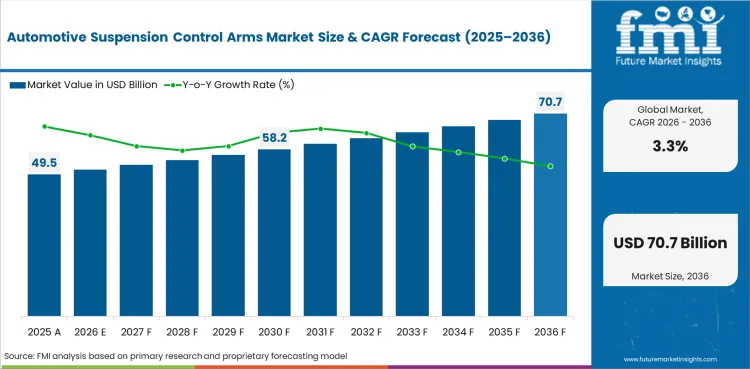
Key Takeaways, Market Size, and Forecast
- The automotive suspension control arms market was valued at USD 49.5 billion in 2025.
- The market is projected to reach USD 51.1 billion in 2026 and USD 70.7 billion by 2036, growing at a CAGR of 3.3%.
- By 2036, the Automotive Suspension Control Arms Market is expected to be worth USD 70.7 billion.
- From 2026 to 2036, the market is projected to expand at a CAGR of 3.3%.
- The market is projected to create an incremental opportunity of USD 19.62 billion between 2026 and 2036.
- In 2026, lower arms are expected to account for 60.0% of the arm type segment, driven by high-volume fitment across passenger car suspension systems where lower arms absorb the majority of lateral and longitudinal forces.
- Passenger cars are expected to lead the vehicle type segment with a 70.0% share.
- South Korea (3.6%) and USA (3.5%) are two of the fastest growing markets in the world.
Automotive Suspension Control Arms Market Definition
The automotive suspension control arms market includes upper and lower control arms, also known as A-arms or wishbones, used in independent suspension systems for passenger cars, light commercial vehicles, and heavy commercial vehicles. Materials include steel, aluminum, and composite constructions.
Automotive Suspension Control Arms Market Inclusions
Market scope encompasses all commercially traded automotive suspension control arm products categorized by arm type (lower arms, upper arms), application (passenger cars, commercial cars), material type (steel, aluminum, composite), and vehicle type (passenger vehicles, light commercial vehicles, heavy commercial vehicles). The forecast period is from 2026 to 2036.
Automotive Suspension Control Arms Market Exclusions
The scope does not include suspension springs, shock absorbers, stabilizer bars, or other suspension components that do not serve as control arms. Solid axle suspension components are also excluded.
Automotive Suspension Control Arms Market Research Methodology
- Primary Research: FMI analysts conducted interviews with automotive OEM chassis engineers, Tier 1 suspension component suppliers, aftermarket distributors, and material technology specialists in key markets.
- Desk Research: Combined data from vehicle production databases, automotive component supplier financial reports, aftermarket sales data, and OEM platform specification documents.
- Market Sizing and Forecasting: Bottom-up approach aggregating data across segments and regions, with regional adoption curves.
- Data Validation: Cross-checked quarterly against industry production data and manufacturer disclosures.
Why is the Automotive Suspension Control Arms Market Growing?
- Global vehicle production recovery and increasing vehicle parc size are sustaining both OEM and aftermarket demand for suspension control arms.
- Lightweighting mandates and EV platform development are driving material transition from steel to aluminum and composite control arms in new vehicle architectures.
- South Korea leads growth at 3.6% CAGR, supported by Hyundai-Kia production volumes and domestic Tier 1 component manufacturing capabilities.
The automotive suspension control arms market reflects the intersection of vehicle production volumes, material technology evolution, and aftermarket replacement demand. Lower arms account for 60.0% of the arm type segment, as they serve as the primary load-bearing link between the vehicle frame and wheel hub in independent front suspension systems. Upper arms complement lower arms in double-wishbone suspension configurations used in premium vehicles and performance platforms.
Passenger cars hold 70.0% of the application segment, reflecting high-volume fitment of independent front suspension systems across all vehicle classes. Steel remains the dominant material at 48.0%, supported by cost advantages and proven fatigue life in mass-market vehicle platforms. Aluminum control arms are gaining procurement share in premium, performance, and electric vehicle platforms where unsprung mass reduction improves handling, ride quality, and energy efficiency.
The aftermarket replacement segment generates recurring demand as control arm bushings and ball joints wear over vehicle service life, typically requiring replacement at 80,000 to 120,000 kilometer intervals depending on driving conditions. The growing global vehicle parc, combined with increasing average vehicle age in developed markets, supports sustained aftermarket revenue across all material types.
Market Segmentation Analysis
- Lower Arms holds 60% of the arm type segment, reflecting its established market position.
- Passenger Cars leads the application segment at 70%, supported by strong demand fundamentals.
- Steel accounts for 48% of the material type segment, driven by dominant end-use demand patterns.
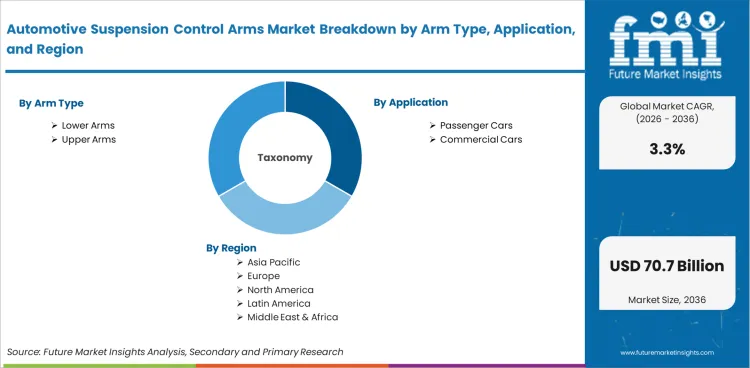
The automotive suspension control arms market is segmented by arm type, application, material type, vehicle type. Each segment reflects distinct procurement patterns and end-use requirements.
Insights into the Lower Arms Type Segment
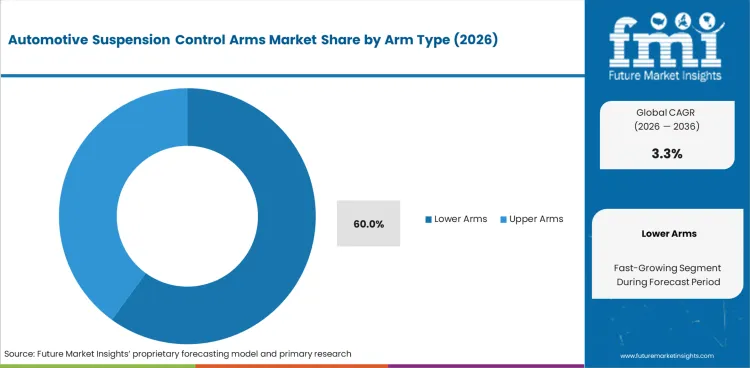
In 2026, Lower Arms is expected to account for 60% of the arm type segment. Lower arms serve as the primary load-bearing link in independent front suspension systems, absorbing lateral, longitudinal, and vertical forces during vehicle operation. They are fitted across all passenger vehicle classes using independent front suspension. Upper arms complement lower arms in double-wishbone configurations used in premium and performance vehicle platforms, providing precise wheel geometry control.
Insights into the Passenger Cars Application Segment
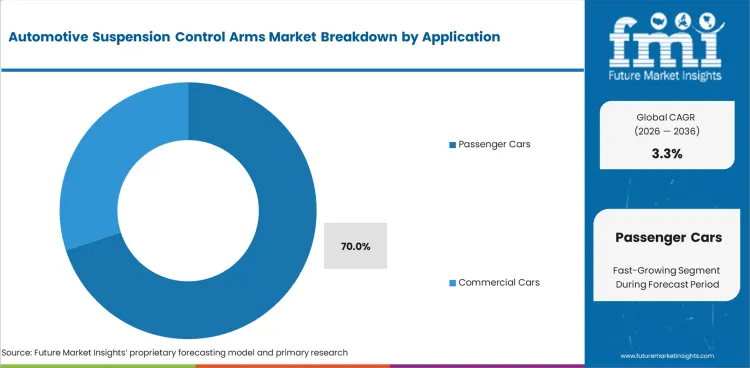
In 2026, Passenger Cars is expected to hold 70% of the application segment. Passenger car fitment generates the highest volume demand, as each vehicle with independent front suspension requires at least two lower control arms. Commercial vehicle applications add demand from light commercial van platforms and heavy truck independent front suspension systems. The aftermarket replacement cycle sustains demand beyond OEM fitment.
Automotive Suspension Control Arms Market Drivers, Restraints, and Opportunities
- Vehicle production recovery and growing vehicle parc support both OEM and aftermarket control arm demand.
- Lightweighting targets and EV platform requirements are accelerating material transition from steel to aluminum.
- Aftermarket replacement cycles generate recurring demand as control arm bushings and ball joints wear over vehicle life.
The automotive suspension control arms market is shaped by vehicle production volumes, material technology evolution, electric vehicle platform development, and the aftermarket replacement cycle driven by component wear.
Vehicle Production and Parc Growth
Demand reflects the recovery of global vehicle production volumes and the increasing total vehicle parc that generates both OEM fitment and aftermarket replacement demand. Each passenger vehicle requires two to four control arms depending on suspension configuration, creating direct volume linkage to production schedules.
Material Transition and Lightweighting
Adoption of aluminum and composite control arms is increasing as automakers pursue corporate average fuel economy targets and electric vehicle range optimization. Aluminum control arms offer 30 to 40% unsprung mass reduction compared to stamped steel, improving handling, ride quality, and energy efficiency.
Electric Vehicle Platform Development
Growth is supported by the development of dedicated electric vehicle platforms that require redesigned suspension geometry to accommodate battery pack mass distribution. Lower center of gravity and increased curb weight in electric vehicles create different structural loading requirements for control arms.
Analysis of Automotive Suspension Control Arms Market By Key Countries
.webp "Top Country Growth Comparison Automotive Suspension Control Arms Market Cagr (2026 2036)")
| Country | CAGR |
|---|---|
| South Korea | 3.6% |
| USA | 3.5% |
| Europe | 3.2% |
| UK | 3.1% |
| Japan | 3% |
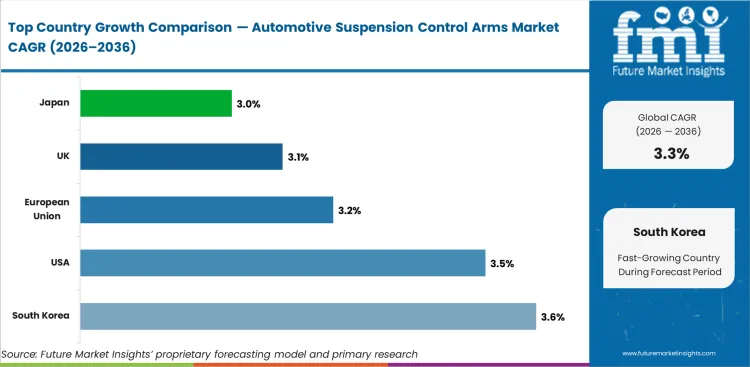
- South Korea leads growth at 3.6% CAGR, supported by Hyundai-Kia group production volumes and domestic Tier 1 component manufacturing strength.
- USA at 3.5% shows strong demand due to vehicle production recovery and large aftermarket replacement demand from aging vehicle parc.
- Europe (3.2%) and UK (3.1%) sustain growth through expanding infrastructure and regulatory support.
The global automotive suspension control arms market is projected to grow at 3.3% CAGR from 2026 to 2036. The analysis covers more than 30 countries, with the following markets showing the strongest growth trajectories.
Demand Outlook for Automotive Suspension Control Arms Market in South Korea
South Korea is projected to grow at 3.6% through 2036, supported by Hyundai-Kia group production volumes and domestic Tier 1 component manufacturing strength.
- Hyundai-Kia production volumes sustain high OEM control arm demand.
- Domestic Tier 1 suppliers provide integrated suspension component manufacturing.
- Electric vehicle platform development creates new control arm specifications.
Future Outlook for Automotive Suspension Control Arms Market in USA
USA is projected to grow at 3.5% through 2036, supported by vehicle production recovery and large aftermarket replacement demand from aging vehicle parc.
- Large vehicle parc generates sustained aftermarket replacement demand.
- Vehicle production recovery supports OEM procurement volumes.
- Electric vehicle assembly expansion creates new platform-specific demand.
Opportunity Analysis of Automotive Suspension Control Arms Market in Europe
Europe is projected to grow at 3.2% through 2036, supported by premium vehicle production and lightweighting material adoption in new platforms.
- Premium vehicle production drives aluminum control arm procurement.
- Lightweighting regulations support material transition investment.
- Aftermarket distribution networks serve aging European vehicle parc.
In-depth Analysis of Automotive Suspension Control Arms Market in UK
UK is projected to grow at 3.1% through 2036, supported by vehicle manufacturing and aftermarket distribution infrastructure.
- Vehicle manufacturing and assembly operations sustain OEM demand.
- Aftermarket distribution infrastructure supports replacement component supply.
- EV platform localization creates new suspension component procurement.
Sales Analysis of Automotive Suspension Control Arms Market in Japan
Japan is projected to grow at 3% through 2036, supported by precision automotive component manufacturing and electric vehicle platform development.
- Precision manufacturing capabilities support control arm quality standards.
- Electric vehicle platform engineering drives suspension redesign.
- Export-oriented component manufacturing serves global OEM customers.
Competitive Landscape and Strategic Positioning
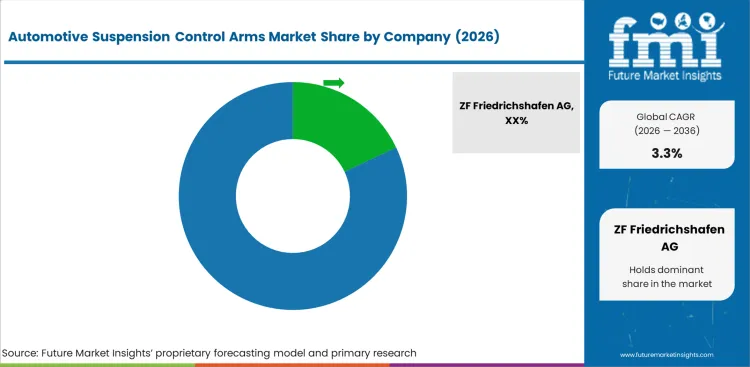
- ZF Friedrichshafen AG leads with an estimated 18.0% share, reflecting its position as a leading Tier 1 chassis and suspension system supplier.
- Magna International and Hyundai Mobis provide integrated suspension component manufacturing for global automakers.
- Aftermarket suppliers including Mevotech serve the replacement component channel with cost-competitive alternatives.
ZF Friedrichshafen AG leads through its comprehensive chassis and suspension system portfolio, supplying control arms as part of integrated front and rear suspension modules to global automakers. The company's engineering capabilities in both steel and aluminum suspension components position it across mass-market and premium vehicle platforms.
Magna International provides suspension component manufacturing through its body and chassis division, serving multiple OEM customers with stamped and forged control arms. Hyundai Mobis Co., Ltd. serves as the primary suspension component supplier to the Hyundai-Kia group while expanding its customer base to other automakers.
TRW Automotive, now part of ZF Group, maintains established relationships with European and North American automakers. Mevotech LP serves the North American aftermarket with replacement control arms designed as direct-fit alternatives to OEM components.
Competitive barriers include automotive qualification requirements, long product development cycles tied to vehicle platform timelines, the capital intensity of stamping and forging operations, and the need to maintain both OEM and aftermarket distribution capabilities.
Key Companies in the Automotive Suspension Control Arms Market
Key global companies leading the automotive suspension control arms market include:
- ZF Friedrichshafen AG (Germany), Magna International Inc. (Canada), Hyundai Mobis Co., Ltd. (South Korea) hold leading positions through established portfolios and broad distribution networks.
- TRW Automotive, ZF Group (Germany), Mevotech LP (Canada) serve regional markets with specialized product offerings.
- Other Regional Manufacturers represent emerging participants with potential for future positioning.
Competitive Benchmarking: Automotive Suspension Control Arms Market
| Company | Suspension System Breadth | OEM Integration Depth | Lightweight Material Tech | Global Manufacturing |
|---|---|---|---|---|
| ZF Friedrichshafen AG | High | High | Strong | Global |
| Magna International Inc. | High | High | Strong | Global |
| Hyundai Mobis Co., Ltd. | High | High | Strong | Global |
| TRW Automotive (ZF Group) | Medium | Medium | Moderate | Regional |
| Mevotech LP | Medium | Medium | Moderate | Regional |
Source: Future Market Insights competitive analysis, 2026.
Key Developments in Automotive Suspension Control Arms Market
- In 2025, ZF Friedrichshafen AG introduced a new aluminum control arm design for electric vehicle platforms, offering 35% weight reduction compared to its steel equivalent.
- In 2025, Magna International expanded its lightweight chassis component production capacity in North America to serve growing EV platform demand.
Key Players in the Automotive Suspension Control Arms Market
Major Global Players
- ZF Friedrichshafen AG
- Magna International Inc.
- Hyundai Mobis Co., Ltd.
- TRW Automotive (ZF Group)
- Mevotech LP
Emerging Players/Startups
- TRW Automotive (ZF Group)
- Mevotech LP
Report Scope and Coverage
| Parameter | Details |
|---|---|
| Quantitative Units | USD 51.1 billion to USD 70.7 billion, at a CAGR of 3.3% |
| Market Definition | The automotive suspension control arms market includes upper and lower control arms, also known as A-arms or wishbones, used in independent suspension systems for passenger cars, light commercial vehi... |
| Regions Covered | North America, Latin America, Europe, East Asia, South Asia and Pacific, Middle East and Africa |
| Countries Covered | South Korea, USA, Europe, UK, Japan, 30 plus countries |
| Key Companies Profiled | ZF Friedrichshafen AG, Magna International Inc., Hyundai Mobis Co., Ltd., TRW Automotive (ZF Group), Mevotech LP |
| Forecast Period | 2026 to 2036 |
| Approach | Hybrid bottom-up and top-down methodology starting with verified transaction data, projecting adoption velocity across segments and regions. |
Segmentation
Automotive Suspension Control Arms Market Segmented by Arm Type:
- Lower Arms
- Upper Arms
Automotive Suspension Control Arms Market Segmented by Application:
- Passenger Cars
- Commercial Cars
Automotive Suspension Control Arms Market Segmented by Material Type:
- Steel
- Aluminum
- Composite
Automotive Suspension Control Arms Market Segmented by Vehicle Type:
- Passenger vehicles
- Light commercial vehicles
- Heavy commercial vehicles
Automotive Suspension Control Arms Market by Region:
- North America
- USA
- Canada
- Mexico
- Latin America
- Brazil
- Chile
- Rest of Latin America
- Western Europe
- Germany
- UK
- Italy
- Spain
- France
- Nordic
- BENELUX
- Rest of Western Europe
- Eastern Europe
- Russia
- Poland
- Hungary
- Balkan & Baltic
- Rest of Eastern Europe
- East Asia
- China
- Japan
- South Korea
- South Asia and Pacific
- India
- ASEAN
- Australia & New Zealand
- Rest of South Asia and Pacific
- Middle East & Africa
- Kingdom of Saudi Arabia
- Other GCC Countries
- Turkiye
- South Africa
- Other African Union
- Rest of Middle East & Africa
Research Sources and Bibliography
- 1. International Organization of Motor Vehicle Manufacturers. (2025). OICA Global Vehicle Production Statistics. OICA.
- 2. Society of Automotive Engineers International. (2024). SAE Standards for Suspension Component Testing and Validation. SAE.
- 3. European Automobile Manufacturers Association. (2025). ACEA Vehicle Parc and Production Data Report. ACEA.
- 4. USA Bureau of Transportation Statistics. (2024). BTS National Vehicle Fleet and Age Profile Report. BTS.
- 5. ZF Friedrichshafen AG. (2025). ZF Annual Report 2025: Chassis Technology Division. ZF.
This bibliography is provided for reader reference. The full Future Market Insights report contains the complete reference list with publication dates, URLs, and supporting data for all cited works.
This Report Answers
- Estimating the size of the market and revenue from 2026 to 2036.
- Segmentation analysis across arm type, application, material type, vehicle type.
- Insights about more than 30 regional markets.
- Assessment of the competitive landscape.
- Company profiling and strategic positioning analysis.
- Investment opportunity identification across key segments and regions.
- Supply chain and procurement structure analysis.
- Delivery of data in PDF and Excel formats.
Frequently Asked Questions
What is the global market demand for Automotive Suspension Control Arms in 2026?
In 2026, the global automotive suspension control arms market is expected to be worth USD 51.1 billion.
How big will the Automotive Suspension Control Arms Market be in 2036?
By 2036, the automotive suspension control arms market is expected to be worth USD 70.7 billion.
How much is demand expected to grow between 2026 and 2036?
Between 2026 and 2036, demand is expected to grow at a CAGR of 3.3%.
Which arm type segment is likely to lead globally by 2026?
Lower Arms is expected to account for 60% of the arm type segment in 2026.
What is causing demand to rise in South Korea?
South Korea is expected to grow at 3.6% CAGR through 2036, supported by Hyundai-Kia group production volumes and domestic Tier 1 component manufacturing strength.
What is causing demand to rise in USA?
USA is expected to grow at 3.5% CAGR through 2036, supported by vehicle production recovery and large aftermarket replacement demand from aging vehicle parc.
What does this report mean by
The automotive suspension control arms market includes upper and lower control arms, also known as A-arms or wishbones, used in independent suspension systems for passenger cars, light commercial vehicles, and heavy commercial vehicles. Materials include steel, aluminum, and composite constructions.
How does FMI make the forecast and check it?
Forecasting models use a hybrid bottom-up and top-down approach, starting with verified transaction data and checking it against industry production statistics and manufacturer disclosures.
Preview the report firsthand - request a free sample
Get SampleGet the brochure for pricing and purchase details.
Get PDFTable of Content
- Executive Summary
- Global Market Outlook
- Demand-side Trends
- Supply-side Trends
- Technology Roadmap Analysis
- Analysis and Recommendations
- Market Overview
- Market Coverage / Taxonomy
- Market Definition / Scope / Limitations
- Research Methodology
- Chapter Orientation
- Analytical Lens and Working Hypotheses
- Market Structure, Signals, and Trend Drivers
- Benchmarking and Cross-market Comparability
- Market Sizing, Forecasting, and Opportunity Mapping
- Research Design and Evidence Framework
- Desk Research Programme (Secondary Evidence)
- Company Annual and Sustainability Reports
- Peer-reviewed Journals and Academic Literature
- Corporate Websites, Product Literature, and Technical Notes
- Earnings Decks and Investor Briefings
- Statutory Filings and Regulatory Disclosures
- Technical White Papers and Standards Notes
- Trade Journals, Industry Magazines, and Analyst Briefs
- Conference Proceedings, Webinars, and Seminar Materials
- Government Statistics Portals and Public Data Releases
- Press Releases and Reputable Media Coverage
- Specialist Newsletters and Curated Briefings
- Sector Databases and Reference Repositories
- FMI Internal Proprietary Databases and Historical Market Datasets
- Subscription Datasets and Paid Sources
- Social Channels, Communities, and Digital Listening Inputs
- Additional Desk Sources
- Expert Input and Fieldwork (Primary Evidence)
- Primary Modes
- Qualitative Interviews and Expert Elicitation
- Quantitative Surveys and Structured Data Capture
- Blended Approach
- Why Primary Evidence is Used
- Field Techniques
- Interviews
- Surveys
- Focus Groups
- Observational and In-context Research
- Social and Community Interactions
- Stakeholder Universe Engaged
- C-suite Leaders
- Board Members
- Presidents and Vice Presidents
- R&D and Innovation Heads
- Technical Specialists
- Domain Subject-matter Experts
- Scientists
- Physicians and Other Healthcare Professionals
- Governance, Ethics, and Data Stewardship
- Research Ethics
- Data Integrity and Handling
- Primary Modes
- Tooling, Models, and Reference Databases
- Desk Research Programme (Secondary Evidence)
- Data Engineering and Model Build
- Data Acquisition and Ingestion
- Cleaning, Normalisation, and Verification
- Synthesis, Triangulation, and Analysis
- Quality Assurance and Audit Trail
- Market Background
- Market Dynamics
- Drivers
- Restraints
- Opportunity
- Trends
- Scenario Forecast
- Demand in Optimistic Scenario
- Demand in Likely Scenario
- Demand in Conservative Scenario
- Opportunity Map Analysis
- Product Life Cycle Analysis
- Supply Chain Analysis
- Investment Feasibility Matrix
- Value Chain Analysis
- PESTLE and Porter’s Analysis
- Regulatory Landscape
- Regional Parent Market Outlook
- Production and Consumption Statistics
- Import and Export Statistics
- Market Dynamics
- Global Market Analysis 2021 to 2025 and Forecast, 2026 to 2036
- Historical Market Size Value (USD Million) Analysis, 2021 to 2025
- Current and Future Market Size Value (USD Million) Projections, 2026 to 2036
- Y-o-Y Growth Trend Analysis
- Absolute $ Opportunity Analysis
- Global Market Pricing Analysis 2021 to 2025 and Forecast 2026 to 2036
- Global Market Analysis 2021 to 2025 and Forecast 2026 to 2036, By Arm Type
- Introduction / Key Findings
- Historical Market Size Value (USD Million) Analysis By Arm Type , 2021 to 2025
- Current and Future Market Size Value (USD Million) Analysis and Forecast By Arm Type , 2026 to 2036
- Lower Arms
- Upper Arms
- Lower Arms
- Y-o-Y Growth Trend Analysis By Arm Type , 2021 to 2025
- Absolute $ Opportunity Analysis By Arm Type , 2026 to 2036
- Global Market Analysis 2021 to 2025 and Forecast 2026 to 2036, By Application
- Introduction / Key Findings
- Historical Market Size Value (USD Million) Analysis By Application, 2021 to 2025
- Current and Future Market Size Value (USD Million) Analysis and Forecast By Application, 2026 to 2036
- Passenger Cars
- Commercial Cars
- Passenger Cars
- Y-o-Y Growth Trend Analysis By Application, 2021 to 2025
- Absolute $ Opportunity Analysis By Application, 2026 to 2036
- Global Market Analysis 2021 to 2025 and Forecast 2026 to 2036, By Material Type
- Introduction / Key Findings
- Historical Market Size Value (USD Million) Analysis By Material Type, 2021 to 2025
- Current and Future Market Size Value (USD Million) Analysis and Forecast By Material Type, 2026 to 2036
- Steel
- Aluminum
- Composite
- Steel
- Y-o-Y Growth Trend Analysis By Material Type, 2021 to 2025
- Absolute $ Opportunity Analysis By Material Type, 2026 to 2036
- Global Market Analysis 2021 to 2025 and Forecast 2026 to 2036, By Vehicle Type
- Introduction / Key Findings
- Historical Market Size Value (USD Million) Analysis By Vehicle Type, 2021 to 2025
- Current and Future Market Size Value (USD Million) Analysis and Forecast By Vehicle Type, 2026 to 2036
- Passenger vehicles
- Light commercial vehicles
- Heavy commercial vehicles
- Passenger vehicles
- Y-o-Y Growth Trend Analysis By Vehicle Type, 2021 to 2025
- Absolute $ Opportunity Analysis By Vehicle Type, 2026 to 2036
- Global Market Analysis 2021 to 2025 and Forecast 2026 to 2036, By Region
- Introduction
- Historical Market Size Value (USD Million) Analysis By Region, 2021 to 2025
- Current Market Size Value (USD Million) Analysis and Forecast By Region, 2026 to 2036
- North America
- Latin America
- Western Europe
- Eastern Europe
- East Asia
- South Asia and Pacific
- Middle East & Africa
- Market Attractiveness Analysis By Region
- North America Market Analysis 2021 to 2025 and Forecast 2026 to 2036, By Country
- Historical Market Size Value (USD Million) Trend Analysis By Market Taxonomy, 2021 to 2025
- Market Size Value (USD Million) Forecast By Market Taxonomy, 2026 to 2036
- By Country
- USA
- Canada
- Mexico
- By Arm Type
- By Application
- By Material Type
- By Vehicle Type
- By Country
- Market Attractiveness Analysis
- By Country
- By Arm Type
- By Application
- By Material Type
- By Vehicle Type
- Key Takeaways
- Latin America Market Analysis 2021 to 2025 and Forecast 2026 to 2036, By Country
- Historical Market Size Value (USD Million) Trend Analysis By Market Taxonomy, 2021 to 2025
- Market Size Value (USD Million) Forecast By Market Taxonomy, 2026 to 2036
- By Country
- Brazil
- Chile
- Rest of Latin America
- By Arm Type
- By Application
- By Material Type
- By Vehicle Type
- By Country
- Market Attractiveness Analysis
- By Country
- By Arm Type
- By Application
- By Material Type
- By Vehicle Type
- Key Takeaways
- Western Europe Market Analysis 2021 to 2025 and Forecast 2026 to 2036, By Country
- Historical Market Size Value (USD Million) Trend Analysis By Market Taxonomy, 2021 to 2025
- Market Size Value (USD Million) Forecast By Market Taxonomy, 2026 to 2036
- By Country
- Germany
- UK
- Italy
- Spain
- France
- Nordic
- BENELUX
- Rest of Western Europe
- By Arm Type
- By Application
- By Material Type
- By Vehicle Type
- By Country
- Market Attractiveness Analysis
- By Country
- By Arm Type
- By Application
- By Material Type
- By Vehicle Type
- Key Takeaways
- Eastern Europe Market Analysis 2021 to 2025 and Forecast 2026 to 2036, By Country
- Historical Market Size Value (USD Million) Trend Analysis By Market Taxonomy, 2021 to 2025
- Market Size Value (USD Million) Forecast By Market Taxonomy, 2026 to 2036
- By Country
- Russia
- Poland
- Hungary
- Balkan & Baltic
- Rest of Eastern Europe
- By Arm Type
- By Application
- By Material Type
- By Vehicle Type
- By Country
- Market Attractiveness Analysis
- By Country
- By Arm Type
- By Application
- By Material Type
- By Vehicle Type
- Key Takeaways
- East Asia Market Analysis 2021 to 2025 and Forecast 2026 to 2036, By Country
- Historical Market Size Value (USD Million) Trend Analysis By Market Taxonomy, 2021 to 2025
- Market Size Value (USD Million) Forecast By Market Taxonomy, 2026 to 2036
- By Country
- China
- Japan
- South Korea
- By Arm Type
- By Application
- By Material Type
- By Vehicle Type
- By Country
- Market Attractiveness Analysis
- By Country
- By Arm Type
- By Application
- By Material Type
- By Vehicle Type
- Key Takeaways
- South Asia and Pacific Market Analysis 2021 to 2025 and Forecast 2026 to 2036, By Country
- Historical Market Size Value (USD Million) Trend Analysis By Market Taxonomy, 2021 to 2025
- Market Size Value (USD Million) Forecast By Market Taxonomy, 2026 to 2036
- By Country
- India
- ASEAN
- Australia & New Zealand
- Rest of South Asia and Pacific
- By Arm Type
- By Application
- By Material Type
- By Vehicle Type
- By Country
- Market Attractiveness Analysis
- By Country
- By Arm Type
- By Application
- By Material Type
- By Vehicle Type
- Key Takeaways
- Middle East & Africa Market Analysis 2021 to 2025 and Forecast 2026 to 2036, By Country
- Historical Market Size Value (USD Million) Trend Analysis By Market Taxonomy, 2021 to 2025
- Market Size Value (USD Million) Forecast By Market Taxonomy, 2026 to 2036
- By Country
- Kingdom of Saudi Arabia
- Other GCC Countries
- Turkiye
- South Africa
- Other African Union
- Rest of Middle East & Africa
- By Arm Type
- By Application
- By Material Type
- By Vehicle Type
- By Country
- Market Attractiveness Analysis
- By Country
- By Arm Type
- By Application
- By Material Type
- By Vehicle Type
- Key Takeaways
- Key Countries Market Analysis
- USA
- Pricing Analysis
- Market Share Analysis, 2025
- By Arm Type
- By Application
- By Material Type
- By Vehicle Type
- Canada
- Pricing Analysis
- Market Share Analysis, 2025
- By Arm Type
- By Application
- By Material Type
- By Vehicle Type
- Mexico
- Pricing Analysis
- Market Share Analysis, 2025
- By Arm Type
- By Application
- By Material Type
- By Vehicle Type
- Brazil
- Pricing Analysis
- Market Share Analysis, 2025
- By Arm Type
- By Application
- By Material Type
- By Vehicle Type
- Chile
- Pricing Analysis
- Market Share Analysis, 2025
- By Arm Type
- By Application
- By Material Type
- By Vehicle Type
- Germany
- Pricing Analysis
- Market Share Analysis, 2025
- By Arm Type
- By Application
- By Material Type
- By Vehicle Type
- UK
- Pricing Analysis
- Market Share Analysis, 2025
- By Arm Type
- By Application
- By Material Type
- By Vehicle Type
- Italy
- Pricing Analysis
- Market Share Analysis, 2025
- By Arm Type
- By Application
- By Material Type
- By Vehicle Type
- Spain
- Pricing Analysis
- Market Share Analysis, 2025
- By Arm Type
- By Application
- By Material Type
- By Vehicle Type
- France
- Pricing Analysis
- Market Share Analysis, 2025
- By Arm Type
- By Application
- By Material Type
- By Vehicle Type
- India
- Pricing Analysis
- Market Share Analysis, 2025
- By Arm Type
- By Application
- By Material Type
- By Vehicle Type
- ASEAN
- Pricing Analysis
- Market Share Analysis, 2025
- By Arm Type
- By Application
- By Material Type
- By Vehicle Type
- Australia & New Zealand
- Pricing Analysis
- Market Share Analysis, 2025
- By Arm Type
- By Application
- By Material Type
- By Vehicle Type
- China
- Pricing Analysis
- Market Share Analysis, 2025
- By Arm Type
- By Application
- By Material Type
- By Vehicle Type
- Japan
- Pricing Analysis
- Market Share Analysis, 2025
- By Arm Type
- By Application
- By Material Type
- By Vehicle Type
- South Korea
- Pricing Analysis
- Market Share Analysis, 2025
- By Arm Type
- By Application
- By Material Type
- By Vehicle Type
- Russia
- Pricing Analysis
- Market Share Analysis, 2025
- By Arm Type
- By Application
- By Material Type
- By Vehicle Type
- Poland
- Pricing Analysis
- Market Share Analysis, 2025
- By Arm Type
- By Application
- By Material Type
- By Vehicle Type
- Hungary
- Pricing Analysis
- Market Share Analysis, 2025
- By Arm Type
- By Application
- By Material Type
- By Vehicle Type
- Kingdom of Saudi Arabia
- Pricing Analysis
- Market Share Analysis, 2025
- By Arm Type
- By Application
- By Material Type
- By Vehicle Type
- Turkiye
- Pricing Analysis
- Market Share Analysis, 2025
- By Arm Type
- By Application
- By Material Type
- By Vehicle Type
- South Africa
- Pricing Analysis
- Market Share Analysis, 2025
- By Arm Type
- By Application
- By Material Type
- By Vehicle Type
- USA
- Market Structure Analysis
- Competition Dashboard
- Competition Benchmarking
- Market Share Analysis of Top Players
- By Regional
- By Arm Type
- By Application
- By Material Type
- By Vehicle Type
- Competition Analysis
- Competition Deep Dive
- ZF Friedrichshafen AG
- Overview
- Product Portfolio
- Profitability by Market Segments (Product/Age /Sales Channel/Region)
- Sales Footprint
- Strategy Overview
- Marketing Strategy
- Product Strategy
- Channel Strategy
- Magna International Inc.
- Hyundai Mobis Co., Ltd.
- TRW Automotive (ZF Group)
- Mevotech LP
- Others
- ZF Friedrichshafen AG
- Competition Deep Dive
- Assumptions & Acronyms Used


