

- Industry Size (2026)
- USD 22.8 Bn
- Forecast (2036)
- USD 40.5 Bn
- CAGR (2026 to 2036)
- 5.90%
Controller to Device Interoperability Market Size, Market Forecast and Outlook By FMI
In 2025, the controller to device interoperability market exceeded USD 21.7 billion and is forecast to rise to USD 22.8 billion in 2026 and USD 40.5 billion by 2036, reflecting a CAGR of 5.90%. This sustained growth trajectory is driven primarily by the operational inefficiencies of isolated factory networks, which are compelling industrial operators to adopt unified semantic standards to ensure seamless communication across heterogeneous production environments.
Manufacturers dismantling proprietary architectures require standardized middleware to synchronize distinct machinery assets. FMI analysts opine that this transition accelerates edge infrastructure deployments by compelling original equipment manufacturers to embed universal translation logic directly into controller hardware. Rockwell Automation published Logix controller OPC UA documentation in September 2025 to enable firmware-level interoperability natively [14]. Integrating such standardized industrial communication frameworks eradicates custom engineering bottlenecks directly.
Summary of Controller to Device Interoperability Market
- Controller to Device Interoperability Market Definition
- Controller to Device Interoperability establishes standardized semantic data exchange architectures, permitting deterministic communication between programmable logic controllers and diverse field-level sensors across vendor-agnostic industrial networks.
- Demand Drivers in the Market
- Legacy point-to-point connections physically constrain process scaling, forcing automation engineers to implement networked topologies capable of dynamic routing.
- Replacing archaic wiring harnesses with intelligent field networks drives efficiency gains.
- Managing this escalating node density requires advanced industrial control network modules that natively translate disparate equipment languages into a cohesive data stream.
- Key Segments Analyzed in the FMI Report
- Industrial Ethernet protocols: 47% volume share as high-bandwidth sensor arrays completely overwhelm traditional serial connections during continuous manufacturing.
- Hardware: 60% volume share reflecting the massive capital required to replace aging physical gateways and specialized network interface cards globally.
- Asia Pacific: High-growth trajectory shaped by massive government-subsidized smart manufacturing initiatives.
- Analyst Opinion at FMI
- Nikhil Kaitwade, Principal Consultant for Process Automation at Future Market Insights, opines, “Failure to unify field-level translation layers cascades into critical system faults during high-speed manufacturing cycles. Consequently, modern industrial automation directors prioritize strictly interoperable gateways to guarantee continuous production throughput across decentralized facilities.”
- Strategic Implications / Executive Takeaways
- Mandate OPC UA compliance across all new controller procurement to prevent future IT/OT convergence bottlenecks.
- Deploy isolated management networks immediately to secure telemetry data extraction without exposing active production loops.
- Qualify embedded network interfaces to significantly reduce latency variations critical to batch consistency.
- Methodology
- Primary Research: Direct interviews with automation architects, network component product managers, and industrial cybersecurity officers.
- Desk Research: Custom procurement datasets, official network standards organization filings, and certified product registry logs.
- Market-Sizing and Forecasting: Bottom-up capacity modeling starting from regional factory automation build-out rates.
- Data Validation and Update Cycle: Findings underwent rigorous cross-verification against certified automation component shipments before final integration.
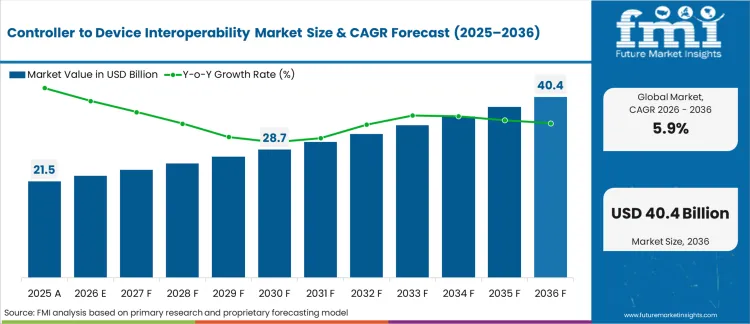
Controller to Device Interoperability Market Key Takeaways
| Metric | Details |
|---|---|
| Industry Size (2026) | USD 22.8 billion |
| Industry Value (2036) | USD 40.5 billion |
| CAGR (2026-2036) | 5.90% |
In the process/factory automation ecosystem, the harmonization of FDI and FDT is positioned as a path toward unified device integration that improves interoperability across OT systems and common information models used for OT/IT connectivity. Reflecting this direction, Stefan Hoppe (President, OPC Foundation) said: “As a co-owner of the FDI specification, the OPC Foundation is committed to robust and interoperable device integration for OPC UA users and fully supports the harmonization of FDI and FDT technologies to achieve this goal.” [21]
Hyperscaler validation of open industrial protocols signals a permanent shift in data routing architectures. Procurement teams are respecifying edge hardware contracts, disqualifying suppliers lacking native cloud-connector certification. Original equipment manufacturers must integrate standard middleware bridging OT assets directly to enterprise analytics engines before the 2027 enterprise software renewal cycles lock out non-compliant hardware.
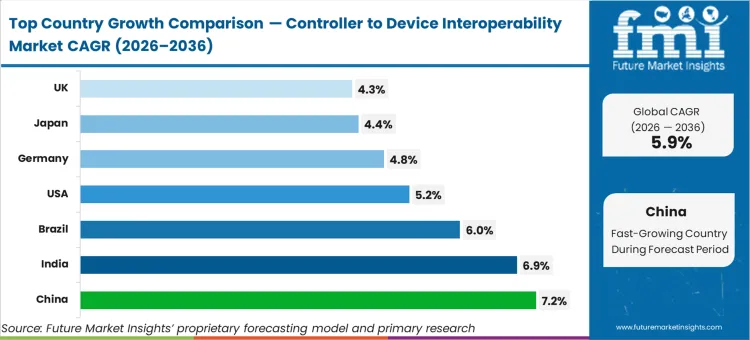
China commands a 7.2% CAGR through 2036 as massive state-backed industrial modernization programs compel manufacturers to replace fragmented serial networks and incorporate interoperable controllers. India follows at a 6.9% CAGR, driven by rapid greenfield facility construction demanding future-proof, high-bandwidth backbones. Brazil investments yield a 6.0% CAGR as aging manufacturing bases execute mandatory upgrades by integrating compliant field devices natively. USA posts a 5.2% CAGR while specialized automotive OEMs integrate converged networking to govern complex data flows. Germany expands at a 4.8% CAGR as modular production machinery tighter latency requirements for precision handling. Japan progresses at a 4.4% CAGR, focusing heavily on legacy robotic fleet modernization strategies. UK facilities generate a 4.3% CAGR as operators prioritize secure-by-design retrofits across critical infrastructure.
Controller to Device Interoperability Market Definition
Controller to Device Interoperability networks utilize open standards, including advanced publish-subscribe architectures, to guarantee packet delivery and semantic understanding across heterogeneous equipment. Industrial operators deploy these frameworks to transform isolated machine data into actionable manufacturing intelligence.
Controller to Device Interoperability Market Inclusions
Market coverage includes managed edge gateways, embedded communication modules, protocol translation software stacks, and determinism-enhancing network switches designed specifically for harsh industrial conditions.
Controller to Device Interoperability Market Exclusions
Consumer-grade networking equipment lacking certified industrial deterministic features falls entirely outside the analytical scope. Standalone IT enterprise routers without embedded OT protocol capabilities are explicitly excluded.
Controller to Device Interoperability Market Research Methodology
- Primary Research: Analysts conducted direct interviews with factory network architects, component engineering directors, and institutional standard body representatives across top automation hubs.
- Desk Research: Data compilation relied strictly on official standards organization membership logs, verified cybersecurity agency incident reports, and validated corporate hardware release documentation.
- Market-Sizing and Forecasting: Analysts constructed a bottom-up adoption model anchoring on regional industrial robotics installation volumes.
- Data Validation and Update Cycle: Initial port-count projections underwent cross-verification against certified automation component registry databases before baseline integration.
Segmental Analysis
Controller to Device Interoperability Market Analysis by Communication protocol
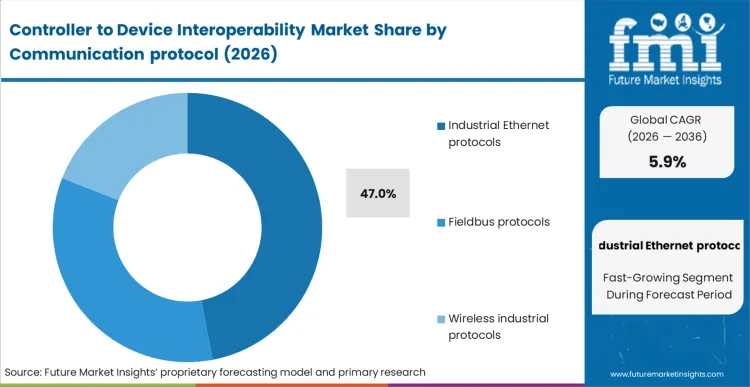
Industrial Ethernet protocols command 47% of the 2026 market share as high-bandwidth sensor arrays completely overwhelm traditional serial connections. Establishing unified factory automation and industrial controls requires standardized application layers to parse complex telemetry perfectly. The OPC Foundation press release states the foundation serves over 1010 members worldwide [4]. Broad consortium support compels equipment vendors to abandon proprietary algorithms to ensure network participation. As per FMI's projection, the ISA Annual Report 2025 reports 18,790 members in 2025 and USD 21M revenue in 2025 [5]. System integrators deploying machine automation controller architectures demand these standardized switches to guarantee seamless vertical data integration.
- Bandwidth capacity: High-resolution optical inspection tools saturate legacy links rapidly. Facilities must deploy Gigabit-capable endpoints to prevent traffic bottlenecks during active production runs.
- Protocol standardization: Interoperability mandates force component buyers to specify hardware supporting unified profiles. Controllers operating on proprietary standards face immediate replacement.
- Semantic clarity: Disparate data models prevent automated analytics platforms from functioning. Network architects require strict compliance to eliminate manual data translation tasks.
Controller to Device Interoperability Market Analysis by Application
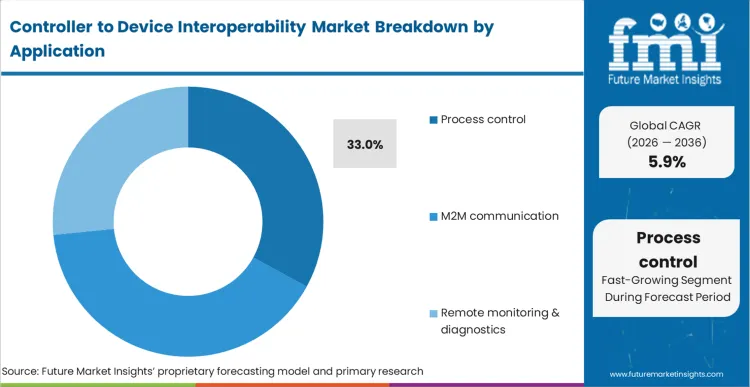
Process control secures 33% of the application share, driven by continuous manufacturing environments demanding absolute sequence precision. Orchestrating chemical and petrochemical flows requires resilient edge computing networks that instantly propagate valve and actuator commands. FieldComm Group reports Saudi Railway Company’s Riyadh Suburban Rail project installed more than 40,000 devices, with over 90% managed using IAMS Asset Guardian [2]. Managing massive field deployments necessitates deterministic execution platforms to prevent fatal timing collisions. According to FMI's estimates, Schneider Electric released EcoStruxure Automation Expert v25.0 in September 2025 [17], providing the software infrastructure to decouple hardware from application logic entirely. Implementing these event-driven micro and nano plc systems eradicates latency variations critical to batch consistency.
- Motion synchronization: High-speed assembly operations demand sub-millisecond communication cycles. Integrators specifying factory networks disqualify protocols unable to guarantee fixed delivery schedules.
- Topology flexibility: Expanding production lines requires adaptable network configurations. Planners must select architectures supporting ring and star topologies natively.
- Downtime prevention: Unscheduled equipment failures destroy quarterly margin targets directly. Maintenance teams require uninterrupted sensor telemetry to execute predictive repair models accurately.
Controller to Device Interoperability Market Analysis by Offering
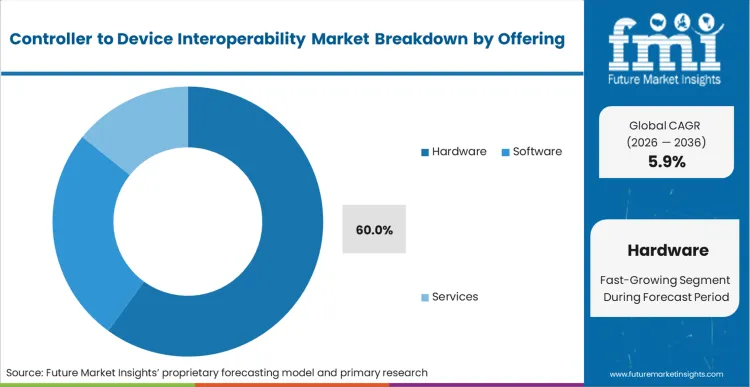
Hardware encompasses 60% of the offering segment, reflecting the massive capital required to replace aging physical gateways and specialized network interface cards. Hardening these edge nodes against environmental and cyber-physical threats remains the foremost procurement priority for critical infrastructure operators. The NIST IoT guidance draft states it describes nine recommended foundational cybersecurity activities for IoT product manufacturers [6]. FMI analysts opine that compliance with federal security baselines forces networking giants to redesign their silicon architectures directly. Belden currently positions the Hirschmann BOBCAT switch for real-time OT networking using TSN and high-port density [24]. Embedding cryptographic verification directly into i o link modules establishes a secure perimeter for decentralized production floors.
- Form factor density: Control cabinet space constraints dictate compact switch designs. Engineers reject bulky networking gear regardless of performance specifications.
- Harsh environment resilience: Steel mills and chemical plants subject electronics to extreme temperatures and vibration. Procurement officers mandate industrial-grade certifications for all network appliances.
- Processing integration: Modern gateways perform localized analytics before forwarding data. Edge computing requirements push processors deeper into the field-level hardware.
Controller to Device Interoperability Market Analysis by Connectivity type
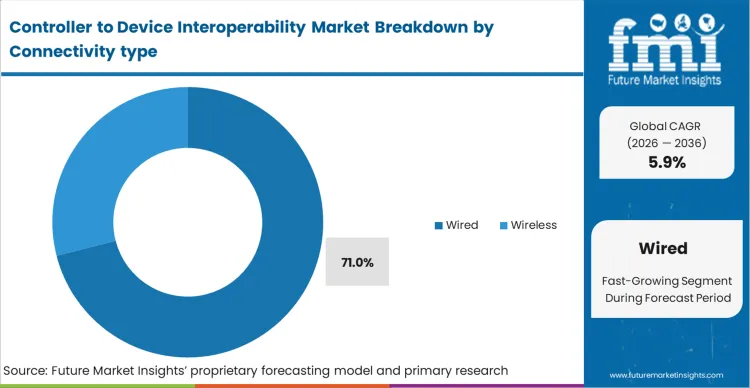
Wired connectivity retains 71% of the market as guaranteed packet delivery mechanisms remain indispensable for safety-critical interlocks. Microsecond transmission deadlines disqualify standard wireless protocols from participating in closed-loop motion control systems definitively. An ODVA Industry Conference paper states mandatory synchronization time for 5G devices is 1.5 µs [3]. Achieving this strict determinism requires heavily shielded physical media managed by advanced traffic shaping algorithms exclusively. Planners integrating time sensitive networking tsn utilize these wired backbones to completely eliminate network jitter. Facility administrators must deploy physical tsn ethernet chips to isolate active control loops from ambient wireless interference reliably.
- Jitter elimination: Microsecond variations in signal delivery disrupt precise machining operations. Quality control managers reject network designs lacking hardware-based timestamping capabilities.
- Standardized timing: Proprietary synchronization methods trap facilities in single-vendor closed systems. System architects demand IEEE 802.1AS compliance to enable competitive bidding on future upgrades.
- Interference immunity: Factory floors generate massive electromagnetic interference that disrupts wireless links. Plant managers install industrial-grade shielded cables to ensure failsafe communication.
Controller to Device Interoperability Market Drivers, Restraints, and Opportunities
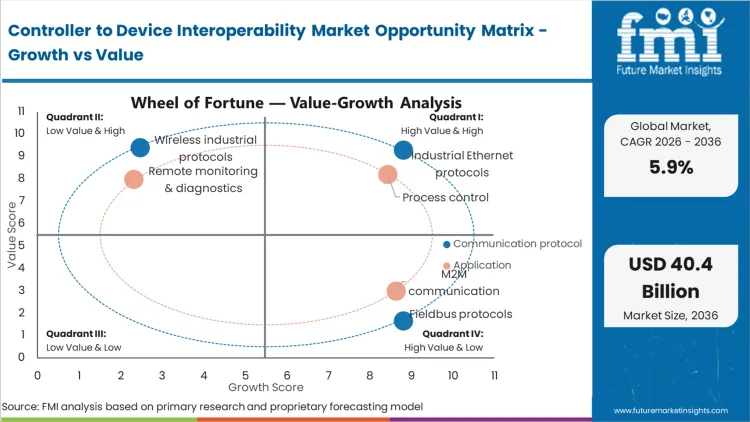
Replacing archaic wiring harnesses with intelligent field networks drives immediate efficiency gains. Upgrading discrete signaling to digital buses allows a single cable to transport both control commands and asset health diagnostics simultaneously. FieldComm Group states there are more than 50 million HART devices in the field [1]. This massive installed base provides a ready foundation for digital integration projects. Plant managers utilizing router and switch size optimizations can drastically reduce cabinet footprints while increasing node density. Operations directors must formalize gateway qualification standards to unlock the diagnostic data trapped within these legacy instruments.
Escalating ransomware campaigns targeting operational technology create severe friction for cloud-integration initiatives. Exposing legacy production assets to internet-facing networks exponentially increases organizational risk profiles. The UK NCSC reports 1,727 incident tips were triaged into 429 incidents requiring support [9]. This persistent threat environment forces operations technology teams to delay protocol convergence projects pending comprehensive security audits. Chief Information Security Officers must mandate unidirectional data diodes and strictly managed ethernet access device configurations to insulate vulnerable machinery from lateral threat propagation.
- AI Model Integration: Hyperscalers are developing direct integration paths to industrial protocols to feed machine learning algorithms. Microsoft and Rockwell published Industrial AI integration guidance in November 2025 highlighting OPC UA/MQTT standards and sample integration paths [15].
- Edge Software Containerization: Distributing protocol translation mechanisms directly via lightweight software containers allows operators to achieve massive scale. PTC announced Kepware Edge and Kepware Server as part of its Fall 2025 release [18].
- Standardized Machine Data: Equipment builders embed standardized data semantics directly into motion controllers to maintain export competitiveness. Omron published guidance on standardization and customization using open standards such as OPC UA and PackML in February 2025 [20].
Regional Analysis
Based on the regional analysis, the Controller to Device Interoperability market is segmented into North America, Latin America, Europe, East Asia, South Asia, Oceania and Middle East & Africa across 40+ countries. The full report also offers market attractiveness analysis based on regional trends.
.webp "Top Country Growth Comparison Controller To Device Interoperability Market Cagr (2026 2036)")
| Country | CAGR (2026 to 2036) |
|---|---|
| China | 7.2% |
| India | 6.9% |
| Brazil | 6.0% |
| USA | 5.2% |
| Germany | 4.8% |
| Japan | 4.4% |
| UK | 4.3% |
Source: Future Market Insights (FMI) analysis, based on proprietary forecasting model and primary research
Asia Pacific Controller to Device Interoperability Market Analysis
Asia Pacific's industrial automation trajectory is defined by aggressive government-mandated digital transformations designed to elevate manufacturing efficiency to global standards. Factory owners managing vast electronics and automotive supply chains face an acute need to unify data across fragmented equipment fleets. This top-down directive forces domestic machine builders to abandon proprietary protocols in favor of interoperable standards. As per FMI's projection, the implementation of dense sensor networks leaves facility managers with no option but to deploy decoupled broker architectures to manage the payload volume. High-throughput facilities demand unified information models to maintain sequence perfection across thousands of robotic assembly cells. Operations directors must integrate high-capacity ethernet connector and transformer infrastructure to orchestrate massive data payloads successfully.
- China: State-driven directives mandate the immediate integration of fragmented supply chain data into centralized provincial analytics platforms, propelling the market toward a 7.2% CAGR through 2036. IFR reports the five major robot markets accounted for 80% of the global robot installations (431,240 units) in 2024 [13]. Procurement directors operating within these industrial zones must secure long-term hardware supply contracts covering compliant semantic models to avoid impending edge gateway shortages.
- India: Massive infrastructure investments require localized manufacturing hubs to rapidly scale predictive maintenance capabilities across newly commissioned facilities, supporting a 6.9% CAGR over the forecast period. Huawei and LinkBroad jointly launched the HL Hotel Network Solution during HUAWEI CONNECT 2025 [19]. Mid-market plant owners must transition from reactive to predictive maintenance architectures featuring standardized fieldbus modules before margin compression eliminates their competitive bidding status.
- Japan: Aging workforce demographics force precision manufacturing operators to aggressively automate quality inspection processes across sprawling cleanroom environments, underpinning a projected 4.4% CAGR. UNCTAD reports the digital economy is expanding at 10 to 12 per cent annually [22]. Quality assurance executives must mandate millisecond-level packet delivery verification protocols to guarantee interoperability between legacy machine centers and next-generation vision inspection nodes.
FMI's report includes comprehensive tracking of the Asia Pacific connectivity landscape, covering adoption rates in Taiwan, Vietnam, and Malaysia. The localization of semiconductor packaging in these zones accelerates the requirement for unified namespace integration to track microscopic defect rates across multi-vendor cleanroom environments securely.
North America Controller to Device Interoperability Market Analysis
North America's connectivity landscape undergoes a massive recalibration as federal infrastructure funding specifically targets the modernization of domestic manufacturing resilience. Plant managers are actively replacing outdated SCADA networks that cannot support the data throughput required by modern supply chain tracking algorithms. This capital injection changes the ROI calculation for operators previously deferring network upgrades. The urgency to establish secure, bidirectional communication channels directly to enterprise resource planning software dictates procurement strategies. Buyers prioritize solutions that offer out-of-the-box protocol compliance verified by deep integration partnerships. Compliance officers must deploy certified interface ic hardware to validate deterministic performance baselines.
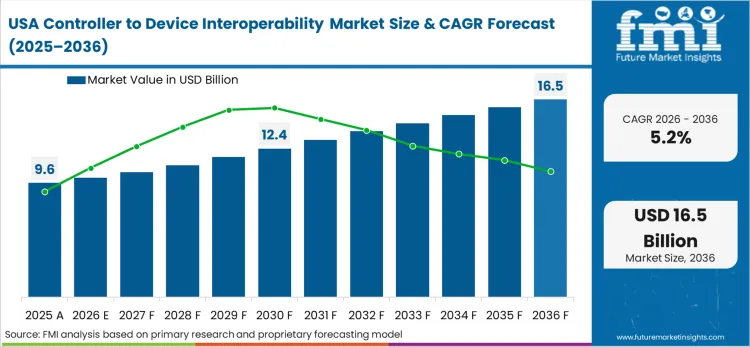
- United States: Strict federal mandates regarding domestic supply chain resilience force operators to deploy advanced predictive maintenance sensor grids across critical energy infrastructure, generating a 5.2% CAGR as corporations aggressively modernize legacy systems. The DOE announced USD 155 million to advance American industrial innovation in January 2026 [12]. Plant engineers must qualify and deploy compliant edge gateways linking proprietary legacy devices to secure cloud analytics platforms before the 2027 fiscal year to access state-level automation subsidization funds.
FMI's report includes deep-dive assessments of the North American market, detailing integration trends across Canada and Mexico. The cross-border integration of automotive supply chains forces Tier-2 parts suppliers in these regions to adopt standardized telemetry to maintain real-time inventory visibility with Detroit-based OEM assembly plants accurately.
Europe Controller to Device Interoperability Market Analysis
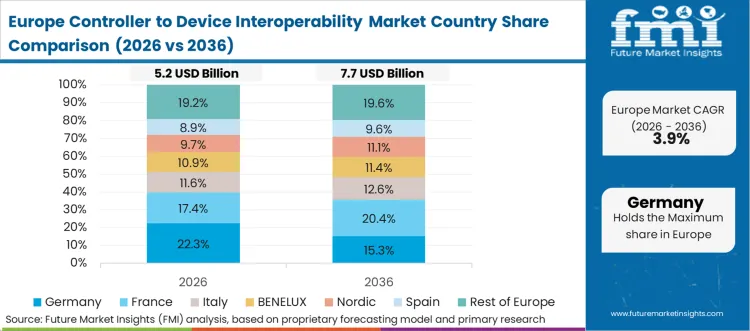
Europe functions as the primary technical proving ground for advanced IT/OT convergence, driven heavily by strict Industrie 4.0 interoperability guidelines. Plant administrators managing highly automated automotive and aerospace facilities require complex data modeling that legacy polling simply cannot accommodate. This structural shift reflects a broader opportunity: replacing isolated production silos with unified digital twins. FMI analysts opine that factory architects now view native topic-naming compliance not as a premium feature, but as a mandatory prerequisite for any equipment entering a European production facility. Integrating comprehensive fiber network latency sync test equipment guarantees network performance before facilities activate automated production lines.
- Germany: The dense concentration of premium automotive manufacturing requires seamless data exchange between thousands of independent robotic assembly cells, driving a 4.8% CAGR as original equipment manufacturers standardize their internal network architectures. CISA stated it released ten Industrial Control Systems advisories on September 30, 2025 [11]. Operations executives must establish unified namespace standards verified against rigorous cyber-physical security frameworks across all vendor contracts before transitioning to fully autonomous production lines.
- United Kingdom: Post-Brexit supply chain optimization mandates require logistics operators to establish real-time visibility across all warehouse automation assets, sustaining a 4.3% CAGR as operators systematically upgrade core routing infrastructure. An FBI/CISA/ACSC advisory states approximately 900 affected entities were exploited by Play ransomware actors as of May 2025 [10]. Supply chain directors lacking decoupled communication architectures face severe penalties from retail partners demanding granular tracking data while simultaneously securing systems against kinetic cyber-physical manipulation.
FMI's report includes detailed tracking of European protocol adoption, expanding coverage to France, Italy, and the Nordics. The rapid deployment of renewable energy microgrids across these nations necessitates decentralized state-management capabilities to balance dynamic load fluctuations efficiently.
Latin America Controller to Device Interoperability Market Analysis
Fluctuating commodity pricing and unstable trade dynamics force regional manufacturers to relentlessly optimize brownfield asset efficiency. Minimizing unplanned downtime dictates the rapid adoption of interoperable sensor grids capable of diagnosing mechanical degradation remotely. Extraction facilities prioritize high-volume, conventional processing over niche organic production to maintain competitive pricing. Affordability consistently outweighs specialized performance differentiation across the region. Facility administrators must route legacy equipment telemetry through standardized edge gateways, utilizing high-performance intent based networking ibn systems to translate disparate analog signals into actionable digital intelligence reliably.
- Brazil: As domestic conglomerates expand functional SKUs to protect margins, consistent meal supply helps stabilize retail pricing despite global export headwinds, securing a 6.0% CAGR through 2036. UNIDO’s MMTD method note states it compiles monthly trade data for 67 countries, covering 89.5% of world manufacturing exports and 86.3% of imports [8]. Operations directors mandate conventional interoperable gateways to ensure finished consumer goods meet rigid supermarket price ceilings without sacrificing production throughput metrics.
FMI's report includes detailed analysis of the Latin American processing sector, incorporating insights from Argentina and Chile. Vast farming networks supply regional extraction plants, forcing domestic processors to modernize mechanical isolation techniques to extract maximum functional value from every machine center deployed.
Competitive Aligners for Market Players
Market structure relies heavily on delivering comprehensive hardware portfolios spanning harsh industrial environments to climate-controlled data centers. Expanding hardware lines enables vendors to capture entire facility upgrade contracts rather than competing for isolated machine-level deployments. According to FMI's estimates, UNIDO reports industrial economies account for 87.7% of global manufacturing value added [7]. Hardware manufacturers must develop integrated software management platforms to simplify the deployment of massive switch networks capable of servicing this massive economic footprint. Facility planners utilizing highly managed ethernet switch arrays aggregate machine telemetry flawlessly.
Strategic partnerships dictate market access as IT networking giants collaborate with specialized industrial automation providers to bridge domain expertise gaps. Joint development initiatives produce pre-validated reference architectures that drastically reduce commissioning times for complex utility projects. NSF VINES Track 2 anticipates approximately 8–10 awards, each up to USD 6,000,000 [23]. System integrators must secure certification across both IT and OT vendor ecosystems to successfully bid on converged infrastructure mega-projects backed by these massive institutional funding rounds.
Silicon integration fundamentally alters competitive dynamics as microprocessor vendors embed deterministic switching logic directly into primary computing cores. Embedding networking capabilities eliminates the need for discrete switching chips, lowering bill-of-material costs for end-device manufacturers significantly. Embedded board designers must migrate to specialized factory floor edge ai industrial pcs to keep future automation products competitive on both price and performance. Edge processing units capable of routing critical traffic autonomously eradicate external switching dependencies.
Recent Developments
The report includes full coverage of key trends from competitive benchmarking. Some of the recent developments covered in the reports:
- In September 2025, Rockwell Automation published Logix controller OPC UA documentation to enable robust controller interoperability via firmware v36 natively. [14]
- In September 2025, Schneider Electric released EcoStruxure Automation Expert v25.0 to decouple hardware components from active application logic globally. [17]
- In December 2025, PTC announced Kepware Edge and Kepware Server as part of its Fall 2025 release to streamline enterprise IT/OT convergence architectures. [18]
Key Players in Controller to Device Interoperability Market
- Cisco Systems, Inc.
- Siemens AG
- Rockwell Automation, Inc.
- Schneider Electric SE
- ABB Ltd.
- Omron
- Huawei
Scope of the Report
| Metric | Value |
|---|---|
| Quantitative Units | USD 22.8 billion (2026) to USD 40.5 billion (2036), at a CAGR of 5.90% |
| Market Definition | Controller to Device Interoperability establishes standardized semantic data exchange architectures, permitting deterministic communication between programmable logic controllers and diverse field-level sensors across vendor-agnostic industrial networks. |
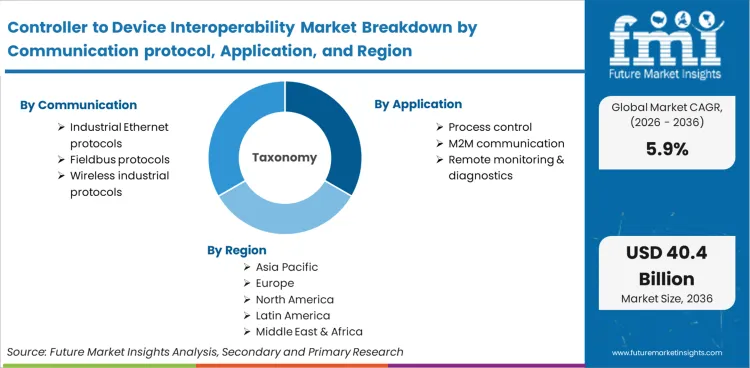
| Communication protocol Segmentation | Industrial Ethernet protocols, Fieldbus protocols, Wireless industrial protocols |
| Application Segmentation | Process control, M2M communication, Remote monitoring & diagnostics |
| Offering Segmentation | Hardware, Software, Services |
| Connectivity type Segmentation | Wired, Wireless |
| Regions Covered | North America, Latin America, Europe, East Asia, South Asia, Oceania, Middle East and Africa |
| Countries Covered | China, India, USA, Germany, Japan, UK, Brazil, and 40 plus countries |
| Key Companies Profiled | Cisco Systems, Inc., Siemens AG, Rockwell Automation, Inc., Schneider Electric SE, ABB Ltd., Omron, Huawei |
| Forecast Period | 2026 to 2036 |
| Approach | Bottom-up capacity modeling starting from regional factory automation build-out rates. |
Controller to Device Interoperability Market Analysis by Segments
Communication protocol:
- Industrial Ethernet protocols
- Fieldbus protocols
- Wireless industrial protocols
Application:
- Process control
- M2M communication
- Remote monitoring & diagnostics
Offering:
- Hardware
- Software
- Services
Connectivity type:
- Wired
- Wireless
Region:
- Asia Pacific
- India
- China
- Japan
- South Korea
- Indonesia
- Australia & New Zealand
- ASEAN
- Rest of Asia Pacific
- Europe
- Germany
- Italy
- France
- United Kingdom
- Spain
- Benelux
- Nordics
- Central & Eastern Europe
- Rest of Europe
- North America
- United States
- Canada
- Mexico
- Latin America
- Brazil
- Argentina
- Chile
- Rest of Latin America
- Middle East & Africa
- Kingdom of Saudi Arabia
- United Arab Emirates
- South Africa
- Turkey
- Rest of Middle East & Africa
Bibliography
- [1] FieldComm Group. (2025). Connecting world more 50 million HART devices field (Company news release).
- [2] FieldComm Group. (2025). Shaping future industrial automation instrumentation plant (Company news release).
- [3] ODVA. (2025, March 19). 2025 ODVA Conference Lodesky 5G CIP-Motion (Industry report).
- [4] OPC Foundation. (2025, March 10). The OPC Foundation elects three new members (Press release).
- [5] ISA. (2025). ISA annual report 2025 (Industry report).
- [6] NIST. (2025, September 30). NIST IR 8259r1 2pd guidance (Government report).
- [7] UNIDO Statistics. (2025). World manufacturing production 2025 Q1 (Government report).
- [8] UNIDO Statistics. (2025). MMTD method note (Government report).
- [9] UK NCSC. (2025, October 14). NCSC annual review 2025 incident management (Government report).
- [10] IC3. (2025, June 04). CSA 250604 joint advisory (Government report).
- [11] CISA. (2025, September 30). CISA releases ten industrial control systems advisories (Government report).
- [12] U.S. DOE. (2026, January 22). Energy department announces 155 million advance american innovation (Government report).
- [13] IFR. (2025). Executive summary WR 2025 industrial robots (Industry report).
- [14] Rockwell Automation. (2025, September). 1756-um023 firmware documentation (Product page).
- [15] Microsoft. (2025, November 14). Transforming industrial networking collaboration (Company news release).
- [16] Cisco. (2025, June 10). Cisco unveils secure network architecture (Press release).
- [17] Schneider Electric. (2025, September 15). EAE V25 0 software release (Product page).
- [18] PTC. (2025, December 02). PTC delivers Kepware Edge and Server (Press release).
- [19] Huawei. (2025, September 19). Global smart hotel market launch (Company news release).
- [20] Omron. (2025, February 21). Factory automation technology standards (Company news release).
- [21] FieldComm Group. (n.d.). Press release: Unified device integration roadmap solidified following FieldComm Group and FDT Group business combination.
- [22] UNCTAD. (2025, March 18). World investment report 2025 (Government report).
- [23] NSF. (2025, May 19). VINES verticals enabling intelligent network systems (Government report).
- [24] Belden. (2025). Hirschmann BOBCAT managed switches (Product page).
This bibliography is provided for reader reference and is not exhaustive. The full report contains the complete reference list and detailed citations.
This Report Addresses
- Market size estimation and revenue forecasts from 2026 to 2036, supported by validated capacity and protocol conversion benchmarks across major processing hubs.
- Growth opportunity mapping across hardware and software formats with emphasis on clean-data supply chain transitions optimizing capacity planning.
- Segment and regional revenue forecasts covering critical applications like process control and remote monitoring structuring investment allocation.
- Competition strategy assessment including integration models, cyber-physical positioning, and process capability benchmarking to evaluate market entry viability.
- Product compliance tracking covering key metrics such as latency synchronization and deterministic routing dictating recipe validation.
- Regulatory impact analysis evaluating strict infrastructure mandates, cyber defense protocols, and unified namespace guidelines dictating procurement compliance.
- Supply chain vulnerability assessment linking upstream component capacity directly to final functional gateway availability mitigating global basis-risk.
- Market report delivery in PDF, Excel, PPT, and interactive dashboard formats for executive and operational use.
Frequently Asked Questions
How large is the demand for Controller to Device Interoperability in the global market in 2026?
Demand for Controller to Device Interoperability in the global market is estimated to be valued at USD 22.8 billion in 2026.
What will be the market size of Controller to Device Interoperability in the global market by 2036?
Market size for Controller to Device Interoperability is projected to reach USD 40.5 billion by 2036.
What is the expected demand growth for Controller to Device Interoperability in the global market between 2026 and 2036?
Demand for Controller to Device Interoperability in the global market is expected to grow at a CAGR of 5.90% between 2026 and 2036.
Which Communication protocol is poised to lead global sales by 2026?
Industrial Ethernet protocols commands 47% of the volume in 2026 as manufacturers prioritize high bandwidth availability and cost parity natively.
How significant is the role of Process control in driving Controller to Device Interoperability adoption in 2026?
Process control represents 33% of segment share as brands replace isolated serial and proprietary fieldbus modules securely.
What is driving demand in China?
State-driven industrial upgrading initiatives and the immediate integration of fragmented supply chain data drive functional hardware adoption in China.
What compliance standards or regulations are referenced for China?
Strict multi-vendor ecosystems and provincial analytics frameworks directly influence domestic procurement behavior.
What is the China growth outlook in this report?
China is projected to grow at a CAGR of 7.2% during 2026 to 2036.
Why is North America described as a priority region in this report?
Federal critical infrastructure directives and strong government-backed funding accelerate commercial extraction capacity thoroughly.
What type of demand dominates in North America?
Cybersecurity-led substitution and predictive maintenance sensor integration dominate regional formulation demand.
What is India's growth outlook in this report?
India is projected to expand at a CAGR of 6.9% during 2026 to 2036.
Does the report cover United States in its regional analysis?
Yes, the United States is included within North America under the regional scope of analysis natively.
What are the sources referred to for analyzing United States?
Official funding awards from the DOE and corporate hardware release updates form the analytical basis.
What is the main demand theme linked to United States in its region coverage?
Strict federal defense infrastructure directives compelling energy and manufacturing operators to eliminate vulnerable legacy edge networks entirely.
Does the report cover Germany in its regional analysis?
Yes, Germany is included within Europe under the regional coverage framework entirely.
What is the main Germany related demand theme in its region coverage?
Dense concentration of premium automotive manufacturing requires seamless data exchange across multi-vendor robotic assembly cells.
Which product formats or configurations are strategically important for Europe supply chains?
Cyber-resilient gateways supporting decoupled protocol architectures hold immense strategic importance structurally.
What is Controller to Device Interoperability and what is it mainly used for?
It is a standardized data exchange architecture permitting deterministic communication between programmable logic controllers and diverse field-level sensors.
What does Controller to Device Interoperability mean in this report?
The market refers to the global deployment, software integration, and industrial usage of universal translation logic across network nodes.
What is included in the scope of this Controller to Device Interoperability report?
Scope includes managed edge gateways, embedded communication modules, protocol translation software stacks, and determinism-enhancing network switches.
What is excluded from the scope of this report?
Consumer-grade networking equipment lacking certified industrial deterministic features and standalone IT enterprise routers are strictly excluded.
What does market forecast mean on this page?
The market forecast represents a model-based projection built on defined industrial capacity and automation adoption assumptions for strategic planning purposes.
How does FMI build and validate the Controller to Device Interoperability forecast?
Forecasts combine bottom-up hardware shipments with certified automation component registries, validated by primary architect interviews securely.
What does zero reliance on speculative third party market research mean here?
Primary interviews, verified cybersecurity agency incident reports, and official standards organization datasets are used exclusively instead of unverified syndicated estimates.
Preview the report firsthand - request a free sample
Get SampleGet the brochure for pricing and purchase details.
Get PDFTable of Content
- Executive Summary
- Global Market Outlook
- Demand-side Trends
- Supply-side Trends
- Technology Roadmap Analysis
- Analysis and Recommendations
- Market Overview
- Market Coverage / Taxonomy
- Market Definition / Scope / Limitations
- Research Methodology
- Chapter Orientation
- Analytical Lens and Working Hypotheses
- Market Structure, Signals, and Trend Drivers
- Benchmarking and Cross-market Comparability
- Market Sizing, Forecasting, and Opportunity Mapping
- Research Design and Evidence Framework
- Desk Research Programme (Secondary Evidence)
- Company Annual and Sustainability Reports
- Peer-reviewed Journals and Academic Literature
- Corporate Websites, Product Literature, and Technical Notes
- Earnings Decks and Investor Briefings
- Statutory Filings and Regulatory Disclosures
- Technical White Papers and Standards Notes
- Trade Journals, Industry Magazines, and Analyst Briefs
- Conference Proceedings, Webinars, and Seminar Materials
- Government Statistics Portals and Public Data Releases
- Press Releases and Reputable Media Coverage
- Specialist Newsletters and Curated Briefings
- Sector Databases and Reference Repositories
- FMI Internal Proprietary Databases and Historical Market Datasets
- Subscription Datasets and Paid Sources
- Social Channels, Communities, and Digital Listening Inputs
- Additional Desk Sources
- Expert Input and Fieldwork (Primary Evidence)
- Primary Modes
- Qualitative Interviews and Expert Elicitation
- Quantitative Surveys and Structured Data Capture
- Blended Approach
- Why Primary Evidence is Used
- Field Techniques
- Interviews
- Surveys
- Focus Groups
- Observational and In-context Research
- Social and Community Interactions
- Stakeholder Universe Engaged
- C-suite Leaders
- Board Members
- Presidents and Vice Presidents
- R&D and Innovation Heads
- Technical Specialists
- Domain Subject-matter Experts
- Scientists
- Physicians and Other Healthcare Professionals
- Governance, Ethics, and Data Stewardship
- Research Ethics
- Data Integrity and Handling
- Primary Modes
- Tooling, Models, and Reference Databases
- Desk Research Programme (Secondary Evidence)
- Data Engineering and Model Build
- Data Acquisition and Ingestion
- Cleaning, Normalisation, and Verification
- Synthesis, Triangulation, and Analysis
- Quality Assurance and Audit Trail
- Market Background
- Market Dynamics
- Drivers
- Restraints
- Opportunity
- Trends
- Scenario Forecast
- Demand in Optimistic Scenario
- Demand in Likely Scenario
- Demand in Conservative Scenario
- Opportunity Map Analysis
- Product Life Cycle Analysis
- Supply Chain Analysis
- Investment Feasibility Matrix
- Value Chain Analysis
- PESTLE and Porter’s Analysis
- Regulatory Landscape
- Regional Parent Market Outlook
- Production and Consumption Statistics
- Import and Export Statistics
- Market Dynamics
- Global Market Analysis 2021 to 2025 and Forecast, 2026 to 2036
- Historical Market Size Value (USD Million) Analysis, 2021 to 2025
- Current and Future Market Size Value (USD Million) Projections, 2026 to 2036
- Y-o-Y Growth Trend Analysis
- Absolute $ Opportunity Analysis
- Global Market Pricing Analysis 2021 to 2025 and Forecast 2026 to 2036
- Global Market Analysis 2021 to 2025 and Forecast 2026 to 2036, By Communication protocol
- Introduction / Key Findings
- Historical Market Size Value (USD Million) Analysis By Communication protocol , 2021 to 2025
- Current and Future Market Size Value (USD Million) Analysis and Forecast By Communication protocol , 2026 to 2036
- Industrial Ethernet protocols
- Fieldbus protocols
- Wireless industrial protocols
- Industrial Ethernet protocols
- Y-o-Y Growth Trend Analysis By Communication protocol , 2021 to 2025
- Absolute $ Opportunity Analysis By Communication protocol , 2026 to 2036
- Global Market Analysis 2021 to 2025 and Forecast 2026 to 2036, By Application
- Introduction / Key Findings
- Historical Market Size Value (USD Million) Analysis By Application, 2021 to 2025
- Current and Future Market Size Value (USD Million) Analysis and Forecast By Application, 2026 to 2036
- Process control
- M2M communication
- Remote monitoring & diagnostics
- Process control
- Y-o-Y Growth Trend Analysis By Application, 2021 to 2025
- Absolute $ Opportunity Analysis By Application, 2026 to 2036
- Global Market Analysis 2021 to 2025 and Forecast 2026 to 2036, By Offering
- Introduction / Key Findings
- Historical Market Size Value (USD Million) Analysis By Offering, 2021 to 2025
- Current and Future Market Size Value (USD Million) Analysis and Forecast By Offering, 2026 to 2036
- Hardware
- Software
- Services
- Hardware
- Y-o-Y Growth Trend Analysis By Offering, 2021 to 2025
- Absolute $ Opportunity Analysis By Offering, 2026 to 2036
- Global Market Analysis 2021 to 2025 and Forecast 2026 to 2036, By Connectivity type
- Introduction / Key Findings
- Historical Market Size Value (USD Million) Analysis By Connectivity type, 2021 to 2025
- Current and Future Market Size Value (USD Million) Analysis and Forecast By Connectivity type, 2026 to 2036
- Wired
- Wireless
- Wired
- Y-o-Y Growth Trend Analysis By Connectivity type, 2021 to 2025
- Absolute $ Opportunity Analysis By Connectivity type, 2026 to 2036
- Global Market Analysis 2021 to 2025 and Forecast 2026 to 2036, By Region
- Introduction
- Historical Market Size Value (USD Million) Analysis By Region, 2021 to 2025
- Current Market Size Value (USD Million) Analysis and Forecast By Region, 2026 to 2036
- North America
- Latin America
- Western Europe
- Eastern Europe
- East Asia
- South Asia and Pacific
- Middle East & Africa
- Market Attractiveness Analysis By Region
- North America Market Analysis 2021 to 2025 and Forecast 2026 to 2036, By Country
- Historical Market Size Value (USD Million) Trend Analysis By Market Taxonomy, 2021 to 2025
- Market Size Value (USD Million) Forecast By Market Taxonomy, 2026 to 2036
- By Country
- USA
- Canada
- Mexico
- By Communication protocol
- By Application
- By Offering
- By Connectivity type
- By Country
- Market Attractiveness Analysis
- By Country
- By Communication protocol
- By Application
- By Offering
- By Connectivity type
- Key Takeaways
- Latin America Market Analysis 2021 to 2025 and Forecast 2026 to 2036, By Country
- Historical Market Size Value (USD Million) Trend Analysis By Market Taxonomy, 2021 to 2025
- Market Size Value (USD Million) Forecast By Market Taxonomy, 2026 to 2036
- By Country
- Brazil
- Chile
- Rest of Latin America
- By Communication protocol
- By Application
- By Offering
- By Connectivity type
- By Country
- Market Attractiveness Analysis
- By Country
- By Communication protocol
- By Application
- By Offering
- By Connectivity type
- Key Takeaways
- Western Europe Market Analysis 2021 to 2025 and Forecast 2026 to 2036, By Country
- Historical Market Size Value (USD Million) Trend Analysis By Market Taxonomy, 2021 to 2025
- Market Size Value (USD Million) Forecast By Market Taxonomy, 2026 to 2036
- By Country
- Germany
- UK
- Italy
- Spain
- France
- Nordic
- BENELUX
- Rest of Western Europe
- By Communication protocol
- By Application
- By Offering
- By Connectivity type
- By Country
- Market Attractiveness Analysis
- By Country
- By Communication protocol
- By Application
- By Offering
- By Connectivity type
- Key Takeaways
- Eastern Europe Market Analysis 2021 to 2025 and Forecast 2026 to 2036, By Country
- Historical Market Size Value (USD Million) Trend Analysis By Market Taxonomy, 2021 to 2025
- Market Size Value (USD Million) Forecast By Market Taxonomy, 2026 to 2036
- By Country
- Russia
- Poland
- Hungary
- Balkan & Baltic
- Rest of Eastern Europe
- By Communication protocol
- By Application
- By Offering
- By Connectivity type
- By Country
- Market Attractiveness Analysis
- By Country
- By Communication protocol
- By Application
- By Offering
- By Connectivity type
- Key Takeaways
- East Asia Market Analysis 2021 to 2025 and Forecast 2026 to 2036, By Country
- Historical Market Size Value (USD Million) Trend Analysis By Market Taxonomy, 2021 to 2025
- Market Size Value (USD Million) Forecast By Market Taxonomy, 2026 to 2036
- By Country
- China
- Japan
- South Korea
- By Communication protocol
- By Application
- By Offering
- By Connectivity type
- By Country
- Market Attractiveness Analysis
- By Country
- By Communication protocol
- By Application
- By Offering
- By Connectivity type
- Key Takeaways
- South Asia and Pacific Market Analysis 2021 to 2025 and Forecast 2026 to 2036, By Country
- Historical Market Size Value (USD Million) Trend Analysis By Market Taxonomy, 2021 to 2025
- Market Size Value (USD Million) Forecast By Market Taxonomy, 2026 to 2036
- By Country
- India
- ASEAN
- Australia & New Zealand
- Rest of South Asia and Pacific
- By Communication protocol
- By Application
- By Offering
- By Connectivity type
- By Country
- Market Attractiveness Analysis
- By Country
- By Communication protocol
- By Application
- By Offering
- By Connectivity type
- Key Takeaways
- Middle East & Africa Market Analysis 2021 to 2025 and Forecast 2026 to 2036, By Country
- Historical Market Size Value (USD Million) Trend Analysis By Market Taxonomy, 2021 to 2025
- Market Size Value (USD Million) Forecast By Market Taxonomy, 2026 to 2036
- By Country
- Kingdom of Saudi Arabia
- Other GCC Countries
- Turkiye
- South Africa
- Other African Union
- Rest of Middle East & Africa
- By Communication protocol
- By Application
- By Offering
- By Connectivity type
- By Country
- Market Attractiveness Analysis
- By Country
- By Communication protocol
- By Application
- By Offering
- By Connectivity type
- Key Takeaways
- Key Countries Market Analysis
- USA
- Pricing Analysis
- Market Share Analysis, 2025
- By Communication protocol
- By Application
- By Offering
- By Connectivity type
- Canada
- Pricing Analysis
- Market Share Analysis, 2025
- By Communication protocol
- By Application
- By Offering
- By Connectivity type
- Mexico
- Pricing Analysis
- Market Share Analysis, 2025
- By Communication protocol
- By Application
- By Offering
- By Connectivity type
- Brazil
- Pricing Analysis
- Market Share Analysis, 2025
- By Communication protocol
- By Application
- By Offering
- By Connectivity type
- Chile
- Pricing Analysis
- Market Share Analysis, 2025
- By Communication protocol
- By Application
- By Offering
- By Connectivity type
- Germany
- Pricing Analysis
- Market Share Analysis, 2025
- By Communication protocol
- By Application
- By Offering
- By Connectivity type
- UK
- Pricing Analysis
- Market Share Analysis, 2025
- By Communication protocol
- By Application
- By Offering
- By Connectivity type
- Italy
- Pricing Analysis
- Market Share Analysis, 2025
- By Communication protocol
- By Application
- By Offering
- By Connectivity type
- Spain
- Pricing Analysis
- Market Share Analysis, 2025
- By Communication protocol
- By Application
- By Offering
- By Connectivity type
- France
- Pricing Analysis
- Market Share Analysis, 2025
- By Communication protocol
- By Application
- By Offering
- By Connectivity type
- India
- Pricing Analysis
- Market Share Analysis, 2025
- By Communication protocol
- By Application
- By Offering
- By Connectivity type
- ASEAN
- Pricing Analysis
- Market Share Analysis, 2025
- By Communication protocol
- By Application
- By Offering
- By Connectivity type
- Australia & New Zealand
- Pricing Analysis
- Market Share Analysis, 2025
- By Communication protocol
- By Application
- By Offering
- By Connectivity type
- China
- Pricing Analysis
- Market Share Analysis, 2025
- By Communication protocol
- By Application
- By Offering
- By Connectivity type
- Japan
- Pricing Analysis
- Market Share Analysis, 2025
- By Communication protocol
- By Application
- By Offering
- By Connectivity type
- South Korea
- Pricing Analysis
- Market Share Analysis, 2025
- By Communication protocol
- By Application
- By Offering
- By Connectivity type
- Russia
- Pricing Analysis
- Market Share Analysis, 2025
- By Communication protocol
- By Application
- By Offering
- By Connectivity type
- Poland
- Pricing Analysis
- Market Share Analysis, 2025
- By Communication protocol
- By Application
- By Offering
- By Connectivity type
- Hungary
- Pricing Analysis
- Market Share Analysis, 2025
- By Communication protocol
- By Application
- By Offering
- By Connectivity type
- Kingdom of Saudi Arabia
- Pricing Analysis
- Market Share Analysis, 2025
- By Communication protocol
- By Application
- By Offering
- By Connectivity type
- Turkiye
- Pricing Analysis
- Market Share Analysis, 2025
- By Communication protocol
- By Application
- By Offering
- By Connectivity type
- South Africa
- Pricing Analysis
- Market Share Analysis, 2025
- By Communication protocol
- By Application
- By Offering
- By Connectivity type
- USA
- Market Structure Analysis
- Competition Dashboard
- Competition Benchmarking
- Market Share Analysis of Top Players
- By Regional
- By Communication protocol
- By Application
- By Offering
- By Connectivity type
- Competition Analysis
- Competition Deep Dive
- Cisco Systems, Inc.
- Overview
- Product Portfolio
- Profitability by Market Segments (Product/Age /Sales Channel/Region)
- Sales Footprint
- Strategy Overview
- Marketing Strategy
- Product Strategy
- Channel Strategy
- Siemens AG
- Rockwell Automation, Inc.
- Schneider Electric SE
- ABB Ltd.
- Omron
- Huawei
- Cisco Systems, Inc.
- Competition Deep Dive
- Assumptions & Acronyms Used


