

- Industry Size (2026)
- USD 13.12 Bn
- Forecast (2036)
- USD 65.9 Bn
- CAGR (2026 to 2036)
- 17.48%
Autonomous Process Orchestration Market Size, Market Forecast and Outlook By FMI
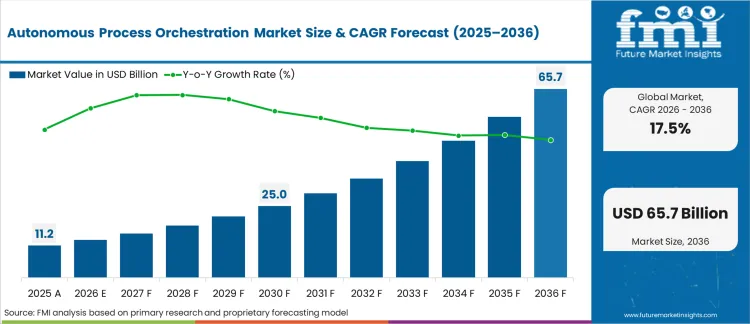
In 2025, the autonomous process orchestration market surpassed a value of USD 11.17 billion, is projected at USD 13.12 billion in 2026 and USD 65.9 billion by 2036, implying a 17.48% CAGR, with momentum tied to enterprise-wide data interoperability and automation mandates. Legacy task automation is giving way to agentic networks capable of cross-system decision-making. Buyers across IT, telecommunications, and finance are standardizing platform-based orchestration to collapse complex workflows into unified operational control layers.
Tier-1 buyers must immediately audit their existing data architectures and standardize scalable orchestration platforms or face mounting integration debt as fragmented automation silos fail to communicate. Suppliers lacking embedded observability and security gating risk exclusion from imminent procurement shortlists.
Summary of Autonomous Process Orchestration Market
- Autonomous Process Orchestration Market Definition
- An advanced enterprise software architecture that coordinates, executes, and monitors complex business workflows natively across multiple systems using AI-driven agents and microservices without requiring continuous human intervention.
- Demand Drivers in the Market
- Mounting integration complexity forces IT departments to deploy unified control planes to manage decentralized microservices.
- Enterprise shift toward agentic AI requires centralized orchestration to maintain security and operational continuity.
- Persistent technical skills gaps compel organizations to automate intricate infrastructure deployment and maintenance tasks.
- Key Segments Analyzed in the FMI Report
- Software/Platform: 70% share driven by enterprise preference for integrated, end-to-end automation control towers over piecemeal tools.
- IT & Telecom: 44.00% share anchored by the urgent need to automate network provisioning and resolve infrastructure incidents autonomously.
- India: Expanding rapidly due to mass localization of business process management hubs requiring advanced cross-system orchestration.
- Analyst Opinion at FMI
- Nikhil Kaitwade, Principal Consultant for Industrial Automation, opines, “Procurement teams are shifting focus from standalone automation tools to total system orchestration. Enterprises that secure supply agreements with vertically integrated platform providers avoid the severe operational bottlenecks currently penalizing operators reliant on fragmented, siloed automation scripts.”
- Strategic Implications / Executive Takeaways
- Consolidate point-solution automation contracts into unified orchestration platforms to reduce technical debt and compliance risks.
- Mandate embedded observability and security gating in all new orchestration vendor RFPs before the 2027 upgrade cycle.
- Prioritize vendor ecosystems that offer seamless bidirectional interoperability with existing enterprise resource planning systems.
- Methodology
- Primary Research: Direct interviews with enterprise IT architects, software platform managers, and automation consultants across major technology hubs.
- Desk Research: Custom corporate capacity announcements, official government cyber threat databases, and patent filings substantiating platform integrations.
- Market-Sizing and Forecasting: Analysts developed a bottom-up adoption model starting from regional enterprise IT spend, projecting scalable orchestration deployment.
- Data Validation and Update Cycle: Findings underwent cross-verification against verified peer-reviewed technical journals before final forecast integration.
Graham Sheldon, Chief Product Officer at UiPath, opined, “AI adoption is on the rise, but tangible benefits are elusive due to lack of clear business ROI, disconnected processes, tools, data, and now also AI agent sprawl. AI transformation leaders have told us they want more AI or more tools, they want one AI platform to manage it all. We’re meeting the demand of modern AI transformation, helping enterprises of all sizes and technical expertise achieve greater agility, responsiveness, and efficiency in their operations, and accelerating ROI from their agentic AI investment.” [2] This architectural pivot establishes agentic orchestration as the mandatory connective tissue for enterprise operations. Procurement directors managing service orchestration upgrades must immediately mandate bidirectional integration capabilities in upcoming vendor contracts.
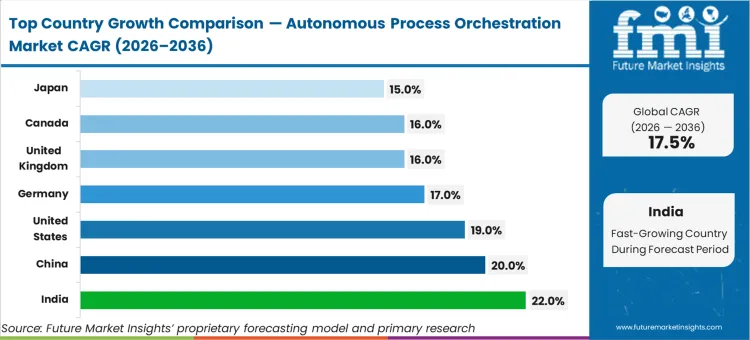
India’s 22% CAGR reflects its dominant role as a global IT and business process outsourcing hub aggressively transitioning from manual processing to autonomous agent deployment. China (20%) and the United States (19%) follow closely, propelled by massive domestic enterprise modernization initiatives and the need to manage spiraling multi-cloud complexity. Germany (17%) and the UK (16%) are heavily driven by industrial and financial compliance mandates, while Canada (16%) and Japan (15%) prioritize automation to offset acute demographic labor shortages across critical infrastructure operations.
Autonomous Process Orchestration Market Definition
The Autonomous Process Orchestration Market encompasses advanced software platforms and integrated services designed to coordinate, automate, and manage complex, multi-step business and IT workflows across disparate systems. It leverages AI, microservices, and event-driven architectures to execute processes with minimal human intervention. A defining example is an AI-driven platform automatically detecting a network failure, provisioning cloud resources, and rerouting traffic seamlessly based on predefined intent policies.
Autonomous Process Orchestration Market Inclusions
The category includes software platforms, cloud-based orchestration systems, API management layers, and associated professional services aimed at business process management and IT automation. It covers solutions deployed across enterprise data centers and multi-cloud environments, including AI-agent orchestration frameworks. For instance, a hybrid cloud environment utilizing microservices to automatically scale e-commerce transaction processing during peak loads is strictly included.
Autonomous Process Orchestration Market Exclusions
The scope excludes basic, single-task robotic process automation (RPA) tools that lack cross-system coordination capabilities. It does not cover raw hardware infrastructure, standalone data storage arrays, or generalized consumer-grade productivity applications. A standalone script designed to merely copy data from one local spreadsheet to another, lacking conditional logic or multi-system interoperability, is strictly excluded from this market boundary.
Autonomous Process Orchestration Market Research Methodology
- Primary Research: Direct interviews with enterprise CIOs, platform architects, and systems integrators provided baseline capacity utilization and software licensing metrics across key geographic markets.
- Desk Research: Custom procurement datasets, corporate acquisition announcements, and verified government cybersecurity logs substantiated regional technology adoption models.
- Market-Sizing and Forecasting: Analysts developed a bottom-up adoption model starting from regional enterprise IT and cloud infrastructure spend, applying historical orchestration deployment ratios to project future platform uptake.
- Data Validation and Update Cycle: Findings underwent cross-verification against official corporate earnings transcripts and verified industry software deployment benchmarks before final integration.
Segmental Analysis
Autonomous Process Orchestration Market Analysis by Component
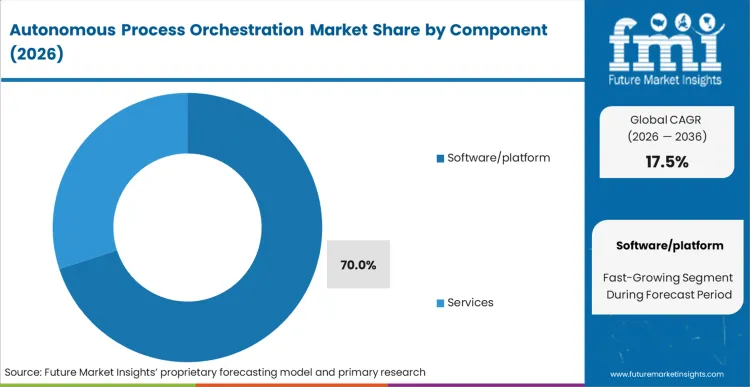
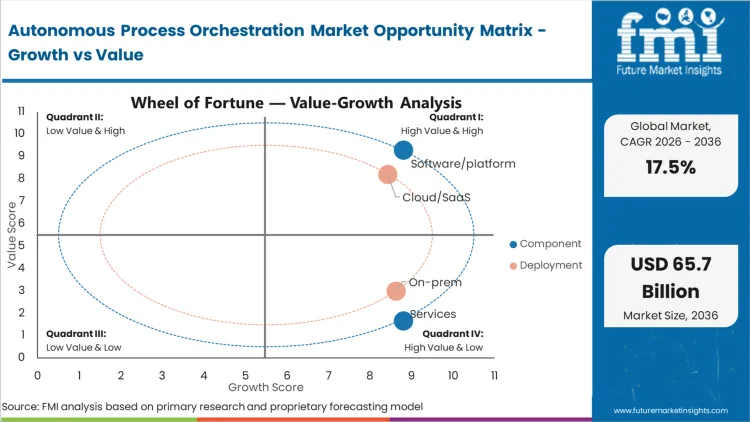
Software/platform solutions capture 70% of the 2026 component share as enterprise IT directors systematically replace fragmented automation scripts with unified, AI-driven control towers. Organizations operating distributed architectures are outsourcing integration complexity directly to these centralized platforms to secure operational continuity across hybrid environments. As workflow management software evolves into fully autonomous agents, enterprise buyers must secure comprehensive platform licenses to avoid integration bottlenecks that stall digital transformation initiatives.
- Technical Validation: Embedded AI software natively bridges disparate legacy systems, eliminating the requirement for manual API recoding during enterprise migrations.
- Product Innovation: Platform vendors aggressively absorb adjacent monitoring and observability tools into their core software offerings to deliver end-to-end operational visibility.
- Procurement Shifts: Comprehensive software suites present a predictable total cost of ownership, displacing sprawling custom integration contracts that carry high maintenance overhead.
Autonomous Process Orchestration Market Analysis by Deployment
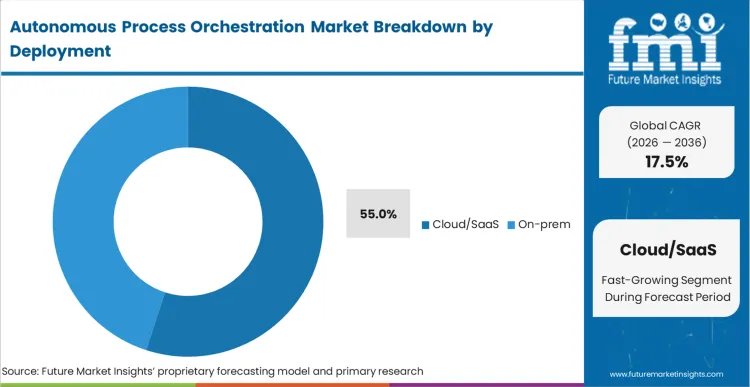
Cloud/SaaS architectures secure 55% of deployment volume as organizations prioritize remote scalability and continuous feature updates over localized infrastructure control. FMI analysts observe that workflow-as-a-service models allow systems engineering teams to rapidly prototype complex autonomous agents without authorizing heavy initial capital expenditure. All on-premise deployments face a widening functional deficit as computationally intense, large language model-driven orchestration capabilities remain strictly cloud-exclusive.
- Process Compatibility: Cloud-native orchestration engines seamlessly synchronize multi-vendor SaaS ecosystems, eliminating the latency inherent in hybrid data transfers.
- Cost Structures: Infrastructure maintenance expenses compound exponentially when enterprises attempt to host localized machine learning models for on-premise workflow coordination.
- Supplier Positioning: SaaS providers establish deep competitive moats by converting unpredictable consulting revenues into highly stable, subscription-based deployment architectures.
Autonomous Process Orchestration Market Analysis by Technology
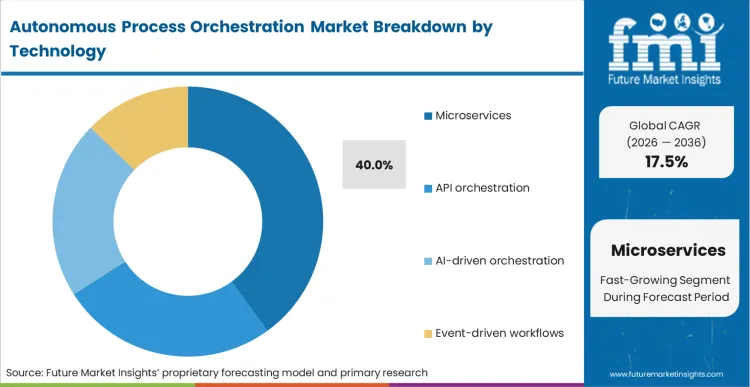
Microservices command 40% of the technology segment, driven by the structural necessity for software engineering teams to decouple monolithic applications into independently orchestratable components. FMI analysts opine that microservices orchestration forms the absolute bedrock for agile enterprise operations facing continuous deployment cycles. Procurement teams specifying legacy monolithic architectures cannot leverage dynamic resource allocation, leaving their infrastructure highly vulnerable to cascading system failures.
- Logistics Advantage: Containerized microservices permit localized code updates and patch deployments without disrupting overarching system stability or requiring global downtime.
- Adoption Acceleration: API-first design principles dominate internal software engineering cultures, forcing the adoption of orchestration tools built explicitly for service mesh environments.
- Volume Concentration: Enterprise capital flows exclusively toward technology platforms capable of natively managing hyper-scaled, concurrent microservice interactions across distributed clusters.
Autonomous Process Orchestration Market Analysis by Business Function
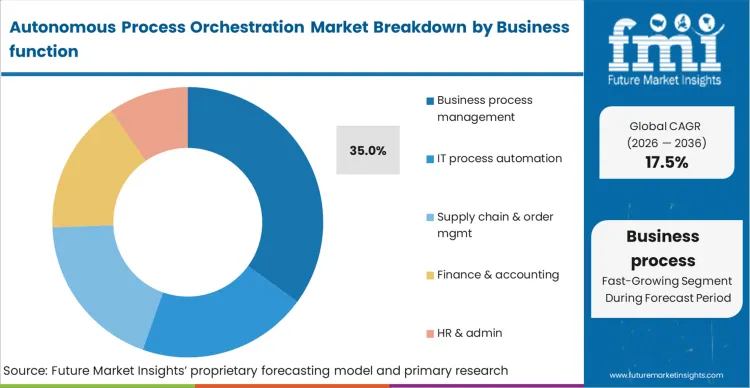
Business process management represents 35% of the functional segment as operations leaders automate historically labor-intensive administrative and compliance workflows. Robotic process automation is fundamentally upgrading into autonomous process coordination, shifting the focus from simple task execution to complex, multi-step decision making. Departments lacking these interconnected capabilities experience severe productivity lags, unable to scale operations without proportional headcount increases.
- Regulatory Auditability: Strictly regulated industries mandate orchestrated workflows to execute flawless, cryptographically verifiable audit trails and enforce data governance protocols.
- Requalification Cycles: Enterprise software evaluation cycles lengthen as platforms embed deeper, cross-departmental business logic directly into their autonomous orchestration engines.
- Supplier Positioning: Vendors capture higher contract values by moving beyond isolated task automation into strategic, enterprise-wide business execution frameworks.
Autonomous Process Orchestration Market Drivers, Restraints, and Opportunities
Labor shortfalls across advanced technical sectors force IT operations leaders to substitute manual system administration with autonomous orchestration. The buyers who fail to transition to advanced Business Process Automation platforms before the end of the current hardware lifecycle encounter unmanageable technical debt. Infrastructure teams increasingly utilize these autonomous agents to auto-remediate network anomalies and execute compliance patching without human intervention.
Deep technical skills gaps fundamentally restrict the rapid scaling of sophisticated multi-cloud orchestration deployments. Vendors must simplify user interfaces and introduce no-code/low-code policy orchestration environments to bypass this severe capability barrier. Orchestration providers failing to abstract this underlying infrastructure complexity concede critical market share to competitors offering pre-configured, domain-specific automation templates.
- Observability Integration: Platform providers bundle data observability natively within their orchestration suites to capture premium enterprise contracts. Snowflake announced its intent to acquire Observe in January 2026 to deliver AI-powered observability [8].
- Agentic Expansion: Expanding agentic capabilities into highly regulated financial and healthcare sectors provides a massive growth vector for specialized orchestration vendors offering verifiable decision logic.
- Industrial IT/OT Convergence: Manufacturing environments require dedicated maintenance orchestration to bridge operational technology networks with IT analytics, minimizing costly operational downtime.
Regional Analysis
Based on the regional analysis, the Autonomous Process Orchestration market is segmented into North America, Latin America, Europe, East Asia, South Asia, Oceania and Middle East & Africa across 40+ countries. The full report also offers market attractiveness analysis based on regional trends.
.webp "Top Country Growth Comparison Autonomous Process Orchestration Market Cagr (2026 2036)")
| Country | CAGR (2026 to 2036) |
|---|---|
| India | 22.0% |
| China | 20.0% |
| United States | 19.0% |
| Germany | 17.0% |
| United Kingdom | 16.0% |
| Canada | 16.0% |
| Japan | 15.0% |
Source: Future Market Insights (FMI) analysis, based on proprietary forecasting model and primary research
Asia Pacific Autonomous Process Orchestration Market Analysis
Asia Pacific's commercialization pace is entirely determined by how rapidly regional enterprises can transition massive manual operational hubs into autonomous, agent-driven networks. Instead of relying purely on labor arbitrage, organizations are upgrading their core infrastructures to execute security orchestration automation and response (SOAR) autonomously. The IEA projects data centre electricity consumption will reach approximately 945 TWh by 2030 [5], a structural compute constraint that forces operators to optimize processing via intelligent orchestration. FMI analysts opine that platform localization shields regional processors from currency swings while establishing the foundation for the region's massive digital transformation mandates. Procurement teams failing to deploy autonomous orchestration will be structurally unable to manage the compounding complexity of their expanding multi-cloud operations.
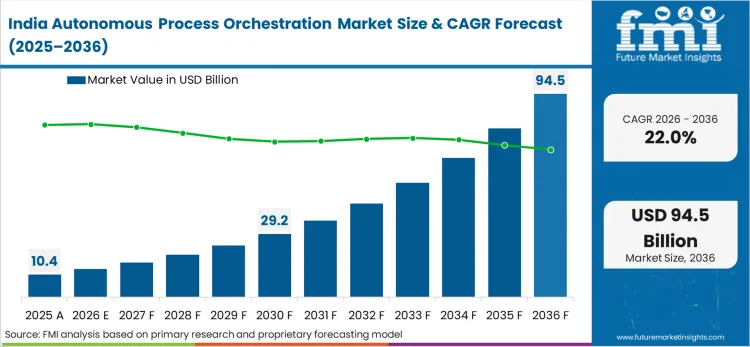
- India: Massive domestic IT and BPO sectors are rapidly localizing intelligent orchestration to maintain global service competitiveness and margins. The WEF reports that 86% of employers expect AI and information processing to be transformative by 2030 [3], a sentiment driving India's 22.0% CAGR through 2036. Service providers must immediately qualify for orchestration vendors that can support massive concurrent API calls to remain on Tier-1 global procurement lists.
- China: State-backed mandates targeting industrial automation establish a massive, captive market for sophisticated process orchestration systems, pushing the market in China to forecast a CAGR of 20.0% through 2036. The ILO reports that 1 in 4 jobs worldwide is potentially exposed to GenAI transformation [6]. Manufacturers operating in China must integrate autonomous IT and supply chain coordination platforms to navigate tightening workforce availability parameters.
- Japan: An aging workforce forces Japanese infrastructure and administrative sectors to adopt comprehensive process automation to sustain baseline operations, driving a projected CAGR of 15.0% through 2036. The Singapore Police reported cybercrime and scam losses fell by nearly USD200 million in 2025 due to enhanced security interventions [14], highlighting the necessity of integrated, automated threat response. Japanese buyers must deploy event-driven orchestration to offset severe personnel shortfalls across critical incident management teams.
FMI's report includes comprehensive tracking of the Asia Pacific ecosystem, connecting IT infrastructure investments to finished platform capacity. Across South Korea, Indonesia, and Australia, growth concentrates where localization aligns with lead-time reduction, prompting buyers to secure robust deployments for domestic digital integration initiatives.
North America Autonomous Process Orchestration Market Analysis
North America's enterprise ecosystem operates as the primary proving ground for advanced, agentic AI integration and multi-cloud orchestration frameworks. Rebounding IT budgets align perfectly with massive downstream investments in interoperability standards and cross-platform automation. Regional buyers prioritize solutions capable of seamless clinical workflow solutions and strict regulatory data handling. As software estates become overwhelmingly complex, orchestration platforms are no longer optional enhancements; they are the foundational control planes required to manage distributed enterprise data securely. Organizations operating without these unified control layers face unmanageable operational sprawl.
- United States: Demand for autonomous orchestration in the United States is estimated to expand at a CAGR of 19.0% through 2036. Unprecedented multi-cloud complexity and intense cybersecurity pressures force USA enterprises to standardize on integrated orchestration platforms. Microsoft published its Power Automate 2025 wave 1 plan covering extensive roadmap expansions [7]. Procurement directors must consolidate fragmented point-solutions into these comprehensive, hyperscaler-backed orchestration ecosystems before the 2027 enterprise renewal cycle.
- Canada: Expanding public sector digitization and stringent domestic data sovereignty rules dictate strict compliance-driven orchestration deployments, pushing the market in Canada to a projected CAGR of 16.0% through 2036. Canadian buyers must specify localized cloud orchestration capabilities to maintain compliance while automating critical administrative workflows.
FMI's report includes full coverage of the North American processing landscape, connecting public cloud availability to enterprise automation capabilities. Mexico operates as an integrated supply node, enabling cross-border IT service movement and processing optimization tailored for nearshored operational hubs.
Europe Autonomous Process Orchestration Market Analysis
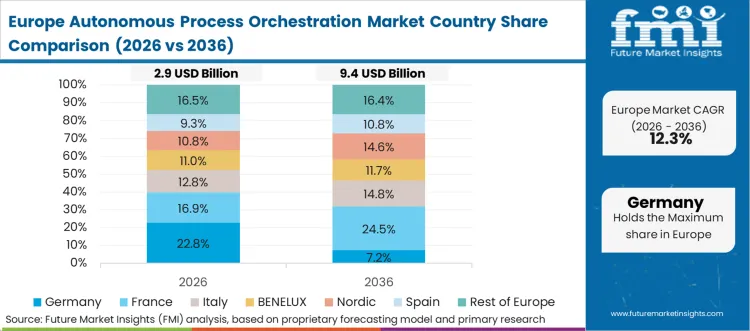
Europe's strict regulatory environment, characterized by GDPR and incoming AI legislation, strictly dictates how autonomous processes can handle enterprise data. Regulatory scrutiny compels manufacturers to source secure, compliant orchestration platforms that provide flawless audit trails and data lineage tracking. UK Government research from the DUPS wave 2 reports that approximately 83% of UK businesses now handle some form of digital data [4]. This massive data footprint requires professional services automation software to manage compliance and operational efficiency simultaneously. Vendors lacking native regulatory reporting capabilities will be systematically disqualified from European enterprise tenders.
- Germany: Germany’s autonomous process orchestration industry is expected to demonstrate a CAGR of 17.0% through 2036. Deep-rooted industrial automation and Industry 4.0 mandates require German manufacturers to orchestrate highly complex IT and OT environments. Siemens expanded its Engineering Copilot TIA beta in November 2025 [12], proving that industrial players are actively embedding autonomous assistance directly into production networks. Suppliers must prove seamless integration with legacy industrial protocols to secure contracts within Germany's massive manufacturing sector.
- United Kingdom: High service-sector density and severe technical skills shortages drive the aggressive adoption of autonomous process management tools. The UK AI Labour Market Survey 2025 reports that 97% of businesses identified at least one AI skills gap [11]. The autonomous process of orchestration space in the UK is forecast to observe a CAGR of 16.0% during the assessment period. British financial and legal enterprises must deploy low-code orchestration platforms to bypass specialized programming bottlenecks and maintain operational velocity.
FMI's report includes comprehensive tracking of the European regulatory ecosystem, connecting compliance mandates to finished orchestration capacity. Across France, Italy, and the Nordics, growth concentrates where localization aligns with strict data governance rules, prompting buyers to secure reliable platforms for their United States business process as a service and local operations.
Competitive Aligners for Market Players
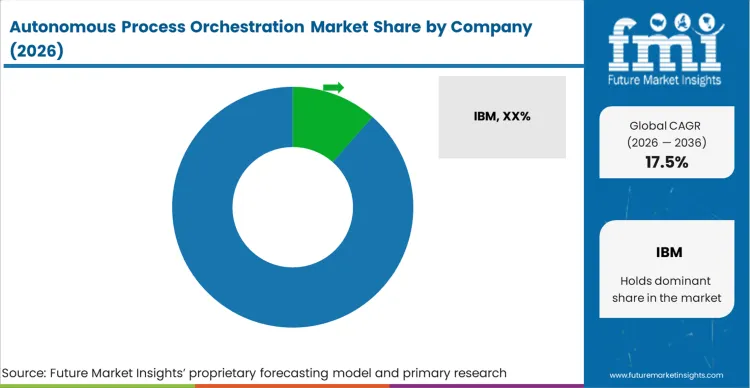
Strategic partnerships and ecosystem integrations completely define vendor viability within the autonomous orchestration landscape. SAP and Microsoft announced bidirectional integration between Joule and Microsoft 365 Copilot for early 2026 [9], seamlessly merging ERP logic with mainstream productivity environments. Buyers must evaluate orchestration vendors based entirely on their pre-built connector libraries and native interoperability with hyperscaler infrastructures to prevent integration delays.
Technological capability differentiates premium platforms from basic scripting utilities as vendors embed advanced AI directly into the orchestration layer. ServiceNow unveiled its new AI Platform designed to put "Any AI, Any Agent, Any Model" to work across the enterprise in May 2025 [1]. As virtual power plant (VPP) and v2g orchestration and broader cross-system agentic coordination becomes the baseline expectation, suppliers without native multi-model support face immediate disqualification.
Incumbency strengthens where platforms can guarantee absolute security and resilience during complex, automated IT interventions. CISA released 10 ICS advisories on a single day in August 2025 [13], illustrating the severe vulnerability landscape surrounding automated industrial control systems. Platform providers must bundle advanced data observability and zero-trust security natively within their orchestration suites to secure mission-critical enterprise deployments.
Recent Developments
The report includes full coverage of key trends from competitive benchmarking. Some of the recent developments covered in the reports:
- In March 2025, PTC previewed its Windchill AI PLM assistant, embedding intelligent automation directly into product lifecycle management workflows. [16]
- In May 2025, Databricks announced its intent to acquire Neon to aggressively expand its capabilities in supporting AI agents and AI-native systems. [10]
- In March 2025, ABB launched a generative AI maintenance assistant designed specifically to automate and simplify industrial device support workflows. [15]
Key Players in Autonomous Process Orchestration Market
- IBM
- Microsoft
- Oracle
- SAP
- ServiceNow
- Pegasystems
- Appian
Scope of the Report
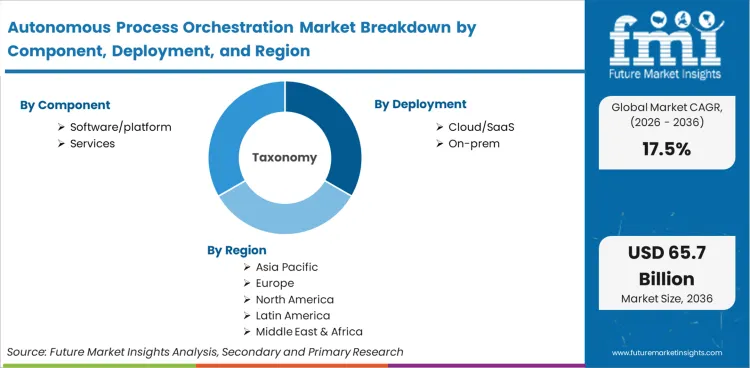
| Metric | Value |
|---|---|
| Quantitative Units | USD 13.12 billion to USD 65.9 billion, at a CAGR of 17.48% |
| Market Definition | An advanced enterprise software architecture that coordinates, executes, and monitors complex business workflows natively across multiple systems using AI-driven agents and microservices without requiring continuous human intervention. |
| Component Segmentation | Software/platform, Services |
| Deployment Segmentation | Cloud/SaaS, On-prem |
| Technology Segmentation | Microservices, API orchestration, AI-driven orchestration, Event-driven workflows |
| Business function Segmentation | Business process management, IT process automation, Supply chain & order mgmt, Finance & accounting, HR & admin |
| Regions Covered | North America, Latin America, Europe, East Asia, South Asia, Oceania, Middle East and Africa |
| Countries Covered | United States, Canada, Mexico, Brazil, Argentina, Germany, France, United Kingdom, Italy, Spain, China, India, Japan, South Korea, Indonesia, Australia and 40 plus countries |
| Key Companies Profiled | IBM, Microsoft, Oracle, SAP, ServiceNow, Pegasystems, Appian |
| Forecast Period | 2026 to 2036 |
| Approach | Hybrid top-down and bottom-up market modeling validated through primary interviews with enterprise CIOs and architects, supported by verified corporate acquisition and deployment data. |
Source: Future Market Insights (FMI) analysis, based on proprietary forecasting model and primary research
Segmental Analysis
Component:
- Software/platform
- Services
Deployment:
- Cloud/SaaS
- On-prem
Technology:
- Microservices
- API orchestration
- AI-driven orchestration
- Event-driven workflows
Business function:
- Business process management
- IT process automation
- Supply chain & order mgmt
- Finance & accounting
- HR & admin
Region:
- Asia Pacific
- India
- China
- Japan
- South Korea
- Indonesia
- Australia & New Zealand
- ASEAN
- Rest of Asia Pacific
- Europe
- Germany
- Italy
- France
- United Kingdom
- Spain
- Benelux
- Nordics
- Central & Eastern Europe
- Rest of Europe
- North America
- United States
- Canada
- Mexico
- Latin America
- Brazil
- Argentina
- Chile
- Rest of Latin America
- Middle East & Africa
- Kingdom of Saudi Arabia
- United Arab Emirates
- South Africa
- Turkey
- Rest of Middle East & Africa
Bibliography
- [1] ServiceNow. (2025, January 29). ServiceNow announces new agentic AI innovations (Press release).
- [2] UiPath. (2025, September 30). UiPath accelerates AI transformation with agentic automation and orchestration (Press release).
- [3] World Economic Forum (WEF). (2025). The Future of Jobs Report 2025 Digest (Industry report).
- [4] UK Government. (2025). Business data use and productivity study wave 2 (Government report).
- [5] International Energy Agency (IEA). (2025). Energy demand from AI (Industry report).
- [6] International Labour Organization (ILO). (2025). One in four jobs at risk of being transformed by GenAI (Industry report).
- [7] Microsoft. (2025). Fabric data agents integrations with Copilot Studio (Company news release).
- [8] Snowflake. (2026, January). Snowflake announces intent to acquire Observe (Press release).
- [9] SAP. (2026, January). SAP Business AI release highlights Q4 2025 (Press release).
- [10] Databricks. (2025, May). Databricks agrees to acquire Neon (Press release).
- [11] UK Government. (2025). AI Labour Market Survey 2025 (Government report).
- [12] Siemens. (2025, November). SPS fair 2025 (Press release).
- [13] Cybersecurity and Infrastructure Security Agency (CISA). (2025, August 7). Bulletin SB25-219 (Government report).
- [14] Singapore Police Force. (2026, February). Scams and Cybercrime (Government report).
- [15] ABB. (2025, March). ABB simplifies industrial device maintenance with generative AI (Press release).
- [16] PTC. (2025, March). PTC brings AI-powered PLM to Hannover Messe (Press release).
This bibliography is provided for reader reference and is not exhaustive. The full report contains the complete reference list and detailed citations.
This Report Addresses
- Market size estimation and revenue forecasts spanning 2026 to 2036, supported by validated corporate IT deployment benchmarks across major hyperscaler environments.
- Growth opportunity mapping across cloud, on-premise, and hybrid architectures with a sharp focus on AI agentic orchestration adoption.
- Segment and regional revenue forecasts detailing critical operational workflows such as supply chain, IT process management, and HR administration.
- Competition strategy assessment evaluating platform ecosystem maturity, cross-vendor API interoperability, and integrated observability capabilities.
- Regulatory impact analysis dissecting stringent data privacy mandates, cybersecurity incident reporting rules, and their direct influence on platform architecture.
- Comprehensive supply chain vulnerability assessment connecting macro skills shortages directly to accelerated investments in low-code orchestration platforms.
- Market report delivery formats including PDF, Excel, PPT, and dynamic interactive dashboard structures customized for executive and technical planning.
Frequently Asked Questions
How large is the demand for Autonomous Process Orchestration Market in the global market in 2026?
Demand for Autonomous Process Orchestration Market in the global market is estimated to be valued at USD 13.12 billion in 2026.
What will be the market size of Autonomous Process Orchestration Market in the global market by 2036?
Market size for Autonomous Process Orchestration Market is projected to reach USD 65.9 billion by 2036.
What is the expected demand growth for Autonomous Process Orchestration Market in the global market between 2026 and 2036?
Demand for Autonomous Process Orchestration Market is expected to grow at a CAGR of 17.48% between 2026 and 2036.
Which Component is poised to lead global sales by 2026?
Software/platform commands 70% in 2026 as organizations consolidate fragmented scripts into unified, AI-driven control towers.
How significant is the role of IT & telecom in driving Autonomous Process Orchestration Market adoption in 2026?
IT & telecom represents 44.00% of segment share as massive network provisioning and cybersecurity workflows mandate fully automated incident resolution.
What is driving demand in India?
India's massive domestic IT outsourcing ecosystem is rapidly shifting from manual execution to intelligent, autonomous agent orchestration to preserve global margins.
What compliance standards or regulations are referenced for India?
Global data privacy and cross-border IT governance standards directly influence domestic BPO procurement behavior.
What is the India growth outlook in this report?
India is projected to grow at a CAGR of 22.0% during 2026 to 2036.
Why is North America described as a priority region in this report?
Unprecedented multi-cloud complexity and intense cybersecurity pressures force USA enterprises to standardise on integrated orchestration platforms.
What type of demand dominates in North America?
Hyperscaler-backed, cloud-native API orchestration and agentic AI deployments dominate regional enterprise procurement demand.
What is China's growth outlook in this report?
China is projected to expand at a CAGR of 20.0% during 2026 to 2036.
Does the report cover United States in its regional analysis?
Yes, United States is included within North America under the regional scope of analysis.
What are the sources referred to for analyzing United States?
Official corporate product release schedules from major hyperscalers and cybersecurity threat reports from federal agencies form the analytical basis.
What is the main demand theme linked to United States in its region coverage?
The consolidation of fragmented, multi-vendor software estates into unified, secure orchestration ecosystems shapes continuous procurement demand.
Does the report cover United Kingdom in its regional analysis?
Yes, United Kingdom is included within Europe under the regional coverage framework.
What is the main United Kingdom related demand theme in its region coverage?
Severe technical skills shortages driving the urgent deployment of low-code, autonomous process management tools dominate regional buyer behavior.
Which product formats or configurations are strategically important for Europe supply chains?
On-premise capable platforms with embedded data lineage tracking generated for strict GDPR and industrial compliance hold immense strategic importance.
What is Autonomous Process Orchestration Market and what is it mainly used for?
It is an advanced enterprise software architecture that coordinates and executes complex business workflows natively across systems using AI-driven agents.
What does Autonomous Process Orchestration Market mean in this report?
The market refers to the global deployment and industrial consumption of platforms, APIs, and microservices orchestrating cross-system business logic.
What is included in the scope of this Autonomous Process Orchestration Market report?
Software platforms, cloud-based orchestration systems, API management layers, and associated professional services aimed at business process and IT automation.
What is excluded from the scope of this report?
Raw hardware infrastructure, single-task robotic process automation (RPA) scripts, and generalized consumer-grade productivity applications are strictly excluded.
What does market forecast mean on this page?
The market forecast represents a model-based projection built on defined technological adoption rates and enterprise cloud transition assumptions for strategic planning purposes.
How does FMI build and validate the Autonomous Process Orchestration Market forecast?
Forecasts combine top-down enterprise IT spend data with bottom-up software deployment yields, validated by primary CIO interviews.
What does zero reliance on speculative third-party market research mean here?
Primary interviews, verified corporate deployment announcements, and official government cybersecurity datasets are used exclusively instead of unverified syndicated estimates.
Preview the report firsthand - request a free sample
Get SampleGet the brochure for pricing and purchase details.
Get PDFTable of Content
- Executive Summary
- Global Market Outlook
- Demand-side Trends
- Supply-side Trends
- Technology Roadmap Analysis
- Analysis and Recommendations
- Market Overview
- Market Coverage / Taxonomy
- Market Definition / Scope / Limitations
- Research Methodology
- Chapter Orientation
- Analytical Lens and Working Hypotheses
- Market Structure, Signals, and Trend Drivers
- Benchmarking and Cross-market Comparability
- Market Sizing, Forecasting, and Opportunity Mapping
- Research Design and Evidence Framework
- Desk Research Programme (Secondary Evidence)
- Company Annual and Sustainability Reports
- Peer-reviewed Journals and Academic Literature
- Corporate Websites, Product Literature, and Technical Notes
- Earnings Decks and Investor Briefings
- Statutory Filings and Regulatory Disclosures
- Technical White Papers and Standards Notes
- Trade Journals, Industry Magazines, and Analyst Briefs
- Conference Proceedings, Webinars, and Seminar Materials
- Government Statistics Portals and Public Data Releases
- Press Releases and Reputable Media Coverage
- Specialist Newsletters and Curated Briefings
- Sector Databases and Reference Repositories
- FMI Internal Proprietary Databases and Historical Market Datasets
- Subscription Datasets and Paid Sources
- Social Channels, Communities, and Digital Listening Inputs
- Additional Desk Sources
- Expert Input and Fieldwork (Primary Evidence)
- Primary Modes
- Qualitative Interviews and Expert Elicitation
- Quantitative Surveys and Structured Data Capture
- Blended Approach
- Why Primary Evidence is Used
- Field Techniques
- Interviews
- Surveys
- Focus Groups
- Observational and In-context Research
- Social and Community Interactions
- Stakeholder Universe Engaged
- C-suite Leaders
- Board Members
- Presidents and Vice Presidents
- R&D and Innovation Heads
- Technical Specialists
- Domain Subject-matter Experts
- Scientists
- Physicians and Other Healthcare Professionals
- Governance, Ethics, and Data Stewardship
- Research Ethics
- Data Integrity and Handling
- Primary Modes
- Tooling, Models, and Reference Databases
- Desk Research Programme (Secondary Evidence)
- Data Engineering and Model Build
- Data Acquisition and Ingestion
- Cleaning, Normalisation, and Verification
- Synthesis, Triangulation, and Analysis
- Quality Assurance and Audit Trail
- Market Background
- Market Dynamics
- Drivers
- Restraints
- Opportunity
- Trends
- Scenario Forecast
- Demand in Optimistic Scenario
- Demand in Likely Scenario
- Demand in Conservative Scenario
- Opportunity Map Analysis
- Product Life Cycle Analysis
- Supply Chain Analysis
- Investment Feasibility Matrix
- Value Chain Analysis
- PESTLE and Porter’s Analysis
- Regulatory Landscape
- Regional Parent Market Outlook
- Production and Consumption Statistics
- Import and Export Statistics
- Market Dynamics
- Global Market Analysis 2021 to 2025 and Forecast, 2026 to 2036
- Historical Market Size Value (USD Million) Analysis, 2021 to 2025
- Current and Future Market Size Value (USD Million) Projections, 2026 to 2036
- Y-o-Y Growth Trend Analysis
- Absolute $ Opportunity Analysis
- Global Market Pricing Analysis 2021 to 2025 and Forecast 2026 to 2036
- Global Market Analysis 2021 to 2025 and Forecast 2026 to 2036, By Component
- Introduction / Key Findings
- Historical Market Size Value (USD Million) Analysis By Component , 2021 to 2025
- Current and Future Market Size Value (USD Million) Analysis and Forecast By Component , 2026 to 2036
- Software/platform
- Services
- Software/platform
- Y-o-Y Growth Trend Analysis By Component , 2021 to 2025
- Absolute $ Opportunity Analysis By Component , 2026 to 2036
- Global Market Analysis 2021 to 2025 and Forecast 2026 to 2036, By Deployment
- Introduction / Key Findings
- Historical Market Size Value (USD Million) Analysis By Deployment, 2021 to 2025
- Current and Future Market Size Value (USD Million) Analysis and Forecast By Deployment, 2026 to 2036
- Cloud/SaaS
- On-prem
- Cloud/SaaS
- Y-o-Y Growth Trend Analysis By Deployment, 2021 to 2025
- Absolute $ Opportunity Analysis By Deployment, 2026 to 2036
- Global Market Analysis 2021 to 2025 and Forecast 2026 to 2036, By Technology
- Introduction / Key Findings
- Historical Market Size Value (USD Million) Analysis By Technology, 2021 to 2025
- Current and Future Market Size Value (USD Million) Analysis and Forecast By Technology, 2026 to 2036
- Microservices
- API orchestration
- AI-driven orchestration
- Event-driven workflows
- Microservices
- Y-o-Y Growth Trend Analysis By Technology, 2021 to 2025
- Absolute $ Opportunity Analysis By Technology, 2026 to 2036
- Global Market Analysis 2021 to 2025 and Forecast 2026 to 2036, By Business function
- Introduction / Key Findings
- Historical Market Size Value (USD Million) Analysis By Business function, 2021 to 2025
- Current and Future Market Size Value (USD Million) Analysis and Forecast By Business function, 2026 to 2036
- Business process management
- IT process automation
- Supply chain & order mgmt
- Finance & accounting
- HR & admin
- Business process management
- Y-o-Y Growth Trend Analysis By Business function, 2021 to 2025
- Absolute $ Opportunity Analysis By Business function, 2026 to 2036
- Global Market Analysis 2021 to 2025 and Forecast 2026 to 2036, By Region
- Introduction
- Historical Market Size Value (USD Million) Analysis By Region, 2021 to 2025
- Current Market Size Value (USD Million) Analysis and Forecast By Region, 2026 to 2036
- North America
- Latin America
- Western Europe
- Eastern Europe
- East Asia
- South Asia and Pacific
- Middle East & Africa
- Market Attractiveness Analysis By Region
- North America Market Analysis 2021 to 2025 and Forecast 2026 to 2036, By Country
- Historical Market Size Value (USD Million) Trend Analysis By Market Taxonomy, 2021 to 2025
- Market Size Value (USD Million) Forecast By Market Taxonomy, 2026 to 2036
- By Country
- USA
- Canada
- Mexico
- By Component
- By Deployment
- By Technology
- By Business function
- By Country
- Market Attractiveness Analysis
- By Country
- By Component
- By Deployment
- By Technology
- By Business function
- Key Takeaways
- Latin America Market Analysis 2021 to 2025 and Forecast 2026 to 2036, By Country
- Historical Market Size Value (USD Million) Trend Analysis By Market Taxonomy, 2021 to 2025
- Market Size Value (USD Million) Forecast By Market Taxonomy, 2026 to 2036
- By Country
- Brazil
- Chile
- Rest of Latin America
- By Component
- By Deployment
- By Technology
- By Business function
- By Country
- Market Attractiveness Analysis
- By Country
- By Component
- By Deployment
- By Technology
- By Business function
- Key Takeaways
- Western Europe Market Analysis 2021 to 2025 and Forecast 2026 to 2036, By Country
- Historical Market Size Value (USD Million) Trend Analysis By Market Taxonomy, 2021 to 2025
- Market Size Value (USD Million) Forecast By Market Taxonomy, 2026 to 2036
- By Country
- Germany
- UK
- Italy
- Spain
- France
- Nordic
- BENELUX
- Rest of Western Europe
- By Component
- By Deployment
- By Technology
- By Business function
- By Country
- Market Attractiveness Analysis
- By Country
- By Component
- By Deployment
- By Technology
- By Business function
- Key Takeaways
- Eastern Europe Market Analysis 2021 to 2025 and Forecast 2026 to 2036, By Country
- Historical Market Size Value (USD Million) Trend Analysis By Market Taxonomy, 2021 to 2025
- Market Size Value (USD Million) Forecast By Market Taxonomy, 2026 to 2036
- By Country
- Russia
- Poland
- Hungary
- Balkan & Baltic
- Rest of Eastern Europe
- By Component
- By Deployment
- By Technology
- By Business function
- By Country
- Market Attractiveness Analysis
- By Country
- By Component
- By Deployment
- By Technology
- By Business function
- Key Takeaways
- East Asia Market Analysis 2021 to 2025 and Forecast 2026 to 2036, By Country
- Historical Market Size Value (USD Million) Trend Analysis By Market Taxonomy, 2021 to 2025
- Market Size Value (USD Million) Forecast By Market Taxonomy, 2026 to 2036
- By Country
- China
- Japan
- South Korea
- By Component
- By Deployment
- By Technology
- By Business function
- By Country
- Market Attractiveness Analysis
- By Country
- By Component
- By Deployment
- By Technology
- By Business function
- Key Takeaways
- South Asia and Pacific Market Analysis 2021 to 2025 and Forecast 2026 to 2036, By Country
- Historical Market Size Value (USD Million) Trend Analysis By Market Taxonomy, 2021 to 2025
- Market Size Value (USD Million) Forecast By Market Taxonomy, 2026 to 2036
- By Country
- India
- ASEAN
- Australia & New Zealand
- Rest of South Asia and Pacific
- By Component
- By Deployment
- By Technology
- By Business function
- By Country
- Market Attractiveness Analysis
- By Country
- By Component
- By Deployment
- By Technology
- By Business function
- Key Takeaways
- Middle East & Africa Market Analysis 2021 to 2025 and Forecast 2026 to 2036, By Country
- Historical Market Size Value (USD Million) Trend Analysis By Market Taxonomy, 2021 to 2025
- Market Size Value (USD Million) Forecast By Market Taxonomy, 2026 to 2036
- By Country
- Kingdom of Saudi Arabia
- Other GCC Countries
- Turkiye
- South Africa
- Other African Union
- Rest of Middle East & Africa
- By Component
- By Deployment
- By Technology
- By Business function
- By Country
- Market Attractiveness Analysis
- By Country
- By Component
- By Deployment
- By Technology
- By Business function
- Key Takeaways
- Key Countries Market Analysis
- USA
- Pricing Analysis
- Market Share Analysis, 2025
- By Component
- By Deployment
- By Technology
- By Business function
- Canada
- Pricing Analysis
- Market Share Analysis, 2025
- By Component
- By Deployment
- By Technology
- By Business function
- Mexico
- Pricing Analysis
- Market Share Analysis, 2025
- By Component
- By Deployment
- By Technology
- By Business function
- Brazil
- Pricing Analysis
- Market Share Analysis, 2025
- By Component
- By Deployment
- By Technology
- By Business function
- Chile
- Pricing Analysis
- Market Share Analysis, 2025
- By Component
- By Deployment
- By Technology
- By Business function
- Germany
- Pricing Analysis
- Market Share Analysis, 2025
- By Component
- By Deployment
- By Technology
- By Business function
- UK
- Pricing Analysis
- Market Share Analysis, 2025
- By Component
- By Deployment
- By Technology
- By Business function
- Italy
- Pricing Analysis
- Market Share Analysis, 2025
- By Component
- By Deployment
- By Technology
- By Business function
- Spain
- Pricing Analysis
- Market Share Analysis, 2025
- By Component
- By Deployment
- By Technology
- By Business function
- France
- Pricing Analysis
- Market Share Analysis, 2025
- By Component
- By Deployment
- By Technology
- By Business function
- India
- Pricing Analysis
- Market Share Analysis, 2025
- By Component
- By Deployment
- By Technology
- By Business function
- ASEAN
- Pricing Analysis
- Market Share Analysis, 2025
- By Component
- By Deployment
- By Technology
- By Business function
- Australia & New Zealand
- Pricing Analysis
- Market Share Analysis, 2025
- By Component
- By Deployment
- By Technology
- By Business function
- China
- Pricing Analysis
- Market Share Analysis, 2025
- By Component
- By Deployment
- By Technology
- By Business function
- Japan
- Pricing Analysis
- Market Share Analysis, 2025
- By Component
- By Deployment
- By Technology
- By Business function
- South Korea
- Pricing Analysis
- Market Share Analysis, 2025
- By Component
- By Deployment
- By Technology
- By Business function
- Russia
- Pricing Analysis
- Market Share Analysis, 2025
- By Component
- By Deployment
- By Technology
- By Business function
- Poland
- Pricing Analysis
- Market Share Analysis, 2025
- By Component
- By Deployment
- By Technology
- By Business function
- Hungary
- Pricing Analysis
- Market Share Analysis, 2025
- By Component
- By Deployment
- By Technology
- By Business function
- Kingdom of Saudi Arabia
- Pricing Analysis
- Market Share Analysis, 2025
- By Component
- By Deployment
- By Technology
- By Business function
- Turkiye
- Pricing Analysis
- Market Share Analysis, 2025
- By Component
- By Deployment
- By Technology
- By Business function
- South Africa
- Pricing Analysis
- Market Share Analysis, 2025
- By Component
- By Deployment
- By Technology
- By Business function
- USA
- Market Structure Analysis
- Competition Dashboard
- Competition Benchmarking
- Market Share Analysis of Top Players
- By Regional
- By Component
- By Deployment
- By Technology
- By Business function
- Competition Analysis
- Competition Deep Dive
- IBM
- Overview
- Product Portfolio
- Profitability by Market Segments (Product/Age /Sales Channel/Region)
- Sales Footprint
- Strategy Overview
- Marketing Strategy
- Product Strategy
- Channel Strategy
- Microsoft
- Oracle
- SAP
- ServiceNow
- Pegasystems
- Appian
- IBM
- Competition Deep Dive
- Assumptions & Acronyms Used


