

- Industry Size (2026)
- USD 9.1 Bn
- Forecast (2036)
- USD 15.8 Bn
- CAGR (2026 to 2036)
- 5.7%
MEA Enterprise Software Market Forecast and Outlook 2026 to 2036
The MEA enterprise software market is projected to expand from USD 9.1 Billion in 2026 to USD 15.8 Billion by 2036, registering a 5.7% CAGR. In MEA, enterprise software budgets are being unlocked by sovereign cloud and regional data centre investments that reduce latency and make regulated workloads deployable in-country. Microsoft reported FY25 cloud scale growth and tied it to enterprise workload adoption, with Satya Nadella stating that cloud and AI is the driving force of business transformation across every industry and sector. ServiceNow’s regionalisation strategy has also become explicit. ServiceNow announced plans to launch UAE Cloud hosted on Microsoft Azure with targeted delivery in the first half of 2025, aligning platform availability with UAE data residency expectations for regulated customers.
Saudi Arabia is acting as the anchor market for MEA hyperscaler localisation, which supports ERP and adjacent workload migrations in public and private sectors. Saudi MCIT’s Cloud First Policy instructs government entities to prioritise cloud solutions and explicitly cites enterprise resource planning systems within the scope of cloud-first decision sequencing. Microsoft provided a construction update on its Saudi datacenter region with availability expected in 2026, and also signed an MoU with PIF and SITE to explore sovereign-cloud services, reinforcing the data residency mechanism driving regulated adoption.
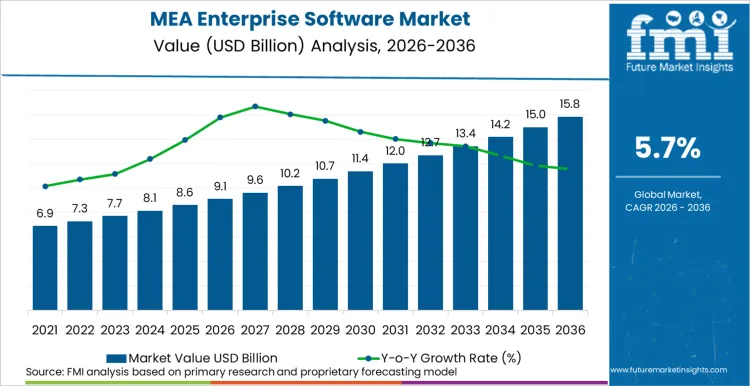
Summary of the MEA Enterprise Software Market
What is Growth Outlook for MEA Enterprise Software Market as per Future Market Insights Projection?
The market will grow at a 5.7% CAGR from USD 9.1 Billion in 2026 to USD 15.8 Billion by 2036.
FMI Research Approach: Built from cloud-first policy signals, sovereign hosting adoption, sector digitisation programmes, and platform localisation disclosures.
Which software type is most structurally central to MEA adoption cycles?
ERP leads with a 24.0% share because government and regulated enterprises prioritise finance, procurement, HR, and asset controls that are easier to standardise under cloud-first mandates.
FMI Research Approach: Segment share aligned to procurement-led ERP rollouts and cloud-first policy scope.
Which enterprise size segment captures most of the spend?
Large enterprises lead with a 62.0% share because regulated and multi-entity groups drive regional platform consolidation and data residency-compliant deployments.
FMI Research Approach: Weighted to disclosed sovereign-cloud and regulated-cloud programmes that primarily target large organisations.
Which industry vertical is the largest buyer segment in MEA enterprise software?
BFSI leads with a 23.0% share as banks and insurers adopt data-governed platforms and workflow systems that can operate under in-country hosting and security controls.
FMI Research Approach: Vertical allocation based on policy-driven data governance and compliance intensity.
Which countries show the strongest growth outlook within MEA?
Saudi Arabia leads at 6.0% CAGR, followed by Nigeria at 5.8% and UAE at 5.9%, supported by cloud-first mandates, data governance laws, and sovereign cloud security frameworks.
FMI Research Approach: Country modelling based on national digitisation mandates, cloud security policy, and legal data governance frameworks.
MEA Enterprise Software Market Key Takeaways
| Metric | Value (USD Billion) |
|---|---|
| Market Size (2026) | USD 9.1 Billion |
| Forecast Value (2036) | USD 15.8 Billion |
| CAGR 2026 to 2036) | 5.7% |
Which governance and platform triggers are accelerating MEA enterprise software adoption?
In MEA, sovereign cloud and cloud-first procurement rules are turning enterprise software into a compliance-enabled upgrade cycle rather than a discretionary IT refresh. Saudi MCIT’s Cloud First Policy directs government entities to prioritise SaaS, then PaaS, then IaaS and explicitly includes ERP systems within the policy’s decision perimeter, which standardises demand for core finance and operations platforms. Microsoft has positioned Saudi Arabia as a regional cloud execution hub with availability for its datacenter region expected in 2026 and a sovereign-cloud MoU with PIF and SITE, which unlocks regulated workloads that previously could not move. In the UAE, the National Cloud Security Policy codifies cloud security requirements and oversight roles, increasing enterprise demand for platforms that can be deployed under government-aligned controls.
How is the MEA Enterprise Software Market Segmented?
The MEA enterprise software market is segmented by software type, enterprise size, industry, and country to reflect how digitisation is being executed under cloud-first mandates and sovereign data governance frameworks. By software type, the market spans ERP, CRM, business intelligence, content management, supply chain management, and other enterprise applications that support core administrative and operational control. By enterprise size, demand is led by large enterprises that can fund multi-year platform migrations and meet data residency and security compliance requirements, while SMEs participate selectively through modular cloud deployments. By industry, adoption is anchored by BFSI, followed by retail, IT and telecom, healthcare, and media and entertainment, reflecting varying levels of regulatory intensity and data governance pressure.
FMI analysis indicates that while cloud platforms and modular applications are expanding rapidly, the market structure remains anchored in policy-driven core systems. This segmentation highlights a governance-led market where foundational platforms provide control and compliance, while newer cloud applications extend functionality and scale.
Why does ERP hold the lead position within MEA enterprise software spend?
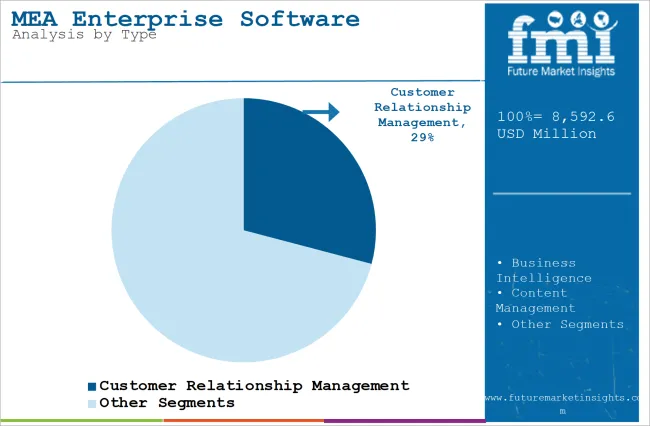
ERP leads with a 24.0% share because MEA digitisation programmes start with controllability. Finance, procurement, HR, payroll, and asset governance are the fastest domains for governments and large groups to mandate, audit, and standardise. Saudi MCIT’s Cloud First Policy instructs government entities to prioritise cloud solutions and explicitly references enterprise resource planning systems in the context of cloud adoption sequencing, which converts policy into recurring ERP procurement and migration cycles. This dynamic is reinforced by hyperscaler localisation that removes the deployment barrier for regulated data. Microsoft announced progress on its Saudi datacenter region with availability expected in 2026, while also signing an MoU with PIF and SITE to explore sovereign-cloud services aligned with security, compliance, and data residency priorities. ERP leadership therefore reflects policy-driven standardisation and infrastructure localisation that makes core systems deployable inside national boundaries, lifting conversion rates for ERP upgrades, cloud migrations, and multi-entity consolidation programmes.
What keeps large enterprises structurally ahead in MEA enterprise software budgets?
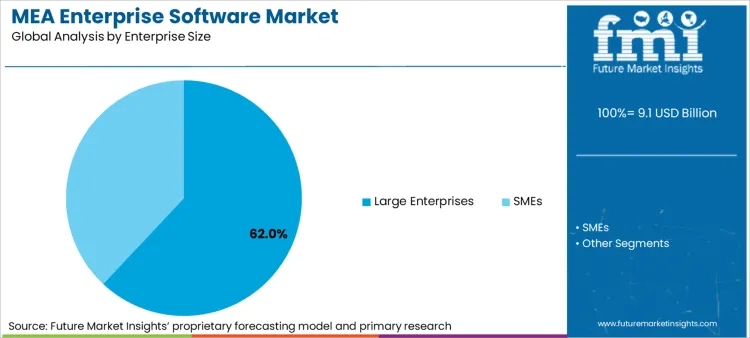
Large enterprises lead with a 62.0% share because the highest-value MEA deployments are compliance-led and multi-entity. These buyers can fund long-cycle programmes spanning data residency, security accreditation, and cross-border operating models. The UAE’s National Cloud Security Policy sets cloud security requirements and identifies responsible entities for enforcement, which creates an adoption pathway that large regulated organisations can execute faster than SMEs due to governance capacity and procurement scale. Platform vendors are aligning offers to these buyers. ServiceNow announced UAE Cloud hosted on Microsoft Azure with delivery targeted in the first half of 2025, signalling a localisation move designed for customers that require in-country hosting and regulated cloud controls. Large-enterprise dominance is therefore a function of compliance overhead, multi-entity integration complexity, and vendor localisation that targets regulated procurement first.
Why does BFSI remain the most defensible vertical in MEA enterprise software demand?
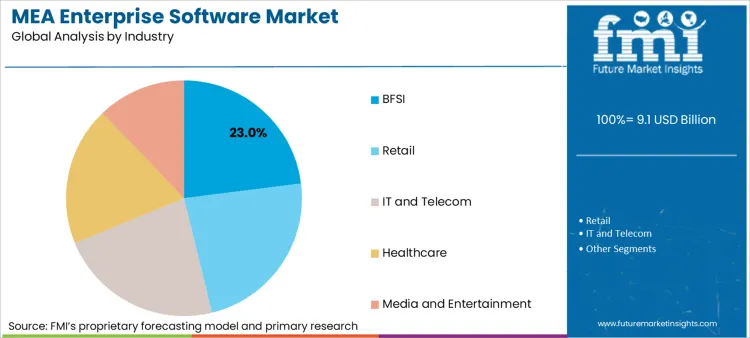
BFSI leads with a 23.0% share because banking and insurance adoption is driven by enforceable data governance and security controls, which increases spend on auditable platforms across analytics, customer operations, workflow, and core back office. Nigeria’s Data Protection Act 2023 establishes a statutory framework for personal information protection and sets up the Nigeria Data Protection Commission, increasing the compliance load for institutions that process consumer data at scale, which translates into stronger demand for governed data platforms and enterprise applications with controllable access, retention, and reporting. In the UAE, the National Cloud Security Policy establishes cloud security principles and requirements that shape how critical workloads are deployed, reinforcing a compliance path that BFSI is structurally positioned to adopt. BFSI leadership reflects governance intensity and the repeat nature of compliance-driven platform upgrades rather than discretionary feature adoption.
Why Is In-Country Cloud Localisation Reshaping Enterprise Software Adoption?
In-country cloud localisation is fundamentally reshaping MEA enterprise software adoption by converting cloud migration from a discretionary IT decision into a compliance-enabled deployment pathway. Microsoft’s confirmation that availability for its Saudi datacenter region is expected in 2026, alongside its MoU with PIF and SITE to explore sovereign-cloud services, establishes a direct route for regulated workloads to move into cloud-based ERP, CRM, and analytics platforms within national boundaries. This shift is being reinforced at the platform layer. ServiceNow’s plan to launch UAE Cloud hosted on Microsoft Azure in the first half of 2025 extends localisation into workflow and IT service management, allowing regulated buyers to adopt modern platforms without breaching data residency rules. The combined effect is a structural move away from offshore hosting toward locally deployable enterprise platforms that materially expand addressable demand.
How Are Security and Data Governance Requirements Changing Procurement Dynamics?
Enterprise software procurement in MEA is increasingly shaped by formal security and data governance frameworks that raise execution thresholds. The UAE National Cloud Security Policy defines security requirements, oversight roles, and enforcement responsibilities, increasing the number of compliance checkpoints required before cloud and application deployments can proceed. In Nigeria, the Data Protection Act 2023 introduces a statutory governance regime and a national regulator, tightening obligations for organisations handling personal data. These frameworks lengthen procurement cycles, intensify vendor due diligence, and increase implementation complexity, particularly for cross-border programmes.
What Role Do Governance Constraints Play in Market Concentration?
Rising governance requirements do not suppress enterprise software spending, but they redirect it toward fewer, compliance-ready vendors. Security accreditation, data residency validation, and regulatory documentation increase cost-to-serve and slow conversion in price-sensitive segments. As a result, market momentum concentrates around large platform providers capable of sustaining longer qualification timelines and meeting multi-country governance expectations, reinforcing consolidation across ERP, CRM, and workflow platforms.
What is the MEA Enterprise Software Market Regional Outlook?
Enterprise software growth across MEA is being led by policy-driven digitisation rather than discretionary IT upgrades, with Gulf markets setting the pace. Saudi Arabia leads regional expansion at a 6.0% CAGR as cloud-first mandates, sovereign hosting initiatives, and public-sector ERP standardisation translate directly into sustained platform adoption. The United Arab Emirates follows closely at 5.9%, supported by national digital government execution and formal cloud security frameworks that accelerate regulated workload migration. In Africa, Nigeria (5.8%) and Egypt (5.7%) are emerging as high-momentum markets, driven by data governance formalisation and state-led digital transformation programmes that expand demand for compliant enterprise platforms. South Africa’s 5.6% CAGR reflects steadier growth anchored in execution capacity and enterprise readiness rather than policy acceleration. FMI analysis indicates that future MEA growth will be concentrated in countries where cloud policy, data governance, and hyperscaler localisation converge to unlock regulated enterprise workloads at scale.

| Country | CAGR (2026 to 2036) |
|---|---|
| Saudi Arabia | 6.0% |
| United Arab Emirates | 5.9% |
| South Africa | 5.6% |
| Egypt | 5.7% |
| Nigeria | 5.8% |
Source: Future Market Insights (FMI) analysis, based on proprietary forecasting model and primary research.
Why does Saudi Arabia set the pace for enterprise software scale-up in MEA across 2026 to 2036?
Saudi Arabia’s 6.0% CAGR is anchored in policy-led cloud procurement and sovereign hosting programmes that convert into core enterprise application rollouts. MCIT’s Cloud First Policy directs government entities to prioritise cloud solutions and explicitly includes ERP systems, which institutionalises demand for finance, procurement, HR, and operations platforms across ministries and public entities. This policy layer is being reinforced by hyperscaler localisation. Microsoft stated its Saudi datacenter region construction is complete on three sites with availability expected in 2026, and it signed an MoU with PIF and SITE to explore sovereign-cloud services aligned with national data residency and compliance priorities. This combination increases the feasibility of migrating regulated workloads, raising implementation velocity for ERP, CRM, analytics, and workflow platforms deployed inside the Kingdom.
What is uniquely pushing UAE enterprise software adoption through 2036?
The UAE’s 5.9% CAGR is supported by state-level digital government execution and formal cloud security policy that shapes how enterprise platforms are procured and deployed. The UAE Digital Government Strategy 2025 frames a cross-sector commitment to embedding digital design across government services, which increases demand for standardised enterprise platforms across shared service centres and agency back offices. The National Cloud Security Policy establishes security principles, requirements, and responsible entities for oversight and enforcement, creating a compliance perimeter that favours enterprise-grade platforms with auditable controls and local deployment options. Vendor localisation is aligning to this perimeter. ServiceNow announced UAE Cloud hosted on Microsoft Azure which launched in 2025, providing a regulated-cloud route, signalling a regulated-cloud route for workflow and enterprise service operations.
How does South Africa’s digital economy push translate into enterprise software demand?
South Africa’s 5.6% CAGR is driven by digitisation priorities that increase enterprise platform adoption across corporates and public institutions, with emphasis on productivity, skills, and digital infrastructure. The USA International Trade Administration characterises South Africa as a leader in Africa’s digital economy, supported by advanced digital infrastructure and proactive government focus on digital growth, which expands the enterprise buyer base capable of deploying modern software platforms. Government policy also targets the enabling layer. South Africa’s National Digital and Future Skills Strategy highlights the need to foster digital skills development across the economy, which supports enterprise adoption by increasing implementer capacity and user readiness for modern systems. For MEA enterprise software, the country mechanism is execution capability. Skills availability and implementer ecosystems reduce deployment risk, supporting steady adoption of ERP, CRM, and analytics platforms across large groups and regulated sectors.
Why does Egypt sustain above-baseline enterprise software growth through 2036?
Egypt’s 5.7% CAGR is supported by national digital transformation priorities and ICT-sector build-out that increases demand for enterprise platforms across government and private sector modernisation programmes. Egypt’s Ministry of Communications and Information Technology states that the ICT 2030 Strategy contributes to Egypt Vision 2030 through building Digital Egypt, including developing ICT infrastructure, fighting corruption, ensuring cybersecurity, and strengthening digital government services. This agenda increases demand for enterprise content management, workflow digitisation, analytics, and core administrative platforms required to industrialise service delivery. The USA International Trade Administration links Egypt’s ICT 2030 strategy to investments, capacity building, and digital government reforms, reinforcing the programme-driven demand mechanism. The growth driver is not consumerisation. It is state-led platform modernisation that expands procurement for core enterprise systems and raises adoption across large enterprises supplying government and regulated sectors.
What makes Nigeria a high-growth enterprise software market in Africa over 2026 to 2036?
Nigeria’s 5.8% CAGR is driven by formalisation of data governance and the resulting compliance requirements for organisations processing personal data at scale. Nigeria’s Data Protection Act 2023 establishes a legal framework for personal information protection and creates the Nigeria Data Protection Commission, which increases governance obligations for data controllers and processors and strengthens demand for enterprise platforms that can enforce access controls, retention, and auditability. This shifts enterprise procurement toward vendors and system integrators that can implement compliant architectures across customer operations, HR, and analytics, especially in BFSI, telecom, and large consumer-facing enterprises. The driver is statutory compliance plus operational scale. As enforcement institutions mature, the cost of non-compliance rises, pushing organisations to modernise enterprise platforms that centralise data governance and reporting.
How is competition structured in the MEA enterprise software market, and where does global leadership fail to translate regionally?
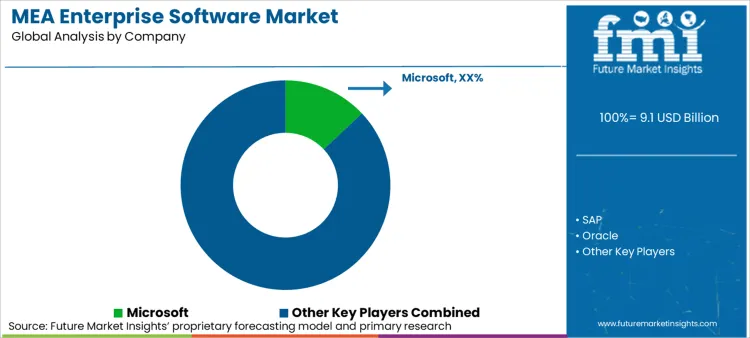
Competition in MEA enterprise software is led by global platform vendors that combine cloud infrastructure, application suites, and compliance-aligned deployment models. Scope includes ERP, CRM, BI, content management, supply chain management, workflow and IT service platforms used by enterprises. Scope excludes consumer apps, bespoke custom development sold as services, hardware, and telecom connectivity. Microsoft is the largest player in this market set with a 15.0% share, reinforced by stated cloud scale and regional sovereign-cloud positioning such as its Saudi datacenter region progress and sovereign-cloud MoU with PIF and SITE. In North America, leadership is shaped by platform bundling and cloud attach across productivity, data, and security. In Europe, ERP leadership is concentrated in SAP and Oracle, with cloud ERP growth disclosed by SAP alongside rising cloud backlog. In Asia, Japan differs because government and industry focus on legacy modernisation and DX creates a procurement environment where global leadership does not automatically translate without local ecosystem alignment. METI has published work on DX and legacy systems and response measures, reinforcing the structural legacy modernisation imperative that shapes enterprise platform decisions.
Recent Developments
- In November 2025, Salesforce agreed to acquire Doti, bringing Doti’s team into its AI R&D hub in Israel and advancing conversational, agent-powered enterprise search and knowledge discovery across Salesforce and Slack.
- In November 2025, Adobe announced a $1.9 billion all-cash agreement to acquire Semrush, aiming to integrate SEO and generative engine optimization into Adobe’s customer experience portfolio as brands adapt to AI-driven search and discovery.
Key Players
- Microsoft
- SAP
- Oracle
- IBM
- Salesforce
- Google (Google Cloud)
- Amazon Web Services (AWS)
- ServiceNow
- Adobe
- Zoho
Market Definition
The MEA enterprise software market covers business application software and platforms deployed by enterprises and government entities across the Middle East and Africa, including ERP, CRM, business intelligence, content management, supply chain management, and other enterprise software types. It includes software delivered via cloud and on-premises models where the primary use case is operating core business functions, compliance reporting, and enterprise workflows. The market reflects procurement driven by cloud-first mandates and sovereign-cloud requirements that determine where workloads can be hosted and which platforms can be adopted at scale, such as Saudi Arabia’s cloud-first guidance for government IT decisions.
Market Inclusion
Included revenues comprise subscription and license revenues for ERP, CRM, BI, content management, and workflow platforms used by SMEs and large enterprises, plus enterprise-grade deployment options that meet national cloud security and data residency requirements. Included are platform rollouts triggered by public sector digitisation and regulated-sector governance, such as UAE cloud security policy frameworks that define security requirements and oversight responsibilities for cloud delivery. Microsoft is treated as the largest player globally in this MEA set based on the provided 15.0% share and its disclosed cloud scale and sovereign-cloud positioning.
Market Exclusion
Excluded are consumer software, telecom connectivity, hardware, data centre colocation sold as infrastructure services, and custom software development sold primarily as professional services without separable enterprise software product revenue. Also excluded are vertical industrial control systems and embedded software used primarily in equipment. Regional leadership differs. Global platform scale does not automatically translate into Japan leadership within Asia because Japan’s enterprise modernisation agenda is shaped by legacy system constraints and government-led DX response measures, requiring local ecosystem fit and implementation capacity.
Scope of Report
| Items | Values |
|---|---|
| Quantitative Units | USD 9.1 Billion |
| Software Type Segments | ERP; Customer Relationship Management (CRM); Business Intelligence (BI); Content Management; Supply Chain Management; Other Enterprise Software |
| Enterprise Size Segments | Large Enterprises; Small & Medium Enterprises (SMEs) |
| Industry Verticals | BFSI; Retail; IT & Telecom; Healthcare; Media & Entertainment; Others |
| Deployment & Governance Context | Cloud-first Enterprise Applications; Sovereign Cloud and In-Country Hosting Deployments; Data Residency and Security-Compliant Platforms |
| Distribution & Procurement Model | Direct Enterprise Licensing; Cloud Subscription and SaaS Platforms; Public Sector and Regulated Industry Procurement |
| Regions Covered | Middle East and Africa (MEA) |
| Key Countries | Saudi Arabia; United Arab Emirates; South Africa; Egypt; Nigeria |
| Key Companies Profiled | Microsoft; SAP; Oracle; IBM; Salesforce; Google (Google Cloud); Amazon Web Services (AWS); ServiceNow; Adobe; Zoho |
| Policy & Regulatory Framework | National cloud-first policies; sovereign-cloud and data residency mandates; cloud security frameworks; national data protection and cybersecurity laws governing enterprise software deployment |
| Additional Attributes | Dollar sales measured for enterprise application software across MEA; demand driven by cloud-first government mandates, sovereign hosting requirements, and national digital transformation programmes; ERP positioned as the primary standardisation layer for finance, procurement, HR, and asset governance; large enterprises as the dominant buyers due to compliance and multi-entity integration needs; BFSI as the leading vertical due to data governance and security intensity. |
MEA Enterprise Software Market by Key Segments
By Type
- Business Intelligence
- Content Management
- Customer Relationship Management
- ERP
- Supply Chain Management
- Other Software Types
By Enterprise Size
- SMEs
- Large Enterprises
By Industry
- BFSI (23.0% share)
- Retail
- IT and Telecom
- Healthcare
- Media and Entertainment
- Others
By Country
- KSA
- Other GCC Countries
- Turkiye
- South Africa
- Other African Union
- Rest of Middle East and Africa
Bibliography
- Federal Republic of Nigeria. (2023). Nigeria Data Protection Act, 2023. National Assembly of Nigeria.
- United Arab Emirates Government. (2023). National cloud security policy. Cyber Security Council.
- Ministry of Economy, Trade and Industry (METI), Japan. (2025). Comprehensive report compiled by the Legacy System Modernization Committee.
Frequently Asked Questions
How big is the MEA enterprise software market?
The MEA enterprise software market is valued at USD 9.1 billion in 2026 and is projected to reach USD 15.8 billion by 2036.
What is the growth outlook for the MEA enterprise software market over the next 10 years?
The market is expected to grow at a 5.7% CAGR from 2026 to 2036, driven by cloud-first mandates, sovereign hosting requirements, and national digital government programms.
Which product segments or formats drive demand in this market?
ERP platforms dominate demand, supported by CRM, business intelligence, and workflow applications deployed through cloud-first and data residency-compliant models.
How does enterprise software adoption differ by region within MEA?
Adoption is led by Saudi Arabia and the UAE through policy-driven cloud localisation, while African markets such as Nigeria and Egypt grow via data governance reforms and state-led digitisation.
What are the main risks and constraints affecting this market?
Growth is constrained by strict data residency, cloud security, and compliance requirements that extend procurement timelines and favour large, governance-ready enterprises.
Preview the report firsthand - request a free sample
Get SampleGet the brochure for pricing and purchase details.
Get PDFTable of Content
- Executive Summary
- Global Market Outlook
- Demand-side Trends
- Supply-side Trends
- Technology Roadmap Analysis
- Analysis and Recommendations
- Market Overview
- Market Coverage / Taxonomy
- Market Definition / Scope / Limitations
- Research Methodology
- Chapter Orientation
- Analytical Lens and Working Hypotheses
- Market Structure, Signals, and Trend Drivers
- Benchmarking and Cross-market Comparability
- Market Sizing, Forecasting, and Opportunity Mapping
- Research Design and Evidence Framework
- Desk Research Programme (Secondary Evidence)
- Company Annual and Sustainability Reports
- Peer-reviewed Journals and Academic Literature
- Corporate Websites, Product Literature, and Technical Notes
- Earnings Decks and Investor Briefings
- Statutory Filings and Regulatory Disclosures
- Technical White Papers and Standards Notes
- Trade Journals, Industry Magazines, and Analyst Briefs
- Conference Proceedings, Webinars, and Seminar Materials
- Government Statistics Portals and Public Data Releases
- Press Releases and Reputable Media Coverage
- Specialist Newsletters and Curated Briefings
- Sector Databases and Reference Repositories
- FMI Internal Proprietary Databases and Historical Market Datasets
- Subscription Datasets and Paid Sources
- Social Channels, Communities, and Digital Listening Inputs
- Additional Desk Sources
- Expert Input and Fieldwork (Primary Evidence)
- Primary Modes
- Qualitative Interviews and Expert Elicitation
- Quantitative Surveys and Structured Data Capture
- Blended Approach
- Why Primary Evidence is Used
- Field Techniques
- Interviews
- Surveys
- Focus Groups
- Observational and In-context Research
- Social and Community Interactions
- Stakeholder Universe Engaged
- C-suite Leaders
- Board Members
- Presidents and Vice Presidents
- R&D and Innovation Heads
- Technical Specialists
- Domain Subject-matter Experts
- Scientists
- Physicians and Other Healthcare Professionals
- Governance, Ethics, and Data Stewardship
- Research Ethics
- Data Integrity and Handling
- Primary Modes
- Tooling, Models, and Reference Databases
- Desk Research Programme (Secondary Evidence)
- Data Engineering and Model Build
- Data Acquisition and Ingestion
- Cleaning, Normalisation, and Verification
- Synthesis, Triangulation, and Analysis
- Quality Assurance and Audit Trail
- Market Background
- Market Dynamics
- Drivers
- Restraints
- Opportunity
- Trends
- Scenario Forecast
- Demand in Optimistic Scenario
- Demand in Likely Scenario
- Demand in Conservative Scenario
- Opportunity Map Analysis
- Product Life Cycle Analysis
- Supply Chain Analysis
- Investment Feasibility Matrix
- Value Chain Analysis
- PESTLE and Porter’s Analysis
- Regulatory Landscape
- Regional Parent Market Outlook
- Production and Consumption Statistics
- Import and Export Statistics
- Market Dynamics
- Global Market Analysis 2021 to 2025 and Forecast, 2026 to 2036
- Historical Market Size Value (USD Million) Analysis, 2021 to 2025
- Current and Future Market Size Value (USD Million) Projections, 2026 to 2036
- Y-o-Y Growth Trend Analysis
- Absolute $ Opportunity Analysis
- Global Market Pricing Analysis 2021 to 2025 and Forecast 2026 to 2036
- Global Market Analysis 2021 to 2025 and Forecast 2026 to 2036, By Type
- Introduction / Key Findings
- Historical Market Size Value (USD Million) Analysis By Type , 2021 to 2025
- Current and Future Market Size Value (USD Million) Analysis and Forecast By Type , 2026 to 2036
- ERP
- Business Intelligence
- Content Management
- Customer Relationship Management
- ERP
- Y-o-Y Growth Trend Analysis By Type , 2021 to 2025
- Absolute $ Opportunity Analysis By Type , 2026 to 2036
- Global Market Analysis 2021 to 2025 and Forecast 2026 to 2036, By Enterprise Size
- Introduction / Key Findings
- Historical Market Size Value (USD Million) Analysis By Enterprise Size, 2021 to 2025
- Current and Future Market Size Value (USD Million) Analysis and Forecast By Enterprise Size, 2026 to 2036
- Large Enterprises
- SMEs
- Large Enterprises
- Y-o-Y Growth Trend Analysis By Enterprise Size, 2021 to 2025
- Absolute $ Opportunity Analysis By Enterprise Size, 2026 to 2036
- Global Market Analysis 2021 to 2025 and Forecast 2026 to 2036, By Industry
- Introduction / Key Findings
- Historical Market Size Value (USD Million) Analysis By Industry, 2021 to 2025
- Current and Future Market Size Value (USD Million) Analysis and Forecast By Industry, 2026 to 2036
- BFSI
- Retail
- IT and Telecom
- Healthcare
- Media and Entertainment
- BFSI
- Y-o-Y Growth Trend Analysis By Industry, 2021 to 2025
- Absolute $ Opportunity Analysis By Industry, 2026 to 2036
- Global Market Analysis 2021 to 2025 and Forecast 2026 to 2036, By Region
- Introduction
- Historical Market Size Value (USD Million) Analysis By Region, 2021 to 2025
- Current Market Size Value (USD Million) Analysis and Forecast By Region, 2026 to 2036
- North America
- Latin America
- Western Europe
- Eastern Europe
- East Asia
- South Asia and Pacific
- Middle East & Africa
- Market Attractiveness Analysis By Region
- North America Market Analysis 2021 to 2025 and Forecast 2026 to 2036, By Country
- Historical Market Size Value (USD Million) Trend Analysis By Market Taxonomy, 2021 to 2025
- Market Size Value (USD Million) Forecast By Market Taxonomy, 2026 to 2036
- By Country
- USA
- Canada
- Mexico
- By Type
- By Enterprise Size
- By Industry
- By Country
- Market Attractiveness Analysis
- By Country
- By Type
- By Enterprise Size
- By Industry
- Key Takeaways
- Latin America Market Analysis 2021 to 2025 and Forecast 2026 to 2036, By Country
- Historical Market Size Value (USD Million) Trend Analysis By Market Taxonomy, 2021 to 2025
- Market Size Value (USD Million) Forecast By Market Taxonomy, 2026 to 2036
- By Country
- Brazil
- Chile
- Rest of Latin America
- By Type
- By Enterprise Size
- By Industry
- By Country
- Market Attractiveness Analysis
- By Country
- By Type
- By Enterprise Size
- By Industry
- Key Takeaways
- Western Europe Market Analysis 2021 to 2025 and Forecast 2026 to 2036, By Country
- Historical Market Size Value (USD Million) Trend Analysis By Market Taxonomy, 2021 to 2025
- Market Size Value (USD Million) Forecast By Market Taxonomy, 2026 to 2036
- By Country
- Germany
- UK
- Italy
- Spain
- France
- Nordic
- BENELUX
- Rest of Western Europe
- By Type
- By Enterprise Size
- By Industry
- By Country
- Market Attractiveness Analysis
- By Country
- By Type
- By Enterprise Size
- By Industry
- Key Takeaways
- Eastern Europe Market Analysis 2021 to 2025 and Forecast 2026 to 2036, By Country
- Historical Market Size Value (USD Million) Trend Analysis By Market Taxonomy, 2021 to 2025
- Market Size Value (USD Million) Forecast By Market Taxonomy, 2026 to 2036
- By Country
- Russia
- Poland
- Hungary
- Balkan & Baltic
- Rest of Eastern Europe
- By Type
- By Enterprise Size
- By Industry
- By Country
- Market Attractiveness Analysis
- By Country
- By Type
- By Enterprise Size
- By Industry
- Key Takeaways
- East Asia Market Analysis 2021 to 2025 and Forecast 2026 to 2036, By Country
- Historical Market Size Value (USD Million) Trend Analysis By Market Taxonomy, 2021 to 2025
- Market Size Value (USD Million) Forecast By Market Taxonomy, 2026 to 2036
- By Country
- China
- Japan
- South Korea
- By Type
- By Enterprise Size
- By Industry
- By Country
- Market Attractiveness Analysis
- By Country
- By Type
- By Enterprise Size
- By Industry
- Key Takeaways
- South Asia and Pacific Market Analysis 2021 to 2025 and Forecast 2026 to 2036, By Country
- Historical Market Size Value (USD Million) Trend Analysis By Market Taxonomy, 2021 to 2025
- Market Size Value (USD Million) Forecast By Market Taxonomy, 2026 to 2036
- By Country
- India
- ASEAN
- Australia & New Zealand
- Rest of South Asia and Pacific
- By Type
- By Enterprise Size
- By Industry
- By Country
- Market Attractiveness Analysis
- By Country
- By Type
- By Enterprise Size
- By Industry
- Key Takeaways
- Middle East & Africa Market Analysis 2021 to 2025 and Forecast 2026 to 2036, By Country
- Historical Market Size Value (USD Million) Trend Analysis By Market Taxonomy, 2021 to 2025
- Market Size Value (USD Million) Forecast By Market Taxonomy, 2026 to 2036
- By Country
- Kingdom of Saudi Arabia
- Other GCC Countries
- Turkiye
- South Africa
- Other African Union
- Rest of Middle East & Africa
- By Type
- By Enterprise Size
- By Industry
- By Country
- Market Attractiveness Analysis
- By Country
- By Type
- By Enterprise Size
- By Industry
- Key Takeaways
- Key Countries Market Analysis
- USA
- Pricing Analysis
- Market Share Analysis, 2025
- By Type
- By Enterprise Size
- By Industry
- Canada
- Pricing Analysis
- Market Share Analysis, 2025
- By Type
- By Enterprise Size
- By Industry
- Mexico
- Pricing Analysis
- Market Share Analysis, 2025
- By Type
- By Enterprise Size
- By Industry
- Brazil
- Pricing Analysis
- Market Share Analysis, 2025
- By Type
- By Enterprise Size
- By Industry
- Chile
- Pricing Analysis
- Market Share Analysis, 2025
- By Type
- By Enterprise Size
- By Industry
- Germany
- Pricing Analysis
- Market Share Analysis, 2025
- By Type
- By Enterprise Size
- By Industry
- UK
- Pricing Analysis
- Market Share Analysis, 2025
- By Type
- By Enterprise Size
- By Industry
- Italy
- Pricing Analysis
- Market Share Analysis, 2025
- By Type
- By Enterprise Size
- By Industry
- Spain
- Pricing Analysis
- Market Share Analysis, 2025
- By Type
- By Enterprise Size
- By Industry
- France
- Pricing Analysis
- Market Share Analysis, 2025
- By Type
- By Enterprise Size
- By Industry
- India
- Pricing Analysis
- Market Share Analysis, 2025
- By Type
- By Enterprise Size
- By Industry
- ASEAN
- Pricing Analysis
- Market Share Analysis, 2025
- By Type
- By Enterprise Size
- By Industry
- Australia & New Zealand
- Pricing Analysis
- Market Share Analysis, 2025
- By Type
- By Enterprise Size
- By Industry
- China
- Pricing Analysis
- Market Share Analysis, 2025
- By Type
- By Enterprise Size
- By Industry
- Japan
- Pricing Analysis
- Market Share Analysis, 2025
- By Type
- By Enterprise Size
- By Industry
- South Korea
- Pricing Analysis
- Market Share Analysis, 2025
- By Type
- By Enterprise Size
- By Industry
- Russia
- Pricing Analysis
- Market Share Analysis, 2025
- By Type
- By Enterprise Size
- By Industry
- Poland
- Pricing Analysis
- Market Share Analysis, 2025
- By Type
- By Enterprise Size
- By Industry
- Hungary
- Pricing Analysis
- Market Share Analysis, 2025
- By Type
- By Enterprise Size
- By Industry
- Kingdom of Saudi Arabia
- Pricing Analysis
- Market Share Analysis, 2025
- By Type
- By Enterprise Size
- By Industry
- Turkiye
- Pricing Analysis
- Market Share Analysis, 2025
- By Type
- By Enterprise Size
- By Industry
- South Africa
- Pricing Analysis
- Market Share Analysis, 2025
- By Type
- By Enterprise Size
- By Industry
- USA
- Market Structure Analysis
- Competition Dashboard
- Competition Benchmarking
- Market Share Analysis of Top Players
- By Regional
- By Type
- By Enterprise Size
- By Industry
- Competition Analysis
- Competition Deep Dive
- Microsoft
- Overview
- Product Portfolio
- Profitability by Market Segments (Product/Age /Sales Channel/Region)
- Sales Footprint
- Strategy Overview
- Marketing Strategy
- Product Strategy
- Channel Strategy
- SAP
- Oracle
- IBM
- Salesforce
- Google (Google Cloud)
- Amazon Web Services (AWS)
- Microsoft
- Competition Deep Dive
- Assumptions & Acronyms Used


