

- Industry Size (2026)
- USD 5.0 Bn
- Forecast (2036)
- USD 7.9 Bn
- CAGR (2026 to 2036)
- 4.7%
Process Control Systems for Steel Market Size, Market Forecast and Outlook By FMI
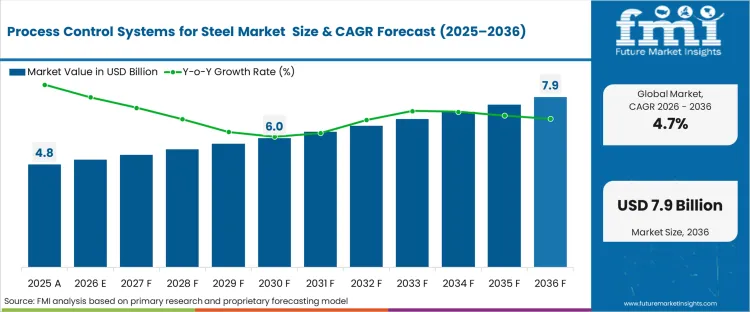
The Process Control Systems for Steel Market was valued at USD 4.8 billion in 2025. The market is projected to reach USD 5.0 billion in 2026 and USD 7.9 billion by 2036, expanding at a CAGR of 4.7% during the forecast period. Level 2 process control systems are expected to lead product type with a 31.4% share in 2026. Hot and cold rolling is projected to remain the leading workflow with a 38.6% share in 2026. Integrated steel plants are expected to lead end-user demand with a 57.2% share in 2026. This sizing reflects FMI’s inference from steel production intensity, continuous casting penetration, and the growing digital control content in new mill upgrades and brownfield modernization programs. World Steel Association data shows crude steel output remained exceptionally large in 2024, while OECD work points to ongoing investment pressure around efficiency, quality, and decarbonization.
Summary of Process Control Systems for Steel Market
- Key Drivers
- Mill modernization pressure: Steelmakers are under constant pressure to improve yield, temperature control, strip quality, and uptime. That pushes spending toward control architectures that reduce process drift and operator dependence.
- Decarbonisation-linked optimization: Energy, fuel, and emissions targets are forcing mills to tighten combustion, reheating, and casting control. Control software is becoming part of the efficiency stack rather than a back-office tool.
- Digital steelmaking expansion: New lines are increasingly ordered with Level 1, Level 2, and digitalization packages together. That lifts automation value per installation and strengthens aftermarket software revenue.
- Key Segments Analyzed in the Report
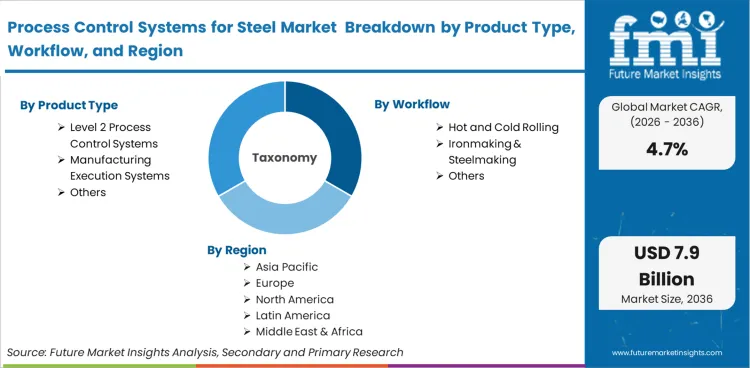
- Product type: level 1 automation systems, level 2 process control systems, manufacturing execution systems, advanced process control software, industrial sensors and analyzers, and others
- Workflow: ironmaking and steelmaking, continuous casting, hot and cold rolling, finishing and material handling
- End user: integrated steel plants, electric arc furnace and mini mills, specialty steel producers
- Region: North America, Latin America, Western Europe, Eastern Europe, East Asia, South Asia & Pacific, and Middle East & Africa
- Analyst Opinion
- Nikhil Kaitwade, Principal Consultant at Future Market Insights, "Value in this market does not pool in the controller box alone. It sits where suppliers can link process models, plant data, and mill-specific metallurgy into repeatable quality gains. The firms that win are the ones that make automation inseparable from throughput, energy discipline, and grade flexibility."
- Process Control Systems for Steel Market Definition
- The Process Control Systems for Steel Market includes hardware, software, and engineering services used to monitor, regulate, and optimize steel production processes. It covers Level 1 automation systems, Level 2 supervisory and model-based process control, manufacturing execution systems, advanced process control software, industrial sensors, analyzers, human machine interfaces, and associated integration services. These systems serve blast furnace and basic oxygen furnace operations, electric arc furnace routes, continuous casting, reheating, hot rolling, cold rolling, coating, and downstream finishing operations across integrated mills and mini mills.
- Process Control Systems for Steel Market Inclusions
- Revenue generated from automation platforms, supervisory control systems, process models, MES layers, analyzers, and steel-specific optimization software sold into steel plants
- New installation, modernization, engineering, commissioning, and recurring support revenue tied to steel mill process control environments
- Demand across integrated mills, EAF and mini mill sites, and specialty steel operations in all major producing regions
- Process Control Systems for Steel Market Exclusions
- General factory IT software with no direct steel process control function
- Revenue from core steelmaking equipment sold without associated automation or control scope
- Pure robotics, warehouse automation, and generic plant electrification systems except where bundled into steel process control scope
- Process Control Systems for Steel Market Research Methodology
- This study evaluates the market across key segments and regions for the base year 2025 and the forecast period 2026 to 2036. All market values are presented in USD billion. The analysis is built on a review of regulatory references, company disclosures, product and technology developments, trade literature, and industry documentation relevant to the value chain. Market estimates are derived through triangulation of demand-side trends, supply-side positioning, pricing dynamics, application intensity, and regional adoption patterns to establish current market size and forecast potential.
Key Drivers, Restraints, and Trends in Process Control Systems for Steel Market
Drivers
Steel production remains a very large industrial base, which keeps the addressable automation footprint substantial. World Steel Association data shows global crude steel production remained above 1.8 billion tonnes in 2024, and continuous casting penetration is already near-universal in major producing countries, making process stability and control quality commercially important. As mills push for tighter temperature windows, lower rework, and better metallurgical consistency, demand rises for Level 2 models, sensor layers, and execution software. Decarbonisation adds another demand channel because reheating, combustion, and line efficiency now matter more to cost and compliance. Supplier documentation from Tenova, Danieli, Primetals, and SMS shows that new steel projects increasingly bundle process control with digitalization and plant optimization rather than treating it as a secondary add-on.
Restraints
Integration complexity remains a real barrier. Many mills operate mixed legacy environments that make migration costly and technically disruptive. Vendor lock-in is another restraint because process models, interfaces, and historical data structures are not easy to swap. Smaller mills also face capital discipline, which slows adoption of full-stack automation upgrades. Project timing can stretch when shutdown windows are short. A final restraint is uneven digital maturity across regional steel fleets, which creates a long tail of plants that still modernize in stages rather than through full architecture replacement.
Trends
The market is moving toward integrated control stacks. Buyers are shifting from stand-alone automation packages to architectures that connect Level 1, Level 2, MES, analytics, and quality tracking. Continuous casting and strip processing remain the sharpest use cases because defects and energy losses surface quickly there. Reheating control is also gaining weight as mills pursue fuel savings and tighter downstream consistency. Competitive differentiation is concentrating around steel-specific models, digital twins, and faster brownfield deployment rather than around generic automation breadth alone.
Segmental Analysis
Process Control Systems for Steel Market Analysis by Product Type
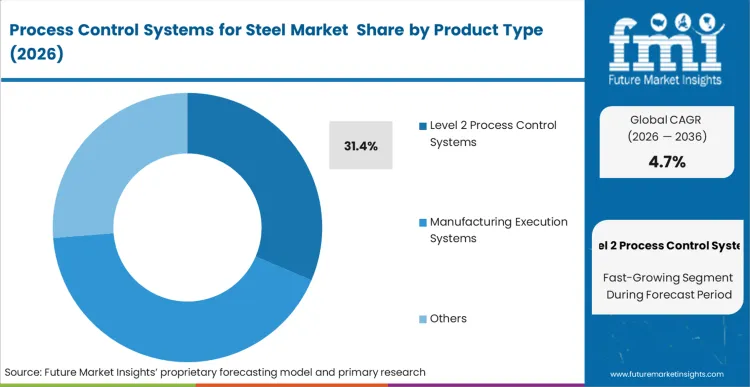
Level 2 process control systems are expected to hold the leading 31.4% share in 2026. They lead because the highest value in steel automation sits in supervisory process models that convert plant data into temperature control, chemistry correction, rolling setup, and defect reduction. This layer sits close enough to production economics to influence yield and grade consistency, but it scales better than site-specific hardware replacement. Tenova states that its Level 2 strip processing platform tracks the entire coil production process to improve and optimize process and product, while its iBOF Level 2 suite covers production planning, tracking, process optimization, and reporting. SMS also describes X-Pact Level 2 automation as guaranteeing efficient process control.
Process Control Systems for Steel Market Analysis by Workflow
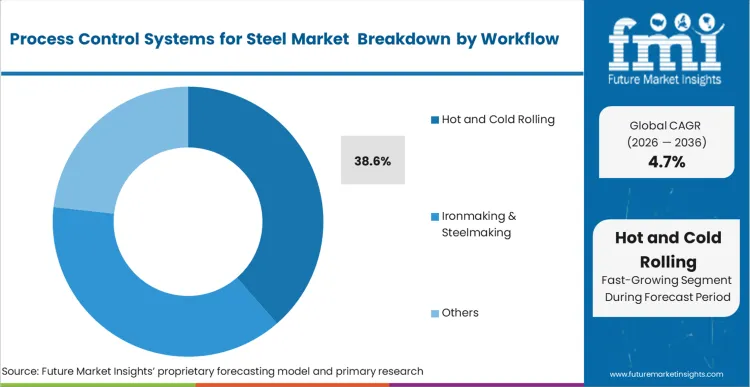
Hot and cold rolling is projected to account for 38.6% of market revenue in 2026. Rolling leads because gauge accuracy, flatness, surface quality, and throughput losses become visible quickly at this stage, which makes control software easier to justify commercially. The workflow also uses dense automation logic around setup models, line tracking, coil data, reheating coordination, and downstream quality correction. Tenova explicitly positions Level 2 strip processing around coil tracking and process optimization, and SMS links Level 2 automation to strip quality and stable mill performance in rolling projects.
Competitive Aligners for Market Players
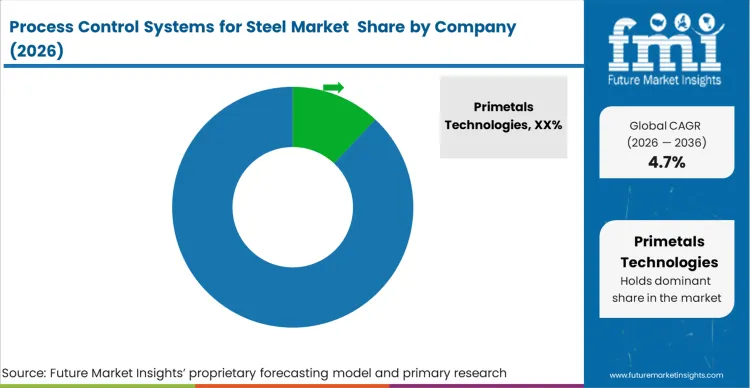
Competitive advantage in this market is not created by control hardware breadth alone. Steelmakers need validated process models, mill-specific engineering, dependable integration, strong HMI and historian layers, analyzers, and lifecycle support that keeps shutdown risk low. The strongest firms combine recurring software and services revenue with deep metallurgical know-how and proven commissioning capability. Primetals’ September 2025 Shanxi Jingang contract included a complete electrics package, Level 1 and Level 2 automation, and an extensive digitalization solution for a 2.6 million ton ESP line. Tenova continues to market steel-specific Level 2 platforms across BOF, reheating, and strip processing. SMS positions X-Pact Level 2 around efficient process control in mill upgrades. Leadership is being built around end-to-end steel workflow fit, not generic automation catalogs.
Key Players in Process Control Systems for Steel Market
- Primetals Technologies
- SMS group GmbH
- Tenova S.p.A.
- Danieli & C. Officine Meccaniche S.p.A.
- ABB Ltd
- Siemens AG
- Yokogawa Electric Corporation
- Emerson Electric Co.
- Rockwell Automation, Inc.
- Schneider Electric SE
Strategic Outlook by FMI on Process Control Systems for Steel Market
The market is shifting from isolated automation procurement toward integrated, steel-specific digital control architectures. The next phase will be shaped by brownfield modernization, decarbonisation-linked efficiency spending, and stronger demand for Level 2 and execution software that directly improves quality and energy performance. The companies most likely to win are those that pair steel process know-how with upgrade-friendly deployment, strong lifecycle support, and software layers that prove measurable mill economics.
Scope of the Report
| Metric | Value |
|---|---|
| Market Value | USD 4.8 billion in 2025 to USD 7.9 billion by 2036 |
| CAGR | 4.7% from 2026 to 2036 |
| Base Year | 2025 |
| Forecast Period | 2026 to 2036 |
| Product Type Segmentation | Level 1 Automation Systems, Level 2 Process Control Systems, Manufacturing Execution Systems, Advanced Process Control Software, Industrial Sensors & Analyzers, Others |
| Workflow Segmentation | Ironmaking & Steelmaking, Continuous Casting, Hot & Cold Rolling, Finishing & Material Handling |
| End User Segmentation | Integrated Steel Plants, Electric Arc Furnace and Mini Mills, Specialty Steel Producers |
| Regions Covered | North America, Latin America, Western Europe, Eastern Europe, East Asia, South Asia and Pacific, Middle East and Africa |
Bibliography
- World Steel Association. 2025. World Steel in Figures 2025.
- OECD. 2025. OECD Steel Outlook 2025. OECD Publishing, Paris.
- OECD. 2024. Addressing Steel Decarbonisation Challenges for Industry and Policy. OECD Science, Technology and Industry Policy Papers, No. 171.
- Primetals Technologies. 2025. Shanxi Jingang New Materials Technology Selects Primetals Technologies for Arvedi ESP Line.
- Tenova. Current. Level 2 Strip Processing.
- Tenova. Current. iBOF® Level 2 Automation.
- SMS group GmbH. 2024. Annual Report 2023.
Frequently Asked Questions
What is the current size of the process control systems for steel market?
The process control systems for steel industry market was valued at USD 4.8 billion in 2025.
What is the expected market value of the process control systems for steel market in 2026?
The market is projected to reach USD 5.0 billion in 2026.
What will be the process control systems for steel industry market value by 2036?
The market is forecast to reach USD 7.9 billion by 2036.
What is the projected CAGR of the process control systems for steel market?
The market is projected to expand at a CAGR of 4.7% from 2026 to 2036.
Which product type leads the process control systems for steel market in 2026?
Level 2 process control systems are expected to lead the market with a 31.4% share in 2026.
Preview the report firsthand - request a free sample
Get SampleGet the brochure for pricing and purchase details.
Get PDFTable of Content
- Executive Summary
- Global Market Outlook
- Demand-side Trends
- Supply-side Trends
- Technology Roadmap Analysis
- Analysis and Recommendations
- Market Overview
- Market Coverage / Taxonomy
- Market Definition / Scope / Limitations
- Research Methodology
- Chapter Orientation
- Analytical Lens and Working Hypotheses
- Market Structure, Signals, and Trend Drivers
- Benchmarking and Cross-market Comparability
- Market Sizing, Forecasting, and Opportunity Mapping
- Research Design and Evidence Framework
- Desk Research Programme (Secondary Evidence)
- Company Annual and Sustainability Reports
- Peer-reviewed Journals and Academic Literature
- Corporate Websites, Product Literature, and Technical Notes
- Earnings Decks and Investor Briefings
- Statutory Filings and Regulatory Disclosures
- Technical White Papers and Standards Notes
- Trade Journals, Industry Magazines, and Analyst Briefs
- Conference Proceedings, Webinars, and Seminar Materials
- Government Statistics Portals and Public Data Releases
- Press Releases and Reputable Media Coverage
- Specialist Newsletters and Curated Briefings
- Sector Databases and Reference Repositories
- FMI Internal Proprietary Databases and Historical Market Datasets
- Subscription Datasets and Paid Sources
- Social Channels, Communities, and Digital Listening Inputs
- Additional Desk Sources
- Expert Input and Fieldwork (Primary Evidence)
- Primary Modes
- Qualitative Interviews and Expert Elicitation
- Quantitative Surveys and Structured Data Capture
- Blended Approach
- Why Primary Evidence is Used
- Field Techniques
- Interviews
- Surveys
- Focus Groups
- Observational and In-context Research
- Social and Community Interactions
- Stakeholder Universe Engaged
- C-suite Leaders
- Board Members
- Presidents and Vice Presidents
- R&D and Innovation Heads
- Technical Specialists
- Domain Subject-matter Experts
- Scientists
- Physicians and Other Healthcare Professionals
- Governance, Ethics, and Data Stewardship
- Research Ethics
- Data Integrity and Handling
- Primary Modes
- Tooling, Models, and Reference Databases
- Desk Research Programme (Secondary Evidence)
- Data Engineering and Model Build
- Data Acquisition and Ingestion
- Cleaning, Normalisation, and Verification
- Synthesis, Triangulation, and Analysis
- Quality Assurance and Audit Trail
- Market Background
- Market Dynamics
- Drivers
- Restraints
- Opportunity
- Trends
- Scenario Forecast
- Demand in Optimistic Scenario
- Demand in Likely Scenario
- Demand in Conservative Scenario
- Opportunity Map Analysis
- Product Life Cycle Analysis
- Supply Chain Analysis
- Investment Feasibility Matrix
- Value Chain Analysis
- PESTLE and Porter’s Analysis
- Regulatory Landscape
- Regional Parent Market Outlook
- Production and Consumption Statistics
- Import and Export Statistics
- Market Dynamics
- Global Market Analysis 2021 to 2025 and Forecast, 2026 to 2036
- Historical Market Size Value (USD Million) Analysis, 2021 to 2025
- Current and Future Market Size Value (USD Million) Projections, 2026 to 2036
- Y-o-Y Growth Trend Analysis
- Absolute $ Opportunity Analysis
- Global Market Pricing Analysis 2021 to 2025 and Forecast 2026 to 2036
- Global Market Analysis 2021 to 2025 and Forecast 2026 to 2036, By Product Type
- Introduction / Key Findings
- Historical Market Size Value (USD Million) Analysis By Product Type , 2021 to 2025
- Current and Future Market Size Value (USD Million) Analysis and Forecast By Product Type , 2026 to 2036
- Level 2 Process Control Systems
- Manufacturing Execution Systems
- Others
- Level 2 Process Control Systems
- Y-o-Y Growth Trend Analysis By Product Type , 2021 to 2025
- Absolute $ Opportunity Analysis By Product Type , 2026 to 2036
- Global Market Analysis 2021 to 2025 and Forecast 2026 to 2036, By Workflow
- Introduction / Key Findings
- Historical Market Size Value (USD Million) Analysis By Workflow, 2021 to 2025
- Current and Future Market Size Value (USD Million) Analysis and Forecast By Workflow, 2026 to 2036
- Hot and Cold Rolling
- Ironmaking & Steelmaking
- Others
- Hot and Cold Rolling
- Y-o-Y Growth Trend Analysis By Workflow, 2021 to 2025
- Absolute $ Opportunity Analysis By Workflow, 2026 to 2036
- Global Market Analysis 2021 to 2025 and Forecast 2026 to 2036, By Region
- Introduction
- Historical Market Size Value (USD Million) Analysis By Region, 2021 to 2025
- Current Market Size Value (USD Million) Analysis and Forecast By Region, 2026 to 2036
- North America
- Latin America
- Western Europe
- Eastern Europe
- East Asia
- South Asia and Pacific
- Middle East & Africa
- Market Attractiveness Analysis By Region
- North America Market Analysis 2021 to 2025 and Forecast 2026 to 2036, By Country
- Historical Market Size Value (USD Million) Trend Analysis By Market Taxonomy, 2021 to 2025
- Market Size Value (USD Million) Forecast By Market Taxonomy, 2026 to 2036
- By Country
- USA
- Canada
- Mexico
- By Product Type
- By Workflow
- By Country
- Market Attractiveness Analysis
- By Country
- By Product Type
- By Workflow
- Key Takeaways
- Latin America Market Analysis 2021 to 2025 and Forecast 2026 to 2036, By Country
- Historical Market Size Value (USD Million) Trend Analysis By Market Taxonomy, 2021 to 2025
- Market Size Value (USD Million) Forecast By Market Taxonomy, 2026 to 2036
- By Country
- Brazil
- Chile
- Rest of Latin America
- By Product Type
- By Workflow
- By Country
- Market Attractiveness Analysis
- By Country
- By Product Type
- By Workflow
- Key Takeaways
- Western Europe Market Analysis 2021 to 2025 and Forecast 2026 to 2036, By Country
- Historical Market Size Value (USD Million) Trend Analysis By Market Taxonomy, 2021 to 2025
- Market Size Value (USD Million) Forecast By Market Taxonomy, 2026 to 2036
- By Country
- Germany
- UK
- Italy
- Spain
- France
- Nordic
- BENELUX
- Rest of Western Europe
- By Product Type
- By Workflow
- By Country
- Market Attractiveness Analysis
- By Country
- By Product Type
- By Workflow
- Key Takeaways
- Eastern Europe Market Analysis 2021 to 2025 and Forecast 2026 to 2036, By Country
- Historical Market Size Value (USD Million) Trend Analysis By Market Taxonomy, 2021 to 2025
- Market Size Value (USD Million) Forecast By Market Taxonomy, 2026 to 2036
- By Country
- Russia
- Poland
- Hungary
- Balkan & Baltic
- Rest of Eastern Europe
- By Product Type
- By Workflow
- By Country
- Market Attractiveness Analysis
- By Country
- By Product Type
- By Workflow
- Key Takeaways
- East Asia Market Analysis 2021 to 2025 and Forecast 2026 to 2036, By Country
- Historical Market Size Value (USD Million) Trend Analysis By Market Taxonomy, 2021 to 2025
- Market Size Value (USD Million) Forecast By Market Taxonomy, 2026 to 2036
- By Country
- China
- Japan
- South Korea
- By Product Type
- By Workflow
- By Country
- Market Attractiveness Analysis
- By Country
- By Product Type
- By Workflow
- Key Takeaways
- South Asia and Pacific Market Analysis 2021 to 2025 and Forecast 2026 to 2036, By Country
- Historical Market Size Value (USD Million) Trend Analysis By Market Taxonomy, 2021 to 2025
- Market Size Value (USD Million) Forecast By Market Taxonomy, 2026 to 2036
- By Country
- India
- ASEAN
- Australia & New Zealand
- Rest of South Asia and Pacific
- By Product Type
- By Workflow
- By Country
- Market Attractiveness Analysis
- By Country
- By Product Type
- By Workflow
- Key Takeaways
- Middle East & Africa Market Analysis 2021 to 2025 and Forecast 2026 to 2036, By Country
- Historical Market Size Value (USD Million) Trend Analysis By Market Taxonomy, 2021 to 2025
- Market Size Value (USD Million) Forecast By Market Taxonomy, 2026 to 2036
- By Country
- Kingdom of Saudi Arabia
- Other GCC Countries
- Turkiye
- South Africa
- Other African Union
- Rest of Middle East & Africa
- By Product Type
- By Workflow
- By Country
- Market Attractiveness Analysis
- By Country
- By Product Type
- By Workflow
- Key Takeaways
- Key Countries Market Analysis
- USA
- Pricing Analysis
- Market Share Analysis, 2025
- By Product Type
- By Workflow
- Canada
- Pricing Analysis
- Market Share Analysis, 2025
- By Product Type
- By Workflow
- Mexico
- Pricing Analysis
- Market Share Analysis, 2025
- By Product Type
- By Workflow
- Brazil
- Pricing Analysis
- Market Share Analysis, 2025
- By Product Type
- By Workflow
- Chile
- Pricing Analysis
- Market Share Analysis, 2025
- By Product Type
- By Workflow
- Germany
- Pricing Analysis
- Market Share Analysis, 2025
- By Product Type
- By Workflow
- UK
- Pricing Analysis
- Market Share Analysis, 2025
- By Product Type
- By Workflow
- Italy
- Pricing Analysis
- Market Share Analysis, 2025
- By Product Type
- By Workflow
- Spain
- Pricing Analysis
- Market Share Analysis, 2025
- By Product Type
- By Workflow
- France
- Pricing Analysis
- Market Share Analysis, 2025
- By Product Type
- By Workflow
- India
- Pricing Analysis
- Market Share Analysis, 2025
- By Product Type
- By Workflow
- ASEAN
- Pricing Analysis
- Market Share Analysis, 2025
- By Product Type
- By Workflow
- Australia & New Zealand
- Pricing Analysis
- Market Share Analysis, 2025
- By Product Type
- By Workflow
- China
- Pricing Analysis
- Market Share Analysis, 2025
- By Product Type
- By Workflow
- Japan
- Pricing Analysis
- Market Share Analysis, 2025
- By Product Type
- By Workflow
- South Korea
- Pricing Analysis
- Market Share Analysis, 2025
- By Product Type
- By Workflow
- Russia
- Pricing Analysis
- Market Share Analysis, 2025
- By Product Type
- By Workflow
- Poland
- Pricing Analysis
- Market Share Analysis, 2025
- By Product Type
- By Workflow
- Hungary
- Pricing Analysis
- Market Share Analysis, 2025
- By Product Type
- By Workflow
- Kingdom of Saudi Arabia
- Pricing Analysis
- Market Share Analysis, 2025
- By Product Type
- By Workflow
- Turkiye
- Pricing Analysis
- Market Share Analysis, 2025
- By Product Type
- By Workflow
- South Africa
- Pricing Analysis
- Market Share Analysis, 2025
- By Product Type
- By Workflow
- USA
- Market Structure Analysis
- Competition Dashboard
- Competition Benchmarking
- Market Share Analysis of Top Players
- By Regional
- By Product Type
- By Workflow
- Competition Analysis
- Competition Deep Dive
- Primetals Technologies
- Overview
- Product Portfolio
- Profitability by Market Segments (Product/Age /Sales Channel/Region)
- Sales Footprint
- Strategy Overview
- Marketing Strategy
- Product Strategy
- Channel Strategy
- SMS group GmbH
- Tenova S.p.A.
- Danieli & C. Officine Meccaniche S.p.A.
- ABB Ltd
- Siemens AG
- Primetals Technologies
- Competition Deep Dive
- Assumptions & Acronyms Used


