

- Industry Size (2026)
- USD 5.8 Bn
- Forecast (2036)
- USD 13.4 Bn
- CAGR (2026 to 2036)
- 8.7%
VOC Control Systems Market Forecast and Outlook 2026 to 2036
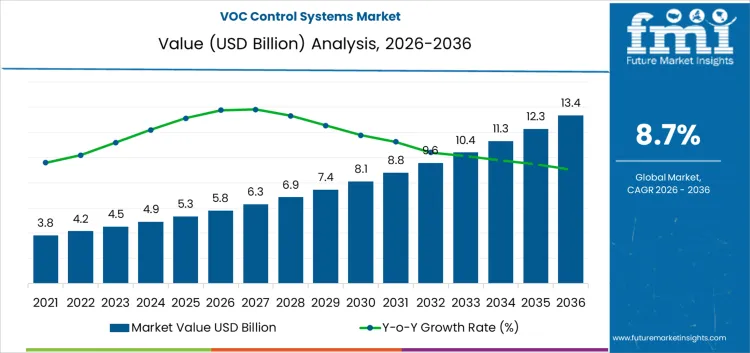
In 2026, the VOC control systems market stands at USD 5.8 billion and is projected to reach USD 13.4 billion by 2036, implying a CAGR of 8.7%. Deployment is driven primarily by regulatory compliance in industries such as chemicals, coatings, printing, pharmaceuticals, and food processing, where volatile organic compound emissions are monitored and limited. System choice depends on concentration levels, exhaust volumes, and process continuity requirements rather than on equipment price alone. Capital decisions are often tied to permitting, plant expansions, or process changes, which makes demand episodic rather than continuous. Geographic concentration follows regions with strict air quality standards and active enforcement regimes.
Operating economics and liability exposure shape adoption behavior across different sectors. Facilities weigh destruction efficiency, energy consumption, uptime risk, and maintenance burden when selecting between thermal oxidation, adsorption, or recovery based systems. Compliance audits, reporting obligations, and inspection frequency influence replacement and upgrade timing. In some regions, incentives or carbon related programs alter technology preference, while elsewhere enforcement relies mainly on penalties. Supplier positioning depends on the ability to support engineering, installation, and long term service. The market expands through regulatory tightening and process modernization, not through discretionary environmental upgrades or uniform industrial expansion.
Quick Stats for VOC Control Systems Market
- VOC Control Systems Market Value (2026): USD 5.8 billion
- VOC Control Systems Market Forecast Value (2036): USD 13.4 billion
- VOC Control Systems Market Forecast CAGR 2026 to 2036: 8.7%
- Leading Type in VOC Control Systems Market: Thermal oxidizers
- Key Growth Regions in VOC Control Systems Market: Asia Pacific, North America, Europe
- Top Players in VOC Control Systems Market: Evoqua Water Technologies (Xylem), DuPont, Honeywell UOP, BASF, Johnson Matthey, Air Liquide Engineering & Construction, Donaldson Company
What is the Growth Forecast for VOC Control Systems Market through 2036?
The VOC control systems market expands in step with regulatory enforcement and industrial capacity additions rather than with discretionary environmental spending. At roughly USD 3.3 billion at the start of the period, the market moves through USD 3.9 billion and USD 4.7 billion as coatings, chemicals, printing, and pharmaceuticals add abatement capacity to meet permitting and compliance thresholds. When spending reaches about USD 5.8 billion, the category is no longer driven only by new plants. Retrofits, line extensions, and process changes begin to account for a large share of orders. Growth is anchored in thermal oxidizers, adsorption systems, and hybrid configurations sized to specific exhaust streams, which makes project value depend more on process complexity and airflow volumes than on simple equipment counts.
As industrial output and compliance coverage widen, the market advances through approximately USD 6.9 billion, USD 8.2 billion, and USD 9.7 billion, with demand increasingly tied to multi-line facilities and integrated emission management programs. By the time spending passes about USD 10.6 billion and then moves toward USD 11.6 and USD 12.4 billion, replacement and system upgrades become as important as first-time installations. Approaching roughly USD 13.4 billion, value growth is driven by higher specification systems, energy recovery integration, and tighter monitoring requirements rather than by a surge in the number of regulated sites. The economics remain compliance-led and project-based, with purchasing decisions dominated by reliability, destruction efficiency, operating cost, and the ability to meet audit and permitting obligations over long operating lives.
VOC Control Systems Market Key Takeaways
| Metric | Value |
|---|---|
| Market Value (2026) | USD 5.8 billion |
| Forecast Value (2036) | USD 13.4 billion |
| Forecast CAGR 2026 to 2036 | 8.7% |
How Is the VOC Control Systems Market Enhancing Industrial Emission Management?
VOC (volatile organic compound) control systems are increasingly adopted to reduce harmful emissions from industrial processes, chemical plants, and manufacturing facilities. Historically, industries relied on passive ventilation or basic scrubbers, which often failed to meet regulatory standards or adequately capture emissions, leading to environmental compliance risks. Modern VOC control systems integrate activated carbon adsorption, thermal oxidation, and biofiltration technologies to efficiently capture, degrade, or neutralize organic pollutants. Industrial operators, environmental compliance managers, and regulatory bodies prioritize system efficiency, reliability, and adherence to emission standards. Early adoption focused on high-emission chemical and petrochemical plants, while current demand spans paints and coatings, printing, automotive, and pharmaceutical manufacturing, driven by stringent regulatory requirements, operational safety, and process control considerations. Capture efficiency, operational reliability, and maintenance requirements influence supplier selection.
Operational compliance, workplace safety, and emission reduction objectives are shaping market growth. Compared with conventional ventilation methods, modern VOC control systems emphasize high removal efficiency, continuous monitoring, and adaptability to diverse industrial processes. Cost structures depend on technology type, material durability, and control system integration, concentrating margins among suppliers capable of delivering reliable, certified solutions. Manufacturers adopt these systems to ensure regulatory compliance, minimize environmental impact, and protect worker health. By 2036, VOC control systems are expected to become standard across industrial sectors, supporting effective emission management, operational reliability, and adherence to environmental regulations.
What Factors Are Shaping the Demand for VOC Control Systems, Segment wise by Technology Type and End Use Industry, in 2026?
The VOC control systems market in 2026 is segmented by technology type and by end use industry. By treatment method, demand is divided into thermal oxidizers, adsorption systems, biofiltration systems, and catalytic oxidizers, each offering different balances between destruction efficiency, operating cost, and maintenance complexity. By end use, demand is organized around chemical processing, oil and gas, pharmaceuticals, and food and beverage, which differ in emission profiles, regulatory exposure, and continuity of operation. These segments reflect how plant operators choose between capital intensive abatement equipment and lower energy or media based solutions depending on process conditions.
Why Do Thermal Oxidizers Dominate Where Compliance Risk Is Highest?
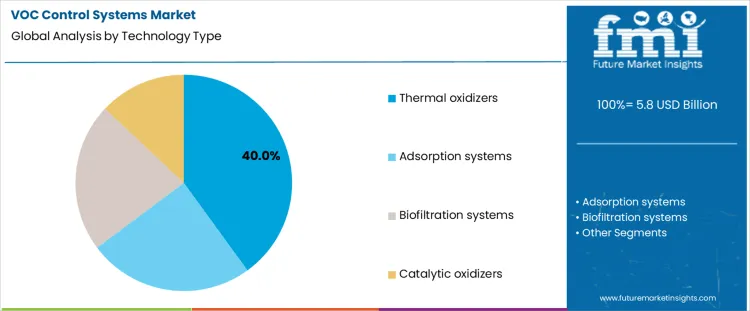
Thermal oxidizers account for about 40% of demand in 2026 because they provide a direct and highly reliable method for destroying a wide range of volatile organic compounds. In regulated environments, certainty of performance matters more than marginal differences in operating cost. Thermal systems achieve very high destruction efficiencies and are less sensitive to changes in gas composition than many alternative technologies. Once installed, they are accepted by regulators and inspectors as a robust solution. In continuous process industries, this predictability reduces compliance risk and operational disputes. These characteristics explain why thermal oxidizers remain the preferred choice in plants where emission limits are strict and interruptions are costly.
Adsorption, biofiltration, and catalytic systems serve more specific process windows. Adsorption works well for lower concentration streams but requires media replacement and regeneration management. Biofiltration suits biodegradable compounds but depends on stable biological conditions. Catalytic oxidizers reduce energy use but require clean, well controlled streams to avoid catalyst poisoning. These technologies are selected where conditions fit, yet their narrower operating envelopes limit their share compared with the broad applicability of thermal oxidation.
Why Does Chemical Processing Lead End Use Demand?
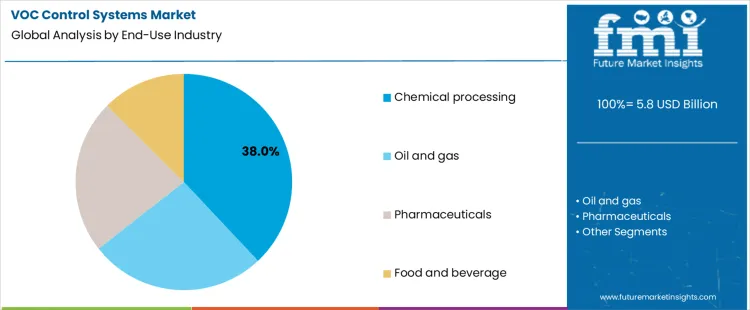
Chemical processing represents about 38% of demand in 2026 because it handles large volumes of solvent laden and hydrocarbon rich exhaust streams. Many chemical plants operate continuous processes where even short compliance failures can lead to shutdowns or penalties. This drives investment in proven, high capacity control systems rather than in marginal solutions. The diversity of products and batch processes also creates variable emission profiles, which favors technologies that can handle wide fluctuations without retuning. Capital spending in this sector is therefore closely tied to regulatory audits, plant expansions, and debottlenecking projects.
Oil and gas, pharmaceuticals, and food processing follow different patterns. Oil and gas facilities often deal with fewer but larger point sources. Pharmaceutical plants emit smaller volumes but face strict documentation and validation cycles. Food and beverage operations generate more dilute and variable streams that can sometimes be treated with simpler systems. These sectors invest steadily, but none combines the scale, variability, and regulatory exposure found in chemical processing, which keeps it as the largest end use segment for VOC control systems.
How Are the Key Dynamics Reshaping the VOC Control Systems Market?
The category is being shaped by how regulators and operators manage compliance risk rather than by equipment replacement cycles. Stricter emission limits raise demand, but project timing is constrained by permitting, capital approval, and integration with production lines. At the same time, many plants are standardizing abatement platforms across sites to simplify audits, spares, and reporting. This creates tension between urgency to comply and caution about locking into the wrong technology. The result is a market driven by governance and lifecycle economics, where scale comes from programmatic rollouts and platform selection more than from one off retrofits or isolated process upgrades.
Why Are Emission Standards Driving VOC Control Systems?
Demand is anchored in enforceable limits and inspection exposure. Coating, chemicals, printing, and food processing sites face defined caps on solvent and hydrocarbon releases, with penalties that disrupt operations and reputations. As permits tighten, operators must either reduce throughput or install abatement. Control systems become enabling infrastructure that protects capacity and keeps lines running. Once a plant commits to a compliance strategy, equipment is sized to cover peak loads and remains in place for many years. Volume follows regulatory coverage expansions and new line approvals rather than discretionary efficiency projects, tying growth to rulemaking and enforcement intensity across regions.
What Is Slowing Wider Adoption of VOC Controls?
The main barrier is project risk, not technology maturity. Installation affects ducts, stacks, and process balance, and outages can be costly. Capital approval competes with production investments, especially where payback is framed as avoided fines rather than revenue. Performance depends on variable inlet loads, which makes sizing contentious and invites conservative overdesign. Energy use and consumables raise operating cost concerns. In multi-product plants, changing recipes can invalidate assumptions. These uncertainties stretch engineering studies and approvals, keeping many sites in staged upgrades or partial coverage even when compliance pressure is rising.
How Are Platforms Changing the VOC Control Systems Market?
The trend is toward standardized abatement stacks. Large operators increasingly select a small set of approved technologies and suppliers, then replicate them across sites to simplify audits, training, and spares. Controls, monitoring, and reporting are integrated into plant systems to produce consistent compliance evidence. Procurement shifts to framework agreements covering families of units and long term service. This reduces engineering variability and shortens permitting for repeat builds. Over time, competition moves from single project wins to inclusion in approved platforms, with success measured by uptime, documentation quality, and ability to support multi-site deployment programs.
What is the Demand for VOC Control Systems by Country?
| Country | CAGR (%) |
|---|---|
| US | 8.0% |
| UK | 7.5% |
| China | 9.5% |
| India | 10.0% |
| Brazil | 8.3% |
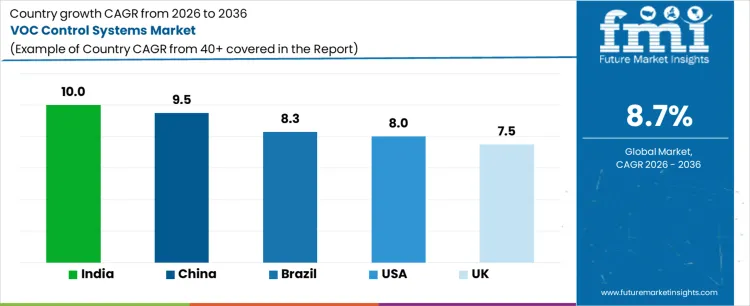
Demand for VOC control systems is rising as industries adopt equipment to reduce volatile organic compound emissions, comply with environmental regulations, and maintain workplace safety. India leads with a 10.0% CAGR, driven by expanding industrial production, stringent emission standards, and increased focus on air quality management. China follows at 9.5%, supported by regulatory compliance, industrial growth, and adoption of emission control technologies. Brazil records 8.3% growth, shaped by industrial modernization and pollution control initiatives. The US grows at 8.0%, influenced by replacement demand and compliance with federal emission standards. The UK shows 7.5% CAGR, reflecting steady adoption in manufacturing and industrial operations.
How is the United States experiencing growth in the VOC control systems market?
United States is experiencing growth at a CAGR of 8%, driven by stringent environmental regulations and compliance standards in states such as California, Texas, and New York. Industrial sectors including chemical manufacturing, painting, and coatings require VOC control systems to meet emission limits. Market concentration is higher around industrial clusters, while regional dispersion exists in secondary manufacturing hubs. Investments focus on high-efficiency filtration, scrubbers, and integration with existing process lines. Growth reflects the enforcement of air quality standards, operational efficiency, and demand for regulatory-compliant emission reduction solutions.
- Chemical, painting, and coatings industries drive adoption.
- Industrial clusters concentrate demand.
- Filtration and scrubber efficiency guide investment.
- Regulatory compliance ensures adoption.
How is the United Kingdom witnessing growth in the VOC control systems market?
United Kingdom is witnessing growth at a CAGR of 7.5%, supported by energy-intensive manufacturing facilities in London, Birmingham, and Manchester. Exposure to export markets and global production cycles encourages the adoption of VOC control systems that meet both domestic and international emission standards. Demand is concentrated in chemical plants, paint factories, and industrial coatings operations. Investments prioritize system reliability, efficiency, and adaptability to diverse process lines. Growth reflects manufacturers’ focus on minimizing environmental impact while remaining competitive in global supply chains.
- Chemical and coatings manufacturing drive adoption.
- Urban industrial hubs concentrate demand.
- System reliability and adaptability guide investment.
- Compliance with international standards supports deployment.
How is China experiencing growth in the VOC control systems market?
China is experiencing growth at a CAGR of 9.5%, fueled by industrial clusters in Shanghai, Guangzhou, and Beijing where chemical, automotive, and coatings sectors are concentrated. Standard-setting influence and local regulations encourage widespread installation of VOC control systems. Market concentration in major industrial zones facilitates adoption, while domestic manufacturers increasingly supply high-efficiency solutions. Investments focus on filtration technology, energy efficiency, and integration with large-scale production systems. Growth reflects government-led initiatives to reduce air pollution and enforce emission compliance in high-output manufacturing centers.
- Chemical and automotive clusters drive adoption.
- Urban industrial zones concentrate demand.
- Filtration and energy efficiency guide investment.
- Regulatory influence shapes deployment.
How is India witnessing growth in the VOC control systems market?
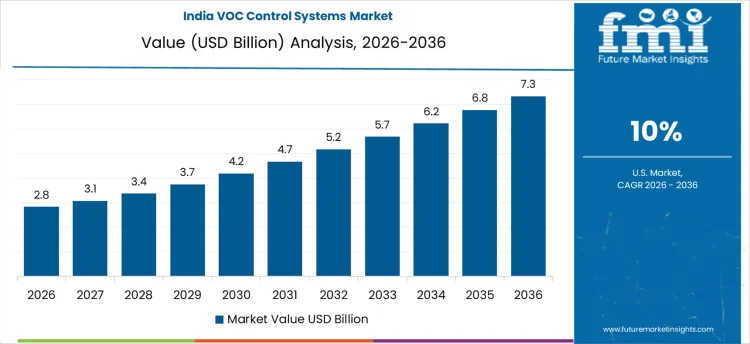
India is experiencing growth at a CAGR of 10%, supported by capital intensity and payback expectations in industrial sectors across Mumbai, Delhi, and Pune. Manufacturers in paints, chemicals, and automotive coatings prioritize VOC control systems that offer high efficiency and predictable returns on investment. Urban industrial hubs concentrate demand, and investments focus on integrating emission control with existing production lines. Growth reflects increasing awareness of air quality standards, rising environmental regulations, and operational cost considerations in Indian manufacturing facilities.
- Paints, chemicals, and automotive coatings drive adoption.
- Urban industrial hubs concentrate demand.
- Efficiency and payback guide investment.
- Integration with production lines supports deployment.
How is Brazil experiencing growth in the VOC control systems market?
Brazil is experiencing growth at a CAGR of 8.3%, driven by sensitivity to downtime and operational risk in industrial sectors such as chemical processing, paints, and coatings in São Paulo, Rio de Janeiro, and Paraná. VOC control systems ensure continuous compliance while minimizing production interruptions. Demand is concentrated in urban industrial zones, and investments focus on reliable filtration, scrubber efficiency, and process integration. Growth reflects the need for consistent emission control, operational reliability, and adherence to national environmental regulations.
- Chemical and coatings industries drive adoption.
- Urban industrial zones concentrate demand.
- Filtration and process integration guide investment.
- Operational reliability influences procurement.
VOC Control Systems Market How Are Providers Addressing Industrial Emissions and Compliance?
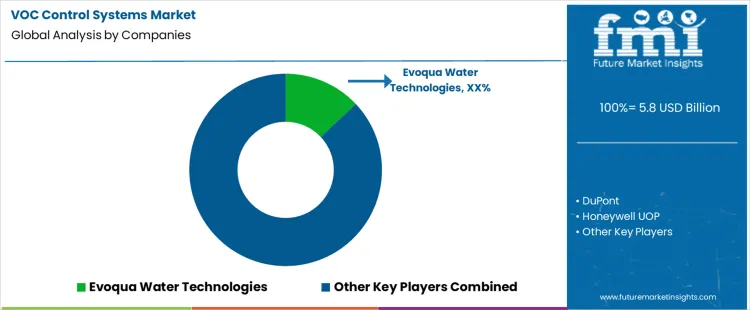
Competition in the volatile organic compound (VOC) control systems market is defined by technology effectiveness, compliance with environmental regulations, and suitability for industrial process integration. Evoqua Water Technologies supplies VOC capture and oxidation systems designed for chemical, petrochemical, and manufacturing emissions, with aftermarket support for system installation and optimization. DuPont provides VOC control media and catalyst systems tailored for thermal and catalytic oxidation, enabling operators to meet stringent air quality standards. Honeywell UOP delivers process reactors and VOC abatement technologies integrated into refinery and petrochemical workflows, emphasising uptime and regulatory alignment. BASF offers advanced sorbents and catalysts engineered to lower VOC emissions across varied industrial processes.
Johnson Matthey focuses on catalytic technologies and engineered systems that assist industrial facilities in achieving low emission targets with minimal energy penalty. Air Liquide Engineering & Construction supplies VOC control solutions that integrate adsorption, oxidation, and heat recovery for large scale industrial sites. Donaldson Company provides filtration and adsorption systems designed to remove VOCs from compressed air and process exhaust streams, with emphasis on modular retrofit capability. Other regional and specialty providers contribute VOC abatement technologies aligned with specific industry needs. Competitive differentiation arises from abatement efficiency, energy consumption, ability to support regulatory reporting, and ease of integration with existing plant infrastructure. Suppliers that offer robust performance data, service support, and validation against emission standards are positioned to meet demand in sectors where VOC control is critical for environmental compliance and community impact mitigation.
Key Players in the VOC Control Systems Market
- Evoqua Water Technologies (Xylem)
- DuPont
- Honeywell UOP
- BASF
- Johnson Matthey
- Air Liquide Engineering & Construction
- Donaldson Company
Scope of the Report
| Items | Values |
|---|---|
| Quantitative Units (2026) | USD billion |
| Technology Type | Thermal Oxidizers, Adsorption Systems, Biofiltration Systems, Catalytic Oxidizers |
| End-Use Industry | Chemical Processing, Oil and Gas, Pharmaceuticals, Food and Beverage |
| Regions Covered | Asia Pacific, Europe, North America, Latin America, Middle East & Africa |
| Countries Covered | China, Japan, South Korea, India, Australia & New Zealand, ASEAN, Germany, United Kingdom, France, Italy, Spain, Nordic, BENELUX, United States, Canada, Mexico, Brazil, Chile, Saudi Arabia, Turkey, South Africa, and other regional markets |
| Key Companies Profiled | Evoqua Water Technologies (Xylem), DuPont, Honeywell UOP, BASF, Johnson Matthey, Air Liquide Engineering & Construction, Donaldson Company |
| Additional Attributes | Dollar sales by technology and end-use; thermal oxidizers and chemical processing as leading segments; demand driven by regulatory compliance, audits, and permitting; project-based economics shaped by destruction efficiency, energy use, uptime risk, and maintenance; growth led by retrofits, system upgrades, and multi-line plant expansions rather than new site count alone. |
VOC Control Systems Market Segmentation
Technology Type:
- Thermal oxidizers
- Adsorption systems
- Biofiltration systems
- Catalytic oxidizers
End-Use Industry:
- Chemical processing
- Oil and gas
- Pharmaceuticals
- Food and beverage
Region
- Asia Pacific
- China
- Japan
- South Korea
- India
- Australia & New Zealand
- ASEAN
- Rest of Asia Pacific
- Europe
- Germany
- United Kingdom
- France
- Italy
- Spain
- Nordic
- BENELUX
- Rest of Europe
- North America
- United States
- Canada
- Mexico
- Latin America
- Brazil
- Chile
- Rest of Latin America
- Middle East & Africa
- Kingdom of Saudi Arabia
- Other GCC Countries
- Turkey
- South Africa
- Other African Union
- Rest of Middle East & Africa
Bibliography
- European Commission. (2024). Directive (EU) 2024/1824 on industrial emissions (integrated pollution prevention and control): Consolidated version and implementation guidance. Directorate-General for Environment.
- United States Environmental Protection Agency. (2024). National emission standards for hazardous air pollutants (NESHAP): Amendments for control of volatile organic compound emissions from industrial sources. U.S. EPA.
- Central Pollution Control Board. (2024). Guidelines for control of volatile organic compound (VOC) emissions from industrial sources: Revised compliance framework. Ministry of Environment, Forest and Climate Change, Government of India.
Frequently Asked Questions
How big is the voc control systems market in 2026?
The global voc control systems market is estimated to be valued at USD 5.8 billion in 2026.
What will be the size of voc control systems market in 2036?
The market size for the voc control systems market is projected to reach USD 13.4 billion by 2036.
How much will be the voc control systems market growth between 2026 and 2036?
The voc control systems market is expected to grow at a 8.7% CAGR between 2026 and 2036.
What are the key product types in the voc control systems market?
The key product types in voc control systems market are thermal oxidizers , adsorption systems, biofiltration systems and catalytic oxidizers.
Which end‑use industry segment to contribute significant share in the voc control systems market in 2026?
In terms of end‑use industry, chemical processing segment to command 38.0% share in the voc control systems market in 2026.
Preview the report firsthand - request a free sample
Get SampleGet the brochure for pricing and purchase details.
Get PDFTable of Content
- Executive Summary
- Global Market Outlook
- Demand-side Trends
- Supply-side Trends
- Technology Roadmap Analysis
- Analysis and Recommendations
- Market Overview
- Market Coverage / Taxonomy
- Market Definition / Scope / Limitations
- Market Background
- Market Dynamics
- Drivers
- Restraints
- Opportunity
- Trends
- Scenario Forecast
- Demand in Optimistic Scenario
- Demand in Likely Scenario
- Demand in Conservative Scenario
- Opportunity Map Analysis
- Product Life Cycle Analysis
- Supply Chain Analysis
- Investment Feasibility Matrix
- Value Chain Analysis
- PESTLE and Porter’s Analysis
- Regulatory Landscape
- Regional Parent Market Outlook
- Production and Consumption Statistics
- Import and Export Statistics
- Market Dynamics
- Global Market Analysis 2021 to 2025 and Forecast, 2026 to 2036
- Historical Market Size Value (USD Million) Analysis, 2021 to 2025
- Current and Future Market Size Value (USD Million) Projections, 2026 to 2036
- Y-o-Y Growth Trend Analysis
- Absolute $ Opportunity Analysis
- Global Market Pricing Analysis 2021 to 2025 and Forecast 2026 to 2036
- Global Market Analysis 2021 to 2025 and Forecast 2026 to 2036, By Technology Type
- Introduction / Key Findings
- Historical Market Size Value (USD Million) Analysis By Technology Type, 2021 to 2025
- Current and Future Market Size Value (USD Million) Analysis and Forecast By Technology Type, 2026 to 2036
- Thermal oxidizers
- Adsorption systems
- Biofiltration systems
- Catalytic oxidizers
- Thermal oxidizers
- Y-o-Y Growth Trend Analysis By Technology Type, 2021 to 2025
- Absolute $ Opportunity Analysis By Technology Type, 2026 to 2036
- Global Market Analysis 2021 to 2025 and Forecast 2026 to 2036, By End‑Use Industry
- Introduction / Key Findings
- Historical Market Size Value (USD Million) Analysis By End‑Use Industry, 2021 to 2025
- Current and Future Market Size Value (USD Million) Analysis and Forecast By End‑Use Industry, 2026 to 2036
- Chemical processing
- Oil and gas
- Pharmaceuticals
- Food and beverage
- Chemical processing
- Y-o-Y Growth Trend Analysis By End‑Use Industry, 2021 to 2025
- Absolute $ Opportunity Analysis By End‑Use Industry, 2026 to 2036
- Global Market Analysis 2021 to 2025 and Forecast 2026 to 2036, By Region
- Introduction
- Historical Market Size Value (USD Million) Analysis By Region, 2021 to 2025
- Current Market Size Value (USD Million) Analysis and Forecast By Region, 2026 to 2036
- North America
- Latin America
- Western Europe
- Eastern Europe
- East Asia
- South Asia and Pacific
- Middle East & Africa
- Market Attractiveness Analysis By Region
- North America Market Analysis 2021 to 2025 and Forecast 2026 to 2036, By Country
- Historical Market Size Value (USD Million) Trend Analysis By Market Taxonomy, 2021 to 2025
- Market Size Value (USD Million) Forecast By Market Taxonomy, 2026 to 2036
- By Country
- USA
- Canada
- Mexico
- By Technology Type
- By End‑Use Industry
- By Country
- Market Attractiveness Analysis
- By Country
- By Technology Type
- By End‑Use Industry
- Key Takeaways
- Latin America Market Analysis 2021 to 2025 and Forecast 2026 to 2036, By Country
- Historical Market Size Value (USD Million) Trend Analysis By Market Taxonomy, 2021 to 2025
- Market Size Value (USD Million) Forecast By Market Taxonomy, 2026 to 2036
- By Country
- Brazil
- Chile
- Rest of Latin America
- By Technology Type
- By End‑Use Industry
- By Country
- Market Attractiveness Analysis
- By Country
- By Technology Type
- By End‑Use Industry
- Key Takeaways
- Western Europe Market Analysis 2021 to 2025 and Forecast 2026 to 2036, By Country
- Historical Market Size Value (USD Million) Trend Analysis By Market Taxonomy, 2021 to 2025
- Market Size Value (USD Million) Forecast By Market Taxonomy, 2026 to 2036
- By Country
- Germany
- UK
- Italy
- Spain
- France
- Nordic
- BENELUX
- Rest of Western Europe
- By Technology Type
- By End‑Use Industry
- By Country
- Market Attractiveness Analysis
- By Country
- By Technology Type
- By End‑Use Industry
- Key Takeaways
- Eastern Europe Market Analysis 2021 to 2025 and Forecast 2026 to 2036, By Country
- Historical Market Size Value (USD Million) Trend Analysis By Market Taxonomy, 2021 to 2025
- Market Size Value (USD Million) Forecast By Market Taxonomy, 2026 to 2036
- By Country
- Russia
- Poland
- Hungary
- Balkan & Baltic
- Rest of Eastern Europe
- By Technology Type
- By End‑Use Industry
- By Country
- Market Attractiveness Analysis
- By Country
- By Technology Type
- By End‑Use Industry
- Key Takeaways
- East Asia Market Analysis 2021 to 2025 and Forecast 2026 to 2036, By Country
- Historical Market Size Value (USD Million) Trend Analysis By Market Taxonomy, 2021 to 2025
- Market Size Value (USD Million) Forecast By Market Taxonomy, 2026 to 2036
- By Country
- China
- Japan
- South Korea
- By Technology Type
- By End‑Use Industry
- By Country
- Market Attractiveness Analysis
- By Country
- By Technology Type
- By End‑Use Industry
- Key Takeaways
- South Asia and Pacific Market Analysis 2021 to 2025 and Forecast 2026 to 2036, By Country
- Historical Market Size Value (USD Million) Trend Analysis By Market Taxonomy, 2021 to 2025
- Market Size Value (USD Million) Forecast By Market Taxonomy, 2026 to 2036
- By Country
- India
- ASEAN
- Australia & New Zealand
- Rest of South Asia and Pacific
- By Technology Type
- By End‑Use Industry
- By Country
- Market Attractiveness Analysis
- By Country
- By Technology Type
- By End‑Use Industry
- Key Takeaways
- Middle East & Africa Market Analysis 2021 to 2025 and Forecast 2026 to 2036, By Country
- Historical Market Size Value (USD Million) Trend Analysis By Market Taxonomy, 2021 to 2025
- Market Size Value (USD Million) Forecast By Market Taxonomy, 2026 to 2036
- By Country
- Kingdom of Saudi Arabia
- Other GCC Countries
- Turkiye
- South Africa
- Other African Union
- Rest of Middle East & Africa
- By Technology Type
- By End‑Use Industry
- By Country
- Market Attractiveness Analysis
- By Country
- By Technology Type
- By End‑Use Industry
- Key Takeaways
- Key Countries Market Analysis
- USA
- Pricing Analysis
- Market Share Analysis, 2025
- By Technology Type
- By End‑Use Industry
- Canada
- Pricing Analysis
- Market Share Analysis, 2025
- By Technology Type
- By End‑Use Industry
- Mexico
- Pricing Analysis
- Market Share Analysis, 2025
- By Technology Type
- By End‑Use Industry
- Brazil
- Pricing Analysis
- Market Share Analysis, 2025
- By Technology Type
- By End‑Use Industry
- Chile
- Pricing Analysis
- Market Share Analysis, 2025
- By Technology Type
- By End‑Use Industry
- Germany
- Pricing Analysis
- Market Share Analysis, 2025
- By Technology Type
- By End‑Use Industry
- UK
- Pricing Analysis
- Market Share Analysis, 2025
- By Technology Type
- By End‑Use Industry
- Italy
- Pricing Analysis
- Market Share Analysis, 2025
- By Technology Type
- By End‑Use Industry
- Spain
- Pricing Analysis
- Market Share Analysis, 2025
- By Technology Type
- By End‑Use Industry
- France
- Pricing Analysis
- Market Share Analysis, 2025
- By Technology Type
- By End‑Use Industry
- India
- Pricing Analysis
- Market Share Analysis, 2025
- By Technology Type
- By End‑Use Industry
- ASEAN
- Pricing Analysis
- Market Share Analysis, 2025
- By Technology Type
- By End‑Use Industry
- Australia & New Zealand
- Pricing Analysis
- Market Share Analysis, 2025
- By Technology Type
- By End‑Use Industry
- China
- Pricing Analysis
- Market Share Analysis, 2025
- By Technology Type
- By End‑Use Industry
- Japan
- Pricing Analysis
- Market Share Analysis, 2025
- By Technology Type
- By End‑Use Industry
- South Korea
- Pricing Analysis
- Market Share Analysis, 2025
- By Technology Type
- By End‑Use Industry
- Russia
- Pricing Analysis
- Market Share Analysis, 2025
- By Technology Type
- By End‑Use Industry
- Poland
- Pricing Analysis
- Market Share Analysis, 2025
- By Technology Type
- By End‑Use Industry
- Hungary
- Pricing Analysis
- Market Share Analysis, 2025
- By Technology Type
- By End‑Use Industry
- Kingdom of Saudi Arabia
- Pricing Analysis
- Market Share Analysis, 2025
- By Technology Type
- By End‑Use Industry
- Turkiye
- Pricing Analysis
- Market Share Analysis, 2025
- By Technology Type
- By End‑Use Industry
- South Africa
- Pricing Analysis
- Market Share Analysis, 2025
- By Technology Type
- By End‑Use Industry
- USA
- Market Structure Analysis
- Competition Dashboard
- Competition Benchmarking
- Market Share Analysis of Top Players
- By Regional
- By Technology Type
- By End‑Use Industry
- Competition Analysis
- Competition Deep Dive
- Evoqua Water Technologies
- Overview
- Product Portfolio
- Profitability by Market Segments (Product/Age /Sales Channel/Region)
- Sales Footprint
- Strategy Overview
- Marketing Strategy
- Product Strategy
- Channel Strategy
- DuPont
- Honeywell UOP
- BASF
- Johnson Matthey
- Air Liquide Engineering & Construction
- Donaldson Company
- Evoqua Water Technologies
- Competition Deep Dive
- Assumptions & Acronyms Used
- Research Methodology


