

- Market Size (2026)
- USD 0.6 Bn
- Forecast (2036)
- USD 1.1 Bn
- CAGR (2026 to 2036)
- 6.2%
Smart Hazard and Safety Indicator Control Modules Market Size, Market Forecast and Outlook By FMI
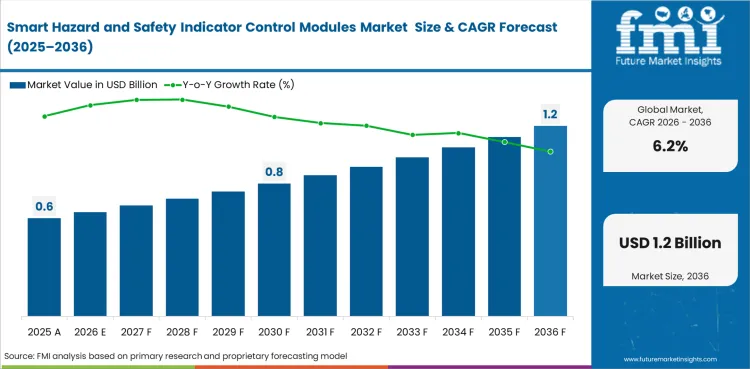
Smart hazard and safety indicator control modules market reached a valuation of USD 0.5 billion in 2025 and is projected to cross USD 0.6 billion in 2026 and reach USD 1.1 billion in 2036 with a 6.2% CAGR from 2026 to 2036. Passenger cars are estimated to represent 74.0% of vehicle-type demand in 2026, and the OEM supply is estimated to account for 88.0% of sales-channel demand in 2026.
Summary of the Smart Hazard and Safety Indicator Control Modules Market
- Demand and Growth Drivers
- Vehicle output reached 92.5 million units in 2024, which keeps the addressable installed base large for cockpit control modules and safety tell-tale hardware.
- NHTSA finalized rear seat belt reminder requirements and extended stronger warnings to front outboard passengers, which lifts content value inside safety indicator modules.
- EU vehicle safety rules applied from 7 July 2024 add a broader safety-feature baseline across new vehicles sold in Europe.
- Euro NCAP confirmed new 2026 HMI assessments with credit for physical buttons on essential controls, which supports tactile hazard-switch layouts.
- Product and Segment View
- Passenger cars lead vehicle-type demand with an estimated 74.0% share in 2026 due to higher cockpit electronics content and broader safety-feature fitment.
- Center stack installation is estimated at 57.0% share in 2026 since hazard activation and status visibility need a direct driver reach position.
- Tactile switch interfaces are estimated at 48.0% share in 2026 as essential controls keep physical access value under distraction and safety scoring pressure.
- LIN-linked modules are estimated to account for 52.0% of network-type demand in 2026 across distributed body-electronics architectures.
- Geography and Competitive Outlook
- China and India hold the strongest medium-term pace under vehicle output of 31.28 million and 6.01 million units in 2024 respectively.
- United States demand rises on rule-led seat-belt reminder upgrades, and Germany benefits from large car output and stricter safety-feature fitment in Europe.
- A specialized global supplier group provides strong cockpit integration capability and reliable control expertise across hazard and safety indicator module programs.
- Analyst Opinion
- Nikhil Kaitwade, Principal Consultant at FMI says, “Demand is moving toward modules with stronger software awareness and broader warning coverage in mainstream vehicle programs. Suppliers with proven switch reliability, compact electronics packaging, and strong OEM integration support are best placed as safety controls gain importance under tighter distraction scrutiny.”
- Smart Hazard and Safety Indicator Control Modules Market Value Analysis
- Market value is moving from a basic switch assembly business into a higher-content cockpit electronics space with more warning and status intelligence.
- Rule expansion around seat-belt alerts is lifting demand for modules with stronger warning control and more visible tell-tale management.
- Driver-distraction scoring is supporting physical-control layouts for key functions, which helps tactile smart modules keep strong program relevance.
- Value expansion is supported by vehicle output scale plus broader body-electronics integration across digital cockpit programs.
Key Takeaways
- Smart hazard and safety indicator control modules market is estimated at USD 0.5 billion in 2025 after back-calculating one year from the 2026 base and projected CAGR.
- Global demand is estimated at USD 0.6 billion in 2026 and is projected to reach USD 1.1 billion by 2036.
- Forecast expansion between 2026 and 2036 is estimated at a 6.2% CAGR under higher smart-module penetration and firmer safety-content requirements.
- Incremental opportunity across the forecast window is estimated at USD 0.5 billion on a global basis.
- OEM supply is projected to lead the sales-channel split with 88.0% share in 2026 due to factory-fit safety and control integration.
- China (8.3%) and India (7.9%) are the two of the fastest growing markets in the world.
Smart Hazard and Safety Indicator Control Modules Market Definition
Smart hazard and safety indicator control modules market covers integrated hardware used to activate hazard warning functions and manage core cabin safety status through illuminated tell-tales or controlled indicators. Scope also extends to modules linked with automotive control panel architectures across vehicle interiors using tactile access and compact electronic control. Included systems cover dashboard or roof-console installations for vehicle platforms requiring reliable manual operation and clean communication with body or cockpit controllers.
Smart Hazard and Safety Indicator Control Modules Market Inclusions
Inclusions cover tactile and hybrid hazard-control modules plus seat-belt reminder indicator controls sold into OEM programs and approved replacement channels. Scope also extends to passenger airbag status indicators and linked warning-control electronics, which align closely with broader automotive human-machine interface (HMI) integration across modern vehicle cabins. Included architectures span LIN or CAN modules with LED tell-tales, local control boards, faceplates, and integrated control hubs used in current vehicle interiors.
Smart Hazard and Safety Indicator Control Modules Market Exclusions
Excluded revenue does not include full digital instrument clusters or standalone central body control units sold as complete computing hardware. Scope also leaves out software-only warning applications without a dedicated physical control module, unlike broader digital instrument clusters systems used for full driver information display. General infotainment displays and ambient-light products fall outside this market if hazard activation or safety-indicator control is not part of the module.
Smart Hazard and Safety Indicator Control Modules Market Research Methodology
- Primary Research: FMI-style assumptions were organized around supplier portfolios in cockpit controls, warning electronics, integrated faceplates, and hazard-switch product families.
- Desk Research: Core evidence used global vehicle production, national auto-industry output, United States seat-belt warning regulation, EU safety rules, and Euro NCAP 2026 HMI changes.
- Market Sizing and Forecasting: 2026 value was estimated from projected smart-module fitment across vehicle output and a blended module value range for integrated warning controls.
- Data Validation: Country pacing was cross-checked against 2024 production levels in China, India, Japan, Mexico, South Korea, Germany, and the United States.
Why Is Demand Rising in Smart Hazard and Safety Indicator Control Modules Market?
- New rear-seat reminder requirements in the United States expand warning-system content across a wider set of seating positions.
- Euro NCAP will score essential physical controls more closely from 2026, which supports tactile hazard and warning interfaces.
- OEM cockpit programs are consolidating local controls into smarter hubs with linked electronics and zone-level communication.
Vehicle programs now face stronger pressure to keep critical cabin controls visible and easy to reach during normal driving. Hazard activation and core safety status functions keep dedicated module demand intact even as automotive electronics content expands across modern vehicle interiors. Direct physical access carries added value in cabins using larger screens. Essential warning functions need fast and simple operation during routine driving.
Another source of demand comes from deeper integration across cockpit electronics and body control architecture in newer vehicle platforms. Suppliers increasingly place hazard access and warning tell-tales into compact boards or faceplate assemblies. This aligns with broader automotive zonal gateway ECU consolidation across vehicle electronics. Unified module designs combine local lighting and communication control within a smaller hardware footprint. Higher integration lifts per-vehicle module value across mid-range and premium automotive programs.
Market Segmentation Analysis
- Passenger cars are estimated to lead vehicle-type demand with 74.0% share in 2026.
- Center stack installation is projected to account for 57.0% of mounting-position demand in 2026.
- LIN-linked designs are estimated at 52.0% share in 2026 across network architecture demand.
- Tactile switch interfaces are estimated to represent 48.0% of interface demand in 2026.
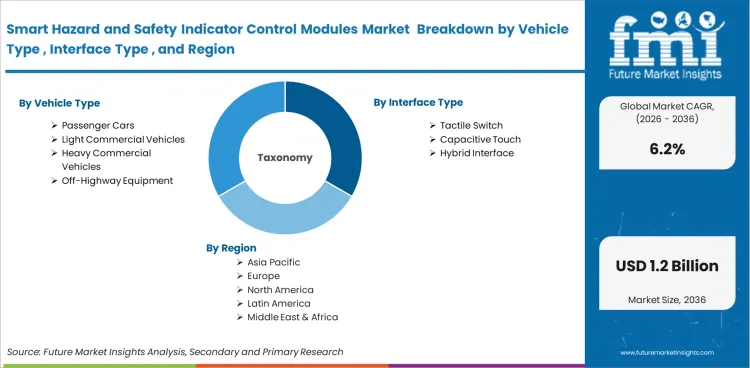
The market for smart hazard and safety indicator control modules is divided into groups based on vehicle type, interface type, mounting position, network type, sales channel, and region. There are passenger cars, light commercial vehicles, heavy commercial vehicles, and off-highway equipment by vehicle type. By interface type, the market includes tactile switch, capacitive touch, and hybrid interface. By mounting position, it covers center stack, overhead console, steering wheel, and steering column. By network type, the market includes LIN modules, CAN modules, and zonal modules. By sales channel, the market is segmented into OEM supply and aftermarket.
Insights into the Vehicle Type Segment
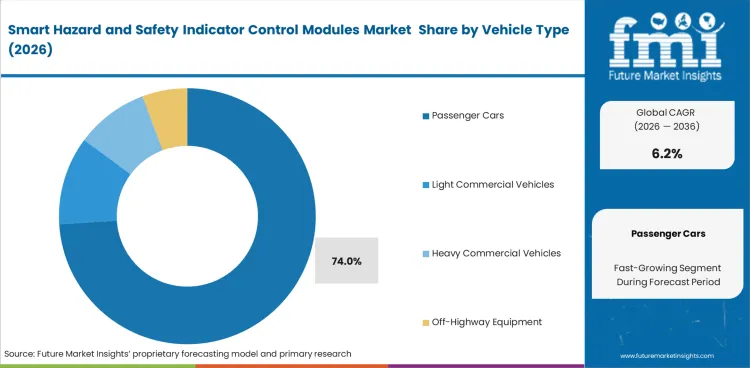
- Passenger cars are estimated to account for 74% share in 2026. Broader cockpit electronics and higher safety content support stronger module demand across mainstream vehicle programs.
- Passenger car intake is large across this market as hazard activation and safety tell-tale functions move into more integrated dashboard control layouts.
Insights into Interface Type Segment
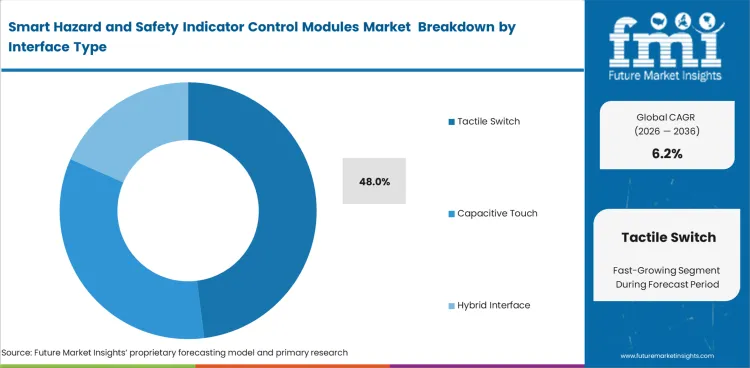
- Tactile switch interface is projected to contribute 48% of total demand in 2026. Direct access and easier actuation support wider use across safety-focused cabin control systems.
- Physical switch layouts support faster driver response across critical functions, which keeps demand broad across passenger and commercial vehicle production.
Insights into the Mounting Position Segment
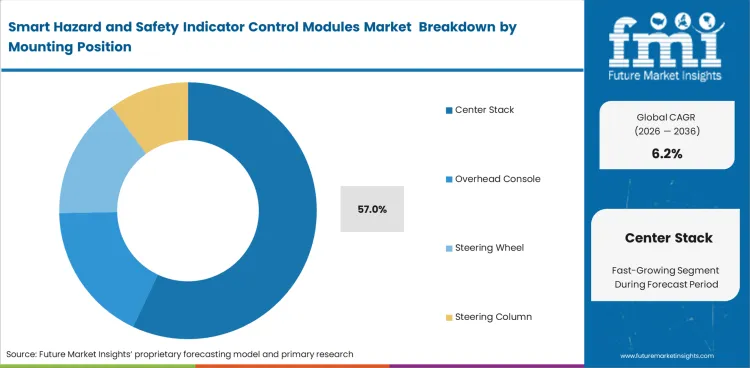
- Center stack is set to represent 57% share in 2026. Direct drivers reach and better visual access support stronger use across hazard and safety indicator module placement.
- Center stack installation supports easier integration with nearby climate and vehicle function controls across compact and mid-size interior architectures.
Insights into the Network Type Segment
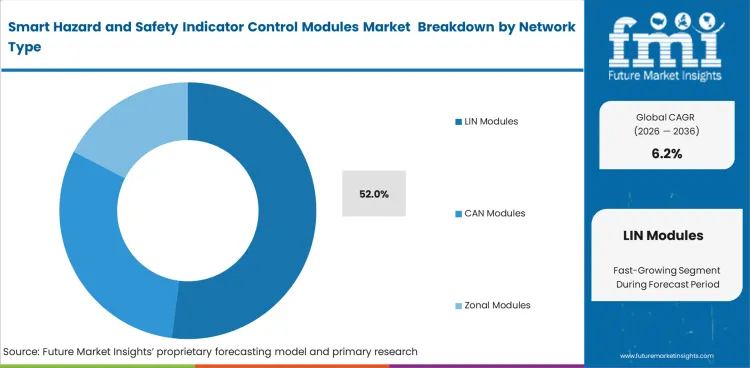
- LIN modules are expected to account for 52% share in 2026. Lower system complexity and broad body electronics use support wider adoption across cost-sensitive vehicle platforms.
- LIN architecture is important across this market as many warning and control functions work well with lower cost communication systems.
Insights into the Sales Channel Segment
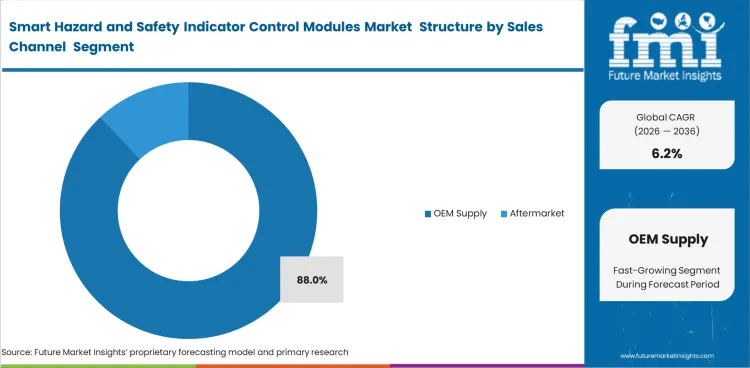
- OEM supply is projected to contribute 88% of total demand in 2026. Factory-fit integration supports broader sales across modules requiring validation and vehicle-level communication.
- OEM volume is dominant across this market as safety modules pass through longer approval cycles and stricter engineering release processes.
Smart Hazard and Safety Indicator Control Modules Market Drivers, Constraints, and Opportunities
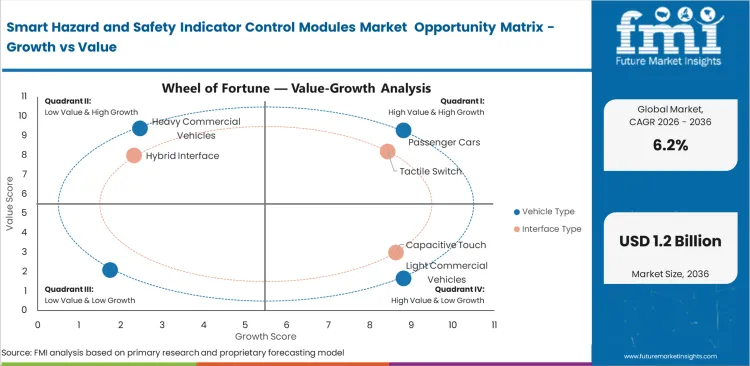
- Seat-belt reminder regulation in the United States supports higher warning-module content across front and rear seating positions.
- Physical-control scoring in Europe supports tactile interfaces for essential functions including hazard activation.
- Low-trim vehicle programs keep price pressure high and can slow adoption of richer hybrid modules.
The market for smart hazard and safety indicator control modules keeps growing because vehicle makers are adding more warning functions and integrating smarter electronics into cockpit systems. Critical controls are kept easy to reach. Price pressure in low trim vehicle programs can limit wider adoption. Higher validation demands raise development burden. Growth continues through tactile control layouts and center stack integration across passenger vehicles.
Seat-Belt Reminder Upgrades
United States rule changes create direct content expansion inside warning modules through new rear seat visual and audio alert requirements. Stronger front seat alerts further increase required functionality across mainstream vehicle programs, subject to updated compliance expectations. Suppliers with proven telltale control and seat status communication gain a stronger position during North American sourcing cycles. Validation capability supports supplier credibility in competitive selection across regulated automotive safety programs globally.
Cost Pressure in Entry Programs
Module expansion faces strict program cost scrutiny across low trim passenger cars and many commercial vehicles. Suppliers must prioritize compact electronics and durable switch design while maintaining strong cost discipline. Easier system integration supports manufacturing efficiency through a simplified architecture globally.
Zone Electronics Upside
Zone oriented cabin electronics create opporutnity for smarter control hubs across the roof and dashboard locations in modern vehicle interior architectures. Valeo and Aptiv highlight broader control integration around faceplates and dome modules within evolving cockpit architectures. This integration approach increases market value by consolidating functions into unified control hubs.
Smart Hazard and Safety Indicator Control Modules Market Analysis by Countries
.webp "Top Country Growth Comparison Smart Hazard And Safety Indicator Control Modules Market Cagr (2026 2036)")
| Country | CAGR 2026 to 2036 |
|---|---|
| China | 8.3% |
| India | 7.9% |
| Mexico | 7.1% |
| United States | 6.4% |
| Germany | 6.2% |
| South Korea | 5.9% |
| Japan | 5.7% |
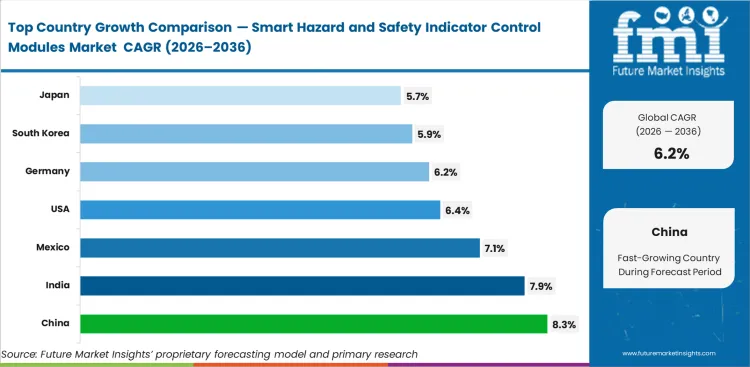
Smart Hazard and Safety Indicator Control Modules Market CAGR Analysis by Country
- China leads the country ranking with an estimated 8.3% CAGR through 2036, supported by very large vehicle output and faster cockpit electronics adoption across domestic brands. Higher production scale and wider safety-content integration are expected to keep China above the global average during the forecast period.
- India follows with an expected 7.9% CAGR, driven by expanding passenger vehicle assembly and broader use of electronic control content across mainstream vehicle programs. Local sourcing activity and richer cabin feature content are anticipated to support stronger demand for smart hazard and safety indicator modules.
- Mexico is projected to record 7.1% CAGR through 2036 under export-led vehicle assembly and broader electronics content across North American platform production. Nearshore supplier investment and steady OEM program flow are estimated to support added intake for integrated warning and control modules.
- United States demand is expected to advance at 6.4% CAGR, supported by large vehicle output and stricter seat belt reminder requirements across future vehicle programs.
Higher warning-system content and broad utility vehicle production are anticipated to support stable module demand across the domestic market. - Germany is forecast to register 6.2% CAGR through 2036, supported by premium vehicle production and wider safety-feature fitment across European automotive programs.
Richer cockpit specifications and strong supplier capability are expected to support continued demand for refined warning-control hardware. - South Korea is estimated to expand at 5.9% CAGR, supported by mature vehicle exports and strong electronics capability across domestic automotive manufacturing.
Software-linked cockpit programs and premium vehicle content are projected to maintain healthy demand for advanced indicator and hazard-control modules. - Japan is projected to record 5.7% CAGR through 2036 under a large automotive base and disciplined adoption of high-quality interior control systems.
Established supplier relationships and stable platform renewal cycles are expected to support consistent intake for warning and control modules.
Global demand for smart hazard and safety indicator control modules is projected to expand from 2026 to 2036 under stricter warning requirements and wider cockpit integration. Asia is expected to lead regional expansion, and mature automotive markets continue to support value through richer module specification and stronger safety-content adoption.
Demand Outlook for Smart Hazard and Safety Indicator Control Modules Market in China
China is projected to record 8.3% CAGR through 2036 and leads this sector through very large passenger vehicle and SUV production. Local manufacturers are adding more digital cabin functions across mid-range programs, and it lifts demand for hazard modules with richer lighting and communication capability. Output scale supports local sourcing for switch assemblies and related control electronics across domestic brands.
- Large production volume supports recurring OEM intake for hazard modules and linked safety indicator assemblies.
- Domestic brands are adding richer cabin electronics across mid-priced vehicles and newer electric vehicle models.
- Local supplier depth supports faster program launch timing and broader part localization across major vehicle programs.
Future Outlook for Smart Hazard and Safety Indicator Control Modules Market in India
India is estimated to advance at 7.9% CAGR during the forecast period under expanding passenger vehicle production and wider use of electronic cabin controls. Domestic assembly programs are adding more feature content across mainstream trims, which supports hazard modules with improved illumination and stronger visual status functions. Supplier investment in cockpit electronics supports local module sourcing across domestic brands and export-oriented vehicle lines.
- Local assembly expansion supports higher module intake across compact cars and utility vehicle programs nationwide.
- Feature enrichment across mainstream trims supports broader use of smart warning controls in daily production.
- Supplier investment in electronics manufacturing supports stronger local availability for integrated control modules across domestic programs.
Sales Analysis of Smart Hazard and Safety Indicator Control Modules Market in Mexico
Mexico is forecast to record 7.1% CAGR during the assessment period, with export-oriented vehicle assembly and wider electronics content in North American platforms. Large production programs serving regional OEM supply chains support intake for hazard modules and related safety indicator controls. Supplier interest in nearshore manufacturing supports more opportunities across cabin electronics and module assembly.
- Export-oriented assembly supports recurring OEM demand for hazard and warning control modules across North American vehicle programs.
- North American platform programs support broader use of integrated cabin electronics across local production lines.
- Nearshore supplier activity supports added opportunity for localized module assembly and component sourcing in Mexico.
Opportunity Analysis for Smart Hazard and Safety Indicator Control Modules Market in the United States
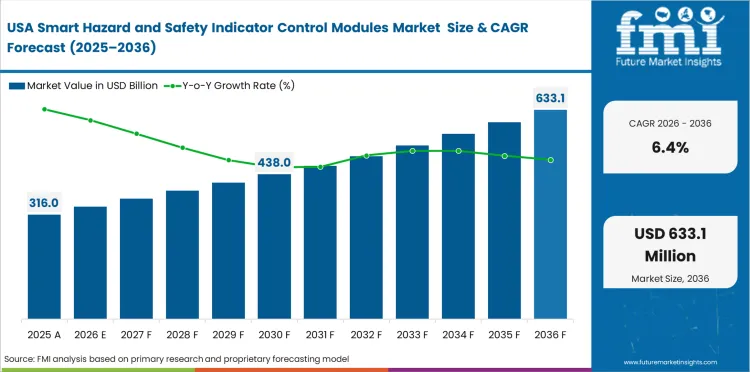
United States demand is projected to expand at 6.4% CAGR by 2036 under warning upgrades driven by new rules and broad vehicle production. NHTSA seat belt reminder requirements enlarge warning function scope across front and rear seating positions in future programs. OEM programs need more capable indicator control hardware across passenger vehicles and utility models with richer safety content.
- Finalized seat belt reminder requirements support added module content across future vehicle platforms in North America.
- Large domestic vehicle output supports steady sourcing demand for hazard switches and linked safety indicators.
- Higher safety-content fitment supports stronger value per vehicle across mainstream and premium programs over time.
Future Outlook for Smart Hazard and Safety Indicator Control Modules Market in Germany
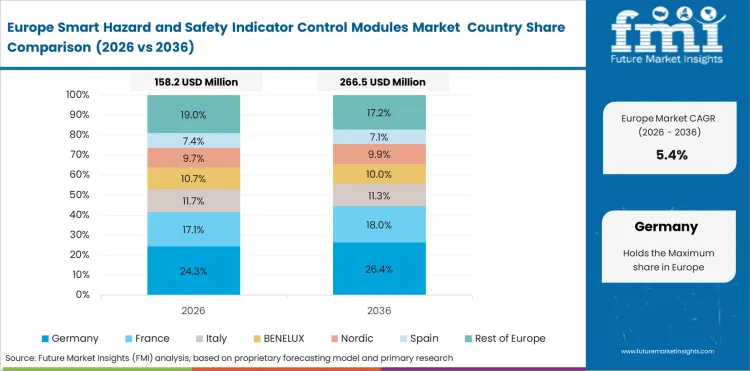
Germany is projected to register 6.2% CAGR from 2026 to 2036 under premium vehicle production and stricter safety-feature fitment in Europe. Vehicle programs from German manufacturers carry richer cockpit content, which supports demand for refined control modules with stronger finish quality. Supplier capability across switches and body electronics supports stable program sourcing for advanced warning-control assemblies.
- Premium vehicle output supports demand for refined modules with stronger lighting control and tactile quality.
- European safety-feature fitment supports broader use of visible warning indicators across new vehicle programs regionwide.
- Dense supplier capability supports stable sourcing for integrated control hardware in higher-value platforms across export programs.
In-Depth Analysis of Smart Hazard and Safety Indicator Control Modules Market in South Korea
South Korea is estimated to expand at 5.9% CAGR over the forecast period through mature vehicle exports and strong electronics capability. Local manufacturers already use advanced cabin controls across many models, which supports consistent intake for refined hazard and indicator modules. Future demand benefits from software based cockpit programs and premium vehicle content across export-focused platforms.
- Strong electronics capability supports refined module design and tighter communication integration across vehicle programs nationwide.
- Export-oriented vehicle programs support continued demand for smart cabin control hardware across major global nameplates.
- Premium content across local platforms supports higher-value module configurations in selected programs during current sourcing cycles.
Demand Outlook for Smart Hazard and Safety Indicator Control Modules Market in Japan
Japan is expected to expand at 5.7% CAGR by 2036 from a large base with mature cockpit electronics content across domestic vehicle production. Established supplier programs support recurring demand for warning controls, and expansion is moderate against faster-rising industries in Asia. Product quality and program discipline support continued intake for hazard modules across passenger vehicles and hybrid models.
- Mature domestic production supports stable sourcing demand for warning-control hardware and linked switch modules across local programs.
- High product quality standards support continued use of precise tactile interfaces across vehicle interiors globally.
- Expansion stays moderate from an already developed electronics base across major local vehicle programs nationally.
Competitive Landscape and Strategic Positioning for Smart Hazard and Safety Indicator Control Modules Market
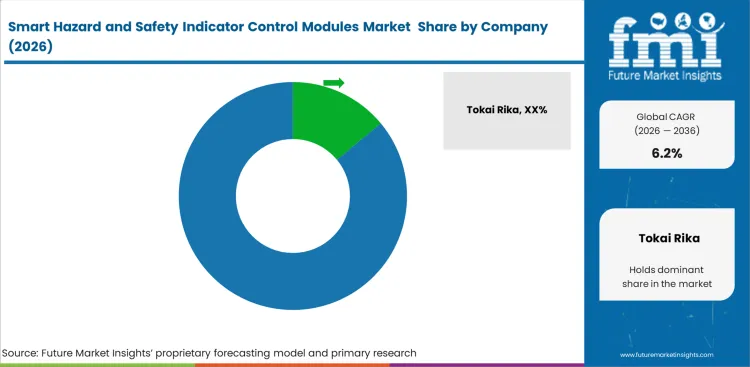
Competition in this market is highly specialized, and supplier selection is driven by program fit rather than broad vendor count. Tokai Rika lists hazard switches in its human interface range, HELLA also offers flasher units and LED indicator control units. Valeo supplies control panels and dome modules, and Aptiv is expanding cockpit control capacity in India.
Supplier strength comes from switch durability and lighting control across modules used in safety-focused cabin programs. Compact electronics packaging also supports supplier standing, especially in programs needing stable communication with body or cockpit controllers. Price is not the only deciding factor in these awards since hazard activation and safety tell-tales stay close to compliance work inside OEM cabins.
Fragmentation is visible across the supplier base, yet program awards often favor vendors with wider cockpit or body electronics exposure. Tokai Rika and Continental hold a credible fit through established control hardware and related electronics capability. FORVIA HELLA and Valeo also align well with this space through warning modules and interior control systems. Aptiv and Alps Alpine add further relevance through cockpit integration and module-level electronics experience. Methode also carries a valid position through user interface and interior sensing linked architectures.
Key Companies
- Tokai Rika, Continental, and FORVIA HELLA maintain strong relevance through hazard switches, warning electronics, and large-scale automotive control experience.
- Valeo, Aptiv, and Alps Alpine bring broader cockpit and HMI capability into this space through control panels, cockpit controllers, and module-system exposure.
- Methode Electronics adds user-interface and LED system depth, which supports niche program opportunities inside integrated warning-control assemblies.
Competitive Benchmarking for Smart Hazard and Safety Indicator Control Modules Market
| Company | Relevant Capability | Market Fit |
|---|---|---|
| Tokai Rika | Hazard switches and sensing switches | High |
| Continental | Display and operating technologies | High |
| FORVIA HELLA | Indicator control units and light switch modules | High |
| Valeo | Control panels and dome modules | High |
| Aptiv | Digital cockpit and cockpit controllers | High |
| Alps Alpine | Automotive module and HMI system exposure | Medium to High |
| Methode Electronics | User interface and LED systems | Medium |
Source: Future Market Insights, 2026.
Key Developments
- In August 2024, Aptiv expanded its Chennai plant with nearly 220,000 square feet for software-defined cockpit solutions and advanced safety features.
- In March 2025, Valeo licensed TactoTek IMSE technology for interior and exterior lighting applications with warning and visual-feedback potential for ADAS use cases.
- In June 2025, Continental created an Advanced Electronics & Semiconductor Solutions organization to design and verify automotive semiconductors for internal demand.
- In July 2025, FORVIA HELLA launched Ignite by FORVIA HELLA to advance software-only automotive products.
Key Players in Smart Hazard and Safety Indicator Control Modules Market
Major Global Players
- Tokai Rika
- Continental
- FORVIA HELLA
- Valeo
- Aptiv
Other Active Participants
- Alps Alpine
- Methode Electronics
Report Scope and Coverage
| Parameter | Details |
|---|---|
| Quantitative Units | USD 0.6 billion to USD 1.1 billion, at a CAGR of 6.2% |
| Market Definition | The smart hazard and safety indicator control modules market covers integrated control hardware used to activate hazard warning functions and manage key in-cabin safety status indicators across passenger cars, light commercial vehicles, heavy commercial vehicles, and selected off-highway platforms. The market includes tactile, capacitive, and hybrid control modules with linked tell-tales, local electronics, and communication interfaces used in modern vehicle interiors. |
| Regions Covered | North America, Latin America, Europe, East Asia, South Asia and Pacific, Middle East and Africa |
| Countries Covered | United States, Germany, Japan, South Korea, China, India, Mexico, and multiple other countries |
| Key Companies Profiled | Tokai Rika, Continental, FORVIA HELLA, Valeo, Aptiv, Alps Alpine, Methode Electronics |
| Forecast Period | 2026 to 2036 |
| Approach | Hybrid vehicle-content methodology starting with vehicle production and safety warning demand signals, estimating hazard and safety indicator module content per vehicle, and projecting OEM and replacement adoption across segments and regions. |
Smart Hazard and Safety Indicator Control Modules Market by Segments
By Vehicle Type
- Passenger Cars
- Light Commercial Vehicles
- Heavy Commercial Vehicles
- Off-Highway Equipment
By Interface Type
- Tactile Switch
- Capacitive Touch
- Hybrid Interface
By Mounting Position
- Center Stack
- Overhead Console
- Steering Wheel
- Steering Column
By Network Type
- LIN Modules
- CAN Modules
- Zonal Modules
By Sales Channel
- OEM Supply
- Aftermarket
By Region
- North America
- USA
- Canada
- Mexico
- Latin America
- Brazil
- Chile
- Rest of Latin America
- Europe
- Germany
- UK
- Italy
- Spain
- France
- Rest of Europe
- East Asia
- China
- Japan
- South Korea
- South Asia and Pacific
- India
- ASEAN
- Australia & New Zealand
- Rest of South Asia and Pacific
- Middle East and Africa
- Saudi Arabia
- Other GCC Countries
- South Africa
- Rest of Middle East and Africa
Research Sources and Bibliography
- Aptiv PLC. (2024, August 13). Aptiv expands Chennai plant to produce fully integrated, software-defined cockpit solutions.
- Valeo. (2025, March 6). Valeo and TactoTek announce collaboration for innovative automotive lighting solutions.
- Continental AG. (2025, June 23). Continental to create an Advanced Electronics & Semiconductor Solutions organization.
- FORVIA HELLA. (2025, July 3). FORVIA HELLA advances the development of software-only products with newly established entity “Ignite by FORVIA HELLA”.
- European New Car Assessment Programme. (2025, November 26). Euro NCAP announces 2026 protocol changes to tackle modern driving risks.
- European Automobile Manufacturers’ Association. (2026, April 2). Economic and market report: Global and EU auto industry, full year 2025.
This Report Answers
- How large is Smart Hazard and Safety Indicator Control Modules Market in 2025 and how high can revenue reach by 2036?
- Which safety-rule changes are lifting module content in the United States and Europe during the forecast window?
- Which vehicle type is estimated to generate the highest demand in 2026 across global OEM programs?
- Which interface format carries the strongest case in 2026 under driver-distraction and physical-control scoring pressure?
- Which mounting position leads demand and why does driver reach keep it ahead of other installation zones?
- Which countries are set for faster expansion through 2036 and what production base supports each one?
- Which suppliers carry the strongest product fit across hazard switches, warning electronics, and cockpit control integration?
- What makes OEM supply far larger than aftermarket demand in this product space?
Frequently Asked Questions
What is the global value of Smart Hazard and Safety Indicator Control Modules Market in 2026?
Global value for 2026 is projected at USD 0.6 billion using vehicle output and safety-content assumptions.
How large can this market become by 2036?
FMI-style modeling places 2036 revenue at USD 1.1 billion under wider smart-module penetration and higher cockpit integration.
How fast can demand expand between 2026 and 2036?
Forecast expansion is estimated at a 6.2% CAGR across the ten-year window.
Which vehicle type leads demand in 2026?
Passenger cars are estimated to lead with 74.0% share in 2026 due to higher cockpit-electronics content.
Which sales channel leads demand in 2026?
OEM supply is projected to lead with 88.0% share in 2026 since validation and integration happen inside vehicle programs.
Why is China projected to lead national expansion?
China produced 31.28 million vehicles in 2024, which supports scale economics and faster cockpit-electronics localization.
Why do tactile interfaces keep a strong position in this market?
Euro NCAP will score essential physical controls more closely from 2026, which supports tactile hazard access.
Euro NCAP will score essential physical controls more closely from 2026, which supports tactile hazard access.
Tokai Rika, FORVIA HELLA, Continental, Valeo, Aptiv, Alps Alpine, and Methode carry the clearest product fit.
Preview the report firsthand - request a free sample
Get SampleGet the brochure for pricing and purchase details.
Get PDFTable of Content
- Executive Summary
- Global Market Outlook
- Demand-side Trends
- Supply-side Trends
- Technology Roadmap Analysis
- Analysis and Recommendations
- Market Overview
- Market Coverage / Taxonomy
- Market Definition / Scope / Limitations
- Research Methodology
- Chapter Orientation
- Analytical Lens and Working Hypotheses
- Market Structure, Signals, and Trend Drivers
- Benchmarking and Cross-market Comparability
- Market Sizing, Forecasting, and Opportunity Mapping
- Research Design and Evidence Framework
- Desk Research Programme (Secondary Evidence)
- Company Annual and Sustainability Reports
- Peer-reviewed Journals and Academic Literature
- Corporate Websites, Product Literature, and Technical Notes
- Earnings Decks and Investor Briefings
- Statutory Filings and Regulatory Disclosures
- Technical White Papers and Standards Notes
- Trade Journals, Industry Magazines, and Analyst Briefs
- Conference Proceedings, Webinars, and Seminar Materials
- Government Statistics Portals and Public Data Releases
- Press Releases and Reputable Media Coverage
- Specialist Newsletters and Curated Briefings
- Sector Databases and Reference Repositories
- FMI Internal Proprietary Databases and Historical Market Datasets
- Subscription Datasets and Paid Sources
- Social Channels, Communities, and Digital Listening Inputs
- Additional Desk Sources
- Expert Input and Fieldwork (Primary Evidence)
- Primary Modes
- Qualitative Interviews and Expert Elicitation
- Quantitative Surveys and Structured Data Capture
- Blended Approach
- Why Primary Evidence is Used
- Field Techniques
- Interviews
- Surveys
- Focus Groups
- Observational and In-context Research
- Social and Community Interactions
- Stakeholder Universe Engaged
- C-suite Leaders
- Board Members
- Presidents and Vice Presidents
- R&D and Innovation Heads
- Technical Specialists
- Domain Subject-matter Experts
- Scientists
- Physicians and Other Healthcare Professionals
- Governance, Ethics, and Data Stewardship
- Research Ethics
- Data Integrity and Handling
- Primary Modes
- Tooling, Models, and Reference Databases
- Desk Research Programme (Secondary Evidence)
- Data Engineering and Model Build
- Data Acquisition and Ingestion
- Cleaning, Normalisation, and Verification
- Synthesis, Triangulation, and Analysis
- Quality Assurance and Audit Trail
- Market Background
- Market Dynamics
- Drivers
- Restraints
- Opportunity
- Trends
- Scenario Forecast
- Demand in Optimistic Scenario
- Demand in Likely Scenario
- Demand in Conservative Scenario
- Opportunity Map Analysis
- Product Life Cycle Analysis
- Supply Chain Analysis
- Investment Feasibility Matrix
- Value Chain Analysis
- PESTLE and Porter’s Analysis
- Regulatory Landscape
- Regional Parent Market Outlook
- Production and Consumption Statistics
- Import and Export Statistics
- Market Dynamics
- Global Market Analysis 2021 to 2025 and Forecast, 2026 to 2036
- Historical Market Size Value (USD Million) Analysis, 2021 to 2025
- Current and Future Market Size Value (USD Million) Projections, 2026 to 2036
- Y-o-Y Growth Trend Analysis
- Absolute $ Opportunity Analysis
- Global Market Pricing Analysis 2021 to 2025 and Forecast 2026 to 2036
- Global Market Analysis 2021 to 2025 and Forecast 2026 to 2036, By Vehicle Type
- Introduction / Key Findings
- Historical Market Size Value (USD Million) Analysis By Vehicle Type , 2021 to 2025
- Current and Future Market Size Value (USD Million) Analysis and Forecast By Vehicle Type , 2026 to 2036
- Passenger Cars
- Light Commercial Vehicles
- Heavy Commercial Vehicles
- Off-Highway Equipment
- Passenger Cars
- Y-o-Y Growth Trend Analysis By Vehicle Type , 2021 to 2025
- Absolute $ Opportunity Analysis By Vehicle Type , 2026 to 2036
- Global Market Analysis 2021 to 2025 and Forecast 2026 to 2036, By Interface Type
- Introduction / Key Findings
- Historical Market Size Value (USD Million) Analysis By Interface Type, 2021 to 2025
- Current and Future Market Size Value (USD Million) Analysis and Forecast By Interface Type, 2026 to 2036
- Tactile Switch
- Capacitive Touch
- Hybrid Interface
- Tactile Switch
- Y-o-Y Growth Trend Analysis By Interface Type, 2021 to 2025
- Absolute $ Opportunity Analysis By Interface Type, 2026 to 2036
- Global Market Analysis 2021 to 2025 and Forecast 2026 to 2036, By Mounting Position
- Introduction / Key Findings
- Historical Market Size Value (USD Million) Analysis By Mounting Position, 2021 to 2025
- Current and Future Market Size Value (USD Million) Analysis and Forecast By Mounting Position, 2026 to 2036
- Center Stack
- Overhead Console
- Steering Wheel
- Steering Column
- Center Stack
- Y-o-Y Growth Trend Analysis By Mounting Position, 2021 to 2025
- Absolute $ Opportunity Analysis By Mounting Position, 2026 to 2036
- Global Market Analysis 2021 to 2025 and Forecast 2026 to 2036, By Network Type
- Introduction / Key Findings
- Historical Market Size Value (USD Million) Analysis By Network Type, 2021 to 2025
- Current and Future Market Size Value (USD Million) Analysis and Forecast By Network Type, 2026 to 2036
- LIN Modules
- CAN Modules
- Zonal Modules
- LIN Modules
- Y-o-Y Growth Trend Analysis By Network Type, 2021 to 2025
- Absolute $ Opportunity Analysis By Network Type, 2026 to 2036
- Global Market Analysis 2021 to 2025 and Forecast 2026 to 2036, By Sales Channel
- Introduction / Key Findings
- Historical Market Size Value (USD Million) Analysis By Sales Channel, 2021 to 2025
- Current and Future Market Size Value (USD Million) Analysis and Forecast By Sales Channel, 2026 to 2036
- OEM Supply
- Aftermarket
- OEM Supply
- Y-o-Y Growth Trend Analysis By Sales Channel, 2021 to 2025
- Absolute $ Opportunity Analysis By Sales Channel, 2026 to 2036
- Global Market Analysis 2021 to 2025 and Forecast 2026 to 2036, By Region
- Introduction
- Historical Market Size Value (USD Million) Analysis By Region, 2021 to 2025
- Current Market Size Value (USD Million) Analysis and Forecast By Region, 2026 to 2036
- North America
- Latin America
- Western Europe
- Eastern Europe
- East Asia
- South Asia and Pacific
- Middle East & Africa
- Market Attractiveness Analysis By Region
- North America Market Analysis 2021 to 2025 and Forecast 2026 to 2036, By Country
- Historical Market Size Value (USD Million) Trend Analysis By Market Taxonomy, 2021 to 2025
- Market Size Value (USD Million) Forecast By Market Taxonomy, 2026 to 2036
- By Country
- USA
- Canada
- Mexico
- By Vehicle Type
- By Interface Type
- By Mounting Position
- By Network Type
- By Sales Channel
- By Country
- Market Attractiveness Analysis
- By Country
- By Vehicle Type
- By Interface Type
- By Mounting Position
- By Network Type
- By Sales Channel
- Key Takeaways
- Latin America Market Analysis 2021 to 2025 and Forecast 2026 to 2036, By Country
- Historical Market Size Value (USD Million) Trend Analysis By Market Taxonomy, 2021 to 2025
- Market Size Value (USD Million) Forecast By Market Taxonomy, 2026 to 2036
- By Country
- Brazil
- Chile
- Rest of Latin America
- By Vehicle Type
- By Interface Type
- By Mounting Position
- By Network Type
- By Sales Channel
- By Country
- Market Attractiveness Analysis
- By Country
- By Vehicle Type
- By Interface Type
- By Mounting Position
- By Network Type
- By Sales Channel
- Key Takeaways
- Western Europe Market Analysis 2021 to 2025 and Forecast 2026 to 2036, By Country
- Historical Market Size Value (USD Million) Trend Analysis By Market Taxonomy, 2021 to 2025
- Market Size Value (USD Million) Forecast By Market Taxonomy, 2026 to 2036
- By Country
- Germany
- UK
- Italy
- Spain
- France
- Nordic
- BENELUX
- Rest of Western Europe
- By Vehicle Type
- By Interface Type
- By Mounting Position
- By Network Type
- By Sales Channel
- By Country
- Market Attractiveness Analysis
- By Country
- By Vehicle Type
- By Interface Type
- By Mounting Position
- By Network Type
- By Sales Channel
- Key Takeaways
- Eastern Europe Market Analysis 2021 to 2025 and Forecast 2026 to 2036, By Country
- Historical Market Size Value (USD Million) Trend Analysis By Market Taxonomy, 2021 to 2025
- Market Size Value (USD Million) Forecast By Market Taxonomy, 2026 to 2036
- By Country
- Russia
- Poland
- Hungary
- Balkan & Baltic
- Rest of Eastern Europe
- By Vehicle Type
- By Interface Type
- By Mounting Position
- By Network Type
- By Sales Channel
- By Country
- Market Attractiveness Analysis
- By Country
- By Vehicle Type
- By Interface Type
- By Mounting Position
- By Network Type
- By Sales Channel
- Key Takeaways
- East Asia Market Analysis 2021 to 2025 and Forecast 2026 to 2036, By Country
- Historical Market Size Value (USD Million) Trend Analysis By Market Taxonomy, 2021 to 2025
- Market Size Value (USD Million) Forecast By Market Taxonomy, 2026 to 2036
- By Country
- China
- Japan
- South Korea
- By Vehicle Type
- By Interface Type
- By Mounting Position
- By Network Type
- By Sales Channel
- By Country
- Market Attractiveness Analysis
- By Country
- By Vehicle Type
- By Interface Type
- By Mounting Position
- By Network Type
- By Sales Channel
- Key Takeaways
- South Asia and Pacific Market Analysis 2021 to 2025 and Forecast 2026 to 2036, By Country
- Historical Market Size Value (USD Million) Trend Analysis By Market Taxonomy, 2021 to 2025
- Market Size Value (USD Million) Forecast By Market Taxonomy, 2026 to 2036
- By Country
- India
- ASEAN
- Australia & New Zealand
- Rest of South Asia and Pacific
- By Vehicle Type
- By Interface Type
- By Mounting Position
- By Network Type
- By Sales Channel
- By Country
- Market Attractiveness Analysis
- By Country
- By Vehicle Type
- By Interface Type
- By Mounting Position
- By Network Type
- By Sales Channel
- Key Takeaways
- Middle East & Africa Market Analysis 2021 to 2025 and Forecast 2026 to 2036, By Country
- Historical Market Size Value (USD Million) Trend Analysis By Market Taxonomy, 2021 to 2025
- Market Size Value (USD Million) Forecast By Market Taxonomy, 2026 to 2036
- By Country
- Kingdom of Saudi Arabia
- Other GCC Countries
- Turkiye
- South Africa
- Other African Union
- Rest of Middle East & Africa
- By Vehicle Type
- By Interface Type
- By Mounting Position
- By Network Type
- By Sales Channel
- By Country
- Market Attractiveness Analysis
- By Country
- By Vehicle Type
- By Interface Type
- By Mounting Position
- By Network Type
- By Sales Channel
- Key Takeaways
- Key Countries Market Analysis
- USA
- Pricing Analysis
- Market Share Analysis, 2025
- By Vehicle Type
- By Interface Type
- By Mounting Position
- By Network Type
- By Sales Channel
- Canada
- Pricing Analysis
- Market Share Analysis, 2025
- By Vehicle Type
- By Interface Type
- By Mounting Position
- By Network Type
- By Sales Channel
- Mexico
- Pricing Analysis
- Market Share Analysis, 2025
- By Vehicle Type
- By Interface Type
- By Mounting Position
- By Network Type
- By Sales Channel
- Brazil
- Pricing Analysis
- Market Share Analysis, 2025
- By Vehicle Type
- By Interface Type
- By Mounting Position
- By Network Type
- By Sales Channel
- Chile
- Pricing Analysis
- Market Share Analysis, 2025
- By Vehicle Type
- By Interface Type
- By Mounting Position
- By Network Type
- By Sales Channel
- Germany
- Pricing Analysis
- Market Share Analysis, 2025
- By Vehicle Type
- By Interface Type
- By Mounting Position
- By Network Type
- By Sales Channel
- UK
- Pricing Analysis
- Market Share Analysis, 2025
- By Vehicle Type
- By Interface Type
- By Mounting Position
- By Network Type
- By Sales Channel
- Italy
- Pricing Analysis
- Market Share Analysis, 2025
- By Vehicle Type
- By Interface Type
- By Mounting Position
- By Network Type
- By Sales Channel
- Spain
- Pricing Analysis
- Market Share Analysis, 2025
- By Vehicle Type
- By Interface Type
- By Mounting Position
- By Network Type
- By Sales Channel
- France
- Pricing Analysis
- Market Share Analysis, 2025
- By Vehicle Type
- By Interface Type
- By Mounting Position
- By Network Type
- By Sales Channel
- India
- Pricing Analysis
- Market Share Analysis, 2025
- By Vehicle Type
- By Interface Type
- By Mounting Position
- By Network Type
- By Sales Channel
- ASEAN
- Pricing Analysis
- Market Share Analysis, 2025
- By Vehicle Type
- By Interface Type
- By Mounting Position
- By Network Type
- By Sales Channel
- Australia & New Zealand
- Pricing Analysis
- Market Share Analysis, 2025
- By Vehicle Type
- By Interface Type
- By Mounting Position
- By Network Type
- By Sales Channel
- China
- Pricing Analysis
- Market Share Analysis, 2025
- By Vehicle Type
- By Interface Type
- By Mounting Position
- By Network Type
- By Sales Channel
- Japan
- Pricing Analysis
- Market Share Analysis, 2025
- By Vehicle Type
- By Interface Type
- By Mounting Position
- By Network Type
- By Sales Channel
- South Korea
- Pricing Analysis
- Market Share Analysis, 2025
- By Vehicle Type
- By Interface Type
- By Mounting Position
- By Network Type
- By Sales Channel
- Russia
- Pricing Analysis
- Market Share Analysis, 2025
- By Vehicle Type
- By Interface Type
- By Mounting Position
- By Network Type
- By Sales Channel
- Poland
- Pricing Analysis
- Market Share Analysis, 2025
- By Vehicle Type
- By Interface Type
- By Mounting Position
- By Network Type
- By Sales Channel
- Hungary
- Pricing Analysis
- Market Share Analysis, 2025
- By Vehicle Type
- By Interface Type
- By Mounting Position
- By Network Type
- By Sales Channel
- Kingdom of Saudi Arabia
- Pricing Analysis
- Market Share Analysis, 2025
- By Vehicle Type
- By Interface Type
- By Mounting Position
- By Network Type
- By Sales Channel
- Turkiye
- Pricing Analysis
- Market Share Analysis, 2025
- By Vehicle Type
- By Interface Type
- By Mounting Position
- By Network Type
- By Sales Channel
- South Africa
- Pricing Analysis
- Market Share Analysis, 2025
- By Vehicle Type
- By Interface Type
- By Mounting Position
- By Network Type
- By Sales Channel
- USA
- Market Structure Analysis
- Competition Dashboard
- Competition Benchmarking
- Market Share Analysis of Top Players
- By Regional
- By Vehicle Type
- By Interface Type
- By Mounting Position
- By Network Type
- By Sales Channel
- Competition Analysis
- Competition Deep Dive
- Tokai Rika
- Overview
- Product Portfolio
- Profitability by Market Segments (Product/Age /Sales Channel/Region)
- Sales Footprint
- Strategy Overview
- Marketing Strategy
- Product Strategy
- Channel Strategy
- Continental
- FORVIA HELLA
- Valeo
- Aptiv
- Alps Alpine
- Methode Electronics
- Tokai Rika
- Competition Deep Dive
- Assumptions & Acronyms Used


