

- Industry Size (2026)
- USD 418.8 Mn
- Forecast (2036)
- USD 1223 Mn
- CAGR (2026 to 2036)
- 11.3%
Microprocessor Controlled Orthosis Market Forecast and Outlook 2026 to 2036
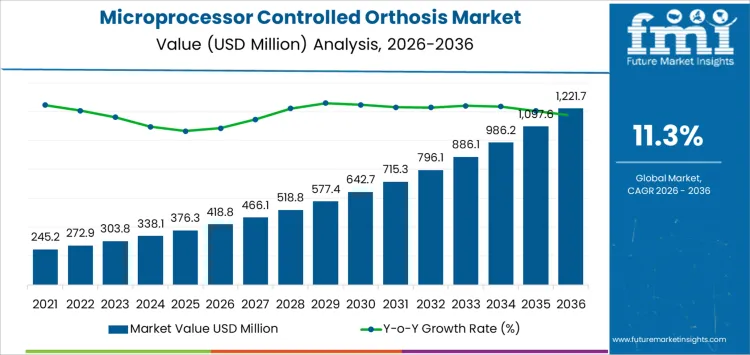
The microprocessor-controlled orthosis market is expected to grow from USD 418.8 million in 2026 to USD 1,223 million by 2036, reflecting a compound annual growth rate (CAGR) of 11.3%. Microprocessor-controlled orthoses are advanced orthopedic devices equipped with intelligent sensors and microprocessors that adjust in real-time to provide better support and comfort for patients with mobility impairments. These devices are widely used in the rehabilitation of individuals with neurological disorders, injuries, or disabilities, such as stroke, cerebral palsy, and spinal cord injuries.
The market is driven by the increasing prevalence of mobility-related conditions, technological advancements in orthotic devices, and rising awareness of personalized medical treatments. As healthcare systems and rehabilitation programs increasingly embrace cutting-edge solutions, the demand for microprocessor-controlled orthoses is expected to rise. Furthermore, the market is supported by the growing shift toward more effective, adaptive treatments that allow for a greater range of motion and better functional outcomes for patients.
Quick Stats for Microprocessor Controlled Orthosis Market
- Microprocessor Controlled Orthosis Market Value (2026): USD 418.8 million
- Microprocessor Controlled Orthosis Market Forecast Value (2036): USD 1,223 million
- Microprocessor Controlled Orthosis Market Global Forecast CAGR (2026–2036): 11.3%
- Top Application by Share in Microprocessor Controlled Orthosis Market: Neurologic Gait Impairment (SCI, Stroke) (48.60%)
- Key Growth Regions in Microprocessor Controlled Orthosis Market: India, China, USA, UK, Germany
- Top Players in Microprocessor Controlled Orthosis Market: Ottobock, Ekso Bionics (incl. Indego), ReWalk Robotics, Cyberdyne, Myomo, Össur (Bionic Bracing/Ortho), DIH / Hocoma, Bionik Laboratories, Reboocon Bionics, Others
What is the Growth Forecast for the Microprocessor Controlled Orthosis Market through 2036?
The inflection point mapping for the microprocessor-controlled orthosis market reveals an initial steady increase followed by accelerated growth in the later years. Starting at USD 418.8 million in 2026, the market grows to USD 466.2 million in 2027 and USD 518.9 million in 2028, marking a period of gradual adoption as more healthcare providers incorporate advanced orthotic solutions into their treatments.
From 2028 to 2030, the market continues to show steady growth, reaching USD 577.6 million in 2029 and USD 643 million in 2030. The inflection point occurs as microprocessor-controlled orthoses gain broader acceptance due to demonstrated improvements in patient outcomes and the integration of more sophisticated technologies. Between 2030 and 2035, the market experiences significant acceleration, with values reaching USD 715.7 million in 2031, USD 796.7 million in 2032, and USD 886.9 million in 2033.
By 2035, the market is projected to reach USD 987.2 million, with the final value of USD 1,223 million expected in 2036. The inflection point analysis suggests that the market will initially grow at a moderate pace, followed by a noticeable acceleration driven by increasing adoption, technological advancements, and the expansion of personalized orthopedic solutions. As more patients and healthcare providers turn to these devices, the growth rate will gain momentum, reflecting the market's maturation in the latter part of the forecast period.
Microprocessor Controlled Orthosis Market Key Takeaways
| Metric | Value |
|---|---|
| Industry Sales Value (2026) | USD 418.8 million |
| Industry Forecast Value (2036) | USD 1,223 million |
| Industry Forecast CAGR (2026-2036) | 11.3% |
What Is Driving the Demand for the Microprocessor Controlled Orthosis Market Globally?
The global demand for microprocessor controlled orthoses is driven by rising prevalence of neuromuscular and musculoskeletal conditions, ageing populations, and growing expectations for mobility improvement and independence. Conditions such as stroke, spinal cord injury, cerebral palsy, multiple sclerosis, and peripheral nerve injuries often impair gait, balance, and joint control. Traditional orthoses provide passive support, but microprocessor controlled orthoses incorporate sensors, actuators, and embedded algorithms that respond in real time to user movement and terrain, improving gait symmetry, stability, and energy efficiency. Clinicians and rehabilitation specialists are increasingly recommending these devices because they offer enhanced functional outcomes compared with conventional braces, particularly for complex gait impairments. Advances in embedded electronics, wearable sensors, and battery technology have made microprocessor systems more reliable and lighter, increasing clinician confidence and user acceptance. Expansion of outpatient rehabilitation services, greater access to advanced mobility aids in emerging markets, and increased insurance and reimbursement coverage for medically necessary assistive devices further support uptake.
Future demand for microprocessor controlled orthoses is expected to grow as technology evolves and awareness of functional benefits increases. Continued innovation in sensor fidelity, control algorithms, and integration with gait analysis systems will improve device responsiveness, comfort, and adaptability to varied environments. As clinical evidence accumulates demonstrating improved mobility, reduced fall risk, and enhanced quality of life, adoption by rehabilitation centres, hospitals, and homecare providers will expand. Population ageing and rising incidence of chronic conditions such as diabetes and stroke will sustain need for orthotic solutions that support long term mobility. Regulatory and reimbursement frameworks that recognise the value of advanced orthotic technologies may further encourage adoption, especially where cost barriers have previously limited access. Integration with tele rehabilitation and remote monitoring systems could broaden utilisation by enabling remote adjustment and progress tracking. Overall, as healthcare systems focus on restoring function and reducing long term disability burden, demand for microprocessor controlled orthoses is poised to grow steadily worldwide.
What Are the Key Segments in Microprocessor Controlled Orthosis Market?
The microprocessor controlled orthosis market is segmented by control/actuation and application. Sensor-based stance/swing control (MP joints) leads the control/actuation segment with 46.7% of the market share, offering advanced gait correction by precisely monitoring and adjusting joint movements. Neurologic gait impairment (SCI, stroke) dominates the application segment with 48.6%, driven by the growing need for rehabilitation solutions for individuals suffering from gait issues caused by neurological conditions. The market is expanding as the demand for advanced orthotic devices that enhance mobility and provide customized support for individuals with walking impairments continues to grow.
Which Control/Actuation Type Drives Microprocessor Controlled Orthosis Market Demand Globally?
Sensor-based stance/swing control (MP joints) accounts for 46.7% of the market share. This type of control provides precise, real-time adjustments to the movement of the joints, ensuring that the orthosis adapts to the user’s gait throughout the stance and swing phases of walking. Sensor-based systems enable more natural and adaptive movement compared to traditional passive orthoses, allowing users to regain better control over their walking pattern. By dynamically adjusting joint motion, sensor-based stance/swing control enhances the mobility and stability of the user, particularly for individuals with neurological conditions like stroke or spinal cord injury (SCI). These systems also provide improved comfort, reduce the energy required for walking, and help prevent secondary complications such as joint strain or misalignment. As the demand for personalized rehabilitation solutions grows, sensor-based stance/swing control is expected to remain a leading driver in the market. The integration of microprocessor controls with sensors enables real-time feedback and adjustment, significantly improving the effectiveness of orthotic devices and making them an integral part of advanced rehabilitation therapy.
Which Application Drives Microprocessor Controlled Orthosis Market Demand Globally?
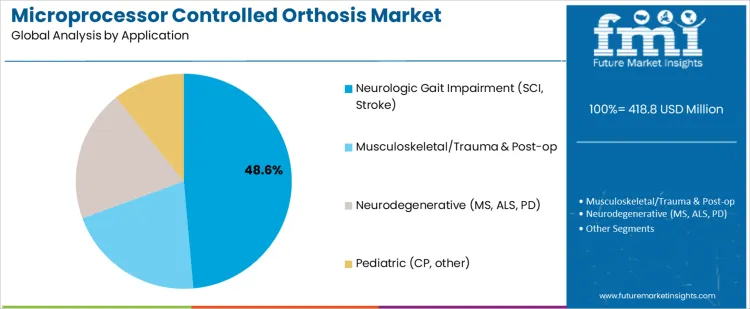
Neurologic gait impairment (SCI, stroke) leads the application segment with 48.6% of the market share. Neurological conditions such as spinal cord injuries (SCI) and stroke often lead to significant gait impairment, requiring advanced orthotic solutions to assist with walking. Microprocessor-controlled orthoses, particularly those with sensor-based stance/swing control, are crucial in addressing these challenges, providing users with a more functional and adaptive solution for walking. These devices support rehabilitation efforts by helping individuals regain mobility, improve stability, and reduce the risk of falls. With stroke and SCI-related gait impairments being highly prevalent, the demand for customized and dynamic orthotic solutions in this application is substantial. The continuous advancements in microprocessor-controlled orthotics contribute to enhanced therapeutic outcomes and help patients regain independence in mobility. While other applications such as musculoskeletal/trauma & post-op, neurodegenerative conditions (MS, ALS, PD), and pediatric cases (CP, other) contribute to market growth, neurologic gait impairment remains the largest application segment due to its widespread need and the increasing focus on improving the quality of life for individuals with neurological conditions.
What are the Key Dynamics of the Global Microprocessor Controlled Orthosis Market?
The global microprocessor controlled orthosis market is expanding as advanced rehabilitation and mobility technologies gain traction in healthcare. These orthotic devices use onboard sensors and processors to adjust support in real time, improving gait, posture and functional movement for users with neuromuscular or orthopedic impairments. Growth reflects rising incidence of mobility related conditions, aging populations, and investment in assistive technology. Adoption spans clinics, rehabilitation centers and home use where precision control and adaptive assistance enhance patient participation in daily activities across diverse regions worldwide.
What are the Key Drivers for the Global Microprocessor Controlled Orthosis Market?
Increasing prevalence of conditions that affect mobility, such as stroke, spinal cord injury and musculoskeletal disorders, encourages clinicians to integrate adaptive orthotic technology into care pathways. Microprocessor controlled orthoses help improve functional independence and reduce secondary complications by dynamically responding to user movement patterns. Advances in sensor technology, real time feedback systems and lightweight materials make these solutions more ergonomic and effective. Expanding rehabilitation services and inclusion of assistive devices in healthcare plans support uptake by providers and patients. Rising awareness among clinicians and patients about benefits of smart orthotic systems fosters demand.
What are the Restraints for the Global Microprocessor Controlled Orthosis Market?
One restraint is the higher cost of development and acquisition compared with conventional orthotic devices, which can limit affordability for some patients and healthcare systems. Specialized design and manufacturing processes require investment in research, quality assurance and user training that add to product cost. Integration with existing clinical workflows and rehabilitation protocols may require additional staff training and system adaptation. Reimbursement policies for advanced orthotic technologies vary across regions and can affect adoption in markets where coverage is limited. Some users may prefer traditional orthoses due to familiarity, influencing short term demand patterns.
What are the Key Trends in the Global Microprocessor Controlled Orthosis Market?
A key trend is convergence of artificial intelligence with embedded sensor feedback to refine real time control and personalize assistance based on individual gait and movement profiles. Developers are focusing on modular designs that allow tuning of support levels and compatibility with wearable systems. Increased use of tele monitoring and connected platforms supports remote assessment and adjustment, extending care beyond clinic settings. Collaboration between orthosis manufacturers, rehabilitation specialists and research institutions is helping validate clinical outcomes and expand indications. Miniaturization of electronics and battery improvements are influencing design evolution, making devices lighter and more user friendly while maintaining adaptive performance.
What is the Country-Wise Outlook for the Microprocessor Controlled Orthosis Market?
Microprocessor controlled orthosis market is expanding, driven by the increasing demand for advanced, customizable orthotic devices that provide better mobility and comfort to individuals with physical disabilities. These orthoses are controlled by microprocessors, which adjust and adapt to the user’s movements, offering improved functionality compared to traditional devices. Countries such as India, China, and the USA are leading the growth, fueled by advancements in healthcare technology, rising awareness of mobility solutions, and increasing demand for personalized medical devices. In markets like the UK and Germany, the adoption of microprocessor-controlled orthoses is supported by strong healthcare systems, a focus on improving quality of life for patients, and the availability of advanced healthcare technologies. As demand for enhanced mobility solutions rises, the market for microprocessor-controlled orthoses is expected to continue expanding globally.
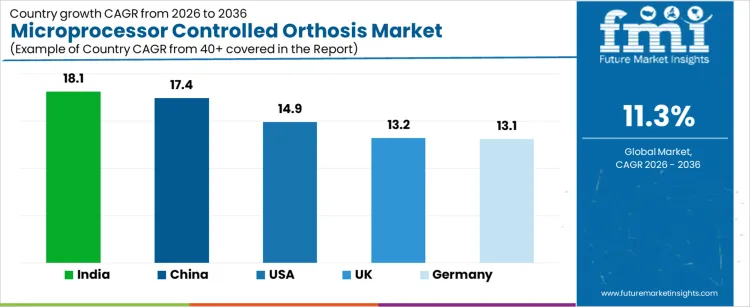
| Country | CAGR (2026 to 2036) |
|---|---|
| India | 18.1% |
| China | 17.4% |
| USA | 14.9% |
| UK | 13.2% |
| Germany | 13.1% |
What is Driving the Growth of the Microprocessor Controlled Orthosis Market in India?
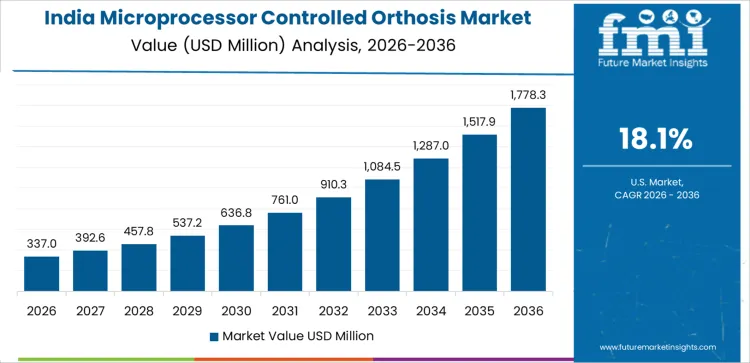
India’s Microprocessor Controlled Orthosis market is projected to grow at a CAGR of 18.1%. The country’s increasing focus on improving healthcare accessibility and the growing prevalence of physical disabilities are key factors driving market growth. As the demand for advanced, customized mobility solutions rises, microprocessor-controlled orthoses are gaining popularity due to their ability to adapt to the user’s specific needs. India’s expanding healthcare infrastructure, combined with the growing middle class and rising disposable incomes, is further contributing to the adoption of these devices. Additionally, government efforts to improve accessibility to healthcare and advanced medical technologies are expected to fuel market growth. As more patients in India seek personalized orthotic solutions to improve their mobility and quality of life, the demand for microprocessor-controlled orthoses is expected to increase significantly.
What is Contributing to the Growth of the Microprocessor Controlled Orthosis Market in China?
China’s Microprocessor Controlled Orthosis market is expected to grow at a CAGR of 17.4%. The country’s rapidly improving healthcare infrastructure, combined with an aging population and rising rates of physical disabilities, is driving the demand for advanced orthotic solutions. Microprocessor-controlled orthoses offer significant benefits, including enhanced comfort, mobility, and adjustability, which are driving their adoption among individuals with mobility impairments. Additionally, the increasing awareness of personalized healthcare solutions and the growing preference for high-tech medical devices are contributing to market growth in China. The Chinese government’s investments in healthcare modernization and its focus on improving accessibility to advanced medical technologies are expected to further accelerate the adoption of microprocessor-controlled orthoses, contributing to the market’s growth.
What is Driving the Microprocessor Controlled Orthosis Market Growth in the USA?
The USA’s Microprocessor Controlled Orthosis market is projected to grow at a CAGR of 14.9%. The USA has a large and growing population of individuals with physical disabilities, including those affected by conditions such as stroke, spinal cord injuries, and arthritis. As the demand for personalized and advanced mobility solutions increases, microprocessor-controlled orthoses are becoming more widely adopted due to their ability to provide superior comfort, adjustability, and functionality. The USA’s highly developed healthcare system, coupled with increasing consumer awareness of advanced healthcare technologies, is driving the market’s growth. Furthermore, advancements in medical technology and the growing focus on improving the quality of life for individuals with physical disabilities are expected to contribute to the expansion of the microprocessor-controlled orthosis market in the USA.
What is Influencing the Growth of the Microprocessor Controlled Orthosis Market in the UK?
The UK’s Microprocessor Controlled Orthosis market is projected to grow at a CAGR of 13.2%. The UK’s well-established healthcare system, combined with an increasing focus on personalized healthcare solutions, is driving the demand for advanced orthotic devices. Microprocessor-controlled orthoses are gaining popularity due to their ability to improve mobility, reduce discomfort, and adapt to the user’s needs. The growing prevalence of conditions that affect mobility, such as neurological disorders and musculoskeletal injuries, is also contributing to market growth. Additionally, the UK government’s support for advancing healthcare technologies and improving accessibility to personalized medical devices is further fueling the adoption of microprocessor-controlled orthoses. As more individuals seek innovative mobility solutions, the market for these devices is expected to grow steadily.
What is Contributing to the Growth of the Microprocessor Controlled Orthosis Market in Germany?
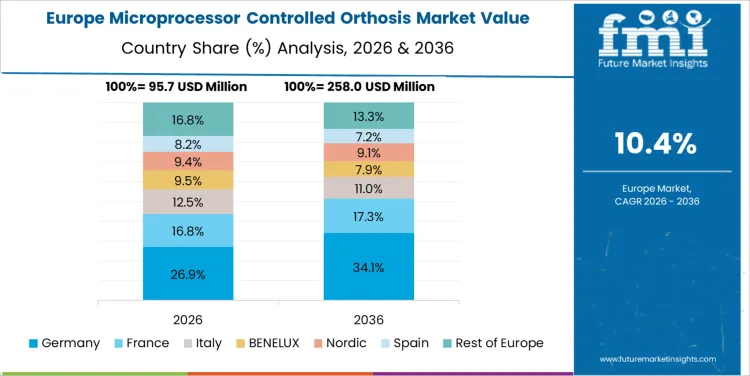
Germany’s Microprocessor Controlled Orthosis market is expected to grow at a CAGR of 13.1%. As one of Europe’s leaders in medical technology, Germany’s healthcare system is increasingly adopting advanced mobility solutions for individuals with physical disabilities. The rising demand for personalized and efficient orthotic devices is driving the growth of microprocessor-controlled orthoses. These devices offer benefits such as greater adaptability, comfort, and improved functionality compared to traditional orthotics, which is leading to increased adoption among patients. Germany’s focus on improving quality of life for individuals with mobility impairments, coupled with advancements in medical technology, is contributing to the expansion of this market. As demand for high-tech, customized solutions grows, the adoption of microprocessor-controlled orthoses is expected to increase steadily in Germany.
What is the Competitive Landscape for the Microprocessor Controlled Orthosis Market?
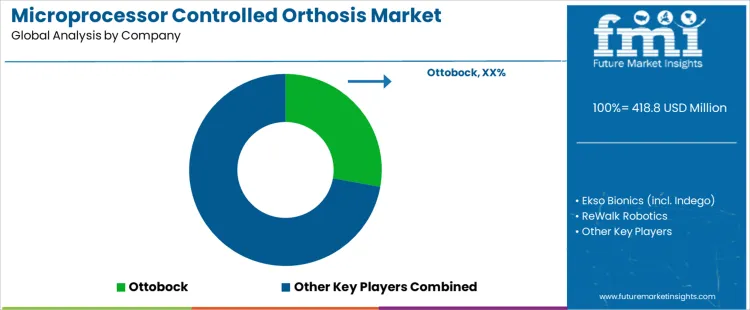
The Microprocessor Controlled Orthosis Market is growing rapidly, with companies developing innovative solutions for individuals with mobility impairments. Ottobock leads the market with its advanced microprocessor-controlled orthotic devices, including the C-Leg, which provides enhanced mobility and stability for users with lower-limb disabilities. Ottobock's established reputation for quality and innovation positions it as the market leader. Ekso Bionics, including its Indego exoskeleton, offers another cutting-edge solution, focusing on wearable robotics to support individuals with spinal cord injuries and neurological conditions. Their devices are designed to assist in walking and rehabilitation, marking them as key competitors in this space.
Other companies like ReWalk Robotics, Cyberdyne, and Myomo bring significant contributions to the market. ReWalk Robotics develops wearable exoskeletons for individuals with spinal cord injuries, enabling them to stand and walk with the assistance of their devices. Cyberdyne has made notable advancements with its HAL exoskeleton, which uses a combination of sensors and robotics to assist with mobility and rehabilitation. Myomo focuses on upper-limb orthoses, particularly for individuals with neuromuscular disorders, offering a solution that promotes independence and restores movement.
Össur, DIH / Hocoma, Bionik Laboratories, and Reboocon Bionics further intensify the competition with their unique offerings. Össur, known for its bionic bracing and orthotics, is expanding its product line with microprocessor-controlled devices aimed at improving joint mobility. DIH / Hocoma specializes in rehabilitation devices, including robotic-assisted therapy systems that help restore movement. Bionik Laboratories and Reboocon Bionics contribute innovative solutions for individuals with mobility challenges, using technology to create devices that improve quality of life. Companies in this market compete through technological innovation, product versatility, and a strong focus on improving patient outcomes and enhancing mobility.
Key Players of the Microprocessor Controlled Orthosis Market
- Ottobock
- Ekso Bionics (incl. Indego)
- ReWalk Robotics
- Cyberdyne
- Myomo
- Össur (Bionic Bracing/Ortho)
- DIH / Hocoma
- Bionik Laboratories
- Reboocon Bionics
- Others
Scope of the Report
| Items | Values |
|---|---|
| Quantitative Units (2026) | USD Million |
| Device Type | Microprocessor KAFO (e.g., C-Brace), Microprocessor AFO, Upper-Extremity Powered Orthosis, Medical Exosuit/Exoskeleton (Orthosis use) |
| Control / Actuation | Sensor-Based Stance/Swing Control (MP joints), Powered Actuators (knee/hip/ankle), FES-Assisted Orthoses (MP-controlled), Passive-Assist with MP Monitoring/Locking |
| Application | Neurologic Gait Impairment (SCI, Stroke), Musculoskeletal/Trauma & Post-op, Neurodegenerative (MS, ALS, PD), Pediatric (CP, other) |
| End User | Rehab Hospitals & Neurorehab Centers, Prosthetics & Orthotics (P&O) Clinics, Acute Hospitals & Trauma Centers, Homecare / Outpatient Programs |
| Companies | Ottobock, Ekso Bionics (incl. Indego), ReWalk Robotics, Cyberdyne, Myomo, Össur (Bionic Bracing/Ortho), DIH / Hocoma, Bionik Laboratories, Reboocon Bionics, Others |
| Regions Covered | North America, Latin America, Western Europe, Eastern Europe, South Asia and Pacific, East Asia, Middle East & Africa |
| Countries Covered | United States, Canada, Mexico, Brazil, Argentina, Germany, France, United Kingdom, Italy, Spain, Netherlands, China, India, Japan, South Korea, ANZ, GCC Countries, South Africa |
| Additional Attributes | Dollar by sales by device type, control/actuation, application, end-user, and region. Includes market trends in microprocessor-controlled orthosis for gait impairment and neurorehabilitation. Focus on neurological disorders (SCI, stroke), musculoskeletal conditions, neurodegenerative diseases (MS, ALS, PD), pediatric uses, and the role of powered actuators, FES-assisted orthoses, and sensor-based control. Highlights cost-effectiveness, regulatory compliance, market share, and competitive positioning of key companies in advancing patient mobility solutions. |
Microprocessor Controlled Orthosis Market Segmentation
Device Type
- Microprocessor KAFO (e.g., C Brace)
- Microprocessor AFO
- Upper Extremity Powered Orthosis
- Medical Exosuit/Exoskeleton (Orthosis use)
Control / Actuation
- Sensor Based Stance/Swing Control (MP joints)
- Powered Actuators (knee/hip/ankle)
- FES Assisted Orthoses (MP controlled)
- Passive Assist with MP Monitoring/Locking
Application
- Neurologic Gait Impairment (SCI, Stroke)
- Musculoskeletal/Trauma & Post op
- Neurodegenerative (MS, ALS, PD)
- Pediatric (CP, other)
End User
- Rehab Hospitals & Neurorehab Centers
- Prosthetics & Orthotics (P&O) Clinics
- Acute Hospitals & Trauma Centers
- Homecare / Outpatient Programs
Region
- Asia Pacific
- China
- Japan
- South Korea
- India
- Australia & New Zealand
- ASEAN
- Rest of Asia Pacific
- Europe
- Germany
- United Kingdom
- France
- Italy
- Spain
- Nordic
- BENELUX
- Rest of Europe
- North America
- United States
- Canada
- Mexico
- Latin America
- Brazil
- Chile
- Rest of Latin America
- Middle East & Africa
- Kingdom of Saudi Arabia
- Other GCC Countries
- Turkey
- South Africa
- Other African Union
- Rest of Middle East & Africa
Frequently Asked Questions
How big is the microprocessor controlled orthosis market in 2026?
The global microprocessor controlled orthosis market is estimated to be valued at USD 418.8 million in 2026.
What will be the size of microprocessor controlled orthosis market in 2036?
The market size for the microprocessor controlled orthosis market is projected to reach USD 1,221.7 million by 2036.
How much will be the microprocessor controlled orthosis market growth between 2026 and 2036?
The microprocessor controlled orthosis market is expected to grow at a 11.3% CAGR between 2026 and 2036.
What are the key product types in the microprocessor controlled orthosis market?
The key product types in microprocessor controlled orthosis market are microprocessor kafo (e.g., c‑brace), microprocessor afo, upper‑extremity powered orthosis and medical exosuit/exoskeleton (orthosis use).
Which control / actuation segment to contribute significant share in the microprocessor controlled orthosis market in 2026?
In terms of control / actuation, sensor‑based stance/swing control (mp joints) segment to command 46.7% share in the microprocessor controlled orthosis market in 2026.
Preview the report firsthand - request a free sample
Get SampleGet the brochure for pricing and purchase details.
Get PDFTable of Content
- Executive Summary
- Global Market Outlook
- Demand-side Trends
- Supply-side Trends
- Technology Roadmap Analysis
- Analysis and Recommendations
- Market Overview
- Market Coverage / Taxonomy
- Market Definition / Scope / Limitations
- Market Background
- Market Dynamics
- Drivers
- Restraints
- Opportunity
- Trends
- Scenario Forecast
- Demand in Optimistic Scenario
- Demand in Likely Scenario
- Demand in Conservative Scenario
- Opportunity Map Analysis
- Product Life Cycle Analysis
- Supply Chain Analysis
- Investment Feasibility Matrix
- Value Chain Analysis
- PESTLE and Porter’s Analysis
- Regulatory Landscape
- Regional Parent Market Outlook
- Production and Consumption Statistics
- Import and Export Statistics
- Market Dynamics
- Global Market Analysis 2021 to 2025 and Forecast, 2026 to 2036
- Historical Market Size Value (USD Million) Analysis, 2021 to 2025
- Current and Future Market Size Value (USD Million) Projections, 2026 to 2036
- Y-o-Y Growth Trend Analysis
- Absolute $ Opportunity Analysis
- Global Market Pricing Analysis 2021 to 2025 and Forecast 2026 to 2036
- Global Market Analysis 2021 to 2025 and Forecast 2026 to 2036, By Device Type
- Introduction / Key Findings
- Historical Market Size Value (USD Million) Analysis By Device Type , 2021 to 2025
- Current and Future Market Size Value (USD Million) Analysis and Forecast By Device Type , 2026 to 2036
- Microprocessor KAFO (e.g., C‑Brace)
- Microprocessor AFO
- Upper‑Extremity Powered Orthosis
- Medical Exosuit/Exoskeleton (Orthosis use)
- Y-o-Y Growth Trend Analysis By Device Type , 2021 to 2025
- Absolute $ Opportunity Analysis By Device Type , 2026 to 2036
- Global Market Analysis 2021 to 2025 and Forecast 2026 to 2036, By Control / Actuation
- Introduction / Key Findings
- Historical Market Size Value (USD Million) Analysis By Control / Actuation, 2021 to 2025
- Current and Future Market Size Value (USD Million) Analysis and Forecast By Control / Actuation, 2026 to 2036
- Sensor‑Based Stance/Swing Control (MP joints)
- Powered Actuators (knee/hip/ankle)
- FES‑Assisted Orthoses (MP‑controlled)
- Passive‑Assist with MP Monitoring/Locking
- Y-o-Y Growth Trend Analysis By Control / Actuation, 2021 to 2025
- Absolute $ Opportunity Analysis By Control / Actuation, 2026 to 2036
- Global Market Analysis 2021 to 2025 and Forecast 2026 to 2036, By Application
- Introduction / Key Findings
- Historical Market Size Value (USD Million) Analysis By Application, 2021 to 2025
- Current and Future Market Size Value (USD Million) Analysis and Forecast By Application, 2026 to 2036
- Neurologic Gait Impairment (SCI, Stroke)
- Musculoskeletal/Trauma & Post‑op
- Neurodegenerative (MS, ALS, PD)
- Pediatric (CP, other)
- Y-o-Y Growth Trend Analysis By Application, 2021 to 2025
- Absolute $ Opportunity Analysis By Application, 2026 to 2036
- Global Market Analysis 2021 to 2025 and Forecast 2026 to 2036, By End User
- Introduction / Key Findings
- Historical Market Size Value (USD Million) Analysis By End User, 2021 to 2025
- Current and Future Market Size Value (USD Million) Analysis and Forecast By End User, 2026 to 2036
- Rehab Hospitals & Neurorehab Centers
- Prosthetics & Orthotics (P&O) Clinics
- Acute Hospitals & Trauma Centers
- Homecare / Outpatient Programs
- Y-o-Y Growth Trend Analysis By End User, 2021 to 2025
- Absolute $ Opportunity Analysis By End User, 2026 to 2036
- Global Market Analysis 2021 to 2025 and Forecast 2026 to 2036, By Region
- Introduction
- Historical Market Size Value (USD Million) Analysis By Region, 2021 to 2025
- Current Market Size Value (USD Million) Analysis and Forecast By Region, 2026 to 2036
- North America
- Latin America
- Western Europe
- Eastern Europe
- East Asia
- South Asia and Pacific
- Middle East & Africa
- Market Attractiveness Analysis By Region
- North America Market Analysis 2021 to 2025 and Forecast 2026 to 2036, By Country
- Historical Market Size Value (USD Million) Trend Analysis By Market Taxonomy, 2021 to 2025
- Market Size Value (USD Million) Forecast By Market Taxonomy, 2026 to 2036
- By Country
- USA
- Canada
- Mexico
- By Device Type
- By Control / Actuation
- By Application
- By End User
- By Country
- Market Attractiveness Analysis
- By Country
- By Device Type
- By Control / Actuation
- By Application
- By End User
- Key Takeaways
- Latin America Market Analysis 2021 to 2025 and Forecast 2026 to 2036, By Country
- Historical Market Size Value (USD Million) Trend Analysis By Market Taxonomy, 2021 to 2025
- Market Size Value (USD Million) Forecast By Market Taxonomy, 2026 to 2036
- By Country
- Brazil
- Chile
- Rest of Latin America
- By Device Type
- By Control / Actuation
- By Application
- By End User
- By Country
- Market Attractiveness Analysis
- By Country
- By Device Type
- By Control / Actuation
- By Application
- By End User
- Key Takeaways
- Western Europe Market Analysis 2021 to 2025 and Forecast 2026 to 2036, By Country
- Historical Market Size Value (USD Million) Trend Analysis By Market Taxonomy, 2021 to 2025
- Market Size Value (USD Million) Forecast By Market Taxonomy, 2026 to 2036
- By Country
- Germany
- UK
- Italy
- Spain
- France
- Nordic
- BENELUX
- Rest of Western Europe
- By Device Type
- By Control / Actuation
- By Application
- By End User
- By Country
- Market Attractiveness Analysis
- By Country
- By Device Type
- By Control / Actuation
- By Application
- By End User
- Key Takeaways
- Eastern Europe Market Analysis 2021 to 2025 and Forecast 2026 to 2036, By Country
- Historical Market Size Value (USD Million) Trend Analysis By Market Taxonomy, 2021 to 2025
- Market Size Value (USD Million) Forecast By Market Taxonomy, 2026 to 2036
- By Country
- Russia
- Poland
- Hungary
- Balkan & Baltic
- Rest of Eastern Europe
- By Device Type
- By Control / Actuation
- By Application
- By End User
- By Country
- Market Attractiveness Analysis
- By Country
- By Device Type
- By Control / Actuation
- By Application
- By End User
- Key Takeaways
- East Asia Market Analysis 2021 to 2025 and Forecast 2026 to 2036, By Country
- Historical Market Size Value (USD Million) Trend Analysis By Market Taxonomy, 2021 to 2025
- Market Size Value (USD Million) Forecast By Market Taxonomy, 2026 to 2036
- By Country
- China
- Japan
- South Korea
- By Device Type
- By Control / Actuation
- By Application
- By End User
- By Country
- Market Attractiveness Analysis
- By Country
- By Device Type
- By Control / Actuation
- By Application
- By End User
- Key Takeaways
- South Asia and Pacific Market Analysis 2021 to 2025 and Forecast 2026 to 2036, By Country
- Historical Market Size Value (USD Million) Trend Analysis By Market Taxonomy, 2021 to 2025
- Market Size Value (USD Million) Forecast By Market Taxonomy, 2026 to 2036
- By Country
- India
- ASEAN
- Australia & New Zealand
- Rest of South Asia and Pacific
- By Device Type
- By Control / Actuation
- By Application
- By End User
- By Country
- Market Attractiveness Analysis
- By Country
- By Device Type
- By Control / Actuation
- By Application
- By End User
- Key Takeaways
- Middle East & Africa Market Analysis 2021 to 2025 and Forecast 2026 to 2036, By Country
- Historical Market Size Value (USD Million) Trend Analysis By Market Taxonomy, 2021 to 2025
- Market Size Value (USD Million) Forecast By Market Taxonomy, 2026 to 2036
- By Country
- Kingdom of Saudi Arabia
- Other GCC Countries
- Turkiye
- South Africa
- Other African Union
- Rest of Middle East & Africa
- By Device Type
- By Control / Actuation
- By Application
- By End User
- By Country
- Market Attractiveness Analysis
- By Country
- By Device Type
- By Control / Actuation
- By Application
- By End User
- Key Takeaways
- Key Countries Market Analysis
- USA
- Pricing Analysis
- Market Share Analysis, 2025
- By Device Type
- By Control / Actuation
- By Application
- By End User
- Canada
- Pricing Analysis
- Market Share Analysis, 2025
- By Device Type
- By Control / Actuation
- By Application
- By End User
- Mexico
- Pricing Analysis
- Market Share Analysis, 2025
- By Device Type
- By Control / Actuation
- By Application
- By End User
- Brazil
- Pricing Analysis
- Market Share Analysis, 2025
- By Device Type
- By Control / Actuation
- By Application
- By End User
- Chile
- Pricing Analysis
- Market Share Analysis, 2025
- By Device Type
- By Control / Actuation
- By Application
- By End User
- Germany
- Pricing Analysis
- Market Share Analysis, 2025
- By Device Type
- By Control / Actuation
- By Application
- By End User
- UK
- Pricing Analysis
- Market Share Analysis, 2025
- By Device Type
- By Control / Actuation
- By Application
- By End User
- Italy
- Pricing Analysis
- Market Share Analysis, 2025
- By Device Type
- By Control / Actuation
- By Application
- By End User
- Spain
- Pricing Analysis
- Market Share Analysis, 2025
- By Device Type
- By Control / Actuation
- By Application
- By End User
- France
- Pricing Analysis
- Market Share Analysis, 2025
- By Device Type
- By Control / Actuation
- By Application
- By End User
- India
- Pricing Analysis
- Market Share Analysis, 2025
- By Device Type
- By Control / Actuation
- By Application
- By End User
- ASEAN
- Pricing Analysis
- Market Share Analysis, 2025
- By Device Type
- By Control / Actuation
- By Application
- By End User
- Australia & New Zealand
- Pricing Analysis
- Market Share Analysis, 2025
- By Device Type
- By Control / Actuation
- By Application
- By End User
- China
- Pricing Analysis
- Market Share Analysis, 2025
- By Device Type
- By Control / Actuation
- By Application
- By End User
- Japan
- Pricing Analysis
- Market Share Analysis, 2025
- By Device Type
- By Control / Actuation
- By Application
- By End User
- South Korea
- Pricing Analysis
- Market Share Analysis, 2025
- By Device Type
- By Control / Actuation
- By Application
- By End User
- Russia
- Pricing Analysis
- Market Share Analysis, 2025
- By Device Type
- By Control / Actuation
- By Application
- By End User
- Poland
- Pricing Analysis
- Market Share Analysis, 2025
- By Device Type
- By Control / Actuation
- By Application
- By End User
- Hungary
- Pricing Analysis
- Market Share Analysis, 2025
- By Device Type
- By Control / Actuation
- By Application
- By End User
- Kingdom of Saudi Arabia
- Pricing Analysis
- Market Share Analysis, 2025
- By Device Type
- By Control / Actuation
- By Application
- By End User
- Turkiye
- Pricing Analysis
- Market Share Analysis, 2025
- By Device Type
- By Control / Actuation
- By Application
- By End User
- South Africa
- Pricing Analysis
- Market Share Analysis, 2025
- By Device Type
- By Control / Actuation
- By Application
- By End User
- USA
- Market Structure Analysis
- Competition Dashboard
- Competition Benchmarking
- Market Share Analysis of Top Players
- By Regional
- By Device Type
- By Control / Actuation
- By Application
- By End User
- Competition Analysis
- Competition Deep Dive
- Ottobock
- Overview
- Product Portfolio
- Profitability by Market Segments (Product/Age /Sales Channel/Region)
- Sales Footprint
- Strategy Overview
- Marketing Strategy
- Product Strategy
- Channel Strategy
- Ekso Bionics (incl. Indego)
- ReWalk Robotics
- Cyberdyne
- Myomo
- Össur (Bionic Bracing/Ortho)
- DIH / Hocoma
- Bionik Laboratories
- Reboocon Bionics
- Others
- Ottobock
- Competition Deep Dive
- Assumptions & Acronyms Used
- Research Methodology


