

- Industry Size (2025)
- USD 87.9 Bn
- Forecast (2035)
- USD 341.5 Bn
- CAGR (2025 to 2035)
- 14.50%
Demand for IoT in Healthcare in USA Forecast and Outlook 2025 to 2035
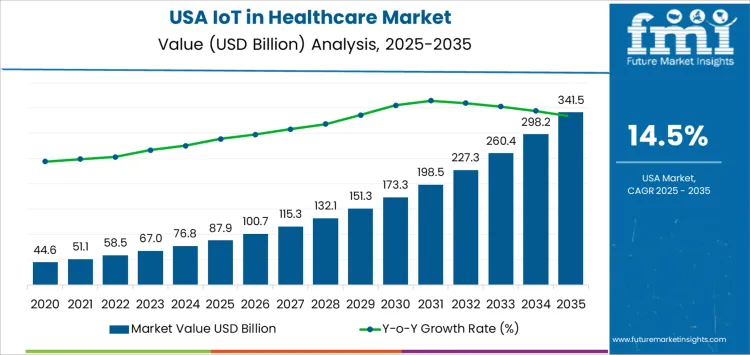
Demand for IoT in healthcare in the USA is expected to reach USD 87.9 billion in 2025, with a forecasted value of USD 341.5 billion by 2035, growing at a CAGR of 14.5% from 2025 to 2035. Demand is segmented by component, application, technology, and region. By component, hardware dominates, accounting for 60% of the total demand, followed by software and services. Prevalence of wearable devices, sensors, and connected equipment has driven the demand for hardware. These devices enable real-time monitoring, chronic disease management, and personalized care. In terms of application, telemedicine leads with a 40% share, reflecting the growing demand for remote healthcare services. Other key applications include medication management, patient monitoring, and connected imaging, with each contributing to the overall industry by improving healthcare access and operational efficiency. The technology segment sees Bluetooth-based solutions holding a prominent position, followed by Wi-Fi-based, NFC-based, and Zigbee-based technologies.
Quick Stats of the Demand for IoT in Healthcare in USA
- Demand for IoT in Healthcare in USA Value (2025): USD 87.9 billion
- Demand for IoT in Healthcare in USA Forecast Value (2035): USD 341.5 billion
- Demand for IoT in Healthcare in USA Forecast CAGR (2025-2035): 14.50%
- Demand for IoT in Healthcare in USA Leading Component: Hardware
- Demand for IoT in Healthcare in USA Key Growth Regions: West USA, South USA, Northeast USA, Midwest USA
- Demand for IoT in Healthcare in USA Top Players: Medtronic, GE HealthCare, Philips, Apple, Microsoft
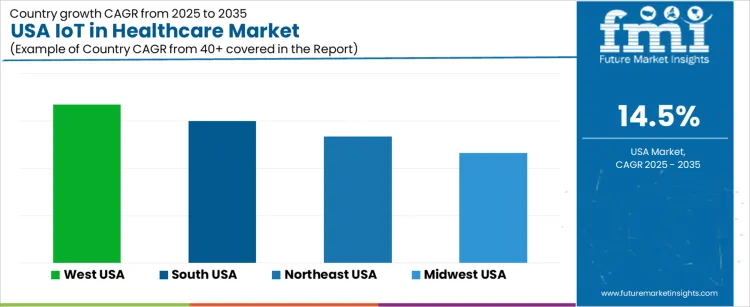
Demand for IoT in healthcare varies across the USA. West USA leads with a 16.7% CAGR, driven by advanced healthcare infrastructure and high technological adoption. The South USA follows closely with a 15.0% CAGR, driven by rising healthcare investments and a focus on digital health solutions. Northeast USA shows a 13.4% CAGR, propelled by its established healthcare network and rising demand for connected devices. Midwest USA experiences the slowest growth at a 11.6% CAGR. The need for personalized healthcare solutions, like telemedicine and remote monitoring, is expanding rapidly across all regions, with West USA and South USA showing the highest growth due to their tech-centric healthcare environments and focus on patient-centered care.
Demand for IoT in Healthcare in USA Key Takeaways
| Metric | Value |
|---|---|
| Industry Value (2025) | USD 87.9 billion |
| Industry Forecast Value (2035) | USD 341.5 billion |
| Forecast CAGR (2025-2035) | 14.50% |
Why is the Demand for IoT in Healthcare in USA Growing?
The demand for IoT in healthcare in the USA is growing as the adoption of connected devices and smart technologies transforms the healthcare sector. IoT applications are revolutionizing healthcare by enabling real-time monitoring of patients' health, improving the management of chronic diseases, and enhancing the efficiency of healthcare delivery. IoT devices, like wearables, remote patient monitoring tools, and connected diagnostic equipment, allow for continuous data collection and immediate feedback, leading to more personalized and timely treatments. This shift toward patient-centered care, coupled with a focus on improving healthcare outcomes, is driving the widespread adoption of IoT technologies in the healthcare industry.
Technological advancements in IoT connectivity, data analytics, and artificial intelligence are playing a critical role in accelerating growth. Enhanced data security, faster internet speeds, and the growing integration of AI in healthcare devices are making IoT solutions more reliable and scalable for clinical use. The healthcare industry's increased focus on reducing costs, improving patient outcomes, and enhancing operational efficiency is another significant driver of IoT adoption. The COVID-19 pandemic has highlighted the importance of remote care and telemedicine, further fueling the demand for IoT-enabled solutions that allow for more efficient and accessible healthcare services.
Despite the rapid growth, challenges like data privacy concerns, regulatory hurdles, and the high cost of IoT device implementation remain. As technology evolves and healthcare systems continue to prioritize digital transformation, the demand for IoT in healthcare in the USA is expected to experience substantial growth, supporting a shift toward more connected and data-driven healthcare models.
What is the Segment-Wise Analysis of Demand for IoT in Healthcare in USA?
Demand for IoT in healthcare in the USA is segmented by component, application, and region. By component, hardware leads at 60%, followed by software and services. In terms of application, telemedicine dominates at 40%, with medication management, clinical operations, patient monitoring, connected imaging, and other healthcare applications also contributing to the industry. Regionally, demand spans across West USA, South USA, Northeast USA, and Midwest USA, with varying levels of adoption based on regional healthcare needs, infrastructure, and technological advancements.
How Does Hardware Lead the Demand for IoT in Healthcare in USA?
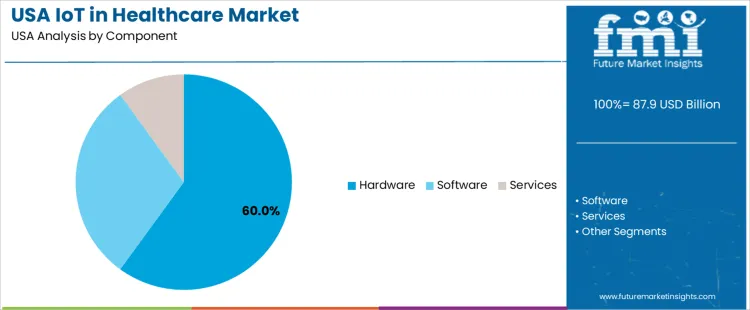
Hardware accounts for 60% of the demand for IoT in healthcare in the USA, driven by the critical role that devices like wearables, sensors, and connected medical equipment play in collecting patient data and improving healthcare outcomes. IoT hardware enables remote patient monitoring, real-time data collection, and the integration of medical devices with healthcare management systems. The demand for hardware is particularly strong in applications lie telemedicine and patient monitoring, where real-time data is essential for effective treatment. As the adoption of IoT technology continues to grow, especially in regions like the West and Northeast USA, the need for reliable and advanced hardware components remains central to expanding the role of IoT in healthcare. The trend towards personalized medicine and remote healthcare further fuels demand for IoT hardware in the healthcare sector.
Why Does Telemedicine Lead the Demand for IoT in Healthcare in USA?
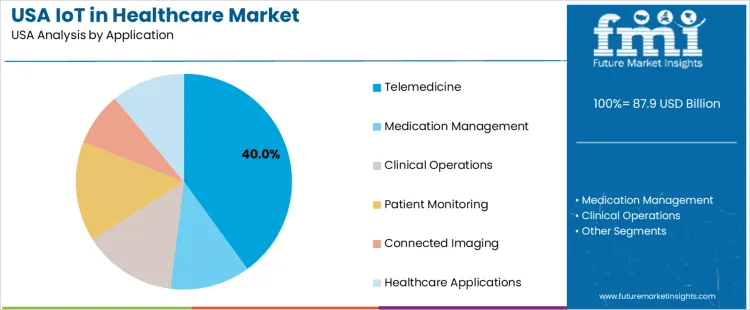
Telemedicine accounts for 40% of the demand for IoT in healthcare in the USA, reflecting the growing need for remote healthcare services. IoT devices play a crucial role in telemedicine by enabling healthcare professionals to remotely monitor patients, provide consultations, and manage chronic conditions from a distance. The demand for telemedicine has surged, especially in rural and underserved areas, where access to healthcare facilities can be limited. The ability to use IoT-enabled devices like wearables, health monitoring sensors, and remote diagnostic tools has made telemedicine a convenient and effective solution for patients and healthcare providers alike. With the increasing focus on reducing healthcare costs and improving access to care, telemedicine continues to be a driving force behind the expansion of IoT in healthcare across the USA, particularly in regions like the South and West, where healthcare accessibility is a key concern.
What are the Key Trends, Drivers, and Restraints in Demand for IoT in Healthcare in USA?
Demand for IoT in healthcare in the USA is expanding due to the growing adoption of connected devices like wearables, remote patient monitors, and smart medical equipment. These innovations enhance care coordination, chronic disease management, and post-discharge monitoring, particularly as the healthcare system shifts toward value-based care and preventive medicine. IoT enables early intervention and continuous monitoring outside of hospitals, which improves patient outcomes. There are barriers to broader adoption, including concerns about data security, privacy, and the integration of new systems with existing healthcare infrastructure. The cost of deploying IoT devices, along with the need for skilled personnel to manage them, can be prohibitive for smaller clinics and home-care providers, limiting their widespread use.
Why is Demand for IoT in Healthcare Growing in USA?
The demand for IoT in healthcare in the USA is growing due to the rising prevalence of chronic diseases like diabetes and cardiovascular conditions, which require continuous monitoring. IoT devices, like wearables and remote monitoring systems, allow for real-time data collection and management outside of hospital settings, empowering patients to manage their conditions. Healthcare providers are seeking cost-effective ways to reduce readmissions, improve patient outcomes, and better manage patient loads. IoT helps in early detection of health issues, thereby reducing the need for expensive interventions. The widespread availability of broadband, wireless connectivity, and the proliferation of smart devices have made IoT solutions more accessible and practical for healthcare providers, contributing to their increasing adoption.
How are Technological & Industry Innovations Driving IoT Demand in USA Healthcare?
Advancements in technology are driving the demand for IoT in healthcare in the USA. Improvements in sensor technology, cloud computing, and connectivity, particularly with 5G, have enhanced the reliability and affordability of IoT devices. Wearable health trackers and remote patient monitoring systems now allow for continuous collection of vital health data, enabling personalized treatment and preventive care. The integration of IoT devices with electronic health records (EHRs), telemedicine platforms, and AI-based analytics allows healthcare providers to gain actionable insights into patient conditions. This improves disease management, resource allocation, and patient outcomes. As these technologies become more advanced and cost-effective, the use of IoT in healthcare is expected to grow, supporting remote care and improving the efficiency of healthcare systems.
What are the Key Challenges and Risks That Could Limit IoT Demand in USA Healthcare?
Despite its growth potential, the adoption of IoT in healthcare in the USA faces significant challenges. Data security and privacy are major concerns, as connected medical devices are vulnerable to cyberattacks, potentially compromising sensitive patient data. Interoperability issues between new IoT devices and existing healthcare infrastructure, like electronic health records (EHRs), can lead to fragmented data and inefficiencies. The high cost of IoT devices, along with the ongoing expenses of maintenance and data storage, may limit adoption, particularly for smaller healthcare providers. The sheer volume of data generated by IoT devices may overwhelm healthcare professionals, leading to information overload and potentially undermining the effectiveness of these solutions in day-to-day care.
What is the Regional Demand Outlook for IoT in Healthcare in USA?
| Region | CAGR (%) |
|---|---|
| West USA | 16.7% |
| South USA | 15.0% |
| Northeast USA | 13.4% |
| Midwest USA | 11.6% |
Demand for IoT in healthcare in the USA is growing rapidly, with West USA leading at a 16.7% CAGR, driven by high technological adoption and advanced healthcare infrastructure. South USA follows with a 15.0% CAGR, supported by growing healthcare investments and an increasing focus on digital health solutions. Northeast USA shows a 13.4% CAGR, reflecting its robust healthcare network and rising demand for connected devices. Midwest USA experiences a 11.6% CAGR, as regional healthcare providers begin integrating IoT solutions for better patient care and operational efficiency.
How is Demand for IoT in Healthcare Growing in West USA?
West USA leads demand for IoT in healthcare, growing at a 16.7% CAGR. The region’s advanced healthcare infrastructure, along with high technological adoption, is a key driver of this growth. States like California are at the forefront of healthcare innovation, with a large number of healthcare providers integrating IoT devices for remote patient monitoring, diagnostics, and personalized care. The region’s tech-focused environment, with strong connections to Silicon Valley and a thriving healthcare startup ecosystem, also contributes to the demand for IoT solutions. West USA’s emphasis on telemedicine and digital health platforms supports the rise in IoT adoption, as healthcare systems seek to improve patient care while reducing costs. With the growing focus on healthcare digitization, the demand for IoT solutions is expected to continue growing strongly in the region.
Why is Demand for IoT in Healthcare Rising in South USA?
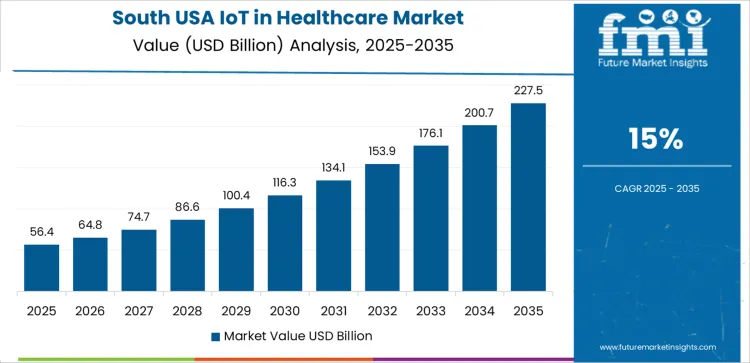
In South USA, demand for IoT in healthcare is rising at a 15.0% CAGR. The region’s increasing healthcare investments, particularly in states like Texas and Florida, are fueling the demand for digital health solutions. Hospitals, clinics, and other healthcare providers are increasingly adopting IoT devices to streamline operations, improve patient care, and enhance efficiency. The growing trend of remote patient monitoring, particularly for chronic disease management, is a significant factor driving IoT adoption. Additionally, South USA is witnessing rapid growth in telemedicine, which relies heavily on IoT technologies for remote diagnostics and treatment. With the rising healthcare costs and demand for more effective healthcare solutions, IoT is becoming a critical tool to improve outcomes while reducing inefficiencies. As healthcare infrastructure continues to modernize, the demand for IoT in healthcare in South USA is expected to keep growing.
How is Demand for IoT in Healthcare Expanding in Northeast USA?
Northeast USA shows steady demand for IoT in healthcare, growing at a 13.4% CAGR. The region’s established healthcare network, particularly in states like New York and Massachusetts, has supported the adoption of IoT technologies in medical settings. With an emphasis on improving patient outcomes and operational efficiencies, healthcare providers in the Northeast are increasingly integrating IoT devices for remote monitoring, data collection, and real-time analytics. The region’s focus on public health, research, and innovation has made it a hub for digital health solutions. The growing prevalence of chronic diseases in the Northeast is driving the demand for IoT-enabled health solutions, which enable continuous monitoring and early intervention. As the region continues to prioritize healthcare transformation and innovation, IoT adoption is expected to rise steadily, improving patient care and enhancing system efficiency.
Why is Demand for IoT in Healthcare Growing in Midwest USA?
Midwest USA is experiencing steady demand for IoT in healthcare, growing at a 11.6% CAGR. The region’s healthcare providers, particularly in cities like Chicago, are beginning to integrate IoT devices to enhance patient care and improve operational efficiency. As the healthcare industry seeks solutions to manage chronic diseases, reduce hospital readmissions, and optimize workflows, IoT technologies are becoming increasingly important. Remote patient monitoring is a key driver, as it enables healthcare providers to monitor patients outside traditional clinical settings, improving access to care in rural and underserved areas. Midwest focuses on expanding its digital health infrastructure, IoT adoption is expected to grow, helping healthcare organizations provide more personalized and data-driven care. While growth in this region may be slower compared to more tech-centric areas like the West, the demand for IoT in healthcare in the Midwest is still increasing steadily.
What is Driving the Demand for IoT in Healthcare in the USA and Who Are the Key Providers?
Demand for IoT in healthcare in the USA is surging as hospitals, clinics, and patients increasingly adopt connected medical devices and digital health technologies. IoT enables continuous, real‑time monitoring of vital signs, chronic conditions, and post‑surgical recovery across various settings. This technology reduces hospital readmissions and supports proactive management of chronic diseases while enhancing convenience and accessibility through remote patient monitoring, telemedicine, and wearables.
Leading companies driving the adoption of IoT in healthcare include Medtronic, GE Healthcare, Philips, Apple, and Microsoft. Medtronic holds a 25.0% industry share and offers connected implants and remote‑monitoring devices. GE Healthcare and Philips provide hospital-based sensor networks, imaging, and monitoring systems. Apple and Microsoft are advancing IoT with wearable health platforms, data analytics, and care coordination tools. These companies integrate medical devices with software, cloud connectivity, and data analytics to deliver IoT-based solutions in diagnostics, monitoring, and care management.
The rise of IoT in USA healthcare is fueled by an increase in chronic diseases, an aging population, and the expanding demand for telehealth and remote care. IoT enables a shift from reactive healthcare to continuous care models. Innovations in sensors, AI-driven health analytics, and secure cloud‑based patient data systems are enabling more personalized and efficient healthcare delivery. As healthcare providers focus on improving patient outcomes and reducing costs, IoT-based solutions are playing a key role in transforming the healthcare landscape.
Key Players in USA IoT in Healthcare Demand
- Medtronic
- GE HealthCare
- Philips
- Apple
- Microsoft
Scope of Report
| Items | Values |
|---|---|
| Quantitative Units (2025) | USD billion |
| Component | Hardware, Software, Services |
| Application | Telemedicine, Medication Management, Clinical Operations, Patient Monitoring, Connected Imaging, Healthcare Applications |
| Technology | Bluetooth-based, Wi-Fi-based, NFC-based, Zigbee-based, RFID-based, Other Technologies |
| End User | Hospitals, Pharmaceuticals, Clinics & Laboratories |
| Region | West USA, South USA, Northeast USA, Midwest USA |
| Countries Covered | USA |
| Key Companies Profiled | Medtronic, GE Healthcare, Philips, Apple, Microsoft |
| Additional Attributes | Dollar sales by application and technology; regional CAGR and growth outlook; increasing use of telemedicine and patient monitoring; innovations in connected healthcare solutions |
USA IoT in Healthcare Demand by Key Segments
Component
- Hardware
- Software
- Services
Application
- Telemedicine
- Medication Management
- Clinical Operations
- Patient Monitoring
- Connected Imaging
- Healthcare Applications
Technology
- Bluetooth-based
- Wi-Fi-based
- NFC-based
- Zigbee-based
- RFID-based
- Other Technologies
End User
- Hospitals
- Pharmaceuticals
- Clinics & Laboratories
Region
- West USA
- South USA
- Northeast USA
- Midwest USA
Frequently Asked Questions
How big is the demand for IoT in healthcare in USA in 2025?
The demand for IoT in healthcare in USA is estimated to be valued at USD 87.9 billion in 2025.
What will be the size of IoT in healthcare in USA in 2035?
The market size for the IoT in healthcare in USA is projected to reach USD 341.5 billion by 2035.
How much will be the demand for IoT in healthcare in USA growth between 2025 and 2035?
The demand for IoT in healthcare in USA is expected to grow at a 14.5% CAGR between 2025 and 2035.
What are the key product types in the IoT in healthcare in USA?
The key product types in IoT in healthcare in USA are hardware, software and services.
Which application segment is expected to contribute significant share in the IoT in healthcare in USA in 2025?
In terms of application, telemedicine segment is expected to command 40.0% share in the IoT in healthcare in USA in 2025.
Preview the report firsthand - request a free sample
Get SampleGet the brochure for pricing and purchase details.
Get PDFTable of Content
- Executive Summary
- USA Market Outlook
- Demand-side Trends
- Supply-side Trends
- Technology Roadmap Analysis
- Analysis and Recommendations
- Market Overview
- Market Coverage / Taxonomy
- Market Definition / Scope / Limitations
- Market Background
- Market Dynamics
- Drivers
- Restraints
- Opportunity
- Trends
- Scenario Forecast
- Demand in Optimistic Scenario
- Demand in Likely Scenario
- Demand in Conservative Scenario
- Opportunity Map Analysis
- Product Life Cycle Analysis
- Supply Chain Analysis
- Investment Feasibility Matrix
- Value Chain Analysis
- PESTLE and Porter’s Analysis
- Regulatory Landscape
- Regional Parent Market Outlook
- Production and Consumption Statistics
- Import and Export Statistics
- Market Dynamics
- USA Market Analysis 2020 to 2024 and Forecast, 2025 to 2035
- Historical Market Size Value (USD Million) Analysis, 2020 to 2024
- Current and Future Market Size Value (USD Million) Projections, 2025 to 2035
- Y-o-Y Growth Trend Analysis
- Absolute $ Opportunity Analysis
- USA Market Pricing Analysis 2020 to 2024 and Forecast 2025 to 2035
- USA Market Analysis 2020 to 2024 and Forecast 2025 to 2035, By Component
- Introduction / Key Findings
- Historical Market Size Value (USD Million) Analysis By Component , 2020 to 2024
- Current and Future Market Size Value (USD Million) Analysis and Forecast By Component , 2025 to 2035
- Hardware
- Software
- Services
- Y-o-Y Growth Trend Analysis By Component , 2020 to 2024
- Absolute $ Opportunity Analysis By Component , 2025 to 2035
- USA Market Analysis 2020 to 2024 and Forecast 2025 to 2035, By Application
- Introduction / Key Findings
- Historical Market Size Value (USD Million) Analysis By Application, 2020 to 2024
- Current and Future Market Size Value (USD Million) Analysis and Forecast By Application, 2025 to 2035
- Telemedicine
- Medication Management
- Clinical Operations
- Patient Monitoring
- Connected Imaging
- Healthcare Applications
- Y-o-Y Growth Trend Analysis By Application, 2020 to 2024
- Absolute $ Opportunity Analysis By Application, 2025 to 2035
- USA Market Analysis 2020 to 2024 and Forecast 2025 to 2035, By Technology
- Introduction / Key Findings
- Historical Market Size Value (USD Million) Analysis By Technology, 2020 to 2024
- Current and Future Market Size Value (USD Million) Analysis and Forecast By Technology, 2025 to 2035
- Bluetooth-based
- Wi-Fi-based
- NFC-based
- Zigbee-based
- RFID-based
- Other Technologies
- Y-o-Y Growth Trend Analysis By Technology, 2020 to 2024
- Absolute $ Opportunity Analysis By Technology, 2025 to 2035
- USA Market Analysis 2020 to 2024 and Forecast 2025 to 2035, By End User
- Introduction / Key Findings
- Historical Market Size Value (USD Million) Analysis By End User, 2020 to 2024
- Current and Future Market Size Value (USD Million) Analysis and Forecast By End User, 2025 to 2035
- Hospitals
- Pharmaceuticals
- Clinics & Laboratories
- Y-o-Y Growth Trend Analysis By End User, 2020 to 2024
- Absolute $ Opportunity Analysis By End User, 2025 to 2035
- Market Structure Analysis
- Competition Dashboard
- Competition Benchmarking
- Market Share Analysis of Top Players
- By Regional
- By Component
- By Application
- By Technology
- By End User
- Competition Analysis
- Competition Deep Dive
- GE HealthCare
- Overview
- Product Portfolio
- Profitability by Market Segments (Product/Age /Sales Channel/Region)
- Sales Footprint
- Strategy Overview
- Marketing Strategy
- Product Strategy
- Channel Strategy
- Philips
- Apple
- Microsoft
- GE HealthCare
- Competition Deep Dive
- Assumptions & Acronyms Used
- Research Methodology


