

- Industry Size (2025)
- USD 13.1 Bn
- Forecast (2035)
- USD 38.8 Bn
- CAGR (2025 to 2035)
- 11.5%
Adoption of IoT in Healthcare in Japan Forecast and Outlook 2025 to 2035
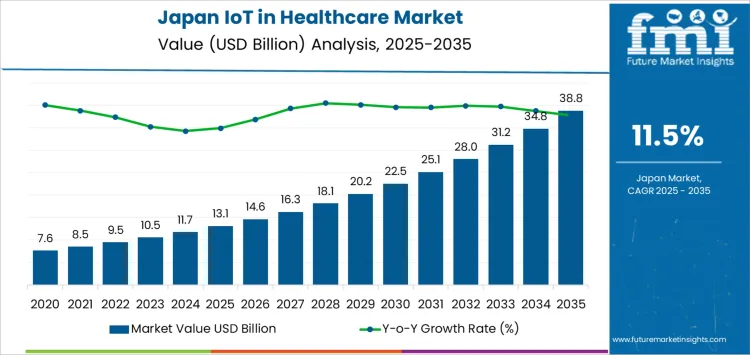
Demand for IoT in healthcare in Japan stands at USD 13.1 billion in 2025 and is projected to reach USD 38.8 billion by 2035 at a CAGR of 11.5%. Hardware holds a 60% share as hospitals expand connected devices, sensors, and imaging systems. Software accounts for 30% driven by platform integration, device orchestration, and clinical analytics, while services represent 10% tied to deployment and maintenance contracts. Telemedicine leads applications with 40% share, supported by patient monitoring at 15%, clinical operations at 14%, connected imaging at 8%, and healthcare applications at 11%. Bluetooth based solutions hold 20% share, Wi Fi based 15%, NFC based 23%, Zigbee based 16%, and RFID based 15% across patient identification, asset tracking, and real time data exchange supporting interoperability across regulated care environments and diagnostic networks.
Hospital systems represent 43% of end user demand as smart wards, remote vitals, and connected imaging expand across acute care settings. Clinics and laboratories account for 30% supported by diagnostic automation and chronic care monitoring, while pharmaceutical users hold 27% using IoT for cold chain tracking, adherence tools, and smart packaging. Deployment intensity remains highest across Kanto, Kinki, and Chubu due to dense hospital clusters, academic medical centers, and vendor integration bases. Tohoku and Kyushu show steady uptake linked with regional telehealth coverage and community diagnostics. Key participants active in Japan include Medtronic, GE HealthCare, Philips, Apple, and Microsoft. Growth through 2035 reflects aging population pressures, hospital workflow digitization, remote care expansion, and rising public investment in connected healthcare infrastructure covering data security frameworks, interoperability standards, and medical network resilience.
Quick Stats of the IoT in Healthcare Industry in Japan:
- IoT in Healthcare Industry in Japan Value (2025): USD 13.1 billion
- IoT in Healthcare Industry in Japan Forecast Value (2035): USD 38.8 billion
- IoT in Healthcare Industry in Japan Forecast CAGR (2025 to 2035): 11.5%
- Leading Component in IoT in Healthcare Industry in Japan: Hardware (60%)
- Key Growth Regions in IoT in Healthcare Industry in Japan: Kyushu & Okinawa, Kanto, Kansai, Chubu
- Top Players in IoT in Healthcare Industry in Japan: Medtronic, GE HealthCare, Philips, Apple, Microsoft
What is the Demand Forecast for IoT in Healthcare in Japan through 2035?
Demand for IoT in healthcare in Japan stands at USD 13.1 billion in 2025 and advances to USD 20.2 billion by 2030, creating a USD 7.1 billion value build within five years. The rise from USD 7.6 billion in 2020 reflects deep integration of connected devices across hospital asset tracking, remote patient monitoring, smart infusion systems, and elder care monitoring platforms. Deployment density continues to rise inside large hospital groups and long-term care facilities that manage high patient turnover and staff shortages. Demand during this phase is shaped by system-level upgrades in electronic health infrastructure, wider use of wearable diagnostics, and automation of ward-level operations that reduce manual workload for clinical staff.
From 2030 to 2035, demand expands from USD 20.2 billion to USD 38.8 billion, delivering a much stronger USD 18.6 billion value increase in the later phase. Annual demand increments widen rapidly as network-connected diagnostics, AI-assisted monitoring, and real-time clinical decision platforms scale across secondary and community hospitals. Growth is reinforced by national digital health programs, rising chronic disease management needs, and expansion of in-home connected care for the aging population. Device-to-cloud data integration becomes central to population health management during this period. By 2035, IoT in healthcare demand in Japan reflects a fully networked clinical operating environment rather than a collection of standalone digital tools.
IoT in Healthcare Industry in Japan Key Takeaways
| Metric | Value |
|---|---|
| Industry Value (2025) | USD 13.1 billion |
| Forecast Value (2035) | USD 38.8 billion |
| Forecast CAGR (2025 to 2035) | 11.5% |
What Is Driving the Demand for IoT in Healthcare in Japan?
The demand for IoT in healthcare in Japan is driven by structural strain on hospitals, rapid population aging, and long standing gaps in continuous patient observation. Traditional care models relied on periodic manual monitoring for vital signs, mobility, and medication compliance. As patient acuity increased across general wards, this approach created staff burden and delayed clinical response to early deterioration. Connected patient monitors, smart beds, and wearable sensors gained adoption as tools to extend clinical visibility beyond fixed nurse rounds. Large urban hospitals introduced networked devices across cardiac care, post-operative recovery, and respiratory monitoring to manage high patient loads with limited staff expansion. Long term care facilities also integrated connected tracking systems to supervise frail residents and reduce emergency transfers.
Future demand for IoT in healthcare in Japan will be shaped by expansion of home based medical care, tighter hospital length of stay controls, and rising dependence on remote clinical supervision. Home monitoring for heart failure, diabetes, and rehabilitation will continue to expand as regional hospitals shift care delivery away from inpatient settings. Data integration with electronic medical records will strengthen routine clinical reliance on connected devices across follow up care and chronic disease management. Barriers include system security risk, fragmented data interoperability, and cautious adoption culture among clinical staff. Budget limits in regional hospitals also restrict large scale deployment. Long term demand will depend on how effectively IoT systems reduce staff workload, prevent avoidable admissions, and support stable care delivery across Japan aging healthcare infrastructure.
What Is the Demand for IoT in Healthcare in Japan by Component and Application?
Summary of the demand for IoT in healthcare in Japan The demand for IoT in healthcare in Japan is shaped by hospital digitalization, remote care expansion, and national focus on efficiency in aging care systems. Hardware leads by component due to the large installed base of sensors, monitoring devices, and connected equipment across hospitals and home care. Telemedicine leads by application because remote consultation and follow up services fit well with rural access needs and elderly care delivery. Procurement is driven by public hospitals, private hospital groups, and home care service providers. Import reliance remains present for advanced sensors and networking modules. Substitution pressure exists across software and service layers under system integration strategies.
Why does hardware dominate the demand for IoT in healthcare in Japan by component?
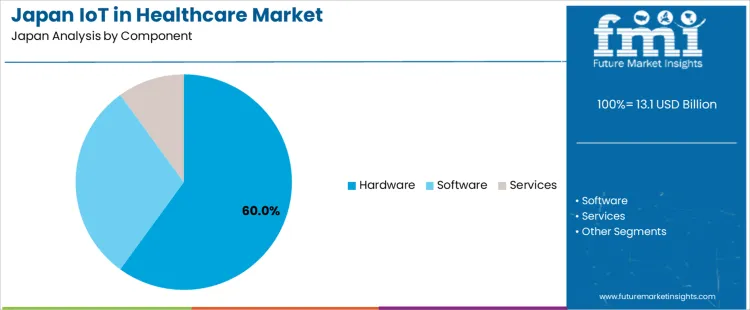
Hardware accounts for 60% of the demand for IoT in healthcare in Japan by component, reflecting the foundational role of physical devices in data collection and transmission. Consumption intensity is driven by bedside monitors, wearable sensors, infusion tracking units, and asset tracking tags deployed across hospitals and long term care facilities. Usage remains stable because continuous data acquisition supports patient safety and workflow efficiency. Procurement is led by large hospital systems and home care equipment providers operating under capital investment programs. Price sensitivity remains moderate because reliability and measurement accuracy define procurement decisions. Specification control emphasizes sensor calibration stability, wireless signal integrity, battery endurance, and enclosure durability.
Hardware also generates consistent repeat demand through replacement cycles linked to wear, calibration drift, and technology refresh programs. Repeat utilization remains predictable because many devices operate under continuous duty conditions. Buyers favor standardized device platforms to simplify maintenance and staff training. Margin structure remains controlled under competitive bidding and framework agreements. Regulatory exposure remains elevated due to medical device certification and electromagnetic compliance requirements. Import reliance persists for semiconductor components and communication modules. Substitution pressure from software driven analytics does not reduce the need for physical sensing hardware across clinical environments.
What drives telemedicine to lead the demand for IoT in healthcare in Japan by application?
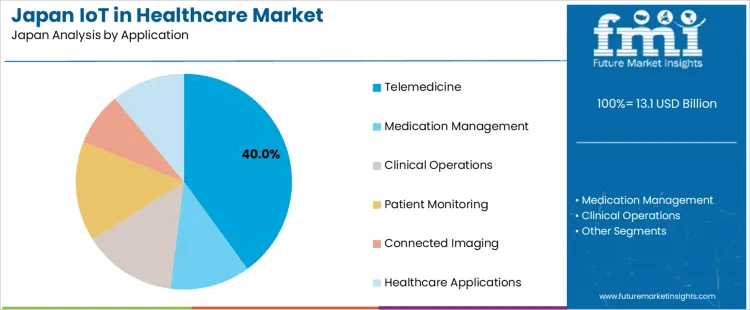
Telemedicine represents 40.0% of the demand for IoT in healthcare in Japan by application, reflecting its role in extending clinical reach to remote and aging populations. Consumption intensity is driven by virtual consultations, chronic disease follow up, and post discharge monitoring programs supported by connected devices. Usage remains stable because physician workload distribution and patient access remain persistent system challenges. Procurement is dominated by hospitals, municipal care programs, and digital health service providers. Price sensitivity remains moderate because telemedicine reduces in person visit burden and associated facility costs. Specification control emphasizes video transmission stability, data security compliance, device pairing reliability, and patient authentication accuracy.
Telemedicine applications also generate steady recurring demand through subscription based service models and continuous patient enrollment. Repeat utilization remains high because chronic care patients engage in frequent remote interactions. Buyers favor integrated platforms that combine consultation software with device connectivity and medical record synchronization. Margin structure remains controlled under reimbursement schedules and service contract pricing. Regulatory exposure remains elevated due to patient data protection and clinical accountability standards. Import reliance persists for communication software frameworks and cloud infrastructure components. Substitution pressure from in clinic visits remains limited in rural regions and home based elder care programs.
What Is Driving the Demand for IoT in Healthcare in Japan Hospital Operations and Home Medical Monitoring?
Demand for IoT in healthcare in Japan is shaped by hospital labor shortages, rapid population aging, and strong reliance on remote patient observation. Large medical centers deploy connected devices for bed management, infusion tracking, and vital sign monitoring to reduce manual workload. Home healthcare providers use connected blood pressure, glucose, and cardiac monitoring systems to support aging patients living alone. Municipal health programs integrate device data into care planning for chronic illness. Demand is built on operational control, caregiver support, and risk monitoring rather than experimental digital health adoption.
How Is Workforce Pressure Inside Hospitals Accelerating Device Connectivity?
Japan hospitals face sustained nurse and technician shortages across acute care and long-term wards. IoT systems support automated patient monitoring, asset tracking, and medication administration verification. Connected beds, smart IV pumps, and wearable sensors reduce direct observation burden during night shifts. Centralized dashboards allow fewer staff to manage larger patient loads with lower response delays. This labor substitution effect links IoT demand directly to workforce constraints rather than digital transformation initiatives.
Why Is Home-Based Elder Care Expanding Medical IoT Utilization?
Japan elder care relies heavily on home-based medical services supported by visiting nurses and remote supervision. IoT devices allow continuous monitoring of blood pressure, oxygen saturation, body motion, and sleep behavior. Care teams receive alerts when abnormal readings appear outside safe thresholds. Families gain visibility into daily health status without constant physical visits. This structure embeds IoT into daily elder care instead of specialty hospital monitoring programs.
How Do Cybersecurity Risk, System Fragmentation, and Cost Controls Limit Expansion?
Healthcare IoT deployment in Japan faces constraint from strict cybersecurity expectations, data privacy risk, and fragmented hospital IT systems. Many hospitals operate mixed-generation infrastructure that complicates device integration. Capital budgets remain tightly controlled under national reimbursement schedules. Smaller clinics prioritize core equipment over networked systems. These technical and financial boundaries slow uniform adoption despite high operational value across hospital and home care environments.
What is the Demand for IoT in Healthcare in Japan by Region?
| Region | CAGR (%) |
|---|---|
| Kyushu & Okinawa | 14.3% |
| Kanto | 13.2% |
| Kansai | 11.6% |
| Chubu | 10.2% |
| Tohoku | 9.0% |
| Rest of Japan | 8.5% |
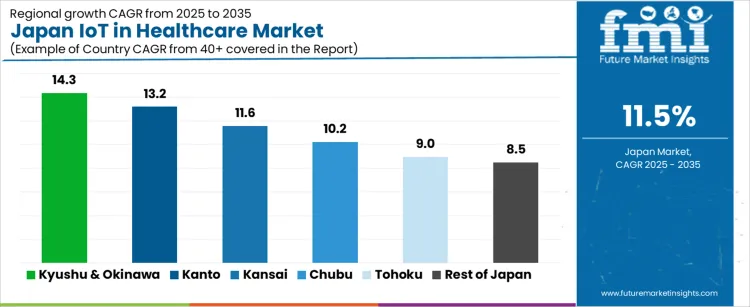
The demand for IoT in healthcare in Japan is rising rapidly across regions, led by Kyushu and Okinawa at a 14.3% CAGR. Growth here is supported by remote patient monitoring programs, smart hospital pilots, and strong deployment in elderly care facilities. Kanto follows at 13.2%, driven by dense networks of tertiary hospitals, digital health startups, and large scale adoption of connected diagnostics and asset tracking systems. Kansai records 11.6% growth, reflecting steady uptake in university hospitals and regional telemedicine platforms. Chubu at 10.2% shows moderate expansion linked to manufacturer led hospital digitization projects. Tohoku and the Rest of Japan, at 9.0% and 8.5%, reflect slower but stable growth shaped by infrastructure gaps, funding constraints, and gradual migration from legacy hospital IT systems to connected care platforms.
How Is Remote Care Expansion Accelerating IoT in Healthcare Demand in Kyushu and Okinawa?
Demand for IoT in healthcare in Kyushu and Okinawa is advancing at a CAGR of 14.3% through 2035, supported by rising use of remote patient monitoring, hospital network digitization, and healthcare access challenges across island and semi rural geographies. This region shows strong uptake of connected vital sign monitors, chronic disease tracking platforms, and emergency response systems. Kyushu and Okinawa differ from Kanto through stronger reliance on IoT for access continuity rather than urban hospital efficiency. Growth reflects public healthcare digitization programs and increasing elderly population monitoring needs.
- Remote patient monitoring anchors core deployment volumes
- Public hospitals lead IoT device integration programs
- Emergency response systems support real time care delivery
- Elderly care facilities sustain continuous device utilization
Why Is Urban Smart Hospital Deployment Sustaining IoT in Healthcare Growth in Kanto?
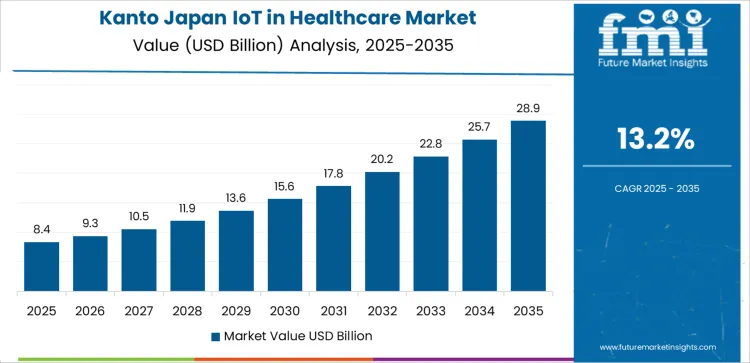
Demand for IoT in healthcare in Kanto is progressing at a CAGR of 13.2% through 2035, driven by dense hospital infrastructure, smart hospital investment programs, and advanced clinical data integration across Tokyo and surrounding areas. Kanto leads in connected imaging equipment, asset tracking systems, and real time patient flow management platforms. This region contrasts with Kyushu and Okinawa through higher focus on operational efficiency and clinical decision automation. Growth reflects integration of IoT with electronic records, predictive maintenance of medical equipment, and hospital wide data visibility.
- Asset tracking platforms improve equipment utilization
- Real time patient flow systems enhance bed management
- Connected imaging systems support high throughput diagnostics
- Hospital automation programs guide continuous upgrades
What Is Driving Balanced IoT in Healthcare Adoption Across Kansai Medical Networks?
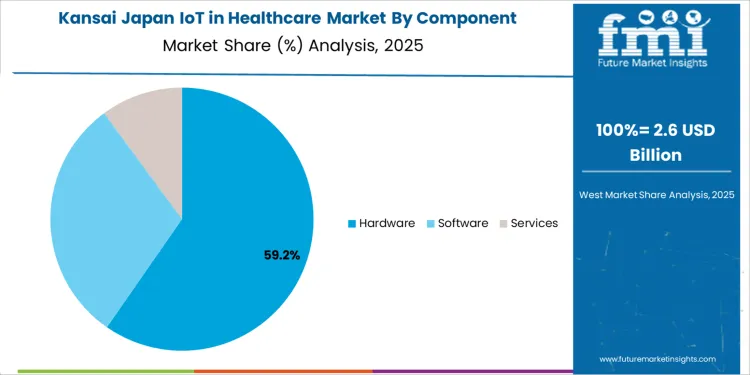
Demand for IoT in healthcare in Kansai is rising at a CAGR of 11.6% through 2035, supported by steady digital hospital upgrades, regional telemedicine deployment, and clinical workflow automation across Osaka and Kyoto. Kansai shows strong use of connected infusion pumps, smart medication cabinets, and inpatient monitoring systems. This region differs from Kanto through gradual rollout across mixed public and private hospital groups. Demand growth reflects balanced investment across patient safety systems, operational monitoring, and remote specialist consultation platforms.
- Smart medication cabinets strengthen dispensing control
- Connected infusion systems support inpatient care accuracy
- Telemedicine links expand specialist access
- Public private hospital networks drive steady deployment
How Is Industrial Workforce Healthcare Digitization Shaping IoT in Healthcare Demand in Chubu?
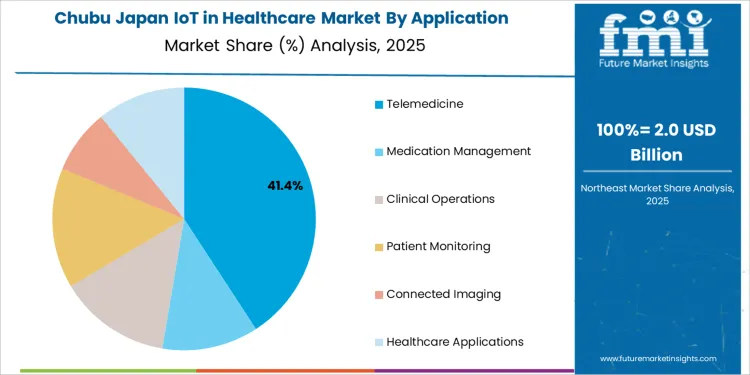
Demand for IoT in healthcare in Chubu is advancing at a CAGR of 10.2% through 2035, supported by employer linked health monitoring programs, general hospital digitization, and steady adoption of connected diagnostic platforms in Aichi. Chubu shows strong deployment across occupational health screening, connected imaging, and automated laboratory systems. This region differs from Kansai through stronger employer sponsored healthcare technology use. Growth reflects workforce health surveillance needs, factory linked medical services, and integration of IoT with primary care clinic operations.
- Occupational health monitoring supports connected device demand
- Automated laboratories use IoT for sample tracking
- Employer sponsored healthcare drives technology uptake
- Primary care digitization sustains steady deployment growth
Why Is Regional Hospital Modernization Supporting IoT in Healthcare Expansion in Tohoku?
Demand for IoT in healthcare in Tohoku is advancing at a CAGR of 9.0% through 2035, supported by regional hospital modernization, aging population care needs, and selective deployment of remote monitoring systems. Miyagi anchors most connected healthcare infrastructure across inpatient monitoring and emergency response coordination. Tohoku differs from Kanto through slower digital transformation and narrower use of advanced analytics platforms. Growth remains focused on essential monitoring, fall detection, and chronic disease management supported by local government healthcare programs.
- Aging population care drives demand for connected monitoring
- Regional hospitals standardize core IoT clinical systems
- Fall detection platforms expand senior care safety
- Public healthcare funding supports gradual rollout
How Is Limited Infrastructure Moderating IoT in Healthcare Growth in Rest of Japan?
Demand for IoT in healthcare in Rest of Japan is advancing at a CAGR of 8.5% through 2035, supported by small city hospital upgrades, remote clinic connectivity projects, and gradual digitization of basic care workflows. These areas differ from Kanto through narrower bandwidth availability and limited specialist systems integration. IoT adoption remains focused on patient monitoring, cold chain tracking for medicines, and clinic level diagnostic connectivity. Growth is steady and shaped by regional health budgets, infrastructure maturity, and dispersed care delivery models.
- Small city hospitals lead basic IoT clinical deployment
- Patient monitoring remains the primary application focus
- Medicine cold chain tracking supports logistics reliability
- Regional funding structures guide adoption pace
What Is Driving the Demand for IoT in Healthcare in Japan and Which Companies Shape System Deployment
The demand for IoT in healthcare in Japan is shaped by hospital labor shortages, national digital health policy targets, and rising demand for remote monitoring across aging patient populations. Fujitsu and NEC hold central domestic roles through hospital information systems, secure device connectivity, and cloud platforms used across public and private medical networks. Omron supports demand through connected blood pressure monitors, respiratory devices, and home based patient monitoring systems integrated into clinical data platforms. NTT Data anchors large scale deployment through health data infrastructure, interoperability frameworks, and municipal health network integration. These domestic firms shape day to day system use through long term contracts with hospital groups and local governments.
Medtronic supports IoT enabled care through connected cardiac devices, infusion systems, and remote patient monitoring platforms used in tertiary care. GE HealthCare and Philips participate through networked imaging systems, patient monitors, and data driven workflow platforms used in acute care and diagnostic settings. Apple contributes through consumer health data capture via wearable devices that link into approved medical software environments. Microsoft supports hospital cloud migration, cybersecurity, and medical data analytics through enterprise platforms used by health systems and research hospitals. System selection in Japan is governed by data security certification, interoperability with existing hospital systems, Japanese language user interfaces, and long term vendor support. Demand visibility tracks home care expansion, prefectural digital health funding, and steady growth in chronic disease monitoring outside hospital settings.
Key Players in the IoT in Healthcare Industry in Japan
- Medtronic
- GE HealthCare
- Philips
- Apple
- Microsoft
Scope of the Report
| Items | Values |
|---|---|
| Quantitative Units (2025) | USD billion |
| Component | Hardware, Software, Services |
| Application | Telemedicine, Medication Management, Clinical Operations, Patient Monitoring, Connected Imaging, Healthcare Applications |
| Technology | Bluetooth-based, Wi-Fi-based, NFC-based, Zigbee-based, RFID-based, Other Technologies |
| End User | Hospitals, Pharmaceuticals, Clinics & Laboratories |
| Region | Kyushu & Okinawa, Kanto, Kansai, Chubu, Tohoku, Rest of Japan |
| Countries Covered | Japan |
| Key Companies Profiled | Medtronic, GE HealthCare, Philips, Apple, Microsoft, Fujitsu, NEC, Omron, NTT Data |
| Additional Attributes | Dollar by sales by component, application, and technology; Regional CAGR and growth drivers; Hospital vs clinic adoption; Outpatient vs home monitoring expansion; Connected device penetration in telemedicine; Integration with EMR and clinical dashboards; Replacement and upgrade cycles; Remote patient monitoring deployment; Chronic disease management and elderly care uptake; Data security compliance, interoperability, and cybersecurity standards; Vendor support and service contracts; Repeat utilization through subscription and monitoring models |
IoT in Healthcare Industry in Japan Segmentation
Component:
- Hardware
- Software
- Services
Application:
- Telemedicine
- Medication Management
- Clinical Operations
- Patient Monitoring
- Connected Imaging
- Healthcare Applications
Technology:
- Bluetooth-based
- Wi-Fi-based
- NFC-based
- Zigbee-based
- RFID-based
- Other Technologies
End User:
- Hospitals
- Pharmaceuticals
- Clinics & Laboratories
Region
- Kyushu & Okinawa
- Kanto
- Kansai
- Chubu
- Tohoku
- Rest of Japan
Frequently Asked Questions
How big is the demand for IoT in healthcare in Japan in 2025?
The demand for IoT in healthcare in Japan is estimated to be valued at USD 13.1 billion in 2025.
What will be the size of IoT in healthcare in Japan in 2035?
The market size for the IoT in healthcare in Japan is projected to reach USD 38.8 billion by 2035.
How much will be the demand for IoT in healthcare in Japan growth between 2025 and 2035?
The demand for IoT in healthcare in Japan is expected to grow at a 11.5% CAGR between 2025 and 2035.
What are the key product types in the IoT in healthcare in Japan?
The key product types in IoT in healthcare in Japan are hardware, software and services.
Which application segment is expected to contribute significant share in the IoT in healthcare in Japan in 2025?
In terms of application, telemedicine segment is expected to command 40.0% share in the IoT in healthcare in Japan in 2025.
Preview the report firsthand - request a free sample
Get SampleGet the brochure for pricing and purchase details.
Get PDFTable of Content
- Executive Summary
- Japan Market Outlook
- Demand-side Trends
- Supply-side Trends
- Technology Roadmap Analysis
- Analysis and Recommendations
- Market Overview
- Market Coverage / Taxonomy
- Market Definition / Scope / Limitations
- Market Background
- Market Dynamics
- Drivers
- Restraints
- Opportunity
- Trends
- Scenario Forecast
- Demand in Optimistic Scenario
- Demand in Likely Scenario
- Demand in Conservative Scenario
- Opportunity Map Analysis
- Product Life Cycle Analysis
- Supply Chain Analysis
- Investment Feasibility Matrix
- Value Chain Analysis
- PESTLE and Porter’s Analysis
- Regulatory Landscape
- Regional Parent Market Outlook
- Production and Consumption Statistics
- Import and Export Statistics
- Market Dynamics
- Japan Market Analysis 2020 to 2024 and Forecast, 2025 to 2035
- Historical Market Size Value (USD Million) Analysis, 2020 to 2024
- Current and Future Market Size Value (USD Million) Projections, 2025 to 2035
- Y-o-Y Growth Trend Analysis
- Absolute $ Opportunity Analysis
- Japan Market Pricing Analysis 2020 to 2024 and Forecast 2025 to 2035
- Japan Market Analysis 2020 to 2024 and Forecast 2025 to 2035, By Component
- Introduction / Key Findings
- Historical Market Size Value (USD Million) Analysis By Component , 2020 to 2024
- Current and Future Market Size Value (USD Million) Analysis and Forecast By Component , 2025 to 2035
- Hardware
- Software
- Services
- Y-o-Y Growth Trend Analysis By Component , 2020 to 2024
- Absolute $ Opportunity Analysis By Component , 2025 to 2035
- Japan Market Analysis 2020 to 2024 and Forecast 2025 to 2035, By Application
- Introduction / Key Findings
- Historical Market Size Value (USD Million) Analysis By Application, 2020 to 2024
- Current and Future Market Size Value (USD Million) Analysis and Forecast By Application, 2025 to 2035
- Telemedicine
- Medication Management
- Clinical Operations
- Patient Monitoring
- Connected Imaging
- Healthcare Applications
- Y-o-Y Growth Trend Analysis By Application, 2020 to 2024
- Absolute $ Opportunity Analysis By Application, 2025 to 2035
- Japan Market Analysis 2020 to 2024 and Forecast 2025 to 2035, By Technology
- Introduction / Key Findings
- Historical Market Size Value (USD Million) Analysis By Technology, 2020 to 2024
- Current and Future Market Size Value (USD Million) Analysis and Forecast By Technology, 2025 to 2035
- Bluetooth-based
- Wi-Fi-based
- NFC-based
- Zigbee-based
- RFID-based
- Other Technologies
- Y-o-Y Growth Trend Analysis By Technology, 2020 to 2024
- Absolute $ Opportunity Analysis By Technology, 2025 to 2035
- Japan Market Analysis 2020 to 2024 and Forecast 2025 to 2035, By End User
- Introduction / Key Findings
- Historical Market Size Value (USD Million) Analysis By End User, 2020 to 2024
- Current and Future Market Size Value (USD Million) Analysis and Forecast By End User, 2025 to 2035
- Hospitals
- Pharmaceuticals
- Clinics & Laboratories
- Y-o-Y Growth Trend Analysis By End User, 2020 to 2024
- Absolute $ Opportunity Analysis By End User, 2025 to 2035
- Market Structure Analysis
- Competition Dashboard
- Competition Benchmarking
- Market Share Analysis of Top Players
- By Regional
- By Component
- By Application
- By Technology
- By End User
- Competition Analysis
- Competition Deep Dive
- Medtronic
- Overview
- Product Portfolio
- Profitability by Market Segments (Product/Age /Sales Channel/Region)
- Sales Footprint
- Strategy Overview
- Marketing Strategy
- Product Strategy
- Channel Strategy
- GE HealthCare
- Philips
- Apple
- Microsoft
- Medtronic
- Competition Deep Dive
- Assumptions & Acronyms Used
- Research Methodology


