

- Industry Size (2025)
- USD 1.9 Bn
- Forecast (2035)
- USD 3.0 Bn
- CAGR (2025 to 2035)
- 4.6%
Demand for Real-Time E-Healthcare System in Japan Forecast and Outlook 2025 to 2035
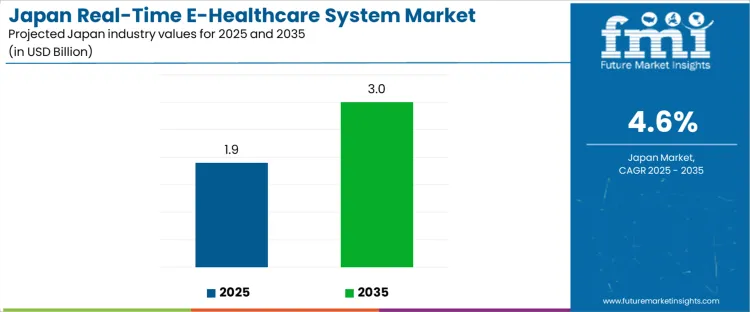
Demand for real-time e-healthcare systems in Japan is projected to grow from USD 1.9 billion in 2025 to USD 3.0 billion by 2035, reflecting a compound annual growth rate (CAGR) of 4.6%. This growth is driven by the increasing need for digital health solutions, especially in a country with an aging population and rising healthcare demands. Real-time e-healthcare systems, which enable instant access to medical data, telemedicine, and remote patient monitoring, are becoming crucial in Japan’s healthcare infrastructure. These systems improve patient care, reduce waiting times, and optimize the efficiency of healthcare providers.
Japan's emphasis on technology adoption and innovation in healthcare, combined with a growing focus on preventative care and chronic disease management, will likely continue to support the demand for real-time e-healthcare systems. Furthermore, government initiatives and regulatory support for digital health technologies will further enhance the adoption and expansion of e-healthcare solutions across the country.
Quick Stats of the Demand for Real-Time E-Healthcare System in Japan
- Demand for Real-Time E-Healthcare System in Japan Value (2025): USD 1.9 billion
- Demand for Real-Time E-Healthcare System in Japan Forecast Value (2035): USD 3.0 billion
- Demand for Real-Time E-Healthcare System in Japan Forecast CAGR (2025-2035): 4.6%
- Demand for Real-Time E-Healthcare System in Japan Leading Product Type: Wireless Body Sensor Network Based e-healthcare Systems (34%)
- Demand for Real-Time E-Healthcare System in Japan Key Growth Regions: Kyushu & Okinawa, Kanto, Kansai, Chubu, Tohoku, Rest of Japan
- Demand for Real-Time E-Healthcare System in Japan Key Players: Abbott, Dexcom, Inc., Medtronic, Cerner Corporation, GE Healthcare
What is the Growth Forecast for the Real-Time E-Healthcare System Market through 2035?
The half-decade weighted growth analysis for the real-time e-healthcare system market in Japan shows consistent growth with a more pronounced contribution in the initial years of the forecast period. Starting at USD 1.9 billion in 2025, the market grows to USD 2.0 billion in 2026 and USD 2.1 billion in 2027. These early years reflect gradual growth as more healthcare providers adopt digital health solutions to address rising demand for accessible and efficient healthcare services.
From 2028 onward, the growth rate accelerates, with the market reaching USD 2.2 billion in 2028, USD 2.3 billion in 2029, and USD 2.4 billion in 2030. As technology continues to evolve and healthcare providers expand their use of real-time e-healthcare systems, the adoption becomes more widespread across Japan, particularly in managing chronic diseases and enhancing patient care.
By 2035, the market reaches USD 3.0 billion, demonstrating long-term, sustained growth driven by innovations in e-healthcare technology, increasing demand for telemedicine, and the country’s emphasis on improving healthcare accessibility. The half-decade weighted growth highlights the stable and gradual expansion of the market, with significant contributions from technology adoption, regulatory support, and evolving healthcare needs.
Key Takeaways of Real-Time E-Healthcare System Industry in Japan
| Metric | Value |
|---|---|
| Industry Sales Value (2025) | USD 1.9 billion |
| Industry Forecast Value (2035) | USD 3 billion |
| Industry Forecast CAGR (2025-2035) | 4.6% |
What Is Driving the Demand for Real Time E Healthcare Systems in Japan?
The demand for real time e healthcare systems in Japan has been shaped by increasing pressure on healthcare services, growing elderly population, and efforts to digitize medical infrastructure. Historically, the medical system relied heavily on paper based records and face to face consultations. In the late 20th century, efforts began to computerize hospital information systems and introduce electronic health records (EHRs) to rationalize complex claims and medical record processes in response to rising medical costs and administrative burdens. Medical institutions started adopting electronic chart systems and hospital information systems to streamline record keeping and data exchange.
In recent years, adoption of digital record systems (EMR/EHR), telemedicine, wearables, and remote patient monitoring has accelerated. The government has advanced national policies to promote digital transformation of healthcare (Medical DX), aiming to standardize electronic medical records across institutions and enable data sharing. The shift has been supported by regulatory reforms and growing investment in healthcare IT systems.
Future demand for real time e healthcare in Japan is likely to increase as the need grows for remote monitoring, chronic disease management, elderly care, and optimized healthcare delivery across dispersed populations. Deployment of real-time monitoring via wearable sensors and IoT devices will support continuous tracking of vital signs and early detection of medical issues. Implementation of cloud based shared health records, AI assisted diagnostics, and remote consultation platforms is expected, driven by government backing and increasing demand for efficient, responsive care. The adoption of such systems depends on progress toward interoperability standards, regulatory clarity for digital health products, and expansion of infrastructure across medical institutions.
What Are the Key Segments in Real-Time E-Healthcare System Market in Japan?
The real-time e-healthcare system market in Japan is segmented by product type and technology. Wireless body sensor network-based e-healthcare systems lead the market, holding 34% of the share. In terms of technology, IoT (Internet of Things) is the dominant technology, representing 30% of the market. The increasing demand for connected health solutions and remote monitoring of patients is driving the growth of real-time e-healthcare systems in Japan.
Which Product Type Drives Real-Time E-Healthcare System Demand in Japan?
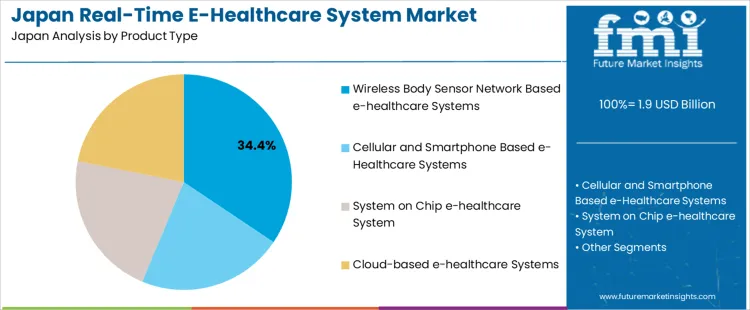
Wireless body sensor network-based e-healthcare systems are the most widely adopted product type in Japan, accounting for 34% of the market share. These systems are used to monitor patients' vital signs in real-time through wearable sensors, which can transmit data wirelessly to healthcare providers. This allows for continuous health monitoring, especially for patients with chronic conditions or those recovering from surgery. Wireless body sensor networks offer a non-invasive, efficient solution for remote monitoring, which is particularly useful in Japan's aging population. The technology helps reduce hospital visits, improve patient outcomes, and increase efficiency in healthcare management. While other product types, such as cellular and smartphone-based e-healthcare systems, system on chip e-healthcare systems, and cloud-based e-healthcare systems, are also important, wireless body sensor network-based systems remain the most popular due to their real-time capabilities and effective integration into the healthcare ecosystem.
Which Technology Drives Real-Time E-Healthcare System Demand in Japan?
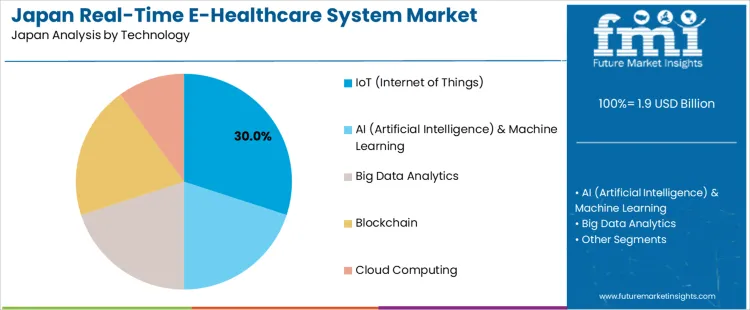
IoT (Internet of Things) is the leading technology driving the demand for real-time e-healthcare systems in Japan, holding 30% of the market share. IoT enables the interconnection of medical devices, wearables, and sensors, allowing healthcare professionals to monitor patients remotely and receive real-time data. This connectivity is crucial for improving patient care, enabling timely interventions, and reducing hospital admissions. IoT-based systems help streamline healthcare operations by enabling continuous data collection, which can be analyzed for insights into patient health trends. Other technologies such as AI (Artificial Intelligence) & Machine Learning, big data analytics, and cloud computing also play important roles in enhancing the capabilities of real-time e-healthcare systems, enabling more precise diagnostics, predictive analytics, and data storage. However, IoT remains the foundational technology, driving the integration of smart devices and enabling seamless data transfer and monitoring across the healthcare system in Japan.
What is the Demand for Real-Time E-Healthcare System in Japan?
Demand for real-time e-healthcare systems in Japan is increasing as the healthcare sector embraces digital technologies to enhance patient care and streamline operations. Real-time e-healthcare systems, which enable immediate access to healthcare data, remote consultations, and continuous monitoring of patient health, are becoming essential in managing the aging population and addressing the growing need for healthcare services. With advancements in telemedicine and health information technology, Japan is adopting these systems to improve efficiency, reduce healthcare costs, and enhance the overall patient experience. The expansion of such systems is expected to continue as the demand for accessible, high-quality healthcare rises.
What are the Drivers of Demand for Real-Time E-Healthcare System in Japan?
Several factors are driving the demand for real-time e-healthcare systems in Japan. First, the aging population, which requires more frequent medical care and management of chronic conditions, is a significant driver. E-healthcare systems enable healthcare providers to offer remote consultations and continuous monitoring, reducing the burden on hospitals and ensuring that elderly patients receive timely care. Second, the increasing demand for convenience and accessibility in healthcare services is pushing the adoption of telemedicine and digital health solutions. Third, advancements in digital infrastructure, including high-speed internet and mobile technology, have made it easier to implement real-time healthcare systems. Additionally, government initiatives and policies promoting digital health solutions are encouraging healthcare providers to adopt these systems to improve care delivery and reduce costs.
What are the Restraints on Demand for Real-Time E-Healthcare System in Japan?
Despite the increasing demand, several factors may limit the widespread adoption of real-time e-healthcare systems in Japan. One of the main challenges is the concern over data security and patient privacy. The transmission of sensitive health information through digital platforms requires robust cybersecurity measures to prevent breaches, which can be costly and complex to implement. Second, the lack of digital literacy among some segments of the population, particularly the elderly, may hinder the adoption of e-healthcare systems. Third, healthcare providers may face difficulties integrating new technologies with existing infrastructure, leading to challenges in training staff and ensuring smooth operations. Finally, regulatory hurdles, including the need to comply with healthcare standards and reimbursement policies, may slow down the adoption of real-time e-healthcare systems.
What are the Key Trends Influencing Demand for Real-Time E-Healthcare System in Japan?
Several key trends are shaping the demand for real-time e-healthcare systems in Japan. One significant trend is the increasing integration of telemedicine and remote monitoring into healthcare practices, enabling patients to receive care from home or other remote locations. This trend is particularly important in managing chronic conditions and ensuring continuous care for the aging population. Another trend is the growth of data-driven healthcare, where real-time health data is used to personalize treatments and improve patient outcomes. Additionally, the rise of artificial intelligence (AI) and machine learning in healthcare is enabling more efficient diagnosis, treatment planning, and decision-making, further driving the demand for real-time e-healthcare systems. Lastly, there is an increasing focus on patient-centered care, with more emphasis on improving the patient experience through digital solutions that allow for easier access to healthcare services and information.
What is the Regional Demand Outlook for the Real-Time E-Healthcare System Market in Japan?
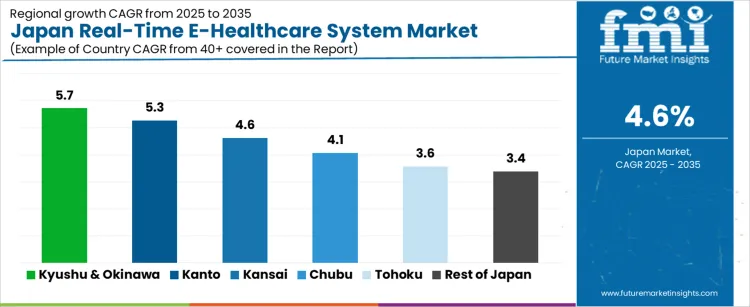
The Real-Time E-Healthcare System market in Japan is projected to experience steady growth, with Kyushu & Okinawa leading the way at a projected CAGR of 5.7%. Kanto follows with a growth rate of 5.3%, while Kansai is expected to grow at 4.6%. Chubu is projected to grow at a rate of 4.1%, while Tohoku and Rest of Japan show more moderate growth, with CAGRs of 3.6% and 3.4%, respectively. As the demand for digital healthcare solutions increases, driven by the need for efficient and accessible medical services, the market for real-time e-healthcare systems in Japan is expected to rise.
| Region | CAGR (2025-2035) |
|---|---|
| Kyushu & Okinawa | 5.7% |
| Kanto | 5.3% |
| Kansai | 4.6% |
| Chubu | 4.1% |
| Tohoku | 3.6% |
| Rest of Japan | 3.4% |
What is Driving the Growth of Real-Time E-Healthcare Systems in Kyushu & Okinawa?
Kyushu & Okinawa is projected to experience the highest growth in the Real-Time E-Healthcare System market, with a projected CAGR of 5.7%. The region’s focus on improving healthcare accessibility and providing timely services is contributing to the demand for real-time e-healthcare solutions. As the population in Kyushu & Okinawa continues to age, the need for remote healthcare solutions and telemedicine is growing. Real-time e-healthcare systems are playing a key role in managing the increasing healthcare demands of elderly individuals and those with chronic conditions. Additionally, the region’s healthcare institutions are increasingly adopting digital health technologies to reduce healthcare costs, improve efficiency, and provide more personalized care. As the adoption of digital health solutions expands, the market for real-time e-healthcare systems is expected to continue growing steadily in Kyushu & Okinawa.
Why is the Real-Time E-Healthcare System Market Expanding in Kanto?
In Kanto, the demand for real-time e-healthcare systems is projected to grow at a CAGR of 5.3%. Kanto, home to Tokyo, Japan’s capital and the world’s largest metropolitan area, has a highly developed healthcare infrastructure that supports the growing adoption of digital healthcare technologies. The rising need for healthcare services due to an aging population and the increased use of mobile devices and internet services are driving the demand for real-time e-healthcare systems in Kanto. Healthcare providers in the region are increasingly turning to e-healthcare solutions to streamline operations, provide remote consultations, and monitor patients with chronic conditions. Additionally, Kanto’s technological advancements and digital transformation initiatives in the healthcare sector are further fueling the demand for real-time e-healthcare systems, enabling patients to access timely care without the need to visit healthcare facilities.
How is the Real-Time E-Healthcare System Market Growing in Kansai?
In Kansai, the Real-Time E-Healthcare System market is projected to grow at a CAGR of 4.6%. The region, which includes major cities like Osaka, Kyoto, and Kobe, has a strong healthcare sector that is increasingly adopting digital health technologies. Kansai’s aging population is driving the demand for remote healthcare services and real-time e-healthcare systems to manage chronic diseases and monitor elderly patients. Healthcare providers in the region are looking for efficient ways to provide care to a growing number of elderly individuals, and e-healthcare solutions are being seen as a key tool in addressing these needs. Additionally, Kansai’s healthcare system is focused on enhancing the quality of care and reducing costs, further contributing to the growing demand for real-time e-healthcare systems. As digital health services continue to expand, the market in Kansai is expected to experience steady growth.
What is Contributing to the Growth of Real-Time E-Healthcare Systems in Chubu?
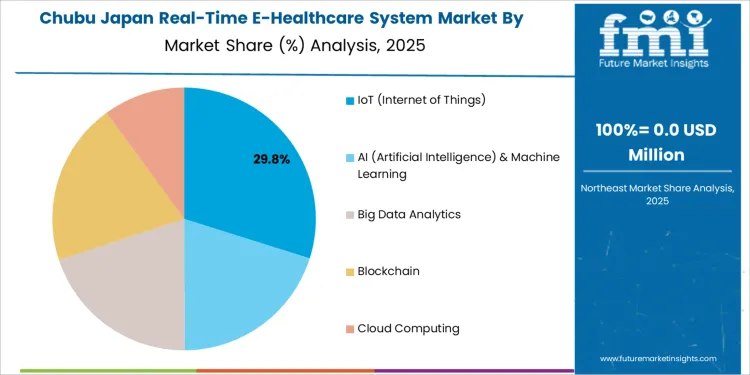
In Chubu, the Real-Time E-Healthcare System market is expected to grow at a CAGR of 4.1%. The region’s focus on technological innovation and improving healthcare accessibility is driving the demand for real-time e-healthcare solutions. Chubu, with cities like Nagoya, is home to a large population of aging individuals who are increasingly in need of digital health solutions. Real-time e-healthcare systems are helping healthcare providers monitor patients remotely, ensuring timely interventions and reducing the strain on healthcare facilities. The growing acceptance of telemedicine and online consultations in the region is further driving market expansion. With healthcare providers looking to improve efficiency, reduce costs, and deliver high-quality care to more patients, the demand for real-time e-healthcare systems in Chubu is expected to rise steadily.
What is Influencing the Growth of Real-Time E-Healthcare Systems in Tohoku?
In Tohoku, the Real-Time E-Healthcare System market is projected to grow at a CAGR of 3.6%. While the region’s growth rate is moderate compared to other areas, the increasing need for remote healthcare services, particularly for elderly individuals in rural areas, is contributing to the adoption of real-time e-healthcare systems. Tohoku’s healthcare providers are increasingly implementing digital health solutions to reach patients in remote locations and improve the overall quality of care. The region’s aging population, combined with a lack of healthcare facilities in some areas, is driving the need for innovative healthcare delivery methods. As healthcare providers look for ways to improve access to care and monitor patients in real-time, the market for real-time e-healthcare systems in Tohoku is expected to continue growing.
What is Contributing to the Growth of Real-Time E-Healthcare Systems in Rest of Japan?
In Rest of Japan, the Real-Time E-Healthcare System market is expected to grow at a more moderate rate of 3.4%. Although this region may have a smaller urban population compared to the major metropolitan areas, the adoption of real-time e-healthcare solutions is still growing. Healthcare providers in Rest of Japan are increasingly turning to digital health technologies to address the needs of rural populations and improve healthcare delivery. The growing awareness of the benefits of e-healthcare systems, including reducing hospital visits, improving patient monitoring, and providing timely care, is contributing to the expansion of the market. As healthcare systems in the rest of Japan continue to evolve and prioritize access to healthcare for all citizens, real-time e-healthcare systems are expected to become more widely used.
What is the Competitive Landscape for Demand for Real Time E Healthcare Systems in Japan?
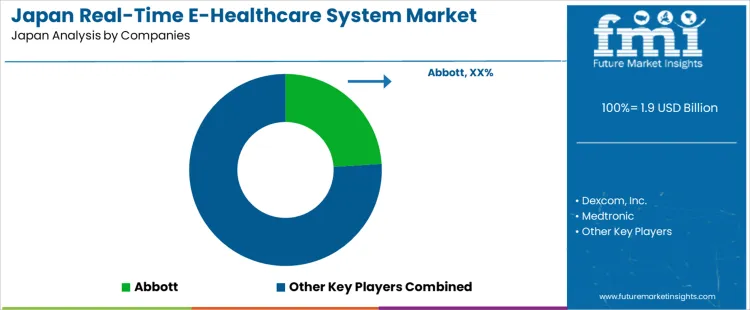
Demand for real time e healthcare systems in Japan is growing strongly as aging demographics, rising chronic disease burden, and a shortage of care personnel push the healthcare sector toward digital and remote monitoring solutions. The expanding elderly population and increasing prevalence of chronic conditions such as diabetes, cardiovascular disease, and respiratory disorders make continuous monitoring and remote care appealing. The growing government and institutional support for telemedicine, remote patient monitoring, and digital health infrastructure further accelerates adoption across hospitals, clinics, care centres, and home care settings.
On the supply side, a mix of global medical device and healthcare IT firms compete to capture the Japanese market. According to the companies you listed-Abbott, Dexcom, Inc., Medtronic, Cerner Corporation, and GE Healthcare-these firms are active suppliers of devices and software platforms for real time e healthcare. Solutions include wearable sensors, remote monitoring devices, data analytics platforms, and integration with electronic health records. Success in Japan depends on factors such as device reliability, ease of integration with local healthcare workflows, support for chronic disease management, compliance with national data standards, and ability to offer comprehensive, scalable remote care solutions. Firms that combine strong technology, service support, and regulatory compliance are positioned to benefit from rising demand as Japan shifts toward more patient centric and digitally enabled healthcare delivery.
Key Players of the Real-Time E-Healthcare System Industry in Japan
- Abbott
- Dexcom, Inc.
- Medtronic
- Cerner Corporation
- GE Healthcare
Scope of the Report
| Items | Details |
|---|---|
| Quantitative Units | USD Billion |
| Regions Covered | Japan |
| Product Type | Wireless Body Sensor Network-based E Healthcare Systems; Cellular & Smartphone-based E Healthcare Systems; System on Chip E Healthcare Systems; Cloud based E Healthcare Systems |
| Technology | IoT (Internet of Things), AI & Machine Learning, Big Data Analytics, Blockchain, Cloud Computing |
| Application | Patient Monitoring; Chronic Disease Management; Emergency Care; Diagnosis & Treatment; Telemedicine; Health & Fitness Tracking |
| End User | Hospitals; Clinics; Homecare Settings; Diagnostic Centers |
| Key Companies / Players | Abbott; Dexcom, Inc.; Medtronic; Cerner Corporation; GE Healthcare |
| Additional Attributes | Dollar sales by system type and application show robust growth, especially in remote patient monitoring, chronic disease management, and telemedicine/online consultation systems. Growth is driven by Japan’s aging population, increasing chronic disease burden, high smartphone & Internet penetration, and government/policy support for digital health. |
Key Segments in the Demand for Real-Time E-Healthcare System in Japan
Product Type
- Wireless Body Sensor Network Based e-healthcare Systems
- Cellular and Smartphone Based e-healthcare Systems
- System on Chip e-healthcare Systems
- Cloud-based e-healthcare Systems
Technology
- IoT (Internet of Things)
- AI (Artificial Intelligence) & Machine Learning
- Big Data Analytics
- Blockchain
- Cloud Computing
Application
- Patient Monitoring
- Chronic Disease Management
- Emergency Care
- Diagnosis & Treatment
- Telemedicine
- Health & Fitness Tracking
End User
- Hospitals
- Clinics
- Homecare Settings
- Diagnostic Centers
Region
- Kyushu & Okinawa
- Kanto
- Kansai
- Chubu
- Tohoku
- Rest of Japan
Frequently Asked Questions
How big is the demand for real-time e-healthcare system in Japan in 2025?
The demand for real-time e-healthcare system in Japan is estimated to be valued at USD 1.9 billion in 2025.
What will be the size of real-time e-healthcare system in Japan in 2035?
The market size for the real-time e-healthcare system in Japan is projected to reach USD 3.0 billion by 2035.
How much will be the demand for real-time e-healthcare system in Japan growth between 2025 and 2035?
The demand for real-time e-healthcare system in Japan is expected to grow at a 4.6% CAGR between 2025 and 2035.
What are the key product types in the real-time e-healthcare system in Japan?
The key product types in real-time e-healthcare system in Japan are wireless body sensor network based e-healthcare systems, cellular and smartphone based e-healthcare systems, system on chip e-healthcare system and cloud-based e-healthcare systems.
Which technology segment is expected to contribute significant share in the real-time e-healthcare system in Japan in 2025?
In terms of technology, IoT (internet of things) segment is expected to command 30.0% share in the real-time e-healthcare system in Japan in 2025.
Preview the report firsthand - request a free sample
Get SampleGet the brochure for pricing and purchase details.
Get PDFTable of Content
- Executive Summary
- Japan Market Outlook
- Demand-side Trends
- Supply-side Trends
- Technology Roadmap Analysis
- Analysis and Recommendations
- Market Overview
- Market Coverage / Taxonomy
- Market Definition / Scope / Limitations
- Market Background
- Market Dynamics
- Drivers
- Restraints
- Opportunity
- Trends
- Scenario Forecast
- Demand in Optimistic Scenario
- Demand in Likely Scenario
- Demand in Conservative Scenario
- Opportunity Map Analysis
- Product Life Cycle Analysis
- Supply Chain Analysis
- Investment Feasibility Matrix
- Value Chain Analysis
- PESTLE and Porter’s Analysis
- Regulatory Landscape
- Regional Parent Market Outlook
- Production and Consumption Statistics
- Import and Export Statistics
- Market Dynamics
- Japan Market Analysis 2020 to 2024 and Forecast, 2025 to 2035
- Historical Market Size Value (USD Million) Analysis, 2020 to 2024
- Current and Future Market Size Value (USD Million) Projections, 2025 to 2035
- Y-o-Y Growth Trend Analysis
- Absolute $ Opportunity Analysis
- Japan Market Pricing Analysis 2020 to 2024 and Forecast 2025 to 2035
- Japan Market Analysis 2020 to 2024 and Forecast 2025 to 2035, By Product Type
- Introduction / Key Findings
- Historical Market Size Value (USD Million) Analysis By Product Type , 2020 to 2024
- Current and Future Market Size Value (USD Million) Analysis and Forecast By Product Type , 2025 to 2035
- Wireless Body Sensor Network Based e-healthcare Systems
- Cellular and Smartphone Based e-Healthcare Systems
- System on Chip e-healthcare System
- Cloud-based e-healthcare Systems
- Y-o-Y Growth Trend Analysis By Product Type , 2020 to 2024
- Absolute $ Opportunity Analysis By Product Type , 2025 to 2035
- Japan Market Analysis 2020 to 2024 and Forecast 2025 to 2035, By Technology
- Introduction / Key Findings
- Historical Market Size Value (USD Million) Analysis By Technology, 2020 to 2024
- Current and Future Market Size Value (USD Million) Analysis and Forecast By Technology, 2025 to 2035
- IoT (Internet of Things)
- AI (Artificial Intelligence) & Machine Learning
- Big Data Analytics
- Blockchain
- Cloud Computing
- Y-o-Y Growth Trend Analysis By Technology, 2020 to 2024
- Absolute $ Opportunity Analysis By Technology, 2025 to 2035
- Japan Market Analysis 2020 to 2024 and Forecast 2025 to 2035, By Application
- Introduction / Key Findings
- Historical Market Size Value (USD Million) Analysis By Application, 2020 to 2024
- Current and Future Market Size Value (USD Million) Analysis and Forecast By Application, 2025 to 2035
- Patient Monitoring
- Chronic Disease Management
- Emergency Care
- Diagnosis & Treatment
- Telemedicine
- Health & Fitness Tracking
- Y-o-Y Growth Trend Analysis By Application, 2020 to 2024
- Absolute $ Opportunity Analysis By Application, 2025 to 2035
- Japan Market Analysis 2020 to 2024 and Forecast 2025 to 2035, By End User
- Introduction / Key Findings
- Historical Market Size Value (USD Million) Analysis By End User, 2020 to 2024
- Current and Future Market Size Value (USD Million) Analysis and Forecast By End User, 2025 to 2035
- Hospitals
- Clinics
- Homecare Settings
- Diagnostic Centers
- Y-o-Y Growth Trend Analysis By End User, 2020 to 2024
- Absolute $ Opportunity Analysis By End User, 2025 to 2035
- Market Structure Analysis
- Competition Dashboard
- Competition Benchmarking
- Market Share Analysis of Top Players
- By Regional
- By Product Type
- By Technology
- By Application
- By End User
- Competition Analysis
- Competition Deep Dive
- Abbott
- Overview
- Product Portfolio
- Profitability by Market Segments (Product/Age /Sales Channel/Region)
- Sales Footprint
- Strategy Overview
- Marketing Strategy
- Product Strategy
- Channel Strategy
- Dexcom, Inc.
- Medtronic
- Cerner Corporation
- GE Healthcare
- Abbott
- Competition Deep Dive
- Assumptions & Acronyms Used
- Research Methodology


