

- Industry Size (2025)
- USD 162.5 Mn
- Forecast (2035)
- USD 310.1 Mn
- CAGR (2025 to 2035)
- 6.7%
Demand for Medication Management System in Japan Forecast and Outlook 2025 to 2035
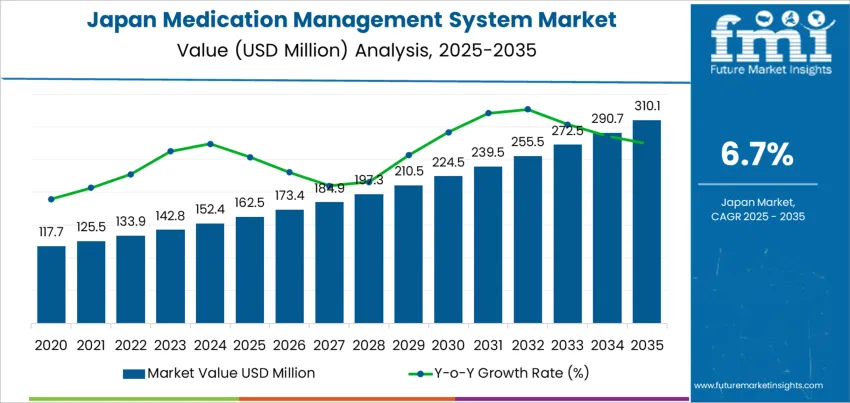
In 2025, demand for medication management systems in Japan is valued at USD 162.5 million and is projected to reach USD 310.1 million by 2035 at a CAGR of 6.7%. Early expansion is closely linked to hospital digitization, rising inpatient volumes among elderly populations, and stricter control over dispensing accuracy in acute and long-term care facilities. Automated dispensing cabinets, pharmacy inventory systems, and bedside verification tools form the core of early procurement.
Public hospitals and large private medical groups lead adoption as they face sustained pressure to reduce medication errors and staff workload. Integration with electronic medical records supports workflow continuity across prescribing, dispensing, and administration stages. Deployment remains concentrated in urban prefectures with high hospital density and advanced care infrastructure.
Quick Stats of the Demand for Medication Management Systems in Japan
- Demand for Medication Management Systems in Japan Value (2025): USD 162.5 million
- Demand for Medication Management Systems in Japan Forecast Value (2035): USD 310.1 million
- Demand for Medication Management Systems in Japan Forecast CAGR (2025 to 2035): 6.7%
- Demand for Medication Management Systems in Japan Leading Software Type: Inventory Management Solutions (30%)
- Demand for Medication Management Systems in Japan Key Growth Regions: Kyushu & Okinawa, Kanto, Kansai, Chubu, Tohoku, Rest of Japan
- Demand for Medication Management Systems in Japan Top Providers: Becton, Dickinson and Company (BD), Omnicell, Inc., Cerner Corporation, McKesson Corporation, Swisslog Healthcare
What is the Demand Forecast for Medication Management System in Japan through 2035?
After 2030, demand growth in Japan is shaped more by continuity-of-care and outpatient management than by inpatient automation alone. Market value rises from about USD 224.5 million in 2030 toward USD 310.1 million by 2035 as systems extend into home care, rehabilitation centers, and chronic disease management networks. Aging-in-place policies increase the need for remote adherence tracking and connected medication packaging.
Community pharmacies adopt centralized inventory and refill orchestration systems to match rising prescription volumes from long-term therapies. Technology focus shifts toward alarm-based adherence support, AI-assisted dosage checks, and cloud-based analytics for population-level medication safety. Procurement increasingly follows multi-facility contracts across hospital groups, nursing care operators, and regional health alliances.
The overall demand for medication management systems in Japan increases from USD 162.5 million in 2025 to USD 224.5 million by 2030, adding USD 62.0 million in absolute value. This phase reflects structural pressure from rapid population aging, polypharmacy risks, and chronic disease management loads across hospitals, long-term care facilities, and community pharmacies. Growth is anchored in the deployment of automated dispensing cabinets, electronic medication administration records, and dose tracking platforms to reduce medication errors and nursing workload. Expansion during this period remains institution-led rather than consumer-led, shaped by hospital digitalization programs, reimbursement-linked safety standards, and steady upgrades of legacy manual workflows.
From 2030 to 2035, the market expands from USD 224.5 million to USD 310.1 million, adding a larger USD 85.6 million in the second half of the decade. This back weighted acceleration reflects deeper penetration of closed-loop medication administration, AI-assisted dose optimization, and integration with national electronic health records. Demand also strengthens across home healthcare and assisted living settings as remote medication adherence monitoring becomes standard for elderly patients. As workforce shortages intensify and clinical risk management becomes more data-driven, medication management systems shift from operational support tools into core clinical safety infrastructure, strengthening long-term demand growth across the Japanese healthcare system.
Medication Management System Industry in Japan Key Takeaways
| Metric | Value |
|---|---|
| Industry Value (2025) | USD 162.5 million |
| Forecast Value (2035) | USD 310.1 million |
| Forecast CAGR (2025 to 2035) | 6.7% |
How is Demand for Medication Management Systems Evolving in Japan?
Demand for medication management systems in Japan is rising as the healthcare environment becomes more complex, especially due to the country’s rapidly aging population. With a growing share of elderly individuals requiring multiple prescriptions for chronic conditions, manual tracking of medications becomes increasingly error-prone and cumbersome. Hospitals, long-term care facilities and home-care providers face pressure to improve safety, prevent drug interactions and manage polypharmacy.
Medication management systems - including automated dispensing, digital records, and electronic tracking - help reduce errors, ensure adherence, and streamline workflows across care settings. These systems are gaining traction where regulatory expectations around patient safety and documentation are rising.
Future growth of this sector in Japan will be shaped by expansion of digital health infrastructure, integration with telemedicine and home-care services, and rising demand for elder-care efficiency. As care shifts from hospital-centric to community and home-based settings, systems that automate dispensing, track dosage schedules, and alert caregivers or patients will become more essential.
Growing investments in healthcare IT and push for data-driven patient management will reinforce adoption. Nevertheless, barriers remain: low penetration of electronic medical records in some primary care settings, concerns about data privacy and interoperability, and investment costs for smaller clinics. The pace of adoption will depend on how well these systems address usability, regulatory compliance and demonstrate clear benefits in rural and aging communities.
How Are Software Type and Delivery Mode Structuring the Demand for Medication Management Systems in Japan?
The demand for medication management systems in Japan is structured by software type and delivery mode. Inventory management solutions account for 30% of total demand, followed by computerized physician order entry systems, clinical decision support system solutions, electronic medication administration records, and other software categories. By delivery mode, cloud based systems represent 51.0% of total adoption, followed by on premise solutions and web based platforms. Demand behavior is shaped by hospital digitization programs, medication error reduction priorities, regulatory compliance requirements, and workforce efficiency goals. These segments reflect how operational control needs and IT infrastructure strategies influence system selection across hospitals, outpatient clinics, and long term care facilities in Japan.
Why Do Inventory Management Solutions Lead Medication Management Software Demand in Japan?
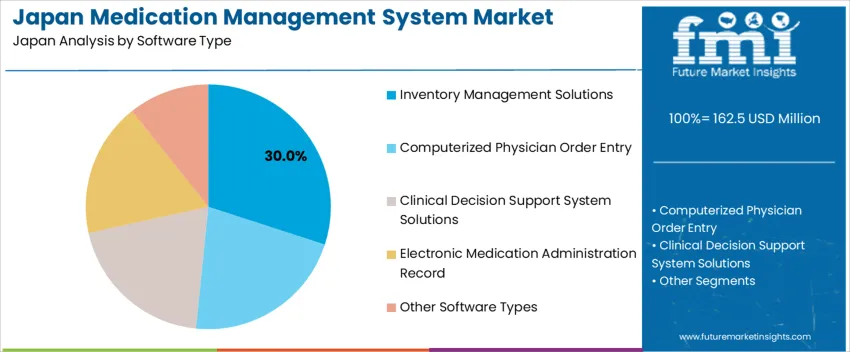
Inventory management solutions account for 30% of total medication management system demand in Japan due to the critical need for accurate drug stock control, expiration tracking, and usage optimization across hospitals and pharmacies. Japanese healthcare institutions operate under strict compliance standards that require precise documentation of medication movement from procurement to administration. Inventory management systems support real time visibility of stock levels, batch tracking, and automated reorder scheduling, which reduces the risk of shortages and overstocking. These systems also improve accountability and audit readiness under national healthcare regulations.
Inventory solutions are widely implemented in both acute care hospitals and long term care facilities where medication consumption patterns vary widely by patient condition. Integration with pharmacy dispensing systems and billing platforms further improves workflow efficiency. These systems also support cost containment by reducing wastage from expired drugs. These control, compliance, and operational efficiency factors sustain inventory management solutions as the leading software type within the Japan medication management system demand structure.
Why Does Cloud Based Delivery Dominate Medication Management System Adoption in Japan?
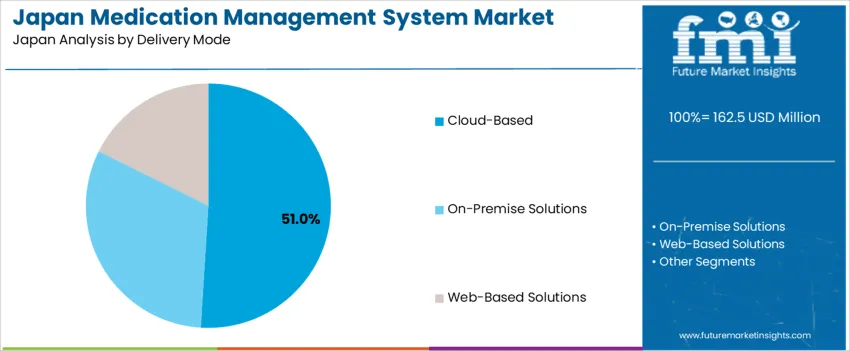
Cloud based delivery accounts for 51.0% of total medication management system demand in Japan due to its scalability, centralized data access, and lower infrastructure maintenance requirements. Cloud platforms allow healthcare providers to access medication records, inventory data, and prescribing systems across multiple facilities without the need for local server installations. This capability supports regional hospital networks and integrated care models that depend on shared patient data for continuity of treatment.
Cloud based systems also simplify software updates, cybersecurity patching, and regulatory compliance management across dispersed healthcare sites. Smaller clinics and nursing homes favor cloud deployment due to limited internal IT staff and lower upfront investment. Data backup and disaster recovery capabilities further support adoption in regions exposed to natural disaster risk. These accessibility, cost control, and system resilience advantages position cloud based delivery as the dominant mode for medication management system deployment in Japan.
Why Is Medication Management in Japan Treated as a Continuity-of-Care System Rather Than a Hospital IT Tool?
Demand for medication management systems in Japan is driven by the need to maintain uninterrupted drug control across hospitals, clinics, and home-based care. A large elderly population manages multiple prescriptions across chronic conditions, which creates high risk of duplication, dosage error, and adverse interaction. Medication continuity extends beyond discharge into community pharmacies and visiting nurse programs. Systems are therefore adopted to synchronize prescribing, dispensing, and adherence tracking across fragmented care settings. This positions medication management as a national patient safety infrastructure rather than a standalone hospital software purchase.
How Do Polypharmacy, Long-Term Care, and Community Pharmacies Shape System Adoption?
Japan has one of the highest rates of polypharmacy among aging societies, with many patients taking five or more drugs daily. Community pharmacies act as active medication coordinators rather than passive dispensers. Medication management systems help pharmacists detect overlapping prescriptions, timing conflicts, and therapy duplication across different providers. Long-term care facilities rely on these platforms to organize dose schedules for dozens of residents with complex regimens. Home-visit nursing teams use shared medication records to confirm adherence and prevent missed doses. These community-centered care structures directly shape real-world system demand.
What Data Governance, Workflow Rigidity, and Cost Controls Limit Faster Expansion?
Medication management system adoption in Japan is restrained by strict healthcare data governance, conservative workflow design, and controlled reimbursement structures. Systems must comply with uniform national standards for medical data handling, which lengthens deployment timelines. Many clinics operate on rigid legacy workflows that resist rapid digital restructuring. Budget approval for new systems often requires demonstrated error reduction rather than productivity gains. Smaller clinics lack full-time IT staff for system maintenance. These operational and financial controls slow system expansion despite clear clinical need.
How Are AI-Assisted Review, Robotics Dispensing, and Home Integration Redefining Demand?
Future demand in Japan is shifting toward AI-supported prescription review, automated dispensing robotics, and direct integration with home-care monitoring platforms. Algorithms now flag interaction risk, kidney-dose mismatch, and elderly sensitivity categories in real time. Robotics handle high-volume unit-dose packaging in hospitals and care homes to reduce manual error. Home medication devices transmit adherence data back to clinics through connected systems. These developments show medication management evolving from record-keeping platforms into active clinical risk-control engines embedded across hospital, pharmacy, and home-care environments.
What is the Demand for Medication Management System in Japan by Region?
| Region | CAGR (%) |
|---|---|
| Kyushu & Okinawa | 8.3% |
| Kanto | 7.7% |
| Kansai | 6.7% |
| Chubu | 5.9% |
| Tohoku | 5.2% |
| Rest of Japan | 4.9% |
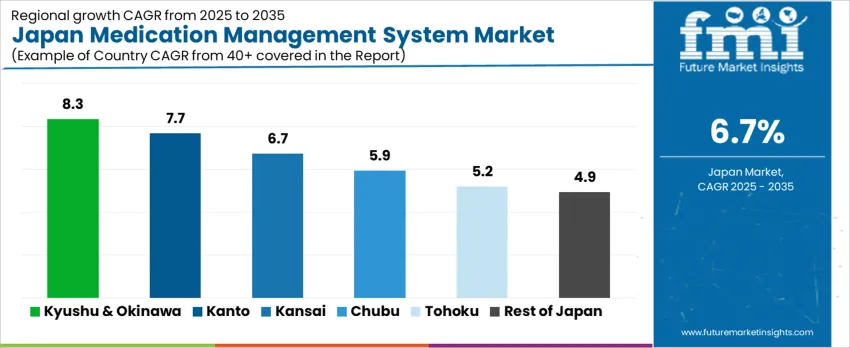
The demand for medication management systems in Japan is rising steadily across all regions, led by Kyushu & Okinawa at an 8.3% CAGR. Growth in this region is supported by hospital digitization programs, rising prescription volumes, and increasing focus on reducing medication errors in secondary care facilities. Kanto follows at 7.7%, driven by large hospital networks, advanced healthcare IT adoption, and strong outpatient service volumes. Kansai records 6.7% growth, supported by ageing population needs and integration of automated dispensing and tracking solutions in urban hospitals. Chubu at 5.9% reflects moderate uptake linked to regional hospital modernization. Tohoku and Rest of Japan, at 5.2% and 4.9%, show stable growth shaped by gradual digitization across smaller healthcare facilities.
How Is Hospital Digitization Advancing Demand in Kyushu And Okinawa?
Kyushu and Okinawa posts a CAGR of 8.3% through 2035 for medication management system demand, driven by hospital modernization programs, expanding elderly care facilities, and rising inpatient medication complexity. Regional medical centers deploy automated dispensing cabinets and electronic medication tracking to reduce administration errors. Long term care hospitals adopt centralized medication scheduling platforms to manage chronic disease therapies. Government supported healthcare digitization improves system affordability for mid sized hospitals. Demand remains safety and efficiency driven, with consistent system upgrades tied to patient volume growth and the expansion of specialized geriatric treatment services.
- Hospital automation supports steady system installation
- Elderly care facilities increase long term usage demand
- Error reduction remains a primary adoption driver
- Public digitization funding improves procurement access
What Is Sustaining High Adoption Rates in Kanto?
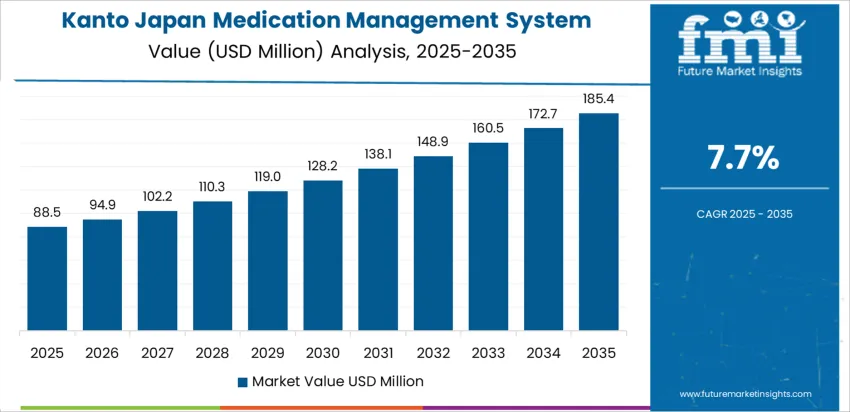
Kanto records a CAGR of 7.7% through 2035 for medication management system demand, supported by dense concentration of tertiary hospitals, academic medical centers, and multi branch pharmacy networks. High outpatient volumes require integrated prescription verification and inventory monitoring platforms. Robotics assisted dispensing and barcode verification systems gain wider use across large hospitals. Private healthcare groups pursue enterprise wide platform standardization. Demand remains integration driven rather than first time installation driven, shaped by interoperability needs across hospital information systems, pharmacy software, and insurance processing platforms.
- Large hospitals anchor advanced system deployments
- Pharmacy networks support centralized medication tracking
- Robotics assisted dispensing gains wider penetration
- Platform integration shapes purchasing priorities
Why Is Kansai Emerging as a Strong Mid Tier Market?
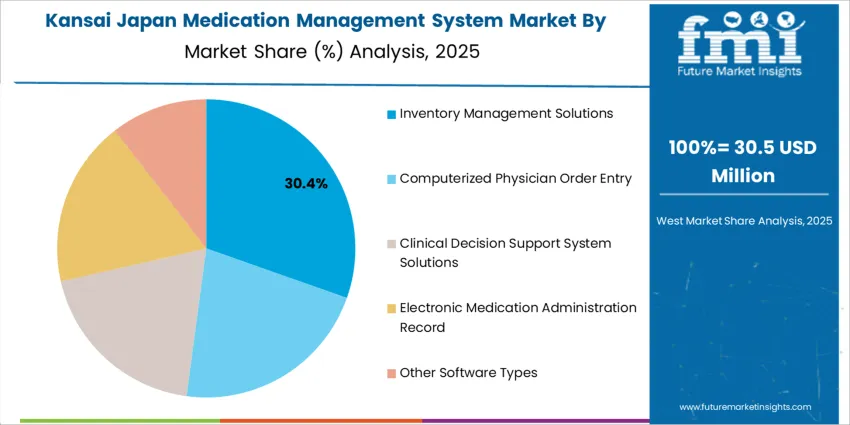
Kansai shows a CAGR of 6.7% through 2035 for medication management system demand, supported by rehabilitation hospitals, chronic disease treatment centers, and expanding regional pharmacy chains. Stroke recovery, oncology care, and long stay rehabilitation units increase the need for precise dosage scheduling and inventory control. Local hospital groups adopt cloud based medication platforms to reduce manual documentation errors. Nursing staff shortages encourage automation adoption. Demand remains workflow driven, with hospitals prioritizing time efficiency, medication visibility, and audit traceability across integrated patient care environments.
- Rehabilitation care raises structured medication scheduling needs
- Chronic disease treatment sustains long cycle system usage
- Staff shortages support automation investment
- Cloud platforms reduce manual documentation load
How Is Industrial Healthcare Spending Shaping Demand in Chubu?
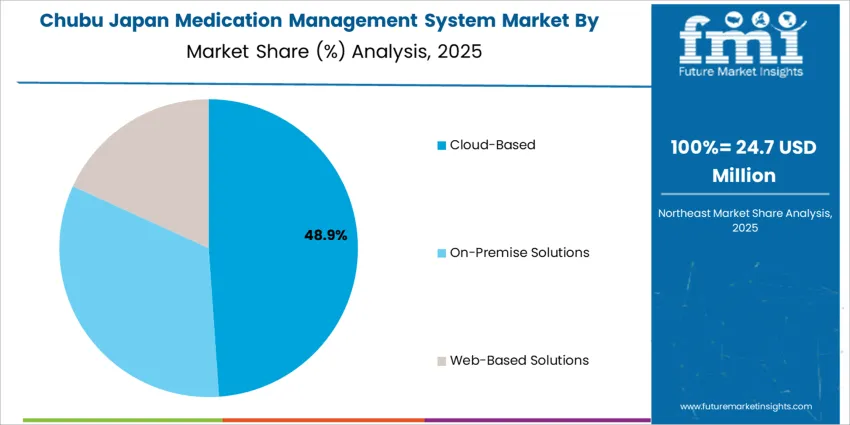
Chubu registers a CAGR of 5.9% through 2035 for medication management system demand, supported by industrial workforce healthcare programs, regional hospital investment, and occupational health clinics. Manufacturing related injury treatment and chronic disease monitoring increase prescription processing volumes. Mid sized hospitals adopt automated dispensing for emergency and surgical wards. Employer sponsored medical programs improve treatment continuity. Demand remains operations driven rather than research driven, with system procurement aligned to predictable patient throughput and hospital budget planning across industrial population centers.
- Occupational healthcare sustains prescription volume growth
- Emergency wards drive automated cabinet adoption
- Employer insurance improves continuity of care
- Budget planning governs controlled system upgrades
What Is Supporting Gradual Expansion in Tohoku?
Tohoku reflects a CAGR of 5.2% through 2035 for medication management system demand, shaped by aging rural populations, public hospital consolidation, and gradual digitization of regional healthcare facilities. Chronic disease management drives steady prescription processing. Smaller hospitals adopt basic electronic medication administration records before moving to full automation. Pharmacy inventory optimization becomes a priority due to limited staffing. Demand remains necessity oriented rather than efficiency driven, with gradual system deployment paced by public healthcare budgets and workforce availability across dispersed service networks.
- Aging population sustains routine medication demand
- Public hospitals guide phased digitization adoption
- Staffing limits increase interest in automation tools
- Budget constraints moderate rapid system rollout
Why Does the Rest of Japan Show Stable but Slower Uptake?
Across the rest of Japan, growth records a CAGR of 4.9% through 2035 for medication management system demand, supported by community hospital coverage, stable outpatient prescription volumes, and national insurance reimbursement continuity. System adoption centers on electronic prescription tracking and basic pharmacy automation. Limited specialist density restricts advanced robotic system penetration. Referral driven care channels concentrate complex medication workflows in large metro hospitals. Demand remains steady and clinically necessary, with upgrades focused on compliance, audit readiness, and essential workflow standardization rather than advanced automation.
- Community hospitals anchor essential system installations
- Insurance stability supports predictable procurement cycles
- Basic pharmacy automation dominates regional demand
- Metro referrals concentrate advanced medication workflows
What Is Driving the Demand for Medication Management Systems in Japan and Who Are the Key Providers Shaping the Market?
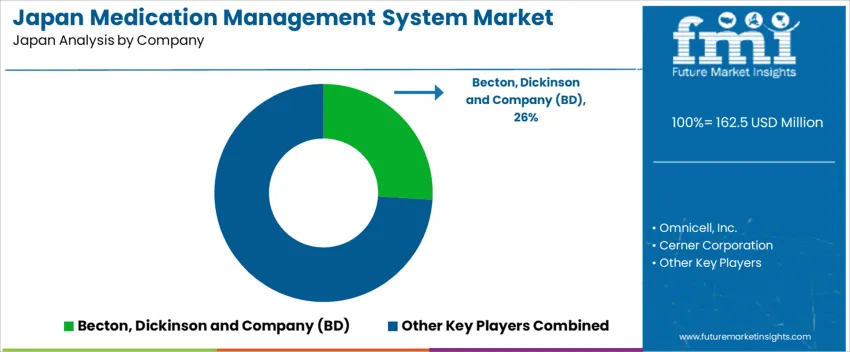
Demand for medication management systems in Japan is rising as healthcare providers face increasing pressure to improve patient safety, reduce medication errors, and manage growing prescription volumes-especially in aging populations. Hospitals and clinics seek automated dispensing cabinets, electronic medication administration records, and barcode scanning to ensure accurate dosage and timely delivery of medications.
The complexity of chronic disease treatment and polypharmacy amplifies the need for systems that integrate prescription tracking, inventory control, and clinical decision support. Pharmacists and care facilities also value systems that streamline workflow, reduce manual handling, and support regulatory compliance under increasingly strict healthcare standards.
Major providers active in Japan’s medication management market include Becton, Dickinson and Company (BD), Omnicell, Inc., Cerner Corporation, McKesson Corporation, and Swisslog Healthcare. BD and Omnicell supply automated dispensing cabinets and pharmacy automation solutions commonly used in hospitals and long term care facilities. Cerner offers software modules for prescription management and electronic medication records, often integrated with hospital information systems.
McKesson supports inventory management and distribution logistics for institutional pharmacies. Swisslog Healthcare delivers automation and robotics for medication distribution and workflow optimisation. Together these firms shape the supply base by offering integrated hardware software solutions that meet Japan’s clinical, regulatory, and operational requirements.
Key Players in Medication Management Systems in Japan
- Becton, Dickinson and Company (BD)
- Omnicell, Inc.
- Cerner Corporation
- McKesson Corporation
- Swisslog Healthcare
Scope of the Report
| Items | Values |
|---|---|
| Quantitative Units (2025) | USD million |
| Software Type | Inventory Management Solutions, Computerized Physician Order Entry, Clinical Decision Support System Solutions, Electronic Medication Administration Record, Other Software Types |
| Delivery Mode | Cloud-Based, On-Premise Solutions, Web-Based Solutions |
| Region | Kyushu & Okinawa, Kanto, Kinki, Chubu, Tohoku, Rest of Japan |
| Countries Covered | Japan |
| Key Companies Profiled | Becton, Dickinson and Company (BD), Omnicell, Inc., Cerner Corporation, McKesson Corporation, Swisslog Healthcare |
| Additional Attributes | Dollar by sales by software type, by delivery mode, by region, Regional CAGR, Hospital digitization programs, Elderly patient prescription volume, Polypharmacy management, Acute and long-term care adoption, Integration with EMRs, Workflow efficiency, AI-assisted dosage checks, Robotics-enabled dispensing, Cloud-based analytics, Home care and assisted living deployment, Multi-facility procurement models, Regulatory compliance and patient safety requirements |
Medication Management Systems in Japan Segmentation
Software Type:
- Inventory Management Solutions
- Computerized Physician Order Entry
- Clinical Decision Support System Solutions
- Electronic Medication Administration Record
- Other Software Types
Delivery Mode:
- Cloud-Based
- On-Premise Solutions
- Web-Based Solutions
Region
- Kyushu & Okinawa
- Kanto
- Kansai
- Chubu
- Tohoku
- Rest of Japan
Frequently Asked Questions
How big is the demand for medication management system in Japan in 2025?
The demand for medication management system in Japan is estimated to be valued at USD 162.5 million in 2025.
What will be the size of medication management system in Japan in 2035?
The market size for the medication management system in Japan is projected to reach USD 310.1 million by 2035.
How much will be the demand for medication management system in Japan growth between 2025 and 2035?
The demand for medication management system in Japan is expected to grow at a 6.7% CAGR between 2025 and 2035.
What are the key product types in the medication management system in Japan?
The key product types in medication management system in Japan are inventory management solutions, computerized physician order entry, clinical decision support system solutions, electronic medication administration record and other software types.
Which delivery mode segment is expected to contribute significant share in the medication management system in Japan in 2025?
In terms of delivery mode, cloud-based segment is expected to command 51.0% share in the medication management system in Japan in 2025.
Preview the report firsthand - request a free sample
Get SampleGet the brochure for pricing and purchase details.
Get PDFTable of Content
- Executive Summary
- Japan Market Outlook
- Demand-side Trends
- Supply-side Trends
- Technology Roadmap Analysis
- Analysis and Recommendations
- Market Overview
- Market Coverage / Taxonomy
- Market Definition / Scope / Limitations
- Market Background
- Market Dynamics
- Drivers
- Restraints
- Opportunity
- Trends
- Scenario Forecast
- Demand in Optimistic Scenario
- Demand in Likely Scenario
- Demand in Conservative Scenario
- Opportunity Map Analysis
- Product Life Cycle Analysis
- Supply Chain Analysis
- Investment Feasibility Matrix
- Value Chain Analysis
- PESTLE and Porter’s Analysis
- Regulatory Landscape
- Regional Parent Market Outlook
- Production and Consumption Statistics
- Import and Export Statistics
- Market Dynamics
- Japan Market Analysis 2020 to 2024 and Forecast, 2025 to 2035
- Historical Market Size Value (USD Million) Analysis, 2020 to 2024
- Current and Future Market Size Value (USD Million) Projections, 2025 to 2035
- Y-o-Y Growth Trend Analysis
- Absolute $ Opportunity Analysis
- Japan Market Pricing Analysis 2020 to 2024 and Forecast 2025 to 2035
- Japan Market Analysis 2020 to 2024 and Forecast 2025 to 2035, By Software Type
- Introduction / Key Findings
- Historical Market Size Value (USD Million) Analysis By Software Type , 2020 to 2024
- Current and Future Market Size Value (USD Million) Analysis and Forecast By Software Type , 2025 to 2035
- Inventory Management Solutions
- Computerized Physician Order Entry
- Clinical Decision Support System Solutions
- Electronic Medication Administration Record
- Other Software Types
- Y-o-Y Growth Trend Analysis By Software Type , 2020 to 2024
- Absolute $ Opportunity Analysis By Software Type , 2025 to 2035
- Japan Market Analysis 2020 to 2024 and Forecast 2025 to 2035, By Delivery Mode
- Introduction / Key Findings
- Historical Market Size Value (USD Million) Analysis By Delivery Mode, 2020 to 2024
- Current and Future Market Size Value (USD Million) Analysis and Forecast By Delivery Mode, 2025 to 2035
- Cloud-Based
- On-Premise Solutions
- Web-Based Solutions
- Y-o-Y Growth Trend Analysis By Delivery Mode, 2020 to 2024
- Absolute $ Opportunity Analysis By Delivery Mode, 2025 to 2035
- Market Structure Analysis
- Competition Dashboard
- Competition Benchmarking
- Market Share Analysis of Top Players
- By Regional
- By Software Type
- By Delivery Mode
- Competition Analysis
- Competition Deep Dive
- Becton, Dickinson and Company (BD)
- Overview
- Product Portfolio
- Profitability by Market Segments (Product/Age /Sales Channel/Region)
- Sales Footprint
- Strategy Overview
- Marketing Strategy
- Product Strategy
- Channel Strategy
- Omnicell, Inc.
- Cerner Corporation
- McKesson Corporation
- Swisslog Healthcare
- Becton, Dickinson and Company (BD)
- Competition Deep Dive
- Assumptions & Acronyms Used
- Research Methodology


