

- Industry Size (2026)
- USD 425.8 Bn
- Forecast (2036)
- USD 1707.7 Bn
- CAGR (2026 to 2036)
- 14.9%
IoT Enabled Equipment Maintenance Solutions Market Forecast and Outlook 2026 to 2036
In 2026, the IoT enabled equipment maintenance solutions market is likely to be valued at USD 425.8 billion and is projected to reach USD 1,707.7 billion by 2036, implying a CAGR of 14.9%. Spending is concentrated in asset intensive sectors such as manufacturing, energy, transport, and utilities, where unplanned downtime carries measurable revenue and safety consequences. Adoption remains uneven because data connectivity, sensor coverage, and control system maturity differ widely by region and by plant age. Cost advantages cluster around regions with strong industrial software, systems integration, and cloud infrastructure ecosystems, which determines where platforms are built and operated even when assets are deployed elsewhere.
Maintenance organizations, rather than IT departments alone, shape procurement outcomes because workflow change and failure accountability sit with operations teams. Once condition monitoring and predictive routines are embedded into planning systems, work orders, and spare parts logic, switching platforms becomes disruptive and costly. Large operators standardize across fleets to gain comparability and scheduling leverage, while smaller sites adopt selectively around critical assets. Data governance rules, cybersecurity audits, and integration effort influence rollout pace. Market expansion follows the concentration of high value assets and uptime critical operations, not a uniform digitization of all equipment categories.
Quick Stats for IoT Enabled Equipment Maintenance Solutions Market
- IoT Enabled Equipment Maintenance Solutions Market Value (2026): USD 425.8 billion
- IoT Enabled Equipment Maintenance Solutions Market Forecast Value (2036): USD 1,707.7 billion
- IoT Enabled Equipment Maintenance Solutions Market Forecast CAGR 2026 to 2036: 14.9%
- Leading Type in IoT Enabled Equipment Maintenance Solutions Market: Predictive maintenance solutions
- Key Growth Regions in IoT Enabled Equipment Maintenance Solutions Market: Asia Pacific, North America, Europe
- Top Players in IoT Enabled Equipment Maintenance Solutions Market: IBM, Siemens, SAP, GE Digital, Microsoft, PTC, Honeywell
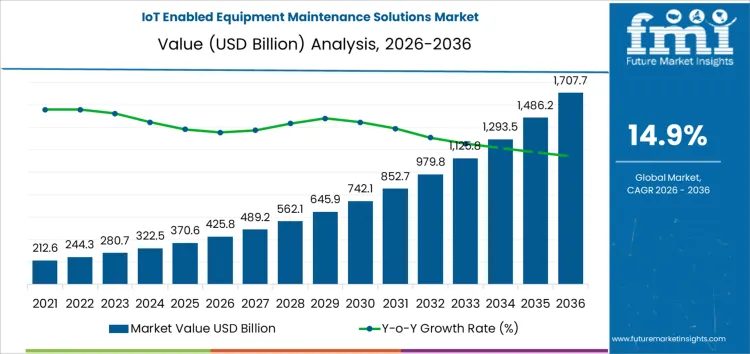
What is the Growth Forecast for the IoT-Enabled Equipment Maintenance Solutions Market through 2036?
The IoT-enabled equipment maintenance solutions industry is expanding as industrial operators shift away from reactive repairs and fixed-interval servicing toward condition-based and predictive maintenance models. In the early stage, adoption is mainly concentrated among large industrial groups, utilities, and transportation operators managing complex and high-value asset fleets. As connectivity becomes more common, manufacturers, energy companies, and logistics operators increasingly deploy connected sensors, remote monitoring tools, and alert-based platforms to reduce unplanned downtime and improve maintenance scheduling discipline. Over time, IoT monitoring transitions from pilot programs into a standard layer of modern asset management. Procurement decisions become more focused on integration with existing enterprise systems, data reliability, and cybersecurity readiness rather than sensor cost alone.
In the later stage, growth is driven less by first-time connectivity and more by deeper analytical capability and operational dependency on IoT maintenance ecosystems. Predictive analytics, machine learning-driven failure modeling, and multi-site fleet management tools gain wider adoption in capital-intensive industries. These systems increasingly support lifecycle asset management, energy efficiency improvement, and optimized spare-parts planning, not just fault detection. Buyers progressively prioritize closed-loop maintenance platforms that connect monitoring, planning, execution, and performance reporting in one workflow. Long-term growth is supported by broader adoption among mid-sized firms, higher penetration per asset, and the strategic role of uptime and cost control. Purchasing decisions remain anchored in data integrity, scalability, and strong vendor support.
IoT-Enabled Equipment Maintenance Solutions Market Key Takeaways
| Metric | Value |
|---|---|
| Market Value (2026) | USD 425.8 billion |
| Forecast Value (2036) | USD 1,707.7 billion |
| Forecast CAGR 2026 to 2036 | 14.9% |
How Are IoT-Enabled Equipment Maintenance Solutions Transforming Operational Reliability?
IoT-enabled equipment maintenance solutions are increasingly adopted to monitor machinery health, predict failures, and optimize maintenance schedules across manufacturing, energy, and industrial facilities. Historically, maintenance relied on reactive or time-based approaches, which often resulted in unplanned downtime, inefficient resource allocation, and higher repair costs. Modern IoT systems integrate sensor networks, cloud analytics, and predictive algorithms to provide real-time insights, early fault detection, and condition-based maintenance recommendations. Industrial operators, plant managers, and equipment OEMs prioritize data accuracy, system interoperability, and actionable analytics. Early adoption focused on large-scale manufacturing plants, while current demand spans energy infrastructure, process industries, and logistics operations, driven by operational efficiency, downtime reduction, and cost optimization. Sensor reliability, analytics accuracy, and integration flexibility influence supplier selection.
Reducing unexpected equipment failures and improving operational planning are shaping market expansion. Compared with traditional maintenance strategies, IoT-enabled solutions provide continuous monitoring, predictive alerts, and data-driven scheduling, enhancing system uptime and resource utilization. Cost structures depend on sensor deployment, software platforms, and data management, concentrating margins among suppliers capable of delivering robust, scalable solutions. Industrial operators adopt these systems to extend equipment lifespan, reduce repair costs, and optimize maintenance workflows. Over the next decade, IoT-enabled maintenance solutions are expected to play a central role in industrial operations, enabling predictive upkeep, informed decision-making, and more resilient, data-driven facility management.
What Factors Are Shaping the Demand for IoT-Enabled Equipment Maintenance Solutions Market, Segment wise by Solution Type and Deployment Model, in 2026?
The IoT-Enabled Equipment Maintenance Solutions Market is shaped less by technology capability and more by who controls maintenance budgets, who owns downtime risk, and who is allowed to change operating procedures. Purchasing decisions in the IoT-Enabled Equipment Maintenance Solutions Market are rarely centralized. They are negotiated between operations leadership, plant engineering, IT, and sometimes external service providers. By solution type, the IoT-Enabled Equipment Maintenance Solutions Market includes predictive maintenance platforms, condition-based monitoring systems, remote diagnostics and alerting tools, and mobile maintenance management software. By deployment model, the IoT-Enabled Equipment Maintenance Solutions Market spans cloud-based, on-premise, hybrid, and edge-computing-enabled architectures. These categories map directly to how organizations distribute authority between operations, IT, and corporate engineering functions.
How Do Commercial Justification Models Shape Solution Type Demand in the IoT-Enabled Equipment Maintenance Solutions Market?
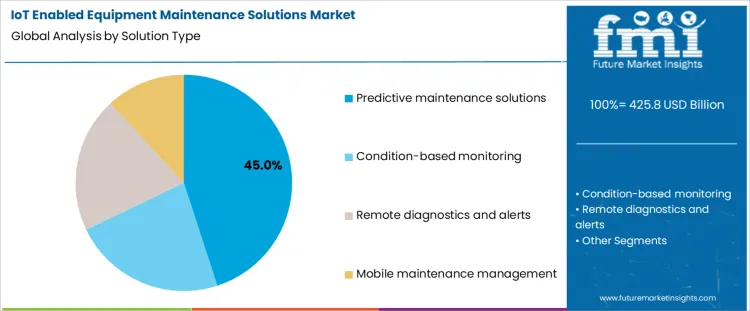
Predictive maintenance solutions represent about 45% of demand in the IoT-Enabled Equipment Maintenance Solutions Market because they are the only category that can be sold directly on avoided financial loss rather than on efficiency improvement. In most industrial organizations, budgets for “process improvement” are limited and slow to approve. Budgets for “risk avoidance” and “downtime prevention” are much easier to justify, especially in asset-heavy sectors such as energy, chemicals, metals, and discrete manufacturing. Predictive maintenance platforms are therefore positioned commercially around failure prevention cases, insurance logic, and production continuity rather than around maintenance productivity.
Condition-based monitoring and remote diagnostics scale more easily across large asset fleets, but they are often sold as extensions to existing control or automation systems rather than as standalone business cases. Mobile maintenance management tools are typically purchased from operational efficiency budgets and face stronger price pressure and longer replacement cycles. For suppliers in the IoT-Enabled Equipment Maintenance Solutions Market, this means that predictive solutions are not just a technical category, but the primary entry point into strategic, budget-owner-level sales conversations.
Why Does Deployment Architecture Follow Organizational Power Structures in the IoT-Enabled Equipment Maintenance Solutions Market?
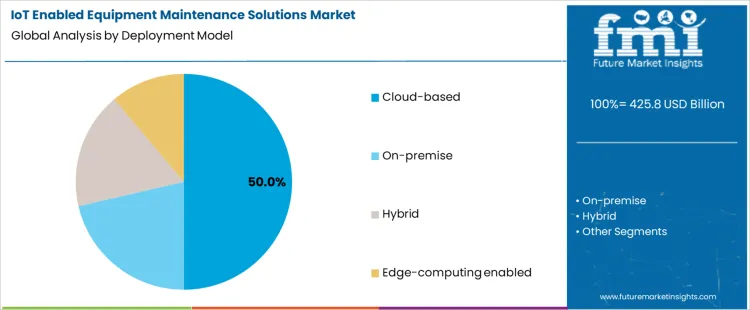
Cloud-based deployment represents about 50% of demand in the IoT-Enabled Equipment Maintenance Solutions Market because it shifts ownership of data infrastructure away from plant-level IT and toward corporate or vendor-managed environments. This is not primarily a technical decision. It is an organizational one. Central engineering and corporate digital teams prefer cloud platforms because they allow cross-site benchmarking, centralized model governance, and vendor-managed updates. For solution suppliers, cloud deployment also supports recurring revenue models and faster feature rollout cycles.
On-premise and hybrid deployments persist where cybersecurity governance, export controls, or operational autonomy dominate decision making. Edge architectures appear where connectivity reliability or response latency cannot be delegated to centralized systems. The real segmentation in the IoT-Enabled Equipment Maintenance Solutions Market is therefore not about technology stacks. It is about who is allowed to own the data, who is allowed to change the algorithms, and who is accountable when the system makes the wrong recommendation. Suppliers that understand this governance reality close deals faster and defend accounts more effectively.
How Are the Key Dynamics Reshaping the IoT Enabled Equipment Maintenance Solutions Market?
This market is not growing because companies like dashboards. It grows because unplanned downtime has become financially and reputationally expensive. As production systems become more complex and tightly scheduled, the tolerance for surprise failures shrinks. IoT based maintenance tools promise foresight, but their real impact depends on whether organizations are willing to change how they plan, intervene, and assign responsibility. In some firms, these systems redefine maintenance from a reactive function into an operational control layer. In others, they remain unused data collectors. The market advances through shifts in management behavior, not through sensor deployment alone.
Why the IoT Equipment Maintenance Market Is Downtime Economics Driven?
Every industry has learned that a stopped line costs far more than the repair itself. In continuous processes, logistics hubs, and automated factories, a single failure can cascade into missed deliveries and contractual penalties. IoT maintenance solutions enter when management starts pricing risk instead of repairs. Vibration, temperature, and load data become tools for planning rather than forensics. Where downtime is visible at board level, these systems become strategic. Where failures are absorbed quietly, they do not. Demand therefore tracks how organizations internalize the cost of interruption, not how modern their equipment looks.
Why the IoT Equipment Maintenance Market Often Disappoints After Installation?
Many projects fail without anyone calling them failures. Sensors are installed, data flows, and nothing in daily behavior changes. Maintenance schedules remain calendar based, and interventions stay reactive. This happens because insights require ownership. Someone must trust the data enough to stop a machine or delay a shipment. In many plants, that authority is unclear. As a result, the system becomes a reporting tool instead of a decision tool. The limitation is not analytics quality. It is organizational willingness to let algorithms overrule habit and hierarchy.
Why the IoT Equipment Maintenance Market Follows Management Models?
These systems thrive in organizations that already manage by metrics. Where performance reviews, budgeting, and planning are data driven, predictive maintenance fits naturally. Where decisions are experience driven and siloed, it does not. Large groups with centralized reliability teams and standardized assets extract far more value than fragmented operators. As industries consolidate and standardize operations, the usefulness of shared condition data increases. This turns IoT maintenance from a local experiment into a network level control layer. The market therefore follows how companies are governed, not how many machines they own.
What is the Demand for IoT-Enabled Equipment Maintenance Solutions by Country?
| Country | CAGR (%) |
|---|---|
| USA | 14.0% |
| UK | 13.5% |
| China | 16.0% |
| India | 17.5% |
| Brazil | 14.2% |
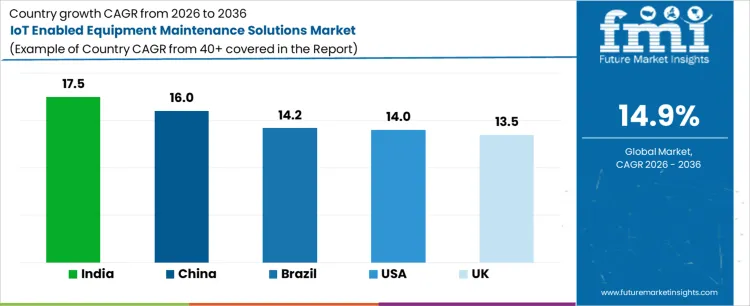
Demand for IoT-enabled equipment maintenance solutions is rising as manufacturing, industrial, and commercial operations adopt digital tools to monitor equipment performance, reduce downtime, and optimize maintenance schedules. India leads with a 17.5% CAGR, driven by increasing adoption of connected industrial systems, predictive maintenance practices, and automation initiatives. China follows at 16.0%, supported by large-scale industrial operations and deployment of IoT-based monitoring solutions. Brazil records 14.2% growth, shaped by modernization of industrial facilities and adoption of digital maintenance platforms. The USA grows at 14.0%, influenced by integration of IoT solutions in manufacturing and commercial equipment. The UK shows 13.5% CAGR, reflecting steady adoption of connected maintenance systems across industries.
What is directing adoption of IoT Enabled Equipment Maintenance Solutions across United States industrial sites?
United States is recording a CAGR of 14%, with adoption led by manufacturing plants, logistics operators, and energy facilities using IoT enabled equipment maintenance solutions. Deployment focuses on predictive maintenance, asset health monitoring, and downtime reduction programs. Engineering teams integrate these platforms with existing control systems and enterprise maintenance software. Data collection strategies emphasize sensor reliability, network stability, and cybersecurity compliance. Large industrial groups roll out these systems across multi plant networks. Service providers supply analytics, remote monitoring, and alert management functions. Procurement decisions include software scalability, integration support, and long term licensing structure. Usage concentrates in automotive, aerospace, food processing, and utilities operations. Budget planning aligns with digital operations programs and reliability improvement targets. Measured outcomes include maintenance labor efficiency, spare inventory control, and improved equipment availability across critical production assets.
Which operational priorities are shaping IoT Enabled Equipment Maintenance Solutions deployment in the United Kingdom?
United Kingdom is recording a CAGR of 13.5%, with usage expanding across manufacturing plants, infrastructure operators, and transport systems using IoT enabled equipment maintenance solutions. Programs focus on condition based servicing, compliance reporting, and lifecycle cost control. Engineering groups connect these platforms to existing asset management and scheduling systems. Data governance and system security receive attention during project planning. Utilities and rail operators form a large share of early adopters. Industrial service firms provide remote monitoring and analytics support. Procurement reviews consider integration effort, training needs, and long term software support. Deployment concentrates in energy, water, transport, and advanced manufacturing sectors. Capital budgets link these projects to reliability improvement and service continuity objectives. Performance measurement tracks unplanned downtime reduction, maintenance planning accuracy, and improvement in asset utilization across operating portfolios.
How are large scale factories in China expanding use of IoT Enabled Equipment Maintenance Solutions?
China is recording a CAGR of 16%, supported by industrial modernization programs and factory digitalization projects using IoT enabled equipment maintenance solutions. Large manufacturing groups deploy these systems to monitor machine condition, energy usage, and production stability. Domestic software and hardware providers expand platform capability and service coverage. Integration work focuses on linking shop floor systems with central operations platforms. Export oriented factories rely on these tools for quality stability and delivery performance. Data volume management and network reliability remain core technical priorities. Procurement teams evaluate platforms through staged pilot projects. Deployment concentrates in automotive, electronics, chemicals, and heavy machinery plants. Budget allocation follows smart manufacturing investment plans. Measured benefits include lower unplanned stoppages, better maintenance scheduling, and improved equipment lifetime management across multi-site industrial operations.
What is accelerating rollout of IoT Enabled Equipment Maintenance Solutions in India?
India is recording a CAGR of 17.5%, with demand rising across manufacturing, power generation, mining, and process industries using IoT enabled equipment maintenance solutions. Plant operators adopt these systems to improve uptime, manage dispersed assets, and control maintenance cost. Deployment projects emphasize cloud connectivity, mobile access, and simplified dashboards. Domestic system integrators play a major role in implementation and support. Import platforms serve large industrial groups with complex asset bases. Data quality and network availability shape project design. Usage expands across automotive, cement, steel, and energy facilities. Investment decisions link to capacity expansion and operational efficiency programs. Performance tracking focuses on reduction of breakdown events and improved maintenance planning accuracy. Rollout follows phased site by site implementation rather than immediate enterprise wide conversion programs.
Which factors influence uptake of IoT Enabled Equipment Maintenance Solutions in Brazil?
Brazil is recording a CAGR of 14.2%, with adoption coming from manufacturing plants, utilities operators, and resource processing facilities using IoT enabled equipment maintenance solutions. Programs focus on reducing downtime, improving asset visibility, and stabilizing maintenance budgets. Integration projects connect sensors, control systems, and central maintenance platforms. Import dependence affects software selection and implementation schedules. Local service firms support installation, configuration, and ongoing monitoring services. Usage concentrates in mining, energy, food processing, and transport infrastructure operations. Procurement evaluations include connectivity reliability, data security, and service availability. Budget planning aligns with productivity improvement and cost control initiatives. Results measurement includes maintenance response time, spare inventory optimization, and improvement in equipment availability across critical operating assets. Deployment expands through priority site programs rather than uniform national rollout strategies.
How Are Leading Technology Providers Shaping the IoT-Enabled Equipment Maintenance Solutions Market?
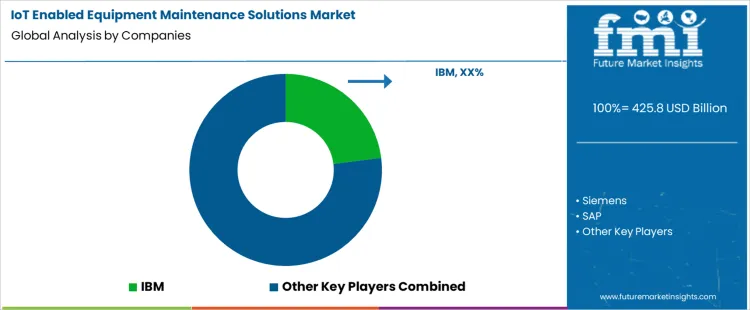
Providers in the IoT-enabled equipment maintenance solutions market differentiate through data analytics depth, integration with enterprise systems, and predictive maintenance capability. IBM delivers platforms that combine IoT device connectivity with AI-driven insights, enabling anomaly detection and maintenance scheduling across industrial assets. Siemens integrates sensor data with its industrial automation suite to support condition-based monitoring and remote diagnostics, benefiting manufacturing and infrastructure operators. SAP offers solutions that embed IoT maintenance data into enterprise resource planning, creating seamless workflows from asset health to work order execution. GE Digital provides industrial IoT software that links real-time equipment telemetry with analytics dashboards to anticipate failures. Microsoft focuses on cloud-native IoT frameworks with scalable data pipelines and integration with business applications for maintenance orchestration.
PTC supplies connected maintenance solutions that leverage digital twin models and augmented reality support for field technicians, enhancing accuracy and response time. Honeywell offers IoT platforms tailored to industrial facilities that unify sensor data, alerting, and maintenance execution in a single interface. Other regional and specialist vendors contribute modular solutions optimized for specific equipment types such as HVAC, energy systems, or fleet assets. Competitive differentiation arises from analytics sophistication, interoperability with existing IT and OT infrastructure, mobile technician support, and ease of deployment. Suppliers with proven integration toolkits, strong cybersecurity features, and service networks attract enterprises seeking to reduce unplanned downtime, lower maintenance costs, and extend equipment life through data-driven maintenance strategies.
Key Players in the IoT Enabled Equipment Maintenance Solutions Market
- IBM
- Siemens
- SAP
- GE Digital
- Microsoft
- PTC
- Honeywell
Scope of the Report
| Items | Values |
|---|---|
| Quantitative Units (2026) | USD billion |
| Solution Type | Predictive maintenance solutions, Condition-based monitoring, Remote diagnostics and alerts, Mobile maintenance management |
| Deployment Model | Cloud-based, On-premise, Hybrid, Edge-computing enabled |
| Region | Asia Pacific, Europe, North America, Latin America, Middle East & Africa |
| Countries Covered | China, Japan, South Korea, India, Australia & New Zealand, ASEAN, Germany, United Kingdom, France, Italy, Spain, Nordic, BENELUX, United States, Canada, Mexico, Brazil, Chile, Saudi Arabia, Turkey, South Africa, and other regional markets |
| Key Companies Profiled | IBM, Siemens, SAP, GE Digital, Microsoft, PTC, Honeywell |
| Additional Attributes | Dollar sales by solution type and deployment model; demand led by predictive maintenance and cloud platforms; growth driven by downtime economics, deeper analytics adoption, and multi-site fleet management; rollout shaped by integration complexity, data governance, and cybersecurity; purchasing decisions driven by scalability, data integrity, and long-term vendor support rather than sensor cost. |
IoT Enabled Equipment Maintenance Solutions Market Segmentation
Solution Type:
- Predictive maintenance solutions
- Condition-based monitoring
- Remote diagnostics and alerts
- Mobile maintenance management
Deployment Model:
- Cloud-based
- On-premise
- Hybrid
- Edge-computing enabled
Region:
- Asia Pacific
- China
- Japan
- South Korea
- India
- Australia & New Zealand
- ASEAN
- Rest of Asia Pacific
- Europe
- Germany
- United Kingdom
- France
- Italy
- Spain
- Nordic
- BENELUX
- Rest of Europe
- North America
- United States
- Canada
- Mexico
- Latin America
- Brazil
- Chile
- Rest of Latin America
- Middle East & Africa
- Kingdom of Saudi Arabia
- Other GCC Countries
- Turkey
- South Africa
- Other African Union
- Rest of Middle East & Africa
Bibliography
- National Institute of Standards and Technology. (2024). Smart manufacturing systems design and analysis program. U.S. Department of Commerce.
- European Commission. (2024). Digitalising European industry: Policy framework and implementation. European Union.
- Organisation for Economic Co-operation and Development. (2024). OECD Digital Economy Outlook 2024: Volume 2 analyses of digital transformation priorities. OECD Publishing.
Frequently Asked Questions
How big is the iot enabled equipment maintenance solutions market in 2026?
The global iot enabled equipment maintenance solutions market is estimated to be valued at USD 425.8 billion in 2026.
What will be the size of iot enabled equipment maintenance solutions market in 2036?
The market size for the iot enabled equipment maintenance solutions market is projected to reach USD 1,707.7 billion by 2036.
How much will be the iot enabled equipment maintenance solutions market growth between 2026 and 2036?
The iot enabled equipment maintenance solutions market is expected to grow at a 14.9% CAGR between 2026 and 2036.
What are the key product types in the iot enabled equipment maintenance solutions market?
The key product types in iot enabled equipment maintenance solutions market are predictive maintenance solutions , condition‑based monitoring, remote diagnostics and alerts and mobile maintenance management.
Which deployment model segment to contribute significant share in the iot enabled equipment maintenance solutions market in 2026?
In terms of deployment model, cloud‑based segment to command 50.0% share in the iot enabled equipment maintenance solutions market in 2026.
Preview the report firsthand - request a free sample
Get SampleGet the brochure for pricing and purchase details.
Get PDFTable of Content
- Executive Summary
- Global Market Outlook
- Demand-side Trends
- Supply-side Trends
- Technology Roadmap Analysis
- Analysis and Recommendations
- Market Overview
- Market Coverage / Taxonomy
- Market Definition / Scope / Limitations
- Market Background
- Market Dynamics
- Drivers
- Restraints
- Opportunity
- Trends
- Scenario Forecast
- Demand in Optimistic Scenario
- Demand in Likely Scenario
- Demand in Conservative Scenario
- Opportunity Map Analysis
- Product Life Cycle Analysis
- Supply Chain Analysis
- Investment Feasibility Matrix
- Value Chain Analysis
- PESTLE and Porter’s Analysis
- Regulatory Landscape
- Regional Parent Market Outlook
- Production and Consumption Statistics
- Import and Export Statistics
- Market Dynamics
- Global Market Analysis 2021 to 2025 and Forecast, 2026 to 2036
- Historical Market Size Value (USD Million) Analysis, 2021 to 2025
- Current and Future Market Size Value (USD Million) Projections, 2026 to 2036
- Y-o-Y Growth Trend Analysis
- Absolute $ Opportunity Analysis
- Global Market Pricing Analysis 2021 to 2025 and Forecast 2026 to 2036
- Global Market Analysis 2021 to 2025 and Forecast 2026 to 2036, By Solution Type
- Introduction / Key Findings
- Historical Market Size Value (USD Million) Analysis By Solution Type , 2021 to 2025
- Current and Future Market Size Value (USD Million) Analysis and Forecast By Solution Type , 2026 to 2036
- Predictive maintenance solutions
- Condition‑based monitoring
- Remote diagnostics and alerts
- Mobile maintenance management
- Predictive maintenance solutions
- Y-o-Y Growth Trend Analysis By Solution Type , 2021 to 2025
- Absolute $ Opportunity Analysis By Solution Type , 2026 to 2036
- Global Market Analysis 2021 to 2025 and Forecast 2026 to 2036, By Deployment Model
- Introduction / Key Findings
- Historical Market Size Value (USD Million) Analysis By Deployment Model, 2021 to 2025
- Current and Future Market Size Value (USD Million) Analysis and Forecast By Deployment Model, 2026 to 2036
- Cloud‑based
- On‑premise
- Hybrid
- Edge‑computing enabled
- Cloud‑based
- Y-o-Y Growth Trend Analysis By Deployment Model, 2021 to 2025
- Absolute $ Opportunity Analysis By Deployment Model, 2026 to 2036
- Global Market Analysis 2021 to 2025 and Forecast 2026 to 2036, By Region
- Introduction
- Historical Market Size Value (USD Million) Analysis By Region, 2021 to 2025
- Current Market Size Value (USD Million) Analysis and Forecast By Region, 2026 to 2036
- North America
- Latin America
- Western Europe
- Eastern Europe
- East Asia
- South Asia and Pacific
- Middle East & Africa
- Market Attractiveness Analysis By Region
- North America Market Analysis 2021 to 2025 and Forecast 2026 to 2036, By Country
- Historical Market Size Value (USD Million) Trend Analysis By Market Taxonomy, 2021 to 2025
- Market Size Value (USD Million) Forecast By Market Taxonomy, 2026 to 2036
- By Country
- USA
- Canada
- Mexico
- By Solution Type
- By Deployment Model
- By Country
- Market Attractiveness Analysis
- By Country
- By Solution Type
- By Deployment Model
- Key Takeaways
- Latin America Market Analysis 2021 to 2025 and Forecast 2026 to 2036, By Country
- Historical Market Size Value (USD Million) Trend Analysis By Market Taxonomy, 2021 to 2025
- Market Size Value (USD Million) Forecast By Market Taxonomy, 2026 to 2036
- By Country
- Brazil
- Chile
- Rest of Latin America
- By Solution Type
- By Deployment Model
- By Country
- Market Attractiveness Analysis
- By Country
- By Solution Type
- By Deployment Model
- Key Takeaways
- Western Europe Market Analysis 2021 to 2025 and Forecast 2026 to 2036, By Country
- Historical Market Size Value (USD Million) Trend Analysis By Market Taxonomy, 2021 to 2025
- Market Size Value (USD Million) Forecast By Market Taxonomy, 2026 to 2036
- By Country
- Germany
- UK
- Italy
- Spain
- France
- Nordic
- BENELUX
- Rest of Western Europe
- By Solution Type
- By Deployment Model
- By Country
- Market Attractiveness Analysis
- By Country
- By Solution Type
- By Deployment Model
- Key Takeaways
- Eastern Europe Market Analysis 2021 to 2025 and Forecast 2026 to 2036, By Country
- Historical Market Size Value (USD Million) Trend Analysis By Market Taxonomy, 2021 to 2025
- Market Size Value (USD Million) Forecast By Market Taxonomy, 2026 to 2036
- By Country
- Russia
- Poland
- Hungary
- Balkan & Baltic
- Rest of Eastern Europe
- By Solution Type
- By Deployment Model
- By Country
- Market Attractiveness Analysis
- By Country
- By Solution Type
- By Deployment Model
- Key Takeaways
- East Asia Market Analysis 2021 to 2025 and Forecast 2026 to 2036, By Country
- Historical Market Size Value (USD Million) Trend Analysis By Market Taxonomy, 2021 to 2025
- Market Size Value (USD Million) Forecast By Market Taxonomy, 2026 to 2036
- By Country
- China
- Japan
- South Korea
- By Solution Type
- By Deployment Model
- By Country
- Market Attractiveness Analysis
- By Country
- By Solution Type
- By Deployment Model
- Key Takeaways
- South Asia and Pacific Market Analysis 2021 to 2025 and Forecast 2026 to 2036, By Country
- Historical Market Size Value (USD Million) Trend Analysis By Market Taxonomy, 2021 to 2025
- Market Size Value (USD Million) Forecast By Market Taxonomy, 2026 to 2036
- By Country
- India
- ASEAN
- Australia & New Zealand
- Rest of South Asia and Pacific
- By Solution Type
- By Deployment Model
- By Country
- Market Attractiveness Analysis
- By Country
- By Solution Type
- By Deployment Model
- Key Takeaways
- Middle East & Africa Market Analysis 2021 to 2025 and Forecast 2026 to 2036, By Country
- Historical Market Size Value (USD Million) Trend Analysis By Market Taxonomy, 2021 to 2025
- Market Size Value (USD Million) Forecast By Market Taxonomy, 2026 to 2036
- By Country
- Kingdom of Saudi Arabia
- Other GCC Countries
- Turkiye
- South Africa
- Other African Union
- Rest of Middle East & Africa
- By Solution Type
- By Deployment Model
- By Country
- Market Attractiveness Analysis
- By Country
- By Solution Type
- By Deployment Model
- Key Takeaways
- Key Countries Market Analysis
- USA
- Pricing Analysis
- Market Share Analysis, 2025
- By Solution Type
- By Deployment Model
- Canada
- Pricing Analysis
- Market Share Analysis, 2025
- By Solution Type
- By Deployment Model
- Mexico
- Pricing Analysis
- Market Share Analysis, 2025
- By Solution Type
- By Deployment Model
- Brazil
- Pricing Analysis
- Market Share Analysis, 2025
- By Solution Type
- By Deployment Model
- Chile
- Pricing Analysis
- Market Share Analysis, 2025
- By Solution Type
- By Deployment Model
- Germany
- Pricing Analysis
- Market Share Analysis, 2025
- By Solution Type
- By Deployment Model
- UK
- Pricing Analysis
- Market Share Analysis, 2025
- By Solution Type
- By Deployment Model
- Italy
- Pricing Analysis
- Market Share Analysis, 2025
- By Solution Type
- By Deployment Model
- Spain
- Pricing Analysis
- Market Share Analysis, 2025
- By Solution Type
- By Deployment Model
- France
- Pricing Analysis
- Market Share Analysis, 2025
- By Solution Type
- By Deployment Model
- India
- Pricing Analysis
- Market Share Analysis, 2025
- By Solution Type
- By Deployment Model
- ASEAN
- Pricing Analysis
- Market Share Analysis, 2025
- By Solution Type
- By Deployment Model
- Australia & New Zealand
- Pricing Analysis
- Market Share Analysis, 2025
- By Solution Type
- By Deployment Model
- China
- Pricing Analysis
- Market Share Analysis, 2025
- By Solution Type
- By Deployment Model
- Japan
- Pricing Analysis
- Market Share Analysis, 2025
- By Solution Type
- By Deployment Model
- South Korea
- Pricing Analysis
- Market Share Analysis, 2025
- By Solution Type
- By Deployment Model
- Russia
- Pricing Analysis
- Market Share Analysis, 2025
- By Solution Type
- By Deployment Model
- Poland
- Pricing Analysis
- Market Share Analysis, 2025
- By Solution Type
- By Deployment Model
- Hungary
- Pricing Analysis
- Market Share Analysis, 2025
- By Solution Type
- By Deployment Model
- Kingdom of Saudi Arabia
- Pricing Analysis
- Market Share Analysis, 2025
- By Solution Type
- By Deployment Model
- Turkiye
- Pricing Analysis
- Market Share Analysis, 2025
- By Solution Type
- By Deployment Model
- South Africa
- Pricing Analysis
- Market Share Analysis, 2025
- By Solution Type
- By Deployment Model
- USA
- Market Structure Analysis
- Competition Dashboard
- Competition Benchmarking
- Market Share Analysis of Top Players
- By Regional
- By Solution Type
- By Deployment Model
- Competition Analysis
- Competition Deep Dive
- IBM
- Overview
- Product Portfolio
- Profitability by Market Segments (Product/Age /Sales Channel/Region)
- Sales Footprint
- Strategy Overview
- Marketing Strategy
- Product Strategy
- Channel Strategy
- Siemens
- SAP
- GE Digital
- Microsoft
- PTC
- Honeywell
- IBM
- Competition Deep Dive
- Assumptions & Acronyms Used
- Research Methodology


