

- Industry Size (2026)
- USD 4.64 Bn
- Forecast (2036)
- USD 10.02 Bn
- CAGR (2026 to 2036)
- 8.0%
Healthcare Business Intelligence Market Size, Market Forecast and Outlook By FMI
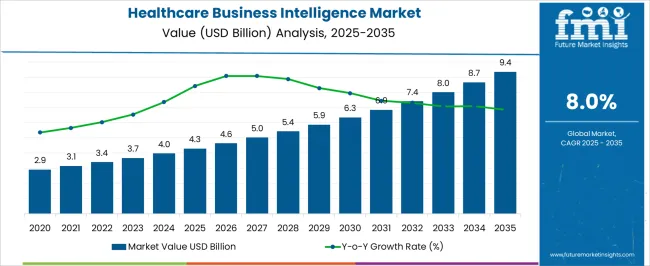
Healthcare business intelligence demand is expected to increase from USD 4.64 billion in 2026 to USD 10.02 billion by 2036. The market is anticipated to register an 8.0% CAGR during the forecast period through 2036. Clinical analytics is expected to retain functional leadership after 44.7% share in 2025 across healthcare organizations. Cloud based deployment is projected to lead adoption after accounting for 57.9% share in 2025.
Summary of the Healthcare Business Intelligence Market
- Demand and Growth Drivers
- Value based reimbursement is expected to lift demand for continuous measurement across care quality and cost performance.
- Expanding electronic health record data is likely to raise need for analytics tools across clinical operations.
- Quality reporting requirements are anticipated to increase use of automated measurement tools across hospitals and payers.
- Function and Deployment View
- Clinical analytics is expected to lead functional demand as predictive models enter clinician workflow planning.
- Cloud based deployment is likely to attract health systems seeking scale with lower infrastructure burden.
- Operational analytics is anticipated to gain attention as hospitals manage staffing pressure and daily care capacity.
- Geography and Competitive Outlook
- China is expected to record the fastest country expansion at 14.6% CAGR through 2036 globally.
- Spain is likely to post strong demand expansion as health services invest in predictive analytics.
- Vendors with verified clinical models are anticipated to gain preference during health system evaluations globally.
- Analyst Opinion
- Sabyasachi Ghosh, Principal Consultant for Healthcare at FMI, suggests, “Healthcare business intelligence is expected to move closer to clinical workflow decisions as predictive tools improve daily care planning. Vendors are likely to gain stronger buyer confidence with analytics able to reduce reporting burden and guide staffing decisions before hospital pressure increases.”
- Healthcare Business Intelligence Market Value Analysis
- Healthcare business intelligence is shifting from retrospective reporting tools into enterprise decision platforms for care organizations.
- Demand is likely to rise as hospitals seek predictive insights for patient risk and operating efficiency.
- Adoption is expected to increase as cloud platforms reduce infrastructure burden for health system analytics teams.
- Spending is anticipated to strengthen as reimbursement models require better measurement across quality and cost outcomes.
Key Takeaways, Market Size, and Forecast
- Global healthcare business intelligence demand is expected to reach USD 4.64 billion in 2026 worldwide.
- By 2036, healthcare business intelligence demand is projected to reach USD 10.02 billion across global markets.
- From 2026 to 2036, the market is anticipated to expand at an 8.0% CAGR worldwide.
- Clinical analytics is likely to continue as the leading function after capturing 44.7% share in 2025.
- Cloud based deployment is expected to lead adoption after accounting for 57.9% share in 2025.
- China is projected to record the fastest country-level expansion at 14.6% CAGR through 2036 globally.
Healthcare Business Intelligence Market Definition
The healthcare business intelligence market covers the global supply of software platforms and services that enable healthcare organizations to collect, integrate, analyze, and visualize clinical, financial, and operational data for decision support. Business intelligence solutions incorporate data warehousing, reporting, dashboards, predictive analytics, and artificial intelligence capabilities to improve patient outcomes, reduce costs, and enhance operational efficiency. They are deployed across hospitals, health systems, insurers, pharmaceutical companies, and research institutions where data driven decisions impact care quality and financial performance.
Market Inclusions
The report includes global and regional market size estimates in value terms, with a forecast period from 2026 to 2036. It provides segmentation by Function, Deployment, and Region. The analysis incorporates technology trends including artificial intelligence integration, cloud migration patterns, electronic health record interoperability, and real time analytics development. Regional demand dynamics, country level growth rates, and competitive positioning are also evaluated as per FMI methodology.
Market Exclusions
The scope excludes electronic health record software focused primarily on clinical documentation rather than analytics. It also excludes standalone data visualization tools not integrated with healthcare specific data models and content. Consulting services related to general digital transformation not specifically tied to business intelligence implementation are not considered. Custom built analytics solutions developed in house by individual healthcare organizations are excluded due to negligible market contribution.
Research Methodology
- Primary Research: Interviews were conducted with healthcare business intelligence vendors, health system chief data officers, hospital analytics managers, and health informatics consultants.
- Desk Research: Public company filings, healthcare IT adoption surveys, regulatory data reporting requirements, and population health management studies were reviewed.
- Market Sizing and Forecasting: A hybrid top down and bottom up model was constructed, reconstructing demand from hospital counts, health insurance enrollment figures, and per organization analytics software investment benchmarks.
- Data Validation and Update Cycle: Outputs were subjected to variance testing against vendor revenue reports, subscription growth metrics, and structured internal review prior to publication.
Healthcare Business Intelligence Market Drivers, Restraints, and Opportunities
The market has historically functioned as a specialized analytics category serving hospital finance departments and quality reporting teams. Its baseline scale is anchored in the regulatory requirement for standardized quality measure reporting to agencies such as the Centers for Medicare and Medicaid Services, which mandates systematic data collection and analysis.
FMI analysts observe a bifurcation between departmental business intelligence tools focused on specific functions such as revenue cycle or infection control and enterprise platforms that integrate data across clinical, financial, and operational domains. Traditional reporting tools face margin compression as visualization capabilities become commoditized, while growth is concentrated in platforms that deliver predictive insights embedded in clinician workflows.
- Centers for Medicare and Medicaid Services quality payment program: The 2024 update to the Medicare Promoting Interoperability Program requires eligible hospitals to report on new digital quality measures derived from electronic health record data, creating demand for business intelligence tools capable of calculating and submitting these measures. The program directly drives analytics investment by linking reimbursement to demonstrated reporting capability. [2]
- 21st Century Cures Act interoperability provisions: The Office of the National Coordinator for Health Information Technology's interoperability rules, fully effective in 2024, require healthcare organizations to provide patients with access to their electronic health information and to implement standardized application programming interfaces. These provisions enable business intelligence platforms to extract data more efficiently from electronic health records, reducing implementation costs and expanding addressable market. [3]
- Predictive analytics clinical validation: A 2024 study published in Health Affairs documented that hospitals implementing predictive analytics for sepsis detection achieved 18% reduction in mortality and 12% reduction in intensive care unit length of stay compared to control institutions. The validation accelerates health system investment by quantifying return on investment for clinical analytics deployments. [4]
Segment Analysis
Healthcare Business Intelligence Market Analysis by Function
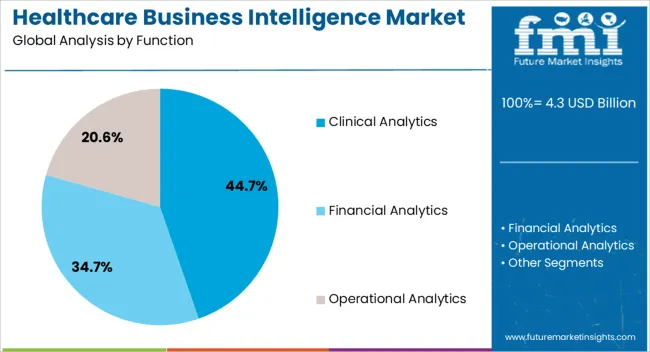
Based on FMI's healthcare business intelligence market report, demand for clinical analytics remains the leading function category, capturing 44.7% of the market share. This dominance is sustained by the direct impact of clinical analytics on patient outcomes, the integration of predictive models into clinician workflows, and the regulatory emphasis on quality measurement and reporting. Clinical analytics also benefit from the growing availability of structured clinical data from electronic health records and the validation of artificial intelligence algorithms for diagnosis support and risk stratification.
- Artificial intelligence integration: Leading vendors are embedding clinical predictive models into their analytics platforms. Oracle Corporation announced in April 2025 the launch of the Autonomous Shield project to assist healthcare clients move to a complete electronic health record and cloud infrastructure solution that minimizes risk and improves system performance. The project includes pre built clinical analytics models for readmission prediction and sepsis detection. [5]
- Real time clinical surveillance: Health systems are deploying clinical analytics platforms that monitor patient data in real time and alert care teams to deterioration. A 2024 case study from a large academic medical center documented that real time surveillance analytics reduced rapid response team activations by 22% and code blue events by 18% through earlier identification of at risk patients. [6]
- Population health management: Clinical analytics platforms increasingly support population health management by stratifying patient risk, identifying care gaps, and tracking intervention effectiveness. These capabilities are essential for organizations accepting financial risk under value based contracts.
Healthcare Business Intelligence Market Analysis by Deployment
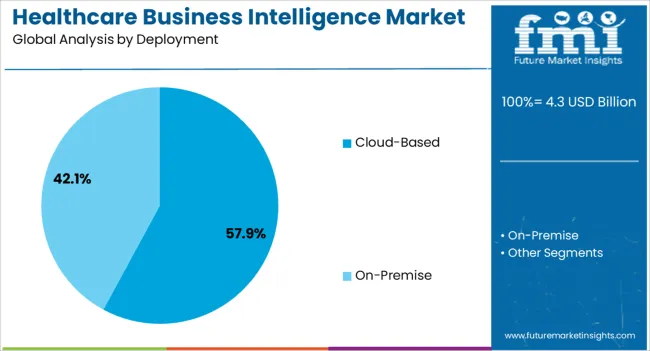
Cloud based deployment generates maximum demand at 57.9% for healthcare business intelligence because health systems seek scalability to accommodate growing data volumes, remote access for distributed care teams, and reduced information technology infrastructure costs. Cloud providers achieving healthcare specific security certifications that address concerns about protected health information reinforce the segment’s dominance.
- Hybrid deployment models: Large health systems with legacy infrastructure investments are adopting hybrid models where sensitive data remains on premises while analytics processing occurs in the cloud. Vendors such as Microsoft and Amazon Web Services offer hybrid architectures that maintain data residency compliance while enabling cloud scale analytics. [7]
- Managed analytics services: Cloud deployment enables vendors to offer managed analytics services that reduce the burden on health system information technology staff. These services include data pipeline management, model maintenance, and report generation, allowing health systems to focus on insight application rather than technical infrastructure.
- Interoperability advantages: Cloud based platforms facilitate data sharing across affiliated hospitals, ambulatory clinics, and post acute providers, enabling enterprise wide analytics that are difficult to achieve with on premise deployments. This capability is increasingly important as health systems consolidate and seek to standardize care across distributed networks.
Regional Analysis
The healthcare business intelligence market is segmented geographically across North America, Europe, Asia Pacific, Latin America, and Middle East and Africa. Growth dynamics differ based on health system digitization maturity, value based care adoption, regulatory reporting requirements, and population health management priorities.
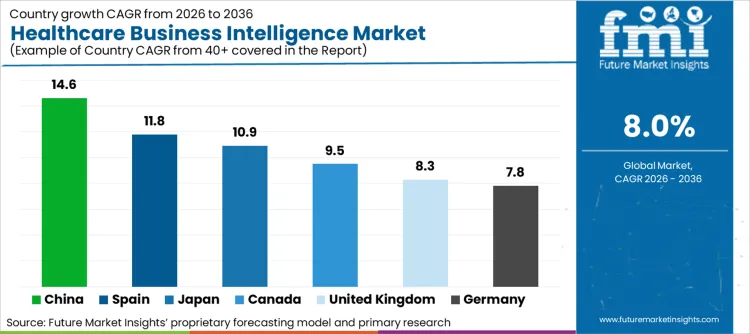
| Country | CAGR 2026 to 2036 |
|---|---|
| China | 14.6% |
| Spain | 11.8% |
| Japan | 10.9% |
| Canada | 9.5% |
| Germany | 7.8% |
| United Kingdom | 8.3% |
Source: Future Market Insights analysis, based on proprietary forecasting model and primary research
North America Market Analysis
North America functions as the largest regional market for healthcare business intelligence, characterized by mature health IT adoption, value based care reimbursement models, and stringent regulatory reporting requirements. The region benefits from strong venture capital investment in health analytics startups and active vendor consolidation.
United States
Demand for healthcare business intelligence solutions in the United States is forecasted to advance at 7.5% CAGR through 2036. Medicare quality payment programs requiring sophisticated analytics, health system consolidation creating demand for enterprise analytics platforms, and the transition to value based care contracts that necessitate continuous performance monitoring, drive growth. The Office of the National Coordinator's interoperability rules have accelerated electronic health record data access, reducing implementation barriers for business intelligence deployments. [3]
Canada
The Canadian market demonstrates a 9.5% CAGR, reflecting provincial health authority investments in enterprise analytics platforms and the federal government's digital health transformation strategy. Provincial initiatives to reduce surgical wait times, manage chronic disease populations, and optimize drug reimbursement programs create sustained demand for business intelligence capabilities. [8]
FMI's analysis of healthcare business intelligence market in North America consists of country wise assessment that includes the United States and Canada. Readers can find Medicare quality payment program tracking, health system consolidation trends, and provincial health IT investment forecasts.
Europe Market Analysis
Europe acts as a diverse regional market for healthcare business intelligence, with variation in digitization maturity, reimbursement models, and data privacy regulations across countries. The region's market is characterized by strong national health service investments in population health analytics and European Union funding for cross border health data initiatives.
Germany
Demand for healthcare business intelligence solutions in Germany is projected to rise at 7.8% CAGR through 2036. Growth is influenced by the Hospital Future Act funding for digital infrastructure, which provides financial support for analytics investments, and the Institute for Quality and Transparency in Healthcare's quality reporting requirements. Germany's federal structure creates demand for analytics platforms that can aggregate data across state level hospital associations while maintaining regional autonomy. [9]
Spain
Spain demonstrates an 11.8% CAGR, driven by regional health service investments in predictive analytics for chronic disease management and waiting list optimization. The Spanish National Health System's digital health strategy prioritizes business intelligence for population health management and resource allocation, with autonomous communities implementing analytics platforms tailored to regional priorities. [10]
United Kingdom
The United Kingdom market grows at 8.3% CAGR, reflecting National Health Service England's analytics priorities under the NHS Long Term Plan, including real time waiting time monitoring, integrated care system performance dashboards, and population health management tools. The Health Foundation's investments in analytics capability building across the NHS create sustained demand for business intelligence solutions. [11]
FMI's analysis of healthcare business intelligence market in Europe consists of country wise assessment that includes Germany, United Kingdom, France, Italy, and Spain. Readers can find national health service digitization strategies, European Union funding programs, and data privacy regulation compliance requirements.
Asia Pacific Market Analysis
Asia Pacific remains the highest growth region for healthcare business intelligence, driven by hospital digitization investments, aging population health management requirements, and government led health data infrastructure initiatives.
China
Healthcare business intelligence adoption in China is projected to rise at 14.6% CAGR through 2036, the highest among major markets. Growth is supported by the National Health Commission's mandate for standardized data platforms across all tertiary hospitals, which requires business intelligence capabilities for quality reporting and performance benchmarking. China's national population health database initiative creates demand for analytics platforms that can aggregate and analyze data from thousands of facilities.
The integration of business intelligence with artificial intelligence for diagnostic support and treatment optimization further accelerates adoption. [12] China's market is distinctive for its emphasis on large scale population analytics and the integration of business intelligence with national health insurance reimbursement systems.
Japan
Demand for healthcare business intelligence solutions in Japan is projected to rise at 10.9% CAGR through 2036. Growth is driven by the Ministry of Health's digital health transformation strategy, which includes investments in analytics for aging population health planning, regional medical coordination, and long term care optimization. Japan's health system faces pressure from population aging and fiscal constraints, creating demand for analytics that improve efficiency while maintaining quality. [13]
Competitive Aligners for Market Players
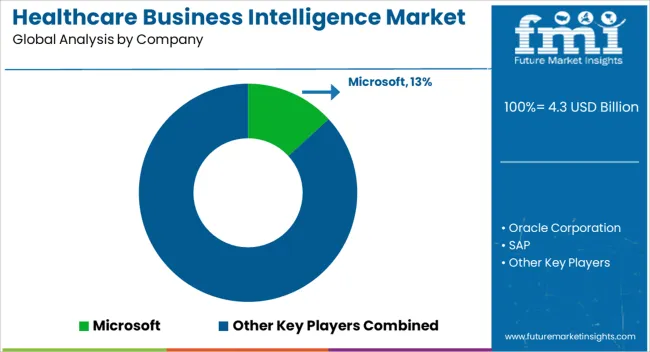
The healthcare business intelligence market is moderately consolidated with Microsoft, Oracle Corporation, SAP, and Tableau Software representing the largest enterprise focused vendors. Specialist healthcare analytics providers such as Infor Inc. and Domo Inc. maintain strong positions through domain specific solutions and deep electronic health record integration.
The primary competitive variable has shifted from feature comparison to healthcare specific artificial intelligence model performance and electronic health record integration depth. Vendors that demonstrate validated accuracy improvements for clinical predictive models and seamless integration with leading electronic health record platforms gain preferred status in health system procurement.
Buyer behavior in this market reflects increasing sophistication among health system analytics leaders who conduct structured vendor evaluations including proof of concept deployments on their own data. Reference ability with comparable organizations and demonstrated return on investment have become decisive factors in vendor selection.
Recent Developments:
- Microsoft and Stanford Medicine - Deployment March 2025: Stanford Medicine and Microsoft unveiled enterprise wide deployment of Nuance Dragon Ambient eXperience Copilot, integrating conversational artificial intelligence with analytics for documentation quality and clinician workload measurement. [1]
- Oracle Corporation - Product Launch April 2025: Oracle launched the Autonomous Shield project to assist healthcare clients move to complete electronic health record and cloud infrastructure solutions with pre built clinical analytics models. [5]
- Tableau Software - Healthcare Analytics Expansion 2024: Tableau expanded its healthcare specific analytics content library with pre built dashboards for quality reporting, revenue cycle management, and population health stratification.
Key Players in the Healthcare Business Intelligence Market
- Microsoft
- Oracle Corporation
- SAP
- Tableau Software Inc.
- Perficient Inc.
- Tibco Software Inc.
- Infor Inc.
- Domo Inc.
- Sisense Inc.
- Panorama Software Inc.
Scope of Report
| Metric | Value |
|---|---|
| Quantitative Units | USD 4.64 billion 2026 to USD 10.02 billion 2036 at a CAGR of 8.0% |
| Market Definition | The healthcare business intelligence market comprises the global supply of software platforms and services that enable healthcare organizations to collect, integrate, analyze, and visualize clinical, financial, and operational data for decision support, incorporating data warehousing, dashboards, predictive analytics, and artificial intelligence capabilities. |
| Function Segmentation | Clinical Analytics, Financial Analytics, Operational Analytics |
| Deployment Segmentation | Cloud Based, On Premise |
| Region Segmentation | North America, Europe, Asia Pacific, Latin America, Middle East and Africa |
| Countries Covered | United States, Canada, Germany, United Kingdom, France, Italy, Spain, China, India, Japan, South Korea, Brazil and 40 plus countries |
| Key Companies Profiled | Microsoft, Oracle Corporation, SAP, Tableau Software Inc., Perficient Inc., Tibco Software Inc., Infor Inc., Domo Inc., Sisense Inc., Panorama Software Inc. |
| Forecast Period | 2026 to 2036 |
| Approach | Hybrid top down and bottom up market modeling validated through primary interviews with healthcare business intelligence vendors, health system chief data officers, and hospital analytics managers supported by trade benchmarking and subscription revenue analysis |
Healthcare Business Intelligence Market Analysis by Segments
Function:
- Clinical Analytics
- Financial Analytics
- Operational Analytics
Deployment:
- Cloud Based
- On Premise
Region:
- North America (USA, Canada, Mexico)
- Latin America (Brazil, Chile, Rest of Latin America)
- Western Europe (Germany, UK, Italy, Spain, France, Nordic, BENELUX, Rest of Western Europe)
- Eastern Europe (Russia, Poland, Hungary, Balkan and Baltic, Rest of Eastern Europe)
- East Asia (China, Japan, South Korea)
- South Asia and Pacific (India, ASEAN, Australia and New Zealand, Rest of South Asia and Pacific)
- Middle East and Africa (Kingdom of Saudi Arabia, Other GCC Countries, Turkiye, South Africa, Other African Union, Rest of Middle East and Africa)
Bibliography
- [1] Stanford Medicine and Microsoft Corporation. (2025, March 12). Stanford Medicine and Microsoft unveil enterprise wide deployment of Nuance Dragon Ambient eXperience Copilot. Stanford Medicine News.
- [2] Centers for Medicare and Medicaid Services. (2024). Medicare Promoting Interoperability Program requirements for eligible hospitals. Federal Register, 89(45), 17892 17905.
- [3] Office of the National Coordinator for Health Information Technology. (2024). 21st Century Cures Act interoperability final rule implementation guide. Washington, D.C.: ONC.
- [4] Chen, J., Patel, V., and Williams, S. (2024). Impact of predictive analytics on sepsis outcomes: A multicenter study. Health Affairs, 43(2), 245 253.
- [5] Oracle Corporation. (2025, April 8). Oracle launches Autonomous Shield project for healthcare clients. Oracle Press Release.
- [6] University of Pittsburgh Medical Center. (2024). Real time clinical surveillance analytics: A case study in rapid response optimization. UPMC Center for Health Analytics.
- [7] Amazon Web Services. (2024). AWS hybrid architecture for healthcare analytics: Compliance and data residency solutions. AWS Healthcare White Paper.
- [8] Canada Health Infoway. (2024). Digital health transformation strategy: Analytics investments and priorities. Toronto: Canada Health Infoway.
- [9] Federal Ministry of Health, Germany. (2024). Hospital Future Act: Digital infrastructure funding program progress report. Berlin: BMG.
- [10] Ministry of Health, Spain. (2024). Spanish National Health System digital health strategy 2024 2027. Madrid: MSSSI.
- [11] NHS England. (2024). NHS Long Term Plan analytics priorities and implementation update. London: NHS England.
- [12] National Health Commission, People's Republic of China. (2024). Standardized data platform mandate for tertiary hospitals. Beijing: NHC.
- [13] Ministry of Health, Labour and Welfare, Japan. (2024). Digital health transformation strategy for aging population health planning. Tokyo: MHLW.
This Report Addresses
- Market intelligence to enable structured strategic decision making across healthcare business intelligence vendors, health system analytics leaders, and health information technology investors.
- Market size estimation and 10 year revenue forecasts from 2026 to 2036 including validated CAGR and absolute dollar opportunity sizing.
- Growth opportunity mapping across Function, Deployment, and regional demand pockets with emphasis on artificial intelligence driven clinical decision support and real time operational analytics.
- Segment and regional forecasting covering clinical, financial, and operational analytics alongside demand trajectories across hospitals, health systems, and insurers.
- Competition strategy assessment including artificial intelligence model validation, electronic health record integration depth, and cloud platform partnerships shaping health system procurement decisions.
- Product and compliance tracking focused on predictive model accuracy, interoperability certification, and regulatory reporting automation.
- Regulatory impact analysis covering Medicare quality payment programs, 21st Century Cures Act interoperability provisions, and national health digitization strategies influencing business intelligence investment priorities.
- Report delivery in PDF, Excel, and presentation ready formats to support executive planning, product development alignment, and market entry strategy development.
Frequently Asked Questions
How large is the demand for healthcare business intelligence solutions in the global market in 2026?
Demand for healthcare business intelligence solutions is estimated to be valued at USD 4.64 billion in 2026.
What will be the market size of healthcare business intelligence in the global market by 2036?
Market size for healthcare business intelligence is projected to reach USD 10.02 billion by 2036.
What is the expected demand growth for healthcare business intelligence between 2026 and 2036?
Demand for healthcare business intelligence is expected to grow at an 8.0% CAGR between 2026 and 2036.
Which function segment is poised to lead global sales?
Clinical analytics is expected to remain the leading function segment, anchored by direct impact on patient outcomes and clinician workflow integration, holding 44.7% share in 2025.
Which deployment type dominates the healthcare business intelligence market?
Cloud based deployment is the dominant model at 57.9% share in 2025, reflecting health system preference for scalability, remote access, and reduced infrastructure maintenance.
What is driving demand in the United States?
Medicare quality payment programs requiring sophisticated analytics, health system consolidation creating demand for enterprise platforms, and transition to value based care contracts are driving demand in the United States.
What is the United States growth outlook in this report?
The United States is projected to expand at a 7.5% CAGR during 2026 to 2036.
What is driving demand in Germany?
Hospital Future Act funding for digital infrastructure and Institute for Quality and Transparency in Healthcare quality reporting requirements are driving demand in Germany.
What is Germany's growth outlook in this report?
Germany is projected to expand at a 7.8% CAGR during 2026 to 2036.
Does the report cover the United Kingdom in its regional analysis?
Yes, the United Kingdom is included within Europe under the regional coverage framework.
What is the United Kingdom's growth outlook in this report?
The United Kingdom is projected to expand at an 8.3% CAGR during 2026 to 2036.
What is driving demand in China?
National Health Commission mandate for standardized data platforms across all tertiary hospitals and integration with national population health databases are driving demand in China.
What is China's growth outlook in this report?
China is projected to expand at a 14.6% CAGR during 2026 to 2036, the highest among major markets.
What is driving demand in Japan?
Ministry of Health digital health transformation strategy and investments in analytics for aging population health planning are driving demand in Japan.
What is Japan's growth outlook in this report?
Japan is projected to expand at a 10.9% CAGR during 2026 to 2036.
Does the report cover Spain in its regional analysis?
Yes, Spain is included within Europe and is covered in the country wise assessment.
What is Spain's growth outlook in this report?
Spain is projected to expand at an 11.8% CAGR during 2026 to 2036.
Does the report cover Canada in its regional analysis?
Yes, Canada is included within North America under the regional scope of analysis.
What is Canada's growth outlook in this report?
Canada is projected to expand at a 9.5% CAGR during 2026 to 2036.
What is healthcare business intelligence and what is it mainly used for?
Healthcare business intelligence comprises software platforms and services that enable healthcare organizations to integrate and analyze clinical, financial, and operational data for decision support. It is mainly used to improve patient outcomes, reduce costs, enhance operational efficiency, and support value based care delivery through data driven insights.
What does the healthcare business intelligence market mean in this report?
It refers to the global supply of healthcare business intelligence software solutions and services by function, deployment, and region, measured in value terms at the software vendor revenue layer.
What is included in the scope of this healthcare business intelligence market report?
Scope includes market sizing and forecasting for 2026 to 2036, segmentation by function, deployment, and region, along with competitive assessment, regulatory impact analysis, and country wise outlook.
What is excluded from the scope of this report?
The scope excludes electronic health record software focused primarily on clinical documentation, standalone data visualization tools not integrated with healthcare specific data models, general digital transformation consulting, and custom built in house analytics solutions.
How are regulatory developments shaping the healthcare business intelligence market?
Regulatory developments including Medicare quality payment programs, 21st Century Cures Act interoperability provisions, and national health digitization strategies are shifting competitive advantage from retrospective reporting tools to real time predictive platforms embedded in clinical workflows with demonstrated accuracy improvements and regulatory reporting automation capabilities.
Preview the report firsthand - request a free sample
Get SampleGet the brochure for pricing and purchase details.
Get PDFTable of Content
- Executive Summary
- Global Market Outlook
- Demand-side Trends
- Supply-side Trends
- Technology Roadmap Analysis
- Analysis and Recommendations
- Market Overview
- Market Coverage / Taxonomy
- Market Definition / Scope / Limitations
- Research Methodology
- Chapter Orientation
- Analytical Lens and Working Hypotheses
- Market Structure, Signals, and Trend Drivers
- Benchmarking and Cross-market Comparability
- Market Sizing, Forecasting, and Opportunity Mapping
- Research Design and Evidence Framework
- Desk Research Programme (Secondary Evidence)
- Company Annual and Sustainability Reports
- Peer-reviewed Journals and Academic Literature
- Corporate Websites, Product Literature, and Technical Notes
- Earnings Decks and Investor Briefings
- Statutory Filings and Regulatory Disclosures
- Technical White Papers and Standards Notes
- Trade Journals, Industry Magazines, and Analyst Briefs
- Conference Proceedings, Webinars, and Seminar Materials
- Government Statistics Portals and Public Data Releases
- Press Releases and Reputable Media Coverage
- Specialist Newsletters and Curated Briefings
- Sector Databases and Reference Repositories
- FMI Internal Proprietary Databases and Historical Market Datasets
- Subscription Datasets and Paid Sources
- Social Channels, Communities, and Digital Listening Inputs
- Additional Desk Sources
- Expert Input and Fieldwork (Primary Evidence)
- Primary Modes
- Qualitative Interviews and Expert Elicitation
- Quantitative Surveys and Structured Data Capture
- Blended Approach
- Why Primary Evidence is Used
- Field Techniques
- Interviews
- Surveys
- Focus Groups
- Observational and In-context Research
- Social and Community Interactions
- Stakeholder Universe Engaged
- C-suite Leaders
- Board Members
- Presidents and Vice Presidents
- R&D and Innovation Heads
- Technical Specialists
- Domain Subject-matter Experts
- Scientists
- Physicians and Other Healthcare Professionals
- Governance, Ethics, and Data Stewardship
- Research Ethics
- Data Integrity and Handling
- Primary Modes
- Tooling, Models, and Reference Databases
- Desk Research Programme (Secondary Evidence)
- Data Engineering and Model Build
- Data Acquisition and Ingestion
- Cleaning, Normalisation, and Verification
- Synthesis, Triangulation, and Analysis
- Quality Assurance and Audit Trail
- Market Background
- Market Dynamics
- Drivers
- Restraints
- Opportunity
- Trends
- Scenario Forecast
- Demand in Optimistic Scenario
- Demand in Likely Scenario
- Demand in Conservative Scenario
- Opportunity Map Analysis
- Product Life Cycle Analysis
- Supply Chain Analysis
- Investment Feasibility Matrix
- Value Chain Analysis
- PESTLE and Porter’s Analysis
- Regulatory Landscape
- Regional Parent Market Outlook
- Production and Consumption Statistics
- Import and Export Statistics
- Market Dynamics
- Global Market Analysis 2021 to 2025 and Forecast, 2026 to 2036
- Historical Market Size Value (USD Billion) Analysis, 2021 to 2025
- Current and Future Market Size Value (USD Billion) Projections, 2026 to 2036
- Y-o-Y Growth Trend Analysis
- Absolute $ Opportunity Analysis
- Global Market Pricing Analysis 2021 to 2025 and Forecast 2026 to 2036
- Global Market Analysis 2021 to 2025 and Forecast 2026 to 2036, By Function
- Introduction / Key Findings
- Historical Market Size Value (USD Billion) Analysis By Function , 2021 to 2025
- Current and Future Market Size Value (USD Billion) Analysis and Forecast By Function , 2026 to 2036
- Clinical Analytics
- Financial Analytics
- Operational Analytics
- Clinical Analytics
- Y-o-Y Growth Trend Analysis By Function , 2021 to 2025
- Absolute $ Opportunity Analysis By Function , 2026 to 2036
- Global Market Analysis 2021 to 2025 and Forecast 2026 to 2036, By Deployment
- Introduction / Key Findings
- Historical Market Size Value (USD Billion) Analysis By Deployment, 2021 to 2025
- Current and Future Market Size Value (USD Billion) Analysis and Forecast By Deployment, 2026 to 2036
- Cloud Based
- On Premise
- Cloud Based
- Y-o-Y Growth Trend Analysis By Deployment, 2021 to 2025
- Absolute $ Opportunity Analysis By Deployment, 2026 to 2036
- Global Market Analysis 2021 to 2025 and Forecast 2026 to 2036, By Region
- Introduction
- Historical Market Size Value (USD Billion) Analysis By Region, 2021 to 2025
- Current Market Size Value (USD Billion) Analysis and Forecast By Region, 2026 to 2036
- North America
- Latin America
- Western Europe
- Eastern Europe
- East Asia
- South Asia and Pacific
- Middle East & Africa
- Market Attractiveness Analysis By Region
- North America Market Analysis 2021 to 2025 and Forecast 2026 to 2036, By Country
- Historical Market Size Value (USD Billion) Trend Analysis By Market Taxonomy, 2021 to 2025
- Market Size Value (USD Billion) Forecast By Market Taxonomy, 2026 to 2036
- By Country
- USA
- Canada
- Mexico
- By Function
- By Deployment
- By Country
- Market Attractiveness Analysis
- By Country
- By Function
- By Deployment
- Key Takeaways
- Latin America Market Analysis 2021 to 2025 and Forecast 2026 to 2036, By Country
- Historical Market Size Value (USD Billion) Trend Analysis By Market Taxonomy, 2021 to 2025
- Market Size Value (USD Billion) Forecast By Market Taxonomy, 2026 to 2036
- By Country
- Brazil
- Chile
- Rest of Latin America
- By Function
- By Deployment
- By Country
- Market Attractiveness Analysis
- By Country
- By Function
- By Deployment
- Key Takeaways
- Western Europe Market Analysis 2021 to 2025 and Forecast 2026 to 2036, By Country
- Historical Market Size Value (USD Billion) Trend Analysis By Market Taxonomy, 2021 to 2025
- Market Size Value (USD Billion) Forecast By Market Taxonomy, 2026 to 2036
- By Country
- Germany
- UK
- Italy
- Spain
- France
- Nordic
- BENELUX
- Rest of Western Europe
- By Function
- By Deployment
- By Country
- Market Attractiveness Analysis
- By Country
- By Function
- By Deployment
- Key Takeaways
- Eastern Europe Market Analysis 2021 to 2025 and Forecast 2026 to 2036, By Country
- Historical Market Size Value (USD Billion) Trend Analysis By Market Taxonomy, 2021 to 2025
- Market Size Value (USD Billion) Forecast By Market Taxonomy, 2026 to 2036
- By Country
- Russia
- Poland
- Hungary
- Balkan & Baltic
- Rest of Eastern Europe
- By Function
- By Deployment
- By Country
- Market Attractiveness Analysis
- By Country
- By Function
- By Deployment
- Key Takeaways
- East Asia Market Analysis 2021 to 2025 and Forecast 2026 to 2036, By Country
- Historical Market Size Value (USD Billion) Trend Analysis By Market Taxonomy, 2021 to 2025
- Market Size Value (USD Billion) Forecast By Market Taxonomy, 2026 to 2036
- By Country
- China
- Japan
- South Korea
- By Function
- By Deployment
- By Country
- Market Attractiveness Analysis
- By Country
- By Function
- By Deployment
- Key Takeaways
- South Asia and Pacific Market Analysis 2021 to 2025 and Forecast 2026 to 2036, By Country
- Historical Market Size Value (USD Billion) Trend Analysis By Market Taxonomy, 2021 to 2025
- Market Size Value (USD Billion) Forecast By Market Taxonomy, 2026 to 2036
- By Country
- India
- ASEAN
- Australia & New Zealand
- Rest of South Asia and Pacific
- By Function
- By Deployment
- By Country
- Market Attractiveness Analysis
- By Country
- By Function
- By Deployment
- Key Takeaways
- Middle East & Africa Market Analysis 2021 to 2025 and Forecast 2026 to 2036, By Country
- Historical Market Size Value (USD Billion) Trend Analysis By Market Taxonomy, 2021 to 2025
- Market Size Value (USD Billion) Forecast By Market Taxonomy, 2026 to 2036
- By Country
- Kingdom of Saudi Arabia
- Other GCC Countries
- Turkiye
- South Africa
- Other African Union
- Rest of Middle East & Africa
- By Function
- By Deployment
- By Country
- Market Attractiveness Analysis
- By Country
- By Function
- By Deployment
- Key Takeaways
- Key Countries Market Analysis
- USA
- Pricing Analysis
- Market Share Analysis, 2025
- By Function
- By Deployment
- Canada
- Pricing Analysis
- Market Share Analysis, 2025
- By Function
- By Deployment
- Mexico
- Pricing Analysis
- Market Share Analysis, 2025
- By Function
- By Deployment
- Brazil
- Pricing Analysis
- Market Share Analysis, 2025
- By Function
- By Deployment
- Chile
- Pricing Analysis
- Market Share Analysis, 2025
- By Function
- By Deployment
- Germany
- Pricing Analysis
- Market Share Analysis, 2025
- By Function
- By Deployment
- UK
- Pricing Analysis
- Market Share Analysis, 2025
- By Function
- By Deployment
- Italy
- Pricing Analysis
- Market Share Analysis, 2025
- By Function
- By Deployment
- Spain
- Pricing Analysis
- Market Share Analysis, 2025
- By Function
- By Deployment
- France
- Pricing Analysis
- Market Share Analysis, 2025
- By Function
- By Deployment
- India
- Pricing Analysis
- Market Share Analysis, 2025
- By Function
- By Deployment
- ASEAN
- Pricing Analysis
- Market Share Analysis, 2025
- By Function
- By Deployment
- Australia & New Zealand
- Pricing Analysis
- Market Share Analysis, 2025
- By Function
- By Deployment
- China
- Pricing Analysis
- Market Share Analysis, 2025
- By Function
- By Deployment
- Japan
- Pricing Analysis
- Market Share Analysis, 2025
- By Function
- By Deployment
- South Korea
- Pricing Analysis
- Market Share Analysis, 2025
- By Function
- By Deployment
- Russia
- Pricing Analysis
- Market Share Analysis, 2025
- By Function
- By Deployment
- Poland
- Pricing Analysis
- Market Share Analysis, 2025
- By Function
- By Deployment
- Hungary
- Pricing Analysis
- Market Share Analysis, 2025
- By Function
- By Deployment
- Kingdom of Saudi Arabia
- Pricing Analysis
- Market Share Analysis, 2025
- By Function
- By Deployment
- Turkiye
- Pricing Analysis
- Market Share Analysis, 2025
- By Function
- By Deployment
- South Africa
- Pricing Analysis
- Market Share Analysis, 2025
- By Function
- By Deployment
- USA
- Market Structure Analysis
- Competition Dashboard
- Competition Benchmarking
- Market Share Analysis of Top Players
- By Regional
- By Function
- By Deployment
- Competition Analysis
- Competition Deep Dive
- Microsoft
- Overview
- Product Portfolio
- Profitability by Market Segments (Product/Age /Sales Channel/Region)
- Sales Footprint
- Strategy Overview
- Marketing Strategy
- Product Strategy
- Channel Strategy
- Oracle Corporation
- SAP
- Tableau Software Inc.
- Perficient Inc.
- Tibco Software Inc.
- Infor Inc.
- Microsoft
- Competition Deep Dive
- Assumptions & Acronyms Used


