

- Industry Size (2025)
- USD 3.3 Bn
- Forecast (2035)
- USD 13.5 Bn
- CAGR (2025 to 2035)
- 15.2%
Healthcare Master Data Management Market Size and Share Forecast Outlook 2025 to 2035
The Healthcare Master Data Management Market is estimated to be valued at USD 3.3 billion in 2025 and is projected to reach USD 13.5 billion by 2035, registering a compound annual growth rate (CAGR) of 15.2% over the forecast period.
Quick Stats for Healthcare Master Data Management Market
- Healthcare Master Data Management Market Value (2025): USD 3.3 billion
- Healthcare Master Data Management Market Forecast Value (2035): USD 13.5 billion
- Healthcare Master Data Management Market Forecast CAGR: 15.2%
- Leading Segment in Healthcare Master Data Management Market in 2025: Software (55.2%)
- Key Growth Regions in Healthcare Master Data Management Market: North America, Asia-Pacific, Europe
- Top Key Players in Healthcare Master Data Management Market: IBM Corporation, Oracle Corporation, SAP SE, Informatica LLC, Reltio Inc., Stibo Systems, Profisee Group, Inc., SAS Institute Inc., Teradata Corporation, SymphonyAI (formerly Symphony Health Solutions), Ataccama Corporation, TIBCO Software Inc., Veeva Systems Inc., Informatica Corporatio
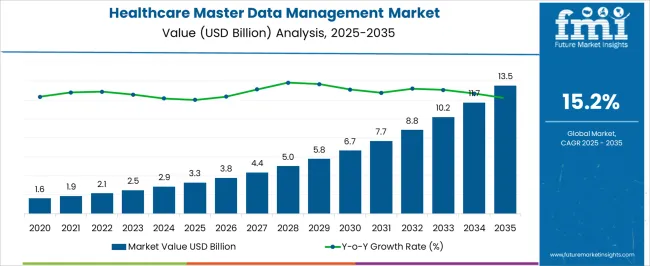
Healthcare Master Data Management Market Key Takeaways
| Metric | Value |
|---|---|
| Healthcare Master Data Management Market Estimated Value in (2025 E) | USD 3.3 billion |
| Healthcare Master Data Management Market Forecast Value in (2035 F) | USD 13.5 billion |
| Forecast CAGR (2025 to 2035) | 15.2% |
Why is the Healthcare Master Data Management Market Growing?
The Healthcare Master Data Management market is witnessing steady growth, driven by the increasing need for accurate, consistent, and unified data across healthcare organizations. Rising adoption of electronic health records, health information exchanges, and interoperable systems is fueling demand for robust master data management solutions. These systems enable healthcare providers to consolidate patient, provider, and operational data, enhancing data quality, reducing redundancies, and improving decision-making.
The integration of cloud computing, AI-driven analytics, and automation is further accelerating adoption by offering scalability, real-time updates, and cost efficiency. Regulatory compliance requirements, such as patient privacy laws and standards for healthcare data governance, are reinforcing the importance of MDM solutions.
The growing focus on value-based care, population health management, and analytics-driven clinical and operational decision-making is shaping market dynamics As healthcare organizations continue to prioritize data integrity, interoperability, and analytics readiness, the Healthcare Master Data Management market is expected to experience sustained growth, driven by technological innovation and increasing investments in data governance strategies.
Segmental Analysis
The healthcare master data management market is segmented by component, deployment mode, application, end-user, and geographic regions. By component, healthcare master data management market is divided into Software and Services. In terms of deployment mode, healthcare master data management market is classified into Cloud and On-Premises. Based on application, healthcare master data management market is segmented into Provider Data Management, Patient Data Management, Payer Data Management, Product Data Management, and Others. By end-user, healthcare master data management market is segmented into Healthcare Providers, Healthcare Payers, Life Science Companies, and Others. Regionally, the healthcare master data management industry is classified into North America, Latin America, Western Europe, Eastern Europe, Balkan & Baltic Countries, Russia & Belarus, Central Asia, East Asia, South Asia & Pacific, and the Middle East & Africa.
Insights into the Software Component Segment
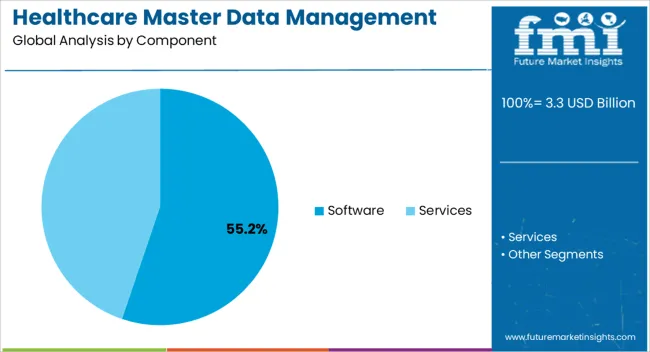
The software component segment is projected to hold 55.2% of the market revenue in 2025, establishing it as the leading component. Growth in this segment is being driven by the demand for centralized platforms that enable healthcare organizations to manage, integrate, and govern diverse data sources efficiently.
Software-based solutions provide capabilities such as data cleansing, deduplication, validation, and real-time synchronization, which reduce errors and improve operational efficiency. Integration with existing electronic health record systems, analytics platforms, and cloud environments enhances adoption and value realization.
The software segment also benefits from continuous updates, scalability, and AI-driven enhancements that improve accuracy, predictive insights, and compliance readiness As healthcare providers seek to optimize provider data management, patient information quality, and analytics-driven operations, the software segment is expected to maintain its leadership position, supported by technological advancements, regulatory enforcement, and increasing emphasis on data-driven decision-making across the healthcare ecosystem.
Insights into the Cloud Deployment Mode Segment
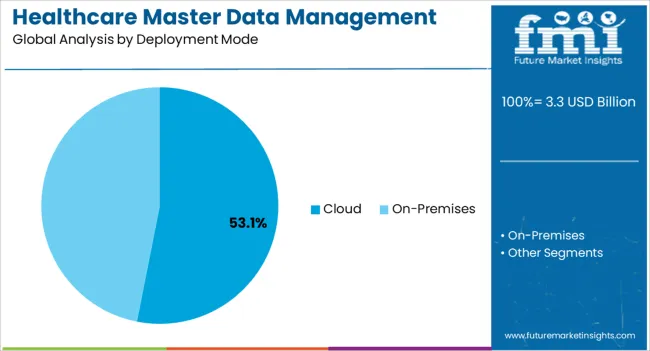
The cloud deployment mode segment is anticipated to account for 53.1% of the market revenue in 2025, making it the leading deployment model. Its growth is driven by the need for scalable, cost-effective, and flexible solutions that support distributed healthcare networks and multiple data sources. Cloud deployment enables real-time access to centralized master data, facilitates collaboration among providers, and reduces the need for on-premises infrastructure and maintenance.
Security features, compliance with healthcare data regulations, and disaster recovery capabilities further reinforce adoption. Organizations benefit from rapid deployment, simplified system upgrades, and the ability to integrate with analytics and AI-driven applications.
The rising adoption of telehealth, digital health platforms, and population health initiatives is accelerating demand for cloud-based MDM solutions As healthcare organizations increasingly prioritize interoperability, operational efficiency, and cost optimization, the cloud deployment mode is expected to remain the dominant model, supporting sustained market expansion and driving improved data governance practices.
Insights into the Provider Data Management Application Segment
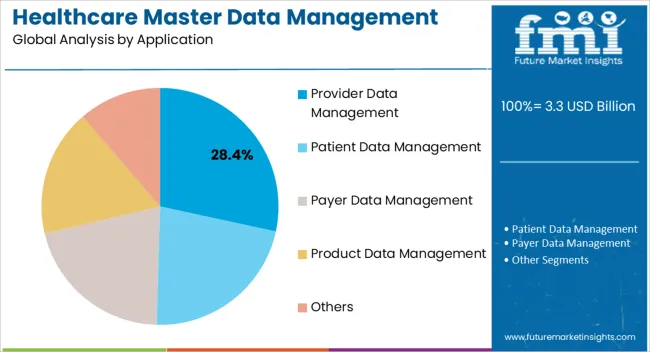
The provider data management application segment is projected to hold 28.4% of the market revenue in 2025, establishing it as the leading application. Growth in this segment is being driven by the critical need to maintain accurate, up-to-date information about healthcare providers, including licensing, specialties, affiliations, and performance metrics.
Accurate provider data supports regulatory compliance, quality of care, reimbursement processes, and operational efficiency. Healthcare organizations are increasingly leveraging MDM solutions to integrate provider information with clinical, operational, and financial systems, reducing errors and improving decision-making.
Automation, AI-driven validation, and real-time updates enhance accuracy and operational reliability As healthcare systems expand and data sources proliferate, the provider data management segment is expected to remain a key driver of market growth, supported by ongoing investments in data quality, governance, and interoperability, ensuring accurate and actionable insights for operational and clinical decision-making.
Market Overview
Healthcare Master Data Management Market Overview
Information Technology has revolutionised every industry and brought about substantial changes. It has made the world more interconnected, interdependent and increased the volume of data to be processed enormously. However, if the data is compromised by way of a leak or hack, it can also have devastating consequences.
This is particularly true in medical healthcare and thus, there is a focus on the healthcare Master Data Management market. MDM is the processes, policies, and tools that allow an organisation to define and manage its critical data, leading to a single point of reference.
The healthcare master data management market is a major component of MDM. Medical healthcare facilities need to keep critical records of their patients’ health and security. Any lapse by way of administering an inadequate or incorrect dosage could even lead to death. It is vital for organisations to keep accurate, up-to-date records of their patients to avoid mistakes that could lead to reputational as well as financial harm to the organisation. Master data in healthcare is mainly divided into identifying data like the patient, provider or location and reference data i.e. linkable vocabulary like LOINC, RxNorm, ICD, SNOMED, etc.
Analysis of Healthcare Master Data Management Market By Key Countries
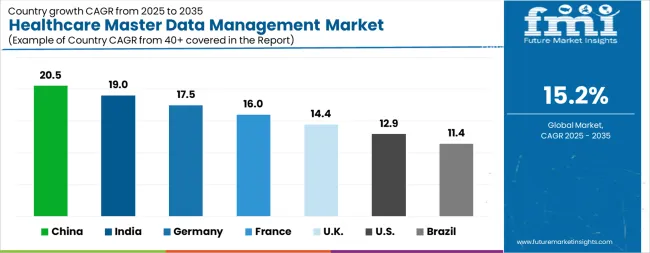
| Country | CAGR |
|---|---|
| China | 20.5% |
| India | 19.0% |
| Germany | 17.5% |
| France | 16.0% |
| UK | 14.4% |
| USA | 12.9% |
| Brazil | 11.4% |
Country-wise Analysis
The Healthcare Master Data Management Market is expected to register a CAGR of 15.2% during the forecast period, exhibiting varied country level momentum. China leads with the highest CAGR of 20.5%, followed by India at 19.0%. Developed markets such as Germany, France, and the UK continue to expand steadily, while the USA is likely to grow at consistent rates. Brazil posts the lowest CAGR at 11.4%, yet still underscores a broadly positive trajectory for the global Healthcare Master Data Management Market. In 2024, Germany held a dominant revenue in the Western Europe market and is expected to grow with a CAGR of 17.5%. The USA Healthcare Master Data Management Market is estimated to be valued at USD 1.1 billion in 2025 and is anticipated to reach a valuation of USD 3.8 billion by 2035. Sales are projected to rise at a CAGR of 12.9% over the forecast period between 2025 and 2035. While Japan and South Korea markets are estimated to be valued at USD 149.1 million and USD 111.3 million respectively in 2025.
Key Players in the Healthcare Master Data Management Market
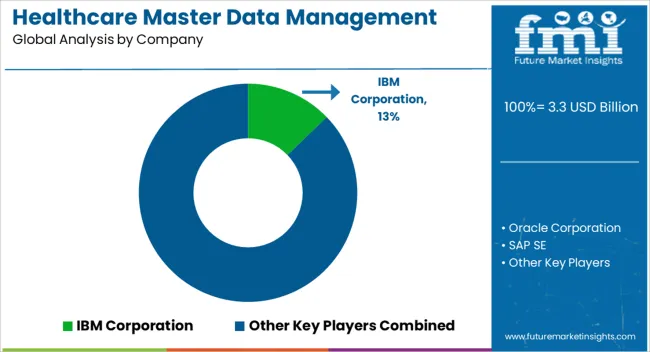
- IBM Corporation
- Oracle Corporation
- SAP SE
- Informatica LLC
- Reltio Inc.
- Stibo Systems
- Profisee Group, Inc.
- SAS Institute Inc.
- Teradata Corporation
- SymphonyAI (formerly Symphony Health Solutions)
- Ataccama Corporation
- TIBCO Software Inc.
- Veeva Systems Inc.
- Informatica Corporatio
Scope of the Report
| Item | Value |
|---|---|
| Quantitative Units | USD 3.3 Billion |
| Component | Software and Services |
| Deployment Mode | Cloud and On-Premises |
| Application | Provider Data Management, Patient Data Management, Payer Data Management, Product Data Management, and Others |
| End-User | Healthcare Providers, Healthcare Payers, Life Science Companies, and Others |
| Regions Covered | North America, Europe, Asia-Pacific, Latin America, Middle East & Africa |
| Country Covered | United States, Canada, Germany, France, United Kingdom, China, Japan, India, Brazil, South Africa |
| Key Companies Profiled | IBM Corporation, Oracle Corporation, SAP SE, Informatica LLC, Reltio Inc., Stibo Systems, Profisee Group, Inc., SAS Institute Inc., Teradata Corporation, SymphonyAI (formerly Symphony Health Solutions), Ataccama Corporation, TIBCO Software Inc., Veeva Systems Inc., and Informatica Corporatio |
Healthcare Master Data Management Market by Segments
Component:
- Software
- Services
Deployment Mode:
- Cloud
- On-Premises
Application:
- Provider Data Management
- Patient Data Management
- Payer Data Management
- Product Data Management
- Others
End-User:
- Healthcare Providers
- Healthcare Payers
- Life Science Companies
- Others
Region:
- North America
- USA
- Canada
- Mexico
- Latin America
- Brazil
- Chile
- Rest of Latin America
- Western Europe
- Germany
- UK
- Italy
- Spain
- France
- Nordic
- BENELUX
- Rest of Western Europe
- Eastern Europe
- Russia
- Poland
- Hungary
- Balkan & Baltic
- Rest of Eastern Europe
- East Asia
- China
- Japan
- South Korea
- South Asia and Pacific
- India
- ASEAN
- Australia & New Zealand
- Rest of South Asia and Pacific
- Middle East & Africa
- Kingdom of Saudi Arabia
- Other GCC Countries
- Turkiye
- South Africa
- Other African Union
- Rest of Middle East & Africa
Frequently Asked Questions
How big is the healthcare master data management market in 2025?
The global healthcare master data management market is estimated to be valued at USD 3.3 billion in 2025.
What will be the size of healthcare master data management market in 2035?
The market size for the healthcare master data management market is projected to reach USD 13.5 billion by 2035.
How much will be the healthcare master data management market growth between 2025 and 2035?
The healthcare master data management market is expected to grow at a 15.2% CAGR between 2025 and 2035.
What are the key product types in the healthcare master data management market?
The key product types in healthcare master data management market are software and services.
Which deployment mode segment to contribute significant share in the healthcare master data management market in 2025?
In terms of deployment mode, cloud segment to command 53.1% share in the healthcare master data management market in 2025.
Preview the report firsthand - request a free sample
Get SampleGet the brochure for pricing and purchase details.
Get PDFTable of Content
- Executive Summary
- Global Market Outlook
- Demand-side Trends
- Supply-side Trends
- Technology Roadmap Analysis
- Analysis and Recommendations
- Market Overview
- Market Coverage / Taxonomy
- Market Definition / Scope / Limitations
- Market Background
- Market Dynamics
- Drivers
- Restraints
- Opportunity
- Trends
- Scenario Forecast
- Demand in Optimistic Scenario
- Demand in Likely Scenario
- Demand in Conservative Scenario
- Opportunity Map Analysis
- Product Life Cycle Analysis
- Supply Chain Analysis
- Investment Feasibility Matrix
- Value Chain Analysis
- PESTLE and Porter’s Analysis
- Regulatory Landscape
- Regional Parent Market Outlook
- Production and Consumption Statistics
- Import and Export Statistics
- Market Dynamics
- Global Market Analysis 2020 to 2024 and Forecast, 2025 to 2035
- Historical Market Size Value (USD Million) Analysis, 2020 to 2024
- Current and Future Market Size Value (USD Million) Projections, 2025 to 2035
- Y-o-Y Growth Trend Analysis
- Absolute $ Opportunity Analysis
- Global Market Pricing Analysis 2020 to 2024 and Forecast 2025 to 2035
- Global Market Analysis 2020 to 2024 and Forecast 2025 to 2035, By Component
- Introduction / Key Findings
- Historical Market Size Value (USD Million) Analysis By Component , 2020 to 2024
- Current and Future Market Size Value (USD Million) Analysis and Forecast By Component , 2025 to 2035
- Software
- Services
- Y-o-Y Growth Trend Analysis By Component , 2020 to 2024
- Absolute $ Opportunity Analysis By Component , 2025 to 2035
- Global Market Analysis 2020 to 2024 and Forecast 2025 to 2035, By Deployment Mode
- Introduction / Key Findings
- Historical Market Size Value (USD Million) Analysis By Deployment Mode, 2020 to 2024
- Current and Future Market Size Value (USD Million) Analysis and Forecast By Deployment Mode, 2025 to 2035
- Cloud
- On-Premises
- Y-o-Y Growth Trend Analysis By Deployment Mode, 2020 to 2024
- Absolute $ Opportunity Analysis By Deployment Mode, 2025 to 2035
- Global Market Analysis 2020 to 2024 and Forecast 2025 to 2035, By Application
- Introduction / Key Findings
- Historical Market Size Value (USD Million) Analysis By Application, 2020 to 2024
- Current and Future Market Size Value (USD Million) Analysis and Forecast By Application, 2025 to 2035
- Provider Data Management
- Patient Data Management
- Payer Data Management
- Product Data Management
- Others
- Y-o-Y Growth Trend Analysis By Application, 2020 to 2024
- Absolute $ Opportunity Analysis By Application, 2025 to 2035
- Global Market Analysis 2020 to 2024 and Forecast 2025 to 2035, By End-User
- Introduction / Key Findings
- Historical Market Size Value (USD Million) Analysis By End-User, 2020 to 2024
- Current and Future Market Size Value (USD Million) Analysis and Forecast By End-User, 2025 to 2035
- Healthcare Providers
- Healthcare Payers
- Life Science Companies
- Others
- Y-o-Y Growth Trend Analysis By End-User, 2020 to 2024
- Absolute $ Opportunity Analysis By End-User, 2025 to 2035
- Global Market Analysis 2020 to 2024 and Forecast 2025 to 2035, By Region
- Introduction
- Historical Market Size Value (USD Million) Analysis By Region, 2020 to 2024
- Current Market Size Value (USD Million) Analysis and Forecast By Region, 2025 to 2035
- North America
- Latin America
- Western Europe
- Eastern Europe
- East Asia
- South Asia and Pacific
- Middle East & Africa
- Market Attractiveness Analysis By Region
- North America Market Analysis 2020 to 2024 and Forecast 2025 to 2035, By Country
- Historical Market Size Value (USD Million) Trend Analysis By Market Taxonomy, 2020 to 2024
- Market Size Value (USD Million) Forecast By Market Taxonomy, 2025 to 2035
- By Country
- USA
- Canada
- Mexico
- By Component
- By Deployment Mode
- By Application
- By End-User
- By Country
- Market Attractiveness Analysis
- By Country
- By Component
- By Deployment Mode
- By Application
- By End-User
- Key Takeaways
- Latin America Market Analysis 2020 to 2024 and Forecast 2025 to 2035, By Country
- Historical Market Size Value (USD Million) Trend Analysis By Market Taxonomy, 2020 to 2024
- Market Size Value (USD Million) Forecast By Market Taxonomy, 2025 to 2035
- By Country
- Brazil
- Chile
- Rest of Latin America
- By Component
- By Deployment Mode
- By Application
- By End-User
- By Country
- Market Attractiveness Analysis
- By Country
- By Component
- By Deployment Mode
- By Application
- By End-User
- Key Takeaways
- Western Europe Market Analysis 2020 to 2024 and Forecast 2025 to 2035, By Country
- Historical Market Size Value (USD Million) Trend Analysis By Market Taxonomy, 2020 to 2024
- Market Size Value (USD Million) Forecast By Market Taxonomy, 2025 to 2035
- By Country
- Germany
- UK
- Italy
- Spain
- France
- Nordic
- BENELUX
- Rest of Western Europe
- By Component
- By Deployment Mode
- By Application
- By End-User
- By Country
- Market Attractiveness Analysis
- By Country
- By Component
- By Deployment Mode
- By Application
- By End-User
- Key Takeaways
- Eastern Europe Market Analysis 2020 to 2024 and Forecast 2025 to 2035, By Country
- Historical Market Size Value (USD Million) Trend Analysis By Market Taxonomy, 2020 to 2024
- Market Size Value (USD Million) Forecast By Market Taxonomy, 2025 to 2035
- By Country
- Russia
- Poland
- Hungary
- Balkan & Baltic
- Rest of Eastern Europe
- By Component
- By Deployment Mode
- By Application
- By End-User
- By Country
- Market Attractiveness Analysis
- By Country
- By Component
- By Deployment Mode
- By Application
- By End-User
- Key Takeaways
- East Asia Market Analysis 2020 to 2024 and Forecast 2025 to 2035, By Country
- Historical Market Size Value (USD Million) Trend Analysis By Market Taxonomy, 2020 to 2024
- Market Size Value (USD Million) Forecast By Market Taxonomy, 2025 to 2035
- By Country
- China
- Japan
- South Korea
- By Component
- By Deployment Mode
- By Application
- By End-User
- By Country
- Market Attractiveness Analysis
- By Country
- By Component
- By Deployment Mode
- By Application
- By End-User
- Key Takeaways
- South Asia and Pacific Market Analysis 2020 to 2024 and Forecast 2025 to 2035, By Country
- Historical Market Size Value (USD Million) Trend Analysis By Market Taxonomy, 2020 to 2024
- Market Size Value (USD Million) Forecast By Market Taxonomy, 2025 to 2035
- By Country
- India
- ASEAN
- Australia & New Zealand
- Rest of South Asia and Pacific
- By Component
- By Deployment Mode
- By Application
- By End-User
- By Country
- Market Attractiveness Analysis
- By Country
- By Component
- By Deployment Mode
- By Application
- By End-User
- Key Takeaways
- Middle East & Africa Market Analysis 2020 to 2024 and Forecast 2025 to 2035, By Country
- Historical Market Size Value (USD Million) Trend Analysis By Market Taxonomy, 2020 to 2024
- Market Size Value (USD Million) Forecast By Market Taxonomy, 2025 to 2035
- By Country
- Kingdom of Saudi Arabia
- Other GCC Countries
- Turkiye
- South Africa
- Other African Union
- Rest of Middle East & Africa
- By Component
- By Deployment Mode
- By Application
- By End-User
- By Country
- Market Attractiveness Analysis
- By Country
- By Component
- By Deployment Mode
- By Application
- By End-User
- Key Takeaways
- Key Countries Market Analysis
- USA
- Pricing Analysis
- Market Share Analysis, 2024
- By Component
- By Deployment Mode
- By Application
- By End-User
- Canada
- Pricing Analysis
- Market Share Analysis, 2024
- By Component
- By Deployment Mode
- By Application
- By End-User
- Mexico
- Pricing Analysis
- Market Share Analysis, 2024
- By Component
- By Deployment Mode
- By Application
- By End-User
- Brazil
- Pricing Analysis
- Market Share Analysis, 2024
- By Component
- By Deployment Mode
- By Application
- By End-User
- Chile
- Pricing Analysis
- Market Share Analysis, 2024
- By Component
- By Deployment Mode
- By Application
- By End-User
- Germany
- Pricing Analysis
- Market Share Analysis, 2024
- By Component
- By Deployment Mode
- By Application
- By End-User
- UK
- Pricing Analysis
- Market Share Analysis, 2024
- By Component
- By Deployment Mode
- By Application
- By End-User
- Italy
- Pricing Analysis
- Market Share Analysis, 2024
- By Component
- By Deployment Mode
- By Application
- By End-User
- Spain
- Pricing Analysis
- Market Share Analysis, 2024
- By Component
- By Deployment Mode
- By Application
- By End-User
- France
- Pricing Analysis
- Market Share Analysis, 2024
- By Component
- By Deployment Mode
- By Application
- By End-User
- India
- Pricing Analysis
- Market Share Analysis, 2024
- By Component
- By Deployment Mode
- By Application
- By End-User
- ASEAN
- Pricing Analysis
- Market Share Analysis, 2024
- By Component
- By Deployment Mode
- By Application
- By End-User
- Australia & New Zealand
- Pricing Analysis
- Market Share Analysis, 2024
- By Component
- By Deployment Mode
- By Application
- By End-User
- China
- Pricing Analysis
- Market Share Analysis, 2024
- By Component
- By Deployment Mode
- By Application
- By End-User
- Japan
- Pricing Analysis
- Market Share Analysis, 2024
- By Component
- By Deployment Mode
- By Application
- By End-User
- South Korea
- Pricing Analysis
- Market Share Analysis, 2024
- By Component
- By Deployment Mode
- By Application
- By End-User
- Russia
- Pricing Analysis
- Market Share Analysis, 2024
- By Component
- By Deployment Mode
- By Application
- By End-User
- Poland
- Pricing Analysis
- Market Share Analysis, 2024
- By Component
- By Deployment Mode
- By Application
- By End-User
- Hungary
- Pricing Analysis
- Market Share Analysis, 2024
- By Component
- By Deployment Mode
- By Application
- By End-User
- Kingdom of Saudi Arabia
- Pricing Analysis
- Market Share Analysis, 2024
- By Component
- By Deployment Mode
- By Application
- By End-User
- Turkiye
- Pricing Analysis
- Market Share Analysis, 2024
- By Component
- By Deployment Mode
- By Application
- By End-User
- South Africa
- Pricing Analysis
- Market Share Analysis, 2024
- By Component
- By Deployment Mode
- By Application
- By End-User
- USA
- Market Structure Analysis
- Competition Dashboard
- Competition Benchmarking
- Market Share Analysis of Top Players
- By Regional
- By Component
- By Deployment Mode
- By Application
- By End-User
- Competition Analysis
- Competition Deep Dive
- IBM Corporation
- Overview
- Product Portfolio
- Profitability by Market Segments (Product/Age /Sales Channel/Region)
- Sales Footprint
- Strategy Overview
- Marketing Strategy
- Product Strategy
- Channel Strategy
- Oracle Corporation
- SAP SE
- Informatica LLC
- Reltio Inc.
- Stibo Systems
- Profisee Group, Inc.
- SAS Institute Inc.
- Teradata Corporation
- SymphonyAI (formerly Symphony Health Solutions)
- Ataccama Corporation
- TIBCO Software Inc.
- Veeva Systems Inc.
- Informatica Corporatio
- IBM Corporation
- Competition Deep Dive
- Assumptions & Acronyms Used
- Research Methodology


