

- Industry Size (2025)
- USD 12.5 Bn
- Forecast (2035)
- USD 21.9 Bn
- CAGR (2025 to 2035)
- 5.8%
Demand for Real-Time E-Healthcare System in USA Forecast and Outlook (2025–2035)
Demand for real-time e-healthcare systems in the USA is expected to grow from USD 12.5 billion in 2025 to USD 21.9 billion by 2035, reflecting a compound annual growth rate (CAGR) of 5.8%. Growth is driven by the increasing demand for telemedicine, remote patient monitoring, and digital health solutions that allow for immediate and efficient healthcare services. Real-time e-healthcare systems are integral to improving patient outcomes, reducing healthcare costs, and expanding access to care, especially in remote and underserved areas. As more healthcare providers adopt digital tools to improve care delivery, market for real-time e-healthcare systems is expected to expand significantly.
Growth is also supported by advancements in healthcare IT infrastructure, growing consumer acceptance of digital health solutions, and regulatory support for telehealth. Increasing focus on preventive care and on managing chronic diseases through digital health tools further drives demand for real-time e-healthcare systems. As patient preferences shift toward more accessible and convenient care options, the market for these systems is projected to grow sustainably.
Quick Stats of the Demand for Real-Time E-Healthcare System in USA
- Demand for Real-Time E-Healthcare System in USA Value (2025): USD 12.5 billion
- Demand for Real-Time E-Healthcare System in USA Forecast Value (2035): USD 21.9 billion
- Demand for Real-Time E-Healthcare System in USA Forecast CAGR (2025-2035): 5.8%
- Demand for Real-Time E-Healthcare System in USA Leading Product Type: Wireless Body Sensor Network Based e-healthcare Systems (34%)
- Demand for Real-Time E-Healthcare System in USA Key Growth Regions: West USA, South USA, Northeast USA, Midwest USA
- Demand for Real-Time E-Healthcare System in USA Key Players: Abbott Laboratories, Dexcom, Inc., Medtronic, Cerner Corporation, GE Healthcare
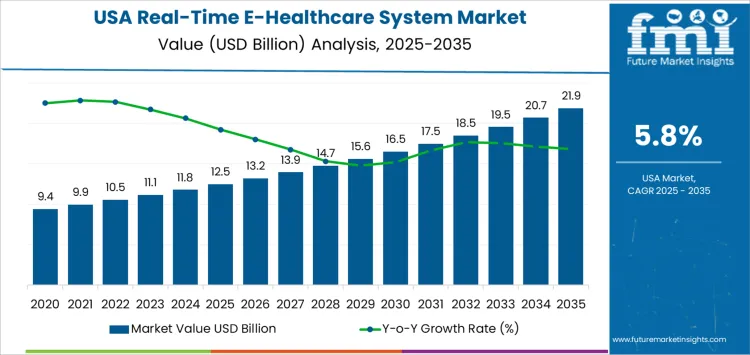
What is the Growth Forecast for the Real-Time E-Healthcare System Market through 2035?
Peak-to-trough analysis for the real-time e-healthcare system market in the USA shows steady and consistent growth with mild fluctuations in the growth rate during the forecast period. Starting at USD 12.5 billion in 2025, the market increases to USD 13.2 billion in 2026, reflecting a slight early growth phase. This period marks the steady adoption of real-time e-healthcare systems, driven by technological advancements and increasing consumer interest in remote healthcare services.
From 2027 onward, the market continues to expand steadily, with values of USD 13.9 billion in 2027, USD 14.7 billion in 2028, and USD 15.6 billion in 2029. These years show a consistent rise in demand for real-time e-healthcare systems, as digital health solutions become more integrated into mainstream healthcare systems. The market reaches USD 16.5 billion in 2030 and USD 17.5 billion in 2031, signaling continued growth. The growth rate shows mild deceleration after 2030, with the market reaching USD 18.5 billion in 2032, USD 19.5 billion in 2033, and USD 20.7 billion in 2034, before peaking at USD 21.9 billion by 2035. The peak-to-trough analysis indicates a steady upward trajectory with slight fluctuations in the growth rate, largely due to market maturity as real-time e-healthcare systems become more universally adopted across healthcare sectors.
USA Real-Time E-Healthcare System Industry Key Takeaways
| Metric | Value |
|---|---|
| Industry Sales Value (2025) | USD 12.5 billion |
| Industry Forecast Value (2035) | USD 21.9 billion |
| Industry Forecast CAGR (2025-2035) | 5.8% |
Why is the Demand for Real Time E Healthcare (Digital / Telehealth) Systems Growing in the USA?
Demand for real time e healthcare systems in the USA is rising rapidly as patients, providers, and payers increasingly value timely access, convenience, and remote monitoring. With a growing number of Americans living with chronic diseases-such as diabetes, heart disease, or respiratory conditions-there is a clear need for continuous monitoring and frequent check ins. Real time digital systems enable physicians and caregivers to monitor vital signs, glucose levels, heart rhythms and other health metrics remotely, enabling early detection of issues, timely interventions, and better management of chronic conditions. This reduces hospital readmissions, lowers costs, and makes care more patient centric.
At the same time, structural and technological shifts in USA healthcare are fueling adoption of e healthcare platforms. Widespread smartphone penetration, expansion of high speed internet and connected home infrastructure, and growing acceptance of remote consultations motivate both providers and patients to embrace telemedicine. Many hospitals, clinics, and home care services now support hybrid models-combining in person care with remote monitoring, virtual visits, and digital follow ups. As consumers increasingly expect healthcare to match the convenience of online banking or retail, and as providers look to improve efficiency and reach rural or underserved populations, the real time e healthcare system market in the USA is poised for strong and sustained growth.
What Are the Key Segments in Real-Time E-Healthcare System Market in the USA?
The real-time e-healthcare system market in the USA is segmented by product type and technology. Wireless body sensor network-based e-healthcare systems lead the market, accounting for 34% of the market share. In terms of technology, IoT (Internet of Things) is the dominant technology, holding 30% of the market. The increasing demand for real-time health monitoring, combined with advancements in connected health technologies, is driving the growth of e-healthcare systems in the USA.
Which Product Type Drives Real-Time E-Healthcare System Demand in the USA?
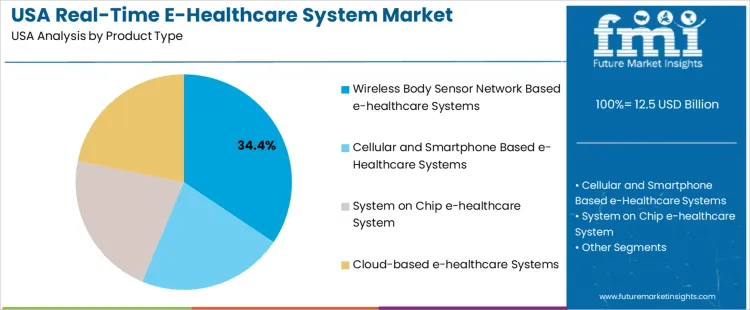
Wireless body sensor network-based e-healthcare systems are the leading product type, holding 34% of the market share. These systems enable the continuous monitoring of a patient’s vital signs and health metrics through wearable sensors, making them essential for real-time healthcare monitoring. Wireless body sensor networks can transmit data to healthcare providers, enabling remote monitoring of chronic conditions, post-operative care, and overall health management. Their ability to provide real-time, actionable data makes them a valuable tool for improving patient outcomes and reducing hospital readmissions. While cellular and smartphone-based e-healthcare systems, system on chip e-healthcare systems, and cloud-based e-healthcare systems are also important segments, wireless body sensor networks are particularly preferred for their convenience, accuracy, and real-time capabilities in monitoring patient health.
Which Technology Drives Real-Time E-Healthcare System Demand in the USA?
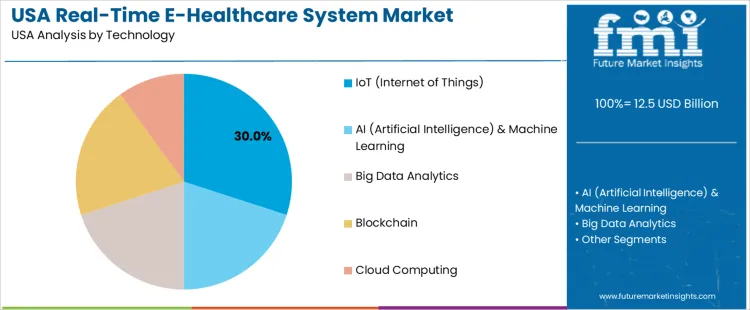
IoT (Internet of Things) is the most influential technology driving the demand for real-time e-healthcare systems in the USA, accounting for 30% of the market share. IoT enables the interconnectivity of various medical devices and sensors, allowing seamless data collection, transmission, and analysis. This connectivity facilitates continuous monitoring and management of patient health, enabling healthcare providers to make informed decisions in real-time. IoT-based systems are essential for improving patient care, enabling remote consultations, and ensuring timely interventions, particularly for chronic conditions. Other technologies such as AI (Artificial Intelligence) and Machine Learning, big data analytics, and cloud computing are also contributing to the market's growth, enhancing the predictive capabilities, data storage, and accessibility of healthcare systems. However, IoT remains the foundational technology, driving the integration of smart devices and real-time monitoring solutions in e-healthcare systems.
What is the Demand for Real-Time E-Healthcare System in USA?
The demand for real-time e-healthcare systems in the USA is increasing as healthcare providers and patients seek faster, more efficient ways to manage and deliver medical services. Real-time e-healthcare systems, which use digital technologies to enable immediate access to healthcare information, remote consultations, and continuous monitoring of patient health, are transforming how healthcare is delivered. This shift towards telemedicine and digital health solutions is driven by the need for improved patient care, convenience, and the ability to reduce healthcare costs. With advancements in technology and increased patient acceptance, the real-time e-healthcare market is expected to expand in the USA.
What are the Drivers of Demand for Real-Time E-Healthcare System in USA?
Several factors are driving the demand for real-time e-healthcare systems in the USA. First, the growing need for convenient and accessible healthcare services is pushing both patients and providers to adopt digital health solutions that allow for remote consultations and continuous health monitoring. Second, the ongoing healthcare provider shortage, especially in rural or underserved areas, is driving the need for telemedicine and e-healthcare systems to provide quality care without the need for physical visits. Third, advancements in technology, including high-speed internet, mobile devices, and wearable health devices, have made real-time e-healthcare more practical and reliable. Fourth, the COVID-19 pandemic significantly accelerated the adoption of telemedicine, and many of these changes are expected to continue post-pandemic. Finally, government initiatives and reimbursement policies that support telemedicine and digital healthcare solutions are also contributing to the increased adoption of real-time e-healthcare systems.
What are the Restraints on Demand for Real-Time E-Healthcare System in USA?
Despite the increasing demand for real-time e-healthcare systems, several factors may limit their broader adoption in the USA. One major restraint is concerns over data security and patient privacy, as the use of digital health systems involves the transmission of sensitive medical information. Compliance with regulations such as HIPAA (Health Insurance Portability and Accountability Act) can pose challenges for healthcare providers when implementing real-time e-healthcare solutions. Another issue is the digital divide, where some patients, particularly older adults or those in low-income areas, may lack access to necessary technology such as smartphones, high-speed internet, or devices for remote monitoring. Additionally, some healthcare providers may be resistant to adopting digital solutions due to concerns about integrating new technologies into their existing systems or lack of training for staff. Finally, reimbursement policies for telemedicine and e-healthcare services may be inconsistent, which can deter providers from offering these services.
What are the Key Trends Influencing Demand for Real-Time E-Healthcare System in USA?
Several key trends are shaping the demand for real-time e-healthcare systems in the USA. A major trend is the increasing use of wearable devices and mobile health apps, which allow patients to track their health data in real time and share it with healthcare providers for remote monitoring. Another trend is the growth of telemedicine, which enables patients to receive consultations and treatment plans from doctors without needing to visit healthcare facilities. The integration of artificial intelligence and machine learning into e-healthcare systems is also enhancing real-time diagnostic capabilities and personalized care. Additionally, the shift towards value-based healthcare, which focuses on improving patient outcomes while reducing costs, is driving the demand for digital health solutions that offer greater efficiency and patient engagement. Finally, the expansion of healthcare access, particularly in rural and underserved communities, is increasing the need for real-time e-healthcare systems as a way to provide equitable access to quality care.
What is the Regional Demand Outlook for the Real-Time E-Healthcare System Market in the USA?
The Real-Time E-Healthcare System market in the USA is expected to experience steady growth, with the West USA leading the way at a projected CAGR of 6.7%. South USA follows closely with a growth rate of 6.0%, while the Northeast USA is expected to grow at 5.3%. The Midwest USA shows moderate growth with a CAGR of 4.6%. The increasing demand for remote healthcare services, telemedicine, and real-time patient monitoring is driving the growth of e-healthcare systems. As healthcare providers continue to seek more efficient and accessible solutions, the adoption of real-time e-healthcare technologies is rising across the United States.
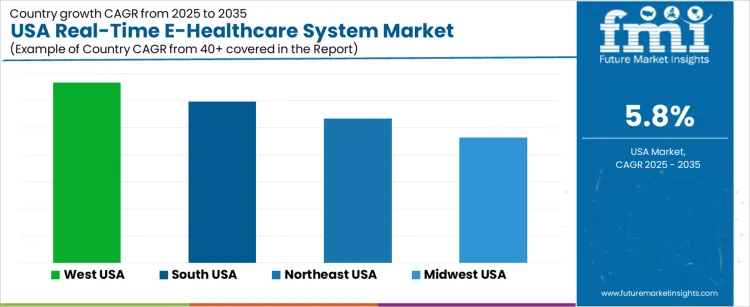
| Region | CAGR (2025-2035) |
|---|---|
| West USA | 6.7% |
| South USA | 6.0% |
| Northeast USA | 5.3% |
| Midwest USA | 4.6% |
What is Driving the Growth of Real-Time E-Healthcare Systems in the West USA?
The West USA is projected to experience the highest growth in the Real-Time E-Healthcare System market, with a projected CAGR of 6.7%. The region's strong healthcare infrastructure, coupled with its tech-savvy population, is a significant driver of this growth. States like California, Washington, and Oregon are at the forefront of adopting digital healthcare solutions, including real-time e-healthcare systems. The increasing demand for telemedicine services, remote monitoring, and virtual consultations in the West is contributing to the growing adoption of e-healthcare technologies. Additionally, the region's focus on innovation, high levels of healthcare spending, and the push for more convenient and accessible healthcare services further fuel the market’s expansion. With a large percentage of the population seeking more flexible and timely healthcare solutions, real-time e-healthcare systems are becoming a vital tool in delivering high-quality care.
Why is the Real-Time E-Healthcare System Market Expanding in South USA?

In South USA, the demand for real-time e-healthcare systems is projected to grow at a CAGR of 6.0%. The region’s large and diverse population, along with an increasing need for accessible and affordable healthcare, is contributing to the rise of real-time e-healthcare solutions. States like Texas, Florida, and Georgia are experiencing rapid growth in their healthcare infrastructure and digital health services. With the increasing adoption of telehealth and remote patient monitoring, real-time e-healthcare systems are being embraced to improve access to care, particularly in rural areas where healthcare providers are scarce. The South’s growing focus on improving healthcare efficiency, reducing costs, and enhancing patient outcomes is driving the adoption of digital health solutions. As the demand for more personalized, on-demand healthcare options rises, the market for real-time e-healthcare systems in South USA is expected to expand steadily.
How is the Real-Time E-Healthcare System Market Growing in Northeast USA?
In Northeast USA, the Real-Time E-Healthcare System market is projected to grow at a CAGR of 5.3%. The region’s well-established healthcare infrastructure and high levels of healthcare spending are supporting the demand for real-time e-healthcare solutions. States like New York, Massachusetts, and Pennsylvania are seeing increased adoption of telemedicine and remote monitoring systems, which are helping to improve patient care and reduce healthcare costs. The growing focus on patient-centered care and personalized medicine in the Northeast is driving the need for real-time e-healthcare systems. Additionally, the region’s large number of healthcare providers and hospitals are increasingly integrating digital health solutions to meet the rising demand for efficient, remote care options. As the region continues to prioritize healthcare accessibility and innovation, real-time e-healthcare systems are expected to play an important role in the future of healthcare delivery.
What is Contributing to the Growth of Real-Time E-Healthcare Systems in Midwest USA?
In Midwest USA, the Real-Time E-Healthcare System market is expected to grow at a more moderate rate of 4.6%. While the region has traditionally been slower to adopt digital health solutions compared to other parts of the country, the rising demand for telemedicine and remote care is driving gradual growth. States like Illinois, Michigan, and Ohio are seeing an increase in healthcare providers using e-healthcare systems to offer virtual consultations and remote patient monitoring. The Midwest’s strong healthcare infrastructure, coupled with growing patient demand for more flexible healthcare options, is fueling the adoption of real-time e-healthcare systems. Additionally, the push for improving healthcare efficiency and reducing operational costs is encouraging healthcare providers in the region to implement digital health technologies. As the market for real-time e-healthcare solutions continues to expand, the Midwest is expected to gradually increase its adoption of these systems, especially in rural areas where access to healthcare professionals is limited.
What is the Competitive Landscape for Demand for Real Time E Healthcare Systems in the USA?
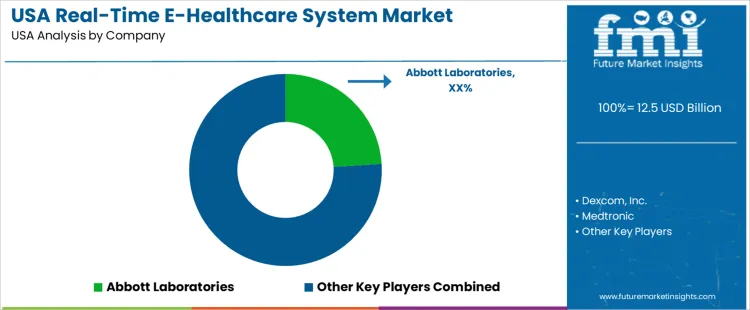
Demand for real time e healthcare systems in the USA has surged as care providers and patients increasingly prioritise remote monitoring, telemedicine, and digital access to health data. Chronic diseases such as diabetes, heart disease, and respiratory conditions require continuous monitoring, and systems that deliver real time data and alerts support early intervention, better disease management, and reduced hospital readmissions. The widespread adoption of wearable sensors, mobile health apps, and cloud based health platforms has expanded access to care beyond hospitals, especially for home based monitoring and tele care. Regulatory push for interoperability of health records along with rising consumer demand for convenience, transparency, and personalised care further accelerate use of real time e health tools in clinics, outpatient settings, and homecare.
On the supply side, a set of global medical device and healthcare IT companies lead in delivering these real time solutions. According to your list, Abbott Laboratories holds a leading share, with other major suppliers including Dexcom, Inc., Medtronic, Cerner Corporation, and GE Healthcare. These firms offer a mix of continuous monitoring devices (for glucose, cardiovascular parameters, vital signs) and integrated software platforms that collect, transmit, and analyse patient data in real time for providers. Competition among suppliers centres on accuracy and reliability of monitoring hardware, interoperability with electronic health record (EHR) systems, ease of use for patients, data security and regulatory compliance, and seamless integration into existing clinical workflows. Suppliers that provide robust, scalable, user friendly, and secure real time e health solutions are best positioned to capitalise on growing demand in the USA as healthcare delivery continues shifting toward remote, patient centric, data driven models.
Key Players of the Real-Time E-Healthcare System Industry in USA
- Abbott Laboratories
- Dexcom, Inc.
- Medtronic
- Cerner Corporation
- GE Healthcare
Scope of the Report
| Items | Details |
|---|---|
| Quantitative Units | USD Billion |
| Regions Covered | USA |
| Product Type | Wireless Body Sensor Network–Based E Healthcare Systems; Cellular & Smartphone–Based E Healthcare Systems; System-on-Chip E Healthcare Systems; Cloud Based E Healthcare Systems |
| Technology | IoT (Internet of Things), AI & Machine Learning, Big Data Analytics, Blockchain, Cloud Computing |
| Application | Patient Monitoring; Chronic Disease Management; Emergency Care; Diagnosis & Treatment; Telemedicine; Health & Fitness Tracking |
| End User | Hospitals; Clinics; Homecare Settings; Diagnostic Centers |
| Key Companies Profiled | Abbott Laboratories; Dexcom, Inc.; Medtronic; Cerner Corporation; GE Healthcare |
| Additional Attributes | Dollar sales by product type and application show robust growth across wireless sensor based and cloud based systems, especially for patient monitoring and chronic disease management. Demand is driven by rising chronic disease prevalence, aging population, and shift towards remote care. IoT, AI, and cloud enabled platforms enable real time data collection and analytics, pushing adoption across hospitals, clinics, and homecare settings. |
Key Segments in the Demand for Real Time E Healthcare System in USA
Product Type
- Wireless Body Sensor Network Based e-Healthcare Systems
- Cellular and Smartphone Based e Healthcare Systems
- System on Chip e Healthcare Systems
- Cloud based e Healthcare Systems
Technology
- IoT (Internet of Things)
- AI (Artificial Intelligence) & Machine Learning
- Big Data Analytics
- Blockchain
- Cloud Computing
Application
- Patient Monitoring
- Chronic Disease Management
- Emergency Care
- Diagnosis & Treatment
- Telemedicine
- Health & Fitness Tracking
End User
- Hospitals
- Clinics
- Homecare Settings
- Diagnostic Centers
Region
- Northeast USA
- West USA
- Midwest USA
- South USA
Frequently Asked Questions
How big is the demand for real-time e-healthcare system in USA in 2025?
The demand for real-time e-healthcare system in USA is estimated to be valued at USD 12.5 billion in 2025.
What will be the size of real-time e-healthcare system in USA in 2035?
The market size for the real-time e-healthcare system in USA is projected to reach USD 21.9 billion by 2035.
How much will be the demand for real-time e-healthcare system in USA growth between 2025 and 2035?
The demand for real-time e-healthcare system in USA is expected to grow at a 5.8% CAGR between 2025 and 2035.
What are the key product types in the real-time e-healthcare system in USA?
The key product types in real-time e-healthcare system in USA are wireless body sensor network based e-healthcare systems, cellular and smartphone based e-healthcare systems, system on chip e-healthcare system and cloud-based e-healthcare systems.
Which technology segment is expected to contribute significant share in the real-time e-healthcare system in USA in 2025?
In terms of technology, IoT (internet of things) segment is expected to command 30.0% share in the real-time e-healthcare system in USA in 2025.
Preview the report firsthand - request a free sample
Get SampleGet the brochure for pricing and purchase details.
Get PDFTable of Content
- Executive Summary
- USA Market Outlook
- Demand-side Trends
- Supply-side Trends
- Technology Roadmap Analysis
- Analysis and Recommendations
- Market Overview
- Market Coverage / Taxonomy
- Market Definition / Scope / Limitations
- Market Background
- Market Dynamics
- Drivers
- Restraints
- Opportunity
- Trends
- Scenario Forecast
- Demand in Optimistic Scenario
- Demand in Likely Scenario
- Demand in Conservative Scenario
- Opportunity Map Analysis
- Product Life Cycle Analysis
- Supply Chain Analysis
- Investment Feasibility Matrix
- Value Chain Analysis
- PESTLE and Porter’s Analysis
- Regulatory Landscape
- Regional Parent Market Outlook
- Production and Consumption Statistics
- Import and Export Statistics
- Market Dynamics
- USA Market Analysis 2020 to 2024 and Forecast, 2025 to 2035
- Historical Market Size Value (USD Million) Analysis, 2020 to 2024
- Current and Future Market Size Value (USD Million) Projections, 2025 to 2035
- Y-o-Y Growth Trend Analysis
- Absolute $ Opportunity Analysis
- USA Market Pricing Analysis 2020 to 2024 and Forecast 2025 to 2035
- USA Market Analysis 2020 to 2024 and Forecast 2025 to 2035, By Product Type
- Introduction / Key Findings
- Historical Market Size Value (USD Million) Analysis By Product Type , 2020 to 2024
- Current and Future Market Size Value (USD Million) Analysis and Forecast By Product Type , 2025 to 2035
- Wireless Body Sensor Network Based e-healthcare Systems
- Cellular and Smartphone Based e-Healthcare Systems
- System on Chip e-healthcare System
- Cloud-based e-healthcare Systems
- Y-o-Y Growth Trend Analysis By Product Type , 2020 to 2024
- Absolute $ Opportunity Analysis By Product Type , 2025 to 2035
- USA Market Analysis 2020 to 2024 and Forecast 2025 to 2035, By Technology
- Introduction / Key Findings
- Historical Market Size Value (USD Million) Analysis By Technology, 2020 to 2024
- Current and Future Market Size Value (USD Million) Analysis and Forecast By Technology, 2025 to 2035
- IoT (Internet of Things)
- AI (Artificial Intelligence) & Machine Learning
- Big Data Analytics
- Blockchain
- Cloud Computing
- Y-o-Y Growth Trend Analysis By Technology, 2020 to 2024
- Absolute $ Opportunity Analysis By Technology, 2025 to 2035
- USA Market Analysis 2020 to 2024 and Forecast 2025 to 2035, By Application
- Introduction / Key Findings
- Historical Market Size Value (USD Million) Analysis By Application, 2020 to 2024
- Current and Future Market Size Value (USD Million) Analysis and Forecast By Application, 2025 to 2035
- Patient Monitoring
- Chronic Disease Management
- Emergency Care
- Diagnosis & Treatment
- Telemedicine
- Health & Fitness Tracking
- Y-o-Y Growth Trend Analysis By Application, 2020 to 2024
- Absolute $ Opportunity Analysis By Application, 2025 to 2035
- USA Market Analysis 2020 to 2024 and Forecast 2025 to 2035, By End User
- Introduction / Key Findings
- Historical Market Size Value (USD Million) Analysis By End User, 2020 to 2024
- Current and Future Market Size Value (USD Million) Analysis and Forecast By End User, 2025 to 2035
- Hospitals
- Clinics
- Homecare Settings
- Diagnostic Centers
- Y-o-Y Growth Trend Analysis By End User, 2020 to 2024
- Absolute $ Opportunity Analysis By End User, 2025 to 2035
- Market Structure Analysis
- Competition Dashboard
- Competition Benchmarking
- Market Share Analysis of Top Players
- By Regional
- By Product Type
- By Technology
- By Application
- By End User
- Competition Analysis
- Competition Deep Dive
- Abbott Laboratories
- Overview
- Product Portfolio
- Profitability by Market Segments (Product/Age /Sales Channel/Region)
- Sales Footprint
- Strategy Overview
- Marketing Strategy
- Product Strategy
- Channel Strategy
- Dexcom, Inc.
- Medtronic
- Cerner Corporation
- GE Healthcare
- Abbott Laboratories
- Competition Deep Dive
- Assumptions & Acronyms Used
- Research Methodology


