

- Industry Size (2025)
- USD 10.4 Bn
- Forecast (2035)
- USD 70.6 Bn
- CAGR (2025 to 2035)
- 21.1%
Next Generation Telehealth Market Size and Share Forecast Outlook 2025 to 2035
The Next Generation Telehealth Market is estimated to be valued at USD 10.4 billion in 2025 and is projected to reach USD 70.6 billion by 2035, registering a compound annual growth rate (CAGR) of 21.1% over the forecast period.
Quick Stats for Next Generation Telehealth Market
- Next Generation Telehealth Market Value (2025): USD 10.4 billion
- Next Generation Telehealth Market Forecast Value (2035): USD 70.6 billion
- Next Generation Telehealth Market Forecast CAGR: 21.1%
- Leading Segment in Next Generation Telehealth Market in 2025: Management Softwares (27.6%)
- Key Growth Regions in Next Generation Telehealth Market: North America, Asia-Pacific, Europe
- Top Key Players in Next Generation Telehealth Market: Philips, Advantech Co. Ltd., Honeywell International Inc., Cisco Systems, digiDoc Technologies, Tunstall, American Well
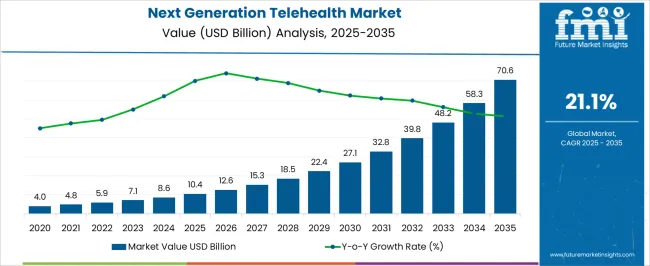
Next Generation Telehealth Market Key Takeaways
| Metric | Value |
|---|---|
| Next Generation Telehealth Market Estimated Value in (2025 E) | USD 10.4 billion |
| Next Generation Telehealth Market Forecast Value in (2035 F) | USD 70.6 billion |
| Forecast CAGR (2025 to 2035) | 21.1% |
Why is the Next Generation Telehealth Market Growing?
The Next Generation Telehealth market is experiencing rapid expansion driven by the increasing adoption of digital health technologies, demand for remote patient monitoring, and rising investments in healthcare infrastructure. The market is being shaped by the shift from traditional in-person care toward integrated virtual care systems, which provide enhanced accessibility, efficiency, and cost-effectiveness. Advancements in AI, cloud-based solutions, and secure data management have enabled healthcare providers to deliver patient-centric services on a global scale.
The increasing prevalence of chronic diseases, aging populations, and heightened focus on preventive healthcare are contributing to the growing demand for telehealth solutions. Moreover, the flexibility to customize telehealth platforms for hospitals, clinics, and homecare environments has strengthened the market potential.
Integration with mobile applications and hardware devices is further driving adoption, while regulatory support for telemedicine reimbursement in several regions is encouraging sustained growth As digital health becomes a critical component of modern healthcare, the Next Generation Telehealth market is poised for continued expansion, providing scalable solutions for both healthcare providers and patients.
Segmental Analysis
The next generation telehealth market is segmented by telehealth software, telemedicine carts, ios applications, end users, data exchange software, and geographic regions. By telehealth software, next generation telehealth market is divided into Management Softwares, Capture & Analysing Softwares, Visualizaing Softwares, Tele-Collaboration Management, Diagnostic Softwares, Reporting Softwares, and Communicating Softwares. In terms of telemedicine carts, next generation telehealth market is classified into Computer Telemedicine Carts, Smartphones Telemedicine Carts, and Wireless Telemedicine Carts. Based on ios applications, next generation telehealth market is segmented into Vital Sign Telemonitoring Applications, Appointment Management, Data Management Applications, and Others. By end users, next generation telehealth market is segmented into Hospitals, Clinics, Healthcare Facilities, Veterinary Facilities, Patients At Home, and Others. By data exchange software, next generation telehealth market is segmented into Data Exchange Softwares and Others. Regionally, the next generation telehealth industry is classified into North America, Latin America, Western Europe, Eastern Europe, Balkan & Baltic Countries, Russia & Belarus, Central Asia, East Asia, South Asia & Pacific, and the Middle East & Africa.
Insights into the Telehealth Software Segment

The Telehealth Software segment is projected to hold 27.60% of the overall market revenue in 2025, establishing it as a leading category within the software subsegments. This prominence is being attributed to the increasing need for management softwares that enable remote consultations, appointment scheduling, patient data storage, and secure communication between patients and healthcare providers.
Adoption has been accelerated by hospitals and clinics seeking centralized platforms to monitor patient outcomes, streamline workflows, and reduce operational inefficiencies. The software’s ability to integrate with mobile applications and hardware devices ensures seamless telemedicine delivery across diverse settings.
Additionally, ongoing enhancements in user experience, interoperability, and analytics functionalities have strengthened market acceptance As healthcare providers continue to prioritize digital transformation and data-driven decision-making, the Telehealth Software segment is expected to maintain strong momentum, supported by the scalability, flexibility, and continuous upgradeability inherent to software-driven solutions.
Insights into the Telemedicine Carts Segment
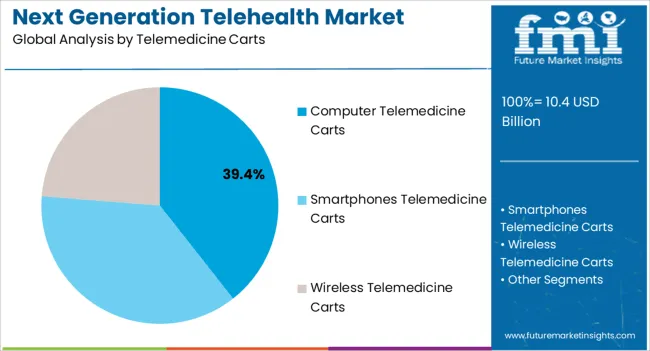
The Computer Telemedicine Carts subsegment is estimated to capture 39.40% of the overall telemedicine hardware market revenue in 2025, emerging as a dominant product category. This leadership is being driven by the requirement for mobile and versatile telehealth hardware that can be deployed in hospitals, clinics, and remote care centers. The carts are favored for their ability to house multiple devices, including vital sign monitoring tools, imaging modules, and communication interfaces, enabling comprehensive patient evaluation.
Growth has been reinforced by the need for integrated solutions that combine hardware and software to deliver seamless virtual care experiences. The portability and modular design of these carts allow healthcare providers to deliver telemedicine services in multiple departments without major infrastructure changes.
Increasing adoption is also being supported by the rising emphasis on standardizing patient monitoring across facilities, which ensures consistent quality of care As healthcare facilities increasingly invest in adaptable telemedicine hardware, the Computer Telemedicine Carts segment is poised to maintain market leadership.
Insights into the iOS Applications Segment
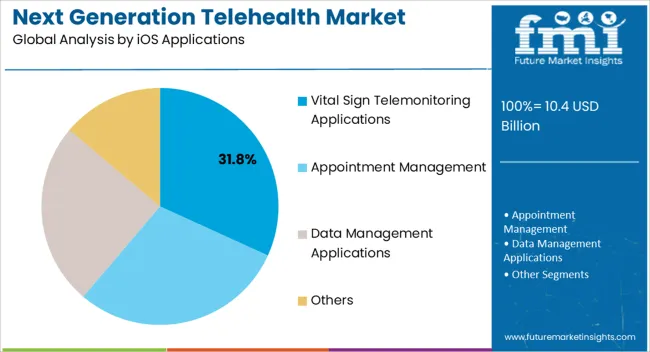
The Vital Sign Telemonitoring Applications subsegment is anticipated to hold 31.80% of the market revenue in 2025, establishing it as the largest contributor among mobile application offerings. This prominence is being driven by the rising demand for mobile-based solutions that enable continuous monitoring of patients’ vital signs from any location. The adoption of these applications has been accelerated by the convenience they provide to both patients and clinicians, allowing real-time health tracking, early detection of anomalies, and improved adherence to treatment plans.
iOS applications are particularly favored due to their compatibility with widely used Apple devices, secure data transmission, and integration with wearable health monitoring technologies. The ability to deliver analytics, alerts, and actionable insights directly to healthcare providers further enhances their utility.
Growth is also supported by the increasing prevalence of chronic conditions, homecare services, and patient preference for self-monitoring solutions As the digital health ecosystem continues to expand, Vital Sign Telemonitoring Applications are expected to remain a leading segment within mobile telehealth platforms.
Market Overview
Next Generation Telehealth Market Overview
Telemedicine or telehealth comprises of the telecommunication and information technologies which provides clinical healthcare from long distances. Telehealth uses next generation technologies such as telemedicine cart, telehealth software for managing, analyzing or visualizing the patient’s data. Next generation Telehealth helps to eliminate barriers and improve access to medical services that would often not be readily available in rural communities. The technology can be utilized in critical care and emergency cases.
Next generation telehealth products have their application in the surgery demonstration, telemedicine meeting, multi-group teleconsultation, tele-ICU, tele-education, teleconsultant, tele-practice among others. In upcoming generation, healthcare uses some latest technologies in the products like LIFESTREAM CONNECT, e-intemed, immersive therapy suit, triagemanager among its other products. Next generation telehealth has some of the crucial benefits over the conventional method of the healthcare management. For an instance next generation telehealth helps to save the time of travel and its expenses by availing the facilities over the long distances. These are the reasons which drives the market of Next generation Telehealth.
Analysis of Next Generation Telehealth Market By Key Countries
| Country | CAGR |
|---|---|
| China | 28.5% |
| India | 26.4% |
| Germany | 24.3% |
| France | 22.2% |
| UK | 20.0% |
| USA | 17.9% |
| Brazil | 15.8% |
Country-wise Analysis
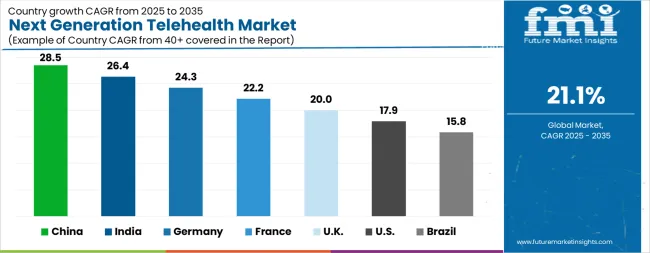
The Next Generation Telehealth Market is expected to register a CAGR of 21.1% during the forecast period, exhibiting varied country level momentum. China leads with the highest CAGR of 28.5%, followed by India at 26.4%. Developed markets such as Germany, France, and the UK continue to expand steadily, while the USA is likely to grow at consistent rates. Brazil posts the lowest CAGR at 15.8%, yet still underscores a broadly positive trajectory for the global Next Generation Telehealth Market. In 2024, Germany held a dominant revenue in the Western Europe market and is expected to grow with a CAGR of 24.3%. The USA Next Generation Telehealth Market is estimated to be valued at USD 3.9 billion in 2025 and is anticipated to reach a valuation of USD 20.4 billion by 2035. Sales are projected to rise at a CAGR of 17.9% over the forecast period between 2025 and 2035. While Japan and South Korea markets are estimated to be valued at USD 485.4 million and USD 354.0 million respectively in 2025.
Key Players in the Next Generation Telehealth Market
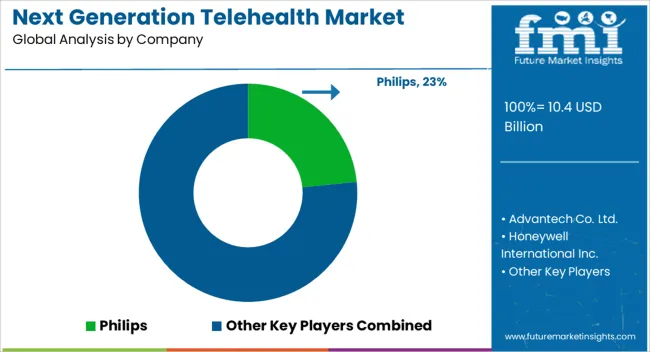
- Philips
- Advantech Co. Ltd.
- Honeywell International Inc.
- Cisco Systems
- digiDoc Technologies
- Tunstall
- American Well
Scope of the Report
| Item | Value |
|---|---|
| Quantitative Units | USD 10.4 Billion |
| Telehealth Software | Management Softwares, Capture & Analysing Softwares, Visualizaing Softwares, Tele-Collaboration Management, Diagnostic Softwares, Reporting Softwares, and Communicating Softwares |
| Telemedicine Carts | Computer Telemedicine Carts, Smartphones Telemedicine Carts, and Wireless Telemedicine Carts |
| iOS Applications | Vital Sign Telemonitoring Applications, Appointment Management, Data Management Applications, and Others |
| End Users | Hospitals, Clinics, Healthcare Facilities, Veterinary Facilities, Patients At Home, and Others |
| Data Exchange Software | Data Exchange Softwares and Others |
| Regions Covered | North America, Europe, Asia-Pacific, Latin America, Middle East & Africa |
| Country Covered | United States, Canada, Germany, France, United Kingdom, China, Japan, India, Brazil, South Africa |
| Key Companies Profiled | Philips, Advantech Co. Ltd., Honeywell International Inc., Cisco Systems, digiDoc Technologies, Tunstall, and American Well |
Next Generation Telehealth Market by Segments
Telehealth Software:
- Management Softwares
- Capture & Analysing Softwares
- Visualizaing Softwares
- Tele-Collaboration Management
- Diagnostic Softwares
- Reporting Softwares
- Communicating Softwares
Telemedicine Carts:
- Computer Telemedicine Carts
- Smartphones Telemedicine Carts
- Wireless Telemedicine Carts
iOS Applications:
- Vital Sign Telemonitoring Applications
- Appointment Management
- Data Management Applications
- Others
End Users:
- Hospitals
- Clinics
- Healthcare Facilities
- Veterinary Facilities
- Patients At Home
- Others
Data Exchange Software:
- Data Exchange Softwares
- Others
Region:
- North America
- USA
- Canada
- Mexico
- Latin America
- Brazil
- Chile
- Rest of Latin America
- Western Europe
- Germany
- UK
- Italy
- Spain
- France
- Nordic
- BENELUX
- Rest of Western Europe
- Eastern Europe
- Russia
- Poland
- Hungary
- Balkan & Baltic
- Rest of Eastern Europe
- East Asia
- China
- Japan
- South Korea
- South Asia and Pacific
- India
- ASEAN
- Australia & New Zealand
- Rest of South Asia and Pacific
- Middle East & Africa
- Kingdom of Saudi Arabia
- Other GCC Countries
- Turkiye
- South Africa
- Other African Union
- Rest of Middle East & Africa
Frequently Asked Questions
How big is the next generation telehealth market in 2025?
The global next generation telehealth market is estimated to be valued at USD 10.4 billion in 2025.
What will be the size of next generation telehealth market in 2035?
The market size for the next generation telehealth market is projected to reach USD 70.6 billion by 2035.
How much will be the next generation telehealth market growth between 2025 and 2035?
The next generation telehealth market is expected to grow at a 21.1% CAGR between 2025 and 2035.
What are the key product types in the next generation telehealth market?
The key product types in next generation telehealth market are management softwares, capture & analysing softwares, visualizaing softwares, tele-collaboration management, diagnostic softwares, reporting softwares and communicating softwares.
Which telemedicine carts segment to contribute significant share in the next generation telehealth market in 2025?
In terms of telemedicine carts, computer telemedicine carts segment to command 39.4% share in the next generation telehealth market in 2025.
Preview the report firsthand - request a free sample
Get SampleGet the brochure for pricing and purchase details.
Get PDFTable of Content
- Executive Summary
- Global Market Outlook
- Demand-side Trends
- Supply-side Trends
- Technology Roadmap Analysis
- Analysis and Recommendations
- Market Overview
- Market Coverage / Taxonomy
- Market Definition / Scope / Limitations
- Market Background
- Market Dynamics
- Drivers
- Restraints
- Opportunity
- Trends
- Scenario Forecast
- Demand in Optimistic Scenario
- Demand in Likely Scenario
- Demand in Conservative Scenario
- Opportunity Map Analysis
- Product Life Cycle Analysis
- Supply Chain Analysis
- Investment Feasibility Matrix
- Value Chain Analysis
- PESTLE and Porter’s Analysis
- Regulatory Landscape
- Regional Parent Market Outlook
- Production and Consumption Statistics
- Import and Export Statistics
- Market Dynamics
- Global Market Analysis 2020 to 2024 and Forecast, 2025 to 2035
- Historical Market Size Value (USD Million) Analysis, 2020 to 2024
- Current and Future Market Size Value (USD Million) Projections, 2025 to 2035
- Y-o-Y Growth Trend Analysis
- Absolute $ Opportunity Analysis
- Global Market Pricing Analysis 2020 to 2024 and Forecast 2025 to 2035
- Global Market Analysis 2020 to 2024 and Forecast 2025 to 2035, By Telehealth Software
- Introduction / Key Findings
- Historical Market Size Value (USD Million) Analysis By Telehealth Software , 2020 to 2024
- Current and Future Market Size Value (USD Million) Analysis and Forecast By Telehealth Software , 2025 to 2035
- Management Softwares
- Capture & Analysing Softwares
- Visualizaing Softwares
- Tele-Collaboration Management
- Diagnostic Softwares
- Reporting Softwares
- Communicating Softwares
- Y-o-Y Growth Trend Analysis By Telehealth Software , 2020 to 2024
- Absolute $ Opportunity Analysis By Telehealth Software , 2025 to 2035
- Global Market Analysis 2020 to 2024 and Forecast 2025 to 2035, By Telemedicine Carts
- Introduction / Key Findings
- Historical Market Size Value (USD Million) Analysis By Telemedicine Carts, 2020 to 2024
- Current and Future Market Size Value (USD Million) Analysis and Forecast By Telemedicine Carts, 2025 to 2035
- Computer Telemedicine Carts
- Smartphones Telemedicine Carts
- Wireless Telemedicine Carts
- Y-o-Y Growth Trend Analysis By Telemedicine Carts, 2020 to 2024
- Absolute $ Opportunity Analysis By Telemedicine Carts, 2025 to 2035
- Global Market Analysis 2020 to 2024 and Forecast 2025 to 2035, By iOS Applications
- Introduction / Key Findings
- Historical Market Size Value (USD Million) Analysis By iOS Applications, 2020 to 2024
- Current and Future Market Size Value (USD Million) Analysis and Forecast By iOS Applications, 2025 to 2035
- Vital Sign Telemonitoring Applications
- Appointment Management
- Data Management Applications
- Others
- Y-o-Y Growth Trend Analysis By iOS Applications, 2020 to 2024
- Absolute $ Opportunity Analysis By iOS Applications, 2025 to 2035
- Global Market Analysis 2020 to 2024 and Forecast 2025 to 2035, By End Users
- Introduction / Key Findings
- Historical Market Size Value (USD Million) Analysis By End Users, 2020 to 2024
- Current and Future Market Size Value (USD Million) Analysis and Forecast By End Users, 2025 to 2035
- Hospitals
- Clinics
- Healthcare Facilities
- Veterinary Facilities
- Patients At Home
- Others
- Y-o-Y Growth Trend Analysis By End Users, 2020 to 2024
- Absolute $ Opportunity Analysis By End Users, 2025 to 2035
- Global Market Analysis 2020 to 2024 and Forecast 2025 to 2035, By Data Exchange Software
- Introduction / Key Findings
- Historical Market Size Value (USD Million) Analysis By Data Exchange Software, 2020 to 2024
- Current and Future Market Size Value (USD Million) Analysis and Forecast By Data Exchange Software, 2025 to 2035
- Data Exchange Softwares
- Others
- Y-o-Y Growth Trend Analysis By Data Exchange Software, 2020 to 2024
- Absolute $ Opportunity Analysis By Data Exchange Software, 2025 to 2035
- Global Market Analysis 2020 to 2024 and Forecast 2025 to 2035, By Region
- Introduction
- Historical Market Size Value (USD Million) Analysis By Region, 2020 to 2024
- Current Market Size Value (USD Million) Analysis and Forecast By Region, 2025 to 2035
- North America
- Latin America
- Western Europe
- Eastern Europe
- East Asia
- South Asia and Pacific
- Middle East & Africa
- Market Attractiveness Analysis By Region
- North America Market Analysis 2020 to 2024 and Forecast 2025 to 2035, By Country
- Historical Market Size Value (USD Million) Trend Analysis By Market Taxonomy, 2020 to 2024
- Market Size Value (USD Million) Forecast By Market Taxonomy, 2025 to 2035
- By Country
- USA
- Canada
- Mexico
- By Telehealth Software
- By Telemedicine Carts
- By iOS Applications
- By End Users
- By Data Exchange Software
- By Country
- Market Attractiveness Analysis
- By Country
- By Telehealth Software
- By Telemedicine Carts
- By iOS Applications
- By End Users
- By Data Exchange Software
- Key Takeaways
- Latin America Market Analysis 2020 to 2024 and Forecast 2025 to 2035, By Country
- Historical Market Size Value (USD Million) Trend Analysis By Market Taxonomy, 2020 to 2024
- Market Size Value (USD Million) Forecast By Market Taxonomy, 2025 to 2035
- By Country
- Brazil
- Chile
- Rest of Latin America
- By Telehealth Software
- By Telemedicine Carts
- By iOS Applications
- By End Users
- By Data Exchange Software
- By Country
- Market Attractiveness Analysis
- By Country
- By Telehealth Software
- By Telemedicine Carts
- By iOS Applications
- By End Users
- By Data Exchange Software
- Key Takeaways
- Western Europe Market Analysis 2020 to 2024 and Forecast 2025 to 2035, By Country
- Historical Market Size Value (USD Million) Trend Analysis By Market Taxonomy, 2020 to 2024
- Market Size Value (USD Million) Forecast By Market Taxonomy, 2025 to 2035
- By Country
- Germany
- UK
- Italy
- Spain
- France
- Nordic
- BENELUX
- Rest of Western Europe
- By Telehealth Software
- By Telemedicine Carts
- By iOS Applications
- By End Users
- By Data Exchange Software
- By Country
- Market Attractiveness Analysis
- By Country
- By Telehealth Software
- By Telemedicine Carts
- By iOS Applications
- By End Users
- By Data Exchange Software
- Key Takeaways
- Eastern Europe Market Analysis 2020 to 2024 and Forecast 2025 to 2035, By Country
- Historical Market Size Value (USD Million) Trend Analysis By Market Taxonomy, 2020 to 2024
- Market Size Value (USD Million) Forecast By Market Taxonomy, 2025 to 2035
- By Country
- Russia
- Poland
- Hungary
- Balkan & Baltic
- Rest of Eastern Europe
- By Telehealth Software
- By Telemedicine Carts
- By iOS Applications
- By End Users
- By Data Exchange Software
- By Country
- Market Attractiveness Analysis
- By Country
- By Telehealth Software
- By Telemedicine Carts
- By iOS Applications
- By End Users
- By Data Exchange Software
- Key Takeaways
- East Asia Market Analysis 2020 to 2024 and Forecast 2025 to 2035, By Country
- Historical Market Size Value (USD Million) Trend Analysis By Market Taxonomy, 2020 to 2024
- Market Size Value (USD Million) Forecast By Market Taxonomy, 2025 to 2035
- By Country
- China
- Japan
- South Korea
- By Telehealth Software
- By Telemedicine Carts
- By iOS Applications
- By End Users
- By Data Exchange Software
- By Country
- Market Attractiveness Analysis
- By Country
- By Telehealth Software
- By Telemedicine Carts
- By iOS Applications
- By End Users
- By Data Exchange Software
- Key Takeaways
- South Asia and Pacific Market Analysis 2020 to 2024 and Forecast 2025 to 2035, By Country
- Historical Market Size Value (USD Million) Trend Analysis By Market Taxonomy, 2020 to 2024
- Market Size Value (USD Million) Forecast By Market Taxonomy, 2025 to 2035
- By Country
- India
- ASEAN
- Australia & New Zealand
- Rest of South Asia and Pacific
- By Telehealth Software
- By Telemedicine Carts
- By iOS Applications
- By End Users
- By Data Exchange Software
- By Country
- Market Attractiveness Analysis
- By Country
- By Telehealth Software
- By Telemedicine Carts
- By iOS Applications
- By End Users
- By Data Exchange Software
- Key Takeaways
- Middle East & Africa Market Analysis 2020 to 2024 and Forecast 2025 to 2035, By Country
- Historical Market Size Value (USD Million) Trend Analysis By Market Taxonomy, 2020 to 2024
- Market Size Value (USD Million) Forecast By Market Taxonomy, 2025 to 2035
- By Country
- Kingdom of Saudi Arabia
- Other GCC Countries
- Turkiye
- South Africa
- Other African Union
- Rest of Middle East & Africa
- By Telehealth Software
- By Telemedicine Carts
- By iOS Applications
- By End Users
- By Data Exchange Software
- By Country
- Market Attractiveness Analysis
- By Country
- By Telehealth Software
- By Telemedicine Carts
- By iOS Applications
- By End Users
- By Data Exchange Software
- Key Takeaways
- Key Countries Market Analysis
- USA
- Pricing Analysis
- Market Share Analysis, 2024
- By Telehealth Software
- By Telemedicine Carts
- By iOS Applications
- By End Users
- By Data Exchange Software
- Canada
- Pricing Analysis
- Market Share Analysis, 2024
- By Telehealth Software
- By Telemedicine Carts
- By iOS Applications
- By End Users
- By Data Exchange Software
- Mexico
- Pricing Analysis
- Market Share Analysis, 2024
- By Telehealth Software
- By Telemedicine Carts
- By iOS Applications
- By End Users
- By Data Exchange Software
- Brazil
- Pricing Analysis
- Market Share Analysis, 2024
- By Telehealth Software
- By Telemedicine Carts
- By iOS Applications
- By End Users
- By Data Exchange Software
- Chile
- Pricing Analysis
- Market Share Analysis, 2024
- By Telehealth Software
- By Telemedicine Carts
- By iOS Applications
- By End Users
- By Data Exchange Software
- Germany
- Pricing Analysis
- Market Share Analysis, 2024
- By Telehealth Software
- By Telemedicine Carts
- By iOS Applications
- By End Users
- By Data Exchange Software
- UK
- Pricing Analysis
- Market Share Analysis, 2024
- By Telehealth Software
- By Telemedicine Carts
- By iOS Applications
- By End Users
- By Data Exchange Software
- Italy
- Pricing Analysis
- Market Share Analysis, 2024
- By Telehealth Software
- By Telemedicine Carts
- By iOS Applications
- By End Users
- By Data Exchange Software
- Spain
- Pricing Analysis
- Market Share Analysis, 2024
- By Telehealth Software
- By Telemedicine Carts
- By iOS Applications
- By End Users
- By Data Exchange Software
- France
- Pricing Analysis
- Market Share Analysis, 2024
- By Telehealth Software
- By Telemedicine Carts
- By iOS Applications
- By End Users
- By Data Exchange Software
- India
- Pricing Analysis
- Market Share Analysis, 2024
- By Telehealth Software
- By Telemedicine Carts
- By iOS Applications
- By End Users
- By Data Exchange Software
- ASEAN
- Pricing Analysis
- Market Share Analysis, 2024
- By Telehealth Software
- By Telemedicine Carts
- By iOS Applications
- By End Users
- By Data Exchange Software
- Australia & New Zealand
- Pricing Analysis
- Market Share Analysis, 2024
- By Telehealth Software
- By Telemedicine Carts
- By iOS Applications
- By End Users
- By Data Exchange Software
- China
- Pricing Analysis
- Market Share Analysis, 2024
- By Telehealth Software
- By Telemedicine Carts
- By iOS Applications
- By End Users
- By Data Exchange Software
- Japan
- Pricing Analysis
- Market Share Analysis, 2024
- By Telehealth Software
- By Telemedicine Carts
- By iOS Applications
- By End Users
- By Data Exchange Software
- South Korea
- Pricing Analysis
- Market Share Analysis, 2024
- By Telehealth Software
- By Telemedicine Carts
- By iOS Applications
- By End Users
- By Data Exchange Software
- Russia
- Pricing Analysis
- Market Share Analysis, 2024
- By Telehealth Software
- By Telemedicine Carts
- By iOS Applications
- By End Users
- By Data Exchange Software
- Poland
- Pricing Analysis
- Market Share Analysis, 2024
- By Telehealth Software
- By Telemedicine Carts
- By iOS Applications
- By End Users
- By Data Exchange Software
- Hungary
- Pricing Analysis
- Market Share Analysis, 2024
- By Telehealth Software
- By Telemedicine Carts
- By iOS Applications
- By End Users
- By Data Exchange Software
- Kingdom of Saudi Arabia
- Pricing Analysis
- Market Share Analysis, 2024
- By Telehealth Software
- By Telemedicine Carts
- By iOS Applications
- By End Users
- By Data Exchange Software
- Turkiye
- Pricing Analysis
- Market Share Analysis, 2024
- By Telehealth Software
- By Telemedicine Carts
- By iOS Applications
- By End Users
- By Data Exchange Software
- South Africa
- Pricing Analysis
- Market Share Analysis, 2024
- By Telehealth Software
- By Telemedicine Carts
- By iOS Applications
- By End Users
- By Data Exchange Software
- USA
- Market Structure Analysis
- Competition Dashboard
- Competition Benchmarking
- Market Share Analysis of Top Players
- By Regional
- By Telehealth Software
- By Telemedicine Carts
- By iOS Applications
- By End Users
- By Data Exchange Software
- Competition Analysis
- Competition Deep Dive
- Philips
- Overview
- Product Portfolio
- Profitability by Market Segments (Product/Age /Sales Channel/Region)
- Sales Footprint
- Strategy Overview
- Marketing Strategy
- Product Strategy
- Channel Strategy
- Advantech Co. Ltd.
- Honeywell International Inc.
- Cisco Systems
- digiDoc Technologies
- Tunstall
- American Well
- Philips
- Competition Deep Dive
- Assumptions & Acronyms Used
- Research Methodology


