

- Industry Size (2026)
- USD 1.1 Bn
- Forecast (2036)
- USD 3.0 Bn
- CAGR (2026 to 2036)
- 10.5%
Coronary CT Angiography Software Market Forecast and Outlook 2026 to 2036
The coronary CT angiography software market is expected to grow from USD 1.1 billion in 2026 to USD 3.0 billion by 2036, reflecting a compound annual growth rate (CAGR) of 10.5%. Coronary CT angiography (CTA) software is used in non-invasive imaging to detect coronary artery disease by providing detailed 3D images of blood vessels. The increasing prevalence of cardiovascular diseases, growing demand for non-invasive diagnostic tools, and advancements in imaging technology are driving the demand for coronary CTA software. This market growth is also supported by the rising adoption of advanced imaging technologies in hospitals and diagnostic centers, offering more accurate and faster diagnostic capabilities for heart-related conditions.
The demand for coronary CTA software is further fueled by the push towards early detection and personalized treatment, as well as the increasing focus on minimizing radiation exposure during diagnostic procedures. As healthcare systems continue to invest in cutting-edge diagnostic tools, coronary CT angiography software is expected to play a crucial role in enhancing the accuracy and efficiency of cardiovascular diagnostics, contributing significantly to the market's growth.
Quick Stats for Coronary CT Angiography Software Market
- Coronary CT Angiography Software Market Value (2026): USD 1.1 billion
- Coronary CT Angiography Software Market Forecast Value (2036): USD 3.0 billion
- Coronary CT Angiography Software Market Global Forecast CAGR (2026–2036): 10.5%
- Top End User by Share in Coronary CT Angiography Software Market: Hospitals & Cardiac Centers (52%)
- Key Growth Regions in Coronary CT Angiography Software Market: USA, UK, China, Germany, Japan
- Top Players in Coronary CT Angiography Software Market: HeartFlow, Siemens Healthineers, GE HealthCare, Philips, Canon Medical Systems, Circle Cardiovascular Imaging, Arterys, Terarecon, Medis Medical Imaging, Ziosoft

What is the Growth Forecast for the Coronary CT Angiography Software Market through 2036?
The compound absolute growth analysis for the coronary CT angiography software market reveals steady and significant growth throughout the forecast period. Starting at USD 1.1 billion in 2026, the market grows to USD 1.2 billion in 2027 and USD 1.3 billion in 2028, reflecting early-stage adoption as healthcare providers begin integrating coronary CTA software into their diagnostic workflows.
From 2028 to 2030, the market continues to expand, reaching USD 1.5 billion in 2029 and USD 1.6 billion in 2030. This period shows a noticeable acceleration as the demand for non-invasive diagnostics grows and coronary CTA software becomes more widely used in routine clinical practice. Between 2030 and 2035, the market continues to gain momentum, with values reaching USD 1.8 billion in 2031, USD 1.9 billion in 2032, and USD 2.1 billion in 2033.
By 2035, the market is projected to reach USD 2.3 billion, with the final market value of USD 3.0 billion expected in 2036. The compound absolute growth analysis indicates that while the market shows gradual growth in the early years, the pace accelerates in the later years as coronary CTA software becomes a standard diagnostic tool in cardiology. The increasing adoption of non-invasive imaging methods, along with technological advancements and the growing emphasis on early cardiovascular disease detection, will drive continued market expansion.
Coronary CT Angiography Software Market Key Takeaways
| Metric | Value |
|---|---|
| Industry Sales Value (2026) | USD 1.1 billion |
| Industry Forecast Value (2036) | USD 3.0 billion |
| Industry Forecast CAGR (2026-2036) | 10.5% |
What Is Driving the Demand for the Coronary CT Angiography Software Market Globally?
The global demand for coronary CT angiography (CCTA) software is driven by the increasing burden of cardiovascular disease and the growing emphasis on early, non invasive diagnosis of coronary artery disease (CAD). CAD remains a leading cause of morbidity and mortality worldwide, and clinicians are prioritising diagnostic approaches that reduce patient risk while providing accurate anatomical and functional information. CCTA software enables high resolution visualisation of coronary arteries, plaque characterization, and assessment of stenosis without the need for invasive catheterisation, lowering procedural risk and improving patient comfort. As imaging infrastructure expands in hospitals and diagnostic centres, especially in North America, Europe, and parts of Asia Pacific, clinicians and radiology departments are adopting advanced CCTA platforms that integrate with CT scanners to enhance throughput, automate analysis, and support clinical decision making. The demand is supported by improvements in CT hardware, such as multi slice scanners and faster acquisition protocols, which enable high quality cardiac imaging. Software that includes AI assisted tools, automated vessel segmentation, and quantitative analysis further streamlines workflows and reduces inter reader variability, adding value for busy cardiovascular imaging practices. Rising awareness of the benefits of non invasive testing among referring physicians and patients has increased utilisation of CCTA in both stable chest pain evaluation and risk stratification contexts.
Future demand for coronary CT angiography software is expected to grow as healthcare systems continue to shift toward preventive cardiology and precision diagnostics. Continued innovation in AI and machine learning will expand capabilities such as plaque composition analysis, fractional flow reserve (FFR CT) simulation, and automated reporting, making CCTA software more clinically actionable. Integration of CCTA outputs with electronic health records and multi modal imaging platforms will support longitudinal patient management, enabling clinicians to track disease progression and response to therapy. Regulatory approvals that recognise advanced analytical features and reimbursement policies that support non invasive imaging will influence adoption rates, particularly in markets where payment structures align with value based care. Expansion of imaging services in emerging markets, driven by investments in diagnostic capacity and growing cardiovascular disease prevalence, will also support uptake. Education and training for radiologists, cardiologists, and technologists on best practices in CCTA interpretation will be important for realising the full clinical potential of advanced software systems. As emphasis on early detection, workflow efficiency, and improved diagnostic confidence continues, demand for sophisticated CCTA software is expected to expand steadily across global healthcare settings.
What Are the Key Segments in Coronary CT Angiography Software Market?
The coronary CT angiography (CTA) software market is segmented by deployment and clinical workflow module. On-premise (hospital PACS-integrated) leads the deployment segment with 46% of the market share, offering integrated solutions within hospital systems for more efficient data management. CTA post-processing & 3D reconstruction dominates the clinical workflow module segment with 34%, reflecting the need for advanced imaging techniques in coronary assessments. The market is expanding as healthcare providers increasingly adopt CTA software to improve diagnostic accuracy, optimize clinical workflows, and enhance patient outcomes in cardiovascular care.
Which Deployment Model Drives Coronary CT Angiography Software Market Demand Globally?

On-premise (hospital PACS-integrated) accounts for 46% of the market share. On-premise deployment of coronary CTA software is preferred by many hospitals due to its integration with existing Picture Archiving and Communication Systems (PACS), which allows seamless storage, retrieval, and sharing of medical imaging data. This deployment model provides secure, localized access to patient data and imaging results, reducing concerns over data privacy and compliance. On-premise systems are also favored for their high performance, reliability, and control over data management, which is critical for time-sensitive cardiovascular diagnostics. The integration with hospital PACS ensures that coronary CTA imaging results are easily accessible across various departments, enhancing workflow efficiency. As hospitals seek to improve cardiovascular diagnostics and streamline clinical operations, the demand for on-premise coronary CTA software is expected to continue growing, securing its position as the leading deployment model in the market.
Which Clinical Workflow Module Drives Coronary CT Angiography Software Market Demand Globally?

CTA post-processing & 3D reconstruction leads the clinical workflow module segment with 34% of the market share. Post-processing and 3D reconstruction are critical steps in coronary CTA, as they enhance the quality of images and provide detailed, three-dimensional visualizations of the coronary arteries. These advanced techniques are essential for accurate diagnosis, treatment planning, and assessment of coronary artery disease, as they allow healthcare providers to examine vascular structures in greater detail. The growing adoption of CTA in cardiovascular care, coupled with the increasing need for precise and comprehensive imaging, drives the demand for post-processing and 3D reconstruction modules. These tools enable clinicians to make better-informed decisions, improving patient outcomes and facilitating faster diagnoses. As the technology behind CTA imaging continues to advance, the importance of CTA post-processing and 3D reconstruction is expected to increase, further driving its dominance in the market.
What are the Key Dynamics of the Global Coronary CT Angiography Software Market?
The global coronary CT angiography software market is growing as demand rises for advanced imaging tools that support non invasive diagnosis of coronary artery disease. These solutions help clinicians visualise vascular structures, assess plaque burden and support treatment planning. Growth in cardiovascular disease incidence, preference for early detection and expansion of imaging infrastructure in hospitals and diagnostic centres contribute to uptake. Software that enhances image quality, facilitates automated measurements and integrates with PACS and reporting systems is increasingly used by cardiology and radiology teams worldwide.
What are the Key Drivers for the Global Coronary CT Angiography Software Market?
Expansion of cardiovascular disease and rising patient volumes for heart disease screenings increase need for tools that improve efficiency and diagnostic confidence. Healthcare providers invest in advanced imaging platforms to deliver precise visualisation of coronary anatomy and function, while reducing referral for invasive procedures. Advances in software algorithms, image reconstruction and machine learning assisted analytics help streamline workflow and reduce interpretation time. Wider availability of CT scanners and integration of sophisticated software into imaging suites supports clinical adoption. Interest in population health management and preventative diagnostics encourages clinicians to use coronary CT angiography as part of comprehensive cardiac care.
What are the Restraints for the Global Coronary CT Angiography Software Market?
One restraint stems from the high cost of advanced imaging solutions and software licencing fees, which can be challenging for smaller clinics and facilities with limited budgets. Integration with legacy picture archiving systems and electronic health records may require additional IT investment and project planning. Variation in reimbursement policies across regions influences how readily providers adopt premium imaging tools. Some clinicians may prefer established diagnostic pathways or feel constrained by training requirements to use newer software functionalities. Data privacy and regulatory compliance for medical imaging software add complexity for vendors and purchasers operating across multiple jurisdictions.
What is the Key Trends in the Global Coronary CT Angiography Software Market?
A key trend is the incorporation of artificial intelligence and deep learning models to enhance image quality, automate vessel segmentation and support detection of plaques and stenosis. Vendors are developing tools that aid quantitative assessment and generate standardised reports to support consistent clinical interpretation. Cloud based deployment and remote review capabilities enable multi site access and collaboration among cardiology teams. Software interoperability with PACS, reporting systems and clinical decision support platforms is gaining importance. Focus on workflow optimisation and reduced interpretation time is influencing product design and investment by imaging departments aiming to improve patient throughput and diagnostic outcomes.
What is the Country-Wise Outlook for the Coronary CT Angiography Software Market?
The Coronary CT Angiography Software market is growing as healthcare providers increasingly adopt advanced imaging technologies to improve the diagnosis and treatment of cardiovascular diseases. Coronary CT angiography (CTA) software offers non-invasive, high-resolution images of the coronary arteries, helping clinicians to assess blockages and other heart conditions more effectively. Countries such as the USA, UK, and China are leading the growth in this market due to advancements in healthcare infrastructure, rising cardiovascular disease prevalence, and the increasing adoption of imaging software for better diagnostics. In markets like Germany and Japan, the demand for coronary CTA software is supported by strong healthcare systems and technological advancements. As the demand for accurate, non-invasive diagnostic tools continues to grow, the coronary CT angiography software market is expected to expand across these regions.
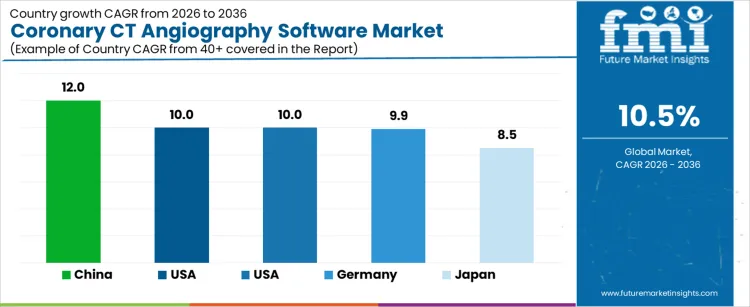
| Country | CAGR (2026 to 2036) |
|---|---|
| USA | 10% |
| UK | 10% |
| China | 12% |
| Germany | 9.9% |
| Japan | 8.5% |
What is Driving the Growth of the Coronary CT Angiography Software Market in the USA?
The USA’s Coronary CT Angiography Software market is projected to grow at a CAGR of 10%. The rising prevalence of cardiovascular diseases, combined with increasing demand for non-invasive diagnostic methods, is driving the adoption of coronary CTA software in the USA. Advanced imaging technologies, including coronary CT angiography, are becoming essential tools in diagnosing heart conditions such as coronary artery disease. As the healthcare system in the USA continues to integrate digital solutions, the demand for sophisticated diagnostic tools like coronary CTA software is expected to rise. Additionally, the growing awareness of cardiovascular health, increased healthcare spending, and a focus on early diagnosis are contributing to the market’s growth in the USA.
What is Contributing to the Growth of the Coronary CT Angiography Software Market in the UK?
The UK’s Coronary CT Angiography Software market is expected to grow at a CAGR of 10%. With an aging population and an increasing prevalence of heart disease, there is a rising demand for advanced diagnostic tools to detect cardiovascular conditions early. Coronary CTA software offers a non-invasive alternative to traditional coronary angiography, providing clear, high-resolution images of coronary arteries. The NHS’s ongoing investment in medical imaging and the UK’s focus on preventative healthcare are helping drive the adoption of coronary CT angiography software. As more healthcare facilities in the UK adopt digital health technologies and advanced imaging solutions, the market for coronary CTA software is expected to expand steadily.
What is Driving the Coronary CT Angiography Software Market Growth in China?

China’s Coronary CT Angiography Software market is projected to grow at a CAGR of 12%. The increasing prevalence of cardiovascular diseases, particularly in urban areas, is driving the demand for advanced diagnostic tools, including coronary CTA software. China’s growing healthcare infrastructure and technological advancements in medical imaging are further fueling market growth. As the demand for early and accurate cardiovascular disease diagnosis rises, the adoption of non-invasive imaging techniques, such as coronary CT angiography, is increasing. Additionally, government initiatives to improve healthcare services and expand access to modern diagnostic technologies are contributing to the growth of the coronary CT angiography software market in China.
What is Influencing the Growth of the Coronary CT Angiography Software Market in Germany?
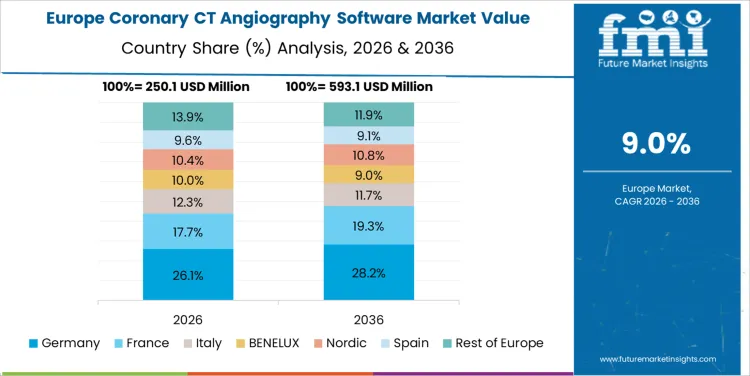
Germany’s Coronary CT Angiography Software market is expected to grow at a CAGR of 9.9%. The country’s well-established healthcare system, combined with a strong focus on medical innovation, is driving the adoption of advanced diagnostic tools like coronary CTA software. As cardiovascular disease becomes more prevalent, the demand for accurate, non-invasive imaging solutions is increasing. Germany’s investment in healthcare technologies, alongside a growing emphasis on preventative healthcare, is contributing to market growth. The continued adoption of digital health solutions and the integration of advanced imaging software into clinical settings are expected to support the expansion of the coronary CT angiography software market in Germany.
What is Contributing to the Growth of the Coronary CT Angiography Software Market in Japan?
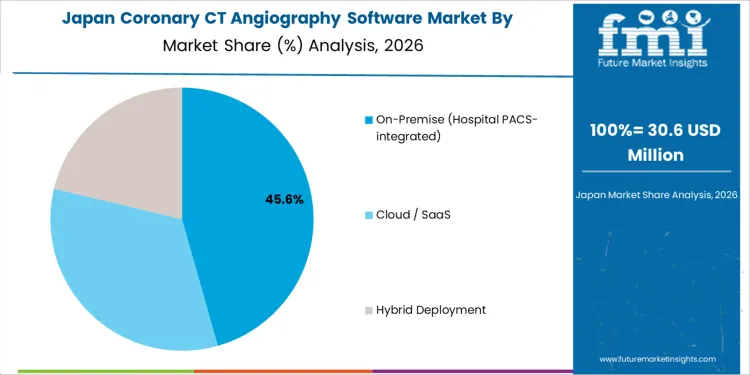
Japan’s Coronary CT Angiography Software market is projected to grow at a CAGR of 8.5%. With a rapidly aging population and rising rates of cardiovascular diseases, Japan is increasingly adopting advanced diagnostic technologies to improve heart health management. Coronary CTA software is becoming more widely used in the country due to its ability to provide high-resolution, non-invasive imaging of the coronary arteries. Japan’s well-developed healthcare infrastructure, combined with a growing focus on early detection and preventive care, is contributing to the market’s growth. As healthcare providers continue to integrate digital solutions and advanced imaging technologies, the demand for coronary CT angiography software is expected to rise in Japan.
What is the Competitive Landscape for the Coronary CT Angiography Software Market?
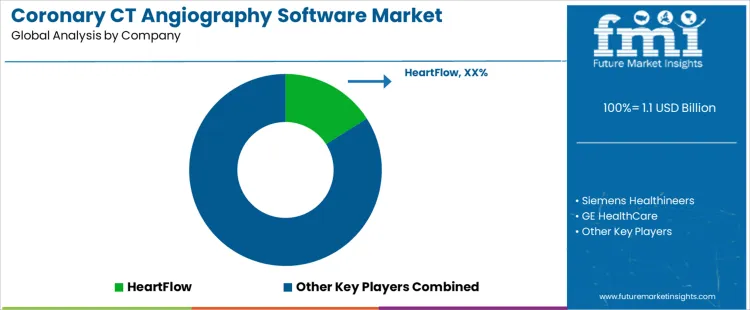
The Coronary CT Angiography Software Market is competitive, with leading companies developing advanced solutions for non-invasive cardiac imaging. HeartFlow is a market leader, offering its HeartFlow FFRCT software, which integrates CT imaging data to assess coronary artery disease and provide critical decision-making support for clinicians. The company’s focus on accuracy and the integration of AI into its software has positioned it at the forefront of this specialized market. Other significant players, such as Siemens Healthineers, GE HealthCare, and Philips, leverage their strong medical imaging expertise to offer comprehensive coronary CT angiography solutions. Siemens Healthineers provides high-performance software with advanced diagnostic capabilities, while GE HealthCare focuses on enhancing workflow efficiency and clinical accuracy in cardiovascular imaging. Philips integrates cutting-edge technologies for detailed and reliable coronary imaging, competing by offering robust solutions that cater to both clinical and research needs.
Canon Medical Systems, Circle Cardiovascular Imaging, and Arterys further contribute to the competitive landscape, each with unique offerings tailored to coronary CT angiography. Canon Medical Systems provides advanced imaging software with precision tools for coronary artery assessment. Circle Cardiovascular Imaging offers specialized software for quantitative coronary analysis, while Arterys integrates AI-driven solutions to improve diagnostic workflow and speed. Terarecon, Medis Medical Imaging, and Ziosoft round out the competitive market by focusing on advanced visualization and analysis tools that support cardiovascular health assessment. These companies compete by offering high-quality, user-friendly software that enhances diagnostic accuracy, reduces procedural time, and improves overall patient outcomes in coronary CT angiography.
Key Players of the Coronary CT Angiography Software Market
- HeartFlow
- Siemens Healthineers
- GE HealthCare
- Philips
- Canon Medical Systems
- Circle Cardiovascular Imaging
- Arterys
- Terarecon
- Medis Medical Imaging
- Ziosoft
Scope of the Report
| Items | Values |
|---|---|
| Quantitative Units (2026) | USD Billion |
| Deployment | On-Premise (Hospital PACS-integrated), Cloud / SaaS, Hybrid Deployment |
| Clinical Workflow Module | CTA Post-Processing & 3D Reconstruction, FFR-CT / Hemodynamic Analytics, Plaque Characterization & Risk Scoring, Reporting, AI Triage & Other Modules |
| End User | Hospitals & Cardiac Centers, Imaging Centers, Teleradiology / Network Groups, Other Users |
| Purchase Model | Perpetual License + Maintenance, Subscription (annual/term), Per-Study / Usage-Based |
| Companies | HeartFlow, Siemens Healthineers, GE HealthCare, Philips, Canon Medical Systems, Circle Cardiovascular Imaging, Arterys, Terarecon, Medis Medical Imaging, Ziosoft |
| Regions Covered | North America, Latin America, Western Europe, Eastern Europe, South Asia and Pacific, East Asia, Middle East & Africa |
| Countries Covered | United States, Canada, Mexico, Brazil, Argentina, Germany, France, United Kingdom, Italy, Spain, Netherlands, China, India, Japan, South Korea, ANZ, GCC Countries, South Africa |
| Additional Attributes | Dollar by sales by deployment type, clinical workflow module, end-user, purchase model, and region. Includes market trends in coronary CT angiography software, focusing on CTA post-processing, 3D reconstruction, FFR-CT, plaque characterization, risk scoring, and AI triage. Highlights cost-effectiveness, regulatory compliance, market share, competitive positioning of key companies, and the impact of various purchase models (perpetual, subscription, per-study) on adoption rates. |
Coronary CT Angiography Software Market Segmentation
Deployment
- On-Premise (Hospital PACS-integrated)
- Cloud / SaaS
- Hybrid Deployment
Clinical Workflow Module
- CTA Post-Processing & 3D Reconstruction
- FFR-CT / Hemodynamic Analytics
- Plaque Characterization & Risk Scoring
- Reporting, AI Triage & Other Modules
End User
- Hospitals & Cardiac Centers
- Imaging Centers
- Teleradiology / Network Groups
- Other Users
Purchase Model
- Perpetual License + Maintenance
- Subscription (annual/term)
- Per-Study / Usage-Based
Region
- Asia Pacific
- China
- Japan
- South Korea
- India
- Australia & New Zealand
- ASEAN
- Rest of Asia Pacific
- Europe
- Germany
- United Kingdom
- France
- Italy
- Spain
- Nordic
- BENELUX
- Rest of Europe
- North America
- United States
- Canada
- Mexico
- Latin America
- Brazil
- Chile
- Rest of Latin America
- Middle East & Africa
- Kingdom of Saudi Arabia
- Other GCC Countries
- Turkey
- South Africa
- Other African Union
- Rest of Middle East & Africa
Frequently Asked Questions
How big is the coronary CT angiography software market in 2026?
The global coronary CT angiography software market is estimated to be valued at USD 1.1 billion in 2026.
What will be the size of coronary CT angiography software market in 2036?
The market size for the coronary CT angiography software market is projected to reach USD 3.0 billion by 2036.
How much will be the coronary CT angiography software market growth between 2026 and 2036?
The coronary CT angiography software market is expected to grow at a 10.5% CAGR between 2026 and 2036.
What are the key product types in the coronary CT angiography software market?
The key product types in coronary CT angiography software market are on-premise (hospital pacs-integrated), cloud / saas and hybrid deployment.
Which clinical workflow module segment to contribute significant share in the coronary CT angiography software market in 2026?
In terms of clinical workflow module, cta post-processing & 3d reconstruction segment to command 34.0% share in the coronary CT angiography software market in 2026.
Preview the report firsthand - request a free sample
Get SampleGet the brochure for pricing and purchase details.
Get PDFTable of Content
- Executive Summary
- Global Market Outlook
- Demand-side Trends
- Supply-side Trends
- Technology Roadmap Analysis
- Analysis and Recommendations
- Market Overview
- Market Coverage / Taxonomy
- Market Definition / Scope / Limitations
- Market Background
- Market Dynamics
- Drivers
- Restraints
- Opportunity
- Trends
- Scenario Forecast
- Demand in Optimistic Scenario
- Demand in Likely Scenario
- Demand in Conservative Scenario
- Opportunity Map Analysis
- Product Life Cycle Analysis
- Supply Chain Analysis
- Investment Feasibility Matrix
- Value Chain Analysis
- PESTLE and Porter’s Analysis
- Regulatory Landscape
- Regional Parent Market Outlook
- Production and Consumption Statistics
- Import and Export Statistics
- Market Dynamics
- Global Market Analysis 2021 to 2025 and Forecast, 2026 to 2036
- Historical Market Size Value (USD Million) Analysis, 2021 to 2025
- Current and Future Market Size Value (USD Million) Projections, 2026 to 2036
- Y-o-Y Growth Trend Analysis
- Absolute $ Opportunity Analysis
- Global Market Pricing Analysis 2021 to 2025 and Forecast 2026 to 2036
- Global Market Analysis 2021 to 2025 and Forecast 2026 to 2036, By Deployment
- Introduction / Key Findings
- Historical Market Size Value (USD Million) Analysis By Deployment , 2021 to 2025
- Current and Future Market Size Value (USD Million) Analysis and Forecast By Deployment , 2026 to 2036
- On-Premise (Hospital PACS-integrated)
- Cloud / SaaS
- Hybrid Deployment
- Y-o-Y Growth Trend Analysis By Deployment , 2021 to 2025
- Absolute $ Opportunity Analysis By Deployment , 2026 to 2036
- Global Market Analysis 2021 to 2025 and Forecast 2026 to 2036, By Clinical Workflow Module
- Introduction / Key Findings
- Historical Market Size Value (USD Million) Analysis By Clinical Workflow Module, 2021 to 2025
- Current and Future Market Size Value (USD Million) Analysis and Forecast By Clinical Workflow Module, 2026 to 2036
- CTA Post-Processing & 3D Reconstruction
- FFR-CT / Hemodynamic Analytics
- Plaque Characterization & Risk Scoring
- Reporting, AI Triage & Other Modules
- Y-o-Y Growth Trend Analysis By Clinical Workflow Module, 2021 to 2025
- Absolute $ Opportunity Analysis By Clinical Workflow Module, 2026 to 2036
- Global Market Analysis 2021 to 2025 and Forecast 2026 to 2036, By End User
- Introduction / Key Findings
- Historical Market Size Value (USD Million) Analysis By End User, 2021 to 2025
- Current and Future Market Size Value (USD Million) Analysis and Forecast By End User, 2026 to 2036
- Hospitals & Cardiac Centers
- Imaging Centers
- Teleradiology / Network Groups
- Other Users
- Y-o-Y Growth Trend Analysis By End User, 2021 to 2025
- Absolute $ Opportunity Analysis By End User, 2026 to 2036
- Global Market Analysis 2021 to 2025 and Forecast 2026 to 2036, By Purchase Model
- Introduction / Key Findings
- Historical Market Size Value (USD Million) Analysis By Purchase Model, 2021 to 2025
- Current and Future Market Size Value (USD Million) Analysis and Forecast By Purchase Model, 2026 to 2036
- Perpetual License + Maintenance
- Subscription (annual/term)
- Per-Study / Usage-Based
- Y-o-Y Growth Trend Analysis By Purchase Model, 2021 to 2025
- Absolute $ Opportunity Analysis By Purchase Model, 2026 to 2036
- Global Market Analysis 2021 to 2025 and Forecast 2026 to 2036, By Region
- Introduction
- Historical Market Size Value (USD Million) Analysis By Region, 2021 to 2025
- Current Market Size Value (USD Million) Analysis and Forecast By Region, 2026 to 2036
- North America
- Latin America
- Western Europe
- Eastern Europe
- East Asia
- South Asia and Pacific
- Middle East & Africa
- Market Attractiveness Analysis By Region
- North America Market Analysis 2021 to 2025 and Forecast 2026 to 2036, By Country
- Historical Market Size Value (USD Million) Trend Analysis By Market Taxonomy, 2021 to 2025
- Market Size Value (USD Million) Forecast By Market Taxonomy, 2026 to 2036
- By Country
- USA
- Canada
- Mexico
- By Deployment
- By Clinical Workflow Module
- By End User
- By Purchase Model
- By Country
- Market Attractiveness Analysis
- By Country
- By Deployment
- By Clinical Workflow Module
- By End User
- By Purchase Model
- Key Takeaways
- Latin America Market Analysis 2021 to 2025 and Forecast 2026 to 2036, By Country
- Historical Market Size Value (USD Million) Trend Analysis By Market Taxonomy, 2021 to 2025
- Market Size Value (USD Million) Forecast By Market Taxonomy, 2026 to 2036
- By Country
- Brazil
- Chile
- Rest of Latin America
- By Deployment
- By Clinical Workflow Module
- By End User
- By Purchase Model
- By Country
- Market Attractiveness Analysis
- By Country
- By Deployment
- By Clinical Workflow Module
- By End User
- By Purchase Model
- Key Takeaways
- Western Europe Market Analysis 2021 to 2025 and Forecast 2026 to 2036, By Country
- Historical Market Size Value (USD Million) Trend Analysis By Market Taxonomy, 2021 to 2025
- Market Size Value (USD Million) Forecast By Market Taxonomy, 2026 to 2036
- By Country
- Germany
- UK
- Italy
- Spain
- France
- Nordic
- BENELUX
- Rest of Western Europe
- By Deployment
- By Clinical Workflow Module
- By End User
- By Purchase Model
- By Country
- Market Attractiveness Analysis
- By Country
- By Deployment
- By Clinical Workflow Module
- By End User
- By Purchase Model
- Key Takeaways
- Eastern Europe Market Analysis 2021 to 2025 and Forecast 2026 to 2036, By Country
- Historical Market Size Value (USD Million) Trend Analysis By Market Taxonomy, 2021 to 2025
- Market Size Value (USD Million) Forecast By Market Taxonomy, 2026 to 2036
- By Country
- Russia
- Poland
- Hungary
- Balkan & Baltic
- Rest of Eastern Europe
- By Deployment
- By Clinical Workflow Module
- By End User
- By Purchase Model
- By Country
- Market Attractiveness Analysis
- By Country
- By Deployment
- By Clinical Workflow Module
- By End User
- By Purchase Model
- Key Takeaways
- East Asia Market Analysis 2021 to 2025 and Forecast 2026 to 2036, By Country
- Historical Market Size Value (USD Million) Trend Analysis By Market Taxonomy, 2021 to 2025
- Market Size Value (USD Million) Forecast By Market Taxonomy, 2026 to 2036
- By Country
- China
- Japan
- South Korea
- By Deployment
- By Clinical Workflow Module
- By End User
- By Purchase Model
- By Country
- Market Attractiveness Analysis
- By Country
- By Deployment
- By Clinical Workflow Module
- By End User
- By Purchase Model
- Key Takeaways
- South Asia and Pacific Market Analysis 2021 to 2025 and Forecast 2026 to 2036, By Country
- Historical Market Size Value (USD Million) Trend Analysis By Market Taxonomy, 2021 to 2025
- Market Size Value (USD Million) Forecast By Market Taxonomy, 2026 to 2036
- By Country
- India
- ASEAN
- Australia & New Zealand
- Rest of South Asia and Pacific
- By Deployment
- By Clinical Workflow Module
- By End User
- By Purchase Model
- By Country
- Market Attractiveness Analysis
- By Country
- By Deployment
- By Clinical Workflow Module
- By End User
- By Purchase Model
- Key Takeaways
- Middle East & Africa Market Analysis 2021 to 2025 and Forecast 2026 to 2036, By Country
- Historical Market Size Value (USD Million) Trend Analysis By Market Taxonomy, 2021 to 2025
- Market Size Value (USD Million) Forecast By Market Taxonomy, 2026 to 2036
- By Country
- Kingdom of Saudi Arabia
- Other GCC Countries
- Turkiye
- South Africa
- Other African Union
- Rest of Middle East & Africa
- By Deployment
- By Clinical Workflow Module
- By End User
- By Purchase Model
- By Country
- Market Attractiveness Analysis
- By Country
- By Deployment
- By Clinical Workflow Module
- By End User
- By Purchase Model
- Key Takeaways
- Key Countries Market Analysis
- USA
- Pricing Analysis
- Market Share Analysis, 2025
- By Deployment
- By Clinical Workflow Module
- By End User
- By Purchase Model
- Canada
- Pricing Analysis
- Market Share Analysis, 2025
- By Deployment
- By Clinical Workflow Module
- By End User
- By Purchase Model
- Mexico
- Pricing Analysis
- Market Share Analysis, 2025
- By Deployment
- By Clinical Workflow Module
- By End User
- By Purchase Model
- Brazil
- Pricing Analysis
- Market Share Analysis, 2025
- By Deployment
- By Clinical Workflow Module
- By End User
- By Purchase Model
- Chile
- Pricing Analysis
- Market Share Analysis, 2025
- By Deployment
- By Clinical Workflow Module
- By End User
- By Purchase Model
- Germany
- Pricing Analysis
- Market Share Analysis, 2025
- By Deployment
- By Clinical Workflow Module
- By End User
- By Purchase Model
- UK
- Pricing Analysis
- Market Share Analysis, 2025
- By Deployment
- By Clinical Workflow Module
- By End User
- By Purchase Model
- Italy
- Pricing Analysis
- Market Share Analysis, 2025
- By Deployment
- By Clinical Workflow Module
- By End User
- By Purchase Model
- Spain
- Pricing Analysis
- Market Share Analysis, 2025
- By Deployment
- By Clinical Workflow Module
- By End User
- By Purchase Model
- France
- Pricing Analysis
- Market Share Analysis, 2025
- By Deployment
- By Clinical Workflow Module
- By End User
- By Purchase Model
- India
- Pricing Analysis
- Market Share Analysis, 2025
- By Deployment
- By Clinical Workflow Module
- By End User
- By Purchase Model
- ASEAN
- Pricing Analysis
- Market Share Analysis, 2025
- By Deployment
- By Clinical Workflow Module
- By End User
- By Purchase Model
- Australia & New Zealand
- Pricing Analysis
- Market Share Analysis, 2025
- By Deployment
- By Clinical Workflow Module
- By End User
- By Purchase Model
- China
- Pricing Analysis
- Market Share Analysis, 2025
- By Deployment
- By Clinical Workflow Module
- By End User
- By Purchase Model
- Japan
- Pricing Analysis
- Market Share Analysis, 2025
- By Deployment
- By Clinical Workflow Module
- By End User
- By Purchase Model
- South Korea
- Pricing Analysis
- Market Share Analysis, 2025
- By Deployment
- By Clinical Workflow Module
- By End User
- By Purchase Model
- Russia
- Pricing Analysis
- Market Share Analysis, 2025
- By Deployment
- By Clinical Workflow Module
- By End User
- By Purchase Model
- Poland
- Pricing Analysis
- Market Share Analysis, 2025
- By Deployment
- By Clinical Workflow Module
- By End User
- By Purchase Model
- Hungary
- Pricing Analysis
- Market Share Analysis, 2025
- By Deployment
- By Clinical Workflow Module
- By End User
- By Purchase Model
- Kingdom of Saudi Arabia
- Pricing Analysis
- Market Share Analysis, 2025
- By Deployment
- By Clinical Workflow Module
- By End User
- By Purchase Model
- Turkiye
- Pricing Analysis
- Market Share Analysis, 2025
- By Deployment
- By Clinical Workflow Module
- By End User
- By Purchase Model
- South Africa
- Pricing Analysis
- Market Share Analysis, 2025
- By Deployment
- By Clinical Workflow Module
- By End User
- By Purchase Model
- USA
- Market Structure Analysis
- Competition Dashboard
- Competition Benchmarking
- Market Share Analysis of Top Players
- By Regional
- By Deployment
- By Clinical Workflow Module
- By End User
- By Purchase Model
- Competition Analysis
- Competition Deep Dive
- HeartFlow
- Overview
- Product Portfolio
- Profitability by Market Segments (Product/Age /Sales Channel/Region)
- Sales Footprint
- Strategy Overview
- Marketing Strategy
- Product Strategy
- Channel Strategy
- Siemens Healthineers
- GE HealthCare
- Philips
- Canon Medical Systems
- Circle Cardiovascular Imaging
- Arterys
- Terarecon
- Medis Medical Imaging
- Ziosoft
- HeartFlow
- Competition Deep Dive
- Assumptions & Acronyms Used
- Research Methodology


