

- Industry Size (2026)
- USD 1.8 Bn
- Forecast (2036)
- USD 4.2 Bn
- CAGR (2026 to 2036)
- 8.8%
Autonomous Machines for Batch-Size-One Manufacturing Demand Forecast and Outlook 2026 to 2036
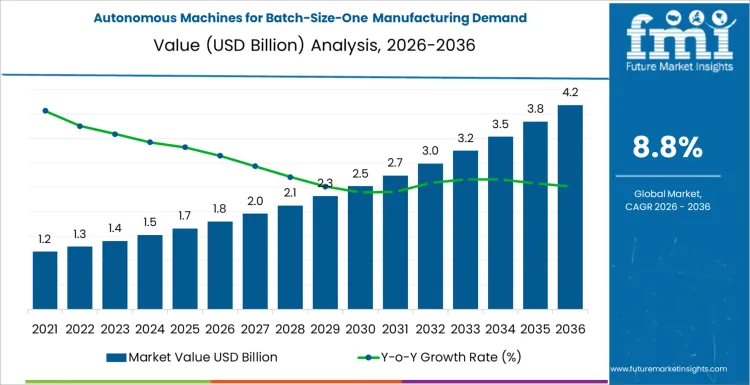
The demand for autonomous machines designed for batch-size-one manufacturing is estimated to reach USD 1.8 billion in 2026 and expand to USD 4.2 billion by 2036, growing at a CAGR of 8.8%. Enterprise spending on autonomous machines configured for single-unit production is allocated across several critical areas to ensure flexibility, precision, and economic viability. A significant portion of the budget is dedicated to advanced reconfigurable tooling systems, which enable rapid changeover between different product specifications without manual intervention.
These systems allow manufacturers to produce individual units economically by eliminating traditional setup costs and changeover times. Another substantial expenditure is directed toward adaptive manufacturing software that can interpret product specifications in real-time and automatically adjust machine parameters, toolpaths, and quality control measures for each unique item. The modular hardware architecture also receives considerable investment, featuring interchangeable components that can be repositioned or replaced automatically to accommodate varying product geometries and manufacturing requirements.
Quick Stats for Autonomous Machines for Batch-Size-One Manufacturing Demand
- Demand for Autonomous Machines for Batch-Size-One Manufacturing Value (2026): USD 1.8 billion
- Demand for Autonomous Machines for Batch-Size-One Manufacturing Forecast Value (2036): USD 4.2 billion
- Demand for Autonomous Machines for Batch-Size-One Manufacturing Forecast CAGR 2026 to 2036: 8.8%
- Leading Technology Type by Demand Share: Reconfigurable machining centers
- Fastest-Growing Applications: Custom electronics assembly, personalized medical devices, bespoke automotive components
- Top Players in Global Demand: DMG MORI Co., Ltd., TRUMPF SE + Co. KG, Mazak Corporation, Haas Automation, Inc., Okuma Corporation
Ongoing precision calibration systems ensure that each individual product meets exact specifications despite the absence of traditional batch learning curves. Skilled technician training forms a critical part of the expenditure, as personnel must understand the complex integration of flexible automation systems and manage the transition from batch to single-unit production paradigms. Lastly, enterprises allocate funds for digital twin integration to simulate and validate each unique manufacturing process before physical production begins. This comprehensive approach enables manufacturers to produce custom products efficiently while maintaining quality standards typically associated with mass production.
Demand for Autonomous Machines for Batch-Size-One Manufacturing Key Takeaways
| Metric | Value |
|---|---|
| Demand Value (2026) | USD 1.8 billion |
| Demand Forecast Value (2036) | USD 4.2 billion |
| Forecast CAGR 2026 to 2036 | 8.8% |
What Enterprise Spending Patterns Are Expected Over The Next Years For Autonomous Machines for Batch-Size-One Manufacturing?
Over the next one to two years, enterprise spending on autonomous machines for batch-size-one manufacturing is expected to focus on pilot programs and proof-of-concept implementations, with most budgets flowing to facilities serving high-value custom products where unit economics justify the investment in flexible automation. Companies will typically fund initial deployments that integrate reconfigurable tooling, adaptive control systems, and automated quality verification on select product lines, then expand to additional applications once changeover times and unit costs meet target thresholds. Procurement will bundle hardware with specialized software development, integration services, and operator training, since these systems require custom programming for each product variant and validation against diverse specifications.
Operating budgets will increase alongside capital purchases as buyers add continuous system monitoring, tooling inventory management, preventive maintenance programs, and performance analytics to ensure changeover reliability remains high across varying production demands. Quality assurance spend will rise in parallel, driven by the need for real-time inspection systems and traceability protocols that verify specifications for each individual unit without traditional statistical sampling methods. Industry standards development referenced by ANSI, ISO, and IEC will influence buying behavior, pushing enterprises to invest in documentation systems and process validation tools that demonstrate capability across product variants. Near term spending will favor modular automation packages that can be deployed incrementally, validated against existing custom manufacturing processes, and scaled across product families with predictable performance outcomes.
How Will the Demand for Autonomous Machines for Batch-Size-One Manufacturing Structure?
Autonomous machines for batch-size-one manufacturing serve a critical function in enabling economic production of individual custom products, reducing changeover costs, and eliminating minimum order quantities that constrain traditional manufacturing. Adoption is influenced by changeover speed requirements, product complexity tolerance, integration capabilities, and cost per unit economics. Segmentation by technology type, manufacturing function, and application reveals how manufacturers select specific flexible automation architectures to meet customization demands, throughput specifications, and quality requirements across different production environments.
Which Technology Type Holds the Largest Share in Autonomous Machines for Batch-Size-One Manufacturing?
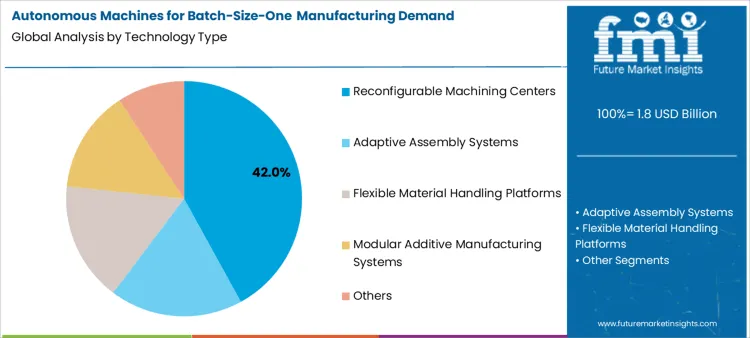
Reconfigurable machining centers account for 42.0%, driven by their ability to automatically adjust tooling, fixtures, and machining parameters for each unique workpiece without manual intervention. Adaptive assembly systems hold 28.0%, supporting automated component placement and joining processes that adjust to varying product configurations and specifications. Flexible material handling platforms represent 18.0%, favored for their capability to transport and position different workpiece geometries throughout the manufacturing process. Modular additive manufacturing systems contribute 8.0%, used where complex geometries or custom materials require layer-based production methods. Other flexible manufacturing technologies account for 4.0%.
Key Points
- Reconfigurable machining dominates precision manufacturing applications.
- Adaptive assembly enables automated handling of product variants.
- Material handling systems optimize workflow for diverse geometries.
How Do Manufacturing Functions Influence Technology Selection?
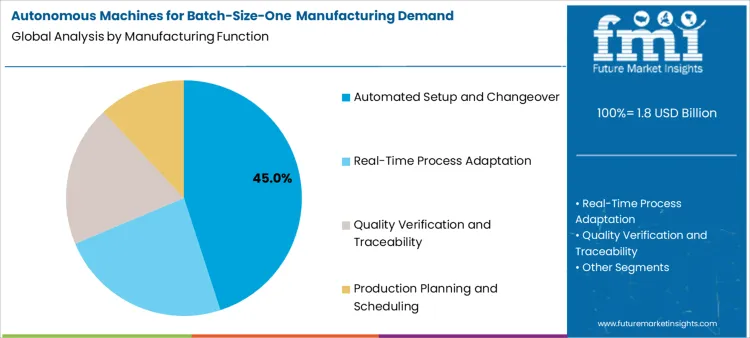
Automated setup and changeover represents 45.0%, reflecting priority on eliminating manual intervention between different product specifications. Real-time process adaptation accounts for 32.0%, essential for adjusting manufacturing parameters automatically based on individual product requirements. Quality verification and traceability holds 16.0%, supporting inspection and documentation systems that verify specifications for each unique unit. Production planning and scheduling represent 7.0%, addressing workflow optimization through predictive algorithms that sequence diverse products efficiently.
Key Points
- Automated changeover eliminates setup time between product variants.
- Process adaptation ensures quality across diverse specifications.
- Individual unit traceability replaces traditional batch tracking methods.
Which Applications Are Driving Demand for These Systems?
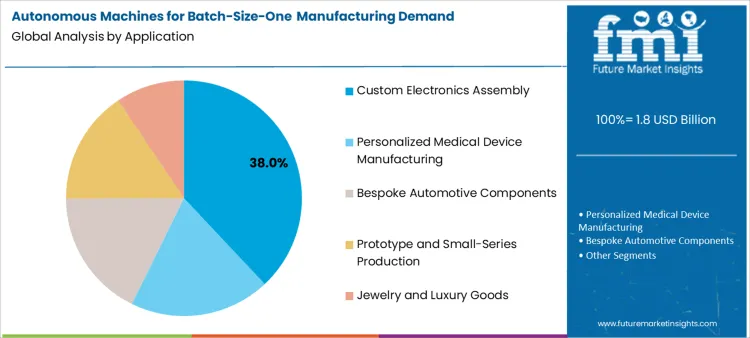
Custom electronics assembly leads with 38.0%, requiring precise component placement and connection processes that adapt to varying circuit board designs and component specifications. Personalized medical device manufacturing accounts for 24.0%, using flexible automation for products requiring individual patient-specific dimensions and regulatory traceability. Bespoke automotive components represent 20.0%, focused on custom parts production for specialty vehicles and aftermarket applications. Prototype and small-series production hold 12.0%, supporting product development and limited-run manufacturing requirements. Jewelry and luxury goods account for 6.0%, where individual customization and craftsmanship quality drive automation investment.
Key Points
- Electronics assembly emphasizes precision and component variety handling.
- Medical devices require patient-specific customization and traceability.
- Automotive applications focus on specialty and aftermarket component production.
What adoption horizon and timing milestones are being indicated by current deployments?
Current deployments indicate an adoption horizon driven by incremental capability validation rather than immediate full-scale implementation. A typical early milestone is changeover time validation, where the system demonstrates consistent setup transitions between different products within target timeframes while maintaining quality standards across varying specifications. A second milestone is unit cost verification, covering production economics that prove single-unit manufacturing remains viable compared to traditional batch production methods. Following economic validation, teams proceed to product variety expansion, where manufacturing systems are tested across increasingly diverse product specifications while maintaining throughput and quality targets.
A subsequent milestone is integration with existing operations, where flexible manufacturing systems coordinate with conventional production lines and enterprise resource planning systems without disrupting established workflows. The point where adoption accelerates is system standardization: validated changeover procedures, proven process adaptation algorithms, and reusable configuration templates that reduce deployment time for similar product categories. Full deployment across facilities follows once unit economics are documented, quality consistency is proven, and operational efficiency benefits are quantified through reduced inventory holding costs and improved customer responsiveness.
How Is Demand for Autonomous Machines for Batch-Size-One Manufacturing Evolving Globally?
Global demand for autonomous machines for batch-size-one manufacturing is expanding as manufacturers seek to reduce inventory costs while improving customer responsiveness and product customization capabilities. Growth reflects rising adoption of flexible automation, adaptive control systems, and modular manufacturing technologies across electronics, medical devices, and specialty manufacturing sectors. Technology selection focuses on reconfigurable systems, adaptive software, and quality verification methods that operate economically at single-unit production volumes with minimal changeover delays. USA. records 8.4% CAGR, Germany records 9.2% CAGR, Japan records 7.8% CAGR, China records 8.9% CAGR, and South Korea records 9.6% CAGR. Adoption remains driven by customer demand for customization and inventory reduction rather than labor cost savings alone.
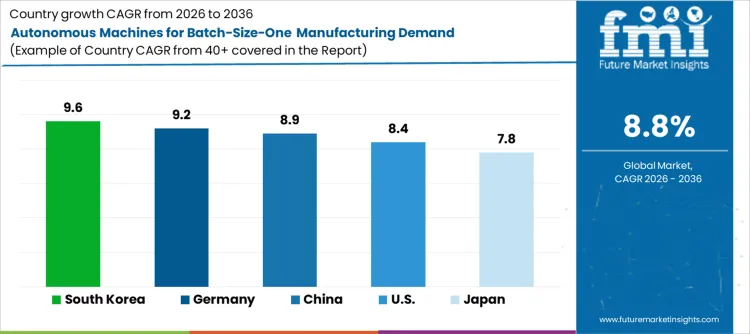
| Country | CAGR (%) |
|---|---|
| South Korea | 9.6% |
| Germany | 9.2% |
| China | 8.9% |
| USA. | 8.4% |
| Japan | 7.8% |
What is Driving Growth of Autonomous Machines for Batch-Size-One Manufacturing Demand In South Korea?
Demand for autonomous machines for batch-size-one manufacturing in South Korea is set to expand as electronics manufacturers integrate flexible production systems for custom consumer devices and specialized components. Growth at 9.6% CAGR reflects rising adoption in semiconductor equipment manufacturing, precision electronics assembly, and advanced materials processing applications. Consumer electronics market demands require rapid product customization and short development cycles that favor single-unit production capabilities. Technology leadership drives adoption of advanced reconfigurable systems and adaptive manufacturing software. Leading electronics companies invest in flexible automation for competitive advantage in custom product markets. Demand remains centered on high-precision manufacturing applications serving global technology customers with specific customization requirements.
- Advancement in custom electronics manufacturing processes
- Investment in precision assembly automation
- Leadership in flexible manufacturing technology development
- Focus on consumer electronics customization applications
Why is Germany Seeing Expansion in Autonomous Machines for Batch-Size-One Manufacturing Adoption?
Autonomous machines for batch-size-one manufacturing demand in Germany is positioned to grow as precision engineering companies integrate flexible automation across automotive, machinery, and industrial equipment sectors. Growth at 9.2% CAGR reflects strong activity in custom automotive components, specialized machinery production, and precision tooling applications. Industry 4.0 initiatives drive integration of flexible manufacturing systems with existing production infrastructure and enterprise software platforms. Engineering excellence standards influence selection of high-precision reconfigurable technologies and adaptive control systems. Established manufacturing companies invest in flexible automation capabilities for operational optimization and customer responsiveness. Demand is driven by customization requirements and delivery speed rather than production volume alone.
- Implementation of Industry 4.0 flexible manufacturing integration
- Integration with existing precision manufacturing systems
- Focus on custom automotive and machinery applications
- Investment in reconfigurable manufacturing technologies
What Factors are Shaping Autonomous Machines for Batch-Size-One Manufacturing Sales in China?
Demand for autonomous machines for batch-size-one manufacturing in China is poised to strengthen as manufacturers integrate flexible production systems and robotics as a service across electronics, consumer goods, and industrial equipment sectors. Growth at 8.9% CAGR reflects rising adoption in custom electronics assembly, personalized consumer products, and specialty component manufacturing applications. Export market requirements drive selection of flexible systems capable of rapid product changeover and specification adaptation. Domestic technology companies prioritize systems compatible with existing manufacturing infrastructure and local technical support networks. Large manufacturers invest in flexible automation systems supporting both domestic customization demands and export market requirements. Demand remains strongest within industries facing increasing customer demands for product personalization and shorter delivery times.
- Growth in custom electronics and consumer goods manufacturing
- Expansion of personalized product production capabilities
- Export market driving flexible manufacturing adoption
- Investment in adaptive manufacturing technologies
What are the Opportunities for Autonomous Machines for Batch-Size-One Manufacturing in the USA.?
Demand for autonomous machines for batch-size-one manufacturing in the USA. is anticipated to grow as manufacturers integrate flexible automation across aerospace, medical devices, and specialty manufacturing sectors. Growth at 8.4% CAGR reflects adoption in custom medical device production, aerospace component manufacturing, and prototype development applications. Regulatory compliance requirements drive selection of validated flexible systems with proven traceability capabilities for individual unit production. Advanced research institutions and technology companies lead development of next-generation adaptive manufacturing algorithms. Large corporations prioritize flexible manufacturing systems supporting both operational efficiency and regulatory compliance requirements. Demand remains focused on applications requiring high precision and individual product documentation rather than volume production.
- Growth in medical device customization applications
- Expansion of aerospace component flexible manufacturing
- Regulatory compliance driving technology selection
- Investment in adaptive manufacturing capabilities
How is Japan Supporting Growth of Autonomous Machines for Batch-Size-One Manufacturing Demand?
Autonomous machines for batch-size-one manufacturing demand in Japan is positioned to rise as precision manufacturing and automation sectors adopt flexible production technologies. Growth at 7.8% CAGR reflects integration in automotive component manufacturing, precision machinery, and specialized equipment production. Quality control standards drive adoption of flexible systems ensuring consistent production outcomes across varying specifications. Established manufacturing industry provides foundation for advanced flexible automation system deployment. Industrial companies prioritize systems supporting both production efficiency and quality consistency in aging workforce conditions. Demand remains focused on applications requiring high precision and long-term reliability rather than rapid deployment.
- Advanced precision manufacturing industry foundation
- Integration in automotive and machinery applications
- Focus on quality control applications
- Emphasis on precision and long-term reliability
What is the competitive landscape of demand for Autonomous Machines for Batch-Size-One Manufacturing globally?
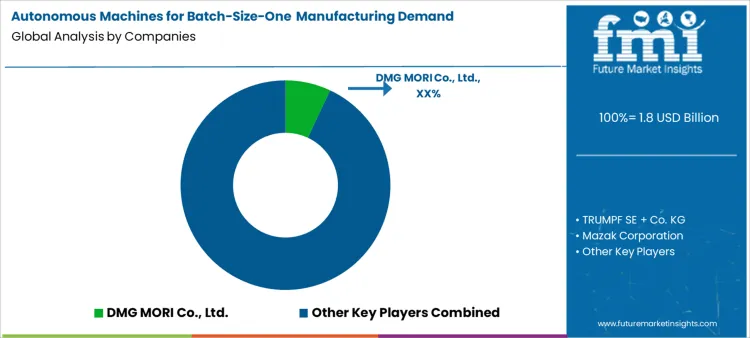
Key companies and organizations active in the ecosystem for autonomous machines for batch-size-one manufacturing include major machine tool manufacturers like DMG MORI, TRUMPF, Mazak, and Haas Automation, which offer reconfigurable machining centers with adaptive control capabilities. Automation technology providers such as Siemens, Rockwell Automation, and Schneider Electric provide control systems and software platforms supporting flexible manufacturing operations. Robotics companies like KUKA, ABB, and FANUC offer modular automation systems crucial for adaptive assembly and material handling functions.
System integrators, both large multinational firms and specialized automation consultancies, focus on implementing flexible manufacturing systems within existing production environments. Standards organizations like ISO/TC 184 and IEEE guide interoperability and performance requirements for flexible automation systems. Research institutions and industry consortia play key roles in advancing adaptive manufacturing algorithms and establishing best practices for single-unit production economics in industrial environments.
Key Players in Autonomous Machines for Batch-Size-One Manufacturing Demand
- DMG MORI Co., Ltd.
- TRUMPF SE + Co. KG
- Mazak Corporation
- Haas Automation, Inc.
- Okuma Corporation
Scope of the Report
| Items | Values |
|---|---|
| Quantitative Units | USD billion |
| Technology Type | Reconfigurable Machining Centers; Adaptive Assembly Systems; Flexible Material Handling Platforms; Modular Additive Manufacturing Systems; Others |
| Manufacturing Function | Automated Setup and Changeover; Real-Time Process Adaptation; Quality Verification and Traceability; Production Planning and Scheduling |
| Application | Custom Electronics Assembly; Personalized Medical Device Manufacturing; Bespoke Automotive Components; Prototype and Small-Series Production; Jewelry and Luxury Goods |
| Regions Covered | Asia Pacific, Europe, North America, Latin America, Middle East & Africa |
| Countries Covered | China, South Korea, USA., Germany, Japan, and 40+ countries |
| Key Companies Profiled | DMG MORI Co., Ltd.; TRUMPF SE + Co. KG; Mazak Corporation; Haas Automation, Inc.; Okuma Corporation; Others |
| Additional Attributes | Dollar sales by technology type, manufacturing function, and application; performance in changeover speed and unit cost economics across electronics, medical devices, and specialty manufacturing; production flexibility, quality consistency, and operational efficiency under single-unit production conditions; impact on inventory costs, customer responsiveness, and product customization capabilities during flexible operation; compatibility with existing manufacturing systems and enterprise resource planning platforms; procurement dynamics driven by unit economics validation, changeover time requirements, and long-term operational partnerships. |
Autonomous Machines for Batch-Size-One Manufacturing Demand by Segment
Technology Type:
- Reconfigurable Machining Centers
- Adaptive Assembly Systems
- Flexible Material Handling Platforms
- Modular Additive Manufacturing Systems
- Others
Manufacturing Function:
- Automated Setup and Changeover
- Real-Time Process Adaptation
- Quality Verification and Traceability
- Production Planning and Scheduling
Application:
- Custom Electronics Assembly
- Personalized Medical Device Manufacturing
- Bespoke Automotive Components
- Prototype and Small-Series Production
- Jewelry and Luxury Goods
Region:
- Asia Pacific
- China
- Japan
- South Korea
- India
- Australia & New Zealand
- ASEAN
- Rest of Asia Pacific
- Europe
- Germany
- United Kingdom
- France
- Italy
- Spain
- Nordic
- BENELUX
- Rest of Europe
- North America
- USA.
- Canada
- Mexico
- Latin America
- Brazil
- Chile
- Rest of Latin America
- Middle East & Africa
- Kingdom of Saudi Arabia
- Other GCC Countries
- Turkey
- South Africa
- Other African Union
- Rest of Middle East & Africa
Bibliography
- Institute of Electrical and Electronics Engineers. (2024). IEEE Standards for Industrial Automation: Flexible Manufacturing Systems (IEEE 1562-2024). IEEE.
- International Organization for Standardization. (2023). ISO 14649: Industrial automation systems and integration (updated edition for single-unit production). ISO.
- International Organization for Standardization. (2024). ISO 23570: Flexible and reconfigurable manufacturing systems (batch-size-one guidelines). ISO.
- Anderson, L., & Chen, H. (2024). Reconfigurable manufacturing systems for single-unit production economics. IEEE Transactions on Automation Science and Engineering, 21(3), 356-371.
- Rodriguez, M., Kim, J., & Taylor, D. (2023). Adaptive control systems for flexible manufacturing in batch-size-one applications. Journal of Manufacturing Systems, 71, 189-203.
Frequently Asked Questions
How big is the autonomous machines for batch-size-one manufacturing demand in 2026?
The global autonomous machines for batch-size-one manufacturing demand is estimated to be valued at USD 1.8 billion in 2026.
What will be the size of autonomous machines for batch-size-one manufacturing demand in 2036?
The market size for the autonomous machines for batch-size-one manufacturing demand is projected to reach USD 4.2 billion by 2036.
How much will be the autonomous machines for batch-size-one manufacturing demand growth between 2026 and 2036?
The autonomous machines for batch-size-one manufacturing demand is expected to grow at a 8.8% CAGR between 2026 and 2036.
What are the key product types in the autonomous machines for batch-size-one manufacturing demand?
The key product types in autonomous machines for batch-size-one manufacturing demand are reconfigurable machining centers, adaptive assembly systems, flexible material handling platforms, modular additive manufacturing systems and others.
Which manufacturing function segment to contribute significant share in the autonomous machines for batch-size-one manufacturing demand in 2026?
In terms of manufacturing function, automated setup and changeover segment to command 45.0% share in the autonomous machines for batch-size-one manufacturing demand in 2026.
Preview the report firsthand - request a free sample
Get SampleGet the brochure for pricing and purchase details.
Get PDFTable of Content
- Executive Summary
- Global Market Outlook
- Demand-side Trends
- Supply-side Trends
- Technology Roadmap Analysis
- Analysis and Recommendations
- Market Overview
- Market Coverage / Taxonomy
- Market Definition / Scope / Limitations
- Market Background
- Market Dynamics
- Drivers
- Restraints
- Opportunity
- Trends
- Scenario Forecast
- Demand in Optimistic Scenario
- Demand in Likely Scenario
- Demand in Conservative Scenario
- Opportunity Map Analysis
- Product Life Cycle Analysis
- Supply Chain Analysis
- Investment Feasibility Matrix
- Value Chain Analysis
- PESTLE and Porter’s Analysis
- Regulatory Landscape
- Regional Parent Market Outlook
- Production and Consumption Statistics
- Import and Export Statistics
- Market Dynamics
- Global Market Analysis 2021 to 2025 and Forecast, 2026 to 2036
- Historical Market Size Value (USD Million) Analysis, 2021 to 2025
- Current and Future Market Size Value (USD Million) Projections, 2026 to 2036
- Y-o-Y Growth Trend Analysis
- Absolute $ Opportunity Analysis
- Global Market Pricing Analysis 2021 to 2025 and Forecast 2026 to 2036
- Global Market Analysis 2021 to 2025 and Forecast 2026 to 2036, By Technology Type
- Introduction / Key Findings
- Historical Market Size Value (USD Million) Analysis By Technology Type, 2021 to 2025
- Current and Future Market Size Value (USD Million) Analysis and Forecast By Technology Type, 2026 to 2036
- Reconfigurable Machining Centers
- Adaptive Assembly Systems
- Flexible Material Handling Platforms
- Modular Additive Manufacturing Systems
- Others
- Reconfigurable Machining Centers
- Y-o-Y Growth Trend Analysis By Technology Type, 2021 to 2025
- Absolute $ Opportunity Analysis By Technology Type, 2026 to 2036
- Global Market Analysis 2021 to 2025 and Forecast 2026 to 2036, By Manufacturing Function
- Introduction / Key Findings
- Historical Market Size Value (USD Million) Analysis By Manufacturing Function, 2021 to 2025
- Current and Future Market Size Value (USD Million) Analysis and Forecast By Manufacturing Function, 2026 to 2036
- Automated Setup and Changeover
- Real-Time Process Adaptation
- Quality Verification and Traceability
- Production Planning and Scheduling
- Automated Setup and Changeover
- Y-o-Y Growth Trend Analysis By Manufacturing Function, 2021 to 2025
- Absolute $ Opportunity Analysis By Manufacturing Function, 2026 to 2036
- Global Market Analysis 2021 to 2025 and Forecast 2026 to 2036, By Application
- Introduction / Key Findings
- Historical Market Size Value (USD Million) Analysis By Application, 2021 to 2025
- Current and Future Market Size Value (USD Million) Analysis and Forecast By Application, 2026 to 2036
- Custom Electronics Assembly
- Personalized Medical Device Manufacturing
- Bespoke Automotive Components
- Prototype and Small-Series Production
- Jewelry and Luxury Goods
- Custom Electronics Assembly
- Y-o-Y Growth Trend Analysis By Application, 2021 to 2025
- Absolute $ Opportunity Analysis By Application, 2026 to 2036
- Global Market Analysis 2021 to 2025 and Forecast 2026 to 2036, By Region
- Introduction
- Historical Market Size Value (USD Million) Analysis By Region, 2021 to 2025
- Current Market Size Value (USD Million) Analysis and Forecast By Region, 2026 to 2036
- North America
- Latin America
- Western Europe
- Eastern Europe
- East Asia
- South Asia and Pacific
- Middle East & Africa
- Market Attractiveness Analysis By Region
- North America Market Analysis 2021 to 2025 and Forecast 2026 to 2036, By Country
- Historical Market Size Value (USD Million) Trend Analysis By Market Taxonomy, 2021 to 2025
- Market Size Value (USD Million) Forecast By Market Taxonomy, 2026 to 2036
- By Country
- USA
- Canada
- Mexico
- By Technology Type
- By Manufacturing Function
- By Application
- By Country
- Market Attractiveness Analysis
- By Country
- By Technology Type
- By Manufacturing Function
- By Application
- Key Takeaways
- Latin America Market Analysis 2021 to 2025 and Forecast 2026 to 2036, By Country
- Historical Market Size Value (USD Million) Trend Analysis By Market Taxonomy, 2021 to 2025
- Market Size Value (USD Million) Forecast By Market Taxonomy, 2026 to 2036
- By Country
- Brazil
- Chile
- Rest of Latin America
- By Technology Type
- By Manufacturing Function
- By Application
- By Country
- Market Attractiveness Analysis
- By Country
- By Technology Type
- By Manufacturing Function
- By Application
- Key Takeaways
- Western Europe Market Analysis 2021 to 2025 and Forecast 2026 to 2036, By Country
- Historical Market Size Value (USD Million) Trend Analysis By Market Taxonomy, 2021 to 2025
- Market Size Value (USD Million) Forecast By Market Taxonomy, 2026 to 2036
- By Country
- Germany
- UK
- Italy
- Spain
- France
- Nordic
- BENELUX
- Rest of Western Europe
- By Technology Type
- By Manufacturing Function
- By Application
- By Country
- Market Attractiveness Analysis
- By Country
- By Technology Type
- By Manufacturing Function
- By Application
- Key Takeaways
- Eastern Europe Market Analysis 2021 to 2025 and Forecast 2026 to 2036, By Country
- Historical Market Size Value (USD Million) Trend Analysis By Market Taxonomy, 2021 to 2025
- Market Size Value (USD Million) Forecast By Market Taxonomy, 2026 to 2036
- By Country
- Russia
- Poland
- Hungary
- Balkan & Baltic
- Rest of Eastern Europe
- By Technology Type
- By Manufacturing Function
- By Application
- By Country
- Market Attractiveness Analysis
- By Country
- By Technology Type
- By Manufacturing Function
- By Application
- Key Takeaways
- East Asia Market Analysis 2021 to 2025 and Forecast 2026 to 2036, By Country
- Historical Market Size Value (USD Million) Trend Analysis By Market Taxonomy, 2021 to 2025
- Market Size Value (USD Million) Forecast By Market Taxonomy, 2026 to 2036
- By Country
- China
- Japan
- South Korea
- By Technology Type
- By Manufacturing Function
- By Application
- By Country
- Market Attractiveness Analysis
- By Country
- By Technology Type
- By Manufacturing Function
- By Application
- Key Takeaways
- South Asia and Pacific Market Analysis 2021 to 2025 and Forecast 2026 to 2036, By Country
- Historical Market Size Value (USD Million) Trend Analysis By Market Taxonomy, 2021 to 2025
- Market Size Value (USD Million) Forecast By Market Taxonomy, 2026 to 2036
- By Country
- India
- ASEAN
- Australia & New Zealand
- Rest of South Asia and Pacific
- By Technology Type
- By Manufacturing Function
- By Application
- By Country
- Market Attractiveness Analysis
- By Country
- By Technology Type
- By Manufacturing Function
- By Application
- Key Takeaways
- Middle East & Africa Market Analysis 2021 to 2025 and Forecast 2026 to 2036, By Country
- Historical Market Size Value (USD Million) Trend Analysis By Market Taxonomy, 2021 to 2025
- Market Size Value (USD Million) Forecast By Market Taxonomy, 2026 to 2036
- By Country
- Kingdom of Saudi Arabia
- Other GCC Countries
- Turkiye
- South Africa
- Other African Union
- Rest of Middle East & Africa
- By Technology Type
- By Manufacturing Function
- By Application
- By Country
- Market Attractiveness Analysis
- By Country
- By Technology Type
- By Manufacturing Function
- By Application
- Key Takeaways
- Key Countries Market Analysis
- USA
- Pricing Analysis
- Market Share Analysis, 2025
- By Technology Type
- By Manufacturing Function
- By Application
- Canada
- Pricing Analysis
- Market Share Analysis, 2025
- By Technology Type
- By Manufacturing Function
- By Application
- Mexico
- Pricing Analysis
- Market Share Analysis, 2025
- By Technology Type
- By Manufacturing Function
- By Application
- Brazil
- Pricing Analysis
- Market Share Analysis, 2025
- By Technology Type
- By Manufacturing Function
- By Application
- Chile
- Pricing Analysis
- Market Share Analysis, 2025
- By Technology Type
- By Manufacturing Function
- By Application
- Germany
- Pricing Analysis
- Market Share Analysis, 2025
- By Technology Type
- By Manufacturing Function
- By Application
- UK
- Pricing Analysis
- Market Share Analysis, 2025
- By Technology Type
- By Manufacturing Function
- By Application
- Italy
- Pricing Analysis
- Market Share Analysis, 2025
- By Technology Type
- By Manufacturing Function
- By Application
- Spain
- Pricing Analysis
- Market Share Analysis, 2025
- By Technology Type
- By Manufacturing Function
- By Application
- France
- Pricing Analysis
- Market Share Analysis, 2025
- By Technology Type
- By Manufacturing Function
- By Application
- India
- Pricing Analysis
- Market Share Analysis, 2025
- By Technology Type
- By Manufacturing Function
- By Application
- ASEAN
- Pricing Analysis
- Market Share Analysis, 2025
- By Technology Type
- By Manufacturing Function
- By Application
- Australia & New Zealand
- Pricing Analysis
- Market Share Analysis, 2025
- By Technology Type
- By Manufacturing Function
- By Application
- China
- Pricing Analysis
- Market Share Analysis, 2025
- By Technology Type
- By Manufacturing Function
- By Application
- Japan
- Pricing Analysis
- Market Share Analysis, 2025
- By Technology Type
- By Manufacturing Function
- By Application
- South Korea
- Pricing Analysis
- Market Share Analysis, 2025
- By Technology Type
- By Manufacturing Function
- By Application
- Russia
- Pricing Analysis
- Market Share Analysis, 2025
- By Technology Type
- By Manufacturing Function
- By Application
- Poland
- Pricing Analysis
- Market Share Analysis, 2025
- By Technology Type
- By Manufacturing Function
- By Application
- Hungary
- Pricing Analysis
- Market Share Analysis, 2025
- By Technology Type
- By Manufacturing Function
- By Application
- Kingdom of Saudi Arabia
- Pricing Analysis
- Market Share Analysis, 2025
- By Technology Type
- By Manufacturing Function
- By Application
- Turkiye
- Pricing Analysis
- Market Share Analysis, 2025
- By Technology Type
- By Manufacturing Function
- By Application
- South Africa
- Pricing Analysis
- Market Share Analysis, 2025
- By Technology Type
- By Manufacturing Function
- By Application
- USA
- Market Structure Analysis
- Competition Dashboard
- Competition Benchmarking
- Market Share Analysis of Top Players
- By Regional
- By Technology Type
- By Manufacturing Function
- By Application
- Competition Analysis
- Competition Deep Dive
- DMG MORI Co., Ltd.
- Overview
- Product Portfolio
- Profitability by Market Segments (Product/Age /Sales Channel/Region)
- Sales Footprint
- Strategy Overview
- Marketing Strategy
- Product Strategy
- Channel Strategy
- TRUMPF SE + Co. KG
- Mazak Corporation
- Haas Automation, Inc.
- Okuma Corporation
- DMG MORI Co., Ltd.
- Competition Deep Dive
- Assumptions & Acronyms Used
- Research Methodology


