

- Industry Size (2026)
- USD 8.3 Bn
- Forecast (2036)
- USD 19.8 Bn
- CAGR (2026 to 2036)
- 9.1%
Autonomous Machines for Non-Standard Industrial Tasks Demand Forecast and Outlook 2026 to 2036
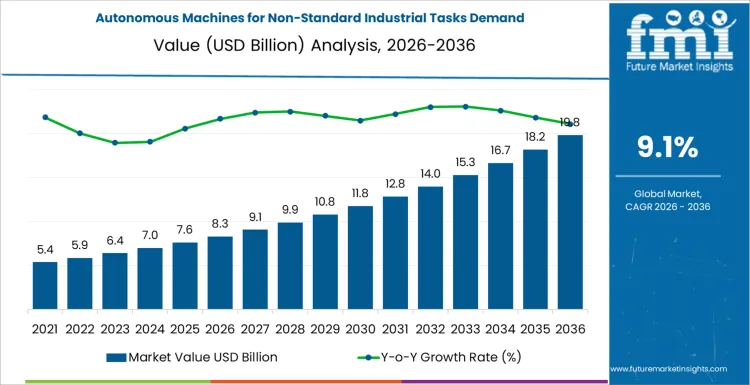
The market for autonomous machines designed to handle non-standard industrial tasks is projected to reach USD 8.3 billion in 2026 and grow to USD 19.8 billion by 2036, representing a compound annual growth rate of 9.1%. Enterprise investment in these specialized systems focuses on addressing manufacturing challenges that cannot be solved through conventional automation approaches. Companies allocate substantial resources to adaptive control systems that enable machines to respond dynamically to unpredictable variations in materials, geometries, and environmental conditions without human intervention.
These systems prove essential when dealing with irregular parts, custom fabrication requirements, or quality anomalies that standard automated equipment cannot process reliably. Manufacturing facilities invest heavily in machine learning algorithms that allow equipment to develop processing strategies for new or unusual tasks through pattern recognition and operational experience accumulation. The sensor fusion technologies receive considerable funding as these machines require multiple data streams including vision, force feedback, thermal monitoring, and acoustic analysis to make real-time decisions about unfamiliar tasks. Investment in flexible end-effector systems enables machines to handle diverse materials and geometries through automated tool changing and adaptive gripping mechanisms.
Quick Stats for Autonomous Machines for Non-Standard Industrial Tasks
- Market Value (2026): USD 8.3 billion
- Market Forecast Value (2036): USD 19.8 billion
- Market Forecast CAGR 2026 to 2036: 9.1%
- Leading Technology Type by Market Share: Adaptive control and machine learning
- Fastest-Growing Applications: Custom manufacturing, quality inspection, material handling
- Top Players in Global Market: ABB Ltd., Siemens AG, Rockwell Automation Inc., Honeywell International Inc., Schneider Electric SE
Companies dedicate resources to real-time decision-making platforms that process sensor data and execute appropriate responses within milliseconds to maintain production quality and safety standards. Integration frameworks also demand significant investment to ensure these autonomous systems communicate effectively with existing manufacturing execution systems and enterprise resource planning platforms. Additionally, safety and compliance systems require ongoing investment to meet regulatory requirements for autonomous operation in industrial environments where human workers may be present.
Market for Autonomous Machines for Non-Standard Industrial Tasks Key Takeaways
| Metric | Value |
|---|---|
| Market Value (2026) | USD 8.3 billion |
| Market Forecast Value (2036) | USD 19.8 billion |
| Forecast CAGR 2026 to 2036 | 9.1% |
Which End Use Segments are Boosting Adoption of Autonomous Machines for Non-Standard Industrial Tasks?
The adoption of autonomous machines for non-standard industrial tasks is being driven by several key sectors. In manufacturing, these machines are used for irregular tasks like assembly, inspection, and material handling, especially where high precision and adaptability are required. The logistics and warehousing sector is also a significant adopter, utilizing autonomous machines for tasks such as sorting and material transportation, where flexibility is needed to handle varying product sizes and dynamic environments. In construction, autonomous machines perform tasks like site preparation and excavation, adapting to ever-changing worksite conditions.
Agriculture benefits from autonomous machines in precision farming, automating planting, harvesting, and crop monitoring in response to variable environmental factors. Mining operations use autonomous systems for ore extraction and site surveillance in hazardous environments. Additionally, healthcare and energy sectors are deploying autonomous machines for tasks like patient monitoring, infrastructure inspection, and maintenance, enhancing efficiency and safety across industries.
How Will the Market for Autonomous Machines for Non-Standard Industrial Tasks Structure?
Autonomous machines for non-standard industrial tasks address manufacturing challenges that require adaptive responses, flexible programming, and real-time decision-making capabilities beyond the scope of traditional automation systems. Market adoption reflects the need to handle irregular products, custom manufacturing processes, and quality control applications where predetermined programming cannot accommodate the full range of possible variations. Technology selection depends on task complexity, environmental variability, safety requirements, and integration compatibility with existing manufacturing infrastructure.
Which Technology Type Holds the Largest Share in Autonomous Machines for Non-Standard Industrial Tasks?
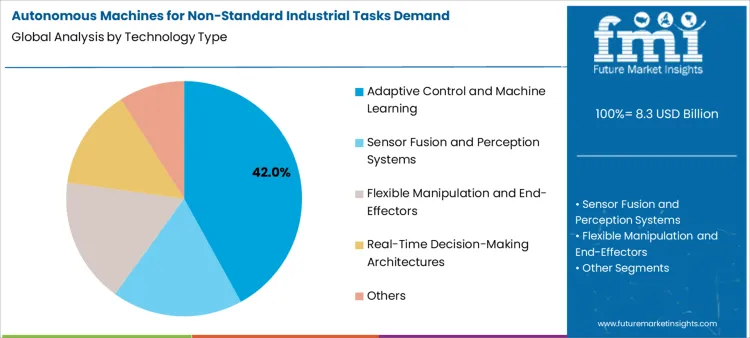
Adaptive control and machine learning systems account for 42.0% of the market, driven by their ability to develop processing strategies for unfamiliar tasks through operational experience and pattern recognition. Sensor fusion and perception platforms represent 26.0%, essential for providing machines with the environmental awareness needed to make autonomous decisions about irregular tasks. Flexible manipulation and end-effector systems hold 18.0%, enabling machines to adapt their physical interactions with diverse materials and geometries. Real-time decision-making architectures contribute 10.0%, supporting rapid response to unexpected conditions during autonomous operation. Other specialized technologies account for 4.0%.
Key Points
- Adaptive control dominates applications requiring learning capabilities
- Sensor fusion enables environmental awareness for autonomous decisions
- Flexible manipulation systems handle diverse materials and geometries
How Do Application Requirements Influence Technology Selection?

Custom manufacturing and fabrication represent 38.0% of applications, reflecting demand for machines that can produce unique or low-volume products without extensive reprogramming. Quality inspection and defect detection account for 28.0%, addressing the need for autonomous systems that can identify and respond to quality variations that exceed predetermined parameters. Material handling of irregular objects holds 20.0%, supporting warehouse and logistics operations where product shapes, sizes, and weights vary significantly. Assembly operations for non-standard components represent 14.0%, enabling autonomous systems to adapt assembly procedures based on part variations and tolerance requirements.
Key Points
- Custom manufacturing requires adaptive programming capabilities
- Quality inspection demands autonomous defect recognition and response
- Material handling applications focus on irregular object management
Which Industries Are Driving Market Growth?
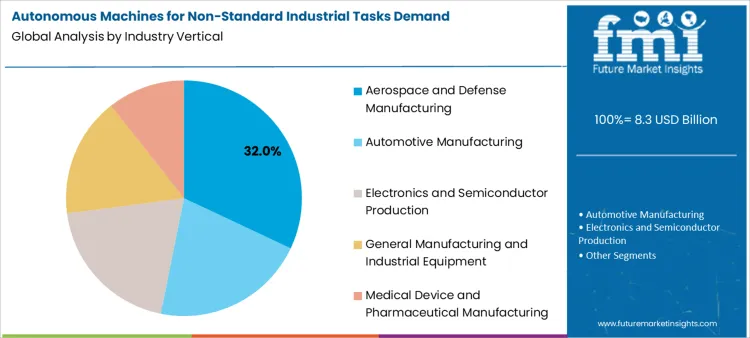
Aerospace and defense manufacturing lead with 32.0% of market demand, requiring autonomous systems for custom fabrication, complex assembly processes, and quality control of specialized components. Automotive manufacturing accounts for 24.0%, using autonomous machines for prototype development, custom tooling production, and handling of model-specific variations. Electronics and semiconductor production represent 20.0%, addressing requirements for precision handling of delicate components and adaptation to rapid product design changes. General manufacturing and industrial equipment hold 16.0%, focusing on job shop environments and custom fabrication operations. Medical device and pharmaceutical manufacturing contribute 8.0%, requiring autonomous systems for sterile processing and regulatory compliance in custom production scenarios.
Key Points
- Aerospace applications emphasize custom fabrication and complex assembly
- Automotive sector focuses on prototype and custom tooling production
- Electronics manufacturing addresses precision handling requirements
What deployment timeline and implementation milestones are being indicated by current installations?
Current installations indicate a deployment timeline structured around progressive capability validation rather than immediate full-scale automation. Initial milestone involves task analysis and feasibility validation, where engineering teams identify specific non-standard tasks that justify autonomous machine investment and define success criteria for automated performance. System development and testing represents the second milestone, encompassing algorithm development, sensor integration, and safety validation in controlled environments before production deployment.
Limited production trials constitute the third milestone, where autonomous machines operate under supervised conditions while processing actual non-standard tasks and building operational experience databases. Performance optimization follows, involving algorithm refinement based on operational data and expansion of machine capabilities to handle additional task variations. Full autonomous operation represents the final milestone, achieved when machines demonstrate consistent performance across the full range of expected task variations while maintaining safety and quality standards equivalent to human operators.
How Is the Market for Autonomous Machines for Non-Standard Industrial Tasks Evolving Globally?
Global market growth for autonomous machines for non-standard industrial tasks reflects increasing demand for flexible manufacturing solutions that can handle irregular products and custom processes without extensive reprogramming. Growth patterns show rising adoption of machine learning, adaptive control systems, and advanced sensor technologies across aerospace, automotive, and electronics manufacturing sectors. Technology selection emphasizes systems that can learn from operational experience and adapt to new task requirements while maintaining safety and quality standards. The United States records 8.8% CAGR, China records 10.5% CAGR, Germany records 8.2% CAGR, Japan records 7.9% CAGR, and South Korea records 9.7% CAGR. Market expansion remains driven by manufacturing flexibility requirements and custom production demands rather than cost reduction alone.
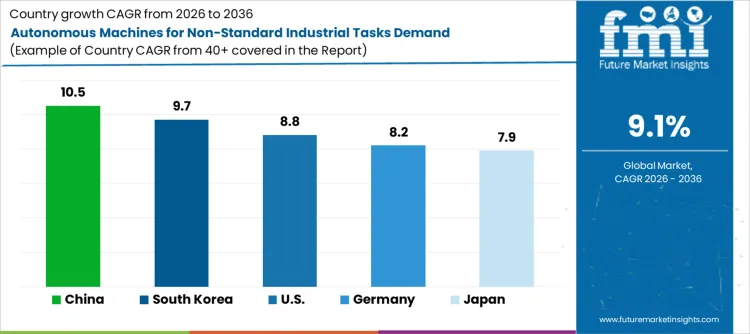
| Country | CAGR (%) |
|---|---|
| China | 10.5% |
| South Korea | 9.7% |
| USA. | 8.8% |
| Germany | 8.2% |
| Japan | 7.9% |
What is Driving Growth of Autonomous Machines for Non-Standard Industrial Tasks in China?
Market growth for autonomous machines for non-standard industrial tasks in China expands as manufacturers develop advanced production capabilities for custom and high-precision applications. Growth at 10.5% CAGR reflects rising demand in electronics manufacturing, aerospace component production, and specialized industrial equipment fabrication. Manufacturing flexibility requirements drive adoption of autonomous systems that can handle product variations and custom specifications without extensive manual programming. Cost-effective automation solutions that reduce dependency on skilled labor while maintaining production quality attract investment from both domestic and international manufacturers. Government initiatives supporting advanced manufacturing technologies encourage development of autonomous systems for complex industrial applications. Market concentration occurs within high-tech manufacturing zones and export-oriented production facilities requiring adaptive automation capabilities.
- Expansion of high-precision manufacturing applications
- Investment in flexible production technologies
- Development of custom manufacturing capabilities
- Government support for advanced automation systems
Why is South Korea Seeing Growth in Autonomous Machines for Non-Standard Industrial Tasks Adoption?
The market for autonomous machines for non-standard industrial tasks in South Korea grows as advanced manufacturing sectors integrate adaptive automation technologies. Growth at 9.7% CAGR reflects strong activity in semiconductor equipment manufacturing, precision electronics assembly, and advanced materials processing. Complex production requirements demand autonomous systems capable of handling product variations and maintaining quality standards in high-precision environments. Technology leadership drives development of cutting-edge autonomous control systems and machine learning algorithms for industrial applications. Leading manufacturing companies invest in autonomous machines to maintain competitive advantages in global markets requiring custom and specialized products. Market focus remains on high-value manufacturing applications where autonomous capabilities justify premium investment costs.
- Leadership in semiconductor equipment manufacturing
- Investment in precision electronics automation
- Development of advanced autonomous control technologies
- Focus on high-value manufacturing applications
What Factors are Shaping Autonomous Machines for Non-Standard Industrial Tasks Sales in the USA.?
Market demand for autonomous machines for non-standard industrial tasks in the United States strengthens as manufacturers address skilled labor shortages and custom production requirements. Growth at 8.8% CAGR reflects rising adoption in aerospace manufacturing, defense applications, and specialized industrial equipment production. Labor availability challenges drive investment in autonomous systems that can perform complex tasks traditionally requiring skilled human operators. Advanced research institutions and technology companies lead development of next-generation autonomous control algorithms and sensor technologies. Large corporations prioritize autonomous machines that support both operational efficiency and regulatory compliance in specialized manufacturing environments. Market strength concentrates in industries requiring custom fabrication and high-precision assembly operations.
- Growth in aerospace and defense manufacturing applications
- Investment in advanced autonomous control technologies
- Labor shortage driving automation adoption
- Focus on custom fabrication and precision assembly
How is Germany Supporting Growth of Autonomous Machines for Non-Standard Industrial Tasks?
The market for autonomous machines for non-standard industrial tasks in Germany grows as manufacturers integrate adaptive automation across precision engineering and specialized manufacturing sectors. Growth at 8.2% CAGR reflects strong adoption in automotive component manufacturing, industrial machinery production, and specialized equipment fabrication. Industry 4.0 initiatives drive integration of autonomous systems with existing manufacturing execution platforms and enterprise resource planning systems. Engineering excellence standards influence selection of high-reliability autonomous technologies and advanced control systems. Established manufacturing companies invest in autonomous machines for operational optimization and maintenance of competitive positioning in global markets. Market demand emphasizes precision requirements and quality standards rather than labor cost reduction alone.
- Implementation of Industry 4.0 autonomous system integration
- Focus on precision engineering applications
- Investment in high-reliability autonomous technologies
- Integration with existing manufacturing platforms
What are the Opportunities for Autonomous Machines for Non-Standard Industrial Tasks in Japan?
Market growth for autonomous machines for non-standard industrial tasks in Japan reflects integration across precision manufacturing and advanced industrial automation sectors. Growth at 7.9% CAGR shows adoption in automotive manufacturing, precision machinery production, and specialized equipment assembly. Quality control standards drive selection of autonomous systems that ensure consistent production outcomes while handling non-standard task variations. Established manufacturing industry provides foundation for advanced autonomous system deployment and validation. Manufacturing companies prioritize systems supporting both automation efficiency and worker safety in environments requiring flexible task execution. Market focus remains on predictive maintenance capabilities to deliver high precision and long-term reliability rather than rapid deployment timelines.
- Advanced manufacturing industry foundation
- Integration in precision machinery applications
- Focus on quality control and consistency
- Emphasis on precision and long-term reliability
What is the competitive landscape for autonomous machines for non-standard industrial tasks globally?
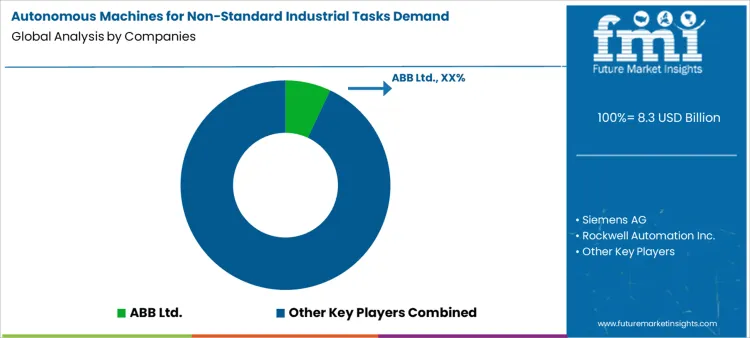
Prominent players active in the autonomous machines for non-standard industrial tasks ecosystem include major industrial automation suppliers such as ABB, Siemens, and Rockwell Automation, which provide integrated platforms combining adaptive control systems with robotic manipulation capabilities. Software and analytics companies like Honeywell, Schneider Electric, and Emerson offer machine learning algorithms and real-time decision-making platforms that enable autonomous operation in unpredictable environments. Sensor technology providers including Cognex, Keyence, and SICK supply advanced perception systems essential for environmental awareness and object recognition in non-standard applications.
System integrators, ranging from large multinational engineering firms to specialized automation consultancies, focus on implementing autonomous solutions within existing manufacturing infrastructure while addressing specific customer requirements. Research institutions and technology consortia advance algorithm development and establish best practices for autonomous operation in industrial environments. Standards organizations such as ISO/TC 299 and IEC develop safety and performance requirements for autonomous industrial systems operating in non-standard scenarios.
Key Players in Autonomous Machines for Non-Standard Industrial Tasks
- ABB Ltd.
- Siemens AG
- Rockwell Automation Inc.
- Honeywell International Inc.
- Schneider Electric SE
Scope of the Report
| Items | Values |
|---|---|
| Quantitative Units | USD billion |
| Technology Type | Adaptive Control and Machine Learning; Sensor Fusion and Perception Systems; Flexible Manipulation and End-Effectors; Real-Time Decision-Making Architectures; Others |
| Application Function | Custom Manufacturing and Fabrication; Quality Inspection and Defect Detection; Material Handling of Irregular Objects; Assembly Operations for Non-Standard Components |
| Industry Vertical | Aerospace and Defense Manufacturing; Automotive Manufacturing; Electronics and Semiconductor Production; General Manufacturing and Industrial Equipment; Medical Device and Pharmaceutical Manufacturing |
| Regions Covered | Asia Pacific, Europe, North America, Latin America, Middle East & Africa |
| Countries Covered | China, South Korea, USA., Germany, Japan, and 40+ countries |
| Key Companies Profiled | ABB Ltd.; Siemens AG; Rockwell Automation Inc.; Honeywell International Inc.; Schneider Electric SE; Others |
| Additional Attributes | Market analysis by technology type, application function, and industry vertical; performance in task adaptability and decision-making accuracy across aerospace, automotive, and electronics manufacturing; operational flexibility, safety compliance, and quality consistency under autonomous operation conditions; impact on labor requirements, production efficiency, and operational costs in non-standard task environments; compatibility with existing manufacturing execution systems and enterprise resource planning platforms; procurement dynamics driven by task complexity requirements, safety validation protocols, and long-term technology partnerships. |
Autonomous Machines for Non-Standard Industrial Tasks Market by Segment
Technology Type:
- Adaptive Control and Machine Learning
- Sensor Fusion and Perception Systems
- Flexible Manipulation and End-Effectors
- Real-Time Decision-Making Architectures
- Others
Application Function:
- Custom Manufacturing and Fabrication
- Quality Inspection and Defect Detection
- Material Handling of Irregular Objects
- Assembly Operations for Non-Standard Components
Industry Vertical:
- Aerospace and Defense Manufacturing
- Automotive Manufacturing
- Electronics and Semiconductor Production
- General Manufacturing and Industrial Equipment
- Medical Device and Pharmaceutical Manufacturing
Region:
- Asia Pacific
- China
- Japan
- South Korea
- India
- Australia & New Zealand
- ASEAN
- Rest of Asia Pacific
- Europe
- Germany
- United Kingdom
- France
- Italy
- Spain
- Nordic
- BENELUX
- Rest of Europe
- North America
- USA.
- Canada
- Mexico
- Latin America
- Brazil
- Chile
- Rest of Latin America
- Middle East & Africa
- Kingdom of Saudi Arabia
- Other GCC Countries
- Turkey
- South Africa
- Other African Union
- Rest of Middle East & Africa
Bibliography
- International Organization for Standardization. (2024). ISO 10218: Robots and robotic devices - Safety requirements for industrial robots (autonomous operation edition). ISO.
- International Organization for Standardization. (2023). ISO 13849: Safety of machinery - Safety-related parts of control systems (autonomous systems). ISO.
- Institute of Electrical and Electronics Engineers. (2024). IEEE Standards for Autonomous Industrial Systems: Non-Standard Task Applications (IEEE 2755-2024). IEEE.
- Martinez, R., & Chen, L. (2024). Machine learning algorithms for autonomous industrial task adaptation. IEEE Transactions on Industrial Informatics, 20(4), 892-908.
- Thompson, K., & Singh, A. (2023). Sensor fusion architectures for autonomous manufacturing systems. Journal of Manufacturing Systems, 70, 245-261.
Frequently Asked Questions
How big is the autonomous machines for non-standard industrial tasks demand in 2026?
The global autonomous machines for non-standard industrial tasks demand is estimated to be valued at USD 8.3 billion in 2026.
What will be the size of autonomous machines for non-standard industrial tasks demand in 2036?
The market size for the autonomous machines for non-standard industrial tasks demand is projected to reach USD 19.8 billion by 2036.
How much will be the autonomous machines for non-standard industrial tasks demand growth between 2026 and 2036?
The autonomous machines for non-standard industrial tasks demand is expected to grow at a 9.1% CAGR between 2026 and 2036.
What are the key product types in the autonomous machines for non-standard industrial tasks demand?
The key product types in autonomous machines for non-standard industrial tasks demand are adaptive control and machine learning, sensor fusion and perception systems, flexible manipulation and end-effectors, real-time decision-making architectures and others.
Which application function segment to contribute significant share in the autonomous machines for non-standard industrial tasks demand in 2026?
In terms of application function, custom manufacturing and fabrication segment to command 38.0% share in the autonomous machines for non-standard industrial tasks demand in 2026.
Preview the report firsthand - request a free sample
Get SampleGet the brochure for pricing and purchase details.
Get PDFTable of Content
- Executive Summary
- Global Market Outlook
- Demand-side Trends
- Supply-side Trends
- Technology Roadmap Analysis
- Analysis and Recommendations
- Market Overview
- Market Coverage / Taxonomy
- Market Definition / Scope / Limitations
- Market Background
- Market Dynamics
- Drivers
- Restraints
- Opportunity
- Trends
- Scenario Forecast
- Demand in Optimistic Scenario
- Demand in Likely Scenario
- Demand in Conservative Scenario
- Opportunity Map Analysis
- Product Life Cycle Analysis
- Supply Chain Analysis
- Investment Feasibility Matrix
- Value Chain Analysis
- PESTLE and Porter’s Analysis
- Regulatory Landscape
- Regional Parent Market Outlook
- Production and Consumption Statistics
- Import and Export Statistics
- Market Dynamics
- Global Market Analysis 2021 to 2025 and Forecast, 2026 to 2036
- Historical Market Size Value (USD Million) Analysis, 2021 to 2025
- Current and Future Market Size Value (USD Million) Projections, 2026 to 2036
- Y-o-Y Growth Trend Analysis
- Absolute $ Opportunity Analysis
- Global Market Pricing Analysis 2021 to 2025 and Forecast 2026 to 2036
- Global Market Analysis 2021 to 2025 and Forecast 2026 to 2036, By Technology Type
- Introduction / Key Findings
- Historical Market Size Value (USD Million) Analysis By Technology Type, 2021 to 2025
- Current and Future Market Size Value (USD Million) Analysis and Forecast By Technology Type, 2026 to 2036
- Adaptive Control and Machine Learning
- Sensor Fusion and Perception Systems
- Flexible Manipulation and End-Effectors
- Real-Time Decision-Making Architectures
- Others
- Adaptive Control and Machine Learning
- Y-o-Y Growth Trend Analysis By Technology Type, 2021 to 2025
- Absolute $ Opportunity Analysis By Technology Type, 2026 to 2036
- Global Market Analysis 2021 to 2025 and Forecast 2026 to 2036, By Application Function
- Introduction / Key Findings
- Historical Market Size Value (USD Million) Analysis By Application Function, 2021 to 2025
- Current and Future Market Size Value (USD Million) Analysis and Forecast By Application Function, 2026 to 2036
- Custom Manufacturing and Fabrication
- Quality Inspection and Defect Detection
- Material Handling of Irregular Objects
- Assembly Operations for Non-Standard Components
- Custom Manufacturing and Fabrication
- Y-o-Y Growth Trend Analysis By Application Function, 2021 to 2025
- Absolute $ Opportunity Analysis By Application Function, 2026 to 2036
- Global Market Analysis 2021 to 2025 and Forecast 2026 to 2036, By Industry Vertical
- Introduction / Key Findings
- Historical Market Size Value (USD Million) Analysis By Industry Vertical, 2021 to 2025
- Current and Future Market Size Value (USD Million) Analysis and Forecast By Industry Vertical, 2026 to 2036
- Aerospace and Defense Manufacturing
- Automotive Manufacturing
- Electronics and Semiconductor Production
- General Manufacturing and Industrial Equipment
- Medical Device and Pharmaceutical Manufacturing
- Aerospace and Defense Manufacturing
- Y-o-Y Growth Trend Analysis By Industry Vertical, 2021 to 2025
- Absolute $ Opportunity Analysis By Industry Vertical, 2026 to 2036
- Global Market Analysis 2021 to 2025 and Forecast 2026 to 2036, By Region
- Introduction
- Historical Market Size Value (USD Million) Analysis By Region, 2021 to 2025
- Current Market Size Value (USD Million) Analysis and Forecast By Region, 2026 to 2036
- North America
- Latin America
- Western Europe
- Eastern Europe
- East Asia
- South Asia and Pacific
- Middle East & Africa
- Market Attractiveness Analysis By Region
- North America Market Analysis 2021 to 2025 and Forecast 2026 to 2036, By Country
- Historical Market Size Value (USD Million) Trend Analysis By Market Taxonomy, 2021 to 2025
- Market Size Value (USD Million) Forecast By Market Taxonomy, 2026 to 2036
- By Country
- USA
- Canada
- Mexico
- By Technology Type
- By Application Function
- By Industry Vertical
- By Country
- Market Attractiveness Analysis
- By Country
- By Technology Type
- By Application Function
- By Industry Vertical
- Key Takeaways
- Latin America Market Analysis 2021 to 2025 and Forecast 2026 to 2036, By Country
- Historical Market Size Value (USD Million) Trend Analysis By Market Taxonomy, 2021 to 2025
- Market Size Value (USD Million) Forecast By Market Taxonomy, 2026 to 2036
- By Country
- Brazil
- Chile
- Rest of Latin America
- By Technology Type
- By Application Function
- By Industry Vertical
- By Country
- Market Attractiveness Analysis
- By Country
- By Technology Type
- By Application Function
- By Industry Vertical
- Key Takeaways
- Western Europe Market Analysis 2021 to 2025 and Forecast 2026 to 2036, By Country
- Historical Market Size Value (USD Million) Trend Analysis By Market Taxonomy, 2021 to 2025
- Market Size Value (USD Million) Forecast By Market Taxonomy, 2026 to 2036
- By Country
- Germany
- UK
- Italy
- Spain
- France
- Nordic
- BENELUX
- Rest of Western Europe
- By Technology Type
- By Application Function
- By Industry Vertical
- By Country
- Market Attractiveness Analysis
- By Country
- By Technology Type
- By Application Function
- By Industry Vertical
- Key Takeaways
- Eastern Europe Market Analysis 2021 to 2025 and Forecast 2026 to 2036, By Country
- Historical Market Size Value (USD Million) Trend Analysis By Market Taxonomy, 2021 to 2025
- Market Size Value (USD Million) Forecast By Market Taxonomy, 2026 to 2036
- By Country
- Russia
- Poland
- Hungary
- Balkan & Baltic
- Rest of Eastern Europe
- By Technology Type
- By Application Function
- By Industry Vertical
- By Country
- Market Attractiveness Analysis
- By Country
- By Technology Type
- By Application Function
- By Industry Vertical
- Key Takeaways
- East Asia Market Analysis 2021 to 2025 and Forecast 2026 to 2036, By Country
- Historical Market Size Value (USD Million) Trend Analysis By Market Taxonomy, 2021 to 2025
- Market Size Value (USD Million) Forecast By Market Taxonomy, 2026 to 2036
- By Country
- China
- Japan
- South Korea
- By Technology Type
- By Application Function
- By Industry Vertical
- By Country
- Market Attractiveness Analysis
- By Country
- By Technology Type
- By Application Function
- By Industry Vertical
- Key Takeaways
- South Asia and Pacific Market Analysis 2021 to 2025 and Forecast 2026 to 2036, By Country
- Historical Market Size Value (USD Million) Trend Analysis By Market Taxonomy, 2021 to 2025
- Market Size Value (USD Million) Forecast By Market Taxonomy, 2026 to 2036
- By Country
- India
- ASEAN
- Australia & New Zealand
- Rest of South Asia and Pacific
- By Technology Type
- By Application Function
- By Industry Vertical
- By Country
- Market Attractiveness Analysis
- By Country
- By Technology Type
- By Application Function
- By Industry Vertical
- Key Takeaways
- Middle East & Africa Market Analysis 2021 to 2025 and Forecast 2026 to 2036, By Country
- Historical Market Size Value (USD Million) Trend Analysis By Market Taxonomy, 2021 to 2025
- Market Size Value (USD Million) Forecast By Market Taxonomy, 2026 to 2036
- By Country
- Kingdom of Saudi Arabia
- Other GCC Countries
- Turkiye
- South Africa
- Other African Union
- Rest of Middle East & Africa
- By Technology Type
- By Application Function
- By Industry Vertical
- By Country
- Market Attractiveness Analysis
- By Country
- By Technology Type
- By Application Function
- By Industry Vertical
- Key Takeaways
- Key Countries Market Analysis
- USA
- Pricing Analysis
- Market Share Analysis, 2025
- By Technology Type
- By Application Function
- By Industry Vertical
- Canada
- Pricing Analysis
- Market Share Analysis, 2025
- By Technology Type
- By Application Function
- By Industry Vertical
- Mexico
- Pricing Analysis
- Market Share Analysis, 2025
- By Technology Type
- By Application Function
- By Industry Vertical
- Brazil
- Pricing Analysis
- Market Share Analysis, 2025
- By Technology Type
- By Application Function
- By Industry Vertical
- Chile
- Pricing Analysis
- Market Share Analysis, 2025
- By Technology Type
- By Application Function
- By Industry Vertical
- Germany
- Pricing Analysis
- Market Share Analysis, 2025
- By Technology Type
- By Application Function
- By Industry Vertical
- UK
- Pricing Analysis
- Market Share Analysis, 2025
- By Technology Type
- By Application Function
- By Industry Vertical
- Italy
- Pricing Analysis
- Market Share Analysis, 2025
- By Technology Type
- By Application Function
- By Industry Vertical
- Spain
- Pricing Analysis
- Market Share Analysis, 2025
- By Technology Type
- By Application Function
- By Industry Vertical
- France
- Pricing Analysis
- Market Share Analysis, 2025
- By Technology Type
- By Application Function
- By Industry Vertical
- India
- Pricing Analysis
- Market Share Analysis, 2025
- By Technology Type
- By Application Function
- By Industry Vertical
- ASEAN
- Pricing Analysis
- Market Share Analysis, 2025
- By Technology Type
- By Application Function
- By Industry Vertical
- Australia & New Zealand
- Pricing Analysis
- Market Share Analysis, 2025
- By Technology Type
- By Application Function
- By Industry Vertical
- China
- Pricing Analysis
- Market Share Analysis, 2025
- By Technology Type
- By Application Function
- By Industry Vertical
- Japan
- Pricing Analysis
- Market Share Analysis, 2025
- By Technology Type
- By Application Function
- By Industry Vertical
- South Korea
- Pricing Analysis
- Market Share Analysis, 2025
- By Technology Type
- By Application Function
- By Industry Vertical
- Russia
- Pricing Analysis
- Market Share Analysis, 2025
- By Technology Type
- By Application Function
- By Industry Vertical
- Poland
- Pricing Analysis
- Market Share Analysis, 2025
- By Technology Type
- By Application Function
- By Industry Vertical
- Hungary
- Pricing Analysis
- Market Share Analysis, 2025
- By Technology Type
- By Application Function
- By Industry Vertical
- Kingdom of Saudi Arabia
- Pricing Analysis
- Market Share Analysis, 2025
- By Technology Type
- By Application Function
- By Industry Vertical
- Turkiye
- Pricing Analysis
- Market Share Analysis, 2025
- By Technology Type
- By Application Function
- By Industry Vertical
- South Africa
- Pricing Analysis
- Market Share Analysis, 2025
- By Technology Type
- By Application Function
- By Industry Vertical
- USA
- Market Structure Analysis
- Competition Dashboard
- Competition Benchmarking
- Market Share Analysis of Top Players
- By Regional
- By Technology Type
- By Application Function
- By Industry Vertical
- Competition Analysis
- Competition Deep Dive
- ABB Ltd.
- Overview
- Product Portfolio
- Profitability by Market Segments (Product/Age /Sales Channel/Region)
- Sales Footprint
- Strategy Overview
- Marketing Strategy
- Product Strategy
- Channel Strategy
- Siemens AG
- Rockwell Automation Inc.
- Honeywell International Inc.
- Schneider Electric SE
- ABB Ltd.
- Competition Deep Dive
- Assumptions & Acronyms Used
- Research Methodology


