

- Industry Size (2026)
- USD 1.0 Bn
- Forecast (2036)
- USD 5.3 Bn
- CAGR (2026 to 2036)
- 18.0%
Autonomous Industrial Inventory-Tracking Drone Market Size, Market Forecast and Outlook By FMI
The autonomous industrial inventory-tracking drone market experienced a valuation of USD 0.8 billion in 2025, and is all set to cross USD 1.0 billion in 2026, registering a CAGR of 18.0% during the forecast period. The industry growth is now trajected towards 2036 at USD 5.3 billion as high-throughput fulfillment centers hit the operational limits of manual cycle counting, forcing a shift toward continuous aerial scanning to prevent inventory reconciliation bottlenecks.
Logistics directors are no longer deciding whether to automate their cycle counts; they are deciding how deeply to integrate aerial computer vision into their core warehouse management systems. The shift from quarterly physical inventories, which traditionally require halting active fulfillment lines, to continuous, real-time discrepancy resolution fundamentally alters facility throughput, heavily justifying the initial autonomous drone inventory tracking cost. Facilities relying on manual verification face mounting labor costs and compounding stockout risks that directly impact service level agreements. The reality is that the aerial platform itself matters less than the autonomous drone platform software that translates visual data from a warehouse inventory drone system into actionable restocking commands.
Summary of Autonomous Industrial Inventory-Tracking Drone Market
- Autonomous Industrial Inventory-Tracking Drone Market Definition
- A functional segment of logistics automation comprising indoor-navigating unmanned aerial vehicles that continuously verify facility inventory levels, replacing manual cycle counting with automated optical or RFID data collection integrated directly into enterprise systems.
- Demand Drivers in the Market
- Labor scarcity in high-turnover logistics hubs forces facility managers to deploy a warehouse inventory drone system to maintain cycle counting frequency.
- Shrinking service level agreement windows require operations directors to identify and resolve stock discrepancies in real-time.
- High-density rack verticalization pushes supply chain planners to adopt aerial scanning where ground-based robots cannot reach.
- Key Segments Analyzed in the FMI Report
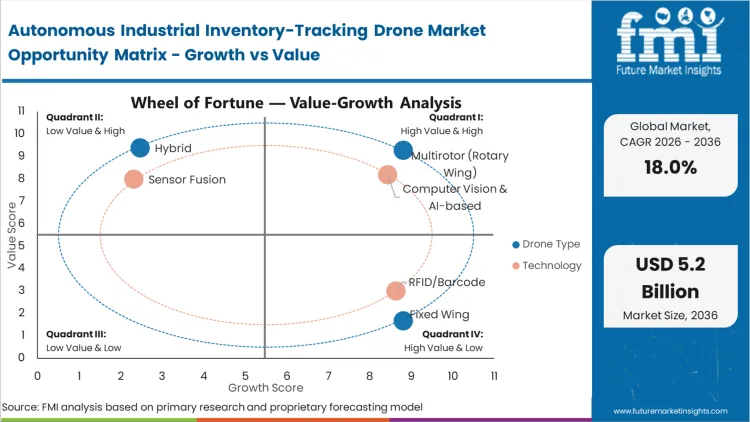
- Multirotor (Rotary Wing): Poised to hold 75.0% share in 2026, as vertical take-off and hover capabilities are strictly required for scanning narrow, high-rack aisles.
- Computer Vision & AI-based: Anticipated to grab 62.0% share in 2026, driven by the operational need to verify visual condition alongside location without relying on perfectly placed barcodes.
- Warehouse & Distribution Centers: Dominant in 2026, as massive third-party logistics providers aggressively modernize their core inventory reconciliation processes.
- China: 25.0% CAGR, reflecting the rapid construction of greenfield e-commerce hubs designed natively for multi-modal robotic integration.
- Analyst Opinion at FMI
- Rahul Pandita, Principal Analyst, Technology, at FMI, opines, "The general consensus is that these systems solve a data collection problem. However, the real bottleneck shifts almost immediately from hardware capability to WMS reconciliation. A drone can scan ten thousand pallets an hour, but if the enterprise software cannot process the resulting discrepancy flags without human intervention, the operational gain is lost. The vendors capturing enterprise contracts are those selling data integration, not just aerial hardware."
- Strategic Implications / Executive Takeaways
- WMS Integration Specialists must prioritize autonomous drone inventory software integration by pre-building API bridges for major enterprise suites to shorten the deployment timeline.
- Facility Automation Directors should prioritize markerless navigation systems to avoid the hidden costs of applying and maintaining optical infrastructure.
- Hardware procurement leads face rapid technological obsolescence and must pivot toward hardware-as-a-service models to maintain fleet capability.
- Methodology
- Primary Research: VP of Supply Chain Operations, Facility Automation Directors, and WMS Integration Specialists across tier-1 logistics providers.
- Desk Research: Aggregation of material handling automation RFPs, facility modernization capex reports, and vendor technical capability matrices.
- Market-Sizing and Forecasting: The baseline anchors to the square footage of highly automated distribution centers and the adoption rate of continuous cycle counting protocols.
- Data Validation and Update Cycle: Forecasts are triangulated against independent vendor hardware shipment logs and secondary software licensing revenue streams.
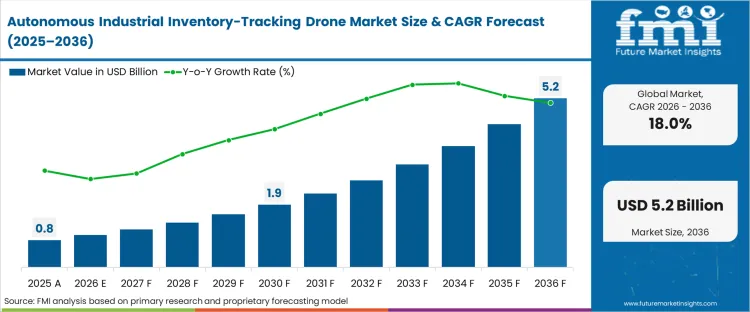
Growth accelerates permanently once these systems transition from infrastructure-dependent navigation to markerless spatial mapping, successfully resolving the historic barrier of autonomous warehouse drone navigation without GPS. When drones no longer require pre-installed QR codes or specialized warehouse lighting to navigate GPS-denied environments, the deployment timeline compresses from weeks to days. Third-party logistics providers who achieve this rapid deployment capability fundamentally alter their margin profiles on short-term leasing contracts.
China is anticipated to advance at 25.0%, followed by the United States at 22.0%, India at 20.0%, Germany at 16.0%, the United Kingdom at 15.0%, Japan at 14.0%, and France at 13.0%. The divergence in expansion speeds reflects a fundamental split between markets dominated by legacy brownfield facilities that require complex retrofitting, and those aggressively building standardized greenfield distribution hubs designed natively for multi-modal robotic integration.
Autonomous Industrial Inventory-Tracking Drone Market Definition
The autonomous industrial inventory-tracking drone market encompasses unmanned aerial vehicles specifically engineered to navigate indoor, GPS-denied environments for the purpose of asset verification and cycle counting. These systems fuse spatial mapping, obstacle avoidance, and optical or radio-frequency sensors to identify, log, and reconcile stock locations against warehouse management software without human piloting.
Autonomous Industrial Inventory-Tracking Drone Market Inclusions
The scope covers fully autonomous and semi-autonomous aerial platforms, integrated computer vision and payload scanning hardware, and the proprietary software suites required for navigation and data reconciliation. This includes associated charging infrastructure, edge computing nodes, and drone analytics platforms that process the captured inventory data.
Autonomous Industrial Inventory-Tracking Drone Market Exclusions
The analysis strictly excludes outdoor delivery drones, agricultural surveying platforms, and manually piloted recreational or commercial quadcopters lacking native indoor spatial mapping capabilities. Stationary gantry scanners and ground-based autonomous mobile robots (AMRs) are also excluded, as their procurement cycles and operational limitations are fundamentally different from aerial systems.
Autonomous Industrial Inventory-Tracking Drone Market Research Methodology
- Primary Research: VP of Supply Chain Operations, Facility Automation Directors, and WMS Integration Specialists across tier-1 logistics providers.
- Desk Research: Aggregation of material handling automation RFPs, facility modernization capex reports, and vendor technical capability matrices.
- Market-Sizing and Forecasting: The baseline anchors to the square footage of highly automated distribution centers and the adoption rate of continuous cycle counting protocols.
- Data Validation and Update Cycle: Forecasts are triangulated against independent vendor hardware shipment logs and secondary software licensing revenue streams.
Segmental Analysis
Autonomous Industrial Inventory-Tracking Drone Market Analysis by Drone Type
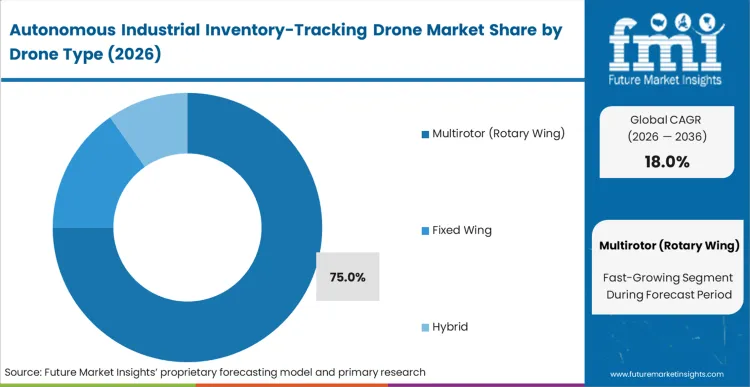
Fixed-wing platforms simply cannot arrest their forward momentum to scan a misaligned barcode on a top-tier rack. Multirotor designs provide the mandatory hover stability and vertical-axis strafing capability required to navigate narrow, high-density aisles. The structural reason Multirotor systems capture 75.0% of the market rests on the geometric constraints of modern fulfillment centers. Based on FMI's assessment, buyers evaluating the best autonomous inventory tracking drones 2026 are not optimizing for aerodynamic efficiency or extended flight times; they are optimizing for precise spatial positioning within a GPS-denied volume. Logistics operators heavily prefer these platforms because they can execute vertical lift directly from ground-level charging pads integrated into the racking structure. The trade-off is higher battery consumption, which is mitigated through autonomous battery-swapping logic. Operations that attempt to deploy hybrid systems often discover that the added mechanical complexity provides no tangible return within standard facility footprints.
- Navigation Disruption: Multirotor designs prevent catastrophic indoor collisions by enabling instantaneous omnidirectional braking. Operators running complex rack layouts avoid the workflow disruption of retrieving crashed hardware.
- Downwash Interference: The rotor wash from heavy payload variants can inadvertently disturb lightweight unboxed inventory on upper shelves. Facility managers must calibrate flight paths to maintain a safe standoff distance.
- Sustained Hovering: To extract the full benefit of optical character recognition (OCR) on damaged labels, the system must hold a perfectly stable position. Buyers must ensure the selected platform features high-frequency micro-adjustments in turbulent indoor air currents.
Autonomous Industrial Inventory-Tracking Drone Market Analysis by Technology
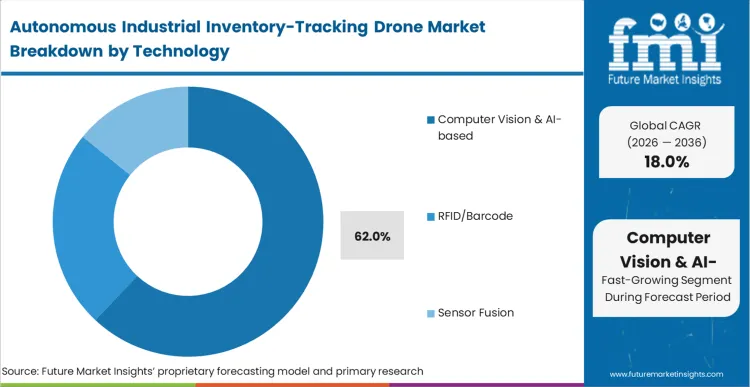
Legacy RFID infrastructure failed to deliver on its promise of perfect inventory visibility because the tag application and gateway calibration processes proved too brittle for dynamic distribution hubs. When weighing RFID drone vs vision-based inventory tracking, buyers clearly favor Computer Vision & AI-based technology because it interprets the facility exactly as a human worker would, reading existing visual labels, identifying box damage, and confirming volumetric space utilization. Securing 62.0% of the category, this optical approach eliminates the massive capital expenditure of retrofitting millions of individual items with radio tags. FMI analysts opine that when addressing how accurate are autonomous inventory drones, operations directors find vision-based systems match or exceed human accuracy without requiring supplier-side compliance. Facilities that cling to older tracking methodologies find themselves trapped in perpetual tag-maintenance cycles that erode the intended labor savings.
- Infrastructure Elimination: Vision-based systems remove the need for fixed gateway readers and facility-wide active transponders. Procurement teams capture immediate capital expenditure reductions during the initial facility upgrade phase.
- Processing Latency: The hidden cost of high-definition visual scanning emerges in edge computing requirements. IT directors must provision substantial localized server capacity to process the optical data before it overwhelms the facility's bandwidth.
- LifecycleAadaptability: Unlike specialized sensor arrays, computer vision models improve via software updates without hardware replacement. The total cost of ownership plummets as the AI learns to recognize new packaging formats natively.
Autonomous Industrial Inventory-Tracking Drone Market Analysis by End-Use Application
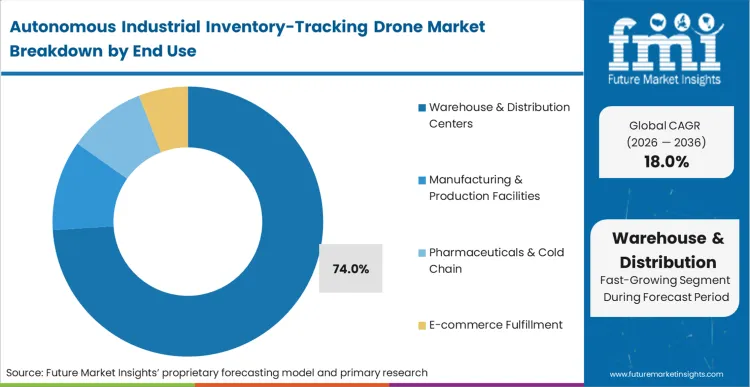
A drone can map a million-square-foot facility in hours, identifying empty bin slots that the WMS incorrectly lists as full. Networks that delay aerial integration continue to absorb the cost of manual search times, directly compressing their operating margins. Site managers at third-party logistics hubs are currently deciding whether to add weekend labor shifts for cycle counting or deploy autonomous fleets to verify stock during off-peak night hours. Drone inventory tracking in e-commerce warehouses represents the dominant deployment enviornment with a share of 50% because modern fulfillment margin structures are entirely dependent on inventory accuracy and velocity. According to FMI's estimates, these massive facilities suffer the highest penalty for "lost" pallets, which cascade into missed shipments and contractual fines. The deployment of aerial systems here is not an innovation initiative; it is a defensive strategy against shrinking labor pools and expanding facility footprints.
- Accuracy Verification: The initial purchase decision is triggered by unacceptably high error rates in annual physical counts. Operations directors seek immediate gap identification to restore confidence in the WMS data.
- Throughput Compatibility: During qualification, the system must prove it can operate concurrently with ground-based AMRs and human pickers. Successful platforms seamlessly yield the right-of-way without losing their scanning sequence.
- Multi-site Scalability: Renewal and fleet expansion depend on the vendor's ability to deploy standardized software across the buyer's entire regional network. Chief Operating Officers authorize wider rollouts only when the data interface requires zero custom coding per site.
Autonomous Industrial Inventory-Tracking Drone Market Drivers, Restraints, and Opportunities
The structural pressure of next-day and same-day fulfillment mandates forces fulfillment center directors to abandon episodic physical inventory counts. To meet these accelerated service level agreements, facilities must maintain absolute certainty of their stock locations, compelling operations leaders to adopt continuous, automated cycle counting. Manual verification simply cannot scale with the verticality of modern high-bay racking systems without introducing severe safety risks and workflow interruptions. By deploying aerial platforms, facility managers guarantee that the physical reality of the warehouse perfectly matches the digital twin in the enterprise software, eliminating the cascading delays caused by pickers arriving at empty slots.
The primary organizational obstacle and one of the main challenges with autonomous warehouse drones slowing wider deployment is the severe complexity of bidirectional integration with legacy Warehouse Management Systems. Unlike standalone hardware, an autonomous drone is useless if its optical findings cannot automatically update the facility's core database. This creates a structural friction where IT departments, rather than logistics personnel, become the bottleneck for adoption. Vendors are attempting to bypass this by offering middleware platforms, but these partial solutions often require brittle custom APIs that fail during routine WMS updates, leaving the buyer with a disconnected fleet of aerial cameras rather than an automated inventory solution.
Opportunities in the Autonomous Industrial Inventory-Tracking Drone Market
- Cold Chain Warehouse Drone Inventory Tracking: Severe temperature constraints in pharmaceutical storage limit human exposure times. Cold chain logistics operators can deploy specialized thermal-resistant platforms to execute highly regulated compliance audits without compromising the environment.
- Autonomous Drones In Manufacturing Inventory: The structural shift from flat storage to dense vertical racking in production buffer zones creates an imperative to monitor empty air. Capacity planners capture immense value by utilizing 3D spatial mapping to consolidate fragmented pallet locations dynamically.
- Off-Hours Fleet Multiplexing: Facilities sitting idle during night shifts offer a perfect operational window, driving an exceptionally strong ROI of autonomous vs manual warehouse inventory. Enterprise drone management solutions allow operators to orchestrate entire swarms to sweep the building autonomously before the morning shift arrives.
Regional Analysis
Regional trajectories for autonomous inventory drones diverge sharply based on local infrastructure maturity, regulatory safety mandates, and the concentration of tier-1 e-commerce operators. While greenfield hubs in the East accelerate native robotic integration, Western markets grapple with retrofitting legacy networks under stringent compliance frameworks with the market being segmented into North America, Europe, Asia Pacific, and other regions across 40 plus countries.
.webp "Top Country Growth Comparison Autonomous Industrial Inventory Tracking Drone Market Cagr (2026 2036)")
| Country | CAGR (2026 to 2036) |
|---|---|
| China | 25.0% |
| United States | 22.0% |
| India | 20.0% |
| Germany | 16.0% |
| United Kingdom | 15.0% |
| Japan | 14.0% |
| France | 13.0% |
Source: Future Market Insights (FMI) analysis, based on proprietary forecasting model and primary research
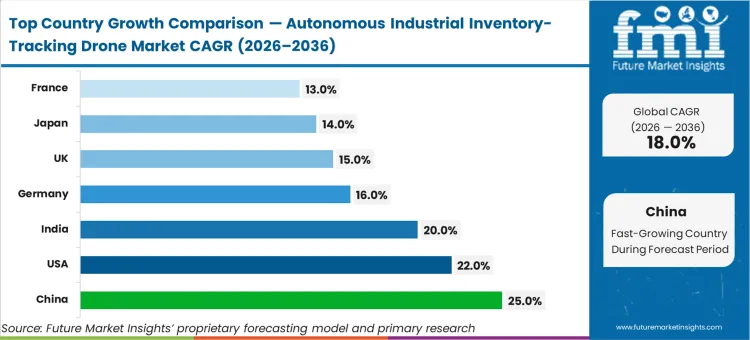
Asia Pacific Autonomous Industrial Inventory-Tracking Drone Market Analysis
Buyers across Asia Pacific are completely bypassing intermediate ground-based scanners, leapfrogging directly to autonomous aerial solutions capable of scaling across massive footprints. This region is constructing greenfield logistics hubs fundamentally designed for robotic integration, contrasting sharply with older Western markets bottlenecked by legacy brownfield facilities. The proliferation of these new high-density distribution centers permanently alters the regional adoption curve for aerial automation. As per FMI's projection, native edge-computing networks, standardized racking, and wide aisles create the perfect canvas for continuous cycle counting, effectively eliminating the expensive retrofitting phases that stall deployments elsewhere.
- China: Expanding at a 25.0% CAGR, China dictates the future baseline for global fulfillment speed by executing the fastest autonomous deployment cycles globally. Procurement directors operating these hyper-scaled automated e-commerce hubs refuse to purchase single units, instead integrating entire aerial fleets directly during the architectural planning phase. This infrastructure-enabled scaling in the end leaves logistics operators in adjacent markets struggling to match the resulting cost-per-pick metrics.
- India: Indian third-party providers are rapidly verticalizing their storage infrastructure to counteract severe congestion across traditional ground-level logistics networks. With demand in the country poised to record a 20.0% CAGR over the forecast period, this extreme verticality creates an immediate operational necessity for aerial scanning platforms as human verification on scissor lifts becomes critically inefficient. By successfully deploying these systems, facility managers clear a massive administrative bottleneck and accept higher inventory turnover without expanding their physical footprint.
- Japan: Facility directors in Japan operate under the harsh reality that human cycle counters cannot be hired at the required volumes, regardless of the wage incentives offered. This chronic labor shortage within the warehousing sector mandates extreme automation across all operational layers, permanently removing human workers from routine inventory reconciliation tasks. Steering the Japanese market toward a projected 14.0% CAGR, these deployments represent a fundamental shift in facility design rather than isolated experiments.
FMI's report includes market analysis across South Korea, Australia, and emerging ASEAN logistics corridors. Facility operators in these secondary markets are standardizing their digital twin architectures around 5G-enabled edge computing, allowing regional supply chain managers to orchestrate aerial cycle counting centrally without overburdening local warehouse bandwidth.
North America Autonomous Industrial Inventory-Tracking Drone Market Analysis
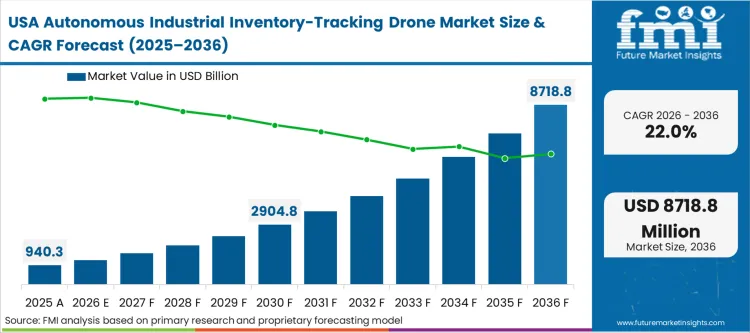
A select group of massive retail and e-commerce operators dictate the technological standards across the entire North American supply chain, defining the region's adoption through highly consolidated logistics networks. These dominant buyers exhibit a procurement behavior that heavily favors mature vendors capable of guaranteeing software uptime over startups that compete purely on hardware specifications. In FMI's view, operators here evaluate platforms strictly on their capacity to prevent stockouts during peak holiday surges and reduce physical count labor hours, ignoring the mere novelty of commercial drones. The network-wide rollouts as a result are only authorized after vendors pass stringent qualification cycles proving seamless integration with top-tier enterprise software.
- United States: Supply chain architects across the United States face immense pressure to maintain absolute inventory visibility across sprawling, multi-state fulfillment networks. Estimated to expand at a CAGR of 22.0%, the domestic market requires facility operators to eradicate all internal data latency to survive the intense competition for next-day delivery supremacy. Vendors who successfully navigate these rigorous enterprise qualification processes in the end locks out smaller competitors by securing highly lucrative, multi-year leasing agreements.
FMI's report includes market analysis across Canada and Mexico's rapidly expanding nearshoring manufacturing hubs. Procurement directors across these border-adjacent networks are prioritizing software-agnostic aerial platforms capable of bridging the inventory data gap between newly built Mexican buffer storage and legacy United States distribution centers without requiring entirely new enterprise software integrations.
Europe Autonomous Industrial Inventory-Tracking Drone Market Analysis
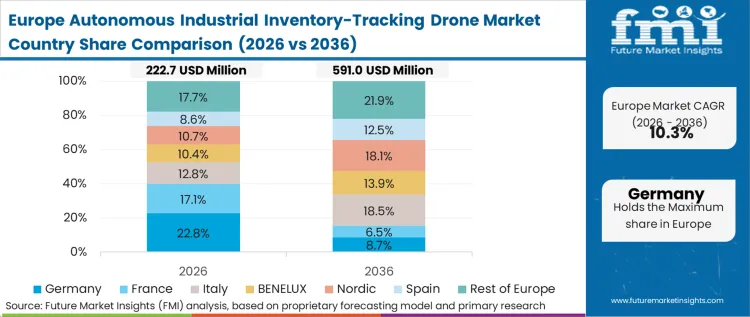
Facility managers across Europe operate under tight compliance frameworks that actively penalize the deployment of elevated work platforms for routine inventory tasks. Based on FMI's assessment, these stringent labor regulations and worker safety directives uniquely shape the regional deployment of aerial scanners, pulling their adoption forward as a necessary safety compliance mechanism rather than a mere efficiency tool. However, implementing these systems remains complicated by strict data privacy and worker surveillance laws. To succeed here, vendors are continually forced to prove that their optical tracking technologies are focused solely on pallets, not personnel.
- Germany: Expanding at a 16.0% CAGR, the market in Germany masks a highly sophisticated landscape where practitioners prioritize flawless, regulation-compliant software over rapid hardware expansion. The country's rigorous occupational safety standards fundamentally shift the operational calculus for high-altitude warehouse tasks. To satisfy strict workplace hazard reduction mandates, logistics operators are practically compelled to replace human-operated scissor lifts with drone inspection and monitoring systems.
- United Kingdom: Procurement managers in the United Kingdom are forced to specify highly maneuverable, ultra-compact aerial platforms capable of operating within severely constrained volumes. Anticipated to register a 15.0% CAGR, the market is heavily influenced by high real estate costs that push distribution centers closer to urban cores, resulting in exceptionally dense and vertically compressed layouts. By successfully implementing these micro-platforms, urban hubs can free up crucial floor space and maximize their holding capacity.
- France: Operations heads in France must carefully position aerial tracking as a workflow augmentation tool and safety enhancement, rather than a direct substitute for personnel. The logistics networks here are characterized by highly unionized workforces that actively resist automation perceived as a threat to labor. driving the French industry toward an expected 13.0% CAGR. This unique dynamic, points toward collaborative human-machine workflows, where aerial platforms handle dangerous upper-tier scanning while personnel manage ground-level discrepancy resolution.
FMI's report includes market analysis across Scandinavia, Benelux, and emerging Southeast Asian manufacturing hubs. The overarching structural pattern across these secondary geographies is the bypassing of hybrid solutions in favor of purely optical, multirotor platforms that require minimal physical infrastructure changes.
Competitive Aligners for Market Players
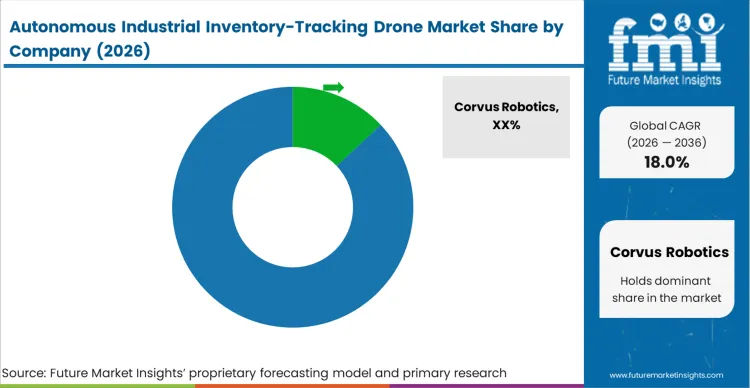
The market exhibits moderate concentration because while the physical multirotor hardware is rapidly commoditizing, the proprietary computer vision models and enterprise software integrations create immense barriers to entry. Buyers evaluating autonomous drone inventory tracking suppliers use software integration speed as their primary qualification variable. A system that requires extensive custom coding to communicate with a tier-1 Warehouse Management System is immediately disqualified, regardless of its flight capabilities.
For procurement teams evaluating the top autonomous drone companies for warehouse inventory, what challengers must build to unseat incumbents is a library of pre-configured API bridges for every major WMS and ERP platform. Incumbents possess years of aggregated flight data that trains their AI to recognize edge cases, such as highly reflective shrink wrap or poorly lit aisles, which gives them a structural advantage in raw scanning reliability. A startup cannot simply replicate this optical maturity overnight. To compete, they must develop highly adaptable unmanned aerial vehicles (UAV) commercial drone architectures that prioritize edge computing, allowing the platform to process complex visual data locally without overwhelming the facility's wireless network.
Reviewing autonomous drone inventory tracking case studies, massive third-party logistics providers actively resist vendor lock-in by enforcing strict data ownership and hardware-agnostic software architectures. When experts compare Corvus Robotics vs Gather AI drones, they note that the market trajectory through 2036 points toward a decoupling of the aerial platform from the analytics software. Dominant vendor incentives to sell bundled, closed-loop systems will clash with the buyer's mandate for modularity, finally forcing the competitive landscape to consolidate around a few dominant software orchestrators rather than hardware manufacturers.
Key Players in Autonomous Industrial Inventory-Tracking Drone Market
- Corvus Robotics
- Gather AI
- PINC Solutions
- DroneScan
- Infinium Robotics
- FlytBase
- EYESEE Drone
Scope of the Report
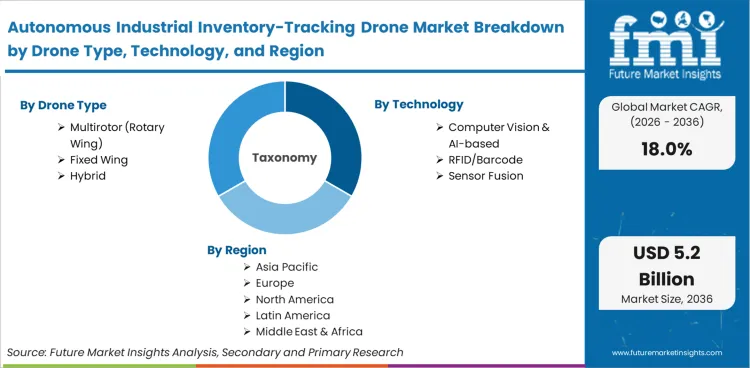
| Metric | Value |
|---|---|
| Quantitative Units | USD 1.0 billion to USD 5.3 billion, at a CAGR of 18.0% |
| Market Definition | A functional segment of logistics automation comprising indoor-navigating unmanned aerial vehicles that continuously verify facility inventory levels, replacing manual cycle counting with automated optical or RFID data collection integrated directly into enterprise systems. |
| Drone Type Segmentation | Multirotor (Rotary Wing), Fixed Wing, Hybrid |
| Technology Segmentation | Computer Vision & AI-based, RFID/Barcode, Sensor Fusion |
| End-Use Application Segmentation | Warehouse & Distribution Centers, Manufacturing & Production Facilities, Pharmaceuticals & Cold Chain, E-commerce Fulfillment |
| Regions Covered | North America, Europe, Asia Pacific, Middle East and Africa, Latin America |
| Countries Covered | China, United States, India, Germany, United Kingdom, Japan, France, and 40 plus countries |
| Key Companies Profiled | Corvus Robotics, Gather AI, PINC Solutions, DroneScan, Infinium Robotics, FlytBase, EYESEE Drone |
| Forecast Period | 2026 to 2036 |
| Approach | Forecasts rely on interviews with VP of Supply Chain Operations and WMS Integration Specialists across tier-1 logistics providers. The baseline anchors to the square footage of highly automated distribution centers and the adoption rate of continuous cycle counting protocols. Projections are triangulated against independent vendor hardware shipment logs and secondary software licensing revenue streams. |
Source: Future Market Insights (FMI) analysis, based on proprietary forecasting model and primary research
Autonomous Industrial Inventory-Tracking Drone Market Segments
Drone Type:
- Multirotor (Rotary Wing)
- Fixed Wing
- Hybrid
Technology:
- Computer Vision & AI-based
- RFID/Barcode
- Sensor Fusion
End-Use Application:
- Warehouse & Distribution Centers
- Manufacturing & Production Facilities
- Pharmaceuticals & Cold Chain
- E-commerce Fulfillment
Regions:
- North America
- United States
- Canada
- Latin America
- Brazil
- Mexico
- Europe
- Germany
- United Kingdom
- France
- Italy
- Spain
- Asia-Pacific
- China
- Japan
- South Korea
- India
- Rest of Asia-Pacific
Bibliography
- Taylor & Francis. (2024, July). Exploring the role of drones and UAVs in logistics and supply chain management: A novel text-based literature review. International Journal of Production Research.
- Elsevier. (2025). Operational excellence through drone-based inventory monitoring: A mathematical model proposal. Procedia CIRP.
- MDPI. (2026, January). Analyzing key factors for warehouse UAV integration: A complex network analysis approach. Logistics.
- Frontiers. (2024, December). Factors affecting the adoption of drones in the food supply chain. Frontiers in Sustainable Food Systems.
- OmniaScience. (2024). Investigation of operational parameters that affect the use of drones in warehouse operations. Journal of Industrial Engineering and Management.
- Elsevier. (2024, December). Drone-based warehouse inventory management of perishables. International Journal of Production Economics.
- IEEE. (2025, March). Warehouse drone inventory management system using OpenCV and AI. ResearchGate.
This bibliography is provided for reader reference. The full FMI report contains the complete reference list with primary source documentation.
Frequently Asked Questions
Exactly what is the market size of autonomous warehouse drones in 2026?
Valued at USD 1.0 billion in 2026, the market reflects aggressive operational expenditure by major third-party logistics providers who have moved past pilot programs into full-scale aerial cycle counting.
How do autonomous drones perform warehouse inventory counts?
Navigating via markerless spatial mapping and edge computing, these systems autonomously scan high-rack aisles with optical computer vision or RFID to instantly flag missing or misplaced pallets against the WMS database.
What CAGR is projected for the market?
A projected CAGR of 18.0% signals a fundamental shift in facility design as capital diverts from legacy ground-based RFID gateways toward agile, multi-modal robotic fleets.
Which Drone Type segment leads?
Multirotor architectures dominate with a 75.0% share because their ability to brake instantly and hover precisely is a non-negotiable requirement for reading damaged barcodes in the turbulent air currents of narrow warehouse aisles.
Which Technology segment leads?
Computer Vision & AI-based systems capture 62.0% of the sector by allowing facility operators to digitize inventory visually without forcing upstream suppliers to comply with expensive active RFID tagging mandates.
Which End-Use Application segment leads?
Warehouse & Distribution Centers form the dominant deployment environment because their entire operating margin hinges on resolving stock discrepancies before they cascade into missed service level agreements.
How much do industrial inventory drones cost?
While exact capital expenditures vary based on hardware-as-a-service leasing and edge computing requirements, the ultimate financial justification relies on offsetting manual labor hours and SLA penalties.
What are the main challenges with autonomous warehouse drones?
The most significant operational friction is the sheer complexity of bidirectional integration with legacy Warehouse Management Systems, where excellent flight hardware often fails if its software cannot reliably push discrepancy flags into the client's core enterprise database.
Which country grows fastest?
China advances at a rapid 25.0% CAGR, significantly outpacing the United States at 22.0%, because Chinese logistics hubs are largely greenfield constructions designed natively for robotics rather than retrofitted legacy brownfield infrastructure.
How do European safety directives impact adoption?
Stringent occupational safety regulations actively penalize the use of human-operated scissor lifts for high-rack audits, transforming aerial scanning platforms from a simple efficiency tool into a required workplace hazard reduction mechanism.
Evaluating an autonomous inventory drone vs AMR robots: What's the difference?
Unlike ground-based Autonomous Mobile Robots (AMRs) that cannot reach upper racking tiers, aerial drones provide the necessary Z-axis mobility to map empty bin slots near the warehouse ceiling.
How are dominant buyers resisting vendor lock-in?
Massive third-party logistics operators enforce strict data ownership protocols and demand hardware-agnostic software architectures to avoid binding their multi-site networks to a single airframe manufacturer.
What happens when hybrid drone systems are deployed indoors?
Operations attempting to utilize hybrid platforms typically find that their added mechanical weight drastically reduces efficiency, as the aerodynamic advantages of fixed-wing flight provide zero return within the confined, stop-and-go environment of a distribution center.
How does edge computing solve processing latency?
Implementing localized edge computing nodes prevents high-definition optical data from overwhelming a facility's wireless network by processing imagery on-site and sending only the final discrepancy reports to the central WMS.
What companies use autonomous inventory drones?
Adoption is spearheaded by massive tier-1 third-party logistics providers, global retail giants executing next-day fulfillment, and pharmaceutical distributors managing strict cold chain compliance where human exposure to freezing temperatures must be minimized.
How does the UK's real estate density shape procurement?
Exceptionally high land costs force British distribution centers to utilize vertically compressed, high-density layouts, requiring procurement managers to specify ultra-compact, highly maneuverable platforms that can safely navigate tight volumes.
What role do pre-built API bridges play in vendor selection?
A robust library of pre-configured API connections to major WMS platforms is often the deciding factor in securing enterprise-wide deployment contracts because IT departments prioritize seamless integration without extensive custom coding.
How does the Indian market overcome its infrastructure bottlenecks?
Adopting aerial tracking allows Indian operators, who are rapidly verticalizing their storage capacity to overcome severe ground-level congestion, to manage increased density without expanding their administrative headcount or physical footprint.
What specific failure mode does autonomous battery swapping prevent?
Integrating charging pads directly into the racking structure prevents the disruption of continuous cycle counting by ensuring the fleet maintains its scanning sequence without requiring manual, human-intervened battery replacements.
What are the emerging trends autonomous inventory drones 2026?
Innovations increasingly center on collaborative swarm intelligence, multi-modal integration where drones hand off localized data to AMRs, and the shift toward purely markerless spatial mapping to eliminate facility-side visual infrastructure requirements.
Preview the report firsthand - request a free sample
Get SampleGet the brochure for pricing and purchase details.
Get PDFTable of Content
- Executive Summary
- Global Market Outlook
- Demand-side Trends
- Supply-side Trends
- Technology Roadmap Analysis
- Analysis and Recommendations
- Market Overview
- Market Coverage / Taxonomy
- Market Definition / Scope / Limitations
- Research Methodology
- Chapter Orientation
- Analytical Lens and Working Hypotheses
- Market Structure, Signals, and Trend Drivers
- Benchmarking and Cross-market Comparability
- Market Sizing, Forecasting, and Opportunity Mapping
- Research Design and Evidence Framework
- Desk Research Programme (Secondary Evidence)
- Company Annual and Sustainability Reports
- Peer-reviewed Journals and Academic Literature
- Corporate Websites, Product Literature, and Technical Notes
- Earnings Decks and Investor Briefings
- Statutory Filings and Regulatory Disclosures
- Technical White Papers and Standards Notes
- Trade Journals, Industry Magazines, and Analyst Briefs
- Conference Proceedings, Webinars, and Seminar Materials
- Government Statistics Portals and Public Data Releases
- Sector Databases and Reference Repositories
- FMI Internal Proprietary Databases and Historical Market Datasets
- Subscription Datasets and Paid Sources
- Social Channels, Communities, and Digital Listening Inputs
- Additional Desk Sources
- Expert Input and Fieldwork (Primary Evidence)
- Primary Modes
- Qualitative Interviews and Expert Elicitation
- Quantitative Surveys and Structured Data Capture
- Blended Approach
- Why Primary Evidence is Used
- Field Techniques
- Interviews
- Surveys
- Focus Groups
- Observational and In-context Research
- Social and Community Interactions
- Stakeholder Universe Engaged
- C-suite Leaders
- Board Members
- Presidents and Vice Presidents
- R&D and Innovation Heads
- Technical Specialists
- Domain Subject-matter Experts
- Scientists
- Physicians and Other Healthcare Professionals
- Governance, Ethics, and Data Stewardship
- Research Ethics
- Data Integrity and Handling
- Primary Modes
- Tooling, Models, and Reference Databases
- Desk Research Programme (Secondary Evidence)
- Data Engineering and Model Build
- Data Acquisition and Ingestion
- Cleaning, Normalisation, and Verification
- Synthesis, Triangulation, and Analysis
- Quality Assurance and Audit Trail
- Market Background
- Market Dynamics
- Drivers
- Restraints
- Opportunity
- Trends
- Scenario Forecast
- Demand in Optimistic Scenario
- Demand in Likely Scenario
- Demand in Conservative Scenario
- Opportunity Map Analysis
- Product Life Cycle Analysis
- Supply Chain Analysis
- Investment Feasibility Matrix
- Value Chain Analysis
- PESTLE and Porter’s Analysis
- Regulatory Landscape
- Regional Parent Market Outlook
- Production and Consumption Statistics
- Import and Export Statistics
- Market Dynamics
- Global Market Analysis 2021 to 2025 and Forecast, 2026 to 2036
- Historical Market Size Value (USD Million) Analysis, 2021 to 2025
- Current and Future Market Size Value (USD Million) Projections, 2026 to 2036
- Y-o-Y Growth Trend Analysis
- Absolute $ Opportunity Analysis
- Global Market Pricing Analysis 2021 to 2025 and Forecast 2026 to 2036
- Global Market Analysis 2021 to 2025 and Forecast 2026 to 2036, By Drone Type
- Introduction / Key Findings
- Historical Market Size Value (USD Million) Analysis By Drone Type , 2021 to 2025
- Current and Future Market Size Value (USD Million) Analysis and Forecast By Drone Type , 2026 to 2036
- Multirotor (Rotary Wing)
- Fixed Wing
- Hybrid
- Multirotor (Rotary Wing)
- Y-o-Y Growth Trend Analysis By Drone Type , 2021 to 2025
- Absolute $ Opportunity Analysis By Drone Type , 2026 to 2036
- Global Market Analysis 2021 to 2025 and Forecast 2026 to 2036, By Technology
- Introduction / Key Findings
- Historical Market Size Value (USD Million) Analysis By Technology, 2021 to 2025
- Current and Future Market Size Value (USD Million) Analysis and Forecast By Technology, 2026 to 2036
- Computer Vision & AI-based
- RFID/Barcode
- Sensor Fusion
- Computer Vision & AI-based
- Y-o-Y Growth Trend Analysis By Technology, 2021 to 2025
- Absolute $ Opportunity Analysis By Technology, 2026 to 2036
- Global Market Analysis 2021 to 2025 and Forecast 2026 to 2036, By End Use
- Introduction / Key Findings
- Historical Market Size Value (USD Million) Analysis By End Use, 2021 to 2025
- Current and Future Market Size Value (USD Million) Analysis and Forecast By End Use, 2026 to 2036
- Warehouse & Distribution Centers
- Manufacturing & Production Facilities
- Pharmaceuticals & Cold Chain
- E-commerce Fulfillment
- Warehouse & Distribution Centers
- Y-o-Y Growth Trend Analysis By End Use, 2021 to 2025
- Absolute $ Opportunity Analysis By End Use, 2026 to 2036
- Global Market Analysis 2021 to 2025 and Forecast 2026 to 2036, By Region
- Introduction
- Historical Market Size Value (USD Million) Analysis By Region, 2021 to 2025
- Current Market Size Value (USD Million) Analysis and Forecast By Region, 2026 to 2036
- North America
- Latin America
- Western Europe
- Eastern Europe
- East Asia
- South Asia and Pacific
- Middle East & Africa
- Market Attractiveness Analysis By Region
- North America Market Analysis 2021 to 2025 and Forecast 2026 to 2036, By Country
- Historical Market Size Value (USD Million) Trend Analysis By Market Taxonomy, 2021 to 2025
- Market Size Value (USD Million) Forecast By Market Taxonomy, 2026 to 2036
- By Country
- USA
- Canada
- Mexico
- By Drone Type
- By Technology
- By End Use
- By Country
- Market Attractiveness Analysis
- By Country
- By Drone Type
- By Technology
- By End Use
- Key Takeaways
- Latin America Market Analysis 2021 to 2025 and Forecast 2026 to 2036, By Country
- Historical Market Size Value (USD Million) Trend Analysis By Market Taxonomy, 2021 to 2025
- Market Size Value (USD Million) Forecast By Market Taxonomy, 2026 to 2036
- By Country
- Brazil
- Chile
- Rest of Latin America
- By Drone Type
- By Technology
- By End Use
- By Country
- Market Attractiveness Analysis
- By Country
- By Drone Type
- By Technology
- By End Use
- Key Takeaways
- Western Europe Market Analysis 2021 to 2025 and Forecast 2026 to 2036, By Country
- Historical Market Size Value (USD Million) Trend Analysis By Market Taxonomy, 2021 to 2025
- Market Size Value (USD Million) Forecast By Market Taxonomy, 2026 to 2036
- By Country
- Germany
- UK
- Italy
- Spain
- France
- Nordic
- BENELUX
- Rest of Western Europe
- By Drone Type
- By Technology
- By End Use
- By Country
- Market Attractiveness Analysis
- By Country
- By Drone Type
- By Technology
- By End Use
- Key Takeaways
- Eastern Europe Market Analysis 2021 to 2025 and Forecast 2026 to 2036, By Country
- Historical Market Size Value (USD Million) Trend Analysis By Market Taxonomy, 2021 to 2025
- Market Size Value (USD Million) Forecast By Market Taxonomy, 2026 to 2036
- By Country
- Russia
- Poland
- Hungary
- Balkan & Baltic
- Rest of Eastern Europe
- By Drone Type
- By Technology
- By End Use
- By Country
- Market Attractiveness Analysis
- By Country
- By Drone Type
- By Technology
- By End Use
- Key Takeaways
- East Asia Market Analysis 2021 to 2025 and Forecast 2026 to 2036, By Country
- Historical Market Size Value (USD Million) Trend Analysis By Market Taxonomy, 2021 to 2025
- Market Size Value (USD Million) Forecast By Market Taxonomy, 2026 to 2036
- By Country
- China
- Japan
- South Korea
- By Drone Type
- By Technology
- By End Use
- By Country
- Market Attractiveness Analysis
- By Country
- By Drone Type
- By Technology
- By End Use
- Key Takeaways
- South Asia and Pacific Market Analysis 2021 to 2025 and Forecast 2026 to 2036, By Country
- Historical Market Size Value (USD Million) Trend Analysis By Market Taxonomy, 2021 to 2025
- Market Size Value (USD Million) Forecast By Market Taxonomy, 2026 to 2036
- By Country
- India
- ASEAN
- Australia & New Zealand
- Rest of South Asia and Pacific
- By Drone Type
- By Technology
- By End Use
- By Country
- Market Attractiveness Analysis
- By Country
- By Drone Type
- By Technology
- By End Use
- Key Takeaways
- Middle East & Africa Market Analysis 2021 to 2025 and Forecast 2026 to 2036, By Country
- Historical Market Size Value (USD Million) Trend Analysis By Market Taxonomy, 2021 to 2025
- Market Size Value (USD Million) Forecast By Market Taxonomy, 2026 to 2036
- By Country
- Kingdom of Saudi Arabia
- Other GCC Countries
- Turkiye
- South Africa
- Other African Union
- Rest of Middle East & Africa
- By Drone Type
- By Technology
- By End Use
- By Country
- Market Attractiveness Analysis
- By Country
- By Drone Type
- By Technology
- By End Use
- Key Takeaways
- Key Countries Market Analysis
- USA
- Pricing Analysis
- Market Share Analysis, 2025
- By Drone Type
- By Technology
- By End Use
- Canada
- Pricing Analysis
- Market Share Analysis, 2025
- By Drone Type
- By Technology
- By End Use
- Mexico
- Pricing Analysis
- Market Share Analysis, 2025
- By Drone Type
- By Technology
- By End Use
- Brazil
- Pricing Analysis
- Market Share Analysis, 2025
- By Drone Type
- By Technology
- By End Use
- Chile
- Pricing Analysis
- Market Share Analysis, 2025
- By Drone Type
- By Technology
- By End Use
- Germany
- Pricing Analysis
- Market Share Analysis, 2025
- By Drone Type
- By Technology
- By End Use
- UK
- Pricing Analysis
- Market Share Analysis, 2025
- By Drone Type
- By Technology
- By End Use
- Italy
- Pricing Analysis
- Market Share Analysis, 2025
- By Drone Type
- By Technology
- By End Use
- Spain
- Pricing Analysis
- Market Share Analysis, 2025
- By Drone Type
- By Technology
- By End Use
- France
- Pricing Analysis
- Market Share Analysis, 2025
- By Drone Type
- By Technology
- By End Use
- India
- Pricing Analysis
- Market Share Analysis, 2025
- By Drone Type
- By Technology
- By End Use
- ASEAN
- Pricing Analysis
- Market Share Analysis, 2025
- By Drone Type
- By Technology
- By End Use
- Australia & New Zealand
- Pricing Analysis
- Market Share Analysis, 2025
- By Drone Type
- By Technology
- By End Use
- China
- Pricing Analysis
- Market Share Analysis, 2025
- By Drone Type
- By Technology
- By End Use
- Japan
- Pricing Analysis
- Market Share Analysis, 2025
- By Drone Type
- By Technology
- By End Use
- South Korea
- Pricing Analysis
- Market Share Analysis, 2025
- By Drone Type
- By Technology
- By End Use
- Russia
- Pricing Analysis
- Market Share Analysis, 2025
- By Drone Type
- By Technology
- By End Use
- Poland
- Pricing Analysis
- Market Share Analysis, 2025
- By Drone Type
- By Technology
- By End Use
- Hungary
- Pricing Analysis
- Market Share Analysis, 2025
- By Drone Type
- By Technology
- By End Use
- Kingdom of Saudi Arabia
- Pricing Analysis
- Market Share Analysis, 2025
- By Drone Type
- By Technology
- By End Use
- Turkiye
- Pricing Analysis
- Market Share Analysis, 2025
- By Drone Type
- By Technology
- By End Use
- South Africa
- Pricing Analysis
- Market Share Analysis, 2025
- By Drone Type
- By Technology
- By End Use
- USA
- Market Structure Analysis
- Competition Dashboard
- Competition Benchmarking
- Market Share Analysis of Top Players
- By Regional
- By Drone Type
- By Technology
- By End Use
- Competition Analysis
- Competition Deep Dive
- Corvus Robotics
- Overview
- Product Portfolio
- Profitability by Market Segments (Product/Age /Sales Channel/Region)
- Sales Footprint
- Strategy Overview
- Marketing Strategy
- Product Strategy
- Channel Strategy
- Gather AI
- PINC Solutions
- DroneScan
- Infinium Robotics
- FlytBase
- EYESEE Drone
- Corvus Robotics
- Competition Deep Dive
- Assumptions & Acronyms Used


