

- Industry Size (2026)
- USD 0.9 Bn
- Forecast (2036)
- USD 1.8 Bn
- CAGR (2026 to 2036)
- 7.9%
Autonomous Floor Cleaning Machine Detergent and Care Chemicals Market Size, Market Forecast and Outlook By FMI
The autonomous floor cleaning machine detergent and care chemicals market was valued at USD 0.8 billion in 2025. Industry is expected to reach USD 0.9 billion in 2026 and expand at a CAGR of 7.9% through 2036, taking total revenue to USD 1.8 billion, supported by increasing deployment of automated floor cleaning systems across commercial facilities.
Summary of Autonomous Floor Cleaning Machine Detergent and Care Chemicals Market
- The market is forecast to reach USD 1.8 billion by 2036.
- The market is expected to grow at a CAGR of 7.9% from 2026 to 2036.
- The market was estimated at USD 0.8 billion in 2025.
- The forecast period represents an incremental opportunity of USD 1.0 billion.
- Low-foam neutral daily cleaners lead the chemistry segment with 32.0% share, driven by compatibility with automated cleaning systems.
- Autonomous scrubber dryers dominate machine compatibility with 46.0% share, reflecting strong adoption in commercial cleaning.
- Concentrates account for 41.0% share in delivery format due to cost efficiency and ease of handling.
- Warehouses and logistics facilities contribute 27.0% share in end-use, supported by large floor areas and automation needs.
- Key companies in the market include Tennant, Ecolab, Diversey / TASKI, Nilfisk, Kärcher, Betco, and Canberra / Husky.
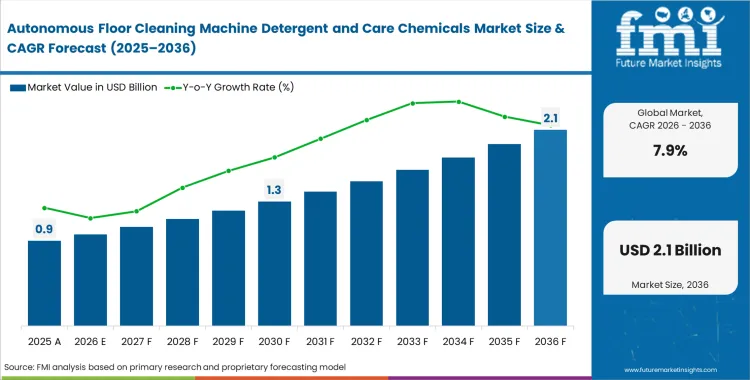
Key Takeaways, Market Size, and Forecast
- 2025 market size: USD 0.8 billion
- 2026 market size: USD 0.9 billion
- 2036 forecast: USD 1.8 billion
- CAGR: 7.9%
- Top chemistry type: Low-foam neutral daily cleaners (32.0%)
- Top machine compatibility: Autonomous scrubber dryers (46.0%)
- Top delivery format: Concentrates (41.0%)
- Top end-use facility: Warehouses and logistics (27.0%)
- Top care-chemical function: Floor cleaning (54.0%)
Balancing higher hygiene requirements with the technical limits of autonomous equipment remains a key operating challenge. Cleaning formulations must deliver effective soil removal while remaining compatible with onboard sensors and navigation systems. Low-foaming chemistries are essential, as excess foam can interfere with optical sensors and reduce machine accuracy. Delays in switching from legacy products increase the risk of equipment damage, particularly where fluids affect sensitive components. Product approval depends on whether time savings from automation offset higher chemical costs, especially when formulations are designed to protect machine integrity. Maintaining anti-corrosive properties can limit dilution flexibility, which adds cost pressure for large-scale users managing automated fleets.
Adoption accelerates when commercial real estate networks standardize robotic cleaning across multiple properties, requiring alignment with approved chemical suppliers. Cartridge-based dosing systems reduce manual handling errors and support consistent application, while also helping maintain warranty compliance and reducing total chemical usage. Ensuring compatibility between cleaning agents and robotic systems is essential to maintain uptime in high-traffic environments.
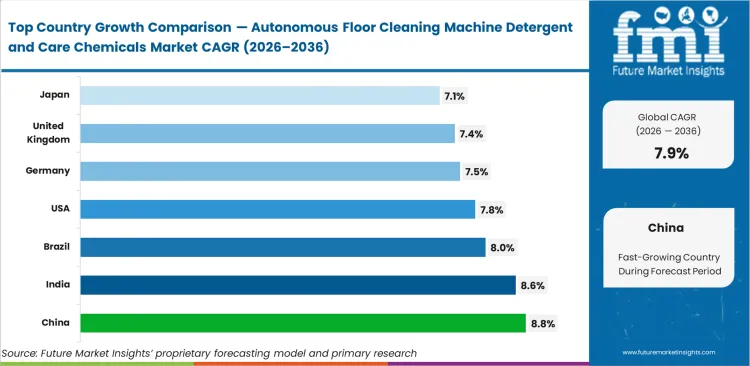
Demand for autonomous floor cleaning machine detergent and care chemicals in China is projected to grow at a CAGR of 8.8%, followed by India at 8.6% and Brazil at 8.0%, supported by expansion across large-scale infrastructure and automation-led cleaning programs. The United States and Germany are expected to grow at 7.8% and 7.5%, while the United Kingdom and Japan are forecast at 7.4% and 7.1% through 2036, where adoption is driven by the need for consistent uptime and efficient automated cleaning operations.
Segmental Analysis
Autonomous Floor Cleaning Machine Detergent and Care Chemicals Market Analysis by Chemistry Type
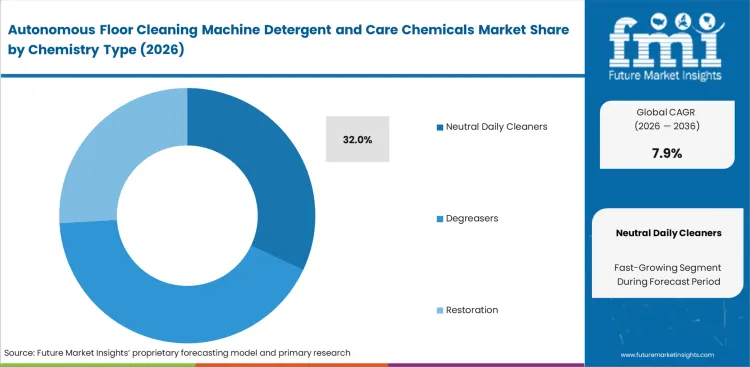
Visual confirmation of cleanliness drives tenant satisfaction scores across premium real estate. Low-foam neutral daily cleaners are anticipated to hold a 32.0% share by 2036, as fleet managers deploy these versatile formulations continuously across lobbies, elevators, and shared workspaces. Night-shift robotic units rely heavily on multi-surface compatibility, avoiding the confusion of switching reservoirs between different architectural materials. Asking why low foam detergents matter in robotic scrubbers reveals that excessive suds visibly degrade vacuum recovery motors and blind optical guidance sensors daily. Formulators increasingly rely on specialized super concentrate cleaning chemicals to balance soil removal power with internal machine safety limits. Securing a reliable low foam neutral floor cleaner for scrubbers ensures uninterrupted hardware function. Expansion within the sustainable green floor care chemicals sector proves robust as building managers completely abandon harsh phenolics. Neutral cleaners dominate volume, yet specialized strippers requiring strict pH balancing generate significantly higher profit margins for manufacturers.
- Purchasing triggers: Sudden component failures force risk management officers to instantly override existing supply contracts. Selecting premium certified formulas immediately restores operational uptime following localized hardware breakdowns.
- Qualification validation: Infection control audits verify pathogen elimination efficacy on standardized test surfaces. Fleet directors demand visual proof confirming no residue remains on reflective flooring.
- Renewal drivers: Robotics maintenance feedback dictates long-term contract survival. Formulations causing internal pump corrosion prompt hardware vendors to block chemical renewals entirely.
Autonomous Floor Cleaning Machine Detergent and Care Chemicals Market Analysis by Machine Compatibility
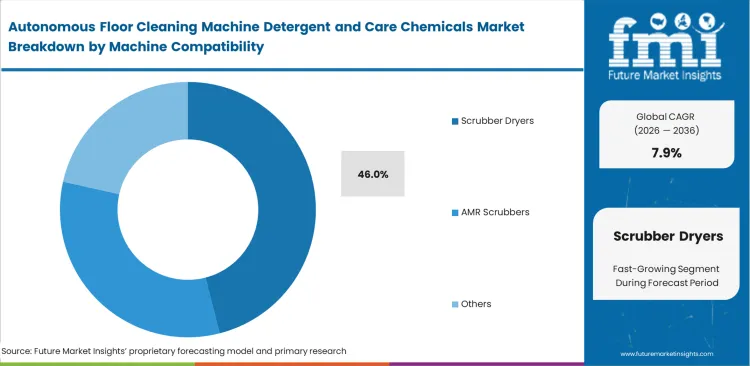
Autonomous scrubber dryers are projected to capture 46.0% share, propelled directly by property management firms aggressively scaling their automated janitorial fleets to offset chronic labor shortages. Specific environmental criteria embedded into vendor service level agreements restrict the use of conventional solvents, refusing to onboard any janitorial firm utilizing conventional solvents that might compromise expensive onboard water recycling systems. Sourcing targeted autonomous scrubber dryer chemicals protects multi-million dollar capital investments. Deploying robotic assets in environments requiring specialized cleaning chemicals for retail centers balances extreme high-traffic soil removal with fast drying times to prevent customer slip liabilities. Commercial building administrators push for proprietary chemical cartridges not to save the planet, but to secure recognized warranty compliance badges that ensure uninterrupted floor cleaning mopping machines functionality.
- Initial failure: Replacing approved manufacturer fluids with cheap generic alternatives temporarily degrades recovery tank sensors. Fleet supervisors risk immediate system lockouts during the initial three-month transition period.
- Persistent friction: Hard water infrastructure severely limits the lathering capability of biodegradable surfactants. Technicians must occasionally clear calcified deposits from delicate internal spray nozzles.
- Realized benefits: Eliminating harsh fumes drastically reduces secondary sensor clouding. Human resource directors document significant declines in employee complaints following chemical overhauls.
Autonomous Floor Cleaning Machine Detergent and Care Chemicals Market Analysis by Delivery Format
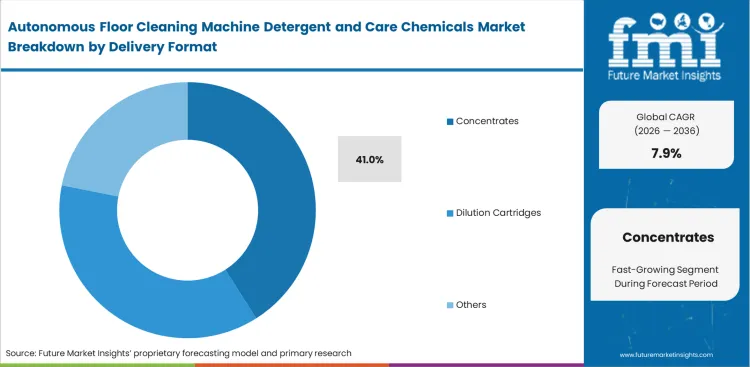
Shipping liquid water across continental supply chains destroys environmental sustainability metrics. Concentrates are estimated to account for 41.0% share as logistics vice presidents restructure distribution models to exclusively transport high-density active ingredients. Regional distributors install sophisticated wall-mounted dilution stations directly into janitorial closets, effectively eliminating manual pouring hazards while strictly controlling consumption rates. Evaluating highly regulated delivery mechanisms indicates that precise cartridge systems offer unparalleled cost-per-use economics, provided equipment maintenance remains flawless. Concentrates drastically reduce shipping weight, but without strictly calibrated closed-loop dosing systems feeding directly into the robotic base, staff manually over-pour, instantly negating both the environmental benefit and the financial savings. Finding verified autonomous floor cleaning chemicals suppliers becomes critical when operations managers ignore routine dispenser calibration and inevitably discover massive supply shortages.
- Procurement savings: Eliminating plastic gallon jugs slashes municipal waste disposal fees entirely. Financial controllers verify immediate returns on investment within two quarters of centralized implementation.
- Hidden expenditures: Complex venturi mixing valves require specialized technicians for routine recalibration. Facility directors absorb unexpected repair costs whenever localized hard water compromises internal components.
- Lifecycle reality: Total cost of ownership metrics prove concentrated systems vastly outperform ready-to-use alternatives. Purchasing departments confidently secure decade-long pricing guarantees based on precise modeling.
Autonomous Floor Cleaning Machine Detergent and Care Chemicals Market Analysis by End-Use Facility
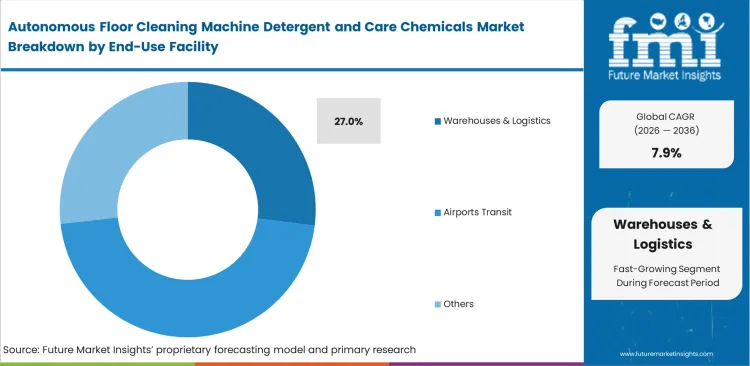
Warehouses & logistics facilities segment is set to account for 27.0% share, reflecting open concrete expanses requiring constant maintenance without interrupting active forklift traffic. Large-scale distribution centers represent the primary adopters within this segment. Growth across this sector hinges entirely on the evolution of powerful industrial cleaners formulated specifically for autonomous application, as mild certified alternatives often require double the physical machine time to completely emulsify hardened tire marks. Transitioning a huge distribution center from conventional riding scrubbers to autonomous fleets disrupts entire custodial scheduling models. Prioritizing constant uptime absorb the initial integration friction, recognizing that deploying specialized green cleaning chemicals prevents devastating respiratory complaints during continuous three-shift operations. Formulating precise warehouses robotic floor cleaning chemicals secures massive recurring procurement contracts.
- Performance peaks: Zinc-free acrylic-compatible cleaners maintain brilliant gloss levels even under heavy foot traffic. Fleet supervisors trust these solutions for prominent corporate lobby areas.
- Edge failures: Cold concrete environments severely restrict fluid activation speeds. Operations managers must adjust robotic travel velocity to allow longer dwell times during winter months.
- Acceptability thresholds: Safety data sheets dictate exact maximum exposure limits. Environmental compliance officers reject any formulation lacking comprehensive dermal toxicity documentation.
Autonomous Floor Cleaning Machine Detergent and Care Chemicals Market Analysis by Care-Chemical Function
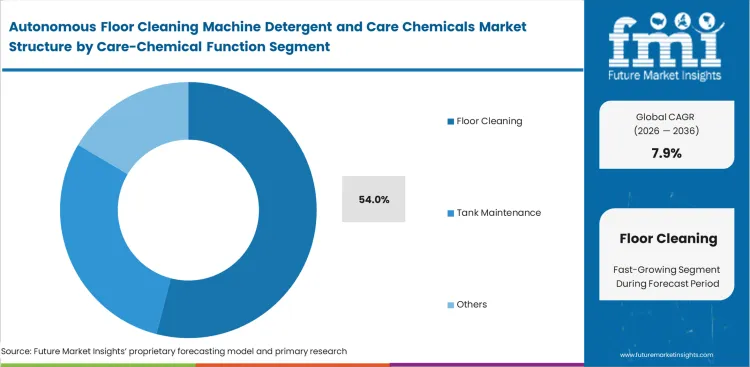
Routine surface maintenance represents the overwhelming majority of daily fluid consumption. Floor cleaning chemistry is projected to command a 54.0% share, reflecting the continuous deployment of primary detergent tanks across all active robotic units. Maintaining optimal cleaning efficiency requires balancing surfactant packages with absolute foam suppression. Formulators increasingly rely on specialized low voc cleaning chemicals to balance soil removal power with indoor air quality regulations inside sealed environments. Facilities failing to utilize proper descaler for scrubber dryer systems or a reliable recovery tank treatment for floor scrubbers cause irreversible internal blockages. This oversight results in catastrophic restorative repair bills that instantly wipe out years of chemical cost savings. Utilizing targeted disinfectant chemicals directly inside autonomous units prevents circulated airborne contaminants across sensitive clinical spaces.
- Expectation baseline: Formulations must completely remove oily residues from resilient surfaces without leaving visible streaks. Operations directors consider any secondary manual rinsing requirement an unacceptable failure.
- Edge conditions: High-humidity environments challenge the evaporation rates of certified water-based formulas. High-humidity environments require localized dehumidification systems to prevent slip hazards behind the robotic unit.
- Standardization minimums: Regulatory bodies require absolute documentation proving exact volatile organic compound levels remain below legal thresholds. Compliance officers reject undocumented products immediately.
Autonomous Floor Cleaning Machine Detergent and Care Chemicals Market Drivers, Restraints, and Opportunities
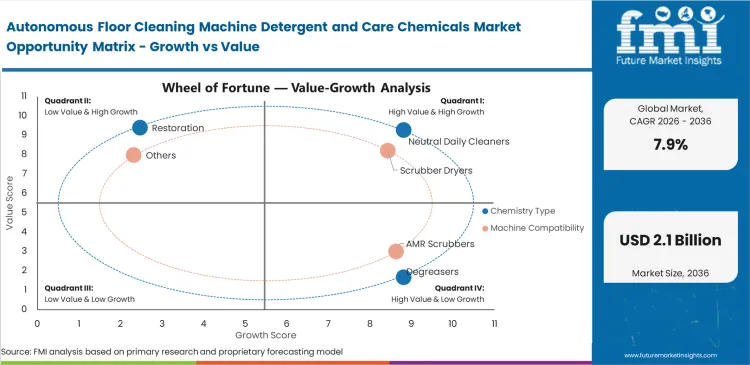
Corporate tenant lease mandates force property management firms to rapidly adopt verified automated environmental protocols. Multinational corporations embed strict efficiency targets and indoor air quality standards into commercial real estate criteria. Retaining these high-value tenants compels building owners to exclusively specify autonomous platforms utilizing certified biodegradable formulas across all outsourced janitorial contracts. Facility management directors who ignore these shifting expectations experience sudden contract terminations when leases expire, losing critical revenue streams to competitors holding comprehensive automation and green building certifications.
Hard water chemistry interactions create severe operational friction for low-foam biodegradable surfactants. Magnesium and calcium ions naturally present in municipal water supplies bind aggressively with plant-based cleaning agents, preventing adequate soil emulsification and leaving dull residues on reflective surfaces. Custodial supervisors managing diverse portfolios frequently abandon certified formulations after repeated tenant complaints regarding visible soap scum buildup in prominent entryways.
Opportunities
- Enzymatic formulations: Living bacterial cultures consume residual organic waste embedded deeply within porous grout lines. Facility directors eliminate chronic floor odors organically, drastically improving perceived cleanliness metrics across properties sourcing.
- Cold-water activation: Surfactants engineered to perform effectively without heated water reduce building energy loads significantly. Operations managers slash utility expenditures while maintaining strict sanitation compliance across massive properties utilizing attached to robotic hybrids.
- Probiotic healthcare maintainers: Utilizing competitive exclusion principles protects vulnerable patient populations. Supply chain directors sourcing bypass harsh bleaches, establishing long-lasting biological barriers against opportunistic surface pathogens.
Regional Analysis
Based on regional analysis, the sector is segmented into Asia Pacific, North America, Western Europe, and Latin America across numerous key countries.
.webp "Top Country Growth Comparison Autonomous Floor Cleaning Machine Detergent And Care Chemicals Market Cagr (2026 2036)")
| Country | CAGR (2026 to 2036) |
|---|---|
| China | 8.8% |
| India | 8.6% |
| Brazil | 8.0% |
| United States | 7.8% |
| Germany | 7.5% |
| United Kingdom | 7.4% |
| Japan | 7.1% |
Source: Future Market Insights (FMI) analysis, based on proprietary forecasting model and primary research
Autonomous Floor Cleaning Machine Detergent and Care Chemicals Market Asia Pacific Analysis
Centralized government mandates dictate aggressive automation standards for newly constructed urban commercial zones and massive logistics hubs. Property developers building sprawling mixed-use districts must secure strict operational efficiency permits prior to occupancy, forcing an immediate transition toward robotic sanitation fleets. Officers negotiate bulk contracts covering entire skyscraper portfolios, prioritizing highly concentrated formulas that minimize storage footprint in dense metropolitan hubs. Facility management firms actively leverage their automated chemical supply chains as primary marketing tools to secure profitable contracts with expanding multinational corporations. Expanding medical tourism drives demand, as private hospitals upgrade sanitation protocols to match international accreditation requirements using cleaning chemicals for fitness and clinical zones. Identifying the optimal suppliers now hinges on absolute sensor neutrality across all active regional sites.
- China: Urban development policies in China link commercial occupancy approvals to strict operational efficiency standards, pushing early adoption of automated cleaning fleets across major metropolitan zones. Building service contractors that transition ahead of these requirements gain an advantage in municipal bidding. The autonomous scrubber chemicals market is expected to grow at a CAGR of 8.8%, driven by adoption across newly developed corporate campuses seeking environmental certification before operations begin. Avoiding legacy formulations remains critical to protect high-value infrastructure investments.
- India: Rapid expansion of private commercial infrastructure creates new requirements for standardized sanitation protocols. India robotic floor cleaning chemicals market sees volume surge as corporate networks standardize procurement across hundreds of regional branches. Purchasing directors moving away from manual labor prioritize advanced robotic chemistries to prevent floor damage and ensure consistent quality. Industry in India is poised to expand at a CAGR of 8.6% as awareness regarding facility automation permanently penetrates the commercial property sector.
- Japan: Japan integrates automation with workforce constraints, where the autonomous floor cleaning chemicals market is set to rise at a CAGR of 7.1% between 2026 and 2036 as aging labor conditions accelerate the shift toward robotic maintenance systems. Controlled environments such as electronics manufacturing and healthcare facilities require formulations that maintain sensor clarity and avoid residue buildup. Demand remains concentrated in applications where precision and contamination control are critical.
Autonomous Floor Cleaning Machine Detergent and Care Chemicals Market North America Analysis
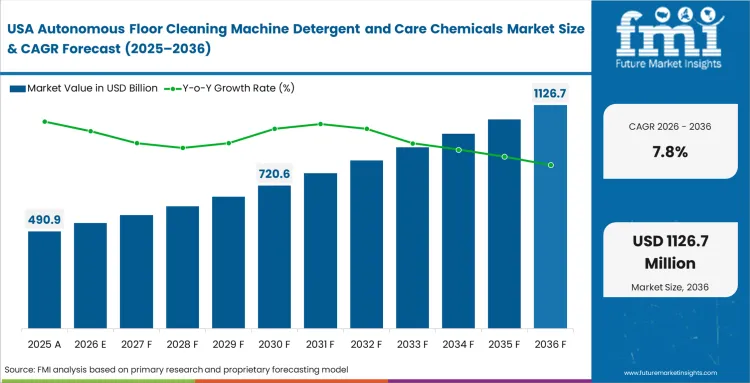
Strict occupational health guidelines structurally encode low-residue requirements directly into vast government service contracts across the entire continent. State-level facility directors face automatic budget penalties if their custodial supply manifests contain unverified floor finishes or dangerous volatile organic compounds. Private sector property management firms actively mimic these federal guidelines, attempting to align their commercial portfolios with recognized indoor air quality certifications to attract elite multinational tenants. Educational districts phase out manual floor strippers, responding directly to intense pressure from parent advocacy groups demanding zero-toxicity learning environments. Unionized building service contractors actively negotiate for the exclusive use of certified automated chemistry, utilizing worker safety and reduced chemical exposure liabilities as central collective bargaining leverage during contract renewals.
- United States: Corporate real estate trusts mandate certified protocols to satisfy escalating environmental reporting demands from demanding institutional investors. Sourcing United States autonomous floor care chemicals outpaces historical averages as these strict compliance mandates cascade from federal facilities down to independent regional clinics. Vice presidents secure premium rental rates by marketing buildings as fully compliant automated environments lacking harsh chemical odors. Mastering complex safety documentation allows distributors to deeply entrench themselves within regional commercial supply chains. The US sector is poised to record a stable CAGR of 7.8% during the forecast period as certified chemistry becomes the undisputed national standard for automated public spaces.
Autonomous Floor Cleaning Machine Detergent and Care Chemicals Market Western Europe Analysis
Regulatory frameworks across Western Europe define both chemical composition and operational compatibility with automated systems. Emission controls, wastewater limits, and workplace safety regulations operate together, requiring formulations that perform efficiently within robotic cleaning platforms while remaining compliant across jurisdictions. Cross-border operators standardize chemical inputs across multiple countries to reduce complexity and maintain consistent operational performance.
- Germany: Strict environmental regulations penalize facilities generating excess chemical wastewater or using non-compliant ingredients such as synthetic fragrances and non-biodegradable surfactants. Property operators rely on verified formulations to avoid financial penalties and maintain compliance with wastewater and indoor air standards. The autonomous floor cleaning machine detergent and care chemicals market is expected to grow at a CAGR of 7.5% by 2036, as these standards protect large industrial and healthcare facilities from regulatory action and ensure adherence to workplace safety requirements.
- United Kingdom: Cost pressure across public sector operations is accelerating adoption of concentrated formats, as councils focus on reducing packaging waste and transport costs. Close monitoring of automated dosing systems helps limit chemical waste caused by inconsistent manual use. The industry is projected to expand at a CAGR of 7.4% during the forecast period, supported by the ability to demonstrate lifecycle cost parity and secure large sanitation contracts across public healthcare systems.
Autonomous Floor Cleaning Machine Detergent and Care Chemicals Market Latin America Analysis
Multinational corporate mandates establish uniform facility automation standards across all regional operations, successfully avoiding much slower municipal regulatory timelines. International hospital networks entering the territory absolutely refuse to compromise their deeply established robotic clinical protocols, forcing local janitorial distributors to immediately overhaul their entire institutional chemical inventory. Facility managers operating within premium commercial real estate sectors constantly balance pathogen control against preserving delicate interior architectural finishes, utilizing advanced systems that leave zero olfactory footprint behind after application. Logistics vice presidents completely restructure distribution models to exclusively transport high-density active ingredients, eliminating the extreme financial costs associated with shipping heavy liquid water across vast continental distances.
- Brazil: Brazil industry is estimated to incline at a CAGR of 8.0% through 2036. Multinational corporate lease mandates are actively establishing uniform facility hygiene standards across sprawling Latin America-based operations to guarantee consistent environmental and safety compliance. Building service contractors transitioning early to verified robotic formulas dominate competitive bidding processes for premium commercial office parks located in major financial districts. Tracking adoption reveals a huge, permanent shift away from cheap, heavily perfumed retail cleaners previously utilized by independent regional custodial firms.
Competitive Aligners for Market Players
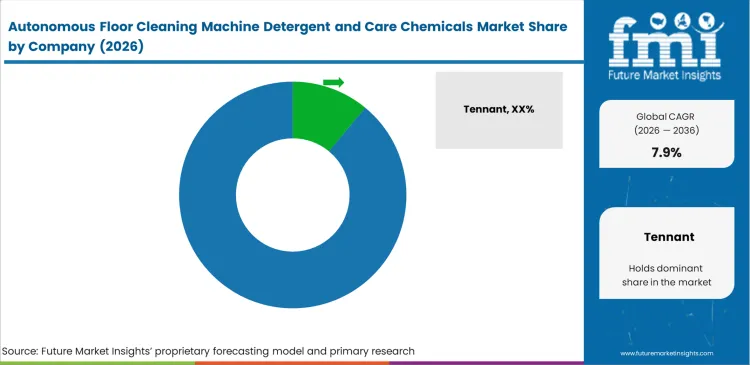
Chemical manufacturers dominating institutional sanitation embed themselves deeply into facility operations, moving far beyond basic material supply. Securing Tennant robotic scrubber detergents or Ecolab low foam floor cleaner for auto scrubbers ensures enterprise-level agreements by engineering proprietary chemical cartridges that integrate directly into the base of autonomous scrubbers. This physical hardware integration establishes massive switching barriers for building service contractors. Directors exploring alternative robotic scrubber detergent manufacturers must carefully calculate the costs of voiding manufacturer warranties, retraining entire robotics supervision teams, and navigating temporary operational disruptions. These formidable transition expenses effectively secure highly lucrative, decade-long industrial institutional chemicals agreements.
Startups formulating innovative sustainable floor solutions routinely fail commercial evaluations simply because they lack the engineering partnerships required to certify their fluids for use in specific robotic platforms. Large-scale building service contractors require vendors who can guarantee uninterrupted compliance during sudden regulatory shifts, heavily favoring established multinationals over agile regional chemists. Testing certified scrubber drier chemicals against generic options proves that non-certified solvents rapidly destroy delicate optical components. The ability to supply comprehensive foodservice floor degreasers alongside autonomous floor formulations determines which vendors capture massive corporate lease accounts.
Large property management firms aggressively resist this equipment lock-in by specifying open-source dispensing hardware across their real estate portfolios. Facility directors increasingly demand wall-mounted dilution stations capable of accepting generic concentrate bulk fills, allowing them to instantly switch chemical suppliers if pricing escalates. Institutional buyers evaluate suppliers based heavily on their ability to deliver bio based cleaning chemicals that do not trigger onboard sensor faults. The technical challenge remains balancing aggressive soil removal with absolute machine safety. Robotics teams working in confined spaces cannot utilize washing machine cleaners style aggressive descalers that require extreme flushing protocols.
Key Players in Autonomous Floor Cleaning Machine Detergent and Care Chemicals Market
- Tennant
- Ecolab
- Diversey / TASKI
- Nilfisk
- Kärcher
- Betco
- Canberra / Husky
Scope of the Report
| Metric | Value |
|---|---|
| Quantitative Units | USD 0.9 billion to USD 1.8 billion, at a CAGR of 7.9% |
| Market Definition | Institutional-grade sanitation agents formulated specifically to operate within robotic scrubber architecture. |
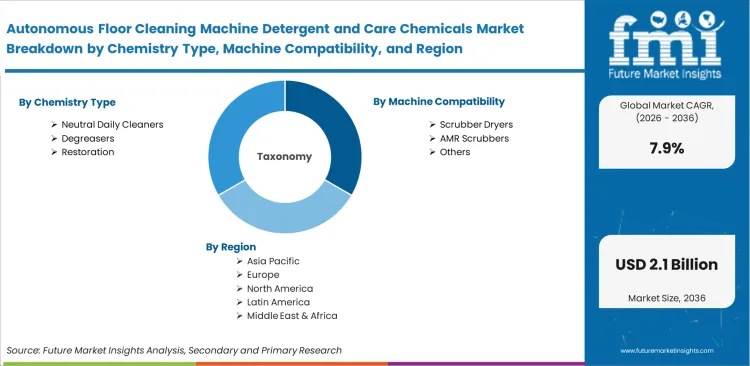
| Segmentation | Chemistry Type, Machine Compatibility, Delivery Format, End-Use Facility, Care-Chemical Function |
| Regions Covered | North America, Latin America, Western Europe, Eastern Europe, Asia Pacific, Middle East and Africa |
| Countries Covered | United States, Canada, Brazil, Mexico, Germany, United Kingdom, France, Spain, Italy, Russia, China, Japan, India, South Korea, Australia, Saudi Arabia, United Arab Emirates, South Africa |
| Key Companies Profiled | Tennant, Ecolab, Diversey / TASKI, Nilfisk, Kärcher, Betco, Canberra / Husky |
| Forecast Period | 2026 to 2036 |
| Approach | Commercial building square footage mapped against baseline robotic fleet chemical consumption rates adjusted for closed-loop dilution ratios. |
Source: Future Market Insights (FMI) analysis, based on proprietary forecasting model and primary research
Autonomous Floor Cleaning Machine Detergent and Care Chemicals Market Analysis by Segments
Chemistry Type:
- Neutral Cleaners
- Degreasers
- Restoration
- Tank Care
- Surface Care
Machine Compatibility:
- Scrubber Dryers
- AMR Scrubbers
- Vacuum Scrubbers
- Service Robots
Delivery Format:
- Concentrates
- Dilution Cartridges
- RTU Packs
- Closed-Loop Dispensing
End-Use Facility:
- Warehouses Logistics
- Airports Transit
- Retail Centres
- Healthcare
- Offices Campuses
Care-Chemical Function:
- Floor Cleaning
- Tank Maintenance
- Descaling
- Odor Care
- Surface Protection
Region:
- North America
- Latin America
- Western Europe
- Eastern Europe
- Asia Pacific
- Middle East and Africa
Bibliography
- Tennant Company. (2026). Industrial floor cleaning solutions & detergents.
- Green Seal. (2025, March 11). GS-40: Floor-care products for industrial and institutional use.
- NHS England. (2025). National standards of healthcare cleanliness 2025.
- United States Environmental Protection Agency. (2026, February 10). Safer Choice.
- Ecolab. (2025, May 13). Ecolab delivers once again on its growth and impact performance, new report shows.
This bibliography is provided for reader reference. The full FMI report contains the complete reference list with primary source documentation.
Frequently Asked Questions
How big is the robotic floor scrubber detergents sector?
The valuation stood at USD 0.8 billion in 2025. Projections indicate total sales will cross USD 0.9 billion in 2026, steadily advancing to reach USD 1.8 billion by 2036.
What is the robotic scrubber detergent size and expected growth?
The space is expected to expand at a 7.9% compound annual growth rate through 2036 as real estate portfolios mandate autonomous cleaning integration to offset chronic labor shortages.
Explain the autonomous scrubber chemicals space?
This category encompasses institutional-grade sanitation agents formulated specifically to operate within robotic scrubber architecture. Products include sensor-safe degreasers, ultra-low foam daily cleaners, and internal tank maintenance treatments designed to prevent biofouling inside automated recovery systems.
Why do low-foam detergents dominate this category?
Excessive suds visibly degrade vacuum recovery motors and blind optical guidance sensors daily. Formulators increasingly rely on specialized low-foaming chemistry to balance soil removal power with internal machine safety limits.
Which machine type drives the most chemical demand?
Autonomous scrubber dryers capture 46.0% share. Property management firms aggressively scale their automated janitorial fleets to offset labor shortages, requiring massive daily volumes of compatible fluid to keep machines operational across multiple shifts.
Which facilities use robotic floor-care chemicals the most?
Warehouses and logistics facilities account for 27.0% share, reflecting massive open concrete expanses requiring constant maintenance without interrupting active forklift traffic.
How do autonomous systems change detergent consumption?
Standardized dosing cartridges eliminate manual mixing errors, drastically reducing total solvent consumption while guaranteeing compliance with strict warranty terms governing high-traffic autonomous deployments.
What limits market growth despite rising robot adoption?
Hard water chemistry interactions create severe operational friction for low-foam biodegradable surfactants. Magnesium and calcium ions naturally present in municipal water supplies bind aggressively with plant-based cleaning agents, preventing adequate soil emulsification and leaving dull residues.
Who are the major suppliers in this niche?
Tennant holds an estimated 12.0% share, alongside Ecolab, Diversey / TASKI, Nilfisk, and Kärcher. Manufacturers install proprietary, cloud-connected dilution equipment directly into robotic plumbing infrastructure to secure long-term enterprise contracts.
What is the difference between floor-care chemicals for manual scrubbers and autonomous scrubbers?
Traditional manual scrubber fluids often contain aggressive petrochemical solvents that provoke immediate internal sensor failures and void manufacturer warranties on robotic units. Autonomous fluids must meet strict viscosity tolerances and feature absolute foam suppression to protect delicate navigational hardware.
Preview the report firsthand - request a free sample
Get SampleGet the brochure for pricing and purchase details.
Get PDFTable of Content
- Executive Summary
- Global Market Outlook
- Demand-side Trends
- Supply-side Trends
- Technology Roadmap Analysis
- Analysis and Recommendations
- Market Overview
- Market Coverage / Taxonomy
- Market Definition / Scope / Limitations
- Research Methodology
- Chapter Orientation
- Analytical Lens and Working Hypotheses
- Market Structure, Signals, and Trend Drivers
- Benchmarking and Cross-market Comparability
- Market Sizing, Forecasting, and Opportunity Mapping
- Research Design and Evidence Framework
- Desk Research Programme (Secondary Evidence)
- Company Annual and Sustainability Reports
- Peer-reviewed Journals and Academic Literature
- Corporate Websites, Product Literature, and Technical Notes
- Earnings Decks and Investor Briefings
- Statutory Filings and Regulatory Disclosures
- Technical White Papers and Standards Notes
- Trade Journals, Industry Magazines, and Analyst Briefs
- Conference Proceedings, Webinars, and Seminar Materials
- Government Statistics Portals and Public Data Releases
- Press Releases and Reputable Media Coverage
- Specialist Newsletters and Curated Briefings
- Sector Databases and Reference Repositories
- FMI Internal Proprietary Databases and Historical Market Datasets
- Subscription Datasets and Paid Sources
- Social Channels, Communities, and Digital Listening Inputs
- Additional Desk Sources
- Expert Input and Fieldwork (Primary Evidence)
- Primary Modes
- Qualitative Interviews and Expert Elicitation
- Quantitative Surveys and Structured Data Capture
- Blended Approach
- Why Primary Evidence is Used
- Field Techniques
- Interviews
- Surveys
- Focus Groups
- Observational and In-context Research
- Social and Community Interactions
- Stakeholder Universe Engaged
- C-suite Leaders
- Board Members
- Presidents and Vice Presidents
- R&D and Innovation Heads
- Technical Specialists
- Domain Subject-matter Experts
- Scientists
- Physicians and Other Healthcare Professionals
- Governance, Ethics, and Data Stewardship
- Research Ethics
- Data Integrity and Handling
- Primary Modes
- Tooling, Models, and Reference Databases
- Desk Research Programme (Secondary Evidence)
- Data Engineering and Model Build
- Data Acquisition and Ingestion
- Cleaning, Normalisation, and Verification
- Synthesis, Triangulation, and Analysis
- Quality Assurance and Audit Trail
- Market Background
- Market Dynamics
- Drivers
- Restraints
- Opportunity
- Trends
- Scenario Forecast
- Demand in Optimistic Scenario
- Demand in Likely Scenario
- Demand in Conservative Scenario
- Opportunity Map Analysis
- Product Life Cycle Analysis
- Supply Chain Analysis
- Investment Feasibility Matrix
- Value Chain Analysis
- PESTLE and Porter’s Analysis
- Regulatory Landscape
- Regional Parent Market Outlook
- Production and Consumption Statistics
- Import and Export Statistics
- Market Dynamics
- Global Market Analysis 2021 to 2025 and Forecast, 2026 to 2036
- Historical Market Size Value (USD Million) Analysis, 2021 to 2025
- Current and Future Market Size Value (USD Million) Projections, 2026 to 2036
- Y-o-Y Growth Trend Analysis
- Absolute $ Opportunity Analysis
- Global Market Pricing Analysis 2021 to 2025 and Forecast 2026 to 2036
- Global Market Analysis 2021 to 2025 and Forecast 2026 to 2036, By Chemistry Type
- Introduction / Key Findings
- Historical Market Size Value (USD Million) Analysis By Chemistry Type , 2021 to 2025
- Current and Future Market Size Value (USD Million) Analysis and Forecast By Chemistry Type , 2026 to 2036
- Neutral Daily Cleaners
- Degreasers
- Restoration
- Neutral Daily Cleaners
- Y-o-Y Growth Trend Analysis By Chemistry Type , 2021 to 2025
- Absolute $ Opportunity Analysis By Chemistry Type , 2026 to 2036
- Global Market Analysis 2021 to 2025 and Forecast 2026 to 2036, By Machine Compatibility
- Introduction / Key Findings
- Historical Market Size Value (USD Million) Analysis By Machine Compatibility, 2021 to 2025
- Current and Future Market Size Value (USD Million) Analysis and Forecast By Machine Compatibility, 2026 to 2036
- Scrubber Dryers
- AMR Scrubbers
- Others
- Scrubber Dryers
- Y-o-Y Growth Trend Analysis By Machine Compatibility, 2021 to 2025
- Absolute $ Opportunity Analysis By Machine Compatibility, 2026 to 2036
- Global Market Analysis 2021 to 2025 and Forecast 2026 to 2036, By Delivery Format
- Introduction / Key Findings
- Historical Market Size Value (USD Million) Analysis By Delivery Format, 2021 to 2025
- Current and Future Market Size Value (USD Million) Analysis and Forecast By Delivery Format, 2026 to 2036
- Concentrates
- Dilution Cartridges
- Others
- Concentrates
- Y-o-Y Growth Trend Analysis By Delivery Format, 2021 to 2025
- Absolute $ Opportunity Analysis By Delivery Format, 2026 to 2036
- Global Market Analysis 2021 to 2025 and Forecast 2026 to 2036, By End-Use Facility
- Introduction / Key Findings
- Historical Market Size Value (USD Million) Analysis By End-Use Facility, 2021 to 2025
- Current and Future Market Size Value (USD Million) Analysis and Forecast By End-Use Facility, 2026 to 2036
- Warehouses & Logistics
- Airports Transit
- Others
- Warehouses & Logistics
- Y-o-Y Growth Trend Analysis By End-Use Facility, 2021 to 2025
- Absolute $ Opportunity Analysis By End-Use Facility, 2026 to 2036
- Global Market Analysis 2021 to 2025 and Forecast 2026 to 2036, By Care-Chemical Function
- Introduction / Key Findings
- Historical Market Size Value (USD Million) Analysis By Care-Chemical Function, 2021 to 2025
- Current and Future Market Size Value (USD Million) Analysis and Forecast By Care-Chemical Function, 2026 to 2036
- Floor Cleaning
- Tank Maintenance
- Others
- Floor Cleaning
- Y-o-Y Growth Trend Analysis By Care-Chemical Function, 2021 to 2025
- Absolute $ Opportunity Analysis By Care-Chemical Function, 2026 to 2036
- Global Market Analysis 2021 to 2025 and Forecast 2026 to 2036, By Region
- Introduction
- Historical Market Size Value (USD Million) Analysis By Region, 2021 to 2025
- Current Market Size Value (USD Million) Analysis and Forecast By Region, 2026 to 2036
- North America
- Latin America
- Western Europe
- Eastern Europe
- East Asia
- South Asia and Pacific
- Middle East & Africa
- Market Attractiveness Analysis By Region
- North America Market Analysis 2021 to 2025 and Forecast 2026 to 2036, By Country
- Historical Market Size Value (USD Million) Trend Analysis By Market Taxonomy, 2021 to 2025
- Market Size Value (USD Million) Forecast By Market Taxonomy, 2026 to 2036
- By Country
- USA
- Canada
- Mexico
- By Chemistry Type
- By Machine Compatibility
- By Delivery Format
- By End-Use Facility
- By Care-Chemical Function
- By Country
- Market Attractiveness Analysis
- By Country
- By Chemistry Type
- By Machine Compatibility
- By Delivery Format
- By End-Use Facility
- By Care-Chemical Function
- Key Takeaways
- Latin America Market Analysis 2021 to 2025 and Forecast 2026 to 2036, By Country
- Historical Market Size Value (USD Million) Trend Analysis By Market Taxonomy, 2021 to 2025
- Market Size Value (USD Million) Forecast By Market Taxonomy, 2026 to 2036
- By Country
- Brazil
- Chile
- Rest of Latin America
- By Chemistry Type
- By Machine Compatibility
- By Delivery Format
- By End-Use Facility
- By Care-Chemical Function
- By Country
- Market Attractiveness Analysis
- By Country
- By Chemistry Type
- By Machine Compatibility
- By Delivery Format
- By End-Use Facility
- By Care-Chemical Function
- Key Takeaways
- Western Europe Market Analysis 2021 to 2025 and Forecast 2026 to 2036, By Country
- Historical Market Size Value (USD Million) Trend Analysis By Market Taxonomy, 2021 to 2025
- Market Size Value (USD Million) Forecast By Market Taxonomy, 2026 to 2036
- By Country
- Germany
- UK
- Italy
- Spain
- France
- Nordic
- BENELUX
- Rest of Western Europe
- By Chemistry Type
- By Machine Compatibility
- By Delivery Format
- By End-Use Facility
- By Care-Chemical Function
- By Country
- Market Attractiveness Analysis
- By Country
- By Chemistry Type
- By Machine Compatibility
- By Delivery Format
- By End-Use Facility
- By Care-Chemical Function
- Key Takeaways
- Eastern Europe Market Analysis 2021 to 2025 and Forecast 2026 to 2036, By Country
- Historical Market Size Value (USD Million) Trend Analysis By Market Taxonomy, 2021 to 2025
- Market Size Value (USD Million) Forecast By Market Taxonomy, 2026 to 2036
- By Country
- Russia
- Poland
- Hungary
- Balkan & Baltic
- Rest of Eastern Europe
- By Chemistry Type
- By Machine Compatibility
- By Delivery Format
- By End-Use Facility
- By Care-Chemical Function
- By Country
- Market Attractiveness Analysis
- By Country
- By Chemistry Type
- By Machine Compatibility
- By Delivery Format
- By End-Use Facility
- By Care-Chemical Function
- Key Takeaways
- East Asia Market Analysis 2021 to 2025 and Forecast 2026 to 2036, By Country
- Historical Market Size Value (USD Million) Trend Analysis By Market Taxonomy, 2021 to 2025
- Market Size Value (USD Million) Forecast By Market Taxonomy, 2026 to 2036
- By Country
- China
- Japan
- South Korea
- By Chemistry Type
- By Machine Compatibility
- By Delivery Format
- By End-Use Facility
- By Care-Chemical Function
- By Country
- Market Attractiveness Analysis
- By Country
- By Chemistry Type
- By Machine Compatibility
- By Delivery Format
- By End-Use Facility
- By Care-Chemical Function
- Key Takeaways
- South Asia and Pacific Market Analysis 2021 to 2025 and Forecast 2026 to 2036, By Country
- Historical Market Size Value (USD Million) Trend Analysis By Market Taxonomy, 2021 to 2025
- Market Size Value (USD Million) Forecast By Market Taxonomy, 2026 to 2036
- By Country
- India
- ASEAN
- Australia & New Zealand
- Rest of South Asia and Pacific
- By Chemistry Type
- By Machine Compatibility
- By Delivery Format
- By End-Use Facility
- By Care-Chemical Function
- By Country
- Market Attractiveness Analysis
- By Country
- By Chemistry Type
- By Machine Compatibility
- By Delivery Format
- By End-Use Facility
- By Care-Chemical Function
- Key Takeaways
- Middle East & Africa Market Analysis 2021 to 2025 and Forecast 2026 to 2036, By Country
- Historical Market Size Value (USD Million) Trend Analysis By Market Taxonomy, 2021 to 2025
- Market Size Value (USD Million) Forecast By Market Taxonomy, 2026 to 2036
- By Country
- Kingdom of Saudi Arabia
- Other GCC Countries
- Turkiye
- South Africa
- Other African Union
- Rest of Middle East & Africa
- By Chemistry Type
- By Machine Compatibility
- By Delivery Format
- By End-Use Facility
- By Care-Chemical Function
- By Country
- Market Attractiveness Analysis
- By Country
- By Chemistry Type
- By Machine Compatibility
- By Delivery Format
- By End-Use Facility
- By Care-Chemical Function
- Key Takeaways
- Key Countries Market Analysis
- USA
- Pricing Analysis
- Market Share Analysis, 2025
- By Chemistry Type
- By Machine Compatibility
- By Delivery Format
- By End-Use Facility
- By Care-Chemical Function
- Canada
- Pricing Analysis
- Market Share Analysis, 2025
- By Chemistry Type
- By Machine Compatibility
- By Delivery Format
- By End-Use Facility
- By Care-Chemical Function
- Mexico
- Pricing Analysis
- Market Share Analysis, 2025
- By Chemistry Type
- By Machine Compatibility
- By Delivery Format
- By End-Use Facility
- By Care-Chemical Function
- Brazil
- Pricing Analysis
- Market Share Analysis, 2025
- By Chemistry Type
- By Machine Compatibility
- By Delivery Format
- By End-Use Facility
- By Care-Chemical Function
- Chile
- Pricing Analysis
- Market Share Analysis, 2025
- By Chemistry Type
- By Machine Compatibility
- By Delivery Format
- By End-Use Facility
- By Care-Chemical Function
- Germany
- Pricing Analysis
- Market Share Analysis, 2025
- By Chemistry Type
- By Machine Compatibility
- By Delivery Format
- By End-Use Facility
- By Care-Chemical Function
- UK
- Pricing Analysis
- Market Share Analysis, 2025
- By Chemistry Type
- By Machine Compatibility
- By Delivery Format
- By End-Use Facility
- By Care-Chemical Function
- Italy
- Pricing Analysis
- Market Share Analysis, 2025
- By Chemistry Type
- By Machine Compatibility
- By Delivery Format
- By End-Use Facility
- By Care-Chemical Function
- Spain
- Pricing Analysis
- Market Share Analysis, 2025
- By Chemistry Type
- By Machine Compatibility
- By Delivery Format
- By End-Use Facility
- By Care-Chemical Function
- France
- Pricing Analysis
- Market Share Analysis, 2025
- By Chemistry Type
- By Machine Compatibility
- By Delivery Format
- By End-Use Facility
- By Care-Chemical Function
- India
- Pricing Analysis
- Market Share Analysis, 2025
- By Chemistry Type
- By Machine Compatibility
- By Delivery Format
- By End-Use Facility
- By Care-Chemical Function
- ASEAN
- Pricing Analysis
- Market Share Analysis, 2025
- By Chemistry Type
- By Machine Compatibility
- By Delivery Format
- By End-Use Facility
- By Care-Chemical Function
- Australia & New Zealand
- Pricing Analysis
- Market Share Analysis, 2025
- By Chemistry Type
- By Machine Compatibility
- By Delivery Format
- By End-Use Facility
- By Care-Chemical Function
- China
- Pricing Analysis
- Market Share Analysis, 2025
- By Chemistry Type
- By Machine Compatibility
- By Delivery Format
- By End-Use Facility
- By Care-Chemical Function
- Japan
- Pricing Analysis
- Market Share Analysis, 2025
- By Chemistry Type
- By Machine Compatibility
- By Delivery Format
- By End-Use Facility
- By Care-Chemical Function
- South Korea
- Pricing Analysis
- Market Share Analysis, 2025
- By Chemistry Type
- By Machine Compatibility
- By Delivery Format
- By End-Use Facility
- By Care-Chemical Function
- Russia
- Pricing Analysis
- Market Share Analysis, 2025
- By Chemistry Type
- By Machine Compatibility
- By Delivery Format
- By End-Use Facility
- By Care-Chemical Function
- Poland
- Pricing Analysis
- Market Share Analysis, 2025
- By Chemistry Type
- By Machine Compatibility
- By Delivery Format
- By End-Use Facility
- By Care-Chemical Function
- Hungary
- Pricing Analysis
- Market Share Analysis, 2025
- By Chemistry Type
- By Machine Compatibility
- By Delivery Format
- By End-Use Facility
- By Care-Chemical Function
- Kingdom of Saudi Arabia
- Pricing Analysis
- Market Share Analysis, 2025
- By Chemistry Type
- By Machine Compatibility
- By Delivery Format
- By End-Use Facility
- By Care-Chemical Function
- Turkiye
- Pricing Analysis
- Market Share Analysis, 2025
- By Chemistry Type
- By Machine Compatibility
- By Delivery Format
- By End-Use Facility
- By Care-Chemical Function
- South Africa
- Pricing Analysis
- Market Share Analysis, 2025
- By Chemistry Type
- By Machine Compatibility
- By Delivery Format
- By End-Use Facility
- By Care-Chemical Function
- USA
- Market Structure Analysis
- Competition Dashboard
- Competition Benchmarking
- Market Share Analysis of Top Players
- By Region
- By Chemistry Type
- By Machine Compatibility
- By Delivery Format
- By End-Use Facility
- By Care-Chemical Function
- Competition Analysis
- Competition Deep Dive
- Tennant
- Overview
- Product Portfolio
- Profitability by Market Segments (Product/Age /Sales Channel/Region)
- Sales Footprint
- Strategy Overview
- Marketing Strategy
- Product Strategy
- Channel Strategy
- Ecolab
- Diversey / TASKI
- Nilfisk
- Kärcher
- Betco
- Tennant
- Competition Deep Dive
- Assumptions & Acronyms Used


