

- Industry Size (2026)
- USD 161.1 Mn
- Forecast (2036)
- USD 402.9 Mn
- CAGR (2026 to 2036)
- 9.6%
Bio-Based Cleaning Chemicals for Solar Panels Market Forecast and Outlook 2026 to 2036
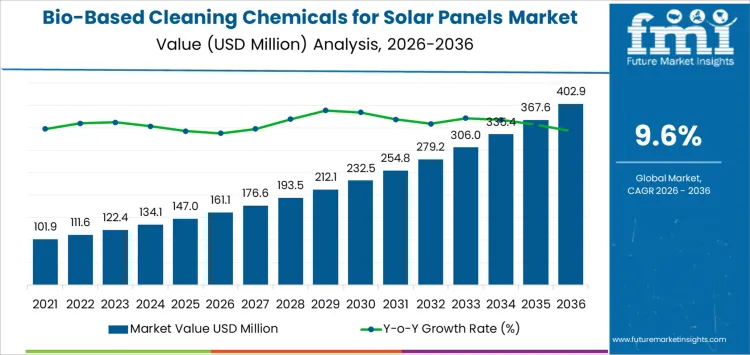
The global bio-based cleaning chemicals for solar panels market is expanding, with a market value of USD 161.1 million in 2026, projected to reach at USD 402.9 million by 2036, growing at a CAGR of 9.6%. The adoption of eco-friendly alternatives to traditional cleaning chemicals is gaining momentum as solar installations rise globally. Among the key formulations, biodegradable surfactant concentrates (plant-based) dominate the market, holding a 30% share due to their effectiveness and environmental safety. Other notable formulations include enzymatic cleaners, waterless polymeric fluids, and solvent-free gel cleaners, each contributing to more sustainable and efficient solar panel maintenance.
Quick Stats for Bio-Based Cleaning Chemicals for Solar Panels Market
- Bio-Based Cleaning Chemicals for Solar Panels Market Value (2026): USD 161.1 million
- Bio-Based Cleaning Chemicals for Solar Panels Market Forecast Value (2036): USD 402.9 million
- Bio-Based Cleaning Chemicals for Solar Panels Market Forecast CAGR: 9.6%
- Leading Formulation / Chemistry in Bio-Based Cleaning Chemicals for Solar Panels Market: Biodegradable surfactant concentrates (plant-based)
- Key Growth Regions in Bio-Based Cleaning Chemicals for Solar Panels Market: Asia Pacific, Europe, North America
- Top Players in Bio-Based Cleaning Chemicals for Solar Panels Market: Ecolab, Emil Otto, Verteco / Lavee, IPC, WattUp, Ecoppia
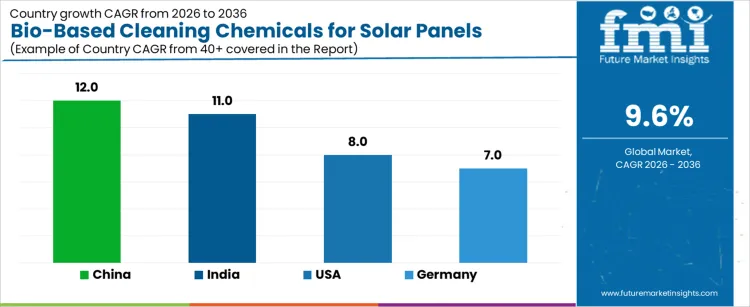
In terms of application methods, manual spray & rinse by contract crews holds the largest share (32%) due to its widespread use, especially in residential and commercial rooftops. Automated systems, such as robotic and vehicle-mounted wash systems, are also growing in adoption, providing cost-effective solutions for large-scale operations. Regionally, China leads with a 12.0% CAGR, driven by its extensive solar energy infrastructure and increasing demand for eco-friendly cleaning solutions. India follows closely with an 11.0% growth rate, fueled by its rapid solar energy adoption and a push for sustainable technologies. The United States and Germany also show strong growth, supported by favorable government policies and rising awareness about the environmental impact of traditional cleaning methods. As the solar energy market continues to grow, the demand for bio-based cleaning chemicals will remain robust, contributing to a cleaner, more sustainable energy future.
Bio-Based Cleaning Chemicals for Solar Panels Market Key Takeaways
| Metric | Value |
|---|---|
| Industry Value (2026) | USD 161.1 million |
| Forecast Value (2036) | USD 402.9 million |
| Forecast CAGR (2026 to 2036) | 9.6% |
How is the Global Bio-Based Cleaning Chemicals for Solar Panels Sector Advancing?
The global bio-based cleaning chemicals for solar panels market is growing rapidly due to the increasing demand for sustainable cleaning solutions in the renewable energy sector. Solar panels, which are critical for clean energy production, require regular maintenance to ensure optimal efficiency. Traditional cleaning chemicals can have negative environmental impacts, leading to the rise of bio-based alternatives that are non-toxic, biodegradable, and effective in removing dirt, dust, and debris from solar panels. These eco-friendly solutions are gaining traction as industries and governments push for greener, more sustainable cleaning methods.
The market for bio-based cleaning chemicals for solar panels is expected to continue growing, driven by the expansion of the solar energy sector and the global push for renewable energy adoption. As solar installations increase worldwide, the need for efficient and environmentally friendly maintenance solutions will also rise. Innovations in bio-based cleaning technologies will enhance their effectiveness and appeal, with a growing focus on improving cleaning performance while minimizing environmental impact. Challenges such as cost considerations, scaling up production, and regional adoption may affect market growth. Despite these challenges, the demand for sustainable cleaning chemicals in the solar industry will continue to drive the market forward as sustainability becomes an increasingly important priority.
What Is the Segment-Wise Analysis for the Global Bio-Based Cleaning Chemicals for Solar Panels Market?
The global bio-based cleaning chemicals for solar panels market is driven by formulation/chemistry and application methods. Biodegradable surfactant concentrates (plant-based) lead the market with a 30% share due to their effectiveness in cleaning solar panels while being environmentally friendly. Other significant chemistries include enzymatic/bio-catalytic cleaners, waterless/ polymeric waterless cleaning fluids, organic acid/ chelant blends, solvent-free foam & gel cleaners, and anti-soiling/hydrophilic bio-coatings. In terms of application methods, manual spray & rinse by contract crews holds the largest share at 32%, followed by automated vehicle/truck-mounted wash systems, robotic/autonomous waterless systems, on-module pre-treatment, and dry wipe/brush systems.
Why Do Biodegradable Surfactant Concentrates (Plant-Based) Lead the Global Bio-Based Cleaning Chemicals Market?
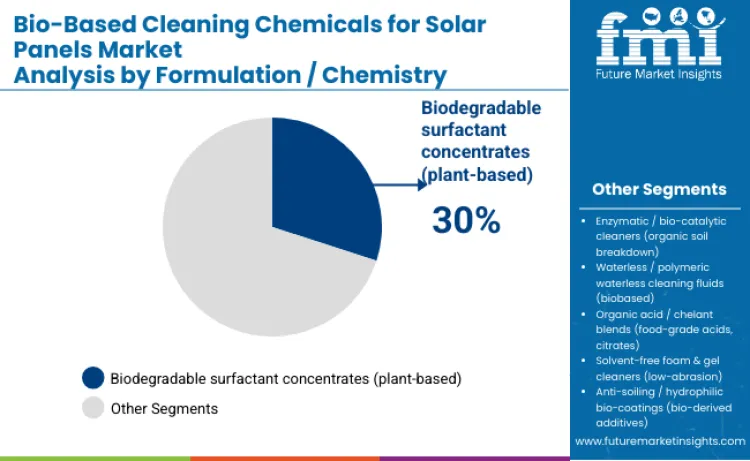
Biodegradable surfactant concentrates (plant-based) lead the global bio-based cleaning chemicals for solar panels market with a 30% share due to their eco-friendly nature and effectiveness in breaking down dirt and organic matter without harming the environment. These surfactants are made from renewable plant sources, making them a sustainable option for cleaning solar panels. As environmental concerns rise, the demand for cleaning chemicals that do not negatively impact ecosystems and that are safe for both humans and the environment has surged. These biodegradable concentrates help meet the growing demand for environmentally responsible cleaning solutions while ensuring the panels' efficiency and longevity.
Why Does Manual Spray & Rinse Hold the Largest Market Share in the Bio-Based Cleaning Chemicals Market?
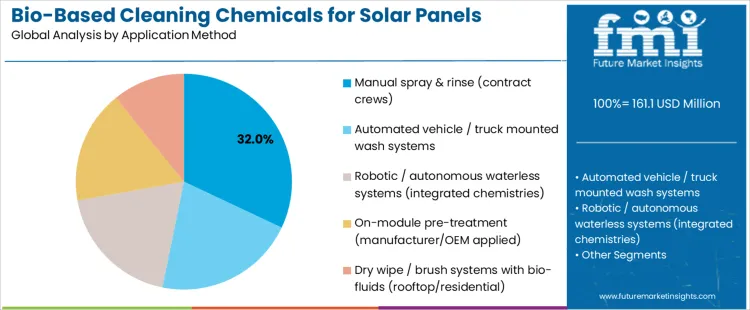
Manual spray & rinse by contract crews holds the largest market share at 32% in the global bio-based cleaning chemicals for solar panels market due to its widespread use in the field and its effectiveness in various environments, including residential and commercial rooftops. This method offers flexibility, allowing cleaning contractors to apply cleaning solutions directly to solar panels, ensuring thorough cleaning and optimal performance. While other automated systems are emerging, manual cleaning remains a cost-effective, easy-to-implement solution, particularly for small-scale operations and residential properties, where specialized equipment is less commonly used.
What is Shaping the Bio-Based Cleaning Chemicals for Solar Panels Market?
The bio based cleaning chemicals for solar panels market is shaped by the increasing global deployment of solar energy systems and the rising need to maintain peak energy production efficiency. Solar panels accumulate dust, dirt, bird droppings, and other contaminants that reduce performance, driving demand for effective cleaning solutions. Traditional cleaners often contain harsh chemicals that can damage panel coatings and harm the environment. Bio based cleaning chemicals, derived from renewable sources and formulated to be biodegradable and non toxic, are gaining preference as they offer effective cleaning while aligning with sustainability goals in renewable energy.
What Challenges Are Limiting the Adoption of Bio Based Cleaning Chemicals for Solar Panels? Adoption is constrained by perceptions around performance and cost. Some operators believe that traditional chemical cleaners may be more potent or faster acting, especially in heavy soiling conditions, creating hesitation toward bio based alternatives. Bio based formulations can also carry higher upfront prices compared with commodity chemical cleaners, making budget sensitive solar operations cautious about switching. Limited awareness of the long term benefits of bio based solutions and variability in product effectiveness across different climates or contaminants can further slow adoption. Availability and distribution challenges in certain regions also pose barriers.
What Key Trends Are Shaping the Bio Based Cleaning Chemicals for Solar Panels Market?
Key trends include the development of tailored bio based formulations optimized for different soiling conditions, such as desert dust, industrial smog, or salt spray in coastal regions. There is rising use of concentrated and water efficient formulations compatible with automated cleaning systems and robotics, addressing water scarcity concerns. Manufacturers are focusing on renewable feedstocks, reduced packaging waste, and cleaner production methods to boost sustainability credentials. Partnerships between cleaning chemical producers and solar maintenance service providers are increasing, as integrated solutions become more attractive for large solar portfolios. Incentives and sustainability reporting requirements are encouraging operators to adopt greener cleaning practices.
What is the Growth Outlook for the Bio-Based Cleaning Chemicals for Solar Panels Market by Country?
| Country | CAGR (%) |
|---|---|
| China | 12.0% |
| India | 11.0% |
| USA | 8.0% |
| Germany | 7.0% |
The bio-based cleaning chemicals for solar panels market is experiencing robust growth, with China leading at a 12.0% CAGR, driven by the country’s large-scale solar energy installations and growing demand for environmentally friendly cleaning solutions. India follows closely at 11.0%, supported by rapid solar energy adoption and increased awareness of sustainable maintenance practices. The USA shows steady growth at 8.0%, driven by the rise in solar panel installations and the shift toward greener cleaning technologies. Germany’s market grows at 7.0%, backed by a strong focus on renewable energy and eco-friendly solutions.
Why is China Leading in the Bio-Based Cleaning Chemicals for Solar Panels Market?
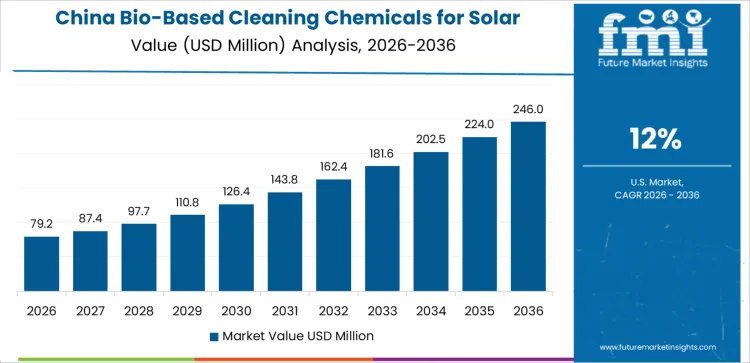
China’s bio-based cleaning chemicals for solar panels market is growing at 12.0%, driven by the country’s leadership in solar panel installations and commitment to clean energy. As the world’s largest producer of solar panels and one of the biggest solar energy markets, China is increasingly adopting eco-friendly maintenance solutions, including bio-based cleaning chemicals. The Chinese government’s support for renewable energy and green technologies, along with the rapid growth of solar farms, is fueling the demand for sustainable cleaning solutions. China’s focus on reducing the environmental impact of industrial processes is driving the adoption of bio-based cleaners. As China continues to lead the global renewable energy transition, the market for bio-based cleaning chemicals in the solar industry is set for continued growth.
What is Contributing to the Growth of the Bio-Based Cleaning Chemicals for Solar Panels Market in India?
India’s bio-based cleaning chemicals for solar panels market is growing at 11.0%, supported by the country’s expanding solar energy capacity and increasing adoption of sustainable technologies. India is one of the fastest-growing markets for solar power, and as solar installations rise, there is a growing need for eco-friendly maintenance solutions. Bio-based cleaning chemicals, which offer effective and environmentally safe cleaning of solar panels, are gaining popularity as part of India’s push for green technologies. The government’s initiatives to promote renewable energy and solar energy adoption further drive the demand for these solutions. With growing awareness of sustainability and cleaner technologies, the market for bio-based cleaning chemicals in India is expected to grow rapidly.
How is the Bio-Based Cleaning Chemicals for Solar Panels Market Expanding in the United States?
The United States’ bio-based cleaning chemicals for solar panels market is growing at 8.0%, driven by the increasing adoption of solar energy and a growing focus on environmentally friendly maintenance solutions. As the USA continues to invest in renewable energy, the demand for sustainable cleaning chemicals for solar panels is rising. The shift toward bio-based solutions, which are less harmful to the environment and provide effective cleaning, is aligned with the growing preference for green technologies. Government incentives and regulations promoting renewable energy and energy efficiency also contribute to the demand for eco-friendly cleaning chemicals in the solar industry. As solar power adoption continues to rise, the market for bio-based cleaning chemicals in the USA is expected to expand steadily.
What is Driving the Bio-Based Cleaning Chemicals for Solar Panels Market in Germany?
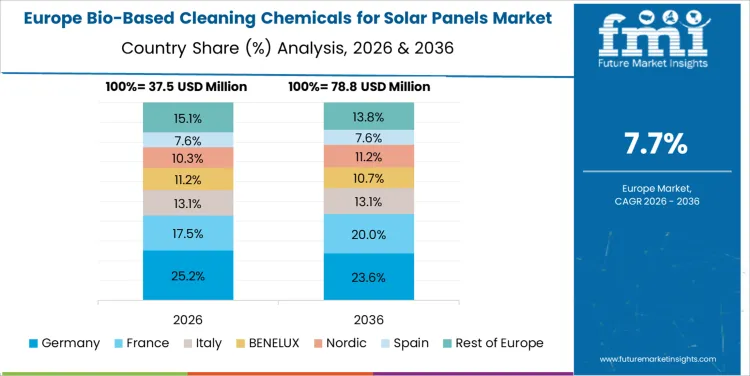
Germany’s bio-based cleaning chemicals for solar panels market is growing at 7.0%, driven by the country’s strong commitment to renewable energy and sustainability. Germany is a leader in solar energy adoption, and as solar installations increase, there is rising demand for eco-friendly cleaning solutions. The German market is focusing on reducing environmental impacts across all sectors, and the solar industry is no exception. Bio-based cleaning chemicals are gaining traction as they offer effective and sustainable cleaning solutions that align with Germany’s environmental goals. As Germany continues to push for cleaner energy solutions and green technologies, the demand for bio-based cleaning chemicals for solar panels is expected to grow steadily, fueled by both government policies and consumer preferences for eco-conscious products.
How are Companies Competing in the Bio‑Based Cleaning Chemicals for Solar Panels Market?
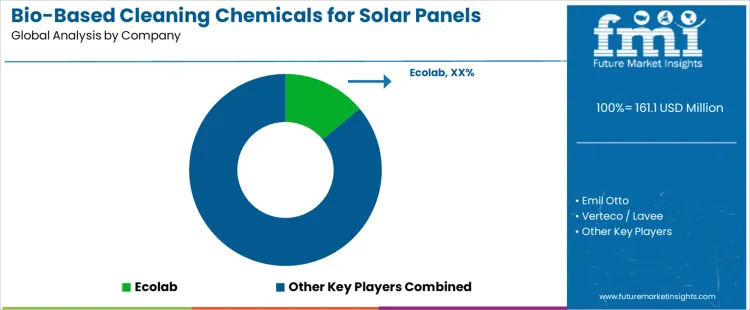
Ecolab, Emil Otto, Verteco / Lavee, IPC, WattUp, and Ecoppia compete with distinct bio‑based cleaning chemicals and service offerings designed to maintain solar panel performance while minimizing environmental impact. Ecolab’s brochures highlight bio‑based formulations tailored for automated and manual cleaning that remove dust, grime, and residues without harming panel coatings. Emil Otto focuses on high‑quality natural solvent blends with strong cleaning efficacy and low ecological footprint, appealing to large solar farm operators seeking sustainable maintenance solutions. Verteco / Lavee positions its products on biodegradability and compatibility with water‑saving cleaning systems, pitching reduced water use alongside chemical performance. IPC’s materials present eco‑friendly detergents engineered for industrial solar installations, with messaging that emphasizes safety and operational ease for maintenance crews.
WattUp and Ecoppia differentiate through integrated cleaning systems paired with their bio‑based chemistries. WattUp promotes automated cleaning robots and sprays that apply low‑impact chemicals precisely, enabling frequent upkeep that maximizes energy yield. Ecoppia’s collateral showcases autonomous robotic cleaning with proprietary bio‑based agents that reduce manual labor and conserve water, targeting utility‑scale installations in harsh environments. Across all firms, product literature stresses biodegradability, reduced toxicity, and regulatory compliance. Competitive strategies rely on innovation in sustainable formulations, technical support, and clear performance data to influence procurement decisions among solar asset managers prioritizing eco‑friendly operations and long‑term panel efficiency.
Key Players in Bio-Based Cleaning Chemicals for Solar Panels Market
- Ecolab
- Emil Otto
- Verteco / Lavee
- IPC
- WattUp
- Ecoppia
Scope of Report
| Items | Values |
|---|---|
| Quantitative Units (2025) | USD million |
| Application Method | Manual Spray & Rinse (Contract Crews), Automated Vehicle / Truck Mounted Wash Systems, Robotic / Autonomous Waterless Systems (Integrated Chemistries), On-Module Pre-Treatment (Manufacturer/OEM Applied), Dry Wipe / Brush Systems with Bio-Fluids (Rooftop/Residential) |
| Formulation / Chemistry | Biodegradable Surfactant Concentrates (Plant-Based), Enzymatic / Bio-Catalytic Cleaners (Organic Soil Breakdown), Waterless / Polymeric Waterless Cleaning Fluids (Biobased), Organic Acid / Chelant Blends (Food-Grade Acids, Citrates), Solvent-Free Foam & Gel Cleaners (Low-Abrasion), Anti-Soiling / Hydrophilic Bio-Coatings (Bio-Derived Additives) |
| Regions Covered | Asia Pacific, Europe, North America, Latin America, Middle East & Africa |
| Countries Covered | USA, China, Japan, South Korea, India, Australia & New Zealand, ASEAN, Germany, UK, France, Italy, Spain, Nordic, BENELUX, Brazil, Chile, Mexico, Saudi Arabia, Other GCC Countries, Turkey, South Africa, Other African Union |
| Key Companies Profiled | Ecolab, Emil Otto, Verteco / Lavee, IPC, WattUp, Ecoppia |
| Additional Attributes | Dollar sales by formulation/chemistry, application method, and region; regional CAGR and growth outlook; distribution channels including contract crews, OEMs, and robotics systems; innovation trends in biodegradable and enzymatic cleaners; competitive positioning of global vs regional suppliers. |
Bio-Based Cleaning Chemicals for Solar Panels Market by Segments
Formulation / Chemistry
- Biodegradable surfactant concentrates (plant-based)
- Enzymatic / bio-catalytic cleaners (organic soil breakdown)
- Waterless / polymeric waterless cleaning fluids (biobased)
- Organic acid / chelant blends (food-grade acids, citrates)
- Solvent-free foam & gel cleaners (low-abrasion)
- Anti-soiling / hydrophilic bio-coatings (bio-derived additives)
Application Method
- Manual spray & rinse (contract crews)
- Automated vehicle / truck mounted wash systems
- Robotic / autonomous waterless systems (integrated chemistries)
- On-module pre-treatment (manufacturer/OEM applied)
- Dry wipe / brush systems with bio-fluids (rooftop/residential)
Region:
- Asia Pacific
- China
- Japan
- South Korea
- India
- Australia & New Zealand
- ASEAN
- Rest of Asia Pacific
- Europe
- Germany
- United Kingdom
- France
- Italy
- Spain
- Nordic
- BENELUX
- Rest of Europe
- North America
- United States
- Canada
- Mexico
- Latin America
- Brazil
- Chile
- Rest of Latin America
- Middle East & Africa
- Kingdom of Saudi Arabia
- Other GCC Countries
- Turkey
- South Africa
- Other African Union
- Rest of Middle East & Africa
Frequently Asked Questions
How big is the bio-based cleaning chemicals for solar panels market in 2026?
The global bio-based cleaning chemicals for solar panels market is estimated to be valued at USD 161.1 million in 2026.
What will be the size of bio-based cleaning chemicals for solar panels market in 2036?
The market size for the bio-based cleaning chemicals for solar panels market is projected to reach USD 402.9 million by 2036.
How much will be the bio-based cleaning chemicals for solar panels market growth between 2026 and 2036?
The bio-based cleaning chemicals for solar panels market is expected to grow at a 9.6% CAGR between 2026 and 2036.
What are the key product types in the bio-based cleaning chemicals for solar panels market?
The key product types in bio-based cleaning chemicals for solar panels market are biodegradable surfactant concentrates (plant-based), enzymatic / bio-catalytic cleaners (organic soil breakdown), waterless / polymeric waterless cleaning fluids (biobased), organic acid / chelant blends (food-grade acids, citrates), solvent-free foam & gel cleaners (low-abrasion) and anti-soiling / hydrophilic bio-coatings (bio-derived additives).
Which application method segment to contribute significant share in the bio-based cleaning chemicals for solar panels market in 2026?
In terms of application method, manual spray & rinse (contract crews) segment to command 32.0% share in the bio-based cleaning chemicals for solar panels market in 2026.
Preview the report firsthand - request a free sample
Get SampleGet the brochure for pricing and purchase details.
Get PDFTable of Content
- Executive Summary
- Global Market Outlook
- Demand-side Trends
- Supply-side Trends
- Technology Roadmap Analysis
- Analysis and Recommendations
- Market Overview
- Market Coverage / Taxonomy
- Market Definition / Scope / Limitations
- Market Background
- Market Dynamics
- Drivers
- Restraints
- Opportunity
- Trends
- Scenario Forecast
- Demand in Optimistic Scenario
- Demand in Likely Scenario
- Demand in Conservative Scenario
- Opportunity Map Analysis
- Product Life Cycle Analysis
- Supply Chain Analysis
- Investment Feasibility Matrix
- Value Chain Analysis
- PESTLE and Porter’s Analysis
- Regulatory Landscape
- Regional Parent Market Outlook
- Production and Consumption Statistics
- Import and Export Statistics
- Market Dynamics
- Global Market Analysis 2021 to 2025 and Forecast, 2026 to 2036
- Historical Market Size Value (USD Million) Analysis, 2021 to 2025
- Current and Future Market Size Value (USD Million) Projections, 2026 to 2036
- Y-o-Y Growth Trend Analysis
- Absolute $ Opportunity Analysis
- Global Market Pricing Analysis 2021 to 2025 and Forecast 2026 to 2036
- Global Market Analysis 2021 to 2025 and Forecast 2026 to 2036, By Formulation / Chemistry
- Introduction / Key Findings
- Historical Market Size Value (USD Million) Analysis By Formulation / Chemistry , 2021 to 2025
- Current and Future Market Size Value (USD Million) Analysis and Forecast By Formulation / Chemistry , 2026 to 2036
- Biodegradable surfactant concentrates (plant-based)
- Enzymatic / bio-catalytic cleaners (organic soil breakdown)
- Waterless / polymeric waterless cleaning fluids (biobased)
- Organic acid / chelant blends (food-grade acids, citrates)
- Solvent-free foam & gel cleaners (low-abrasion)
- Anti-soiling / hydrophilic bio-coatings (bio-derived additives)
- Y-o-Y Growth Trend Analysis By Formulation / Chemistry , 2021 to 2025
- Absolute $ Opportunity Analysis By Formulation / Chemistry , 2026 to 2036
- Global Market Analysis 2021 to 2025 and Forecast 2026 to 2036, By Application Method
- Introduction / Key Findings
- Historical Market Size Value (USD Million) Analysis By Application Method, 2021 to 2025
- Current and Future Market Size Value (USD Million) Analysis and Forecast By Application Method, 2026 to 2036
- Manual spray & rinse (contract crews)
- Automated vehicle / truck mounted wash systems
- Robotic / autonomous waterless systems (integrated chemistries)
- On-module pre-treatment (manufacturer/OEM applied)
- Dry wipe / brush systems with bio-fluids (rooftop/residential)
- Y-o-Y Growth Trend Analysis By Application Method, 2021 to 2025
- Absolute $ Opportunity Analysis By Application Method, 2026 to 2036
- Global Market Analysis 2021 to 2025 and Forecast 2026 to 2036, By Region
- Introduction
- Historical Market Size Value (USD Million) Analysis By Region, 2021 to 2025
- Current Market Size Value (USD Million) Analysis and Forecast By Region, 2026 to 2036
- North America
- Latin America
- Western Europe
- Eastern Europe
- East Asia
- South Asia and Pacific
- Middle East & Africa
- Market Attractiveness Analysis By Region
- North America Market Analysis 2021 to 2025 and Forecast 2026 to 2036, By Country
- Historical Market Size Value (USD Million) Trend Analysis By Market Taxonomy, 2021 to 2025
- Market Size Value (USD Million) Forecast By Market Taxonomy, 2026 to 2036
- By Country
- USA
- Canada
- Mexico
- By Formulation / Chemistry
- By Application Method
- By Country
- Market Attractiveness Analysis
- By Country
- By Formulation / Chemistry
- By Application Method
- Key Takeaways
- Latin America Market Analysis 2021 to 2025 and Forecast 2026 to 2036, By Country
- Historical Market Size Value (USD Million) Trend Analysis By Market Taxonomy, 2021 to 2025
- Market Size Value (USD Million) Forecast By Market Taxonomy, 2026 to 2036
- By Country
- Brazil
- Chile
- Rest of Latin America
- By Formulation / Chemistry
- By Application Method
- By Country
- Market Attractiveness Analysis
- By Country
- By Formulation / Chemistry
- By Application Method
- Key Takeaways
- Western Europe Market Analysis 2021 to 2025 and Forecast 2026 to 2036, By Country
- Historical Market Size Value (USD Million) Trend Analysis By Market Taxonomy, 2021 to 2025
- Market Size Value (USD Million) Forecast By Market Taxonomy, 2026 to 2036
- By Country
- Germany
- UK
- Italy
- Spain
- France
- Nordic
- BENELUX
- Rest of Western Europe
- By Formulation / Chemistry
- By Application Method
- By Country
- Market Attractiveness Analysis
- By Country
- By Formulation / Chemistry
- By Application Method
- Key Takeaways
- Eastern Europe Market Analysis 2021 to 2025 and Forecast 2026 to 2036, By Country
- Historical Market Size Value (USD Million) Trend Analysis By Market Taxonomy, 2021 to 2025
- Market Size Value (USD Million) Forecast By Market Taxonomy, 2026 to 2036
- By Country
- Russia
- Poland
- Hungary
- Balkan & Baltic
- Rest of Eastern Europe
- By Formulation / Chemistry
- By Application Method
- By Country
- Market Attractiveness Analysis
- By Country
- By Formulation / Chemistry
- By Application Method
- Key Takeaways
- East Asia Market Analysis 2021 to 2025 and Forecast 2026 to 2036, By Country
- Historical Market Size Value (USD Million) Trend Analysis By Market Taxonomy, 2021 to 2025
- Market Size Value (USD Million) Forecast By Market Taxonomy, 2026 to 2036
- By Country
- China
- Japan
- South Korea
- By Formulation / Chemistry
- By Application Method
- By Country
- Market Attractiveness Analysis
- By Country
- By Formulation / Chemistry
- By Application Method
- Key Takeaways
- South Asia and Pacific Market Analysis 2021 to 2025 and Forecast 2026 to 2036, By Country
- Historical Market Size Value (USD Million) Trend Analysis By Market Taxonomy, 2021 to 2025
- Market Size Value (USD Million) Forecast By Market Taxonomy, 2026 to 2036
- By Country
- India
- ASEAN
- Australia & New Zealand
- Rest of South Asia and Pacific
- By Formulation / Chemistry
- By Application Method
- By Country
- Market Attractiveness Analysis
- By Country
- By Formulation / Chemistry
- By Application Method
- Key Takeaways
- Middle East & Africa Market Analysis 2021 to 2025 and Forecast 2026 to 2036, By Country
- Historical Market Size Value (USD Million) Trend Analysis By Market Taxonomy, 2021 to 2025
- Market Size Value (USD Million) Forecast By Market Taxonomy, 2026 to 2036
- By Country
- Kingdom of Saudi Arabia
- Other GCC Countries
- Turkiye
- South Africa
- Other African Union
- Rest of Middle East & Africa
- By Formulation / Chemistry
- By Application Method
- By Country
- Market Attractiveness Analysis
- By Country
- By Formulation / Chemistry
- By Application Method
- Key Takeaways
- Key Countries Market Analysis
- USA
- Pricing Analysis
- Market Share Analysis, 2025
- By Formulation / Chemistry
- By Application Method
- Canada
- Pricing Analysis
- Market Share Analysis, 2025
- By Formulation / Chemistry
- By Application Method
- Mexico
- Pricing Analysis
- Market Share Analysis, 2025
- By Formulation / Chemistry
- By Application Method
- Brazil
- Pricing Analysis
- Market Share Analysis, 2025
- By Formulation / Chemistry
- By Application Method
- Chile
- Pricing Analysis
- Market Share Analysis, 2025
- By Formulation / Chemistry
- By Application Method
- Germany
- Pricing Analysis
- Market Share Analysis, 2025
- By Formulation / Chemistry
- By Application Method
- UK
- Pricing Analysis
- Market Share Analysis, 2025
- By Formulation / Chemistry
- By Application Method
- Italy
- Pricing Analysis
- Market Share Analysis, 2025
- By Formulation / Chemistry
- By Application Method
- Spain
- Pricing Analysis
- Market Share Analysis, 2025
- By Formulation / Chemistry
- By Application Method
- France
- Pricing Analysis
- Market Share Analysis, 2025
- By Formulation / Chemistry
- By Application Method
- India
- Pricing Analysis
- Market Share Analysis, 2025
- By Formulation / Chemistry
- By Application Method
- ASEAN
- Pricing Analysis
- Market Share Analysis, 2025
- By Formulation / Chemistry
- By Application Method
- Australia & New Zealand
- Pricing Analysis
- Market Share Analysis, 2025
- By Formulation / Chemistry
- By Application Method
- China
- Pricing Analysis
- Market Share Analysis, 2025
- By Formulation / Chemistry
- By Application Method
- Japan
- Pricing Analysis
- Market Share Analysis, 2025
- By Formulation / Chemistry
- By Application Method
- South Korea
- Pricing Analysis
- Market Share Analysis, 2025
- By Formulation / Chemistry
- By Application Method
- Russia
- Pricing Analysis
- Market Share Analysis, 2025
- By Formulation / Chemistry
- By Application Method
- Poland
- Pricing Analysis
- Market Share Analysis, 2025
- By Formulation / Chemistry
- By Application Method
- Hungary
- Pricing Analysis
- Market Share Analysis, 2025
- By Formulation / Chemistry
- By Application Method
- Kingdom of Saudi Arabia
- Pricing Analysis
- Market Share Analysis, 2025
- By Formulation / Chemistry
- By Application Method
- Turkiye
- Pricing Analysis
- Market Share Analysis, 2025
- By Formulation / Chemistry
- By Application Method
- South Africa
- Pricing Analysis
- Market Share Analysis, 2025
- By Formulation / Chemistry
- By Application Method
- USA
- Market Structure Analysis
- Competition Dashboard
- Competition Benchmarking
- Market Share Analysis of Top Players
- By Regional
- By Formulation / Chemistry
- By Application Method
- Competition Analysis
- Competition Deep Dive
- Ecolab
- Overview
- Product Portfolio
- Profitability by Market Segments (Product/Age /Sales Channel/Region)
- Sales Footprint
- Strategy Overview
- Marketing Strategy
- Product Strategy
- Channel Strategy
- Emil Otto
- Verteco / Lavee
- IPC
- WattUp
- Ecoppia
- Ecolab
- Competition Deep Dive
- Assumptions & Acronyms Used
- Research Methodology


