

- Industry Size (2026)
- USD 4.4 Bn
- Forecast (2036)
- USD 7.1 Bn
- CAGR (2026 to 2036)
- 5.0%
Low-VOC Cleaning Chemicals Market Forecast and Outlook 2026 to 2036
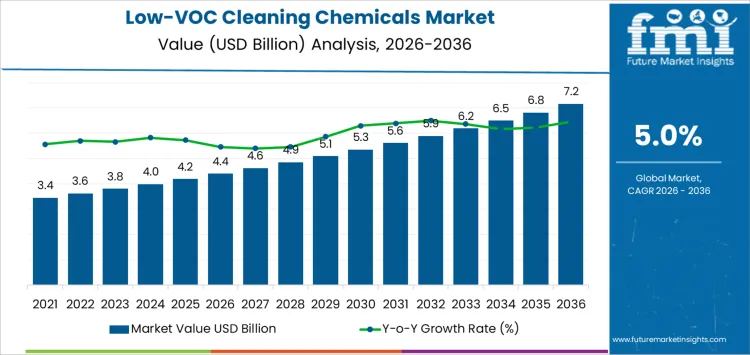
The low-VOC cleaning chemicals market is valued at USD 4.4 billion in 2026 and is projected to reach USD 7.1 billion by 2036, reflecting a CAGR of 5.0%. Growth from USD 3.3 billion in 2020 to USD 4.4 billion in 2026 reflects wider adoption across institutional, commercial, and industrial cleaning operations. Early demand is driven by reformulation of existing products and substitution away from solvent heavy cleaners. Procurement remains tied to routine maintenance schedules rather than episodic purchasing. Consumption patterns show steady volume intake across facilities with consistent cleaning frequency.
From 2027 onward, market value rises from USD 4.6 billion to USD 5.6 billion by 2031, then advances to USD 7.1 billion by 2036 through stable annual increments. Commercial buildings and industrial sites continue to anchor demand as cleaning intensity remains unchanged. Household adoption expands gradually as product availability increases across retail channels. Growth reflects incremental penetration within established applications rather than rapid expansion into new use categories. Annual value movement remains measured, indicating controlled adoption supported by consistent replacement demand and formulation transitions.
Quick Stats of the Low-VOC Cleaning Chemicals Marke
- Low-VOC Cleaning Chemicals Market Value (2026): USD 4.4 billion
- Low-VOC Cleaning Chemicals Market Forecast Value (2036): USD 7.1 billion
- Low-VOC Cleaning Chemicals Market Forecast CAGR (2026-2036): 5.0%
- Leading Product Type in Low-VOC Cleaning Chemicals Market: Specialty Cleaners (30%)
- Key Growth Regions: China, U.K., U.S., Germany, Japan
- Top Players: Ecolab, Diversey, SC Johnson Professional, 3M, Reckitt, Procter & Gamble, Unilever, Clorox, Zep, Betco
What is the Growth Forecast for the Low-VOC Cleaning Chemicals Market through 2036?
Between 2026 and 2031, the low-VOC cleaning chemicals market expands from USD 4.4 billion to about USD 5.4 billion, reflecting steady broad-based adoption rather than abrupt demand shifts. Growth during this phase is shaped by procurement changes across institutional cleaning, food processing facilities, and commercial buildings where air quality management is becoming more operationally relevant. Early gains are driven by reformulation of existing product lines and substitution within established contracts, rather than greenfield demand creation. Manufacturers focus on compatibility with existing cleaning protocols, cost stability, and maintaining performance parity, which supports gradual but reliable uptake across professional cleaning channels.
From 2031 to 2036, the market grows from roughly USD 5.4 billion to USD 7.1 billion, indicating a clearer acceleration in value expansion. This phase reflects deeper penetration across industrial maintenance, healthcare sanitation, and large-scale facilities management, where chemical specifications increasingly influence vendor selection. Growth is reinforced by wider acceptance of low-emission formulations in long-term supply agreements and expanded use in high-frequency cleaning environments. Earlier progress relied on selective substitution, while later expansion reflects normalized adoption, higher-volume consumption, and broader geographic consistency in purchasing standards across global commercial and industrial cleaning operations.
Low VOC Cleaning Chemicals Market Key Takeaways
| Metric | Value |
|---|---|
| Market Value (2026) | USD 4.4 billion |
| Forecast Value (2036) | USD 7.1 billion |
| Forecast CAGR (2026-2036) | 5.0% |
What Is Driving the Demand for the Low-VOC Cleaning Chemicals Market from 2026 to 2036?
Demand for low-VOC cleaning chemicals developed as regulators, facility managers, and manufacturers responded to indoor air quality concerns and worker exposure limits. Commercial buildings, healthcare facilities, and industrial sites adopted formulations with reduced solvent emissions to meet occupational safety rules. Historical growth followed tighter building standards, green procurement policies, and replacement of legacy solvent-heavy cleaners. Buyers prioritised cleaning efficacy, surface compatibility, and certification compliance. Adoption remained strongest in institutional cleaning, food processing, and manufacturing environments where routine exposure risks required controlled chemical profiles.
From 2026 to 2036 demand is expected to expand with broader enforcement of air quality standards and wider adoption across residential and industrial applications. Growth aligns with construction of sealed buildings, expansion of data centres, and increased use of contract cleaning services. Product development focuses on bio-based solvents, water-based formulations, and concentrated chemistries that lower emission levels without reducing performance. Buyers evaluate compliance documentation, formulation transparency, and cost stability. Demand depends on regulatory alignment, contractor specifications, and continued shift toward safer chemical management practices.
What Is the Demand for the Low-VOC Cleaning Chemicals Market by Product Type and Form for 2026 to 2036?
The low-VOC cleaning chemicals market from 2026 to 2036 is shaped by emission regulations, indoor air quality standards, and reformulation across professional and household cleaning categories. Specialty low-VOC cleaners hold the largest product share as users seek targeted performance under restricted solvent limits. Liquid concentrates dominate by form because they support controlled dilution, reduced transport volume, and consistent dosing across institutional and industrial cleaning programs.
Why do specialty cleaners account for 30% of the demand in the low-VOC cleaning chemicals market by product type from 2026 to 2036?
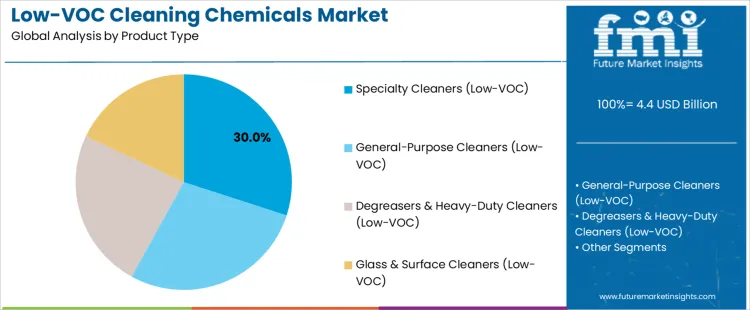
Specialty cleaners account for 30% of demand because regulated environments require formulations designed for specific soils, surfaces, and hygiene protocols. Consumption intensity remains high in healthcare, food processing, laboratories, and commercial facilities where compliance and surface compatibility drive product selection. Usage stays stable since these cleaners are specified within standard operating procedures rather than discretionary purchasing. Procurement decisions prioritize verified VOC thresholds, residue behavior, and material safety documentation. Price sensitivity stays moderate as performance reliability and compliance assurance outweigh unit pricing. Specification control emphasizes solvent substitution quality, formulation stability, and compatibility with repeated use on sensitive surfaces. Demand remains consistent through 2026 to 2036 as organizations continue replacing conventional cleaners with task-specific low-VOC alternatives that align with occupational exposure standards.
Why do liquid concentrates represent 38% of the demand in the low-VOC cleaning chemicals market by form from 2026 to 2036?
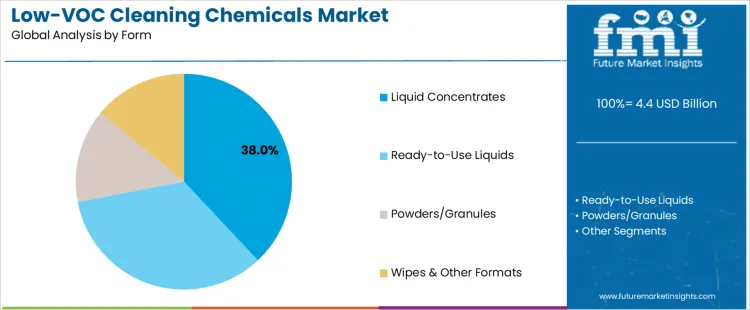
Liquid concentrates represent 38% of demand because they allow flexible strength adjustment while minimizing packaging and storage requirements. Consumption is strong in commercial cleaning services and industrial sites that rely on centralized dilution systems. Usage stays steady since concentrates maintain chemical integrity after mixing and support consistent coverage across large surface areas. Procurement favors formats compatible with automated dispensers and standardized dilution ratios. Price sensitivity remains moderate because concentrates lower cost per use and reduce handling frequency. Specification control focuses on dilution stability, viscosity control, and preservation of low-VOC characteristics post-mixing. Demand continues from 2026 to 2036 as large-scale users prioritize formats that balance regulatory compliance, operational efficiency, and predictable cleaning performance.
How Is Demand for Low VOC Cleaning Chemicals Evolving Across Regulated Commercial and Institutional Settings?
Demand develops through purchasing decisions made by facilities that manage indoor environments under stricter air quality oversight. Offices, schools, and healthcare buildings increasingly select formulations that limit volatile emissions during daily cleaning routines. Facility managers favor products compatible with existing protocols while reducing odor complaints and worker exposure. Janitorial contractors adjust inventories to meet client specifications tied to building standards. These shifts occur through routine procurement changes rather than consumer driven trends, creating steady adoption shaped by compliance needs, workforce considerations, and operational practicality across commercial and institutional spaces.
What Regulatory and Facility Level Factors Are Driving Demand for Low VOC Cleaning Chemicals?
A primary driver is enforcement of indoor air quality guidelines applied across workplaces, schools, and healthcare facilities. Building operators adopt low VOC formulations to align with occupational exposure limits and lease requirements. Public institutions follow procurement rules that reference emission thresholds in cleaning products. Healthcare facilities select low odor solutions to maintain patient comfort during frequent sanitation cycles. Corporate offices adopt them to reduce complaints linked to enclosed ventilation systems. These drivers reflect localized compliance and facility management needs rather than broad environmental messaging or consumer preference shifts.
What Cost and Performance Factors Act as Barriers to Wider Adoption of Low VOC Cleaning Chemicals?
A key barrier is cost sensitivity among cleaning contractors and smaller facilities operating under fixed service budgets. Low VOC formulations often require higher upfront spending, which limits uptake where price competition is strong. Some users report slower drying times or reduced effectiveness on heavy soils, which affects productivity expectations. Facilities with older equipment calibrated for conventional chemicals hesitate to switch due to retraining needs. Procurement teams tied to long term supply contracts delay changes to avoid disruption. These factors restrain adoption despite regulatory and workplace driven interest.
What is the Growth Outlook for the Low VOC Cleaning Chemicals Market Across Key Global Regions?
| Country / Region | CAGR (%) |
|---|---|
| China | 6.0% |
| U.K. | 4.7% |
| U.S. | 4.7% |
| Germany | 4.6% |
| Japan | 3.6% |
The low VOC cleaning chemicals market is expanding steadily across global regions, shaped by regulatory pressure, industrial hygiene standards, and shifts in institutional procurement. China leads growth at 6.0%, supported by tightening emission norms, large scale industrial cleaning demand, and rising adoption in manufacturing facilities. Brazil follows at 5.8%, driven by commercial cleaning expansion and workplace safety compliance. Europe records 4.8%, reflecting strict environmental regulations and consistent demand from healthcare and public infrastructure. The U.K. and U.S. each post 4.7%, supported by green procurement policies and institutional cleaning contracts. Germany at 4.6% shows stable uptake linked to industrial and automotive applications. South Korea at 4.2% reflects gradual transition toward low emission formulations, while Japan at 3.6% shows measured growth shaped by mature cleaning standards and slower formulation change cycles.
Why Is China Recording Faster Growth in Low VOC Cleaning Chemicals Demand?
Low VOC cleaning chemicals demand in China is increasing at a CAGR of 6.0% from 2026 to 2036 as commercial real estate, manufacturing zones, and public infrastructure projects adopt compliant products. Commercial buildings use low emission cleaners to manage indoor conditions. Manufacturing zones specify approved formulations to support workforce safety. Public infrastructure projects include low VOC cleaners in maintenance requirements. Growth reflects broad scale adoption across expanding facilities nationwide.
- Commercial buildings manage indoor conditions with compliant cleaners.
- Manufacturing zones specify low VOC products for worker safety.
- Infrastructure projects include approved cleaners in maintenance plans.
How Is Regulatory Compliance Guiding Low VOC Cleaning Chemicals Demand in the United States?
Low VOC cleaning chemicals demand in the United States is growing at a CAGR of 4.7% from 2026 to 2036 as commercial buildings, healthcare facilities, and institutional buyers align procurement with indoor air quality standards. Facility managers increasingly specify compliant formulations to reduce exposure risks for occupants and staff. Healthcare providers rely on low emission products to maintain hygiene without compromising air conditions. Contract cleaning firms standardize approved formulations across service portfolios. Growth reflects gradual replacement of conventional cleaners with regulated alternatives across offices, hospitals, and public infrastructure nationwide.
- Facility managers prioritize products that meet indoor air quality requirements.
- Healthcare providers rely on low VOC cleaners for routine sanitation tasks.
- Cleaning service firms standardize compliant formulations across contracts.
What Influences Demand Patterns in the United Kingdom?
Low VOC cleaning chemicals demand in the United Kingdom is growing at a CAGR of 4.7% from 2026 to 2036 as offices, healthcare facilities, and education institutions transition toward regulated formulations. Office managers adopt products aligned with indoor air objectives. Healthcare facilities rely on compliant cleaners for routine sanitation. Education institutions integrate low emission products into daily maintenance. Growth reflects steady institutional transition across service sectors.
- Offices adopt cleaners aligned with air quality objectives.
- Healthcare facilities rely on compliant sanitation products.
- Schools integrate low VOC cleaners into daily maintenance.
How Is Germany Supporting Structured Adoption of Low VOC Cleaning Chemicals?
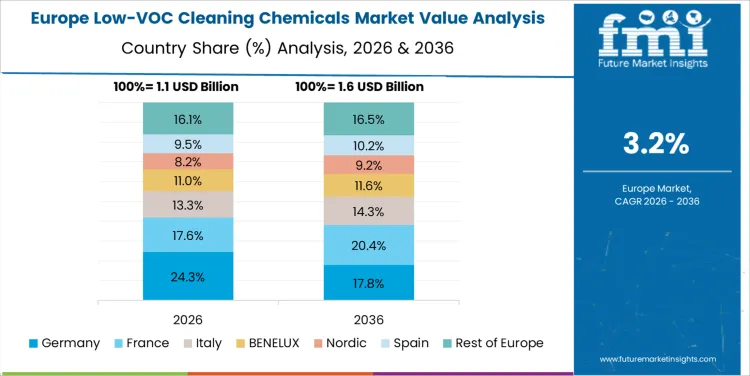
Low VOC cleaning chemicals demand in Germany is expanding at a CAGR of 4.6% from 2026 to 2036 as industrial facilities, offices, and healthcare institutions apply regulated products across cleaning routines. Industrial users select formulations suitable for precision environments. Offices adopt products aligned with occupational safety norms. Healthcare institutions integrate low emission cleaners into daily hygiene protocols. Growth reflects disciplined procurement practices guided by regulatory clarity and workplace safety standards.
- Industrial users select cleaners suitable for precision environments.
- Offices adopt products aligned with occupational safety norms.
- Healthcare institutions integrate low emission cleaners into hygiene routines.
What Is Shaping Low VOC Cleaning Chemicals Adoption in Japan?
Low VOC cleaning chemicals demand in Japan is expanding at a CAGR of 3.6% from 2026 to 2036 as offices, transport operators, and public institutions adopt products aligned with building management guidelines. Facility operators prefer formulations that limit lingering odors and airborne residues. Transport hubs use low emission cleaners for enclosed passenger areas. Public institutions integrate compliant products into scheduled maintenance programs. Growth reflects structured adoption driven by disciplined facility management practices and long term emphasis on indoor environmental quality across urban and regional settings.
- Facility operators select formulations that limit indoor residue buildup.
- Transport hubs use low VOC products in enclosed public areas.
- Public institutions integrate compliant cleaners into maintenance schedules.
What Is Driving the Demand for Low VOC Cleaning Chemicals and Which Companies Shape Institutional and Household Adoption?
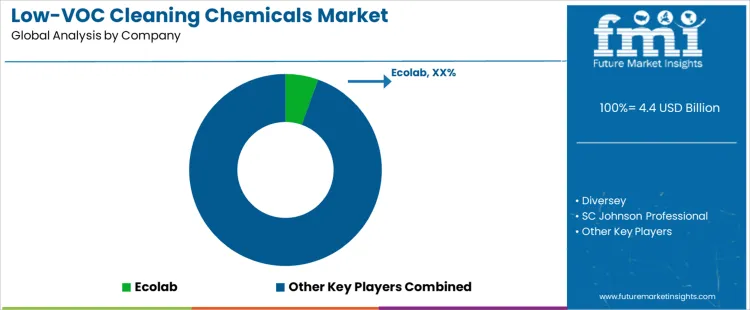
The demand for low VOC cleaning chemicals is shaped by indoor air quality standards, occupational safety rules, and preference for reduced odor formulations across commercial and residential settings. Ecolab holds a central position through institutional cleaning programs used in hospitals, hotels, and foodservice facilities that require controlled emissions and consistent hygiene outcomes. Diversey supports adoption through professional grade cleaners supplied to offices, schools, and transport hubs with documented low VOC profiles. SC Johnson Professional participates through workplace hygiene products used in corporate buildings and public facilities. 3M contributes through surface care and specialty cleaning solutions applied in industrial and healthcare environments. Zep and Betco support facility maintenance through low odor formulations used by contract cleaners and building managers.
Household demand is influenced by sensitivity to fumes, child safety concerns, and use in enclosed living spaces. Procter and Gamble, Unilever, Reckitt, and Clorox shape consumer adoption through branded cleaners positioned for kitchens, bathrooms, and multi surface use with reduced solvent content. Buyers focus on cleaning efficacy, fragrance control, and compatibility with frequent use. Retailers emphasize clear labeling and compliance with safety guidelines. Usage expands across green building projects, elderly care facilities, and densely occupied housing. Demand visibility tracks tightening indoor air rules, growth in professional cleaning services, and steady consumer shift toward low odor cleaning solutions.
Key Players in the Low VOC Cleaning Chemicals Market
- Ecolab
- Diversey
- SC Johnson Professional
- 3M
- Reckitt
- Procter & Gamble
- Unilever
- Clorox
- Zep
- Betco
Scope of the Report
| Items | Values |
|---|---|
| Quantitative Units (2026) | USD billion |
| Product Type | Specialty Cleaners (Low-VOC), General-Purpose Cleaners (Low-VOC), Degreasers & Heavy-Duty Cleaners (Low-VOC), Glass & Surface Cleaners (Low-VOC) |
| Form | Liquid Concentrates, Ready-to-Use Liquids, Powders & Granules, Wipes & Other Formats |
| End Use Sector | Eco-Label / Certified Low-Emission, Low-Odor / Indoor Air Quality Focused, Standard Low-VOC Reformulations |
| Regions Covered | Asia Pacific, Europe, North America, Latin America, Middle East & Africa |
| Countries Covered | China, Japan, South Korea, India, Australia & New Zealand, ASEAN, Germany, United Kingdom, France, Italy, Spain, Nordic, BENELUX, USA, Canada, Mexico, Brazil, Chile, Saudi Arabia, Turkey, South Africa, plus 40+ additional countries globally |
| Key Companies Profiled | Ecolab, Diversey, SC Johnson Professional, 3M, Reckitt, Procter & Gamble, Unilever, Clorox, Zep, Betco |
| Additional Attributes | Dollar by sales across product type, form, and end use sector; institutional and commercial procurement patterns; reformulation trends away from solvent-heavy chemistries; compatibility with existing cleaning protocols; indoor air quality compliance considerations; contract cleaning specification alignment; dilution and dosing practices; supply chain stability; regional regulatory alignment; performance parity versus conventional cleaners |
Low VOC Cleaning Chemicals Market Segmentation
Product Type:
- Specialty Cleaners (Low-VOC)
- General-Purpose Cleaners (Low-VOC)
- Degreasers & Heavy-Duty Cleaners (Low-VOC)
- Glass & Surface Cleaners (Low-VOC)
Form:
- Liquid Concentrates
- Ready-to-Use Liquids
- Powders/Granules
- Wipes & Other Formats
End-Use Sector:
- Eco-Label / Certified Low-Emission
- Low-Odor / Indoor Air Quality Focused
- Standard Low-VOC Reformulations
Region:
- Asia Pacific
- China
- Japan
- South Korea
- India
- Australia & New Zealand
- ASEAN
- Rest of Asia Pacific
- Europe
- Germany
- United Kingdom
- France
- Italy
- Spain
- Nordic
- BENELUX
- Rest of Europe
- North America
- United States
- Canada
- Mexico
- Latin America
- Brazil
- Chile
- Rest of Latin America
- Middle East & Africa
- Kingdom of Saudi Arabia
- Other GCC Countries
- Turkey
- South Africa
- Other African Union
- Rest of Middle East & Africa
Frequently Asked Questions
How big is the low-VOC cleaning chemicals market in 2026?
The global low-VOC cleaning chemicals market is estimated to be valued at USD 4.4 billion in 2026.
What will be the size of low-VOC cleaning chemicals market in 2036?
The market size for the low-VOC cleaning chemicals market is projected to reach USD 7.2 billion by 2036.
How much will be the low-VOC cleaning chemicals market growth between 2026 and 2036?
The low-VOC cleaning chemicals market is expected to grow at a 5.0% CAGR between 2026 and 2036.
What are the key product types in the low-VOC cleaning chemicals market?
The key product types in low-VOC cleaning chemicals market are specialty cleaners (low-voc), general-purpose cleaners (low-voc), degreasers & heavy-duty cleaners (low-voc) and glass & surface cleaners (low-voc).
Which form segment to contribute significant share in the low-VOC cleaning chemicals market in 2026?
In terms of form, liquid concentrates segment to command 38.0% share in the low-VOC cleaning chemicals market in 2026.
Preview the report firsthand - request a free sample
Get SampleGet the brochure for pricing and purchase details.
Get PDFTable of Content
- Executive Summary
- Global Market Outlook
- Demand-side Trends
- Supply-side Trends
- Technology Roadmap Analysis
- Analysis and Recommendations
- Market Overview
- Market Coverage / Taxonomy
- Market Definition / Scope / Limitations
- Market Background
- Market Dynamics
- Drivers
- Restraints
- Opportunity
- Trends
- Scenario Forecast
- Demand in Optimistic Scenario
- Demand in Likely Scenario
- Demand in Conservative Scenario
- Opportunity Map Analysis
- Product Life Cycle Analysis
- Supply Chain Analysis
- Investment Feasibility Matrix
- Value Chain Analysis
- PESTLE and Porter’s Analysis
- Regulatory Landscape
- Regional Parent Market Outlook
- Production and Consumption Statistics
- Import and Export Statistics
- Market Dynamics
- Global Market Analysis 2021 to 2025 and Forecast, 2026 to 2036
- Historical Market Size Value (USD Million) Analysis, 2021 to 2025
- Current and Future Market Size Value (USD Million) Projections, 2026 to 2036
- Y-o-Y Growth Trend Analysis
- Absolute $ Opportunity Analysis
- Global Market Pricing Analysis 2021 to 2025 and Forecast 2026 to 2036
- Global Market Analysis 2021 to 2025 and Forecast 2026 to 2036, By Product Type
- Introduction / Key Findings
- Historical Market Size Value (USD Million) Analysis By Product Type , 2021 to 2025
- Current and Future Market Size Value (USD Million) Analysis and Forecast By Product Type , 2026 to 2036
- Specialty Cleaners (Low-VOC)
- General-Purpose Cleaners (Low-VOC)
- Degreasers & Heavy-Duty Cleaners (Low-VOC)
- Glass & Surface Cleaners (Low-VOC)
- Y-o-Y Growth Trend Analysis By Product Type , 2021 to 2025
- Absolute $ Opportunity Analysis By Product Type , 2026 to 2036
- Global Market Analysis 2021 to 2025 and Forecast 2026 to 2036, By Form
- Introduction / Key Findings
- Historical Market Size Value (USD Million) Analysis By Form, 2021 to 2025
- Current and Future Market Size Value (USD Million) Analysis and Forecast By Form, 2026 to 2036
- Liquid Concentrates
- Ready-to-Use Liquids
- Powders/Granules
- Wipes & Other Formats
- Y-o-Y Growth Trend Analysis By Form, 2021 to 2025
- Absolute $ Opportunity Analysis By Form, 2026 to 2036
- Global Market Analysis 2021 to 2025 and Forecast 2026 to 2036, By End-Use Sector
- Introduction / Key Findings
- Historical Market Size Value (USD Million) Analysis By End-Use Sector, 2021 to 2025
- Current and Future Market Size Value (USD Million) Analysis and Forecast By End-Use Sector, 2026 to 2036
- Eco-Label / Certified Low-Emission
- Low-Odor / Indoor Air Quality Focused
- Standard Low-VOC Reformulations
- Y-o-Y Growth Trend Analysis By End-Use Sector, 2021 to 2025
- Absolute $ Opportunity Analysis By End-Use Sector, 2026 to 2036
- Global Market Analysis 2021 to 2025 and Forecast 2026 to 2036, By Region
- Introduction
- Historical Market Size Value (USD Million) Analysis By Region, 2021 to 2025
- Current Market Size Value (USD Million) Analysis and Forecast By Region, 2026 to 2036
- North America
- Latin America
- Western Europe
- Eastern Europe
- East Asia
- South Asia and Pacific
- Middle East & Africa
- Market Attractiveness Analysis By Region
- North America Market Analysis 2021 to 2025 and Forecast 2026 to 2036, By Country
- Historical Market Size Value (USD Million) Trend Analysis By Market Taxonomy, 2021 to 2025
- Market Size Value (USD Million) Forecast By Market Taxonomy, 2026 to 2036
- By Country
- USA
- Canada
- Mexico
- By Product Type
- By Form
- By End-Use Sector
- By Country
- Market Attractiveness Analysis
- By Country
- By Product Type
- By Form
- By End-Use Sector
- Key Takeaways
- Latin America Market Analysis 2021 to 2025 and Forecast 2026 to 2036, By Country
- Historical Market Size Value (USD Million) Trend Analysis By Market Taxonomy, 2021 to 2025
- Market Size Value (USD Million) Forecast By Market Taxonomy, 2026 to 2036
- By Country
- Brazil
- Chile
- Rest of Latin America
- By Product Type
- By Form
- By End-Use Sector
- By Country
- Market Attractiveness Analysis
- By Country
- By Product Type
- By Form
- By End-Use Sector
- Key Takeaways
- Western Europe Market Analysis 2021 to 2025 and Forecast 2026 to 2036, By Country
- Historical Market Size Value (USD Million) Trend Analysis By Market Taxonomy, 2021 to 2025
- Market Size Value (USD Million) Forecast By Market Taxonomy, 2026 to 2036
- By Country
- Germany
- UK
- Italy
- Spain
- France
- Nordic
- BENELUX
- Rest of Western Europe
- By Product Type
- By Form
- By End-Use Sector
- By Country
- Market Attractiveness Analysis
- By Country
- By Product Type
- By Form
- By End-Use Sector
- Key Takeaways
- Eastern Europe Market Analysis 2021 to 2025 and Forecast 2026 to 2036, By Country
- Historical Market Size Value (USD Million) Trend Analysis By Market Taxonomy, 2021 to 2025
- Market Size Value (USD Million) Forecast By Market Taxonomy, 2026 to 2036
- By Country
- Russia
- Poland
- Hungary
- Balkan & Baltic
- Rest of Eastern Europe
- By Product Type
- By Form
- By End-Use Sector
- By Country
- Market Attractiveness Analysis
- By Country
- By Product Type
- By Form
- By End-Use Sector
- Key Takeaways
- East Asia Market Analysis 2021 to 2025 and Forecast 2026 to 2036, By Country
- Historical Market Size Value (USD Million) Trend Analysis By Market Taxonomy, 2021 to 2025
- Market Size Value (USD Million) Forecast By Market Taxonomy, 2026 to 2036
- By Country
- China
- Japan
- South Korea
- By Product Type
- By Form
- By End-Use Sector
- By Country
- Market Attractiveness Analysis
- By Country
- By Product Type
- By Form
- By End-Use Sector
- Key Takeaways
- South Asia and Pacific Market Analysis 2021 to 2025 and Forecast 2026 to 2036, By Country
- Historical Market Size Value (USD Million) Trend Analysis By Market Taxonomy, 2021 to 2025
- Market Size Value (USD Million) Forecast By Market Taxonomy, 2026 to 2036
- By Country
- India
- ASEAN
- Australia & New Zealand
- Rest of South Asia and Pacific
- By Product Type
- By Form
- By End-Use Sector
- By Country
- Market Attractiveness Analysis
- By Country
- By Product Type
- By Form
- By End-Use Sector
- Key Takeaways
- Middle East & Africa Market Analysis 2021 to 2025 and Forecast 2026 to 2036, By Country
- Historical Market Size Value (USD Million) Trend Analysis By Market Taxonomy, 2021 to 2025
- Market Size Value (USD Million) Forecast By Market Taxonomy, 2026 to 2036
- By Country
- Kingdom of Saudi Arabia
- Other GCC Countries
- Turkiye
- South Africa
- Other African Union
- Rest of Middle East & Africa
- By Product Type
- By Form
- By End-Use Sector
- By Country
- Market Attractiveness Analysis
- By Country
- By Product Type
- By Form
- By End-Use Sector
- Key Takeaways
- Key Countries Market Analysis
- USA
- Pricing Analysis
- Market Share Analysis, 2025
- By Product Type
- By Form
- By End-Use Sector
- Canada
- Pricing Analysis
- Market Share Analysis, 2025
- By Product Type
- By Form
- By End-Use Sector
- Mexico
- Pricing Analysis
- Market Share Analysis, 2025
- By Product Type
- By Form
- By End-Use Sector
- Brazil
- Pricing Analysis
- Market Share Analysis, 2025
- By Product Type
- By Form
- By End-Use Sector
- Chile
- Pricing Analysis
- Market Share Analysis, 2025
- By Product Type
- By Form
- By End-Use Sector
- Germany
- Pricing Analysis
- Market Share Analysis, 2025
- By Product Type
- By Form
- By End-Use Sector
- UK
- Pricing Analysis
- Market Share Analysis, 2025
- By Product Type
- By Form
- By End-Use Sector
- Italy
- Pricing Analysis
- Market Share Analysis, 2025
- By Product Type
- By Form
- By End-Use Sector
- Spain
- Pricing Analysis
- Market Share Analysis, 2025
- By Product Type
- By Form
- By End-Use Sector
- France
- Pricing Analysis
- Market Share Analysis, 2025
- By Product Type
- By Form
- By End-Use Sector
- India
- Pricing Analysis
- Market Share Analysis, 2025
- By Product Type
- By Form
- By End-Use Sector
- ASEAN
- Pricing Analysis
- Market Share Analysis, 2025
- By Product Type
- By Form
- By End-Use Sector
- Australia & New Zealand
- Pricing Analysis
- Market Share Analysis, 2025
- By Product Type
- By Form
- By End-Use Sector
- China
- Pricing Analysis
- Market Share Analysis, 2025
- By Product Type
- By Form
- By End-Use Sector
- Japan
- Pricing Analysis
- Market Share Analysis, 2025
- By Product Type
- By Form
- By End-Use Sector
- South Korea
- Pricing Analysis
- Market Share Analysis, 2025
- By Product Type
- By Form
- By End-Use Sector
- Russia
- Pricing Analysis
- Market Share Analysis, 2025
- By Product Type
- By Form
- By End-Use Sector
- Poland
- Pricing Analysis
- Market Share Analysis, 2025
- By Product Type
- By Form
- By End-Use Sector
- Hungary
- Pricing Analysis
- Market Share Analysis, 2025
- By Product Type
- By Form
- By End-Use Sector
- Kingdom of Saudi Arabia
- Pricing Analysis
- Market Share Analysis, 2025
- By Product Type
- By Form
- By End-Use Sector
- Turkiye
- Pricing Analysis
- Market Share Analysis, 2025
- By Product Type
- By Form
- By End-Use Sector
- South Africa
- Pricing Analysis
- Market Share Analysis, 2025
- By Product Type
- By Form
- By End-Use Sector
- USA
- Market Structure Analysis
- Competition Dashboard
- Competition Benchmarking
- Market Share Analysis of Top Players
- By Regional
- By Product Type
- By Form
- By End-Use Sector
- Competition Analysis
- Competition Deep Dive
- Ecolab
- Overview
- Product Portfolio
- Profitability by Market Segments (Product/Age /Sales Channel/Region)
- Sales Footprint
- Strategy Overview
- Marketing Strategy
- Product Strategy
- Channel Strategy
- Diversey
- SC Johnson Professional
- 3M
- Reckitt
- Procter & Gamble
- Unilever
- Clorox
- Zep
- Betco
- Ecolab
- Competition Deep Dive
- Assumptions & Acronyms Used
- Research Methodology


