

- Industry Size (2026)
- USD 1.3 Bn
- Forecast (2036)
- USD 2.1 Bn
- CAGR (2026 to 2036)
- 5.3%
Low-VOC Cleaning Chemicals for Enclosed Workspaces Market Size, Market Forecast and Outlook By FMI
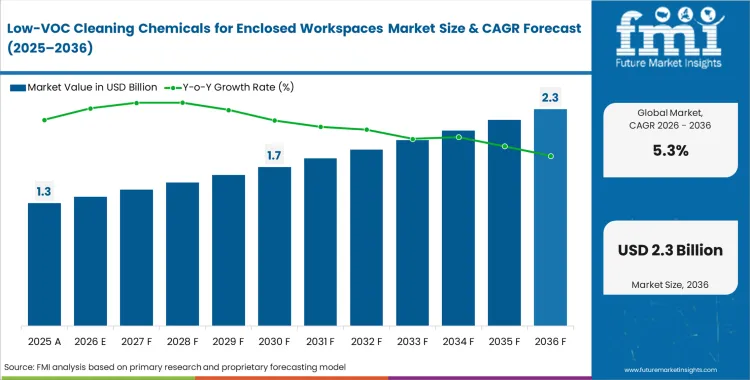
The low-VOC cleaning chemicals for enclosed workspaces market was valued at USD 1.23 billion in 2025. Demand is expected to reach USD 1.3 billion in 2026 and expand at a CAGR of 5.3% through 2036, taking total revenue to USD 2.1 billion, supported by continued investment in indoor air quality-compliant cleaning systems.
Summary of Low-VOC Cleaning Chemicals for Enclosed Workspaces Market
- Low-VOC Cleaning Chemicals for Enclosed Workspaces Market Snapshot
- The low-VOC cleaning chemicals for enclosed workspaces market is valued at USD 1.2 billion in 2025 and is projected to reach USD 2.1 billion by 2036.
- The market is expected to grow at a 5.3% CAGR from 2026 to 2036.
- This is a specification-led institutional and commercial cleaning chemicals category where indoor-air-quality management, occupant comfort, and safer-building procurement matter more than simple low upfront chemical cost.
- Environmental regulatory bodies note that VOC concentrations are often higher indoors than outdoors, while occupational safety frameworks identify cleaning products as one of the pollutant sources in commercial and institutional buildings.
- Low-VOC Cleaning Chemicals for Enclosed Workspaces Market Demand and Growth Drivers
- Demand is being lifted by broader adoption of low-VOC formulations across institutional and commercial cleaning operations, which FMI highlights in the parent low-VOC cleaning chemicals market.
- Enclosed workplaces are a particularly relevant use case as federal office-building guidance focuses on the importance of maintaining healthier indoor environments for building occupants.
- Green-building supports the category as green -building certification frameworks require at least 75% of cleaning products and materials by cost to comply with recognized standards in qualifying projects.
- Growth remains steady as most demand comes from substitution, reformulation, and purchasing-policy shifts instead of greenfield category creation.
- Low-VOC Cleaning Chemicals for Enclosed Workspaces Market Product and Segment View
- Specialty cleaners lead the product family segment, with share expected to reach 30%, reflecting their role in targeted applications where low-VOC performance must meet specific surface and use requirements.
- Ready-to-use liquids are preferred in occupied workspaces due to consistency and ease of use, with the formulation segment projected to account for 34% share.
- Office buildings and corporate workplaces remain the dominant end-use environment, contributing an estimated 33% share as enclosed spaces prioritize air quality and occupant comfort.
- Water-based, low-solvent formulations align with emission control requirements, with the chemistry segment expected to represent 31% share.
- Multi-site workplaces and managed facilities rely on structured sourcing models, placing direct institutional supply at 42% share within the supply channel.
- Low-VOC Cleaning Chemicals for Enclosed Workspaces Market Geography and Competitive Outlook
- China, India, and Brazil represent the faster-growth markets in this model, while the United Kingdom, United States, Germany, and Japan reflect steadier demand shaped by replacement cycles and compliance-driven adoption.
- Key participants include Ecolab, Solenis (Diversey), SC Johnson Professional, 3M, Reckitt, Clorox, and Zep.
- Market structure reflects a concentrated supplier base, as workplace cleaning buyers prioritize validated performance, dispensing systems, training support, and alignment with internal policies over pure price-based purchasing.
Indoor air quality standards are shaping maintenance protocols within sealed commercial environments, where reducing solvent emissions is as important as cleaning performance. Building teams must manage effective soil removal while limiting exposure to off-gassing compounds that can trigger occupant discomfort. Adoption of low-VOC formulations increases when they demonstrate clear benefits in reducing respiratory complaints, even when unit costs are higher. Maintaining strict emission limits can require adjustments in concentration levels, which affects dilution efficiency and complicates cost control across large facilities. Budget constraints remain a key consideration as operators’ balance compliance requirements with fixed operating spend.
Adoption accelerates when corporate leasing groups enforce zero-emission standards across entire property portfolios, requiring immediate alignment with approved product lists. Standardized dosing systems help ensure consistent application and support compliance with occupational safety requirements in enclosed environments, while also reducing reliance on manual handling practices.
China is projected to grow at a CAGR of 6.2% during the forecast period, followed by India at 6.0% CAGR, reflecting expansion across urban infrastructure and commercial developments. The United Kingdom is expected to grow at 5.8%, with Brazil at 5.7% and the United States at 5.5%, while Germany and Japan are forecast at 5.2% and 4.9%, where demand is shaped by stricter indoor air quality expectations and upgrades to existing building stock.Top of Form
Segmental Analysis
Low-VOC Cleaning Chemicals for Enclosed Workspaces Market Analysis by Product Family
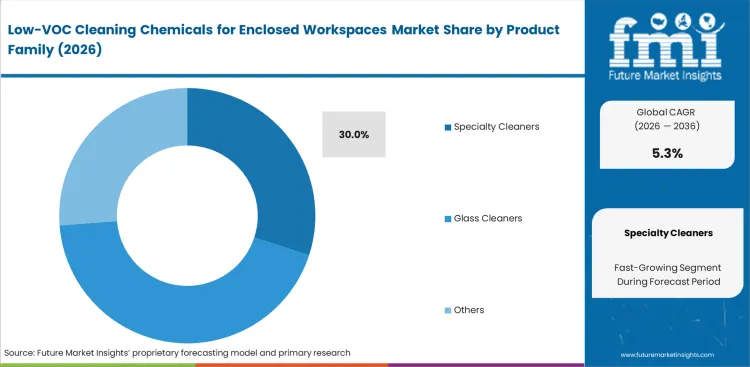
Specialty cleaners is likely to command 30.0% in 2026 share as custodians deploy these targeted formulations continuously across challenging architectural finishes. Night-shift crews rely heavily on fast-acting chemistry, avoiding the confusion of switching bottles between different synthetic materials. Establishing correct material compatibility actually determines long-term contract retention, as etched surfaces visibly broadcast poor maintenance quality to executives daily. Formulators increasingly supply eco label certified cleaning chemicals for professional users to balance specialized soil removal power with indoor air quality regulations. Utilizing targeted air duct cleaning chemicals directly prevents circulated airborne contaminants. Facilities failing to match the correct low-voc restroom cleaners for office buildings or low-VOC carpet cleaners for enclosed spaces to porous finishes cause irreversible damage, instantly wiping out years of chemical cost savings.
- Purchase triggers: Outbreak events or sudden executive visits force risk management officers to instantly override existing supply contracts, selecting premium low-emission formulas immediately.
- Validation protocols: Infection control audits verify pathogen elimination efficacy on standardized test surfaces without violating air quality thresholds.
- Contract renewals: Custodial staff feedback dictates long-term brand survival, as formulations causing respiratory irritation prompt union representatives to block vendor renewals.
Low-VOC Cleaning Chemicals for Enclosed Workspaces Market Analysis by Formulation
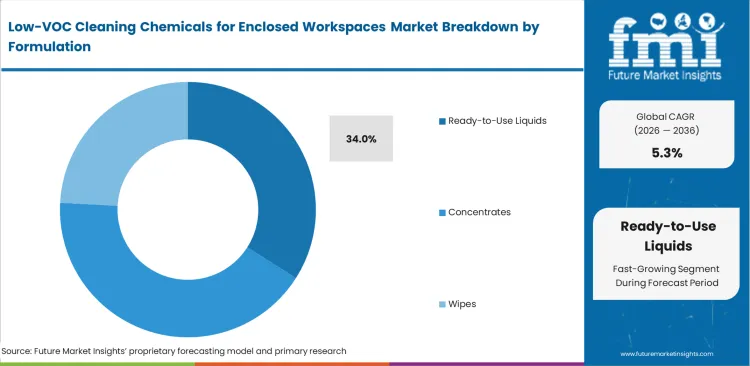
Shipping liquid water across continental supply chains degrades environmental sustainability metrics, format convenience influences daily usage. Ready-to-use liquids is set to garner 34.0% share in 2026 as site supervisors prioritize immediate deployment without complex mixing requirements. Commercial distributors supply highly regulated green cleaning chemicals for industrial maintenance to offer unparalleled safety, provided workers follow correct application procedures. Employing reliable ready to use rtu cleaning and disinfection chemicals drastically reduces the risk of accidental chemical splashes. When evaluating ready-to-use vs concentrate low-voc cleaners, buyers note that without strictly calibrated dosing systems, custodial staff manually mixing concentrates often over-pour. Operating without proper dispenser calibration inevitably creates massive supply shortages halfway through the month, forcing emergency purchasing at exorbitant retail prices.
- Operational savings: Eliminating complex mixing valves slashes specialized maintenance technician fees entirely.
- Unexpected expenditures: Purchasing pre-mixed liquids significantly increases total freight transportation costs over the lifespan of a multi-year institutional contract.
- Lifecycle comparisons: Total cost of ownership metrics prove concentrated systems significantly outperform ready-to-use alternatives financially, though labor compliance remains a critical deciding factor.
Low-VOC Cleaning Chemicals for Enclosed Workspaces Market Analysis by End-use Environment
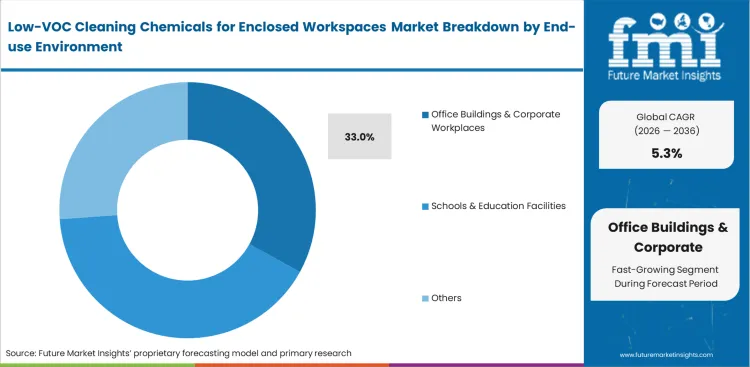
Office buildings & corporate workplaces is estimated to account for 33.0% share in 2026, propelled directly by property management firms accumulating LEED points to justify premium rental rates per square foot. Specific environmental criteria embedded into vendor service level agreements restrict the use of into all vendor service level agreements, refusing to onboard any janitorial firm utilizing conventional highly volatile solvents. Centralized purchasing departments specify exact super concentrate cleaning chemical delivery systems to standardize safety across hundreds of regional branches. Whether sourcing school low-voc cleaning chemicals or government building low-voc cleaning chemicals, administrators push for compliant office-safe low-voc cleaning products to secure recognized badges that attract elite occupants. Property owners delaying this transition watch helplessly as environmentally conscious anchor tenants relocate to newer, fully certified competitive developments nearby.
- Initial implementation: Replacing degreasers with mild certified alternatives temporarily slows routine turnaround times while staff adapt to new dwell requirements.
- Hardware friction: Hard water infrastructure severely limits the lathering capability of biodegradable low-solvent surfactants across legacy plumbing architectures.
- Realized advantages: Eliminating harsh fumes drastically reduces custodial staff sick days, generating significant measurable declines in employee turnover.
Low-VOC Cleaning Chemicals for Enclosed Workspaces Market Analysis by Chemistry Platform
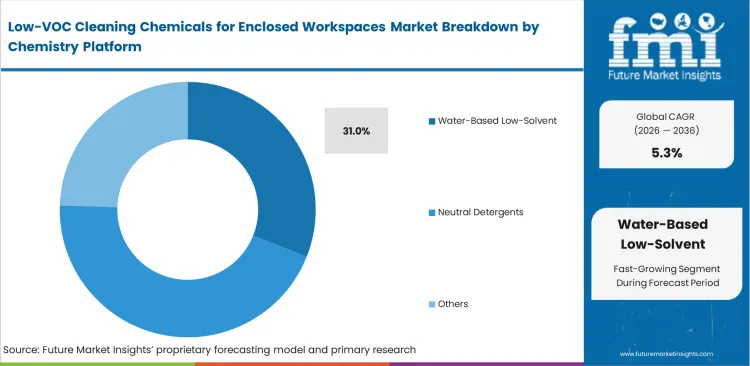
Balancing heavy-duty sanitation against strict occupational exposure limits challenges formulators daily. Water-based low-solvent formulations is set to capture 31.0% share in 2026, offering stable broad-spectrum performance without releasing harsh fumes into sealed ventilation systems. Contract cleaning managers rely on water-based low-voc cleaners for offices for routine sanitation, valuing long shelf life and compatibility with diverse architectural finishes. Deploying advanced multi surface disinfectant cleaners neutralizes active pathogen threats while maintaining safe indoor air quality metrics across enclosed public spaces. When comparing low-voc vs fragrance-free cleaning chemicals, safety officers note that while both reduce complaints, low-VOC options specifically target measurable airborne emission limits. Teams ignoring staff feedback regarding chemical odors experience surging employee turnover, multiplying recruitment costs far beyond initial chemical budget limits.
- Performance maximums: Water-based formulas maintain active soil-lifting properties even when applied to heavily trafficked resilient flooring.
- Temperature constraints: Cold water environments severely restrict activation speed, forcing operations managers to ensure proper ambient heating during winter months.
- Safety thresholds: Regulatory data sheets dictate exact maximum exposure limits, ensuring compliance officers reject any formulation lacking comprehensive dermal toxicity testing documentation.
Low-VOC Cleaning Chemicals for Enclosed Workspaces Market Analysis by Supply Channel
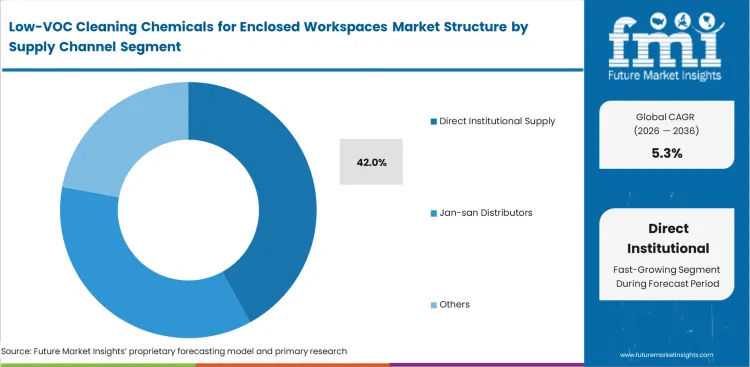
Direct institutional supply is predicted to represent around 42.0% share in 2026, enabling global healthcare and commercial brands to enforce strict zero-emission hygiene standards across thousands of affiliated properties. Supply chain vice presidents negotiate bulk pricing, securing reliable access to specialized surface disinfectant products worldwide. Relying strictly on centralized hubs leaves remote facilities vulnerable during logistical strikes. Administrators lacking backup regional low-voc office cleaning chemical suppliers face complete operational shutdowns, forcing unacceptable compromises utilizing unapproved scented retail chemicals that violate internal air quality policies. Identifying the best low-voc cleaning chemical suppliers requires auditing their ability to maintain uninterrupted inventory across decentralized facility networks.
- Early adopters: Flagship clinical properties pioneer direct supply agreements to guarantee absolute sensory neutrality across sensitive patient wards.
- Mainstream followers: Mid-scale academic institutions adopt centralized purchasing to match premium hygiene standards while simplifying staff training.
- Late converts: Independent public facilities finally abandon local hardware stores when administrators demand hospital-grade low-emission disinfection proofs.
Low-VOC Cleaning Chemicals for Enclosed Workspaces Market Drivers, Restraints, and Opportunities
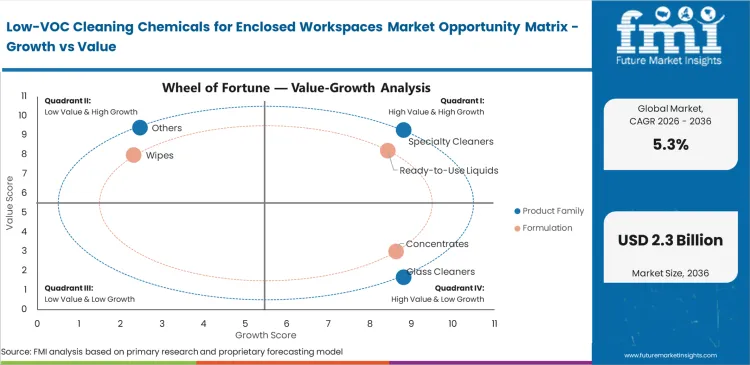
Regulatory shifts regarding indoor air quality compel executive housekeepers to adopt low-emission cleaning products for offices immediately. Custodial departments operating within sealed HVAC environments cannot tolerate chemicals releasing volatile organic compounds that trigger building-wide sensory complaints. Faster room turnover without residual chemical odors directly improves occupant satisfaction, making single-pass unscented sanitation an absolute operational necessity. Implementing verified floor cleaning detergent and care chemicals prevents devastating respiratory events during weekend maintenance cycles. Buyers comparing low-voc vs conventional cleaning products willingly pay premium per-liter prices for hypoallergenic chemistries to consistently achieve higher daily room completion rates while effectively supporting green cleaning for office buildings.
Hard water chemistry interactions create severe operational friction for low-solvent surfactants. Magnesium and calcium ions naturally present in municipal water supplies bind aggressively with modified cleaning agents, preventing adequate foaming and leaving dull residues on reflective surfaces. Custodial supervisors managing diverse portfolios frequently abandon certified floor cleaner formulations after repeated tenant complaints regarding visible soap scum buildup in prominent entryways.
Opportunities
- Enzymatic formulations: Living bacterial cultures consume residual organic waste embedded deeply within porous grout lines without releasing synthetic volatile compounds.
- Cold-water activation: Surfactants engineered to perform effectively without heated water reduce building energy loads significantly across massive educational properties sourcing cleaning chemicals for schools and education facilities.
- Probiotic healthcare maintainers: Utilizing competitive exclusion principles establishes long-lasting biological barriers against opportunistic surface pathogens while bypassing harsh airborne bleaches.
Low-VOC Cleaning Chemicals for Enclosed Workspaces Market Regional Analysis
Based on regional analysis, the sector is segmented into Asia Pacific, Western Europe, North America, and Latin America across numerous key countries.
.webp "Top Country Growth Comparison Low Voc Cleaning Chemicals For Enclosed Workspaces Market Cagr (2026 2036)")
| Country | CAGR (2026 to 2036) |
|---|---|
| China | 6.2% |
| India | 6.0% |
| United Kingdom | 5.8% |
| Brazil | 5.7% |
| United States | 5.5% |
| Germany | 5.2% |
| Japan | 4.9% |
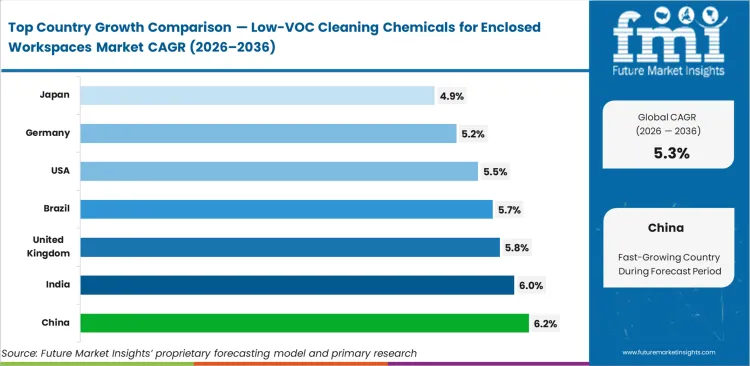
Source: Future Market Insights (FMI) analysis, based on proprietary forecasting model and primary research
Low-VOC Cleaning Chemicals for Enclosed Workspaces Market Asia Pacific Market Analysis
Centralized government mandates dictate environmental standards for newly constructed urban commercial zones. Property developers building mixed-use districts must secure strict green building permits prior to occupancy, forcing an immediate transition toward low-emission sanitation chemistry. Sourcing advanced cleaning chemicals for retail and shopping centres aligns perfectly with regional municipal regulations targeting commercial airborne emissions. Expanding medical tourism drives demand, as private hospitals upgrade sanitation protocols to match international accreditation requirements.
- China: China low-VOC cleaning chemicals sector is projected to grow at a CAGR of 6.2% from 2026 to 2036. Urban construction approvals across commercial and retail infrastructure are tied to air quality compliance, which removes high-emission cleaning agents from early-stage specifications. Developers align with low-solvent formulations during project design to meet municipal airborne emission thresholds before occupancy. Domestic manufacturers maintain supply dominance due to faster regulatory alignment and the ability to support large-scale urban projects without import delays. High-footfall retail environments further reinforce demand for low-emission products that maintain stable indoor air conditions under continuous usage.
- India: Rapid expansion of private commercial infrastructure creates new requirements for standardized sanitation protocols. Low-VOC cleaning chemicals India volume surges as corporate networks standardize procurement across hundreds of regional branches. Expansion in India is estimated to registers 6.0% CAGR over the forecast period as awareness regarding workplace indoor air quality cleaning products permanently penetrates the commercial property sector.
- Japan: Japan integrates workforce limitations with precision-environment requirements, where the low-VOC cleaning chemicals market is advancing at a CAGR of 4.9% between 2026 and 2036 as aging labor conditions and controlled manufacturing environments restrict exposure to airborne emissions. Demand remains concentrated in electronics manufacturing, healthcare facilities, and other controlled environments where chemical stability directly impacts operational continuity.
Low-VOC Cleaning Chemicals for Enclosed Workspaces Market Western Europe Market Analysis
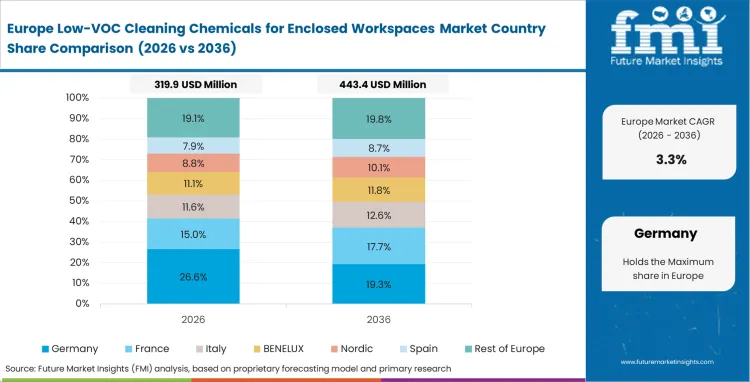
Regulatory enforcement across Western Europe restricts the use of volatile chemical inputs across institutional and commercial environments. Emission ceilings, occupational exposure limits, and wastewater regulations operate together, shaping formulation design and limiting market entry for non-compliant products. Cross-border operators standardize low-VOC systems across portfolios to maintain regulatory alignment while reducing operational complexity. Concentrated formats gain traction as they reduce packaging volume and transport load within tightly regulated supply chains.
- United Kingdom: Cost efficiency and compliance are being addressed together in the United Kingdom as local authorities move toward concentrated, low-emission cleaning systems that reduce transport volume and storage burden. Demand for low-VOC cleaning chemicals in the United Kingdom is expected to rise at a CAGR of 5.8% through 2036, supported by purchasing preference for products that fit tighter environmental standards without adding avoidable operating cost. Concentrated formats also help lower packaging use and improve handling efficiency across public facilities working under stricter procurement discipline.
- Germany: Environmental enforcement is more tightly embedded into day-to-day facility operations in Germany, where solvent-heavy institutional cleaning products are losing relevance under stricter emission controls. The low-VOC cleaning chemicals market in Germany is projected to expand at a CAGR of 5.2% through 2036. Product selection in this market increasingly depends on whether low-emission formulations can satisfy regulatory expectations while still delivering consistent cleaning performance across schools, healthcare sites, and other public-use facilities.
Low-VOC Cleaning Chemicals for Enclosed Workspaces Market North America Market Analysis
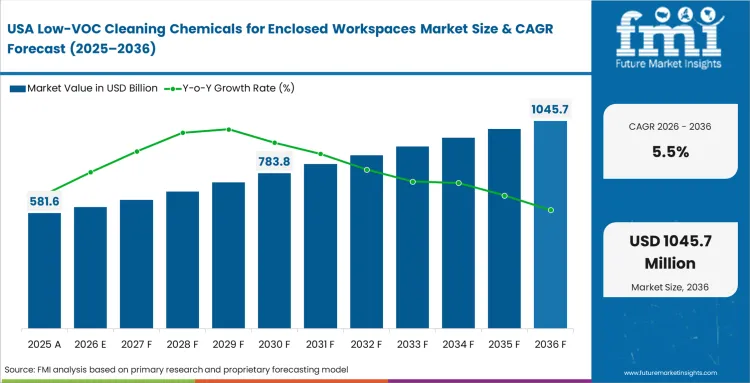
Strict occupational health guidelines structurally encode sensory-neutral requirements directly into vast government service contracts across the entire continent. State-level facility directors face automatic budget penalties if their custodial supply manifests contain unverified volatile organic compounds. Private sector property management firms actively mimic these federal guidelines, attempting to align their commercial portfolios with recognized indoor air quality certifications to attract elite multinational tenants. Educational districts phase out legacy scented products, responding directly to intense pressure from parent advocacy groups demanding zero-toxicity learning environments. Employing highly regulated cleaning chemicals for fitness and recreation facilities safely sanitizes heavy equipment without leaving residual fumes.
- United States: Environmental reporting pressure is raising the bar for cleaning chemical selection across commercial and institutional facilities in the United States. Demand for low-VOC cleaning chemicals in the country is projected to grow at a CAGR of 5.5% through 2036 as compliance expectations move from federal properties into wider regional healthcare and commercial networks. Certified safety documentation is becoming more valuable in this market because distributors that can manage it well are harder to displace within established supply chains. Faster resolution of indoor air quality complaints also carries practical value, helping facilities reduce exposure to liability linked to occupational health concerns.
Low-VOC Cleaning Chemicals for Enclosed Workspaces Market Latin America Market Analysis
Multinational corporate mandates establish uniform facility hygiene standards across all regional operations, successfully bypassing much slower municipal regulatory timelines. International networks entering the territory absolutely refuse to compromise their deeply established low-emission clinical protocols, forcing local janitorial distributors to immediately overhaul their entire institutional chemical inventory. Facility managers operating within premium commercial real estate sectors constantly balance aggressive pathogen control against preserving delicate interior architectural finishes, utilizing advanced systems that leave zero olfactory footprint behind after application. Furthermore, eliminating harsh chemical fumes drastically reduces custodial staff sick days, effectively solving chronic absenteeism problems currently plaguing regional contract cleaning firms. Incorporating specialized green solvents for industrial cleaning entirely removes hazardous airborne particulates from enclosed maintenance bays.
- Brazil: Brazil’s low-VOC cleaning chemicals market is expected to grow at a CAGR of 5.7% from 2026 to 2036, driven by multinational occupancy requirements that prioritize indoor air quality compliance. Adoption of low-emission systems improves tenant retention while reducing operational disruptions linked to enclosed air contamination.
Low-VOC Cleaning Chemicals for Enclosed Workspaces Market Competitive Aligners for Market Players
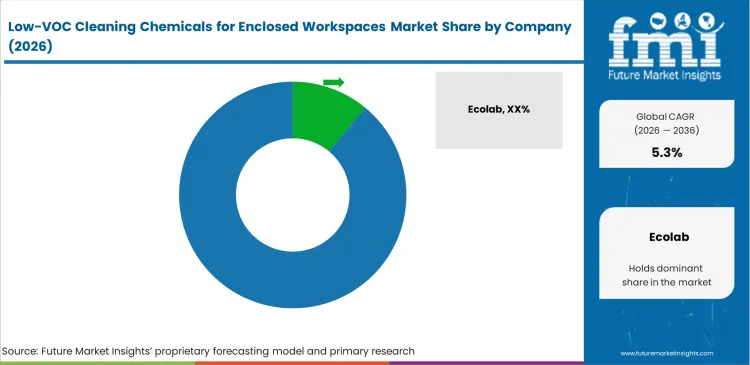
Chemical manufacturers dominating institutional sanitation embed themselves deeply into facility operations, moving far beyond basic material supply. Ecolab and Diversey secure enterprise-level agreements by installing proprietary dilution equipment directly into commercial plumbing infrastructure. This physical hardware integration establishes massive switching barriers for building service contractors. Financial controllers exploring alternative suppliers must carefully calculate the costs of removing existing dispensers, retraining entire custodial fleets, and navigating temporary operational disruptions. These formidable transition expenses effectively secure highly lucrative, decade-long agreements covering the intense demand for industrial institutional cleaning products in eu networks.
Large property management firms resist equipment lock-in by specifying open-source dispensing hardware across their real estate portfolios. Administrators increasingly demand wall-mounted dilution stations capable of accepting generic concentrate cartridges, allowing them to instantly switch suppliers if pricing escalates unexpectedly. Formulators capable of delivering significant volumes of low-emission commercial laundry detergent secure secondary hospital accounts effortlessly. Supplying comprehensive disinfectant chemicals alongside advanced floor systems allows manufacturers to secure complete facility maintenance contracts. Regional distributors secure recurring revenue by managing the complex certification documentation required during annual facility audits, acting as compliance partners rather than mere logistics providers.
Key Players in Low-VOC Cleaning Chemicals for Enclosed Workspaces Market
- Ecolab
- Solenis (Diversey)
- SC Johnson Professional
- 3M
- Reckitt
- Clorox
- Zep
Scope of the Report
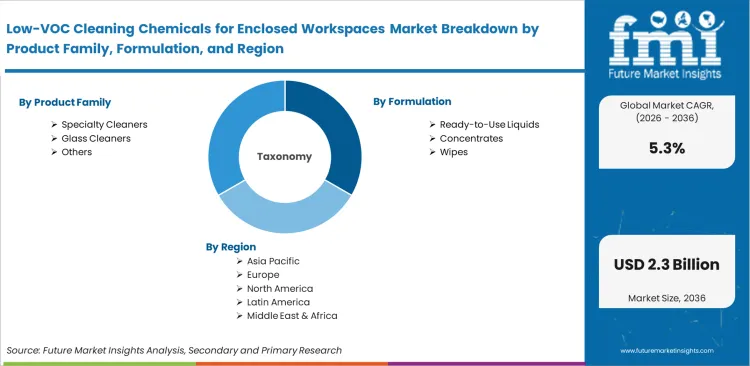
| Metric | Value |
|---|---|
| Quantitative Units | USD 1.3 billion to USD 2.1 billion, at a CAGR of 5.3% |
| Market Definition | Institutional-grade sanitation agents formulated specifically to minimize volatile organic compound emissions. Products include low-odor degreasers, neutral daily surface treatments, and specialized stain removers. |
| Segmentation | Product Family, Formulation, End-use Environment, Chemistry Platform, Supply Channel |
| Regions Covered | North America, Latin America, Western Europe, Eastern Europe, Asia Pacific, Middle East and Africa |
| Countries Covered | United States, Canada, Brazil, Mexico, Germany, United Kingdom, France, Spain, Italy, Russia, China, Japan, India, South Korea, Australia, Saudi Arabia, United Arab Emirates, South Africa |
| Key Companies Profiled | Ecolab, Solenis (Diversey), SC Johnson Professional, 3M, Reckitt, Clorox, Zep |
| Forecast Period | 2026 to 2036 |
| Approach | Commercial building square footage mapped against baseline floor chemical consumption rates adjusted for concentrate dilution ratios. |
Source: Future Market Insights (FMI) analysis, based on proprietary forecasting model and primary research
Analysis by Segments
Product Family
- Specialty cleaners
- General-purpose cleaners
- Glass cleaners
- Restroom cleaners
- Carpet cleaners
Formulation
- Ready-to-use liquids
- Concentrates
- Wipes
- Sprays
- Pods / cartridges
End-use Environment
- Office buildings & corporate workplaces
- Schools & education facilities
- Healthcare admin and non-clinical spaces
- Government & public buildings
- Labs and controlled support spaces
Chemistry Platform
- Water-based low-solvent formulations
- Hydrogen peroxide systems
- Bio-based surfactant blends
- Neutral detergents
- Enzyme-based cleaners
Supply Channel
- Direct institutional supply
- Jan-san distributors
- Facility management contractors
- Procurement platforms / GPO-style contracts
- Online / catalog procurement
Region
- North America
- Latin America
- Western Europe
- Eastern Europe
- Asia Pacific
- Middle East and Africa
Bibliography
- Environmental Protection Agency. (2025, July 24). Volatile organic compounds' impact on indoor air quality.
- Green Seal. (n.d.). GS-37 cleaning products for industrial and institutional use. (Green Seal)
- Health Canada. (2025, September 19). Guidance on improving indoor air quality in office buildings. Government of Canada.
- U.S. Environmental Protection Agency. (2025, October 21). Identifying greener cleaning products.
- National Institute for Occupational Safety and Health. (2025). Exposure assessment of peracetic acid-based disinfectant during hospital discharge room cleaning (EPHB Report No. 358-12a). Centers for Disease Control and Prevention.
This bibliography is provided for reader reference. The full FMI report contains the complete reference list with primary source documentation.
Frequently Asked Questions
How big is the low-voc enclosed workspace cleaning sector?
The valuation stood at USD 1.2 billion in 2025. Projections indicate total sales will cross USD 1.3 billion in 2026, steadily advancing to reach USD 2.1 billion by 2036.
What is the low-voc cleaning chemicals CAGR?
The space is expected to expand at a 5.3% compound annual growth rate through 2036 as real estate portfolios tighten environmental compliance mandates.
Why are low-voc cleaning chemicals growing in offices?
Eliminating harsh fumes drastically reduces indoor air quality alarms across sealed HVAC architectures. Faster room turnover without residual chemical odors directly improves occupant satisfaction, making single-pass low-emission sanitation an absolute operational necessity.
How to choose low-voc cleaners for offices?
Identifying the optimal supplier requires auditing their ability to maintain uninterrupted inventory across decentralized facility networks. Administrators prioritize formulations that balance effective heavy-duty soil removal against strict occupational safety exposure limits.
Which product family leads this space?
Specialty cleaners capture 30.0% share. Night-shift crews deploy these targeted formulations continuously across challenging architectural finishes to prevent irreversible material degradation.
Which end-use environments generate the most demand?
Office buildings and corporate workplaces account for 33.0% share. Specific environmental criteria embedded into vendor service level agreements restrict the use of into all vendor service level agreements, refusing to onboard any janitorial firm utilizing conventional highly volatile solvents.
How do low-VOC cleaners relate to indoor air quality goals?
Substituting traditional industrial degreasers with certified low-solvent chemistries directly prevents circulated airborne contaminants. This transition protects vulnerable occupants from suffering documented respiratory distress following routine custodial shifts.
What creates hidden costs for concentrate dosing systems?
Complex venturi mixing valves require specialized technicians for routine recalibration. Administrators absorb unexpected repair expenses whenever localized hard water compromises internal mechanical components. Uncalibrated equipment silently wastes expensive active ingredients, inflating quarterly supply budgets.
How do multi-certified products complicate daily operations?
Meeting overlapping chemical restrictions across three different standards compromises heavy soil removal capabilities. Custodial supervisors discover that heavily restricted surfactants fail to dissolve grease efficiently. Cleaning staff must apply excessive physical scrubbing, causing labor costs to soar.
Why does direct institutional supply capture 42.0% format share?
Enterprise operations demand absolute zero-emission hygiene standardization worldwide. Corporate procurement teams negotiate bulk contracts, forcing franchised operators to utilize approved vendor lists. Direct channels guarantee formula consistency across thousands of diverse clinical locations.
Preview the report firsthand - request a free sample
Get SampleGet the brochure for pricing and purchase details.
Get PDFTable of Content
- Executive Summary
- Global Market Outlook
- Demand-side Trends
- Supply-side Trends
- Technology Roadmap Analysis
- Analysis and Recommendations
- Market Overview
- Market Coverage / Taxonomy
- Market Definition / Scope / Limitations
- Research Methodology
- Chapter Orientation
- Analytical Lens and Working Hypotheses
- Market Structure, Signals, and Trend Drivers
- Benchmarking and Cross-market Comparability
- Market Sizing, Forecasting, and Opportunity Mapping
- Research Design and Evidence Framework
- Desk Research Programme (Secondary Evidence)
- Company Annual and Sustainability Reports
- Peer-reviewed Journals and Academic Literature
- Corporate Websites, Product Literature, and Technical Notes
- Earnings Decks and Investor Briefings
- Statutory Filings and Regulatory Disclosures
- Technical White Papers and Standards Notes
- Trade Journals, Industry Magazines, and Analyst Briefs
- Conference Proceedings, Webinars, and Seminar Materials
- Government Statistics Portals and Public Data Releases
- Press Releases and Reputable Media Coverage
- Specialist Newsletters and Curated Briefings
- Sector Databases and Reference Repositories
- FMI Internal Proprietary Databases and Historical Market Datasets
- Subscription Datasets and Paid Sources
- Social Channels, Communities, and Digital Listening Inputs
- Additional Desk Sources
- Expert Input and Fieldwork (Primary Evidence)
- Primary Modes
- Qualitative Interviews and Expert Elicitation
- Quantitative Surveys and Structured Data Capture
- Blended Approach
- Why Primary Evidence is Used
- Field Techniques
- Interviews
- Surveys
- Focus Groups
- Observational and In-context Research
- Social and Community Interactions
- Stakeholder Universe Engaged
- C-suite Leaders
- Board Members
- Presidents and Vice Presidents
- R&D and Innovation Heads
- Technical Specialists
- Domain Subject-matter Experts
- Scientists
- Physicians and Other Healthcare Professionals
- Governance, Ethics, and Data Stewardship
- Research Ethics
- Data Integrity and Handling
- Primary Modes
- Tooling, Models, and Reference Databases
- Desk Research Programme (Secondary Evidence)
- Data Engineering and Model Build
- Data Acquisition and Ingestion
- Cleaning, Normalisation, and Verification
- Synthesis, Triangulation, and Analysis
- Quality Assurance and Audit Trail
- Market Background
- Market Dynamics
- Drivers
- Restraints
- Opportunity
- Trends
- Scenario Forecast
- Demand in Optimistic Scenario
- Demand in Likely Scenario
- Demand in Conservative Scenario
- Opportunity Map Analysis
- Product Life Cycle Analysis
- Supply Chain Analysis
- Investment Feasibility Matrix
- Value Chain Analysis
- PESTLE and Porter’s Analysis
- Regulatory Landscape
- Regional Parent Market Outlook
- Production and Consumption Statistics
- Import and Export Statistics
- Market Dynamics
- Global Market Analysis 2021 to 2025 and Forecast, 2026 to 2036
- Historical Market Size Value (USD Million) Analysis, 2021 to 2025
- Current and Future Market Size Value (USD Million) Projections, 2026 to 2036
- Y-o-Y Growth Trend Analysis
- Absolute $ Opportunity Analysis
- Global Market Pricing Analysis 2021 to 2025 and Forecast 2026 to 2036
- Global Market Analysis 2021 to 2025 and Forecast 2026 to 2036, By Product Family
- Introduction / Key Findings
- Historical Market Size Value (USD Million) Analysis By Product Family , 2021 to 2025
- Current and Future Market Size Value (USD Million) Analysis and Forecast By Product Family , 2026 to 2036
- Specialty Cleaners
- Glass Cleaners
- Others
- Specialty Cleaners
- Y-o-Y Growth Trend Analysis By Product Family , 2021 to 2025
- Absolute $ Opportunity Analysis By Product Family , 2026 to 2036
- Global Market Analysis 2021 to 2025 and Forecast 2026 to 2036, By Formulation
- Introduction / Key Findings
- Historical Market Size Value (USD Million) Analysis By Formulation, 2021 to 2025
- Current and Future Market Size Value (USD Million) Analysis and Forecast By Formulation, 2026 to 2036
- Ready-to-Use Liquids
- Concentrates
- Wipes
- Ready-to-Use Liquids
- Y-o-Y Growth Trend Analysis By Formulation, 2021 to 2025
- Absolute $ Opportunity Analysis By Formulation, 2026 to 2036
- Global Market Analysis 2021 to 2025 and Forecast 2026 to 2036, By End-use Environment
- Introduction / Key Findings
- Historical Market Size Value (USD Million) Analysis By End-use Environment, 2021 to 2025
- Current and Future Market Size Value (USD Million) Analysis and Forecast By End-use Environment, 2026 to 2036
- Office Buildings & Corporate Workplaces
- Schools & Education Facilities
- Others
- Office Buildings & Corporate Workplaces
- Y-o-Y Growth Trend Analysis By End-use Environment, 2021 to 2025
- Absolute $ Opportunity Analysis By End-use Environment, 2026 to 2036
- Global Market Analysis 2021 to 2025 and Forecast 2026 to 2036, By Chemistry Platform
- Introduction / Key Findings
- Historical Market Size Value (USD Million) Analysis By Chemistry Platform, 2021 to 2025
- Current and Future Market Size Value (USD Million) Analysis and Forecast By Chemistry Platform, 2026 to 2036
- Water-Based Low-Solvent
- Neutral Detergents
- Others
- Water-Based Low-Solvent
- Y-o-Y Growth Trend Analysis By Chemistry Platform, 2021 to 2025
- Absolute $ Opportunity Analysis By Chemistry Platform, 2026 to 2036
- Global Market Analysis 2021 to 2025 and Forecast 2026 to 2036, By Supply Channel
- Introduction / Key Findings
- Historical Market Size Value (USD Million) Analysis By Supply Channel, 2021 to 2025
- Current and Future Market Size Value (USD Million) Analysis and Forecast By Supply Channel, 2026 to 2036
- Direct Institutional Supply
- Jan-san Distributors
- Others
- Direct Institutional Supply
- Y-o-Y Growth Trend Analysis By Supply Channel, 2021 to 2025
- Absolute $ Opportunity Analysis By Supply Channel, 2026 to 2036
- Global Market Analysis 2021 to 2025 and Forecast 2026 to 2036, By Region
- Introduction
- Historical Market Size Value (USD Million) Analysis By Region, 2021 to 2025
- Current Market Size Value (USD Million) Analysis and Forecast By Region, 2026 to 2036
- North America
- Latin America
- Western Europe
- Eastern Europe
- East Asia
- South Asia and Pacific
- Middle East & Africa
- Market Attractiveness Analysis By Region
- North America Market Analysis 2021 to 2025 and Forecast 2026 to 2036, By Country
- Historical Market Size Value (USD Million) Trend Analysis By Market Taxonomy, 2021 to 2025
- Market Size Value (USD Million) Forecast By Market Taxonomy, 2026 to 2036
- By Country
- USA
- Canada
- Mexico
- By Product Family
- By Formulation
- By End-use Environment
- By Chemistry Platform
- By Supply Channel
- By Country
- Market Attractiveness Analysis
- By Country
- By Product Family
- By Formulation
- By End-use Environment
- By Chemistry Platform
- By Supply Channel
- Key Takeaways
- Latin America Market Analysis 2021 to 2025 and Forecast 2026 to 2036, By Country
- Historical Market Size Value (USD Million) Trend Analysis By Market Taxonomy, 2021 to 2025
- Market Size Value (USD Million) Forecast By Market Taxonomy, 2026 to 2036
- By Country
- Brazil
- Chile
- Rest of Latin America
- By Product Family
- By Formulation
- By End-use Environment
- By Chemistry Platform
- By Supply Channel
- By Country
- Market Attractiveness Analysis
- By Country
- By Product Family
- By Formulation
- By End-use Environment
- By Chemistry Platform
- By Supply Channel
- Key Takeaways
- Western Europe Market Analysis 2021 to 2025 and Forecast 2026 to 2036, By Country
- Historical Market Size Value (USD Million) Trend Analysis By Market Taxonomy, 2021 to 2025
- Market Size Value (USD Million) Forecast By Market Taxonomy, 2026 to 2036
- By Country
- Germany
- UK
- Italy
- Spain
- France
- Nordic
- BENELUX
- Rest of Western Europe
- By Product Family
- By Formulation
- By End-use Environment
- By Chemistry Platform
- By Supply Channel
- By Country
- Market Attractiveness Analysis
- By Country
- By Product Family
- By Formulation
- By End-use Environment
- By Chemistry Platform
- By Supply Channel
- Key Takeaways
- Eastern Europe Market Analysis 2021 to 2025 and Forecast 2026 to 2036, By Country
- Historical Market Size Value (USD Million) Trend Analysis By Market Taxonomy, 2021 to 2025
- Market Size Value (USD Million) Forecast By Market Taxonomy, 2026 to 2036
- By Country
- Russia
- Poland
- Hungary
- Balkan & Baltic
- Rest of Eastern Europe
- By Product Family
- By Formulation
- By End-use Environment
- By Chemistry Platform
- By Supply Channel
- By Country
- Market Attractiveness Analysis
- By Country
- By Product Family
- By Formulation
- By End-use Environment
- By Chemistry Platform
- By Supply Channel
- Key Takeaways
- East Asia Market Analysis 2021 to 2025 and Forecast 2026 to 2036, By Country
- Historical Market Size Value (USD Million) Trend Analysis By Market Taxonomy, 2021 to 2025
- Market Size Value (USD Million) Forecast By Market Taxonomy, 2026 to 2036
- By Country
- China
- Japan
- South Korea
- By Product Family
- By Formulation
- By End-use Environment
- By Chemistry Platform
- By Supply Channel
- By Country
- Market Attractiveness Analysis
- By Country
- By Product Family
- By Formulation
- By End-use Environment
- By Chemistry Platform
- By Supply Channel
- Key Takeaways
- South Asia and Pacific Market Analysis 2021 to 2025 and Forecast 2026 to 2036, By Country
- Historical Market Size Value (USD Million) Trend Analysis By Market Taxonomy, 2021 to 2025
- Market Size Value (USD Million) Forecast By Market Taxonomy, 2026 to 2036
- By Country
- India
- ASEAN
- Australia & New Zealand
- Rest of South Asia and Pacific
- By Product Family
- By Formulation
- By End-use Environment
- By Chemistry Platform
- By Supply Channel
- By Country
- Market Attractiveness Analysis
- By Country
- By Product Family
- By Formulation
- By End-use Environment
- By Chemistry Platform
- By Supply Channel
- Key Takeaways
- Middle East & Africa Market Analysis 2021 to 2025 and Forecast 2026 to 2036, By Country
- Historical Market Size Value (USD Million) Trend Analysis By Market Taxonomy, 2021 to 2025
- Market Size Value (USD Million) Forecast By Market Taxonomy, 2026 to 2036
- By Country
- Kingdom of Saudi Arabia
- Other GCC Countries
- Turkiye
- South Africa
- Other African Union
- Rest of Middle East & Africa
- By Product Family
- By Formulation
- By End-use Environment
- By Chemistry Platform
- By Supply Channel
- By Country
- Market Attractiveness Analysis
- By Country
- By Product Family
- By Formulation
- By End-use Environment
- By Chemistry Platform
- By Supply Channel
- Key Takeaways
- Key Countries Market Analysis
- USA
- Pricing Analysis
- Market Share Analysis, 2025
- By Product Family
- By Formulation
- By End-use Environment
- By Chemistry Platform
- By Supply Channel
- Canada
- Pricing Analysis
- Market Share Analysis, 2025
- By Product Family
- By Formulation
- By End-use Environment
- By Chemistry Platform
- By Supply Channel
- Mexico
- Pricing Analysis
- Market Share Analysis, 2025
- By Product Family
- By Formulation
- By End-use Environment
- By Chemistry Platform
- By Supply Channel
- Brazil
- Pricing Analysis
- Market Share Analysis, 2025
- By Product Family
- By Formulation
- By End-use Environment
- By Chemistry Platform
- By Supply Channel
- Chile
- Pricing Analysis
- Market Share Analysis, 2025
- By Product Family
- By Formulation
- By End-use Environment
- By Chemistry Platform
- By Supply Channel
- Germany
- Pricing Analysis
- Market Share Analysis, 2025
- By Product Family
- By Formulation
- By End-use Environment
- By Chemistry Platform
- By Supply Channel
- UK
- Pricing Analysis
- Market Share Analysis, 2025
- By Product Family
- By Formulation
- By End-use Environment
- By Chemistry Platform
- By Supply Channel
- Italy
- Pricing Analysis
- Market Share Analysis, 2025
- By Product Family
- By Formulation
- By End-use Environment
- By Chemistry Platform
- By Supply Channel
- Spain
- Pricing Analysis
- Market Share Analysis, 2025
- By Product Family
- By Formulation
- By End-use Environment
- By Chemistry Platform
- By Supply Channel
- France
- Pricing Analysis
- Market Share Analysis, 2025
- By Product Family
- By Formulation
- By End-use Environment
- By Chemistry Platform
- By Supply Channel
- India
- Pricing Analysis
- Market Share Analysis, 2025
- By Product Family
- By Formulation
- By End-use Environment
- By Chemistry Platform
- By Supply Channel
- ASEAN
- Pricing Analysis
- Market Share Analysis, 2025
- By Product Family
- By Formulation
- By End-use Environment
- By Chemistry Platform
- By Supply Channel
- Australia & New Zealand
- Pricing Analysis
- Market Share Analysis, 2025
- By Product Family
- By Formulation
- By End-use Environment
- By Chemistry Platform
- By Supply Channel
- China
- Pricing Analysis
- Market Share Analysis, 2025
- By Product Family
- By Formulation
- By End-use Environment
- By Chemistry Platform
- By Supply Channel
- Japan
- Pricing Analysis
- Market Share Analysis, 2025
- By Product Family
- By Formulation
- By End-use Environment
- By Chemistry Platform
- By Supply Channel
- South Korea
- Pricing Analysis
- Market Share Analysis, 2025
- By Product Family
- By Formulation
- By End-use Environment
- By Chemistry Platform
- By Supply Channel
- Russia
- Pricing Analysis
- Market Share Analysis, 2025
- By Product Family
- By Formulation
- By End-use Environment
- By Chemistry Platform
- By Supply Channel
- Poland
- Pricing Analysis
- Market Share Analysis, 2025
- By Product Family
- By Formulation
- By End-use Environment
- By Chemistry Platform
- By Supply Channel
- Hungary
- Pricing Analysis
- Market Share Analysis, 2025
- By Product Family
- By Formulation
- By End-use Environment
- By Chemistry Platform
- By Supply Channel
- Kingdom of Saudi Arabia
- Pricing Analysis
- Market Share Analysis, 2025
- By Product Family
- By Formulation
- By End-use Environment
- By Chemistry Platform
- By Supply Channel
- Turkiye
- Pricing Analysis
- Market Share Analysis, 2025
- By Product Family
- By Formulation
- By End-use Environment
- By Chemistry Platform
- By Supply Channel
- South Africa
- Pricing Analysis
- Market Share Analysis, 2025
- By Product Family
- By Formulation
- By End-use Environment
- By Chemistry Platform
- By Supply Channel
- USA
- Market Structure Analysis
- Competition Dashboard
- Competition Benchmarking
- Market Share Analysis of Top Players
- By Regional
- By Product Family
- By Formulation
- By End-use Environment
- By Chemistry Platform
- By Supply Channel
- Competition Analysis
- Competition Deep Dive
- Ecolab
- Overview
- Product Portfolio
- Profitability by Market Segments (Product/Age /Sales Channel/Region)
- Sales Footprint
- Strategy Overview
- Marketing Strategy
- Product Strategy
- Channel Strategy
- Solenis (Diversey)
- SC Johnson Professional
- 3M
- Reckitt
- Clorox
- Ecolab
- Competition Deep Dive
- Assumptions & Acronyms Used


