

- Industry Size (2026)
- USD 2.9 Bn
- Forecast (2036)
- USD 5.8 Bn
- CAGR (2026 to 2036)
- 7.2%
Eco-Label Certified Cleaning Chemicals for Professional Users Market Forecast and Outlook By FMI
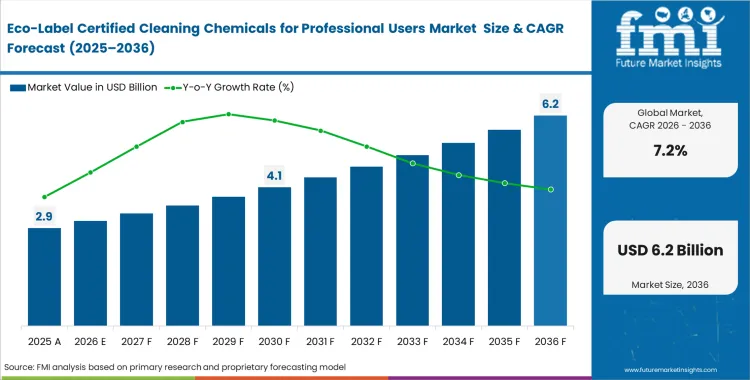
The eco-label certified cleaning chemicals for professional users market was valued at USD 2.7 billion in 2025. Industry is expected to reach USD 2.9 billion in 2026 and grow at a CAGR of 7.2% through 2036, reaching USD 5.8 billion, as corporate property portfolios tighten supplier selection criteria by linking service agreements directly to verified environmental compliance standards.
Summary of Eco-Label Certified Cleaning Chemicals for Professional Users Market
- The market is estimated at USD 2.7 billion in 2025.
- The market is projected to reach USD 5.8 billion by 2036.
- The market is expected to grow at a CAGR of 7.2% from 2026 to 2036.
- The forecast period represents an incremental opportunity of USD 2.9 billion.
- General surface cleaners lead the product segment with a 28.0% share.
- Commercial buildings dominate the end-use segment with a 33.0% share.
- Concentrated formats lead the format segment with a 37.0% share.
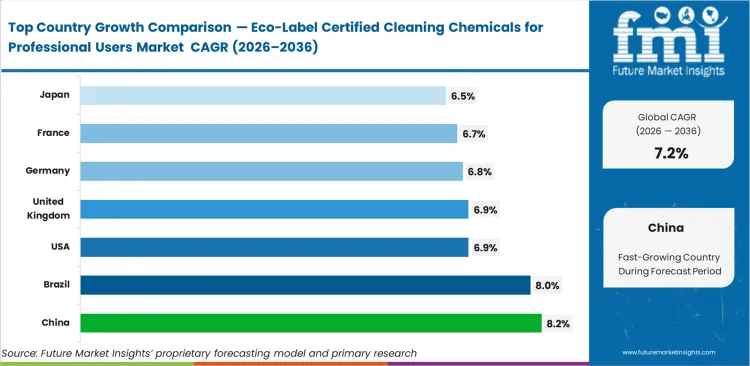
- China (8.2%) and Brazil (8.0%) are among the fastest-growing markets.
- The United States (6.9%) and the United Kingdom (6.9%) show steady growth trends.
- Key companies in the market include Ecolab, Diversey, SC Johnson Professional, 3M, Zep, Spartan Chemical, and Werner & Mertz Professional.
Commercial facilities face pressure to convert entire building portfolios to certified green protocols before upcoming corporate tenant lease renewals. Retaining Tier-1 anchor tenants requires proving Scope 3 emission reductions, pushing eco label certified chemicals into mandatory procurement categories. Failing to secure these certifications exposes facility operators to immediate contract termination from multinational leaseholders demanding strict ESG compliance. FMI's assessment indicates that building service contractors quietly welcome these strict mandates, realizing that standardizing operations around verified professional cleaning products dramatically simplifies inventory management. This shift establishes the foundation of the facility management cleaning chemicals market.
Large commercial real estate investment trusts are enforcing green compliance across vendor bidding processes, forcing facility management firms to restructure sourcing models. Transitioning away from conventional formulations leads to immediate inventory clearance across regional distribution networks. Suppliers without complete environmental documentation lose eligibility for large-scale contracts, reshaping vendor positioning and limiting participation to those able to meet certification and reporting requirements.
China is expected to grow at a CAGR of 8.2%, supported by urban development policies linking occupancy approvals to green building certifications. Brazil follows at 8.0% as multinational corporations standardize facility requirements across regional operations. The United States and the United Kingdom are both projected to expand at 6.9%, while Germany is expected to grow at 6.8%. France is forecast at 6.7%, and Japan at 6.5% during the forecast period, reflecting a divide between regions building baseline compliance into new infrastructure and mature markets tightening thresholds toward low-toxicity and reduced-emission standards.
Segmental Analysis
Eco-Label Certified Cleaning Chemicals for Professional Users Market Analysis by Certification Type
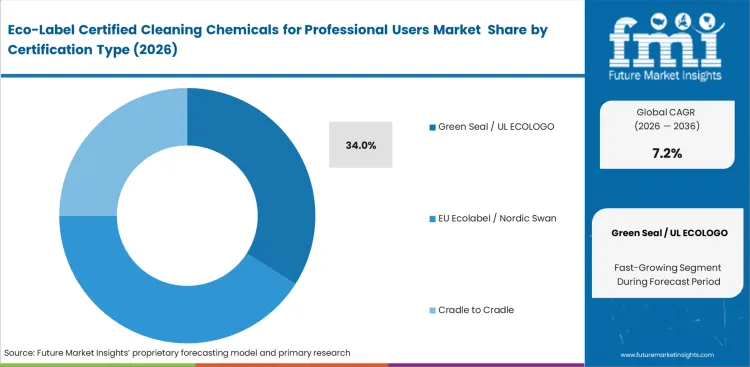
The eco-label certified cleaning chemicals for professional users market captures 34.0% share as North American federal and state-level procurement guidelines hardcode these specific standards into mandatory facility contracts. Building service contractors bidding on government contracts face automatic disqualification if their proposed supply manifests lack these exact credentials. According to FMI's estimates, facility managers operating retail complexes increasingly specify retail cleaning chemicals carrying dual certifications to satisfy diverse tenant requirements.
Navigating janitorial chemical certification programs can be complex, and multi-certified products often fail in the field because meeting overlapping chemical restrictions across three different standards usually compromises the surfactant efficacy required for heavy soil removal. Custodial supervisors who select over-certified industrial green solvents regularly experience soaring labor costs, as staff must apply excessive physical scrubbing to compensate for weakened chemical performance. Facilities increasingly search for commercial cleaning products with green seal certification to avoid these efficacy tradeoffs while maintaining compliance.
Eco-Label Certified Cleaning Chemicals for Professional Users Market Analysis by Product Family
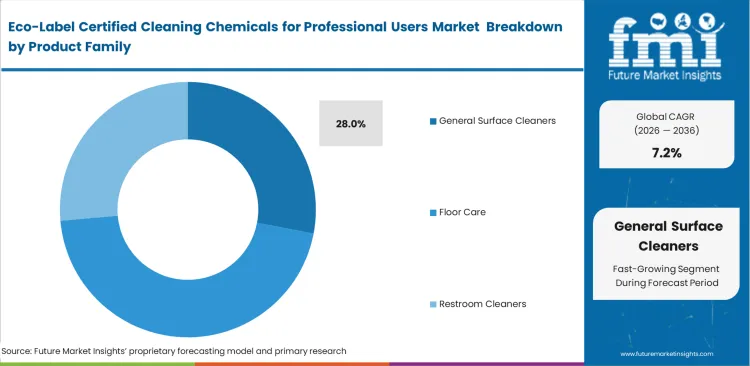
General surface cleaners remain central to daily maintenance routines across commercial environments, driven by the need for consistent visual cleanliness in shared spaces. General surface cleaners is expected to account for 28.0% share in 2026, supported by continuous usage across lobbies, elevators, and work areas. Multi-surface compatibility reduces operational complexity, allowing staff to maintain efficiency during high-frequency cleaning cycles.
Floor care products play a decisive role in long-term service contracts, as visible wear or surface dullness directly affects tenant perception. Restroom cleaners continue to see steady demand due to increased focus on hygiene transparency. While general surface cleaners dominate in volume, specialized formulations such as pH-balanced solutions for institutional use and eco-certified kitchen degreasers are gaining traction due to regulatory pressure on wastewater discharge and surface-specific requirements.
Eco-Label Certified Cleaning Chemicals for Professional Users Market Analysis by End-Use Sector
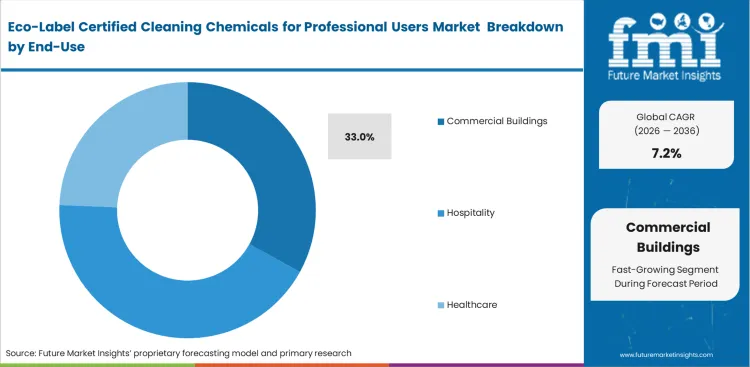
Commercial buildings are expected to contribute 33.0% share in 2026, driven by structured facility management practices and sustainability-linked leasing strategies. Property managers integrate environmental compliance criteria into service agreements to support certification systems such as LEED and maintain premium asset positioning. Low-VOC formulations are widely adopted in sealed building environments to maintain indoor air quality and prevent system-level alerts within HVAC-controlled spaces. Consistent use of certified cleaning chemicals supports compliance targets while aligning with tenant expectations for safer indoor environments. Adoption is further reinforced by the need to meet international sustainability benchmarks that influence tenant acquisition and retention.
Eco-Label Certified Cleaning Chemicals for Professional Users Market Analysis by Format
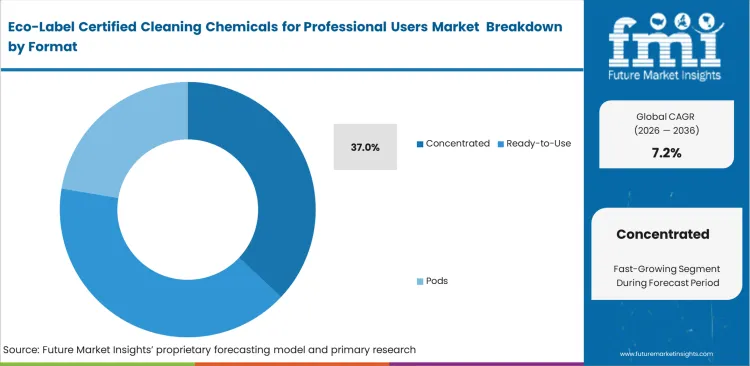
Transporting liquid volume significantly impacts environmental sustainability metrics. Concentrated eco certified cleaning chemicals are estimated to hold 37.0% share in 2026 supported by restructure distribution models to exclusively transport high-density active ingredients. Regional distributors install sophisticated wall-mounted dilution stations directly into janitorial closets, significantly reducing manual pouring hazards while controlling consumption rates.
Highly regulated super concentrate chemicals offer highly favorable cost-per-use economics, provided equipment maintenance remains flawless. Concentrates drastically reduce shipping weight, but without strictly calibrated closed-loop dosing systems, manually over-pour, negating intended environmental and financial benefits. Ignoring routine dispenser calibration inevitably causes kitchen degreasing chemicals shortages, forcing emergency purchasing at premium retail prices.
Eco-Label Certified Cleaning Chemicals for Professional Users Market Drivers, Restraints, and Opportunities
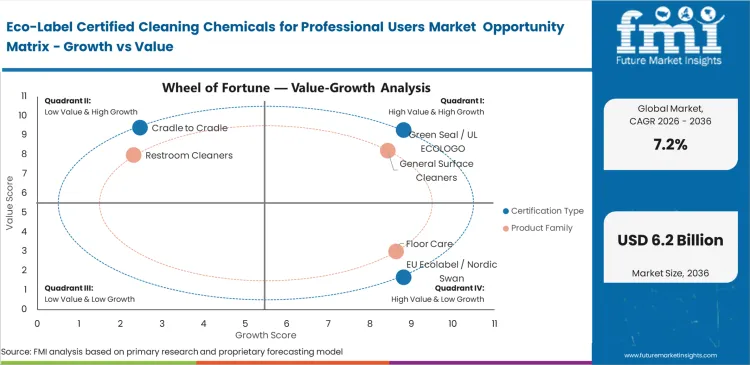
Corporate tenant lease mandates are forcing rapid adoption of eco-label certified cleaning chemicals, as property management firms align operations with verified environmental protocols. Multinational tenants are embedding Scope 3 emission targets and indoor air quality requirements into real estate agreements, translating directly into stricter green cleaning specifications within janitorial contracts. Retaining high-value occupants increasingly depends on meeting these conditions, which pushes building owners to standardize around fragrance-free formulations and certified biodegradable chemistries across managed facilities.
Hard water conditions introduce operational limitations for biodegradable surfactants, particularly in regions with elevated magnesium and calcium content in municipal supply. These minerals bind with plant-based agents, reducing foaming efficiency and leaving visible residue on reflective surfaces. Custodial teams responsible for high-use areas such as fitness and locker room facilities often face recurring complaints tied to soap scum buildup, which can lead to discontinuation of certified formulations when cleaning performance fails to meet tenant expectations.
Opportunities include:
- Enzymatic formulations: Living bacterial cultures consume residual organic waste long after initial application. Facility directors eliminate chronic drain odors organically, drastically reducing plumbing maintenance callouts.
- Cold-water activation: Surfactants engineered to perform effectively without heated water reduce building energy loads. Operations managers slash natural gas expenditures while maintaining strict sanitation compliance.
- Agricultural derivatives: Converting crop waste into highly effective biobased degreasers bypasses volatile petrochemical pricing cycles. Supply chain directors secure stable long-term material costs despite crude oil market fluctuations.
Eco-Label Certified Cleaning Chemicals for Professional Users Market Regional Analysis
Based on regional analysis, the segment is divided across numerous key geographies to track which countries are growing fastest in eco-label professional cleaning chemicals.
.webp "Top Country Growth Comparison Eco Label Certified Cleaning Chemicals For Professional Users Market Cagr (2026 2036)")
| Country | CAGR (2026 to 2036) |
|---|---|
| China | 8.2% |
| Brazil | 8.0% |
| United States | 6.9% |
| United Kingdom | 6.9% |
| Germany | 6.8% |
| France | 6.7% |
| Japan | 6.5% |
Source: Future Market Insights (FMI) analysis, based on proprietary forecasting model and primary research
Eco-Label Certified Cleaning Chemicals for Professional Users Market Asia Pacific Market Analysis
Centralized government mandates dictate aggressive environmental standards for newly constructed urban commercial zones. Property developers building mixed-use districts must secure strict green building permits prior to occupancy, forcing an immediate transition toward certified sanitation chemistry. Officers negotiate bulk contracts covering entire skyscraper portfolios, prioritizing highly concentrated formulas that minimize storage footprint in dense metropolitan hubs. Institutional catering facilities increasingly demand certified vent hood chemicals to meet tightening municipal exhaust regulations.
- China: China is projected to witness an 8.2% CAGR in the eco-label certified cleaning chemicals segment through 2036. In China, urban planning policies link occupancy approvals directly to green building compliance, making certified formulations a prerequisite rather than an upgrade. Contractors aligned with these standards gain consistent access to municipal projects and large-scale commercial developments.
- Japan: Aging labor conditions directing demand toward low-residue products support an estimated 6.5% CAGR in Japan from 2026 to 2036. Chemical selection increasingly reflects occupational exposure limits, which directs demand toward low-residue, low-odor products. Domestic production covers most standard requirements, while specialized formulations continue to enter through controlled imports where local capability is insufficient.
Eco-Label Certified Cleaning Chemicals for Professional Users Market North America Market Analysis
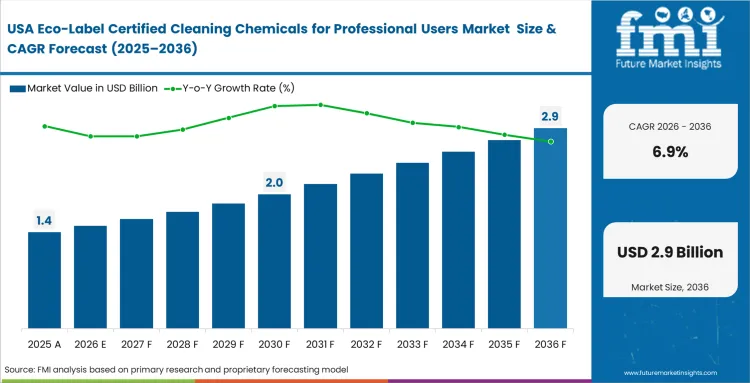
Municipal purchasing frameworks structurally encode environmental requirements directly into vast government service contracts. The United States eco-label cleaning chemicals market thrives as state-level facility directors face automatic budget penalties if their custodial supply manifests contain unverified conventional solvents. Private sector property management firms mimic these federal guidelines, attempting to align their commercial portfolios with recognized LEED certification standards. According to FMI's estimates, educational districts are aggressively phasing out legacy industrial cleaners, driving up demand for safe eco label cleaning products for schools.
- United States: The United States eco-label certified cleaning chemicals market is expected to grow at 6.9% from 2026 to 2036. Real estate portfolios tied to institutional capital incorporate certified chemical usage into ESG reporting frameworks, linking cleaning inputs directly to asset valuation and tenant acquisition. Domestic manufacturing dominates due to regulatory alignment and supply consistency, while imports remain limited to niche formulations.
- Brazil: Brazil’s eco-label certified cleaning chemicals market is projected to expand at a CAGR of 8.0% through 2036, as multinational firms extend uniform facility standards into Latin American operations. This introduces structured demand for certified products, often supported by imports where local production does not yet meet required specifications.
Eco-Label Certified Cleaning Chemicals for Professional Users Market Europe Market Analysis
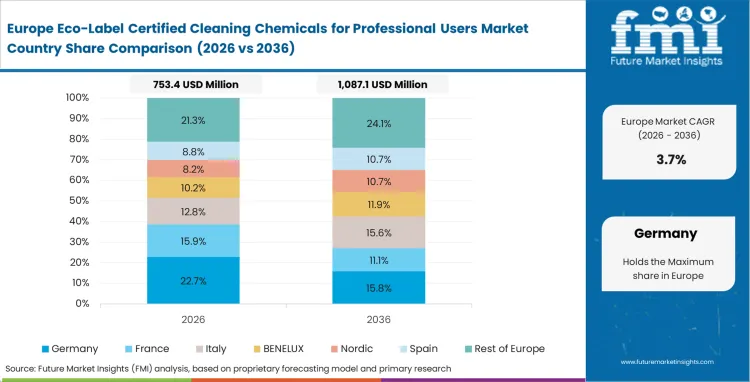
Strict regulatory frameworks systematically eliminate hazardous chemicals from institutional supply chains across the continent. The overarching presence of the EU Ecolabel professional cleaning products framework provides a unified, highly trusted verification mechanism that public and private procurement teams adopt without hesitation. Healthcare networks actively overhaul infection control protocols, seeking verified disinfectant chemicals that do not compromise stringent environmental discharge limits. As per FMI's projection, cross-border facility management firms consolidate their supplier bases, choosing manufacturers capable of delivering professional cleaning chemicals meeting EU Ecolabel standards across multiple jurisdictions.
- United Kingdom: The United Kingdom aligns cost reduction with compliance, where the eco‑label certified cleaning chemicals market is expected to grow at a CAGR of 6.9% from 2026 to 2036 as councils and large institutional buyers accelerate the shift toward concentrated formats. Local authorities increasingly favor products that reduce packaging waste, storage requirements, and transport mileage, particularly within urban waste‑minimization targets.
- Germany: Germany integrates environmental controls directly into operational systems, with the market advancing at 6.8% through 2036 as wastewater restrictions eliminate non-compliant chemical usage at the facility level. Strict limits on phosphates, surfactant residues, and aquatic toxicity force commercial and industrial sites to adopt certified chemistries that align with federal and municipal water authority standards.
- France: France reinforces compliance through procurement access, where the eco-label certified cleaning chemicals market is expected to grow at 6.7%, as uncertified suppliers are excluded from public maintenance contracts. Centralized public purchasing bodies apply strict eligibility criteria tied to recognized ecolabel certifications, limiting participation to vendors that meet defined biodegradability and toxicity benchmarks.
Competitive Aligners for Market Players
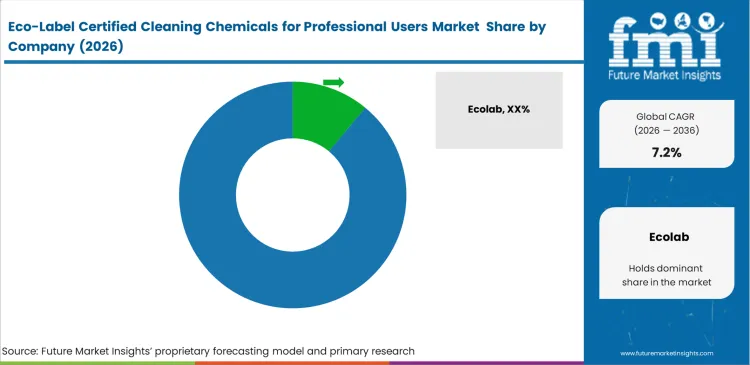
Chemical manufacturers supplying institutional sanitation are increasingly embedded within day-to-day facility operations rather than operating as standalone vendors. Companies such as Ecolab and Diversey secure large-scale contracts by installing proprietary, cloud-connected dilution systems directly into commercial plumbing infrastructure. This integration creates high switching barriers, as facility teams must account for dispenser removal, workforce retraining, and temporary disruption to cleaning routines when considering alternative suppliers, which extends contract duration and stabilizes supplier relationships over longer cycles.
Smaller suppliers developing specialized formulations, including those for senior care environments, often struggle to meet the administrative and certification requirements expected in large institutional contracts. Maintaining multiple ecolabel certifications such as Green Seal, Nordic Swan, and Cradle to Cradle requires sustained documentation, testing, and renewal processes that exceed the capacity of many regional producers. Large building service contractors prioritize vendors that can maintain uninterrupted compliance during regulatory updates, which favors established multinational suppliers with dedicated regulatory and support infrastructure.
Key Players
- Ecolab
- Diversey, A Solenis Company
- SC Johnson Professional
- 3M
- Zep
- Spartan Chemical
- Werner & Mertz Professional
Scope of the Report
| Metric | Value |
|---|---|
| Quantitative Units | USD 2.90 billion to USD 5.8 billion, at a CAGR of 7.20% |
| Market Definition | Institutional-grade sanitation formulations carrying verified third-party environmental credentials. This category captures solutions engineered to meet strict biodegradability, low aquatic toxicity, and minimal volatile organic compound thresholds while maintaining heavy-duty soil removal capabilities. |
| Segmentation | Certification Type, Product Family, End-Use Sector, Format |
| Regions Covered | North America, Latin America, Western Europe, Eastern Europe, Asia Pacific, Middle East and Africa |
| Countries Covered | United States, Canada, Brazil, Mexico, Germany, United Kingdom, France, Spain, Italy, Russia, China, Japan, India, South Korea, Australia, Saudi Arabia, United Arab Emirates, South Africa |
| Key Companies Profiled | Ecolab, Diversey, A Solenis Company, SC Johnson Professional, 3M, Zep, Spartan Chemical, Werner & Mertz Professional |
| Forecast Period | 2026 to 2036 |
| Approach | Commercial building square footage mapped against baseline chemical consumption rates adjusted for concentrate dilution ratios. |
Source: Future Market Insights (FMI) analysis, based on proprietary forecasting model and primary research
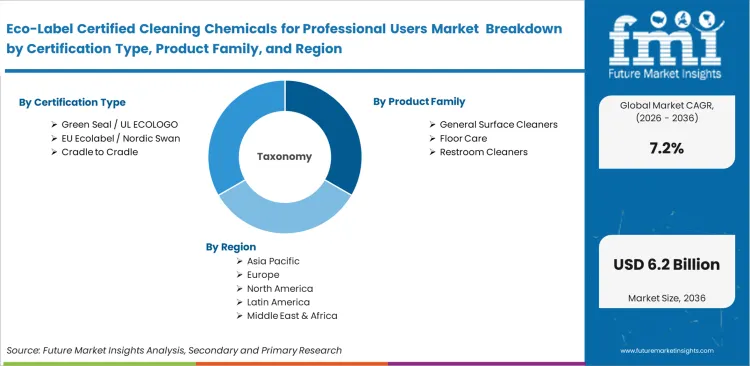
Analysis by Segments
Certification Type
- Green Seal / UL ECOLOGO
- EU Ecolabel / Nordic Swan
- Cradle to Cradle
- Multi-certified
Product Family
- General Surface Cleaners
- Floor Care
- Restroom Cleaners
- Kitchen Degreasers
End-Use Sector
- Commercial Buildings
- Hospitality
- Healthcare
- Institutions
- Industrial
Format
- Concentrates
- Ready-to-Use
- Pods
- Dosing Systems
Region
- North America
- United States
- Canada
- Latin America
- Brazil
- Mexico
- Western Europe
- Germany
- United Kingdom
- France
- Spain
- Italy
- Eastern Europe
- Russia
- Poland
- Asia Pacific
- China
- India
- Japan
- South Korea
- Australia
- Middle East and Africa
- Saudi Arabia
- United Arab Emirates
- South Africa
Bibliography
- European Commission. (2024, March 4). Revision of EU Ecolabel criteria for cleaning products.
- European Commission, Joint Research Centre. (2026, January). Final technical report on the revision of the EU Ecolabel criteria for detergent products (JRC145239).
- United States Environmental Protection Agency. (2026, January). Safer Choice performance measures.
- United States Environmental Protection Agency. (2026, February 10). Safer Choice.
- Nordic Ecolabelling. (2026, March 11). Cleaning products, version 026.
This bibliography is provided for reader reference. The full FMI report contains the complete reference list with primary source documentation.
Frequently Asked Questions
To explain the eco-label certified cleaning chemicals market for professional users, what is its core definition?
It encompasses institutional-grade sanitation formulations carrying verified third-party environmental credentials designed to meet strict biodegradability, low aquatic toxicity, and minimal volatile organic compound thresholds.
How big is the eco-label certified cleaning chemicals for professional users market?
The industry size was evaluated at USD 2.71 billion in 2025 and is projected to reach USD 2.90 billion in 2026. To summarize the growth outlook for eco-label certified cleaning chemicals through 2036, it is poised to hit USD 5.8 billion at a CAGR of 7.20%.
Which certification type leads eco-label cleaning chemicals demand?
Green Seal / UL ECOLOGO holds 34.0% share because North American municipal purchasing frameworks hardcode these specific environmental credentials into binding facility contracts. Bidding on government tenders without these exact validations guarantees automatic disqualification.
If we compare Green Seal, UL ECOLOGO, and EU Ecolabel for professional cleaners, how do they differ?
Green Seal and UL ECOLOGO dominate North American compliance standards, deeply integrated into LEED and federal purchasing. EU Ecolabel provides a unified, highly trusted verification mechanism across European jurisdictions, focusing heavily on stringent aquatic toxicity and biodegradability metrics.
How do safer choice vs green seal cleaning products factor into institutional purchasing?
While both promote environmental and human health, Green Seal is often hardcoded into institutional and commercial LEED requirements, whereas Safer Choice serves as a broader EPA-backed safety benchmark that public facilities look to when evaluating toxicity profiles.
How does Green Seal vs EU Ecolabel cleaning chemicals impact global facility management?
Cross-border facility management firms must navigate these distinct regional frameworks. North American operations prioritize Green Seal for LEED compliance, while European branches exclusively authorize EU Ecolabel formulations to avoid severe municipal fines and satisfy strict green public procurement guidelines.
Why do professional buyers prefer third-party certified cleaning chemicals?
Corporate real estate lease renewals increasingly mandate strict Scope 3 emission targets. Property management directors compel building service contractors to exclusively source verified green chemistry because failing to secure LEED-aligned sanitation protocols results in immediate contract termination.
Are eco certified cleaning chemicals for hospitals widely adopted?
Yes, sustainability directors for massive healthcare networks actively overhaul infection control protocols, seeking verified disinfectants that do not compromise stringent environmental discharge limits while maintaining patient safety.
Why do general surface cleaners lead the product family?
Visual confirmation of cleanliness drives tenant satisfaction scores across premium real estate. Night-shift crews deploy these versatile formulations continuously across lobbies and elevators, preventing custodians from mistakenly damaging delicate interior materials.
How do multi-certified products complicate daily operations?
Meeting overlapping chemical restrictions across three different standards compromises heavy soil removal capabilities. Custodial supervisors discover that heavily restricted surfactants fail to dissolve grease efficiently, forcing cleaning staff to apply excessive physical scrubbing, causing labor costs to soar.
Preview the report firsthand - request a free sample
Get SampleGet the brochure for pricing and purchase details.
Get PDFTable of Content
- Executive Summary
- Global Market Outlook
- Demand-side Trends
- Supply-side Trends
- Technology Roadmap Analysis
- Analysis and Recommendations
- Market Overview
- Market Coverage / Taxonomy
- Market Definition / Scope / Limitations
- Research Methodology
- Chapter Orientation
- Analytical Lens and Working Hypotheses
- Market Sizing, Forecasting, and Opportunity Mapping
- Research Design and Evidence Framework
- Desk Research Programme (Secondary Evidence)
- Company Annual and Sustainability Reports
- Peer-reviewed Journals and Academic Literature
- Corporate Websites, Product Literature, and Technical Notes
- Earnings Decks and Investor Briefings
- Statutory Filings and Regulatory Disclosures
- Technical White Papers and Standards Notes
- Trade Journals, Industry Magazines, and Analyst Briefs
- Conference Proceedings, Webinars, and Seminar Materials
- Government Statistics Portals and Public Data Releases
- Press Releases and Reputable Media Coverage
- Specialist Newsletters and Curated Briefings
- Sector Databases and Reference Repositories
- FMI Internal Proprietary Databases and Historical Market Datasets
- Subscription Datasets and Paid Sources
- Social Channels, Communities, and Digital Listening Inputs
- Additional Desk Sources
- Expert Input and Fieldwork (Primary Evidence)
- Primary Modes
- Qualitative Interviews and Expert Elicitation
- Quantitative Surveys and Structured Data Capture
- Blended Approach
- Why Primary Evidence is Used
- Observational and In-context Research
- Social and Community Interactions
- Primary Modes
- Stakeholder Universe Engaged
- C-suite Leaders
- Board Members
- Presidents and Vice Presidents
- R&D and Innovation Heads
- Technical Specialists
- Domain Subject-matter Experts
- Scientists
- Physicians and Other Healthcare Professionals
- Governance, Ethics, and Data Stewardship
- Research Ethics
- Data Integrity and Handling
- Desk Research Programme (Secondary Evidence)
- Tooling, Models, and Reference Databases
- Data Engineering and Model Build
- Data Acquisition and Ingestion
- Cleaning, Normalisation, and Verification
- Synthesis, Triangulation, and Analysis
- Quality Assurance and Audit Trail
- Market Background
- Market Dynamics
- Drivers
- Restraints
- Opportunity
- Trends
- Scenario Forecast
- Demand in Optimistic Scenario
- Demand in Likely Scenario
- Demand in Conservative Scenario
- Opportunity Map Analysis
- Product Life Cycle Analysis
- Supply Chain Analysis
- Investment Feasibility Matrix
- Value Chain Analysis
- PESTLE and Porter’s Analysis
- Regulatory Landscape
- Regional Parent Market Outlook
- Production and Consumption Statistics
- Import and Export Statistics
- Market Dynamics
- Global Market Analysis 2021 to 2025 and Forecast, 2026 to 2036
- Historical Market Size Value (USD Million) Analysis, 2021 to 2025
- Current and Future Market Size Value (USD Million) Projections, 2026 to 2036
- Y-o-Y Growth Trend Analysis
- Absolute $ Opportunity Analysis
- Global Market Pricing Analysis 2021 to 2025 and Forecast 2026 to 2036
- Global Market Analysis 2021 to 2025 and Forecast 2026 to 2036, By Certification Type
- Introduction / Key Findings
- Historical Market Size Value (USD Million) Analysis By Certification Type , 2021 to 2025
- Current and Future Market Size Value (USD Million) Analysis and Forecast By Certification Type , 2026 to 2036
- Green Seal / UL ECOLOGO
- EU Ecolabel / Nordic Swan
- Cradle to Cradle
- Green Seal / UL ECOLOGO
- Y-o-Y Growth Trend Analysis By Certification Type , 2021 to 2025
- Absolute $ Opportunity Analysis By Certification Type , 2026 to 2036
- Global Market Analysis 2021 to 2025 and Forecast 2026 to 2036, By Product Family
- Introduction / Key Findings
- Historical Market Size Value (USD Million) Analysis By Product Family, 2021 to 2025
- Current and Future Market Size Value (USD Million) Analysis and Forecast By Product Family, 2026 to 2036
- General Surface Cleaners
- Floor Care
- Restroom Cleaners
- General Surface Cleaners
- Y-o-Y Growth Trend Analysis By Product Family, 2021 to 2025
- Absolute $ Opportunity Analysis By Product Family, 2026 to 2036
- Global Market Analysis 2021 to 2025 and Forecast 2026 to 2036, By End-Use
- Introduction / Key Findings
- Historical Market Size Value (USD Million) Analysis By End-Use, 2021 to 2025
- Current and Future Market Size Value (USD Million) Analysis and Forecast By End-Use, 2026 to 2036
- Commercial Buildings
- Hospitality
- Healthcare
- Commercial Buildings
- Y-o-Y Growth Trend Analysis By End-Use, 2021 to 2025
- Absolute $ Opportunity Analysis By End-Use, 2026 to 2036
- Global Market Analysis 2021 to 2025 and Forecast 2026 to 2036, By Format
- Introduction / Key Findings
- Historical Market Size Value (USD Million) Analysis By Format, 2021 to 2025
- Current and Future Market Size Value (USD Million) Analysis and Forecast By Format, 2026 to 2036
- Concentrated
- Ready-to-Use
- Pods
- Concentrated
- Y-o-Y Growth Trend Analysis By Format, 2021 to 2025
- Absolute $ Opportunity Analysis By Format, 2026 to 2036
- Global Market Analysis 2021 to 2025 and Forecast 2026 to 2036, By Region
- Introduction
- Historical Market Size Value (USD Million) Analysis By Region, 2021 to 2025
- Current Market Size Value (USD Million) Analysis and Forecast By Region, 2026 to 2036
- North America
- Latin America
- Western Europe
- Eastern Europe
- East Asia
- South Asia and Pacific
- Middle East & Africa
- Market Attractiveness Analysis By Region
- North America Market Analysis 2021 to 2025 and Forecast 2026 to 2036, By Country
- Historical Market Size Value (USD Million) Trend Analysis By Market Taxonomy, 2021 to 2025
- Market Size Value (USD Million) Forecast By Market Taxonomy, 2026 to 2036
- By Country
- USA
- Canada
- Mexico
- By Certification Type
- By Product Family
- By End-Use
- By Format
- By Country
- Market Attractiveness Analysis
- By Country
- By Certification Type
- By Product Family
- By End-Use
- By Format
- Key Takeaways
- Latin America Market Analysis 2021 to 2025 and Forecast 2026 to 2036, By Country
- Historical Market Size Value (USD Million) Trend Analysis By Market Taxonomy, 2021 to 2025
- Market Size Value (USD Million) Forecast By Market Taxonomy, 2026 to 2036
- By Country
- Brazil
- Chile
- Rest of Latin America
- By Certification Type
- By Product Family
- By End-Use
- By Format
- By Country
- Market Attractiveness Analysis
- By Country
- By Certification Type
- By Product Family
- By End-Use
- By Format
- Key Takeaways
- Western Europe Market Analysis 2021 to 2025 and Forecast 2026 to 2036, By Country
- Historical Market Size Value (USD Million) Trend Analysis By Market Taxonomy, 2021 to 2025
- Market Size Value (USD Million) Forecast By Market Taxonomy, 2026 to 2036
- By Country
- Germany
- UK
- Italy
- Spain
- France
- Nordic
- BENELUX
- Rest of Western Europe
- By Certification Type
- By Product Family
- By End-Use
- By Format
- By Country
- Market Attractiveness Analysis
- By Country
- By Certification Type
- By Product Family
- By End-Use
- By Format
- Key Takeaways
- Eastern Europe Market Analysis 2021 to 2025 and Forecast 2026 to 2036, By Country
- Historical Market Size Value (USD Million) Trend Analysis By Market Taxonomy, 2021 to 2025
- Market Size Value (USD Million) Forecast By Market Taxonomy, 2026 to 2036
- By Country
- Russia
- Poland
- Hungary
- Balkan & Baltic
- Rest of Eastern Europe
- By Certification Type
- By Product Family
- By End-Use
- By Format
- By Country
- Market Attractiveness Analysis
- By Country
- By Certification Type
- By Product Family
- By End-Use
- By Format
- Key Takeaways
- East Asia Market Analysis 2021 to 2025 and Forecast 2026 to 2036, By Country
- Historical Market Size Value (USD Million) Trend Analysis By Market Taxonomy, 2021 to 2025
- Market Size Value (USD Million) Forecast By Market Taxonomy, 2026 to 2036
- By Country
- China
- Japan
- South Korea
- By Certification Type
- By Product Family
- By End-Use
- By Format
- By Country
- Market Attractiveness Analysis
- By Country
- By Certification Type
- By Product Family
- By End-Use
- By Format
- Key Takeaways
- South Asia and Pacific Market Analysis 2021 to 2025 and Forecast 2026 to 2036, By Country
- Historical Market Size Value (USD Million) Trend Analysis By Market Taxonomy, 2021 to 2025
- Market Size Value (USD Million) Forecast By Market Taxonomy, 2026 to 2036
- By Country
- India
- ASEAN
- Australia & New Zealand
- Rest of South Asia and Pacific
- By Certification Type
- By Product Family
- By End-Use
- By Format
- By Country
- Market Attractiveness Analysis
- By Country
- By Certification Type
- By Product Family
- By End-Use
- By Format
- Key Takeaways
- Middle East & Africa Market Analysis 2021 to 2025 and Forecast 2026 to 2036, By Country
- Historical Market Size Value (USD Million) Trend Analysis By Market Taxonomy, 2021 to 2025
- Market Size Value (USD Million) Forecast By Market Taxonomy, 2026 to 2036
- By Country
- Kingdom of Saudi Arabia
- Other GCC Countries
- Turkiye
- South Africa
- Other African Union
- Rest of Middle East & Africa
- By Certification Type
- By Product Family
- By End-Use
- By Format
- By Country
- Market Attractiveness Analysis
- By Country
- By Certification Type
- By Product Family
- By End-Use
- By Format
- Key Takeaways
- Key Countries Market Analysis
- USA
- Pricing Analysis
- Market Share Analysis, 2025
- By Certification Type
- By Product Family
- By End-Use
- By Format
- Canada
- Pricing Analysis
- Market Share Analysis, 2025
- By Certification Type
- By Product Family
- By End-Use
- By Format
- Mexico
- Pricing Analysis
- Market Share Analysis, 2025
- By Certification Type
- By Product Family
- By End-Use
- By Format
- Brazil
- Pricing Analysis
- Market Share Analysis, 2025
- By Certification Type
- By Product Family
- By End-Use
- By Format
- Chile
- Pricing Analysis
- Market Share Analysis, 2025
- By Certification Type
- By Product Family
- By End-Use
- By Format
- Germany
- Pricing Analysis
- Market Share Analysis, 2025
- By Certification Type
- By Product Family
- By End-Use
- By Format
- UK
- Pricing Analysis
- Market Share Analysis, 2025
- By Certification Type
- By Product Family
- By End-Use
- By Format
- Italy
- Pricing Analysis
- Market Share Analysis, 2025
- By Certification Type
- By Product Family
- By End-Use
- By Format
- Spain
- Pricing Analysis
- Market Share Analysis, 2025
- By Certification Type
- By Product Family
- By End-Use
- By Format
- France
- Pricing Analysis
- Market Share Analysis, 2025
- By Certification Type
- By Product Family
- By End-Use
- By Format
- India
- Pricing Analysis
- Market Share Analysis, 2025
- By Certification Type
- By Product Family
- By End-Use
- By Format
- ASEAN
- Pricing Analysis
- Market Share Analysis, 2025
- By Certification Type
- By Product Family
- By End-Use
- By Format
- Australia & New Zealand
- Pricing Analysis
- Market Share Analysis, 2025
- By Certification Type
- By Product Family
- By End-Use
- By Format
- China
- Pricing Analysis
- Market Share Analysis, 2025
- By Certification Type
- By Product Family
- By End-Use
- By Format
- Japan
- Pricing Analysis
- Market Share Analysis, 2025
- By Certification Type
- By Product Family
- By End-Use
- By Format
- South Korea
- Pricing Analysis
- Market Share Analysis, 2025
- By Certification Type
- By Product Family
- By End-Use
- By Format
- Russia
- Pricing Analysis
- Market Share Analysis, 2025
- By Certification Type
- By Product Family
- By End-Use
- By Format
- Poland
- Pricing Analysis
- Market Share Analysis, 2025
- By Certification Type
- By Product Family
- By End-Use
- By Format
- Hungary
- Pricing Analysis
- Market Share Analysis, 2025
- By Certification Type
- By Product Family
- By End-Use
- By Format
- Kingdom of Saudi Arabia
- Pricing Analysis
- Market Share Analysis, 2025
- By Certification Type
- By Product Family
- By End-Use
- By Format
- Turkiye
- Pricing Analysis
- Market Share Analysis, 2025
- By Certification Type
- By Product Family
- By End-Use
- By Format
- South Africa
- Pricing Analysis
- Market Share Analysis, 2025
- By Certification Type
- By Product Family
- By End-Use
- By Format
- USA
- Market Structure Analysis
- Competition Dashboard
- Competition Benchmarking
- Market Share Analysis of Top Players
- By Regional
- By Certification Type
- By Product Family
- By End-Use
- By Format
- Competition Analysis
- Competition Deep Dive
- Ecolab
- Overview
- Product Portfolio
- Profitability by Market Segments (Product/Age /Sales Channel/Region)
- Sales Footprint
- Strategy Overview
- Marketing Strategy
- Product Strategy
- Channel Strategy
- Diversey, A Solenis Company
- SC Johnson Professional
- 3M
- Zep
- Spartan Chemical
- Ecolab
- Competition Deep Dive
- Assumptions & Acronyms Used


