

- Industry Size (2026)
- USD 1.0 Bn
- Forecast (2036)
- USD 1.8 Bn
- CAGR (2026 to 2036)
- 5.80%
Cleaning Chemicals for Fitness and Recreation Facilities Market Forecast and Outlook 2026 to 2036
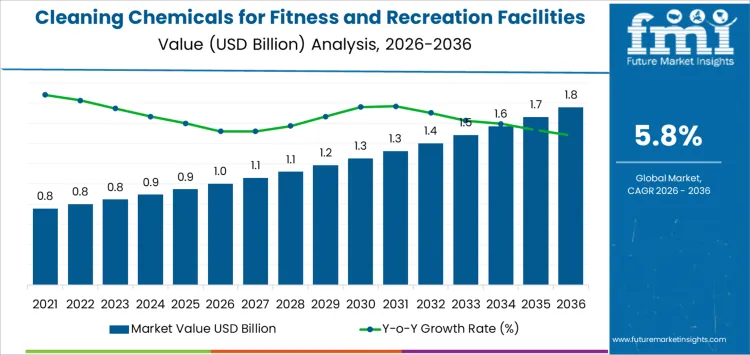
In 2026, the cleaning chemicals for fitness and recreation facilities market is valued at USD 1.0 billion and is projected to reach USD 1.8 billion by 2036, reflecting a CAGR of 5.8%. Growth from USD 0.6 billion in 2020 is supported by consistent sanitation needs across gyms, fitness clubs, and multipurpose sports complexes. Equipment surface disinfectants account for the largest share as high contact workout machines require frequent cleaning. Ready to use sprays and wipes dominate early adoption due to rapid application and minimal preparation time during operating hours.
From 2027 to 2031, market value increases from USD 1.1 billion to USD 1.4 billion, then advances steadily toward USD 1.8 billion by 2036. Gyms and fitness clubs remain the primary consumers as member turnover sustains regular cleaning cycles. Sports arenas and community recreation centers contribute stable secondary demand for floor, mat, and restroom cleaners. Products positioned as skin safe and fast contact time maintain steady uptake. Long term growth reflects routine maintenance practices, predictable facility usage, and recurring replenishment rather than expansion in facility counts.
Quick Stats of the Cleaning Chemicals for Fitness and Recreation Facilities Market:
- Cleaning Chemicals for Fitness and Recreation Facilities Market Value (2026): USD 1.0 billion
- Cleaning Chemicals for Fitness and Recreation Facilities Market Forecast Value (2036): USD 1.8 billion
- Cleaning Chemicals for Fitness and Recreation Facilities Market Forecast CAGR (2026-2036): 5.8%
- Leading Product Family in the Market: Equipment Surface Disinfectants (36%)
- Key Growth Regions: China, Brazil, USA, UK, Germany
- Top Players: Ecolab, Diversey, CloroxPro, Reckitt, SC Johnson Professional, 3M, Zep, Spartan Chemical, Betco, Unilever Professional
What is the Growth Forecast for the Cleaning Chemicals for Fitness and Recreation Facilities Market through 2036?
From 2026 to 2031, the cleaning chemicals for fitness and recreation facilities market increases from USD 1.0 billion to about USD 1.3 billion, reflecting steady year-on-year growth tied to facility utilization rather than expansion in site count. Demand in this phase is driven by frequent surface cleaning of equipment, locker rooms, studios, and shared amenities where high contact rates require regular sanitation. Annual gains remain measured, shaped by membership recovery, extended operating hours, and standardized cleaning protocols adopted by gym chains and community recreation centers. Spending growth tracks usage intensity and class scheduling density rather than discretionary upgrades.
Between 2031 and 2036, the market expands from roughly USD 1.3 billion to USD 1.8 billion, showing a stronger pace of annual growth. Incremental value additions increase as operators raise cleaning frequency, broaden coverage across specialty zones, and integrate cleaning routines into staff workflows between sessions. Demand becomes less dependent on membership volume and more influenced by service expectations, liability management, and brand positioning. This shift supports larger year-on-year increases, reflecting deeper embedding of cleaning chemicals into daily operational cycles across fitness clubs, sports complexes, and recreation facilities worldwide.
Cleaning Chemicals for Fitness and Recreation Facilities Market Key Takeaways
| Metric | Value |
|---|---|
| Market Value (2026) | USD 1.0 billion |
| Forecast Value (2036) | USD 1.8 billion |
| Forecast CAGR (2026–2036) | 5.80% |
How Are Shared Equipment Use and High Turnover Shaping the Cleaning Chemicals for Fitness and Recreation Facilities Market from 2026 to 2036?
Fitness centres and recreation facilities increased use of targeted cleaning chemicals as shared equipment and constant user rotation raised hygiene demands. Gyms, swimming complexes, indoor courts, and studios required cleaners suitable for sweat residue, body contact surfaces, and moisture prone areas. Historical demand followed growth in membership based facilities and extended operating hours. Managers selected products that worked quickly between sessions and were compatible with rubber flooring, mats, metal equipment, and upholstery. Procurement aligned with daily cleaning schedules, staff training limits, and member expectations for visible cleanliness.
From 2026 to 2036 demand is expected to reflect expansion of wellness centres, community sports facilities, and multi-use recreation spaces. Operators adopt chemicals that support frequent wipe downs without damaging equipment finishes. Growth aligns with increased emphasis on hygiene reassurance and rapid surface turnaround. Suppliers focus on low residue, fast drying formulations suitable for high contact zones. Buyers evaluate skin contact safety, odour control, and ease of application across diverse activity areas.
What Is the Demand for the Cleaning Chemicals for Fitness and Recreation Facilities Market by Product Family and Facility Type for 2026 to 2036?
From 2026 to 2036, the cleaning chemicals for fitness and recreation facilities market is shaped by shared equipment usage, high perspiration exposure, and continuous member turnover. Equipment surface disinfectants account for 36% of product family demand as facilities prioritize hygiene on frequently touched machines and accessories. Gyms and fitness clubs represent the largest facility type at 54% due to dense daily footfall, extended operating hours, and routine equipment rotation. Demand reflects structured cleaning intervals, member safety expectations, and the need to preserve equipment condition while maintaining visible cleanliness across workout environments.
Why do equipment surface disinfectants account for 36% of demand in the cleaning chemicals for fitness and recreation facilities market by product family from 2026 to 2036?
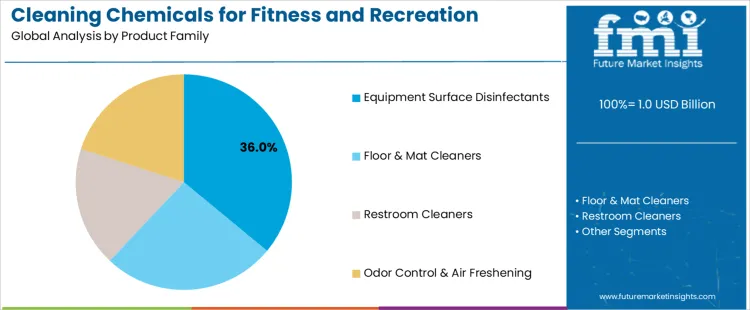
Equipment surface disinfectants account for 36% of demand because fitness equipment experiences repeated direct skin contact throughout the day. Consumption intensity remains high on treadmills, weight machines, free weights, mats, and cardio consoles where sweat, skin oils, and microbial transfer accumulate quickly. Usage stays steady as facilities implement wipe-down protocols between users and scheduled deep cleaning during off-peak hours. Procurement decisions emphasize fast-acting disinfectants that remain safe for plastics, rubber grips, vinyl padding, and electronic interfaces.
Buyers favor formulations that dry quickly and avoid residue that could affect grip or user comfort. Price sensitivity remains moderate since hygiene assurance directly influences member retention and brand reputation. Specification control focuses on material compatibility, contact time clarity, and low odor profiles. Demand continues from 2026 to 2036 as fitness participation remains strong and operators reinforce visible sanitation practices. Repeat purchasing patterns remain predictable due to constant equipment turnover and standardized cleaning routines embedded into daily operations.
Why do gyms and fitness clubs represent 54% of demand in the cleaning chemicals for fitness and recreation facilities market by facility type from 2026 to 2036?
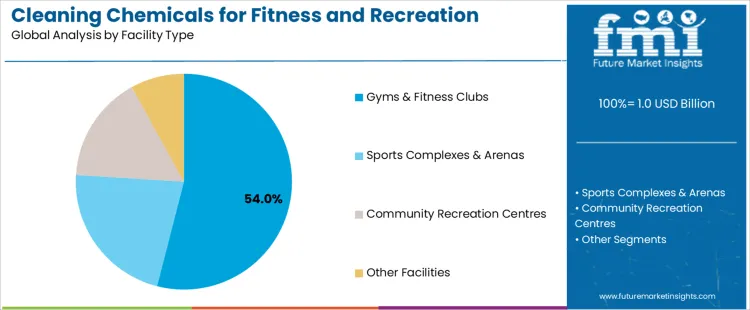
Gyms and fitness clubs represent 54% of demand because they combine high member density with repeated equipment sharing across long operating hours. Consumption is concentrated in weight rooms, cardio zones, group exercise studios, and locker-adjacent areas where cleaning occurs throughout the day. Usage remains steady as staff and members engage in continuous wipe-down practices supported by readily available cleaning products. Procurement favors versatile chemicals that perform across multiple surface types while supporting frequent application.
Buyers prioritize products that align with visible hygiene expectations and do not disrupt workout flow. Price sensitivity stays moderate as cleaning chemicals form a small share of overall operating costs yet carry significant impact on member confidence. Specification control emphasizes ease of use, packaging durability, and compatibility with dispensers placed throughout the facility. Demand persists from 2026 to 2036 as gym memberships stabilize and operators maintain consistent cleanliness standards to support safe and appealing workout environments.
How Is Demand for Cleaning Chemicals in Fitness and Recreation Facilities Shaped by High Contact Activity Patterns?
What Facility Management Practices Are Driving Demand for Cleaning Chemicals in Fitness and Recreation Settings?
Drivers originate from operational policies focused on member safety, equipment care, and uptime. Gym operators standardize approved chemicals to protect machine surfaces and warranties. Recreation managers adopt cleaners suitable for frequent wipe downs by both staff and users. Extended operating hours increase reliance on products that work within short cleaning windows. Facilities offering youth and community programs follow local hygiene guidelines that influence chemical selection. These practices reflect management priorities around injury prevention, asset protection, and consistent facility presentation within active, high turnover environments.
What Practical Constraints Are Limiting Wider Adoption of Specialized Cleaning Chemicals in Fitness Facilities?
Barriers relate to cost sensitivity, user behavior, and storage limits. Smaller gyms operate under tight margins and favor basic multipurpose cleaners. Member applied cleaning can lead to overuse or misuse of specialized products. Storage space near workout areas restricts stocking options. Some facilities avoid strong formulations due to skin contact concerns. Older buildings lack dispensing systems needed for concentrates. Contracted cleaning services also limit flexibility in product choice. These constraints slow adoption where simplicity, cost control, and user safety dominate purchasing decisions.
What is the Growth Outlook for Cleaning Chemicals Used in Fitness and Recreation Facilities Across Key Countries?
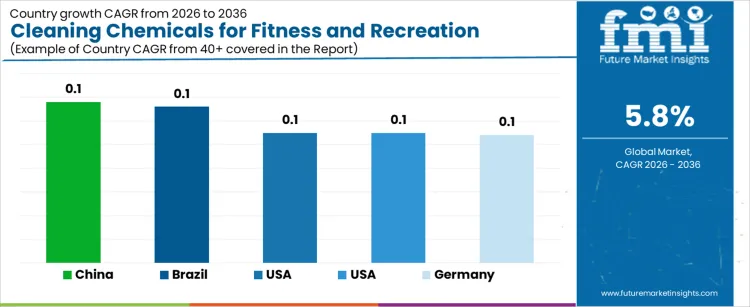
| Country | CAGR (%) |
|---|---|
| China | 6.8% |
| Brazil | 6.6% |
| USA | 5.5% |
| UK | 5.5% |
| Germany | 5.4% |
The demand for cleaning chemicals used in fitness and recreation facilities is growing steadily as operators maintain hygiene standards in high contact environments. China leads growth at 6.8%, supported by rapid expansion of gyms, sports complexes, and public recreation centers. Brazil follows at 6.6%, driven by increased participation in fitness activities and greater focus on sanitation in shared facilities. The USA and UK each record 5.5%, reflecting routine disinfection of equipment, locker rooms, and common areas within mature fitness markets. Germany at 5.4% shows consistent growth linked to regulated hygiene requirements and structured facility management practices. Overall expansion is supported by recurring cleaning cycles, high equipment usage rates, and continued emphasis on cleanliness and user safety.
How Are Member Hygiene Expectations Driving the Cleaning Chemicals for Fitness and Recreation Facilities Market in the United States?
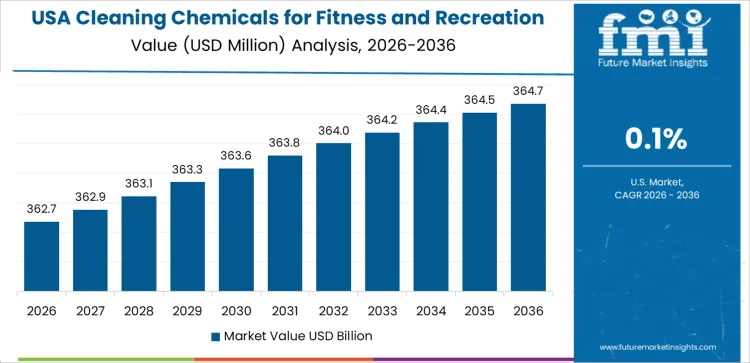
Cleaning chemicals for fitness and recreation facilities demand in the United States is growing at a CAGR of 5.50% from 2026 to 2036 as gyms, sports centers, and wellness clubs maintain strict cleanliness routines. Facility operators apply specialized chemicals across workout floors, locker rooms, equipment surfaces, and shower areas. Management teams schedule frequent cleaning cycles to address high contact zones and shared equipment use. Cleaning protocols align with member expectations for safe exercise environments. Growth reflects continued emphasis on hygiene as a core service attribute within fitness and recreational operations nationwide.
- Facility operators apply cleaning chemicals across equipment and shared areas.
- Management teams schedule frequent cleaning cycles for high contact zones.
- Cleaning protocols align with member hygiene expectations.
What Is Supporting Adoption of the Cleaning Chemicals for Fitness and Recreation Facilities Market in Germany?
Cleaning chemicals for fitness and recreation facilities demand in Germany is expanding at a CAGR of 5.40% from 2026 to 2036 as fitness studios and sports complexes follow structured maintenance standards. Operators use certified cleaning chemicals to maintain hygiene across training areas and amenities. Facility teams follow defined routines aligned with health and safety requirements. Sports associations encourage consistent cleaning practices across affiliated venues. Growth reflects disciplined facility management and compliance driven sanitation practices within the recreational sector.
- Operators use certified chemicals to maintain training and locker areas.
- Facility teams follow routines aligned with safety requirements.
- Sports associations encourage consistent sanitation practices.
Why Is the Cleaning Chemicals for Fitness and Recreation Facilities Market Growing Faster in China?
Cleaning chemicals for fitness and recreation facilities demand in China is increasing at a CAGR of 6.80% from 2026 to 2036 as gym memberships and recreational infrastructure expand. New fitness centers integrate professional cleaning programs during early operations. Existing facilities increase cleaning frequency to manage dense member traffic. Service providers supply chemicals suitable for large floor areas and equipment intensive environments. Growth reflects expansion of urban fitness culture and rising expectations for clean recreational spaces.
- New fitness centers integrate professional cleaning programs early.
- Existing facilities increase cleaning frequency due to member traffic.
- Service providers supply chemicals for equipment intensive environments.
How Are Operational Standards Influencing the Cleaning Chemicals for Fitness and Recreation Facilities Market in the United Kingdom?
Cleaning chemicals for fitness and recreation facilities demand in the United Kingdom is growing at a CAGR of 5.50% from 2026 to 2036 as gyms and leisure centers maintain defined hygiene policies. Facility managers apply approved chemicals across workout zones and communal amenities. Cleaning schedules align with peak usage periods to maintain operational flow. Local authorities support facility inspections tied to hygiene compliance. Growth reflects steady institutional focus on cleanliness across recreational environments.
- Facility managers apply approved chemicals across workout and communal areas.
- Cleaning schedules align with peak facility usage periods.
- Authorities support inspections linked to hygiene compliance.
What Factors Are Supporting Growth of the Cleaning Chemicals for Fitness and Recreation Facilities Market in Brazil?
Cleaning chemicals for fitness and recreation facilities demand in Brazil is expanding at a CAGR of 6.60% from 2026 to 2036 as gyms, sports clubs, and recreational centers strengthen sanitation practices. Operators increase chemical use to manage shared equipment and high humidity conditions. Service contractors support routine cleaning across facilities. Investors emphasize maintenance programs to enhance member retention. Growth reflects rising awareness of hygiene importance within expanding recreational infrastructure across urban regions.
- Operators increase chemical use to manage shared equipment areas.
- Service contractors support routine cleaning across facilities.
- Investors emphasize maintenance programs to support member retention.
What Is Driving the Demand for Cleaning Chemicals for Fitness and Recreation Facilities and Which Companies Shape Daily Sanitation?
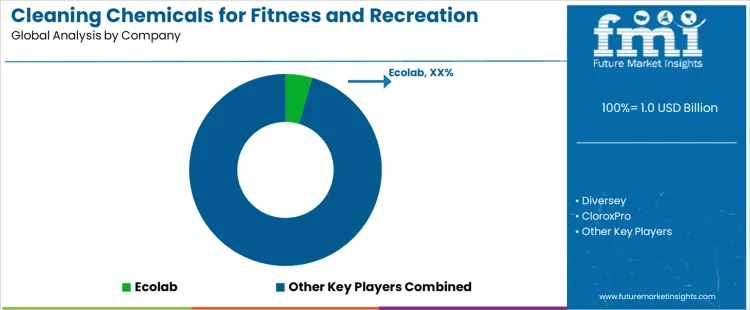
Cleaning chemical demand in fitness and recreation facilities is driven by constant equipment sharing, sweat and moisture exposure, and expectations for visible hygiene by members and staff. Gyms, sports centers, pools, and studios rely on fast acting products that can be applied between sessions without disrupting schedules. Ecolab and Diversey support large chains through standardized cleaning programs designed for high turnover environments. CloroxPro and Reckitt supply disinfectants used on cardio machines, free weights, mats, and locker room surfaces. SC Johnson Professional and 3M provide surface cleaners and wipes suited to frequent contact points. Zep, Spartan Chemical, and Betco serve contract cleaning teams managing multi-site fitness operations.
Product selection emphasizes rapid kill time, material compatibility with rubber, vinyl, and metal, and low residue to prevent slip risk. Unilever Professional contributes general purpose cleaners used in showers, restrooms, and staff areas. Facility managers value clear labeling, simple application, and minimal odor during peak hours. Usage spans training floors, locker rooms, group class studios, and recreational courts. Demand visibility tracks expansion of gym memberships, reopening of community sports facilities, increased group fitness participation, and ongoing focus on member confidence in shared exercise environments.
Key Players in the Cleaning Chemicals for Fitness and Recreation Facilities Market
- Ecolab
- Diversey
- CloroxPro
- Reckitt
- SC Johnson Professional
- 3M
- Zep
- Spartan Chemical
- Betco
- Unilever Professional
Scope of the Report
| Items | Values |
|---|---|
| Quantitative Units (2026) | USD billion |
| Product Family | Equipment Surface Disinfectants; Floor and Mat Cleaners; Restroom Cleaners; Odor Control and Air Freshening Products |
| Facility Type | Gyms and Fitness Clubs; Sports Complexes and Arenas; Community Recreation Centres; Other Recreation Facilities |
| Format | Ready to Use Sprays; Disinfectant Wipes; Concentrates; Other Formats |
| Performance Claim | Fast Contact Time Disinfectants; Skin Safe and Low Irritant Products; Eco Preferable Options; Standard Institutional Formulations |
| Regions Covered | Asia Pacific; Europe; North America; Latin America; Middle East and Africa |
| Countries Covered | China; Japan; South Korea; India; Australia and New Zealand; ASEAN; Germany; United Kingdom; France; Italy; Spain; Nordic; BENELUX; United States; Canada; Mexico; Brazil; Chile; Kingdom of Saudi Arabia; Turkey; South Africa; plus additional countries across Asia Pacific, Europe, Latin America, and Middle East and Africa |
| Key Companies Profiled | Ecolab; Diversey; CloroxPro; Reckitt; SC Johnson Professional; 3M; Zep; Spartan Chemical; Betco; Unilever Professional |
| Additional Attributes | Dollar by sales across product families and facility types; cleaning chemical consumption patterns linked to shared equipment usage and member turnover; adoption of ready to use formats for rapid wipe down during operating hours; variation in chemical usage between gyms, sports arenas, and community recreation centres; emphasis on material compatibility with rubber flooring, mats, metals, and upholstered equipment; integration of cleaning routines into staff and member workflows; procurement practices shaped by hygiene expectations, liability management, and brand positioning across fitness chains |
Cleaning Chemicals for Fitness and Recreation Facilities Market Segmentation
Product Family:
- Equipment Surface Disinfectants
- Floor & Mat Cleaners
- Restroom Cleaners
- Odor Control & Air Freshening
Facility Type:
- Gyms & Fitness Clubs
- Sports Complexes & Arenas
- Community Recreation Centres
- Other Facilities
Format:
- RTU Sprays
- Disinfectant Wipes
- Concentrates
- Other Formats
Performance Claim:
- Fast Contact-Time Disinfectants
- Skin-Safe / Low-Irritant
- Eco-Preferable
- Standard Institutional
Region
Asia Pacific
- China
- Japan
- South Korea
- India
- Australia & New Zealand
- ASEAN
- Rest of Asia Pacific
Europe
- Germany
- United Kingdom
- France
- Italy
- Spain
- Nordic
- BENELUX
- Rest of Europe
North America
- United States
- Canada
- Mexico
Latin America
- Brazil
- Chile
- Rest of Latin America
Middle East & Africa
- Kingdom of Saudi Arabia
- Other GCC Countries
- Turkey
- South Africa
- Other African Union
- Rest of Middle East & Africa
Frequently Asked Questions
How big is the cleaning chemicals for fitness and recreation facilities market in 2026?
The global cleaning chemicals for fitness and recreation facilities market is estimated to be valued at USD 1.0 billion in 2026.
What will be the size of cleaning chemicals for fitness and recreation facilities market in 2036?
The market size for the cleaning chemicals for fitness and recreation facilities market is projected to reach USD 1.8 billion by 2036.
How much will be the cleaning chemicals for fitness and recreation facilities market growth between 2026 and 2036?
The cleaning chemicals for fitness and recreation facilities market is expected to grow at a 5.8% CAGR between 2026 and 2036.
What are the key product types in the cleaning chemicals for fitness and recreation facilities market?
The key product types in cleaning chemicals for fitness and recreation facilities market are equipment surface disinfectants, floor & mat cleaners, restroom cleaners and odor control & air freshening.
Which facility type segment to contribute significant share in the cleaning chemicals for fitness and recreation facilities market in 2026?
In terms of facility type, gyms & fitness clubs segment to command 54.0% share in the cleaning chemicals for fitness and recreation facilities market in 2026.
Preview the report firsthand - request a free sample
Get SampleGet the brochure for pricing and purchase details.
Get PDFTable of Content
- Executive Summary
- Global Market Outlook
- Demand-side Trends
- Supply-side Trends
- Technology Roadmap Analysis
- Analysis and Recommendations
- Market Overview
- Market Coverage / Taxonomy
- Market Definition / Scope / Limitations
- Market Background
- Market Dynamics
- Drivers
- Restraints
- Opportunity
- Trends
- Scenario Forecast
- Demand in Optimistic Scenario
- Demand in Likely Scenario
- Demand in Conservative Scenario
- Opportunity Map Analysis
- Product Life Cycle Analysis
- Supply Chain Analysis
- Investment Feasibility Matrix
- Value Chain Analysis
- PESTLE and Porter’s Analysis
- Regulatory Landscape
- Regional Parent Market Outlook
- Production and Consumption Statistics
- Import and Export Statistics
- Market Dynamics
- Global Market Analysis 2021 to 2025 and Forecast, 2026 to 2036
- Historical Market Size Value (USD Million) Analysis, 2021 to 2025
- Current and Future Market Size Value (USD Million) Projections, 2026 to 2036
- Y-o-Y Growth Trend Analysis
- Absolute $ Opportunity Analysis
- Global Market Pricing Analysis 2021 to 2025 and Forecast 2026 to 2036
- Global Market Analysis 2021 to 2025 and Forecast 2026 to 2036, By Product Family
- Introduction / Key Findings
- Historical Market Size Value (USD Million) Analysis By Product Family , 2021 to 2025
- Current and Future Market Size Value (USD Million) Analysis and Forecast By Product Family , 2026 to 2036
- Equipment Surface Disinfectants
- Floor & Mat Cleaners
- Restroom Cleaners
- Odor Control & Air Freshening
- Y-o-Y Growth Trend Analysis By Product Family , 2021 to 2025
- Absolute $ Opportunity Analysis By Product Family , 2026 to 2036
- Global Market Analysis 2021 to 2025 and Forecast 2026 to 2036, By Facility Type
- Introduction / Key Findings
- Historical Market Size Value (USD Million) Analysis By Facility Type, 2021 to 2025
- Current and Future Market Size Value (USD Million) Analysis and Forecast By Facility Type, 2026 to 2036
- Gyms & Fitness Clubs
- Sports Complexes & Arenas
- Community Recreation Centres
- Other Facilities
- Y-o-Y Growth Trend Analysis By Facility Type, 2021 to 2025
- Absolute $ Opportunity Analysis By Facility Type, 2026 to 2036
- Global Market Analysis 2021 to 2025 and Forecast 2026 to 2036, By Format
- Introduction / Key Findings
- Historical Market Size Value (USD Million) Analysis By Format, 2021 to 2025
- Current and Future Market Size Value (USD Million) Analysis and Forecast By Format, 2026 to 2036
- RTU Sprays
- Disinfectant Wipes
- Concentrates
- Other Formats
- Y-o-Y Growth Trend Analysis By Format, 2021 to 2025
- Absolute $ Opportunity Analysis By Format, 2026 to 2036
- Global Market Analysis 2021 to 2025 and Forecast 2026 to 2036, By Performance Claim
- Introduction / Key Findings
- Historical Market Size Value (USD Million) Analysis By Performance Claim, 2021 to 2025
- Current and Future Market Size Value (USD Million) Analysis and Forecast By Performance Claim, 2026 to 2036
- Fast Contact-Time Disinfectants
- Skin-Safe / Low-Irritant
- Eco-Preferable
- Standard Institutional
- Y-o-Y Growth Trend Analysis By Performance Claim, 2021 to 2025
- Absolute $ Opportunity Analysis By Performance Claim, 2026 to 2036
- Global Market Analysis 2021 to 2025 and Forecast 2026 to 2036, By Region
- Introduction
- Historical Market Size Value (USD Million) Analysis By Region, 2021 to 2025
- Current Market Size Value (USD Million) Analysis and Forecast By Region, 2026 to 2036
- North America
- Latin America
- Western Europe
- Eastern Europe
- East Asia
- South Asia and Pacific
- Middle East & Africa
- Market Attractiveness Analysis By Region
- North America Market Analysis 2021 to 2025 and Forecast 2026 to 2036, By Country
- Historical Market Size Value (USD Million) Trend Analysis By Market Taxonomy, 2021 to 2025
- Market Size Value (USD Million) Forecast By Market Taxonomy, 2026 to 2036
- By Country
- USA
- Canada
- Mexico
- By Product Family
- By Facility Type
- By Format
- By Performance Claim
- By Country
- Market Attractiveness Analysis
- By Country
- By Product Family
- By Facility Type
- By Format
- By Performance Claim
- Key Takeaways
- Latin America Market Analysis 2021 to 2025 and Forecast 2026 to 2036, By Country
- Historical Market Size Value (USD Million) Trend Analysis By Market Taxonomy, 2021 to 2025
- Market Size Value (USD Million) Forecast By Market Taxonomy, 2026 to 2036
- By Country
- Brazil
- Chile
- Rest of Latin America
- By Product Family
- By Facility Type
- By Format
- By Performance Claim
- By Country
- Market Attractiveness Analysis
- By Country
- By Product Family
- By Facility Type
- By Format
- By Performance Claim
- Key Takeaways
- Western Europe Market Analysis 2021 to 2025 and Forecast 2026 to 2036, By Country
- Historical Market Size Value (USD Million) Trend Analysis By Market Taxonomy, 2021 to 2025
- Market Size Value (USD Million) Forecast By Market Taxonomy, 2026 to 2036
- By Country
- Germany
- UK
- Italy
- Spain
- France
- Nordic
- BENELUX
- Rest of Western Europe
- By Product Family
- By Facility Type
- By Format
- By Performance Claim
- By Country
- Market Attractiveness Analysis
- By Country
- By Product Family
- By Facility Type
- By Format
- By Performance Claim
- Key Takeaways
- Eastern Europe Market Analysis 2021 to 2025 and Forecast 2026 to 2036, By Country
- Historical Market Size Value (USD Million) Trend Analysis By Market Taxonomy, 2021 to 2025
- Market Size Value (USD Million) Forecast By Market Taxonomy, 2026 to 2036
- By Country
- Russia
- Poland
- Hungary
- Balkan & Baltic
- Rest of Eastern Europe
- By Product Family
- By Facility Type
- By Format
- By Performance Claim
- By Country
- Market Attractiveness Analysis
- By Country
- By Product Family
- By Facility Type
- By Format
- By Performance Claim
- Key Takeaways
- East Asia Market Analysis 2021 to 2025 and Forecast 2026 to 2036, By Country
- Historical Market Size Value (USD Million) Trend Analysis By Market Taxonomy, 2021 to 2025
- Market Size Value (USD Million) Forecast By Market Taxonomy, 2026 to 2036
- By Country
- China
- Japan
- South Korea
- By Product Family
- By Facility Type
- By Format
- By Performance Claim
- By Country
- Market Attractiveness Analysis
- By Country
- By Product Family
- By Facility Type
- By Format
- By Performance Claim
- Key Takeaways
- South Asia and Pacific Market Analysis 2021 to 2025 and Forecast 2026 to 2036, By Country
- Historical Market Size Value (USD Million) Trend Analysis By Market Taxonomy, 2021 to 2025
- Market Size Value (USD Million) Forecast By Market Taxonomy, 2026 to 2036
- By Country
- India
- ASEAN
- Australia & New Zealand
- Rest of South Asia and Pacific
- By Product Family
- By Facility Type
- By Format
- By Performance Claim
- By Country
- Market Attractiveness Analysis
- By Country
- By Product Family
- By Facility Type
- By Format
- By Performance Claim
- Key Takeaways
- Middle East & Africa Market Analysis 2021 to 2025 and Forecast 2026 to 2036, By Country
- Historical Market Size Value (USD Million) Trend Analysis By Market Taxonomy, 2021 to 2025
- Market Size Value (USD Million) Forecast By Market Taxonomy, 2026 to 2036
- By Country
- Kingdom of Saudi Arabia
- Other GCC Countries
- Turkiye
- South Africa
- Other African Union
- Rest of Middle East & Africa
- By Product Family
- By Facility Type
- By Format
- By Performance Claim
- By Country
- Market Attractiveness Analysis
- By Country
- By Product Family
- By Facility Type
- By Format
- By Performance Claim
- Key Takeaways
- Key Countries Market Analysis
- USA
- Pricing Analysis
- Market Share Analysis, 2025
- By Product Family
- By Facility Type
- By Format
- By Performance Claim
- Canada
- Pricing Analysis
- Market Share Analysis, 2025
- By Product Family
- By Facility Type
- By Format
- By Performance Claim
- Mexico
- Pricing Analysis
- Market Share Analysis, 2025
- By Product Family
- By Facility Type
- By Format
- By Performance Claim
- Brazil
- Pricing Analysis
- Market Share Analysis, 2025
- By Product Family
- By Facility Type
- By Format
- By Performance Claim
- Chile
- Pricing Analysis
- Market Share Analysis, 2025
- By Product Family
- By Facility Type
- By Format
- By Performance Claim
- Germany
- Pricing Analysis
- Market Share Analysis, 2025
- By Product Family
- By Facility Type
- By Format
- By Performance Claim
- UK
- Pricing Analysis
- Market Share Analysis, 2025
- By Product Family
- By Facility Type
- By Format
- By Performance Claim
- Italy
- Pricing Analysis
- Market Share Analysis, 2025
- By Product Family
- By Facility Type
- By Format
- By Performance Claim
- Spain
- Pricing Analysis
- Market Share Analysis, 2025
- By Product Family
- By Facility Type
- By Format
- By Performance Claim
- France
- Pricing Analysis
- Market Share Analysis, 2025
- By Product Family
- By Facility Type
- By Format
- By Performance Claim
- India
- Pricing Analysis
- Market Share Analysis, 2025
- By Product Family
- By Facility Type
- By Format
- By Performance Claim
- ASEAN
- Pricing Analysis
- Market Share Analysis, 2025
- By Product Family
- By Facility Type
- By Format
- By Performance Claim
- Australia & New Zealand
- Pricing Analysis
- Market Share Analysis, 2025
- By Product Family
- By Facility Type
- By Format
- By Performance Claim
- China
- Pricing Analysis
- Market Share Analysis, 2025
- By Product Family
- By Facility Type
- By Format
- By Performance Claim
- Japan
- Pricing Analysis
- Market Share Analysis, 2025
- By Product Family
- By Facility Type
- By Format
- By Performance Claim
- South Korea
- Pricing Analysis
- Market Share Analysis, 2025
- By Product Family
- By Facility Type
- By Format
- By Performance Claim
- Russia
- Pricing Analysis
- Market Share Analysis, 2025
- By Product Family
- By Facility Type
- By Format
- By Performance Claim
- Poland
- Pricing Analysis
- Market Share Analysis, 2025
- By Product Family
- By Facility Type
- By Format
- By Performance Claim
- Hungary
- Pricing Analysis
- Market Share Analysis, 2025
- By Product Family
- By Facility Type
- By Format
- By Performance Claim
- Kingdom of Saudi Arabia
- Pricing Analysis
- Market Share Analysis, 2025
- By Product Family
- By Facility Type
- By Format
- By Performance Claim
- Turkiye
- Pricing Analysis
- Market Share Analysis, 2025
- By Product Family
- By Facility Type
- By Format
- By Performance Claim
- South Africa
- Pricing Analysis
- Market Share Analysis, 2025
- By Product Family
- By Facility Type
- By Format
- By Performance Claim
- USA
- Market Structure Analysis
- Competition Dashboard
- Competition Benchmarking
- Market Share Analysis of Top Players
- By Regional
- By Product Family
- By Facility Type
- By Format
- By Performance Claim
- Competition Analysis
- Competition Deep Dive
- Ecolab
- Overview
- Product Portfolio
- Profitability by Market Segments (Product/Age /Sales Channel/Region)
- Sales Footprint
- Strategy Overview
- Marketing Strategy
- Product Strategy
- Channel Strategy
- Diversey
- CloroxPro
- Reckitt
- SC Johnson Professional
- 3M
- Zep
- Spartan Chemical
- Betco
- Unilever Professional
- Ecolab
- Competition Deep Dive
- Assumptions & Acronyms Used
- Research Methodology


