

- Industry Size (2026)
- USD 2.0 Bn
- Forecast (2036)
- USD 3.2 Bn
- CAGR (2026 to 2036)
- 4.8%
Cleaning Chemicals for Schools and Education Facilities Market Forecast and Outlook 2026 to 2036
In 2026, the cleaning chemicals for schools and education facilities market is valued at USD 2.0 billion and is projected to reach USD 3.2 billion by 2036, reflecting a CAGR of 4.8%. Growth from USD 1.5 billion in 2020 is linked to regular cleaning needs across classrooms, corridors, cafeterias, and shared student spaces. Surface cleaners and disinfectants form the largest product family as daily contact areas require routine treatment. Low odor and low irritant formulations gain preference due to prolonged indoor exposure and age sensitive environments within educational settings.
From 2027 to 2031, market value increases from USD 2.1 billion to USD 2.5 billion, before advancing toward USD 3.2 billion by 2036. School districts and institutions continue to rely on janitorial supply distributors and direct contracts to ensure consistent availability. Restroom and floor care products maintain steady usage driven by daily maintenance schedules. Cafeterias and gym areas contribute stable demand tied to hygiene inspections. Long term growth reflects predictable procurement cycles, compliance driven purchasing, and gradual expansion of institutional cleaning programs rather than changes in cleaning intensity.
Quick Stats of the Cleaning Chemicals for Schools and Education Facilities Market
- Cleaning Chemicals for Schools and Education Facilities Market Value (2026): USD 2.0 billion
- Cleaning Chemicals for Schools and Education Facilities Market Forecast Value (2036): USD 3.2 billion
- Cleaning Chemicals for Schools and Education Facilities Market Forecast CAGR (2026-2036): 4.8%
- Leading Product Family in the Market: Surface Cleaners & Disinfectants (34%)
- Key Growth Regions: China, Brazil, USA, UK, Germany
- Top Players: Ecolab, Diversey, Zep, Spartan Chemical, Betco, Clorox, SC Johnson Professional, Reckitt, Solenis, 3M
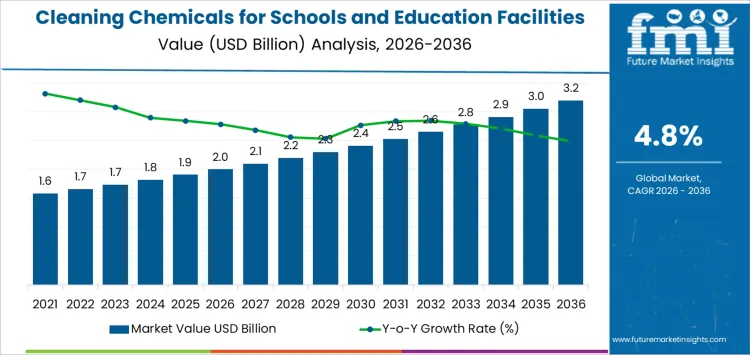
What is the Growth Forecast for the Cleaning Chemicals for Schools and Education Facilities Market through 2036?
Between 2026 and 2031, the cleaning chemicals for schools and education facilities market grows from USD 2.0 billion to about USD 2.4 billion, reflecting steady demand tied to routine academic operations rather than episodic surges. Consumption during this phase is shaped by daily classroom use, cafeteria sanitation, and shared facility maintenance across public and private institutions. Purchasing behavior remains budget-driven, with emphasis on consistent supply, ease of application, and compatibility with custodial workflows. Growth is supported by stable enrollment levels, regular cleaning schedules, and periodic refurbishment of educational infrastructure rather than expansion in facility count.
From 2031 to 2036, the market expands from approximately USD 2.4 billion to USD 3.2 billion, indicating a firmer pace of value growth. This phase reflects higher usage intensity per facility, broader adoption of specialized formulations for restrooms and high-touch areas, and increased procurement through centralized school district contracts. Earlier growth relied on baseline maintenance needs, while later expansion is driven by more structured hygiene programs, higher cleaning frequency in shared spaces, and stronger coordination between education authorities and facility service providers.
Cleaning Chemicals for Schools and Education Facilities Market Key Takeaways
| Metric | Value |
|---|---|
| Market Value (2026) | USD 2.0 billion |
| Forecast Value (2036) | USD 3.2 billion |
| Forecast CAGR (2026-2036) | 4.80% |
How Are Safety Standards and Daily Occupancy Needs Driving the Cleaning Chemicals for Schools and Education Facilities Market from 2026 to 2036?
Educational facilities increased use of dedicated cleaning chemicals as daily occupancy levels and shared surface contact remained high. Schools, colleges, and training centres relied on detergents and disinfectants formulated for classrooms, washrooms, cafeterias, and sports areas. Historical demand reflected routine cleaning schedules aligned with academic calendars and public health guidance issued by local authorities. Buyers prioritised products with clear usage instructions, mild formulations suitable for frequent application, and compatibility with varied surfaces such as desks, flooring, and learning equipment. Procurement often followed district level contracts and budget cycles.
From 2026 to 2036 demand is expected to track investment in school infrastructure, stricter hygiene benchmarks, and decentralised cleaning responsibilities. Institutions adopt products that balance effective sanitation with low odour and reduced irritation risk for children. Growth aligns with extended school hours, after school programs, and increased use of multipurpose spaces. Suppliers develop formulations that support rapid cleaning between sessions and safe storage on site. Buyers assess regulatory compliance, staff usability, and consistency across campuses when selecting cleaning chemicals for education environments.
What Is the Demand for the Cleaning Chemicals for Schools and Education Facilities Market by Product Family and Application Area for 2026 to 2036?
From 2026 to 2036, the cleaning chemicals for schools and education facilities market is shaped by daily occupancy density, age-sensitive hygiene requirements, and structured maintenance schedules across public and private institutions. Surface cleaners and disinfectants hold a 34% share as routine cleaning focuses on desks, learning equipment, and shared touchpoints. Classrooms and common areas represent the largest application area at 38% because they experience continuous student movement and repeated surface contact. Demand reflects preference for reliable formulations that support frequent use while aligning with safety expectations for children and staff.
Why do surface cleaners and disinfectants account for 34% of demand in the cleaning chemicals for schools and education facilities market by product family from 2026 to 2036?
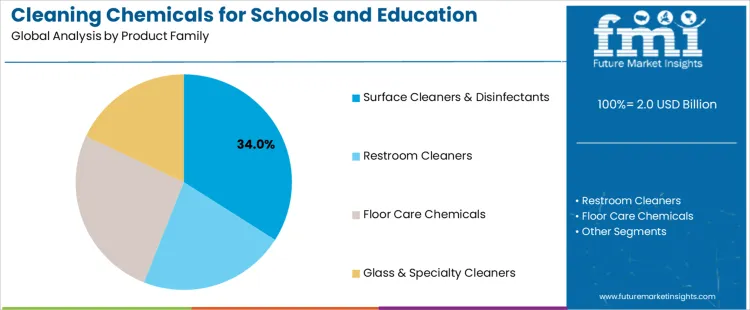
Surface cleaners and disinfectants account for 34% of demand because educational environments require repeated cleaning of high-contact surfaces throughout the day. Consumption intensity remains high on desks, chairs, whiteboards, door handles, switches, and shared learning tools. Usage stays steady as schools follow fixed cleaning intervals aligned with class schedules, breaks, and end-of-day routines. Procurement decisions emphasize formulations that deliver consistent soil removal and microbial control without leaving harsh residues. Buyers favor products compatible with wood laminates, plastics, coated metals, and electronic surfaces commonly found in classrooms. Price sensitivity remains moderate since health protection and attendance continuity carry greater importance than marginal cost differences. Specification control focuses on low odor, quick drying, and material safety under repeated application. Demand continues from 2026 to 2036 as institutions formalize hygiene protocols and allocate dedicated budgets for surface sanitation. Repeat purchasing patterns remain predictable due to daily consumption cycles tied to student attendance. Substitution pressure from multi-purpose household cleaners stays limited where institutional standards require validated performance and consistent outcomes.
Why do classrooms and common areas represent 38% of demand in the cleaning chemicals for schools and education facilities market by application area from 2026 to 2036?
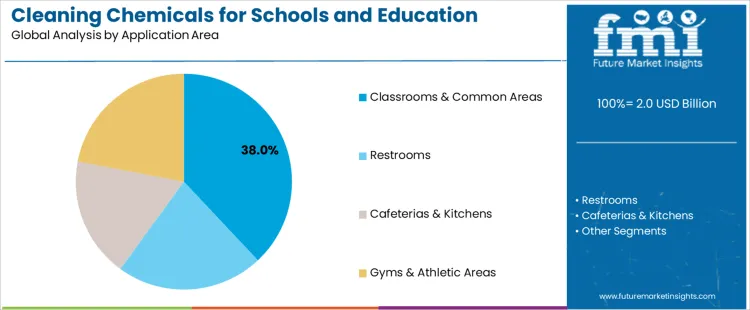
Classrooms and common areas represent 38% of demand because they account for the highest occupancy time and surface interaction within educational facilities. Consumption is concentrated in lecture rooms, corridors, libraries, staff rooms, and assembly spaces where students and faculty circulate continuously. Usage remains steady as cleaning teams address visible soil, spills, and hygiene concerns multiple times daily. Procurement favors chemicals that support fast turnaround between classes and events without disrupting learning activities. Buyers prioritize solutions that dry quickly and maintain surface appearance while supporting frequent reapplication. Price sensitivity stays moderate as cleaning frequency and labor efficiency influence total operating cost more than unit pricing. Specification control emphasizes streak-free performance, slip resistance, and compatibility with microfiber and low-moisture cleaning systems. Demand persists from 2026 to 2036 as school infrastructure expands and existing institutions maintain higher hygiene benchmarks. Repeat utilization remains consistent because classrooms and shared spaces form the core focus of daily cleaning plans.
How Is Demand for Cleaning Chemicals in Schools and Education Facilities Shaped by Daily Campus Operations?
Demand develops through routine cleaning schedules in classrooms, corridors, cafeterias, and shared activity spaces where occupancy changes throughout the day. Primary schools rely on general purpose cleaners that support frequent desk and floor cleaning between sessions. Universities use specialized products for laboratories, libraries, and dormitories with varied surface needs. Childcare centers select formulations suitable for repeated contact surfaces such as toys and play areas. These requirements arise from structured timetables, high touch density, and responsibility for student safety, anchoring demand in daily operational control rather than discretionary purchasing.
What Institutional and Operational Factors Are Driving Demand for Cleaning Chemicals in Education Facilities?
Drivers originate from policies and routines set by school administrations and local education boards. Schools follow cleaning standards linked to attendance management and illness prevention protocols. Facility managers favor products that allow quick turnaround between classes without disrupting schedules. Centralized procurement by school districts encourages standardized chemical selection across multiple campuses. Boarding schools and universities drive demand through residential cleaning needs that extend beyond teaching hours. These factors reflect institutional planning, budget oversight, and accountability requirements that guide chemical use within structured educational environments.
What Practical Constraints Are Limiting Broader Use of Advanced Cleaning Chemicals in Schools?
Barriers relate to budget limits, staffing patterns, and product familiarity. Public schools operate under fixed maintenance budgets that restrict adoption of higher cost formulations. Cleaning staff often manage large areas with limited time, favoring familiar products that fit existing routines. Storage space constraints limit stocking of multiple specialized chemicals. Some facilities avoid products requiring precise dilution or training. Procurement cycles tied to academic years also slow changes. These constraints shape conservative purchasing where predictability and cost control outweigh performance upgrades.
What is the Growth Outlook for Cleaning Chemicals Used in Schools and Education Facilities Across Key Countries?
| Country | CAGR (%) |
|---|---|
| China | 5.8% |
| Brazil | 5.6% |
| USA | 4.5% |
| UK | 4.5% |
| Germany | 4.4% |
The demand for cleaning chemicals used in schools and education facilities is expanding steadily across major economies, shaped by hygiene standards, institutional procurement, and routine maintenance needs. China leads growth at 5.8%, supported by large scale public school infrastructure, expanding urban education facilities, and government driven sanitation programs. Brazil follows at 5.6%, driven by increased focus on hygiene compliance in public schools, private education networks, and childcare centers. The USA and UK each record 4.5%, reflecting stable demand from K–12 schools, universities, and daycare facilities with established cleaning schedules and long term supplier contracts. Germany at 4.4% shows consistent growth linked to regulated cleaning protocols and structured facility management systems. Overall growth remains moderate, supported by recurring consumption cycles and sustained emphasis on safe learning environments.
How Are Hygiene Standards Supporting the Cleaning Chemicals for Schools and Education Facilities Market in the United States?
Cleaning chemicals for schools and education facilities demand in the United States is growing at a CAGR of 4.5% from 2026 to 2036 as public and private institutions maintain structured sanitation programs. Schools rely on specialized cleaning chemicals to manage daily classroom hygiene, restroom sanitation, and cafeteria cleanliness. Education administrators emphasize consistent cleaning schedules to reduce absenteeism and support safe learning environments. Facility service providers supply products aligned with school safety guidelines and approved chemical use lists. Growth reflects steady institutional spending on hygiene products across primary, secondary, and higher education campuses nationwide.
- Schools apply cleaning chemicals to maintain daily classroom and restroom hygiene.
- Education administrators prioritize sanitation to support student attendance.
- Service providers supply products aligned with institutional safety guidelines.
What Is Driving Adoption of the Cleaning Chemicals for Schools and Education Facilities Market in Germany?
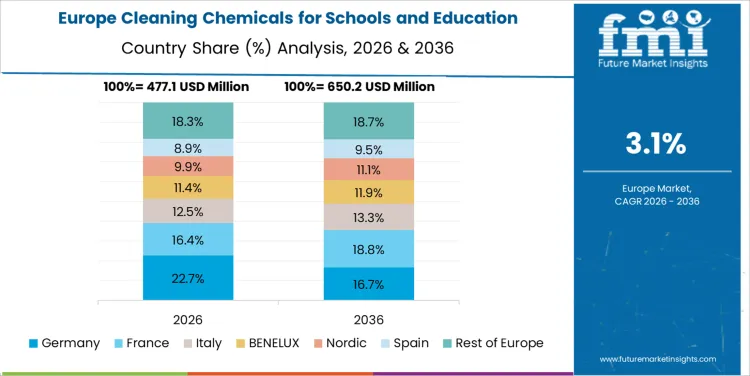
Cleaning chemicals for schools and education facilities demand in Germany is expanding at a CAGR of 4.4% from 2026 to 2036 as schools, universities, and training centers follow standardized facility maintenance practices. Educational institutions use certified cleaning chemicals to maintain hygiene across classrooms, laboratories, and shared spaces. Facility managers implement scheduled cleaning routines supported by approved chemical formulations. Public education authorities oversee procurement standards to ensure safe product use. Growth reflects disciplined facility management and consistent public funding for school maintenance.
- Educational institutions use certified chemicals for hygiene maintenance.
- Facility managers implement structured cleaning routines across campuses.
- Public authorities oversee procurement standards for school sanitation.
Why Is the Cleaning Chemicals for Schools and Education Facilities Market Growing Faster in China?
Cleaning chemicals for schools and education facilities demand in China is increasing at a CAGR of 5.8% from 2026 to 2036 as expanding school infrastructure and rising enrollment drive sanitation needs. New schools and universities integrate professional cleaning programs from early operational stages. Existing institutions increase cleaning frequency to support large student populations. Local service providers supply chemicals designed for high use environments. Growth reflects rapid expansion of education facilities and heightened attention to hygiene management across urban and regional campuses.
- New schools integrate professional cleaning programs at launch.
- Existing institutions increase cleaning frequency due to enrollment growth.
- Service providers supply chemicals suited for high use environments.
How Are Institutional Requirements Influencing the Cleaning Chemicals for Schools and Education Facilities Market in the United Kingdom?
Cleaning chemicals for schools and education facilities demand in the United Kingdom is growing at a CAGR of 4.5% from 2026 to 2036 as schools and universities maintain regulated hygiene practices. Educational institutions apply approved cleaning chemicals to meet inspection standards and health requirements. Facility teams follow defined cleaning protocols across classrooms, sports areas, and dining facilities. Local authorities support consistent funding for maintenance supplies. Growth reflects ongoing compliance with institutional hygiene expectations across the education sector.
- Schools apply approved chemicals to meet inspection standards.
- Facility teams follow defined cleaning protocols across campuses.
- Local authorities support funding for maintenance supplies.
What Is Supporting Expansion of the Cleaning Chemicals for Schools and Education Facilities Market in Brazil?
Cleaning chemicals for schools and education facilities demand in Brazil is expanding at a CAGR of 5.6% from 2026 to 2036 as public schools, private institutions, and universities strengthen sanitation practices. Schools increase use of cleaning chemicals to manage shared spaces and high student traffic. Private institutions invest in professional cleaning services to support learning conditions. Government programs support basic hygiene infrastructure upgrades. Growth reflects rising awareness of hygiene importance within the education system across urban and regional areas.
- Schools increase chemical use to manage shared learning spaces.
- Private institutions invest in professional cleaning services.
- Government programs support hygiene infrastructure improvements.
What Is Driving the Demand for Cleaning Chemicals for Schools and Education Facilities and Which Companies Shape Procurement?
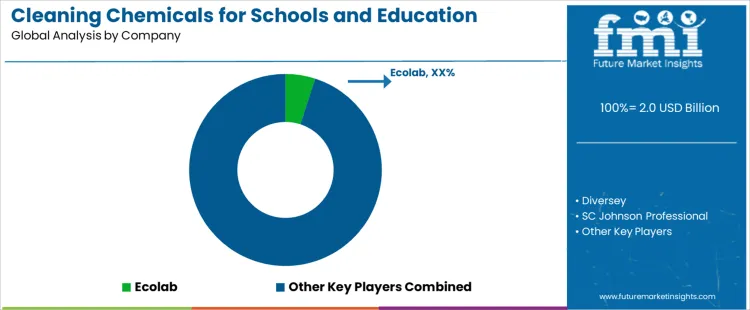
Cleaning chemical demand in schools and education facilities is shaped by high daily occupancy, shared surface contact, and strict requirements for student safety. Administrators prioritize products that deliver hygiene control without strong odors or residue that disrupt classrooms. Ecolab and Diversey support large districts through structured cleaning programs aligned with custodial workflows and training support. SC Johnson Professional and P and G Professional supply classroom and restroom cleaners designed for frequent use and simplified dosing. CloroxPro contributes disinfectants used in nurse offices, cafeterias, and high touch areas. Zep, Betco, and Spartan Chemical serve maintenance teams and contracted services that manage multi building campuses. 3M supports specialty surface care in gyms and common areas.
Product selection focuses on safety labeling, ease of use, and compatibility with varied surfaces such as desks, floors, lockers, and sports equipment. Schools favor products that support quick room turnover between classes and reduce allergen exposure. Unilever Professional supplies general purpose cleaners used in cafeterias and staff areas. Procurement decisions reflect budget controls, storage limitations, and staff training needs. Demand visibility tracks enrollment growth, infrastructure upgrades, and increased focus on routine hygiene protocols across public and private education systems.
Key Players in the Cleaning Chemicals for Schools and Education Facilities Market
- Ecolab
- Diversey
- Zep
- Spartan Chemical
- Betco
- Clorox
- SC Johnson Professional
- Reckitt
- Solenis
- 3M
Scope of the Report
| Items | Values |
|---|---|
| Quantitative Units (2026) | USD billion |
| Product Family | Surface Cleaners and Disinfectants; Restroom Cleaners; Floor Care Chemicals; Glass and Specialty Cleaners |
| Application Area | Classrooms and Common Areas; Restrooms; Cafeterias and Kitchens; Gyms and Athletic Areas |
| Compliance Requirement | Low Odor and Low Irritant Formulations; Eco Label and Green Programs; Registered Disinfectants for Institutional Use; Standard Institutional Cleaners |
| Supply Model | Jan San Distribution; District and Institution Direct Contracts; Retail and E commerce; Other Supply Models |
| Regions Covered | Asia Pacific; Europe; North America; Latin America; Middle East and Africa |
| Countries Covered | China; Japan; South Korea; India; Australia and New Zealand; ASEAN; Germany; United Kingdom; France; Italy; Spain; Nordic; BENELUX; United States; Canada; Mexico; Brazil; Chile; Kingdom of Saudi Arabia; Turkey; South Africa; plus additional countries across Asia Pacific, Europe, Latin America, and Middle East and Africa |
| Key Companies Profiled | Ecolab; Diversey; Zep; Spartan Chemical; Betco; Clorox; SC Johnson Professional; Reckitt; Solenis; 3M |
| Additional Attributes | Dollar by sales across product families and application areas; procurement patterns driven by school district budgeting cycles; usage frequency variation between classrooms, cafeterias, and restrooms; preference for low odor and low irritant formulations in age sensitive environments; centralized versus campus level purchasing behavior; compatibility with custodial workflows and rapid turnaround needs; impact of enrollment levels and shared space utilization on cleaning consumption |
Cleaning Chemicals for Schools and Education Facilities Market Segmentation
Product Family:
- Surface Cleaners & Disinfectants
- Restroom Cleaners
- Floor Care Chemicals
- Glass & Specialty Cleaners
Application Area:
- Classrooms & Common Areas
- Restrooms
- Cafeterias & Kitchens
- Gyms & Athletic Areas
Compliance Requirement:
- Low-Odor / Low-Irritant Formulations
- Eco-Label / Green Programs
- Registered Disinfectants (institutional)
- Standard Institutional Cleaners
Supply Model:
- Jan-San Distribution
- District/Institution Direct Contracts
- Retail & E-commerce
- Other Models
Region:
- Asia Pacific
- China
- Japan
- South Korea
- India
- Australia & New Zealand
- ASEAN
- Rest of Asia Pacific
- Europe
- Germany
- United Kingdom
- France
- Italy
- Spain
- Nordic
- BENELUX
- Rest of Europe
- North America
- United States
- Canada
- Mexico
- Latin America
- Brazil
- Chile
- Rest of Latin America
- Middle East & Africa
- Kingdom of Saudi Arabia
- Other GCC Countries
- Turkey
- South Africa
- Other African Union
- Rest of Middle East & Africa
Frequently Asked Questions
How big is the cleaning chemicals for schools and education facilities market in 2026?
The global cleaning chemicals for schools and education facilities market is estimated to be valued at USD 2.0 billion in 2026.
What will be the size of cleaning chemicals for schools and education facilities market in 2036?
The market size for the cleaning chemicals for schools and education facilities market is projected to reach USD 3.2 billion by 2036.
How much will be the cleaning chemicals for schools and education facilities market growth between 2026 and 2036?
The cleaning chemicals for schools and education facilities market is expected to grow at a 4.8% CAGR between 2026 and 2036.
What are the key product types in the cleaning chemicals for schools and education facilities market?
The key product types in cleaning chemicals for schools and education facilities market are surface cleaners & disinfectants, restroom cleaners, floor care chemicals and glass & specialty cleaners.
Which application area segment to contribute significant share in the cleaning chemicals for schools and education facilities market in 2026?
In terms of application area, classrooms & common areas segment to command 38.0% share in the cleaning chemicals for schools and education facilities market in 2026.
Preview the report firsthand - request a free sample
Get SampleGet the brochure for pricing and purchase details.
Get PDFTable of Content
- Executive Summary
- Global Market Outlook
- Demand-side Trends
- Supply-side Trends
- Technology Roadmap Analysis
- Analysis and Recommendations
- Market Overview
- Market Coverage / Taxonomy
- Market Definition / Scope / Limitations
- Market Background
- Market Dynamics
- Drivers
- Restraints
- Opportunity
- Trends
- Scenario Forecast
- Demand in Optimistic Scenario
- Demand in Likely Scenario
- Demand in Conservative Scenario
- Opportunity Map Analysis
- Product Life Cycle Analysis
- Supply Chain Analysis
- Investment Feasibility Matrix
- Value Chain Analysis
- PESTLE and Porter’s Analysis
- Regulatory Landscape
- Regional Parent Market Outlook
- Production and Consumption Statistics
- Import and Export Statistics
- Market Dynamics
- Global Market Analysis 2021 to 2025 and Forecast, 2026 to 2036
- Historical Market Size Value (USD Million) Analysis, 2021 to 2025
- Current and Future Market Size Value (USD Million) Projections, 2026 to 2036
- Y-o-Y Growth Trend Analysis
- Absolute $ Opportunity Analysis
- Global Market Pricing Analysis 2021 to 2025 and Forecast 2026 to 2036
- Global Market Analysis 2021 to 2025 and Forecast 2026 to 2036, By Product Family
- Introduction / Key Findings
- Historical Market Size Value (USD Million) Analysis By Product Family , 2021 to 2025
- Current and Future Market Size Value (USD Million) Analysis and Forecast By Product Family , 2026 to 2036
- Surface Cleaners & Disinfectants
- Restroom Cleaners
- Floor Care Chemicals
- Glass & Specialty Cleaners
- Y-o-Y Growth Trend Analysis By Product Family , 2021 to 2025
- Absolute $ Opportunity Analysis By Product Family , 2026 to 2036
- Global Market Analysis 2021 to 2025 and Forecast 2026 to 2036, By Application Area
- Introduction / Key Findings
- Historical Market Size Value (USD Million) Analysis By Application Area, 2021 to 2025
- Current and Future Market Size Value (USD Million) Analysis and Forecast By Application Area, 2026 to 2036
- Classrooms & Common Areas
- Restrooms
- Cafeterias & Kitchens
- Gyms & Athletic Areas
- Y-o-Y Growth Trend Analysis By Application Area, 2021 to 2025
- Absolute $ Opportunity Analysis By Application Area, 2026 to 2036
- Global Market Analysis 2021 to 2025 and Forecast 2026 to 2036, By Compliance Requirement
- Introduction / Key Findings
- Historical Market Size Value (USD Million) Analysis By Compliance Requirement, 2021 to 2025
- Current and Future Market Size Value (USD Million) Analysis and Forecast By Compliance Requirement, 2026 to 2036
- Low-Odor / Low-Irritant Formulations
- Eco-Label / Green Programs
- Registered Disinfectants (institutional)
- Standard Institutional Cleaners
- Y-o-Y Growth Trend Analysis By Compliance Requirement, 2021 to 2025
- Absolute $ Opportunity Analysis By Compliance Requirement, 2026 to 2036
- Global Market Analysis 2021 to 2025 and Forecast 2026 to 2036, By Supply Model
- Introduction / Key Findings
- Historical Market Size Value (USD Million) Analysis By Supply Model, 2021 to 2025
- Current and Future Market Size Value (USD Million) Analysis and Forecast By Supply Model, 2026 to 2036
- Jan-San Distribution
- District/Institution Direct Contracts
- Retail & E-commerce
- Other Models
- Y-o-Y Growth Trend Analysis By Supply Model, 2021 to 2025
- Absolute $ Opportunity Analysis By Supply Model, 2026 to 2036
- Global Market Analysis 2021 to 2025 and Forecast 2026 to 2036, By Region
- Introduction
- Historical Market Size Value (USD Million) Analysis By Region, 2021 to 2025
- Current Market Size Value (USD Million) Analysis and Forecast By Region, 2026 to 2036
- North America
- Latin America
- Western Europe
- Eastern Europe
- East Asia
- South Asia and Pacific
- Middle East & Africa
- Market Attractiveness Analysis By Region
- North America Market Analysis 2021 to 2025 and Forecast 2026 to 2036, By Country
- Historical Market Size Value (USD Million) Trend Analysis By Market Taxonomy, 2021 to 2025
- Market Size Value (USD Million) Forecast By Market Taxonomy, 2026 to 2036
- By Country
- USA
- Canada
- Mexico
- By Product Family
- By Application Area
- By Compliance Requirement
- By Supply Model
- By Country
- Market Attractiveness Analysis
- By Country
- By Product Family
- By Application Area
- By Compliance Requirement
- By Supply Model
- Key Takeaways
- Latin America Market Analysis 2021 to 2025 and Forecast 2026 to 2036, By Country
- Historical Market Size Value (USD Million) Trend Analysis By Market Taxonomy, 2021 to 2025
- Market Size Value (USD Million) Forecast By Market Taxonomy, 2026 to 2036
- By Country
- Brazil
- Chile
- Rest of Latin America
- By Product Family
- By Application Area
- By Compliance Requirement
- By Supply Model
- By Country
- Market Attractiveness Analysis
- By Country
- By Product Family
- By Application Area
- By Compliance Requirement
- By Supply Model
- Key Takeaways
- Western Europe Market Analysis 2021 to 2025 and Forecast 2026 to 2036, By Country
- Historical Market Size Value (USD Million) Trend Analysis By Market Taxonomy, 2021 to 2025
- Market Size Value (USD Million) Forecast By Market Taxonomy, 2026 to 2036
- By Country
- Germany
- UK
- Italy
- Spain
- France
- Nordic
- BENELUX
- Rest of Western Europe
- By Product Family
- By Application Area
- By Compliance Requirement
- By Supply Model
- By Country
- Market Attractiveness Analysis
- By Country
- By Product Family
- By Application Area
- By Compliance Requirement
- By Supply Model
- Key Takeaways
- Eastern Europe Market Analysis 2021 to 2025 and Forecast 2026 to 2036, By Country
- Historical Market Size Value (USD Million) Trend Analysis By Market Taxonomy, 2021 to 2025
- Market Size Value (USD Million) Forecast By Market Taxonomy, 2026 to 2036
- By Country
- Russia
- Poland
- Hungary
- Balkan & Baltic
- Rest of Eastern Europe
- By Product Family
- By Application Area
- By Compliance Requirement
- By Supply Model
- By Country
- Market Attractiveness Analysis
- By Country
- By Product Family
- By Application Area
- By Compliance Requirement
- By Supply Model
- Key Takeaways
- East Asia Market Analysis 2021 to 2025 and Forecast 2026 to 2036, By Country
- Historical Market Size Value (USD Million) Trend Analysis By Market Taxonomy, 2021 to 2025
- Market Size Value (USD Million) Forecast By Market Taxonomy, 2026 to 2036
- By Country
- China
- Japan
- South Korea
- By Product Family
- By Application Area
- By Compliance Requirement
- By Supply Model
- By Country
- Market Attractiveness Analysis
- By Country
- By Product Family
- By Application Area
- By Compliance Requirement
- By Supply Model
- Key Takeaways
- South Asia and Pacific Market Analysis 2021 to 2025 and Forecast 2026 to 2036, By Country
- Historical Market Size Value (USD Million) Trend Analysis By Market Taxonomy, 2021 to 2025
- Market Size Value (USD Million) Forecast By Market Taxonomy, 2026 to 2036
- By Country
- India
- ASEAN
- Australia & New Zealand
- Rest of South Asia and Pacific
- By Product Family
- By Application Area
- By Compliance Requirement
- By Supply Model
- By Country
- Market Attractiveness Analysis
- By Country
- By Product Family
- By Application Area
- By Compliance Requirement
- By Supply Model
- Key Takeaways
- Middle East & Africa Market Analysis 2021 to 2025 and Forecast 2026 to 2036, By Country
- Historical Market Size Value (USD Million) Trend Analysis By Market Taxonomy, 2021 to 2025
- Market Size Value (USD Million) Forecast By Market Taxonomy, 2026 to 2036
- By Country
- Kingdom of Saudi Arabia
- Other GCC Countries
- Turkiye
- South Africa
- Other African Union
- Rest of Middle East & Africa
- By Product Family
- By Application Area
- By Compliance Requirement
- By Supply Model
- By Country
- Market Attractiveness Analysis
- By Country
- By Product Family
- By Application Area
- By Compliance Requirement
- By Supply Model
- Key Takeaways
- Key Countries Market Analysis
- USA
- Pricing Analysis
- Market Share Analysis, 2025
- By Product Family
- By Application Area
- By Compliance Requirement
- By Supply Model
- Canada
- Pricing Analysis
- Market Share Analysis, 2025
- By Product Family
- By Application Area
- By Compliance Requirement
- By Supply Model
- Mexico
- Pricing Analysis
- Market Share Analysis, 2025
- By Product Family
- By Application Area
- By Compliance Requirement
- By Supply Model
- Brazil
- Pricing Analysis
- Market Share Analysis, 2025
- By Product Family
- By Application Area
- By Compliance Requirement
- By Supply Model
- Chile
- Pricing Analysis
- Market Share Analysis, 2025
- By Product Family
- By Application Area
- By Compliance Requirement
- By Supply Model
- Germany
- Pricing Analysis
- Market Share Analysis, 2025
- By Product Family
- By Application Area
- By Compliance Requirement
- By Supply Model
- UK
- Pricing Analysis
- Market Share Analysis, 2025
- By Product Family
- By Application Area
- By Compliance Requirement
- By Supply Model
- Italy
- Pricing Analysis
- Market Share Analysis, 2025
- By Product Family
- By Application Area
- By Compliance Requirement
- By Supply Model
- Spain
- Pricing Analysis
- Market Share Analysis, 2025
- By Product Family
- By Application Area
- By Compliance Requirement
- By Supply Model
- France
- Pricing Analysis
- Market Share Analysis, 2025
- By Product Family
- By Application Area
- By Compliance Requirement
- By Supply Model
- India
- Pricing Analysis
- Market Share Analysis, 2025
- By Product Family
- By Application Area
- By Compliance Requirement
- By Supply Model
- ASEAN
- Pricing Analysis
- Market Share Analysis, 2025
- By Product Family
- By Application Area
- By Compliance Requirement
- By Supply Model
- Australia & New Zealand
- Pricing Analysis
- Market Share Analysis, 2025
- By Product Family
- By Application Area
- By Compliance Requirement
- By Supply Model
- China
- Pricing Analysis
- Market Share Analysis, 2025
- By Product Family
- By Application Area
- By Compliance Requirement
- By Supply Model
- Japan
- Pricing Analysis
- Market Share Analysis, 2025
- By Product Family
- By Application Area
- By Compliance Requirement
- By Supply Model
- South Korea
- Pricing Analysis
- Market Share Analysis, 2025
- By Product Family
- By Application Area
- By Compliance Requirement
- By Supply Model
- Russia
- Pricing Analysis
- Market Share Analysis, 2025
- By Product Family
- By Application Area
- By Compliance Requirement
- By Supply Model
- Poland
- Pricing Analysis
- Market Share Analysis, 2025
- By Product Family
- By Application Area
- By Compliance Requirement
- By Supply Model
- Hungary
- Pricing Analysis
- Market Share Analysis, 2025
- By Product Family
- By Application Area
- By Compliance Requirement
- By Supply Model
- Kingdom of Saudi Arabia
- Pricing Analysis
- Market Share Analysis, 2025
- By Product Family
- By Application Area
- By Compliance Requirement
- By Supply Model
- Turkiye
- Pricing Analysis
- Market Share Analysis, 2025
- By Product Family
- By Application Area
- By Compliance Requirement
- By Supply Model
- South Africa
- Pricing Analysis
- Market Share Analysis, 2025
- By Product Family
- By Application Area
- By Compliance Requirement
- By Supply Model
- USA
- Market Structure Analysis
- Competition Dashboard
- Competition Benchmarking
- Market Share Analysis of Top Players
- By Regional
- By Product Family
- By Application Area
- By Compliance Requirement
- By Supply Model
- Competition Analysis
- Competition Deep Dive
- Ecolab
- Overview
- Product Portfolio
- Profitability by Market Segments (Product/Age /Sales Channel/Region)
- Sales Footprint
- Strategy Overview
- Marketing Strategy
- Product Strategy
- Channel Strategy
- Diversey
- SC Johnson Professional
- 3M
- CloroxPro
- Zep
- Betco
- Spartan Chemical
- P&G Professional
- Unilever Professional
- Ecolab
- Competition Deep Dive
- Assumptions & Acronyms Used
- Research Methodology


