

- Industry Size (2026):
- USD 651 Mn
- Forecast (2036)
- USD 1060.4 Mn
- CAGR (2026 to 2036)
- 5.0%
Oven & Grill Cleaning Chemicals Market Forecast and Outlook 2026 to 2036
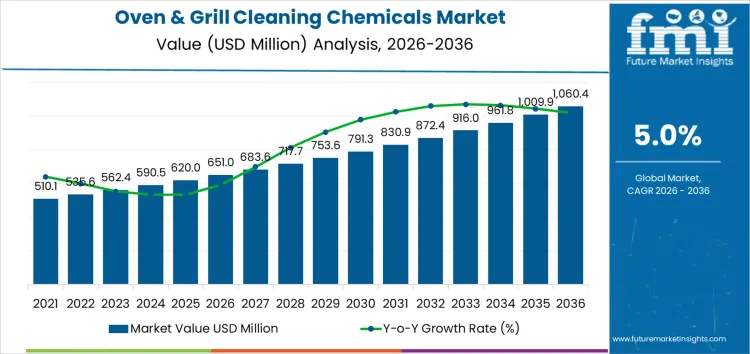
The Oven & Grill Cleaning Chemicals market is expected to grow from USD 651 million in 2026 to USD 1,060.4 million by 2036, at a CAGR of 5.0%. Demand is driven by foodservice industry expansion, rising hygiene standards, and increasing adoption of industrial cleaning solutions in restaurants, institutional kitchens, bakeries, and food processing facilities. Caustic-based oven cleaners and solvent-based grill and griddle cleaners lead the product segment, supported by low-fume and enzymatic/bio-based formulations. Bulk jugs, trigger sprays, aerosols, and tablet formats ensure convenient application across varied commercial settings.
Restaurants and institutional kitchens account for the majority of end-use consumption, followed by bakeries and industrial food processing units. Leading companies prioritize effective cleaning performance, regulatory compliance, and multi-format packaging options. Growth is reinforced by stringent sanitation regulations, increasing foodservice establishments, and adoption of specialized chemical solutions. The market shows steady expansion as hygiene-focused cleaning practices become integral to foodservice and commercial kitchen operations worldwide.
Quick Stats of the Oven & Grill Cleaning Chemicals Market
- Oven & Grill Cleaning Chemicals Market Value (2026): USD 651 million
- Oven & Grill Cleaning Chemicals Forecast Value (2036): USD 1,060.4 million
- Oven & Grill Cleaning Chemicals Market Forecast CAGR (2026–2036): 5.0%
- Leading Product Type in the Market: Oven Cleaners (34%)
- Key Growth Regions in the Market: China, Brazil, USA, UK, Germany
- Top Players in the Market: Reckitt, Ecolab, Solenis (Diversey), Zep, 3M, SC Johnson, Procter & Gamble, Spartan Chemical, Betco, Unilever Professional
What is the Growth Forecast for the Oven & Grill Cleaning Chemicals Market through 2036?
From 2026 to 2031, the oven and grill cleaning chemicals market grows from USD 651 million to USD 831 million, reflecting the early adoption phase. Annual value additions increase from USD 46 million in 2026 to USD 56 million in 2031. Growth is driven by commercial kitchens, foodservice operations, and industrial catering facilities seeking effective grease and carbon removal solutions while maintaining hygiene compliance. Early adoption is concentrated in North America and Europe, which account for around 65% of market value, with uptake influenced by regulatory mandates, high-volume operations, and validation of chemical performance on diverse kitchen surfaces.
Between 2031 and 2036, the market expands from roughly USD 831 million to USD 1,060.4 million, illustrating the late adoption phase characterized by broader penetration and multi-site deployment. Annual increments rise to USD 63–65 million, supported by repeat procurement, scaling across restaurant chains, institutional kitchens, and automated cleaning programs. Growth is reinforced by rising hygiene standards, portfolio-wide adoption, and structural integration of cleaning chemicals into standardized foodservice sanitation protocols. Early growth relied on selective high-value deployments, while later expansion reflects global market penetration and normalized adoption.
Oven and Grill Cleaning Chemicals Market Key Takeaways
| Metric | Value |
|---|---|
| Market Value (2026) | USD 651 million |
| Forecast Value (2036) | USD 1,060.4 million |
| Forecast CAGR (2026–2036) | 5.0% |
Why Is Demand Changing for Oven and Grill Cleaning Chemicals?
Early use of oven and grill cleaning chemicals developed from persistent operational challenges rather than planned specification. Traditional detergents and degreasers removed surface soil, but heavy carbonised deposits, baked-on fats, and burnt residues in commercial and residential ovens resisted basic cleaning. Manual scraping and repeated hot water washes increased labour, risked surface damage, and reduced equipment uptime. Operators sought stronger chemistries that could break down hardened residues without excessive mechanical effort. Initial adoption of specialised oven and grill cleaners was driven by field experience with cleaning failures, visible buildup, and safety hazards such as smoke and flare-ups during cooking rather than by formal hygiene standards.
Future demand for oven and grill cleaning chemicals will be shaped by structured sanitation expectations, safety compliance, and operational efficiency objectives rather than by soil removal alone. Commercial kitchens and foodservice facilities are now evaluated on documented cleaning outcomes, slip and fire risk mitigation, and alignment with facility maintenance protocols. Formulations are selected for effectiveness at lower application temperatures, reduced corrosiveness on stainless steel and enamel surfaces, and compatibility with automated cleaning systems. Chemical performance is evaluated through measurable residue removal, reduced cleaning time, and worker exposure profiles.
What Factors Are Affecting the Demand for Oven and Grill Cleaning Chemicals Market in Terms of Product Type and Chemistry?
Demand for oven and grill cleaning chemicals is segmented by product type and chemistry across commercial kitchens, foodservice chains, and institutional cooking operations. Oven cleaners account for about 34% of total demand, making them the leading product type. Grill and griddle cleaners, carbon removers or soakers, and fryer boil out chemicals represent additional categories without disclosed share splits. These product types address different soil severity levels, application temperatures, and cleaning intervals. Chemistry selection determines cleaning speed, fume generation, and surface compatibility. Caustic based systems account for about 38% of demand, followed by solvent based, low fume formulations, enzymatic or bio based systems, and other blends. Together, these segments explain demand formation shaped by baked on soil intensity and operational downtime tolerance rather than cleaning frequency alone.
What Drives Demand by Product Type in the Oven and Grill Cleaning Chemicals Market?
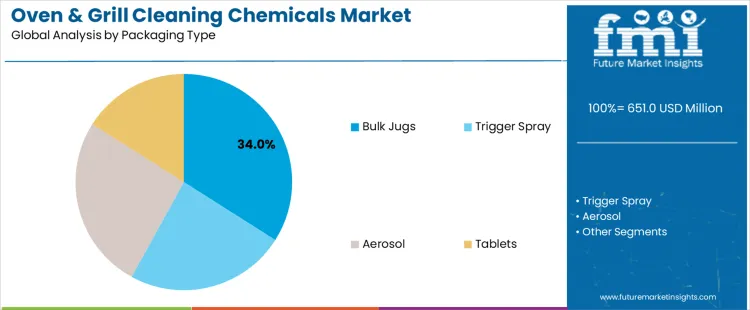
Oven cleaners lead demand with a 34% share because enclosed ovens accumulate carbonized grease that requires aggressive chemical action. These products are used during scheduled deep cleaning cycles to restore cooking efficiency. Grill and griddle cleaners are applied more frequently due to direct food contact surfaces and continuous grease exposure. Carbon removers and soakers are used for detachable parts where extended dwell time is acceptable. Fryer boil out chemicals are applied periodically to remove polymerized oil residues from internal fryer surfaces. Product type selection reflects equipment design, soil severity, and allowable downtime. Demand therefore aligns with kitchen maintenance cycles rather than daily cleaning routines.
Product driven demand remains stable because cleaning protocols are standardized by equipment type. Oven cleaners are reserved for deep cleaning intervals. Grill and griddle products are embedded in routine operations. Boil out chemicals follow fryer maintenance schedules. Operators avoid substituting product types due to performance and safety considerations. This stabilizes demand distribution. Product type segmentation therefore reflects fixed kitchen workflows rather than short term shifts in cleaning practice.
How Does Chemistry Shape Demand for Oven and Grill Cleaning Chemicals Market?
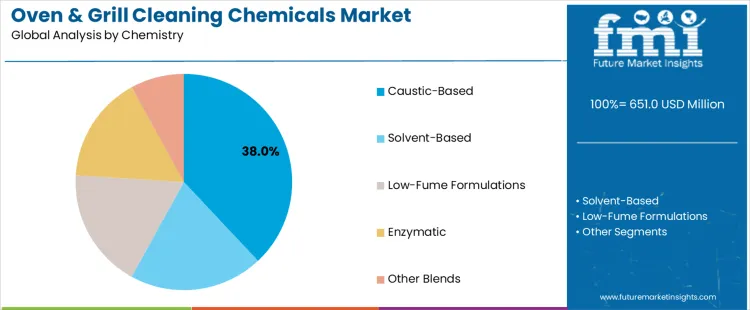
Caustic based formulations account for about 38% of total demand, making them the leading chemistry. Their dominance reflects effectiveness in breaking down carbonized fats and baked on residues at high temperatures. Solvent based systems are applied where rapid grease penetration is required with lower alkalinity. Low fume formulations are specified where ventilation is limited or staff exposure must be reduced. Enzymatic and bio based chemistries are used in maintenance cleaning or overnight applications with longer contact times. Other blends address surface sensitivity or regulatory requirements. Chemistry selection depends on soil composition, temperature, and safety protocols. Demand follows cleaning effectiveness under operational constraints rather than preference for milder formulations.
Caustic systems maintain leadership due to reliability and speed. Solvent products remain relevant for targeted applications. Low fume chemistries grow where exposure control is prioritized. Enzymatic systems remain limited to lower severity use cases. Kitchens avoid frequent chemistry changes due to training and equipment compatibility. This stabilizes chemistry driven demand. Chemistry segmentation therefore reinforces reliance on high performance formulations for heavy duty cooking equipment.
How Are Oven and Grill Cleaning Chemicals Being Applied Across Commercial and Residential Kitchens?
Use appears in environments where baked-on grease, carbon deposits, and food residues accumulate on ovens, grills, and cooking equipment. Restaurants, hotels, institutional kitchens, and catering facilities apply heavy-duty formulations to maintain hygiene, ensure food safety, and prevent fire hazards. Residential users adopt specialized cleaners for home ovens and barbecues to remove stubborn residues without damaging surfaces. These applications reflect operational and safety priorities rather than decorative or aesthetic considerations, with adoption driven by cleaning efficiency, surface protection, and regulatory compliance.
What Operational and Material Conditions Support Adoption of Oven and Grill Cleaning Chemicals?
Selection aligns with surfaces and materials requiring effective degreasing without corrosion or etching. Formulations are optimized for pH, surfactant composition, and foam control to balance cleaning power with material compatibility. Cleaning teams rely on spray, wipe, or soak methods compatible with equipment size, shape, and accessibility. Health and safety teams ensure products meet local sanitation regulations and minimize chemical exposure. These conditions emerge from operational efficiency, surface protection, and user safety priorities in structured kitchen and foodservice workflows.
Which Practical Considerations Limit Wider Use of Oven and Grill Cleaning Chemicals?
Strong formulations may require protective equipment and careful handling, limiting adoption in small or residential kitchens. Compatibility with stainless steel, enamel, or non-stick surfaces must be verified to prevent damage. Cost per application can be significant in high-frequency cleaning environments. Rinse water and disposal regulations may restrict certain chemistries. These factors result in selective deployment where cleaning efficacy, surface integrity, and operational safety justify incremental cost and procedural attention.
What is the Demand for Oven and Grill Cleaning Chemicals by Country?
| Country | CAGR (%) |
|---|---|
| USA | 5.0% |
| Germany | 4.4% |
| China | 6.4% |
| UK | 4.6% |
| Brazil | 6.0% |
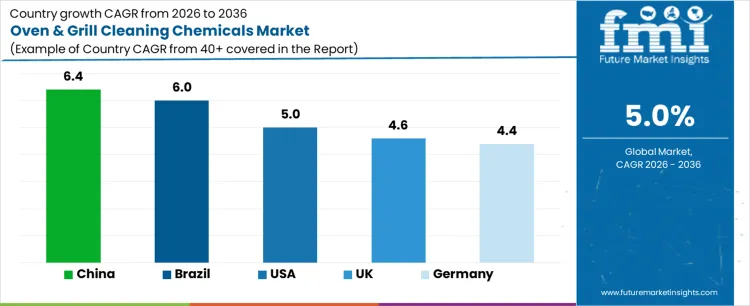
The demand for oven and grill cleaning chemicals varies across countries, driven by commercial kitchen growth, foodservice hygiene standards, and industrial cleaning requirements. China leads with a 6.4% CAGR, supported by expanding restaurant chains, institutional kitchens, and food processing facilities requiring specialized cleaning solutions. Brazil follows at 6.0%, driven by growth in commercial kitchens and hospitality sectors. The USA grows at 5.0%, reflecting steady adoption in restaurants, hotels, and institutional facilities. Germany records 4.4%, shaped by mature cleaning markets and regulatory compliance. The UK posts 4.6%, supported by consistent demand in foodservice and industrial cleaning operations.
How Is Oven and Grill Cleaning Driving Growth in the United States?
In the United States, revenue from the Oven & Grill Cleaning Chemicals Market is expanding at a CAGR of 5% through 2036, driven by adoption of high-performance chemical formulations that remove grease, burnt food residues, and carbon deposits from ovens, grills, and commercial kitchen equipment. Manufacturers are integrating cleaning chemicals in restaurants, hotels, industrial kitchens, and institutional foodservice operations to maintain hygiene and operational efficiency. Demand is concentrated in commercial kitchens, catering facilities, and industrial foodservice. Domestic suppliers provide surface-compatible, high-efficiency chemical solutions suitable for manual and automated cleaning systems. Recurring cleaning schedules and regulatory hygiene standards are sustaining predictable procurement nationwide.
- Restaurants, hotels, and industrial kitchens drive oven and grill cleaning adoption
- Chemicals remove grease, burnt residues, and carbon deposits efficiently
- Domestic suppliers provide surface-compatible, high-performance formulations
- Recurring cleaning schedules sustain predictable procurement
How Are Hygiene Standards Supporting Growth in Germany?
Germany continues to record steady growth in the Oven & Grill Cleaning Chemicals Market at a CAGR of 4.4% through 2036, supported by stringent hygiene regulations and commercial kitchen standards. Manufacturers are adopting cleaning chemicals to maintain cleanliness, prevent microbial contamination, and ensure equipment efficiency in restaurants, hotels, and industrial kitchens. Demand is concentrated in foodservice operations, institutional kitchens, and hospitality facilities. Domestic suppliers provide high-quality, surface-compatible chemical formulations suitable for manual and automated cleaning processes. Compliance with hygiene standards and recurring cleaning programs are sustaining measured adoption nationwide.
- Restaurants, hotels, and industrial kitchens anchor demand
- Chemicals maintain cleanliness and prevent microbial contamination
- Domestic suppliers provide surface-compatible, high-quality formulations
- Recurring cleaning programs sustain steady adoption
How Is Industrial and Foodservice Expansion Accelerating Adoption in China?
In China, revenue from the Oven & Grill Cleaning Chemicals Market is growing at a CAGR of 6.4% through 2036, driven by rapid growth of restaurants, hotels, and industrial kitchens. Manufacturers are integrating cleaning chemicals to remove grease, burnt residues, and carbon deposits efficiently while maintaining hygiene. Demand is strong across commercial kitchens, institutional facilities, and catering services. Domestic suppliers are scaling production of high-performance, surface-compatible chemical formulations suitable for manual and automated cleaning systems. Expanding foodservice operations and recurring cleaning schedules are sustaining rapid adoption nationwide.
- Restaurants, hotels, and industrial kitchens drive chemical adoption
- Chemicals remove grease, burnt residues, and carbon deposits efficiently
- Domestic suppliers scale surface-compatible, high-performance formulations
- Recurring cleaning schedules sustain consistent adoption
How Is Hygiene and Commercial Kitchen Operations Supporting Growth in the United Kingdom?
In the United Kingdom, revenue from the Oven & Grill Cleaning Chemicals Market is expanding at a CAGR of 4.6% through 2036, supported by adoption of cleaning chemicals in commercial kitchens, institutional facilities, and industrial foodservice operations. Manufacturers are integrating oven and grill cleaners to remove stubborn residues, maintain hygiene, and comply with food safety standards. Demand is concentrated in restaurants, hotels, schools, and industrial kitchens. Domestic suppliers provide high-quality, surface-compatible chemical formulations suitable for manual and automated cleaning systems. Recurring cleaning schedules and regulatory compliance are sustaining predictable procurement nationwide.
- Restaurants, hotels, schools, and industrial kitchens anchor demand
- Chemicals remove stubborn residues and maintain hygiene
- Domestic suppliers provide surface-compatible, high-quality formulations
- Recurring cleaning schedules sustain predictable procurement
How Is Industrial and Foodservice Expansion Supporting Adoption in Brazil?
Brazil is seeing strong growth in the Oven & Grill Cleaning Chemicals Market at a CAGR of 6% through 2036, supported by increasing adoption in commercial kitchens, industrial facilities, and institutional foodservice operations. Manufacturers are adopting cleaning chemicals to remove grease, burnt residues, and carbon deposits efficiently while maintaining hygiene standards. Demand is concentrated in restaurants, hotels, hospitals, and industrial kitchens. Domestic suppliers are expanding production of high-performance, surface-compatible chemical solutions suitable for manual and automated cleaning systems. Growth in commercial kitchens and recurring cleaning schedules are sustaining robust procurement nationwide.
- Restaurants, hotels, hospitals, and industrial kitchens drive chemical adoption
- Chemicals remove grease, burnt residues, and carbon deposits efficiently
- Domestic suppliers expand surface-compatible, high-performance formulations
- Recurring cleaning schedules sustain robust procurement
Which Companies Compete in The Oven and Grill Cleaning Chemicals Market Based On Soil Severity and Operator Exposure Constraints?
Oven and grill cleaning chemicals are selected according to how effectively they remove carbonized grease under high heat conditions while remaining manageable for routine staff use. In commercial kitchens, performance is judged by dwell time, reactivation under heat, and ease of rinse rather than raw alkalinity. Ecolab and Solenis, through the Diversey platform, influence this segment by embedding heavy duty cleaners within structured cleaning schedules tied to equipment maintenance and inspection routines. Reckitt and SC Johnson supply formulations used in both professional and controlled consumer environments, where packaging, instruction clarity, and exposure limits shape acceptance. Product selection reflects effectiveness on baked on soils, surface compatibility with steel and enamel, and predictable results across repeated cycles.
Competitive dynamics are shaped by how products integrate into kitchen operations and safety practices. Zep, Spartan Chemical, and Betco maintain relevance by offering oven and grill cleaners tailored to specific equipment types, including fryers, flat tops, and rotisseries. Procter and Gamble and Unilever Professional participate through standardized professional lines aligned with chain kitchen requirements. 3M contributes through niche surface care and cleaning systems rather than volume chemical supply. Local distributors and trainers influence outcomes by guiding dilution, application timing, and protective equipment use. Competitive positioning depends on reliability during scheduled deep cleans, ease of staff compliance, and continuity of supply rather than formulation novelty or brand hierarchy.
Key Players in the Oven and Grill Cleaning Chemicals Market
- Reckitt
- Ecolab
- Solenis (Diversey)
- Zep
- 3M
- SC Johnson
- Procter & Gamble
- Spartan Chemical
- Betco
- Unilever Professional
Scope of the Report
| Items | Values |
|---|---|
| Quantitative Units (2026) | USD million |
| Product Type | Oven Cleaners, Grill & Griddle Cleaners, Carbon Removers / Soakers, Fryer Boil-Out Chemicals |
| Chemistry | Caustic-Based, Solvent-Based, Low-Fume Formulations, Enzymatic / Bio-Based, Other Blends |
| End-Use / Application | Restaurants, Institutional Kitchens, Bakeries, Food Processing & Other |
| Packaging Type | Bulk Jugs / Pails, Trigger Spray, Aerosol, Tablets / Sachets |
| Region | Asia Pacific (China, Japan, South Korea, India, Australia & New Zealand, ASEAN, Rest of Asia Pacific), Europe (Germany, United Kingdom, France, Italy, Spain, Nordic, BENELUX, Rest of Europe), North America (United States, Canada, Mexico), Latin America (Brazil, Chile, Rest of Latin America), Middle East & Africa (KSA, Other GCC Countries, Turkey, South Africa, Other African Union, Rest of Middle East & Africa) |
| Key Companies Profiled | Reckitt, Ecolab, Solenis (Diversey), Zep, 3M, SC Johnson, Procter & Gamble, Spartan Chemical, Betco, Unilever Professional |
| Additional Attributes | Dollar by sales by product type, Dollar by sales by chemistry, Dollar by sales by end-use, Dollar by sales by packaging type, Dollar by sales by region, Cleaning efficiency on baked-on soils, Surface compatibility, Worker exposure minimization, Regulatory compliance, Integration with automated cleaning systems, Repeat application performance |
Oven and Grill Cleaning Chemicals Market Segmentation
Product Type:
- Oven Cleaners
- Grill & Griddle Cleaners
- Carbon Removers / Soakers
- Fryer Boil-Out Chemicals
Chemistry:
- Caustic-Based
- Solvent-Based
- Low-Fume Formulations
- Enzymatic / Bio-Based
- Other Blends
End-Use:
- Restaurants
- Institutional Kitchens
- Bakeries
- Food Processing & Other
Packaging Type:
- Bulk Jugs / Pails
- Trigger Spray
- Aerosol
- Tablets / Sachets
Region
Asia Pacific
- China
- Japan
- South Korea
- India
- Australia & New Zealand
- ASEAN
- Rest of Asia Pacific
Europe
- Germany
- United Kingdom
- France
- Italy
- Spain
- Nordic
- BENELUX
- Rest of Europe
North America
- United States
- Canada
- Mexico
Latin America
- Brazil
- Chile
- Rest of Latin America
Middle East & Africa
- Kingdom of Saudi Arabia
- Other GCC Countries
- Turkey
- South Africa
- Other African Union
- Rest of Middle East & Africa
Frequently Asked Questions
How big is the oven & grill cleaning chemicals market in 2026?
The global oven & grill cleaning chemicals market is valued at USD 651.0 million in 2026.
What will be the size of the oven & grill cleaning chemicals market in 2036?
The market is projected to reach USD 1,060.4 million by 2036.
How fast will the oven & grill cleaning chemicals market grow between 2026 and 2036?
The market will grow at a CAGR of 5.0% from 2026 to 2036.
Which product type leads the oven & grill cleaning chemicals market in 2026?
Oven cleaners lead the market with a 34.0% share in 2026.
Who are the major players in the oven & grill cleaning chemicals market?
Key players include Reckitt, Ecolab, Solenis (Diversey), Zep, 3M, SC Johnson, Procter & Gamble, Spartan Chemical, Betco, and Unilever Professional.
Preview the report firsthand - request a free sample
Get SampleGet the brochure for pricing and purchase details.
Get PDFTable of Content
- Executive Summary
- Global Market Outlook
- Demand-side Trends
- Supply-side Trends
- Technology Roadmap Analysis
- Analysis and Recommendations
- Market Overview
- Market Coverage / Taxonomy
- Market Definition / Scope / Limitations
- Market Background
- Market Dynamics
- Drivers
- Restraints
- Opportunity
- Trends
- Scenario Forecast
- Demand in Optimistic Scenario
- Demand in Likely Scenario
- Demand in Conservative Scenario
- Opportunity Map Analysis
- Product Life Cycle Analysis
- Supply Chain Analysis
- Investment Feasibility Matrix
- Value Chain Analysis
- PESTLE and Porter’s Analysis
- Regulatory Landscape
- Regional Parent Market Outlook
- Production and Consumption Statistics
- Import and Export Statistics
- Market Dynamics
- Global Market Analysis 2021 to 2025 and Forecast, 2026 to 2036
- Historical Market Size Value (USD Million) Analysis, 2021 to 2025
- Current and Future Market Size Value (USD Million) Projections, 2026 to 2036
- Y-o-Y Growth Trend Analysis
- Absolute $ Opportunity Analysis
- Global Market Pricing Analysis 2021 to 2025 and Forecast 2026 to 2036
- Global Market Analysis 2021 to 2025 and Forecast 2026 to 2036, By Product Type
- Introduction / Key Findings
- Historical Market Size Value (USD Million) Analysis By Product Type , 2021 to 2025
- Current and Future Market Size Value (USD Million) Analysis and Forecast By Product Type , 2026 to 2036
- Oven Cleaners
- Grill & Griddle Cleaners
- Carbon Removers
- Fryer Boil-Out Chemicals
- Oven Cleaners
- Y-o-Y Growth Trend Analysis By Product Type , 2021 to 2025
- Absolute $ Opportunity Analysis By Product Type , 2026 to 2036
- Global Market Analysis 2021 to 2025 and Forecast 2026 to 2036, By Chemistry
- Introduction / Key Findings
- Historical Market Size Value (USD Million) Analysis By Chemistry, 2021 to 2025
- Current and Future Market Size Value (USD Million) Analysis and Forecast By Chemistry, 2026 to 2036
- Caustic-Based
- Solvent-Based
- Low-Fume Formulations
- Enzymatic
- Other Blends
- Caustic-Based
- Y-o-Y Growth Trend Analysis By Chemistry, 2021 to 2025
- Absolute $ Opportunity Analysis By Chemistry, 2026 to 2036
- Global Market Analysis 2021 to 2025 and Forecast 2026 to 2036, By End-Use
- Introduction / Key Findings
- Historical Market Size Value (USD Million) Analysis By End-Use, 2021 to 2025
- Current and Future Market Size Value (USD Million) Analysis and Forecast By End-Use, 2026 to 2036
- Restaurants
- Institutional Kitchens
- Bakeries
- Food Processing & Other
- Restaurants
- Y-o-Y Growth Trend Analysis By End-Use, 2021 to 2025
- Absolute $ Opportunity Analysis By End-Use, 2026 to 2036
- Global Market Analysis 2021 to 2025 and Forecast 2026 to 2036, By Packaging Type
- Introduction / Key Findings
- Historical Market Size Value (USD Million) Analysis By Packaging Type, 2021 to 2025
- Current and Future Market Size Value (USD Million) Analysis and Forecast By Packaging Type, 2026 to 2036
- Bulk Jugs
- Trigger Spray
- Aerosol
- Tablets
- Bulk Jugs
- Y-o-Y Growth Trend Analysis By Packaging Type, 2021 to 2025
- Absolute $ Opportunity Analysis By Packaging Type, 2026 to 2036
- Global Market Analysis 2021 to 2025 and Forecast 2026 to 2036, By Region
- Introduction
- Historical Market Size Value (USD Million) Analysis By Region, 2021 to 2025
- Current Market Size Value (USD Million) Analysis and Forecast By Region, 2026 to 2036
- North America
- Latin America
- Western Europe
- Eastern Europe
- East Asia
- South Asia and Pacific
- Middle East & Africa
- Market Attractiveness Analysis By Region
- North America Market Analysis 2021 to 2025 and Forecast 2026 to 2036, By Country
- Historical Market Size Value (USD Million) Trend Analysis By Market Taxonomy, 2021 to 2025
- Market Size Value (USD Million) Forecast By Market Taxonomy, 2026 to 2036
- By Country
- USA
- Canada
- Mexico
- By Product Type
- By Chemistry
- By End-Use
- By Packaging Type
- By Country
- Market Attractiveness Analysis
- By Country
- By Product Type
- By Chemistry
- By End-Use
- By Packaging Type
- Key Takeaways
- Latin America Market Analysis 2021 to 2025 and Forecast 2026 to 2036, By Country
- Historical Market Size Value (USD Million) Trend Analysis By Market Taxonomy, 2021 to 2025
- Market Size Value (USD Million) Forecast By Market Taxonomy, 2026 to 2036
- By Country
- Brazil
- Chile
- Rest of Latin America
- By Product Type
- By Chemistry
- By End-Use
- By Packaging Type
- By Country
- Market Attractiveness Analysis
- By Country
- By Product Type
- By Chemistry
- By End-Use
- By Packaging Type
- Key Takeaways
- Western Europe Market Analysis 2021 to 2025 and Forecast 2026 to 2036, By Country
- Historical Market Size Value (USD Million) Trend Analysis By Market Taxonomy, 2021 to 2025
- Market Size Value (USD Million) Forecast By Market Taxonomy, 2026 to 2036
- By Country
- Germany
- UK
- Italy
- Spain
- France
- Nordic
- BENELUX
- Rest of Western Europe
- By Product Type
- By Chemistry
- By End-Use
- By Packaging Type
- By Country
- Market Attractiveness Analysis
- By Country
- By Product Type
- By Chemistry
- By End-Use
- By Packaging Type
- Key Takeaways
- Eastern Europe Market Analysis 2021 to 2025 and Forecast 2026 to 2036, By Country
- Historical Market Size Value (USD Million) Trend Analysis By Market Taxonomy, 2021 to 2025
- Market Size Value (USD Million) Forecast By Market Taxonomy, 2026 to 2036
- By Country
- Russia
- Poland
- Hungary
- Balkan & Baltic
- Rest of Eastern Europe
- By Product Type
- By Chemistry
- By End-Use
- By Packaging Type
- By Country
- Market Attractiveness Analysis
- By Country
- By Product Type
- By Chemistry
- By End-Use
- By Packaging Type
- Key Takeaways
- East Asia Market Analysis 2021 to 2025 and Forecast 2026 to 2036, By Country
- Historical Market Size Value (USD Million) Trend Analysis By Market Taxonomy, 2021 to 2025
- Market Size Value (USD Million) Forecast By Market Taxonomy, 2026 to 2036
- By Country
- China
- Japan
- South Korea
- By Product Type
- By Chemistry
- By End-Use
- By Packaging Type
- By Country
- Market Attractiveness Analysis
- By Country
- By Product Type
- By Chemistry
- By End-Use
- By Packaging Type
- Key Takeaways
- South Asia and Pacific Market Analysis 2021 to 2025 and Forecast 2026 to 2036, By Country
- Historical Market Size Value (USD Million) Trend Analysis By Market Taxonomy, 2021 to 2025
- Market Size Value (USD Million) Forecast By Market Taxonomy, 2026 to 2036
- By Country
- India
- ASEAN
- Australia & New Zealand
- Rest of South Asia and Pacific
- By Product Type
- By Chemistry
- By End-Use
- By Packaging Type
- By Country
- Market Attractiveness Analysis
- By Country
- By Product Type
- By Chemistry
- By End-Use
- By Packaging Type
- Key Takeaways
- Middle East & Africa Market Analysis 2021 to 2025 and Forecast 2026 to 2036, By Country
- Historical Market Size Value (USD Million) Trend Analysis By Market Taxonomy, 2021 to 2025
- Market Size Value (USD Million) Forecast By Market Taxonomy, 2026 to 2036
- By Country
- Kingdom of Saudi Arabia
- Other GCC Countries
- Turkiye
- South Africa
- Other African Union
- Rest of Middle East & Africa
- By Product Type
- By Chemistry
- By End-Use
- By Packaging Type
- By Country
- Market Attractiveness Analysis
- By Country
- By Product Type
- By Chemistry
- By End-Use
- By Packaging Type
- Key Takeaways
- Key Countries Market Analysis
- USA
- Pricing Analysis
- Market Share Analysis, 2025
- By Product Type
- By Chemistry
- By End-Use
- By Packaging Type
- Canada
- Pricing Analysis
- Market Share Analysis, 2025
- By Product Type
- By Chemistry
- By End-Use
- By Packaging Type
- Mexico
- Pricing Analysis
- Market Share Analysis, 2025
- By Product Type
- By Chemistry
- By End-Use
- By Packaging Type
- Brazil
- Pricing Analysis
- Market Share Analysis, 2025
- By Product Type
- By Chemistry
- By End-Use
- By Packaging Type
- Chile
- Pricing Analysis
- Market Share Analysis, 2025
- By Product Type
- By Chemistry
- By End-Use
- By Packaging Type
- Germany
- Pricing Analysis
- Market Share Analysis, 2025
- By Product Type
- By Chemistry
- By End-Use
- By Packaging Type
- UK
- Pricing Analysis
- Market Share Analysis, 2025
- By Product Type
- By Chemistry
- By End-Use
- By Packaging Type
- Italy
- Pricing Analysis
- Market Share Analysis, 2025
- By Product Type
- By Chemistry
- By End-Use
- By Packaging Type
- Spain
- Pricing Analysis
- Market Share Analysis, 2025
- By Product Type
- By Chemistry
- By End-Use
- By Packaging Type
- France
- Pricing Analysis
- Market Share Analysis, 2025
- By Product Type
- By Chemistry
- By End-Use
- By Packaging Type
- India
- Pricing Analysis
- Market Share Analysis, 2025
- By Product Type
- By Chemistry
- By End-Use
- By Packaging Type
- ASEAN
- Pricing Analysis
- Market Share Analysis, 2025
- By Product Type
- By Chemistry
- By End-Use
- By Packaging Type
- Australia & New Zealand
- Pricing Analysis
- Market Share Analysis, 2025
- By Product Type
- By Chemistry
- By End-Use
- By Packaging Type
- China
- Pricing Analysis
- Market Share Analysis, 2025
- By Product Type
- By Chemistry
- By End-Use
- By Packaging Type
- Japan
- Pricing Analysis
- Market Share Analysis, 2025
- By Product Type
- By Chemistry
- By End-Use
- By Packaging Type
- South Korea
- Pricing Analysis
- Market Share Analysis, 2025
- By Product Type
- By Chemistry
- By End-Use
- By Packaging Type
- Russia
- Pricing Analysis
- Market Share Analysis, 2025
- By Product Type
- By Chemistry
- By End-Use
- By Packaging Type
- Poland
- Pricing Analysis
- Market Share Analysis, 2025
- By Product Type
- By Chemistry
- By End-Use
- By Packaging Type
- Hungary
- Pricing Analysis
- Market Share Analysis, 2025
- By Product Type
- By Chemistry
- By End-Use
- By Packaging Type
- Kingdom of Saudi Arabia
- Pricing Analysis
- Market Share Analysis, 2025
- By Product Type
- By Chemistry
- By End-Use
- By Packaging Type
- Turkiye
- Pricing Analysis
- Market Share Analysis, 2025
- By Product Type
- By Chemistry
- By End-Use
- By Packaging Type
- South Africa
- Pricing Analysis
- Market Share Analysis, 2025
- By Product Type
- By Chemistry
- By End-Use
- By Packaging Type
- USA
- Market Structure Analysis
- Competition Dashboard
- Competition Benchmarking
- Market Share Analysis of Top Players
- By Regional
- By Product Type
- By Chemistry
- By End-Use
- By Packaging Type
- Competition Analysis
- Competition Deep Dive
- Reckitt
- Overview
- Product Portfolio
- Profitability by Market Segments (Product/Age /Sales Channel/Region)
- Sales Footprint
- Strategy Overview
- Marketing Strategy
- Product Strategy
- Channel Strategy
- Ecolab
- Solenis (Diversey)
- Zep
- 3M
- SC Johnson
- Procter & Gamble
- Spartan Chemical
- Betco
- Unilever Professional
- Reckitt
- Competition Deep Dive
- Assumptions & Acronyms Used
- Research Methodology


