

- Industry Size (2026)
- USD 1.4 Bn
- Forecast (2036)
- USD 2.4 Bn
- CAGR (2026 to 2036)
- 5.50%
Cleaning Chemicals for Airports and Transport Hubs Market Size, Market Forecast and Outlook By FMI
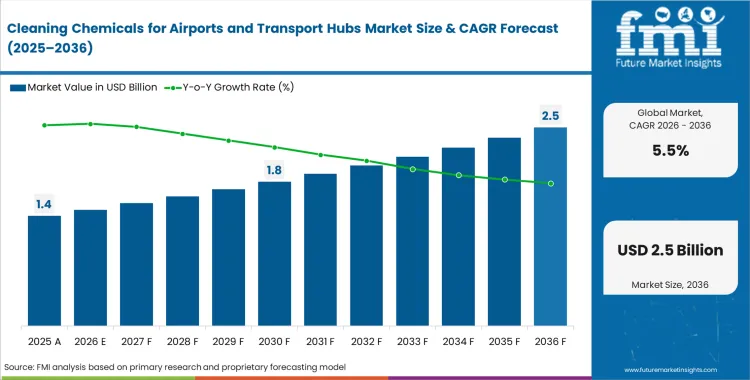
The cleaning chemicals for airports and transport hubs market stood at USD 1.3 billion in 2025. Demand is estimated to cross USD 1.4 billion in 2026 at a CAGR of 5.50% during the forecast years. Continuous investment generates growing revenue to USD 2.4 billion through 2036 as high-touch transit nodes transition from visual cleanliness standards to measurable pathogen-reduction protocols. Rising passenger volumes reduces the time available for routine sanitation, leaving limited room for slower, multi-step cleaning processes.
Procurement teams respond by prioritizing fast-acting chemistries that deliver results within tighter operational windows. Continuing with legacy multi-purpose liquids increases the risk of non-compliance as environmental and hygiene regulations become more stringent. Such delays multiply labor costs rapidly. FMI notes that what appears as an aesthetic upgrade is actually a commercial cleaning standard realignment driven by sheer footfall density.
Summary of Cleaning Chemicals for Airports and Transport Hubs Market
- The market is estimated at USD 1.3 billion in 2025.
- The market is projected to reach USD 2.4 billion by 2036.
- The market is expected to grow at a CAGR of 5.5% from 2026 to 2036.
- The forecast period represents an incremental opportunity of about USD 0.9 billion.
- Surface cleaners and disinfectants lead by product type with a 34.0% share.
- Quats dominate by chemistry with a 31.0% share.
- Liquid concentrates lead by formulation with a 41.0% share.
- Airports dominate by hub type with a 46.0% share.
- India (6.7%), Saudi Arabia (6.5%), and China (6.2%) are among the fastest-growing markets.
- Key companies in the market include Ecolab, Solenis, Clorox Professional, Zep, SC Johnson Professional, Betco, and Spartan Chemical.
Once an aviation or rail authority standardizes dosing equipment to a specific concentrate architecture, supplier switching barriers rise exponentially. Procurement officers lock into multi-year service contracts because replacing installed dilution dispensers costs more than saving pennies on competing fluids. Airport cleaning chemicals suppliers benefit autonomously after this infrastructure is bolted to janitorial closet walls.
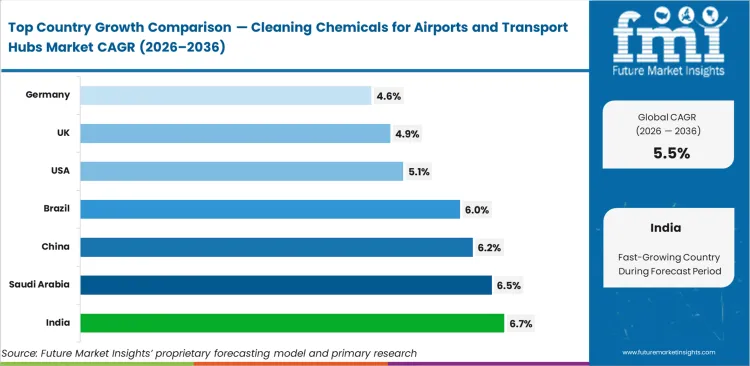
India is expected to hold 6.7% CAGR as rapid terminal network buildouts require immediate baseline transport hub cleaning chemicals. Saudi Arabia is estimated to hold 6.5% CAGR behind massive aviation infrastructure expansion. China is anticipated to capture 6.2% CAGR driven by passenger numbers recovering and renewed adoption of transport hub cleaning chemicals. Brazil is poised to garner 6.0% CAGR as regional transit authorities formalize maintenance tenders. The United States purchasing is set to record 5.1% CAGR, with the United Kingdom anticipated to capture 4.9% CAGR and Germany estimated to hold 4.6% CAGR, reflecting mature environments where growth relies on premiumizing chemical mixes.
Segmental Analysis
Cleaning Chemicals for Airports and Transport Hubs Market Analysis by Product Type
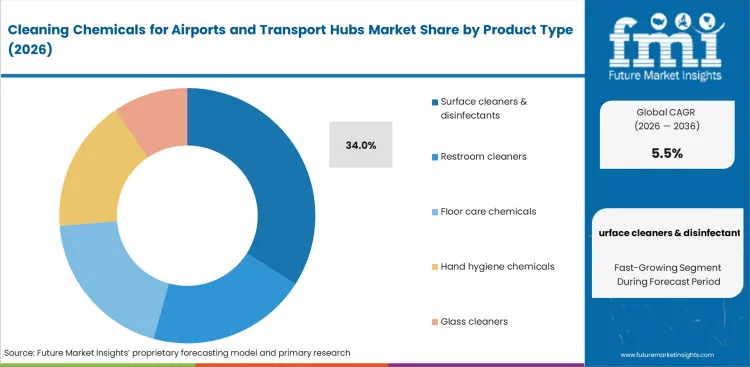
Legacy multi-purpose liquids do not meet the turnaround constraints of modern aviation environments, pushing procurement officers toward specialized pathogen-control agents. Surface cleaners & disinfectants are estimated to hold 34.0% share in 2026 because facility managers at international airports require verified biocidal efficacy that general detergents cannot legally claim. Institutional buyers depend on these formulations to manage infection risks linked to high passenger density within confined concourses.
Contact-time requirements create a direct operational constraint, as cleaning cycles must fit within narrow intervals between departing flights. Janitorial supervisors who do not follow dwell-time mandates face compliance audits and regulatory penalties. Procurement teams prioritize cleaning chemicals that allow workflows to remain compliant without slowing passenger movement. Deploying dedicated professional cleaning products alongside institutional hand hygiene chemicals helps maintain both operational speed and regulatory adherence.
- Initial selection criteria: Verified biocidal claims against high-consequence pathogens guide procurement decisions. Infection control directors reject formulations that lack proper regulatory registration, regardless of cleaning performance.
- Qualification hurdles: Material compatibility testing determines whether repeated applications degrade terminal seating and high-value surfaces. Maintenance teams eliminate corrosive options that increase long-term asset wear.
- Renewal drivers: Consistent dilution performance and hardware reliability support long-term vendor contracts. Facility directors prioritize stable airport cleaning chemicals supply chains over minor product differences during contract renewal.
Cleaning Chemicals for Airports and Transport Hubs Market Analysis by Chemistry
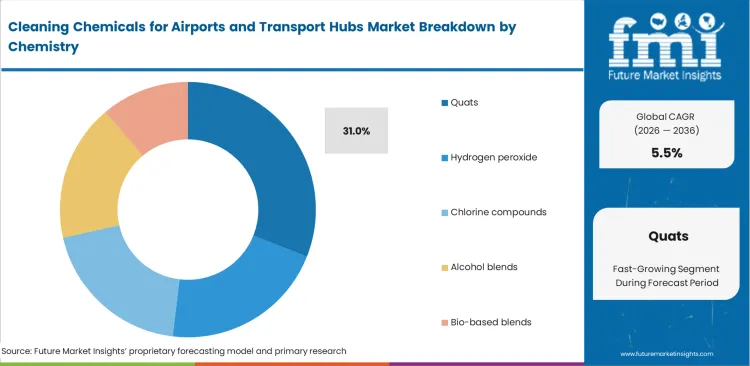
Qualification standards for environmental hygiene dictate how active ingredients are selected across transport networks. Airlines and rail operators rely on chemistries that can disinfect high-contact surfaces without damaging synthetic interiors or passenger-facing materials. Quats is anticipated to capture 31.0% share in 2026 as sanitation directors prefer their balance of broad-spectrum efficacy and controlled material interaction. Operational use introduces practical constraints, as improper dilution leaves residual films that affect surface appearance and perceived cleanliness. Selecting optimized multi surface disinfectant cleaners prevents floor slipperiness, reducing safety risks in high-traffic zones. Facilities heads frequently evaluate quats vs peroxide for transport hubs alongside broader disinfectant chemicals to balance both cleaning performance and operational safety.
- Cost origin points: Procurement teams secure cost advantages through concentrated formats that reduce freight by minimizing water transport. Supply chain teams prioritize active ingredient shipment over bulk liquid movement.
- Hidden operational expenses: Incorrect dilution wastes chemical stock and leads to additional labor required to correct residue buildup or ineffective cleaning.
- Lifecycle comparison metrics: Controlled dispensing systems reduce long-term cost by improving dosing accuracy and lowering excess consumption over extended operational cycles.
Cleaning Chemicals for Airports and Transport Hubs Market Analysis by Formulation
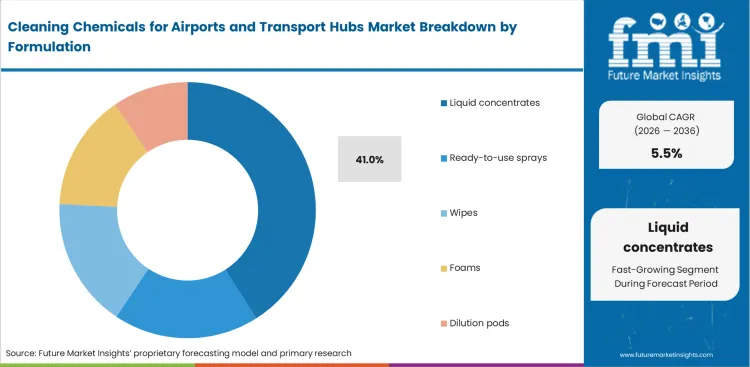
Storage limitations within transit hubs require strict control over volumetric efficiency and inventory handling. Liquid concentrates are expected to holds 41.0% share in 2026 as logistics managers avoid allocating premium terminal space to ready-to-use water-based products. High-traffic rail and airport hubs depend on centralized dilution systems to supply large cleaning teams efficiently across expansive facilities. Liquid formats integrate directly into mechanized cleaning equipment, removing the need for manual preparation steps that slow operations. Incorrect dilution ratios create safety risks, including chemical exposure and surface damage, making closed-loop dispensing systems necessary. Consistent supply of super-concentrated chemical supplies alongside airport restroom sanitation chemicals supports uninterrupted sanitation across complex transit environments.
- Prevention targets: Closed-loop dispensing systems prevent unauthorized chemical access and eliminate risks associated with manual mixing errors.
- Residual vulnerability: Failure of the centralized dilution infrastructure disrupts cleaning operations across entire terminals, requiring backup procedures to maintain continuity.
- Maximum capture requirements: High workforce turnover requires structured training to ensure correct system usage and avoid operational inefficiencies.
Cleaning Chemicals for Airports and Transport Hubs Market Analysis by Application
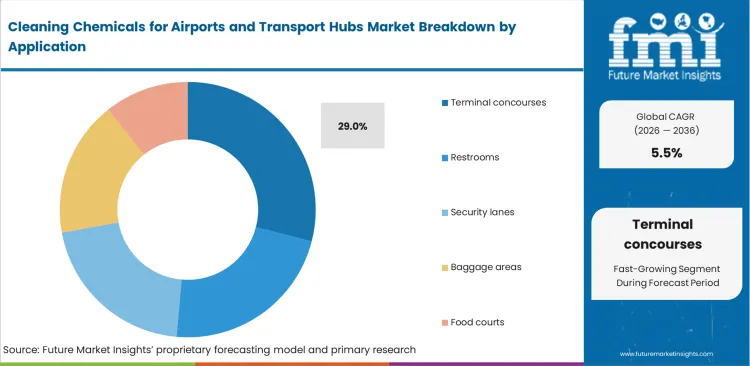
Footfall concentration directly determines how intensively cleaning chemicals are deployed across different transport zones. Shift supervisors are required to continuously manage visible spills across large, uninterrupted passenger pathways. Continuous movement makes it impractical to isolate these areas for deep cleaning during operating hours, forcing reliance on ongoing maintenance cycles rather than periodic intervention. Surface wear is further accelerated by constant friction from wheeled luggage, which gradually erodes protective coatings, an aspect often overlooked in standard cleaning assessments. Facilities require specialized maintenance formulations rather than conventional detergents.
Terminal concourses are expected to account for a 29.0% share, reflecting the sustained cleaning pressure within these high-density zones. When formulation strength is not aligned with actual traffic intensity, flooring assets deteriorate faster, increasing long-term replacement costs. Procurement strategies increasingly prioritize high-traffic surface cleaners alongside optimized floor cleaning detergents to extend asset life without interrupting passenger flow. The use of certified food-contact surface sanitizers has become essential to safeguard dining areas located within these high-density zones.
- Primary producers: Large chemical manufacturers continue to dominate supply due to the scale required to service international airport networks. Smaller, specialized formulators face structural limitations in meeting consistent volume demands across multiple geographies.
- Supply constraints: Availability of key biocide inputs remains a critical vulnerability. Shortages can quickly disrupt institutional supply chains, requiring procurement teams to pre-qualify alternative formulations to avoid operational gaps.
- Future supply landscape: Production models are gradually shifting toward localized blending to reduce the cost burden associated with transporting high-volume liquid chemicals. This transition is expected to strengthen the role of regional distributors, particularly those capable of maintaining buffer inventories for major transit authorities.
Cleaning Chemicals for Airports and Transport Hubs Market Analysis by Hub Type
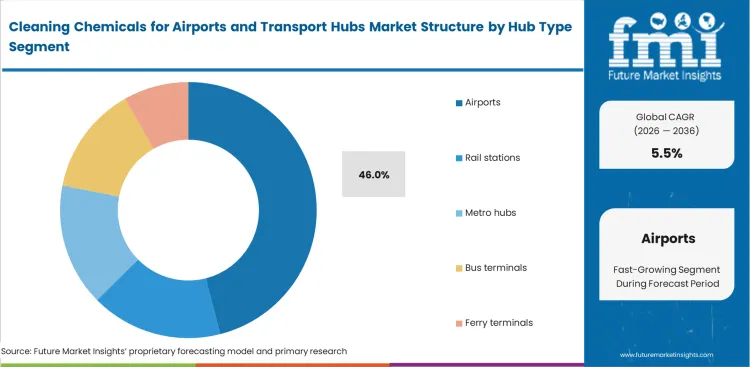
Budget allocation varies by the regulatory structure governing each transit environment. Aviation authorities operate under tighter compliance regimes and maintain higher maintenance budgets than other segments. Regulatory pressure around cross-border pathogen control pushes airport operators toward hospital-grade chemical formulations. A clear divide exists within the same facility; premium lounges require surface-safe cleaners, while adjacent concourses depend on heavy-duty degreasers.
Airports are expected to capture a 46.0% share, reflecting both operational scale and compliance intensity. Standardizing across these environments increases the risk of asset damage, particularly in high-value interiors. Tiered chemical deployment allows operators to address differing requirements without compromising material integrity. Buyers seeking aircraft cleaning chemicals are also prioritizing green cleaning chemicals to meet sustainability targets, consistent with procurement behavior in retail cleaning chemicals, where visible hygiene influences public perception.
- Extreme environment performance: Aviation-grade disinfectants are designed to meet pathogen reduction requirements within short gate turnaround windows.
- Edge condition failures: High-alcohol formulations evaporate quickly in ventilated terminals, limiting effective contact time and creating compliance gaps.
- Qualification strictness: Aviation authorities require strict material compatibility validation. Formulations must not degrade flame-retardant materials under repeated use.
Cleaning Chemicals for Airports and Transport Hubs Market Drivers, Restraints, and Opportunities
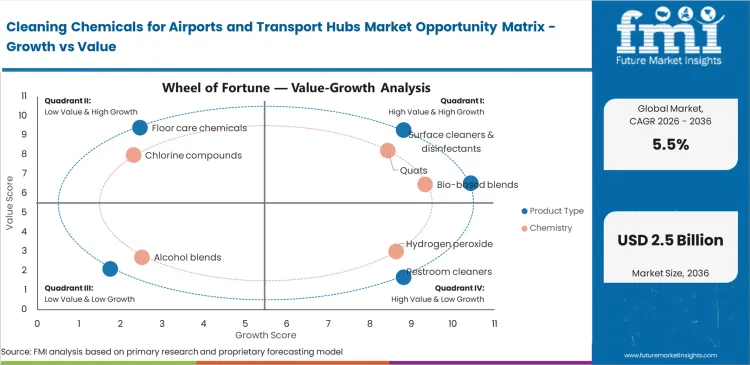
Terminal operators risk severe financial penalties if sanitation audits reveal protocol breaches within high-traffic public zones. Facility directors recognize that an outbreak traced to poor terminal hygiene inflicts catastrophic reputational damage. This operational dread forces transit authorities to abandon baseline detergents and procure certified broad-spectrum disinfectants regardless of minor price fluctuations. Delaying chemical upgrades directly compromises passenger safety while inviting regulatory intervention. Operations managers deploying disinfectant fogging chemicals and targeted security tray disinfectant chemicals demonstrate immediate responsiveness to airborne and surface-level biological threats. Rapid-acting surface disinfectant chemicals paired with accessible hand sanitizers close crucial hygiene gaps.
Legacy procurement structures trap transit authorities in outdated chemical contracts that prevent agile adaptation to new hygiene standards. Municipal purchasing rules require prolonged bidding cycles. This bureaucratic friction means transit hubs often deploy formulations that are years behind current technological capabilities. An institutional disinfectant for terminals RFQ requires immense administrative coordination, slowing down adoption of safer chemistries. Cooperative purchasing agreements provide partial relief but still struggle against entrenched vendor relationships.
Opportunities in the Cleaning Chemicals for Airports and Transport Hubs Market
- Autonomous scrubber integration: Formulating low-foam concentrates specifically engineered for robotic floor machines. Fleet managers gain massive labor efficiencies when chemicals match hardware precisely.
- Security checkpoint focus: Developing rapid-kill security lane disinfectant chemicals that sanitize high-touch bins without leaving residue. Operations directors avoid passenger bottlenecks when contact times drop below thirty seconds.
- Concentrate packaging reduction: Engineering hyper-concentrated solid formats that eliminate bulky plastic drums. Supply chain supervisors unlock valuable travel ready sanitizer packaging storage space within cramped subterranean transit stations.
Regional Analysis
Based on regional analysis, Cleaning Chemicals for Airports and Transport Hubs is segmented into North America, Latin America, Western Europe, Eastern Europe, and Asia Pacific across 40 plus countries.
.webp "Top Country Growth Comparison Cleaning Chemicals For Airports And Transport Hubs Market Cagr (2026 2036)")
| Country | CAGR (2026 to 2036) |
|---|---|
| India | 6.7% |
| Saudi Arabia | 6.5% |
| China | 6.2% |
| Brazil | 6.0% |
| United States | 5.1% |
| United Kingdom | 4.9% |
| Germany | 4.6% |
Source: Future Market Insights (FMI) analysis, based on proprietary forecasting model and primary research
Asia Pacific Cleaning Chemicals for Airports and Transport Hubs Market Analysis
Rising passenger volumes are placing sustained pressure on cleaning cycles, increasing reliance on concentrated formulations that reduce handling effort and storage requirements. Cleaning demand within a single facility remains uneven, manual wiping dominates high-touch surfaces, while machines handle large floor areas, leading to separate chemical requirements within the same site. Rail network expansion across the region is reinforcing standardized hygiene protocols, supporting long-term supply agreements for institutional chemical vendors.
- India: Greenfield airport development is creating sanitation supply chains from the ground up, with procurement decisions taken during early construction phases. Vendor selection at this stage typically defines long-term supply alignment tied to facility operations. The airport cleaning chemicals market in India is poised to expand at a 6.7% CAGR. Early contract capture provides suppliers with predictable, recurring volume across the asset lifecycle.
- China: High passenger throughput across rail networks and large transit hubs is increasing chemical consumption per facility. Sales of transport hub cleaning chemicals in China are expected to increase at a CAGR of 6.2% during the forecast period. Maintenance teams prioritize formulations that can support quick turnaround under dense footfall conditions without operational delays. Supplier scale and delivery reliability continue to influence contract allocation across major hubs.
FMI's report includes Japan and South Korea. Mature infrastructure in these adjacent markets prioritizes premium eco-certified chemistries over sheer volumetric expansion. Indonesia is emerging as a promising market in Asia Pacific, where rapid urbanization and a growing middle class are driving demand for eco-certified cleaning solutions.
Middle East Cleaning Chemicals for Airports and Transport Hubs Market Analysis
Aviation master planning across this region places facility maintenance alongside core operational targets. Airport operators treat terminal conditions as part of national positioning, approving sanitation budgets that exceed typical global benchmarks. Local conditions shape chemical selection high ambient temperatures require stable formulations, while persistent dust exposure drives heavier floor care usage per site. Premium cleaning agents are used to maintain consistent presentation standards aligned with international passenger expectations.
- Saudi Arabia: Large-scale aviation investments are paired with strict hygiene requirements across new and upgraded airports. Procurement teams favor premium imported formulations, with supplier credibility and product reliability taking priority over cost. The airport cleaning chemicals market in Saudi Arabia is expected to rise at 6.5% CAGR. High dust loads and temperature exposure increase usage frequency, especially for floor care and surface protection. Suppliers that maintain consistent supply and performance standards are more likely to secure long-term contracts.
FMI's report includes United Arab Emirates and Qatar. Intense competition between regional transit hubs drives continuous upgrades in aesthetic maintenance standards. Singapore is seeing opportunity in the sector, as its emphasis on high public hygiene standards and sustainable urban development drives adoption of innovative green cleaning formats.
Europe Cleaning Chemicals for Airports and Transport Hubs Market Analysis
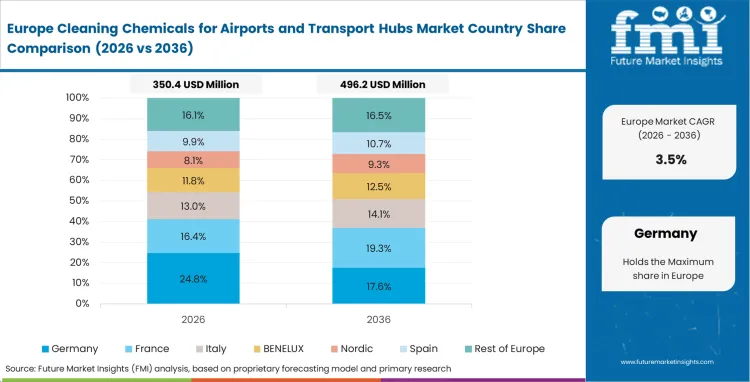
Strict environmental regulation defines how sanitation chemicals are selected and used across older transit infrastructure. Sustainability teams influence procurement decisions, removing legacy formulations that do not meet ecological standards even if performance remains strong. Rail operators managing aging stations face trade-offs between compliance and effective pathogen control, particularly where surfaces are sensitive. Modern disinfectants often create compatibility issues in heritage environments, as stronger chemistries can damage older materials. Suppliers must meet strict approval frameworks while maintaining performance, which limits the use of standard industrial products.
- United Kingdom: Privatized rail operators operate under constant public scrutiny regarding cleanliness. Station managers deploy visible sanitation teams using eco-label certified chemicals to maintain passenger confidence. Sales of rail cleaning chemicals in the United Kingdom is anticipated to rise at a 4.9% CAGR through 2036. Visible cleaning activity remains tied to fare justification and passenger expectations.
- Germany: Environmental certification approach defines which chemicals can be used in transport facilities. The rail cleaning chemicals market in Germany is expected to grow at a CAGR of 4.6% during the forecast period. Procurement teams rely on approved lists, restricting non-certified products regardless of cost. Suppliers must provide compliant formulations that meet both regulatory and operational requirements to secure contracts.
FMI's report includes France and Italy. Intense union regulations regarding worker chemical exposure heavily influence product selection toward safer green cleaning chemicals formats. Spain is experiencing rising demand for green cleaning chemicals, supported by government initiatives promoting sustainability and workplace safety standards.
Competitive Aligners for Market Players
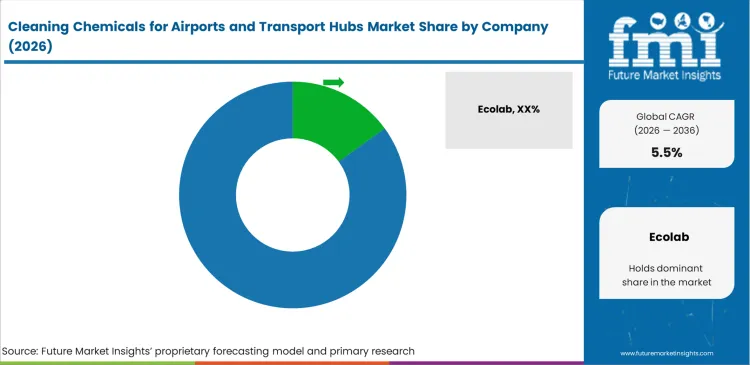
Competition in this sector centers on supply reliability, service capability, and control over installed infrastructure rather than product performance alone. Transit authorities operate multi-site networks that require uninterrupted chemical delivery, pushing procurement teams toward suppliers with proven distribution depth and contingency capacity. Buyers routinely benchmark suppliers such as ecolab vs diversey for airport cleaning to assess execution strength across large contracts. Ecolab and Solenis secure high-value aviation accounts by combining global logistics networks with on-site technical teams that support dosing systems and automated cleaning equipment. Mid-sized suppliers struggle to compete at this level, as they lack the capital and service infrastructure required to maintain continuous on-ground support.
Incumbents retain control through extensive installed bases of proprietary dispensing systems embedded across terminal cleaning infrastructure. Leading airport disinfectant chemical manufacturers such as Clorox Professional and SC Johnson Professional structure contracts around these closed-loop systems, making vendor replacement operationally difficult. A transit operator changing suppliers must handle the removal and reinstallation of hundreds of dosing units, adding cost, downtime, and coordination effort. Dependence on existing hardware limits switching and allows established suppliers to maintain pricing control during renewals. Finance teams rarely approve capital spend to replace functioning systems for marginal chemical savings. Compatibility with existing disinfection equipment further reinforces supplier continuity.
Procurement consortiums representing regional transport hubs are addressing this constraint by requiring open dosing compatibility in new tenders. Suppliers such as Zep Inc., Betco Corporation, and Spartan Chemical Company align their products with universal mixing systems, reducing reliance on proprietary infrastructure. Rail operators are also consolidating volumes through joint purchasing agreements, increasing leverage on total cost per use. Suppliers that integrate with automated floor-scrubbing equipment gain an additional entry point, particularly in facilities upgrading cleaning operations and reducing manual dependence.
Key Players in Cleaning Chemicals for Airports and Transport Hubs Market
- Ecolab
- Solenis
- Clorox Professional
- Zep
- SC Johnson Professional
- Betco
- Spartan Chemical
Scope of the Report
| Metric | Value |
|---|---|
| Quantitative Units | USD 1.4 Billion to USD 2.4 Billion, at a CAGR of 5.50% |
| Market Definition | This category covers commercial-grade chemical formulations engineered to maintain hygiene, control pathogens, and preserve infrastructure assets within high-density passenger transport environments. |
| Segmentation | Product Type, Chemistry, Formulation, Application, Hub Type |
| Regions Covered | North America, Latin America, Western Europe, Eastern Europe, Asia Pacific |
| Countries Covered | India, Saudi Arabia, China, Brazil, United States, United Kingdom, Germany |
| Key Companies Profiled | Ecolab, Solenis, Clorox Professional, Zep, SC Johnson Professional, Betco, Spartan Chemical |
| Forecast Period | 2026 to 2036 |
| Approach | Volumetric models anchored to global passenger throughput expansion. |
Source: Future Market Insights (FMI) analysis, based on proprietary forecasting model and primary research
Cleaning Chemicals for Airports and Transport Hubs Market Analysis by Segments
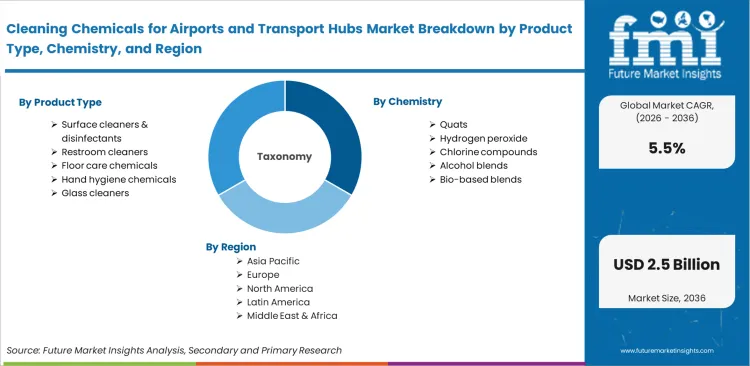
Product Type
- Surface cleaners & disinfectants
- Restroom cleaners
- Floor care chemicals
- Hand hygiene chemicals
- Glass cleaners
Chemistry
- Quats
- Hydrogen peroxide
- Chlorine compounds
- Alcohol blends
- Bio-based blends
Formulation
- Liquid concentrates
- Ready-to-use sprays
- Wipes
- Foams
- Dilution pods
Application
- Terminal concourses
- Restrooms
- Security lanes
- Baggage areas
- Food courts
Hub Type
- Airports
- Rail stations
- Metro hubs
- Bus terminals
- Ferry terminals
Region
- North America
- Latin America
- Western Europe
- Eastern Europe
- Asia Pacific
Bibliography
- Airports Council International. (2026, January 28). ACI World releases global airport traffic forecasts as long-term demand growth continues to reshape aviation.
- Civil Aviation Authority. (2026, February 24). UK aviation officially breaks records with over 300m passenger journeys in 2025.
- Centers for Disease Control and Prevention. (2024, March 19). Environmental cleaning procedures.
- Federal Register. (2024, August 8). Final modifications to the Safer Choice Standard and a provision for a Safer Choice cleaning service.
- Fraport AG. (2026, January 16). Fraport Traffic Figures 2025: Broad growth across airport network.
- General Authority of Civil Aviation. (2026, January 28). GACA reviews 2025 aviation sector achievements.
- International Union of Railways. (2025, October 9). Traffic trends among UIC member companies in 2024.
This bibliography is provided for reader reference. The full FMI report contains the complete reference list with primary source documentation.
This Report Addresses
- Integration challenges between legacy dilution dispensers and next-generation highly concentrated chemical formulas.
- Pathogen-reduction protocol compliance variations separating massive aviation hubs from regional rail networks.
- Contractual lock-in mechanisms deployed by top-tier suppliers securing long-term transit authority maintenance agreements.
- Footfall density impacts on preferred formulation profiles across terminal concourses versus subterranean baggage zones.
- Regulatory shifts forcing transport procurement officers toward eco-certified green cleaning profiles.
- Volume differences distinguishing baseline rail station maintenance from premium aviation lounge sanitation.
- Hidden labor expenses linked to inaccurate manual dosing versus closed-loop mechanized dispensing systems.
- Strategic supplier positioning required to capture emerging greenfield airport construction demand.
Frequently Asked Questions
What limits rapid adoption of novel bio-based chemistries in aviation hubs?
Rigorous pathogen-kill mandates require extensive clinical validation before transit authorities authorize formulation changes. Facility directors refuse unproven eco-products that risk failing regulatory compliance audits, delaying sustainable chemical penetration until efficacy profiles match legacy biocides completely.
Why do quats dominate rail station sanitation despite newer alternatives?
Rail operators prioritize quaternary compounds due to excellent material compatibility across historic infrastructure and synthetic seating. These chemistries sanitize without corroding aging surfaces, providing reliable broad-spectrum protection that preserves expensive physical assets during daily maintenance cycles.
How does passenger throughput dictate concentrate formatting?
Extreme footfall density compresses available cleaning windows, requiring janitorial teams to utilize high-capacity mechanized scrubbers. Liquid concentrates integrate seamlessly into these machines, minimizing refill downtime while maximizing active cleaning hours across sprawling terminal concourses.
What structural barrier prevents regional formulators from winning airport contracts?
Massive transit facilities demand uninterrupted supply chain reliability and dedicated technical support for complex dosing hardware. Regional players lack sufficient capital to deploy on-site technicians globally, disqualifying them from major aviation tenders requiring intensive operational oversight.
Why are ready-to-use sprays losing share to centralized dilution systems?
Storage constraints within subterranean transit nodes make transporting and warehousing bulk water highly inefficient. Logistics managers mandate dilution stations to eliminate bulky plastic drum storage, freeing critical square footage while driving down per-liter chemical costs.
What separates Indian adoption rates from mature European networks?
Rapid greenfield terminal construction across India requires entirely new sanitation supply infrastructures, generating immediate massive-volume contracts. European networks possess entrenched protocols, meaning growth relies on slow premiumization rather than equipping empty new facilities.
How do automation trends alter chemical formulation requirements?
Robotic floor scrubbers utilize precision fluid dynamics that clash with highly foaming legacy detergents. Formulators must engineer specific low-foam concentrates that prevent sensor fouling and pump cavitation within these expensive autonomous maintenance units.
Why do security lanes require different chemistries than terminal restrooms?
Security zones feature highly sensitive electronic screening equipment easily damaged by volatile airborne solvents. Operations managers deploy specialized low-residue wipes in these areas, reserving aggressive liquid disinfectants strictly for high-risk restroom environments.
What drives high valuation projections for 2036?
Continuous expansion of global mobility networks directly multiplies maintainable square footage requiring daily pathogen control. Sustained investment transforms discretionary cleaning budgets into mandatory health-security expenditures, locking in long-term chemical volume consumption.
How does supplier lock-in operate within transit tenders?
Incumbents install proprietary mixing hardware across dozens of terminal utility closets at immense capital cost. Procurement officers renewing contracts rarely possess authorization to fund full hardware replacement, effectively securing recurring revenue for entrenched vendors.
Why is chemical dwell time a critical procurement metric?
Flight turnaround windows dictate absolute maximum allowable cleaning times. Supervisors reject highly effective disinfectants requiring ten-minute contact times because operational schedules demand formulas that achieve pathogen destruction within sixty seconds.
What advantage do chlorine compounds offer ferry terminals?
Marine environments subject transit hubs to severe moisture and biological fouling. Chlorine formulations provide aggressive remediation against persistent molds and mildew that milder quaternary blends fail to eliminate within high-humidity coastal settings.
How do compliance audits shape janitorial training?
Failing sanitation inspections triggers severe financial penalties for contract operators. Supervisors enforce strict closed-loop dispensing protocols to eliminate manual mixing errors, guaranteeing every chemical application meets exact regulatory dilution requirements.
Why do sustainability directors target floor care chemicals first?
Massive concourse footprints consume massive volumes of daily floor maintainers. Upgrading these specific bulk chemicals to eco-certified standards provides the largest immediate reduction in overall facility environmental impact scores.
What risks accompany localized chemical blending?
Regional transit hubs attempting to mix custom formulations face severe quality control inconsistencies. Maintaining exact biocidal efficacy requires laboratory-grade precision that decentralized maintenance closets cannot reliably replicate during peak operations.
How does luggage friction influence procurement?
Wheeled suitcases aggressively degrade protective floor sealants across main thoroughfares. Maintenance directors procure specialized chemical maintainers designed specifically to harden finishes and resist mechanical abrasion, extending intervals between complete resurfacing.
Why do bus terminals lag behind airports in chemical premiumization?
Municipal bus networks operate on extremely compressed public funding models compared to heavily capitalized aviation authorities. Budgetary restrictions force bus depot managers to rely on generic industrial cleaners rather than specialized pathogen-specific formulations.
What role do cooperative purchasing agreements play?
Regional transport authorities aggregate chemical demands to leverage bulk pricing models previously reserved for national networks. These consortiums successfully force top-tier suppliers to lower concentrate pricing to secure consolidated regional contracts.
How do extreme temperatures affect formulation stability?
Transit facilities in severe climates face significant chemical degradation during warehouse storage. Procurement officers mandate high-stability chemistries to prevent active ingredients from neutralizing before application across overheated terminal zones.
Why are hand hygiene chemicals analyzed alongside surface disinfectants?
Comprehensive infection control protocols treat passenger skin and terminal surfaces as connected transmission vectors. Facility directors procure integrated hygiene portfolios to ensure chemical compatibility between hand sanitizers and adjacent surface cleaners.
What prevents immediate transition to bio-based blends?
Strict regulatory frameworks require extensive real-world testing before approving new active ingredients for commercial transport use. Risk-averse transit authorities wait for definitive clinical validation before replacing proven synthetic pathogen-reduction protocols.
How does vendor consolidation impact terminal operations?
Contracting multiple specialized suppliers creates overlapping logistical complexities and incompatible dosing hardware. Operations managers drive consolidation to establish unified training protocols and secure single-point accountability for entire facility hygiene outcomes.
Preview the report firsthand - request a free sample
Get SampleGet the brochure for pricing and purchase details.
Get PDFTable of Content
- Executive Summary
- Global Market Outlook
- Demand-side Trends
- Supply-side Trends
- Technology Roadmap Analysis
- Analysis and Recommendations
- Market Overview
- Market Coverage / Taxonomy
- Market Definition / Scope / Limitations
- Research Methodology
- Chapter Orientation
- Analytical Lens and Working Hypotheses
- Market Structure, Signals, and Trend Drivers
- Benchmarking and Cross-market Comparability
- Market Sizing, Forecasting, and Opportunity Mapping
- Research Design and Evidence Framework
- Desk Research Programme (Secondary Evidence)
- Company Annual and Sustainability Reports
- Peer-reviewed Journals and Academic Literature
- Corporate Websites, Product Literature, and Technical Notes
- Earnings Decks and Investor Briefings
- Statutory Filings and Regulatory Disclosures
- Technical White Papers and Standards Notes
- Trade Journals, Industry Magazines, and Analyst Briefs
- Conference Proceedings, Webinars, and Seminar Materials
- Government Statistics Portals and Public Data Releases
- Press Releases and Reputable Media Coverage
- Specialist Newsletters and Curated Briefings
- Sector Databases and Reference Repositories
- FMI Internal Proprietary Databases and Historical Market Datasets
- Subscription Datasets and Paid Sources
- Social Channels, Communities, and Digital Listening Inputs
- Additional Desk Sources
- Expert Input and Fieldwork (Primary Evidence)
- Primary Modes
- Qualitative Interviews and Expert Elicitation
- Quantitative Surveys and Structured Data Capture
- Blended Approach
- Why Primary Evidence is Used
- Field Techniques
- Interviews
- Surveys
- Focus Groups
- Observational and In-context Research
- Social and Community Interactions
- Stakeholder Universe Engaged
- C-suite Leaders
- Board Members
- Presidents and Vice Presidents
- R&D and Innovation Heads
- Technical Specialists
- Domain Subject-matter Experts
- Scientists
- Physicians and Other Healthcare Professionals
- Governance, Ethics, and Data Stewardship
- Research Ethics
- Data Integrity and Handling
- Primary Modes
- Tooling, Models, and Reference Databases
- Desk Research Programme (Secondary Evidence)
- Data Engineering and Model Build
- Data Acquisition and Ingestion
- Cleaning, Normalisation, and Verification
- Synthesis, Triangulation, and Analysis
- Quality Assurance and Audit Trail
- Market Background
- Market Dynamics
- Drivers
- Restraints
- Opportunity
- Trends
- Scenario Forecast
- Demand in Optimistic Scenario
- Demand in Likely Scenario
- Demand in Conservative Scenario
- Opportunity Map Analysis
- Product Life Cycle Analysis
- Supply Chain Analysis
- Investment Feasibility Matrix
- Value Chain Analysis
- PESTLE and Porter’s Analysis
- Regulatory Landscape
- Regional Parent Market Outlook
- Production and Consumption Statistics
- Import and Export Statistics
- Market Dynamics
- Global Market Analysis 2021 to 2025 and Forecast, 2026 to 2036
- Historical Market Size Value (USD Million) Analysis, 2021 to 2025
- Current and Future Market Size Value (USD Million) Projections, 2026 to 2036
- Y-o-Y Growth Trend Analysis
- Absolute $ Opportunity Analysis
- Global Market Pricing Analysis 2021 to 2025 and Forecast 2026 to 2036
- Global Market Analysis 2021 to 2025 and Forecast 2026 to 2036, By Product Type
- Introduction / Key Findings
- Historical Market Size Value (USD Million) Analysis By Product Type , 2021 to 2025
- Current and Future Market Size Value (USD Million) Analysis and Forecast By Product Type , 2026 to 2036
- Surface cleaners & disinfectants
- Restroom cleaners
- Floor care chemicals
- Hand hygiene chemicals
- Glass cleaners
- Surface cleaners & disinfectants
- Y-o-Y Growth Trend Analysis By Product Type , 2021 to 2025
- Absolute $ Opportunity Analysis By Product Type , 2026 to 2036
- Global Market Analysis 2021 to 2025 and Forecast 2026 to 2036, By Chemistry
- Introduction / Key Findings
- Historical Market Size Value (USD Million) Analysis By Chemistry, 2021 to 2025
- Current and Future Market Size Value (USD Million) Analysis and Forecast By Chemistry, 2026 to 2036
- Quats
- Hydrogen peroxide
- Chlorine compounds
- Alcohol blends
- Bio-based blends
- Quats
- Y-o-Y Growth Trend Analysis By Chemistry, 2021 to 2025
- Absolute $ Opportunity Analysis By Chemistry, 2026 to 2036
- Global Market Analysis 2021 to 2025 and Forecast 2026 to 2036, By Formulation
- Introduction / Key Findings
- Historical Market Size Value (USD Million) Analysis By Formulation, 2021 to 2025
- Current and Future Market Size Value (USD Million) Analysis and Forecast By Formulation, 2026 to 2036
- Liquid concentrates
- Ready-to-use sprays
- Wipes
- Foams
- Dilution pods
- Liquid concentrates
- Y-o-Y Growth Trend Analysis By Formulation, 2021 to 2025
- Absolute $ Opportunity Analysis By Formulation, 2026 to 2036
- Global Market Analysis 2021 to 2025 and Forecast 2026 to 2036, By Application
- Introduction / Key Findings
- Historical Market Size Value (USD Million) Analysis By Application, 2021 to 2025
- Current and Future Market Size Value (USD Million) Analysis and Forecast By Application, 2026 to 2036
- Terminal concourses
- Restrooms
- Security lanes
- Baggage areas
- Food courts
- Terminal concourses
- Y-o-Y Growth Trend Analysis By Application, 2021 to 2025
- Absolute $ Opportunity Analysis By Application, 2026 to 2036
- Global Market Analysis 2021 to 2025 and Forecast 2026 to 2036, By Hub Type
- Introduction / Key Findings
- Historical Market Size Value (USD Million) Analysis By Hub Type, 2021 to 2025
- Current and Future Market Size Value (USD Million) Analysis and Forecast By Hub Type, 2026 to 2036
- Airports
- Rail stations
- Metro hubs
- Bus terminals
- Ferry terminals
- Airports
- Y-o-Y Growth Trend Analysis By Hub Type, 2021 to 2025
- Absolute $ Opportunity Analysis By Hub Type, 2026 to 2036
- Global Market Analysis 2021 to 2025 and Forecast 2026 to 2036, By Region
- Introduction
- Historical Market Size Value (USD Million) Analysis By Region, 2021 to 2025
- Current Market Size Value (USD Million) Analysis and Forecast By Region, 2026 to 2036
- North America
- Latin America
- Western Europe
- Eastern Europe
- East Asia
- South Asia and Pacific
- Middle East & Africa
- Market Attractiveness Analysis By Region
- North America Market Analysis 2021 to 2025 and Forecast 2026 to 2036, By Country
- Historical Market Size Value (USD Million) Trend Analysis By Market Taxonomy, 2021 to 2025
- Market Size Value (USD Million) Forecast By Market Taxonomy, 2026 to 2036
- By Country
- USA
- Canada
- Mexico
- By Product Type
- By Chemistry
- By Formulation
- By Application
- By Hub Type
- By Country
- Market Attractiveness Analysis
- By Country
- By Product Type
- By Chemistry
- By Formulation
- By Application
- By Hub Type
- Key Takeaways
- Latin America Market Analysis 2021 to 2025 and Forecast 2026 to 2036, By Country
- Historical Market Size Value (USD Million) Trend Analysis By Market Taxonomy, 2021 to 2025
- Market Size Value (USD Million) Forecast By Market Taxonomy, 2026 to 2036
- By Country
- Brazil
- Chile
- Rest of Latin America
- By Product Type
- By Chemistry
- By Formulation
- By Application
- By Hub Type
- By Country
- Market Attractiveness Analysis
- By Country
- By Product Type
- By Chemistry
- By Formulation
- By Application
- By Hub Type
- Key Takeaways
- Western Europe Market Analysis 2021 to 2025 and Forecast 2026 to 2036, By Country
- Historical Market Size Value (USD Million) Trend Analysis By Market Taxonomy, 2021 to 2025
- Market Size Value (USD Million) Forecast By Market Taxonomy, 2026 to 2036
- By Country
- Germany
- UK
- Italy
- Spain
- France
- Nordic
- BENELUX
- Rest of Western Europe
- By Product Type
- By Chemistry
- By Formulation
- By Application
- By Hub Type
- By Country
- Market Attractiveness Analysis
- By Country
- By Product Type
- By Chemistry
- By Formulation
- By Application
- By Hub Type
- Key Takeaways
- Eastern Europe Market Analysis 2021 to 2025 and Forecast 2026 to 2036, By Country
- Historical Market Size Value (USD Million) Trend Analysis By Market Taxonomy, 2021 to 2025
- Market Size Value (USD Million) Forecast By Market Taxonomy, 2026 to 2036
- By Country
- Russia
- Poland
- Hungary
- Balkan & Baltic
- Rest of Eastern Europe
- By Product Type
- By Chemistry
- By Formulation
- By Application
- By Hub Type
- By Country
- Market Attractiveness Analysis
- By Country
- By Product Type
- By Chemistry
- By Formulation
- By Application
- By Hub Type
- Key Takeaways
- East Asia Market Analysis 2021 to 2025 and Forecast 2026 to 2036, By Country
- Historical Market Size Value (USD Million) Trend Analysis By Market Taxonomy, 2021 to 2025
- Market Size Value (USD Million) Forecast By Market Taxonomy, 2026 to 2036
- By Country
- China
- Japan
- South Korea
- By Product Type
- By Chemistry
- By Formulation
- By Application
- By Hub Type
- By Country
- Market Attractiveness Analysis
- By Country
- By Product Type
- By Chemistry
- By Formulation
- By Application
- By Hub Type
- Key Takeaways
- South Asia and Pacific Market Analysis 2021 to 2025 and Forecast 2026 to 2036, By Country
- Historical Market Size Value (USD Million) Trend Analysis By Market Taxonomy, 2021 to 2025
- Market Size Value (USD Million) Forecast By Market Taxonomy, 2026 to 2036
- By Country
- India
- ASEAN
- Australia & New Zealand
- Rest of South Asia and Pacific
- By Product Type
- By Chemistry
- By Formulation
- By Application
- By Hub Type
- By Country
- Market Attractiveness Analysis
- By Country
- By Product Type
- By Chemistry
- By Formulation
- By Application
- By Hub Type
- Key Takeaways
- Middle East & Africa Market Analysis 2021 to 2025 and Forecast 2026 to 2036, By Country
- Historical Market Size Value (USD Million) Trend Analysis By Market Taxonomy, 2021 to 2025
- Market Size Value (USD Million) Forecast By Market Taxonomy, 2026 to 2036
- By Country
- Kingdom of Saudi Arabia
- Other GCC Countries
- Turkiye
- South Africa
- Other African Union
- Rest of Middle East & Africa
- By Product Type
- By Chemistry
- By Formulation
- By Application
- By Hub Type
- By Country
- Market Attractiveness Analysis
- By Country
- By Product Type
- By Chemistry
- By Formulation
- By Application
- By Hub Type
- Key Takeaways
- Key Countries Market Analysis
- USA
- Pricing Analysis
- Market Share Analysis, 2025
- By Product Type
- By Chemistry
- By Formulation
- By Application
- By Hub Type
- Canada
- Pricing Analysis
- Market Share Analysis, 2025
- By Product Type
- By Chemistry
- By Formulation
- By Application
- By Hub Type
- Mexico
- Pricing Analysis
- Market Share Analysis, 2025
- By Product Type
- By Chemistry
- By Formulation
- By Application
- By Hub Type
- Brazil
- Pricing Analysis
- Market Share Analysis, 2025
- By Product Type
- By Chemistry
- By Formulation
- By Application
- By Hub Type
- Chile
- Pricing Analysis
- Market Share Analysis, 2025
- By Product Type
- By Chemistry
- By Formulation
- By Application
- By Hub Type
- Germany
- Pricing Analysis
- Market Share Analysis, 2025
- By Product Type
- By Chemistry
- By Formulation
- By Application
- By Hub Type
- UK
- Pricing Analysis
- Market Share Analysis, 2025
- By Product Type
- By Chemistry
- By Formulation
- By Application
- By Hub Type
- Italy
- Pricing Analysis
- Market Share Analysis, 2025
- By Product Type
- By Chemistry
- By Formulation
- By Application
- By Hub Type
- Spain
- Pricing Analysis
- Market Share Analysis, 2025
- By Product Type
- By Chemistry
- By Formulation
- By Application
- By Hub Type
- France
- Pricing Analysis
- Market Share Analysis, 2025
- By Product Type
- By Chemistry
- By Formulation
- By Application
- By Hub Type
- India
- Pricing Analysis
- Market Share Analysis, 2025
- By Product Type
- By Chemistry
- By Formulation
- By Application
- By Hub Type
- ASEAN
- Pricing Analysis
- Market Share Analysis, 2025
- By Product Type
- By Chemistry
- By Formulation
- By Application
- By Hub Type
- Australia & New Zealand
- Pricing Analysis
- Market Share Analysis, 2025
- By Product Type
- By Chemistry
- By Formulation
- By Application
- By Hub Type
- China
- Pricing Analysis
- Market Share Analysis, 2025
- By Product Type
- By Chemistry
- By Formulation
- By Application
- By Hub Type
- Japan
- Pricing Analysis
- Market Share Analysis, 2025
- By Product Type
- By Chemistry
- By Formulation
- By Application
- By Hub Type
- South Korea
- Pricing Analysis
- Market Share Analysis, 2025
- By Product Type
- By Chemistry
- By Formulation
- By Application
- By Hub Type
- Russia
- Pricing Analysis
- Market Share Analysis, 2025
- By Product Type
- By Chemistry
- By Formulation
- By Application
- By Hub Type
- Poland
- Pricing Analysis
- Market Share Analysis, 2025
- By Product Type
- By Chemistry
- By Formulation
- By Application
- By Hub Type
- Hungary
- Pricing Analysis
- Market Share Analysis, 2025
- By Product Type
- By Chemistry
- By Formulation
- By Application
- By Hub Type
- Kingdom of Saudi Arabia
- Pricing Analysis
- Market Share Analysis, 2025
- By Product Type
- By Chemistry
- By Formulation
- By Application
- By Hub Type
- Turkiye
- Pricing Analysis
- Market Share Analysis, 2025
- By Product Type
- By Chemistry
- By Formulation
- By Application
- By Hub Type
- South Africa
- Pricing Analysis
- Market Share Analysis, 2025
- By Product Type
- By Chemistry
- By Formulation
- By Application
- By Hub Type
- USA
- Market Structure Analysis
- Competition Dashboard
- Competition Benchmarking
- Market Share Analysis of Top Players
- By Regional
- By Product Type
- By Chemistry
- By Formulation
- By Application
- By Hub Type
- Competition Analysis
- Competition Deep Dive
- Ecolab
- Overview
- Product Portfolio
- Profitability by Market Segments (Product/Age /Sales Channel/Region)
- Sales Footprint
- Strategy Overview
- Marketing Strategy
- Product Strategy
- Channel Strategy
- Solenis
- Clorox Professional
- Zep
- SC Johnson Professional
- Betco
- Spartan Chemical
- Ecolab
- Competition Deep Dive
- Assumptions & Acronyms Used


