

- Industry Size (2026)
- USD 2.2 Bn
- Forecast (2036)
- USD 3.4 Bn
- CAGR (2026 to 2036)
- 4.5%
Cleaning Chemicals for Retail and Shopping Centres Market Forecast and Outlook 2026 to 2036
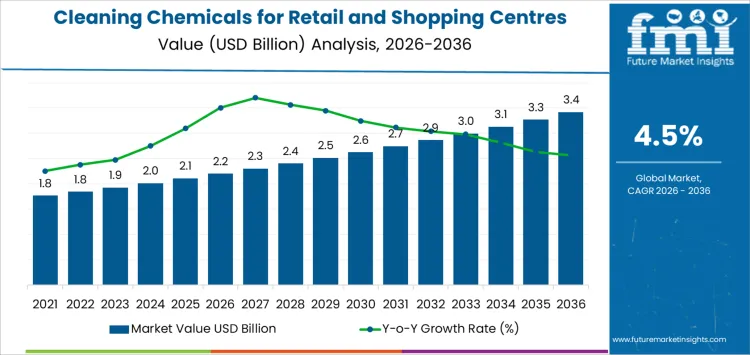
In 2026, the cleaning chemicals for retail and shopping centres market is valued at USD 2.2 billion and is expected to reach USD 3.4 billion by 2036, reflecting a CAGR of 4.5%. Growth from USD 1.6 billion in 2020 is driven by routine cleaning across malls, shopping centres, and high street retail buildings. Floor care chemicals represent the largest product family as common areas and food courts experience continuous foot traffic. Surface cleaners and disinfectants maintain strong demand at storefronts and entrances where appearance and hygiene directly influence customer experience.
From 2027 to 2031, market value increases from USD 2.3 billion to USD 2.7 billion, before advancing steadily toward USD 3.4 billion by 2036. Regional malls and large shopping complexes continue to anchor consumption due to extended operating hours and high visitor volumes. Restroom and glass cleaners support consistent secondary demand tied to daily maintenance schedules. Janitorial supply distribution remains the dominant supply model, complemented by direct facility contracts and management providers. Long term growth reflects predictable procurement cycles, gradual retail space expansion, and steady upkeep requirements rather than changes in cleaning intensity.
Quick Stats of the Cleaning Chemicals for Retail and Shopping Centres Market
- Cleaning Chemicals for Retail and Shopping Centres Market Value (2026): USD 2.2 billion
- Cleaning Chemicals for Retail and Shopping Centres Market Forecast Value (2036): USD 3.4 billion
- Cleaning Chemicals for Retail and Shopping Centres Market Forecast CAGR (2026-2036): 4.5%
- Leading Product Family in the Market: Floor Care Chemicals (34%)
- Key Growth Regions: China, Brazil, USA, UK, Germany
- Top Players: Ecolab, Diversey, SC Johnson Professional, 3M, CloroxPro, Zep, Betco, Spartan Chemical, P&G Professional, Unilever Professional
What is the Growth Forecast for the Cleaning Chemicals for Retail and Shopping Centres Market through 2036?
From 2026 to 2031, the cleaning chemicals for retail and shopping centres market increases from USD 2.2 billion to about USD 2.6 billion, reflecting a gradual year-on-year rise aligned with footfall recovery and stable mall operations. Annual increments during this phase remain moderate, shaped by routine floor care, restroom sanitation, and food court cleaning rather than aggressive expansion. Spending growth tracks tenant occupancy rates and operating hours, with retailers prioritizing consistent appearance and hygiene. Yearly gains are incremental, indicating a phase of normalization where consumption grows steadily in line with visitor traffic and leasing stability.
Between 2031 and 2036, the market expands from roughly USD 2.6 billion to USD 3.4 billion, showing a stronger year-on-year progression compared with the earlier period. Annual additions accelerate as larger retail complexes increase cleaning frequency, mixed-use developments expand maintenance scope, and extended trading hours raise chemical usage per site. Growth becomes less dependent on traffic recovery and more driven by higher cleaning intensity, broader surface coverage, and centralized procurement across retail portfolios. This shift results in larger yearly value gains, marking a clear step-up in the pace of expansion through the latter half of the forecast period.
Cleaning Chemicals for Retail and Shopping Centres Market Key Takeaways
| Metric | Value |
|---|---|
| Market Value (2026) | USD 2.2 billion |
| Forecast Value (2036) | USD 3.4 billion |
| Forecast CAGR (2026–2036) | 4.50% |
How Are Footfall Intensity and Brand Presentation Driving the Cleaning Chemicals for Retail and Shopping Centres Market from 2026 to 2036?
Retail stores and shopping centres increased use of specialised cleaning chemicals to manage constant foot traffic and extended operating hours. Floors, entrances, food courts, and restrooms required frequent cleaning to maintain appearance and safety. Historical demand reflected emphasis on visual cleanliness, slip resistance, and fast turnaround between peak shopping periods. Facility teams selected products compatible with polished floors, glass, escalators, and fixtures commonly used in retail interiors. Procurement aligned with mall management contracts and tenant expectations for consistent presentation.
From 2026 to 2036 demand is expected to grow with expansion of mixed use retail spaces and longer trading hours. Centres adopt chemicals suited for mechanised cleaning and quick drying to limit disruption during open hours. Growth reflects higher expectations for hygiene in shared spaces such as fitting rooms and payment areas. Suppliers develop formulations that balance cleaning strength with surface protection. Buyers assess performance consistency, labour efficiency, and compatibility across diverse retail formats and materials.
What Is the Demand for the Cleaning Chemicals for Retail and Shopping Centres Market by Product Family and Retail Zone for 2026 to 2036?
Across 2026 to 2036, the cleaning chemicals for retail and shopping centres market is influenced by high visitor turnover, extended operating hours, and strong emphasis on visual cleanliness. Floor care chemicals hold a 34% share as large open areas require frequent maintenance to manage foot traffic soil and spill incidents. Common areas and food courts also account for 34% of demand by retail zone because they concentrate dining activity, movement between stores, and prolonged customer dwell time. Purchasing patterns reflect routine maintenance schedules and brand-driven cleanliness standards.
Why do floor care chemicals account for 34% of demand in the cleaning chemicals for retail and shopping centres market by product family from 2026 to 2036?
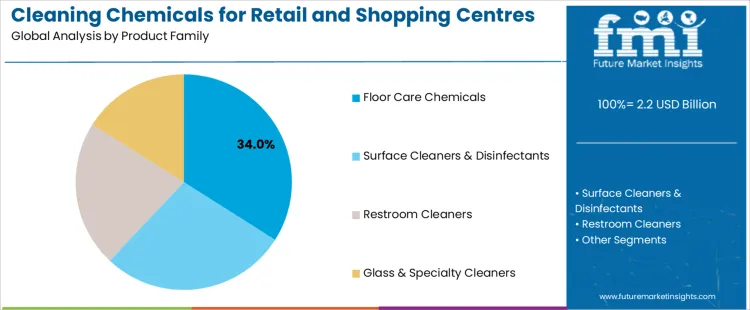
Floor care chemicals account for 34% of demand because retail environments rely on clean, safe walking surfaces to support customer flow and reduce incident risk. Consumption intensity remains high across malls, outlets, and mixed-use centres where floors are exposed to continuous foot traffic, food spills, and outdoor contaminants. Usage stays steady as cleaning teams follow fixed schedules that include daily cleaning and periodic deep maintenance. Procurement decisions emphasize products that remove embedded soil while preserving floor finish and slip resistance. Buyers favor formulations compatible with mechanized scrubbers and low-moisture systems used during operating hours. Price sensitivity remains moderate since floor appearance directly affects customer perception and tenant satisfaction. Specification control focuses on residue management, drying speed, and compatibility with stone, tile, vinyl, and coated concrete surfaces. Demand continues from 2026 to 2036 as retail operators expand experiential spaces and maintain consistent standards across large floor areas. Repeat purchasing patterns remain predictable due to continuous consumption tied to daily maintenance cycles.
Why do common areas and food courts represent 34% of demand in the cleaning chemicals for retail and shopping centres market by retail zone from 2026 to 2036?
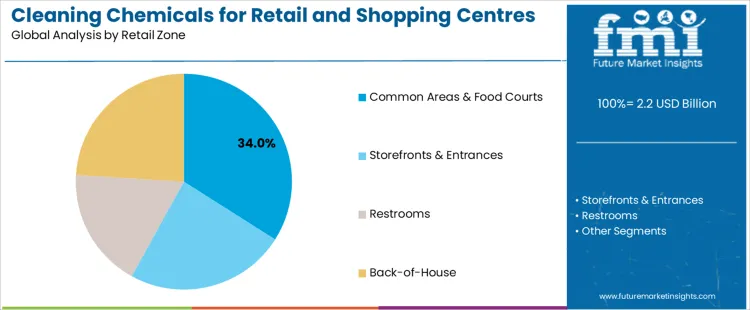
Common areas and food courts represent 34% of demand because they experience the highest concentration of visitors and extended occupancy periods. Consumption is concentrated in corridors, seating zones, dining areas, and circulation spaces where food residue, spills, and waste accumulation occur throughout the day. Usage remains steady as cleaning teams operate in multiple shifts to maintain hygiene without interrupting customer activity. Procurement favors chemicals that act quickly and leave minimal odor while supporting frequent reapplication. Buyers prioritize solutions that manage grease, sugars, and particulate soil across mixed surface types. Price sensitivity stays moderate as cleanliness directly supports dwell time and overall retail performance. Specification control emphasizes versatility, rapid drying, and compatibility with microfiber and spray-cleaning methods. Demand persists from 2026 to 2036 as shopping centres continue positioning common areas and food courts as social anchors requiring sustained cleanliness and visual appeal.
How Is Demand for Cleaning Chemicals in Retail and Shopping Centres Shaped by Store Operations and Foot Traffic Patterns?
Demand develops through daily maintenance routines in malls, supermarkets, and standalone retail stores where cleanliness links directly to safety and store presentation. High footfall corridors require frequent floor cleaning to manage dirt tracked from outside. Food courts rely on degreasers suited to mixed seating and dining surfaces. Apparel stores select low residue cleaners to protect fixtures and displays. Supermarkets use rapid drying products to avoid aisle closures during trading hours. These needs arise from operating schedules, customer movement patterns, and surface variety, grounding demand in practical store management rather than discretionary hygiene upgrades.
What Retail Management Practices Are Driving Demand for Cleaning Chemicals in Shopping Centres?
Drivers originate from operational controls set by property managers and retail chains. Mall operators standardize approved chemicals to ensure consistent results across tenants. Anchor stores influence demand through centralized procurement that favors scalable, easy to use formulations. Extended opening hours increase reliance on cleaners that work within short overnight windows. Retailers adopt products compatible with mechanized scrubbers used in large floor areas. Health and safety checks also encourage use of slip resistant floor care chemicals. These drivers reflect structured retail management practices focused on uptime, appearance, and risk control.
What Practical Constraints Are Limiting Wider Adoption of Specialized Cleaning Chemicals in Retail Settings?
Barriers relate to cost sensitivity, tenant coordination, and surface diversity. Smaller retailers operate under tight budgets and favor basic multipurpose cleaners. Shopping centres host varied flooring materials, which complicates chemical selection and limits specialization. Cleaning contractors working across multiple sites prioritize products that fit all locations. Short cleaning windows restrict use of chemicals requiring extended dwell time. Storage limits in back rooms reduce inventory flexibility. These constraints slow adoption where simplicity, cost predictability, and operational speed outweigh performance gains.
What is the Growth Outlook for Cleaning Chemicals Used in Retail and Shopping Centres Across Key Countries?
| Country | CAGR (%) |
|---|---|
| China | 5.5% |
| Brazil | 5.3% |
| USA | 4.2% |
| UK | 4.2% |
| Germany | 4.1% |
The demand for cleaning chemicals used in retail and shopping centres is growing at a measured pace as operators maintain hygiene standards to support customer experience and regulatory compliance. China leads growth at 5.5%, driven by rapid expansion of malls, mixed use retail complexes, and high footfall urban shopping zones. Brazil follows at 5.3%, supported by growth in organized retail formats and increased outsourcing of facility management services. The USA and UK each record 4.2%, reflecting mature retail environments with steady cleaning schedules and long term supplier contracts. Germany at 4.1% shows stable growth linked to structured maintenance practices and consistent foot traffic in retail spaces. Overall expansion is supported by routine sanitation needs, surface care requirements, and ongoing maintenance of public facing commercial environments.
How Are Footfall Management Needs Shaping the Cleaning Chemicals for Retail and Shopping Centres Market in the United States?
Cleaning chemicals for retail and shopping centres demand in the United States is growing at a CAGR of 4.2% from 2026 to 2036 as malls, big box stores, and mixed use retail complexes manage high visitor turnover. Retail operators apply cleaning chemicals across entrances, food courts, restrooms, and common areas to maintain presentable environments. Property managers coordinate cleaning schedules with store operating hours to reduce disruption. Service providers supply products designed for frequent use on varied flooring and surface materials. Growth reflects steady emphasis on cleanliness as part of customer experience management across retail properties nationwide.
- Retail operators apply chemicals to maintain cleanliness across shared spaces.
- Property managers coordinate cleaning with store operating schedules.
- Service providers supply products suited for frequent surface treatment.
What Is Driving Adoption of the Cleaning Chemicals for Retail and Shopping Centres Market in Germany?
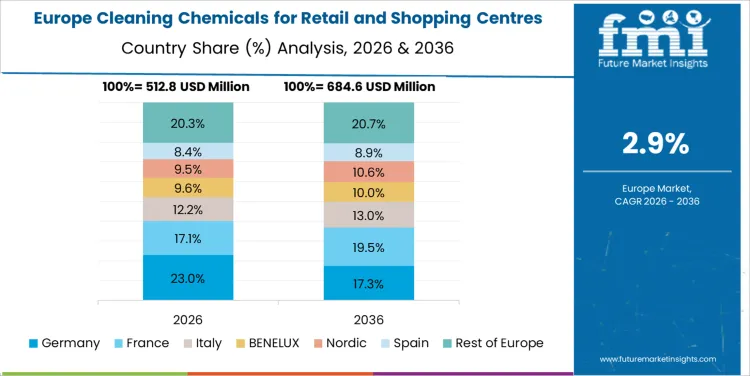
Cleaning chemicals for retail and shopping centres demand in Germany is expanding at a CAGR of 4.1% from 2026 to 2036 as shopping centres and retail chains follow structured facility upkeep practices. Mall operators use certified cleaning chemicals to maintain hygiene across corridors, rest areas, and service zones. Facility teams follow defined routines aligned with operational standards. Retail chains integrate centralized procurement to ensure consistency across locations. Growth reflects disciplined maintenance approaches and regulated facility management within the retail sector.
- Mall operators use certified chemicals for corridor and facility hygiene.
- Facility teams follow defined routines aligned with operational standards.
- Retail chains apply centralized procurement for cleaning supplies.
Why Is the Cleaning Chemicals for Retail and Shopping Centres Market Expanding Faster in China?
Cleaning chemicals for retail and shopping centres demand in China is increasing at a CAGR of 5.5% from 2026 to 2036 as large scale malls and urban retail hubs expand. New shopping complexes integrate professional cleaning programs during commissioning. Existing centres increase cleaning frequency to manage dense daily foot traffic. Local service providers supply chemicals designed for large floor areas and extended operating hours. Growth reflects continued retail infrastructure development and rising expectations for clean public environments across urban regions.
- New malls integrate professional cleaning programs at opening stages.
- Existing centres increase cleaning frequency due to high foot traffic.
- Service providers supply chemicals for large retail floor areas.
How Are Operational Practices Influencing the Cleaning Chemicals for Retail and Shopping Centres Market in the United Kingdom?
Cleaning chemicals for retail and shopping centres demand in the United Kingdom is growing at a CAGR of 4.2% from 2026 to 2036 as shopping centres, high street stores, and retail parks maintain routine hygiene programs. Retail managers apply approved cleaning chemicals across customer facing areas. Facility teams align cleaning activities with peak and off peak hours. Property owners support procurement aligned with safety and maintenance guidelines. Growth reflects consistent operational focus on cleanliness within the retail environment.
- Retail managers apply chemicals across customer facing areas.
- Facility teams align cleaning with peak and off peak hours.
- Property owners support procurement aligned with safety guidelines.
What Is Supporting Growth of the Cleaning Chemicals for Retail and Shopping Centres Market in Brazil?
Cleaning chemicals for retail and shopping centres demand in Brazil is expanding at a CAGR of 5.3% from 2026 to 2036 as malls and retail complexes manage high visitor volumes in urban areas. Retail operators increase chemical usage to maintain shared spaces and food courts. Service contractors support routine cleaning across large properties. Property developers invest in maintenance programs to support tenant retention. Growth reflects rising attention to cleanliness as a component of retail property management across major cities.
- Retail operators increase chemical use to maintain shared spaces.
- Service contractors support routine cleaning across retail properties.
- Property developers invest in maintenance to support tenant retention.
What Is Driving the Demand for Cleaning Chemicals for Retail and Shopping Centres and Which Companies Shape Daily Operations?
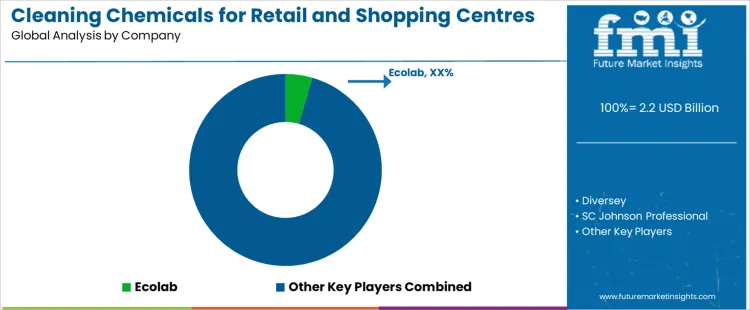
Cleaning chemical demand in retail and shopping centres is driven by high foot traffic, frequent surface contact, and the need to maintain visual cleanliness without interrupting shoppers. Operators prioritize products that work quickly on floors, glass, food courts, restrooms, and shared fixtures during business hours. Ecolab and Diversey support large mall operators through structured cleaning programs and floor care systems designed for continuous use. SC Johnson Professional and 3M supply multi surface cleaners and disinfectants suited to storefronts, seating areas, and staff zones. CloroxPro supports hygiene control in restrooms and food service areas. Zep, Betco, and Spartan Chemical serve contract cleaning firms managing multi-tenant facilities.
Product selection emphasizes rapid drying, low odor, and compatibility with stone, tile, vinyl, and polished concrete. P and G Professional and Unilever Professional provide general purpose cleaners used in back of house and storage areas. Facility managers value products that reduce slip risk and support consistent appearance across long trading hours. Usage extends to escalators, elevators, display surfaces, and loading docks. Demand visibility tracks retail footfall recovery, expansion of mixed use developments, longer store operating hours, and continued outsourcing of cleaning services across large shopping complexes.
Key Players in the Cleaning Chemicals for Retail and Shopping Centres Market
- Ecolab
- Diversey
- SC Johnson Professional
- 3M
- CloroxPro
- Zep
- Betco
- Spartan Chemical
- P&G Professional
- Unilever Professional
Scope of the Report
| Items | Values |
|---|---|
| Quantitative Units (2026) | USD billion |
| Product Family | Floor Care Chemicals; Surface Cleaners and Disinfectants; Restroom Cleaners; Glass and Specialty Cleaners |
| Retail Zone | Common Areas and Food Courts; Storefronts and Entrances; Restrooms; Back of House |
| Facility Type | Regional Malls; Shopping Centres and Big Box Complexes; High Street Retail Buildings; Other Retail Facilities |
| Supply Model | Jan San Distribution; Retail Facility Direct Contracts; Facility Management Providers; Other Supply Models |
| Regions Covered | Asia Pacific; Europe; North America; Latin America; Middle East and Africa |
| Countries Covered | China; Japan; South Korea; India; Australia and New Zealand; ASEAN; Germany; United Kingdom; France; Italy; Spain; Nordic; BENELUX; United States; Canada; Mexico; Brazil; Chile; Kingdom of Saudi Arabia; Turkey; South Africa; plus additional countries across Asia Pacific, Europe, Latin America, and Middle East and Africa |
| Key Companies Profiled | Ecolab; Diversey; SC Johnson Professional; 3M; CloroxPro; Zep; Betco; Spartan Chemical; P and G Professional; Unilever Professional |
| Additional Attributes | Dollar by sales across product families and retail zones; procurement patterns shaped by mall management contracts and tenant standards; variation in chemical usage between common areas, food courts, and storefronts; preference for rapid drying and low odor formulations during operating hours; compatibility requirements with mechanized floor cleaning equipment; impact of footfall intensity and extended trading hours on cleaning frequency; standardization of approved chemicals across multi-tenant retail portfolios |
Cleaning Chemicals for Retail and Shopping Centres Market Segmentation
Product Family:
- Floor Care Chemicals
- Surface Cleaners & Disinfectants
- Restroom Cleaners
- Glass & Specialty Cleaners
Retail Zone:
- Common Areas & Food Courts
- Storefronts & Entrances
- Restrooms
- Back-of-House
Facility Type:
- Regional Malls
- Shopping Centres / Big-Box Complexes
- High-Street Retail Buildings
- Other Retail Facilities
Supply Model:
- Jan-San Distribution
- Retail Facility Direct Contracts
- Facility Management Providers
- Other Models
Region:
- Asia Pacific
- China
- Japan
- South Korea
- India
- Australia & New Zealand
- ASEAN
- Rest of Asia Pacific
- Europe
- Germany
- United Kingdom
- France
- Italy
- Spain
- Nordic
- BENELUX
- Rest of Europe
- North America
- United States
- Canada
- Mexico
- Latin America
- Brazil
- Chile
- Rest of Latin America
- Middle East & Africa
- Kingdom of Saudi Arabia
- Other GCC Countries
- Turkey
- South Africa
- Other African Union
- Rest of Middle East & Africa
Frequently Asked Questions
How big is the cleaning chemicals for retail and shopping centres market in 2026?
The global cleaning chemicals for retail and shopping centres market is estimated to be valued at USD 2.2 billion in 2026.
What will be the size of cleaning chemicals for retail and shopping centres market in 2036?
The market size for the cleaning chemicals for retail and shopping centres market is projected to reach USD 3.4 billion by 2036.
How much will be the cleaning chemicals for retail and shopping centres market growth between 2026 and 2036?
The cleaning chemicals for retail and shopping centres market is expected to grow at a 4.5% CAGR between 2026 and 2036.
What are the key product types in the cleaning chemicals for retail and shopping centres market?
The key product types in cleaning chemicals for retail and shopping centres market are floor care chemicals, surface cleaners & disinfectants, restroom cleaners and glass & specialty cleaners.
Which retail zone segment to contribute significant share in the cleaning chemicals for retail and shopping centres market in 2026?
In terms of retail zone, common areas & food courts segment to command 34.0% share in the cleaning chemicals for retail and shopping centres market in 2026.
Preview the report firsthand - request a free sample
Get SampleGet the brochure for pricing and purchase details.
Get PDFTable of Content
- Executive Summary
- Global Market Outlook
- Demand-side Trends
- Supply-side Trends
- Technology Roadmap Analysis
- Analysis and Recommendations
- Market Overview
- Market Coverage / Taxonomy
- Market Definition / Scope / Limitations
- Market Background
- Market Dynamics
- Drivers
- Restraints
- Opportunity
- Trends
- Scenario Forecast
- Demand in Optimistic Scenario
- Demand in Likely Scenario
- Demand in Conservative Scenario
- Opportunity Map Analysis
- Product Life Cycle Analysis
- Supply Chain Analysis
- Investment Feasibility Matrix
- Value Chain Analysis
- PESTLE and Porter’s Analysis
- Regulatory Landscape
- Regional Parent Market Outlook
- Production and Consumption Statistics
- Import and Export Statistics
- Market Dynamics
- Global Market Analysis 2021 to 2025 and Forecast, 2026 to 2036
- Historical Market Size Value (USD Million) Analysis, 2021 to 2025
- Current and Future Market Size Value (USD Million) Projections, 2026 to 2036
- Y-o-Y Growth Trend Analysis
- Absolute $ Opportunity Analysis
- Global Market Pricing Analysis 2021 to 2025 and Forecast 2026 to 2036
- Global Market Analysis 2021 to 2025 and Forecast 2026 to 2036, By Product Family
- Introduction / Key Findings
- Historical Market Size Value (USD Million) Analysis By Product Family , 2021 to 2025
- Current and Future Market Size Value (USD Million) Analysis and Forecast By Product Family , 2026 to 2036
- Floor Care Chemicals
- Surface Cleaners & Disinfectants
- Restroom Cleaners
- Glass & Specialty Cleaners
- Y-o-Y Growth Trend Analysis By Product Family , 2021 to 2025
- Absolute $ Opportunity Analysis By Product Family , 2026 to 2036
- Global Market Analysis 2021 to 2025 and Forecast 2026 to 2036, By Retail Zone
- Introduction / Key Findings
- Historical Market Size Value (USD Million) Analysis By Retail Zone, 2021 to 2025
- Current and Future Market Size Value (USD Million) Analysis and Forecast By Retail Zone, 2026 to 2036
- Common Areas & Food Courts
- Storefronts & Entrances
- Restrooms
- Back-of-House
- Y-o-Y Growth Trend Analysis By Retail Zone, 2021 to 2025
- Absolute $ Opportunity Analysis By Retail Zone, 2026 to 2036
- Global Market Analysis 2021 to 2025 and Forecast 2026 to 2036, By Facility Type
- Introduction / Key Findings
- Historical Market Size Value (USD Million) Analysis By Facility Type, 2021 to 2025
- Current and Future Market Size Value (USD Million) Analysis and Forecast By Facility Type, 2026 to 2036
- Regional Malls
- Shopping Centres / Big-Box Complexes
- High-Street Retail Buildings
- Other Retail Facilities
- Y-o-Y Growth Trend Analysis By Facility Type, 2021 to 2025
- Absolute $ Opportunity Analysis By Facility Type, 2026 to 2036
- Global Market Analysis 2021 to 2025 and Forecast 2026 to 2036, By Supply Model
- Introduction / Key Findings
- Historical Market Size Value (USD Million) Analysis By Supply Model, 2021 to 2025
- Current and Future Market Size Value (USD Million) Analysis and Forecast By Supply Model, 2026 to 2036
- Jan-San Distribution
- Retail Facility Direct Contracts
- Facility Management Providers
- Other Models
- Y-o-Y Growth Trend Analysis By Supply Model, 2021 to 2025
- Absolute $ Opportunity Analysis By Supply Model, 2026 to 2036
- Global Market Analysis 2021 to 2025 and Forecast 2026 to 2036, By Region
- Introduction
- Historical Market Size Value (USD Million) Analysis By Region, 2021 to 2025
- Current Market Size Value (USD Million) Analysis and Forecast By Region, 2026 to 2036
- North America
- Latin America
- Western Europe
- Eastern Europe
- East Asia
- South Asia and Pacific
- Middle East & Africa
- Market Attractiveness Analysis By Region
- North America Market Analysis 2021 to 2025 and Forecast 2026 to 2036, By Country
- Historical Market Size Value (USD Million) Trend Analysis By Market Taxonomy, 2021 to 2025
- Market Size Value (USD Million) Forecast By Market Taxonomy, 2026 to 2036
- By Country
- USA
- Canada
- Mexico
- By Product Family
- By Retail Zone
- By Facility Type
- By Supply Model
- By Country
- Market Attractiveness Analysis
- By Country
- By Product Family
- By Retail Zone
- By Facility Type
- By Supply Model
- Key Takeaways
- Latin America Market Analysis 2021 to 2025 and Forecast 2026 to 2036, By Country
- Historical Market Size Value (USD Million) Trend Analysis By Market Taxonomy, 2021 to 2025
- Market Size Value (USD Million) Forecast By Market Taxonomy, 2026 to 2036
- By Country
- Brazil
- Chile
- Rest of Latin America
- By Product Family
- By Retail Zone
- By Facility Type
- By Supply Model
- By Country
- Market Attractiveness Analysis
- By Country
- By Product Family
- By Retail Zone
- By Facility Type
- By Supply Model
- Key Takeaways
- Western Europe Market Analysis 2021 to 2025 and Forecast 2026 to 2036, By Country
- Historical Market Size Value (USD Million) Trend Analysis By Market Taxonomy, 2021 to 2025
- Market Size Value (USD Million) Forecast By Market Taxonomy, 2026 to 2036
- By Country
- Germany
- UK
- Italy
- Spain
- France
- Nordic
- BENELUX
- Rest of Western Europe
- By Product Family
- By Retail Zone
- By Facility Type
- By Supply Model
- By Country
- Market Attractiveness Analysis
- By Country
- By Product Family
- By Retail Zone
- By Facility Type
- By Supply Model
- Key Takeaways
- Eastern Europe Market Analysis 2021 to 2025 and Forecast 2026 to 2036, By Country
- Historical Market Size Value (USD Million) Trend Analysis By Market Taxonomy, 2021 to 2025
- Market Size Value (USD Million) Forecast By Market Taxonomy, 2026 to 2036
- By Country
- Russia
- Poland
- Hungary
- Balkan & Baltic
- Rest of Eastern Europe
- By Product Family
- By Retail Zone
- By Facility Type
- By Supply Model
- By Country
- Market Attractiveness Analysis
- By Country
- By Product Family
- By Retail Zone
- By Facility Type
- By Supply Model
- Key Takeaways
- East Asia Market Analysis 2021 to 2025 and Forecast 2026 to 2036, By Country
- Historical Market Size Value (USD Million) Trend Analysis By Market Taxonomy, 2021 to 2025
- Market Size Value (USD Million) Forecast By Market Taxonomy, 2026 to 2036
- By Country
- China
- Japan
- South Korea
- By Product Family
- By Retail Zone
- By Facility Type
- By Supply Model
- By Country
- Market Attractiveness Analysis
- By Country
- By Product Family
- By Retail Zone
- By Facility Type
- By Supply Model
- Key Takeaways
- South Asia and Pacific Market Analysis 2021 to 2025 and Forecast 2026 to 2036, By Country
- Historical Market Size Value (USD Million) Trend Analysis By Market Taxonomy, 2021 to 2025
- Market Size Value (USD Million) Forecast By Market Taxonomy, 2026 to 2036
- By Country
- India
- ASEAN
- Australia & New Zealand
- Rest of South Asia and Pacific
- By Product Family
- By Retail Zone
- By Facility Type
- By Supply Model
- By Country
- Market Attractiveness Analysis
- By Country
- By Product Family
- By Retail Zone
- By Facility Type
- By Supply Model
- Key Takeaways
- Middle East & Africa Market Analysis 2021 to 2025 and Forecast 2026 to 2036, By Country
- Historical Market Size Value (USD Million) Trend Analysis By Market Taxonomy, 2021 to 2025
- Market Size Value (USD Million) Forecast By Market Taxonomy, 2026 to 2036
- By Country
- Kingdom of Saudi Arabia
- Other GCC Countries
- Turkiye
- South Africa
- Other African Union
- Rest of Middle East & Africa
- By Product Family
- By Retail Zone
- By Facility Type
- By Supply Model
- By Country
- Market Attractiveness Analysis
- By Country
- By Product Family
- By Retail Zone
- By Facility Type
- By Supply Model
- Key Takeaways
- Key Countries Market Analysis
- USA
- Pricing Analysis
- Market Share Analysis, 2025
- By Product Family
- By Retail Zone
- By Facility Type
- By Supply Model
- Canada
- Pricing Analysis
- Market Share Analysis, 2025
- By Product Family
- By Retail Zone
- By Facility Type
- By Supply Model
- Mexico
- Pricing Analysis
- Market Share Analysis, 2025
- By Product Family
- By Retail Zone
- By Facility Type
- By Supply Model
- Brazil
- Pricing Analysis
- Market Share Analysis, 2025
- By Product Family
- By Retail Zone
- By Facility Type
- By Supply Model
- Chile
- Pricing Analysis
- Market Share Analysis, 2025
- By Product Family
- By Retail Zone
- By Facility Type
- By Supply Model
- Germany
- Pricing Analysis
- Market Share Analysis, 2025
- By Product Family
- By Retail Zone
- By Facility Type
- By Supply Model
- UK
- Pricing Analysis
- Market Share Analysis, 2025
- By Product Family
- By Retail Zone
- By Facility Type
- By Supply Model
- Italy
- Pricing Analysis
- Market Share Analysis, 2025
- By Product Family
- By Retail Zone
- By Facility Type
- By Supply Model
- Spain
- Pricing Analysis
- Market Share Analysis, 2025
- By Product Family
- By Retail Zone
- By Facility Type
- By Supply Model
- France
- Pricing Analysis
- Market Share Analysis, 2025
- By Product Family
- By Retail Zone
- By Facility Type
- By Supply Model
- India
- Pricing Analysis
- Market Share Analysis, 2025
- By Product Family
- By Retail Zone
- By Facility Type
- By Supply Model
- ASEAN
- Pricing Analysis
- Market Share Analysis, 2025
- By Product Family
- By Retail Zone
- By Facility Type
- By Supply Model
- Australia & New Zealand
- Pricing Analysis
- Market Share Analysis, 2025
- By Product Family
- By Retail Zone
- By Facility Type
- By Supply Model
- China
- Pricing Analysis
- Market Share Analysis, 2025
- By Product Family
- By Retail Zone
- By Facility Type
- By Supply Model
- Japan
- Pricing Analysis
- Market Share Analysis, 2025
- By Product Family
- By Retail Zone
- By Facility Type
- By Supply Model
- South Korea
- Pricing Analysis
- Market Share Analysis, 2025
- By Product Family
- By Retail Zone
- By Facility Type
- By Supply Model
- Russia
- Pricing Analysis
- Market Share Analysis, 2025
- By Product Family
- By Retail Zone
- By Facility Type
- By Supply Model
- Poland
- Pricing Analysis
- Market Share Analysis, 2025
- By Product Family
- By Retail Zone
- By Facility Type
- By Supply Model
- Hungary
- Pricing Analysis
- Market Share Analysis, 2025
- By Product Family
- By Retail Zone
- By Facility Type
- By Supply Model
- Kingdom of Saudi Arabia
- Pricing Analysis
- Market Share Analysis, 2025
- By Product Family
- By Retail Zone
- By Facility Type
- By Supply Model
- Turkiye
- Pricing Analysis
- Market Share Analysis, 2025
- By Product Family
- By Retail Zone
- By Facility Type
- By Supply Model
- South Africa
- Pricing Analysis
- Market Share Analysis, 2025
- By Product Family
- By Retail Zone
- By Facility Type
- By Supply Model
- USA
- Market Structure Analysis
- Competition Dashboard
- Competition Benchmarking
- Market Share Analysis of Top Players
- By Regional
- By Product Family
- By Retail Zone
- By Facility Type
- By Supply Model
- Competition Analysis
- Competition Deep Dive
- Ecolab
- Overview
- Product Portfolio
- Profitability by Market Segments (Product/Age /Sales Channel/Region)
- Sales Footprint
- Strategy Overview
- Marketing Strategy
- Product Strategy
- Channel Strategy
- Diversey
- SC Johnson Professional
- 3M
- CloroxPro
- Zep
- Betco
- Spartan Chemical
- P&G Professional
- Unilever Professional
- Ecolab
- Competition Deep Dive
- Assumptions & Acronyms Used
- Research Methodology


