

- Industry Size (2026)
- USD 0.8 Bn
- Forecast (2036)
- USD 1.5 Bn
- CAGR (2026 to 2036)
- 6.5%
Kitchen Vent Hood and Duct Cleaning Chemicals Market Size, Market Forecast and Outlook By FMI
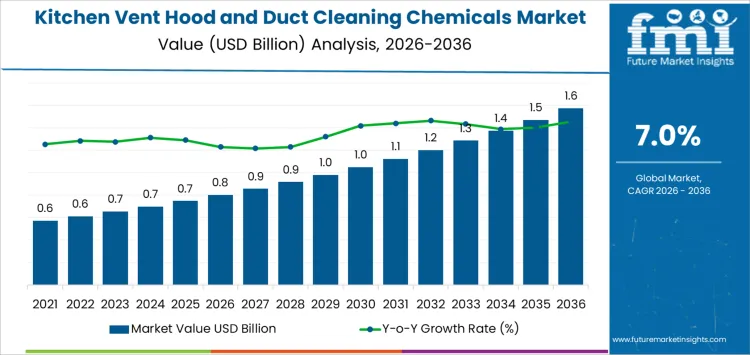
The kitchen vent hood and duct cleaning chemicals market surpassed a valuation of USD 0.7 billion in 2025. Revenue is poised to reach USD 0.8 billion in 2026 at a CAGR of 6.5% during the forecast period. Demand outlook carries total valuation to USD 1.5 billion through 2036 as facility managers move from reactive grease removal toward scheduled breakdown programs that align better with insurer expectations and recurring fire-risk control, supporting wider use of kitchen degreasing chemicals.
Summary of Kitchen Vent Hood and Duct Cleaning Chemicals Market
- Market Snapshot
- The Kitchen Vent Hood and Duct Cleaning Chemicals Market is valued at USD 0.7 billion in 2025 and is projected to reach USD 1.5 billion by 2036.
- The industry is expected to grow at a 6.5% CAGR from 2026 to 2036, creating an incremental opportunity of USD 0.7 billion over the 2026 base of USD 0.8 billion.
- This market remains a compliance-sensitive professional cleaning chemicals category where grease removal efficiency, residue control, fire-risk reduction, and maintenance practicality shape buying decisions.
- Demand stays linked to recurring cleaning cycles in commercial exhaust systems rather than one-time discretionary chemical purchases.
- Demand and Growth Drivers
- Demand is rising because commercial kitchens must prevent grease accumulation in hoods, ducts, and filters to maintain fire safety and operational readiness.
- Heavy-duty degreasing chemistries are seeing stronger use because standard surface cleaners do not handle baked-on grease and carbonized deposits effectively.
- Growth is also being supported by expansion in organized foodservice, higher kitchen utilization rates, and broader use of outsourced maintenance contractors.
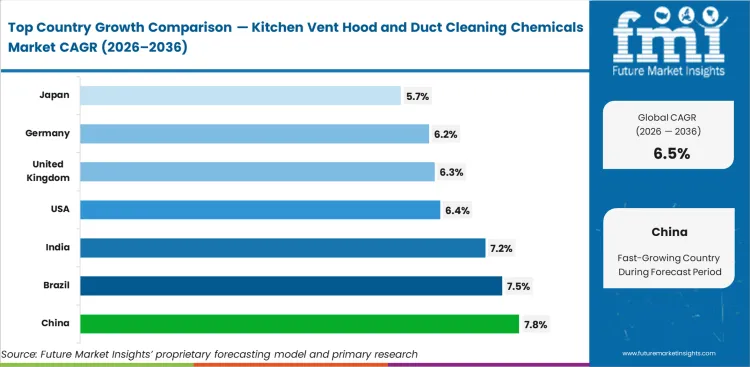
- Among key countries, China leads at 7.8% CAGR, followed by Brazil at 7.5%, India at 7.2%, the United States at 6.4%, the United Kingdom at 6.3%, Germany at 6.2%, and Japan at 5.7%.
- Growth remains moderated by labor-intensive service windows, chemical handling constraints, and the need to balance cleaning strength with equipment-material compatibility.
- Product and Segment View
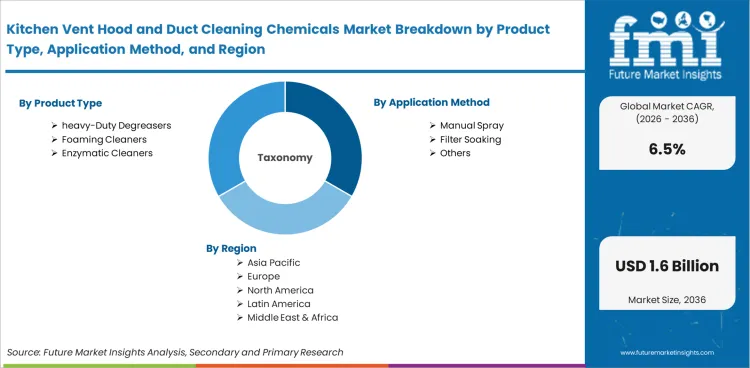
- The market covers degreasers, foaming cleaners, enzymatic cleaners, and rinse-support chemicals used in commercial kitchen ventilation and exhaust cleaning.
- These chemicals are used across restaurants, hotels, institutional kitchens, food processors, and other high-grease cooking environments.
- Heavy-duty degreasers lead the product type segment with 46% share, reflecting their importance in removing thick grease and carbon buildup.
- Manual spray leads the application method segment with 34% share, as technicians still rely on direct targeted application in uneven hood and duct surfaces.
- Restaurants lead the end use segment with an estimated 39% share, supported by the large installed base of grease-intensive kitchens.
- Routine cleaning leads the compliance need segment with an estimated 41% share, since most chemical demand comes from recurring service intervals.
- Asia Pacific leads the regional split with an estimated 31% share, driven by foodservice expansion and increasing commercial kitchen density.
- The scope includes hood, duct, filter, and exhaust-system cleaning chemicals, but excludes general-purpose janitorial cleaners, residential kitchen cleaners, and cleaning labor revenue.
- Geography and Competitive Outlook
- China, Brazil, and India are the faster-growing markets, while the United States remains a stable high-value base with mature contractor and multi-site foodservice demand.
- Competition is shaped by service reach, contractor relationships, degreasing efficiency, safety profile, and account access in foodservice and institutional channels.
- Key participants include Ecolab, Diversey, Zep, Spartan Chemical, and Betco.
- The market appears fragmented to moderately concentrated, with Ecolab likely remaining the largest single participant.
Key Takeaways, Market Size, and Forecast
- Kitchen Vent Hood and Duct Cleaning Chemicals Market is projected to grow from USD 0.8 billion in 2026 to USD 1.5 billion by 2036, at a CAGR of 6.5%.
- The kitchen vent hood and duct cleaning chemicals market was valued at USD 0.7 billion in 2025.
- By 2036, the Kitchen Vent Hood and Duct Cleaning Chemicals Market is expected to be worth USD 1.5 billion.
- From 2026 to 2036, the market is projected to expand at a CAGR of 6.5%.
- The market is projected to create an incremental opportunity of USD 0.7 billion between 2026 and 2036.
- In 2026, Heavy-duty degreasers are expected to account for 46.0% of the product type segment.
- China (7.8%) and Brazil (7.5%) are two of the fastest growing markets.
Restaurant operators are under direct pressure from fire-safety inspections focused on grease buildup inside exhaust hoods, plenums, and ducting. Delayed chemical treatment raises the risk of non-compliance, temporary closure, and insurance disputes when fire events are traced to poor exhaust maintenance. Most buying decisions are no longer based on visible cleanliness alone. Teams responsible for site upkeep are placing greater weight on how effectively kitchen degreasing chemicals cut through carbonized grease deposits, reduce residual fire load, and support safer cleaning outcomes inside hard-to-reach duct systems. Product selection is therefore shifting toward formulations designed for deeper penetration and more reliable removal of baked-on deposits without leaving behind problematic residues.
Once inspection protocols require documented bare-metal cleaning results during scheduled service cycles, adoption moves quickly from discretionary to routine. Maintenance teams can no longer depend on surface-level wipe-down practices where internal duct conditions remain untreated. Carbon breakdown at the deposit layer becomes a practical operating requirement, which raises the standard for supplier qualification across large restaurant and hospitality portfolios. Vendors serving this market increasingly need to demonstrate that their kitchen degreasing chemicals can support repeatable cleaning performance under stricter audit and service documentation requirements.
China is projected to witness a CAGR of 7.8% in the market through 2036, supported by expanding commercial foodservice capacity and tighter enforcement of urban fire-safety codes. Brazil is expected to expand at a CAGR of 7.5%, driven by more formal restaurant maintenance practices across organized foodservice networks. India is likely to record 7.2% CAGR during the forecast period, reflecting continued chain-restaurant expansion and rising attention to back-of-house safety standards. The United States market is anticipated to grow at a CAGR of 6.4%, backed by steady replacement demand and established exhaust-cleaning service cycles. The United Kingdom is expected to register 6.3% CAGR, compared with 6.2% for Germany, with both markets shaped by regular inspection discipline and tighter service compliance. Japan is set to post 5.7%, as a mature operating base keeps expansion more measured than in faster-scaling foodservice markets. Regional differences remain closely tied to how aggressively local fire authorities enforce exhaust-cleaning standards rather than to foodservice volume alone.
Segmental Analysis
Kitchen Vent Hood and Duct Cleaning Chemicals Market Analysis by Product Type
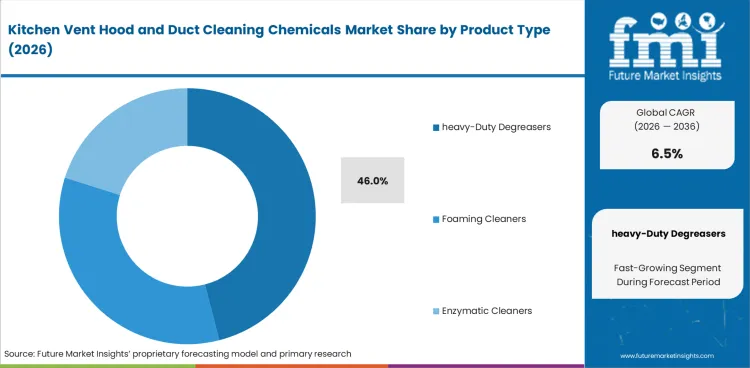
Commercial kitchens dealing with constant grease vapor buildup need fast chemical action because delayed breakdown quickly turns into a fire-risk and labor-intensity problem. FMI’s assessment indicates heavy-duty degreasers are expected to account for 46.0% share in 2026 due to their ability to cut through baked-on fat and carbon within limited overnight cleaning windows. Maintenance teams working between closing and reopening cannot rely on slower biological action when deposits have already hardened inside the system. High-alkaline blends remain common because they loosen stubborn grease fast enough to restore working surfaces before the next shift begins. Many operators overlook the fact that repeated harsh treatment can shorten the service life of exhaust hood filters and cleaning kits, especially where aluminum components face frequent exposure. Buyers that match degreasing strength with material compatibility usually avoid avoidable replacement cycles while still meeting fire-safety cleaning requirements.
- Initial contact speed: Highly alkaline formulas break down carbonized grease quickly on contact. Overnight crews depend on that fast action to complete restoration within limited operating windows.
- Vertical adhesion failure: Liquid caustics often run off vertical duct surfaces before full grease digestion takes place. Applicators then need multiple passes, which lifts chemical use per job.
- Lifecycle asset degradation: Repeated exposure to aggressive chemistry can damage softer metal components over time. Facility managers then face earlier exhaust hood filters replacement despite acceptable short-term cleaning results.
Kitchen Vent Hood and Duct Cleaning Chemicals Market Analysis by Application Method
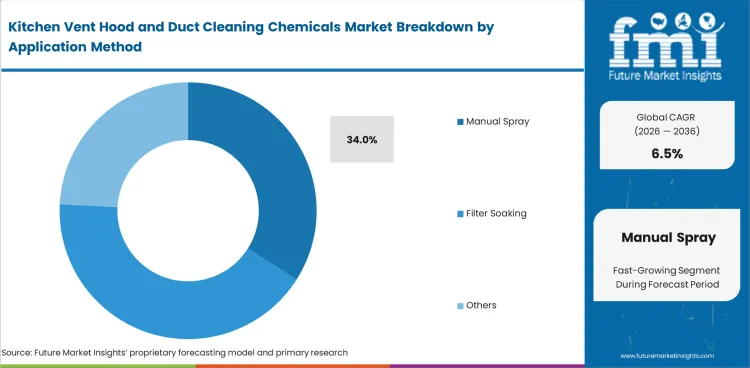
Manual spray delivery remains widely used because many smaller foodservice operators prefer low equipment dependency and direct control over how chemicals are applied. No added capital outlay is required, which keeps this method attractive for independent kitchens managing tight maintenance budgets. FMI notes that operators often compare concentrate and ready-to-use options based on storage constraints, staff familiarity, and immediate handling convenience around the kitchen hood area. Manual spray systems are projected to secure 34.0% share in 2026 for that reason. This method works reasonably well for visible grease around fryer lines, splash zones, and front-end canopy surfaces where access is straightforward. Its weakness becomes clear deeper in the duct run, where limited reach can leave hidden deposits untreated until inspection failures or elevated cleaning costs force a more intensive intervention.
- Targeted localized application: Trigger sprayers allow crews to focus chemistry on visible grease buildup near high-use cooking stations. That helps reduce waste during routine spot cleaning.
- Atomization inhalation risks: Pressurized spraying can release airborne caustic particles in confined back-of-house areas. Supervisors must enforce respiratory protection during active chemical application.
- Reach limitations: Standard nozzles cannot push chemistry far into bends, shafts, or extended duct pathways. Operators relying only on manual spray often miss contamination deeper inside the system.
Kitchen Vent Hood and Duct Cleaning Chemicals Market Analysis by End Use
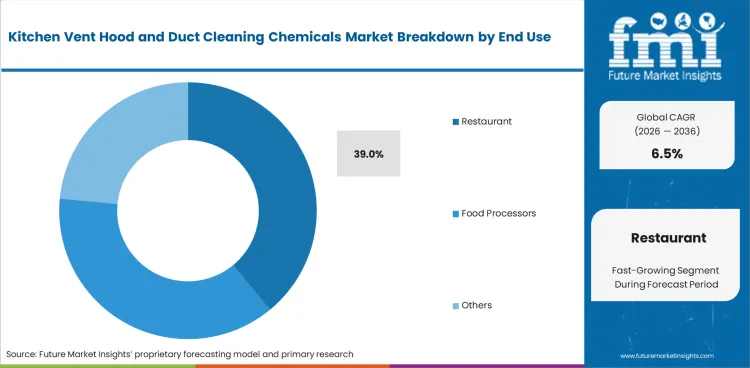
Restaurants operate under continuous grease-loading conditions because long cooking hours, repeated frying, and high-temperature protein preparation keep exhaust contamination levels elevated throughout the day. Fast-food outlets and high-throughput kitchens place especially heavy stress on each kitchen hood system, while full-service formats can produce denser carbon residue from searing and finishing methods. FMI analysts note that restaurant demand stays high because this segment runs longer hours and faces more frequent hood-cleaning cycles than most institutional kitchens. Restaurants are anticipated to account for 39.0% share in 2026. Product selection also needs to reflect cooking style, since chemistry that works for fryer grease may not perform the same way on protein-heavy residue. Operators that misalign cleaning strength with deposit type often deal with smoke rollback, airflow restriction, and inconsistent kitchen performance.
- High-heat polymerization: Searing and frying create fine grease particles that harden quickly on cooler metal surfaces. Crews often need stronger formulations to remove protein-based carbon deposits effectively.
- Cross-contamination risks: Overhead cleaning can splash active chemistry onto prep areas and adjacent equipment. Kitchen managers usually schedule full protection and isolation before work begins.
- Brand consistency mandates: Chain operators track vent-cleaning discipline closely across sites. Units that fail internal compliance checks can face escalation well before an actual fire event occurs.
Kitchen Vent Hood and Duct Cleaning Chemicals Market Analysis by Compliance Need
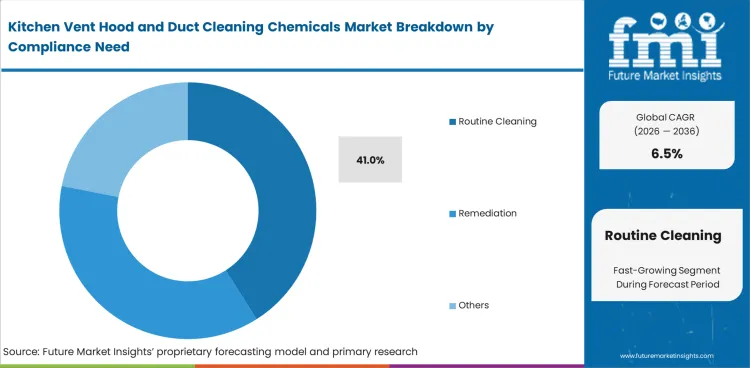
Fire-safety compliance pushes many operators toward planned maintenance because delayed grease removal raises inspection risk and forces heavier corrective treatment later. Routine cleaning is set to represent 41.0% share in 2026, reflecting its role in keeping grease accumulation below critical thresholds across active kitchen ventilation systems. FMI estimates indicate that industrial and institutional cleaning chemicals used in scheduled programs help operators manage buildup gradually instead of waiting for severe blockage or emergency service conditions. Night crews often integrate lighter foaming or enzymatic products into shutdown procedures, so deposits do not harden unchecked between shifts. This approach changes the operating burden from periodic restoration to steady preventive control. Facilities that postpone routine programs usually face tougher residue, harsher chemical exposure, and faster wear on system components.
- Continuous enzymatic action: Biological formulas work gradually between cooking cycles to reduce fresh grease accumulation. Closing crews use them where overnight dwell time can support preventive cleaning.
- Temperature sensitivity: Enzyme performance drops sharply when chemistry is applied before the exhaust line cools. Managers must time cleaning activity carefully to avoid wasted labor and weak results.
- Long-term cost reduction: Consistent routine treatment lowers the chance of severe buildup requiring intensive contractor intervention. Budget owners often see lower deep-cleaning frequency when preventive discipline remains in place.
Kitchen Vent Hood and Duct Cleaning Chemicals Market Drivers, Restraints, and Opportunities
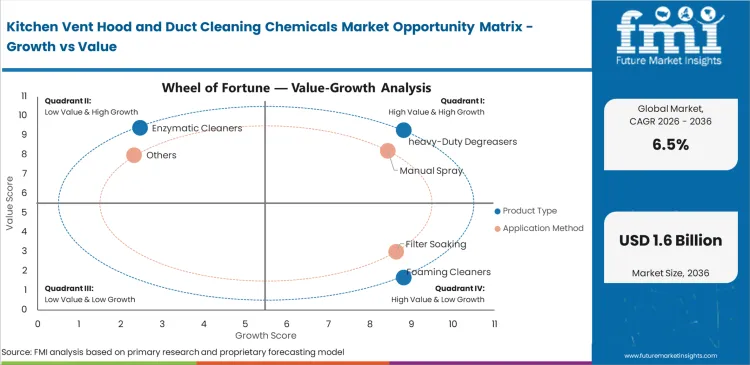
Insurance review of exhaust maintenance records is becoming more important in the kitchen exhaust cleaning chemicals market. Hospitality groups with multiple locations face greater liability when fire investigations reveal grease buildup or poor service records. That is making it harder to postpone spending on specialized cleaning chemicals in facilities where compliance, inspections, and fire prevention are taken more seriously. In some markets, fire-safety checks and health inspections are being linked more closely, which is adding pressure to keep exhaust systems cleaner and maintenance records in better order. This is increasing demand for certified degreasers that can handle strict cleaning requirements, especially in kitchens expected to pass bare-metal inspections.
At the same time, very strong alkaline products still face a practical limit. They can remove heavy grease more effectively, but they also bring higher safety risk during use. Buyers are often cautious about approving highly caustic products when staff training is uneven and misuse can lead to burns or handling mistakes. That concern pushes some operators toward milder products, even when they are less effective on heavy grease and baked-on residue. Encapsulated-solvent technologies are helping to improve grease removal while reducing direct exposure during application. Even so, adoption remains selective because many operators still see the higher cost as hard to justify for routine cleaning.
Opportunities in Kitchen Vent Hood and Duct Cleaning Chemicals Market
- Foam-adhesion chemistry: Formulators engineering foams clinging to vertical ductwork for sixty minutes capture lucrative commercial contractor contracts. Application specialists need extended dwell times for total carbon liquefaction.
- Probiotic continuous-cleaning lines: Developing dormant bacterial strains activating upon grease contact provides a safer choice of kitchen degreaser for commercial use. Kitchen staff spray baffles nightly, reducing total manual scraping requirements.
- IoT-verified dosing systems: Hardware manufacturers integrating low-voc hood cleaning chemicals delivery tracking directly into exhaust sensors provide indisputable compliance records. Corporate risk managers authorize premium eco-label certified cleaning chemicals for professional users when usage is digitally verifiable.
Regional Analysis
.webp "Top Country Growth Comparison Kitchen Vent Hood And Duct Cleaning Chemicals Market Cagr (2026 2036)")
Based on regional analysis, kitchen vent hood and duct cleaning chemicals market is segmented into North America, Latin America, Europe, Asia Pacific, and Middle East & Africa across 40 plus countries.
| Country | CAGR (2026 to 2036) |
|---|---|
| China | 7.8% |
| Brazil | 7.5% |
| India | 7.2% |
| United States | 6.4% |
| United Kingdom | 6.3% |
| Germany | 6.2% |
| Japan | 5.7% |
Source: Future Market Insights (FMI) analysis, based on proprietary forecasting model and primary research
Asia Pacific Kitchen Vent Hood and Duct Cleaning Chemicals Market Analysis
Accelerating urbanization forces dense commercial foodservice integration into high-rise mixed-use real estate across Asian property markets. Developers now mandate stringent exhaust safety protocols to prevent fires in these complex structures. FMI's analysis indicates regional low VOC cleaning chemicals demand scales directly with mall-based dining expansion. Heavy wok-frying techniques generate unique volatile grease profiles requiring specialized solvent blends that traditional institutional cleaners cannot match.
- China: Severe urban fire codes mandate certified chemical extraction procedures across densely populated metropolitan zones. Sales of kitchen vent hood and duct cleaning chemicals in China are expected to increase at a CAGR of 7.8% during the forecast period. Restaurant owners face immediate closures for non-compliance, accelerating the rapid adoption of high-performance degreasers capable of passing rigorous municipal safety audits.
- India: Chain restaurant proliferation formalizes previously unstructured maintenance practices throughout the expanding hospitality sector. Acquisition managers sourcing kitchen exhaust cleaning chemicals in India require standardized bulk supply contracts to ensure consistent operational safety. This shift means India is projected to witness 7.2% CAGR in the exhaust degreaser segment through 2036. Such formalized purchasing moves volume definitively away from local generic detergent suppliers.
- Japan: Demand for kitchen vent hood and duct cleaning chemicals in Japan is anticipated to rise at a CAGR of 5.7% from 2026 to 2036. Mature regulatory frameworks maintain strict routine maintenance schedules rather than relying on reactive emergency interventions. Facilities managers prioritizing eco-friendly enzymatic solutions cause this steady expansion, continuously demanding formulation refinement from suppliers to meet stringent environmental discharge standards.
FMI's report includes South Korea and ASEAN nations. Rising tourist infrastructure investments across Southeast Asia push international hotel chains to standardize chemical sourcing.
North America Kitchen Vent Hood and Duct Cleaning Chemicals Market Analysis
Litigation risks surrounding commercial property fires define North American purchase strategies entirely. Insurance underwriters dictate exact chemical maintenance frequencies across massive franchise networks, linking policy validity directly to bare-metal exhaust conditions. FMI analysts observe corporate risk officers overriding local restaurant managers to mandate standardized high-alkaline treatments, removing purchasing autonomy from individual store operators to ensure network-wide liability protection.
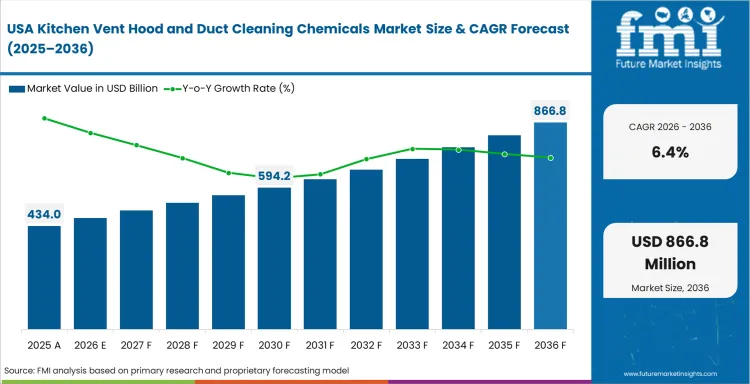
- United States: Strict NFPA 96 enforcement results in continuous compliance-based purchasing across massive national foodservice networks. The kitchen hood cleaning chemicals sector in the USA is expected to register a CAGR of 6.4% by 2036 as a result. Facility executives navigate this regulatory environment by relying heavily on established contractor networks, cementing incumbent chemical supplier dominance and creating high barriers to entry for new formulators.
FMI's report includes Canada and Mexico. Cross-border franchise expansion forces Mexican foodservice operators to adopt stringent US-style chemical maintenance protocols.
Europe Kitchen Vent Hood and Duct Cleaning Chemicals Market Analysis
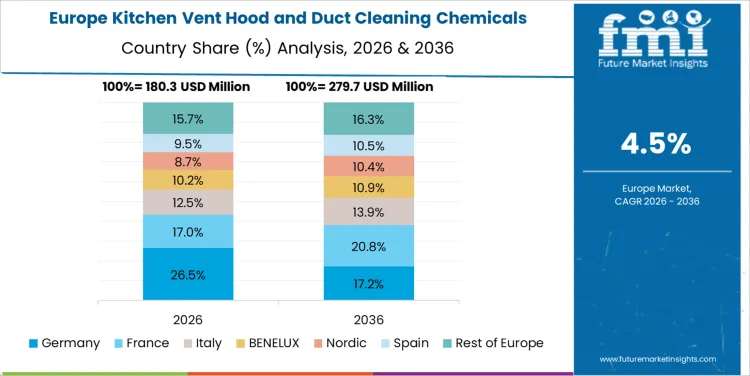
Stringent occupational safety and environmental discharge regulations dictate regional chemical engineering parameters across the European continent. Formulation chemists must balance extreme grease-cutting power against strict wastewater toxicity limits enforced by local municipalities. Based on FMI's assessment, local distributors transition rapidly toward biodegradable enzymatic foams that satisfy both fire compliance auditors and environmental health inspectors simultaneously.
- United Kingdom: Local council environmental health officers heavily scrutinize exhaust emissions from historic and densely packed commercial districts. Pub operators utilizing compliant formulas avoid severe municipal fines and sudden operational shutdowns. The United Kingdom is forecast to record steady growth in duct cleaning chemicals at a CAGR of 6.3% from 2026 to 2036. Suppliers succeeding here prioritize biodegradable ingredients without sacrificing degreasing efficacy.
- Germany: The kitchen vent hood cleaning chemicals industry in Germany is poised to expand at a CAGR of 6.2% during the forecast period. Deep industrial standardization forces cleaning contractors to use certified sustainable solutions across all commercial applications. Operations directors eliminate harsh caustics from their inventories, successfully capturing lucrative government foodservice contracts that mandate strict adherence to national ecological purchasing guidelines.
FMI's report includes France, Italy, and Spain. Mediterranean hospitality sectors experience seasonal demand spikes, requiring rapid-action chemicals during peak tourist months.
Latin America Kitchen Vent Hood and Duct Cleaning Chemicals Market Analysis
Formalizing restaurant maintenance protocols replaces reactive manual scraping across developing urban centers throughout the region. Property managers increasingly integrate chemical extraction mandates into commercial lease agreements to protect high-density real estate investments. FMI observes franchise operators centralizing chemical purchasing to ensure consistent safety compliance across disparate locations, elevating the baseline performance required from local janitorial supply chains.
- Brazil: Municipal health and safety modernization programs force independent operators to drastically upgrade their baseline maintenance standards. Vent hood cleaning chemicals adoption in Brazil is likely to advance at a CAGR of 7.5% by 2036. Sourcing directors switch aggressively from generic institutional detergents to specialized grease-cutting formulations, creating a highly lucrative environment for suppliers offering verifiable fire-hazard mitigation solutions.
FMI's report includes Mexico and Argentina. Expanding domestic restaurant chains utilize standardized chemical protocols optimizing total facility operating costs.
Competitive Aligners for Market Players
Contract cleaning service integration defines true competitive advantage within this specific chemical sector. Established kitchen vent hood chemical suppliers like Ecolab and Diversey do not merely ship drums of caustic liquids; they deploy automated dosing hardware directly into commercial kitchens. Facilities directors choose partners capable of proving compliance to fire marshals, rendering standalone chemical efficacy a secondary purchasing factor. Independent restaurant owners lack dedicated maintenance staff, pushing them toward suppliers offering bundled training and digital tracking solutions alongside premium degreasers.
Incumbent kitchen exhaust degreaser manufacturers possess massive proprietary libraries documenting material compatibility data. Zep and Spartan Chemical understand exactly how specific high-alkaline formulas react with aging galvanized steel versus modern stainless baffles. Challengers attempting competition purely on unit cost frequently ignore hood cleaning chemical compatibility with stainless steel, activating severe metal corrosion in older exhaust systems. Formulating powerful green cleaning chemicals for industrial maintenance remains simple, but engineering one cleaning aggressively without voiding expensive hood warranties requires decades of field-testing feedback loops.
National restaurant chains actively resist total chemical vendor lock-in by standardizing application hardware based on a strict hood cleaning chemicals purchase checklist. Corporate acquisition teams separate chemical supply contracts from dispensing equipment ownership. If Betco attempts unreasonable price increases, massive franchise networks instantly switch bulk chemical providers without changing wall-mounted foamers. Competition centers entirely on who formulates highest-clinging foam at lowest cost-per-ounce, while simultaneously providing auditable fire-safety documentation.
Key Players in Kitchen Vent Hood and Duct Cleaning Chemicals Market
- Ecolab
- Diversey
- Zep
- Spartan Chemical
- Betco
Scope of the Report
| Metric | Value |
|---|---|
| Quantitative Units | USD 0.8 billion in 2026 to USD 1.5 billion by 2036, at a CAGR of 6.5% |
| Market Definition | Specialized reactive formulations dissolve carbonized fats within commercial exhaust infrastructure. Fire mitigation mandates govern chemical design over aesthetic outcomes. |
| Segmentation | Product type, Application method, End use, Compliance need, and Region |
| Regions Covered | North America, Latin America, Europe, Asia Pacific, Middle East & Africa |
| Countries Covered | China, Brazil, India, United States, United Kingdom, Germany, Japan |
| Key Companies Profiled | Ecolab, Diversey, Zep, Spartan Chemical, Betco |
| Forecast Period | 2026 to 2036 |
| Approach | Commercial kitchen square footage expansion models and quarterly fire inspection frequency metrics anchored baseline volume calculations. |
Source: Future Market Insights (FMI) analysis, based on proprietary forecasting model and primary research
Kitchen Vent Hood and Duct Cleaning Chemicals Market Segmentation
Product type
- Heavy-duty degreasers
- Foaming cleaners
- Enzymatic cleaners
- Rinse aids
Application method
- Manual spray
- Filter soaking
- Foam cannon
- Other methods
End use
- Restaurants
- Institutional kitchens
- Food processors
- Other kitchens
Compliance need
- Routine cleaning
- Fire compliance
- Deep cleaning
- Remediation
Region:
- North America
- United States
- Canada
- Europe
- Germany
- United Kingdom
- France
- Italy
- Spain
- Asia Pacific
- China
- Japan
- South Korea
- Taiwan
- Singapore
- Latin America
- Brazil
- Mexico
- Argentina
- Middle East & Africa
- GCC Countries
- South Africa
Bibliography
- Centers for Disease Control and Prevention. (2024). When and how to clean and disinfect a facility.
- USA Food and Drug Administration. (2024). Safe food handling.
- Sultana, N., Roddick, F. A., & Pramanik, B. K. (2024). Fat, oil and grease wastewater and dishwashers: Uncovering the link to FOG deposition. Science of the Total Environment, 907, 168032.
- Stubenrauch, C., & Drenckhan, W. (2024). Cleaning solid surfaces with liquid interfaces and foams: From theory to applications. Current Opinion in Colloid & Interface Science, 72, 101818.
- Kora, A. J. (2024). Renewable, natural, traditional dish wash cleaning materials used in India: An overview. Bulletin of the National Research Centre, 48, 28.
This bibliography is provided for reader reference. The full FMI report contains the complete reference list with primary source documentation.
This Report Addresses
- Heavy-duty degreasers dominance across commercial foodservice applications
- Manual spray application preferences among independent restaurant operators
- Fire compliance documentation pushing preventative maintenance chemical consumption
- Foam-adhesion chemistry requirements for vertical duct cleaning
- NFPA 96 regulatory enforcement accelerating high-performance formulation adoption
- Enzyme and biological formulation integration into routine cleaning schedules
- Competitive vendor lock-in strategies utilizing automated chemical dosing hardware
- Occupational safety concerns limiting extreme pH caustic deployment
Frequently Asked Questions
What chemicals are used to clean kitchen exhaust ducts?
Formulators engineer specialized reactive compounds combining highly alkaline caustics and specialized foaming solvents. Fire mitigation mandates govern chemical design heavily over simple aesthetic restoration priorities.
What is NFPA 96 for hood cleaning chemicals?
Strict standards outline ventilation control and fire protection mandates for commercial cooking operations. Facilities failing documented compliance face immediate risk of voided insurance policies during spontaneous combustion events.
Who are the top companies in kitchen vent hood cleaning chemicals?
Ecolab, Diversey, Zep, Spartan Chemical, and Betco dominate supply chains. Leading incumbents distinguish themselves by bundling digital compliance tracking hardware with specialized chemical deliveries.
What drives growth in kitchen exhaust cleaning chemicals?
Insurance underwriters explicitly tying liability coverage validity to documented exhaust maintenance schedules force rapid chemical adoption. Facility directors purchase certified high-performance degreasers capable of passing bare-metal visual inspections continuously.
How do buyers evaluate alkaline vs enzymatic hood cleaning chemicals?
Heavy-duty alkaline blends provide unmatched breakdown speed against severe carbonization during short overnight windows. Conversely, biological enzymatic foams digest grease slowly between active shifts, reducing total long-term mechanical scraping requirements.
Why consider ready-to-use vs concentrate hood cleaners?
Mom-and-pop operators frequently select concentrated gallons for cost efficiency and straightforward dilution into manual sprayers. High-volume franchise networks prioritize specialized ready-to-use foaming chemistries ensuring consistent application through wall-mounted automated dispensers.
Is there an exhaust degreaser safe for aluminum surfaces?
Operations managers source specifically buffered formulations preventing premature component failure. Relying exclusively on extreme heavy-duty caustics degrades aluminum baffle integrity severely over prolonged maintenance cycles.
How critical is hood cleaning chemical compatibility with stainless steel?
Challengers attempting competition purely on unit cost frequently cause severe metal corrosion in older exhaust infrastructure. Engineering aggressive formulas without voiding expensive commercial hood warranties requires decades of verified field-testing data.
Preview the report firsthand - request a free sample
Get SampleGet the brochure for pricing and purchase details.
Get PDFTable of Content
- Executive Summary
- Global Market Outlook
- Demand-side Trends
- Supply-side Trends
- Technology Roadmap Analysis
- Analysis and Recommendations
- Market Overview
- Market Coverage / Taxonomy
- Market Definition / Scope / Limitations
- Research Methodology
- Chapter Orientation
- Analytical Lens and Working Hypotheses
- Market Structure, Signals, and Trend Drivers
- Benchmarking and Cross-market Comparability
- Market Sizing, Forecasting, and Opportunity Mapping
- Research Design and Evidence Framework
- Desk Research Programme (Secondary Evidence)
- Company Annual and Sustainability Reports
- Peer-reviewed Journals and Academic Literature
- Corporate Websites, Product Literature, and Technical Notes
- Earnings Decks and Investor Briefings
- Statutory Filings and Regulatory Disclosures
- Technical White Papers and Standards Notes
- Trade Journals, Industry Magazines, and Analyst Briefs
- Conference Proceedings, Webinars, and Seminar Materials
- Government Statistics Portals and Public Data Releases
- Press Releases and Reputable Media Coverage
- Specialist Newsletters and Curated Briefings
- Sector Databases and Reference Repositories
- FMI Internal Proprietary Databases and Historical Market Datasets
- Subscription Datasets and Paid Sources
- Social Channels, Communities, and Digital Listening Inputs
- Additional Desk Sources
- Expert Input and Fieldwork (Primary Evidence)
- Primary Modes
- Qualitative Interviews and Expert Elicitation
- Quantitative Surveys and Structured Data Capture
- Blended Approach
- Why Primary Evidence is Used
- Field Techniques
- Interviews
- Surveys
- Focus Groups
- Observational and In-context Research
- Social and Community Interactions
- Stakeholder Universe Engaged
- C-suite Leaders
- Board Members
- Presidents and Vice Presidents
- R&D and Innovation Heads
- Technical Specialists
- Domain Subject-matter Experts
- Scientists
- Physicians and Other Healthcare Professionals
- Governance, Ethics, and Data Stewardship
- Research Ethics
- Data Integrity and Handling
- Primary Modes
- Tooling, Models, and Reference Databases
- Desk Research Programme (Secondary Evidence)
- Data Engineering and Model Build
- Data Acquisition and Ingestion
- Cleaning, Normalisation, and Verification
- Global Market Analysis 2021 to 2025 and Forecast, 2026 to 2036
- Historical Market Size Value (USD Million) Analysis, 2021 to 2025
- Current and Future Market Size Value (USD Million) Projections, 2026 to 2036
- Y-o-Y Growth Trend Analysis
- Absolute $ Opportunity Analysis
- Global Market Pricing Analysis 2021 to 2025 and Forecast 2026 to 2036
- Global Market Analysis 2021 to 2025 and Forecast 2026 to 2036, By Product Type
- Introduction / Key Findings
- Historical Market Size Value (USD Million) Analysis By Product Type , 2021 to 2025
- Current and Future Market Size Value (USD Million) Analysis and Forecast By Product Type , 2026 to 2036
- heavy-Duty Degreasers
- Foaming Cleaners
- Enzymatic Cleaners
- heavy-Duty Degreasers
- Y-o-Y Growth Trend Analysis By Product Type , 2021 to 2025
- Absolute $ Opportunity Analysis By Product Type , 2026 to 2036
- Global Market Analysis 2021 to 2025 and Forecast 2026 to 2036, By Application Method
- Introduction / Key Findings
- Historical Market Size Value (USD Million) Analysis By Application Method, 2021 to 2025
- Current and Future Market Size Value (USD Million) Analysis and Forecast By Application Method, 2026 to 2036
- Manual Spray
- Filter Soaking
- Others
- Manual Spray
- Y-o-Y Growth Trend Analysis By Application Method, 2021 to 2025
- Absolute $ Opportunity Analysis By Application Method, 2026 to 2036
- Global Market Analysis 2021 to 2025 and Forecast 2026 to 2036, By End Use
- Introduction / Key Findings
- Historical Market Size Value (USD Million) Analysis By End Use, 2021 to 2025
- Current and Future Market Size Value (USD Million) Analysis and Forecast By End Use, 2026 to 2036
- Restaurant
- Food Processors
- Others
- Restaurant
- Y-o-Y Growth Trend Analysis By End Use, 2021 to 2025
- Absolute $ Opportunity Analysis By End Use, 2026 to 2036
- Global Market Analysis 2021 to 2025 and Forecast 2026 to 2036, By Compliance Need
- Introduction / Key Findings
- Historical Market Size Value (USD Million) Analysis By Compliance Need, 2021 to 2025
- Current and Future Market Size Value (USD Million) Analysis and Forecast By Compliance Need, 2026 to 2036
- Routine Cleaning
- Remediation
- Others
- Routine Cleaning
- Y-o-Y Growth Trend Analysis By Compliance Need, 2021 to 2025
- Absolute $ Opportunity Analysis By Compliance Need, 2026 to 2036
- Global Market Analysis 2021 to 2025 and Forecast 2026 to 2036, By Region
- Introduction
- Historical Market Size Value (USD Million) Analysis By Region, 2021 to 2025
- Current Market Size Value (USD Million) Analysis and Forecast By Region, 2026 to 2036
- North America
- Latin America
- Western Europe
- Eastern Europe
- East Asia
- South Asia and Pacific
- Middle East & Africa
- Market Attractiveness Analysis By Region
- North America Market Analysis 2021 to 2025 and Forecast 2026 to 2036, By Country
- Historical Market Size Value (USD Million) Trend Analysis By Market Taxonomy, 2021 to 2025
- Market Size Value (USD Million) Forecast By Market Taxonomy, 2026 to 2036
- By Country
- USA
- Canada
- Mexico
- By Product Type
- By Application Method
- By End Use
- By Compliance Need
- By Country
- Market Attractiveness Analysis
- By Country
- By Product Type
- By Application Method
- By End Use
- By Compliance Need
- Key Takeaways
- Latin America Market Analysis 2021 to 2025 and Forecast 2026 to 2036, By Country
- Historical Market Size Value (USD Million) Trend Analysis By Market Taxonomy, 2021 to 2025
- Market Size Value (USD Million) Forecast By Market Taxonomy, 2026 to 2036
- By Country
- Brazil
- Chile
- Rest of Latin America
- By Product Type
- By Application Method
- By End Use
- By Compliance Need
- By Country
- Market Attractiveness Analysis
- By Country
- By Product Type
- By Application Method
- By End Use
- By Compliance Need
- Key Takeaways
- Western Europe Market Analysis 2021 to 2025 and Forecast 2026 to 2036, By Country
- Historical Market Size Value (USD Million) Trend Analysis By Market Taxonomy, 2021 to 2025
- Market Size Value (USD Million) Forecast By Market Taxonomy, 2026 to 2036
- By Country
- Germany
- UK
- Italy
- Spain
- France
- Nordic
- BENELUX
- Rest of Western Europe
- By Product Type
- By Application Method
- By End Use
- By Compliance Need
- By Country
- Market Attractiveness Analysis
- By Country
- By Product Type
- By Application Method
- By End Use
- By Compliance Need
- Key Takeaways
- Eastern Europe Market Analysis 2021 to 2025 and Forecast 2026 to 2036, By Country
- Historical Market Size Value (USD Million) Trend Analysis By Market Taxonomy, 2021 to 2025
- Market Size Value (USD Million) Forecast By Market Taxonomy, 2026 to 2036
- By Country
- Russia
- Poland
- Hungary
- Balkan & Baltic
- Rest of Eastern Europe
- By Product Type
- By Application Method
- By End Use
- By Compliance Need
- By Country
- Market Attractiveness Analysis
- By Country
- By Product Type
- By Application Method
- By End Use
- By Compliance Need
- Key Takeaways
- East Asia Market Analysis 2021 to 2025 and Forecast 2026 to 2036, By Country
- Historical Market Size Value (USD Million) Trend Analysis By Market Taxonomy, 2021 to 2025
- Market Size Value (USD Million) Forecast By Market Taxonomy, 2026 to 2036
- By Country
- China
- Japan
- South Korea
- By Product Type
- By Application Method
- By End Use
- By Compliance Need
- By Country
- Market Attractiveness Analysis
- By Country
- By Product Type
- By Application Method
- By End Use
- By Compliance Need
- Key Takeaways
- South Asia and Pacific Market Analysis 2021 to 2025 and Forecast 2026 to 2036, By Country
- Historical Market Size Value (USD Million) Trend Analysis By Market Taxonomy, 2021 to 2025
- Market Size Value (USD Million) Forecast By Market Taxonomy, 2026 to 2036
- By Country
- India
- ASEAN
- Australia & New Zealand
- Rest of South Asia and Pacific
- By Product Type
- By Application Method
- By End Use
- By Compliance Need
- By Country
- Market Attractiveness Analysis
- By Country
- By Product Type
- By Application Method
- By End Use
- By Compliance Need
- Key Takeaways
- Middle East & Africa Market Analysis 2021 to 2025 and Forecast 2026 to 2036, By Country
- Historical Market Size Value (USD Million) Trend Analysis By Market Taxonomy, 2021 to 2025
- Market Size Value (USD Million) Forecast By Market Taxonomy, 2026 to 2036
- By Country
- Kingdom of Saudi Arabia
- Other GCC Countries
- Turkiye
- South Africa
- Other African Union
- Rest of Middle East & Africa
- By Product Type
- By Application Method
- By End Use
- By Compliance Need
- By Country
- Market Attractiveness Analysis
- By Country
- By Product Type
- By Application Method
- By End Use
- By Compliance Need
- Key Takeaways
- Key Countries Market Analysis
- USA
- Pricing Analysis
- Market Share Analysis, 2025
- By Product Type
- By Application Method
- By End Use
- By Compliance Need
- Canada
- Pricing Analysis
- Market Share Analysis, 2025
- By Product Type
- By Application Method
- By End Use
- By Compliance Need
- Mexico
- Pricing Analysis
- Market Share Analysis, 2025
- By Product Type
- By Application Method
- By End Use
- By Compliance Need
- Brazil
- Pricing Analysis
- Market Share Analysis, 2025
- By Product Type
- By Application Method
- By End Use
- By Compliance Need
- Chile
- Pricing Analysis
- Market Share Analysis, 2025
- By Product Type
- By Application Method
- By End Use
- By Compliance Need
- Germany
- Pricing Analysis
- Market Share Analysis, 2025
- By Product Type
- By Application Method
- By End Use
- By Compliance Need
- UK
- Pricing Analysis
- Market Share Analysis, 2025
- By Product Type
- By Application Method
- By End Use
- By Compliance Need
- Italy
- Pricing Analysis
- Market Share Analysis, 2025
- By Product Type
- By Application Method
- By End Use
- By Compliance Need
- Spain
- Pricing Analysis
- Market Share Analysis, 2025
- By Product Type
- By Application Method
- By End Use
- By Compliance Need
- France
- Pricing Analysis
- Market Share Analysis, 2025
- By Product Type
- By Application Method
- By End Use
- By Compliance Need
- India
- Pricing Analysis
- Market Share Analysis, 2025
- By Product Type
- By Application Method
- By End Use
- By Compliance Need
- ASEAN
- Pricing Analysis
- Market Share Analysis, 2025
- By Product Type
- By Application Method
- By End Use
- By Compliance Need
- Australia & New Zealand
- Pricing Analysis
- Market Share Analysis, 2025
- By Product Type
- By Application Method
- By End Use
- By Compliance Need
- China
- Pricing Analysis
- Market Share Analysis, 2025
- By Product Type
- By Application Method
- By End Use
- By Compliance Need
- Japan
- Pricing Analysis
- Market Share Analysis, 2025
- By Product Type
- By Application Method
- By End Use
- By Compliance Need
- South Korea
- Pricing Analysis
- Market Share Analysis, 2025
- By Product Type
- By Application Method
- By End Use
- By Compliance Need
- Russia
- Pricing Analysis
- Market Share Analysis, 2025
- By Product Type
- By Application Method
- By End Use
- By Compliance Need
- Poland
- Pricing Analysis
- Market Share Analysis, 2025
- By Product Type
- By Application Method
- By End Use
- By Compliance Need
- Hungary
- Pricing Analysis
- Market Share Analysis, 2025
- By Product Type
- By Application Method
- By End Use
- By Compliance Need
- Kingdom of Saudi Arabia
- Pricing Analysis
- Market Share Analysis, 2025
- By Product Type
- By Application Method
- By End Use
- By Compliance Need
- Turkiye
- Pricing Analysis
- Market Share Analysis, 2025
- By Product Type
- By Application Method
- By End Use
- By Compliance Need
- South Africa
- Pricing Analysis
- Market Share Analysis, 2025
- By Product Type
- By Application Method
- By End Use
- By Compliance Need
- USA
- Market Structure Analysis
- Competition Dashboard
- Competition Benchmarking
- Market Share Analysis of Top Players
- By Regional
- By Product Type
- By Application Method
- By End Use
- By Compliance Need
- Competition Analysis
- Competition Deep Dive
- Competition Deep Dive
- Assumptions & Acronyms Used


