

- Industry Size (2026)
- USD 18.7 Bn
- Forecast (2036)
- USD 57.1 Bn
- CAGR (2026 to 2036)
- 11.80%
Semiconductor Process Chemicals Market Forecast and Outlook 2026 to 2036
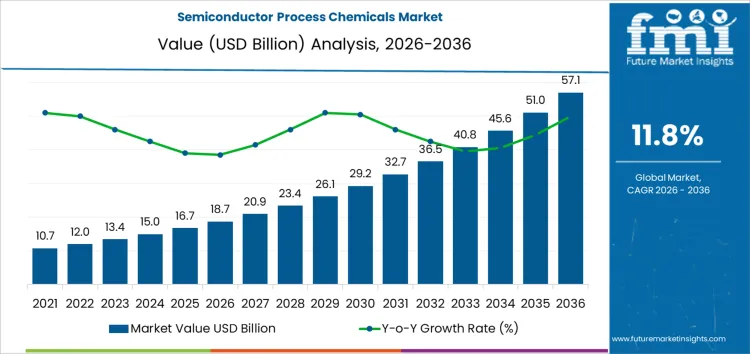
The semiconductor process chemicals market is anticipated to expand from USD 18.7 billion in 2026 to USD 57.1 billion by 2036, expanding at a CAGR of 11.80%. This market occupies a critical position within the semiconductor manufacturing value chain, as process chemicals directly influence yield stability, device performance, and fab uptime. Demand growth is closely aligned with advanced node scaling, rising wafer complexity, and continuous increases in process steps per wafer. Unlike cyclical equipment spending, consumption of process chemicals remains structurally recurring, tied to wafer starts and capacity utilization across logic, memory, and power semiconductor fabs. Competitive intensity is shaped by ultra-high purity requirements, long qualification timelines, and deep integration with fab process recipes, creating high entry barriers. Supply reliability and proximity to fabrication clusters are increasingly decisive as fabs pursue localized and resilient supply chains. Between 2026 and 2036, the market’s expansion is driven less by volume alone and more by value density, co-development partnerships, and sustained demand for precision chemistries supporting next-generation semiconductor manufacturing.
Quick Stats for Semiconductor Process Chemicals Market
- Semiconductor Process Chemicals Market Value (2026): USD 18.7 Billion
- Semiconductor Process Chemicals Market Forecast Value (2036): USD 57.1 Billion
- Semiconductor Process Chemicals Market Forecast CAGR 2026 to 2036: 11.80%
- Leading Chemical Type in Semiconductor Process Chemicals Market: Acid & Base Chemicals (40% share)
- Key Growth Regions in Semiconductor Process Chemicals Market: Asia Pacific, North America, Europe, Latin America, Middle East & Africa
- Top Key Players in Semiconductor Process Chemicals Market: Shin-Etsu Chemical Co., Ltd., Merck KGaA, DuPont de Nemours, Inc., Dow Chemical Company, JSR Corporation, Tokyo Ohka Kogyo Co., Ltd., Air Liquide S.A., Linde plc
Semiconductor Process Chemicals Market Key Takeaways
| Metric | Value |
|---|---|
| Semiconductor Process Chemicals Market Value (2026) | USD 18.7 Billion |
| Semiconductor Process Chemicals Market Forecast Value (2036) | USD 57.1 Billion |
| Semiconductor Process Chemicals Market Forecast CAGR 2026 to 2036 | 11.80% |
How Are Advanced Node Scaling and Fab Localization Transforming Demand for Semiconductor Process Chemicals?
The semiconductor process chemicals market is being reshaped by aggressive scaling toward advanced technology nodes and increasing fabrication complexity. As device geometries shrink and process steps multiply, fabs require ultra-high-purity chemicals with tightly controlled specifications for cleaning, etching, deposition, and planarization. For chemical producers, this is shifting demand away from commodity volumes toward value-dense formulations where impurity control, consistency, and process compatibility directly influence yield and device performance.
Supply-chain strategy has become a critical purchasing factor for fabs and integrated device manufacturers. Governments and chipmakers are investing heavily in domestic and regional fabrication capacity, driving demand for localized chemical manufacturing, secure logistics, and dual-sourcing capability. Suppliers that can provide near-fab production, rapid qualification, and uninterrupted supply are gaining preferred-vendor status. Long-term supply agreements and co-development partnerships are increasingly replacing transactional chemical procurement models.
Technology roadmaps and sustainability requirements are also influencing product development priorities. Advanced logic, memory, and power semiconductor processes are driving demand for next-generation photoresists, specialty gases, wet chemicals, and CMP slurries tailored to specific process nodes. At the same time, fabs are pushing chemical suppliers to reduce environmental impact through lower chemical consumption, improved recycling compatibility, and safer formulations. For manufacturers and suppliers, competitive advantage in the semiconductor process chemicals market increasingly depends on technical collaboration, supply reliability, and the ability to scale innovation alongside fab technology transitions.
How Is The Semiconductor Process Chemicals Market Segmented?
The semiconductor process chemicals market is structured around chemical type and application, reflecting how material purity and process specificity drive procurement decisions across wafer fabrication facilities. By chemical type, acid and base chemicals form the leading segment with 40% share, as they are essential inputs across multiple front-end semiconductor processes. Other chemical categories such as photoresists and auxiliaries, solvents and cleaners, gases, and slurries and CMP chemicals support critical patterning, deposition, and planarization steps. By application, cleaning and surface preparation account for the largest share at 30%, while etching and deposition, doping and implantation, CMP, and other wafer processes collectively sustain broad-based demand throughout semiconductor manufacturing workflows.
Why Do Acid And Base Chemicals Dominate The Semiconductor Process Chemicals Market By Chemical Type?

Acid and base chemicals lead the semiconductor process chemicals market with 40% share because they are indispensable across wafer cleaning, oxide removal, surface conditioning, and contamination control processes. Chemicals such as hydrofluoric acid, sulfuric acid, and ammonium hydroxide are used repeatedly at different fabrication stages, resulting in high consumption volumes. Their role in achieving ultra-clean wafer surfaces directly impacts yield and device performance. Semiconductor fabs prioritize consistent supply and ultra-high purity grades, creating stable long-term demand for qualified suppliers. From a manufacturer perspective, acid and base chemicals generate recurring revenue streams due to continuous usage. These process-critical and volume-driven factors explain their dominant position.
Why Does Cleaning and Surface Preparation Represent the Largest Application Segment?
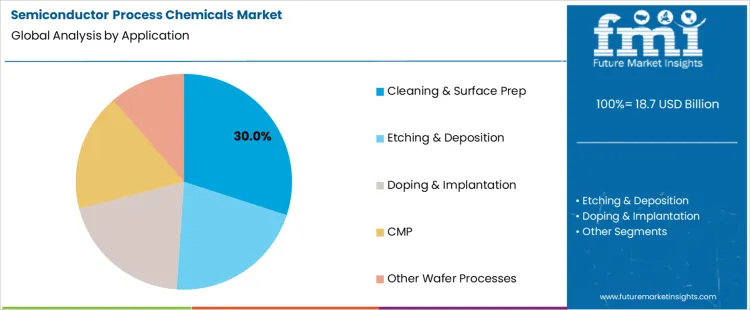
Cleaning and surface preparation account for 30% share of the semiconductor process chemicals market because wafer cleanliness is fundamental to every subsequent fabrication step. Any residual particles, organic contaminants, or metallic impurities can lead to defects and yield loss. As device geometries shrink and node complexity increases, cleaning requirements become more stringent and frequent. Semiconductor manufacturers deploy multiple wet cleaning steps between lithography, etching, and deposition processes. This drives sustained consumption of high-purity chemicals across fabs. For chemical suppliers, this application segment offers predictable demand tied to wafer starts and capacity utilization. These technical requirements position cleaning and surface preparation as the largest application area.
What Factors Are Driving Demand In The Semiconductor Process Chemicals Market?
Semiconductor process chemicals market is propelled by continuous growth in semiconductor fabrication, advanced logic and memory node deployments, and expanding applications for devices in automotive, AI, IoT, and 5G systems. Process chemicals including etchants, photoresists, developers, cleaning agents, dopants, and CMP slurries are essential at various wafer fabrication stages. As feature sizes shrink to sub-5 nm and beyond, tighter process control, higher purity standards, and advanced chemistries are required. For chemical manufacturers and suppliers, reliability, supply continuity, and compatibility with evolving process recipes are key drivers that influence fab adoption and long-term contracts.
How Are Technology And Material Innovations Shaping The Semiconductor Process Chemicals Market?
Technological innovation is reshaping the semiconductor process chemicals market by accelerating development of high-purity formulations, ultra-low defect chemistries, and tailored materials that support advanced patterning techniques. Next-generation EUV lithography requires specialized photoresists and developers with improved sensitivity and line-edge control. Advanced cleaning chemistries reduce particle contamination and defectivity on high-aspect-ratio structures, while atomic layer deposition (ALD) and chemical vapor deposition (CVD) chemistries support conformal films for 3D memory and logic. Suppliers investing in co-development with fabs and rigorous qualification cycles gain competitive advantage. Integration with in-situ monitoring and digital recipe management enhances process control and yield outcomes.
What Challenges Are Restricting Growth In The Semiconductor Process Chemicals Market?
Growth in the semiconductor process chemicals market is restricted by stringent quality requirements, long qualification cycles, and supply chain vulnerabilities. Semiconductor fabs demand ultra-high purity chemicals with trace-level control of metallic and organic impurities, necessitating extensive in-house R&D and contamination control protocols. Product qualification timelines can extend fabrication ramp-ups and delay new node introduction, increasing time-to-revenue for suppliers. Pricing pressure from major integrated device manufacturers (IDMs) and foundries can compress margins. Dependence on critical raw materials and concentrated manufacturing capacity elevates supply risk, requiring robust risk mitigation strategies for continuous fab operations.
What Is the Country-Wise Outlook for the Semiconductor Process Chemicals Market?
The semiconductor process chemicals market is closely linked to wafer fabrication capacity expansion, technology node migration, and yield optimization requirements across global fabs. Countries with strong foundry, memory, and logic manufacturing bases show faster growth due to continuous consumption of wet chemicals, photoresists, etchants, and CMP slurries. Procurement behavior is increasingly shaped by ultra-high purity requirements, qualification depth, supply continuity, and proximity of chemical production to fab clusters. Asia remains the primary growth engine as new fabs come online, while North America and Japan focus on high-value, specification-intensive applications. Suppliers that combine purity leadership, localized logistics, and long-term fab relationships are better positioned to capture sustained country-level opportunities.
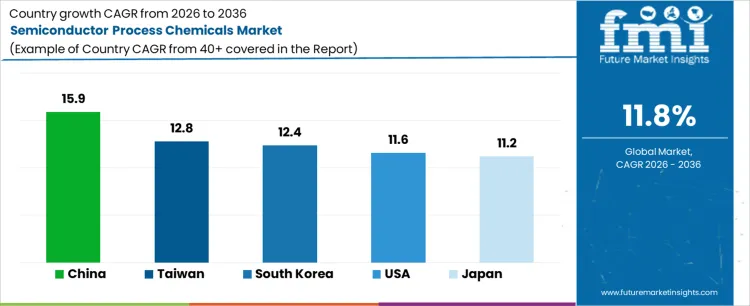
| Country | CAGR (%) |
|---|---|
| China | 13.2% |
| Taiwan | 12.8% |
| South Korea | 12.4% |
| USA | 11.6% |
| Japan | 11.2% |
How Is China Emerging as the Fastest-Expanding Market for Semiconductor Process Chemicals?
Rapid capacity build-out across domestic wafer fabrication facilities defines the trajectory of the semiconductor process chemicals market in China, growing at a CAGR of 13.2% during 2026 to 2036. Large investments in logic, memory, and specialty semiconductor fabs are translating into sustained consumption of wet cleaning chemicals, etchants, CMP slurries, and specialty process formulations. Procurement priorities are shaped by the need for uninterrupted supply, competitive pricing, and proximity of chemical manufacturing to fab locations. Domestic chemical suppliers are expanding capabilities and gaining share in mature process nodes, supported by localization policies and long-term supply agreements. For advanced nodes, however, fabs continue to rely on imported ultra-high-purity chemicals, maintaining opportunities for international suppliers. Qualification depth, scalability, and consistency across large batch volumes influence vendor selection. Distribution infrastructure near fab clusters is increasingly important to manage logistics risk. China represents a volume-led expansion market where success depends on production scale, local presence, and ability to meet evolving purity and reliability thresholds as domestic semiconductor capabilities advance.
Why Does Taiwan Remain a Strategic Hub for High-Purity Semiconductor Chemicals?
Advanced foundry dominance underpins the semiconductor process chemicals market in Taiwan, expanding at a CAGR of 12.8% during the forecast period. Leading fabs operating at sub-5 nm and beyond require ultra-high-purity chemicals with extremely tight contamination tolerances. Buyers emphasize batch-to-batch consistency, traceability, and real-time quality monitoring. Procurement is relationship-driven, favoring long-term partnerships with suppliers that have undergone rigorous qualification processes. Local chemical blending, packaging, and distribution infrastructure plays a critical role in ensuring just-in-time delivery and minimizing downtime risks. Taiwan’s fabs maintain continuous production cycles, creating stable, recurring consumption of process chemicals rather than project-based demand. Suppliers benefit from predictable offtake volumes but face high barriers to entry due to qualification intensity. The market rewards chemical producers with strong analytical capability, process control expertise, and localized technical support teams.
How Is South Korea Driving Demand Through Memory and Logic Fabrication?
High wafer throughput across memory and expanding logic fabs shapes the semiconductor process chemicals market in South Korea, growing at a CAGR of 12.4% during 2026 to 2036. Large-scale production of DRAM, NAND, and logic devices results in substantial and consistent consumption of wet chemicals, cleaning agents, and specialty formulations. Buyers prioritize purity levels that directly impact yield performance, along with supply reliability capable of supporting continuous high-volume manufacturing. Qualification processes are extensive, often favoring incumbent suppliers with long operational histories inside fabs. Local logistics capability and rapid response to process changes are critical selection criteria. Procurement decisions balance cost efficiency with risk mitigation, given the scale of production and sensitivity to contamination events. South Korea offers suppliers a volume-intensive environment with strong demand visibility, provided they meet stringent quality benchmarks.
What Shapes the United States as a High-Value Semiconductor Chemicals Market?
Strategic fab investments and supply chain security considerations define the semiconductor process chemicals market in the United States, expanding at a CAGR of 11.6% during 2026 to 2036. Growth is driven by new and expanded facilities focused on advanced logic, power semiconductors, and defense-related applications. Buyers emphasize regulatory compliance, domestic sourcing, and strong technical collaboration. Procurement decisions increasingly favor suppliers with local production, robust EHS practices, and R&D support capable of co-developing process solutions. While overall volumes are lower than in Asia, unit value per contract remains high due to specification rigor and customization requirements. Qualification depth and documentation standards are stringent, creating barriers for new entrants. The United States represents a value-driven market where suppliers compete on innovation capability, reliability, and alignment with national semiconductor manufacturing strategies rather than pure scale economics.
Why Does Japan Continue to Influence Specialty Chemical Demand?
Specialty materials leadership underpins the semiconductor process chemicals market in Japan, growing at a CAGR of 11.2% over the forecast period. Japanese demand is centered on high-performance photoresists, precision wet chemicals, and niche process formulations used both domestically and in export-oriented supply chains. Buyers emphasize formulation accuracy, long-term process stability, and intellectual property strength. Procurement is conservative, favoring suppliers with established reputations and decades-long relationships. Domestic fabs provide a stable consumption base, while exports to global semiconductor manufacturers amplify demand. Japan rewards chemical suppliers with deep formulation expertise, strong quality culture, and continuous incremental innovation. This market remains influential in shaping global standards for specialty semiconductor chemicals.
How Are Suppliers Differentiating in the Semiconductor Process Chemicals Market?

Competition in the semiconductor process chemicals market is fundamentally driven by purity control, defect reduction capability, and process-node compatibility. Shin-Etsu Chemical Co., Ltd. sets benchmarks through ultra-high-purity photoresists, silicon precursors, and wet chemicals engineered for advanced logic and memory nodes. Dow Chemical Company and DuPont de Nemours, Inc. compete through formulation depth, offering developers, cleaners, and patterning chemistries designed to maintain critical dimension stability and minimize line-edge roughness across high-volume manufacturing environments.
Portfolio breadth and fab integration capability define the next layer of competition. Merck KGaA positions itself through tightly controlled CMP slurries, wet etchants, and surface treatment chemicals supported by lot-level traceability. JSR Corporation and Tokyo Ohka Kogyo Co., Ltd. focus on lithography-critical materials, with product documentation emphasizing sensitivity control and pattern fidelity for EUV and advanced DUV processes. These suppliers compete on process stability rather than volume pricing.
Gas and specialty chemical reliability is another decisive factor. Air Liquide S.A. and Linde plc supply ultra-high-purity process gases with specifications centered on contamination control and delivery consistency. Avantor, Inc., Wacker Chemie AG, and BASF SE support fabs with solvents, silicones, and specialty intermediates optimized for yield protection. Across suppliers, competitive advantage is built on documented purity metrics, process compatibility, and long-term supply assurance rather than transactional cost.
Key Players in Semiconductor Process Chemicals Market
- Shin-Etsu Chemical Co., Ltd.
- Dow Chemical Company
- DuPont de Nemours, Inc.
- Merck KGaA
- Air Liquide S.A.
- Linde plc
- Honeywell International Inc.
- JSR Corporation
- Tokyo Ohka Kogyo Co., Ltd.
- Avantor, Inc.
- Wacker Chemie AG
- BASF SE
Scope of Report
| Attribute | Description |
|---|---|
| Quantitative Unit | USD Billion |
| Chemical Type | Acid & Base Chemicals, Photoresists & Auxiliaries, Solvents & Cleaners, Gases, Slurries & CMP Chemicals |
| Application | Cleaning & Surface Prep, Etching & Deposition, Doping & Implantation, CMP, Other Wafer Processes |
| Countries Covered | China, Japan, South Korea, India, Australia & New Zealand, ASEAN, Rest of Asia Pacific, Germany, United Kingdom, France, Italy, Spain, Nordic, BENELUX, Rest of Europe, United States, Canada, Mexico, Brazil, Chile, Rest of Latin America, Kingdom of Saudi Arabia, Other GCC Countries, Turkey, South Africa, Other African Union, Rest of Middle East & Africa |
| Regions Covered | Asia Pacific, Europe, North America, Latin America, Middle East & Africa |
| Key Companies Profiled | Shin-Etsu Chemical Co., Ltd., Dow Chemical Company, DuPont de Nemours, Inc., Merck KGaA, Air Liquide S.A., Linde plc, Honeywell International Inc., JSR Corporation, Tokyo Ohka Kogyo Co., Ltd., Avantor, Inc., Wacker Chemie AG, BASF SE |
| Additional Attributes | Dollar sales by chemical type and application are assessed across wafer fabrication process nodes. The report includes country-level demand assessment, growth projections for 2026 to 2036, analysis of purity and contamination control requirements, evaluation of advanced node chemical adoption, competitive benchmarking of suppliers, and assessment of capacity expansion and localization trends across global semiconductor manufacturing ecosystems. |
Semiconductor Process Chemicals Market by Key Segments
Chemical Type
- Acid & Base Chemicals
- Photoresists & Auxiliaries
- Solvents & Cleaners
- Gases
- Slurries & CMP Chemicals
Application
- Cleaning & Surface Prep
- Etching & Deposition
- Doping & Implantation
- CMP
- Other Wafer Processes
Region:
- Asia Pacific
- China
- Japan
- South Korea
- India
- Australia & New Zealand
- ASEAN
- Rest of Asia Pacific
- Europe
- Germany
- United Kingdom
- France
- Italy
- Spain
- Nordic
- BENELUX
- Rest of Europe
- North America
- United States
- Canada
- Mexico
- Latin America
- Brazil
- Chile
- Rest of Latin America
- Middle East & Africa
- Kingdom of Saudi Arabia
- Other GCC Countries
- Turkey
- South Africa
- Other African Union
- Rest of Middle East & Africa
Bibliography
- National Science and Technology Council. (2024). National strategy on microelectronics research. Executive Office of the President of the United States.
- International Roadmap for Devices and Systems. (2024). IRDS 2024 edition: Roadmap chapters and updates. IEEE.
- Organisation for Economic Co-operation and Development. (2024). Mapping the global semiconductor value chain. OECD Publishing.
- National Institute of Standards and Technology. (2024). CHIPS Research and Development Program. U.S. Department of Commerce.
- Semiconductor Industry Association. (2024). PFAS and the semiconductor industry: Technical and policy context. SIA.
Frequently Asked Questions
How big is the semiconductor process chemicals market in 2026?
The global semiconductor process chemicals market is estimated to be valued at USD 18.7 billion in 2026.
What will be the size of semiconductor process chemicals market in 2036?
The market size for the semiconductor process chemicals market is projected to reach USD 57.1 billion by 2036.
How much will be the semiconductor process chemicals market growth between 2026 and 2036?
The semiconductor process chemicals market is expected to grow at a 11.8% CAGR between 2026 and 2036.
What are the key product types in the semiconductor process chemicals market?
The key product types in semiconductor process chemicals market are acid & base chemicals, photoresists & auxiliaries, solvents & cleaners, gases and slurries & cmp chemicals.
Which application segment to contribute significant share in the semiconductor process chemicals market in 2026?
In terms of application, cleaning & surface prep segment to command 30.0% share in the semiconductor process chemicals market in 2026.
Preview the report firsthand - request a free sample
Get SampleGet the brochure for pricing and purchase details.
Get PDFTable of Content
- Executive Summary
- Global Market Outlook
- Demand-side Trends
- Supply-side Trends
- Technology Roadmap Analysis
- Analysis and Recommendations
- Market Overview
- Market Coverage / Taxonomy
- Market Definition / Scope / Limitations
- Market Background
- Market Dynamics
- Drivers
- Restraints
- Opportunity
- Trends
- Scenario Forecast
- Demand in Optimistic Scenario
- Demand in Likely Scenario
- Demand in Conservative Scenario
- Opportunity Map Analysis
- Product Life Cycle Analysis
- Supply Chain Analysis
- Investment Feasibility Matrix
- Value Chain Analysis
- PESTLE and Porter’s Analysis
- Regulatory Landscape
- Regional Parent Market Outlook
- Production and Consumption Statistics
- Import and Export Statistics
- Market Dynamics
- Global Market Analysis 2021 to 2025 and Forecast, 2026 to 2036
- Historical Market Size Value (USD Million) Analysis, 2021 to 2025
- Current and Future Market Size Value (USD Million) Projections, 2026 to 2036
- Y-o-Y Growth Trend Analysis
- Absolute $ Opportunity Analysis
- Global Market Pricing Analysis 2021 to 2025 and Forecast 2026 to 2036
- Global Market Analysis 2021 to 2025 and Forecast 2026 to 2036, By Chemical Type
- Introduction / Key Findings
- Historical Market Size Value (USD Million) Analysis By Chemical Type , 2021 to 2025
- Current and Future Market Size Value (USD Million) Analysis and Forecast By Chemical Type , 2026 to 2036
- Acid & Base Chemicals
- Photoresists & Auxiliaries
- Solvents & Cleaners
- Gases
- Slurries & CMP Chemicals
- Acid & Base Chemicals
- Y-o-Y Growth Trend Analysis By Chemical Type , 2021 to 2025
- Absolute $ Opportunity Analysis By Chemical Type , 2026 to 2036
- Global Market Analysis 2021 to 2025 and Forecast 2026 to 2036, By Application
- Introduction / Key Findings
- Historical Market Size Value (USD Million) Analysis By Application, 2021 to 2025
- Current and Future Market Size Value (USD Million) Analysis and Forecast By Application, 2026 to 2036
- Cleaning & Surface Prep
- Etching & Deposition
- Doping & Implantation
- CMP
- Other Wafer Processes
- Cleaning & Surface Prep
- Y-o-Y Growth Trend Analysis By Application, 2021 to 2025
- Absolute $ Opportunity Analysis By Application, 2026 to 2036
- Global Market Analysis 2021 to 2025 and Forecast 2026 to 2036, By Region
- Introduction
- Historical Market Size Value (USD Million) Analysis By Region, 2021 to 2025
- Current Market Size Value (USD Million) Analysis and Forecast By Region, 2026 to 2036
- North America
- Latin America
- Western Europe
- Eastern Europe
- East Asia
- South Asia and Pacific
- Middle East & Africa
- Market Attractiveness Analysis By Region
- North America Market Analysis 2021 to 2025 and Forecast 2026 to 2036, By Country
- Historical Market Size Value (USD Million) Trend Analysis By Market Taxonomy, 2021 to 2025
- Market Size Value (USD Million) Forecast By Market Taxonomy, 2026 to 2036
- By Country
- USA
- Canada
- Mexico
- By Chemical Type
- By Application
- By Country
- Market Attractiveness Analysis
- By Country
- By Chemical Type
- By Application
- Key Takeaways
- Latin America Market Analysis 2021 to 2025 and Forecast 2026 to 2036, By Country
- Historical Market Size Value (USD Million) Trend Analysis By Market Taxonomy, 2021 to 2025
- Market Size Value (USD Million) Forecast By Market Taxonomy, 2026 to 2036
- By Country
- Brazil
- Chile
- Rest of Latin America
- By Chemical Type
- By Application
- By Country
- Market Attractiveness Analysis
- By Country
- By Chemical Type
- By Application
- Key Takeaways
- Western Europe Market Analysis 2021 to 2025 and Forecast 2026 to 2036, By Country
- Historical Market Size Value (USD Million) Trend Analysis By Market Taxonomy, 2021 to 2025
- Market Size Value (USD Million) Forecast By Market Taxonomy, 2026 to 2036
- By Country
- Germany
- UK
- Italy
- Spain
- France
- Nordic
- BENELUX
- Rest of Western Europe
- By Chemical Type
- By Application
- By Country
- Market Attractiveness Analysis
- By Country
- By Chemical Type
- By Application
- Key Takeaways
- Eastern Europe Market Analysis 2021 to 2025 and Forecast 2026 to 2036, By Country
- Historical Market Size Value (USD Million) Trend Analysis By Market Taxonomy, 2021 to 2025
- Market Size Value (USD Million) Forecast By Market Taxonomy, 2026 to 2036
- By Country
- Russia
- Poland
- Hungary
- Balkan & Baltic
- Rest of Eastern Europe
- By Chemical Type
- By Application
- By Country
- Market Attractiveness Analysis
- By Country
- By Chemical Type
- By Application
- Key Takeaways
- East Asia Market Analysis 2021 to 2025 and Forecast 2026 to 2036, By Country
- Historical Market Size Value (USD Million) Trend Analysis By Market Taxonomy, 2021 to 2025
- Market Size Value (USD Million) Forecast By Market Taxonomy, 2026 to 2036
- By Country
- China
- Japan
- South Korea
- By Chemical Type
- By Application
- By Country
- Market Attractiveness Analysis
- By Country
- By Chemical Type
- By Application
- Key Takeaways
- South Asia and Pacific Market Analysis 2021 to 2025 and Forecast 2026 to 2036, By Country
- Historical Market Size Value (USD Million) Trend Analysis By Market Taxonomy, 2021 to 2025
- Market Size Value (USD Million) Forecast By Market Taxonomy, 2026 to 2036
- By Country
- India
- ASEAN
- Australia & New Zealand
- Rest of South Asia and Pacific
- By Chemical Type
- By Application
- By Country
- Market Attractiveness Analysis
- By Country
- By Chemical Type
- By Application
- Key Takeaways
- Middle East & Africa Market Analysis 2021 to 2025 and Forecast 2026 to 2036, By Country
- Historical Market Size Value (USD Million) Trend Analysis By Market Taxonomy, 2021 to 2025
- Market Size Value (USD Million) Forecast By Market Taxonomy, 2026 to 2036
- By Country
- Kingdom of Saudi Arabia
- Other GCC Countries
- Turkiye
- South Africa
- Other African Union
- Rest of Middle East & Africa
- By Chemical Type
- By Application
- By Country
- Market Attractiveness Analysis
- By Country
- By Chemical Type
- By Application
- Key Takeaways
- Key Countries Market Analysis
- USA
- Pricing Analysis
- Market Share Analysis, 2025
- By Chemical Type
- By Application
- Canada
- Pricing Analysis
- Market Share Analysis, 2025
- By Chemical Type
- By Application
- Mexico
- Pricing Analysis
- Market Share Analysis, 2025
- By Chemical Type
- By Application
- Brazil
- Pricing Analysis
- Market Share Analysis, 2025
- By Chemical Type
- By Application
- Chile
- Pricing Analysis
- Market Share Analysis, 2025
- By Chemical Type
- By Application
- Germany
- Pricing Analysis
- Market Share Analysis, 2025
- By Chemical Type
- By Application
- UK
- Pricing Analysis
- Market Share Analysis, 2025
- By Chemical Type
- By Application
- Italy
- Pricing Analysis
- Market Share Analysis, 2025
- By Chemical Type
- By Application
- Spain
- Pricing Analysis
- Market Share Analysis, 2025
- By Chemical Type
- By Application
- France
- Pricing Analysis
- Market Share Analysis, 2025
- By Chemical Type
- By Application
- India
- Pricing Analysis
- Market Share Analysis, 2025
- By Chemical Type
- By Application
- ASEAN
- Pricing Analysis
- Market Share Analysis, 2025
- By Chemical Type
- By Application
- Australia & New Zealand
- Pricing Analysis
- Market Share Analysis, 2025
- By Chemical Type
- By Application
- China
- Pricing Analysis
- Market Share Analysis, 2025
- By Chemical Type
- By Application
- Japan
- Pricing Analysis
- Market Share Analysis, 2025
- By Chemical Type
- By Application
- South Korea
- Pricing Analysis
- Market Share Analysis, 2025
- By Chemical Type
- By Application
- Russia
- Pricing Analysis
- Market Share Analysis, 2025
- By Chemical Type
- By Application
- Poland
- Pricing Analysis
- Market Share Analysis, 2025
- By Chemical Type
- By Application
- Hungary
- Pricing Analysis
- Market Share Analysis, 2025
- By Chemical Type
- By Application
- Kingdom of Saudi Arabia
- Pricing Analysis
- Market Share Analysis, 2025
- By Chemical Type
- By Application
- Turkiye
- Pricing Analysis
- Market Share Analysis, 2025
- By Chemical Type
- By Application
- South Africa
- Pricing Analysis
- Market Share Analysis, 2025
- By Chemical Type
- By Application
- USA
- Market Structure Analysis
- Competition Dashboard
- Competition Benchmarking
- Market Share Analysis of Top Players
- By Regional
- By Chemical Type
- By Application
- Competition Analysis
- Competition Deep Dive
- Shin-Etsu Chemical Co., Ltd.
- Overview
- Product Portfolio
- Profitability by Market Segments (Product/Age /Sales Channel/Region)
- Sales Footprint
- Strategy Overview
- Marketing Strategy
- Product Strategy
- Channel Strategy
- Dow Chemical Company
- DuPont de Nemours, Inc.
- Merck KGaA
- Air Liquide S.A.
- Linde plc
- Honeywell International Inc.
- JSR Corporation
- Tokyo Ohka Kogyo Co., Ltd.
- Avantor, Inc.
- Wacker Chemie AG
- BASF SE
- Others
- Shin-Etsu Chemical Co., Ltd.
- Competition Deep Dive
- Assumptions & Acronyms Used
- Research Methodology


