

- Market Size (2026)
- USD 0.6 Bn
- Forecast (2036)
- USD 1.2 Bn
- CAGR (2026 to 2036)
- 7.2%
Chemicals for Acid Mine Drainage Neutralization Market Size, Forecast, and Outlook By FMI
Summary of the Chemicals for Acid Mine Drainage Neutralization Market
- Demand and Growth Drivers
- Acid discharge from coal and metal mines drives chemical use as acidic water needs controlled pH correction before release.
- Legacy mine cleanup strengthens reagent demand as abandoned mine drainage can continue long after extraction ends.
- Active treatment plants reinforce bulk chemical buying as high-flow discharge needs regular dosing and sludge control.
- Product and Segment View
- Hydrated lime and quicklime are projected to capture 37.2% share in 2026 as treatment plants need fast pH correction.
- Active treatment plants are estimated to represent 42.0% of treatment process demand in 2026, due to controlled dosing and sludge handling.
- Coal mines are anticipated to account for 41.0% of mine type segment in 2026 as sulfide-bearing waste raises acidic drainage exposure.
- Legacy mine remediation is forecast to hold 46.0% application share in 2026, backed by public cleanup work and liability control needs.
- Geography and Competitive Outlook
- India is forecast to grow at 9.4% CAGR through 2036, backed by coalfield expansion and stricter mine water handling.
- South Africa’s 9.1% CAGR reflects stronger treatment needs across gold basins and coal mining districts during the forecast period.
- Competitive strength favors lime producers able to pair regional supply access with practical dosing assistance.
- Analyst Opinion
- Nikhil Kaitwade, Principal Consultant for Chemicals & Materials at FMI, says, “Acid mine drainage neutralization now favors daily water control for mine operators and remediation agencies. Reliable alkali strength with local lime capacity can reduce stoppage risk. Kiln energy and sludge disposal costs shape longer treatment contracts.”
- Chemicals for Acid Mine Drainage Neutralization Market Value Analysis
- The chemicals for acid mine drainage neutralization market has shifted from periodic cleanup use to a structured reagent supply base.
- Mine water discharge control raises neutralizing chemical use across coalfields and metal mining districts.
- The market gains from wider use of industrial water treatment across mining and heavy process sites.
- Mine operators use pH control records to confirm discharge compliance across active operations and closed sites.
- Treatment plants often choose products by comparing reagent cost with sludge disposal burden over long operating cycles.
Key Takeaways, Market Size, and Forecast
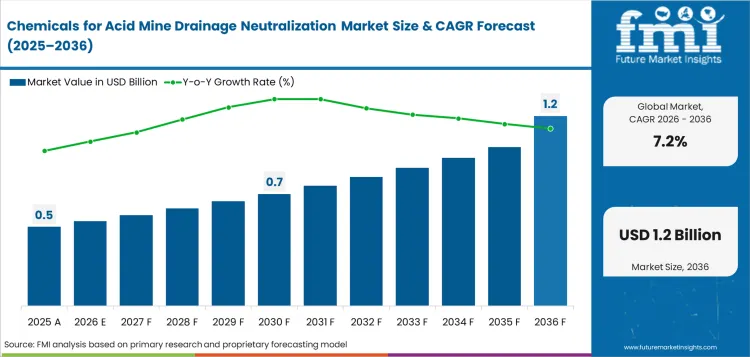
- The chemicals for acid mine drainage neutralization market was valued at USD 0.5 billion in 2025.
- By 2036, the chemicals for acid mine drainage neutralization market is expected to be worth USD 1.2 billion.
- From 2026 to 2036, the market is projected to expand at a CAGR of 7.2%.
- The market is projected to create an incremental opportunity of USD 0.6 billion between 2026 and 2036.
- In 2026, hydrated lime and quicklime are expected to account for 37.2% of neutralizing chemistry demand.
- India at 9.4% and South Africa at 9.1% are two faster expanding country markets.
Acid mine drainage treatment starts with a practical problem: acidic water carries dissolved metals into streams and mine outflows. EPA’s December 2025 Good Samaritan guidance links abandoned hardrock mine remediation to National Environmental Policy Act Environmental Assessment requirements under the 2024 law. That gives neutralization projects a clearer permitting path. Treatment chemistry still depends on pH correction. The 2025 International Mine Water Association paper states that neutralization allows targeted metals to fall out of solution. Operators therefore need lime, limestone or other alkaline reagents matched to water chemistry. USGS modeling tools add another buying factor because PHREEQ-N-AMDTreat simulates water-quality changes during passive and active treatment. Chemical suppliers can support better dosing plans when they combine reagent supply with treatment modeling. USGS interest in rare earth elements from acid mine drainage also broadens the commercial frame. Neutralization chemicals are likely to be specified with metals control and recovery potential in mind.
Chemicals for Acid Mine Drainage Neutralization Market Definition
The chemicals for acid mine drainage neutralization market includes alkaline reagents used to raise pH and precipitate dissolved metals from acidic mine water. These chemicals serve active mine operations and legacy mine remediation programs. Scope includes hydrated lime, quicklime, limestone, caustic soda, soda ash, and magnesium hydroxide. Pumps, clarifiers, membranes, and sludge hauling services are outside the scope.
Chemicals for Acid Mine Drainage Neutralization Market Inclusions
Market scope covers all commercially traded chemicals for acid mine drainage neutralization categorized by neutralizing chemistry such as hydrated lime and quicklime, limestone, caustic soda, soda ash, and magnesium hydroxide; treatment process such as active treatment plants, passive limestone drains, high-density sludge, batch treatment, and mobile treatment; mine type such as coal mines, copper mines, gold mines, polymetallic mines, and other mines; applications such as legacy mine remediation, active mine operations, tailings water, process water, and emergency response; and product forms such as dry powder, slurry, granular, and briquettes. Revenue scope covers 2026 to 2036. Stakeholders include neutralizing chemical manufacturers, lime producers, mining companies, mine water treatment contractors, remediation agencies, environmental consultants, distributors, dosing system providers, wastewater treatment operators, and regulatory bodies.
Chemicals for Acid Mine Drainage Neutralization Market Exclusions
Scope does not include finished treatment plants, mine water pumps, membrane systems, sludge transport, metal recovery equipment, laboratory testing services, or non-acidic water conditioning chemicals.
Chemicals for Acid Mine Drainage Neutralization Market Research Methodology
- Primary Research: FMI analysts talked to mine operators, water treatment contractors, lime producers, and remediation specialists in major mining markets.
- Desk Research: Combined data from mineral output reports, lime production summaries, mine water treatment references, and company product portfolios.
- Market sizing and forecasting: Added reagent use across treatment process groups and country mine activity from the bottom up.
- Data validation: Cross-checked every quarter against lime supply depth, coal output, metal mining activity, and chemical use patterns.
Why is the Chemicals for Acid Mine Drainage Neutralization Market Growing?
- Mine water treatment teams are using neutralizing chemicals to control acidity before discharge permits are affected.
- Legacy mine sites need long-term alkali dosing as sulfide-bearing waste can keep producing acidic water.
- Active treatment plants use lime-based reagents for fast pH correction and metal precipitation.
Large-scale acid mine drainage treatment favors active chemical dosing as high-flow discharge needs fast pH control. A 2026 RSC review describes lime neutralization and high-density sludge treatment as established active treatment methods for mine drainage. Lime neutralization makes lime and related alkalis recurring operating inputs instead of one-time cleanup materials. Chemical producers gain from repeat delivery cycles and plant-level dosing trials. Mine operators gain cost control through stable reagent performance and lower rework across treatment operations.
Lime availability affects treatment cost as neutralization plants need steady bulk chemical supply. The USGS January 2026 report estimated USA quicklime and hydrated lime production at 15 million tons in 2025. The supply base matters for mine water treatment sites that rely on local delivery and storage planning. Reagent producers with nearby capacity can reduce transport exposure for remote mining districts. Treatment contractors use delivered lime cost as a major filter before choosing dosing chemistry.
Market Segmentation Analysis
- Hydrated lime and quicklime are projected to capture 37.2% share in 2026 as active plants need fast pH correction.
- Active treatment plants are anticipated to hold 42.0% of treatment process use in 2026 through controlled dosing and sludge handling.
- Coal mines are estimated to represent 41.0% of mine type share in 2026 as pyrite-bearing waste raises acid drainage exposure.
- Legacy mine remediation is forecast to lead applications with 46.0% share in 2026 across abandoned mine discharge treatment programs.
- Dry powder is expected to make up 52.0% of product form sales in 2026 as remote sites need easier storage and lower freight burden.
Chemicals for acid mine drainage neutralization are divided into five primary segment groups based on neutralizing chemistry, treatment process, mine type, application, and product form. Neutralizing chemistry includes hydrated lime and quicklime, limestone, caustic soda, soda ash, magnesium hydroxide, and other alkalis. Treatment process includes active treatment plants, passive limestone drains, high-density sludge, batch treatment, and mobile treatment. Mine type includes coal mines, copper mines, gold mines, polymetallic mines, and other mines. Application includes legacy mine remediation, active mine operations, tailings water, process water, and emergency response. Product form includes dry powder, slurry, granular, and briquettes.
Insights into the Hydrated Lime And Quicklime Neutralizing Chemistry Segment
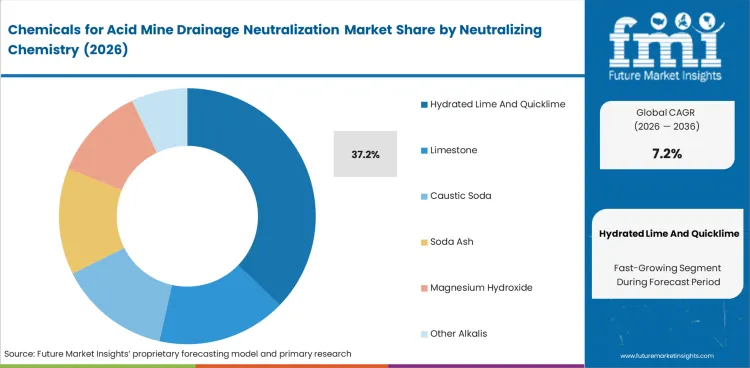
- In 2026, hydrated lime and quicklime are expected to make up 37.2% of the neutralizing chemistry segment. Lime-based products support rapid pH correction across treatment plants handling acidic flows and dissolved metals.
- Limestone and magnesium hydroxide address selected projects requiring slower release profiles or easier slurry handling. Their use improves in sites with lower acidity loads or stricter handling needs.
Insights into the Active Treatment Plants Treatment Process Segment
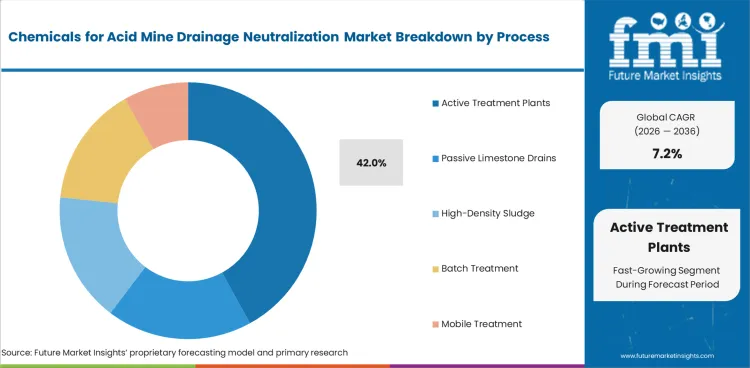
- Active treatment plants are projected to account for 42.0% of the treatment process segment in 2026. High-flow mine drainage requires controlled dosing and reliable sludge handling across daily operations.
- Passive limestone drains serve lower-flow sites with limited operating staff. Batch and mobile treatment formats support smallerprojects requiring temporary or site-specific neutralization capacity.
Insights into the Coal Mines Mine Type Segment
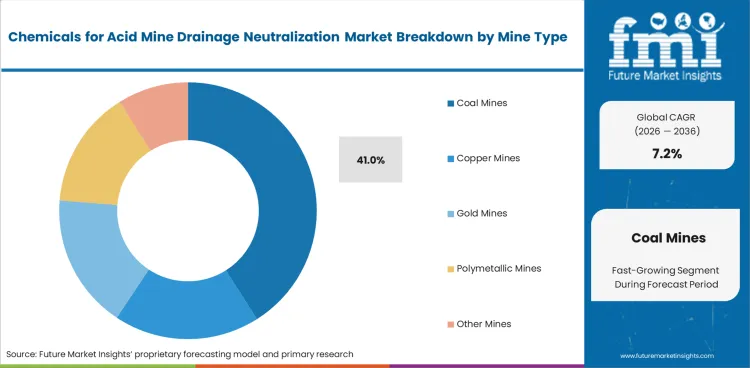
- In 2026, coal mines are estimated to represent 41.0% of the mine type segment. Pyrite-bearing waste and old workings create steady acid drainage exposure across coalfield treatment sites.
- Copper and gold mines require neutralization chemicals for tailings water and process water control. Their use improves in projects with higher metals load and stricter discharge checks.
Insights into the Legacy Mine Remediation Application Segment
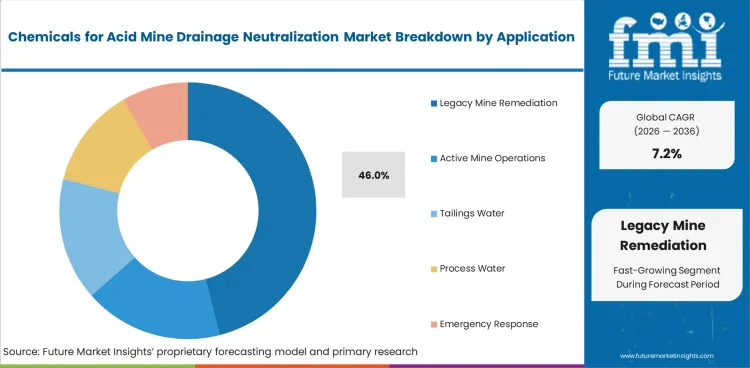
- Legacy mine remediation is forecast to hold 46.0% of the application segment in 2026. Abandoned mine discharge creates long treatment cycles for public cleanup and liability control programs.
- Active mine operations use neutralizers for process water and daily discharge management. Emergency response applications serve sudden acidity events requiring quick chemical dosing at site level.
Insights into the Dry Powder Product Form Segment
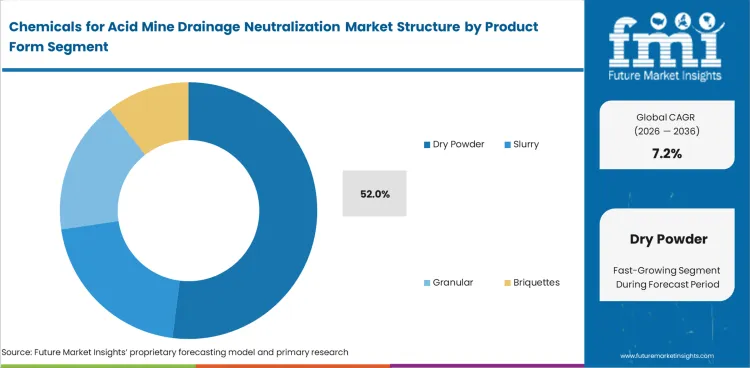
- In 2026, dry powder is projected to account for 52.0% of the product form segment. Remote mine sites prefer dry formats for easier storage and lower water transport burden.
- Slurry products support treatment plants seeking faster feed preparation and reduced mixing work. Granular and briquette formats serve passive systems needing slower chemical release.
Chemicals for Acid Mine Drainage Neutralization Market Drivers, Restraints, and Opportunities
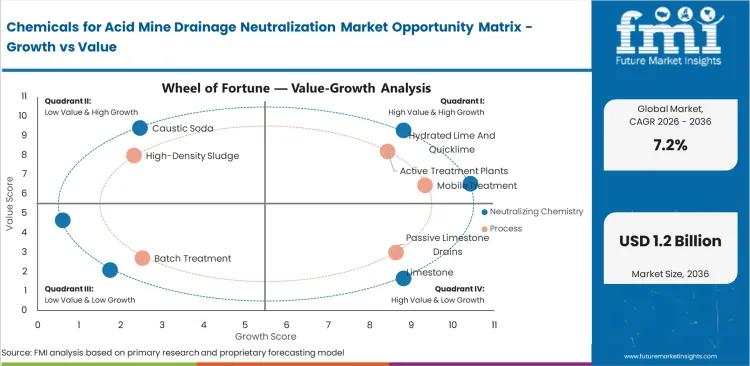
- Continuous acidity generation creates planned chemical demand across legacy mine basins and active tailings systems.
- High freight cost increases pricing pressure for remote treatment plants using bulk lime and limestone.
- Metal recovery from acidic drainage creates service opportunity for staged precipitation and reagent optimization.
Demand for chemicals for acid mine drainage neutralization keeps rising as mine operators need reliable pH control and safer discharge management across acidic mine water systems. Reagent cost and sludge disposal burden can slow wider use at remote sites with limited local supply. Market expansion comes through lime dosing programs and legacy mine remediation across coal and metal mining districts.
Hydrated Lime Holds a Treatment Premium
AMD neutralization contracts carry a lime price floor despite stable volume. In February 2026, USGS estimated 2025 USA quicklime and hydrated lime output at 15 million metric tons, unchanged from 2024 and valued at about USD 4.0 billion. The quicklime average plant value eased only to USD 260 per metric ton from USD 261.4 in 2024, and hydrated lime increased to USD 280 from USD 274.2. For mine water treatment buyers, the pricing split matters because hydrated lime reduces handling friction and dosing variability. The pricing response should be grade-specific escalation, not a blended lime clause across reagent supply agreements.
Caustic Soda Pricing Moves Toward Use-Based Billing
Iowa’s North King AML construction specifications show why caustic soda pricing for AMD neutralization is moving toward use-based field billing because commodity-only quotes no longer reflect full service requirements. In the 2025 bid documentation, the standard neutralizing agent is 20% to 25% liquid caustic soda, with treatment continued until pH reaches 6.5 to 9.0. Caustic soda will be measured by gallons used and paid at the contract unit price per gallon because the rate covers furnishing and application. For suppliers, use-based billing supports higher delivered service pricing because transport and storage add cost. For mine owners, the specification means reagent budgets should include dose uncertainty and site access planning.
Analysis of Chemicals for Acid Mine Drainage Neutralization Market By Key Countries
.webp "Top Country Growth Comparison Chemicals For Acid Mine Drainage Neutralization Market Cagr (2026 2036)")
| Country | CAGR |
|---|---|
| India | 9.4% |
| South Africa | 9.1% |
| China | 8.4% |
| Australia | 7.8% |
| Chile | 7.2% |
| Canada | 6.7% |
| USA | 5.9% |
Source: Future Market Insights, 2026.
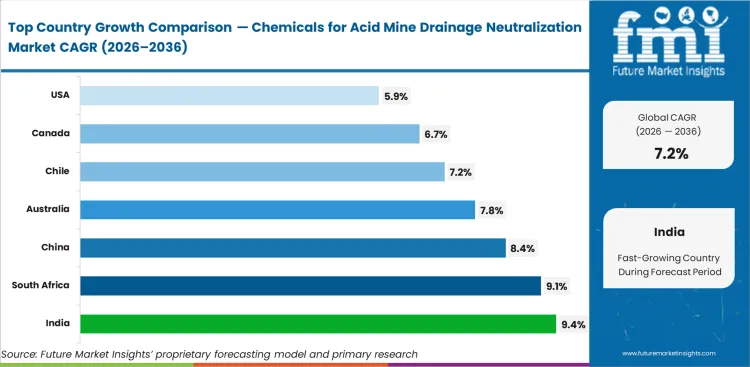
Chemicals for Acid Mine Drainage Neutralization Market CAGR Analysis By Country
- India is forecast to record 9.4% CAGR through 2036, backed by coalfield expansion and stronger mine water control needs.
- South Africa’s 9.1% CAGR points to continued treatment pressure across gold basin drainage and coal mine water systems.
- China is projected at 8.4% CAGR during the forecast period as large coal output keeps environmental control needs high.
- Australia’s 7.8% CAGR is shaped by coal export activity and mine closure water management requirements.
- Chile is expected to grow at 7.2% CAGR as copper mining intensity raises tailings water treatment needs.
- Canada is forecast at 6.7% CAGR with coal and metal mining basins requiring recurring water treatment.
- The USA is projected to expand at 5.9% CAGR as mature treatment networks serve abandoned mine remediation programs.
Demand for chemicals for acid mine drainage neutralization is forecast to rise at 7.2% CAGR from 2026 to 2036. Country-level analysis covers the major markets contributing to this forecast, with major markets listed below.
Demand Outlook for Chemicals for Acid Mine Drainage Neutralization Market in India
The chemicals for acid mine drainage neutralization industry in India is projected to record a CAGR of 9.4% through 2036. India’s coal production increased to 1047.523 million tonnes in 2024-25. India’s output base raises the need for chemicals for acid mine drainage neutralization across coalfield water control. Local chemical producers can benefit from mine sites seeking dependable neutralization supply and lower transport exposure.
- Coalfield expansion raises steady need for lime-based treatment across mine discharge and process water systems.
- Domestic mine operators need dosing chemicals to reduce pH variation across seasonal water flows.
- Local reagent supply can reduce freight risk for mining districts using mine water treatment inputs.
Sales Analysis of Chemicals for Acid Mine Drainage Neutralization Market in South Africa
The chemicals for acid mine drainage neutralization sector in South Africa is expected to expand at a CAGR of 9.1% during the assessment period. South Africa’s mining sector report listed coal production at 256.6 Mt in 2024. Gold and coal basins create recurring treatment pressure as acidic drainage affects water systems around old workings. Local lime users need chemical supply plans to handle both active treatment and long-cycle remediation.
- Gold basin drainage raises demand for lime neutralization and sludge handling in long-life remediation sites.
- Coal mining districts need alkali supply for water quality control and discharge compliance.
- Treatment contractors value field-ready chemical formats to match site storage and dosing equipment.
Demand Outlook for Chemicals for Acid Mine Drainage Neutralization Market in China
The chemicals for acid mine drainage neutralization industry in China is forecast to grow at a CAGR of 8.4% during the forecast years. China’s coal mining base creates a steady need for chemicals used in acid mine drainage neutralization. Mine operators require a bulk alkali supply and consistent dosing to control acidic discharge. Local reagent producers can serve treatment sites that need dependable pH correction across coalfield water systems.
- Large coal output increases recurring treatment needs across acidic drainage and process water flows.
- Mine water programs need reliable pH control as discharge standards tighten around mining districts.
- Local production scale favors bulk chemical contracts linked to beneficiation reagent use.
Opportunity Analysis of Chemicals for Acid Mine Drainage Neutralization Market in Australia
The chemicals for acid mine drainage neutralization segment in Australia is forecast to advance at 7.8% CAGR over the forecast years. Australia’s thermal coal export volumes are expected to fall from 205 Mt in 2024-25 to 202 Mt by 2026-27. Australia’s production and export base keeps chemicals for acid mine drainage neutralization relevant for mine water control and closure planning. Chemical producers with regional supply can serve coal basins and metal mine sites.
- Coal export districts need acid drainage control across active mines and site rehabilitation programs.
- Mine closure work raises demand for longer reagent planning and passive treatment chemistry.
- Water treatment suppliers can serve mines using dosing systems and site water treatment equipment.
Future Outlook for Chemicals for Acid Mine Drainage Neutralization Market in Chile
The chemicals for acid mine drainage neutralization industry in Chile is expected to post 7.2% CAGR through 2036. Chile produced 5.5 million tons of copper in 2024 and recorded a five percent increase from the previous year. Chile’s copper base supports demand for chemicals for acid mine drainage neutralization across tailings water and acidic discharge systems. Reliable reagent supply is important as copper mines manage water reuse and metals precipitation.
- Copper operations need pH control chemicals across tailings water and process water circuits.
- High-altitude mining sites increase the importance of reliable storage and delivery planning.
- Producers with mineral chemistry depth can serve copper sites using surface mining inputs.
Demand Outlook for Chemicals for Acid Mine Drainage Neutralization Market in Canada
The chemicals for acid mine drainage neutralization industry in Canada is projected to expand at 6.7% CAGR during the assessment period. Natural Resources Canada listed coal production at 42.6 million tonnes in 2024. Coal and metal mining regions raise demand for chemicals for acid mine drainage neutralization across active operations and closure sites. Remote geography raises the value of dry powder formats and predictable bulk deliveries.
- Western mining basins need lime supply for drainage control across coal and metal mine sites.
- Remote site logistics favor chemical formatswith easier storage and lower water freight.
- Treatment plant reliability raises demand for diaphragm pumps across dosing lines.
In-depth Analysis of Chemicals for Acid Mine Drainage Neutralization Market in the USA
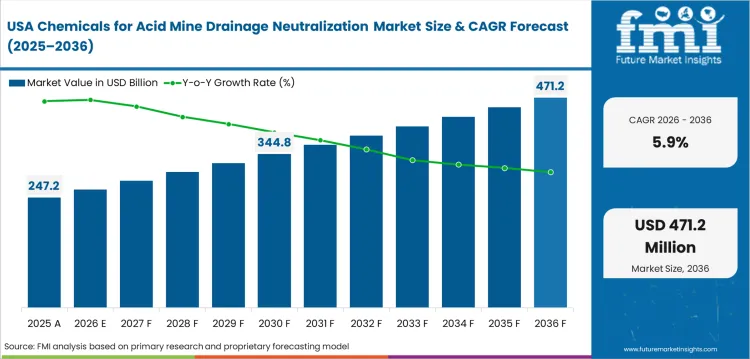
The chemicals for acid mine drainage neutralization industry in the United States is expected to record 5.9% CAGR by 2036. USA coal production reached 512.5 million short tons in 2024 and producing mines declined to 524. The mature coal base keeps chemicals for acid mine drainage neutralization linked to operating mines and abandoned mine programs. Vendors with local lime capacity and water treatment product depth can protect service quality across long contracts.
- Abandoned mine remediation boosts recurring demand for lime and limestone across coalfield water systems.
- Mature treatment networks favor chemical vendors with dosing knowledge and dependable delivery.
- Mine water work overlaps with sludge treatment chemicals as neutralization improves metal-rich solids.
Competitive Landscape and Strategic Positioning
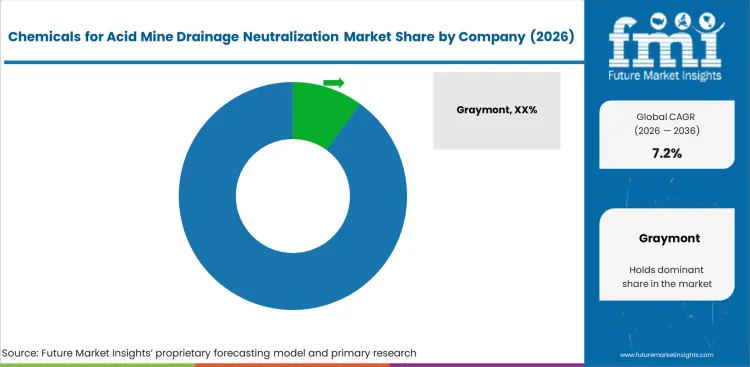
- Graymont supplies calcium-based reagents used in mining water treatment and critical minerals processing projects.
- Lhoist and Carmeuse offer lime-based mineral portfolios serving industrial water treatment and mine drainage control.
- Specialist producers focus on magnesium-based alkalis for sites needing safer handling and tighter pH adjustment.
Competition in this market centers on reagent reliability and mine-site delivery strength. Graymont holds a visible position through calcium-based solutions used in water purification and critical minerals processing. Lhoist participates through lime products applied in acid mine drainage neutralization and industrial water circuits. Carmeuse serves treatment users with quicklime and hydrated lime for pH correction and solids control. United States Lime & Minerals adds regional depth through lime products used in water treatment applications.
Cost exposure creates a practical filter for supplier selection across mine water treatment systems. Kiln energy pressure and freight distance can raise delivered reagent costs for remote sites. Sludge disposal cost influences chemistry choice across active treatment plants. Mining companies prefer chemical producers with consistent alkalinity and reliable delivery records. Stronger competitors pair lime reactivity with dosing assistance and site-ready documentation. Producers with broader reagent options are better placed to serve plants managing pH control and solids burden.
Key Companies in the Chemicals for Acid Mine Drainage Neutralization Market
Global companies active in the chemicals for acid mine drainage neutralization market include:
- Graymont, Lhoist, and Carmeuse have strong calcium-based reagent infrastructure for mine water and industrial treatment.
- Mississippi Lime, United States Lime & Minerals, and Calcinor serve treatment users through lime and limestone product coverage.
- Martin Marietta Magnesia Specialties holds a specialist position across magnesium-based alkali chemistry and pH control applications.
Competitive Benchmarking: Chemicals for Acid Mine Drainage Neutralization Market
| Company | Neutralization Chemistry Depth | Mine Water Application Coverage | Bulk Supply Capability | Geographic Footprint |
|---|---|---|---|---|
| Graymont | High | High | Strong | North America, Asia Pacific |
| Lhoist | High | High | Strong | Europe, North America |
| Carmeuse | High | High | Strong | Europe, North America |
| Mississippi Lime | High | Medium | Strong | North America |
| United States Lime & Minerals | Medium | Medium | Strong | United States |
| Calcinor | Medium | Medium | Moderate | Europe, Latin America |
| Martin Marietta Magnesia Specialties | Medium | Medium | Moderate | North America |
Source: Future Market Insights, 2026.
Key Developments in Chemicals for Acid Mine Drainage Neutralization Market
- April 2025, Graymont announced a new lime production investment in Victoria, Australia. The investment increases local lime availability for mining and industrial customers.
- September 2025, Graymont completed the acquisition of Compact Energy in Malaysia. The acquired facility brings quicklime and hydrated lime processing capacity near Port Klang.
Key Players in the Chemicals for Acid Mine Drainage Neutralization Market
Major Global Players:
- Graymont
- Lhoist
- Carmeuse
- Mississippi Lime
- United States Lime & Minerals
Specialist Players:
- Calcinor
- Martin Marietta Magnesia Specialties
Report Scope and Coverage
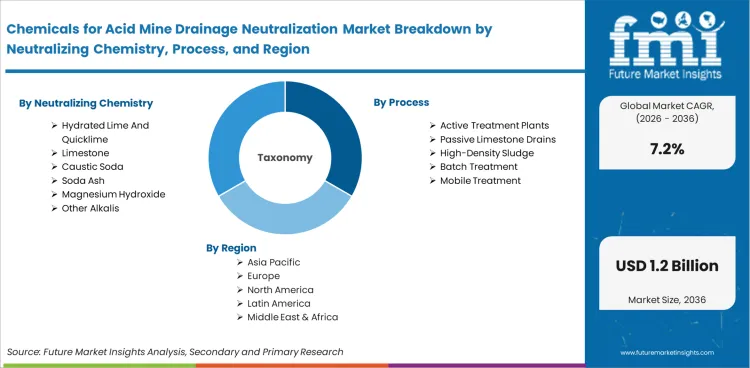
Chemicals for Acid Mine Drainage Neutralization Market Breakdown By Neutralizing Chemistry, Treatment Process, And Region
| Parameter | Details |
|---|---|
| Quantitative Units | USD 0.6 billion to USD 1.2 billion, at a CAGR of 7.2% |
| Market Definition | The market encompasses alkaline chemicals used to neutralize acidic mine drainage and precipitate dissolved metals. |
| Regions Covered | North America, Latin America, Europe, East Asia, South Asia and Pacific, Middle East and Africa |
| Countries Covered | USA, Canada, Chile, Australia, China, India, South Africa, and 30 plus countries |
| Key Companies Profiled | Graymont, Lhoist, Carmeuse, Mississippi Lime, United States Lime & Minerals, Calcinor, Martin Marietta Magnesia Specialties |
| Forecast Period | 2026 to 2036 |
| Approach | Hybrid bottom-up and top-down methodology starting with reagent use and verified mining activity patterns. |
Source: Future Market Insights, 2026.
Chemicals for Acid Mine Drainage Neutralization Market by Segments
Chemicals for Acid Mine Drainage Neutralization Market Segmented by Neutralizing Chemistry:
- Hydrated Lime And Quicklime
- Limestone
- Caustic Soda
- Soda Ash
- Magnesium Hydroxide
- Other Alkalis
Chemicals for Acid Mine Drainage Neutralization Market Segmented by Treatment Process:
- Active Treatment Plants
- Passive Limestone Drains
- High-Density Sludge
- Batch Treatment
- Mobile Treatment
Chemicals for Acid Mine Drainage Neutralization Market Segmented by Mine Type:
- Coal Mines
- Copper Mines
- Gold Mines
- Polymetallic Mines
- Other Mines
Chemicals for Acid Mine Drainage Neutralization Market Segmented by Application:
- Legacy Mine Remediation
- Active Mine Operations
- Tailings Water
- Process Water
- Emergency Response
Chemicals for Acid Mine Drainage Neutralization Market Segmented by Product Form:
- Dry Powder
- Slurry
- Granular
- Briquettes
Chemicals for Acid Mine Drainage Neutralization Market by Region:
- North America
- USA
- Canada
- Mexico
- Latin America
- Brazil
- Chile
- Rest of Latin America
- Europe
- Germany
- UK
- Italy
- Spain
- France
- Rest of Europe
- East Asia
- China
- Japan
- South Korea
- South Asia and Pacific
- India
- ASEAN
- Australia & New Zealand
- Rest of South Asia and Pacific
- Middle East and Africa
- Saudi Arabia
- Other GCC Countries
- South Africa
- Rest of Middle East and Africa
Research Sources and Bibliography
- Iowa Department of Agriculture and Land Stewardship. (2025). North King AML construction - supplemental construction specifications: Bid no. IA-048.
- USA Geological Survey. (2026, January). Mineral commodity summaries 2026: Lime. USA Geological Survey.
- USA Energy Information Administration. (2025, November). Annual coal report 2024. USA Energy Information Administration.
- Press Information Bureau. (2026, January 12). Ministry of Coal’s year end review 2025. Government of India.
- Department of Mineral and Petroleum Resources. (2025). South Africa’s mining sector performance 2024. Government of South Africa.
- Department of Industry, Science and Resources. (2025, December 19). Resources and energy quarterly: December 2025. Australian Government.
- International Trade Administration. (2025, November 24). Chile - Mining. USA Department of Commerce.
- Natural Resources Canada. (2026, February 13). Coal facts. Government of Canada.
- Federal Reserve Bank of St. Louis. (2025, July). Producer Price Index by Commodity: Chemicals and Allied Products: Lime. FRED.
- Ngerem, E. C., Sanusi, I. A., Dalu, T., & Suinyuy, T. N. (2026). Sustainable acid mine drainage wastewater remediation: A comprehensive review and bibliometric analysis. Environmental Science: Advances.
- United States Lime & Minerals. (2026). Hydrated lime. United States Lime & Minerals.
This Report Answers
- What is the current and future size of the chemicals for acid mine drainage neutralization market?
- How fast is the chemicals for acid mine drainage neutralization market expected to expand between 2026 and 2036?
- Which neutralizing chemistry is expected to lead the market by 2026?
- Which treatment process is expected to account for the highest demand by 2026?
- What factors are driving demand for acid mine drainage neutralization chemicals globally?
- How are legacy mine remediation programs influencing reagent use?
- Why are coal mines the main mine type demand base for neutralization chemicals?
- How are active treatment plants creating demand for lime-based reagents?
- Which countries are projected to record faster expansion through 2036?
- What is driving market expansion in India and South Africa?
- Who are the key companies active in the chemicals for acid mine drainage neutralization market?
- How does FMI estimate and validate the market forecast?
Frequently Asked Questions
What is the global market demand for Chemicals for Acid Mine Drainage Neutralization in 2026?
In 2026, the global market for chemicals for acid mine drainage neutralization is expected to be worth USD 0.6 billion.
How big will the market for Chemicals for Acid Mine Drainage Neutralization be in 2036?
By 2036, the market for chemicals for acid mine drainage neutralization is expected to be worth USD 1.2 billion.
How much is demand for Chemicals for Acid Mine Drainage Neutralization expected to expand between 2026 and 2036?
Between 2026 and 2036, demand for chemicals for acid mine drainage neutralization is expected to expand at a CAGR of 7.2%.
Which neutralizing chemistry segment is likely to be the leading neutralizing chemistry globally by 2026?
Hydrated lime and quicklime will make up 37.2% of the neutralizing chemistry segment in 2026.
What supports demand growth in India?
The India chemicals for acid mine drainage neutralization market is projected to record 9.4% CAGR through 2036, backed by coal output and mine water control needs.
What supports demand growth in South Africa?
The South Africa chemicals for acid mine drainage neutralization market is projected to expand at 9.1% CAGR through 2036, backed by gold basin drainage and coal mine water treatment.
What is included in the Chemicals for Acid Mine Drainage Neutralization Market definition?
The chemicals for acid mine drainage neutralization market includes alkaline reagents used to raise pH and precipitate dissolved metals from acidic mine water.
How does FMI prepare and check the Chemicals for Acid Mine Drainage Neutralization forecast?
Forecasting models use a hybrid bottom-up and top-down method, starting with reagent demand and checking it against verified mining activity patterns.
Preview the report firsthand - request a free sample
Get SampleGet the brochure for pricing and purchase details.
Get PDFTable of Content
- Key Takeaways
- Market Size and CAGR
- Top Growth Driver
- Fastest Growing Segment
- Leading Region
- Key Companies
- Emerging Opportunities
- Executive Summary
- Global Market Outlook
- Demand-side Trends
- Supply-side Trends
- Technology Roadmap Analysis
- Analysis and Recommendations
- Analyst Perspective (What is happening? Why now? What should investors know?)
- Key Questions Answered
- How large is the market?
- What is the CAGR?
- What are key trends?
- Which region dominates?
- Who are the leaders?
- Market Overview
- Market Coverage / Taxonomy
- Market Definition / Scope / Limitations
- Research Methodology
- Chapter Orientation
- Analytical Lens and Working Hypotheses
- Market Structure, Signals, and Trend Drivers
- Benchmarking and Cross-market Comparability
- Market Sizing, Forecasting, and Opportunity Mapping
- Research Design and Evidence Framework
- Desk Research Programme (Secondary Evidence)
- Expert Input and Fieldwork (Primary Evidence)
- Tooling, Models, and Reference Databases
- Data Engineering and Model Build
- Quality Assurance and Audit Trail
- Market Background
- Market Dynamics (Drivers, Restraints, Opportunity, Trends)
- Scenario Forecast (Optimistic, Likely, Conservative)
- Impact Analysis
- AI Impact
- Sustainability Impact
- Regulatory Impact
- Technology Impact
- Consumer / Buyer Analysis
- Purchase Drivers
- Adoption Barriers
- Buyer Journey
- Opportunity Map Analysis
- Product Life Cycle Analysis
- Supply Chain Analysis
- Investment Feasibility Matrix
- Value Chain Analysis
- PESTLE and Porter's Analysis
- Regulatory Landscape
- Regional Parent Market Outlook
- Production and Consumption Statistics
- Import and Export Statistics
- Global Market Analysis and Forecast, 2021 to 2036
- Historical Market Size Value (USD Million) & Volume (Unit) Analysis, 2021 to 2025
- Current and Future Market Size Value (USD Million) & Volume (Unit) Projections, 2026 to 2036
- Y-o-Y Growth Trend Analysis
- Absolute $ Opportunity Analysis
- Global Market Pricing Analysis, 2021 to 2036
- Global Market Analysis and Forecast, By Neutralizing Chemistry, 2021 to 2036
- Introduction / Key Findings
- Historical Market Size Value (USD Million) & Volume (Unit) Analysis By Neutralizing Chemistry, 2021 to 2025
- Current and Future Market Size Value (USD Million) & Volume (Unit) Analysis and Forecast By Neutralizing Chemistry, 2026 to 2036
- Hydrated Lime And Quicklime
- Limestone
- Caustic Soda
- Soda Ash
- Magnesium Hydroxide
- Other Alkalis
- Hydrated Lime And Quicklime
- Y-o-Y Growth Trend Analysis By Neutralizing Chemistry, 2021 to 2025
- Absolute $ Opportunity Analysis By Neutralizing Chemistry, 2026 to 2036
- Global Market Analysis and Forecast, By Treatment Process, 2021 to 2036
- Introduction / Key Findings
- Historical Market Size Value (USD Million) & Volume (Unit) Analysis By Treatment Process, 2021 to 2025
- Current and Future Market Size Value (USD Million) & Volume (Unit) Analysis and Forecast By Treatment Process, 2026 to 2036
- Active Treatment Plants
- Passive Limestone Drains
- High-Density Sludge
- Batch Treatment
- Mobile Treatment
- Active Treatment Plants
- Y-o-Y Growth Trend Analysis By Treatment Process, 2021 to 2025
- Absolute $ Opportunity Analysis By Treatment Process, 2026 to 2036
- Global Market Analysis and Forecast, By Mine Type, 2021 to 2036
- Introduction / Key Findings
- Historical Market Size Value (USD Million) & Volume (Unit) Analysis By Mine Type, 2021 to 2025
- Current and Future Market Size Value (USD Million) & Volume (Unit) Analysis and Forecast By Mine Type, 2026 to 2036
- Coal Mines
- Copper Mines
- Gold Mines
- Polymetallic Mines
- Other Mines
- Coal Mines
- Y-o-Y Growth Trend Analysis By Mine Type, 2021 to 2025
- Absolute $ Opportunity Analysis By Mine Type, 2026 to 2036
- Global Market Analysis and Forecast, By Application, 2021 to 2036
- Introduction / Key Findings
- Historical Market Size Value (USD Million) & Volume (Unit) Analysis By Application, 2021 to 2025
- Current and Future Market Size Value (USD Million) & Volume (Unit) Analysis and Forecast By Application, 2026 to 2036
- Legacy Mine Remediation
- Active Mine Operations
- Tailings Water
- Process Water
- Emergency Response
- Legacy Mine Remediation
- Y-o-Y Growth Trend Analysis By Application, 2021 to 2025
- Absolute $ Opportunity Analysis By Application, 2026 to 2036
- Global Market Analysis and Forecast, By Product Form, 2021 to 2036
- Introduction / Key Findings
- Historical Market Size Value (USD Million) & Volume (Unit) Analysis By Product Form, 2021 to 2025
- Current and Future Market Size Value (USD Million) & Volume (Unit) Analysis and Forecast By Product Form, 2026 to 2036
- Dry Powder
- Slurry
- Granular
- Briquettes
- Dry Powder
- Y-o-Y Growth Trend Analysis By Product Form, 2021 to 2025
- Absolute $ Opportunity Analysis By Product Form, 2026 to 2036
- Global Market Analysis and Forecast, By Region, 2021 to 2036
- Introduction
- Historical Market Size Value (USD Million) & Volume (Unit) Analysis By Region, 2021 to 2025
- Current Market Size Value (USD Million) & Volume (Unit) Analysis and Forecast By Region, 2026 to 2036
- North America
- Latin America
- Western Europe
- Eastern Europe
- East Asia
- South Asia and Pacific
- Middle East & Africa
- Market Attractiveness Analysis By Region
- North America Market Analysis and Forecast, By Country, 2021 to 2036
- Historical Market Size Value (USD Million) & Volume (Unit) Trend Analysis By Market Taxonomy, 2021 to 2025
- Market Size Value (USD Million) & Volume (Unit) Forecast By Market Taxonomy, 2026 to 2036
- By Country
- USA
- Canada
- Mexico
- By Neutralizing Chemistry
- By Treatment Process
- By Mine Type
- By Application
- By Product Form
- By Country
- Market Attractiveness Analysis
- By Country
- By Neutralizing Chemistry
- By Treatment Process
- By Mine Type
- By Application
- By Product Form
- Key Takeaways
- Latin America Market Analysis and Forecast, By Country
- Historical Market Size Value (USD Million) & Volume (Unit) Trend Analysis By Market Taxonomy, 2021 to 2025
- Market Size Value (USD Million) & Volume (Unit) Forecast By Market Taxonomy, 2026 to 2036
- By Country
- Brazil
- Chile
- Rest of Latin America
- By Neutralizing Chemistry
- By Treatment Process
- By Mine Type
- By Application
- By Product Form
- By Country
- Market Attractiveness Analysis
- By Country
- By Neutralizing Chemistry
- By Treatment Process
- By Mine Type
- By Application
- By Product Form
- Key Takeaways
- Western Europe Market Analysis and Forecast, By Country
- Historical Market Size Value (USD Million) & Volume (Unit) Trend Analysis By Market Taxonomy, 2021 to 2025
- Market Size Value (USD Million) & Volume (Unit) Forecast By Market Taxonomy, 2026 to 2036
- By Country
- Germany
- UK
- Italy
- Spain
- France
- Nordic
- BENELUX
- Rest of Western Europe
- By Neutralizing Chemistry
- By Treatment Process
- By Mine Type
- By Application
- By Product Form
- By Country
- Market Attractiveness Analysis
- By Country
- By Neutralizing Chemistry
- By Treatment Process
- By Mine Type
- By Application
- By Product Form
- Key Takeaways
- Eastern Europe Market Analysis and Forecast, By Country
- Historical Market Size Value (USD Million) & Volume (Unit) Trend Analysis By Market Taxonomy, 2021 to 2025
- Market Size Value (USD Million) & Volume (Unit) Forecast By Market Taxonomy, 2026 to 2036
- By Country
- Russia
- Poland
- Hungary
- Balkan & Baltic
- Rest of Eastern Europe
- By Neutralizing Chemistry
- By Treatment Process
- By Mine Type
- By Application
- By Product Form
- By Country
- Market Attractiveness Analysis
- By Country
- By Neutralizing Chemistry
- By Treatment Process
- By Mine Type
- By Application
- By Product Form
- Key Takeaways
- East Asia Market Analysis and Forecast, By Country
- Historical Market Size Value (USD Million) & Volume (Unit) Trend Analysis By Market Taxonomy, 2021 to 2025
- Market Size Value (USD Million) & Volume (Unit) Forecast By Market Taxonomy, 2026 to 2036
- By Country
- China
- Japan
- South Korea
- By Neutralizing Chemistry
- By Treatment Process
- By Mine Type
- By Application
- By Product Form
- By Country
- Market Attractiveness Analysis
- By Country
- By Neutralizing Chemistry
- By Treatment Process
- By Mine Type
- By Application
- By Product Form
- Key Takeaways
- South Asia and Pacific Market Analysis and Forecast, By Country
- Historical Market Size Value (USD Million) & Volume (Unit) Trend Analysis By Market Taxonomy, 2021 to 2025
- Market Size Value (USD Million) & Volume (Unit) Forecast By Market Taxonomy, 2026 to 2036
- By Country
- India
- ASEAN
- Australia & New Zealand
- Rest of South Asia and Pacific
- By Neutralizing Chemistry
- By Treatment Process
- By Mine Type
- By Application
- By Product Form
- By Country
- Market Attractiveness Analysis
- By Country
- By Neutralizing Chemistry
- By Treatment Process
- By Mine Type
- By Application
- By Product Form
- Key Takeaways
- Middle East & Africa Market Analysis and Forecast, By Country
- Historical Market Size Value (USD Million) & Volume (Unit) Trend Analysis By Market Taxonomy, 2021 to 2025
- Market Size Value (USD Million) & Volume (Unit) Forecast By Market Taxonomy, 2026 to 2036
- By Country
- Kingdom of Saudi Arabia
- Other GCC Countries
- Türkiye
- South Africa
- Other African Union
- Rest of Middle East & Africa
- By Neutralizing Chemistry
- By Treatment Process
- By Mine Type
- By Application
- By Product Form
- By Country
- Market Attractiveness Analysis
- By Country
- By Neutralizing Chemistry
- By Treatment Process
- By Mine Type
- By Application
- By Product Form
- Key Takeaways
- Key Countries Market Analysis
- USA
- Pricing Analysis
- Market Share Analysis, 2025
- By Neutralizing Chemistry
- By Treatment Process
- By Mine Type
- By Application
- By Product Form
- Canada
- Pricing Analysis
- Market Share Analysis, 2025
- By Neutralizing Chemistry
- By Treatment Process
- By Mine Type
- By Application
- By Product Form
- Mexico
- Pricing Analysis
- Market Share Analysis, 2025
- By Neutralizing Chemistry
- By Treatment Process
- By Mine Type
- By Application
- By Product Form
- Brazil
- Pricing Analysis
- Market Share Analysis, 2025
- By Neutralizing Chemistry
- By Treatment Process
- By Mine Type
- By Application
- By Product Form
- Chile
- Pricing Analysis
- Market Share Analysis, 2025
- By Neutralizing Chemistry
- By Treatment Process
- By Mine Type
- By Application
- By Product Form
- Germany
- Pricing Analysis
- Market Share Analysis, 2025
- By Neutralizing Chemistry
- By Treatment Process
- By Mine Type
- By Application
- By Product Form
- UK
- Pricing Analysis
- Market Share Analysis, 2025
- By Neutralizing Chemistry
- By Treatment Process
- By Mine Type
- By Application
- By Product Form
- Italy
- Pricing Analysis
- Market Share Analysis, 2025
- By Neutralizing Chemistry
- By Treatment Process
- By Mine Type
- By Application
- By Product Form
- Spain
- Pricing Analysis
- Market Share Analysis, 2025
- By Neutralizing Chemistry
- By Treatment Process
- By Mine Type
- By Application
- By Product Form
- France
- Pricing Analysis
- Market Share Analysis, 2025
- By Neutralizing Chemistry
- By Treatment Process
- By Mine Type
- By Application
- By Product Form
- India
- Pricing Analysis
- Market Share Analysis, 2025
- By Neutralizing Chemistry
- By Treatment Process
- By Mine Type
- By Application
- By Product Form
- ASEAN
- Pricing Analysis
- Market Share Analysis, 2025
- By Neutralizing Chemistry
- By Treatment Process
- By Mine Type
- By Application
- By Product Form
- Australia & New Zealand
- Pricing Analysis
- Market Share Analysis, 2025
- By Neutralizing Chemistry
- By Treatment Process
- By Mine Type
- By Application
- By Product Form
- China
- Pricing Analysis
- Market Share Analysis, 2025
- By Neutralizing Chemistry
- By Treatment Process
- By Mine Type
- By Application
- By Product Form
- Japan
- Pricing Analysis
- Market Share Analysis, 2025
- By Neutralizing Chemistry
- By Treatment Process
- By Mine Type
- By Application
- By Product Form
- South Korea
- Pricing Analysis
- Market Share Analysis, 2025
- By Neutralizing Chemistry
- By Treatment Process
- By Mine Type
- By Application
- By Product Form
- Russia
- Pricing Analysis
- Market Share Analysis, 2025
- By Neutralizing Chemistry
- By Treatment Process
- By Mine Type
- By Application
- By Product Form
- Poland
- Pricing Analysis
- Market Share Analysis, 2025
- By Neutralizing Chemistry
- By Treatment Process
- By Mine Type
- By Application
- By Product Form
- Hungary
- Pricing Analysis
- Market Share Analysis, 2025
- By Neutralizing Chemistry
- By Treatment Process
- By Mine Type
- By Application
- By Product Form
- Kingdom of Saudi Arabia
- Pricing Analysis
- Market Share Analysis, 2025
- By Neutralizing Chemistry
- By Treatment Process
- By Mine Type
- By Application
- By Product Form
- Türkiye
- Pricing Analysis
- Market Share Analysis, 2025
- By Neutralizing Chemistry
- By Treatment Process
- By Mine Type
- By Application
- By Product Form
- South Africa
- Pricing Analysis
- Market Share Analysis, 2025
- By Neutralizing Chemistry
- By Treatment Process
- By Mine Type
- By Application
- By Product Form
- USA
- Market Structure Analysis
- Competition Dashboard
- Competition Benchmarking
- Market Share Analysis of Top Players
- By Regional
- By Neutralizing Chemistry
- By Treatment Process
- By Mine Type
- By Application
- By Product Form
- Emerging Startups
- Innovation Benchmarking
- Competition Analysis
- Competition Deep Dive
- Graymont
- Overview
- Product Portfolio
- Profitability by Market Segments (Product/Region/Sales Channel)
- Sales Footprint
- Strategy Overview
- Marketing Strategy
- Product Strategy
- Channel Strategy
- Lhoist
- Carmeuse
- Mississippi Lime
- Value (USD Million) & Volume (Unit)ed States Lime & Minerals
- Calcinor
- Martin Marietta Magnesia Specialties
- Graymont
- Case Studies
- Success Stories
- Recent Developments
- Competition Deep Dive
- Assumptions & Acronyms Used


