

- Industry Size (2026)
- USD 589.1 Mn
- Forecast (2036)
- USD 1394.6 Mn
- CAGR (2026 to 2036)
- 9%
Regenerable Acid Gas Removal Chemicals Market Forecast and Outlook 2026 to 2036
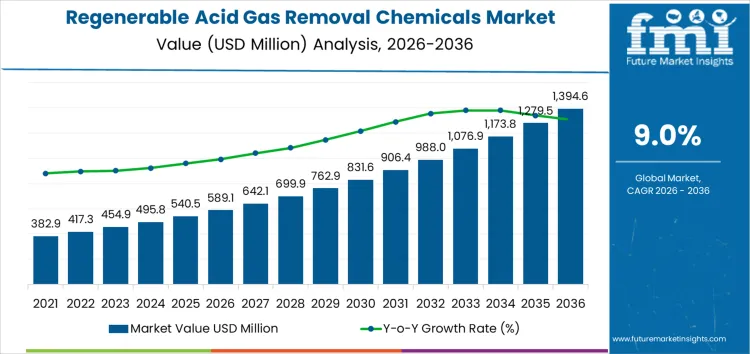
The regenerable acid gas removal chemicals market is valued at USD 589.1 million in 2026 and is expected to reach USD 1,394.6 million by 2036, growing at a compound annual growth rate (CAGR) of 9%. This market plays a crucial role in industries where air and gas quality control are essential, such as oil and gas, chemical manufacturing, and energy production. With environmental regulations becoming more stringent, companies are increasingly turning to regenerable acid gas removal solutions to meet compliance while optimizing operational costs. The market’s influence is expanding as decision-makers prioritize long-term, sustainable solutions that minimize waste and reduce environmental impact. Competitive dynamics are shaped by the need for reliable, scalable technologies, with established players leveraging proven solutions while new entrants seek to innovate. As regulatory pressures intensify, this market will continue to grow, rewarding companies that can offer efficient, cost-effective, and adaptable chemical solutions capable of addressing evolving environmental challenges.
Quick Stats of the Regenerable Acid Gas Removal Chemicals Market
- Regenerable Acid Gas Removal Chemicals Market Value (2026): USD 589.1 million
- Regenerable Acid Gas Removal Chemicals Market Forecast Value (2036): USD 1,394.6 million
- Regenerable Acid Gas Removal Chemicals Market Global Forecast CAGR (2026-2036): 9%
- Regenerable Acid Gas Removal Chemicals Market Leading Segment: Target Gas (CO₂) 38%
- Key Growth Regions in Regenerable Acid Gas Removal Chemicals Market: China
- Top Players in Regenerable Acid Gas Removal Chemicals Market: BASF SE, Shell Catalysts & Technologies, Huntsman Corporation, Fluor Corporation (Econamine), MHI Engineering
What is the Growth Forecast for the Regenerable Acid Gas Removal Chemicals Market through 2036?
The volume growth contribution for the regenerable acid gas removal chemicals market is expected to be the dominant factor driving market expansion. Starting at USD 589.1 million in 2026, the market will grow steadily, reaching USD 643.2 million in 2027, a growth of USD 54.1 million, and USD 703 million in 2028, adding USD 59.8 million in value. This increase is primarily driven by the rising demand for acid gas removal solutions across industries, particularly in oil and gas, petrochemicals, and natural gas processing. The growing need to meet stricter environmental regulations globally, especially in developing regions, will drive substantial volume demand. From 2026 to 2031, the market is projected to expand by approximately USD 429.9 million, increasing from USD 589.1 million to USD 1,018.7 million, driven by higher adoption of regenerable chemicals in industrial applications. This volume-driven growth will continue as industrialization accelerates, and stricter emission controls are enforced globally.
In parallel, technological advancements will contribute significantly to market growth, enhancing the adoption of regenerable acid gas removal chemicals. By 2030, the market value will rise to USD 843.4 million, reflecting a growth of USD 140.4 million, partly fueled by improved chemical formulations that offer higher efficiency and lower operational costs. From 2031 to 2036, innovations in the regeneration process and the development of more effective chemicals will contribute to a continued annual increase of USD 200 million on average, reaching USD 1,394.6 million by 2036. These technological improvements will enable industries to adopt more sustainable and cost-effective solutions, further boosting market expansion.
Regenerable Acid Gas Removal Chemicals Market Key Takeaways
| Metric | Value |
|---|---|
| Industry Sales Value (2026) | USD 589.1 million |
| Industry Forecast Value (2036) | USD 1,394.6 million |
| Industry Forecast CAGR (2026-2036) | 9% |
What Is Driving the Demand for the Regenerable Acid Gas Removal Chemicals Market Globally?
The global demand for regenerable acid gas removal chemicals is being driven by stricter environmental regulations aimed at reducing emissions of sulfur dioxide, carbon dioxide, hydrogen sulfide, and other acid gases from industrial sources. Power plants, refineries, chemical manufacturers, and gas processing facilities are required to meet tighter limits on air pollutants to protect public health and comply with national and regional air quality standards. Traditional single use absorbents often require frequent replacement and generate significant waste. Regenerable acid gas removal chemicals allow operators to capture contaminants and then regenerate or recycle the spent material for repeated use. This reduces operating costs and waste disposal burdens while maintaining high removal efficiency. Regulatory drivers in North America, Europe, and Asia have expanded monitoring and reporting requirements, encouraging plant owners to adopt more sustainable treatment technologies. Growth in industrial production and energy generation also increases the volume of gas streams requiring treatment, reinforcing the need for effective, long term removal solutions. In addition, public and corporate sustainability goals are increasing interest in solutions that balance performance with environmental impact.
Future demand for regenerable acid gas removal chemicals is expected to grow as industries pursue cleaner production and transition toward lower carbon and lower emission operations. Advances in chemical formulations and system designs are improving capture rates, reducing energy demand for regeneration, and expanding applicability to a broader range of gas compositions and temperatures. Integration of real time monitoring and automation allows facilities to optimise reagent use and maintain consistent compliance under variable operating conditions. Regulatory frameworks that reward reductions in lifecycle emissions and support circular economy principles will further reinforce adoption of regenerable solutions over disposable alternatives. Expansion of gas treatment needs in emerging markets, driven by infrastructure build out and industrialisation, will extend demand beyond established regions. As energy systems evolve and industrial sectors prioritise both economic and environmental performance, regenerable acid gas removal chemicals that offer cost efficiency, reduced waste, and strong capture performance are expected to see continued global uptake.
What are the Leading Segments in the Global Regenerable Acid Gas Removal Chemicals Market?
The global regenerable acid gas removal chemicals market is segmented by chemical type and target gas. Among chemical types, amino acid salt-based solvents lead the market, capturing 30% of the share, followed by advanced aqueous amine blends, ionic liquid-based absorbents, activated carbon & adsorbent systems, and other regenerable acid gas removal chemicals. Amino acid salt-based solvents are preferred for their effectiveness in capturing acid gases, particularly CO₂, while also being regenerable for reuse. On the target gas side, CO₂ dominates the market, holding 38% of the share, followed by H₂S, SO₂, NOx, and other acid gas mixtures. CO₂ is a major focus due to its environmental impact and the growing demand for CO₂ capture technologies in industries such as power generation and natural gas processing.
What Drives the Growth of Amino Acid Salt-Based Solvents in the Regenerable Acid Gas Removal Chemicals Market?
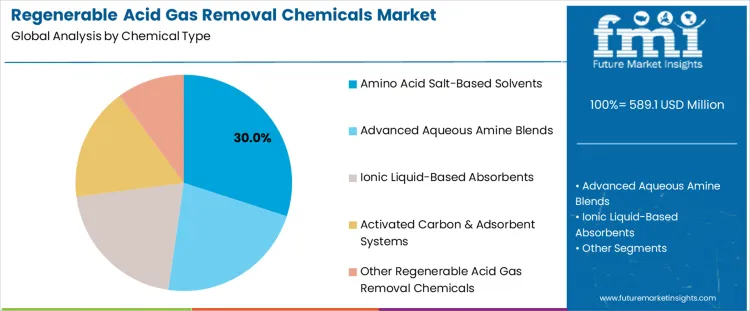
Amino acid salt-based solvents are the leading chemical type in the regenerable acid gas removal chemicals market, holding 30% of the share. These solvents are highly effective at removing acid gases, such as CO₂ and H₂S, from industrial emissions and natural gas streams. They work by forming reversible chemical bonds with acid gases, which can be easily broken during regeneration for reuse. The growing demand for sustainable and cost-effective gas removal solutions is driving the adoption of amino acid salt-based solvents, especially in industries like power generation, natural gas processing, and biogas upgrading.
These solvents are preferred for their high efficiency, low environmental impact, and ease of regeneration. As industries increasingly focus on reducing their carbon footprint and complying with stringent environmental regulations, amino acid salt-based solvents are expected to maintain their dominant position in the market for acid gas removal.
What is Driving the Demand for CO₂ in the Regenerable Acid Gas Removal Chemicals Market?
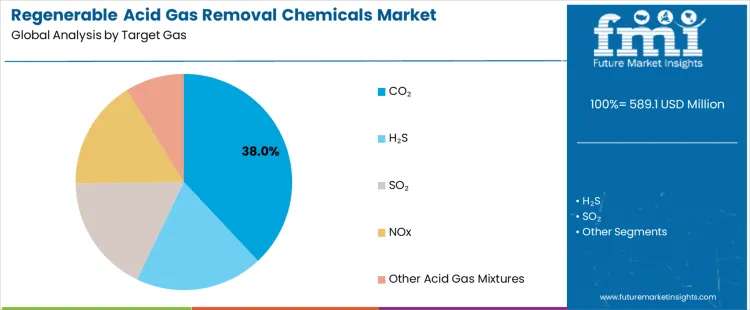
CO₂ is the leading target gas in the regenerable acid gas removal chemicals market, capturing 38% of the share. This demand is primarily driven by the increasing focus on reducing greenhouse gas emissions and mitigating climate change. CO₂ is a major contributor to global warming, and industries such as power generation, natural gas processing, and industrial manufacturing are under increasing pressure to capture and reduce CO₂ emissions. Regenerable acid gas removal chemicals, particularly amino acid salt-based solvents and advanced aqueous amine blends, are highly effective in capturing CO₂ from industrial emissions.
The growing adoption of carbon capture, utilization, and storage (CCUS) technologies and the emphasis on sustainable practices are driving the demand for CO₂ removal solutions. As governments and industries continue to prioritize climate change mitigation, the demand for effective, regenerable CO₂ capture technologies is expected to remain strong, ensuring CO₂’s dominance as the primary target gas in the market.
What are the Key Dynamics in the Global Regenerable Acid Gas Removal Chemicals Market?
The global regenerable acid gas removal chemicals market is expanding as industries adopt solutions that capture and recycle acid gases such as carbon dioxide, hydrogen sulfide, sulfur dioxide and other acidic contaminants from industrial emissions, natural gas streams and process gases. Regenerable chemicals enable repeated use through thermal or pressure swing regeneration, lowering operating cost and waste generation compared with one time use sorbents. Growth reflects regulatory pressure to meet stricter emission standards, investment in carbon capture and utilization infrastructure, and demand for cost effective gas treatment methods across energy, petrochemical and industrial sectors worldwide.
What are the Key Drivers for the Regenerable Acid Gas Removal Chemicals Market?
A key driver is tightening environmental regulation that compels power plants, refineries, petrochemical facilities and gas processing plants to reduce acid gas emissions that contribute to air pollution and corrosion of equipment. Regenerable acid gas removal systems offer economic advantages by enabling repeated chemical cycling, reducing reagent consumption and waste disposal costs. Growth in carbon capture, storage, and utilization initiatives also encourages adoption of chemicals that selectively capture CO₂ for reuse or sequestration. Expansion of natural gas production and processing increases demand for acid gas removal in pipeline quality control. Advances in sorbent and solvent technology improve capture performance, thermal stability and regeneration efficiency, strengthening market uptake.
What are the Restraints for the Regenerable Acid Gas Removal Chemicals Market?
One restraint is the technical complexity and cost of integrating regenerable acid gas removal systems with existing industrial infrastructure. Facilities may require capital investment in regeneration units, heat integration and process controls, which can be significant for retrofit projects. Performance of regenerable chemistry may vary with contaminant concentration, gas composition and operating conditions, requiring thorough pilot testing and optimization. Some operators hesitate to adopt new chemicals until long term reliability, regeneration efficiency and lifecycle cost advantages are clearly demonstrated. Variability in regulatory enforcement timelines across regions can also influence investment planning for advanced acid gas removal technologies.
What are the Key Trends in the Regenerable Acid Gas Removal Chemicals Market?
A key trend is development of advanced sorbents and solvents that improve regeneration efficiency and reduce energy consumption during the capture and release cycle. Materials such as tailored amine blends, solid supported amines and metal organic frameworks are gaining attention for enhanced selectivity and thermal stability. Integration of real time monitoring and process control systems enables precise dosing and regenerable chemical management that maximizes performance. There is growing interest in coupling regenerable acid gas removal with carbon capture and utilization pathways, supporting circular carbon strategies. Collaborative research between chemical developers, industrial end users and academic institutions accelerates validation of next generation formulations and drives adoption in large scale applications.
What is the Country-Wise Analysis of the Regenerable Acid Gas Removal Chemicals Market?
The regenerable acid gas removal chemicals market is expected to grow steadily, driven by increasing demand for efficient and sustainable solutions to remove harmful acid gases, such as hydrogen sulfide (H₂S) and carbon dioxide (CO₂), from industrial emissions. These chemicals are crucial in natural gas processing, refineries, and other industries to meet environmental standards and improve air quality. High-growth markets such as China and India are witnessing strong demand due to their rapidly expanding industrial sectors, energy needs, and growing environmental concerns. Developed markets such as the United States, Germany, and South Korea are also experiencing steady growth, supported by stringent environmental regulations, technological advancements in gas removal technologies, and the push for sustainable industrial practices.
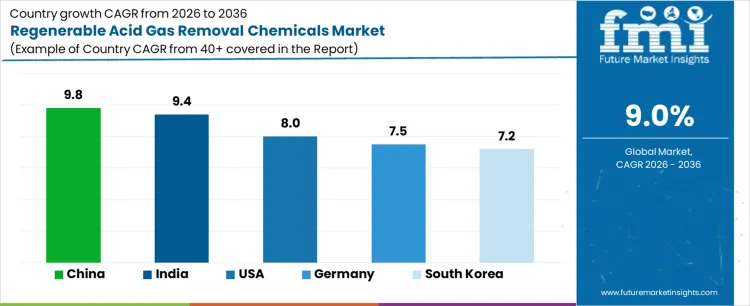
| Country | CAGR (2026-2036) |
|---|---|
| China | 9.8% |
| India | 9.4% |
| USA | 8% |
| Germany | 7.5% |
| South Korea | 7.2% |
What is the Growth Outlook on the Regenerable Acid Gas Removal Chemicals Market in China?
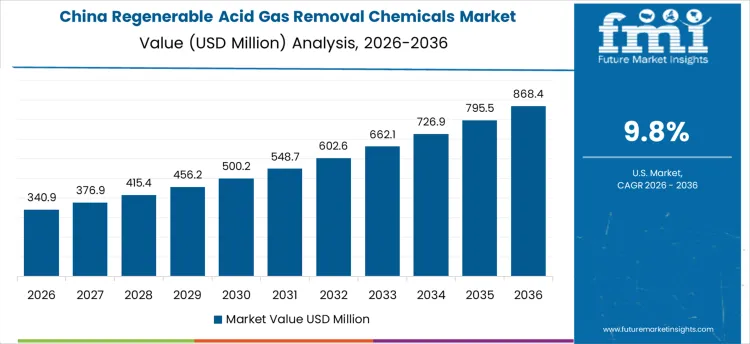
The regenerable acid gas removal chemicals market in China is expected to grow at the highest rate, with a projected CAGR of 9.8%. As one of the largest industrial economies in the world, China faces significant challenges related to air pollution and environmental protection. The country’s energy-intensive industries, particularly natural gas processing and refining, generate high levels of acid gases that require effective removal solutions. The Chinese government’s commitment to reducing emissions and improving air quality, along with stricter environmental regulations, is driving the adoption of regenerable acid gas removal chemicals. As China continues to invest in cleaner technologies and sustainable industrial practices, the market for these chemicals is expected to grow rapidly.
What is the Market Outlook on the Regenerable Acid Gas Removal Chemicals Market in India?
The regenerable acid gas removal chemicals market in India is projected to grow steadily, with a projected CAGR of 9.4%. India’s expanding industrial base, coupled with its growing energy needs, is creating strong demand for effective solutions to manage acid gas emissions. As the country continues to invest in natural gas processing, petrochemical production, and refinery operations, the need for efficient gas removal technologies is rising. The Indian government’s increasing focus on sustainability and environmental regulations to control air pollution is expected to drive the demand for regenerable acid gas removal chemicals. As India continues to develop its industrial and energy sectors, the market for these chemicals is poised for steady growth.
What is the Growth Forecast for the Regenerable Acid Gas Removal Chemicals Market in the United States?
The regenerable acid gas removal chemicals market in the United States is expected to grow steadily, with a projected CAGR of 8%. The U.S. industrial sector, particularly the natural gas, petrochemical, and refinery industries, generates significant amounts of acid gases that need to be effectively removed to meet environmental standards. The U.S. government’s stringent air quality regulations, such as the Clean Air Act, are driving the adoption of advanced pollution control technologies, including regenerable acid gas removal chemicals. As the demand for cleaner energy and sustainable industrial practices grows, the U.S. market for these chemicals is expected to expand steadily, supported by ongoing investments in gas treatment technologies.
What is the Market Outlook on the Regenerable Acid Gas Removal Chemicals Market in Germany?
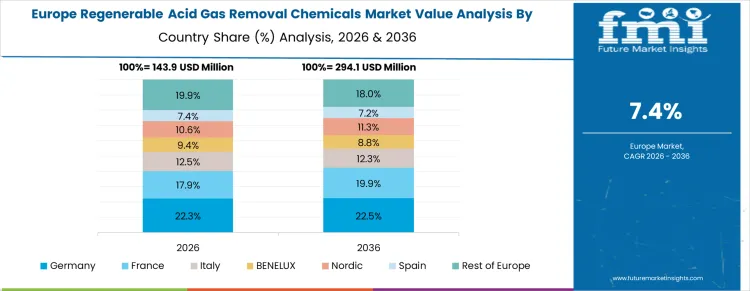
The regenerable acid gas removal chemicals market in Germany is projected to grow at a moderate pace, with a projected CAGR of 7.5%. Germany’s strong commitment to sustainability and strict environmental regulations are key factors driving the adoption of regenerable acid gas removal chemicals. The country’s industrial sectors, particularly natural gas processing, chemical manufacturing, and refining, are significant contributors to acid gas emissions. As Germany seeks to meet its environmental goals and improve air quality, the demand for effective and sustainable gas removal technologies is rising. The market for these chemicals is expected to grow steadily as industries adopt cleaner technologies to comply with environmental standards and reduce their carbon footprint.
What are the Growth Prospects for the Regenerable Acid Gas Removal Chemicals Market in South Korea?
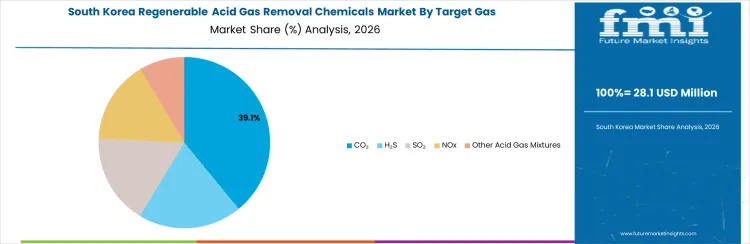
The regenerable acid gas removal chemicals market in South Korea is expected to grow steadily, with a projected CAGR of 7.2%. South Korea’s industrial sector, including its heavy industries such as shipbuilding, petrochemicals, and power generation, generates significant acid gas emissions, driving the need for effective removal technologies. The South Korean government’s emphasis on environmental sustainability, air quality improvement, and regulatory compliance is contributing to the growing demand for regenerable acid gas removal chemicals. With increasing investments in cleaner technologies and the rising focus on reducing emissions, the market for these chemicals is set for steady growth as South Korea continues to address its environmental challenges.
What is the Competitive Landscape for the Regenerable Acid Gas Removal Chemicals Market?
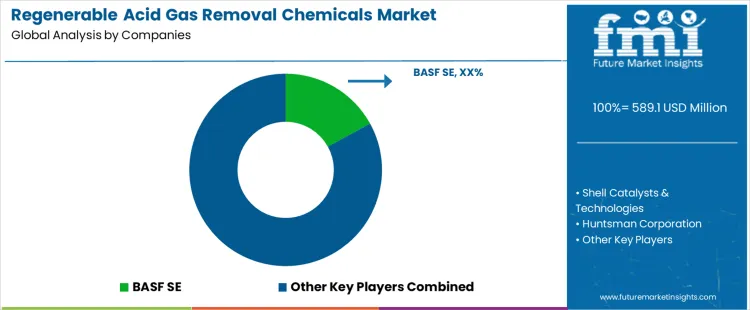
The regenerable acid gas removal chemicals market is growing rapidly as industries seek sustainable, cost-effective solutions for removing acid gases such as CO₂, H₂S, and other contaminants from industrial emissions. BASF SE leads the market with its innovative regenerable acid gas removal chemicals, offering high-performance solutions that enable the safe and efficient capture of acid gases while allowing the chemicals to be regenerated and reused. Their focus on product effectiveness, environmental responsibility, and operational efficiency has positioned them as a dominant player. Shell Catalysts & Technologies, Huntsman Corporation, and Fluor Corporation (Econamine) are significant competitors, each providing specialized chemicals for acid gas removal. Shell Catalysts & Technologies focuses on advanced materials and technologies for acid gas capture, while Huntsman Corporation and Fluor Corporation (Econamine) offer regenerable solutions with high efficiency and cost-effectiveness for large-scale industrial applications.
MHI Engineering further contributes to the competitive landscape by offering acid gas removal chemicals designed for energy-efficient and sustainable operation in gas treatment processes. MHI Engineering focuses on providing advanced solutions that minimize energy consumption and enhance the regeneration process. These companies compete by focusing on product innovation, cost reduction, sustainability, and the ability to meet the growing demand for effective, regenerable acid gas removal solutions across various industries. As environmental regulations tighten and the demand for cleaner emissions increases, the market for regenerable acid gas removal chemicals is expected to continue expanding.
Key Players of the Regenerable Acid Gas Removal Chemicals Market
- BASF SE
- Shell Catalysts & Technologies
- Huntsman Corporation
- Fluor Corporation (Econamine)
- MHI Engineering
Scope of the Report
| Items | Values |
|---|---|
| Quantitative Units (2026) | USD Million |
| Chemical Type | Amino Acid Salt-Based Solvents, Advanced Aqueous Amine Blends, Ionic Liquid-Based Absorbents, Activated Carbon & Adsorbent Systems, Other Regenerable Acid Gas Removal Chemicals |
| Target Gas | CO₂, H₂S, SO₂, NOx, Other Acid Gas Mixtures |
| End-Use Industry | Oil & Gas Processing, Power Generation & Utilities, Petrochemical & Refining, Cement & Steel Manufacturing, Waste-to-Energy & Industrial Emissions |
| Companies | BASF SE, Shell Catalysts & Technologies, Huntsman Corporation, Fluor Corporation (Econamine), MHI Engineering |
| Regions Covered | North America, Latin America, Western Europe, Eastern Europe, South Asia and Pacific, East Asia, Middle East & Africa |
| Countries Covered | United States, Canada, Mexico, Brazil, Argentina, Germany, France, United Kingdom, Italy, Spain, Netherlands, China, India, Japan, South Korea, ANZ, GCC Countries, South Africa |
| Additional Attributes | Dollar by sales by chemical type, target gas, end-use industry, and region. Includes market trends in regenerable acid gas removal chemicals, performance in various gas removal applications, cost-effectiveness, sustainability practices, regulatory compliance, market share and competitive positioning of key companies, and the role of regenerable chemicals in improving industrial gas removal efficiency, reducing emissions, and supporting environmental compliance across various industrial sectors. |
Regenerable Acid Gas Removal Chemicals Market Segmentation
Chemical Type:
- Amino Acid Salt-Based Solvents
- Advanced Aqueous Amine Blends
- Ionic Liquid-Based Absorbents
- Activated Carbon & Adsorbent Systems
- Other Regenerable Acid Gas Removal Chemicals
Target Gas:
- CO₂
- H₂S
- SO₂
- NOx
- Other Acid Gas Mixtures
End-Use Industry:
- Oil & Gas Processing
- Power Generation & Utilities
- Petrochemical & Refining
- Cement & Steel Manufacturing
- Waste-to-Energy & Industrial Emissions
Region:
- Asia Pacific
- China
- Japan
- South Korea
- India
- Australia & New Zealand
- ASEAN
- Rest of Asia Pacific
- Europe
- Germany
- United Kingdom
- France
- Italy
- Spain
- Nordic
- BENELUX
- Rest of Europe
- North America
- United States
- Canada
- Mexico
- Latin America
- Brazil
- Chile
- Rest of Latin America
- Middle East & Africa
- Kingdom of Saudi Arabia
- Other GCC Countries
- Turkey
- South Africa
- Other African Union
- Rest of Middle East & Africa
Frequently Asked Questions
How big is the regenerable acid gas removal chemicals market in 2026?
The global regenerable acid gas removal chemicals market is estimated to be valued at USD 589.1 million in 2026.
What will be the size of regenerable acid gas removal chemicals market in 2036?
The market size for the regenerable acid gas removal chemicals market is projected to reach USD 1,394.6 million by 2036.
How much will be the regenerable acid gas removal chemicals market growth between 2026 and 2036?
The regenerable acid gas removal chemicals market is expected to grow at a 9.0% CAGR between 2026 and 2036.
What are the key product types in the regenerable acid gas removal chemicals market?
The key product types in regenerable acid gas removal chemicals market are amino acid salt-based solvents, advanced aqueous amine blends, ionic liquid-based absorbents, activated carbon & adsorbent systems and other regenerable acid gas removal chemicals.
Which target gas segment to contribute significant share in the regenerable acid gas removal chemicals market in 2026?
In terms of target gas, co₂ segment to command 38.0% share in the regenerable acid gas removal chemicals market in 2026.
Preview the report firsthand - request a free sample
Get SampleGet the brochure for pricing and purchase details.
Get PDFTable of Content
- Executive Summary
- Global Market Outlook
- Demand-side Trends
- Supply-side Trends
- Technology Roadmap Analysis
- Analysis and Recommendations
- Market Overview
- Market Coverage / Taxonomy
- Market Definition / Scope / Limitations
- Market Background
- Market Dynamics
- Drivers
- Restraints
- Opportunity
- Trends
- Scenario Forecast
- Demand in Optimistic Scenario
- Demand in Likely Scenario
- Demand in Conservative Scenario
- Opportunity Map Analysis
- Product Life Cycle Analysis
- Supply Chain Analysis
- Investment Feasibility Matrix
- Value Chain Analysis
- PESTLE and Porter’s Analysis
- Regulatory Landscape
- Regional Parent Market Outlook
- Production and Consumption Statistics
- Import and Export Statistics
- Market Dynamics
- Global Market Analysis 2021 to 2025 and Forecast, 2026 to 2036
- Historical Market Size Value (USD Million) Analysis, 2021 to 2025
- Current and Future Market Size Value (USD Million) Projections, 2026 to 2036
- Y-o-Y Growth Trend Analysis
- Absolute $ Opportunity Analysis
- Global Market Pricing Analysis 2021 to 2025 and Forecast 2026 to 2036
- Global Market Analysis 2021 to 2025 and Forecast 2026 to 2036, By Chemical Type
- Introduction / Key Findings
- Historical Market Size Value (USD Million) Analysis By Chemical Type , 2021 to 2025
- Current and Future Market Size Value (USD Million) Analysis and Forecast By Chemical Type , 2026 to 2036
- Amino Acid Salt-Based Solvents
- Advanced Aqueous Amine Blends
- Ionic Liquid-Based Absorbents
- Activated Carbon & Adsorbent Systems
- Other Regenerable Acid Gas Removal Chemicals
- Amino Acid Salt-Based Solvents
- Y-o-Y Growth Trend Analysis By Chemical Type , 2021 to 2025
- Absolute $ Opportunity Analysis By Chemical Type , 2026 to 2036
- Global Market Analysis 2021 to 2025 and Forecast 2026 to 2036, By Target Gas
- Introduction / Key Findings
- Historical Market Size Value (USD Million) Analysis By Target Gas, 2021 to 2025
- Current and Future Market Size Value (USD Million) Analysis and Forecast By Target Gas, 2026 to 2036
- CO₂
- H₂S
- SO₂
- NOx
- Other Acid Gas Mixtures
- CO₂
- Y-o-Y Growth Trend Analysis By Target Gas, 2021 to 2025
- Absolute $ Opportunity Analysis By Target Gas, 2026 to 2036
- Global Market Analysis 2021 to 2025 and Forecast 2026 to 2036, By End-Use Industry
- Introduction / Key Findings
- Historical Market Size Value (USD Million) Analysis By End-Use Industry, 2021 to 2025
- Current and Future Market Size Value (USD Million) Analysis and Forecast By End-Use Industry, 2026 to 2036
- Oil & Gas Processing
- Power Generation & Utilities
- Petrochemical & Refining
- Cement & Steel Manufacturing
- Waste-to-Energy & Industrial Emissions
- Oil & Gas Processing
- Y-o-Y Growth Trend Analysis By End-Use Industry, 2021 to 2025
- Absolute $ Opportunity Analysis By End-Use Industry, 2026 to 2036
- Global Market Analysis 2021 to 2025 and Forecast 2026 to 2036, By Region
- Introduction
- Historical Market Size Value (USD Million) Analysis By Region, 2021 to 2025
- Current Market Size Value (USD Million) Analysis and Forecast By Region, 2026 to 2036
- North America
- Latin America
- Western Europe
- Eastern Europe
- East Asia
- South Asia and Pacific
- Middle East & Africa
- Market Attractiveness Analysis By Region
- North America Market Analysis 2021 to 2025 and Forecast 2026 to 2036, By Country
- Historical Market Size Value (USD Million) Trend Analysis By Market Taxonomy, 2021 to 2025
- Market Size Value (USD Million) Forecast By Market Taxonomy, 2026 to 2036
- By Country
- USA
- Canada
- Mexico
- By Chemical Type
- By Target Gas
- By End-Use Industry
- By Country
- Market Attractiveness Analysis
- By Country
- By Chemical Type
- By Target Gas
- By End-Use Industry
- Key Takeaways
- Latin America Market Analysis 2021 to 2025 and Forecast 2026 to 2036, By Country
- Historical Market Size Value (USD Million) Trend Analysis By Market Taxonomy, 2021 to 2025
- Market Size Value (USD Million) Forecast By Market Taxonomy, 2026 to 2036
- By Country
- Brazil
- Chile
- Rest of Latin America
- By Chemical Type
- By Target Gas
- By End-Use Industry
- By Country
- Market Attractiveness Analysis
- By Country
- By Chemical Type
- By Target Gas
- By End-Use Industry
- Key Takeaways
- Western Europe Market Analysis 2021 to 2025 and Forecast 2026 to 2036, By Country
- Historical Market Size Value (USD Million) Trend Analysis By Market Taxonomy, 2021 to 2025
- Market Size Value (USD Million) Forecast By Market Taxonomy, 2026 to 2036
- By Country
- Germany
- UK
- Italy
- Spain
- France
- Nordic
- BENELUX
- Rest of Western Europe
- By Chemical Type
- By Target Gas
- By End-Use Industry
- By Country
- Market Attractiveness Analysis
- By Country
- By Chemical Type
- By Target Gas
- By End-Use Industry
- Key Takeaways
- Eastern Europe Market Analysis 2021 to 2025 and Forecast 2026 to 2036, By Country
- Historical Market Size Value (USD Million) Trend Analysis By Market Taxonomy, 2021 to 2025
- Market Size Value (USD Million) Forecast By Market Taxonomy, 2026 to 2036
- By Country
- Russia
- Poland
- Hungary
- Balkan & Baltic
- Rest of Eastern Europe
- By Chemical Type
- By Target Gas
- By End-Use Industry
- By Country
- Market Attractiveness Analysis
- By Country
- By Chemical Type
- By Target Gas
- By End-Use Industry
- Key Takeaways
- East Asia Market Analysis 2021 to 2025 and Forecast 2026 to 2036, By Country
- Historical Market Size Value (USD Million) Trend Analysis By Market Taxonomy, 2021 to 2025
- Market Size Value (USD Million) Forecast By Market Taxonomy, 2026 to 2036
- By Country
- China
- Japan
- South Korea
- By Chemical Type
- By Target Gas
- By End-Use Industry
- By Country
- Market Attractiveness Analysis
- By Country
- By Chemical Type
- By Target Gas
- By End-Use Industry
- Key Takeaways
- South Asia and Pacific Market Analysis 2021 to 2025 and Forecast 2026 to 2036, By Country
- Historical Market Size Value (USD Million) Trend Analysis By Market Taxonomy, 2021 to 2025
- Market Size Value (USD Million) Forecast By Market Taxonomy, 2026 to 2036
- By Country
- India
- ASEAN
- Australia & New Zealand
- Rest of South Asia and Pacific
- By Chemical Type
- By Target Gas
- By End-Use Industry
- By Country
- Market Attractiveness Analysis
- By Country
- By Chemical Type
- By Target Gas
- By End-Use Industry
- Key Takeaways
- Middle East & Africa Market Analysis 2021 to 2025 and Forecast 2026 to 2036, By Country
- Historical Market Size Value (USD Million) Trend Analysis By Market Taxonomy, 2021 to 2025
- Market Size Value (USD Million) Forecast By Market Taxonomy, 2026 to 2036
- By Country
- Kingdom of Saudi Arabia
- Other GCC Countries
- Turkiye
- South Africa
- Other African Union
- Rest of Middle East & Africa
- By Chemical Type
- By Target Gas
- By End-Use Industry
- By Country
- Market Attractiveness Analysis
- By Country
- By Chemical Type
- By Target Gas
- By End-Use Industry
- Key Takeaways
- Key Countries Market Analysis
- USA
- Pricing Analysis
- Market Share Analysis, 2025
- By Chemical Type
- By Target Gas
- By End-Use Industry
- Canada
- Pricing Analysis
- Market Share Analysis, 2025
- By Chemical Type
- By Target Gas
- By End-Use Industry
- Mexico
- Pricing Analysis
- Market Share Analysis, 2025
- By Chemical Type
- By Target Gas
- By End-Use Industry
- Brazil
- Pricing Analysis
- Market Share Analysis, 2025
- By Chemical Type
- By Target Gas
- By End-Use Industry
- Chile
- Pricing Analysis
- Market Share Analysis, 2025
- By Chemical Type
- By Target Gas
- By End-Use Industry
- Germany
- Pricing Analysis
- Market Share Analysis, 2025
- By Chemical Type
- By Target Gas
- By End-Use Industry
- UK
- Pricing Analysis
- Market Share Analysis, 2025
- By Chemical Type
- By Target Gas
- By End-Use Industry
- Italy
- Pricing Analysis
- Market Share Analysis, 2025
- By Chemical Type
- By Target Gas
- By End-Use Industry
- Spain
- Pricing Analysis
- Market Share Analysis, 2025
- By Chemical Type
- By Target Gas
- By End-Use Industry
- France
- Pricing Analysis
- Market Share Analysis, 2025
- By Chemical Type
- By Target Gas
- By End-Use Industry
- India
- Pricing Analysis
- Market Share Analysis, 2025
- By Chemical Type
- By Target Gas
- By End-Use Industry
- ASEAN
- Pricing Analysis
- Market Share Analysis, 2025
- By Chemical Type
- By Target Gas
- By End-Use Industry
- Australia & New Zealand
- Pricing Analysis
- Market Share Analysis, 2025
- By Chemical Type
- By Target Gas
- By End-Use Industry
- China
- Pricing Analysis
- Market Share Analysis, 2025
- By Chemical Type
- By Target Gas
- By End-Use Industry
- Japan
- Pricing Analysis
- Market Share Analysis, 2025
- By Chemical Type
- By Target Gas
- By End-Use Industry
- South Korea
- Pricing Analysis
- Market Share Analysis, 2025
- By Chemical Type
- By Target Gas
- By End-Use Industry
- Russia
- Pricing Analysis
- Market Share Analysis, 2025
- By Chemical Type
- By Target Gas
- By End-Use Industry
- Poland
- Pricing Analysis
- Market Share Analysis, 2025
- By Chemical Type
- By Target Gas
- By End-Use Industry
- Hungary
- Pricing Analysis
- Market Share Analysis, 2025
- By Chemical Type
- By Target Gas
- By End-Use Industry
- Kingdom of Saudi Arabia
- Pricing Analysis
- Market Share Analysis, 2025
- By Chemical Type
- By Target Gas
- By End-Use Industry
- Turkiye
- Pricing Analysis
- Market Share Analysis, 2025
- By Chemical Type
- By Target Gas
- By End-Use Industry
- South Africa
- Pricing Analysis
- Market Share Analysis, 2025
- By Chemical Type
- By Target Gas
- By End-Use Industry
- USA
- Market Structure Analysis
- Competition Dashboard
- Competition Benchmarking
- Market Share Analysis of Top Players
- By Regional
- By Chemical Type
- By Target Gas
- By End-Use Industry
- Competition Analysis
- Competition Deep Dive
- BASF SE
- Overview
- Product Portfolio
- Profitability by Market Segments (Product/Age /Sales Channel/Region)
- Sales Footprint
- Strategy Overview
- Marketing Strategy
- Product Strategy
- Channel Strategy
- Shell Catalysts & Technologies
- Huntsman Corporation
- Fluor Corporation (Econamine)
- MHI Engineering
- BASF SE
- Competition Deep Dive
- Assumptions & Acronyms Used
- Research Methodology


