

- Industry Size (2026)
- USD 676.4 Mn
- Forecast (2036)
- USD 1616 Mn
- CAGR (2026 to 2036)
- 9.1%
Arsenic Removal Media and Chemicals Market Forecast and Outlook 2026 to 2036
The arsenic removal media and chemicals market is valued at USD 676.4 million in 2026 and is forecasted to reach USD 1,616 million by 2036, expanding at a CAGR of 9.1%. Growth is driven by chronic arsenic contamination in groundwater, tightening drinking water standards, and public health programs targeting long-term exposure risks. Municipal authorities prioritize dedicated arsenic treatment solutions as conventional filtration and disinfection systems show limited removal efficiency, particularly in naturally contaminated aquifers.
Iron oxide and ferric-based adsorbents represent leading chemical-type demand due to high affinity for both arsenite and arsenate species. These media enable efficient adsorption across varying pH conditions and are suitable for fixed-bed, point-of-entry, and centralized treatment configurations. Preference for ferric-based systems reflects operational simplicity, predictable breakthrough behavior, and compatibility with existing drinking water treatment infrastructure. Segment structure indicates emphasis on adsorption-driven purification over complex chemical transformation approaches for arsenic control.
Quick Stats for Arsenic Removal Media and Chemicals Market
- Arsenic Removal Media and Chemicals Market Value (2026): USD 676.4 million
- Arsenic Removal Media and Chemicals Market Forecast Value (2036): USD 1,616 million
- Arsenic Removal Media and Chemicals Market Forecast CAGR (2026-2036): 9.1%
- Leading Chemical Type in Global Demand: Iron Oxide or Ferric-Based Adsorbents
- Fastest-Growing Countries: India, China, Bangladesh, USA, Germany
- Top Players in Global Demand: AdEdge Water Technologies, Evoqua Water Technologies, Kemira, Kurita Water Industries, Veolia Water Technologies
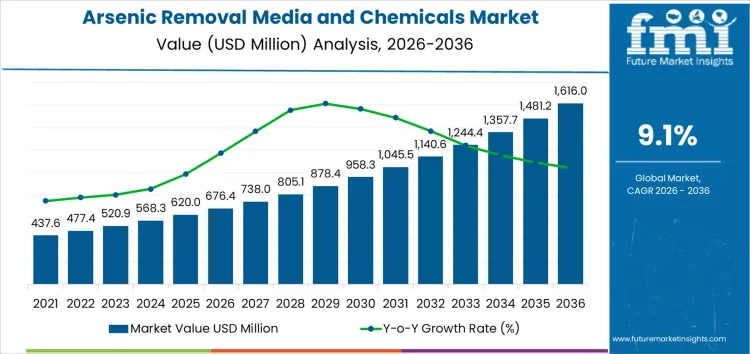
Municipal drinking water purification represents leading treatment application demand, reflecting regulatory focus on safe potable water supply. India, China, Bangladesh, USA, and Germany emerge as fastest-growing countries, supported by groundwater dependence and regulatory enforcement. Competitive landscape includes AdEdge Water Technologies, Evoqua Water Technologies, Kemira, Kurita Water Industries, and Veolia Water Technologies. These players focus on high-capacity adsorbents, lifecycle media optimization, and scalable deployment for arsenic-affected regions.
Arsenic Removal Media and Chemicals Market Key Takeaways
| Metric | Value |
|---|---|
| Market Value (2026) | USD 676.4 million |
| Market Forecast Value (2036) | USD 1,616 million |
| Forecast CAGR (2026-2036) | 9.1% |
Why is the Demand for Arsenic Removal Media and Chemicals Market Growing?
Demand for arsenic removal media and chemicals is growing globally due to increasing detection of arsenic in groundwater and surface water supplies and tightening regulatory limits enforced by public health authorities. Arsenic contamination arises from natural geological sources and anthropogenic activities such as mining, industrial processing, and agricultural runoff. Utilities and rural water systems adopt specialized adsorbents, ion exchange resins, and precipitation chemicals to achieve arsenic concentrations below evolving safety thresholds. Expansion of potable reuse and decentralized water treatment programs reinforces need for reliable removal solutions that maintain safe drinking water quality.
Regulatory frameworks in multiple regions mandate lower maximum contaminant levels, which strengthens procurement of high-performance media tailored to varying water chemistries and pH conditions. Industrial users implement arsenic control within process and effluent streams to meet compliance and reduce liability. Research and development improve media capacity, regeneration efficiency, and overall cost-effective, broadening applicability across utilities of varied scale. NGOs and international development programs support implementation of removal technologies in communities affected by endemic arsenic exposure. Seasonal water quality fluctuation increases reliance on adaptive treatment strategies that combine multiple removal agents.
How Are the Segments Classified in the Arsenic Removal Media and Chemicals Market?
Demand for arsenic removal media and chemicals globally is shaped by drinking water safety standards, groundwater contamination prevalence, and public health risk mitigation requirements. Treatment operators assess adsorption capacity, media longevity, regeneration behavior, and compatibility with centralized and decentralized systems. Adoption patterns reflect strong reliance on proven adsorption technologies across municipal utilities, groundwater remediation programs, and industrial effluent treatment operations addressing chronic arsenic exposure risks.
Which Chemical Type Holds the Largest Share of Global Demand?
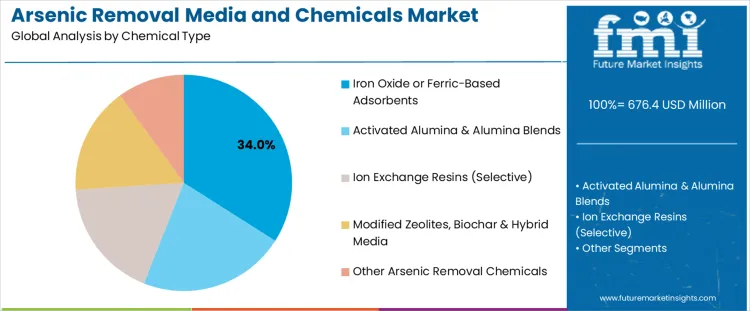
Iron oxide or ferric-based adsorbents hold 34.0%, representing the largest share of global demand. These materials demonstrate strong affinity for arsenic species and stable performance across variable water chemistries. Activated alumina and alumina blends account for 22.0%, supporting established use in fixed-bed filtration systems. Selective ion exchange resins hold 18.0%, enabling targeted arsenic removal under controlled conditions. Modified zeolites, biochar, and hybrid media account for 16.0%, reflecting innovation in adsorption enhancement. Other arsenic removal chemicals hold 10.0%. Chemical-type distribution reflects preference for high-capacity, reliable adsorption media.
Key Points
-
Iron-based adsorbents lead due to strong arsenic binding efficiency.
- Alumina systems support established filtration infrastructure.
- Hybrid media address performance optimization needs.
Which Treatment Application Accounts for the Highest Share of Global Adoption?
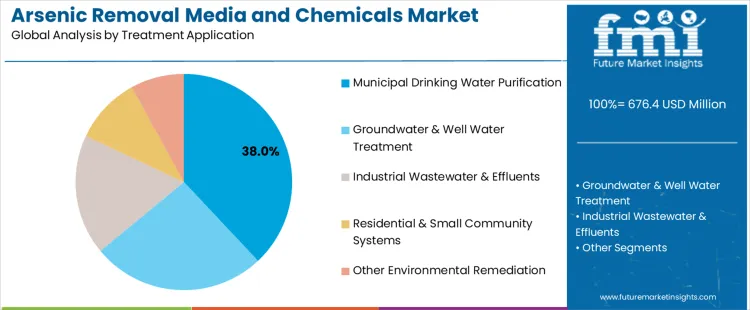
Municipal drinking water purification holds 38.0%, accounting for the highest share of global adoption. Utilities prioritize arsenic removal to meet potable water standards and protect public health. Groundwater and well water treatment accounts for 26.0%, addressing naturally occurring arsenic contamination. Industrial wastewater and effluents hold 18.0%, managing process-related arsenic discharge. Residential and small community systems account for 10.0%, supporting decentralized treatment. Other environmental remediation holds 8.0%. Application distribution reflects concentration of arsenic risk within drinking water sources.
Key Points
- Municipal purification dominates due to regulatory compliance needs.
- Groundwater treatment addresses geogenic contamination.
- Industrial effluents require controlled arsenic discharge management.
Which End-Use Sector Drives the Largest Share of Global Demand?
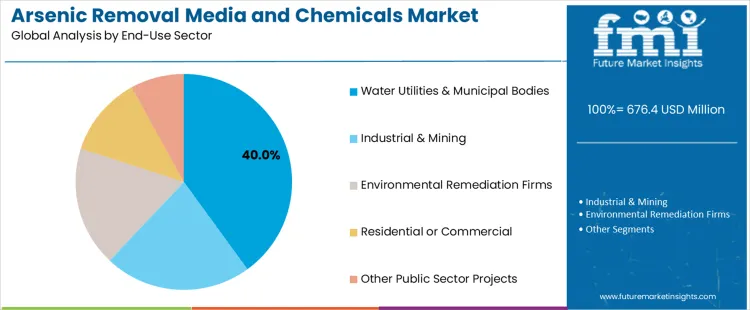
Water utilities and municipal bodies hold 40.0%, driving the largest share of global demand. These entities operate large-scale systems under strict water quality regulations. Industrial and mining sectors account for 22.0%, managing arsenic-bearing effluents and process water. Environmental remediation firms hold 18.0%, supporting site cleanup and legacy contamination control. Residential or commercial users account for 12.0%, relying on point-of-use solutions. Other public sector projects hold 8.0%. End-use distribution reflects centralized responsibility for arsenic risk management.
Key Points
- Utilities lead due to scale and regulatory accountability.
- Industrial users manage process-related arsenic exposure.
- Remediation firms address legacy contamination sites.
What are the Key Dynamics in the Arsenic Removal Media and Chemicals Market?
Global demand rises as water and wastewater treatment facilities, mining operations, and industrial processors adopt specialized media and chemical solutions to mitigate arsenic contamination. Arsenic adsorbents, coagulants, and precipitation reagents support reduction of arsenic to meet stringent health-based limits in drinking water and effluent discharges. Adoption aligns with expanded monitoring, regulatory enforcement, and infrastructure investment to protect public health and aquatic ecosystems across multiple regions. Usage spans municipal utilities, rural water systems, and heavy-industry effluent treatment.
How do regulatory standards and public health priorities shape global demand?
Governments and environmental agencies in North America, Europe, Asia-Pacific, and Latin America enforce low permissible arsenic concentrations in drinking water due to arsenic’s toxicity and carcinogenic risk. Utilities incorporate adsorptive media-such as activated alumina, iron-based sorbents, and hybrid engineered materials-and chemical dosing strategies to enhance removal of both arsenite and arsenate species. Industrial sectors including mining, electronics, and metal plating deploy arsenic removal solutions to comply with discharge permits and avoid liability for contaminated runoff. Public awareness campaigns highlighting arsenic risk in groundwater drive investment in community and point-of-use treatment systems. Standards tied to sustainable development goals reinforce arsenic mitigation measures within broader water quality initiatives.
How do source variability, cost barriers, and operational complexity influence market scalability?
Arsenic occurrence and speciation vary with geologic context, redox conditions, and other water chemistry parameters, necessitating tailored selection of removal media and dosing strategies. Performance of media and chemicals depends on competing ions, pH, and organic content, influencing treatment effectiveness and lifecycle cost. Advanced adsorbents may carry higher upfront costs, affecting adoption in resource-limited areas. Regeneration and disposal of spent media introduce logistical and environmental considerations. Integration with existing treatment infrastructure requires careful design to avoid adverse impacts on downstream processes. Regional differences in arsenic regulation and enforcement create uneven urgency for deployment. Global growth depends on development of cost-effective, robust removal solutions and integrated treatment frameworks that support reliable arsenic compliance across diverse water quality contexts.
How Is Demand for Arsenic Removal Media and Chemicals Evolving?
Demand for arsenic removal media and chemicals is increasing globally due to public health risk mitigation, tighter drinking water standards, and groundwater contamination exposure. India leads with a 10.6% CAGR, supported by large-scale rural mitigation programs and groundwater dependence. China follows at 10.2%, driven by regional contamination control and municipal treatment upgrades. Bangladesh records 9.8%, reflecting long-term arsenic exposure management and donor-supported water safety programs. USA posts an 8.5% CAGR, shaped by regulatory compliance for small and mid-sized utilities. Germany records 7.6%, supported by precautionary regulation and advanced treatment optimization. Growth reflects sustained focus on arsenic risk reduction worldwide.
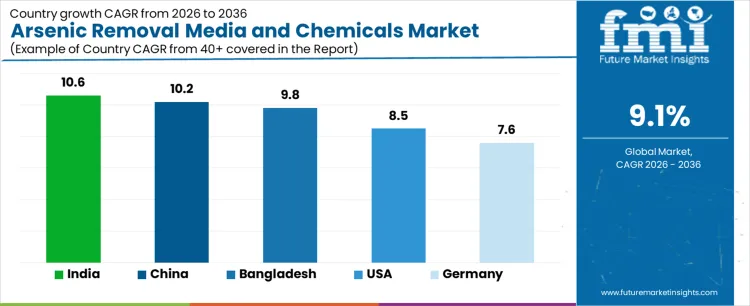
| Country | CAGR (%) |
|---|---|
| India | 10.6% |
| China | 10.2% |
| Bangladesh | 9.8% |
| USA | 8.5% |
| Germany | 7.6% |
What factors are driving strong adoption of arsenic removal solutions in India?
India demand is driven by widespread groundwater arsenic contamination and reliance on decentralized drinking water sources. CAGR of 10.6% reflects deployment of adsorption media, iron-based chemicals, and point-of-use treatment systems. Rural water supply schemes integrate arsenic removal units to meet potable water standards. State-level monitoring programs increase treatment coverage. Municipal utilities adopt chemical removal to supplement existing filtration. Public health initiatives prioritize long-term exposure reduction. Growth remains infrastructure-led and policy-supported, aligned with improving safe water access across affected regions.
- Groundwater arsenic contamination mitigation
- Rural and decentralized water treatment deployment
- Use of iron-based adsorption and chemicals
- Public health–driven water safety programs
How is China sustaining high growth in arsenic removal media usage?
China demand reflects regional groundwater contamination challenges and modernization of municipal water treatment plants. CAGR of 10.2% is supported by adoption of granular media, co-precipitation chemicals, and hybrid treatment processes. Utilities integrate arsenic removal within multi-stage treatment trains. Centralized planning enables standardized procurement and implementation. Industrial discharge controls reduce upstream contamination. Continuous water quality monitoring sustains consistent media replacement demand. Growth remains scale-driven and regulation-aligned, supported by national water safety objectives.
- Regional groundwater arsenic control programs
- Integration into municipal treatment systems
- Standardized procurement and deployment
- Continuous water quality monitoring
What supports sustained arsenic removal demand growth in Bangladesh?
Bangladesh demand is driven by chronic groundwater arsenic exposure and reliance on tube wells. CAGR of 9.8% reflects long-term deployment of adsorption media, household filters, and community-scale treatment units. International funding and NGO programs support technology rollout. Monitoring initiatives guide targeted intervention in high-risk zones. Chemical and media solutions provide interim mitigation where alternative sources remain limited. Growth remains public health–focused and program-driven, aligned with reducing long-term exposure risks.
- Chronic groundwater arsenic exposure management
- Community and household-scale treatment systems
- International funding and NGO involvement
- Targeted intervention in high-risk regions
What regulatory drivers shape arsenic removal demand in the USA?
USA demand is shaped by federal arsenic limits and compliance requirements for drinking water systems. CAGR of 8.5% reflects adoption of removal media and chemicals by small and mid-sized utilities. Utilities deploy adsorption, coagulation, and ion exchange to meet regulatory thresholds. Aging infrastructure favors chemical and media-based solutions without major plant reconstruction. Monitoring and reporting obligations sustain consistent treatment demand. Growth remains regulation-driven and compliance-focused, aligned with public health protection standards.
- Federal arsenic limits for drinking water
- Small and mid-sized utility compliance needs
- Media and chemical-based treatment adoption
- Monitoring and reporting requirements
Why does Germany show steady but controlled demand growth?
Germany demand reflects precautionary water quality regulation and low baseline contamination levels. CAGR of 7.6% is supported by targeted use of arsenic removal media in localized groundwater treatment. Utilities emphasize preventive monitoring and optimized dosing. Strong source protection reduces widespread treatment requirements. Documentation and validation standards guide deployment. Growth remains efficiency-led and stability-focused, aligned with established water management and public health protection practices.
- Precautionary drinking water regulation
- Targeted groundwater treatment deployment
- Strong source protection measures
- Emphasis on documentation and validation
What is the competitive landscape of demand for arsenic removal media and chemicals?
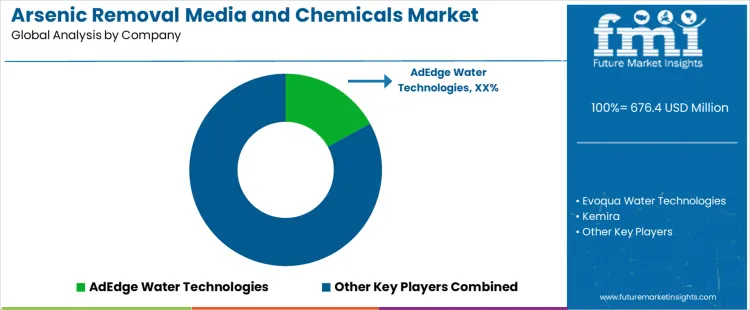
Demand for arsenic removal media and chemicals is driven by stringent drinking water standards, groundwater contamination in developing regions, and long-term public health risk mitigation programs. Treatment approaches include adsorption media, iron-based coagulants, hybrid filtration systems, and chemical oxidation combined with solid separation. Buyers evaluate removal efficiency across arsenic III and arsenic V species, media lifespan, operational complexity, and waste disposal requirements. Procurement teams prioritize proven performance under variable source water chemistry, regulatory acceptance, and scalability for small community systems and large municipal plants. Trend in the global market reflects expansion of groundwater-dependent supply systems, increased regulatory enforcement, and preference for reliable point-of-entry and centralized treatment solutions.
AdEdge Water Technologies maintains strong positioning through specialized adsorption media and packaged systems designed specifically for arsenic compliance applications. Evoqua Water Technologies supports global demand with engineered media, chemical solutions, and integrated treatment systems applied across municipal and industrial installations. Kemira supplies iron-based coagulants and supporting chemicals used widely in arsenic precipitation and removal processes. Kurita Water Industries contributes adsorption media and chemical programs aligned with drinking water and industrial treatment requirements, supported by strong process expertise. Veolia Water Technologies integrates arsenic removal media and chemicals within broader water treatment solutions, enabling compliance-driven deployment at scale. Competitive differentiation depends on removal reliability, media longevity, process integration capability, and ability to support diverse water quality conditions globally.
Key Players in the Arsenic Removal Media and Chemicals Market
- AdEdge Water Technologies
- Evoqua Water Technologies
- Kemira
- Kurita Water Industries
- Veolia Water Technologies
Scope of the Report
| Items | Values |
|---|---|
| Quantitative Units | USD million |
| Chemical Type | Iron Oxide or Ferric-Based Adsorbents; Activated Alumina & Alumina Blends; Ion Exchange Resins (Selective); Modified Zeolites, Biochar & Hybrid Media; Other Arsenic Removal Chemicals |
| Treatment Application | Municipal Drinking Water Purification; Groundwater & Well Water Treatment; Industrial Wastewater & Effluents; Residential & Small Community Systems; Other Environmental Remediation |
| End-Use Sector | Water Utilities & Municipal Bodies; Industrial & Mining; Environmental Remediation Firms; Residential or Commercial; Other Public Sector Projects |
| Regions Covered | Asia Pacific, Europe, North America, Latin America, Middle East & Africa |
| Countries Covered | India, China, Bangladesh, USA, Germany, and 40+ countries |
| Key Companies Profiled | AdEdge Water Technologies; Evoqua Water Technologies; Kemira; Kurita Water Industries; Veolia Water Technologies |
| Additional Attributes | Dollar sales by chemical type and treatment application; adoption trends for ferric-based and alumina adsorption media in arsenic mitigation; removal efficiency metrics for As(III) and As(V) species; compatibility with centralized and decentralized water treatment systems; media lifecycle, regeneration, and disposal considerations; drinking water quality regulations and arsenic compliance standards influencing technology selection. |
Arsenic Removal Media and Chemicals Market by Segment
Chemical Type:
- Iron Oxide or Ferric-Based Adsorbents
- Activated Alumina & Alumina Blends
- Ion Exchange Resins (Selective)
- Modified Zeolites, Biochar & Hybrid Media
- Other Arsenic Removal Chemicals
Treatment Application:
- Municipal Drinking Water Purification
- Groundwater & Well Water Treatment
- Industrial Wastewater & Effluents
- Residential & Small Community Systems
- Other Environmental Remediation
End-Use Sector:
- Water Utilities & Municipal Bodies
- Industrial & Mining
- Environmental Remediation Firms
- Residential or Commercial
- Other Public Sector Projects
Region:
- Asia Pacific
- China
- Japan
- South Korea
- India
- Australia & New Zealand
- ASEAN
- Rest of Asia Pacific
- Europe
- Germany
- United Kingdom
- France
- Italy
- Spain
- Nordic
- BENELUX
- Rest of Europe
- North America
- United States
- Canada
- Mexico
- Latin America
- Brazil
- Chile
- Rest of Latin America
- Middle East & Africa
- Kingdom of Saudi Arabia
- Other GCC Countries
- Turkey
- South Africa
- Other African Union
- Rest of Middle East & Africa
Bibliography
- World Health Organization. (2023). Guidelines for drinking-water quality: Arsenic risk assessment and treatment requirements. World Health Organization.
- USA Environmental Protection Agency. (2023). Arsenic treatment technologies for drinking water systems. USA Environmental Protection Agency.
- European Commission. (2023). Drinking water directive and arsenic compliance requirements for public water supplies. European Commission.
- Organization for Economic Co-operation and Development. (2024). Managing arsenic contamination in groundwater and drinking water sources. OECD Publishing.
Frequently Asked Questions
How big is the arsenic removal media and chemicals market in 2026?
The global arsenic removal media and chemicals market is estimated to be valued at USD 676.4 million in 2026.
What will be the size of arsenic removal media and chemicals market in 2036?
The market size for the arsenic removal media and chemicals market is projected to reach USD 1,616.0 million by 2036.
How much will be the arsenic removal media and chemicals market growth between 2026 and 2036?
The arsenic removal media and chemicals market is expected to grow at a 9.1% CAGR between 2026 and 2036.
What are the key product types in the arsenic removal media and chemicals market?
The key product types in arsenic removal media and chemicals market are iron oxide or ferric-based adsorbents, activated alumina & alumina blends, ion exchange resins (selective), modified zeolites, biochar & hybrid media and other arsenic removal chemicals.
Which treatment application segment to contribute significant share in the arsenic removal media and chemicals market in 2026?
In terms of treatment application, municipal drinking water purification segment to command 38.0% share in the arsenic removal media and chemicals market in 2026.
Preview the report firsthand - request a free sample
Get SampleGet the brochure for pricing and purchase details.
Get PDFTable of Content
- Executive Summary
- Global Market Outlook
- Demand-side Trends
- Supply-side Trends
- Technology Roadmap Analysis
- Analysis and Recommendations
- Market Overview
- Market Coverage / Taxonomy
- Market Definition / Scope / Limitations
- Market Background
- Market Dynamics
- Drivers
- Restraints
- Opportunity
- Trends
- Scenario Forecast
- Demand in Optimistic Scenario
- Demand in Likely Scenario
- Demand in Conservative Scenario
- Opportunity Map Analysis
- Product Life Cycle Analysis
- Supply Chain Analysis
- Investment Feasibility Matrix
- Value Chain Analysis
- PESTLE and Porter’s Analysis
- Regulatory Landscape
- Regional Parent Market Outlook
- Production and Consumption Statistics
- Import and Export Statistics
- Market Dynamics
- Global Market Analysis 2021 to 2025 and Forecast, 2026 to 2036
- Historical Market Size Value (USD Million) Analysis, 2021 to 2025
- Current and Future Market Size Value (USD Million) Projections, 2026 to 2036
- Y-o-Y Growth Trend Analysis
- Absolute $ Opportunity Analysis
- Global Market Pricing Analysis 2021 to 2025 and Forecast 2026 to 2036
- Global Market Analysis 2021 to 2025 and Forecast 2026 to 2036, By Chemical Type
- Introduction / Key Findings
- Historical Market Size Value (USD Million) Analysis By Chemical Type , 2021 to 2025
- Current and Future Market Size Value (USD Million) Analysis and Forecast By Chemical Type , 2026 to 2036
- Iron Oxide or Ferric-Based Adsorbents
- Activated Alumina & Alumina Blends
- Ion Exchange Resins (Selective)
- Modified Zeolites, Biochar & Hybrid Media
- Other Arsenic Removal Chemicals
- Iron Oxide or Ferric-Based Adsorbents
- Y-o-Y Growth Trend Analysis By Chemical Type , 2021 to 2025
- Absolute $ Opportunity Analysis By Chemical Type , 2026 to 2036
- Global Market Analysis 2021 to 2025 and Forecast 2026 to 2036, By Treatment Application
- Introduction / Key Findings
- Historical Market Size Value (USD Million) Analysis By Treatment Application, 2021 to 2025
- Current and Future Market Size Value (USD Million) Analysis and Forecast By Treatment Application, 2026 to 2036
- Municipal Drinking Water Purification
- Groundwater & Well Water Treatment
- Industrial Wastewater & Effluents
- Residential & Small Community Systems
- Other Environmental Remediation
- Municipal Drinking Water Purification
- Y-o-Y Growth Trend Analysis By Treatment Application, 2021 to 2025
- Absolute $ Opportunity Analysis By Treatment Application, 2026 to 2036
- Global Market Analysis 2021 to 2025 and Forecast 2026 to 2036, By End-Use Sector
- Introduction / Key Findings
- Historical Market Size Value (USD Million) Analysis By End-Use Sector, 2021 to 2025
- Current and Future Market Size Value (USD Million) Analysis and Forecast By End-Use Sector, 2026 to 2036
- Water Utilities & Municipal Bodies
- Industrial & Mining
- Environmental Remediation Firms
- Residential or Commercial
- Other Public Sector Projects
- Water Utilities & Municipal Bodies
- Y-o-Y Growth Trend Analysis By End-Use Sector, 2021 to 2025
- Absolute $ Opportunity Analysis By End-Use Sector, 2026 to 2036
- Global Market Analysis 2021 to 2025 and Forecast 2026 to 2036, By Region
- Introduction
- Historical Market Size Value (USD Million) Analysis By Region, 2021 to 2025
- Current Market Size Value (USD Million) Analysis and Forecast By Region, 2026 to 2036
- North America
- Latin America
- Western Europe
- Eastern Europe
- East Asia
- South Asia and Pacific
- Middle East & Africa
- Market Attractiveness Analysis By Region
- North America Market Analysis 2021 to 2025 and Forecast 2026 to 2036, By Country
- Historical Market Size Value (USD Million) Trend Analysis By Market Taxonomy, 2021 to 2025
- Market Size Value (USD Million) Forecast By Market Taxonomy, 2026 to 2036
- By Country
- USA
- Canada
- Mexico
- By Chemical Type
- By Treatment Application
- By End-Use Sector
- By Country
- Market Attractiveness Analysis
- By Country
- By Chemical Type
- By Treatment Application
- By End-Use Sector
- Key Takeaways
- Latin America Market Analysis 2021 to 2025 and Forecast 2026 to 2036, By Country
- Historical Market Size Value (USD Million) Trend Analysis By Market Taxonomy, 2021 to 2025
- Market Size Value (USD Million) Forecast By Market Taxonomy, 2026 to 2036
- By Country
- Brazil
- Chile
- Rest of Latin America
- By Chemical Type
- By Treatment Application
- By End-Use Sector
- By Country
- Market Attractiveness Analysis
- By Country
- By Chemical Type
- By Treatment Application
- By End-Use Sector
- Key Takeaways
- Western Europe Market Analysis 2021 to 2025 and Forecast 2026 to 2036, By Country
- Historical Market Size Value (USD Million) Trend Analysis By Market Taxonomy, 2021 to 2025
- Market Size Value (USD Million) Forecast By Market Taxonomy, 2026 to 2036
- By Country
- Germany
- UK
- Italy
- Spain
- France
- Nordic
- BENELUX
- Rest of Western Europe
- By Chemical Type
- By Treatment Application
- By End-Use Sector
- By Country
- Market Attractiveness Analysis
- By Country
- By Chemical Type
- By Treatment Application
- By End-Use Sector
- Key Takeaways
- Eastern Europe Market Analysis 2021 to 2025 and Forecast 2026 to 2036, By Country
- Historical Market Size Value (USD Million) Trend Analysis By Market Taxonomy, 2021 to 2025
- Market Size Value (USD Million) Forecast By Market Taxonomy, 2026 to 2036
- By Country
- Russia
- Poland
- Hungary
- Balkan & Baltic
- Rest of Eastern Europe
- By Chemical Type
- By Treatment Application
- By End-Use Sector
- By Country
- Market Attractiveness Analysis
- By Country
- By Chemical Type
- By Treatment Application
- By End-Use Sector
- Key Takeaways
- East Asia Market Analysis 2021 to 2025 and Forecast 2026 to 2036, By Country
- Historical Market Size Value (USD Million) Trend Analysis By Market Taxonomy, 2021 to 2025
- Market Size Value (USD Million) Forecast By Market Taxonomy, 2026 to 2036
- By Country
- China
- Japan
- South Korea
- By Chemical Type
- By Treatment Application
- By End-Use Sector
- By Country
- Market Attractiveness Analysis
- By Country
- By Chemical Type
- By Treatment Application
- By End-Use Sector
- Key Takeaways
- South Asia and Pacific Market Analysis 2021 to 2025 and Forecast 2026 to 2036, By Country
- Historical Market Size Value (USD Million) Trend Analysis By Market Taxonomy, 2021 to 2025
- Market Size Value (USD Million) Forecast By Market Taxonomy, 2026 to 2036
- By Country
- India
- ASEAN
- Australia & New Zealand
- Rest of South Asia and Pacific
- By Chemical Type
- By Treatment Application
- By End-Use Sector
- By Country
- Market Attractiveness Analysis
- By Country
- By Chemical Type
- By Treatment Application
- By End-Use Sector
- Key Takeaways
- Middle East & Africa Market Analysis 2021 to 2025 and Forecast 2026 to 2036, By Country
- Historical Market Size Value (USD Million) Trend Analysis By Market Taxonomy, 2021 to 2025
- Market Size Value (USD Million) Forecast By Market Taxonomy, 2026 to 2036
- By Country
- Kingdom of Saudi Arabia
- Other GCC Countries
- Turkiye
- South Africa
- Other African Union
- Rest of Middle East & Africa
- By Chemical Type
- By Treatment Application
- By End-Use Sector
- By Country
- Market Attractiveness Analysis
- By Country
- By Chemical Type
- By Treatment Application
- By End-Use Sector
- Key Takeaways
- Key Countries Market Analysis
- USA
- Pricing Analysis
- Market Share Analysis, 2025
- By Chemical Type
- By Treatment Application
- By End-Use Sector
- Canada
- Pricing Analysis
- Market Share Analysis, 2025
- By Chemical Type
- By Treatment Application
- By End-Use Sector
- Mexico
- Pricing Analysis
- Market Share Analysis, 2025
- By Chemical Type
- By Treatment Application
- By End-Use Sector
- Brazil
- Pricing Analysis
- Market Share Analysis, 2025
- By Chemical Type
- By Treatment Application
- By End-Use Sector
- Chile
- Pricing Analysis
- Market Share Analysis, 2025
- By Chemical Type
- By Treatment Application
- By End-Use Sector
- Germany
- Pricing Analysis
- Market Share Analysis, 2025
- By Chemical Type
- By Treatment Application
- By End-Use Sector
- UK
- Pricing Analysis
- Market Share Analysis, 2025
- By Chemical Type
- By Treatment Application
- By End-Use Sector
- Italy
- Pricing Analysis
- Market Share Analysis, 2025
- By Chemical Type
- By Treatment Application
- By End-Use Sector
- Spain
- Pricing Analysis
- Market Share Analysis, 2025
- By Chemical Type
- By Treatment Application
- By End-Use Sector
- France
- Pricing Analysis
- Market Share Analysis, 2025
- By Chemical Type
- By Treatment Application
- By End-Use Sector
- India
- Pricing Analysis
- Market Share Analysis, 2025
- By Chemical Type
- By Treatment Application
- By End-Use Sector
- ASEAN
- Pricing Analysis
- Market Share Analysis, 2025
- By Chemical Type
- By Treatment Application
- By End-Use Sector
- Australia & New Zealand
- Pricing Analysis
- Market Share Analysis, 2025
- By Chemical Type
- By Treatment Application
- By End-Use Sector
- China
- Pricing Analysis
- Market Share Analysis, 2025
- By Chemical Type
- By Treatment Application
- By End-Use Sector
- Japan
- Pricing Analysis
- Market Share Analysis, 2025
- By Chemical Type
- By Treatment Application
- By End-Use Sector
- South Korea
- Pricing Analysis
- Market Share Analysis, 2025
- By Chemical Type
- By Treatment Application
- By End-Use Sector
- Russia
- Pricing Analysis
- Market Share Analysis, 2025
- By Chemical Type
- By Treatment Application
- By End-Use Sector
- Poland
- Pricing Analysis
- Market Share Analysis, 2025
- By Chemical Type
- By Treatment Application
- By End-Use Sector
- Hungary
- Pricing Analysis
- Market Share Analysis, 2025
- By Chemical Type
- By Treatment Application
- By End-Use Sector
- Kingdom of Saudi Arabia
- Pricing Analysis
- Market Share Analysis, 2025
- By Chemical Type
- By Treatment Application
- By End-Use Sector
- Turkiye
- Pricing Analysis
- Market Share Analysis, 2025
- By Chemical Type
- By Treatment Application
- By End-Use Sector
- South Africa
- Pricing Analysis
- Market Share Analysis, 2025
- By Chemical Type
- By Treatment Application
- By End-Use Sector
- USA
- Market Structure Analysis
- Competition Dashboard
- Competition Benchmarking
- Market Share Analysis of Top Players
- By Regional
- By Chemical Type
- By Treatment Application
- By End-Use Sector
- Competition Analysis
- Competition Deep Dive
- AdEdge Water Technologies
- Overview
- Product Portfolio
- Profitability by Market Segments (Product/Age /Sales Channel/Region)
- Sales Footprint
- Strategy Overview
- Marketing Strategy
- Product Strategy
- Channel Strategy
- Evoqua Water Technologies
- Kemira
- Kurita Water Industries
- Veolia Water Technologies
- AdEdge Water Technologies
- Competition Deep Dive
- Assumptions & Acronyms Used
- Research Methodology


