

- Industry Size (2026)
- USD 407.5 Mn
- Forecast (2036)
- USD 1057 Mn
- CAGR (2026 to 2036)
- 10%
Microplastic Aggregation and Removal Chemicals Market Forecast and Outlook 2026 to 2036
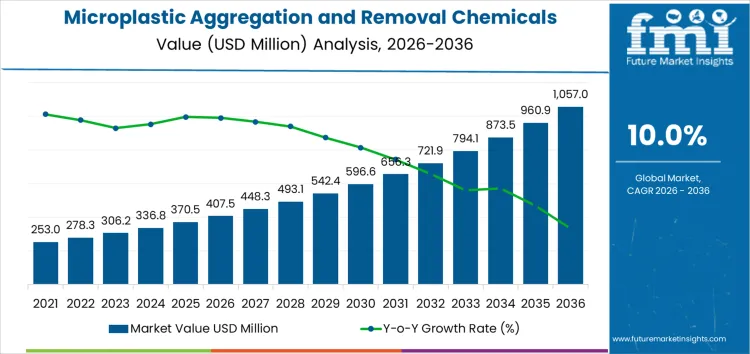
The microplastic aggregation and removal chemicals market is projected to grow from USD 407.5 million in 2026 to USD 1,057 million by 2036, reflecting a compound annual growth rate (CAGR) of 10%. Regionally, the market will experience uneven adoption, with demand driven primarily by stricter environmental regulations in developed economies. North America and Europe will lead in early adoption, driven by regulatory pressures and heightened environmental awareness. In contrast, emerging markets may see slower uptake due to budget constraints and varying levels of regulatory enforcement.
Geographic cost advantages will also play a critical role, with suppliers in low-cost regions able to capture market share by offering more competitive pricing. However, these suppliers may face challenges in aligning with higher regulatory standards and product specifications required in developed markets. As the market matures, companies will need to address these regional disparities and adapt their strategies to local regulatory landscapes while maintaining cost-efficiency to remain competitive globally.
Quick Stats of the Microplastic Aggregation and Removal Chemicals Market
- Microplastic Aggregation and Removal Chemicals Market Value (2026): USD 407.5 million
- Microplastic Aggregation and Removal Chemicals Market Forecast Value (2036): USD 1,057 million
- Microplastic Aggregation and Removal Chemicals Market Global Forecast CAGR (2026-2036): 10%
- Microplastic Aggregation and Removal Chemicals Market Leading Segment: Treatment Method (Chemical Agglomeration & Flocculation) 38%
- Key Growth Regions in Microplastic Aggregation and Removal Chemicals Market: India
- Top Players in Microplastic Aggregation and Removal Chemicals Market: Kemira, Solenis, SNF Floerger, Veolia Water Technologies, Ecolab
What is the Growth Forecast for the Microplastic Aggregation and Removal Chemicals Market through 2036?
The compound absolute growth analysis of the microplastic aggregation and removal chemicals market highlights the consistent increase in market value over the forecast period. Starting at USD 407.5 million in 2026, the market will experience a steady increase in absolute dollar value each year. Between 2026 and 2031, the market will grow by approximately USD 256.1 million, from USD 407.5 million to USD 664.1 million. This growth reflects the increasing awareness of microplastic pollution and the rising demand for chemical solutions to address this issue.
From 2031 to 2036, the market will continue to expand, adding around USD 391.6 million in value over the final five years, reaching USD 1,057 million by 2036. This later phase of growth will be driven by ongoing environmental regulations, greater adoption of microplastic removal technologies, and continued innovation in chemical formulations. The overall compound absolute growth reflects a steadily increasing market value as microplastic pollution control becomes a higher priority in both public and private sectors. This consistent growth suggests a robust and expanding market with increasing adoption of removal solutions in various industries.
Microplastic Aggregation and Removal Chemicals Market Key Takeaways
| Metric | Value |
|---|---|
| Industry Sales Value (2026) | USD 407.5 million |
| Industry Forecast Value (2036) | USD 1,057 million |
| Industry Forecast CAGR (2026-2036) | 10% |
What Is Driving the Demand for the Microplastic Aggregation and Removal Chemicals Market Globally?
The global demand for microplastic aggregation and removal chemicals is being driven by rising awareness of microplastic pollution in aquatic and terrestrial environments and growing regulatory pressure to mitigate its impact. Microplastics, tiny plastic fragments from packaging, textiles, tires, and personal care products, have been detected in oceans, rivers, drinking water, and soil worldwide. Traditional wastewater treatment and stormwater systems are not designed to capture very fine plastic particles, leading to widespread environmental dispersal.
Aggregation and removal chemicals help bind microplastic particles into larger clusters that can be more effectively captured, filtered, or removed during treatment processes. Municipal utilities, industrial wastewater facilities, and environmental remediation firms are increasingly adopting solutions that improve microplastic capture efficiency to meet evolving water quality standards and reduce environmental release. Research linking microplastic exposure to ecological harm and potential human health concerns has heightened stakeholder interest in proactive removal strategies. Public expectations for cleaner water, pressure from environmental advocacy groups, and corporate sustainability commitments further reinforce industry uptake of aggregation and removal chemistries.
Future demand for microplastic aggregation and removal chemicals is expected to grow as regulatory frameworks, water treatment technologies, and environmental monitoring practices evolve. Advances in chemical formulations that target specific polymer types, particle sizes, or environmental conditions will increase effectiveness and broaden application across drinking water treatment, industrial effluent control, and stormwater management. Integration with membrane filtration, sedimentation, and adsorption systems will enable more comprehensive microplastic mitigation strategies in both new and retrofit installations.
Governments and international bodies are increasingly considering microplastic limits in water quality regulations, which will create stronger compliance incentives for utilities and industries. Research investment and field trials will provide performance data that inform best practices and help standardise treatment protocols, reducing uncertainty for adopters. Growth in urbanisation and industrial activity in emerging markets will drive additional infrastructure investment, including advanced treatment chemicals that support microplastic removal. As climate resilience and ecosystem protection become core elements of water management planning, solutions that address microplastic pollution while supporting operational efficiency and regulatory compliance are expected to see steady global expansion.
What are the Leading Segments in the Global Microplastic Aggregation and Removal Chemicals Market?
The global microplastic aggregation and removal chemicals market is segmented by application area and treatment method. Among application areas, municipal wastewater treatment plants lead the market, capturing 34% of the share, followed by industrial effluent treatment, stormwater & urban runoff treatment, drinking water treatment facilities, and marine & river water remediation. Municipal wastewater treatment plants are the largest consumers of microplastic removal chemicals due to their role in treating large volumes of water containing microplastic pollutants. On the treatment method side, chemical agglomeration & flocculation dominates the market, holding 38% of the share, followed by membrane-enhanced chemical treatment, electrocoagulation with chemical enhancers, hybrid biological-chemical systems, and other emerging microplastic removal methods. Chemical agglomeration and flocculation are widely used due to their effectiveness in aggregating microplastics into larger particles that can be more easily removed from water.
What Drives the Growth of Municipal Wastewater Treatment Plants in the Microplastic Aggregation and Removal Chemicals Market?

Municipal wastewater treatment plants are the leading application area in the microplastic aggregation and removal chemicals market, holding 34% of the share. This demand is primarily driven by the growing awareness of microplastic pollution and its harmful effects on the environment and human health. Wastewater treatment plants process large volumes of water that often contain significant amounts of microplastics from domestic, industrial, and agricultural sources. As regulations on water quality and the reduction of microplastic pollution tighten globally, there is an increasing focus on implementing effective water treatment technologies to remove microplastics.
The use of microplastic aggregation and removal chemicals, such as those based on chemical agglomeration and flocculation, plays a crucial role in meeting these regulatory standards. Municipal wastewater treatment plants are adopting these chemicals to enhance their ability to remove microplastics and other pollutants, making them a key driver in the market. As the need for cleaner water continues to grow, municipal wastewater treatment plants will remain a dominant sector in the microplastic removal market.
What is Driving the Demand for Chemical Agglomeration & Flocculation in the Microplastic Aggregation and Removal Chemicals Market?
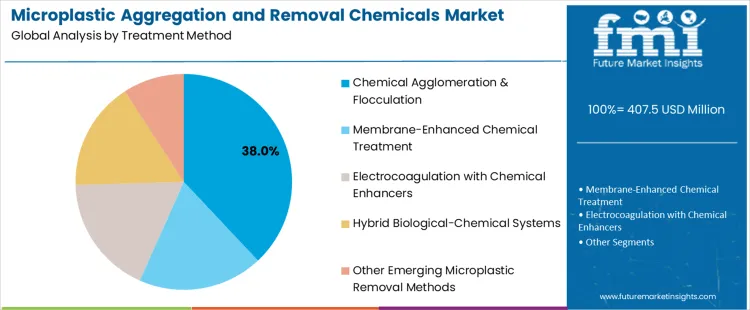
Chemical agglomeration & flocculation is the leading treatment method in the microplastic aggregation and removal chemicals market, capturing 38% of the share. This technique is highly effective in removing microplastics from water by using chemicals that cause small particles to clump together, forming larger aggregates (flocs) that can be easily separated. The growing need to address microplastic contamination in wastewater and surface water, combined with the high efficiency of chemical agglomeration & flocculation, is driving its adoption in municipal wastewater treatment plants, industrial effluent treatment, and other water treatment facilities. This method is particularly attractive because it is cost-effective, scalable, and applicable to a wide range of water types and contamination levels. As environmental regulations and public concern over microplastics increase, the demand for this treatment method is expected to continue rising, securing its position as a dominant solution in the market for microplastic removal.
What are the Key Dynamics in the Global Microplastic Aggregation and Removal Chemicals Market?
The global microplastic aggregation and removal chemicals market is expanding as environmental, industrial and municipal stakeholders seek effective solutions to capture and remove microplastic particles from water, wastewater and stormwater streams. Microplastic aggregation chemicals promote clumping of tiny polymer fragments into larger agglomerates that can be more easily filtered, settled or skimmed in treatment systems. Growth reflects rising concern about plastic pollution’s ecological and human health impacts, tightening regulatory scrutiny of water quality, and demand for scalable technologies that improve removal efficiency in water treatment, industrial effluent and environmental cleanup efforts worldwide.
What are the Key Drivers for the Microplastic Aggregation and Removal Chemicals Market?
Heightened regulatory focus on reducing microplastic discharge into aquatic environments is a major driver of market growth. Water utilities, industrial users and environmental agencies are seeking products that enhance capture of microplastics during conventional treatment processes, helping facilities meet emerging monitoring and discharge standards. Increased public awareness of microplastic contamination in drinking water, seafood and recreational waters fuels demand for remediation technologies. Advances in polymer chemistry, flocculant technology and targeted aggregation agents improve performance and enable integration with existing filtration and sedimentation infrastructure. Investment in sustainable water management and circular economy goals also motivates adoption of microplastic control solutions.
What are the Restraints for the Microplastic Aggregation and Removal Chemicals Market?
One restraint is the technical complexity of designing chemicals that selectively target microplastics of varied sizes, shapes and polymer types without adversely affecting water treatment processes or downstream applications. Effectiveness can vary based on water chemistry, particle load and treatment configuration, requiring testing and optimization that add time and cost. Some facilities may hesitate to adopt new aggregation chemistries until performance is validated at full scale. Concerns about residual chemical impacts on treated water quality or sludge handling may influence purchasing decisions, especially where regulatory frameworks remain in development. High cost of specialty aggregation agents relative to conventional coagulants and flocculants can affect uptake in budget-constrained operations.
What are the Key Trends in the Microplastic Aggregation and Removal Chemicals Market?
A key trend is development of multifunctional aggregation and removal agents that work with sustainable, low-impact coagulants and flocculants to enhance microplastic capture while minimizing chemical footprint. Researchers and formulators are creating targeted polymers and bio-based additives that improve selectivity for microplastic particles without compromising water treatment performance. Integration of microplastic monitoring and real-time analytics helps facilities optimise chemical dosing and evaluate removal efficiency. Adoption of advanced filtration and separation technologies, such as membrane systems and enhanced sedimentation, in concert with aggregation chemicals, supports higher removal rates. Collaboration among water technology firms, regulators and research institutions accelerates performance benchmarking and supports specification of solutions that align environmental compliance with operational efficiency.
What is the Country-Wise Analysis of the Microplastic Aggregation and Removal Chemicals Market?
The microplastic aggregation and removal chemicals market is projected to grow steadily, driven by increasing global concern over the environmental impact of microplastics in water bodies, soils, and marine ecosystems. These chemicals are used to agglomerate and remove microplastics from contaminated water, offering a promising solution to the growing problem of plastic pollution. High-growth markets such as India and China are seeing significant demand due to their large industrial sectors, rapid urbanization, and increasing focus on environmental protection. Developed markets such as the United States, Germany, and South Korea are also witnessing steady growth, supported by stringent environmental regulations, technological advancements in water treatment, and a growing push for sustainable waste management practices.
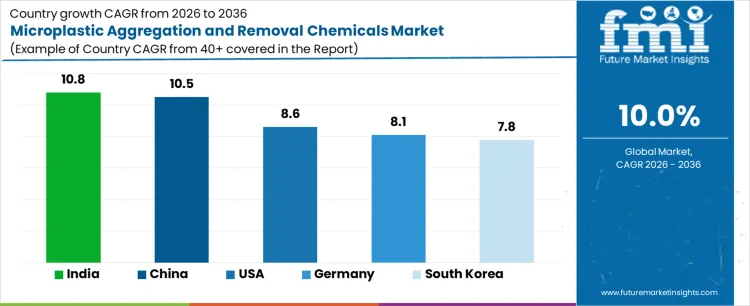
| Country | CAGR (%) |
|---|---|
| India | 10.8 |
| China | 10.5 |
| USA | 8.6 |
| Germany | 8.1 |
| South Korea | 7.8 |
What is the Growth Outlook for the Microplastic Aggregation and Removal Chemicals Market in India?
The microplastic aggregation and removal chemicals market in India is expected to grow at the highest rate, with a projected CAGR of 10.8%. India’s rapidly expanding industrial and urban sectors are contributing to the increasing pollution of water bodies with microplastics. As awareness of the environmental impact of microplastic pollution grows, there is rising demand for effective and sustainable solutions. The Indian government’s commitment to improving environmental quality and reducing plastic waste, along with international environmental agreements, is driving the adoption of microplastic removal technologies. As India invests in better waste management infrastructure and cleaner technologies, the market for microplastic aggregation and removal chemicals is poised for strong growth.
What is the Market Outlook for the Microplastic Aggregation and Removal Chemicals Market in China?
The microplastic aggregation and removal chemicals market in China is projected to grow steadily, with a projected CAGR of 10.5%. China’s industrial base, urbanization, and high levels of plastic waste have led to a growing microplastic pollution problem, particularly in water bodies. As one of the largest contributors to global plastic pollution, China is increasing efforts to combat the environmental impact of microplastics. The Chinese government has implemented stricter environmental regulations to address plastic pollution, creating a growing demand for effective chemical solutions to remove microplastics. With China’s continued focus on sustainability and environmental protection, the market for microplastic removal chemicals is expected to see significant growth.
What is the Growth Forecast for the Microplastic Aggregation and Removal Chemicals Market in the United States?
The microplastic aggregation and removal chemicals market in the United States is expected to grow steadily, with a projected CAGR of 8.6%. The USA faces increasing challenges related to water pollution, particularly from microplastics, and is investing heavily in cleaner technologies and waste management solutions. The USA government’s stricter environmental regulations, including those from the Environmental Protection Agency (EPA), are pushing industries and municipalities to adopt solutions that can mitigate plastic pollution. As environmental awareness grows, especially in coastal and urban areas, demand for microplastic removal chemicals is expected to rise. The USA market for these chemicals is set for steady growth, driven by increasing regulatory pressure and a focus on reducing environmental pollutants.
What is the Market Outlook for the Microplastic Aggregation and Removal Chemicals Market in Germany?
The microplastic aggregation and removal chemicals market in Germany is projected to grow at a steady pace, with a projected CAGR of 8.1%. Germany’s strict environmental regulations and commitment to reducing plastic pollution are driving the adoption of microplastic removal technologies. The country’s focus on sustainability and green technologies, combined with increasing public awareness about the harmful effects of microplastics, is contributing to market growth. Germany is actively investing in wastewater treatment and other pollution control technologies, which will further drive the demand for microplastic aggregation and removal chemicals. As Germany continues to pursue its climate and environmental goals, the market for these chemicals is expected to expand steadily.
What are the Growth Prospects for the Microplastic Aggregation and Removal Chemicals Market in South Korea?
The microplastic aggregation and removal chemicals market in South Korea is expected to grow steadily, with a projected CAGR of 7.8%. South Korea’s rapid urbanization and industrialization have contributed to growing pollution, including microplastics, in water bodies. The South Korean government’s focus on environmental sustainability and reducing plastic waste is driving the adoption of advanced solutions for microplastic removal. As the country addresses plastic pollution and aims to meet international environmental standards, demand for chemical solutions to combat microplastic contamination is increasing. With strong investments in green technologies and sustainable waste management practices, South Korea’s market for microplastic aggregation and removal chemicals is expected to continue growing at a steady pace.
What is the Competitive Landscape for the Microplastic Aggregation and Removal Chemicals Market?
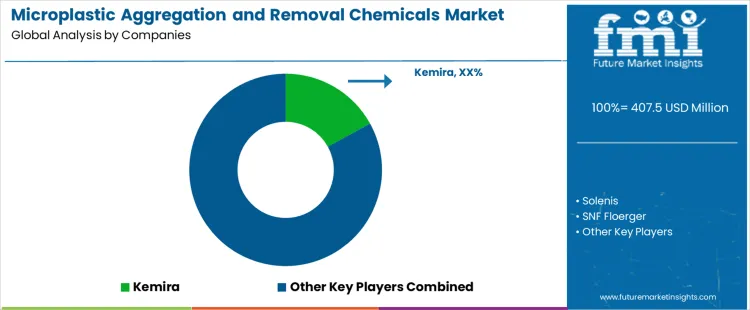
The microplastic aggregation and removal chemicals market is growing as industries and municipalities increasingly focus on reducing microplastic pollution in water systems and the environment. Kemira leads the market with its innovative microplastic aggregation and removal chemicals, offering high-performance solutions that help aggregate and remove microplastics from wastewater and natural water bodies. Their strong focus on sustainability, product efficacy, and regulatory compliance has positioned them as a dominant player in the market. Solenis, SNF Floerger, and Veolia Water Technologies are significant competitors, each providing specialized chemicals designed to enhance the aggregation and removal of microplastics from water. Solenis and SNF Floerger offer solutions that improve water treatment processes, while Veolia Water Technologies focuses on providing advanced technologies and chemicals for effective microplastic removal and water purification.
Ecolab further contributes to the competitive landscape with its microplastic removal solutions, emphasizing the importance of environmental sustainability and water quality in its product offerings. Ecolab provides effective chemical treatments that help remove microplastics from industrial and municipal water systems. These companies compete by focusing on product innovation, sustainability, and their ability to meet the increasing demand for effective, eco-friendly solutions for microplastic removal. As awareness of microplastic pollution continues to rise, the market for aggregation and removal chemicals is expected to expand, driven by stricter environmental regulations and the need for more efficient water treatment technologies.
Key Players of the Microplastic Aggregation and Removal Chemicals Market
- Kemira
- Solenis
- SNF Floerger
- Veolia Water Technologies
- Ecolab
Scope of the Report
| Items | Values |
|---|---|
| Quantitative Units (2026) | USD Million |
| Chemical Type | Flocculants (Organic & Inorganic), Coagulants (Metal Salts, Bio-Based), Bio-Based Polymer Aggregation Agents, Surfactant-Enhanced Capture Agents, Other Specialty Microplastic Removal Chemicals |
| Application Area | Municipal Wastewater Treatment Plants, Industrial Effluent Treatment, Stormwater & Urban Runoff Treatment, Drinking Water Treatment Facilities, Marine & River Water Remediation |
| Treatment Method | Chemical Agglomeration & Flocculation, Membrane-Enhanced Chemical Treatment, Electrocoagulation with Chemical Enhancers, Hybrid Biological-Chemical Systems, Other Emerging Microplastic Removal Methods |
| Companies | Kemira, Solenis, SNF Floerger, Veolia Water Technologies, Ecolab |
| Regions Covered | North America, Latin America, Western Europe, Eastern Europe, South Asia and Pacific, East Asia, Middle East & Africa |
| Countries Covered | United States, Canada, Mexico, Brazil, Argentina, Germany, France, United Kingdom, Italy, Spain, Netherlands, China, India, Japan, South Korea, ANZ, GCC Countries, South Africa |
| Additional Attributes | Dollar by sales by chemical type, application area, treatment method, and region. Includes market trends in microplastic aggregation and removal chemicals, performance in various water and effluent treatment applications, cost-effectiveness, sustainability practices, regulatory compliance, market share and competitive positioning of key companies, and the role of microplastic removal chemicals in improving water quality, enhancing treatment efficiency, and supporting environmental remediation across industries. |
Microplastic Aggregation and Removal Chemicals Market Segmentation
Chemical Type
- Flocculants (Organic & Inorganic)
- Coagulants (Metal Salts, Bio-Based)
- Bio-Based Polymer Aggregation Agents
- Surfactant-Enhanced Capture Agents
- Other Specialty Microplastic Removal Chemicals
Application Area
- Municipal Wastewater Treatment Plants
- Industrial Effluent Treatment
- Stormwater & Urban Runoff Treatment
- Drinking Water Treatment Facilities
- Marine & River Water Remediation
Treatment Method
- Chemical Agglomeration & Flocculation
- Membrane-Enhanced Chemical Treatment
- Electrocoagulation with Chemical Enhancers
- Hybrid Biological-Chemical Systems
- Other Emerging Microplastic Removal Methods
Region
- Asia Pacific
- China
- Japan
- South Korea
- India
- Australia & New Zealand
- ASEAN
- Rest of Asia Pacific
- Europe
- Germany
- United Kingdom
- France
- Italy
- Spain
- Nordic
- BENELUX
- Rest of Europe
- North America
- United States
- Canada
- Mexico
- Latin America
- Brazil
- Chile
- Rest of Latin America
- Middle East & Africa
- Kingdom of Saudi Arabia
- Other GCC Countries
- Turkey
- South Africa
- Other African Union
- Rest of Middle East & Africa
Frequently Asked Questions
How big is the microplastic aggregation and removal chemicals market in 2026?
The global microplastic aggregation and removal chemicals market is estimated to be valued at USD 407.5 million in 2026.
What will be the size of microplastic aggregation and removal chemicals market in 2036?
The market size for the microplastic aggregation and removal chemicals market is projected to reach USD 1,057.0 million by 2036.
How much will be the microplastic aggregation and removal chemicals market growth between 2026 and 2036?
The microplastic aggregation and removal chemicals market is expected to grow at a 10.0% CAGR between 2026 and 2036.
What are the key product types in the microplastic aggregation and removal chemicals market?
The key product types in microplastic aggregation and removal chemicals market are flocculants (organic & inorganic), coagulants (metal salts, bio-based), bio-based polymer aggregation agents, surfactant-enhanced capture agents and other specialty microplastic removal chemicals.
Which application area segment to contribute significant share in the microplastic aggregation and removal chemicals market in 2026?
In terms of application area, municipal wastewater treatment plants segment to command 34.0% share in the microplastic aggregation and removal chemicals market in 2026.
Preview the report firsthand - request a free sample
Get SampleGet the brochure for pricing and purchase details.
Get PDFTable of Content
- Executive Summary
- Global Market Outlook
- Demand-side Trends
- Supply-side Trends
- Technology Roadmap Analysis
- Analysis and Recommendations
- Market Overview
- Market Coverage / Taxonomy
- Market Definition / Scope / Limitations
- Market Background
- Market Dynamics
- Drivers
- Restraints
- Opportunity
- Trends
- Scenario Forecast
- Demand in Optimistic Scenario
- Demand in Likely Scenario
- Demand in Conservative Scenario
- Opportunity Map Analysis
- Product Life Cycle Analysis
- Supply Chain Analysis
- Investment Feasibility Matrix
- Value Chain Analysis
- PESTLE and Porter’s Analysis
- Regulatory Landscape
- Regional Parent Market Outlook
- Production and Consumption Statistics
- Import and Export Statistics
- Market Dynamics
- Global Market Analysis 2021 to 2025 and Forecast, 2026 to 2036
- Historical Market Size Value (USD Million) Analysis, 2021 to 2025
- Current and Future Market Size Value (USD Million) Projections, 2026 to 2036
- Y-o-Y Growth Trend Analysis
- Absolute $ Opportunity Analysis
- Global Market Pricing Analysis 2021 to 2025 and Forecast 2026 to 2036
- Global Market Analysis 2021 to 2025 and Forecast 2026 to 2036, By Chemical Type
- Introduction / Key Findings
- Historical Market Size Value (USD Million) Analysis By Chemical Type , 2021 to 2025
- Current and Future Market Size Value (USD Million) Analysis and Forecast By Chemical Type , 2026 to 2036
- Flocculants (Organic & Inorganic)
- Coagulants (Metal Salts, Bio-Based)
- Bio-Based Polymer Aggregation Agents
- Surfactant-Enhanced Capture Agents
- Other Specialty Microplastic Removal Chemicals
- Flocculants (Organic & Inorganic)
- Y-o-Y Growth Trend Analysis By Chemical Type , 2021 to 2025
- Absolute $ Opportunity Analysis By Chemical Type , 2026 to 2036
- Global Market Analysis 2021 to 2025 and Forecast 2026 to 2036, By Application Area
- Introduction / Key Findings
- Historical Market Size Value (USD Million) Analysis By Application Area, 2021 to 2025
- Current and Future Market Size Value (USD Million) Analysis and Forecast By Application Area, 2026 to 2036
- Municipal Wastewater Treatment Plants
- Industrial Effluent Treatment
- Stormwater & Urban Runoff Treatment
- Drinking Water Treatment Facilities
- Marine & River Water Remediation
- Municipal Wastewater Treatment Plants
- Y-o-Y Growth Trend Analysis By Application Area, 2021 to 2025
- Absolute $ Opportunity Analysis By Application Area, 2026 to 2036
- Global Market Analysis 2021 to 2025 and Forecast 2026 to 2036, By Treatment Method
- Introduction / Key Findings
- Historical Market Size Value (USD Million) Analysis By Treatment Method, 2021 to 2025
- Current and Future Market Size Value (USD Million) Analysis and Forecast By Treatment Method, 2026 to 2036
- Chemical Agglomeration & Flocculation
- Membrane-Enhanced Chemical Treatment
- Electrocoagulation with Chemical Enhancers
- Hybrid Biological-Chemical Systems
- Other Emerging Microplastic Removal Methods
- Chemical Agglomeration & Flocculation
- Y-o-Y Growth Trend Analysis By Treatment Method, 2021 to 2025
- Absolute $ Opportunity Analysis By Treatment Method, 2026 to 2036
- Global Market Analysis 2021 to 2025 and Forecast 2026 to 2036, By Region
- Introduction
- Historical Market Size Value (USD Million) Analysis By Region, 2021 to 2025
- Current Market Size Value (USD Million) Analysis and Forecast By Region, 2026 to 2036
- North America
- Latin America
- Western Europe
- Eastern Europe
- East Asia
- South Asia and Pacific
- Middle East & Africa
- Market Attractiveness Analysis By Region
- North America Market Analysis 2021 to 2025 and Forecast 2026 to 2036, By Country
- Historical Market Size Value (USD Million) Trend Analysis By Market Taxonomy, 2021 to 2025
- Market Size Value (USD Million) Forecast By Market Taxonomy, 2026 to 2036
- By Country
- USA
- Canada
- Mexico
- By Chemical Type
- By Application Area
- By Treatment Method
- By Country
- Market Attractiveness Analysis
- By Country
- By Chemical Type
- By Application Area
- By Treatment Method
- Key Takeaways
- Latin America Market Analysis 2021 to 2025 and Forecast 2026 to 2036, By Country
- Historical Market Size Value (USD Million) Trend Analysis By Market Taxonomy, 2021 to 2025
- Market Size Value (USD Million) Forecast By Market Taxonomy, 2026 to 2036
- By Country
- Brazil
- Chile
- Rest of Latin America
- By Chemical Type
- By Application Area
- By Treatment Method
- By Country
- Market Attractiveness Analysis
- By Country
- By Chemical Type
- By Application Area
- By Treatment Method
- Key Takeaways
- Western Europe Market Analysis 2021 to 2025 and Forecast 2026 to 2036, By Country
- Historical Market Size Value (USD Million) Trend Analysis By Market Taxonomy, 2021 to 2025
- Market Size Value (USD Million) Forecast By Market Taxonomy, 2026 to 2036
- By Country
- Germany
- UK
- Italy
- Spain
- France
- Nordic
- BENELUX
- Rest of Western Europe
- By Chemical Type
- By Application Area
- By Treatment Method
- By Country
- Market Attractiveness Analysis
- By Country
- By Chemical Type
- By Application Area
- By Treatment Method
- Key Takeaways
- Eastern Europe Market Analysis 2021 to 2025 and Forecast 2026 to 2036, By Country
- Historical Market Size Value (USD Million) Trend Analysis By Market Taxonomy, 2021 to 2025
- Market Size Value (USD Million) Forecast By Market Taxonomy, 2026 to 2036
- By Country
- Russia
- Poland
- Hungary
- Balkan & Baltic
- Rest of Eastern Europe
- By Chemical Type
- By Application Area
- By Treatment Method
- By Country
- Market Attractiveness Analysis
- By Country
- By Chemical Type
- By Application Area
- By Treatment Method
- Key Takeaways
- East Asia Market Analysis 2021 to 2025 and Forecast 2026 to 2036, By Country
- Historical Market Size Value (USD Million) Trend Analysis By Market Taxonomy, 2021 to 2025
- Market Size Value (USD Million) Forecast By Market Taxonomy, 2026 to 2036
- By Country
- China
- Japan
- South Korea
- By Chemical Type
- By Application Area
- By Treatment Method
- By Country
- Market Attractiveness Analysis
- By Country
- By Chemical Type
- By Application Area
- By Treatment Method
- Key Takeaways
- South Asia and Pacific Market Analysis 2021 to 2025 and Forecast 2026 to 2036, By Country
- Historical Market Size Value (USD Million) Trend Analysis By Market Taxonomy, 2021 to 2025
- Market Size Value (USD Million) Forecast By Market Taxonomy, 2026 to 2036
- By Country
- India
- ASEAN
- Australia & New Zealand
- Rest of South Asia and Pacific
- By Chemical Type
- By Application Area
- By Treatment Method
- By Country
- Market Attractiveness Analysis
- By Country
- By Chemical Type
- By Application Area
- By Treatment Method
- Key Takeaways
- Middle East & Africa Market Analysis 2021 to 2025 and Forecast 2026 to 2036, By Country
- Historical Market Size Value (USD Million) Trend Analysis By Market Taxonomy, 2021 to 2025
- Market Size Value (USD Million) Forecast By Market Taxonomy, 2026 to 2036
- By Country
- Kingdom of Saudi Arabia
- Other GCC Countries
- Turkiye
- South Africa
- Other African Union
- Rest of Middle East & Africa
- By Chemical Type
- By Application Area
- By Treatment Method
- By Country
- Market Attractiveness Analysis
- By Country
- By Chemical Type
- By Application Area
- By Treatment Method
- Key Takeaways
- Key Countries Market Analysis
- USA
- Pricing Analysis
- Market Share Analysis, 2025
- By Chemical Type
- By Application Area
- By Treatment Method
- Canada
- Pricing Analysis
- Market Share Analysis, 2025
- By Chemical Type
- By Application Area
- By Treatment Method
- Mexico
- Pricing Analysis
- Market Share Analysis, 2025
- By Chemical Type
- By Application Area
- By Treatment Method
- Brazil
- Pricing Analysis
- Market Share Analysis, 2025
- By Chemical Type
- By Application Area
- By Treatment Method
- Chile
- Pricing Analysis
- Market Share Analysis, 2025
- By Chemical Type
- By Application Area
- By Treatment Method
- Germany
- Pricing Analysis
- Market Share Analysis, 2025
- By Chemical Type
- By Application Area
- By Treatment Method
- UK
- Pricing Analysis
- Market Share Analysis, 2025
- By Chemical Type
- By Application Area
- By Treatment Method
- Italy
- Pricing Analysis
- Market Share Analysis, 2025
- By Chemical Type
- By Application Area
- By Treatment Method
- Spain
- Pricing Analysis
- Market Share Analysis, 2025
- By Chemical Type
- By Application Area
- By Treatment Method
- France
- Pricing Analysis
- Market Share Analysis, 2025
- By Chemical Type
- By Application Area
- By Treatment Method
- India
- Pricing Analysis
- Market Share Analysis, 2025
- By Chemical Type
- By Application Area
- By Treatment Method
- ASEAN
- Pricing Analysis
- Market Share Analysis, 2025
- By Chemical Type
- By Application Area
- By Treatment Method
- Australia & New Zealand
- Pricing Analysis
- Market Share Analysis, 2025
- By Chemical Type
- By Application Area
- By Treatment Method
- China
- Pricing Analysis
- Market Share Analysis, 2025
- By Chemical Type
- By Application Area
- By Treatment Method
- Japan
- Pricing Analysis
- Market Share Analysis, 2025
- By Chemical Type
- By Application Area
- By Treatment Method
- South Korea
- Pricing Analysis
- Market Share Analysis, 2025
- By Chemical Type
- By Application Area
- By Treatment Method
- Russia
- Pricing Analysis
- Market Share Analysis, 2025
- By Chemical Type
- By Application Area
- By Treatment Method
- Poland
- Pricing Analysis
- Market Share Analysis, 2025
- By Chemical Type
- By Application Area
- By Treatment Method
- Hungary
- Pricing Analysis
- Market Share Analysis, 2025
- By Chemical Type
- By Application Area
- By Treatment Method
- Kingdom of Saudi Arabia
- Pricing Analysis
- Market Share Analysis, 2025
- By Chemical Type
- By Application Area
- By Treatment Method
- Turkiye
- Pricing Analysis
- Market Share Analysis, 2025
- By Chemical Type
- By Application Area
- By Treatment Method
- South Africa
- Pricing Analysis
- Market Share Analysis, 2025
- By Chemical Type
- By Application Area
- By Treatment Method
- USA
- Market Structure Analysis
- Competition Dashboard
- Competition Benchmarking
- Market Share Analysis of Top Players
- By Regional
- By Chemical Type
- By Application Area
- By Treatment Method
- Competition Analysis
- Competition Deep Dive
- Kemira
- Overview
- Product Portfolio
- Profitability by Market Segments (Product/Age /Sales Channel/Region)
- Sales Footprint
- Strategy Overview
- Marketing Strategy
- Product Strategy
- Channel Strategy
- Solenis
- SNF Floerger
- Veolia Water Technologies
- Ecolab
- Kemira
- Competition Deep Dive
- Assumptions & Acronyms Used
- Research Methodology


