

- Industry Size (2026)
- USD 31.23 Bn
- Forecast (2036)
- USD 53.34 Bn
- CAGR (2026 to 2036)
- 5.50%
Oxo Chemicals Market Size, Market Forecast and Outlook By FMI
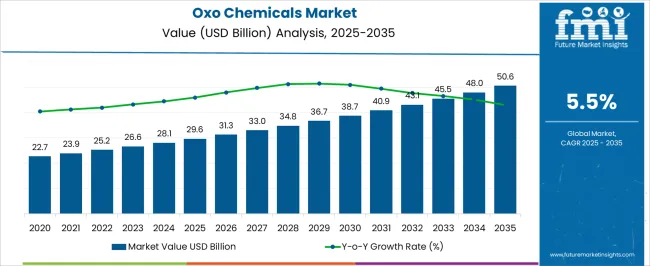
The oxo chemicals market was valued at USD 29.60 billion in 2025, projected to reach USD 31.23 billion in 2026, and is forecast to expand to USD 53.34 billion by 2036 at a 5.50% CAGR. Structural shifts in end-use procurement cycles and tightening performance specifications across downstream sectors are accelerating capital allocation toward oxo chemicals categories. Procurement teams operating across global supply chains now require standardized compliance certifications, compressing qualification timelines and elevating minimum specification thresholds for approved supplier lists.
Summary of Oxo Chemicals Market
- Market Snapshot
- The oxo chemicals market is valued at USD 29.60 billion in 2025 and is projected to reach USD 53.34 billion by 2036.
- The industry is expected to grow at a 5.50% CAGR from 2026 to 2036, creating an incremental opportunity of USD 22.11 billion.
- The market operates as a specification-driven procurement category where compliance certifications, material performance standards, and supply chain integration define competitive positioning.
- Demand and Growth Drivers
- Demand is rising as downstream industries face tightening performance specifications and mandatory compliance requirements across procurement cycles.
- Technology upgrades and process automation are accelerating adoption of higher-specification oxo chemicals products across manufacturing operations.
- Infrastructure expansion programs in emerging economies are creating greenfield demand that bypasses legacy supplier constraints.
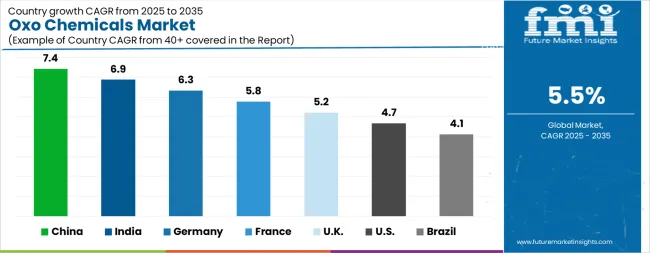
- Among key countries, China at 7.40%, India at 6.90%, Germany at 6.30%, France at 5.80%, UK at 5.20%, USA at 4.70%, Brazil at 4.10%.
- Product and Segment View
- The market includes oxo chemicals products segmented across product type, application categories serving diverse industrial and commercial applications.
- N-Butyraldehyde leads by product type with 21.6% share in 2026.
- Plasticizers leads by application with 26.4% share in 2026.
- The scope covers N-Butyraldehyde, Propionaldehyde, Isobutyraldehyde, Heptanoic And Pelargonic Acids configurations among other formats, while excluding unrelated commodity categories and non-specialized alternatives.
- Geography and Competitive Outlook
- China and India are the fastest-growing markets due to infrastructure expansion and rising industrial demand, while North America and Europe remain high-value mature demand bases.
- Competition is shaped by vertical integration capabilities, specification compliance certifications, and established procurement channel relationships, with key players including The Dow Chemical Company, BASF SE, BAX Chemicals BV, ExxonMobil Chemical Company, Mitsui Chemicals America Inc., LG Chem, OXEA Group.
- Market consolidation trends are evident as leading suppliers acquire complementary capabilities to meet broadening customer specification requirements.
- Analyst Opinion at FMI
- Nikhil Kaitwade, Principal Consultant, opines: 'As per FMI analysis, the oxo chemicals market is transitioning from a volume-driven procurement model to a specification-led qualification framework. Buyers who delay integration of higher-performance oxo chemicals solutions into their supply chains face material cost escalation as compliance timelines compress. FMI analysts observe that suppliers lacking certified production capabilities will find themselves excluded from approved vendor lists as downstream operators enforce tighter material specifications.'
- Strategic Implications / Executive Takeaways
- Procurement directors must transition vendor qualification processes to prioritize lifecycle cost models and specification compliance certifications over lowest unit price evaluations.
- Capital project teams should mandate compatibility with next-generation performance standards in all new equipment procurement specifications entering the 2027 tender cycle.
- Supply chain architects must develop multi-source qualification programs to mitigate concentration risk across critical oxo chemicals supply categories.
Oxo Chemicals Market Key Takeaways
| Metric | Details |
|---|---|
| Industry Size (2026) | USD 31.23 billion |
| Industry Value (2036) | USD 53.34 billion |
| CAGR (2026-2036) | 5.50% |
Source: Future Market Insights, 2026
Capital expenditure planning cycles across verticals consuming oxo chemicals products have shifted from discretionary upgrades to mandated replacements. Regulatory frameworks governing material performance, safety testing, and environmental compliance are tightening across all major consumption regions. Buyers evaluating supplier contracts increasingly weight lifecycle cost models over upfront unit pricing, favoring suppliers with vertically integrated operations and certified testing capabilities.
Regional deployment parameters reflect differentiated adoption velocities. China sets the pace with a 7.40% CAGR, followed by India at 6.90% as infrastructure expansion programs bypass legacy procurement constraints. Germany operations advance at a 6.30% rate, supported by regulatory compliance mandates. France tracks at 5.80%. UK networks maintain a 5.20% expansion trajectory. USA registers a 4.70% pace. Brazil expands at a 4.10% trajectory.
Oxo Chemicals Market Definition
Oxo Chemicals constitutes the material, product, or technology category defined by its primary industrial function within downstream manufacturing and end-use sectors. The scope encompasses standardized and specialty configurations compliant with global performance and safety specifications. Core inclusions govern products meeting defined procurement parameters across industrial, commercial, and institutional buyer categories.
Oxo Chemicals Market Inclusions
Market scope includes N-Butyraldehyde, Propionaldehyde, Isobutyraldehyde, Heptanoic And Pelargonic Acids, Branched Oxo Acids configurations and related product variants. Global and regional market sizes, forecast period 2026 to 2036, and segment breakdowns by product type, application are fully incorporated within the analytical boundary.
Oxo Chemicals Market Exclusions
Standard commodity alternatives lacking specialized performance certifications are excluded. Downstream finished goods, standalone accessory components, and non-standardized custom fabrications fall outside the analytical parameters. Legacy product formats without current industry specification compliance are explicitly omitted from the valuation.
Oxo Chemicals Market Research Methodology
- Primary Research: Analysts engaged with procurement specification leads, technical managers, and supply chain directors across key consumption sectors to map decision gates triggering product upgrades and supplier requalification.
- Desk Research: Data collection phases aggregated regulatory compliance frameworks, industry standards ratification schedules, and published procurement guidelines from major institutional buyers.
- Market-Sizing and Forecasting: Baseline values derive from a bottom-up aggregation of product volumes and contract values, applying region-specific adoption curves to project future demand velocity.
- Data Validation and Update Cycle: Projections are tested against publicly reported expenditure guidance from leading industrial consumers and trade association production statistics.
Why is the Oxo Chemicals Market Growing?
The Oxo Chemicals market is experiencing steady growth, driven by the increasing demand for chemical intermediates in diverse industrial applications, including plastics, coatings, adhesives, and solvents. Rising industrialization and the expansion of downstream manufacturing sectors are fueling the adoption of oxo chemicals. Advancements in production technologies have improved process efficiency, reduced waste, and enhanced product quality, supporting market expansion.
Environmental regulations and the focus on sustainable chemical processes are encouraging the use of eco-efficient oxo chemical manufacturing techniques. The growing demand for specialized chemical intermediates for high-performance products in emerging economies is also contributing to market growth. In addition, the expansion of end-use industries such as automotive, construction, and consumer goods has created consistent demand for oxo chemicals.
As manufacturers focus on producing cost-effective, high-purity chemicals with reliable supply chains, the market is expected to maintain its growth trajectory Investments in research and development for novel applications and process optimization are likely to create new opportunities over the coming decade, positioning oxo chemicals as a critical component in industrial chemistry.
Segmental Analysis
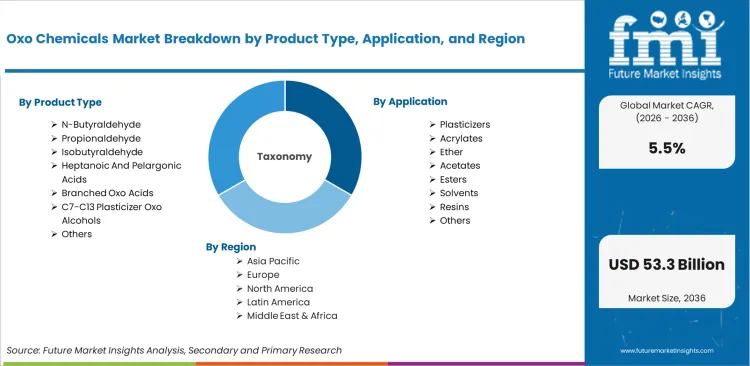
The oxo chemicals market is segmented by product type, application, and geographic regions. By product type, oxo chemicals market is divided into N-Butyraldehyde, Propionaldehyde, Isobutyraldehyde, Heptanoic And Pelargonic Acids C7-C9 Oxo Acids, Branched Oxo Acids, C7-C13 Plasticizer Oxo Alcohols, and Others. In terms of application, oxo chemicals market is classified into Plasticizers, Acrylates, Ether, Acetates, Esters, Solvents, Resins, and Others. Regionally, the oxo chemicals industry is classified into North America, Latin America, Western Europe, Eastern Europe, Balkan & Baltic Countries, Russia & Belarus, Central Asia, East Asia, South Asia & Pacific, and the Middle East & Africa.
Insights into the N-Butyraldehyde Product Type Segment
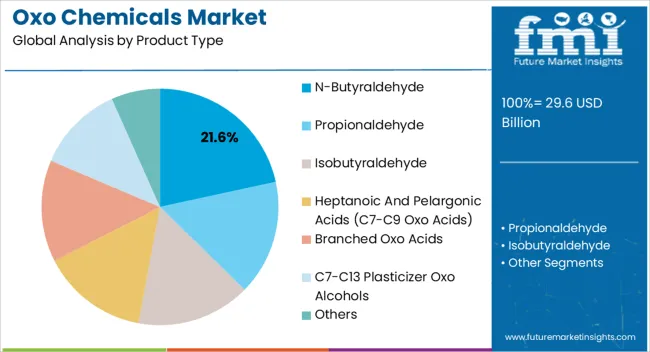
The N-Butyraldehyde product type segment is projected to hold 21.6% of the Oxo Chemicals market revenue in 2026, establishing it as the leading product type. Growth in this segment is being driven by its extensive use as a chemical intermediate in the production of plasticizers, solvents, and coatings. The segment’s high reactivity and versatility make it suitable for various downstream applications, enabling manufacturers to produce specialized products efficiently.
Its adoption is further supported by improved production methods that enhance yield, reduce energy consumption, and ensure product consistency. Industrial demand for N-Butyraldehyde is rising in emerging economies, where chemical manufacturing capacity and end-use applications are expanding rapidly. The ability to integrate this chemical into multiple processes without significant operational modifications strengthens its market position.
Additionally, regulatory compliance and environmental considerations are encouraging manufacturers to adopt high-purity N-Butyraldehyde, which reinforces its preference As demand for efficient chemical intermediates in large-scale industrial applications continues to rise, N-Butyraldehyde is expected to maintain its leadership position in the Oxo Chemicals market.
Insights into the Plasticizers Application Segment
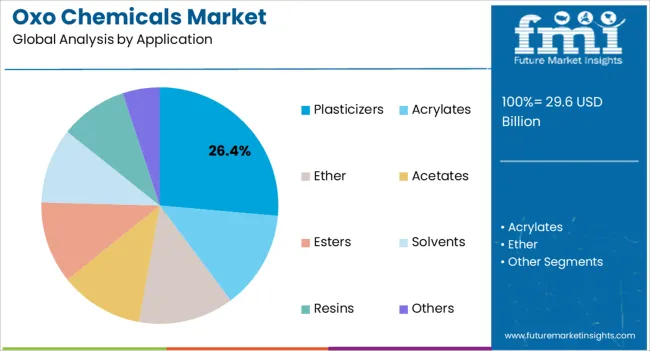
The plasticizers application segment is anticipated to account for 26.4% of the Oxo Chemicals market revenue in 2026, making it the leading application area. Growth is being driven by the rising demand for flexible and durable plastics in industries such as construction Chemicals, automotive, packaging, and consumer goods. Oxo chemicals, particularly N-Butyraldehyde-derived products, are used to produce high-performance plasticizers that enhance polymer flexibility, processability, and longevity.
Adoption is further supported by innovations in environmentally friendly plasticizer formulations that comply with stringent regulatory standards. Manufacturers are increasingly integrating these chemicals into large-scale production to meet growing demand for high-quality, reliable plastics.
The ability to optimize performance properties while maintaining cost efficiency has reinforced the use of oxo chemicals in plasticizer production As global demand for durable, lightweight, and flexible materials increases, particularly in emerging economies, the plasticizers segment is expected to remain the primary growth driver in the Oxo Chemicals market, supported by continuous product innovation and expanding industrial applications.
Market Overview
Oxo Chemicals Market Overview
Oxo chemicals are intermediate and derivative chemical compounds which are characteristically used in chemical and manufacturing processes of paints, plasticizers, coatings, adhesives and lubricant additives. They are formed by hydroformylation of olefins with a synthesis gas, which is a universal route to C3-C15 aldehydes, which are further converted to alcohol, acids and other complex compounds.
As these oxo chemical play a vital role in manufacturing of various types oif surface coating, polymers and solvents, they are an integral part of construction, automotive and OEM inudsry. Furthermore, oxo chemicals are the most important ingredient for the manufacturing of plasticizers, which in turn are a constitutive part of automotive, plastics, cables and wires industry.
Propylene-derived n-butyraldehyde and isobutyraldehyde are the most prominent oxo chemical in terms of volume sales, particularly due to rising consumption their alcohol derivatives in plasticizer industry.
With the reviving economies of developed nation coupled with ever rising industrial infrastructure among the third world countries, demand for oxo chemicals is forecasted to steadily increase over the forecast period.
Analysis of Oxo Chemicals Market By Key Countries
.webp "Top Country Growth Comparison Oxo Chemicals Market Cagr (2026 2036)")
| Country | CAGR |
|---|---|
| China | 7.4% |
| India | 6.9% |
| Germany | 6.3% |
| France | 5.8% |
| UK | 5.2% |
| USA | 4.7% |
| Brazil | 4.1% |
Country-wise Analysis
The Oxo Chemicals Market is expected to register a CAGR of 5.5% during the forecast period, exhibiting varied country level momentum. China leads with the highest CAGR of 7.4%, followed by India at 6.9%. Developed markets such as Germany, France, and the UK continue to expand steadily, while the USA is likely to grow at consistent rates. Brazil posts the lowest CAGR at 4.1%, yet still underscores a broadly positive trajectory for the global Oxo Chemicals Market. In 2026, Germany held a dominant revenue in the Western Europe market and is expected to grow with a CAGR of 6.3%. The USA Oxo Chemicals Market is estimated to be valued at USD 10.7 billion in 2026 and is anticipated to reach a valuation of USD 17.0 billion by 2036. Sales are projected to rise at a CAGR of 4.7% over the forecast period between 2026 and 2036. While Japan and South Korea markets are estimated to be valued at USD 1.4 billion and USD 748.3 million respectively in 2026.
Key Players in the Oxo Chemicals Market
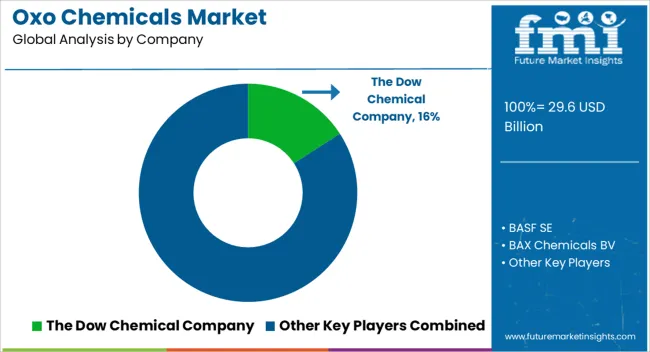
- The Dow Chemical Company
- BASF SE
- BAX Chemicals BV
- ExxonMobil Chemical Company
- Mitsui Chemicals America Inc.
- LG Chem
- OXEA Group
- Andhra Petrochemicals
- Evonik Industries
- Eastman Chemical
Scope of the Report
| Metric | Value |
|---|---|
| Quantitative Units | USD 31.23 billion to USD 53.34 billion, at a CAGR of 5.50% |
| Market Definition | Oxo Chemicals encompasses the material, product, or technology category serving downstream industrial, commercial, and institutional end-use sectors under defined performance and safety specifications. |
| Product Type Segmentation | N-Butyraldehyde, Propionaldehyde, Isobutyraldehyde, Heptanoic And Pelargonic Acids, Branched Oxo Acids, C7-C13 Plasticizer Oxo Alcohols, Others |
| Application Segmentation | Plasticizers, Acrylates, Ether, Acetates, Esters, Solvents, Resins, Others |
| Regions Covered | North America, Latin America, Europe, East Asia, South Asia, Oceania, Middle East & Africa |
| Countries Covered | China, India, Germany, France, UK, USA, Brazil, and 40 plus countries |
| Key Companies Profiled | The Dow Chemical Company, BASF SE, BAX Chemicals BV, ExxonMobil Chemical Company, Mitsui Chemicals America Inc., LG Chem, OXEA Group, Andhra Petrochemicals, Evonik Industries, Eastman Chemical |
| Forecast Period | 2026 to 2036 |
| Approach | Forecasting models apply a bottom-up methodology starting with global installed base metrics and projecting conversion rates to higher-specification product categories. |
Oxo Chemicals Market by Segments
Product Type:
- N-Butyraldehyde
- Propionaldehyde
- Isobutyraldehyde
- Heptanoic And Pelargonic Acids (C7-C9 Oxo Acids)
- Branched Oxo Acids
- C7-C13 Plasticizer Oxo Alcohols
- Others
Application:
- Plasticizers
- Acrylates
- Ether
- Acetates
- Esters
- Solvents
- Resins
- Others
Region:
- North America
- USA
- Canada
- Mexico
- Latin America
- Brazil
- Chile
- Rest of Latin America
- Western Europe
- Germany
- UK
- Italy
- Spain
- France
- Nordic
- BENELUX
- Rest of Western Europe
- Eastern Europe
- Russia
- Poland
- Hungary
- Balkan & Baltic
- Rest of Eastern Europe
- East Asia
- China
- Japan
- South Korea
- South Asia and Pacific
- India
- ASEAN
- Australia & New Zealand
- Rest of South Asia and Pacific
- Middle East & Africa
- Kingdom of Saudi Arabia
- Other GCC Countries
- Turkiye
- South Africa
- Other African Union
- Rest of Middle East & Africa
Bibliography
- 1. Organisation for Economic Co-operation and Development. (2025, June). Industrial performance and competitiveness indicators. OECD.
- 2. World Bank Group. (2025). Global economic prospects: Industrial supply chains and trade facilitation. World Bank.
- 3. United Nations Industrial Development Organization. (2025). Industrial development report: Manufacturing and global value chains. UNIDO.
- 4. International Organization for Standardization. (2025). ISO standards catalogue: Materials testing and quality management. ISO.
- 5. European Commission, Directorate-General for Internal Market, Industry, Entrepreneurship and SMEs. (2025). Single market for goods: Industrial product compliance. European Commission.
- 6. USA Bureau of Labor Statistics. (2025). Producer price indexes for intermediate demand. USA Department of Labor.
This bibliography is provided for reader reference. The full Future Market Insights report contains the complete reference list with primary research documentation.
Frequently Asked Questions
How large is the demand for Oxo Chemicals in the global market in 2026?
Demand for Oxo Chemicals in the global market is estimated to be valued at USD 31.23 billion in 2026.
What will be the market size of Oxo Chemicals in the global market by 2036?
Market size for Oxo Chemicals is projected to reach USD 53.34 billion by 2036.
What is the expected demand growth for Oxo Chemicals in the global market between 2026 and 2036?
Demand for Oxo Chemicals is expected to grow at a CAGR of 5.50% between 2026 and 2036.
Which Product Type is poised to lead global sales by 2026?
N-Butyraldehyde accounts for 21.6% in 2026, driven by established procurement specifications and downstream integration requirements.
What is driving demand in China?
China leads with a 7.40% CAGR as greenfield industrial facilities deploying modern procurement frameworks create scaled demand for specification-compliant oxo chemicals products.
What is the India growth outlook in this report?
India is projected to grow at a CAGR of 6.90% during 2026 to 2036.
What is Oxo Chemicals and what is it mainly used for?
Oxo Chemicals constitutes the specialized material, product, or technology category designed for defined industrial, commercial, and institutional applications. End-use sectors primarily deploy it to meet performance, safety, and regulatory compliance requirements.
How does FMI build and validate the Oxo Chemicals forecast?
Forecasting models apply a bottom-up methodology starting with global installed base metrics and cross-validate projections against quarterly industry production and trade volumes.
Preview the report firsthand - request a free sample
Get SampleGet the brochure for pricing and purchase details.
Get PDFTable of Content
- Executive Summary
- Global Market Outlook
- Demand-side Trends
- Supply-side Trends
- Technology Roadmap Analysis
- Analysis and Recommendations
- Market Overview
- Market Coverage / Taxonomy
- Market Definition / Scope / Limitations
- Research Methodology
- Chapter Orientation
- Analytical Lens and Working Hypotheses
- Market Structure, Signals, and Trend Drivers
- Benchmarking and Cross-market Comparability
- Market Sizing, Forecasting, and Opportunity Mapping
- Research Design and Evidence Framework
- Desk Research Programme (Secondary Evidence)
- Company Annual and Sustainability Reports
- Peer-reviewed Journals and Academic Literature
- Corporate Websites, Product Literature, and Technical Notes
- Earnings Decks and Investor Briefings
- Statutory Filings and Regulatory Disclosures
- Technical White Papers and Standards Notes
- Trade Journals, Industry Magazines, and Analyst Briefs
- Conference Proceedings, Webinars, and Seminar Materials
- Government Statistics Portals and Public Data Releases
- Press Releases and Reputable Media Coverage
- Specialist Newsletters and Curated Briefings
- Sector Databases and Reference Repositories
- FMI Internal Proprietary Databases and Historical Market Datasets
- Subscription Datasets and Paid Sources
- Social Channels, Communities, and Digital Listening Inputs
- Additional Desk Sources
- Expert Input and Fieldwork (Primary Evidence)
- Primary Modes
- Qualitative Interviews and Expert Elicitation
- Quantitative Surveys and Structured Data Capture
- Blended Approach
- Why Primary Evidence is Used
- Field Techniques
- Interviews
- Surveys
- Focus Groups
- Observational and In-context Research
- Social and Community Interactions
- Stakeholder Universe Engaged
- C-suite Leaders
- Board Members
- Presidents and Vice Presidents
- R&D and Innovation Heads
- Technical Specialists
- Domain Subject-matter Experts
- Scientists
- Physicians and Other Healthcare Professionals
- Governance, Ethics, and Data Stewardship
- Research Ethics
- Data Integrity and Handling
- Primary Modes
- Tooling, Models, and Reference Databases
- Desk Research Programme (Secondary Evidence)
- Data Engineering and Model Build
- Data Acquisition and Ingestion
- Cleaning, Normalisation, and Verification
- Synthesis, Triangulation, and Analysis
- Quality Assurance and Audit Trail
- Market Background
- Market Dynamics
- Drivers
- Restraints
- Opportunity
- Trends
- Scenario Forecast
- Demand in Optimistic Scenario
- Demand in Likely Scenario
- Demand in Conservative Scenario
- Opportunity Map Analysis
- Product Life Cycle Analysis
- Supply Chain Analysis
- Investment Feasibility Matrix
- Value Chain Analysis
- PESTLE and Porter’s Analysis
- Regulatory Landscape
- Regional Parent Market Outlook
- Production and Consumption Statistics
- Import and Export Statistics
- Market Dynamics
- Global Market Analysis 2021 to 2025 and Forecast, 2026 to 2036
- Historical Market Size Value (USD Million) Analysis, 2021 to 2025
- Current and Future Market Size Value (USD Million) Projections, 2026 to 2036
- Y-o-Y Growth Trend Analysis
- Absolute $ Opportunity Analysis
- Global Market Pricing Analysis 2021 to 2025 and Forecast 2026 to 2036
- Global Market Analysis 2021 to 2025 and Forecast 2026 to 2036, By Product Type
- Introduction / Key Findings
- Historical Market Size Value (USD Million) Analysis By Product Type , 2021 to 2025
- Current and Future Market Size Value (USD Million) Analysis and Forecast By Product Type , 2026 to 2036
- N-Butyraldehyde
- Propionaldehyde
- Isobutyraldehyde
- Heptanoic And Pelargonic Acids
- Branched Oxo Acids
- C7-C13 Plasticizer Oxo Alcohols
- Others
- N-Butyraldehyde
- Y-o-Y Growth Trend Analysis By Product Type , 2021 to 2025
- Absolute $ Opportunity Analysis By Product Type , 2026 to 2036
- Global Market Analysis 2021 to 2025 and Forecast 2026 to 2036, By Application
- Introduction / Key Findings
- Historical Market Size Value (USD Million) Analysis By Application, 2021 to 2025
- Current and Future Market Size Value (USD Million) Analysis and Forecast By Application, 2026 to 2036
- Plasticizers
- Acrylates
- Ether
- Acetates
- Esters
- Solvents
- Resins
- Others
- Plasticizers
- Y-o-Y Growth Trend Analysis By Application, 2021 to 2025
- Absolute $ Opportunity Analysis By Application, 2026 to 2036
- Global Market Analysis 2021 to 2025 and Forecast 2026 to 2036, By Region
- Introduction
- Historical Market Size Value (USD Million) Analysis By Region, 2021 to 2025
- Current Market Size Value (USD Million) Analysis and Forecast By Region, 2026 to 2036
- North America
- Latin America
- Western Europe
- Eastern Europe
- East Asia
- South Asia and Pacific
- Middle East & Africa
- Market Attractiveness Analysis By Region
- North America Market Analysis 2021 to 2025 and Forecast 2026 to 2036, By Country
- Historical Market Size Value (USD Million) Trend Analysis By Market Taxonomy, 2021 to 2025
- Market Size Value (USD Million) Forecast By Market Taxonomy, 2026 to 2036
- By Country
- USA
- Canada
- Mexico
- By Product Type
- By Application
- By Country
- Market Attractiveness Analysis
- By Country
- By Product Type
- By Application
- Key Takeaways
- Latin America Market Analysis 2021 to 2025 and Forecast 2026 to 2036, By Country
- Historical Market Size Value (USD Million) Trend Analysis By Market Taxonomy, 2021 to 2025
- Market Size Value (USD Million) Forecast By Market Taxonomy, 2026 to 2036
- By Country
- Brazil
- Chile
- Rest of Latin America
- By Product Type
- By Application
- By Country
- Market Attractiveness Analysis
- By Country
- By Product Type
- By Application
- Key Takeaways
- Western Europe Market Analysis 2021 to 2025 and Forecast 2026 to 2036, By Country
- Historical Market Size Value (USD Million) Trend Analysis By Market Taxonomy, 2021 to 2025
- Market Size Value (USD Million) Forecast By Market Taxonomy, 2026 to 2036
- By Country
- Germany
- UK
- Italy
- Spain
- France
- Nordic
- BENELUX
- Rest of Western Europe
- By Product Type
- By Application
- By Country
- Market Attractiveness Analysis
- By Country
- By Product Type
- By Application
- Key Takeaways
- Eastern Europe Market Analysis 2021 to 2025 and Forecast 2026 to 2036, By Country
- Historical Market Size Value (USD Million) Trend Analysis By Market Taxonomy, 2021 to 2025
- Market Size Value (USD Million) Forecast By Market Taxonomy, 2026 to 2036
- By Country
- Russia
- Poland
- Hungary
- Balkan & Baltic
- Rest of Eastern Europe
- By Product Type
- By Application
- By Country
- Market Attractiveness Analysis
- By Country
- By Product Type
- By Application
- Key Takeaways
- East Asia Market Analysis 2021 to 2025 and Forecast 2026 to 2036, By Country
- Historical Market Size Value (USD Million) Trend Analysis By Market Taxonomy, 2021 to 2025
- Market Size Value (USD Million) Forecast By Market Taxonomy, 2026 to 2036
- By Country
- China
- Japan
- South Korea
- By Product Type
- By Application
- By Country
- Market Attractiveness Analysis
- By Country
- By Product Type
- By Application
- Key Takeaways
- South Asia and Pacific Market Analysis 2021 to 2025 and Forecast 2026 to 2036, By Country
- Historical Market Size Value (USD Million) Trend Analysis By Market Taxonomy, 2021 to 2025
- Market Size Value (USD Million) Forecast By Market Taxonomy, 2026 to 2036
- By Country
- India
- ASEAN
- Australia & New Zealand
- Rest of South Asia and Pacific
- By Product Type
- By Application
- By Country
- Market Attractiveness Analysis
- By Country
- By Product Type
- By Application
- Key Takeaways
- Middle East & Africa Market Analysis 2021 to 2025 and Forecast 2026 to 2036, By Country
- Historical Market Size Value (USD Million) Trend Analysis By Market Taxonomy, 2021 to 2025
- Market Size Value (USD Million) Forecast By Market Taxonomy, 2026 to 2036
- By Country
- Kingdom of Saudi Arabia
- Other GCC Countries
- Turkiye
- South Africa
- Other African Union
- Rest of Middle East & Africa
- By Product Type
- By Application
- By Country
- Market Attractiveness Analysis
- By Country
- By Product Type
- By Application
- Key Takeaways
- Key Countries Market Analysis
- USA
- Pricing Analysis
- Market Share Analysis, 2025
- By Product Type
- By Application
- Canada
- Pricing Analysis
- Market Share Analysis, 2025
- By Product Type
- By Application
- Mexico
- Pricing Analysis
- Market Share Analysis, 2025
- By Product Type
- By Application
- Brazil
- Pricing Analysis
- Market Share Analysis, 2025
- By Product Type
- By Application
- Chile
- Pricing Analysis
- Market Share Analysis, 2025
- By Product Type
- By Application
- Germany
- Pricing Analysis
- Market Share Analysis, 2025
- By Product Type
- By Application
- UK
- Pricing Analysis
- Market Share Analysis, 2025
- By Product Type
- By Application
- Italy
- Pricing Analysis
- Market Share Analysis, 2025
- By Product Type
- By Application
- Spain
- Pricing Analysis
- Market Share Analysis, 2025
- By Product Type
- By Application
- France
- Pricing Analysis
- Market Share Analysis, 2025
- By Product Type
- By Application
- India
- Pricing Analysis
- Market Share Analysis, 2025
- By Product Type
- By Application
- ASEAN
- Pricing Analysis
- Market Share Analysis, 2025
- By Product Type
- By Application
- Australia & New Zealand
- Pricing Analysis
- Market Share Analysis, 2025
- By Product Type
- By Application
- China
- Pricing Analysis
- Market Share Analysis, 2025
- By Product Type
- By Application
- Japan
- Pricing Analysis
- Market Share Analysis, 2025
- By Product Type
- By Application
- South Korea
- Pricing Analysis
- Market Share Analysis, 2025
- By Product Type
- By Application
- Russia
- Pricing Analysis
- Market Share Analysis, 2025
- By Product Type
- By Application
- Poland
- Pricing Analysis
- Market Share Analysis, 2025
- By Product Type
- By Application
- Hungary
- Pricing Analysis
- Market Share Analysis, 2025
- By Product Type
- By Application
- Kingdom of Saudi Arabia
- Pricing Analysis
- Market Share Analysis, 2025
- By Product Type
- By Application
- Turkiye
- Pricing Analysis
- Market Share Analysis, 2025
- By Product Type
- By Application
- South Africa
- Pricing Analysis
- Market Share Analysis, 2025
- By Product Type
- By Application
- USA
- Market Structure Analysis
- Competition Dashboard
- Competition Benchmarking
- Market Share Analysis of Top Players
- By Regional
- By Product Type
- By Application
- Competition Analysis
- Competition Deep Dive
- The Dow Chemical Company
- Overview
- Product Portfolio
- Profitability by Market Segments (Product/Age /Sales Channel/Region)
- Sales Footprint
- Strategy Overview
- Marketing Strategy
- Product Strategy
- Channel Strategy
- BASF SE
- BAX Chemicals BV
- ExxonMobil Chemical Company
- Mitsui Chemicals America Inc.
- LG Chem
- OXEA Group
- Andhra Petrochemicals
- Evonik Industries
- Eastman Chemical
- The Dow Chemical Company
- Competition Deep Dive
- Assumptions & Acronyms Used


