

- Industry Size (2026)
- USD 1.66 Bn
- Forecast (2036)
- USD 2.41 Bn
- CAGR (2026 to 2036)
- 3.80%
Oxo-octyl Acetate Market Size, Market Forecast and Outlook By FMI
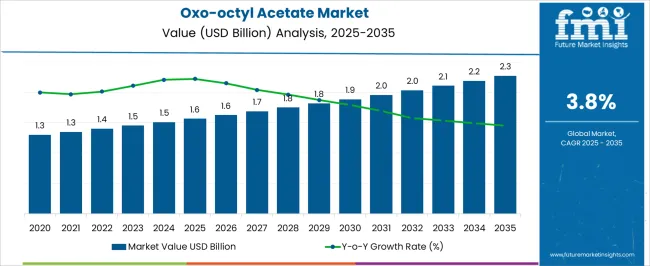
The oxo-octyl acetate market was valued at USD 1.60 billion in 2025, projected to reach USD 1.66 billion in 2026, and is forecast to expand to USD 2.41 billion by 2036 at a 3.80% CAGR. Structural shifts in end-use procurement cycles and tightening performance specifications across downstream sectors are accelerating capital allocation toward oxo-octyl acetate categories. Procurement teams operating across global supply chains now require standardized compliance certifications, compressing qualification timelines and elevating minimum specification thresholds for approved supplier lists.
Summary of Oxo-octyl Acetate Market
- Market Snapshot
- The oxo-octyl acetate market is valued at USD 1.60 billion in 2025 and is projected to reach USD 2.41 billion by 2036.
- The industry is expected to grow at a 3.80% CAGR from 2026 to 2036, creating an incremental opportunity of USD 0.75 billion.
- The market operates as a specification-driven procurement category where compliance certifications, material performance standards, and supply chain integration define competitive positioning.
- Demand and Growth Drivers
- Demand is rising as downstream industries face tightening performance specifications and mandatory compliance requirements across procurement cycles.
- Technology upgrades and process automation are accelerating adoption of higher-specification oxo-octyl acetate products across manufacturing operations.
- Infrastructure expansion programs in emerging economies are creating greenfield demand that bypasses legacy supplier constraints.
- Among key countries, China at 5.10%, India at 4.80%, Germany at 4.40%, France at 4.00%, UK at 3.60%, USA at 3.20%, Brazil at 2.90%.
- Product and Segment View
- The market includes oxo-octyl acetate products segmented across grade, raw material, end-use categories serving diverse industrial and commercial applications.
- Pharmaceutical Grade leads by grade with 56.7% share in 2026.
- Petrochemical-Based leads by raw material with 62.9% share in 2026.
- The scope covers Pharmaceutical Grade, Cosmetics Grade, Petrochemical-Based, Bio-Based configurations among other formats, while excluding unrelated commodity categories and non-specialized alternatives.
- Geography and Competitive Outlook
- China and India are the fastest-growing markets due to infrastructure expansion and rising industrial demand, while North America and Europe remain high-value mature demand bases.
- Competition is shaped by vertical integration capabilities, specification compliance certifications, and established procurement channel relationships, with key players including Eastman Chemical Company, BASF SE, ExxonMobil Chemical, Evonik Industries AG, Dow Chemical Company, Shell Chemicals, LyondellBasell Industries.
- Market consolidation trends are evident as leading suppliers acquire complementary capabilities to meet broadening customer specification requirements.
- Analyst Opinion at FMI
- Nikhil Kaitwade, Principal Consultant, opines: 'As per FMI analysis, the oxo-octyl acetate market is transitioning from a volume-driven procurement model to a specification-led qualification framework. Buyers who delay integration of higher-performance oxo-octyl acetate solutions into their supply chains face material cost escalation as compliance timelines compress. FMI analysts observe that suppliers lacking certified production capabilities will find themselves excluded from approved vendor lists as downstream operators enforce tighter material specifications.'
- Strategic Implications / Executive Takeaways
- Procurement directors must transition vendor qualification processes to prioritize lifecycle cost models and specification compliance certifications over lowest unit price evaluations.
- Capital project teams should mandate compatibility with next-generation performance standards in all new equipment procurement specifications entering the 2027 tender cycle.
- Supply chain architects must develop multi-source qualification programs to mitigate concentration risk across critical oxo-octyl acetate supply categories.
Capital expenditure planning cycles across verticals consuming oxo-octyl acetate products have shifted from discretionary upgrades to mandated replacements. Regulatory frameworks governing material performance, safety testing, and environmental compliance are tightening across all major consumption regions. Buyers evaluating supplier contracts increasingly weight lifecycle cost models over upfront unit pricing, favoring suppliers with vertically integrated operations and certified testing capabilities.
Regional deployment parameters reflect differentiated adoption velocities. China sets the pace with a 5.10% CAGR, followed by India at 4.80% as infrastructure expansion programs bypass legacy procurement constraints. Germany operations advance at a 4.40% rate, supported by regulatory compliance mandates. France tracks at 4.00%. UK networks maintain a 3.60% expansion trajectory. USA registers a 3.20% pace. Brazil expands at a 2.90% trajectory.
Oxo-octyl Acetate Market Key Takeaways
| Metric | Details |
|---|---|
| Industry Size (2026) | USD 1.66 billion |
| Industry Value (2036) | USD 2.41 billion |
| CAGR (2026-2036) | 3.80% |
Source: Future Market Insights, 2026
Oxo-octyl Acetate Market Definition
Oxo-octyl Acetate constitutes the material, product, or technology category defined by its primary industrial function within downstream manufacturing and end-use sectors. The scope encompasses standardized and specialty configurations compliant with global performance and safety specifications. Core inclusions govern products meeting defined procurement parameters across industrial, commercial, and institutional buyer categories.
Oxo-octyl Acetate Market Inclusions
Market scope includes Pharmaceutical Grade, Cosmetics Grade, Petrochemical-Based, Bio-Based, Paint and Coatings Industry configurations and related product variants. Global and regional market sizes, forecast period 2026 to 2036, and segment breakdowns by grade, raw material, end-use are fully incorporated within the analytical boundary.
Oxo-octyl Acetate Market Exclusions
Standard commodity alternatives lacking specialized performance certifications are excluded. Downstream finished goods, standalone accessory components, and non-standardized custom fabrications fall outside the analytical parameters. Legacy product formats without current industry specification compliance are explicitly omitted from the valuation.
Oxo-octyl Acetate Market Research Methodology
- Primary Research: Analysts engaged with procurement specification leads, technical managers, and supply chain directors across key consumption sectors to map decision gates triggering product upgrades and supplier requalification.
- Desk Research: Data collection phases aggregated regulatory compliance frameworks, industry standards ratification schedules, and published procurement guidelines from major institutional buyers.
- Market-Sizing and Forecasting: Baseline values derive from a bottom-up aggregation of product volumes and contract values, applying region-specific adoption curves to project future demand velocity.
- Data Validation and Update Cycle: Projections are tested against publicly reported expenditure guidance from leading industrial consumers and trade association production statistics.
Why is the Oxo-octyl Acetate Market Growing?
The oxo-octyl acetate market is demonstrating steady growth, driven by its increasing use across pharmaceutical, industrial, and specialty chemical applications. The compound’s favorable solvency characteristics, stability under varying conditions, and compatibility with multiple formulations support its adoption in diverse end-use industries. Rising demand for high-purity grades in regulated sectors, such as pharmaceuticals and personal care, is further enhancing market potential.
In the industrial domain, expanding use in coatings, adhesives, and specialty intermediates is contributing to consistent consumption patterns. Advances in production efficiency, coupled with improvements in raw material processing, are ensuring a stable supply chain and cost competitiveness.
Additionally, the growing emphasis on tailored chemical formulations for high-performance applications is encouraging manufacturers to invest in quality control and application-specific product development. As industries seek reliable, versatile, and compliant chemical ingredients, oxo-octyl acetate is expected to maintain its growth trajectory, supported by a balance of regulatory compliance, product innovation, and rising end-use diversification across both mature and emerging markets.
Segmental Analysis
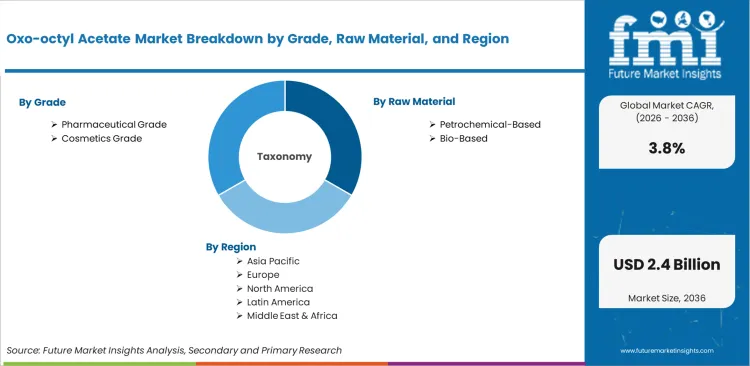
The oxo-octyl acetate market is segmented by grade, raw material, end-use, and geographic regions. By grade, oxo-octyl acetate market is divided into Pharmaceutical Grade and Cosmetics Grade. In terms of raw material, oxo-octyl acetate market is classified into Petrochemical-Based and Bio-Based. Based on end-use, the oxo-octyl acetate market is segmented into the Paint and Coatings Industry, Adhesive Industry, Printing Industry, Cleaning Industry, Cosmetics and Personal Care, and Others. Regionally, the oxo-octyl acetate industry is classified into North America, Latin America, Western Europe, Eastern Europe, Balkan & Baltic Countries, Russia & Belarus, Central Asia, East Asia, South Asia & Pacific, and the Middle East & Africa.
Insights into the Pharmaceutical Grade Segment
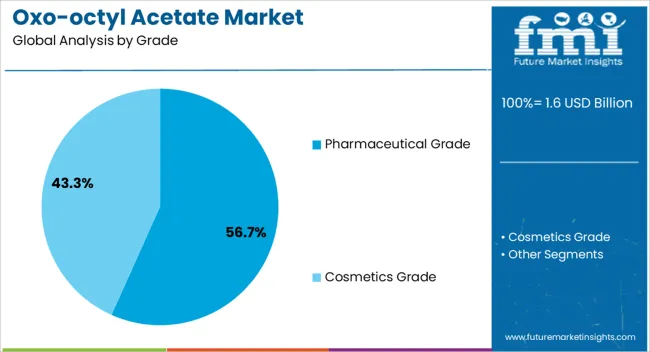
The pharmaceutical grade segment is projected to hold 56.7% of the oxo-octyl acetate market revenue share in 2026, making it the leading grade category. This dominance is attributed to its compliance with stringent purity and safety requirements, which are essential for applications in drug formulation, medical coatings, and other healthcare-related uses. The high level of quality assurance in pharmaceutical-grade production minimizes contaminants, ensuring consistent performance in sensitive applications.
The growth of the pharmaceutical sector is reinforcing demand, driven by expanding healthcare access, rising chronic disease prevalence, and increased R&D activity. The ability of pharmaceutical-grade oxo-octyl acetate to integrate seamlessly into formulations without compromising stability or efficacy is further enhancing its adoption.
Manufacturers are also focusing on meeting global regulatory standards, making this grade suitable for export-oriented markets. With the pharmaceutical industry continuing to prioritize reliable and compliant excipients, the pharmaceutical-grade segment is expected to retain its leadership position in the coming years.
Insights into the Petrochemical-Based Raw Material Segment
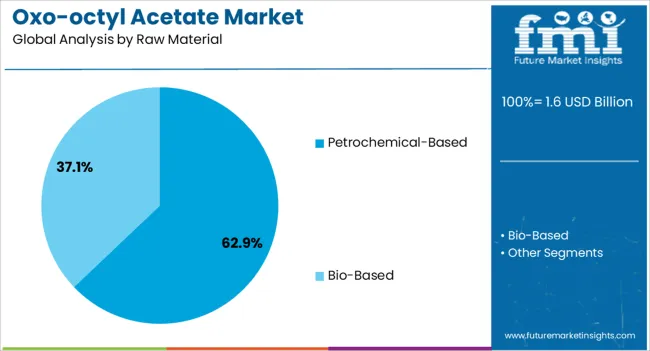
The petrochemical-based raw material segment is expected to account for 62.9% of the oxo-octyl acetate market revenue share in 2026, establishing itself as the dominant raw material source. The ready availability of petrochemical feedstocks, well-established supply chains, and cost-effective large-scale production capabilities supports this leadership. The consistency of petrochemical-based production processes ensures uniform quality, which is essential for both industrial and specialty applications.
Its versatility allows it to serve as the base for multiple grades, including pharmaceutical and industrial variants, broadening its applicability across sectors. The segment benefits from robust refining and petrochemical infrastructure, particularly in regions with integrated chemical manufacturing hubs.
Furthermore, the competitive pricing and reliability associated with petrochemical-based raw materials make them a preferred choice for manufacturers seeking scalability and long-term supply stability. As demand for oxo-octyl acetate grows across different end-use industries, the petrochemical-based segment is expected to maintain its dominance due to its efficiency, availability, and adaptability to varied production requirements.
Insights into the Paint and Coatings Industry End-Use Segment
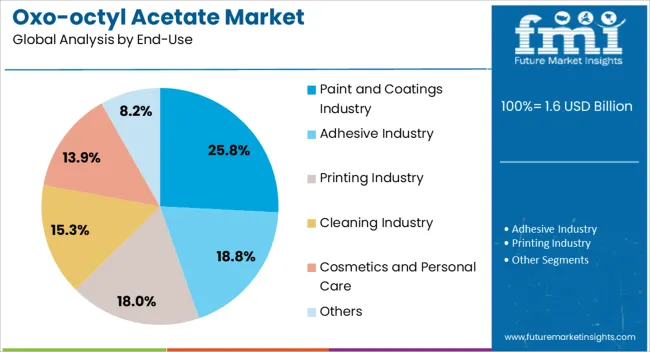
The paint and coatings industry segment is anticipated to capture 25.8% of the oxo-octyl acetate market revenue share in 2026, making it a leading end-use category. This position is driven by the compound’s excellent solvency, film-forming ability, and compatibility with a wide range of resins and pigments. In coatings, oxo-octyl acetate facilitates improved flow, leveling, and application performance, contributing to superior finish quality.
Its role as a solvent in high-performance formulations supports demand in both industrial and decorative coating segments. The market is also benefiting from infrastructure development, urbanization, and growth in the automotive and construction sectors, which are driving increased consumption of paints and coatings.
Stringent environmental and performance standards are prompting manufacturers to select solvents that deliver both efficiency and regulatory compliance, areas where oxo-octyl acetate performs strongly. With continued innovation in coating technologies and increasing focus on performance-driven formulations, the paint and coatings industry is expected to remain a significant and stable contributor to overall market demand.
What are the Drivers, Restraints, and Key Trends of the Oxo-octyl Acetate Market?
The oxo-octyl acetate market is poised for growth as demand from personal care, flavoring, and fragrance industries rises. Demand is driven by the compound’s use in cosmetics, air fresheners, and food products due to its pleasant fruity odor and non-toxicity. Opportunities are opening in the development of eco-friendly formulations and expanding product applications. Trends indicate increasing use in clean-label formulations and growing interest in high-purity grades. Challenges persist with fluctuating raw material prices, stringent regulatory approvals, and competition from alternative flavoring agents.
Demand Strengthened By Personal Care and Fragrance Sectors
Demand for oxo-octyl acetate is being reinforced by its widespread use in personal care products such as perfumes, deodorants, and body sprays, where its fruity and pleasant scent enhances consumer appeal. It is increasingly incorporated into air fresheners and household products to create refreshing atmospheres. In food and beverage applications, it serves as a flavoring agent, particularly in fruit and citrus-flavored items. The compound's non-toxic and safe nature makes it attractive for use in products that require direct skin contact. In our opinion, the continued growth of the personal care and fragrance industries will maintain demand for this compound, especially as consumer preferences shift towards more natural ingredients.
Opportunities In Eco-Friendly Formulations And Product Expansion
Opportunities are expanding in the development of eco-friendly formulations that capitalize on the growing consumer demand for natural, sustainable products. As regulations tighten around synthetic chemicals, the demand for natural flavoring agents like oxo-octyl acetate in clean-label formulations is expected to increase. The compound’s versatility allows it to be used in a wide range of products, from perfumes and cosmetics to cleaning agents and food flavoring. In our view, the strongest market growth will come from product diversification, particularly in green chemistry initiatives, where safer, biodegradable options are prioritized over traditional, petrochemical-based ingredients.
Trends Indicating Increased Use In Clean-Label Products
Trends in the oxo-octyl acetate market indicate a growing preference for clean-label products. Consumers are more focused on natural ingredients, leading to an increased demand for non-synthetic compounds like oxo-octyl acetate. This shift aligns with broader market trends in the personal care and food industries, where transparency and non-toxic formulations are key drivers. Manufacturers are increasingly formulating products with fewer chemicals, and oxo-octyl acetate, with its naturally derived properties, has found increasing applications. From an opinionated perspective, companies that prioritize clean-label formulations will capture a more significant share of the market, aligning with consumer demand for safer and more sustainable products.
Challenges From Raw Material Prices and Regulatory Hurdles
Challenges in the oxo-octyl acetate market stem from fluctuating raw material costs, which are influenced by the availability of feedstocks and global market dynamics. The compound’s price is closely tied to the cost of raw materials such as octanol, making cost control difficult for manufacturers. Regulatory hurdles surrounding the approval of chemicals in personal care, food, and fragrance products also create challenges, as they require extensive testing and certification processes. In our view, overcoming these barriers requires consistent innovation, cost-efficient sourcing, and effective regulatory navigation to stay competitive in the evolving market.
Analysis of Oxo-octyl Acetate Market By Key Countries
.webp "Top Country Growth Comparison Oxo Octyl Acetate Market Cagr (2026 2036)")
| Country | CAGR |
|---|---|
| China | 5.1% |
| India | 4.8% |
| Germany | 4.4% |
| France | 4.0% |
| UK | 3.6% |
| USA | 3.2% |
| Brazil | 2.9% |
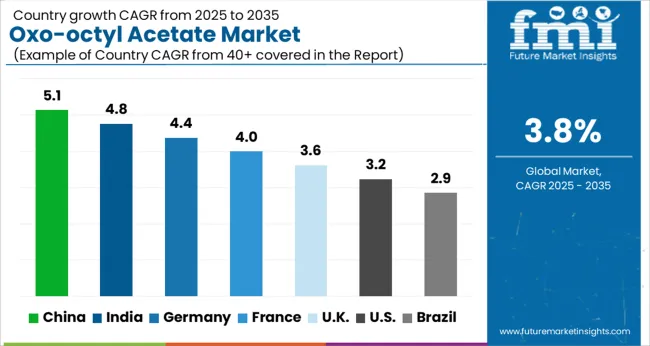
The global oxo-octyl acetate market is projected to grow at 3.8% from 2026 to 2036. China leads at 5.1%, followed by India 4.8% and Germany 4.4%; the United Kingdom 3.6% and United States 3.2% follow. Demand is being driven by applications in plasticizers, adhesives, coatings, and personal care products, where its excellent solvency, compatibility with PVC, and low volatility are highly valued. The increasing use of oxo-octyl acetate in automotive, construction, and consumer goods industries is pushing growth. Asia is set to lead on volume production, while Europe and North America are expected to focus on regulatory compliance and sustainable formulations. Markets will increasingly demand products that comply with environmental regulations and offer improved safety profiles, especially in consumer goods and industrial applications. This report includes insights on 40+ countries; the top markets are shown here for reference.
Freight trucking is propelled by industrial trade, e-commerce expansion, specialized cargo demand, and intermodal integration. These dynamics underscore its critical role as the foundation of global supply chains.
Growth Analysis of Oxo-octyl Acetate Market in China
The oxo-octyl acetate market in China is expected to expand at 5.1%. Demand is being propelled by the rapid growth of plasticizer applications in PVC products for construction, automotive, and flooring. Local production of oxo-octyl acetate is increasing, driven by rising domestic consumption in industrial coatings and adhesives sectors. Growing automotive production, coupled with the demand for flexible and durable materials, is boosting the use of this ester. The shift toward environmentally friendly and safer formulations is pushing suppliers to enhance their product lines with more sustainable alternatives. It is expected that China will remain a key driver in the oxo-octyl acetate market, benefiting from its expansive industrial base, low-cost production capabilities, and strong growth in end-use industries.
- Automotive production and demand for durable plastics are driving the need for oxo-octyl acetate in coatings and adhesives.
- Government regulations promoting safer chemicals are accelerating the development of sustainable formulations.
- Regional supply chains and growing export capacity are enabling domestic manufacturers to meet global demand.
Demand Outlook for Oxo-octyl Acetate Market in India
The oxo-octyl acetate market in India is projected to grow at 4.8%. Demand is being driven by the construction, automotive, and consumer goods industries, where the need for flexible and durable materials continues to rise. The use of oxo-octyl acetate as a plasticizer in PVC products, as well as its application in personal care products, is growing rapidly. Manufacturers in India are increasingly focusing on compliance with global regulatory standards, as consumers and businesses demand safer and more eco-friendly products. The market is also seeing growth in the adhesives sector, with rising demand for this product in the packaging and textile industries. It is expected that India’s expanding industrial base and regulatory shift toward sustainable products will continue to boost market growth.
- Increased demand for flexible PVC applications in construction and automotive sectors is driving the need for oxo-octyl acetate.
- Rising awareness about eco-friendly and non-toxic plasticizers is pushing the market toward more sustainable solutions.
- India’s rapidly expanding manufacturing base and growing export capabilities are strengthening the oxo-octyl acetate supply chain.
Analysis of Oxo-octyl Acetate Market in Germany
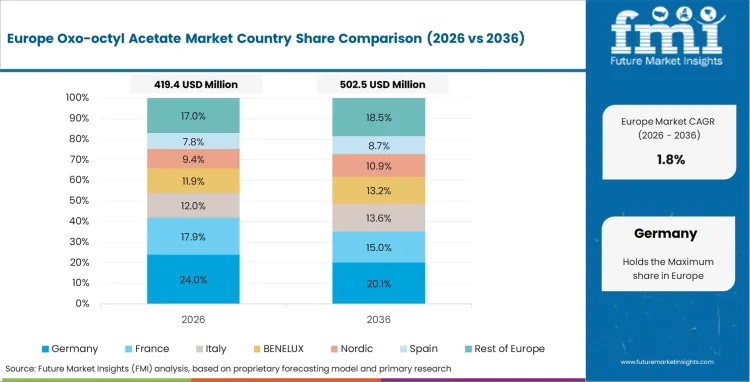
The oxo-octyl acetate market in Germany is forecast to increase at 4.4%. Growth is being fueled by the demand for high-quality plasticizers in the automotive and construction industries, as well as increasing adoption in personal care formulations. German regulations promoting safer and more sustainable products are leading to the development of eco-friendly alternatives to traditional plasticizers, enhancing the demand for oxo-octyl acetate in these industries. Additionally, the growth of the coatings and adhesives sectors is further driving demand for this versatile compound. Germany’s strong industrial base, along with a focus on regulatory compliance and sustainability, positions it as a leader in the European market for oxo-octyl acetate.
- Strict European regulations on plasticizers and chemicals are driving demand for safer and more sustainable alternatives.
- Germany’s strong automotive sector and construction industry are key drivers of the market’s growth.
- Increasing adoption in the personal care sector for fragrances and cosmetic formulations is expanding the product’s reach in new markets.
Demand Forecast for Oxo-octyl Acetate Market in the United Kingdom
The oxo-octyl acetate market in the UK is expected to expand at 3.6%. The growing need for flexible and durable materials in automotive and construction applications is supporting demand. The demand for oxo-octyl acetate is also rising in personal care products, especially in cosmetics and fragrances, due to its ability to act as a solvent and carrier. The UK’s strong regulatory framework promoting safer chemicals and the demand for eco-friendly solutions are encouraging manufacturers to produce more sustainable products. It is expected that the UK will continue to see steady growth driven by its focus on environmental regulations and innovation in new applications for oxo-octyl acetate.
- The push for sustainable and safer plasticizers is encouraging innovation in eco-friendly formulations for industrial and consumer goods.
- Strong demand from the automotive sector for flexible materials continues to support the growth of oxo-octyl acetate applications in coatings and adhesives.
- The growing personal care sector is increasing the need for high-quality solvents and carriers in cosmetic formulations.
Oxo-octyl Acetate Market Growth Outlook in the United States
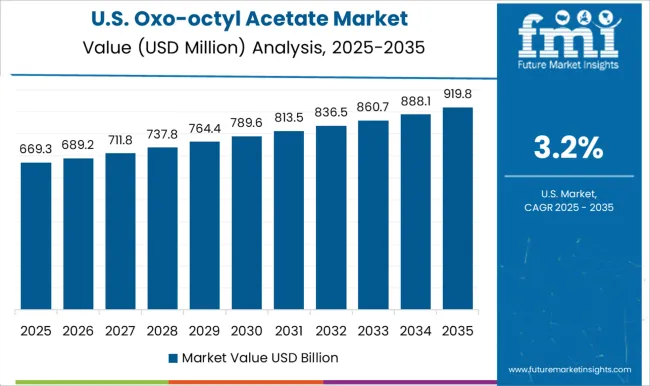
The oxo-octyl acetate market in the United States is projected to grow at 3.2%. The demand for this versatile chemical is being driven by the growth in the automotive and construction sectors, where plasticizers are essential for improving the flexibility and durability of materials. The increasing adoption of sustainable products in the USA market is also pushing manufacturers to explore eco-friendly alternatives, further boosting demand for oxo-octyl acetate.
The rising use of this compound in personal care and cosmetic products is expanding the market’s scope. As regulatory standards continue to tighten, USA manufacturers are focusing on producing safer, non-toxic alternatives to traditional plasticizers.
- The USA market is seeing growing demand for plasticizers in the automotive and construction sectors, driving the need for oxo-octyl acetate.
- Environmental regulations and consumer preferences for safer, sustainable products are pushing manufacturers to innovate in eco-friendly formulations.
- Increasing use in personal care products is expanding the market for oxo-octyl acetate in the USA
Competitive Landscape of Oxo-octyl Acetate Market
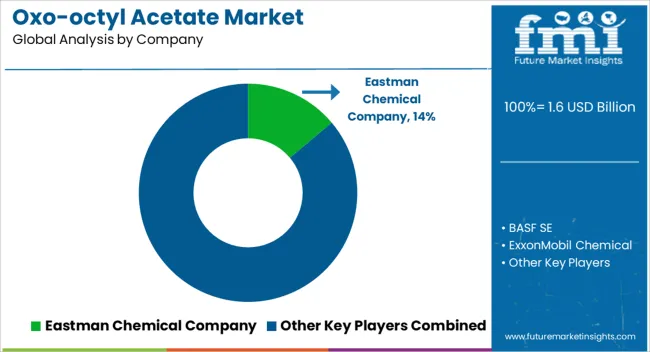
Leading players such as BASF, Eastman Chemical, Lanxess, and Dow Chemicals hold significant market share by leveraging large-scale production capacities, consistent quality, and extensive distribution networks. Competition is shaped by the ability to offer high-purity oxo-octyl acetate suitable for applications in coatings, inks, adhesives, and personal care products. Differentiation is achieved through process efficiency, cost-effective production methods, and regulatory compliance for volatile organic compounds (VOCs) and environmental standards. Regional suppliers focus on serving niche markets with tailored grades for specific applications, adding layers to competitive dynamics. Strategic partnerships with downstream manufacturers, investments in process optimization, and expansion of regional production facilities enhance market positioning. Price volatility of raw materials such as alcohols and acetic acid affects competitiveness, compelling players to adopt flexible supply chain strategies.
Key Players in the Oxo-octyl Acetate Market
- Eastman Chemical Company
- BASF SE
- ExxonMobil Chemical
- Evonik Industries AG
- Dow Chemical Company
- Shell Chemicals
- LyondellBasell Industries
- SABIC
- INEOS Group
- Mitsui Chemicals
- Arkema Group
- Mitsubishi Chemical Corporation
- Huntsman Corporation
- Celanese Corporation
- Solvay S.A.
Scope of the Report
| Metric | Value |
|---|---|
| Quantitative Units | USD 1.66 billion to USD 2.41 billion, at a CAGR of 3.80% |
| Market Definition | Oxo-octyl Acetate encompasses the material, product, or technology category serving downstream industrial, commercial, and institutional end-use sectors under defined performance and safety specifications. |
| Grade Segmentation | Pharmaceutical Grade, Cosmetics Grade |
| Raw Material Segmentation | Petrochemical-Based, Bio-Based |
| End-Use Segmentation | Paint and Coatings Industry, Adhesive Industry, Printing Industry, Cleaning Industry, Cosmetics and Personal Care, Others |
| Regions Covered | North America, Latin America, Europe, East Asia, South Asia, Oceania, Middle East & Africa |
| Countries Covered | China, India, Germany, France, UK, USA, Brazil, and 40 plus countries |
| Key Companies Profiled | Eastman Chemical Company, BASF SE, ExxonMobil Chemical, Evonik Industries AG, Dow Chemical Company, Shell Chemicals, LyondellBasell Industries, SABIC, INEOS Group, Mitsui Chemicals |
| Forecast Period | 2026 to 2036 |
| Approach | Forecasting models apply a bottom-up methodology starting with global installed base metrics and projecting conversion rates to higher-specification product categories. |
Oxo-octyl Acetate Market by Segments
Grade:
- Pharmaceutical Grade
- Cosmetics Grade
Raw Material:
- Petrochemical-Based
- Bio-Based
End-Use:
- Paint and Coatings Industry
- Adhesive Industry
- Printing Industry
- Cleaning Industry
- Cosmetics and Personal Care
- Others
Region:
- North America
- USA
- Canada
- Mexico
- Latin America
- Brazil
- Chile
- Rest of Latin America
- Western Europe
- Germany
- UK
- Italy
- Spain
- France
- Nordic
- BENELUX
- Rest of Western Europe
- Eastern Europe
- Russia
- Poland
- Hungary
- Balkan & Baltic
- Rest of Eastern Europe
- East Asia
- China
- Japan
- South Korea
- South Asia and Pacific
- India
- ASEAN
- Australia & New Zealand
- Rest of South Asia and Pacific
- Middle East & Africa
- Kingdom of Saudi Arabia
- Other GCC Countries
- Turkiye
- South Africa
- Other African Union
- Rest of Middle East & Africa
Bibliography
- 1. Organisation for Economic Co-operation and Development. (2025, June). Industrial performance and competitiveness indicators. OECD.
- 2. World Bank Group. (2025). Global economic prospects: Industrial supply chains and trade facilitation. World Bank.
- 3. United Nations Industrial Development Organization. (2025). Industrial development report: Manufacturing and global value chains. UNIDO.
- 4. International Organization for Standardization. (2025). ISO standards catalogue: Materials testing and quality management. ISO.
- 5. European Commission, Directorate-General for Internal Market, Industry, Entrepreneurship and SMEs. (2025). Single market for goods: Industrial product compliance. European Commission.
- 6. USA Bureau of Labor Statistics. (2025). Producer price indexes for intermediate demand. USA Department of Labor.
This bibliography is provided for reader reference. The full Future Market Insights report contains the complete reference list with primary research documentation.
Frequently Asked Questions
How large is the demand for Oxo-octyl Acetate in the global market in 2026?
Demand for Oxo-octyl Acetate in the global market is estimated to be valued at USD 1.66 billion in 2026.
What will be the market size of Oxo-octyl Acetate in the global market by 2036?
Market size for Oxo-octyl Acetate is projected to reach USD 2.41 billion by 2036.
What is the expected demand growth for Oxo-octyl Acetate in the global market between 2026 and 2036?
Demand for Oxo-octyl Acetate is expected to grow at a CAGR of 3.80% between 2026 and 2036.
Which Grade is poised to lead global sales by 2026?
Pharmaceutical Grade accounts for 56.7% in 2026, driven by established procurement specifications and downstream integration requirements.
What is driving demand in China?
China leads with a 5.10% CAGR as greenfield industrial facilities deploying modern procurement frameworks create scaled demand for specification-compliant oxo-octyl acetate products.
What is the India growth outlook in this report?
India is projected to grow at a CAGR of 4.80% during 2026 to 2036.
What is Oxo-octyl Acetate and what is it mainly used for?
Oxo-octyl Acetate constitutes the specialized material, product, or technology category designed for defined industrial, commercial, and institutional applications. End-use sectors primarily deploy it to meet performance, safety, and regulatory compliance requirements.
How does FMI build and validate the Oxo-octyl Acetate forecast?
Forecasting models apply a bottom-up methodology starting with global installed base metrics and cross-validate projections against quarterly industry production and trade volumes.
Preview the report firsthand - request a free sample
Get SampleGet the brochure for pricing and purchase details.
Get PDFTable of Content
- Executive Summary
- Global Market Outlook
- Demand-side Trends
- Supply-side Trends
- Technology Roadmap Analysis
- Analysis and Recommendations
- Market Overview
- Market Coverage / Taxonomy
- Market Definition / Scope / Limitations
- Research Methodology
- Chapter Orientation
- Analytical Lens and Working Hypotheses
- Market Structure, Signals, and Trend Drivers
- Benchmarking and Cross-market Comparability
- Market Sizing, Forecasting, and Opportunity Mapping
- Research Design and Evidence Framework
- Desk Research Programme (Secondary Evidence)
- Company Annual and Sustainability Reports
- Peer-reviewed Journals and Academic Literature
- Corporate Websites, Product Literature, and Technical Notes
- Earnings Decks and Investor Briefings
- Statutory Filings and Regulatory Disclosures
- Technical White Papers and Standards Notes
- Trade Journals, Industry Magazines, and Analyst Briefs
- Conference Proceedings, Webinars, and Seminar Materials
- Government Statistics Portals and Public Data Releases
- Press Releases and Reputable Media Coverage
- Specialist Newsletters and Curated Briefings
- Sector Databases and Reference Repositories
- FMI Internal Proprietary Databases and Historical Market Datasets
- Subscription Datasets and Paid Sources
- Social Channels, Communities, and Digital Listening Inputs
- Additional Desk Sources
- Expert Input and Fieldwork (Primary Evidence)
- Primary Modes
- Qualitative Interviews and Expert Elicitation
- Quantitative Surveys and Structured Data Capture
- Blended Approach
- Why Primary Evidence is Used
- Field Techniques
- Interviews
- Surveys
- Focus Groups
- Observational and In-context Research
- Social and Community Interactions
- Stakeholder Universe Engaged
- C-suite Leaders
- Board Members
- Presidents and Vice Presidents
- R&D and Innovation Heads
- Technical Specialists
- Domain Subject-matter Experts
- Scientists
- Physicians and Other Healthcare Professionals
- Governance, Ethics, and Data Stewardship
- Research Ethics
- Data Integrity and Handling
- Primary Modes
- Tooling, Models, and Reference Databases
- Desk Research Programme (Secondary Evidence)
- Data Engineering and Model Build
- Data Acquisition and Ingestion
- Cleaning, Normalisation, and Verification
- Synthesis, Triangulation, and Analysis
- Quality Assurance and Audit Trail
- Market Background
- Market Dynamics
- Drivers
- Restraints
- Opportunity
- Trends
- Scenario Forecast
- Demand in Optimistic Scenario
- Demand in Likely Scenario
- Demand in Conservative Scenario
- Opportunity Map Analysis
- Product Life Cycle Analysis
- Supply Chain Analysis
- Investment Feasibility Matrix
- Value Chain Analysis
- PESTLE and Porter’s Analysis
- Regulatory Landscape
- Regional Parent Market Outlook
- Production and Consumption Statistics
- Import and Export Statistics
- Market Dynamics
- Global Market Analysis 2021 to 2025 and Forecast, 2026 to 2036
- Historical Market Size Value (USD Million) Analysis, 2021 to 2025
- Current and Future Market Size Value (USD Million) Projections, 2026 to 2036
- Y-o-Y Growth Trend Analysis
- Absolute $ Opportunity Analysis
- Global Market Pricing Analysis 2021 to 2025 and Forecast 2026 to 2036
- Global Market Analysis 2021 to 2025 and Forecast 2026 to 2036, By Grade
- Introduction / Key Findings
- Historical Market Size Value (USD Million) Analysis By Grade , 2021 to 2025
- Current and Future Market Size Value (USD Million) Analysis and Forecast By Grade , 2026 to 2036
- Pharmaceutical Grade
- Cosmetics Grade
- Pharmaceutical Grade
- Y-o-Y Growth Trend Analysis By Grade , 2021 to 2025
- Absolute $ Opportunity Analysis By Grade , 2026 to 2036
- Global Market Analysis 2021 to 2025 and Forecast 2026 to 2036, By Raw Material
- Introduction / Key Findings
- Historical Market Size Value (USD Million) Analysis By Raw Material, 2021 to 2025
- Current and Future Market Size Value (USD Million) Analysis and Forecast By Raw Material, 2026 to 2036
- Petrochemical-Based
- Bio-Based
- Petrochemical-Based
- Y-o-Y Growth Trend Analysis By Raw Material, 2021 to 2025
- Absolute $ Opportunity Analysis By Raw Material, 2026 to 2036
- Global Market Analysis 2021 to 2025 and Forecast 2026 to 2036, By End-Use
- Introduction / Key Findings
- Historical Market Size Value (USD Million) Analysis By End-Use, 2021 to 2025
- Current and Future Market Size Value (USD Million) Analysis and Forecast By End-Use, 2026 to 2036
- Paint and Coatings Industry
- Adhesive Industry
- Printing Industry
- Cleaning Industry
- Cosmetics and Personal Care
- Others
- Paint and Coatings Industry
- Y-o-Y Growth Trend Analysis By End-Use, 2021 to 2025
- Absolute $ Opportunity Analysis By End-Use, 2026 to 2036
- Global Market Analysis 2021 to 2025 and Forecast 2026 to 2036, By Region
- Introduction
- Historical Market Size Value (USD Million) Analysis By Region, 2021 to 2025
- Current Market Size Value (USD Million) Analysis and Forecast By Region, 2026 to 2036
- North America
- Latin America
- Western Europe
- Eastern Europe
- East Asia
- South Asia and Pacific
- Middle East & Africa
- Market Attractiveness Analysis By Region
- North America Market Analysis 2021 to 2025 and Forecast 2026 to 2036, By Country
- Historical Market Size Value (USD Million) Trend Analysis By Market Taxonomy, 2021 to 2025
- Market Size Value (USD Million) Forecast By Market Taxonomy, 2026 to 2036
- By Country
- USA
- Canada
- Mexico
- By Grade
- By Raw Material
- By End-Use
- By Country
- Market Attractiveness Analysis
- By Country
- By Grade
- By Raw Material
- By End-Use
- Key Takeaways
- Latin America Market Analysis 2021 to 2025 and Forecast 2026 to 2036, By Country
- Historical Market Size Value (USD Million) Trend Analysis By Market Taxonomy, 2021 to 2025
- Market Size Value (USD Million) Forecast By Market Taxonomy, 2026 to 2036
- By Country
- Brazil
- Chile
- Rest of Latin America
- By Grade
- By Raw Material
- By End-Use
- By Country
- Market Attractiveness Analysis
- By Country
- By Grade
- By Raw Material
- By End-Use
- Key Takeaways
- Western Europe Market Analysis 2021 to 2025 and Forecast 2026 to 2036, By Country
- Historical Market Size Value (USD Million) Trend Analysis By Market Taxonomy, 2021 to 2025
- Market Size Value (USD Million) Forecast By Market Taxonomy, 2026 to 2036
- By Country
- Germany
- UK
- Italy
- Spain
- France
- Nordic
- BENELUX
- Rest of Western Europe
- By Grade
- By Raw Material
- By End-Use
- By Country
- Market Attractiveness Analysis
- By Country
- By Grade
- By Raw Material
- By End-Use
- Key Takeaways
- Eastern Europe Market Analysis 2021 to 2025 and Forecast 2026 to 2036, By Country
- Historical Market Size Value (USD Million) Trend Analysis By Market Taxonomy, 2021 to 2025
- Market Size Value (USD Million) Forecast By Market Taxonomy, 2026 to 2036
- By Country
- Russia
- Poland
- Hungary
- Balkan & Baltic
- Rest of Eastern Europe
- By Grade
- By Raw Material
- By End-Use
- By Country
- Market Attractiveness Analysis
- By Country
- By Grade
- By Raw Material
- By End-Use
- Key Takeaways
- East Asia Market Analysis 2021 to 2025 and Forecast 2026 to 2036, By Country
- Historical Market Size Value (USD Million) Trend Analysis By Market Taxonomy, 2021 to 2025
- Market Size Value (USD Million) Forecast By Market Taxonomy, 2026 to 2036
- By Country
- China
- Japan
- South Korea
- By Grade
- By Raw Material
- By End-Use
- By Country
- Market Attractiveness Analysis
- By Country
- By Grade
- By Raw Material
- By End-Use
- Key Takeaways
- South Asia and Pacific Market Analysis 2021 to 2025 and Forecast 2026 to 2036, By Country
- Historical Market Size Value (USD Million) Trend Analysis By Market Taxonomy, 2021 to 2025
- Market Size Value (USD Million) Forecast By Market Taxonomy, 2026 to 2036
- By Country
- India
- ASEAN
- Australia & New Zealand
- Rest of South Asia and Pacific
- By Grade
- By Raw Material
- By End-Use
- By Country
- Market Attractiveness Analysis
- By Country
- By Grade
- By Raw Material
- By End-Use
- Key Takeaways
- Middle East & Africa Market Analysis 2021 to 2025 and Forecast 2026 to 2036, By Country
- Historical Market Size Value (USD Million) Trend Analysis By Market Taxonomy, 2021 to 2025
- Market Size Value (USD Million) Forecast By Market Taxonomy, 2026 to 2036
- By Country
- Kingdom of Saudi Arabia
- Other GCC Countries
- Turkiye
- South Africa
- Other African Union
- Rest of Middle East & Africa
- By Grade
- By Raw Material
- By End-Use
- By Country
- Market Attractiveness Analysis
- By Country
- By Grade
- By Raw Material
- By End-Use
- Key Takeaways
- Key Countries Market Analysis
- USA
- Pricing Analysis
- Market Share Analysis, 2025
- By Grade
- By Raw Material
- By End-Use
- Canada
- Pricing Analysis
- Market Share Analysis, 2025
- By Grade
- By Raw Material
- By End-Use
- Mexico
- Pricing Analysis
- Market Share Analysis, 2025
- By Grade
- By Raw Material
- By End-Use
- Brazil
- Pricing Analysis
- Market Share Analysis, 2025
- By Grade
- By Raw Material
- By End-Use
- Chile
- Pricing Analysis
- Market Share Analysis, 2025
- By Grade
- By Raw Material
- By End-Use
- Germany
- Pricing Analysis
- Market Share Analysis, 2025
- By Grade
- By Raw Material
- By End-Use
- UK
- Pricing Analysis
- Market Share Analysis, 2025
- By Grade
- By Raw Material
- By End-Use
- Italy
- Pricing Analysis
- Market Share Analysis, 2025
- By Grade
- By Raw Material
- By End-Use
- Spain
- Pricing Analysis
- Market Share Analysis, 2025
- By Grade
- By Raw Material
- By End-Use
- France
- Pricing Analysis
- Market Share Analysis, 2025
- By Grade
- By Raw Material
- By End-Use
- India
- Pricing Analysis
- Market Share Analysis, 2025
- By Grade
- By Raw Material
- By End-Use
- ASEAN
- Pricing Analysis
- Market Share Analysis, 2025
- By Grade
- By Raw Material
- By End-Use
- Australia & New Zealand
- Pricing Analysis
- Market Share Analysis, 2025
- By Grade
- By Raw Material
- By End-Use
- China
- Pricing Analysis
- Market Share Analysis, 2025
- By Grade
- By Raw Material
- By End-Use
- Japan
- Pricing Analysis
- Market Share Analysis, 2025
- By Grade
- By Raw Material
- By End-Use
- South Korea
- Pricing Analysis
- Market Share Analysis, 2025
- By Grade
- By Raw Material
- By End-Use
- Russia
- Pricing Analysis
- Market Share Analysis, 2025
- By Grade
- By Raw Material
- By End-Use
- Poland
- Pricing Analysis
- Market Share Analysis, 2025
- By Grade
- By Raw Material
- By End-Use
- Hungary
- Pricing Analysis
- Market Share Analysis, 2025
- By Grade
- By Raw Material
- By End-Use
- Kingdom of Saudi Arabia
- Pricing Analysis
- Market Share Analysis, 2025
- By Grade
- By Raw Material
- By End-Use
- Turkiye
- Pricing Analysis
- Market Share Analysis, 2025
- By Grade
- By Raw Material
- By End-Use
- South Africa
- Pricing Analysis
- Market Share Analysis, 2025
- By Grade
- By Raw Material
- By End-Use
- USA
- Market Structure Analysis
- Competition Dashboard
- Competition Benchmarking
- Market Share Analysis of Top Players
- By Regional
- By Grade
- By Raw Material
- By End-Use
- Competition Analysis
- Competition Deep Dive
- Eastman Chemical Company
- Overview
- Product Portfolio
- Profitability by Market Segments (Product/Age /Sales Channel/Region)
- Sales Footprint
- Strategy Overview
- Marketing Strategy
- Product Strategy
- Channel Strategy
- BASF SE
- ExxonMobil Chemical
- Evonik Industries AG
- Dow Chemical Company
- Shell Chemicals
- LyondellBasell Industries
- SABIC
- INEOS Group
- Mitsui Chemicals
- Arkema Group
- Mitsubishi Chemical Corporation
- Huntsman Corporation
- Celanese Corporation
- Solvay S.A.
- Eastman Chemical Company
- Competition Deep Dive
- Assumptions & Acronyms Used


